- Analytics
- News and Tools
- Market News
CFD Markets News and Forecasts — 28-06-2021
| Time | Country | Event | Period | Previous value | Forecast |
|---|---|---|---|---|---|
| 06:00 (GMT) | United Kingdom | Nationwide house price index | June | 1.8% | 0.7% |
| 06:00 (GMT) | United Kingdom | Nationwide house price index, y/y | June | 10.9% | 13.7% |
| 06:45 (GMT) | France | Consumer confidence | June | 97 | 100 |
| 08:30 (GMT) | United Kingdom | Consumer credit, mln | May | -0.377 | 0.328 |
| 08:30 (GMT) | United Kingdom | Mortgage Approvals | May | 86.9 | 85.34 |
| 08:30 (GMT) | United Kingdom | Net Lending to Individuals, bln | May | 2.9 | |
| 09:00 (GMT) | Eurozone | Industrial confidence | June | 11.5 | 13 |
| 09:00 (GMT) | Eurozone | Consumer Confidence | June | -5.1 | -3.3 |
| 09:00 (GMT) | Eurozone | Economic sentiment index | June | 114.5 | 116.5 |
| 12:00 (GMT) | Germany | CPI, y/y | June | 2.5% | 2.3% |
| 12:00 (GMT) | Germany | CPI, m/m | June | 0.5% | 0.4% |
| 13:00 (GMT) | U.S. | Housing Price Index, y/y | April | 13.9% | |
| 13:00 (GMT) | U.S. | Housing Price Index, m/m | April | 1.4% | |
| 13:00 (GMT) | U.S. | S&P/Case-Shiller Home Price Indices, y/y | April | 13.3% | 14.5% |
| 13:40 (GMT) | Eurozone | ECB President Lagarde Speaks | |||
| 14:00 (GMT) | U.S. | Consumer confidence | June | 117.2 | 119 |
| 23:15 (GMT) | Australia | RBA's Governor Philip Lowe Speaks | |||
| 23:50 (GMT) | Japan | Industrial Production (YoY) | May | 15.8% | |
| 23:50 (GMT) | Japan | Industrial Production (MoM) | May | 2.9% | -2.4% |
FXStreet reports that economists at Westpac are neutral on the NZD/USD pair for the week ahead - expecting the 0.6940-0.7120 range to contain as supportive domestic fundamentals are offset by a strengthened US dollar.
“We are neutral for the week ahead, expecting the 0.6940-0.7120 range to contain.”
“Domestic fundamentals remain supportive, with NZ-US yield spreads rising due to the RBNZ’s more hawkish outlook (vs the Fed), and NZ commodity prices expected to remain elevated over the rest of this year. Against that, the USD has been strengthened by the recent hawkish shift by the Fed, such strength unlikely to dissipate during the weeks ahead.”
“By year-end, we expect NZD/USD to be higher, at 0.74. We have reduced that forecast from 0.76, due to the Fed shift, but remain bullish for the above domestic reasons, as well as an expectation global risk sentiment remains elevated as global economic growth recovers further.”
eFXdata reports that ANZ Research sees a scope for further USD upside over the coming months.
"Federal Reserve policy makers have calmed rates markets following the FOMC hawkish surprise. This has allowed risk assets to stabilise, albeit while the USD now has a firmer foundation for rallies. It will be important that policy makers do not induce policy uncertainty, which would feed into higher volatility in risk assets and amplify bouts of dollar strength."
"Overall, we think markets have shifted to a more balanced investment environment, warranting an easing of cyclical risk and rising allocations to USD and value strategies."
FXStreet notes that measured from June 18 all G10 currencies with the exception of the JPY have gained some ground vs. the USD. The EUR, however, finds itself towards the bottom of the performance table in that time frame. In the view of Jane Foley Senior, FX Strategist at Rabobank, this is likely a function of various factors.
“Firstly, the market had been positioned long of the single currency on optimism regarding the vaccine catch-up trade in the region. Forecasts that the delta variant of Covid could spread through Europe in the summer months could now be undermining confidence in this trade. Secondly, while there was a modest pick-up in German 10 yr breakevens on Friday, the market’s focus in terms of inflationary impulse and central bank reaction remains squarely on the US. Thirdly, the failure of EUR/USD to hold levels above 1.1950 last week will have undermined the resolve of EUR bulls.”
“We have lowered our long-held 1 mth EUR/USD forecast from 1.20 to 1.19. Our 3mth and 6 mth forecasts remain unaltered at 1.19 and 1.17 respectively.
“Even though it will take a while for the data fog to clear, the June FOMC let the genie out of the bag about the possibility of a Fed rate hike as early as 2022."
FXStreet notes that Brent crude oil completed a bullish “triangle” continuation pattern in Q2 as well as breaking the key 2019 and 2020 highs at $71.75/95 also suggesting we are seeing a much larger, longer-term base. Therefore, strategists at Credit Suisse stay bullish with the next resistance at $75.60.
“We stay bullish with resistance seen next at $75.60, above which can reinforce a broader basing story for our original bull ‘flag’ target at $79.10, then the aforementioned ‘measured triangle objective’ at $82.50.”
“Bigger picture, above here can expose the 2018 high at an even more distant $86.74 next, which we expect to cap the market at least temporarily.”
- Issues like access to central bank accounts need to be front and center
- Money market funds and Treasury markets can lose liquidity in times of stress
U.S. stock-index futures rose slightly on Monday, as a retreat in the U.S. Treasury yields supported the technology stocks, while the overall market sentiment was cautious amid growing worries about a spike of Delta variant infections in Asia and ahead of the release of the key U.S. payrolls data later this week.
Global Stocks:
Index/commodity | Last | Today's Change, points | Today's Change, % |
Nikkei | 29,048.02 | -18.16 | -0.06% |
Hang Seng | 29,268.30 | -19.92 | -0.07% |
Shanghai | 3,606.37 | -1.19 | -0.03% |
S&P/ASX | 7,307.30 | -0.70 | -0.01% |
FTSE | 7,110.13 | -25.94 | -0.36% |
CAC | 6,605.54 | -17.33 | -0.26% |
DAX | 15,630.61 | +22.64 | +0.15% |
Crude oil | $74.06 | +0.01% | |
Gold | $1,776.20 | -0.09% |
FXStreet notes that gold strength in Q2 has been capped ahead of the key $1959/66 highs for the year and late 2010 and the subsequent move lower has seen the market break back below the 200-day average. Strategists at Credit Suisse believe that this leaves the immediate risk lower in the broader consolidation range heading into Q3.
“Below support at $1765/55 would warn of a fall back to the YTD lows and 38.2% retracement of the entire 2015/2020 bull trend, but with this expected to remain a solid floor. A closing break lower though would warn of a more damaging downturn, with support seen next at the 50% retracement at $1561.”
“Gold has arguably overshot the move in Real Yields, however, we continue to look for 10yr US Real Yields to rise to retest their highs seen earlier this year, which would suggest XAU/USD is likely to stay under pressure in its range and the USD continues to hold key supports and is seen under pressure to rise, at least in the short-term, which should also prove a headwind for the yellow metal.”
(company / ticker / price / change ($/%) / volume)
3M Co | MMM | 194.8 | 0.05(0.03%) | 810 |
ALCOA INC. | AA | 36.13 | 0.33(0.92%) | 9226 |
ALTRIA GROUP INC. | MO | 47.65 | 0.03(0.06%) | 8558 |
Amazon.com Inc., NASDAQ | AMZN | 3,415.00 | 13.54(0.40%) | 14712 |
Apple Inc. | AAPL | 133.2 | 0.09(0.07%) | 328896 |
AT&T Inc | T | 28.95 | 0.06(0.21%) | 91420 |
Boeing Co | BA | 245.5 | -2.88(-1.16%) | 177422 |
Caterpillar Inc | CAT | 216.82 | 0.51(0.24%) | 11514 |
Chevron Corp | CVX | 106.85 | -0.45(-0.42%) | 8326 |
Cisco Systems Inc | CSCO | 53.12 | 0.06(0.11%) | 4927 |
Citigroup Inc., NYSE | C | 71.34 | -0.21(-0.29%) | 31497 |
Deere & Company, NYSE | DE | 350.01 | 0.02(0.01%) | 939 |
E. I. du Pont de Nemours and Co | DD | 76.75 | 0.21(0.27%) | 2332 |
Exxon Mobil Corp | XOM | 64.4 | -0.26(-0.40%) | 31143 |
Facebook, Inc. | FB | 342.81 | 1.44(0.42%) | 15855 |
FedEx Corporation, NYSE | FDX | 292.1 | 0.15(0.05%) | 11492 |
Ford Motor Co. | F | 15.2 | 0.01(0.07%) | 335729 |
Freeport-McMoRan Copper & Gold Inc., NYSE | FCX | 37.6 | 0.36(0.97%) | 54271 |
General Electric Co | GE | 13.14 | -0.02(-0.15%) | 59832 |
General Motors Company, NYSE | GM | 60.4 | 0.10(0.17%) | 33672 |
Goldman Sachs | GS | 367.9 | -0.87(-0.24%) | 6322 |
Hewlett-Packard Co. | HPQ | 29.81 | 0.10(0.34%) | 6464 |
Home Depot Inc | HD | 313.91 | 0.28(0.09%) | 892 |
Intel Corp | INTC | 56.18 | 0.27(0.48%) | 29967 |
International Business Machines Co... | IBM | 147.2 | 0.36(0.25%) | 5899 |
International Paper Company | IP | 61.2 | 0.52(0.86%) | 4161 |
Johnson & Johnson | JNJ | 164.17 | -0.04(-0.02%) | 3703 |
JPMorgan Chase and Co | JPM | 153.75 | -0.30(-0.19%) | 38613 |
Merck & Co Inc | MRK | 77 | -0.20(-0.26%) | 8327 |
Microsoft Corp | MSFT | 266.64 | 1.62(0.61%) | 45150 |
Nike | NKE | 153.4 | -0.95(-0.62%) | 160133 |
Pfizer Inc | PFE | 39.11 | 0.13(0.33%) | 39530 |
Procter & Gamble Co | PG | 134.95 | 0.03(0.02%) | 4507 |
Starbucks Corporation, NASDAQ | SBUX | 113.2 | 0.16(0.14%) | 4844 |
Tesla Motors, Inc., NASDAQ | TSLA | 673 | 1.13(0.17%) | 241345 |
The Coca-Cola Co | KO | 54.24 | -0.08(-0.15%) | 24177 |
Twitter, Inc., NYSE | TWTR | 67.97 | 0.04(0.06%) | 15171 |
UnitedHealth Group Inc | UNH | 402.05 | -2.90(-0.72%) | 2510 |
Verizon Communications Inc | VZ | 56.42 | 0.04(0.07%) | 16899 |
Visa | V | 239 | 1.68(0.71%) | 2355 |
Wal-Mart Stores Inc | WMT | 138.55 | 0.02(0.01%) | 2710 |
Walt Disney Co | DIS | 177.73 | -0.62(-0.35%) | 25732 |
Yandex N.V., NASDAQ | YNDX | 70.86 | 0.33(0.47%) | 639 |
Salesforce (CRM) initiated with a Buy at Redburn; target $320
Int'l Paper (IP) upgraded to Overweight from Equal-Weight at Stephens; target raised to $80
- Immediate corona-related measures should then be reduced in both fiscal and monetary policy
- He'd like to discuss when emergency ends from a monetary policy point of view
- Net PEPP could be reduced step by step in advance; this will then show whether the envelope is used up
- Coming year would not be crisis year if assumptions about pandemic are confirmed
- Financing conditions still cheap
FXStreet reports that FX Strategists at UOB Group suggest that a move to the 111.35 level in USD/JPY now seems to be losing traction.
24-hour view: “... Our expectations for USD to ‘edge higher’ last Friday was wrong as it dropped to 110.47 before snapping back up. The price actions have resulted in a mixed outlook and USD could trade between 110.50 and 111.00 for today.”
Next 1-3 weeks: “USD dropped to 110.47 last Friday before rebounding quickly. Upward momentum has been dented and the chance for USD to advance to 111.35 has diminished. In order to rejuvenate the flagging momentum, USD has to move and stay above 111.00 within these 1 to 2 days or a break of 110.40 (no change in ‘strong support’ level) would not be surprising.”
- Pandemic Emergency Purchase Programme (PEPP) will end when virus emergency is over
- We are not seeing yet the end of the emergency
- The market has the right assessment on outlook for PEPP and Asset Purchase Programme (APP)
USD edged up against most of its major rivals in the European session on Monday as worries about a spike of Delta variant infections in Asia kept investors' risk appetite in check.
The U.S. Dollar Index (DXY), measuring the U.S. currency's value relative to a basket of foreign currencies, edged up 0.07% to 91.91.
Australia's largest city, Sydney, started a fresh two-week lockdown on Saturday due to concerns over the Delta variant virus cases, while Thailand imposed new restrictions for a month to prevent the new virus outbreak. In addition, reports say that Tokyo may soon see a new state of emergency declared and that Hong Kong is to ban all travelers from Britain from July 1 to keep out Covid-19 variants.
In Europe, Germany's Chancellor Angela Merkel reportedly aims to advance a plan that restricts British travelers from the EU.
Market participants also remain cautious, awaiting the release of the key U.S. payrolls data, which is due later this week. Economists are forecasting that nonfarm payrolls increased by 683,000 in June.
FXStreet notes that the S&P 500 looks to be resuming its core uptrend post the looked for consolidation phase around 4200. Analysts at Credit Suisse look for further strength to the 4350 level and then ideally 4436/56.
“Whilst our bias remains higher, poor momentum continues to warn of a weakening trend and we need to see resistance at 4260/62 cleared in our view to add impetus to the rally for a move to our 4350 next objective. We would look for a fresh pause here ahead of a move to the upper end of its ‘typical’ extreme at 4382 (15% above the 200-day average), then 4436/56.”
“A close below support from the 63-day average and recent low at 4157 would suggest a more protracted corrective phase can emerge, potentially for a significant part of Q3.”
- Move will take effect from Thursday, July 1
- Anyone who has been in Britain for longer than two hours in past 21 days will be barred from entering city
- Britain will be put back on Hong Kong's list of “extremely high-risk” countries
FXStreet reports that Axel Rudolph, Senior FICC Technical Analyst at Commerzbank, suggests that USD/CHF is set to move higher and has the March 12 high at 0.9325 in its crosshairs.
“USD/CHF still has the 61.8% Fibonacci retracement at 0.9264 and the March 12 high at 0.9325 in its sights. Further up the early March high can be seen at 0.9375 and the April peak at 0.9472.”
“Only a today unexpected slip below last week’s low at 0.9143 would push the 55 and 200-day moving averages at 0.9075/73 and also the 0.9054/46 late May and early June highs.”
FXStreet notes that EUR/USD remains capped below its 200-day average at 1.1998/1.2007. Economists at Credit Suisse look for a test of its uptrend from last year and 78.6% retracement of the March/May rally at 1.1847/24.
“EUR/USD reversed sharply off its highs again on Friday from just ahead of a key cluster of resistances at 1.1986/1.2007 – the 200-day average, price resistance and the 38.2% retracement of the May/June fall, in line with our bias for this zone to cap the market for a resumption of the sell-off from late May.”
“For now, the pair remains trapped in its tight range of the past few days, with support still seen at 1.1920/12 initially, below which would complete a small intraday top. Thereafter, a move below 1.1880 is needed for a move back to the uptrend from March last year and recent low at 1.1847, with the 78.6% retracement of the March/May rally just below at 1.1824.”
“Whilst a fresh hold at 1.1824 should be allowed for, a break in due course should see the lower end of the converging range, now at 1.1763.”
FXStreet reports that asian currencies dropped after the June FOMC meeting. Yet, economists at HSBC believe the smaller and more open ASEAN currencies should regain some lost ground later this year.
“We believe the smaller and more open ASEAN currencies, such as the SGD and MYR, should be able to regain some lost ground as markets re-focus on their vaccination progress and re-opening timelines.”
“The higher-yielding currencies, such as the INR, may remain relatively more subdued because of the Fed impending tapering. For the RMB, domestic factors should be more dominant than the broad USD trend, in our view. In China, economic activity data for May was generally below consensus expectations. The RMB’s cyclical advantage has indeed narrowed. This will be reflected in rate differentials, current account dynamics (narrowing surplus), and capital flows (less inflows from foreigners, more outflows from locals).”
Reuters reports that ECB board member Fabio Panetta said that the ECB must not reduce stimulus too early and should retain the exceptional flexibility of its emergency bond purchase scheme beyond the current crisis.
"The pandemic emergency purchase programme has shown the benefits of flexible monetary policies when differences in financing conditions across countries represent a persistent obstacle to the transmission mechanism," Panetta said.
"We should strive to retain the 'unconventional flexibility' that has served us well during the pandemic," Panetta told.
Those comments could put Panetta on a collision course with influential policymakers such as ECB Executive Board member Isabel Schnabel and Bundesbank President Jens Weidmann, who have both argued against retaining all of PEPP's flexibility beyond the current crisis.
Panetta also warned against cutting ECB support too soon, saying an early retreat would push up borrowing costs too much and would eventually force the ECB to ramp up purchases later.
FXStreet reports that according to economists at Westpac, the reverberations from the FOMC keep a lid on the aussie, around say 0.7645, but support around 0.7500 looks solid given equity rebound and resilient commodities.
“Commodity prices have been choppy but overall remain very supportive for the aussie. Along with iron ore still above $200, prices are robust for both thermal and coking coal, plus LNG as oil keeps surging.”
“We are now projecting a higher profile for both US and Australian yields, but the rise in AU yields had the larger impact on our short-term fair value model. It is now in the mid-0.80s, versus spot in the mid-0.70s. Spot divergence from any fair value model of any currency is to be expected but it is hard to not see A$ higher multi-week/month.”
Reuters reports that European Union countries gave the final seal of approval to a law to make the bloc's greenhouse gas emissions targets legally binding.
Negotiators from Parliament and EU member states reached a deal in April on the climate law, which sets targets to reduce net EU emissions by 55% by 2030, from 1990 levels, and eliminate them by 2050.
Ministers from the 27 EU countries formally approved the deal on Monday, except for Bulgaria, which abstained.
Leaders from all EU countries signed up to the 2030 emissions-cutting target in December, which aim to put the bloc on a pathway that, if followed globally, would avoid the worst impacts of climate change. The targets apply to overall EU emissions, rather than a binding requirement for each country.
The law aims to put climate at the heart of all EU policymaking, ensuring that future regulations support the emissions-cutting aims.
Doing that will require a huge policy overhaul. Most EU laws are designed to meet a previous target to cut emissions by 40% by 2030.
FXStreet reports that FX Strategists at UOB Group said that further rangebound between 6.4300 and 6.4900 is now expected in USD/CNH.
Next 1-3 weeks: “We have expected USD to strengthen since the middle of the month. In our latest narrative from last Friday, we indicated that ‘risk of a short-term top has increased’ and ‘a break of 6.4500 would indicate that USD strength has run its course’. USD subsequently dropped to 6.4531 during NY session before rebounding slightly. While 6.4500 is still intact, upward momentum has waned considerably and last week’s 6.4946 is likely a short-term top. That said, it is too early expect a sizeable pullback. From here, USD could trade within a 6.4300/6.4900 range for a period of time.”
Reuters reports that Fitch Ratings affirmed China's ratings at "A+" with a stable outlook, saying the country's economy has entered a mature stage in its COVID-19 pandemic recovery.
Fitch forecast China's gross domestic product growth at 8.4% in 2021 and 5.5% in 2022.
On Friday, S&P Global Ratings also affirmed the country's ratings.
Bloomberg reports that South Korea raised its economic forecast for this year by a wide margin on expectations for record exports and a rebound in consumption as vaccination levels rise.
The country’s gross domestic product is expected to grow 4.2% this year, a full percentage point higher than the previous projection at the end of last year, the finance ministry said. Inflation will probably reach 1.8%, the ministry said, up from its earlier expectation of 1.1%.
The government’s forecasts are more optimistic than the central bank’s, as the expected spending from an upcoming extra budget was reflected. The ministry sees employment rising by 250,000 this year, while the Bank of Korea sees just over a half of that.
FXStreet reports that Art Woo, Senior Economist and Director Economics at the Bank of Montreal, said that with WTI piercing US$70/bbl, the chatter of $100 oil has picked up steam.
“Beyond higher-than-expected prices, we think another key development that is working in OPEC+’s favour is the fact that the recovery in US crude oil production has remained muted to date.”
“We wonder if OPEC+ would be truly comfortable letting crude oil prices run significantly higher despite the obvious economic benefits of greater export dollars and fiscal revenues. Indeed, crude oil prices, if sustained, have already reached levels that would push many key OPEC+ members’ budgets back into surplus.”
“Letting oil hit $100 or $90, particularly on a sustained basis, would also surely increase the viability of some U.S. production shut in last year. Moreover, there is the risk that higher prices could fast-forward the move to renewable energies (i.e., electric vehicles). As a result, there is a possibility that OPEC+ could begin to unwind its production cuts a little more aggressively despite a potential return of Iranian production.”
During today's Asian trading, the US dollar fell against the pound, and was almost unchanged against the euro and the yen.
The ICE index, which tracks the dynamics of the dollar against six currencies (euro, swiss franc, yen, canadian dollar, pound sterling and swedish krona), fell by 0.07%.
The market's focus this week is on US unemployment data for the current month, which will be released on July 2. The consensus forecast of experts provides for an increase in the number of jobs in the United States in June by 683 thousand and a decrease in unemployment to 5.7% from 5.8%.
Data on the labor market are key for the policy of the Federal Reserve System, along with inflation indicators. It is the dynamics of employment that will largely determine when the Fed will begin to curtail the large-scale incentives introduced at the peak of the coronavirus pandemic.
Neil Kashkari, president of the Federal Reserve Bank of Minneapolis, said on Friday that although the US economy is at the beginning of a strong recovery, it still has a long way to go to regain the jobs lost during the coronavirus pandemic. "We are now only at the beginning of what I hope is a very powerful recovery, but we are still in a deep hole," as the number of jobs in the economy is about 7 million less than it was before the pandemic began, he said.
FXStreet reports that strategists at ANZ Bank discuss NZD/USD prospects
“Higher short-end rates (in turn a reflection of expectations of earlier OCR hikes) are helping support the kiwi’s rebound off-post-FOMC lows. While we expect that to continue, it’s likely to be a slow grind.”
“Wellington remains in Level 2 (which has been extended by a further 48hrs), but with no cases yet, markets are taking a glass-half-full view and it has not affected the NZD. But it isn’t over yet: the situation over the Tasman is more severe. While it doesn’t directly affect the NZD much, it could via its correlation with the AUD, and via the knock-on impact on the trans-Tasman travel bubble.”
RTTNews reports that Bank of Japan policymakers said at the monetary policy meeting held on June 17 and 18 that Japan's inflation is likely to rise in the second half of 2021 as pent-up demand starts materializing.
According to the summary of opinions, inflation is set to be around zero percent in the short run.
Inflation is expected to increase gradually, mainly on the back of continued improvement in economic activity, a rise in energy prices, and a dissipation of the effects of a reduction in mobile phone charges.
Nonetheless, inflationary pressure is expected be only transitory due to an entrenched deflationary mindset.
EUR/USD
Resistance levels (open interest**, contracts)
$1.2026 (682)
$1.1996 (994)
$1.1976 (580)
Price at time of writing this review: $1.1932
Support levels (open interest**, contracts):
$1.1904 (3160)
$1.1874 (1919)
$1.1836 (577)
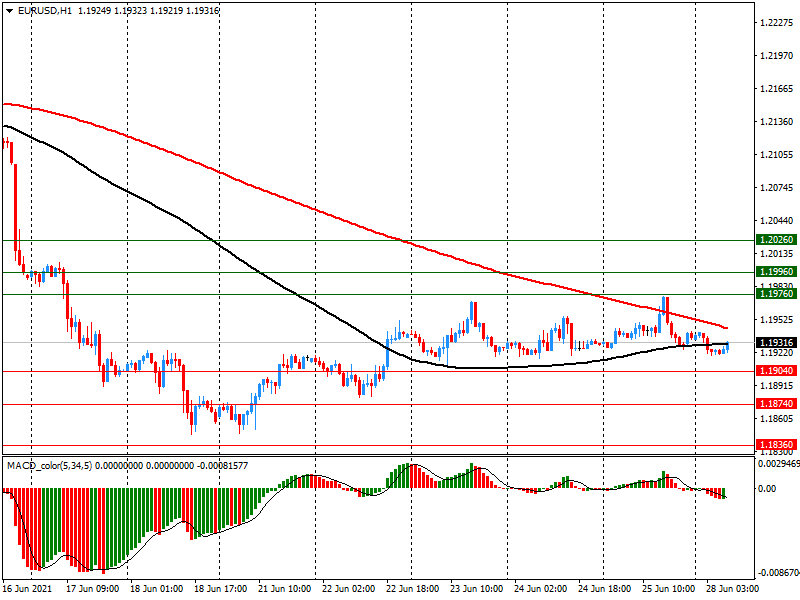
Comments:
- Overall open interest on the CALL options and PUT options with the expiration date June, 25 is 55261 contracts (according to data from July, 9) with the maximum number of contracts with strike price $1,2200 (5957);
GBP/USD
$1.4106 (326)
$1.4018 (1350)
$1.3951 (267)
Price at time of writing this review: $1.3909
Support levels (open interest**, contracts):
$1.3827 (758)
$1.3801 (1315)
$1.3769 (859)
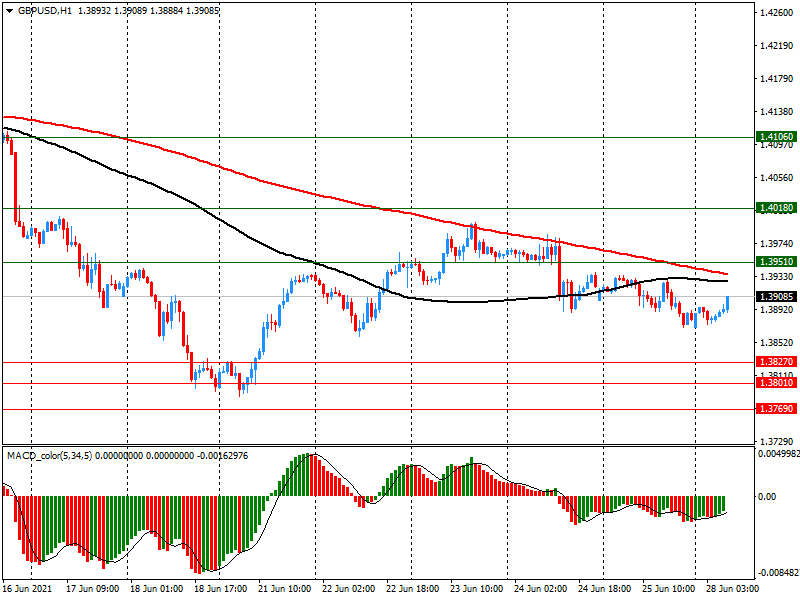
Comments:
- Overall open interest on the CALL options with the expiration date July, 9 is 15938 contracts, with the maximum number of contracts with strike price $1,4500 (3570);
- Overall open interest on the PUT options with the expiration date July, 9 is 17701 contracts, with the maximum number of contracts with strike price $1,4000 (2936);
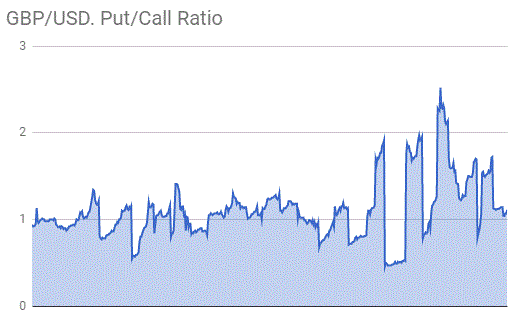
- The ratio of PUT/CALL was 1.11 versus 1.07 from the previous trading day according to data from June, 25
* - The Chicago Mercantile Exchange bulletin (CME) is used for the calculation.
** - Open interest takes into account the total number of option contracts that are open at the moment.
As reported by the Federal Statistical Office (Destatis), the index of import prices increased by 11.8% in May 2021 compared with the corresponding month of the preceding year. This has been the highest year-on-year-change since October 1981 (+13.6%). In April 2021 and in March 2021 the annual rates of change were +10.3% and +6.9%, respectively. From April 2021 to May 2021 the index rose by 1.7%. Economists had expected a 1.3% increase.
In May 2021 Energy imports were twice as expensive as in May 2020. This high rate of annual change derives from the very low prices in May 2020. The largest influence on the year-on-year rate of energy price increase had crude oil with a plus of 135.0%.
The index of import prices, excluding crude oil and mineral oil products, increased by 8.0% in May 2021 compared with May 2020 and in comparison with April 2021 it rose by 1.4%.
The index of export prices increased by 4.2% in May 2021 compared with the corresponding month of the preceding year. This has been the highest year-on-year-change since March 2011 (+4.4%). In April 2021 and in March 2021 the annual rates of change were +3.3% and +2.2%, respectively. From April 2021 to May 2021 the index rose by 0.7%.
Reuters reports that according to official forecasts, the coronavirus-induced border closures and lockdowns in Australia will have an enduring impact on government coffers and population growth.
The Australian government forecasts the budget will remain in deficit for at least another 40 years, a departure from the ruling Liberal-National coalition's long-established "debt-and-disaster" rhetoric.
"The economic crisis associated with the COVID-19 pandemic has placed significant demands on public finances in Australia and around the world. While Australia's stronger-than-expected economic recovery has flowed through into the fiscal position, the effects of the pandemic on the budget are expected to remain into the long term," the report said.
Australia's economy bounced back strongly from its first recession in three decades in the second half of last year helped by earlier-than-expected reopening from coronavirus shutdowns and massive monetary and fiscal stimulus.
"The economic recovery is well underway, but some effects from the pandemic will persist," the report says.
Australia now expects its population to total 38.8 million by 2061, down from its last forecast in 2015 when it saw it hitting 40 million by 2056. Its population currently stands at 26 million.
| Raw materials | Closed | Change, % |
|---|---|---|
| Brent | 75.87 | 0.72 |
| Silver | 26.075 | 0.49 |
| Gold | 1781.148 | 0.28 |
| Palladium | 2627.56 | -0.47 |
| Time | Country | Event | Period | Previous value | Forecast |
|---|---|---|---|---|---|
| 12:00 (GMT) | United Kingdom | MPC Member Andy Haldane Speaks | |||
| 13:00 (GMT) | U.S. | FOMC Member Williams Speaks | |||
| 23:30 (GMT) | Japan | Unemployment Rate | May | 2.8% | 2.9% |
| 23:50 (GMT) | Japan | Retail sales, y/y | May | 12% | 7.9% |
| Pare | Closed | Change, % |
|---|---|---|
| AUDUSD | 0.75918 | 0.13 |
| EURJPY | 132.221 | -0.03 |
| EURUSD | 1.19357 | 0.04 |
| GBPJPY | 153.759 | -0.33 |
| GBPUSD | 1.38801 | -0.26 |
| NZDUSD | 0.70667 | 0.17 |
| USDCAD | 1.2297 | -0.2 |
| USDCHF | 0.91666 | -0.11 |
| USDJPY | 110.767 | -0.08 |







© 2000-2026. All rights reserved.
This site is managed by Teletrade D.J. LLC 2351 LLC 2022 (Euro House, Richmond Hill Road, Kingstown, VC0100, St. Vincent and the Grenadines).
The information on this website is for informational purposes only and does not constitute any investment advice.
The company does not serve or provide services to customers who are residents of the US, Canada, Iran, The Democratic People's Republic of Korea, Yemen and FATF blacklisted countries.
Making transactions on financial markets with marginal financial instruments opens up wide possibilities and allows investors who are willing to take risks to earn high profits, carrying a potentially high risk of losses at the same time. Therefore you should responsibly approach the issue of choosing the appropriate investment strategy, taking the available resources into account, before starting trading.
Use of the information: full or partial use of materials from this website must always be referenced to TeleTrade as the source of information. Use of the materials on the Internet must be accompanied by a hyperlink to teletrade.org. Automatic import of materials and information from this website is prohibited.
Please contact our PR department if you have any questions or need assistance at pr@teletrade.global.


 Bank
Bank transfers


