- Analytics
- News and Tools
- Market News
CFD Markets News and Forecasts — 23-06-2021
| Time | Country | Event | Period | Previous value | Forecast |
|---|---|---|---|---|---|
| 08:00 (GMT) | Eurozone | ECB Economic Bulletin | |||
| 08:00 (GMT) | Germany | IFO - Business Climate | June | 99.2 | 100.6 |
| 08:00 (GMT) | Germany | IFO - Current Assessment | June | 95.7 | 97.8 |
| 08:00 (GMT) | Germany | IFO - Expectations | June | 102.9 | 103.9 |
| 11:00 (GMT) | United Kingdom | Asset Purchase Facility | 875 | 875 | |
| 11:00 (GMT) | United Kingdom | BoE Interest Rate Decision | 0.1% | 0.1% | |
| 11:00 (GMT) | United Kingdom | Bank of England Minutes | |||
| 12:30 (GMT) | U.S. | Continuing Jobless Claims | June | 3518 | 3470 |
| 12:30 (GMT) | U.S. | Goods Trade Balance, $ bln. | May | -85.23 | |
| 12:30 (GMT) | U.S. | PCE price index ex food, energy, q/q | Quarter I | 1.3% | 2.5% |
| 12:30 (GMT) | U.S. | PCE price index, q/q | Quarter I | 1.5% | 3.7% |
| 12:30 (GMT) | U.S. | Durable Goods Orders | May | -1.3% | 2.8% |
| 12:30 (GMT) | U.S. | Durable goods orders ex defense | May | 0% | |
| 12:30 (GMT) | U.S. | Durable Goods Orders ex Transportation | May | 1% | 0.8% |
| 12:30 (GMT) | U.S. | Initial Jobless Claims | June | 412 | 380 |
| 12:30 (GMT) | U.S. | GDP, q/q | Quarter I | 4.3% | 6.4% |
| 13:00 (GMT) | Belgium | Business Climate | June | 6.5 | |
| 15:00 (GMT) | U.S. | FOMC Member Williams Speaks | |||
| 22:45 (GMT) | New Zealand | Trade Balance, mln | May | 388 | |
| 23:01 (GMT) | United Kingdom | Gfk Consumer Confidence | June | -9 | -7 |
| 23:30 (GMT) | Japan | Tokyo CPI ex Fresh Food, y/y | June | -0.2% | -0.1% |
| 23:30 (GMT) | Japan | Tokyo Consumer Price Index, y/y | June | -0.4% |
The
U.S. Commerce Department announced on Wednesday that the sales of new
single-family homes dropped 5.9 percent m-o-m to a seasonally adjusted annual
rate of 769,000 units in May. This was the lowest reading since May 2020.
Economists
had forecast the sales pace of 870,000 last month.
April’s
sales pace was revised down to 817,000 units from the originally reported 863,000
units.
According
to the report, new home sales in the South, the largest area, plunged 14.5
percent m-o-m in May. In the meantime, new home sales in the Northeast jumped 33.3
percent m-o-m and those in the West rose 6.7 percent m-o-m. In the Midwest, new
home sales were flat m-o-m.
The
report also showed that median sales price climbed 18.1 percent y-o-y to
$374,400, while the average sales price surged 16.8 percent y-o-y to $430,600.
In
y-o-y terms, new home sales were up 9.2 percent in May.
The
U.S. Energy Information Administration (EIA) revealed on Wednesday that crude
inventories declined by 7.614 million barrels in the week ended June 18,
following a plunge of 7.355 million barrels in the previous week. Economists
had forecast a draw of 3.942 million barrels.
At the same time, gasoline stocks fell by 2.930 million barrels, while analysts had expected an advance of 0.833 million barrels. Distillate stocks rose by 1.754 million barrels, while analysts had forecast an increase of 1.083 million barrels.
Meanwhile, oil production in the U.S. decreased by 100,000 barrels a day to 11,100 million barrels a day.
U.S.
crude oil imports averaged 6.9 million barrels per day last week, up by 197,000
barrels per day from the previous week.
Preliminary
data released by IHS Markit on Wednesday revealed that U.S. private sector
business activity demonstrated a further marked expansion in early June.
According
to the report, the Markit flash manufacturing purchasing manager's index (PMI)
came in at 62.6 in June, up from 62.1 in May. The latest reading pointed to a
record expansion in factory activity. Economists had expected the reading to decrease
to 61.5. A reading above 50 signals an expansion in activity, while a reading
below this level signals a contraction. Rates of output and new order growth
remained well above their respective series averages, although supplier
delays and difficulties finding suitable workers led to a softer increase in
production among manufacturers. Average supplier delivery times lengthened to
the highest extent on record by some margin, while employment growth slowed, as firms struggled to find staff or entice workers back to employment. On
the price front, the rate of input cost inflation accelerated to a fresh series
record amid broad-based raw material price hikes. Firms increased their selling
prices at a quicker rate in an effort to pass on these higher costs, with charge
inflation also surpassing all previous records.
The
Markit flash services purchasing manager's index (PMI) dropped to 64.8 in June,
down from the record 70.4 in the previous month. Economists had expected the
reading to slip to 70.0. Thus, the rate of expansion was the second-sharpest since
data collection for the series began in October 2009, supported by further
upturns in customer demand as pandemic conditions eased further during the
month. New
business and new export order continued to demonstrate strong growth, while the
rate of job creation was the slowest for three months, as struggles among
companies to find suitable workers hampered employment growth. At the same
time, wage costs and additional transportation fees pushed up cost burdens,
which grew at the second-fastest pace on record. Similarly, output prices increase
markedly as firms sought to pass on greater input costs to clients.
Overall,
IHS Markit Flash U.S. Composite PMI Output Index came in at 63.9 in June, down
from 68.7 in May, but nonetheless signaling a historically elevated rate of growth
in output across the private sector.
“The
early PMI indicators point to further impressive growth of the US economy in
June, rounding off an unprecedented growth spurt over the second quarter as a
whole,” noted Chris Williamson, Chief Business Economist at HIS Markit. “While
both output growth and inflows of new orders have come off their peaks in both
manufacturing and services, this is as much due to capacity constraints limiting
firms’ abilities to cope with demand rather than any cooling of the economy,” he
added.
U.S. stock-index futures rose slightly on Wednesday, pointing to the continuation of a two-day rebound rally, as investors continued to digest Tuesday’s congressional testimony from Fed Chair Powell, who reiterated his view that inflation pressures would be temporary, easing worries that the U.S. central bank could pull back sharply on economic support.
Global Stocks:
Index/commodity | Last | Today's Change, points | Today's Change, % |
Nikkei | 28,874.89 | -9.24 | -0.03% |
Hang Seng | 28,817.07 | +507.31 | +1.79% |
Shanghai | 3,566.22 | +8.81 | +0.25% |
S&P/ASX | 7,298.50 | -43.70 | -0.60% |
FTSE | 7,122.10 | +32.09 | +0.45% |
CAC | 6,590.09 | -21.41 | -0.32% |
DAX | 15,589.60 | -46.73 | -0.30% |
Crude oil | $73.58 | +1.00% | |
Gold | $1,780.80 | +0.19% |
(company / ticker / price / change ($/%) / volume)
3M Co | MMM | 196 | 0.86(0.44%) | 1286 |
ALCOA INC. | AA | 34.5 | 0.59(1.74%) | 119194 |
ALTRIA GROUP INC. | MO | 47.33 | 0.09(0.19%) | 6703 |
Amazon.com Inc., NASDAQ | AMZN | 3,511.89 | 6.45(0.18%) | 31144 |
American Express Co | AXP | 163.51 | -0.99(-0.60%) | 392 |
Apple Inc. | AAPL | 134.02 | 0.04(0.03%) | 688332 |
AT&T Inc | T | 28.85 | 0.07(0.24%) | 42920 |
Boeing Co | BA | 244.43 | 0.65(0.27%) | 40795 |
Caterpillar Inc | CAT | 213.72 | 0.59(0.28%) | 4907 |
Chevron Corp | CVX | 107.15 | 0.75(0.70%) | 10590 |
Cisco Systems Inc | CSCO | 53.21 | -0.05(-0.09%) | 342502 |
Citigroup Inc., NYSE | C | 69.29 | 0.33(0.48%) | 101853 |
Deere & Company, NYSE | DE | 344.01 | 1.91(0.56%) | 58250 |
Exxon Mobil Corp | XOM | 64.21 | 0.42(0.66%) | 90224 |
Facebook, Inc. | FB | 339.26 | 0.23(0.07%) | 51611 |
FedEx Corporation, NYSE | FDX | 298.56 | 0.87(0.29%) | 6057 |
Ford Motor Co. | F | 15.15 | 0.24(1.61%) | 1288479 |
Freeport-McMoRan Copper & Gold Inc., NYSE | FCX | 37.15 | 0.66(1.81%) | 97921 |
General Electric Co | GE | 13.06 | 0.03(0.23%) | 166929 |
General Motors Company, NYSE | GM | 59.6 | 0.36(0.61%) | 64722 |
Goldman Sachs | GS | 359.2 | 1.67(0.47%) | 7232 |
Google Inc. | GOOG | 2,537.00 | -2.99(-0.12%) | 2009 |
Hewlett-Packard Co. | HPQ | 29.26 | 0.12(0.41%) | 4921 |
Home Depot Inc | HD | 313.38 | 0.67(0.21%) | 3388 |
HONEYWELL INTERNATIONAL INC. | HON | 216.2 | 0.71(0.33%) | 1050 |
Intel Corp | INTC | 55.89 | 0.02(0.04%) | 69483 |
International Business Machines Co... | IBM | 146.61 | 0.25(0.17%) | 201041 |
Johnson & Johnson | JNJ | 163.6 | -0.02(-0.01%) | 3017 |
JPMorgan Chase and Co | JPM | 150.96 | 0.75(0.50%) | 53295 |
McDonald's Corp | MCD | 234.35 | 0.47(0.20%) | 813 |
Merck & Co Inc | MRK | 76.15 | -0.04(-0.05%) | 4480 |
Microsoft Corp | MSFT | 266.24 | 0.73(0.27%) | 221946 |
Nike | NKE | 132.7 | 0.22(0.17%) | 15185 |
Pfizer Inc | PFE | 39.56 | -0.05(-0.13%) | 38430 |
Tesla Motors, Inc., NASDAQ | TSLA | 632.7 | 8.99(1.44%) | 450659 |
The Coca-Cola Co | KO | 54.63 | 0.07(0.13%) | 13690 |
Twitter, Inc., NYSE | TWTR | 64.2 | 0.42(0.66%) | 54276 |
Verizon Communications Inc | VZ | 56.55 | 0.18(0.32%) | 61828 |
Visa | V | 236.02 | 0.09(0.04%) | 2827 |
Wal-Mart Stores Inc | WMT | 137.3 | 0.27(0.20%) | 5496 |
Walt Disney Co | DIS | 174.09 | 0.59(0.34%) | 15636 |
Yandex N.V., NASDAQ | YNDX | 69.1 | 0.54(0.79%) | 2148 |
The
Department of Commerce reported on Wednesday that current account (C/A) gap in
the U.S. widened by 11.8 percent q-o-q to $195.7 billion in the first quarter
of 2021 from a revised $175.1 billion gap in the previous quarter (originally
-$188.5 billion). This was the highest C/A deficit since the first quarter of
2007.
The
deficit was 3.6 percentage of current-dollar GDP in the first quarter, up from 3.3
percent in the fourth quarter of 2020.
Economists
had forecast a deficit of $206.8 billion.
According
to the report, a $20.7 billion widening of the C/A deficit in the first
quarter mostly reflected an increased deficit on goods and a reduced surplus on
primary income.
Exports
of goods rose $24.5 billion, to $408.6 billion, and imports of goods jumped 39.9
billion, to $677.0 billion. The gains in both exports and imports reflected
increases in nearly all major categories.
Exports
of services went up $1.1 billion, to $175.9 billion, while imports of services rose
$1.8 billion, to $120.2 billion.
Receipts
of primary income grew $9.6 billion, to $261.7 billion, while payments of
primary income went up $13.5 billion, to $211.4 billion. The advances in both
receipts and payments mainly reflected increases in direct investment income.
Elsewhere,
receipts of secondary income rose $1.6 billion, to $42.6 billion and payments
of secondary income increased $2.3 billion, to $75.9 billion, mainly reflecting
increases in general government transfers.
Statistics
Canada announced on Wednesday that the Canadian retail sales decreased 5.7
percent m-o-m to CAD54.77 billion in April, following an unrevised 3.6 percent
m-o-m gain in March.
This was the first decline in retail sales since January and the sharpest one since
April 2020, and coincided with the third wave of the COVID-19 pandemic.
Economists
had forecast a 5.0 percent m-o-m drop for April.
According
to the report, sales fell in 9 of 11 subsectors in April, accounting for 74.2
percent of total retail sales, led by lower sales at clothing and clothing
accessories stores (-28.6 percent m-o-m) and general merchandise stores (-8.1 percent
m-o-m). Meanwhile, sales at food and beverage stores (+0.6 percent m-o-m) and
miscellaneous store retailers (+0.9 percent m-o-m) recorded gains. Core retail
sales, which excludes gasoline stations and motor vehicle and parts dealers,
plunged 7.6 percent m-o-m in April after growing 4.7 percent m-o-m in March.
This represented the steepest decline in a year and the second-largest decrease on
record.
In y-o-y terms, Canadian retail sales climbed 56.7
percent in April, following an unrevised 23.7 percent jump in March.

| Time | Country | Event | Period | Previous value | Forecast | Actual |
|---|---|---|---|---|---|---|
| 07:15 | France | Manufacturing PMI | June | 59.4 | 59 | 58.6 |
| 07:15 | France | Services PMI | June | 56.6 | 59.4 | 57.4 |
| 07:30 | Germany | Manufacturing PMI | June | 64.4 | 63 | 64.9 |
| 07:30 | Germany | Services PMI | June | 52.8 | 55.5 | 58.1 |
| 08:00 | Eurozone | Manufacturing PMI | June | 63.1 | 62.1 | 63.1 |
| 08:00 | Eurozone | Services PMI | June | 55.2 | 57.8 | 58.0 |
| 08:30 | United Kingdom | Purchasing Manager Index Manufacturing | June | 65.6 | 64 | 64.2 |
| 08:30 | United Kingdom | Purchasing Manager Index Services | June | 62.9 | 63 | 61.7 |
GBP traded mixed against its major counterparts in the European session on Wednesday. While the pound rose against USD, EUR, JPY, CHF, it weakened against CAD, AUD and NZD, as demand for riskier currencies returned after the Fed Chairman Jerome Powell on Tuesday reiterated his view that inflation pressures would be temporary, easing worries that the U.S. central bank could pull back on economic support soon.
Market participants also received encouraging data from IHS Markit and the Chartered Institute of Procurement & Supply (CIPS), which showed that the UK’s private sector witnessed one of the fastest growth on record in June. According to the survey, the headline seasonally adjusted IHS Markit/CIPS Flash UK Composite Output Index registered at 61.7 in June, down slightly from May's record reading of 62.9 but still pointing to one of the strongest monthly improvements in business activity across the private sector since 1998. The PMI for the services sector slipped to 61.7 in June from 62.9 in the previous month. Economists had forecast the index to increase to 63.0. Meanwhile, the indicator for the manufacturing sector fell to 64.2 from the record of 65.6 seen in May. The reading was in line with economists’ expectations and still pointed to a solid expansion in factory activity, the second-highest since the survey began in January 1992.
The report also revealed that the rate of input cost inflation accelerated for the fifth month running and was the joint-fastest on record, equal with that seen in June 2008.
However, market participants do not expect the latest data will have an influence on the decisions of the Bank of England’s policymakers, set to be released tomorrow.
- 7.5 million jobs still missing from the onset of the pandemic remains “benchmark” for Fed
- Fed should avoid tightening policy too soon during the fight to regain them
- We have to make sure our policies don’t pivot in ways that make look like we are declaring victory prematurely
- Phase of high inflation will be longer than we expected initially, perhaps 6-9 months instead of 2-3
The
Mortgage Bankers Association (MBA) reported on Wednesday the mortgage
application volume in the U.S. rose 2.1 percent in the week ended June 18,
following a 4.2 percent jump in the previous week.
According
to the report, refinance applications increased 2.8 percent, while applications
to purchase a home went up 0.6 percent.
Meanwhile,
the average fixed 30-year mortgage rate rose from 3.11 percent to 3.18 percent,
the highest in four weeks.
"Mortgage
rates increased last week, with the 30-year fixed rate rising to 3.18 percent -
the highest level in a month. Despite the jump in rates, refinances increased
for the second consecutive week, pushed higher by a 4 percent bump in
conventional refinance applications," noted Joel Kan, MBA's Associate vice
president of economic and industry forecasting. "Purchase applications
have regained an upward trend over the past few weeks. Activity was slightly
higher for the third straight week, but remained lower than the same week a
year ago. Government purchase applications drove most of last week's increase,
which also contributed to a slightly lower overall average purchase loan
size."
- If pace of activity we are forecasting continues, clearly this recommendation will sooner or later disappear
FXStreet reports that USD/JPY continues its strong push higher as expected after holding key support from the 13-day exponential average, uptrend from early January and recent low at 109.83/71. Analysts at Credit Suisse look for a move above the 110.97 YTD high for a move to long-term resistance, starting at 111.94.
“We continue to look for a sustained move above the 110.97 high for the year to expose long -term and more important resistance, starting at 111.94 and stretching up to the 112.40 high of 2019.”
“Whilst we would expect a cap in the 112.40 zone at first, we are biased to a break higher in due course, which would then see a much more significant base established to mark a more important turn higher and a move to 114.00 next.”
FXStreet reports that UOB Group’s FX Strategists see USD/CNH facing a tough resistance in the vicinity of 6.5000 in the near term.
24-hour view: “Upward momentum is beginning to wane and this coupled with overbought conditions suggests that USD is unlikely to strengthen much further. For today, USD is more likely to trade between 6.4680 and 6.4900.”
Next 1-3 weeks: “We have expected a stronger USD since early last week. Our view was not wrong and in our update yesterday (22 Jun, spot at 6.4690), we indicated that USD is still strong but ‘overbought conditions suggest that 6.4930 may not come into the picture so soon’. While USD rose to 6.4860 during NY session, shorter-term momentum appears to be struggling. That said, USD could move above 6.4930 but may not be able to maintain a foothold above this major level (next resistance is at 6.5000). On the downside, a breach of 6.4500 (‘strong support’ level was 6.4400 yesterday) would indicate that the current USD strength has run its course.”
FXStreet reports that economists at Credit Suisse discuss EUR/USD prospects.
“We look for a move back to a cluster of resistances at 1.1997/1.2007 – the 200-day average, price resistance and the 38.2% retracement of the May/June fall. We will then look for a fresh cap here for a resumption of the sell -off from late May. A closing break though would ease the immediate threat of further weakness and reinforce a broader sideways converging range, with resistance seen next at 1.2074. Support is seen at 1.1911 initially, with a move below 1.1880 needed for a move back to 1.1847, then support at 1.1836/24 – the uptrend from the March low last year and the 78.6% retracement of the March/May rally.”
Bloomberg reports that Chancellor Angela Merkel’s cabinet approved plans to increase borrowing by 99.7 billion euros next year to help finance Germany’s response to the coronavirus pandemic.
Under the plans approved Wednesday, a constitutional check on borrowing -- known as the debt brake -- will be suspended next year for a third year in a row. While Germany aims to reinstate the mechanism from 2023, pressure on the federal budget will likely continue.
Scholz’s budget and financing outlook through 2025 probably won’t survive in their current form. The government that takes over after September’s election will likely alter the plans before they go through parliament.
Merkel’s conservative bloc is set to retain power, recent polls suggest, possibly in a coalition with the Greens. The SPD is likely to go into opposition after ruling with the CDU/CSU for all but four years since 2005.
FXStreet reports that economists at Credit Suisse discuss AUD/USD prospects.
“AUD/USD may see a short-term correction back towards the ‘neckline’ to the major top at 0.7588/7617, however the recent weekly close below the key band of support including the 200-day average at 0.7556 reversed us into a medium-term bearish view. We look for a turn back lower in due course, with the next initial support seen at 0.7477/61, below which would complete a fresh intraday bearish continuation pattern to open up the 23.6% retracement of the entire up move from 2020 at 0.7418 next. It’s worth noting that there is a dearth of meaningful support below here, with the ‘measured top objective’ seen all the way down at 0.7085/43.”
Reuters reports that a ECB study found that men suffered bigger jobs losses across the euro zone during the COVID-19 pandemic.
Men accounted for more than 60% of the jobs losses last year, while in terms of hours worked they suffered more than two-thirds of the overall drop, the ECB said in an Economic Bulletin article.
With women heavily represented in the leisure and hospitality sector, some economists and even ECB officials warned that women were at risk of losing more, but the study suggests that women found new work more easily then men.
“Employment losses between the fourth quarter of 2019 and the fourth quarter of 2020 were mainly concentrated in the wholesale and retail trade and transportation sectors for men and in the recreation and personal services sectors for women. Conversely, the employment gains in public administration and in education were tilted towards female workers,” the ECB added.
According to the report from IHS Markit/CIPS, June saw further strong growth in output across the UK private sector. The overall expansion in activity was only slightly slower than the record posted in May and among the fastest since the series began in January 1998. Marked increases in output were seen across both the manufacturing and service sectors as the economy continued to reopen following the COVID-19 lockdown earlier in the year. Companies responded to rising workloads by taking on extra staff at an unprecedented rate at the end of the second quarter. Also hitting previously unsurpassed levels, however, were rates of inflation of input costs and output prices as supply-chain disruption fuelled price pressures.
The headline seasonally adjusted UK Composite Output Index registered at 61.7 in June, down slightly from May's record reading of 62.9 but still pointing to one of the strongest monthly improvements in business activity across the private sector since 1998. New orders continued to surge, with marked increases seen across both monitored sectors. The rate of expansion in new export orders remained much softer than that seen for total new business, however, amid a second successive reduction in services new business from abroad. Companies responded to rising workloads by taking on extra staff in June. Moreover, the rate of job creation quickened to the strongest in the series history. The rate of input cost inflation accelerated for the fifth month running and was the joint-fastest on record, equal with that seen in June 2008. While inflation continued to be led by the manufacturing sector, service providers also posted a marked increase in input prices. In turn, the rate of output price inflation hit a fresh record high for the second month running.
Looking ahead, companies remained confident that output will increase over the next 12 months as the recovery from the COVID-19 pandemic continues. Optimism was signalled at manufacturers and service providers alike. That said, overall sentiment eased to the lowest in five months.
According to the report from IHS Markit, eurozone business activity grew at the fastest rate for 15 years in June as the economy re opened further from virus-fighting restrictions and vaccine progress boosted confidence. Prices charged for goods and services rose at an unprecedented rate, however, as demand continued to outstrip supply. Despite firms taking on extra staff at the sharpest rate for almost three years, June saw a record rise in backlogs of work, a further near-record lengthening of supply chains and the increasingly widespread depletion of warehouse inventories.
The headline Eurozone Composite PMI increased from 57.1 in May to 59.2 in June, its highest since June 2006. The latest reading indicated a third successive month of accelerating output growth as the economy continued to open up from COVID-19 related restrictions. A further improvement in demand was also recorded, as new order growth likewise accelerated to the fastest since June 2006.
Business confidence in the outlook meanwhile rose to the highest since future sentiment data were first available in 2012, buoyed by the recent surge in demand and prospects of the economy opening up further in coming months.
Manufacturing continued to lead the upturn, reporting a twelfth successive month of output growth with the rate of expansion picking up again, albeit remaining slightly below March’s record high. Production growth was again sharpest in Germany, with France lagging the rest of the region amid a slower rate of new order growth.
Although manufacturing reported the stronger pace of growth, it was the service sector that again reported the biggest improvement in performance, with business activity growth accelerating to a pace not exceeded since July 2007.
According to the report from IHS Markit, the recovery in Germany’s private sector economy gained momentum in June, with the further easing of COVID-19 restrictions and release of pent-up demand leading to a sharp and accelerated rise in business activity. However, the recovery in output levels was accompanied by a further increase in price pressures, with rates of inflation in both input costs and output prices accelerating to new record highs.
The headline Flash Germany PMI Composite Output Index registered 60.4 in June, up sharply from 56.2 in May and its highest reading since March 2011. The upturn reflected improved performances across both monitored sectors. In services, business activity rose at the quickest for more than ten years (index at 58.1), with many customer-facing businesses buoyed by the easing of virus containment measures. Manufacturing output growth also accelerated (index at 65.1), after having slowed in each of the previous two months. This coincided with a stronger expansion in factory new orders as well as a slight fall in the number of businesses reporting longer lead-times on materials and components (although reports of delays were still among the highest in the series history).
Businesses reported stronger optimism towards the year-ahead outlook for activity in June. Expectations among services firms rose particularly sharply, reaching the highest since February 2000, reflecting progress in vaccinations and growing confidence regarding an eventual end to the pandemic. Nevertheless, the degree of optimism was still marginally stronger in manufacturing, where it picked up to a new series high (data on manufacturing expectations were first collected in July 2012).
| Time | Country | Event | Period | Previous value | Forecast | Actual |
|---|---|---|---|---|---|---|
| 00:30 | Japan | Manufacturing PMI | June | 53 | 51.5 | |
| 00:30 | Japan | Nikkei Services PMI | June | 46.5 | 47.2 | |
| 05:00 | Japan | Coincident Index | April | 92.9 | 95.3 | |
| 05:00 | Japan | Leading Economic Index | April | 102.4 | 103.8 |
During today's Asian trading, the US dollar was trading steadily against most major currencies after declining on comments from the head of the US Federal Reserve (Fed) Jerome Powell.
The Fed left monetary policy unchanged at the end of its June meeting last week, with a dot plot showing that the majority of Fed leaders - 13 people - expect a rate increase in 2023. This put pressure on the stock market and contributed to the growth of the dollar.
Meanwhile, Powell said on Tuesday that the Fed's goal is to restore the labor market, noting that fears of rising inflation alone will not be enough to raise rates. Powell reiterated his view that the acceleration in inflation in the country is likely to be temporary, saying that the Fed will continue to support the economy.
The ICE index, which tracks the dynamics of the dollar against six currencies (euro, swiss franc, yen, canadian dollar, pound sterling and swedish krona), rose by 0.02%.
FXStreet reports that FX Strategists at UOB Group.noted that extra gains in USD/JPY are likely once 111.00 is cleared.
Next 1-3 weeks: “On Monday, we held the view that USD has moved into a consolidation phase and we expected USD to trade within a 109.60/110.80 range. We did not anticipate the rapid manner by which USD approaches the top of the expected range (overnight high of 110.79). Upward momentum has improved but not by all that much. From here, USD has to close above the major resistance at 111.00 before a sustained advance can be expected. The prospect for such a move appears to be high as long as USD stays above 110.05 within these few days. Looking ahead, the next resistance above 111.00 is at 111.35.”
EUR/USD
Resistance levels (open interest**, contracts)
$1.2040 (621)
$1.2012 (880)
$1.1992 (574)
Price at time of writing this review: $1.1928
Support levels (open interest**, contracts):
$1.1894 (3087)
$1.1864 (1843)
$1.1829 (582)

Comments:
- Overall open interest on the CALL options and PUT options with the expiration date June, 22 is 53815 contracts (according to data from July, 9) with the maximum number of contracts with strike price $1,2200 (5957);
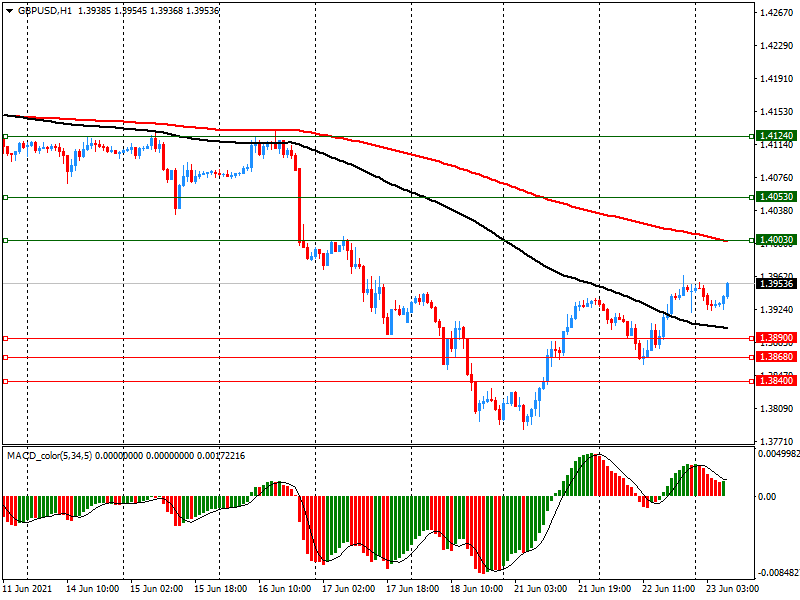
GBP/USD
$1.4124 (343)
$1.4053 (1341)
$1.4003 (242)
Price at time of writing this review: $1.3954
Support levels (open interest**, contracts):
$1.3890 (2927)
$1.3868 (1248)
$1.3840 (752)
Comments:
- Overall open interest on the CALL options with the expiration date July, 9 is 15626 contracts, with the maximum number of contracts with strike price $1,4500 (3570);
- Overall open interest on the PUT options with the expiration date July, 9 is 16328 contracts, with the maximum number of contracts with strike price $1,4000 (2927);
- The ratio of PUT/CALL was 1.04 versus 1.04 from the previous trading day according to data from June, 22

* - The Chicago Mercantile Exchange bulletin (CME) is used for the calculation.
** - Open interest takes into account the total number of option contracts that are open at the moment.
Reuters reports that a senior Australian central bank official said that absorbing spare labour market capacity and achieving full employment are important national priorities.
Australia's labour market has surpassed all expectations with the unemployment rate sliding to pre-pandemic levels of 5.1%. The RBA estimates that the rate will likely need to be around 4% to generate wage and inflation pressures.
"Full employment is a worthy goal for its own sake, given how important jobs and income are for people's welfare," RBA Assistant Governor Luci Ellis said.
"It is also a precondition for achieving the rates of wages growth that would be consistent with inflation being sustainably within the 2%-3% target range that the Bank is mandated to achieve."
Ellis said the RBA Board was committed to maintaining its highly supportive monetary policy settings to help achieve its employment and inflation goals.
RTTNews reports that the latest survey from Jibun Bank showed that the manufacturing sector in Japan continued to expand in June, with a manufacturing PMI score of 51.5. That's down from 53.0 in May, although it remains above the 50 that separates expansion from contraction.
This was the weakest reading of the headline Index for four months. This came as output levels declined for the first time since January and at the quickest pace seen since November 2020, while growth in new orders softened to a marginal pace. Positively, job creation continued for the third consecutive month, with the rate of growth picking up slightly to reach the fastest since January 2020. Firms also remained confident that activity would increase over the next 12 months, however optimism dipped to a three-month low in June.
| Raw materials | Closed | Change, % |
|---|---|---|
| Brent | 74.94 | 0.07 |
| Silver | 25.75 | -0.81 |
| Gold | 1778.548 | -0.3 |
| Palladium | 2556.22 | -0.85 |
| Time | Country | Event | Period | Previous value | Forecast |
|---|---|---|---|---|---|
| 00:30 (GMT) | Japan | Manufacturing PMI | June | 53 | |
| 00:30 (GMT) | Japan | Nikkei Services PMI | June | 46.5 | |
| 05:00 (GMT) | Japan | Coincident Index | April | 92.9 | |
| 05:00 (GMT) | Japan | Leading Economic Index | April | 102.4 | |
| 07:15 (GMT) | France | Manufacturing PMI | June | 59.4 | 59 |
| 07:15 (GMT) | France | Services PMI | June | 56.6 | 59.4 |
| 07:30 (GMT) | Germany | Services PMI | June | 52.8 | 55.5 |
| 07:30 (GMT) | Germany | Manufacturing PMI | June | 64.4 | 63 |
| 08:00 (GMT) | Eurozone | Manufacturing PMI | June | 63.1 | 62.1 |
| 08:00 (GMT) | Eurozone | Services PMI | June | 55.2 | 57.8 |
| 08:30 (GMT) | United Kingdom | Purchasing Manager Index Manufacturing | June | 65.6 | 64 |
| 08:30 (GMT) | United Kingdom | Purchasing Manager Index Services | June | 62.9 | 63 |
| 12:30 (GMT) | Canada | Retail Sales, m/m | April | 3.6% | -5% |
| 12:30 (GMT) | Canada | Retail Sales YoY | April | 23.7% | |
| 12:30 (GMT) | U.S. | Current account, bln | Quarter I | -188.5 | -206.8 |
| 12:30 (GMT) | Canada | Retail Sales ex Autos, m/m | April | 4.3% | -5% |
| 13:45 (GMT) | U.S. | Manufacturing PMI | June | 62.1 | 61.4 |
| 13:45 (GMT) | U.S. | Services PMI | June | 70.4 | 70 |
| 14:00 (GMT) | U.S. | New Home Sales | May | 0.863 | 0.87 |
| 14:30 (GMT) | U.S. | Crude Oil Inventories | June | -7.355 | -3.625 |
| 15:00 (GMT) | U.S. | FOMC Member Bostic Speaks |
| Pare | Closed | Change, % |
|---|---|---|
| AUDUSD | 0.75508 | 0.17 |
| EURJPY | 132.101 | 0.51 |
| EURUSD | 1.19386 | 0.19 |
| GBPJPY | 154.287 | 0.4 |
| GBPUSD | 1.39448 | 0.08 |
| NZDUSD | 0.70235 | 0.53 |
| USDCAD | 1.23039 | -0.43 |
| USDCHF | 0.91789 | 0.05 |
| USDJPY | 110.641 | 0.33 |







© 2000-2026. All rights reserved.
This site is managed by Teletrade D.J. LLC 2351 LLC 2022 (Euro House, Richmond Hill Road, Kingstown, VC0100, St. Vincent and the Grenadines).
The information on this website is for informational purposes only and does not constitute any investment advice.
The company does not serve or provide services to customers who are residents of the US, Canada, Iran, The Democratic People's Republic of Korea, Yemen and FATF blacklisted countries.
Making transactions on financial markets with marginal financial instruments opens up wide possibilities and allows investors who are willing to take risks to earn high profits, carrying a potentially high risk of losses at the same time. Therefore you should responsibly approach the issue of choosing the appropriate investment strategy, taking the available resources into account, before starting trading.
Use of the information: full or partial use of materials from this website must always be referenced to TeleTrade as the source of information. Use of the materials on the Internet must be accompanied by a hyperlink to teletrade.org. Automatic import of materials and information from this website is prohibited.
Please contact our PR department if you have any questions or need assistance at pr@teletrade.global.


 Bank
Bank transfers


