- Analytics
- News and Tools
- Market News
CFD Markets News and Forecasts — 22-06-2021
| Time | Country | Event | Period | Previous value | Forecast |
|---|---|---|---|---|---|
| 00:30 (GMT) | Japan | Manufacturing PMI | June | 53 | |
| 00:30 (GMT) | Japan | Nikkei Services PMI | June | 46.5 | |
| 05:00 (GMT) | Japan | Coincident Index | April | 92.9 | |
| 05:00 (GMT) | Japan | Leading Economic Index | April | 102.4 | |
| 07:15 (GMT) | France | Manufacturing PMI | June | 59.4 | 59 |
| 07:15 (GMT) | France | Services PMI | June | 56.6 | 59.4 |
| 07:30 (GMT) | Germany | Services PMI | June | 52.8 | 55.5 |
| 07:30 (GMT) | Germany | Manufacturing PMI | June | 64.4 | 63 |
| 08:00 (GMT) | Eurozone | Manufacturing PMI | June | 63.1 | 62.1 |
| 08:00 (GMT) | Eurozone | Services PMI | June | 55.2 | 57.8 |
| 08:30 (GMT) | United Kingdom | Purchasing Manager Index Manufacturing | June | 65.6 | 64 |
| 08:30 (GMT) | United Kingdom | Purchasing Manager Index Services | June | 62.9 | 63 |
| 12:30 (GMT) | Canada | Retail Sales, m/m | April | 3.6% | -5% |
| 12:30 (GMT) | Canada | Retail Sales YoY | April | 23.7% | |
| 12:30 (GMT) | U.S. | Current account, bln | Quarter I | -188.5 | -206.8 |
| 12:30 (GMT) | Canada | Retail Sales ex Autos, m/m | April | 4.3% | -5% |
| 13:45 (GMT) | U.S. | Manufacturing PMI | June | 62.1 | 61.4 |
| 13:45 (GMT) | U.S. | Services PMI | June | 70.4 | 70 |
| 14:00 (GMT) | U.S. | New Home Sales | May | 0.863 | 0.87 |
| 14:30 (GMT) | U.S. | Crude Oil Inventories | June | -7.355 | -3.625 |
| 15:00 (GMT) | U.S. | FOMC Member Bostic Speaks |
- There is evidence that there is some frothiness and the Fed is watching that
- Structural issues in Treasury market will need work
- We must make sure Fed communications don't add to market volatility
- I feel very good about the progress we're making on vaccines
- Says he sees 3-3.5% GDP growth in 2022; sees inflation around 2% in 2022; sees sharp rise in prices as mostly temporary
- Policy will really be driven by the data
- Fed needs to think about the timing of the asset purchase pace and the composition, need to analyze carefully
- Decisions should be based on how the economy is evolving rather than where things are now
- Discussion about the appropriate stance of Fed funds rate is still a far way off
- Recent inflation numbers are very high and get a lot of attention
- Fed needs to be careful watching data and understanding to what extent inflation is temporary
- Progress in labor market is still not close to the substantial further progress threshold set for asset purchases
- Interest rates are well within the range just as FOMC wants
The
European Commission (EC) reported on Tuesday its flash estimate showed the
consumer confidence indicator for the Eurozone rose by 1.8 points to -3.3 in June
from an unrevised -5.1 in the previous month. This was the highest reading since January 2018.
Economists
had expected the index to increase to -3.0.
Considering
the European Union (EU) as a whole, consumer sentiment also improved by 1.5 points to -4.5.
Given this month’s gains, both indicators are
now well above their pre-pandemic levels.
The
National Association of Realtors (NAR) announced on Tuesday that the U.S.
existing home sales declined 0.9 percent m-o-m to a seasonally adjusted rate of
5.80 million in May from an unrevised 5.85 million in April. This was the lowest reading
since June 2020.
Economists
had forecast home resales dropping to a 5.72 million-unit pace last month.
In
y-o-y terms, existing-home sales surged 23.6 percent in May.
According
to the report, three of the four major regions recorded m-o-m decreases in
existing-home sales in May but each registered double-digit advances in y-o-y terms.
The median existing-home price for all housing types in May was $350,300, up
23.6 percent y-o-y. This was a record high and marks 111 straight months of y-o-y
gains.
Single-family
home sales stood at a seasonally-adjusted annual rate of 5.08 million in May, being
down 1.0 percent m-o-m, but up 39.2 percent from one year ago. The median
existing single-family home price was $356,600 in May, up 24.4 percent from May
2020. Meanwhile, existing condominium and co-op sales were recorded at a
seasonally-adjusted annual rate of 720,000 units in May, unchanged from April
but up 100.0 percent from one year ago. The median existing condo price was
$306,000 in May, an annual advance of 21.5percent.
"Home
sales fell moderately in May and are now approaching pre-pandemic
activity," noted Lawrence Yun, NAR's chief economist. "Lack of
inventory continues to be the overwhelming factor holding back home sales, but
falling affordability is simply squeezing some first-time buyers out of the
market. The market's outlook, however, is encouraging. Supply is expected to
improve, which will give buyers more options and help tamp down record-high
asking prices for existing homes."
FXStreet notes that the U.S. Federal Reserve will not be the first of the G10 central banks to tighten policy as the Bank of Canada cannot wait until 2023 and economists at Société Générale believe USD/CAD will trade below 1.20 eventually.
“Relative to its two biggest drivers, US-Canadian rate spreads and the price of oil, the USD/CAD exchange rate has pretty consistently looked higher than it should in recent years. Unlike many crosses, however, this is one that didn’t look odd in the spring of 2020 because oil prices collapsed. However, as they rise, USD/CAD really ought to be under 1.20, and we’re inclined to remain short as a result - for now.”
“Threats to a bullish USD/CAD view are 1) weaker oil prices; 2) the CAD being more sensitive to China and the yuan, which has been strong even as the Chinese economy slows signs of slowing; we would be nervous if the yuan were to weaken; and 3) risk aversion more broadly as the Fed inches towards a ‘proper’ change in monetary policy.”
“If the BoC tightens earlier than the Fed, despite the latter being ‘in the news’ currently, then that may be the catalyst for USD/CAD’s final hurrah below 1.20.”
U.S. stock-index futures rose slightly on Tuesday, pointing to a continuation of Monday’s rebound in the U.S. equity market, while investors prepared for the Federal Reserve chairman Jerome Powell’s testimony to the U.S. Congress regarding the central bank’s response to the coronavirus pandemic (due at 18:00 GMT).
Global Stocks:
Index/commodity | Last | Today's Change, points | Today's Change, % |
Nikkei | 28,884.13 | +873.20 | +3.12% |
Hang Seng | 28,309.76 | -179.24 | -0.63% |
Shanghai | 3,557.41 | +28.23 | +0.80% |
S&P/ASX | 7,342.20 | +106.90 | +1.48% |
FTSE | 7,091.36 | +29.07 | +0.41% |
CAC | 6,611.72 | +9.18 | +0.14% |
DAX | 15,629.96 | +26.72 | +0.17% |
Crude oil | $72.79 | -0.45 | |
Gold | $1776.30 | -0.37% |
FXStreet reports that gold’s sudden slip through the $1808.60 mid-May low forced analysts at Commerzbank to neutralize their long-term forecast. The 2019-2021 uptrend line at $1729.48 is key for the long-term uptrend.
“XAU/USD is currently holding above the $1757.09/$1755.76 mid-March high and late April low, a slip through which would engage key support at the $1729.48 2019-2021 uptrend line. While above there we will retain our longer-term upside bias.”
“Longer-term, we still target the$ 1959/65 November 2020 high and the 2021 high.”
“Minor resistance on the way up can be spotted at the $1808.60/181621 late February high and mid-May low above which the 55 and 200-day moving averages can be seen at $1833.00/$1835.18.”
(company / ticker / price / change ($/%) / volume)
3M Co | MMM | 195.6 | 0.39(0.20%) | 519 |
ALCOA INC. | AA | 33.2 | 0.11(0.33%) | 64363 |
ALTRIA GROUP INC. | MO | 47.34 | 0.05(0.11%) | 5968 |
Amazon.com Inc., NASDAQ | AMZN | 3,462.20 | 8.24(0.24%) | 20581 |
American Express Co | AXP | 165.25 | 0.35(0.21%) | 1591 |
AMERICAN INTERNATIONAL GROUP | AIG | 47.76 | 0.01(0.02%) | 759 |
Apple Inc. | AAPL | 132.38 | 0.08(0.06%) | 420130 |
AT&T Inc | T | 28.92 | -0.01(-0.03%) | 40998 |
Caterpillar Inc | CAT | 213.9 | 0.69(0.32%) | 8235 |
Chevron Corp | CVX | 105.5 | -0.55(-0.52%) | 18615 |
Cisco Systems Inc | CSCO | 53.27 | 0.09(0.17%) | 7955 |
Citigroup Inc., NYSE | C | 68.65 | 0.20(0.29%) | 47213 |
Deere & Company, NYSE | DE | 339.92 | 2.04(0.60%) | 665 |
Exxon Mobil Corp | XOM | 62.8 | 0.21(0.34%) | 83865 |
Facebook, Inc. | FB | 333 | 0.71(0.21%) | 47903 |
FedEx Corporation, NYSE | FDX | 295.98 | 2.82(0.96%) | 7737 |
Ford Motor Co. | F | 14.86 | 0.08(0.54%) | 271414 |
Freeport-McMoRan Copper & Gold Inc., NYSE | FCX | 35.7 | -0.08(-0.22%) | 152916 |
General Electric Co | GE | 13.16 | -0.03(-0.23%) | 198415 |
General Motors Company, NYSE | GM | 59.5 | 0.20(0.34%) | 22726 |
Goldman Sachs | GS | 357.4 | -0.14(-0.04%) | 12820 |
Hewlett-Packard Co. | HPQ | 29.39 | 0.18(0.62%) | 1001 |
Home Depot Inc | HD | 308.7 | 1.10(0.36%) | 1989 |
Intel Corp | INTC | 55.91 | 0.04(0.07%) | 27473 |
International Business Machines Co... | IBM | 147 | 0.35(0.24%) | 2491 |
JPMorgan Chase and Co | JPM | 150.55 | 0.12(0.08%) | 33102 |
Merck & Co Inc | MRK | 76.78 | 0.03(0.04%) | 103733 |
Microsoft Corp | MSFT | 263.27 | 0.64(0.24%) | 59162 |
Nike | NKE | 130.35 | 0.27(0.21%) | 4363 |
Starbucks Corporation, NASDAQ | SBUX | 111 | 0.03(0.03%) | 1340 |
Tesla Motors, Inc., NASDAQ | TSLA | 621 | 0.17(0.03%) | 106466 |
The Coca-Cola Co | KO | 54.27 | -0.09(-0.17%) | 15468 |
Twitter, Inc., NYSE | TWTR | 62 | 0.04(0.06%) | 16204 |
Verizon Communications Inc | VZ | 56.44 | 0.05(0.09%) | 10917 |
Visa | V | 234.99 | 0.67(0.29%) | 1739 |
Wal-Mart Stores Inc | WMT | 136.58 | 0.18(0.13%) | 3918 |
Walt Disney Co | DIS | 174.11 | 0.14(0.08%) | 4676 |
Yandex N.V., NASDAQ | YNDX | 68.76 | 0.29(0.42%) | 7228 |
FXStreet reports that USD/JPY has held support at 109.81/71 as expected. Subsequently, analysts at Credit Suisse stay biased higher for a test the YTD high at 110.97.
“Above 110.49/54 should add weight to our view for the risk to turn higher again, with a move back to 110.77/83, then a test of the 110.97 high for the year. Above here in due course can expose long-term and more important resistance, starting at 111.94 and stretching up to the 112.40 high of 2019.”
“Support moves to the 13-day ema at 110.04 initially, which we now look to try and hold. Below 109.71 though would warn of a deeper setback to retest the June lows and 55-day average at 109.29/19, but with a fresh floor expected here.”
FXStreet notes that copper (LME) is dropping towards strong support seen at the 8800/8570 region, which analysts at Commerzbank expect to hold.
“Copper’s slide is ongoing with the 8800.00/8570.00 March to early April lows getting ever closer. This support area we expect to hold, though. If not, we would have to allow for the 200-day moving average and the January high at 8256.60/8238.00 to be reached.”
“Overall downside pressure should retain the upper hand while the contract remains below the February high, May low and the 55-day moving average at 9617.00/9795.00.”
FXStreet reports that EUR/USD strength stays seen as temporary ahead of a test of its uptrend from last year and 78.6% retracement of the March/May rally at 1.1833/23. Whilst analysts at Credit Suisse look for this to hold at first, below in due course can see 1.1760.
“EUR/USD has not unsurprisingly seen a small bounce following the aggressive sell-off of the past week but we view this as temporary ahead of a move back to 1.1847, then support at 1.1833/23 – the uptrend from the March low last year and the 78.6% retracement of the March/May rally.”
“We continue to look for the 1.1833/23 region to hold at first for a fresh attempt to see some consolidation, but with a break expected in due course to see weakness extend to the lower end of the converging range, now at 1.1760.”
“Resistance stays seen at 1.1922/27 initially, above which can see a minor base for a move to 1.1952, then the 200-day average at 1.1996. With price resistance just above 1.2007 we look for a fresh cap here.”
| Time | Country | Event | Period | Previous value | Forecast | Actual |
|---|---|---|---|---|---|---|
| 06:00 | United Kingdom | PSNB, bln | May | -29.1 | -26.1 | -24.3 |
| 10:00 | United Kingdom | CBI industrial order books balance | June | 17 | 18 | 19 |
USD rose against its major counterparts in the European session on Tuesday, as investors awaited the Federal Reserve chairman Jerome Powell’s testimony to the U.S. Congress regarding the central bank’s response to the coronavirus pandemic (due at 18:00 GMT). Investors hope to get further guidance on the Fed's recent hawkish shift in policy outlook.
The U.S. Dollar Index (DXY), measuring the U.S. currency's value relative to a basket of foreign currencies, increased 0.16% to 92.05.
In his prepared remarks for Congressional hearings, Powell noted that the U.S. economy has shown “sustained improvement”, supported by widespread vaccinations and unprecedented monetary and fiscal policy actions, and reiterated his view that inflation pressures, which have “increased notably in recent months”, will drop back toward the Fed’s longer-run goal once “transitory supply effects abate”. He also said that “indicators of economic activity and employment have continued to strengthen, and real GDP this year appears to be on track to post its fastest rate of increase in decades”. Powell, however, added that the pandemic continues to pose risks to the economic outlook and pledged that “the Fed will do everything we can to support the economy for as long as it takes to complete the recovery”.
FXStreet reports that in the opinion of FX Strategists at UOB Group, USD/JPY is likely to navigate within the 109.60-110.80 range for the time being.
24-hour view: “The rebound has scope to extend but any advance is likely limited to a test of 110.55. The major resistance at 110.80 is not expected to come into the picture. Support is at 110.00 followed by 109.80.”
Next 1-3 weeks: “There is no change in our view from yesterday (21 Jun, spot at 110.20). As highlighted, the current movement is viewed as part of a consolidation phase and USD is expected to trade within a 109.60/110.80 range for now.”
FXStreet notes that AUD/USD recovered slightly on Monday, but remains capped below the 200-day average at 0.7557 - let alone the “neckline” to the large top at 0.7587. Analysts at Credit Suisse look for a renewed turn back lower.
“The aussie maintains its weekly close below the key band of support including the 200-day average at 0.7555/31. This completed a major top to reverse us into a medium term bearish view, with the next initial support seen at 0.7477/61, below which would complete a fresh intraday bearish continuation pattern to open up the 23.6% retracement of the entire upmove from 2020 at 0.7418 next.”
“First short-term resistance moves to the breakdown point at 0.7547/62. Above here would trigger a small intraday base to suggest a corrective move back higher, with the next level at 0.7587/92, then at most 0.7622/ 23, where we’d look for a cap.”
- German industry has got through the pandemic well; better than in some other European countries
- We will have to spend gigantic amounts in the next few years
- Must get public finances back in order in coming years
- Government aid for companies can end in most cases
The
latest survey by the Confederation of British Industry (CBI) revealed on
Tuesday the UK manufacturers' order books continued to grow in June.
According
to the report, the CBI's monthly factory order book balance increased to +19 in
June from +17 in the previous month. This was the highest reading since May 1988 and
was well above its long-run average of -14. Economists had forecast the reading
to come in at +18. Meanwhile, export order books (-8 from -17 in May) improved
to their strongest since April 2019 and were better than the long-run average (-18).
The
CBI also reported that output volumes in the three months to June (+37 from +18
in May) grew at the fastest pace on record (since 1975).
It was also expected that output will continue to expand at a quick, albeit a slightly slower, pace in the next three months (+33).
In
other survey results, output price expectations for the next
three months (+48 from +38 in May) heightened to their highest since January
1982. Stock adequacy (-10 from -6 in May) declined to its lowest level on
record (since April 1977).
“The
rebound in manufacturing activity has gathered pace in June, with output growth
accelerating to its fastest pace on record and order books their strongest in
over 30 years,” noted Anna Leach, CBI Deputy Chief Economist. “Encouragingly,
this performance is reflected in the majority of manufacturing sub-sectors and
looks set to continue in the coming quarter. However, supply shortages continue
to bite, and firms expect that to push through into prices in the months ahead.”
Meanwhile,
Tom Crotty, Group Director at INEOS and Chair of the CBI Manufacturing Council,
said: “It
is hugely reassuring to see the manufacturing sector performing well after a
particularly difficult start to the year. There is a real sense of optimism
from many in the sector that there are good times ahead. However, the picture
is not all rosy, with firms continuing to face difficulties arising from supply
chain disruption and cost pressures. Staff shortages are also causing issues
for many manufacturing businesses across the country.”
FXStreet reports that according to FX Strategists at UOB Group, USD/CNH’s upside momentum could extend to the 6.5000 area in the next weeks.
Next 1-3 weeks: “We have expected a stronger USD since early last week. In our latest narrative from last Friday, we indicated upward momentum is stronger than expected and the ‘next level to focus on above 6.4660 is at 6.4800’. Our view was not wrong as USD soared to within one pip of 6.4800 yesterday (high of 6.4799). The next resistance above 6.4800 is at 6.4930 but in view of the overbought conditions, this level may not come into the picture so soon. The upside risk is deemed intact as long as USD does not move below 6.4400 (‘strong support’ level was at 6.4270 yesterday).”
Reuters reports that Japan Iron and Steel Federation said that Japan's crude steel output rose 42.2% in May from a year earlier, climbing for a third consecutive month as industry demand picked up from a coronavirus-related slump.
Output, which is not seasonally adjusted, increased to 8.42 million tonnes in the world's No.3 steel producer, up 7.7% from April.
Steel output in May last year plunged 31.7% from a year earlier as the pandemic collapsed demand, forcing steelmakers to suspend some of their blast furnaces.
The 44% jump marks the biggest year-on-year increase since May 2010 when the local economy was recovering from the global financial crisis in 2009, a researcher at the federation said.
FXStreet reports that economists at Charles Schwab said that it is possible that good data could be interpreted as bad news for the US stock market at least in the near-term as strong economic data, especially on jobs, could prompt the Fed to unwind earlier.
“Now, strong data may suggest tighter policy is forthcoming and weigh on stocks as investors begin to expect an eventual downturn. We believe that the US economy can withstand tighter monetary policy and continue to produce solid growth after achieving ‘escape velocity’ and may no longer need the boost from the Fed’s extraordinary stimulus. But, in the near-term, it is possible that good data could be interpreted as bad news for the US stock market should strong economic data – especially on jobs – prompt the Fed to unwind earlier and faster.”
Reuters reports that the EU is set to continue a system of quotas and tariffs that have been in place since 2018 for a further three years to protect EU steelmakers from a potential surge of imports.
Washington's retention of 25% steel tariffs has closed the U.S. market to many exporters, prompting the EU to put in place safeguard measures for 26 grades of steel, with imports over the quota thresholds subject to tariffs. The quotas have increased each year.
12 EU countries, including France, Germany and Italy, urged the European Commission in January to extend the safeguard measures beyond their June 30 expiration date.
The Commission has reviewed the measures and proposed a three-year extension, with the quotas rising by 3% at the start, as well as in 2022 and 2023. EU members have since approved it, EU diplomats said.
Since the safeguards will have lasted beyond three years, those subject to the quotas can, under WTO rules, bring counter-measures such as tariffs on EU goods.
According to the report from National Institute of Statistics (ISTAT), in April 2021 the seasonally adjusted turnover index increased by 3.3% compared to the previous month (+4.0% the domestic market and +1.7% in the non-domestic market); the average of the quarter February-April increased by 4.8% compared to the previous one (+5.7% in domestic market and +3.1% in non-domestic market).
With respect to the same month of the previous year the calendar adjusted industrial turnover index increased by 105.1% (+114.7% in domestic market and +87.8% in non-domestic market). Calendar working days in April 2021 were 21 as in April 2020.
The seasonally adjusted volume turnover index (only for the manufacturing sector) increased by 2.2% compared to the previous month and by 3.1% in the quarter February-April compared to the previous one. The calendar adjusted volume turnover index increased by 98.2% with respect to the same month of the previous year.
FXStreet reports that economists at Natixis said that US growth has already slowed down in 2021, but there is reason to fear a sharp slowdown in the US economy in 2022.
“The stimulus package only covers 2021, and we see that the investment plan (initially $2,300 billion) will ultimately have to be much smaller to be accepted. The fiscal deficit is therefore likely to be significantly smaller in 2022 than in 2021, which of course would slow down growth. The Fed will probably reduce its debt purchases in 2022 and stabilise the size of its balance sheet. This is unlikely to have much effect on the US long-term interest rate, but could push down asset prices, generating a negative wealth effect. If it is confirmed that a significant number of Americans will not return to the labour market, the participation rate will fall, as after the subprime crisis, which will obviously slow down growth.”
eFXdata reports that Bank of America Global Research discusses its USD outlook through the year-end.
"Although we remain constructive on the USD post-FOMC, we would also urge for caution as we still see too many moving parts. We don’t necessarily expect the USD to rally across the board. This would depend on risk sentiment. Assuming a slow Fed policy normalization, and during a strong global recovery from the pandemic, we would expect risk assets to remain supported, which in turn means high beta currencies should continue doing well. Our main call remains for USD strength during Fed policy normalization, but against currencies of central banks that will not be normalizing monetary policies any time soon, including EUR, CHF and JPY," BofA adds.
FXStreet reports that economists at Danske Bank continue to see EUR/USD towards 1.15 over the coming quarters.
“From here, 1) broad equity indices should continue to do well, 2) jobs data should confirm and 3) inflation expectations (5y5y) should not fall too much. We expect Fed headlines/speeches to be hawkish over the coming weeks. If so, there is scope for further USD upside after the summer.”
“We see a clear move away from financials, materials and similar (the equity reflation trade) towards technology and the quality-factor. EUR/USD is especially exposed as spot has been one of the big winners of the reflation theme (less so for e.g. in Latin America). Hence, Fed surprised markets whom are now squaring positions, in a sharp USD-positive move.”
“We continue to forecast EUR/USD towards 1.15 over the coming quarters on peak reflation and peak PMIs.”
| Time | Country | Event | Period | Previous value | Forecast | Actual |
|---|---|---|---|---|---|---|
| 06:00 | United Kingdom | PSNB, bln | May | -29.1 | -26.1 | -24.3 |
During today's Asian trading, the US dollar rose against most major currencies.
The ICE index, which tracks the dollar's performance against six currencies (euro, swiss franc, yen, canadian dollar, pound sterling and swedish krona), rose 0.09%.
The pace of employment growth in the United States will increase in the coming months, and inflationary pressures will ease amid the ongoing recovery of the American economy from the effects of the COVID-19 pandemic, Federal Reserve Chairman Jerome Powell said.
"The U.S. economy is showing steady improvement," says the text of Powell's speech, which he will present to the U.S. Congress on Tuesday.
According to Powell, the credit programs adopted by the Federal Reserve at the peak of the crisis "freed up more than $2 trillion in funding", which helped reduce job losses in companies, non-profit organizations and in local governments.
Meanwhile, the head of the Federal Reserve Bank of New York, John Williams, said yesterday that he is not ready for the Fed to abandon the support it provides to the economy, amid uncertainty about the pace of recovery from the effects of the pandemic.
Earlier on Monday, the head of the St. Louis Fed, James Bullard, and the head of the Dallas Fed, Rob Kaplan, said that the day when the Fed will begin to wind down the asset purchase program is approaching.
EUR/USD
Resistance levels (open interest**, contracts)
$1.2032 (399)
$1.2001 (879)
$1.1977 (577)
Price at time of writing this review: $1.1898
Support levels (open interest**, contracts):
$1.1852 (1839)
$1.1819 (584)
$1.1781 (634)
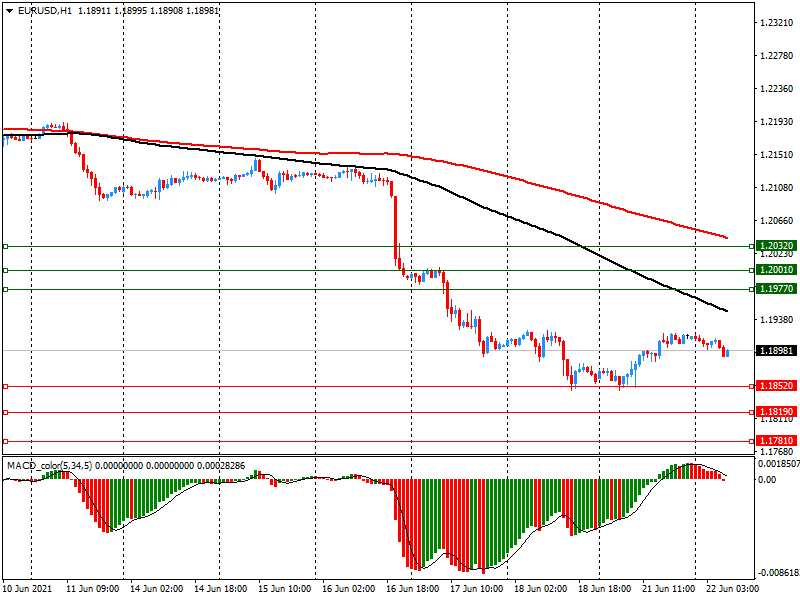
Comments:
- Overall open interest on the CALL options and PUT options with the expiration date June, 21 is 52885 contracts (according to data from July, 9) with the maximum number of contracts with strike price $1,2200 (5960);
GBP/USD
$1.4024 (107)
$1.4001 (240)
$1.3983 (135)
Price at time of writing this review: $1.3906
Support levels (open interest**, contracts):
$1.3858 (1232)
$1.3831 (746)
$1.3799 (1320)

Comments:
- Overall open interest on the CALL options with the expiration date July, 9 is 15515 contracts, with the maximum number of contracts with strike price $1,4500 (3571);
- Overall open interest on the PUT options with the expiration date July, 9 is 16141 contracts, with the maximum number of contracts with strike price $1,4000 (2927);
- The ratio of PUT/CALL was 1.04 versus 1.14 from the previous trading day according to data from June, 21
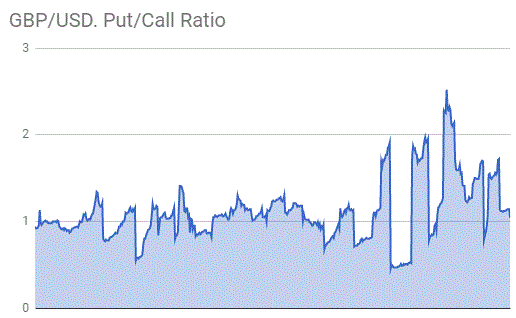
* - The Chicago Mercantile Exchange bulletin (CME) is used for the calculation.
** - Open interest takes into account the total number of option contracts that are open at the moment.
According to the report from Office for National Statistics, public sector net borrowing in the UK was estimated to have been GBP 24.3 billion in May 2021, GBP 19.4 billion less than in May 2020 and compared with market expectations of GBP 26.1 billion. Still, this was the second-highest May borrowing since monthly records began in 1993, as the coronavirus pandemic has had a substantial impact on the economy and subsequently on public sector borrowing and debt.
Provisional May 2021 estimates of central government receipts were £56.9 billion, £7.5 billion more than in May 2020, while central government bodies spent £81.8 billion, £10.9 billion less than in May 2020.
Public sector net borrowing (PSNB ex) was estimated to have been £53.4 billion in the financial year-to-May 2021; this was the second-highest financial year-to-May borrowing since monthly records began in 1993, £37.7 billion less than in the same period last year.
Public sector net borrowing (PSNB ex) in the financial year ending (FYE) March 2021 was estimated to have been £299.2 billion, revised down by £1.1 billion from last month’s provisional estimate, but remains the highest borrowing since financial year records began in FYE March 1946.
Expressed as a ratio of gross domestic product (GDP), public sector net borrowing (PSNB ex) in FYE March 2021 was 14.3%, the highest such ratio since the end of World War Two, when it was 15.2% in FYE March 1946.
RTTNews reports that property website Rightmove said that UK house prices increased to a new record high for the third consecutive month in June.
House prices increased by a moderate 0.8 percent month-on-month in June, which was slower than the 1.8 percent rise seen in May.
Although this was the largest increase at this time of year since 2015, buoyed by the strength of both the top end of the market and hotspot lifestyle change locations, data indicates an early sign of slowing in the pace of the current hectic market, Rightmove said.
The national average of property prices rose to a new record high for the third consecutive month. The average property prices totaled GBP 336,073.
On a yearly basis, house price growth accelerated to 7.5 percent in June from 6.7 percent in May.
| Raw materials | Closed | Change, % |
|---|---|---|
| Brent | 74.83 | 1.74 |
| Silver | 25.94 | 0.38 |
| Gold | 1783.058 | 0.82 |
| Palladium | 2583.15 | 4.46 |
| Time | Country | Event | Period | Previous value | Forecast |
|---|---|---|---|---|---|
| 06:00 (GMT) | United Kingdom | PSNB, bln | May | -31.7 | -26.1 |
| 10:00 (GMT) | United Kingdom | CBI industrial order books balance | June | 17 | |
| 14:00 (GMT) | U.S. | Richmond Fed Manufacturing Index | June | 18 | |
| 14:00 (GMT) | Eurozone | Consumer Confidence | June | -5.1 | -3 |
| 14:00 (GMT) | U.S. | Existing Home Sales | May | 5.85 | 5.72 |
| 15:00 (GMT) | U.S. | FOMC Member Daly Speaks | |||
| 18:00 (GMT) | U.S. | Fed Chair Powell Testimony | |||
| 23:50 (GMT) | Japan | Monetary Policy Meeting Minutes |
| Pare | Closed | Change, % |
|---|---|---|
| AUDUSD | 0.75376 | 0.73 |
| EURJPY | 131.428 | 0.56 |
| EURUSD | 1.19165 | 0.45 |
| GBPJPY | 153.677 | 1.09 |
| GBPUSD | 1.39344 | 1 |
| NZDUSD | 0.69869 | 0.74 |
| USDCAD | 1.23574 | -0.87 |
| USDCHF | 0.91742 | -0.43 |
| USDJPY | 110.275 | 0.06 |







© 2000-2026. All rights reserved.
This site is managed by Teletrade D.J. LLC 2351 LLC 2022 (Euro House, Richmond Hill Road, Kingstown, VC0100, St. Vincent and the Grenadines).
The information on this website is for informational purposes only and does not constitute any investment advice.
The company does not serve or provide services to customers who are residents of the US, Canada, Iran, The Democratic People's Republic of Korea, Yemen and FATF blacklisted countries.
Making transactions on financial markets with marginal financial instruments opens up wide possibilities and allows investors who are willing to take risks to earn high profits, carrying a potentially high risk of losses at the same time. Therefore you should responsibly approach the issue of choosing the appropriate investment strategy, taking the available resources into account, before starting trading.
Use of the information: full or partial use of materials from this website must always be referenced to TeleTrade as the source of information. Use of the materials on the Internet must be accompanied by a hyperlink to teletrade.org. Automatic import of materials and information from this website is prohibited.
Please contact our PR department if you have any questions or need assistance at pr@teletrade.global.


 Bank
Bank transfers


