- Analytics
- News and Tools
- Market News
CFD Markets News and Forecasts — 25-06-2021
On Monday, at 23:30 GMT, Japan will announce a change in the unemployment rate for May, and at 23:50 GMT - a change in the volume of retail trade for May.
On Tuesday, at 08:30 GMT, Britain will report changes in the volume of the M4 aggregate of the money supply, the number of approved applications for a mortgage loan and the volume of net loans to individuals for May. At 09:00 GMT, the eurozone will present the index of business optimism in industry, the index of economic sentiment and the consumer confidence index for June. At 12:00 GMT, Germany will release the consumer price index for June. At 13:00 GMT, the US will present the S&P/Case-Shiller housing price index for April, and at 14:00 GMT - the consumer confidence indicator for June. At 23:50 GMT, Japan will announce a change in industrial production for May.
On Wednesday, at 01:00 GMT, China will release the PMI index for the manufacturing sector and the index of activity in the non-manufacturing sector for June. Also at 01:00 GMT, New Zealand will publish ANZ's business confidence indicator for June. At 01:30 GMT, Australia will report on the change in the volume of lending to the private sector for May. At 05:00 GMT, Japan will release a consumer confidence indicator for June and announce a change in the housing starts for May. At 06:00 GMT, Britain will announce changes in GDP, the balance of payments balance and the volume of investments for the 1st quarter. At 06:45 GMT, France will announce the change in the volume of consumer spending for May and will present the consumer price index for June. At 07:00 GMT, Switzerland will publish the KOF Leading Indicator for June. At 07:55 GMT, Germany will report on the change in the unemployment rate and the number of unemployed for June. At 08:00 GMT, Switzerland will release the index of expectations of Swiss investors, according to ZEW and Credit Suisse for June. At 09:00 GMT, the eurozone will publish the consumer price index for June. At 12:15 GMT, the US will report a change in the number of employees from ADP for June. At 12:30 GMT, Canada will announce the change in GDP for April and release the producer price index for May. At 13:45 GMT, the US will publish the Chicago Purchasing Managers ' Index for June. At 14:00 GMT, the United States will announce a change in the volume of pending home sales for May. At 14:30 GMT, the US will report on the change in oil reserves according to the Ministry of Energy. At 22:30 GMT, Australia will release the index of activity in the manufacturing sector from AiG for June. At 22:45 GMT, New Zealand will announce a change in the volume of construction permits for May. At 23:50 GMT, Japan will publish the BoJ Tankan. Non-Manufacturing Index and Manufacturing Index for the 2nd quarter.
On Thursday, at 01:30 GMT, Australia will announce a change in the foreign trade balance for May. At 01:45 GMT, China will present the PMI index for the manufacturing sector from Caixin for June. At 06:30 GMT, Switzerland will publish the consumer price index for June and report on the change in retail trade for May. At 07:00 GMT, in the eurozone, ECB head Lagarde will make a speech. Then the focus will be on the PMI indices for the manufacturing sector for June: France will report at 07:50 GMT, Germany at 07:55 GMT, the eurozone at 08:00 GMT, and Britain at 08:30 GMT. In addition, at 08:00 GMT, in Britain, the head of the Bank of England Bailey will make a speech. At 09:00 GMT, the eurozone will report a change in the unemployment rate for May. At 12:30 GMT, the US will announce a change in the number of initial applications for unemployment benefits. At 13:45 GMT, the US will publish the PMI index for the manufacturing sector for May. At 14:00 GMT, the US will present the ISM manufacturing index for June and report on the change in spending in the construction sector for May. Also on Thursday, an OPEC-JMMC meeting will be held .
On Friday, at 06:00 GMT, Germany will announce the retail trade change for May. At 09:00 GMT, the eurozone will release the producer price index for May. At 12:30 GMT, the US will report changes in the unemployment rate and the nonfarm payrolls for June. Also at 12:30 GMT, the US and Canada will announce a change in the trade balance for May. In addition, at 12:30 GMT, Canada will announce a change in construction permits for May. At 14:00 GMT, the US will report a change in production orders for May. At 17:00 GMT, in the US, the Baker Hughes report on the number of active oil drilling rigs will be released.
On Sunday at 22:30 GMT, Australia will release the AiG construction activity index for June.
Following the release of the latest U.S. personal income and spending report, James Knightley, ING's Chief International Economist, discusses May's PCE inflation data.
"The main market interest in the personal income and spending report is focused on the inflation readings. May's core Personal Consumer Expenditure deflator (the Federal Reserve's favoured inflation measure) has come in as expected at 3.4% year-on-year despite the month-on-month reading being a touch below anticipated at 0.5% MoM versus the 0.6% consensus forecast. The Treasury market appears to have liked that story, as it hints that inflation momentum may be moderating."
"Nonetheless, we have to remember that the annual rate of inflation is still the highest since April 1992 and there are plenty of inflation risks still out there given ongoing supply frictions and the fact businesses are struggling to find workers. This is putting up costs and in an environment for strong consumer demand there is growing evidence that companies are increasingly aware of their own pricing power. We continue to suspect that inflation may not be as transitory as the Federal Reserve initially thought."
- Says U.S. economy is at the beginning of a very strong recovery
- Expects high price readings to return to normal
- Says some of the high inflation readings are no surprise
- Believes millions of Americans on the sidelines of the labor market will return
- Notes maximum employment at a minimum means returning to the pre-COVID level of employment
- Hard to say definitively how much the extra $300/week in unemployment benefits is affecting the labor market
The final reading for the June Reuters/Michigan index of consumer sentiment came in at 85.5 compared to a preliminary reading of 86.4 and the May final reading of 82.9.
Economists had forecast the index to be upwardly revised to 86.5.
According
to the report, the index of consumer expectations rose 6.0 percent m-o-m to 83.5
from May’s final reading of 78.8, while the index of the current economic
conditions edged down 0.9 percent m-o-m to 88.6 from May’s final reading of 89.4.
“Although
consumer sentiment slipped in late June, it still remained 3.1% above the May
reading, and the second highest since the start of the pandemic,” noted Richard
Curtin, Surveys of Consumers chief economist. “Consumers continued to pay close
attention to three critical factors: inflation, unemployment, and interest
rates. Not only did year-ahead inflation expectations fall slightly to 4.2% in
June from May's decade peak of 4.6%, consumers also believed that the price surges
will mostly be temporary. Declines in unemployment rate in the year ahead were
expected by 56% of consumers, the largest proportion ever recorded in the
history of the surveys. The growing strength in the economy meant that nearly
three-quarters of all consumers expected rising interest rates during the year
ahead, the highest proportion since 2018 when the economy was near its last
peak.”
ActionForex, analysts at TD Bank Financial Group discuss the latest report on U.S. personal income and outlays in May.
"Personal income declined by 2.0% month-on-month in May, better than the median consensus estimate for a fall of 2.5%. Another pullback in stimulus payments accounted for the deterioration."
"Personal spending was flat (+0.0%) month-on-month in May, below the consensus call for 0.4%... Spending on services rose by 0.7%, slowing slightly from the 1.1% gain of the previous month... Offsetting gains in services, goods spending declined by 1.3%, but from upwardly revised 0.5% growth in April (originally reported as a 0.6% decline)."
"With the pullback in income, the personal saving rate edged down from 14.5% in April to 12.4%. The rate remains historically high, roughly five percentage points above its pre-pandemic level."
"The overall PCE price deflator rose by 0.4% m/m, slightly lower than the consensus estimate of 0.5%. Relative to May 2020, the index was up 3.9%. The Fed’s preferred inflation measure - the core PCE price index - rose by 0.5% m/m and 3.4% year-on-year, close to the consensus expectation for 0.6% m/m and 3.4% y/y, respectively."
"The services sector is getting its mojo back thanks to a broader business reopening and increased confidence of people to get back to normal. The most affected sectors of the economy – transportation, recreation, and food services & accommodations – were the biggest contributors to growth in May. With pent-up demand for pandemic-constrained services unleashing further, we expect consumption to grow at a double-digit rate (annualized) in the second quarter of 2021."
"Driven by an expected waning of economic impact payments, the decline in personal income is tempting to skip over. Still, it’s worth noting the steady growth in wages & salaries, whose level is now above its pre-recession trend, paving the way for continued growth once the impact of stimulus payments is more fully in the rear-view mirror."
"Inflation continues to raise eyebrows. Still, the increase in May was expected given base effect and transitory factors associated with a fast reopening of the economy... Until the Fed has more proof of inflation’s persistence it is unlikely to signal a more aggressive policy stance."
U.S. stock-index futures rose on Friday after data showed the U.S. core personal consumption expenditures (PCE) price index, the Federal Reserve's preferred inflation gauge, rose in line with expectations in May.
Global Stocks:
Index/commodity | Last | Today's Change, points | Today's Change, % |
Nikkei | 29,066.18 | +190.95 | +0.66% |
Hang Seng | 29,288.22 | +405.76 | +1.40% |
Shanghai | 3,607.56 | +40.91 | +1.15% |
S&P/ASX | 7,308.00 | +32.70 | +0.45% |
FTSE | 7,135.26 | +25.29 | +0.36% |
CAC | 6,621.35 | -9.80 | -0.15% |
DAX | 15,574.32 | -14.91 | -0.10% |
Crude oil | $73.41 | +0.15% | |
Gold | $1,788.40 | +0.66% |
FXStreet reports that Axel Rudolph, Senior FICC Technical Analyst at Commerzbank, believes that EUR/GBP faces a key resistance in the 0.8732/22 band.
“EUR/GBP has now reached the February and mid-March lows at .8549/33 and dropped to its current June low at .8530 before recovering. Further down sits the April low at .8471.”
“Immediate downside pressure should retain the upper hand while the cross stays below the .8643 June 10 high. ”
“Key resistance remains to be seen at .8722/32, the late February and April highs. This would need to be overcome in order to negate downside pressure.”
(company / ticker / price / change ($/%) / volume)
ALCOA INC. | AA | 36.94 | 0.59(1.62%) | 40797 |
ALTRIA GROUP INC. | MO | 47.48 | 0.05(0.11%) | 6873 |
Amazon.com Inc., NASDAQ | AMZN | 3,458.34 | 9.26(0.27%) | 14430 |
American Express Co | AXP | 168.26 | 0.05(0.03%) | 1300 |
AMERICAN INTERNATIONAL GROUP | AIG | 48.49 | 0.28(0.58%) | 488 |
Apple Inc. | AAPL | 133.53 | 0.12(0.09%) | 446109 |
AT&T Inc | T | 28.75 | -0.04(-0.14%) | 78937 |
Boeing Co | BA | 250.58 | 0.01(0.00%) | 54564 |
Caterpillar Inc | CAT | 221.82 | 2.48(1.13%) | 38438 |
Chevron Corp | CVX | 107.4 | 0.26(0.24%) | 2707 |
Cisco Systems Inc | CSCO | 52.81 | 0.03(0.06%) | 11577 |
Citigroup Inc., NYSE | C | 71.92 | 0.60(0.84%) | 69639 |
Deere & Company, NYSE | DE | 352.01 | 1.39(0.40%) | 913 |
E. I. du Pont de Nemours and Co | DD | 76.57 | 0.17(0.22%) | 1008 |
Exxon Mobil Corp | XOM | 64.56 | 0.04(0.06%) | 35082 |
Facebook, Inc. | FB | 343.75 | 0.57(0.17%) | 17056 |
FedEx Corporation, NYSE | FDX | 291.81 | -11.13(-3.67%) | 77430 |
Ford Motor Co. | F | 15.28 | 0.02(0.13%) | 323088 |
Freeport-McMoRan Copper & Gold Inc., NYSE | FCX | 38.03 | 0.51(1.36%) | 96608 |
General Electric Co | GE | 13.18 | 0.04(0.30%) | 104026 |
General Motors Company, NYSE | GM | 60.18 | 0.14(0.23%) | 30634 |
Goldman Sachs | GS | 369.52 | 0.77(0.21%) | 8679 |
Google Inc. | GOOG | 2,548.77 | 3.13(0.12%) | 1519 |
Hewlett-Packard Co. | HPQ | 29.57 | 0.10(0.34%) | 7674 |
Home Depot Inc | HD | 312.3 | 0.46(0.15%) | 2335 |
HONEYWELL INTERNATIONAL INC. | HON | 218.3 | 0.61(0.28%) | 1395 |
Intel Corp | INTC | 55.97 | -0.10(-0.18%) | 64976 |
International Business Machines Co... | IBM | 145.75 | 0.31(0.21%) | 2367 |
Johnson & Johnson | JNJ | 163.13 | -0.24(-0.15%) | 2300 |
JPMorgan Chase and Co | JPM | 153.5 | 0.99(0.65%) | 59707 |
McDonald's Corp | MCD | 233 | -0.33(-0.14%) | 1277 |
Merck & Co Inc | MRK | 76.09 | -0.27(-0.35%) | 16473 |
Microsoft Corp | MSFT | 267.07 | 0.38(0.14%) | 53881 |
Nike | NKE | 151.01 | 17.41(13.03%) | 1105314 |
Pfizer Inc | PFE | 39.27 | 0.08(0.20%) | 30201 |
Starbucks Corporation, NASDAQ | SBUX | 112.2 | 0.21(0.19%) | 8577 |
Tesla Motors, Inc., NASDAQ | TSLA | 688.01 | 8.19(1.20%) | 411199 |
The Coca-Cola Co | KO | 54.4 | 0.01(0.02%) | 10579 |
Travelers Companies Inc | TRV | 150.13 | 0.16(0.11%) | 841 |
Twitter, Inc., NYSE | TWTR | 68.2 | -0.05(-0.07%) | 44275 |
Verizon Communications Inc | VZ | 56.44 | 0.07(0.12%) | 24064 |
Visa | V | 236.53 | 0.29(0.12%) | 2483 |
Wal-Mart Stores Inc | WMT | 137.11 | 0.20(0.15%) | 4788 |
Walt Disney Co | DIS | 178.7 | 0.77(0.43%) | 16794 |
Yandex N.V., NASDAQ | YNDX | 69.65 | 0.01(0.01%) | 100 |
NIKE (NKE) target raised to $175 from $167 at Pivotal Research Group
Netflix (NFLX) upgraded to Outperform from Neutral at Credit Suisse; target $586
The
Commerce Department reported on Friday that consumer spending in the U.S. was
flat m-o-m in May after a revised 0.9 percent m-o-m advance in April
(originally a 0.5 percent m-o-m increase). Economists
had forecast the reading to show a 0.4 percent m-o-m gain.
Meanwhile,
consumer income fell 2.0 percent m-o-m in May, following an unrevised 13.1
percent m-o-m plunge in the previous month. Economists had
forecast a 2.5 percent m-o-m drop.
The May
decrease in personal income primarily reflected a drop in government social
benefits. Within government social benefits, "other" social benefits fell
as economic impact payments made to individuals from the American Rescue Plan
Act of 2021 continued, but at a lower level than in April. Unemployment
insurance also went down, led by declines in payments from the Pandemic
Unemployment Compensation program.
The
personal consumption expenditures (PCE) price index, excluding the volatile
categories of food and energy, which is the Fed's preferred inflation measure, rose
0.5 percent m-o-m in May, following an unrevised 0.7 percent m-o-m increase in March.
Economists had projected the index would advance 0.6 percent m-o-m.
In
the 12 months through May, the core PCE surged 3.4 percent, accelerating from an unrevised 3.1 percent in the 12 months through April. Economists had forecast a jump of 3.4 percent
y-o-y. This was the highest reading since the early 1990s and was well above
the Fed’s 2-percent target.
- Eurozone economy expected to return to pre-pandemic levels in Q2 2022
- Outlook is now balanced
- Inflation likely to increase in Autumn, but only temporary
- Continued support of fiscal and monetary policy will be needed to avoid pandemic leaving scars
| Time | Country | Event | Period | Previous value | Forecast | Actual |
|---|---|---|---|---|---|---|
| 06:00 | Germany | Gfk Consumer Confidence Survey | July | -6.9 | -4 | -0.3 |
| 08:00 | Eurozone | Private Loans, Y/Y | May | 3.8% | 3.9% | |
| 08:00 | Eurozone | M3 money supply, adjusted y/y | May | 9.2% | 8.5% | 8.4% |
| 10:00 | United Kingdom | CBI retail sales volume balance | June | 18 | 14 | 25 |
| 11:00 | United Kingdom | BOE Quarterly Bulletin |
USD dipped against most of its major rivals in the European session on Friday as investors cautiously awaited the U.S. PCE inflation data set to be released today at 13:30 GMT.
The U.S. Dollar Index (DXY), measuring the U.S. currency's value relative to a basket of foreign currencies, edged down 0.07% to 91.75.
Economists forecast that the core personal consumption expenditures (PCE) price index, the Federal Reserve's preferred inflation gauge, rose 3.4% in May, its fastest pace in more than three decades. There are fears that hotter-than-expected inflation could push the Fed’s policymakers to change their timetable for interest rate hikes, which at present aren't penciled in until at least 2023, or to begin tapering its asset purchases soon.
Meanwhile, the overall market sentiment remains positive with optimism around the U.S. Senate group agreement on a $1.2 trillion infrastructure bill underpinning investors’ appetite for riskier currencies.
Bert Colijn, a Senior Economist at ING, notes that annual comparisons for both money growth and bank lending in the Eurozone are distorted by strong base effects, but recent developments provide little guidance for the economic recovery ahead.
"There have been substantial drops in M3 growth from 9.2 to 8.4% in May, with bank lending growth dropping from 7.7 to 6.7%. This is all due to the large jumps in monetary support and emergency liquidity borrowing seen during the first wave of the pandemic."
"Therefore, the monthly flows are much more relevant at the moment, which show modest relevance for the economic outlook."
"Let’s start with M3, which increased by 0.5% month-on-month in May. This is up from 0.2% in April and comparable to the pre-pandemic range seen in 2015-2019. This shows modest money growth after a year of strong expansion."
"Overall, monetary developments remain relatively stable despite plunging headline figures due to base effects. The appetite for lending among businesses remains lukewarm at the moment, despite financial conditions remaining very loose and economic prospects dramatically improving. This means the strong outlook for economic recovery is not getting much extra oomph from the lending side."
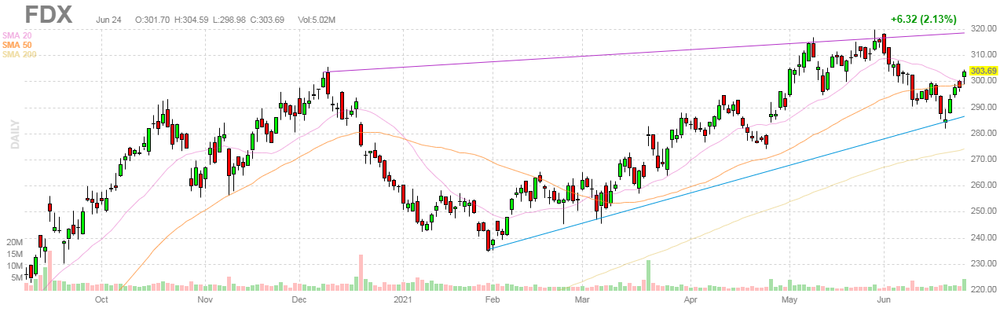
FedEx (FDX) reported Q4 FY 2021 earnings of $5.01 per share (versus $2.53 per share in Q4 FY 2020), slightly beating analysts’ consensus estimate of $5.00 per share.
The company’s quarterly revenues amounted to $22.565 bln (+30.0% y/y), beating analysts’ consensus estimate of $21.537 bln.
The company also issued upside guidance for FY 2022, projecting EPS of $20.50-21.50 versus analysts’ consensus estimate of $20.48.
FDX fell to $291.56 (-3.76%) in pre-market trading.
FXStreet reports that Commerzbank’s Senior FICC Technical Analyst Axel Rudolph suggests that Cable’s upside still appears limited by the 1.3977/1.4018 band.
“GBP/USD continues to be side-lined above the 2020-2021 support line at 1.3790 but below the 55-day moving average at 1.4014.”
“Below 1.3784 the March and April lows can be found at 1.3670/69.”
“Minor resistance between the March and April highs and mid-May low at 1.3977/1.4018 is expected to continue to cap.”
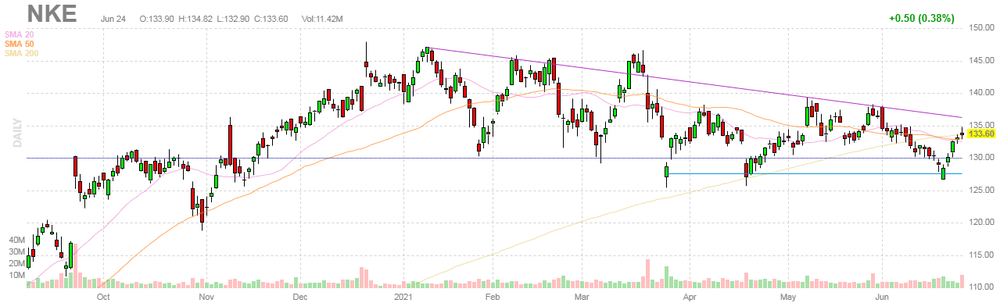
Nike (NKE) reported Q4 FY 2021 earnings of $0.93 per share (versus -$0.51 per share in Q4 FY 2020), beating analysts’ consensus estimate of $0.51 per share.
The company’s quarterly revenues amounted to $12.300 bln (+94.8% y/y), beating analysts’ consensus estimate of $11.019 bln.
The company also issued upside guidance for FY 2022, projecting revenues of above $50 bln versus analysts’ consensus estimate of $48.48 bln.
NKE rose to $149.69 (+12.04%) in pre-market trading.
FXStreet reports that Axel Rudolph, Senior FICC Technical Analyst at Commerzbank, comments on the recent price action around EUR/USD.
“EUR/USD so far dropped to 1.1847, close to the early March low and the 78.6% Fibonacci retracement at 1.1836/24 which may soon be reached once the short-term consolidation above this area has run its course.”
“Further down the April 5 low sits at 1.1738 and the March low can be spotted at 1.1704.”
“Minor resistance can be seen along the 200-day moving average at 1.1998 and also at the 1.2052 mid-May low.”
The
Confederation of British Industry (CBI) reported on Tuesday its latest survey
of retailers showed retail sales volume balance rose to +25 in the year to June
from +18 in May, being above seasonal norms. This was the highest reading since
August 2018.
Economists had forecast the reading to ease to +14.
The
report also revealed that the retail orders' balance grew at the quickest pace since September 2015.
In other survey results, overall sales were above seasonal norms to the greatest extent since November 2016 (+23 from -3 in May). Sales were forecast to remain good for the time of year next month (+23).
Meanwhile, the volume of stocks in relation to expected sales reached a record low in June (-19 from -6, question first asked in 1983), with all three main sectors -retail, wholesale and motor trades - reporting stocks as too low. Relative stock levels were seen to remain low next month as well (-22).
“After
a generally gloomy 2021 so far, the sun finally shone for retailers in June,
with seasonal sales volumes the strongest since November 2016. This was the
latest sign that the success of the vaccination programme is feeding through to
stronger consumer confidence which, along with the re-opening of hospitality,
is encouraging shoppers back onto the streets,” noted Ben Jones, Principal
Economist at the CBI. “But the sector remains a long way from a full recovery.
The return of demand is patchy, with inner-city footfall still well down. The
outlook is also clouded somewhat by supply pressures, with stocks seen as too
low compared with expected sales, as logistical and capacity challenges
continue to hamper global activity.”
FXStreet reports that according to UOB Group’s FX Strategists, the negative phase in AUD/USD seems to have ended.
Next 1-3 weeks: “On Wednesday, we highlighted that ‘the prospect for AUD to weaken to 0.7450 has diminished’ and ‘a break of 0.7600 would indicate that the weak phase in AUD has come to an end’. While 0.7600 is still intact, the loss in momentum over the past couple of days suggests that the weak phase that started more than a week ago has come to an end. The current movement is viewed as the early stages of a consolidation phase and AUD is expected to trade within a 0.7520/0.7650 for now.”
Reuters reports that China's central bank said that it would lower payment fees for small firms from September 30, including for bank account services, yuan settlement and electronic banking.
China has vowed repeatedly to keep supporting small businesses, and continue targeted tax and fee cuts this year in the wake of the pandemic. The People's Bank of China (PBOC) will also reduce interbank ATM fees.
In total, the fee reductions are estimated to be worth 24 billion yuan ($3.72 billion) per year, it added in a joint statement with the country's banking regulator, market regulator and state planner.
Bloomberg reports that the ECB said it will start overseeing “systemic” investment firms as a long-planned legal change adds to responsibilities that have steadily expanded in recent years.
The central bank said in a statement that firms with more than 30 billion euros of assets that underwrite or trade financial instruments on their own account will now have to apply for banking licenses under new legislation that takes effect this week.
European authorities are putting securities firms on a tighter leash to ensure that risks in trading businesses are supervised appropriately. The ECB has steadily expanded its remit since taking on supervision of euro area banks at the end of 2014 and again when international banks started moving operations to the bloc because of Brexit.
A first group will probably enter ECB oversight in the second half of the year, the ECB said.
According to the report from National Institute of Statistics (ISTAT), in June 2021, the consumer confidence index got on from 110.6 to 115.1. All its components bettered, but particularly optimistic signals emerged from the economic climate and from the current one. Looking at the data, the economic climate surged from 116.2 to 126.9, the current one progressed from 102.6 to 108.1, the personal one grew from 108.7 to 111.1 and, finally, the future one rose from 122.5 to 125.5.
With reference to the business confidence climate, the index (IESI, Istat Economic Sentiment Indicator) made progress from 107.3 to 112.8.
The confidence index in manufacturing increased from 110.9 to 114.8. The confidence index in construction slipped from 153.9 to 153.6. The market services confidence index got on from 99.1 to 106.7. The retail trade confidence index developed significantly passing from 99.9 to 106.7. The confidence improvement was common to both kinds of distribution: the index improved from 103.0 to 108.6 in the large scale distribution and from 92.7 to 101.5 in the small and medium scale one.
According to the report from European Central Bank, the annual growth rate of the broad monetary aggregate M3 decreased to 8.4% in May 2021 from 9.2% in April, averaging 9.2% in the three months up to and including May. Economists had expected a 8.5% increase.
The components of M3 showed the following developments. The annual growth rate of the narrower aggregate M1, which comprises currency in circulation and overnight deposits, decreased to 11.6% in May from 12.3% in April. The annual growth rate of short-term deposits other than overnight deposits (M2-M1) decreased to -0.7% in May from 0.3% in April. The annual growth rate of marketable instruments (M3-M2) increased to 11.3% in May from 10.5% in April.
Annual growth rate of adjusted loans to households stood at 3.9% in May, compared with 3.8% in April
Annual growth rate of adjusted loans to non-financial corporations decreased to 1.9% in May from 3.2% in April
FXStreet reports that in opinion of FX Strategists at UOB Group, USD/CNH could have charted an interim top following the recent price action.
Next 1-3 weeks: “After USD rose to 6.4946, we noted yesterday that “upward momentum has improved, albeit not by much”. We highlighted that “further USD strength appears likely but 6.5000 is another major level and is expected to offer solid resistance”. USD subsequently eased off and closed slightly lower at 6.4699 (-0.13%). Upward momentum is beginning to slow and this coupled with overbought conditions has increased the risk of a short-term top. However, only a break of 6.4500 (no change in ‘strong support” level) would indicate that the USD strength that started more than a week ago has run its course.”
Reuters reports that S&P Global Ratings said that it affirmed China's ratings at A+/A-1 with a stable outlook.
"China was likely to maintain above-average economic growth relative to other middle-income economies in the next few years. This is in part due to its effective containment of the COVID-19 pandemic and rapid vaccine rollout," S&P said.
"We expect real GDP growth to come in at 8.3% this year, before moderating to about 5% from 2022-2024," S&P added
| Time | Country | Event | Period | Previous value | Forecast | Actual |
|---|---|---|---|---|---|---|
| 06:00 | Germany | Gfk Consumer Confidence Survey | July | -6.9 | -4 | -0.3 |
During today's Asian trading, the US dollar declined against the euro and the japanese yen, but rose against the pound.
Analysts note an improvement in investors' appetite for risk due to the achievement of a bipartisan agreement between US congressmen on a large-scale package of measures to modernize infrastructure.
US President Joe Biden announced on Thursday that the Democratic and Republican senators had a "really good meeting", at which they eventually managed to reach an agreement.
Earlier, The Wall Street Journal reported that representatives of a bipartisan group of US lawmakers discussing a $1 trillion infrastructure spending plan have agreed on the general principles of the deal and plan to meet with US President Joe Biden on Thursday to try to conclude an agreement.
The last round of negotiations focused on the financing of the package of measures, which provides incentives totaling $973 billion over five years or $1.25 trillion over eight years.
The pound continued yesterday's decline against the US dollar. Following the results of the June meeting, the Bank of England kept the base interest rate at 0.1%, and also decided to leave the volume of the asset repurchase program at the level of 895 billion pounds, including the repurchase of government bonds in the amount of 875 billion pounds. According to analysts, the pound fell in price against the background of the absence of "hawkish" statements of the regulator.
The ICE index, which tracks the dynamics of the dollar against six currencies (euro, swiss franc, yen, canadian dollar, pound sterling and swedish krona), fell by 0.10%.
EUR/USD
Resistance levels (open interest**, contracts)
$1.2030 (627)
$1.2001 (992)
$1.1980 (576)
Price at time of writing this review: $1.1941
Support levels (open interest**, contracts):
$1.1920 (2109)
$1.1899 (3115)
$1.1870 (1849)
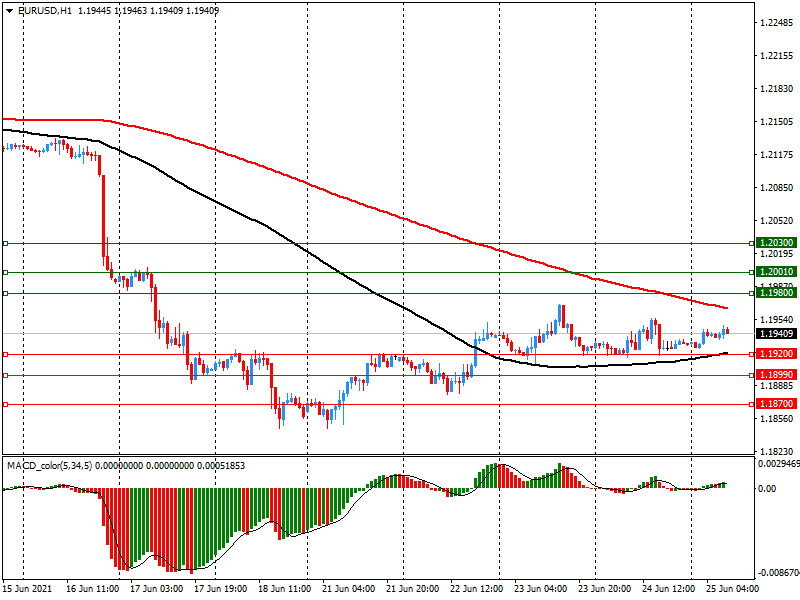
Comments:
- Overall open interest on the CALL options and PUT options with the expiration date June, 24 is 53611 contracts (according to data from July, 9) with the maximum number of contracts with strike price $1,2200 (5956);
GBP/USD
$1.4114 (331)
$1.4038 (1350)
$1.3984 (242)
Price at time of writing this review: $1.3903
Support levels (open interest**, contracts):
$1.3846 (762)
$1.3814 (1305)
$1.3777 (859)
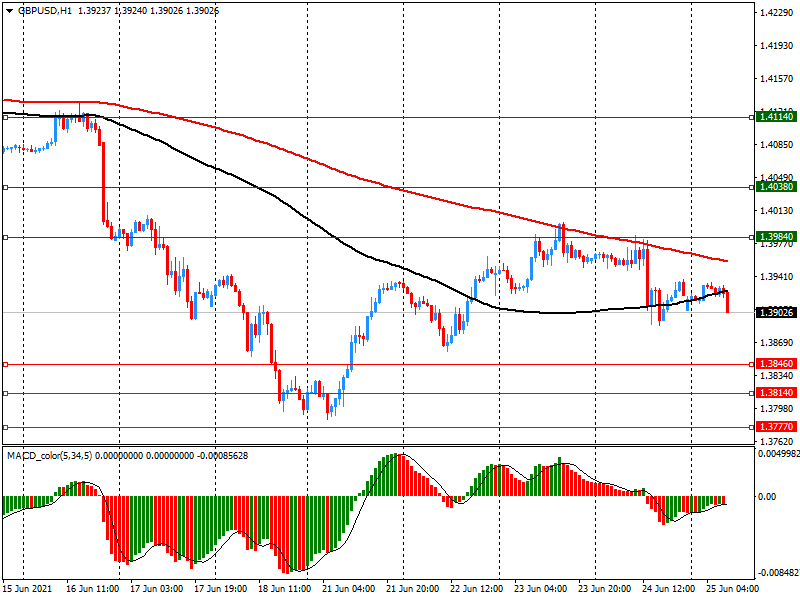
Comments:
- Overall open interest on the CALL options with the expiration date July, 9 is 15852 contracts, with the maximum number of contracts with strike price $1,4500 (3570);
- Overall open interest on the PUT options with the expiration date July, 9 is 16964 contracts, with the maximum number of contracts with strike price $1,4000 (2936);
- The ratio of PUT/CALL was 1.07 versus 1.07 from the previous trading day according to data from June, 24
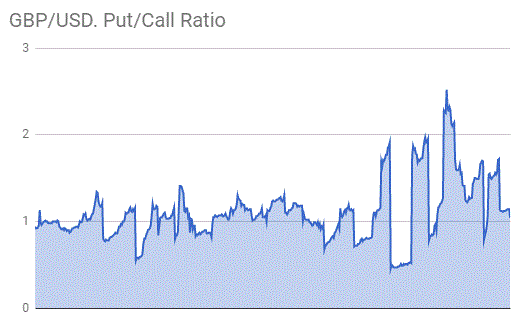
* - The Chicago Mercantile Exchange bulletin (CME) is used for the calculation.
** - Open interest takes into account the total number of option contracts that are open at the moment.
eFXdata reports that Barclays Research discuss ECB policy trajectory.
'The EUR continues to bring up the rear among our G10 forecasts, as its economy lags its peers and monetary policy faces no realistic chance of normalisation within the next few years. While the economy is expected to bounce back vigorously over the next year, it is only catching up after a larger and more protracted downturn than other G10. While inflation has picked up and there are risks that some minority voices within the ECB’s Governing Council will mimic voices from other central banks on normalising policy, we expect the core of the Council to hold firm and keep policy ultra-loose for the foreseeable future," Barclays adds.
RTTNews reports that survey results from market research group GfK showed that UK consumer sentiment remained unchanged in June.
The consumer confidence index held steady at -9.0 in June, while it was forecast to rise to -7.0.
"A repetition of last month's score doesn't mean confidence is about to nose-dive," Joe Staton, client strategy director at GfK, said.
The upwards trajectory for the Index since the dark days at the start of the pandemic is currently still on track, Staton said.
The index measuring past changes in personal finances gained four points to zero. The forecast for personal finances over the next year rose only one point to +11.
The measure for the general economic situation over the last year edged up one point to -47, while the expectations for the general economic situation over the coming twelve months dropped by six points to -2.
According to the report from GfK, consumer confidence in Germany increased noticeably in June. Both economic and income expectations increased significantly, along with the propensity to buy showing moderate growth. As a result, GfK is forecasting a value of -0.3 points in consumer sentiment for July 2021, up 6.6 points from June of this year (revised from -6.9 points).
What is remarkable this month is that consumers are very confident when it comes to the general development of the German economy. Following the sharp rise in the previous month, economic expectations increased significantly once again. After an increase of 17.3 points, the indicator currently climbs to 58.4 points. This is the highest value in more than ten years. A higher value was last measured in February 2011, at 59 points.
Rolf Bürkl, GfK consumer expert comments on the subject: “We are leaving the lockdown behind more and more. Sharply declining incidence rates, as well as significant progress in vaccination, allow increasingly extensive relaxations or openings. In addition, vacation travel is now possible again. This leads to increased optimism, which is also reflected in improved consumer confidence. As a result, we are forecasting a value of -0.3 points in consumer sentiment for July 2021, the highest value since the summer of last year. A higher value was last measured in August 2020, at -0.2 points.”
| Raw materials | Closed | Change, % |
|---|---|---|
| Brent | 75.38 | 0.21 |
| Silver | 25.932 | 0.26 |
| Gold | 1774.798 | -0.21 |
| Palladium | 2641.45 | 1.19 |
| Time | Country | Event | Period | Previous value | Forecast |
|---|---|---|---|---|---|
| 06:00 (GMT) | Germany | Gfk Consumer Confidence Survey | July | -7 | -4 |
| 08:00 (GMT) | Eurozone | Private Loans, Y/Y | May | 3.8% | |
| 08:00 (GMT) | Eurozone | M3 money supply, adjusted y/y | May | 9.2% | 8.5% |
| 10:00 (GMT) | United Kingdom | CBI retail sales volume balance | June | 18 | 14 |
| 11:00 (GMT) | United Kingdom | BOE Quarterly Bulletin | |||
| 12:30 (GMT) | U.S. | Personal spending | May | 0.5% | 0.4% |
| 12:30 (GMT) | U.S. | PCE price index ex food, energy, Y/Y | May | 3.1% | 3.4% |
| 12:30 (GMT) | U.S. | PCE price index ex food, energy, m/m | May | 0.7% | 0.6% |
| 12:30 (GMT) | U.S. | Personal Income, m/m | May | -13.1% | -2.5% |
| 13:00 (GMT) | Belgium | Business Climate | June | 6.5 | |
| 14:00 (GMT) | U.S. | Reuters/Michigan Consumer Sentiment Index | June | 82.9 | 86.5 |
| 17:00 (GMT) | U.S. | Baker Hughes Oil Rig Count | June | 373 |
| Pare | Closed | Change, % |
|---|---|---|
| AUDUSD | 0.75817 | 0.1 |
| EURJPY | 132.263 | -0.06 |
| EURUSD | 1.19308 | 0.04 |
| GBPJPY | 154.276 | -0.42 |
| GBPUSD | 1.39165 | -0.32 |
| NZDUSD | 0.70547 | 0.22 |
| USDCAD | 1.23213 | 0.12 |
| USDCHF | 0.91774 | 0.01 |
| USDJPY | 110.855 | -0.09 |







© 2000-2026. All rights reserved.
This site is managed by Teletrade D.J. LLC 2351 LLC 2022 (Euro House, Richmond Hill Road, Kingstown, VC0100, St. Vincent and the Grenadines).
The information on this website is for informational purposes only and does not constitute any investment advice.
The company does not serve or provide services to customers who are residents of the US, Canada, Iran, The Democratic People's Republic of Korea, Yemen and FATF blacklisted countries.
Making transactions on financial markets with marginal financial instruments opens up wide possibilities and allows investors who are willing to take risks to earn high profits, carrying a potentially high risk of losses at the same time. Therefore you should responsibly approach the issue of choosing the appropriate investment strategy, taking the available resources into account, before starting trading.
Use of the information: full or partial use of materials from this website must always be referenced to TeleTrade as the source of information. Use of the materials on the Internet must be accompanied by a hyperlink to teletrade.org. Automatic import of materials and information from this website is prohibited.
Please contact our PR department if you have any questions or need assistance at pr@teletrade.global.


 Bank
Bank transfers


