- Analytics
- News and Tools
- Market News
CFD Markets News and Forecasts — 16-04-2020
| Time | Country | Event | Period | Previous value | Forecast |
|---|---|---|---|---|---|
| 02:00 | China | Retail Sales y/y | March | -20.5% | -10% |
| 02:00 | China | Industrial Production y/y | March | -13.5% | -7.3% |
| 02:00 | China | Fixed Asset Investment | March | -24.5% | -15.1% |
| 02:00 | China | GDP y/y | Quarter I | 6% | -6.5% |
| 04:30 | Japan | Tertiary Industry Index | February | 0.8% | |
| 04:30 | Japan | Industrial Production (MoM) | February | 1% | 0.4% |
| 04:30 | Japan | Industrial Production (YoY) | February | -2.3% | -4.7% |
| 09:00 | Eurozone | Construction Output, y/y | February | 6% | |
| 09:00 | Eurozone | Harmonized CPI ex EFAT, Y/Y | March | 1.2% | 1% |
| 09:00 | Eurozone | Harmonized CPI | March | 0.2% | 0.5% |
| 09:00 | Eurozone | Harmonized CPI, Y/Y | March | 1.2% | 0.7% |
| 12:30 | Canada | Foreign Securities Purchases | February | 17.01 | |
| 14:00 | U.S. | Leading Indicators | March | 0.1% | -7% |
| 17:00 | U.S. | Baker Hughes Oil Rig Count | April | 504 |
FXStreet notes that no one needs absolute, total, confirmation that the U.S. economy is suffering tremendously. Jennifer Lee from the Bank of Montreal recaps the latest macroeconomic data released by the US administration.
“US housing starts fell more than expected in March, down 22.3% to a one-year low of 1.216 mln units annualized.”
“Building permits, an indicator of future starts, were also down but the decline was not as steep as expected. Permits fell 6.8% to a 9-month low of 1.353 mln units annualized, suggesting that there is activity waiting in the shadows once activity resumes. When that happens is the billion-dollar question.”
“First-time UI claims came in at 5.245 mln in the week of April 11, the fourth consecutive week that it can be measured in the millions. Those who remain on UI (aka continuing claims) totalled an unbelievable 11.976 mln.”
“On an ISM-basis, the Empire State Survey fell to a record low 31.2, while the Philly Fed survey hit 29.7, also the lowest ever.”
“These are terrible numbers. No surprise. But we should look for a sharp reversal as the economy re-opens... gradually.”
- Says that after lockdown ends, there will be both inflationary and disinflationary pressures
- Balance of forces leans towards deflationary pressures, depends on the length of lockdown and policy effectiveness
- Despite the policy responses, we will not be able to avoid a rise in unemployment, which will weigh on real wage growth across the economy
Statistics Canada released its Monthly Survey of Manufacturing on Thursday, which showed that the Canadian manufacturing sales rose 0.5 percent m-o-m in February to CAD56.18 billion, following an unrevised 0.2 percent m-o-m decline in January. That was the first advance in manufacturing sales since August 2019.
Economists had forecast a 0.1 percent m-o-m decrease for February.
According to the survey, higher sales in the transportation equipment industry (4.0 percent m-o-m) were the major contributor to the February growth. Overall, sales increased in 11 of 21 industries, representing 58.4 percent of total Canadian manufacturing. Notable gains in sales were also posted by such industries as plastics and rubber products (+4.3 percent m-o-m), fabricated metal product (+1.9 percent m-o-m), computer and electronic product (+5.2 percent m-o-m) and chemical (+1.3 percent m-o-m). On the contrary, the machinery (-6.0 percent m-o-m), aerospace product and parts (-9.3 percent m-o-m), petroleum and coal product (-2.2 percent m-o-m) and food (-1.0 percent m-o-m) industries recorded the biggest declines in sales.
FXStreet notes that in the weeks ahead, GBP will be focused on how deep the coronavirus downturn is likely to be and how quickly the economy can recover. Overlaying this picture will be the direction of the post-Brexit negotiations, per Rabobank.
“We expect that these talks and the uncertainties connected with issues such as border and immigration procedures have the potential to increase the vulnerability of the pound in the months ahead.”
“While investors are likely to be encouraged by any reports that suggest that the forthcoming post-Brexit talks are progressing well, they will also be mindful that the UK may still carry out the threat of walking away from the talks without a deal.”
“Given the weight of economic uncertainty see risk of GBP/USD dipping below 1.20 on a 3-month view though we have pencilled in a relief rally later in the year.”
- Doctors, hairdressers, massage and cosmetic parlours can reopen April 27
- Obligatory schools, stores and markets reopening on May 11
- Expands financial support to cover more self-employed people such as taxi drivers
- Non-obligatory schools, universities, museums, zoos and libraries to reopen on June 8
- Easing of restrictions to be accompanied by protective measures and obligation to wear masks is possible
- Relaxation of restrictions hinges on no significant rise in new COVID-19 cases
- Vulnerable people should stay at home
The Manufacturing Business Outlook Survey, released by the Federal Reserve Bank of Philadelphia on Thursday, revealed the contraction in the region's manufacturing activity continued in April.
According to the survey, the diffusion index for current general activity plunged from -12.7 in March to -56.6 this month. That was the lowest reading since July 1980.
Economists had forecast the index to decrease to -30.0.
A reading above 0 signals expansion, while a reading below 0 indicates contraction.
According to the report, the indexes for new orders (-55.4 points to -70.96, the lowest reading ever) and shipments (-74.3 points to -74.1, the all-time low) declined sharply this month, coinciding with ongoing developments related to the coronavirus pandemic. Meanwhile, employment (-50.8 points to -46.7) fell into negative territory. Elsewhere, unfilled orders (-6.1 points to -13.5) slipped deeper into contraction territory, while delivery times (+13.2 points to 4.1) rose, suggesting longer delivery times. On the price front, prices paid index decreased 14.1 points to -9.3, while prices received index fell 17.4 points to -10.6.
FXStreet reports that economist Ho Woei Chen, CFA, at UOB Group, reviewed the latest interest rate cut by the PBoC.
“The People’s Bank of China (PBoC) cut its 1Y medium-term facility (MLF) rate by 20 bps to record low 2.95% today, matching a similar cut to its 7-day reverse repo rate on 30 March. The first 50bps reduction to the banks’ reserve requirement ratio (RRR) announced earlier this month has also become effective today… with the second 50bps cut effective a month later.”
“According to the PBoC, the MLF cut injected CNY100 bn (US$14.2 bn) of liquidity into the financial system. The MLF cut came just before next loan prime rate (LPR) fixing on 20 April and the 1Q2020 GDP release (17 April), which is expected to post its first quarterly GDP contraction since the data was available in 1992.”
“To put matters into perspective, the 20 bps cut to the 1Y MLF is the largest since 2016 with the previous reduction in February at 10 bps. The relatively steep cut may be a signal that the PBoC is gearing up for more monetary policy easing in the near-term to contain the downside growth risk.”
“As the benchmark Loan Prime Rate (LPR) is pegged to the MLF, we anticipate that the 1Y and 5Y & above LPR could fall around 10 bps at the upcoming monthly fixing on 20 April to reflect the lower funding costs.”
“Overall, the PBoC is likely to maintain its measured and targeted approach so far especially as the domestic economy has started to stabilise.”
U.S. stock-index futures rose on Thursday, as official data showed the U.S. weekly jobless claims fell from the previous two weeks.
Global Stocks:
| Index/commodity | Last | Today's Change, points | Today's Change, % |
| Nikkei | 19,290.20 | -259.89 | -1.33% |
| Hang Seng | 24,006.45 | -138.89 | -0.58% |
| Shanghai | 2,819.94 | +8.76 | +0.31% |
| S&P/ASX | 5,416.30 | -50.40 | -0.92% |
| FTSE | 5,627.46 | +29.81 | +0.53% |
| CAC | 4,382.89 | +29.17 | +0.67% |
| DAX | 10,404.47 | +124.71 | +1.21% |
| Crude oil | $20.19 | | +1.61% |
| Gold | $1,752.60 | | +0.71% |
(company / ticker / price / change ($/%) / volume)
| 3M Co | MMM | 146.94 | 1.78(1.22%) | 158447 |
| ALCOA INC. | AA | 7.31 | 0.05(0.69%) | 9373 |
| ALTRIA GROUP INC. | MO | 41.06 | 0.15(0.37%) | 6331 |
| Amazon.com Inc., NASDAQ | AMZN | 2,341.50 | 33.82(1.47%) | 129383 |
| American Express Co | AXP | 84.58 | 0.79(0.94%) | 12930 |
| AMERICAN INTERNATIONAL GROUP | AIG | 24 | -0.08(-0.33%) | 3945 |
| Apple Inc. | AAPL | 288.3 | 3.87(1.36%) | 476483 |
| AT&T Inc | T | 30.24 | 0.15(0.50%) | 121195 |
| Boeing Co | BA | 144.5 | -1.48(-1.01%) | 289573 |
| Caterpillar Inc | CAT | 112.1 | 0.57(0.51%) | 9850 |
| Chevron Corp | CVX | 82.7 | 0.21(0.25%) | 115802 |
| Cisco Systems Inc | CSCO | 41.76 | 0.24(0.58%) | 50255 |
| Citigroup Inc., NYSE | C | 43 | 0.14(0.33%) | 124187 |
| Deere & Company, NYSE | DE | 136 | 0.69(0.51%) | 1202 |
| E. I. du Pont de Nemours and Co | DD | 35.98 | 0.41(1.15%) | 550 |
| Exxon Mobil Corp | XOM | 40.66 | 0.18(0.45%) | 110475 |
| Facebook, Inc. | FB | 178.05 | 1.08(0.61%) | 116089 |
| FedEx Corporation, NYSE | FDX | 120.89 | 0.99(0.83%) | 13550 |
| Ford Motor Co. | F | 5.06 | 0.03(0.60%) | 355380 |
| Freeport-McMoRan Copper & Gold Inc., NYSE | FCX | 7.85 | 0.18(2.35%) | 62486 |
| General Electric Co | GE | 6.49 | -0.01(-0.15%) | 822202 |
| General Motors Company, NYSE | GM | 21.86 | 0.20(0.92%) | 34451 |
| Google Inc. | GOOG | 1,272.00 | 9.53(0.75%) | 12981 |
| Hewlett-Packard Co. | HPQ | 15.05 | 0.05(0.33%) | 1375 |
| Home Depot Inc | HD | 199.54 | 1.06(0.53%) | 19714 |
| HONEYWELL INTERNATIONAL INC. | HON | 135.09 | 0.25(0.19%) | 867 |
| Intel Corp | INTC | 59.85 | 0.98(1.66%) | 101228 |
| International Business Machines Co... | IBM | 119.25 | 0.56(0.47%) | 13129 |
| International Paper Company | IP | 32.2 | 0.40(1.26%) | 701 |
| Johnson & Johnson | JNJ | 148.8 | 1.14(0.77%) | 38262 |
| JPMorgan Chase and Co | JPM | 90.95 | 0.16(0.18%) | 128325 |
| McDonald's Corp | MCD | 179.07 | 1.23(0.69%) | 14445 |
| Merck & Co Inc | MRK | 82.18 | 0.11(0.13%) | 2695 |
| Microsoft Corp | MSFT | 174.78 | 2.90(1.69%) | 608663 |
| Nike | NKE | 86.05 | 1.01(1.19%) | 165583 |
| Pfizer Inc | PFE | 36.24 | 0.27(0.75%) | 10913 |
| Procter & Gamble Co | PG | 121.89 | 0.67(0.55%) | 18755 |
| Starbucks Corporation, NASDAQ | SBUX | 73.11 | 0.56(0.77%) | 23603 |
| Tesla Motors, Inc., NASDAQ | TSLA | 721.95 | -7.88(-1.08%) | 392916 |
| The Coca-Cola Co | KO | 47.9 | 0.29(0.61%) | 74871 |
| Travelers Companies Inc | TRV | 102 | -0.17(-0.17%) | 1934 |
| Twitter, Inc., NYSE | TWTR | 26.99 | -0.52(-1.89%) | 377253 |
| UnitedHealth Group Inc | UNH | 281.65 | -0.03(-0.01%) | 6870 |
| Verizon Communications Inc | VZ | 57.83 | 0.90(1.58%) | 50272 |
| Visa | V | 168.48 | 2.52(1.52%) | 53772 |
| Wal-Mart Stores Inc | WMT | 129.26 | 0.50(0.39%) | 22323 |
| Walt Disney Co | DIS | 104.62 | 1.25(1.21%) | 109114 |
| Yandex N.V., NASDAQ | YNDX | 35.84 | 0.95(2.72%) | 6769 |
The Commerce Department reported on Thursday the housing starts plunged by 22.3 percent m-o-m (the most since March 1984) in March to a seasonally adjusted annual pace of 1.216 million, while building permits fell by 6.8 percent m-o-m (the most since July 2015) to an annual rate of 1.353 million.
Economists had forecast both housing starts and building permits decreasing to a pace of 1.300 million units each.
Data for February was revised to show homebuilding growing to a pace of 1.564 million units, instead of increasing at a rate of 1.599 million units as previously reported.
Groundbreaking on single-family homes fell 17.5 percent m-o-m to a rate of 856,000 units in March, while housing starts for the multi-family plumped 32.1 percent m-o-m to a 347,000 -unit pace.
Barrick (GOLD) downgraded to Equal Weight from Overweight at Barclays
MasterCard (MA) downgraded to Neutral from Buy at Guggenheim
Twitter (TWTR) downgraded to Neutral from Overweight at JP Morgan; target $29
Freeport-McMoRan (FCX) upgraded to Overweight from Equal Weight at Barclays; target $10
The data from the Labor Department revealed on Thursday the number of applications for unemployment dropped last week from the previous two weeks, but still remained huge, showing that the coronavirus' damage to the U.S. labor market remains profound.
According to the report, the initial claims for unemployment benefits totaled 5,245,000 for the week ended April 11. That brings the number of job losses over the past four weeks to 22 million.
Economists had expected 5,100,000 new claims last week.
Claims for the prior week were revised upwardly to 6,615,000 from the initial estimate of 6,606,000.
Meanwhile, the four-week moving average of claims jumped to 5,508,500 from 4,267,750 in the previous week, the highest level on the record.
| Time | Country | Event | Period | Previous value | Forecast | Actual |
|---|---|---|---|---|---|---|
| 06:00 | Germany | CPI, m/m | March | 0.4% | 0.1% | 0.1% |
| 06:00 | Germany | CPI, y/y | March | 1.7% | 1.4% | 1.4% |
| 06:30 | Switzerland | Producer & Import Prices, y/y | March | -2.1% | -2.7% | |
| 09:00 | Eurozone | Industrial production, (MoM) | February | 2.3% | -0.2% | -0.1% |
| 09:00 | Eurozone | Industrial Production (YoY) | February | -1.7% | -2% | -1.9% |
| 12:30 | Canada | Manufacturing Shipments (MoM) | February | -0.2% | -0.1% | 0.5% |
| 12:30 | U.S. | Continuing Jobless Claims | April | 7446 | 14000 | 11976 |
| 12:30 | U.S. | Philadelphia Fed Manufacturing Survey | April | -12.7 | -30 | -56.6 |
| 12:30 | U.S. | Housing Starts | March | 1.564 | 1.3 | 1.216 |
| 12:30 | U.S. | Building Permits | March | 1.452 | 1.3 | 1.353 |
| 12:30 | U.S. | Initial Jobless Claims | April | 6615 | 5100 | 5245 |
EUR fell against most major currencies in the European session on Thursday as announcements of easing of restrictions in a number of European countries, including Germany, were not enough to outweigh the expectations for the economic fall-out. Markets do not believe that a half-trillion-euro rescue package, agreed by Eurozone's governments last week to help the countries through the COVID-19 outbreak, will be insufficient, especially for debt-laden Italy.
Market participants also received the Eurozone's industrial production figures for February (before COVID-19 lockdown measures).
Eurostat reported industrial production in the Eurozone edged down 0.1 percent m/m in February, following a 2.3 percent m/m gain in January. Economists had forecast a drop of 0.2 percent m/m. In y/y terms, industrial production declined 1.9 percent after a 1.7 percent drop in January. Economists had forecast a 2 percent decrease. Production of capital goods tumbled 3.6 percent y/y in February, while energy output slumped 2.2 percent y/y and intermediate goods output fell 0.8 percent y/y.
Meanwhile, the ECB's President Christine Lagarde acknowledged that incoming economic data, particularly recent survey results, had started to show "unprecedented falls", pointing to "a large contraction in output" in the Eurozone. She also noted that recent policy actions had helped to improve conditions for funds and reiterated that the ECB would explore all options and all contingencies to support the economy.
FXStreet notes that pressure is mounting on the EUR/CHF pair and FX strategists at Credit Suisse are alert of a more significant break lower.
“We ideally look for the momentum to accelerate, with support seen initially at 1.0507/00. Removal of here would see support next at 1.0471/70, ahead of a move back to 1.0413/09, where we would expect to see fresh buying at first.”
“Resistance moves initially 1.0528/31, then 1.0540, ahead of 1.0551/52, which ideally caps to keep the short-term downside bias intact.”
“Our bias stays lower looking for an acceleration of the downside momentum, with key support at 1.0413/09.”
- Says state of emergency to last until 6 May
- Wants citizens to avoid traveling to other prefectures
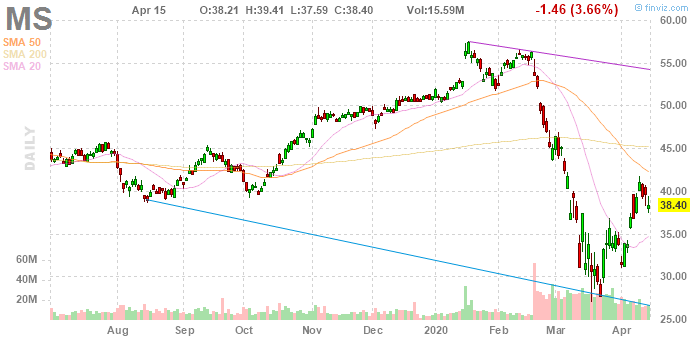
Morgan Stanley (MS) reported Q1 FY 2020 earnings of $1.01 per share (versus $1.33 per share in Q1 FY 2019), missing analysts' consensus estimate of $1.11 per share.
The company's quarterly revenues amounted to $9.487 bln (-7.8% y/y), missing analysts' consensus estimate of $9.816 bln.
MS fell to $38.00 (-1.04%) in pre-market trading.
FXStreet reports that economists at MUFG Bank note the Canadian dollar weakened sharply yesterday as it was hit by double whammy from lower oil prices and further BoC monetary easing. It helped to lift USD/CAD back above the 1.4100-level.
“Governor Poloz attempted to draw a line between their asset purchases and so-called quantitative easing. Overall, it would suggest that the BoC is not seriously considering increasing the pace of federal government bond purchases. Nevertheless, the scale of the negative economic shock will keep the BoC under pressure to deliver further support measures.”
“The BoC did reveal that their analysis of alternative scenarios sees activity down 1-3% in Q1 and 15-30% lower in Q2 compared to the end of last year. In these circumstances, we maintain our bearish outlook for the Canadian dollar in the near-term.
“USD/CAD is likely to rise back towards the 1.4500-level.”
FXStreet reports that, while economists at TD Securities think jobless claims have likely passed their apex, they expect the level to remain extraordinarily high.
“We forecast a drop to 5.0mn from 6.6mn this week, but also flag risks to the upside as backlogs may give an additional boost to claims.”
“We estimate an extra 14.5 million claims relative to the previous trend over the last three weeks, equivalent to 8.8% of the labor force. That number will rise to 19.1mn, or 11.6% of the labor force if our forecast for the upcoming week is realized. “
“We are forecasting a sharp decline in the Philly Fed mfg index from -12.7 to -40 in April.”
“We also expect the sharp weakening in most of the economic data for March to be extended to housing starts and permits. Our 1200K forecast in starts for March implies a 25% decline.”
FXStreet reports that analysts at Credit Suisse note that AUD/USD posted a ‘bearish engulfing’ candlestick reversal to signal the broader downtrend may be resuming.
“AUD/USD saw a sharp rejection from the 61.8% retracement of the fall from December 2019 at 0.6451 as expected, completing a small intra-day top as well as a ‘bearish engulfing’ candlestick reversal to add weight to the view that the corrective rebound may now be over.”
“Support is initially seen at the 13-day and 21-day exponential averages at 0.6253/36, where we would expect to see a pause at first. Removal of here in due course would then see support move to 0.6221/20.”
“A break below 0.6195 is needed to confirm that the short - term risks have turned lower.”
“Resistance is at 0.6451/6487.”
FXStreet reports that FX Strategists at UOB Group do not rule out further gains in USD/JPY in the next weeks, although always within the broader consolidative range.
24-hour view: “We highlighted yesterday USD ‘could weaken further to 106.65 before a recovery can be expected’. However, USD rebounded from much higher level than anticipated as it staged a robust advance after touching 106.91. The recovery has gained considerable momentum and from here, barring a move below 107.20 (minor support at 107.45), USD could strengthen to 108.20. For today, the next resistance at 108.70 is unlikely to come into the picture.”
Next 1-3 weeks: “We noted yesterday that USD ‘is still under pressure but downward momentum has not improved by all that much and USD has to close below 106.65 before further weakness can be expected’. USD subsequently rebounded strongly and downward momentum has more or less dissipated. The recovery could extend higher but at this stage, any advance is viewed as part of a 107.00/109.00 range that we first indicated on Monday (13 Apr).”
- Says that shape of economic recovery is uncertain
- Downside risks to inflation outlook have increased
- Says Incoming economic data have started to show unprecedented falls
- Points to a large contraction in output in euro area
- ECB committed to do everything necessary within its mandate to fight crisis
- Recent policy actions have helped to improve conditions for funds
- Central banks have taken coordinated action to enhance provision of USD liquidity
- ECB has also agreed to swap line arrangements to provide euro liquidity
- Assessing further requests for euro-providing swap lines
FXStreet reports that the underperformance of the CNY against the basket of currencies is driven by a combination of stronger USD demand from importers and locals, and a temporary weaker CNY demand from foreigners, in the opinion of economists at HSBC Bank.
"Allowing flexibility in USD/CNY but also keeping CNY overvaluation in check is feasible as long as the EUR/USD holds its range around 1.10, in our view."
"The CNY's effective appreciation has slowed, probably due to importers' USD purchases, financial flows and the recent PBOC's monetary easing."
"If the USD is soft in the near-term, USD/CNY may drop below 7.0 sooner rather than later. But a two-way FX market is likely to be the new normal, as it best serves China's current macro-economic conditions."
Bloomberg reports that strategists at UBS Group AG predict that investor demand for Switzerland's currency, already trading at a five-year high, will increase as the country's economy will outperform others during the recession.
"Switzerland enters this recession with excellent credit quality, and its pandemic health situation is under control," UBS strategists Thomas Flury and Gaetan Peroux wrote in a note to clients. "Hence its economy should do relatively well in comparison to other regions."The economic impact of a further decline of the euro against the franc should be limited, as Swiss tourism and many export sectors are already suffering from a drop in activity.
Only at a level of 1.03 francs per euro would the economy face more serious consequences, UBS said. The currency pair currently trades at around 1.052 francs.
The Swiss National Bank said last month it sold francs more aggressively in the foreign exchange market to push back against the appreciation.
Given the likelihood of a further weakening of the euro, investors should hedge their exposure to the common currency, UBS suggested.
According to the report from Eurostat, in February 2020 - the month before COVID-19 containment measures began to be widely introduced by Member States - compared with January 2020, seasonally adjusted industrial production fell by 0.1% in the euro area and remained unchanged in the EU. Economists had expected a 0.2% decrease in the euro area. In January 2020, industrial production grew by 2.3% in the euro area and by 2.1% in the EU.
In February 2020 compared with February 2019, industrial production decreased by 1.9% in the euro area and by 1.3% in the EU. Economists had expected a 2.0% decrease in the euro area.
In the euro area in February 2020, compared with January 2020, production of durable consumer goods fell by 2.0% and capital goods by 1.5%, while production of both intermediate goods and non-durable consumer goods rose by 0.4% and energy by 0.7%. In the EU, production of durable consumer goods fell by 1.4% and capital goods by 1.2%, while production of both intermediate goods and non-durable consumer goods rose by 0.6% and energy by 1.0%.
In the euro area in February 2020, compared with February 2019, production of capital goods fell by 3.6%, energy by 2.2% and intermediate goods by 0.8%, while production of non-durable consumer goods rose by 0.1% and durable consumer goods by 0.9%. In the EU, production of capital goods fell by 3.1%, energy by 1.7% and intermediate goods by 0.2%, while production of non-durable consumer goods rose by 0.5% and durable consumer goods by 1.5%.
FXStreet reports that analysts at Westpac Institutional Bank expect next Monday's Consumers Price Index (CPI) release to show a 0.4% rise for the March quarter. NZD/USD trades at 0.5967.
"We expect a 0.4% rise in consumer prices for the March quarter, lifting the annual inflation rate to 2.1%."
"Our estimate is in line with market forecasts, and a touch below the 0.5% increase that the Reserve Bank expected in its February Monetary Policy Statement."
"We don't expect this release to be marketmoving, with markets more focused on how the lockdown progresses."
Reuters reports that Britain should ask for an extension to its post-Brexit transition period to ease uncertainty at a time when the world economy is being hammered by the coronavirus pandemic, the head of the International Monetary Fund said.
"It is tough as it is. Let's not make it any tougher," Kristalina Georgieva told BBC radio in comments broadcast.
"My advice would be to seek ways in which this element of uncertainty is reduced in the interests of everybody, of the UK, of the EU, the whole world."
The transition period is due to end on Dec. 31, and barriers to exports and imports will go up if a new trade agreement is not reached by then, a challenge which has been made harder by the coronavirus crisis.
Georgieva was speaking after the IMF warned on Tuesday that the world economy is heading for its steepest downturn this year since the Great Depression of the 1930s.
In her interview with the BBC, the IMF managing director praised the emergency measures taken by Britain's finance ministry and the Bank of England which she said had been taken "early" and were well-coordinated.
"That very strong package of measures is helping the UK, but given the UK's sizeable role in the world economy, it's actually helping everyone," Georgieva said.
CNBC reports that according to David Kelly, chief global strategist at JPMorgan Asset Mangement, East Asia could do better than other parts of the world as the coronavirus pandemic leaves many major economies virtually frozen.
"I think the overall outlook for East Asia is quite good relative to to other regions of the world … in economic terms and probably in market terms in the second half of 2020," Kelly told CNBC.
Global economic activity has plummeted as authorities implement extensive social distancing measures and lockdowns to stem the spread of the disease. But Kelly said places such as South Korea, Taiwan and Hong Kong have a better chance of "escaping from Covid-19 than Europe and the U.S. does."
The strategist also said China, where the virus was first reported late last year, is likely to keep reopening its economy as it takes a different approach from the West.
"It may be that while the U.S. and Western countries will shy away from achieving some sort of herd immunity and wait for a vaccine, it could be that China may soldier on with reopening the economy even if there's some rise in the case load and they will sort of struggle to try and dampen down that growth but not abandon this reopening of the economy," Kelly said.
Kelly also said he expects a "big drop" in second-quarter GDP for the United States, which saw a spike in coronavirus cases and shutdowns beginning in March. "I think first quarter GDP will now be negative in the U.S., but second quarter GDP could be down 20 to 25% in annualized rate," Kelly said. "A huge decline."
FXStreet reports that crude oil prices were under pressure as weak economic data weighed on sentiment, per ANZ Bank.
"Signs of deep US recession emerged with retail sales and factory output down sharply. However, the outlook looks grim with the New York Fed's manufacturing index falling to -78.2."
"Sentiment was helped after the IEA said that global oil demand will probably fall 9% in 2020 and that storage tanks will probably fill by mid-year."
"WTI prices regained some of the losses after news emerged of a US plan to pay producers to leave oil in the ground. The Energy Department has drafted plans to compensate companies for sitting on as much as 365mbbl of oil reserves."
"It's clear to the market that the recent OPEC+ supply agreement will only limit the worst of the damage that restrictions on people's movement is having on demand."
eFXdata reports that NAB Research discusses NZD/USD technical outlook and expects a test of 0.6180/6205 in the coming one to two weeks.
"The Base of the 2018/2019 downtrend channel at 0.6070/90 is giving way to the recent multi-week uptrend. A weekly close above 0.6070/90 will confirm a bullish multi-week bias. Range lows, prior to the aggressive March decline at 0.6180/6205 are an obvious next resistance level. Only a break above 0.6205 would target a retest of the key 2019/2020 pivot at 0.6450/80," NAB notes.
"We anticipate a further incremental rise in price and test of 0.6180/6205 in the coming one to two weeks," NAB adds.
According to the report from Federal Statistical Office (FSO), the Producer and Import Price Index fell in March 2020 by 0.3% compared with the previous month, reaching 99.4 points (December 2015 = 100). This decline is due in particular to lower prices for petroleum products. Compared with March 2019, the price level of the whole range of domestic and imported products fell by 2.7%.
In particular, lower prices for petroleum products were responsible for the decrease in the Producer Price Index compared with the previous month. Food products as well as motor vehicles and motor vehicle parts were cheaper. In contrast, increasing prices were observed for scrap.
The Import Price Index also registered lower prices compared with February 2020, particularly for petroleum products. Price decreases were also seen for petroleum and natural gas, wearing apparel, basic metals and semi-finished metal products, food products, textiles, other transport equipment, other parts and accessories for motor vehicles as well as leather and travel goods. In contrast, pome and stone fruits were more expensive.
During today's Asian trading, the US dollar rose against the euro and the yen.
However, the yen may rise may rise to 100 yen/$1 in the coming months, analysts in Tokyo said.
The ICE Dollar index, which shows the value of the dollar against six major world currencies, rose 0.31% from the previous day.
According to experts, the yen will benefit from large-scale monetary stimulus from the US Federal reserve, which affects the dollar.
"The yen may rise to 100 yen / $1 in the period from April to June, as US monetary policy puts pressure on the dollar and traders' attention is again focused on such fundamental factors as the fall in us Treasury yields," according to strategists at Citigroup Global.
The growth in demand for the dollar interrupted the rise of the yen last month, after the Japanese national currency rose to a three-year high of 101.19 yen/$1. The yen was strengthened by the demand for safe haven assets in the context of the pandemic.
According to the report from Federal Statistical Office (Destatis), the inflation rate in Germany, measured as the year-on-year change in the consumer price index, stood at +1.4% in March 2020. This means that the inflation rate was down (January and February 2020: +1.7%).
The prices of goods (total) rose by 1.3% from March 2019 to March 2020, which was below average. It was mainly due to a decrease of energy product prices by 0.9%. The sharpest decline was recorded for heating oil prices (-19.6%) due to the oil price slump in the world market observed since the beginning of the year. Consumers also benefited from lower motor fuel prices (-3.3%). Excluding heating oil and motor fuel prices, the inflation rate would have been +1.6% in March 2020.
The prices of services (total) were up 1.4% in March 2020 compared with March 2019. Net rents exclusive of heating expenses, which are important as they account for large part of household final consumption expenditure, rose by 1.5%.
Compared with February 2020, the consumer price index rose by 0.1% in March 2020. However, energy prices declined by 2.2%, especially prices of heating oil (-10.1%) and motor fuels (-4.7%). In contrast, seasonally higher prices had to be paid for clothing (+4.0%).
-
The total number of infections worldwide stands at around 2,056,055 and at least 134,178 people have died from the disease, according to the latest figures from Johns Hopkins University.
-
Singapore's health ministry said as of April 15, noon local time, there were 447 new cases of Covid-19 infection.
-
The International Monetary Fund said in it expects growth in Asia to stall at zero percent in 2020, calling it "the worst growth performance in almost 60 years."
-
Global cases: More than 2 million
-
Global deaths: At least 134,178
-
Most cases reported: United States (636,350), Spain (177,644), Italy (165,155), Germany (134,753), and France (134,582).
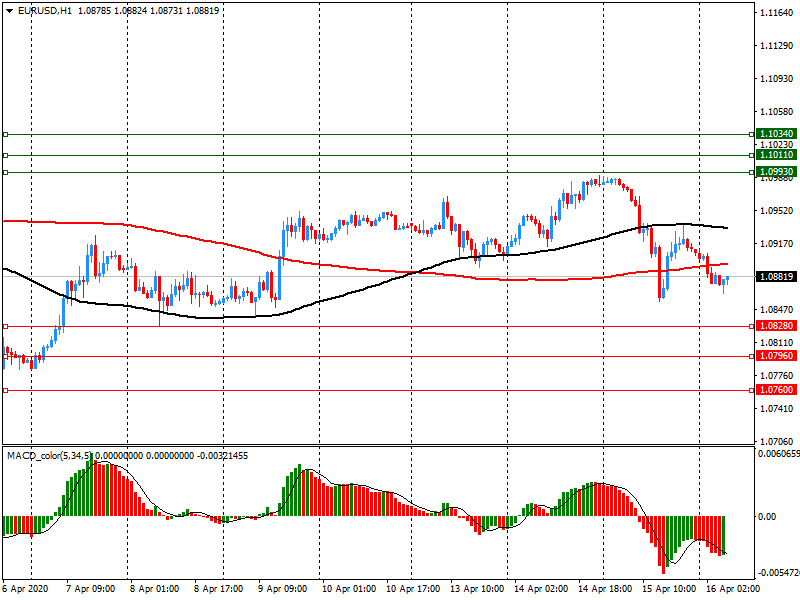
EUR/USD
Resistance levels (open interest**, contracts)
$1.1034 (839)
$1.1011 (679)
$1.0993 (322)
Price at time of writing this review: $1.0882
Support levels (open interest**, contracts):
$1.0828 (1711)
$1.0796 (1831)
$1.0760 (1817)
Comments:
- Overall open interest on the CALL options and PUT options with the expiration date May, 8 is 66950 contracts (according to data from April, 15) with the maximum number of contracts with strike price $1,1200 (3275);
GBP/USD
Resistance levels (open interest**, contracts)
$1.2763 (1657)
$1.2705 (956)
$1.2662 (575)
Price at time of writing this review: $1.2487
Support levels (open interest**, contracts):
$1.2394 (299)
$1.2325 (633)
$1.2246 (587)

Comments:
- Overall open interest on the CALL options with the expiration date May, 8 is 16070 contracts, with the maximum number of contracts with strike price $1,2700 (1657);
- Overall open interest on the PUT options with the expiration date May, 8 is 16245 contracts, with the maximum number of contracts with strike price $1,2850 (1073);
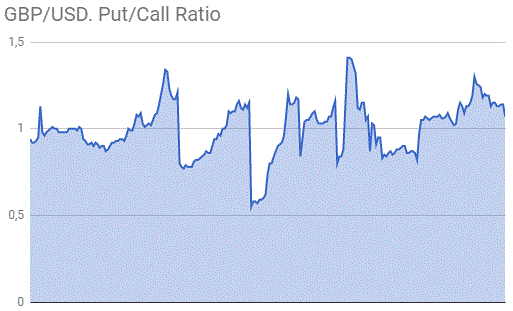
- The ratio of PUT/CALL was 1.01 versus 1.07 from the previous trading day according to data from April, 15
* - The Chicago Mercantile Exchange bulletin (CME) is used for the calculation.
** - Open interest takes into account the total number of option contracts that are open at the moment.
| Index | Change, points | Closed | Change, % |
|---|---|---|---|
| NIKKEI 225 | -88.72 | 19550.09 | -0.45 |
| Hang Seng | -290.06 | 24145.34 | -1.19 |
| ASX 200 | -21.4 | 5466.7 | -0.39 |
| FTSE 100 | -193.66 | 5597.65 | -3.34 |
| DAX | -416.8 | 10279.76 | -3.9 |
| CAC 40 | -170.19 | 4353.72 | -3.76 |
| Dow Jones | -445.41 | 23504.35 | -1.86 |
| S&P 500 | -62.7 | 2783.36 | -2.2 |
| NASDAQ Composite | -122.56 | 8393.18 | -1.44 |
| Time | Country | Event | Period | Previous value | Forecast |
|---|---|---|---|---|---|
| 01:00 | Australia | Consumer Inflation Expectation | April | 4% | |
| 01:30 | Australia | Changing the number of employed | March | 26.7 | -40 |
| 01:30 | Australia | Unemployment rate | March | 5.1% | 5.5% |
| 06:00 | Germany | CPI, m/m | March | 0.4% | 0.1% |
| 06:00 | Germany | CPI, y/y | March | 1.7% | 1.4% |
| 06:30 | Switzerland | Producer & Import Prices, y/y | March | -2.1% | |
| 09:00 | Eurozone | Industrial production, (MoM) | February | 2.3% | -0.2% |
| 09:00 | Eurozone | Industrial Production (YoY) | February | -1.9% | -2% |
| 12:30 | Canada | Manufacturing Shipments (MoM) | February | -0.2% | -0.1% |
| 12:30 | U.S. | Continuing Jobless Claims | April | 7455 | 14000 |
| 12:30 | U.S. | Philadelphia Fed Manufacturing Survey | April | -12.7 | -30 |
| 12:30 | U.S. | Housing Starts | March | 1.599 | 1.3 |
| 12:30 | U.S. | Building Permits | March | 1.452 | 1.3 |
| 12:30 | U.S. | Initial Jobless Claims | April | 6606 | 5100 |
| 13:30 | United Kingdom | MPC Member Tenreyro Speaks |
| Pare | Closed | Change, % |
|---|---|---|
| AUDUSD | 0.63205 | -1.86 |
| EURJPY | 117.067 | -0.48 |
| EURUSD | 1.09071 | -0.67 |
| GBPJPY | 134.447 | -0.57 |
| GBPUSD | 1.25227 | -0.78 |
| NZDUSD | 0.59914 | -1.86 |
| USDCAD | 1.41056 | 1.61 |
| USDCHF | 0.96455 | 0.48 |
| USDJPY | 107.32 | 0.19 |







© 2000-2026. All rights reserved.
This site is managed by Teletrade D.J. LLC 2351 LLC 2022 (Euro House, Richmond Hill Road, Kingstown, VC0100, St. Vincent and the Grenadines).
The information on this website is for informational purposes only and does not constitute any investment advice.
The company does not serve or provide services to customers who are residents of the US, Canada, Iran, The Democratic People's Republic of Korea, Yemen and FATF blacklisted countries.
Making transactions on financial markets with marginal financial instruments opens up wide possibilities and allows investors who are willing to take risks to earn high profits, carrying a potentially high risk of losses at the same time. Therefore you should responsibly approach the issue of choosing the appropriate investment strategy, taking the available resources into account, before starting trading.
Use of the information: full or partial use of materials from this website must always be referenced to TeleTrade as the source of information. Use of the materials on the Internet must be accompanied by a hyperlink to teletrade.org. Automatic import of materials and information from this website is prohibited.
Please contact our PR department if you have any questions or need assistance at pr@teletrade.global.


 Bank
Bank transfers


