- Analytics
- News and Tools
- Market News
CFD Markets News and Forecasts — 17-04-2020
On Monday, at 06:00 GMT, Germany will present the producer price index for March. At 08:00 GMT, the eurozone will announce a change in the balance of payments for February, and at 09:00 GMT, a change in the trade balance for February. At 10:00 GMT in Germany, the Bundesbank's monthly report will be released. At 12:30 GMT, Canada will report changes in wholesale trade for February, and the US will present the index of economic activity from the Chicago Fed for March.
On Tuesday. at 01:30 GMT in Australia, the RBA meeting's minutes will be released. At 06:00 GMT, Switzerland will announce a change in the foreign trade balance for March. Also at 06:00 GMT, UK will report changes in the number of applications for unemployment benefits for March, as well as the unemployment rate and average earnings for February. At 09:00 GMT, Germany and the eurozone will publish the ZEW Economic Sentiment for April. At 12:30 GMT Canada will report the change of volume of retail sales for February. At 14:00 GMT, the US will announce changes in existing home sales for March.
On Wednesday. At 00:30 GMT, Australia will publish the index of leading economic indicators from MI for March. At 06:00 GMT, UK will release the consumer price index, retail price index, producer price index and new home price index for March. At 13:00 GMT, the US will present the house price index for February. At 14:00 GMT, the eurozone will publish a consumer confidence indicator for April. At 14:30 GMT in the US, the Department of energy will release a report on changes in oil reserves.
On Thursday, at 00:30 GMT, Japan will present the manufacturing PMI and the service PMI for April. At 06:00 GMT, Germany will release the Gfk consumer climate index for may. Also at 06:00 GMT, UK will announce a change in the net amount of public sector debt for March. Then the focus will be on manufacturing PMI and services PMI for April: at 07:15 GMT, France will report, at 07:30 GMT - Germany, at 08: 00 GMT-the Eurozone, and at 08:30 GMT - UK. At 10:00 GMT, UK will release the balance of industrial orders according to the CBI for April. At 12:30 GMT, the US will announce a change in the number of initial applications for unemployment benefits. At 13:45 GMT the US will publish the manufacturing PMI and services PMI for April. At 14:00 GMT, the US will report changes in the new home sales for March. At 23:30 GMT, Japan will publish the consumer price index for March.
On Friday, at 04:30 GMT, Japan will release the index of activity in all sectors of the economy for February. At 06:00 GMT, UK will announce a change in retail sales for March. At 08:00 GMT, Germany will publish the IFO business environment indicator, the IFO current situation assessment indicator, and the IFO economic expectations indicator for April. At 12:30 GMT, the US will report a change in the volume of orders for long-term goods for March. At 13:00 GMT, Belgium will present the business sentiment index for April. At 14: 00 GMT, the US will release the Reuters/Michigan Consumer Sentiment Index for April. At 17:00 GMT the US will release a Baker Hughes report on the number of active oil rigs.
FXStreet notes that S&P 500 is up 19% from 19 March. The rally has undoubtedly been helped by a flattening out of the curve of new corona cases globally and previously unheard-of measures from authorities to ease the default risk burden further, per Nordea.
“Profit estimates have, not surprisingly, continued to get downgraded and S&P 500 is now expected to have -12% EPS growth in 2020 according to Bloomberg. The downgrade process is far from over, in our view.”
“Macro indicators point to a risk of a 30 to 60% drop in earnings for 2020.”
“The current S&P 500 forward P/E of 19.5 is in all likelihood a major understatement of the actual P/E ratio. The equity market is far from recessionary cheap.”
The Conference Board announced on Friday its Leading Economic Index (LEI) for the U.S. declined 6.7 percent m-o-m in March to 104.2 (2016 = 100), following a downwardly revised 0.2 percent m-o-m fall in February (originally a 0.1 percent m-o-m advance).
Economists had forecast a drop of 7.0 percent m-o-m.
"In March, the US LEI registered the largest decline in its 60-year history," noted Ataman Ozyildirim, Senior Director of Economic Research at The Conference Board. "The unprecedented and sudden deterioration was broad based, with the largest negative contributions coming from initial claims for unemployment insurance and stock prices. The sharp drop in the LEI reflects the sudden halting in business activity as a result of the global pandemic and suggests the US economy will be facing a very deep contraction."
The report also revealed the Conference Board Coincident Economic Index (CEI) for the U.S. dropped 0.9 percent m-o-m in March to 106.6, following a 0.3 percent m-o-m advance in February. Meanwhile, its Lagging Economic Index (LAG) for the U.S. rose 1.2 percent m-o-m in March to 110.2, following a 0.3 percent m-o-m gain in February.
- Banks must address serious strain on their operational capacity for handling surge in loan demand
- IMF sees a V-shaped recovery for the global economy but there is a huge amount of uncertainty
- IMF meetings have shown clear commitment to do what's necessary
- Large and small companies will need new equity
- MPC will set out its view very clearly in May on how much scarring UK economy faces
FXStreet reports that analysts at Standard Chartered Bank note that China’s economy contracted for the first time in over four decades due to the coronavirus-inflicted slowdown.
“GDP contracted 6.8% y/y in Q1 versus growth of 6% in Q4 (Figure 1). However, economic activity improved in March, with the decline in industrial production narrowing to 1.1% y/y from 13.5% y/y in January-February.”
“We now expect quarterly GDP growth of 3.0% y/y in Q2-2020 (4% prior), 6.0% in Q3 (5%), and 6.1% in Q4 (5.5%). Our growth forecast for 2020 remains unchanged at 2.5%.”
“We upgrade our 2021 GDP growth forecast to 7.5% from 5.8% prior, as we estimate growth of 18% y/y in Q1-2021 due to favourable base effects.”
“We maintain our expectation for another 80bps of cuts in the reserve requirement ratio (RRR) in Q2-Q3, a 25bps cut to the benchmark deposit rate in Q2, and another 10bps cut in the medium-term lending facility (MLF) rate in Q3.”
- We should just write off the second quarter
- Economic data is very ugly reflecting shutdown in activity, furloughs and layoffs
- Fed is working to help markets function and support businesses so they can be ready when economy reopens
- Fed is trying to limit the economic damage
- Getting back to work has to be done very carefully
FXStreet reports that analysts at ABN Amro note the GDP figures showed that the Chinese economy contracted for the first time since China started publishing quarterly figures in 1992.
“Real GDP contracted by 6.8% YoY, and that was even more than consensus expectations including ours. On a quarterly basis, the economy shrank by 9.8% in Q1.”
“We still expect the Chinese economy to show a rebound in the second quarter as the economy gradually normalises, but the strength of that recovery will be constrained by the collapse in global growth and trade that will hit China’s exports and related industrial activity. All in all, downside risks to our 2020 annual growth forecast of 3.0% have risen.”
U.S. stock-index futures rose on Friday after the U.S. President Donald Trump laid out plans to reopen the country's economy and media reported that Gilead Sciences' drug showed some effectiveness in treating the coronavirus.
Global Stocks:
| Index/commodity | Last | Today's Change, points | Today's Change, % |
| Nikkei | 19,897.26 | +607.06 | +3.15% |
| Hang Seng | 24,380.00 | +373.55 | +1.56% |
| Shanghai | 2,838.49 | +18.56 | +0.66% |
| S&P/ASX | 5,487.50 | +71.20 | +1.31% |
| FTSE | 5,802.32 | +173.89 | +3.09% |
| CAC | 4,519.86 | +169.70 | +3.90% |
| DAX | 10,659.87 | +358.33 | +3.48% |
| Crude oil | $17.89 | | -9.96% |
| Gold | $1,719.40 | | -0.71% |
FXStreet notes that the EU leaders are due to hold a video conference on April 23 to discuss a way forward. The outlook for EUR/USD is likely to be complicated by Eurozone specific factors, according to Rabobank
“While the USD can be expected to give up ground on risk-on days, overall we expect it could be some months before the safe-haven USD trends lower. For EUR/USD the outlook is complicated by the political risk that has started to simmer in the Eurozone.”
“Currently we are forecasting a dip to EUR/USD 1.05 on a 3 month view, but politics will remain key for the outlook for the EUR.”
(company / ticker / price / change ($/%) / volume)
| 3M Co | MMM | 147.4 | 2.50(1.73%) | 8435 |
| ALCOA INC. | AA | 7.25 | 0.29(4.17%) | 70364 |
| ALTRIA GROUP INC. | MO | 41.39 | 0.99(2.45%) | 11267 |
| Amazon.com Inc., NASDAQ | AMZN | 2,372.70 | -35.49(-1.47%) | 134997 |
| American Express Co | AXP | 86.2 | 4.85(5.96%) | 35500 |
| AMERICAN INTERNATIONAL GROUP | AIG | 24.5 | 1.32(5.69%) | 6941 |
| Apple Inc. | AAPL | 285.75 | -0.94(-0.33%) | 1378039 |
| AT&T Inc | T | 31.03 | 0.87(2.88%) | 185847 |
| Boeing Co | BA | 149.1 | 14.86(11.07%) | 1192674 |
| Caterpillar Inc | CAT | 114.8 | 2.61(2.33%) | 20470 |
| Chevron Corp | CVX | 81.84 | 1.85(2.31%) | 84666 |
| Cisco Systems Inc | CSCO | 42.4 | 0.90(2.17%) | 108724 |
| Citigroup Inc., NYSE | C | 43.2 | 2.68(6.61%) | 304310 |
| E. I. du Pont de Nemours and Co | DD | 37.99 | 1.77(4.89%) | 1880 |
| Exxon Mobil Corp | XOM | 39.85 | 0.70(1.79%) | 274749 |
| Facebook, Inc. | FB | 179.8 | 3.55(2.01%) | 158335 |
| FedEx Corporation, NYSE | FDX | 121.2 | 2.12(1.78%) | 17751 |
| Ford Motor Co. | F | 5.15 | 0.21(4.25%) | 810700 |
| Freeport-McMoRan Copper & Gold Inc., NYSE | FCX | 7.97 | 0.39(5.15%) | 113904 |
| General Electric Co | GE | 6.66 | 0.42(6.73%) | 2063151 |
| General Motors Company, NYSE | GM | 22.1 | 1.23(5.89%) | 45103 |
| Goldman Sachs | GS | 184 | 6.96(3.93%) | 37664 |
| Google Inc. | GOOG | 1,288.00 | 24.53(1.94%) | 14086 |
| Hewlett-Packard Co. | HPQ | 15.59 | 0.35(2.30%) | 11546 |
| Home Depot Inc | HD | 210 | 10.15(5.08%) | 26264 |
| HONEYWELL INTERNATIONAL INC. | HON | 137.62 | 5.29(4.00%) | 1198 |
| Intel Corp | INTC | 62.5 | 1.71(2.81%) | 101194 |
| International Business Machines Co... | IBM | 119 | 3.27(2.83%) | 15793 |
| International Paper Company | IP | 31.5 | 1.03(3.38%) | 2161 |
| Johnson & Johnson | JNJ | 152 | 2.33(1.56%) | 27437 |
| JPMorgan Chase and Co | JPM | 92.6 | 5.27(6.03%) | 399334 |
| McDonald's Corp | MCD | 185.99 | 6.49(3.62%) | 16279 |
| Merck & Co Inc | MRK | 84.02 | 1.02(1.23%) | 13604 |
| Microsoft Corp | MSFT | 180.2 | 3.16(1.78%) | 475826 |
| Nike | NKE | 89 | 2.70(3.13%) | 183611 |
| Pfizer Inc | PFE | 36.53 | 0.65(1.81%) | 34131 |
| Procter & Gamble Co | PG | 121.8 | 0.30(0.25%) | 315215 |
| Starbucks Corporation, NASDAQ | SBUX | 77.3 | 3.79(5.16%) | 59640 |
| Tesla Motors, Inc., NASDAQ | TSLA | 770 | 24.79(3.33%) | 360448 |
| The Coca-Cola Co | KO | 48.25 | 1.15(2.44%) | 35395 |
| Travelers Companies Inc | TRV | 104.88 | 5.07(5.08%) | 5093 |
| Twitter, Inc., NYSE | TWTR | 27.2 | 0.65(2.45%) | 132023 |
| UnitedHealth Group Inc | UNH | 305 | 6.57(2.20%) | 7207 |
| Verizon Communications Inc | VZ | 57.93 | 0.27(0.46%) | 42174 |
| Visa | V | 170.6 | 8.18(5.04%) | 130737 |
| Wal-Mart Stores Inc | WMT | 130.8 | -1.53(-1.16%) | 37667 |
| Walt Disney Co | DIS | 108.25 | 6.23(6.11%) | 244792 |
| Yandex N.V., NASDAQ | YNDX | 35.86 | 0.89(2.55%) | 21987 |
Netflix (NFLX) target raised to $500 from $450 at BMO Capital Markets
Apple (AAPL) downgraded to Sell from Neutral at Goldman; target lowered to $233
FedEx (FDX) downgraded to Equal Weight from Overweight at Barclays; target $135
- German economy can achieve growth of 5% in 2021
- I'm optimistic but we've got some tough days ahead
- It may take quite awhile before people want to be in crowds again, so it may take longer to get through period once rules are relaxed
- We have seen a significant improvement in liquidity and market function
- Don't see economy back to full strength by year-end
| Time | Country | Event | Period | Previous value | Forecast | Actual |
|---|---|---|---|---|---|---|
| 04:30 | Japan | Industrial Production (MoM) | February | 1.9% | 0.4% | -0.3% |
| 04:30 | Japan | Industrial Production (YoY) | February | -2.4% | -4.7% | -5.7% |
| 09:00 | Eurozone | Construction Output, y/y | February | 6.9% | -0.9% | |
| 09:00 | Eurozone | Harmonized CPI ex EFAT, Y/Y | March | 1.2% | 1% | 1% |
| 09:00 | Eurozone | Harmonized CPI | March | 0.2% | 0.5% | 0.5% |
| 09:00 | Eurozone | Harmonized CPI, Y/Y | March | 1.2% | 0.7% | 0.7% |
GBP traded mixed against its major rivals in the European session on Friday after the UK's government extended the lockdown for "at least" three weeks. The pound rose against USD, fell against AUD and NZD, and changed little against EUR, JPY, CHF and CAD.
The UK's Foreign Secretary Dominic Raab, who is deputizing for PM Boris Johnson while he recovers from COVID-19, announced that the lockdown restrictions in the UK would continue for "at least" another three weeks as experts still couldn't be sure the coronavirus epidemic had peaked. "We're now at both a delicate and dangerous phase in this pandemic," Raab noted at a news conference. Lifting the lockdown, he said, would, "risk all the progress we've made. Now is not the moment to give the coronavirus a second chance."
Meanwhile, the UK's health minister Matt Hancock announced that Britain had expanded the COVID-19 testing program. "I can today expand eligibility for testing to the police, the fire service, prison staff, critical local authority staff, the judiciary, and DWP (Department of Work and Pensions) staff who need it," Hancock told a parliamentary committee.
Comments from the UK's officials that rule out any extension of trade negotiations with the EU beyond 2020 also remained in investors' focus. The UK PM Johnson's spokesman stated on Thursday the government would not ask for an extension to the transition period. "Extending the transition would simply prolong the negotiations, prolong business uncertainty and delay the moment of control of our borders," the PM's official spokesman said. "It would also keep us bound by EU legislation at a point when we need legislative and economic flexibility to manage the U.K. response to the coronavirus pandemic."
- Work is taking place to prepare for relaxing of restrictions
- But for now, the public message is focused on staying at home
- UK still not using full capacity on coronavirus testing
Strategists at ING note that French President Emmanuel Macron has stressed the need for debt sharing in order to deal with the Covid-19 crisis and keep the EU project alive.
"In his “moment of truth” speech, French President Emmanuel Macron further underscored the need for debt mutualisation (coronabonds) in order to deal with the Covid-19 crisis and keep the EU project sustainably and credibly alive. "
"Still, opposition from northern EU states remains in place and the bar is set high for a solution to be agreed at the EU leaders video conference call next Thursday."
"Even without a coronabond, our economists expect the EU to continue muddling through and eventually come up with a face-saving solution."
"This in our view should prevent any large risk premia being built into the euro during the current Covid-19 crisis and risk premia driven euro downside (even with the help of the European Central Bank, which should soften the BTP´s downside via the ECB’s Pandemic Emergency Purchase Programme)."
"We thus continue to see higher EUR/USD into the summer months as the Federal Reserve's large balance sheet expansion weighs on the dollar."
Procter & Gamble (PG) reported Q3 FY 2020 earnings of $1.17 per share (versus $1.06 per share in Q3 FY 2019), beating analysts' consensus estimate of $1.13 per share.
The company's quarterly revenues amounted to $17.214 bln (+4.6% y/y), generally in line with analysts' consensus estimate of $17.293 bln.
The company also lowered guidance for FY 2020, projecting revenues of +3-4% y/y to $69.8-70.4 bln versus analysts' consensus estimate of $70.42 bln. That was down from prior guidance of +4-5% y/y.
PG rose to $123.15 (+1.36%) in pre-market trading.

- Says OPEC+ deal needs time to have full effect on the oil market
- Still expects the deal to have an effect on oil prices
- Closely monitoring the oil market
Iris Pang, ING's Chief Economist, notes that China’s GDP went into deep contraction in 1Q20, and signs of a recovery in activity are mixed.
"GDP contracted 6.8% year-on-year in 1Q20, the last time we saw such a big contraction was back in 1967 when China saw the economy shrink -5.8% during the Cultural Revolution. The contraction this time is a result of city lockdowns and strict social distancing measures but the comparison provides us with a sense of how big an impact Covid-19 has had."
"Fixed asset investments contracted 16.1%YoY in 1Q20 but rose 6.05%YoY in March."
"According to the National Bureau of Statistics, there were many items that experienced a slower contraction in Jan-Mar compared to in Jan-Feb. That means there are signs of some growth in investment in March. But it is still too soon to gauge the effectiveness of stimulus measures on investment."
"Industrial production shrank 8.4%YoY in 1Q20 but shows signs of heading back to recovery in March as the shrinkage narrowed to 1.1%YoY during that month."
"Retail sales in March fell 15.8%YoY after falling 19.0%YoY in Jan-Feb. Retail sales show some improvement in terms of the variety of spending. It was not just food and medicine as in Jan-Feb, but also telecommunication equipment (+6.5%YoY), which is most likely purchases of smartphones."
"Monetary easing and fiscal stimulus will certainly continue."
"We expect a 20bp cut in the 1Y Loan Prime Rate on 20 April. Apart from that, there will be more targeted RRR cuts, which should focus on inclusive finance so that SMEs, which are employers of many workers, can get loans from banks."
"We have downgraded China’ GDP growth further to -3.1%YoY in 2Q20, -0.5%YoY in 3Q20 and 4.5%YoY in 4Q20. 2020 full-year growth is projected at -1.5%."
"USD/CNY has been affected by the changes of cases and death tolls of Covid-19 globally. We are revising the yuan to depreciate less than in our previous forecasts to USD/CNY at 7.15, 7.0 and 6.9 by end of 2Q, 3Q and 4Q20, respectively."
That represents a 2.9% increase and brings the total to 188,068.
The latest daily death toll was not immediately made available.
Bloomberg reports that Bundesbank President Jens Weidmann praised euro-area governments for providing "significant, impressive" spending in the fight against the coronavirus, but warned that they'll need to tighten their budgets once the emergency has passed.
The German central banker told Bloomberg in an interview by email that the economy will need broad support for some time. He also argued that "the pandemic plainly shows how important a solid fiscal policy is."
"An extremely expansionary fiscal stance cannot be sustained permanently," he said. "Going forward, then, all countries will have to focus on reducing the very high debt ratios and ensuring acceptance in the capital markets, and to do this in a way that is compatible with our fiscal rules."
The comments strike at the heart of the debate over how Europe should handle the aftermath of the coronavirus, with governments across the 19-nation bloc pledging hundreds of billions of euros to support small businesses and compensate for lost wages.
"It is not yet possible to say for sure whether the measures taken to date will be enough," said Weidmannl. "Monetary policy is making a major and important contribution within the scope of its mandate, and will continue to play its role."
According to the report from Eurostat, in February 2020 - the month before COVID-19 containment measures began to be widely introduced by Member States - compared with January 2020, seasonally adjusted production in the construction sector fell by 1.5% in the euro area and by 1.0% in the EU. In January 2020, production in construction increased by 4.0% in the euro area and by 3.4% in the EU. In February 2020 compared with February 2019, production in construction decreased by 0.9% in both the euro area and the EU.
In the euro area in February 2020, compared with January 2020, civil engineering decreased by 1.6% and building construction by 1.4%. In the EU, civil engineering decreased by 1.0% and building construction by 0.9%.
In the euro area in February 2020, compared with February 2019 building construction decreased by 1.9% while civil engineering increased by 4.0%. In the EU building construction decreased by 1.7% while civil engineering increased by 3.5%.
According to the report from Eurostat, the euro area annual inflation rate was 0.7% in March 2020, down from 1.2% in February. A year earlier, the rate was 1.4%. European Union annual inflation was 1.2% in March 2020, down from 1.6% in February. A year earlier, the rate was 1.6%.
The lowest annual rates were registered in Spain, Italy, Cyprus and Portugal (all 0.1%). The highest annual rates were recorded in Hungary, Poland (both 3.9%) and Czechia (3.6%). Compared with February, annual inflation fell in twenty-six Member States and rose in one.
In March, the highest contribution to the annual euro area inflation rate came from services (+0.60 percentage points, pp), followed by food, alcohol & tobacco (+0.46 pp), non-energy industrial goods (+0.13 pp) and energy (-0.45 pp).
FXStreet reports that there is no doubt that the Covid pandemic will lead to a short but deep world recession. However, the effect on inflation is unclear, Louis Boisset from BNP Paribas informs.
"In the short-term, many observers expect disinflationary bias, due to the drop in demand; the decline in non-food commodity prices; open economies may have enough inventory to meet the demand."
"The medium-term inflation outlook is more ambiguous, one of the main questions is to know which one between the demand and supply shock is dominant."
"When the health measures will get lifted, inflation can surge given the remaining constraints on supply. The acceleration of the shortening process of global value chains may trigger an increase in production costs and a subsequent increase in inflation."
"From the supply side, this crisis will for sure lead to bankruptcies and a higher level of unemployed people but, unlike wars or natural disasters, the current situation could not result in equivalent destruction of production capacity. From the demand side, precautionary behaviors and a still high level of uncertainties could have a lasting negative effect on private demand, and thus on inflation dynamics."
FXStreet reports that EUR/CHF stays directly offered below the 55-day moving average at 1.0604, a negative bias is entrenched below here, as Commerzbank's Karen Jones notes.
"The market has eroded the 1.0524 March low, it has not sustained the initial break and we may see further consolidation near-term ahead of a slide lower."
"Below the 1.0509 low lies the 1.0250/35 area, made up of a long term Fibo and the April 2015 low."
"Only a close above the 55-day ma will alleviate downside pressure and will target the 1.0812 September low."
Bloomberg reports that according to Morgan Stanley, most Asian economies will suffer their biggest blow from coronavirus containment measures in the second quarter of the year, even as the worst seems to have passed already for China.
Asia excluding Japan will see two consecutive quarters of contraction -- the technical definition of a recession -- as lockdowns and social-distancing norms are still being tightened or extended in countries where infections have yet to peak, economists including Deyi Tan wrote in a note.
For example, India, Malaysia, and the Philippines have extended lockdowns in their countries, Indonesia has expanded social-distancing norms to the greater Jakarta area and Singapore has stepped up enforcement of its "circuit-breaker" measures over the past two weeks.
Economic output in Asia ex-Japan will shrink by 1% in the second quarter, Morgan Stanley estimates, projecting that nine of 10 economies it tracks in the region will contract from April to June. If China is removed from the calculation too, the region's economies will shrink 3.8% in the second quarter, the bank estimates.
China, which suffered its first contraction in decades in the first quarter, will grow by 1.5% in the second quarter, the report said.
According to the report from European Automobile Manufacturers Association (ACEA), In March 2020, the EU passenger car market recorded a dramatic drop (-55.1%) in registrations of new vehicles as a result of the COVID-19 outbreak. With containment/lockdown measures taking hold in most markets from around the middle of the month, the vast majority of European dealerships were closed during the second half of March. Consequently, demand across the region fell by more than half last month, dropping from 1,264,569 units registered in March 2019 to 567,308 units.
All 27 EU markets contracted in March, but Italy took the biggest hit, with registrations falling by 85.4% to 28,326 new cars (compared to 194,302 units in March 2019). Likewise, demand also collapsed in France (-72.2%) and Spain (-69.3%) last month. Germany recorded a less extreme drop than the other key markets, but registrations fell by 37.7% nevertheless.
From January to March 2020, demand for new cars in the European Union1 declined by 25.6%, with the impact of the corona crisis on March figures weighing heavily on the total. Each of the major EU markets posted significant losses so far in 2020: Italy -35.5%, France -34.1%, Spain -31% and Germany -20.3%.
FXStreet reports that FX Strategists at UOB Group noted EUR/USD is seen sticking to the rangebound theme for the time being.
24-hour view: "Yesterday, we were of the view that 'the overall risk has shifted to the downside but oversold conditions could 'limit' any further decline to 1.0815'. Our expectation was not wrong as EUR dropped to 1.0816 during NY hours before rebounding. Downward momentum is beginning to ease but it is too soon to expect a sustained recovery. From here, EUR could drift lower but any weakness is viewed as part of a 1.0805/1.0905 range (a clear break below 1.0805 is unlikely)."
Next 1-3 weeks: "After the relatively strong advance in EUR on Tuesday (14 Apr), we noted yesterday (15 Apr, spot at 1.0980) that 'upward momentum is showing sign of picking up but at this stage, it is premature to expect the start of a sustained advance'. We added, 'only a NY closing above 1.1030 would increase the odds for EUR to move towards the late-March peak of 1.1146'. However, we did not anticipate the sudden turnaround that sent EUR tumbling to an overnight low of 1.0855. Upward momentum has fizzled out and the overall outlook is mixed. From here, EUR could continue to trade in an undecided manner within the 1.0750/1.1000 range that we first indicated last Wednesday (08 Apr, spot at 1.0890)."
| Time | Country | Event | Period | Previous value | Forecast | Actual |
|---|---|---|---|---|---|---|
| 02:00 | China | Retail Sales y/y | March | -20.5% | -10% | -15.8% |
| 02:00 | China | Industrial Production y/y | March | -13.5% | -7.3% | -1.1% |
| 02:00 | China | Fixed Asset Investment | March | -24.5% | -15.1% | -16.1% |
| 02:00 | China | GDP y/y | Quarter I | 6% | -6.5% | -6.8% |
| 04:30 | Japan | Tertiary Industry Index | February | 0.3% | -0.5% | |
| 04:30 | Japan | Industrial Production (MoM) | February | 1.9% | 0.4% | -0.3% |
| 04:30 | Japan | Industrial Production (YoY) | February | -2.4% | -4.7% | -5.7% |
The US dollar declined against the euro and yen. Some weakening of the dollar may contribute to the information that the US plans to gradually return the economy to normal. This is likely to support investors' appetite for risk, experts say.
US President Donald Trump said on Thursday that, despite the difficult epidemiological situation, it is time to restart the sectors of the American economy that were suspended to contain the spread of COVID-19 coronavirus infection.
The Chinese yuan is stable against the US currency after the publication of data on the first fall in the country's GDP since 1992. According to the State statistical office, China's GDP collapsed in the first quarter of 2020 by 6.8% in annual terms. The consensus forecast of experts provided for a drop in Chinese GDP in January-March by 6.5%.
The sharp decline reflects the severe damage caused to the Chinese economy by the COVID-19 coronavirus outbreak and restrictions imposed by the country's authorities to curb its spread. Now the Chinese government needs to take measures to support the economy in the face of increased unemployment and social instability, while trying to keep the debt load and financial risks under control, experts say.
The State statistical office, however, notes that the long-term growth potential of the Chinese economy remains unchanged, despite the short-term decline caused by COVID-19.
The ICE index, which tracks the dynamics of the us dollar against six currencies (Euro, Swiss franc, yen, canadian dollar, pound sterling and Swedish Krona), fell by 0.15%
eFXdata reports that Nordea Research discusses the USD outlook and flags a scope for a 15% decline over the coming year.
"We have talked about the prospects of a materially weaker USD, once we are out of this Corona mess for some weeks in a row now. And on some metrics, it could look like the price dynamics have started to change for the USD. Everyone and their mother will get all the USD liquidity they need from the Fed, which could turn out to be a material gamechanger for the USD," Nordea notes.
"We don't rule out a >15% weakening of the USD over the coming year. The Fed has teed up a pretty remarkable trend-shift should relative central bank balance sheets start to matter for EUR/USD spot again. In any case we think it makes sense to start considering an increase of USD hedge ratios to shield against the risk of a materially weaker USD," Nordea adds.
CNBC reports that Gita Gopinath, chief economist at the International Monetary Fund, said that global economic activity, which has been hit by the coronavirus pandemic, may not fully recover even by the end of 2021.
"We have a recovery projected for 2021 of 5.8% growth, but that is a partial recovery," she told CNBC.
"So even by the end of 2021, we're expecting level of economic activity to be below what we had projected before the virus," she added.
The fast-spreading coronavirus, which has infected more than 2 million people globally, has led authorities to shut schools and businesses - bringing much of the world's economic activity to a halt.
Governments and central banks around the world have stepped in with measures to help businesses and households to survive the crisis - a response that Gopinath said has been "aggressive" and "rapid."
"I think if you compare that to the global financial crisis ... the response has been just that much speedier and the scale of it has been that much bigger," she said, noting that economies around the world have announced about $8 trillion worth of fiscal stimulus.
But she also said that the amount of stimulus is not "equally distributed" across economies, with around $7 trillion coming from G-20 countries.
Marketwatch reports that the White House unveiled new guidelines for states and localities on lifting coronavirus-related restrictions on citizens and businesses, as President Trump looks to bring the nation's focus toward reigniting an economy battered by efforts to stop the spread of COVID-19.
The protocols, titled "Opening Up America Again," do not suggest a time frame for when states should lift restrictions, as the president had suggested they might earlier this week. "Governors will be empowered to tailor an approach that meets the diverse circumstances of their own state," Trump said during a press conference Thursday evening.
The White House proposed a list of six metrics states should "satisfy before preceding to a phased opening."
RTTNews reports that according to the report from National Bureau of Statistics, China's gross domestic product was down a seasonally adjusted 9.8 percent on quarter in the first quarter of 2020. That was in line with expectations following the 1.5 percent gain in the three months prior.
On a yearly basis, GDP sank 6.8 percent - missing expectations for a drop of 6.0 percent following the 6.0 percent increase in the previous three months.
The bureau also said that fixed asset investment tumbled an annual 16.1 percent in March, shy of forecasts for a decline of 15.0 percent following the 24.5 percent plunge in February.
Industrial production dipped 1.1 percent on year, beating forecasts for a fall of 5.8 percent after dropping 13.5 percent in the previous month.
Retail sales plunged 15.8 percent on year, missing forecasts for a fall of 10.0 percent after skidding 20.5 percent a month earlier.
-
CNBC said that Singapore reported 728 new cases as of noon on April 16, yet another daily record high this week and drastically higher than the previous high of 447 reported for Wednesday.
-
Global cases: More than 2.15 million
-
Global deaths: At least 144,243
-
Most cases reported: United States (671,331), Spain (184,948), Italy (168,941), France (147,091), and Germany (137,698).
EUR/USD
Resistance levels (open interest**, contracts)
$1.1004 (785)
$1.0974 (679)
$1.0949 (322)
Price at time of writing this review: $1.0869
Support levels (open interest**, contracts):
$1.0822 (1304)
$1.0807 (1165)
$1.0788 (1740)
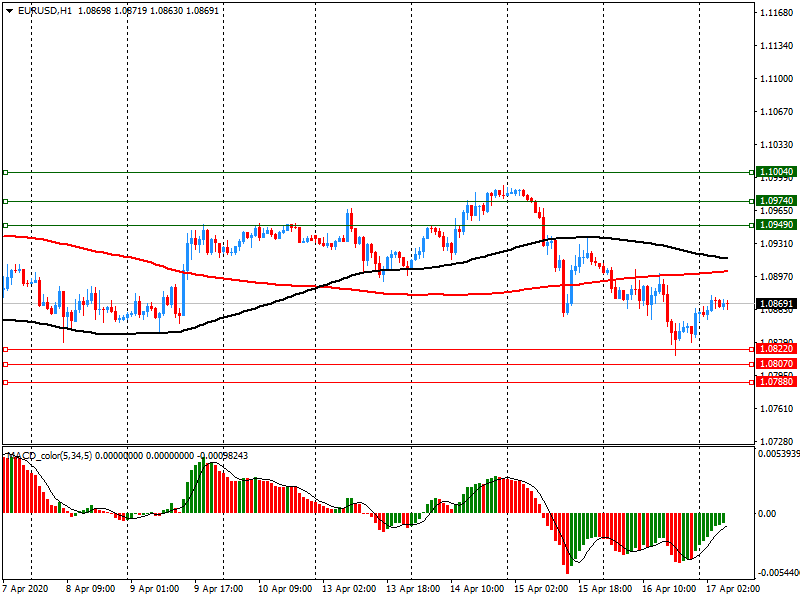
Comments:
- Overall open interest on the CALL options and PUT options with the expiration date May, 8 is 67732 contracts (according to data from April, 16) with the maximum number of contracts with strike price $1,1200 (3496);
GBP/USD
Resistance levels (open interest**, contracts)
$1.2739 (1656)
$1.2668 (955)
$1.2612 (613)
Price at time of writing this review: $1.2489
Support levels (open interest**, contracts):
$1.2423 (679)
$1.2394 (262)
$1.2350 (344)
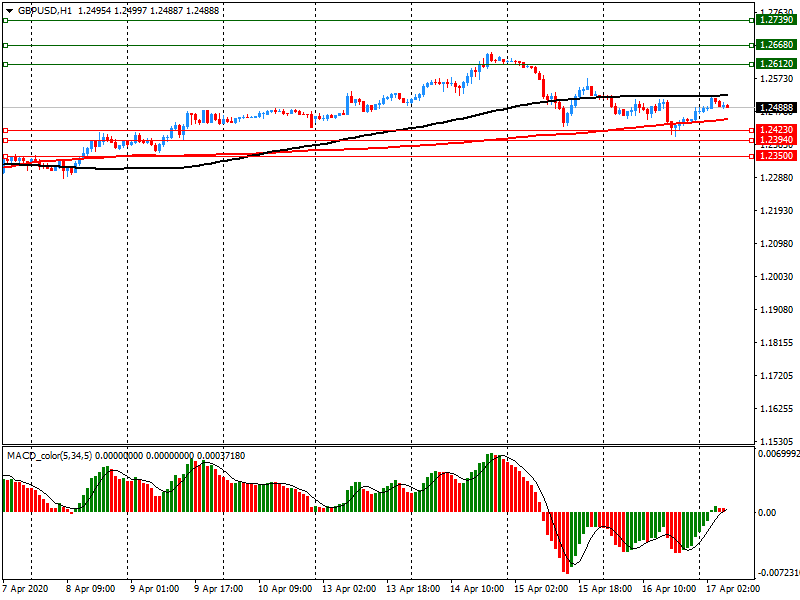
Comments:
- Overall open interest on the CALL options with the expiration date May, 8 is 16170 contracts, with the maximum number of contracts with strike price $1,2700 (1656);
- Overall open interest on the PUT options with the expiration date May, 8 is 16509 contracts, with the maximum number of contracts with strike price $1,2850 (1073);
- The ratio of PUT/CALL was 1.02 versus 1.01 from the previous trading day according to data from April, 16
* - The Chicago Mercantile Exchange bulletin (CME) is used for the calculation.
** - Open interest takes into account the total number of option contracts that are open at the moment.
| Raw materials | Closed | Change, % |
|---|---|---|
| Brent | 27.3 | 1.3 |
| WTI | 19.18 | -2.24 |
| Silver | 15.48 | 0.32 |
| Gold | 1717.716 | 0.08 |
| Palladium | 2153.82 | -0.36 |
| Index | Change, points | Closed | Change, % |
|---|---|---|---|
| NIKKEI 225 | -259.89 | 19290.2 | -1.33 |
| Hang Seng | -138.89 | 24006.45 | -0.58 |
| KOSPI | -0.01 | 1857.07 | -0 |
| ASX 200 | -50.4 | 5416.3 | -0.92 |
| FTSE 100 | 30.78 | 5628.43 | 0.55 |
| DAX | 21.78 | 10301.54 | 0.21 |
| CAC 40 | -3.56 | 4350.16 | -0.08 |
| Dow Jones | 33.33 | 23537.68 | 0.14 |
| S&P 500 | 16.19 | 2799.55 | 0.58 |
| NASDAQ Composite | 139.18 | 8532.36 | 1.66 |
| Time | Country | Event | Period | Previous value | Forecast |
|---|---|---|---|---|---|
| 02:00 | China | Retail Sales y/y | March | -20.5% | -10% |
| 02:00 | China | Industrial Production y/y | March | -13.5% | -7.3% |
| 02:00 | China | Fixed Asset Investment | March | -24.5% | -15.1% |
| 02:00 | China | GDP y/y | Quarter I | 6% | -6.5% |
| 04:30 | Japan | Tertiary Industry Index | February | 0.8% | |
| 04:30 | Japan | Industrial Production (MoM) | February | 1% | 0.4% |
| 04:30 | Japan | Industrial Production (YoY) | February | -2.3% | -4.7% |
| 09:00 | Eurozone | Construction Output, y/y | February | 6% | |
| 09:00 | Eurozone | Harmonized CPI ex EFAT, Y/Y | March | 1.2% | 1% |
| 09:00 | Eurozone | Harmonized CPI | March | 0.2% | 0.5% |
| 09:00 | Eurozone | Harmonized CPI, Y/Y | March | 1.2% | 0.7% |
| 12:30 | Canada | Foreign Securities Purchases | February | 17.01 | |
| 14:00 | U.S. | Leading Indicators | March | 0.1% | -7% |
| 17:00 | U.S. | Baker Hughes Oil Rig Count | April | 504 |
| Pare | Closed | Change, % |
|---|---|---|
| AUDUSD | 0.63558 | 0.56 |
| EURJPY | 117.305 | 0.2 |
| EURUSD | 1.08595 | -0.43 |
| GBPJPY | 134.811 | 0.27 |
| GBPUSD | 1.2479 | -0.35 |
| NZDUSD | 0.59948 | 0.06 |
| USDCAD | 1.40135 | -0.65 |
| USDCHF | 0.96817 | 0.37 |
| USDJPY | 108.022 | 0.65 |







© 2000-2026. All rights reserved.
This site is managed by Teletrade D.J. LLC 2351 LLC 2022 (Euro House, Richmond Hill Road, Kingstown, VC0100, St. Vincent and the Grenadines).
The information on this website is for informational purposes only and does not constitute any investment advice.
The company does not serve or provide services to customers who are residents of the US, Canada, Iran, The Democratic People's Republic of Korea, Yemen and FATF blacklisted countries.
Making transactions on financial markets with marginal financial instruments opens up wide possibilities and allows investors who are willing to take risks to earn high profits, carrying a potentially high risk of losses at the same time. Therefore you should responsibly approach the issue of choosing the appropriate investment strategy, taking the available resources into account, before starting trading.
Use of the information: full or partial use of materials from this website must always be referenced to TeleTrade as the source of information. Use of the materials on the Internet must be accompanied by a hyperlink to teletrade.org. Automatic import of materials and information from this website is prohibited.
Please contact our PR department if you have any questions or need assistance at pr@teletrade.global.


 Bank
Bank transfers


