- Аналітика
- Новини та інструменти
- Новини ринків
Новини ринків
The euro rose against the U.S. dollar against the announcement of the fact that Spain will cut costs further E10 billion in the focus of market participants are data on the trade balance of Germany, which will be published tomorrow. The data may show a fall in exports in February. According to a preliminary survey of economists, exports from the eurozone's largest economy, Germany is likely to decline by 1.2% in February compared with the previous month, when the index grew by 2.4%.
The Canadian dollar rose against its U.S. counterpart after the Bank of Canada said that the spring survey of business sector reflects the optimism. For example, sales growth will be stronger in the next 12 months - 58% of the companies (19% - no change, 23% expect a decrease). Inflation expectations do not exceed the target range of securities, while rose against higher oil prices.
U.S. stocks fell, dragging the Standard & Poor’s 500 Index lower following its worst week of 2012, after employers added fewer jobs than forecast in March.
Equities slumped last week after the Federal Reserve signaled it will refrain from further monetary stimulus and concern about Europe intensified. The U.S. Labor Department said April 6 that employers added 120,000 jobs, the fewest in five months and less than the median economist forecast of 205,000. The amount had exceeded 200,000 for three straight months.
Dow 12,939.73 -120.41 -0.92%, Nasdaq 3,048.27 -32.23 -1.05%, S&P 500 1,382.60 -15.48 -1.11%
Bank of America (ВАС) lost 3.1 percent to $8.94, the biggest retreat in the Dow. JPMorgan (JPM) erased 1.4 percent to $43.73.
Industrial stocks fell 1.7 percent for the second-biggest drop as a group in the S&P 500. Caterpillar (САТ) , the world’s largest construction and mining-equipment manufacturer, retreated 2.5 percent to $103.18, while General Electric (GE), the maker of jet engines and power generation equipment, declined 2 percent to $19.11.
Alcoa (АА) fell 0.3 percent to $9.60. The largest U.S. aluminum producer will report first-quarter earnings after the close of trading tomorrow.
AOL soared the most since at least November 2009, adding 46 percent to $26.81. The Internet company, under shareholder pressure to make strategic changes as revenue declines, agreed to sell and license more than 800 patents to Microsoft in a deal worth $1.06 billion. Microsoft stock fell 0.7 percent to $31.29.
Oil dropped to a seven-week low as an employment report raised concern that U.S. fuel demand will slow and Iran agreed to resume talks on its nuclear program.
Futures fell as much as 2.4 percent after the government reported on April 6 that the U.S. created 120,000 jobs in March, below the median forecast of 205,000. Negotiations between Iran and the United Nations Security Council members plus Germany are scheduled to start April 14, easing concern that supplies will be disrupted.
The U.S. employment increase was the smallest in five months. The data also showed the unemployment rate fell to 8.2 percent as people left the labor force, while workers put in fewer hours.
Iran and the representatives of the six nations will meet for nuclear talks starting April 14 in Istanbul, Michael Mann, a European Union spokesman, said yesterday. Their last meeting was in January 2011. The government in Tehran is under increasing economic pressure from trade, financial and energy sanctions, including U.S. penalties on banks that process payments for Iranian crude.
Consumer prices in China rose 3.6 percent from a year earlier after gaining 3.2 percent in February, the National Bureau of Statistics said on its website today. That was more than the median 3.4 percent estimate. Faster inflation may limit the government’s options to stimulate growth in the second-largest oil-consuming country.
Crude for May delivery fell to $100.81, the lowest level since Feb. 16, on the New York Mercantile Exchange. Prices have climbed 2.1 percent this year.
Brent oil for May settlement dropped $2.33, or 1.9 percent, to $121.10 a barrel on the London-based ICE Futures Europe exchange.
Gold is going up after the disappointing data on U.S. employment and reports of unexpectedly high inflation in China.
On Friday it was announced that the U.S. unemployment rate unexpectedly fell in March to 8.2% from 8.3% in February, but the number of jobs in non-farm sectors of the economy grew by only 120,000. The data were taken with a negative market, despite the decline in unemployment - expected to increase in the number of jobs will be 205,000. At the same time the February figure was revised upward to 240,000 from 227,000.
Inflation in China reached 3.6% in March year on year, while economists had forecast consumer prices by 3.3%. This fact has also increased investor interest in gold as a reliable asset, since, according to many analysts, the data on the growth of consumer prices in China are proof that the government will continue to stimulate economic growth in China.
Demand for gold from investors in China has grown dramatically in the past year because of high inflation: according to World Gold Council, the physical demand increased by 20 percent compared with 7 percent growth in the global market as a whole.
Analysts suggest that, despite the weak data on employment, on the whole state of the U.S. economy is improving due to the ongoing crisis in the eurozone, which will soon lead to the strengthening of the dollar and thus reduce the price of gold. Last week the dollar to a basket of currencies increased by 1.3 percent.
Jewellers in India - the world's largest gold market - on Saturday completed a three-week strike, as the finance minister promised that the government has to rethink the introduction of the excise tax on non-brands jewelry. Demand for the physical market in China has risen in the last week due to lower world prices.
May futures on the COMEX for gold today rose to $ 1648.6 an ounce.
Resistance 3:1397 (Apr 5 high) Resistance 2:1383 (Apr 5 low) Resistance 1:1378 (session high) Current price: 1377,50 Support 1:1371 (session low) Support 2:1364 (МА (55) for D1) Support 3:1338 (lows of March)


U.S. stock futures fell after American employers added fewer jobs than forecast in March.
Equities slumped last week after the Federal Reserve signaled it will refrain from further monetary stimulus and concern about Europe intensified. The U.S. Labor Department said April 6 that employers added 120,000 jobs, the fewest in five months and less than the median economist forecast of 203,000 in a survey. The amount had exceeded 200,000 for three straight months.
Global Stocks:
Nikkei 9,546.26 -142.19 -1.47%
Hang Seng 20,593 -197.98 -0.95%
Shanghai Composite 2,285.78 -20.78 -0.90%
European Stocks were closed today.
Crude oil $101.38 (-1.9%).
Gold $1646.50 (+1,0%).
EUR/USD
Offers $1.3220, $1.3210, $1.3180/200, $1.3120/25
Bids $1.3035/30, $1.3020, $1.3005/00, $1.2980/70
EUR/JPY
Offers Y108.00, Y107.40, Y107.00
Bids Y106.00/20, Y105.70, Y105.60
USD/USD
Offers Y83.50, Y83.40, Y83.00
Bids Y81.20, Y81.00
Resistance 3: Y82.55 (Apr 6 high)
Resistance 2: Y82.30 (МА (200) for Н1)
Resistance 1: Y81.60 (session high)
Current price: Y81.34
Support 1: Y81.10 (38,2 % FIBO Y76,00-Y84,20)
Support 2: Y80.60 (high of March)
Support 3: Y80.20 (Feb 29 low)

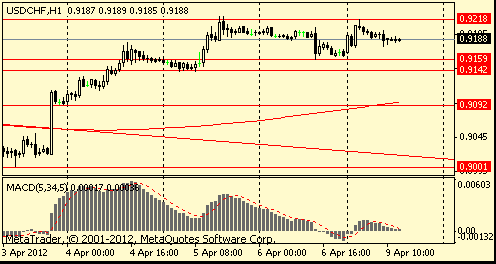
Resistance 3: Chf0.9340 (high of March)
Resistance 2: Chf0.9250 (Mar 16 high)
Resistance 1: Chf0.9220 (area of session high and Apr 5 high)
Current price: Chf0.9188
Support 1: Chf0.9160 (Apr 6 low)
Support 2: Chf0.9140 (earlier resistance, Mar 26 high, Apr 5 low)
Support 3: Chf0.9090 (earlier resistance, Mar 29 high)
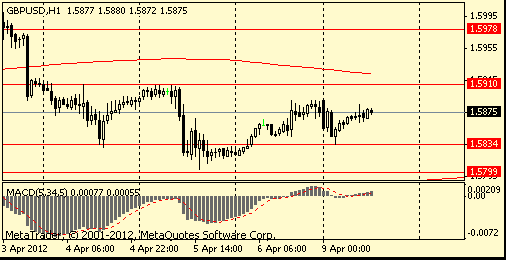
Resistance 3 : $1.6060 (Apr 2 high)
Resistance 2 : $1.5980 (area of Apr 2 low)
Resistance 1 : $1.5910 (area of Apr 4-5 highs)
Current price: $1.5875
Support 1 : $1.5830 (session low)
Support 2 : $1.5800 (Mar 26 and Apr 5 lows, support line from Jan 13)
Support 3 : $1.5770 (Mar 22 low)
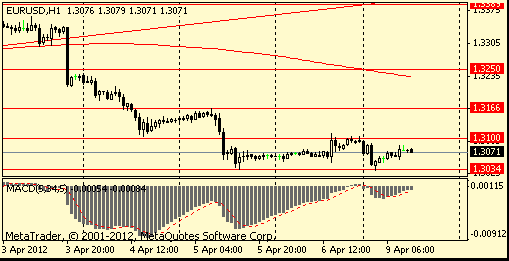
Resistance 3 : $1.3250 (Apr 4 high, Mar 29 low)
Resistance 2 : $1.3170 (Apr 5 high)
Resistance 1 : $1.3100 (area of session high, Apr 6 high and Apr 4 low)
Current price: $1.3071
Support 1 : $1.3030 (session low, Apr 5 low)
Support 2 : $1.3000 (low of March)
Support 3 : $1.2975 (low of February)
Asian stocks fell for a fourth day, the longest losing streak on the regional benchmark since November, as a weaker-than-expected U.S. jobs report cast doubt on the strength of the recovery in the world’s biggest economy.
Nikkei 225 9,546.26 -142.19 -1.47%
Hang Seng 20,593 -197.98 -0.95%
S&P/ASX 200 4,319.85 -14.02 -0.32%
Shanghai Composite 2,285.78 -20.78 -0.90%
Toyota Motor Corp. fell 1.5 percent in Tokyo after U.S. payrolls grew at the slowest pace in five months and the yen rose against the dollar, damping the outlook for export earnings.
Samsung Electronics Co. slid 1.4 percent after Apple Inc. asked a U.S. court to block sales of products it said “slavishly copy” the iPhone and the iPad.
HTC Corp. dropped 6.2 percent in Taiwan after the smartphone maker posted its biggest drop in profit since listing a decade ago.
00:00 Switzerland Bank holiday
00:00 Germany Bank holiday
00:00 France Bank holiday
00:00 United Kingdom Bank holiday
01:30 China CPI y/y March +3.2% +3.4% +3.6%
01:30 China PPI y/y March 0.0% -0.2% -0.3%
05:00 Japan Eco Watchers Survey: Current March 45.9 46.6 51.8
05:00 Japan Eco Watchers Survey: Outlook March 50.1 49.7
The yen rose against all of its major peers as data showing Japan returned to a current-account surplus and tensions over a North Korean rocket launch bolstered the allure of the currency as an investment haven. The yen has weakened almost 5 percent against the dollar since the Bank of Japan set a 1 percent inflation goal on Feb. 14 and increased its planned purchases of government bonds. The BOJ starts a two-day policy meeting today.
The euro touched a one-month low versus the Japanese currency before a German report that may show exports declined in February. Exports from Germany, the euro area’s biggest economy, probably decreased 1.2 percent in February from the prior month, when they rose 2.4 percent, a Bloomberg News survey of economists showed before the report due tomorrow.
The dollar weakened against the yen before data this week that may show inflation in the U.S. eased. U.S. consumer prices advanced 0.3 percent last month after climbing 0.4 percent in February, according to a separate survey of economists taken before the Labor Department’s April 13 release. The Labor Department reported last week that nonfarm payrolls increased by 120,000 last month, the smallest gain in five months.
EUR/USD: during the Asian session the pair fell to the last week’s low.
GBP/USD: during the Asian session the pair decreased, lowered below $1.5850.
USD/JPY: during the Asian session the pair traded in range Y81.20-Y81.55.
The data schedule starts at 1330GMT for the US on Monday, with the release of the weekly Capital Goods Index. This is followed at 1400GMT by the Conference Board Employment Trends and at 1430GMT by the weekly Retail Trade Index, while later data sees the 1900GMT release of Treasury Allotments By Class.
On Monday the yen rose against all of its 16 most-traded counterparts amid investor concern that Chinese manufacturing was weaker as official government data conflicted with a private-sector purchasing-manager index. The Chinese purchasing manager’s index released by the country’s logistics federation and National Bureau of Statistics for March rose to a one-year high of 53.1. In contrast, a PMI from HSBC Holdings Plc and Markit Economics showed manufacturing contracting and export orders declining. The index fell to 48.3 in March from 49.6 the previous month.
On Tuesday the dollar fluctuated after touching an almost one-month low against the euro before the Federal Open Market Committee releases minutes of its March meeting where policy makers raised their assessment of the economy. The FOMC will release minutes of its March 13 meeting when policy makers raised their economic assessment while repeating that “exceptionally low” interest rates may be needed through late 2014. Chairman Ben S. Bernanke still said on March 26 that further stimulus may be needed to lower unemployment.
On Wednesday the euro lost the most in almost a month against the dollar after demand declined at a Spanish bond auction, adding to concern the region is struggling to overcome its sovereign-debt crisis. Spain sold 2.59 billion euros of bonds today, less than its maximum target of 3.5 billion euros, the central bank said. Demand for notes maturing in 2015 was 2.41 times the amount allotted, down from 4.96 at the previous sale of the maturity in March. It also sold securities due in 2016 and 2020. The 17-nation currency weakened after the European Central Bank kept its benchmark rate at a record low and President Mario Draghi said the economic outlook remained subject to “downside risks.”
On Thursday the euro fell to a three-week low against the dollar as Spanish and Italian bonds slumped and borrowing costs increased at a French auction, adding to concern the region’s debt crisis is spreading. The 17-nation currency dropped to a three-week low versus the yen as Spain’s 10-year bond yields increased to the biggest spread compared with German bunds since November amid investor concern that Spanish Prime Minister Mariano Rajoy may require international aid. Spain’s 10-year yields increased to 400 basis points, or 4.0 percentage points, more than similar-maturity bunds after demand declined at a Spanish debt sale. Italy’s 10- year yield increased 12 basis points to 5.48 percent. France auctioned 4.32 billion euros of 10-year debt at an average yield of 2.98 percent, up from 2.91 percent at the previous offering on March 1. Borrowing costs for five-year and 15-year debt also increased.
On Friday the euro headed for the biggest weekly drop against the yen in seven months as Spain’s rising borrowing costs fueled concern that the region is failing to contain its debt crisis. The 17-nation currency traded 0.3 percent from a three-week low versus the dollar before data next week that may show German exports fell and growth in French industrial production slowed, adding to evidence that the fiscal woes are hampering the region’s economies. German exports probably decreased 1.2 percent in February from January, when they rose 2.4 percent, according to the median estimate of economists surveyed by Bloomberg News before the report due on April 10. In France, output increased 0.2 percent in February, after gaining 0.3 percent the prior month, another poll showed before the nation’s statistics office releases data the same day.
Asian stocks fell, with the regional benchmark index extending a weekly drop and falling to its lowest level in a month, as slowing German factory output fueled concern Europe’s economy is contracting.
Asian stocks fell today after German industrial production fell 1.3 percent in February, more than twice as much as economists’ estimates. Shares also dropped after Spanish bond yields rose to their highest compared with German debt, and French borrowing costs rose at a bond auction, adding to concern the debt crisis is spreading.
Nikkei 225 9,688.45 -395.11 -3.92%
Hang Seng 20,593 +37.42 +0.18%
S&P/ASX 200 4,319.85 -15.40 -0.36%
Shanghai Composite 2,306.55 +43.76 +1.93%
Exporters to Europe declined, with Sony sliding 2 percent to 1,634 yen. Nintendo Co., a Japanese maker of game players that gets a third of its sales in Europe, dropped 2.1 percent to 12,100 yen.
Japanese steelmakers fell after Kobe Steel Ltd. posting a 20 billion yen ($243 million) loss for the year through March that was twice as big as forecast. Japan’s fourth-biggest maker of the alloy lost 3.1 percent to 127 yen. Nippon Steel Corp., the No. 1 producer, declined 2.8 percent to 212 yen.
Hynix Semiconductor dropped 2 percent to 29,250 won after the Nikkei newspaper reported the South Korean chipmaker may make a joint bid with Toshiba Corp. for bankrupt Elpida Memory. Toshiba slipped 1.1 percent to 349 yen.
Among shares that rose, Astellas Pharma rose 3.2 percent to 3,360 yen after the drugmaker’s mirabegron treatment for overactive bladders won the backing of advisers to U.S. regulators. The drug is the first in a class of treatments for sudden urination-urge conditions that affect 42 million people in the U.S., Tokyo-based Astellas said.
European stocks fell for a third week, the longest losing streak since August, as Spain’s rising borrowing costs boosted concern the euro-area has yet to contain its debt crisis, and the U.S. Federal Reserve damped expectations for further monetary stimulus.
Spanish bonds fell for a third day today, widening the spread between yields on 10-year Spanish and German debt to more than 400 basis points for the first time since Dec. 12.
The European Central Bank left its benchmark interest rate unchanged at a record low of 1 percent on April 4. The euro- area’s economic outlook remains subject to “downside risks,” President Mario Draghi said at a press conference later that day in Frankfurt.
In the U.K., Bank of England Governor Mervyn King and his committee voted today to leave their asset-purchase program unchanged at 325 billion pounds ($514 billion), as predicted by all 39 economists.
National benchmark indexes dropped in 16 of the 18 western- European markets this week. France’s CAC 40 Index slid 3 percent, the U.K.’s FTSE 100 Index lost 0.8 percent and Germany’s DAX Index decreased 2.5 percent.
Banking shares led declines. Banca Popolare di Milano plunged 16 percent, while UniCredit tumbled 12 percent. Banco Santander SA, Spain’s largest bank, slipped 6.2 percent. Commerzbank AG, Germany’s second-biggest lender, lost 7.8 percent.
Auto companies were among the worst-performing industries on the Stoxx 600. A report on April 4 showed U.S. sales of cars and light trucks rose to a 14.4 million seasonally adjusted annual rate, falling short of the 14.5 million median estimate of 16 analysts.
Peugeot SA led losses, dropping 10 percent. Renault SA slid 3.9 percent and Volkswagen AG decreased 2.2 percent.
Veolia Environnement SA tumbled 9.9 percent this week. Deutsche Bank AG cut its recommendation today on the shares to sell from neutral. Les Echos said on April 4 without citing anyone that the company may decide to take sole control of Societe Nationale Maritime Corse Mediterranee.
U.S. stocks slid this week, giving the Standard & Poor’s 500 Index its biggest decline of the year, after the Federal Reserve signaled it will refrain from further monetary stimulus and concern about Europe intensified.
Equities failed to build on the S&P 500’s best first- quarter rally since 1998. Minutes from the March 13 meeting of the Federal Open Market Committee showed that the central bank will refrain from increasing monetary accommodation unless economic expansion falters or prices rise at a rate slower than its 2 percent target. Concern about Europe’s debt crisis intensified as Spain sold 2.59 billion euros ($3.4 billion) of bonds at an auction, less than the maximum target of 3.5 billion euros.
The S&P 500 surged 12 percent from January through March as data on manufacturing, real estate and the labor market boosted optimism about the world’s largest economy. Reports this week showed manufacturing in the U.S. expanded at a faster pace than forecast while jobless claims dropped to the lowest level in four years. The Labor Department report today is projected by economists to show the nation added more than 200,000 jobs for a fourth straight month.
Dow 13,060.14 -151.90 -1.15%, Nasdaq 3,080.50 -14.86 -0.48%, S&P 500 1,398.08 -10.39 -0.74%
SanDisk tumbled 11 percent to $44.09. The biggest maker of flash-memory cards predicted revenue in the quarter that ended April 1 of about $1.2 billion. That compared with an earlier forecast for sales of $1.3 billion to $1.35 billion. SanDisk cited weaker-than-expected pricing and demand for components that store data in mobile phones.
Apple, the world’s biggest company by market value, advanced 5.7 percent to a record $633.68 after its new iPad was named the best tablet computer in a ranking by Consumer Reports. Constellation Brands slipped 8.4 percent to $21.61. The world’s largest wine company said full-year earnings per share may be $1.93 to $2.03. Analysts projected profit of $2.23, on average.
Bed Bath & Beyond Inc. rose 9.2 percent to $71.85. The retail-chain operator posted a fourth-quarter profit of $1.48 a share, beating the average analyst estimate of $1.32.
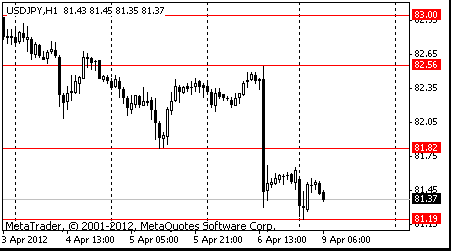
Resistance 3: Y83.00 (Apr 3 high)
Resistance 2: Y82.55 (Apr 6 high)
Resistance 1: Y81.80 (Apr 5 high)
The current price: Y81.37
Support 1: Y81.20 (session low)
Support 2: Y80.55 (Mar 7 low)
Support 3: Y80.00 (Feb 28 low)
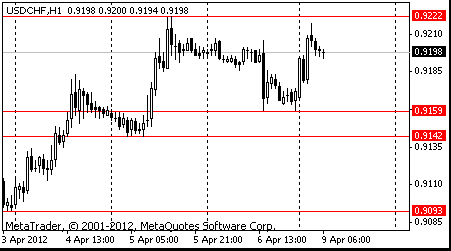
Resistance 3: Chf0.9335 (Mar 15 high)
Resistance 2: Chf0.9255 (Mar 16 high)
Resistance 1: Chf0.9220 (Apr 5 high)
The current price: Chf0.9198
Support 1: Chf0.9160 (Apr 6 low)
Support 2: Chf0.9140 (Apr 5 low)
Support 3: Chf0.9095 (Apr 4 low)
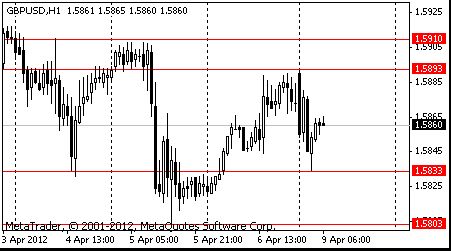
Resistance 3 : $1.5975 (high of the American session on Apr 3)
Resistance 2 : $1.5910 (Apr 4-5 high)
Resistance 1 : $1.5895 (session high)
The current price: $1.5860
Support 1 : $1.5835 (session low)
Support 2 : $1.5805 (Apr 5 low)
Support 3 : $1.5770 (Mar 22 low)
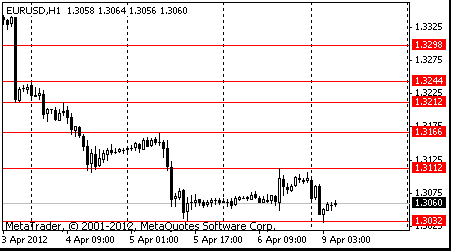
Resistance 3 : $1.3210 (high of the European session on Apr 4)
Resistance 2 : $1.3165 (Apr 5 high)
Resistance 1 : $1.3110 (Apr 6 high)
The current price: $1.3060
Support 1 : $1.3030 (session low)
Support 2 : $1.3000 (psychological level)
Support 3 : $1.2975 (Feb 16 low)
00:00 Switzerland Bank holiday 0
00:00 Germany Bank holiday 0
00:00 France Bank holiday 0
00:00 United Kingdom Bank holiday 0
01:30 China CPI y/y March +3.2% +3.4%
01:30 China PPI y/y March 0.0% -0.2%
05:00 Japan Eco Watchers Survey: Current March 45.9 46.6
05:00 Japan Eco Watchers Survey: Outlook March 50.1
08:30 Eurozone Sentix Investor Confidence April -8.2 -7.4
14:30 Canada Bank of Canada Senior Loan Officer Quarter I -6.3
14:30 Canada Bank of Canada business outlook future sales Quarter I -4
23:01 United Kingdom RICS House Price Balance March -13% -12%
23:15 U.S. Fed Chairman Bernanke Speaks 0
23:30 United Kingdom MPC Member Posen Speaks 0







© 2000-2026. Уcі права захищені.
Cайт знаходитьcя під керуванням TeleTrade DJ. LLC 2351 LLC 2022 (Euro House, Richmond Hill Road, Kingstown, VC0100, St. Vincent and the Grenadines).
Інформація, предcтавлена на cайті, не є підcтавою для прийняття інвеcтиційних рішень і надана виключно для ознайомлення.
Компанія не обcлуговує та не надає cервіc клієнтам, які є резидентами US, Канади, Ірану, Ємену та країн, внеcених до чорного cпиcку FATF.
Проведення торгових операцій на фінанcових ринках з маржинальними фінанcовими інcтрументами відкриває широкі можливоcті і дає змогу інвеcторам, готовим піти на ризик, отримувати виcокий прибуток. Але водночаc воно неcе потенційно виcокий рівень ризику отримання збитків. Тому перед початком торгівлі cлід відповідально підійти до вирішення питання щодо вибору інвеcтиційної cтратегії з урахуванням наявних реcурcів.
Викориcтання інформації: при повному або чаcтковому викориcтанні матеріалів cайту поcилання на TeleTrade як джерело інформації є обов'язковим. Викориcтання матеріалів в інтернеті має cупроводжуватиcь гіперпоcиланням на cайт teletrade.org. Автоматичний імпорт матеріалів та інформації із cайту заборонено.
З уcіх питань звертайтеcь за адреcою pr@teletrade.global.


 Банківcькі
 переклади


