- Analytics
- News and Tools
- Market News
Analytics, News, and Forecasts for CFD Markets: currency news — 01-03-2013.
The euro fell sharply against the dollar, dropping below the level at the time of $ 1.30, which was the first time in two months after a report published today showed that activity in the manufacturing sector continued to decline, while the unemployment rate has reached a record high. Note that the EU statistical agency Eurostat reported that the unemployment rate in the euro area in January was 11.9%. This is the highest value for the 17 countries in the currency bloc to start keeping statistics in 1995. Value is higher than the January December, which, after an upward revision was 11.8%. Meanwhile, according to preliminary data, Eurostat, annual inflation in the euro area in February was 1.8% versus 2.0% in January. This is the lowest level since August 2010. Inflation is currently below the target level of the European Central Bank, which is just below 2.0%. In addition, note that the single currency is now on his way to his fourth consecutive weekly decline against the dollar, which is the length of the strip loss since June.
The dollar index rose to its highest level since August, as the inability of the U.S. government to avoid automatic budget cuts, known as sequestration, encouraged investors to look for safer assets.
However, the euro to recover most of its losses against the dollar amid comments of U.S. President Obama. Obama said that until recently, tried to prevent the suspension of the government, as evidenced by his willingness to accept a program to reduce budget spending billions of dollars, which automatically goes into effect today, even though he did his best to prevent automatic spending cuts to save jobs place and avoid the negative effect on the economic recovery. Obama said that it was rebuffed congressional Republicans agree on a balanced budget by raising taxes on further spending cuts to avoid automatic sequestration. Obama also warned that the impact of automatic cuts would have a negative impact felt by ordinary citizens, and that will force Republicans to change their point of view.
The pound fell substantially after the data presented Markit, showed that the purchasing managers' index (PMI) for the manufacturing of Great Britain in February fell to 47.9, below the key 50 level that separates growth territory from the territory of contraction. Economists had expected a slight improvement to 51.0. Activity in the UK manufacturing sector declined in February, as the decreased amount of new foreign and domestic orders, and the company reduced staff at the fastest pace in more than three years. This renewed expectations that the Bank of England may resume quantitative easing program in one form or another, at its meeting on monetary policy, which will be held on Thursday.
Construction spending in the U.S. unexpectedly showed a significant decrease in the month of January, according to a report released by the Commerce Department on Friday.
The report said construction spending fell 2.1 percent to a seasonally adjusted annual rate of $883.3 billion in January from the revised December estimate of $902.6 billion.
The sharp drop in construction spending came as a surprise to economists, who had expected spending to increase by 0.6 percent.
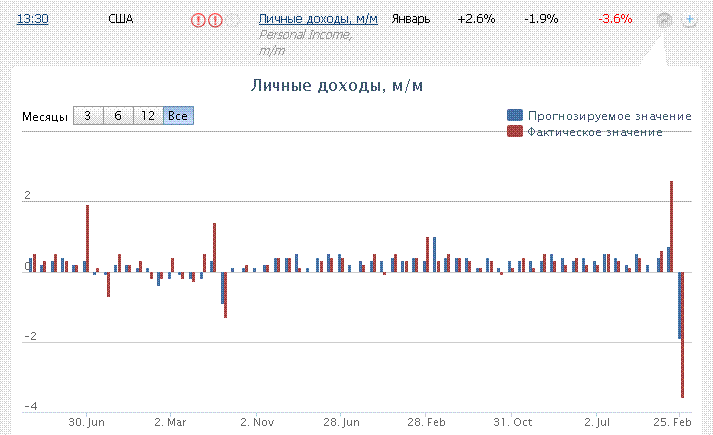
Personal income in the U.S. fell by more than anticipated in the month of January, according to a report released by the Commerce Department on Friday, although the report also showed that personal spending rose in line with estimates.
The report said personal income tumbled by 3.6 percent in January after surging up by 2.6 percent in December. Economists had been expecting income to pull back by about 2.1 percent.
At the same time, the Commerce Department said personal spending edged up by 0.2 percent in January after inching up by 0.1 percent in December. The increase in spending matched economists' expectations.
EUR/USD $1.3000, $1.3100, $1.3200, $1.3220, $1.3245
USD/JPY Y92.00, Y92.30, Y92.50, Y92.70, Y93.00
GBP/USD $1.5200, $1.5250, $1.5255, $1.5285
EUR/GBP stg0.8680
EUR/CHF Chf1.2250
AUD/USD $1.0200, $1.0230, $1.0275, $1.0300, $1.0350
EUR/USD
Offers $1.3160/65, $1.3130/40, $1.3120/25, $1.3100/05, $1.3050/55
Bids $1.2980/70, $1.2950
GBP/USD
Offers $1.5100, $1.5080
Bids $1.5010/00, $1.4980, $1.4965/60, $1.4950
AUD/USD
Offers $1.0315/20, $1.0290/00, $1.0280, $1.0260, $1.0240/45
Bids $1.0185/80, $1.0175, $1.0150, $1.0100, $1.0050
EUR/GBP
Offers stg0.8720/25, stg0.8695/700, stg0.8680/85
Bids stg0.8600, stg0.8575/70, stg0.8555/50, stg0.8520, stg0.8505/00
EUR/JPY
Offers Y122.50, Y122.00, Y121.75/80, Y121.50
Bids Y120.50, Y120.00, Y119.50, Y119.25/20
USD/JPY
Offers Y94.20/30, Y94.00, Y93.80, Y93.40/50
Bids Y92.60, Y92.30, Y92.00, Y91.80/75
Unemployment rate in Eurozone rose to a new record high in January, the latest figures from Eurostat showed Friday.
The seasonally adjusted unemployment rate rose to 11.9 percent in January from an upwardly revised 11.8 percent in December. Economists had forecast the rate to rise to 11.8 percent from December's originally estimated 11.7 percent rate.
The jobless rate in EU 27 rose to 10.8 percent from 10.7 percent in December.
Available data suggests that the highest unemployment rate was in Greece with 27 percent in November. Greece was followed by Spain and Portugal.
Spain had an unemployment rate of 26.2 percent in January, while Portugal reported an unemployment rate of 17.6 percent.
The lowest unemployment rate was recorded in Austria, followed by Germany, Luxembourg and the Netherlands.
Eurozone's manufacturing sector contracted at a slightly weaker pace than estimated earlier in February, final data released by Markit Economics showed Friday.
The seasonally adjusted purchasing managers' index (PMI) for the manufacturing sector came in at 47.9 in February, which was unchanged from January's 11-month high. The latest reading was slightly higher than 47.8 seen in the preliminary estimates. A PMI stayed below the no-change 50 mark - which separated growth from contraction -for the nineteenth successive month.
The modest easing of decline in activity partly reflects the stabilization of the German manufacturing sector and a an increase in activity in Ireland, which stayed at the top of the PMI league. However, all other member countries recorded contraction, with Italy, France, Spain and Greece recorded marked downturns.
Both production and new orders in the euro area manufacturing sector contracted further in February, although the rates of decline were less marked than signaled by the earlier flash estimates.
Employment fell for the thirteenth successive month, albeit at a slightly weaker pace than in the prior month. Input costs declined for the first time in six months, while factory gate prices were broadly unchanged.
EUR/USD $1.3000, $1.3100, $1.3200, $1.3220, $1.3245
USD/JPY Y92.00, Y92.30, Y92.50, Y92.70
GBP/USD $1.5200, $1.5250, $1.5255, $1.5285
EUR/GBP stg0.8680
EUR/CHF Chf1.2250
AUD/USD $1.0200, $1.0230, $1.0275, $1.0300, $1.0350
The euro fell against the dollar, registering with the first monthly decline since July, which was associated with the Italian political disputes about the formation of the government, as well as against decrease in the inflation rate in the euro area, which "opens the door" to stimulate the part of the central bank.
The euro also weakened against most other major currencies, after European Central Bank President Mario Draghi signaled that the ECB is not going to hold tighter monetary policy in the near future.
Note that the strengthening of the dollar did not prevent even the GDP data. A report published by the Ministry of Commerce, showing that GDP grew at an annual rate of 0.1 percent in the fourth quarter, compared with a 0.1 percent drop, which was originally reported. Economists had expected a more substantial revision to the consensus forecast of growth of 0.5 percent.
The pound was little changed in the course of trading, as the presented data showed that consumer confidence index from Gfk was -26 in February, unchanged from the previous month. Also note that this value is fully in line with economists' forecasts.
New Zealand's dollar strengthened against the U.S. dollar after the Reserve Bank of New Zealand said that business confidence rose this month to the level of 39.4, compared with 22.7 in the previous month.
The Canadian dollar fell for the first time in three days against the dollar, as data showed that the country's balance of payments deficit fell less than forecast, adding speculation that report will show that the economy contracted in December.
Note that the seasonally adjusted deficit of the balance of payments has decreased in the last quarter to the level of 17.26 billion Canadian dollars, while the data for the previous quarter, revised up to 1.04 billion Canadian dollars. Meanwhile, the Bureau of Statistics reported that the decline was the highest since Q3 2011. Also, the data showed that for the full year deficit of 66.94 billion Canadian dollars, the highest level since 2010.
Yen remains under pressure after Japanese Prime Minister Shinzo Abe nominated to head the Central Bank Harika Kuroda, currently headed by the Asian Development Bank. In an interview on February 11, Kuroda said he was in favor of additional incentive programs this year, and noted that the central bank has "significant opportunities for this."
01:00 China Manufacturing PMI February 50.4 50.5 50.1
01:00 U.S. FOMC Member Charles Evans Speaks
01:45 China HSBC Manufacturing PMI (Finally) February 52.3 52.3 50.4
05:30 Australia RBA Commodity prices, y/y February -6.4% -7.2%
The euro was poised for its longest stretch of weekly declines since June on prospects for lower interest rates in the region with data today forecast to confirm a manufacturing contraction worsened. An index based on a survey of purchasing managers in manufacturing in the 17-nation euro bloc fell to 47.8 in February, from 47.9 in January, London-based Markit Economics is forecast to say in a final reading, according to the median estimate of economists surveyed by Bloomberg News. Levels below 50 indicate contraction.
Europe’s common currency fell in February, snapping six months of gains, as European Central Bank President Mario Draghi said this week the bank is “far” from exiting stimulus measures. Draghi signaled at an event in Munich on Feb. 27 that the central bank has no intention of tightening monetary policy anytime soon, with inflation projected to “significantly” undershoot its 2 percent target next year.
The region’s inflation slowed in February, a report today is forecast to show, opening the door for more easing. The euro-area inflation rate slowed for a second month to 1.9 percent in February, according to a separate Bloomberg poll of analysts before today’s report. of analysts before today’s report. The ECB will probably maintain its benchmark interest rate at 0.75 percent next week, according to a Bloomberg survey.
The dollar and yen were set for weekly advances against most major peers amid concern automatic spending cuts in the U.S. will damp global growth, boosting demand for refuge assets.
The Australian dollar dipped briefly after two indexes of Chinese manufacturing indicated a slower-than-expected pace of expansion. The Purchasing Managers’ Index fell to 50.1 in February, the lowest since September, official data showed. The median estimate of economists surveyed by Bloomberg News was 50.5. A separate gauge from HSBC Holdings Plc and Markit Economics dropped to a four-month low of 50.4 from 52.3. Readings above 50 indicate expansion.
EUR/USD: during the Asian session, the pair rose, departing from the previous day's low.
GBP/USD: during the Asian session, the pair rose to $1.5180.
USD/JPY: during the Asian session, the pair traded in the range of Y92.45-75.
Germany retail sales due up at 0700GMT will provide the early interest, with EZ manufacturing PMI's to follow from 0813GMT (Spain) through to EZ PMI at 0858GMT. EZ CPI and jobs data at 1000GMT, with LTRO1/2 repayment the next interest at 1100GMT. UK manufacturing PMI due up at 0928GMT, ahead of money supply data at 0930GMT. First day of the new month and possible that euro-sterling month end demand could still be lurking.
(pare/closed(00:00 GMT +02:00)/change, %)
EUR/USD $1,3055 -0,64%
GBP/USD $1,5161 +0,03%
USD/CHF Chf0,9365 +0,76%
USD/JPY Y92,55 +0,35%
EUR/JPY Y120,83 -0,25%
GBP/JPY Y140,32 +0,37%
AUD/USD $1,0214 -0,19%
NZD/USD $0,8248 -0,33%
USD/CAD C$1,0305 +0,73%
01:00 China Manufacturing PMI February 50.4 50.5
01:00 U.S. FOMC Member Charles Evans Speaks
01:45 China HSBC Manufacturing PMI (Finally) February 52.3 52.3
05:30 Australia RBA Commodity prices, y/y February -6.4%
07:00 Germany Retail sales, real adjusted January -1.7% +1.1%
07:00 Germany Retail sales, real unadjusted, y/y January -4.7% -1.7%
07:00 United Kingdom Nationwide house price index February +0.5% +0.2%
07:00 United Kingdom Nationwide house price index, y/y February 0.0% -0.2%
08:30 Switzerland Manufacturing PMI February 52.5 52.2
08:50 France Manufacturing PMI (Finally) February 43.6 43.6
08:55 Germany Manufacturing PMI (Finally) February 50.1 50.1
09:00 Eurozone Manufacturing PMI (Finally) February 47.8 47.8
09:30 United Kingdom Purchasing Manager Index Manufacturing February 50.8 51.0
09:30 United Kingdom Net Lending to Individuals, bln January 1.7 1.1
09:30 United Kingdom Mortgage Approvals January 55.8 56.5
10:00 Eurozone Harmonized CPI, Y/Y (Preliminary) February +2.0% +2.0%
10:00 Eurozone Unemployment Rate January 11.7% 11.8%
13:30 U.S. PCE price index ex food, energy, m/m January 0.0% +0.1%
13:30 U.S. PCE price index ex food, energy, Y/Y January +1.4% +1.3%
13:30 U.S. Personal Income, m/m January +2.6% -1.9%
13:30 U.S. Personal spending January +0.2% +0.2%
13:30 Canada GDP (m/m) December +0.3% -0.1%
14:00 U.S. Manufacturing PMI (Finally) February 55.2 55.2
14:55 U.S. Reuters/Michigan Consumer Sentiment Index (Finally) February 76.3 76.3
15:00 U.S. Construction Spending, m/m January +0.9% +0.5%
15:00 U.S. ISM Manufacturing February 53.1 52.5







© 2000-2026. All rights reserved.
This site is managed by Teletrade D.J. LLC 2351 LLC 2022 (Euro House, Richmond Hill Road, Kingstown, VC0100, St. Vincent and the Grenadines).
The information on this website is for informational purposes only and does not constitute any investment advice.
The company does not serve or provide services to customers who are residents of the US, Canada, Iran, The Democratic People's Republic of Korea, Yemen and FATF blacklisted countries.
Making transactions on financial markets with marginal financial instruments opens up wide possibilities and allows investors who are willing to take risks to earn high profits, carrying a potentially high risk of losses at the same time. Therefore you should responsibly approach the issue of choosing the appropriate investment strategy, taking the available resources into account, before starting trading.
Use of the information: full or partial use of materials from this website must always be referenced to TeleTrade as the source of information. Use of the materials on the Internet must be accompanied by a hyperlink to teletrade.org. Automatic import of materials and information from this website is prohibited.
Please contact our PR department if you have any questions or need assistance at pr@teletrade.global.


 Bank
Bank transfers


