- Analytics
- News and Tools
- Market News
Analytics, News, and Forecasts for CFD Markets: currency news — 16-02-2018.
Consumer sentiment rose in early February to its second highest level since 2004 despite lower and much more volatile stock prices. Even among households in the top third of the income distribution, the Sentiment Index rose to 112.8, the highest level since the prior peak of 114.2 was repeatedly recorded in 2007, 2004, and 2000. Stock market gyrations were dominated by rising incomes, employment growth, and by net favorable perceptions of the tax reforms. Indeed, when asked to identify any recent economic news they had heard, negative references to stock prices were spontaneously cited by just 6% of all consumers. In contrast, favorable references to government policies were cited by 35% in February, unchanged from January, and the highest level recorded in more than a half century.
Privately-owned housing units authorized by building permits in January were at a seasonally adjusted annual rate of 1,396,000. This is 7.4 percent above the revised December rate of 1,300,000 and is 7.4 percent above the January 2017 rate of 1,300,000. Single-family authorizations in January were at a rate of 866,000; this is 1.7 percent below the revised December figure of 881,000. Authorizations of units in buildings with five units or more were at a rate of 479,000 in January. Privately-owned housing starts in January were at a seasonally adjusted annual rate of 1,326,000. This is 9.7 percent above the revised December estimate of 1,209,000 and is 7.3 percent above the January 2017 rate of 1,236,000. Single-family housing starts in January were at a rate of 877,000; this is 3.7 percent above the revised December figure of 846,000. The January rate for units in buildings with five units or more was 431,000.
Manufacturing sales declined 0.3% to $55.5 billion in December, following a revised increase of 3.8% in November. The decline was mainly the result of lower sales in the petroleum and coal products industry and the food manufacturing industry.
Overall, sales were down in 11 of 21 industries, representing 57.0% of the manufacturing sector. Sales of non-durable goods decreased 1.3%, while sales of durable goods rose 0.7%.
Once the effects of price changes are taken into account, manufacturing sales in volume terms edged down 0.1% in December.
The price index for U.S. imports rose 1.0 percent in January, after increases of 0.2 percent in December and 1.0 percent in November. The 1.0-percent advances were the largest 1-month rises since the index increased 1.2 percent in May 2016. Import prices advanced 3.6 percent between January 2017 and January 2018.
U.S. export prices increased 0.8 percent in January. The index has not risen by more than 0.8 percent since the index advanced 1.1 percent in May 2016. In January, the increase in nonagricultural prices more than offset a decline in agricultural prices. The price index for exports increased 3.4 percent over the past 12 months.
-
Says GDP up 0.4 pct q/q in q1, growth seen accelerating to 0.5 pct q/q in q2
In January 2018, the underlying pattern in retail sales, as suggested by the three-month on three-month measure, is one of slow growth with the quantity bought increasing by 0.1%; the lowest growth since April 2017.
The monthly growth rate for the quantity bought increased by 0.1% with declines across all main sectors except non-food stores.
When compared with January 2017, the quantity bought in January 2018 increased by 1.6%; a slowdown to year-on-year growth when compared with an increase of 2.4% in January 2017.
The main contribution to the year-on-year growth came from non-food stores, with sports equipment, games and toys increasing sales in the quantity bought in this sector by 10.9%.
EUR/USD
Resistance levels (open interest**, contracts)
$1.2627 (1759)
$1.2598 (5112)
$1.2573 (3749)
Price at time of writing this review: $1.2535
Support levels (open interest**, contracts):
$1.2454 (203)
$1.2403 (483)
$1.2365 (1059)
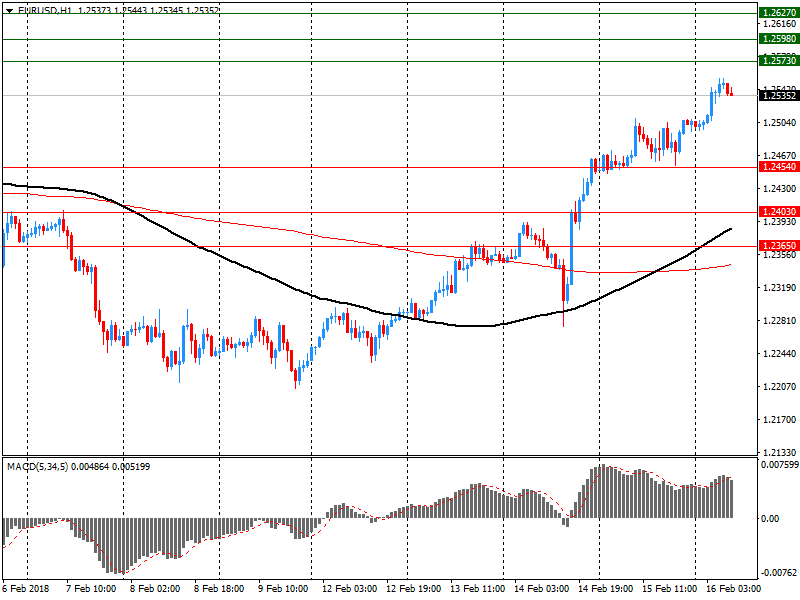
Comments:
- Overall open interest on the CALL options and PUT options with the expiration date March, 9 is 126551 contracts (according to data from February, 15) with the maximum number of contracts with strike price $1,2300 (5715);
GBP/USD
Resistance levels (open interest**, contracts)
$1.4245 (2806)
$1.4222 (2399)
$1.4185 (2508)
Price at time of writing this review: $1.4128
Support levels (open interest**, contracts):
$1.4041 (798)
$1.4007 (855)
$1.3961 (1572)
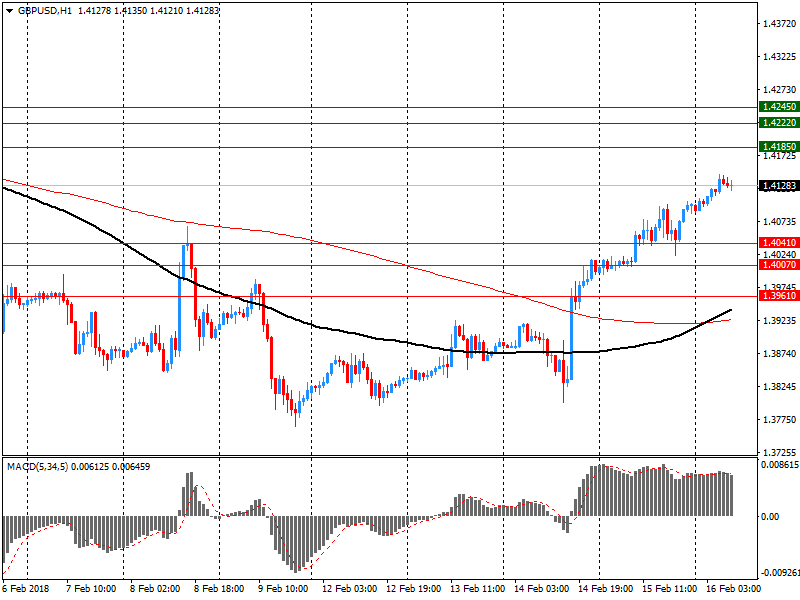
Comments:
- Overall open interest on the CALL options with the expiration date March, 9 is 47827 contracts, with the maximum number of contracts with strike price $1,3900 (3706);
- Overall open interest on the PUT options with the expiration date March, 9 is 44789 contracts, with the maximum number of contracts with strike price $1,3900 (2290);
- The ratio of PUT/CALL was 0.94 versus 0.95 from the previous trading day according to data from February, 15
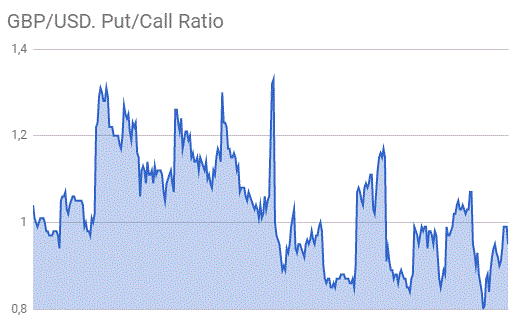
* - The Chicago Mercantile Exchange bulletin (CME) is used for the calculation.
** - Open interest takes into account the total number of option contracts that are open at the moment.
-
Board does not see a strong case for a near-term adjustment of monetary policy
-
Growth outlook has not been affected by the recent volatility in the equity market
-
We don't expect a repeat of these very strong employment outcomes in 2018
-
Economy has been moving in the right direction
-
The Australian labour market has been noticeably stronger than we were expecting
As reported by the Federal Statistical Office (Destatis), the selling prices in wholesale trade increased by 2.0% in January 2018 from the corresponding month of the preceding year. In December 2017 and in November 2017 the annual rates of change were +1.8% and +3.3%, respectively.
From December 2017 to January 2018 the index rose by 0.9%.







© 2000-2026. All rights reserved.
This site is managed by Teletrade D.J. LLC 2351 LLC 2022 (Euro House, Richmond Hill Road, Kingstown, VC0100, St. Vincent and the Grenadines).
The information on this website is for informational purposes only and does not constitute any investment advice.
The company does not serve or provide services to customers who are residents of the US, Canada, Iran, The Democratic People's Republic of Korea, Yemen and FATF blacklisted countries.
Making transactions on financial markets with marginal financial instruments opens up wide possibilities and allows investors who are willing to take risks to earn high profits, carrying a potentially high risk of losses at the same time. Therefore you should responsibly approach the issue of choosing the appropriate investment strategy, taking the available resources into account, before starting trading.
Use of the information: full or partial use of materials from this website must always be referenced to TeleTrade as the source of information. Use of the materials on the Internet must be accompanied by a hyperlink to teletrade.org. Automatic import of materials and information from this website is prohibited.
Please contact our PR department if you have any questions or need assistance at pr@teletrade.global.


 Bank
Bank transfers


