- Analytics
- News and Tools
- Market News
CFD Markets News and Forecasts — 03-11-2020
| Time | Country | Event | Period | Previous value | Forecast |
|---|---|---|---|---|---|
| 01:45 (GMT) | China | Markit/Caixin Services PMI | October | 54.8 | |
| 08:50 (GMT) | France | Services PMI | October | 47.5 | 46.5 |
| 08:55 (GMT) | Germany | Services PMI | October | 50.6 | 48.9 |
| 09:00 (GMT) | Eurozone | Services PMI | October | 48 | 46.2 |
| 09:30 (GMT) | United Kingdom | Purchasing Manager Index Services | October | 56.1 | 52.2 |
| 10:00 (GMT) | Eurozone | Producer Price Index, MoM | September | 0.1% | 0.3% |
| 10:00 (GMT) | Eurozone | Producer Price Index (YoY) | September | -2.5% | -2.4% |
| 13:15 (GMT) | U.S. | ADP Employment Report | October | 749 | |
| 13:30 (GMT) | Canada | Trade balance, billions | September | -2.45 | -2.6 |
| 13:30 (GMT) | U.S. | International Trade, bln | September | -67.1 | -63.9 |
| 14:45 (GMT) | U.S. | Services PMI | October | 54.6 | |
| 15:00 (GMT) | U.S. | ISM Non-Manufacturing | October | 57.8 | 57.5 |
| 15:30 (GMT) | U.S. | Crude Oil Inventories | October | 4.32 | 1.964 |
FXStreet notes that in October, the Mexican peso appreciated from 22.073 to 21.235. Notwithstanding, a combination of sluggish fiscal response to the pandemic, uncertainty over the health outlook and some controversial government’s policies will continue to weigh on economic recovery, limiting the pace of MXN appreciation expected ahead, per MUFG Bank.
“Some market analysts and the IMF have improved their GDP perspectives for this full year with a bounce-back in manufacturing driven by external demand, despite the weak domestic demand. But still, the perspectives are of a sharp contraction around 9%.”
“In early October, president Lopez Obrador announced an infrastructure plan to be developed with the private sector, totalling MXN297 B (USD14 B). However, an inefficient decision-making process, limited and unattractive opportunities and the president’s reluctance to open up the energy sector to more private participation, maintain low business confidence, thus dampening the economic outlook.”
“The path of the Mexican economy and particularly the Mexican Peso might also be influenced by the outcome of the US presidential elections, considering their strong inter-linkages. Regardless the winner, the end of political uncertainty with the election of the American president might lead to an immediate reaction of stronger Mexican peso and higher investor confidence."
- ECB's policymakers are debating whether to channel part of the upcoming stimulus via APP
The U.S.
Commerce Department reported on Tuesday that the value of new factory orders rose
1.1 percent m-o-m in September, following a revised 0.6 percent m-o-m advance in August (originally a 0.7 percent m-o-m increase). That marked the fifth consecutive month of gains in factory orders.
Economists had
forecast a 1.0 percent m-o-m increase.
According to
the report, orders for transportation equipment increased 4.1 percent m-o-m in September compared to a 0.9 percent m-o-m drop in August. Gains also occurred in fabricated
metal products (+1.2 percent m-o-m) and computers and electronic products (+0.6
percent m-o-m). These increases, however, were partially offset by a decline in new orders for machinery (-0.3 percent m-o-m).
Meanwhile, total factory orders excluding
transportation, a volatile part of the overall reading, rose 0.5 percent m-o-m
in September (compared to an upwardly revised 0.9 percent m-o-m surge in August),
while orders for nondefense capital goods excluding aircraft, a measure of
business spending plans, increased 1.0 percent m-o-m (compared to an upwardly revised 2.4 percent m-o-m surge in the
previous month). The report also showed that shipments of core
capital goods rose 0.5 percent m-o-m in September,
rather than gaining 0.3 percent m-o-m as previously reported.
Overall, durable goods orders rose 1.9 percent m-o-m in September, while orders for nondurable goods grew 0.3 percent m-o-m.
U.S. stock-index futures rose on Tuesday, as investors bet on a victory for Democrat Joe Biden at the 2020 U.S. presidential election, which is expected to be followed by massive fiscal stimulus.
Global Stocks:
Index/commodity | Last | Today's Change, points | Today's Change, % |
Nikkei | 23,295.48 | +318.35 | +1.39% |
Hang Seng | 24,939.73 | +479.72 | +1.96% |
Shanghai | 3,271.07 | +45.95 | +1.42% |
S&P/ASX | 6,066.40 | +115.10 | +1.93% |
FTSE | 5,772.26 | +117.29 | +2.07% |
CAC | 4,787.40 | +96.26 | +2.05% |
DAX | 12,011.68 | +223.40 | +1.90% |
Crude oil | $38.06 | +3.40% | |
Gold | $1,907.90 | +0.81% |
(company / ticker / price / change ($/%) / volume)
3M Co | MMM | 165.25 | 2.31(1.42%) | 2660 |
ALCOA INC. | AA | 13.9 | 0.29(2.13%) | 5883 |
ALTRIA GROUP INC. | MO | 36.82 | 0.34(0.93%) | 18498 |
Amazon.com Inc., NASDAQ | AMZN | 3,012.00 | 7.52(0.25%) | 46614 |
American Express Co | AXP | 94.61 | 1.21(1.30%) | 8943 |
AMERICAN INTERNATIONAL GROUP | AIG | 32.87 | 0.42(1.29%) | 13017 |
Apple Inc. | AAPL | 109.44 | 0.67(0.62%) | 885147 |
AT&T Inc | T | 27.52 | 0.18(0.66%) | 88089 |
Boeing Co | BA | 151.25 | 2.65(1.78%) | 123556 |
Caterpillar Inc | CAT | 166.24 | 2.97(1.82%) | 13363 |
Chevron Corp | CVX | 73.4 | 1.25(1.73%) | 19953 |
Cisco Systems Inc | CSCO | 36.25 | 0.35(0.97%) | 53985 |
Citigroup Inc., NYSE | C | 42.99 | 0.78(1.85%) | 149076 |
Deere & Company, NYSE | DE | 235 | 3.30(1.42%) | 1592 |
E. I. du Pont de Nemours and Co | DD | 59.59 | 0.79(1.34%) | 1607 |
Exxon Mobil Corp | XOM | 34.66 | 0.67(1.97%) | 138204 |
Facebook, Inc. | FB | 263.1 | 1.74(0.67%) | 89246 |
FedEx Corporation, NYSE | FDX | 271.01 | 4.03(1.51%) | 12419 |
Ford Motor Co. | F | 7.78 | 0.07(0.91%) | 437781 |
Freeport-McMoRan Copper & Gold Inc., NYSE | FCX | 18.54 | 0.30(1.64%) | 73633 |
General Electric Co | GE | 7.66 | 0.14(1.86%) | 1013623 |
General Motors Company, NYSE | GM | 35.2 | 0.65(1.88%) | 28307 |
Goldman Sachs | GS | 193.05 | 2.85(1.50%) | 14496 |
Google Inc. | GOOG | 1,630.00 | 3.97(0.24%) | 11690 |
Hewlett-Packard Co. | HPQ | 18.75 | 0.34(1.85%) | 2744 |
Home Depot Inc | HD | 274.5 | 3.76(1.39%) | 4512 |
HONEYWELL INTERNATIONAL INC. | HON | 176.35 | 2.74(1.58%) | 3477 |
Intel Corp | INTC | 44.79 | 0.33(0.74%) | 133434 |
International Business Machines Co... | IBM | 113.94 | 1.03(0.91%) | 7432 |
International Paper Company | IP | 45.6 | 0.55(1.22%) | 259 |
Johnson & Johnson | JNJ | 140.36 | 1.67(1.20%) | 12456 |
JPMorgan Chase and Co | JPM | 101.99 | 1.74(1.74%) | 48684 |
McDonald's Corp | MCD | 215.43 | 2.87(1.35%) | 4588 |
Merck & Co Inc | MRK | 77.55 | 0.84(1.10%) | 11801 |
Microsoft Corp | MSFT | 203.56 | 1.23(0.61%) | 136182 |
Nike | NKE | 124.47 | 2.08(1.70%) | 9333 |
Pfizer Inc | PFE | 36.54 | 0.31(0.85%) | 98094 |
Procter & Gamble Co | PG | 140.17 | 1.67(1.21%) | 3877 |
Starbucks Corporation, NASDAQ | SBUX | 86.99 | 1.02(1.19%) | 3697 |
Tesla Motors, Inc., NASDAQ | TSLA | 408.23 | 7.72(1.93%) | 470154 |
The Coca-Cola Co | KO | 49.15 | 0.53(1.09%) | 10609 |
Twitter, Inc., NYSE | TWTR | 40.11 | 0.64(1.62%) | 249349 |
UnitedHealth Group Inc | UNH | 317.21 | 5.11(1.64%) | 5305 |
Verizon Communications Inc | VZ | 58.21 | 0.51(0.88%) | 10820 |
Visa | V | 187.4 | 2.66(1.44%) | 33905 |
Wal-Mart Stores Inc | WMT | 141.66 | 1.26(0.90%) | 10902 |
Walt Disney Co | DIS | 121.65 | 1.52(1.27%) | 13918 |
Yandex N.V., NASDAQ | YNDX | 57.14 | 0.26(0.46%) | 5111 |
FXStreet reports that analysts at Credit Suisse note that the S&P 500 is holding key support from the 3209/3199 September low though the market has weakened as the election approaches. Whilst above here, this would suggest that investors are more skewed to a clean sweep election result and the likelihood is that consolidation from September is temporary before the core uptrend resumes.
“The S&P 500 has stabilized as expected as we approach the US election after having fallen to within a touching distance of its pivotal support at 3209/3199, which includes the key September low. Key technically will be whether this 3209/3199 support remains intact post the election.”
“Given we are seeing both S&P 500 and Nasdaq 100 hold key supports into tonight and with the long-end of the US bond market actually already breaking key support levels, we remain of the view investors are more positioned to a clean sweep outcome rather than a split or contested result and a ‘blue sweep’ at that.”
“If we can hold 3209/3199 post the election then that should add weight to the view weakness from September has been consolidation in the broader bull trend. We thus look for a test of key resistance seen starting at the price gap from last week, seen starting at 3342 and stretching up to 3390/94, also the 13 and 63-day averages, with sellers expected here. A close above 3394 though stays needed to suggest a better low has indeed been established, with resistance then seen next at 3410/15, then 3441.”
- Negotiations on fisheries are "stuck"
- Trade negotiations have so far failed to agree on level playing field; EU wants to prescribe joint standards in more detailed way, but UK is against it
- Talks failed to overcome differences over state aid, as well as EU demand for independent oversight body in UK to police any agreement between both parties
- But EU expects good progress and sides closing in on joint legal texts for other areas, including social security
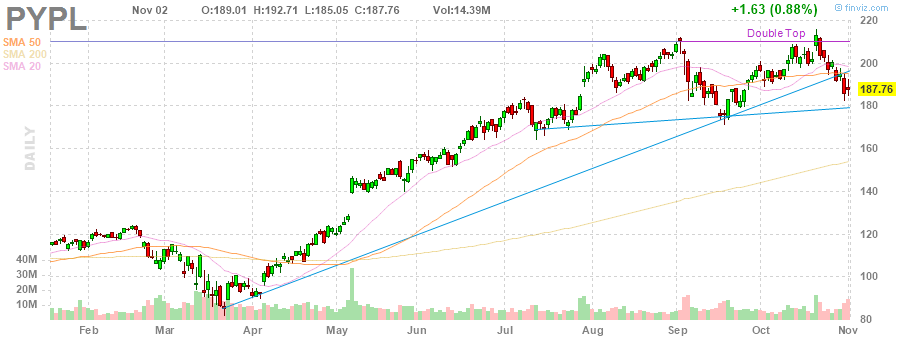
PayPal (PYPL) reported Q3 FY 2020 earnings of $1.07 per share (versus $0.61 per share in Q3 FY 2019), beating analysts’ consensus estimate of $0.94 per share.
The company’s quarterly revenues amounted to $5.459 bln (+24.7% y/y), roughly in line with analysts’ consensus estimate of $5.412 bln.
The company also issued guidance for Q4 FY 2020, projecting EPS growth of +17-18% y/y, or ~$1.01 (versus analysts’ consensus estimate of $1.07) and revenues of up +20-25% y/y, or $5.95-6.20 bln (versus analysts’ consensus estimate of $6.10 bln).
PYPL fell to $177.40 (-5.52%) in pre-market trading.
USD weakened against its major rivals in the European session on Tuesday as investors were pricing in a potential victory for Democrat Joe Biden at the 2020 U.S. presidential election. The U.S. Dollar Index (DXY), measuring the U.S. currency's value relative to a basket of foreign currencies, dropped 0.55% to 93.61.
Most opinion polls have indicated that the Democratic candidate Joe Biden is to defeat incumbent president Donald Trump in today's long-awaited elections. But regardless of the outcome, markets most of all want a clear winner.
A Biden win is expected to weaken the U.S. currency, as it paves the way to massive fiscal stimulus and less disruptive trade relations, boosting other currencies at the dollar’s expense.
In addition, market participants are closely monitoring the outcomes of several Senate races, which will determine if the “Blue Wave” will take over Congress. According to the RealClearPolitics, polling averages expect each party to have 50 seats in the Senate.
- Serious talks are underway to try and reach a Brexit deal
- There is some progress on level playing field question
- But it is far from being concluded yet
FXStreet reports that Ho Woei Chen, CFA, Economist at UOB Group, reviewed the recent PMI figures and recovery prospects in the Chinese economy.
“The Markit/Caixin China manufacturing PMI rose 0.6 points to 53.6 in October from 53.0 in September, recording its 6 th consecutive month of expansion (above-50 reading). This is also the highest reading since January 2011.”
“The rebound in the manufacturing sector from the pandemic low continued to be led by the large-sized enterprises.”
“The CFLP non-manufacturing PMI rose 0.3 points to its highest level since October 2013 at 56.2 from 55.9 in September. The stronger reading is likely to be boosted by the Golden Week given pent-up demand and the easing of capacity restrictions at tourist sites ahead of the long holiday.”
“Overall, China’s October PMIs suggest a sustained recovery in both the manufacturing and services sectors in 4Q20 which means that more broad-based easing measures will likely not be necessary... We have raised our 4Q20 GDP forecast to potential growth rate of 6.2% y/y from our previous forecast of 5.7% with our full-year 2020 GDP growth at 1.9%.”
FXStreet notes that during October oil prices slid at the largest monthly level since March (Brent -8.5% MoM; WTI -11.0% MoM) owing to rising virus cases and higher Libyan supply. MUFG Bank’s bullish oil price thesis remains intact but the next leg up will require time and patience.
“There remains no case for above $50/b (yet), but also no case lower at $30/b. While we had cautioned that a risk-off event amidst a resurging virus wave and higher Libyan supply is possible, our constructive bullish oil price conviction remains intact."
“We continue to look for Brent and WTI to end-2020 at $48/b and $45/b, respectively, although we acknowledge downside risks. More broadly, given oil inventories remain elevated, the next leg up in oil prices will require time and patience – whilst $20/b to $40-45/b between April to June was a sprint, $40-45/b to $60/b will be a marathon.”
- Still working towards agreement with UK
- No solution found yet on fisheries
- EU's chief negotiator Barnier is to brief member states sometime this week
FXStreet reports that Lisa Shalett from Morgan Stanley expects three policy-related tenets of conventional investing wisdom to reverse.
“Political gridlock: It is generally seen as positive for markets when rival political parties control different branches of government, mainly because it limits the potential for new regulation and tax increases. However, we believe investors are slowly embracing the need for a greater level of cooperation and compromise in Washington than we’ve seen lately. This could lead to more government spending, including pandemic relief and infrastructure spending, which stands to create jobs and boost incomes.”
“Higher taxes: Many investors regard increased government spending, especially when funded by tax increases, as an impediment to corporate earnings and economic growth. However, the COVID-19 recession is occurring against a backdrop of record deficits and debt. With now historically low-interest rates potentially headed higher as growth picks up, this debt load could increasingly drag on the economy and weigh on the dollar, squeezing out other government spending. Financing that debt likely will require new revenues. Reforming the tax code, including raising corporate taxes, may be unavoidable.”
“Rising Inflation: Investors often fear inflation, which has triggered bear markets in the past. However, the Fed’s new ‘average inflation targeting’ framework could allow inflation to float above the 2% target for years to make up for the past decade when inflation has mostly been below that level. Investors have yet to grasp fully this sea change.”
“The next business cycle, combined with these likely policy shifts, will produce fresh market leadership centered on capital investment, infrastructure, housing and strong consumer spending. I suggest that investors consider repositioning portfolios toward select sectors, including financials, industrials, clean energy, construction, consumer durables and service-sector automation, and away from the digital and technology-related ‘work-from-home winners’ of 2020.”
FXStreet notes that EUR/USD weakness has extended for a test and hold of the 1.1612 September low, which economists at Credit Suisse think is likely to remain intact into the US election.
“EUR/USD weakness has extended to just shy of the 1.1612 September low and we suspect this holds for now ahead of the US election for a rebound. With a top still in place following the break of support at 1.1701 though strength will stay seen as temporary ahead of a break below 1.1612 in due course with support then seen next at the 50% retracement of the rally from late June at 1.1590 and eventually what should be more important support at 1.1495/85 – the March high and 38.2% retracement of the entire 2020 rally – which we look to prove a solid floor for a resumption of the core uptrend. Should weakness extend, which is not our base case, this would warn of a more damaging reversal lower with support seen next at 1.1425/23.”
FXStreet reports that FX Strategists at UOB Group noted USD/CNH could lose upside momentum on a break below 6.6750.
Next 1-3 weeks: “Our latest narrative was from last Thursday (29 Oct, spot at 6.7225) wherein ‘upward momentum has improved and if USD were to break 6.7450, the next level to focus on is at 6.7650’. We indicated that USD ‘is expected to trade with an upward bias as long as it does not move below 6.6750’. However, USD did not break 6.7450 but came close to taking out the ‘strong support’ level at 6.6750 (low of 6.6770 on Friday). The surprisingly soft price actions have dented the momentum but only a break of 6.6750 would indicate that the upside risk has dissipated. Meanwhile, USD has to move and stay above 6.7150 within these 1 to 2 days or the odds for a break of 6.7450 would diminish quickly.”
FXStreet reports that given the event risk around the US election, near-term uncertainty is high but economists at UBS think the setback to risk assets is likely to be relatively short-lived.
“Regardless of who wins the presidency, we expect another sizable fiscal stimulus bill to pass soon after the election. Both monetary and fiscal policy should remain accommodative. And with ten vaccine candidates in late-stage trials globally, our central scenario is that restrictions can start to be lifted by 2Q21, helping corporate earnings recover to pre-pandemic levels by around the end of 2021.”
“We continue to see upside over the medium-term, and target 3,700 on the S&P 500 by June 2021, around 13.2% higher than the current level.”
Reuters reports that Deputy Economy Minister Laura Castelli said that Italy is preparing another stimulus package to accompany stricter measures to contain the spread of the new coronavirus.
"Again this time the decree will be accompanied by a stimulus package to support companies and the supply chain that will be hit by restrictions placed on their activities," Castelli said.
"We are already working on it and it will be ready shortly."
eFXdata reports that Credit Agricole CIB Research discusses USD/JPY outlook through the US elections outcomes.
"USD/JPY remains caught in a tug-of-war between the influence of relative rates and government bond yield curves and the impact of the US election," CACIB notes.
"A clear result in favour of Biden would likely lead to a relief rally in USD/JPY and allow the exchange rate to play catch up with the move in rates in favour of the USD, dependent on the US economic data and the outcome of the FOMC meeting also this week. The FOMC will likely stay dovish. A surprise victory in favour of President Trump would also lead to a higher USD/JPY as investors buy into a repeat of the reflation trade that occurred in 2016," CACIB adds.
FXStreet reports that Alvin Liew, Senior Economist at UOB Group, assesses the latest GDP figures in the US economy.
“The US released its best-ever quarterly economic report as the 3Q 2020 GDP, surged by 33.1% q/q SAAR, the largest output gain on record since data were made available in 1947.”
“We now project flat growth in 4Q 2020 (i.e. 0% q/q) but the rebound in the second half of the year will still not offset the 1H contraction even though it is less severe than previously projected. The US full-year 2020 GDP is now expected to contract by a smaller 3.8% (from the previous projection of -4.5% made in September)…We continue to expect the US GDP to rebound at an above-potential rate of 2.8% in 2021.”
Reuters reports that ECB policymaker Klaas Knot said the European Central Bank's emergency bond buying scheme is a temporary tool but Europe is still in an emergency situation and the outlook is actually darkening as the pandemic spreads.
"It's of course clear that recent developments have not been good," Knot said. "We have a second wave, it will weigh on the economic outlook, it will weigh on the price stability outlook."
Knot added that banks are bound to take a hit from the crisis as their loan books deteriorate, making them difficult to extend credit. That makes additional funding mechanism necessary, a key argument to kickstat a stalled discussion on Europe's capital market union.
eFXdata reports that ANZ Research discusses its expectations for US elections and the FOMC meeting.
"The US election on the 3 November, is the big event, with results likely to stretch into Thursday’s Asian trading session. The most pro-risk outcome is a landslide ‘Blue Wave’ result, which could carry a higher medium term growth path, while drawing lower risks of political or legal challenge. If the race narrows relative to current polling, expect a concession from either party to be unlikely (some estimates place the probability of concession speech from either party in the week of the election at 30%). This could result in a drawn out election outcome that could take weeks to resolve," ANZ notes.
"Amidst the political risk, the FOMC also meets, however we do not expect any change to policy," ANZ adds.
FXStreet reports that strategists at Credit Suisse remain long-term gold bulls.
“Gold extends its consolidation from our $2075 target hit in August and we maintain our core view this is a temporary and corrective pause in the broader uptrend. Indeed, price action is beginning to increasingly look like a bullish ‘wedge’ continuation pattern, adding weight to our view.”
“Key support stays seen intact at $1837 – the 38.2% retracement of the 2020 rally – and our bias remains for this to continue to hold. Above $1933 would now suggest the “wedge” has been completed for strength back to $2016, then the $2075 high.”
“Big picture, we continue to look for $2300.”
CNBC reports that according to David Roche, president and global strategist at Independent Strategy, the Chinese yuan has “a long way” to go before it comes anywhere close to challenging the U.S. dollar’s status as a reserve currency.
“Dethroning the dollar — which the euro tried to do, and settled at a miserable 18-20% of all the international things that go on — is very, very difficult,” Roche told CNBC.
A number of “almost abstract” conditions, including not having too much leverage in the system as well as the rule of law, need to be met before a currency can achieve reserve status, the strategist said. He added that the Chinese yuan is “a long way from achieving that.”
“There is a certain amount of illusion at the moment that the (yuan) — which accounts for 2% of international trade settlements and even less if you come to financial investment flows — that this can take over,” Roche said.
Roche suggested the reserve currency status tends to be “unmerited.”
“The U.S. economy has progressively shrunk over the last two decades, it is a smaller proportion of international trade,” he said. “Yet the dollar is an increasing proportion of the settlement of international trade and an even bigger proportion of financial reserves.”
| Time | Country | Event | Period | Previous value | Forecast | Actual |
|---|---|---|---|---|---|---|
| 00:00 | U.S. | Presidential Election | ||||
| 03:30 | Australia | Announcement of the RBA decision on the discount rate | 0.25% | 0.10% | 0.1% | |
| 07:30 | Switzerland | Consumer Price Index (MoM) | October | 0% | 0.0% | 0% |
| 07:30 | Switzerland | Consumer Price Index (YoY) | October | -0.8% | -0.6% | -0.6% |
During today's Asian trading, the dollar declined against the euro, yen and pound ahead of the US presidential election.
The results of public opinion polls show that the candidate from the Democratic party, Joe Biden, is ahead of the current Republican President, Donald Trump, in popularity. So, according to a survey conducted by NBC and the Wall Street Journal, the gap between Trump and Biden reaches 10 percentage points.
"The baseline scenario based on the results of the polls is a Biden victory, but we can expect pitfalls, including delaying the results of calculations due to early voting, as well as a potential challenge to the election results," says IG analyst Jini Pan.
The focus of the market this week is also the meeting of the Federal reserve system, which will be held on November 4-5. Experts would like to get more information from the Fed about what the next steps will be in relation to the volume of assets on its balance sheet, but do not expect new signals at the upcoming meeting.
The ICE index, which tracks the dynamics of the US dollar against six currencies (Euro, Swiss franc, yen, canadian dollar, pound sterling and Swedish Krona), fell by 0.25%.
Meanwhile, the Reserve Bank of Australia (RBA) lowered its benchmark interest rate to a record low, and also reduced its target yield on three-year government bonds following its meeting on Tuesday. In addition, the RBA announced the launch of a 100 billion Australian dollar quantitative easing (QE) program, aiming to support the economic recovery from the crisis caused by the coronavirus pandemic. The base rate has been lowered to 0.1% per annum from 0.25%, and the target yield on three - year government bonds has been lowered to the same level, the RBA said in a statement.
According to the report from the Federal Statistical Office, the consumer price index (CPI) remained stable in October 2020 compared with the previous month, remaining at 101.2 points (December 2015 = 100). Inflation was –0.6% compared with the same month of the previous year.
The stability of the index compared with the previous month is the result of opposing trends that counterbalanced each other overall. Prices for clothing and footwear increased, as well as those for glasses and contact lenses. In contrast, prices for combined offers for fixed-line and mobile communication, as well as those for other fruits (melons and grapes) decreased.
In October 2020, the Swiss Harmonised Index of Consumer Prices (HICP) stood at 100.45 points (base 2015 = 100). This corresponds to a rate of change of 0.0% compared with the previous month and of –0.9% compared with the same month the previous year. Due to the effects of the pandemic, the same missing price imputation techniques used for the CPI were introduced for the HICP.
FXStreet reports that сable’s decline does not rule out a potential retracement to the 1.2845 level in the next weeks, noted FX Strategists at UOB Group.
Next 1-3 weeks: “Yesterday, we highlighted that ‘downward momentum has improved further but still appears lackluster for now’. We added, ‘GBP is deemed to be under mild downward pressure and could gravitate towards the major support at 1.2845’. GBP subsequently plummeted to 1.2854 but the decline was short-lived. From here, there is no change in our view and we still see chance for GBP to test the 1.2845 level. Only a break of 1.3030 (no change in ‘strong resistance’ level) would indicate that the current mild downward pressure has eased. Looking forward, the next support below 1.2845 is at 1.2800.”
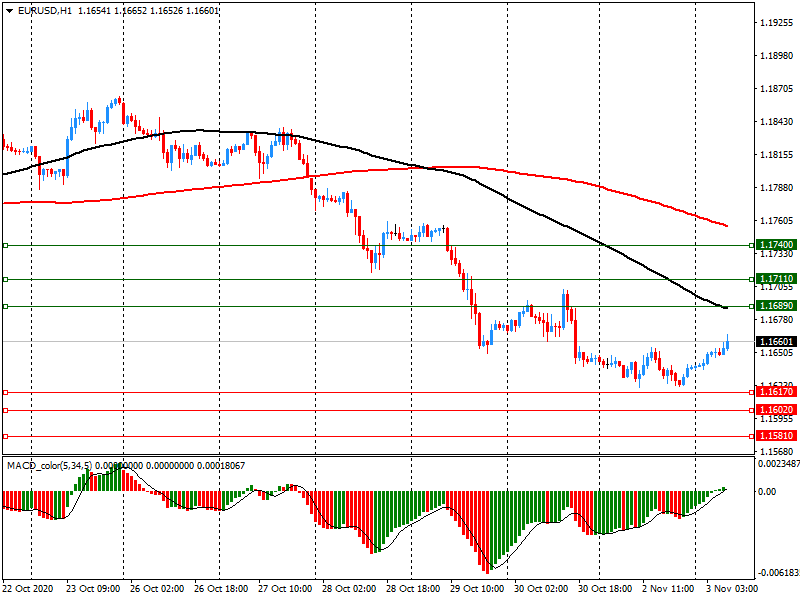
EUR/USD
Resistance levels (open interest**, contracts)
$1.1740 (606)
$1.1711 (536)
$1.1689 (417)
Price at time of writing this review: $1.1660
Support levels (open interest**, contracts):
$1.1617 (1654)
$1.1602 (2020)
$1.1581 (835)
Comments:
- Overall open interest on the CALL options and PUT options with the expiration date November, 6 is 60024 contracts (according to data from November, 2) with the maximum number of contracts with strike price $1,1800 (4269);
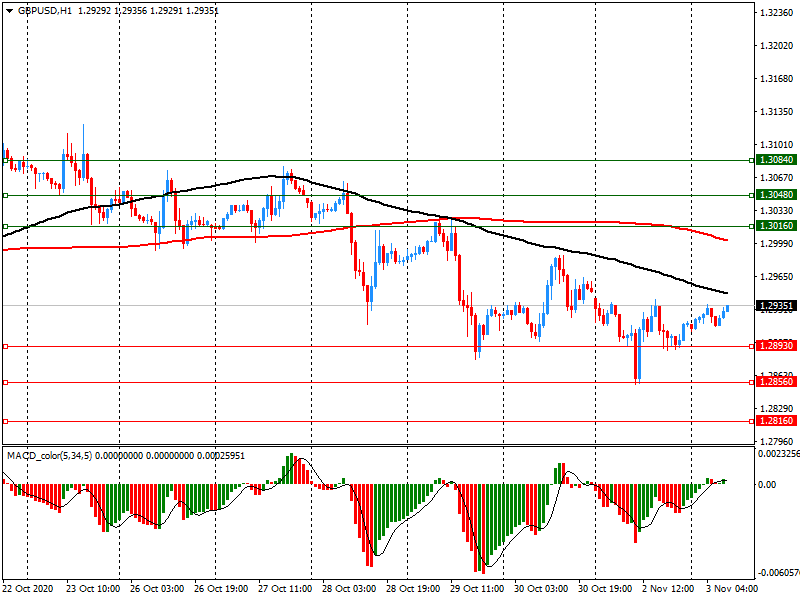
GBP/USD
Resistance levels (open interest**, contracts)
$1.3084 (1212)
$1.3048 (2570)
$1.3016 (906)
Price at time of writing this review: $1.2935
Support levels (open interest**, contracts):
$1.2893 (826)
$1.2856 (649)
$1.2816 (556)
Comments:
- Overall open interest on the CALL options with the expiration date November, 6 is 33159 contracts, with the maximum number of contracts with strike price $1,3950 (3784);
- Overall open interest on the PUT options with the expiration date November, 6 is 26528 contracts, with the maximum number of contracts with strike price $1,2050 (2391);
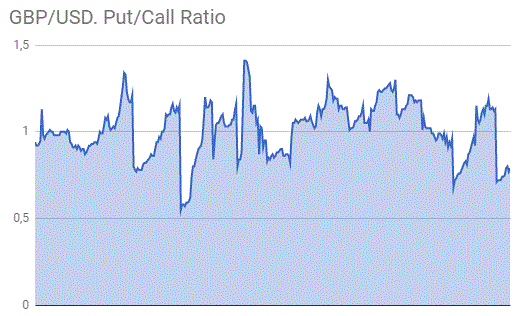
- The ratio of PUT/CALL was 0.80 versus 0.80 from the previous trading day according to data from November, 2
* - The Chicago Mercantile Exchange bulletin (CME) is used for the calculation.
** - Open interest takes into account the total number of option contracts that are open at the moment.
RTTNews reports that as the economic recovery is expected to be bumpy, Australia's central bank unveiled a package of measures to support job creation and underpin growth.
Reserve Bank of Australia decided to lower its key cash rate by 15 basis points to a record low of 0.10 percent.
The bank also decided to cut the target for the yield on the 3-year Australian Government bond to around 0.1 percent and to purchase A$100 billion government bonds of maturities of around 5 to 10 years over the next six months.
Further, the bank will reduce the interest rate on new drawings under the Term Funding Facility to 0.1 percent and cut the interest rate on Exchange Settlement balances to zero.
The bank said today's decision will assist the recovery by lowering financing costs for borrowers; contributing to a lower exchange rate than otherwise; and supporting asset prices and balance sheets.
Policymakers observed that addressing the high rate of unemployment as an important national priority.
According to RBA, economic growth is expected to be around 6 percent over the year to June 2021 and 4 percent in 2022.
| Raw materials | Closed | Change, % |
|---|---|---|
| Brent | 38.83 | 4.78 |
| Silver | 24.04 | 1.86 |
| Gold | 1894.957 | 0.88 |
| Palladium | 2212.95 | 0.33 |
| Index | Change, points | Closed | Change, % |
|---|---|---|---|
| NIKKEI 225 | 318.35 | 23295.48 | 1.39 |
| Hang Seng | 352.59 | 24460.01 | 1.46 |
| KOSPI | 33.01 | 2300.16 | 1.46 |
| ASX 200 | 23.7 | 5951.3 | 0.4 |
| FTSE 100 | 77.7 | 5654.97 | 1.39 |
| DAX | 231.8 | 11788.28 | 2.01 |
| CAC 40 | 96.9 | 4691.14 | 2.11 |
| Dow Jones | 423.45 | 26925.05 | 1.6 |
| S&P 500 | 40.28 | 3310.24 | 1.23 |
| NASDAQ Composite | 46.02 | 10957.61 | 0.42 |
| Time | Country | Event | Period | Previous value | Forecast |
|---|---|---|---|---|---|
| 00:00 (GMT) | U.S. | Presidential Election | |||
| 03:30 (GMT) | Australia | Announcement of the RBA decision on the discount rate | 0.25% | 0.10% | |
| 07:30 (GMT) | Switzerland | Consumer Price Index (MoM) | October | 0% | 0.0% |
| 07:30 (GMT) | Switzerland | Consumer Price Index (YoY) | October | -0.8% | -0.6% |
| 15:00 (GMT) | U.S. | Factory Orders | September | 0.7% | 1% |
| 21:30 (GMT) | Australia | AiG Performance of Construction Index | October | 45.2 | |
| 21:45 (GMT) | New Zealand | Employment Change, q/q | Quarter III | -0.4% | -0.8% |
| 21:45 (GMT) | New Zealand | Unemployment Rate | Quarter III | 4.0% | 5.4% |
| 23:50 (GMT) | Japan | Monetary Policy Meeting Minutes |
| Pare | Closed | Change, % |
|---|---|---|
| AUDUSD | 0.70556 | 0.43 |
| EURJPY | 121.922 | 0.05 |
| EURUSD | 1.16384 | -0.07 |
| GBPJPY | 135.308 | -0.09 |
| GBPUSD | 1.29168 | -0.2 |
| NZDUSD | 0.66323 | 0.34 |
| USDCAD | 1.3221 | -0.76 |
| USDCHF | 0.91923 | 0.3 |
| USDJPY | 104.748 | 0.1 |







© 2000-2026. All rights reserved.
This site is managed by Teletrade D.J. LLC 2351 LLC 2022 (Euro House, Richmond Hill Road, Kingstown, VC0100, St. Vincent and the Grenadines).
The information on this website is for informational purposes only and does not constitute any investment advice.
The company does not serve or provide services to customers who are residents of the US, Canada, Iran, The Democratic People's Republic of Korea, Yemen and FATF blacklisted countries.
Making transactions on financial markets with marginal financial instruments opens up wide possibilities and allows investors who are willing to take risks to earn high profits, carrying a potentially high risk of losses at the same time. Therefore you should responsibly approach the issue of choosing the appropriate investment strategy, taking the available resources into account, before starting trading.
Use of the information: full or partial use of materials from this website must always be referenced to TeleTrade as the source of information. Use of the materials on the Internet must be accompanied by a hyperlink to teletrade.org. Automatic import of materials and information from this website is prohibited.
Please contact our PR department if you have any questions or need assistance at pr@teletrade.global.


 Bank
Bank transfers


