- Analytics
- News and Tools
- Market News
CFD Markets News and Forecasts — 05-08-2021
| Time | Country | Event | Period | Previous value | Forecast |
|---|---|---|---|---|---|
| 01:30 (GMT) | Australia | RBA Monetary Policy Statement | |||
| 03:00 (GMT) | New Zealand | Expected Annual Inflation 2y from now | Quarter III | 2.05% | |
| 05:00 (GMT) | Japan | Leading Economic Index | June | 102.6 | |
| 05:00 (GMT) | Japan | Coincident Index | June | 92.7 | |
| 06:00 (GMT) | United Kingdom | Halifax house price index | July | -0.5% | |
| 06:00 (GMT) | United Kingdom | Halifax house price index 3m Y/Y | July | 8.8% | |
| 06:00 (GMT) | Germany | Industrial Production s.a. (MoM) | June | -0.3% | 0.5% |
| 06:45 (GMT) | France | Non-Farm Payrolls | Quarter II | 0.5% | |
| 06:45 (GMT) | France | Trade Balance, bln | June | -6.8 | |
| 07:00 (GMT) | Switzerland | Foreign Currency Reserves | July | 941.1 | |
| 11:15 (GMT) | United Kingdom | MPC Member Dr Ben Broadbent Speaks | |||
| 12:30 (GMT) | U.S. | Average workweek | July | 34.7 | 34.7 |
| 12:30 (GMT) | U.S. | Government Payrolls | July | 188 | |
| 12:30 (GMT) | U.S. | Manufacturing Payrolls | July | 15 | 25 |
| 12:30 (GMT) | U.S. | Labor Force Participation Rate | July | 61.6% | |
| 12:30 (GMT) | U.S. | Private Nonfarm Payrolls | July | 662 | 700 |
| 12:30 (GMT) | U.S. | Average hourly earnings | July | 0.3% | 0.3% |
| 12:30 (GMT) | Canada | Unemployment rate | July | 7.8% | 7.4% |
| 12:30 (GMT) | Canada | Employment | July | 230.7 | 177.5 |
| 12:30 (GMT) | U.S. | Unemployment Rate | July | 5.9% | 5.7% |
| 12:30 (GMT) | U.S. | Nonfarm Payrolls | July | 850 | 870 |
| 14:00 (GMT) | U.S. | Wholesale Inventories | June | 1.3% | 0.8% |
| 14:00 (GMT) | Canada | Ivey Purchasing Managers Index | July | 71.9 | |
| 17:00 (GMT) | U.S. | Baker Hughes Oil Rig Count | August | 385 | |
| 19:00 (GMT) | U.S. | Consumer Credit | June | 35.28 | 23 |
ActionForex reports that analysts at TD Bank Financial Group discuss Canada's June trade balance data.
"Canada recorded a merchandise trade surplus of $3.2 billion in June, following a deficit of $1.6 billion in May. Merchandise exports surged 8.7% (m/m), whereas imports fell 1.0%. Stripping away price effects, export volumes advanced an impressive 7.0% while import volumes fell by 2.2%."
"In June, Canadian exports benefitted from robust demand for energy products and a rise in auto production. However, production levels remain extremely low in the auto industry, largely reflecting global shortages for semiconductor chips. On the opposite side of the ledger, the drop in import volumes points to some moderation in domestic demand during the month. Notably, import volumes for machinery/equipment and consumer goods both declined, sending a subdued signal for business investment and consumer spending, respectively."
"For the second quarter overall, merchandise export volumes plunged 4.7%, while import volumes were flatter (-0.6%). This suggests that net trade weighed on second quarter economic growth."
"We continue to receive mixed signals on the outlook for trade going forward. We expect global economic growth to continue in the second half, with a strong performance recorded in the U.S. However, the Delta variant is a growing risk. In addition, the recovery in service exports is expected to lag until travel/international tourism restrictions are more significantly eased. Supply chain disruptions are still being reported in manufacturing PMI surveys, suggesting continued volatility in the data going forward."
eFXdata reports that analysts at MUFG Research discuss their USD outlook ahead of tomorrow's U.S. NFP report.
"Yesterday’s comments from Fed Vice Chair Clarida have captured even more market attention... The timing is broadly in line with the consensus view now on the FOMC and market expectations although it was still sufficient to trigger a hawkish repricing of short-term US rates yesterday. At the same time, Fed Vice Chair Clarida stated that he would support announcing a moderation in asset purchases later this year."
"After yesterday’s volatility, we still believe tomorrow’s NFP report remains the most important for driving US dollar performance in the near-term."
FXStreet notes that the Bank of England (BoE) was pretty much as expected, with one dissenter and modest tightening seen over the forecasting period. GBP/USD saw a modest uplift in the immediate aftermath of the policy decision. The move was short-lived, however. In the view of economists at TD Securities, cable should remain fairly well-anchored around current levels.
“The MPC voted to leave policy on hold today, with one dissent to reduce QE prematurely. There were two notable changes in the committee's communications: forward guidance was revised to acknowledge that some policy tightening would be appropriate by late-2024, and the sequence of tightening steps was revised, with a lower Bank Rate threshold to commence balance sheet runoff.”
“While we would not be surprised to see an upward extension to test 1.3960, cable may struggle to advance much beyond 1.3985 without fresh catalysts.”
“Solid support remains in place around 1.3875."
FXStreet тщеуы that USD/CHF posted an aggressive bullish “key reversal day” on Wednesday. Notwithstanding, the pair needs to break back above 0.9074/79 to reassert a tactical bullish bias, analysts at Credit Suisse suggest.
“Only a clear break above resistance at 0.9074/79 would confirm a floor, with resistance seen next at the 55-day average at 0.9103/05.”
“A break above 0.9103/05 is needed to add weight to a recovery story for a move to 0.9130 next, ahead of key resistance from the downtrend from April at 0.9206. Above here is needed to suggest a broader recovery can take place for a move back to 0.9264/75 thereafter.”
Statistics
Canada announced on Thursday that Canada recorded a trade surplus of CAD3.23
billion in June, compared with a revised CAD1.58-billion deficit in May
(originally a CAD1.39-billion gap).
Economists
had forecast a deficit of CAD0.68 billion.
According
to the report, Canada’s exports surged 8.7 percent m-o-m to CAD53.76 billion in
June, as 9 of the 11 product sections posted gains, led by energy products
(+22.9 percent m-o-m) and motor vehicles and parts (+14.9 percent m-o-m).
Meanwhile, imports declined 1.0 percent m-o-m to CAD50.53 billion in June, with
7 of the 11 product sections recording drops, including consumer goods (-3.7 percent
m-o-m) and motor vehicles and parts (-3.8 percent m-o-m).
U.S. stock-index futures rose on Thursday, as investors digested U.S. weekly jobless claims while awaiting the release of a crucial payroll report on Friday.
Global Stocks:
Index/commodity | Last | Today's Change, points | Today's Change, % |
Nikkei | 27,728.12 | +144.04 | +0.52% |
Hang Seng | 26,204.69 | -221.86 | -0.84% |
Shanghai | 3,466.55 | -10.67 | -0.31% |
S&P/ASX | 7,511.10 | +7.90 | +0.11% |
FTSE | 7,116.28 | -7.58 | -0.11% |
CAC | 6,771.94 | +25.71 | +0.38% |
DAX | 15,716.97 | +24.84 | +0.16% |
Crude oil | $68.53 | +0.56% | |
Gold | $1,813.90 | -0.04% |
(company / ticker / price / change ($/%) / volume)
ALCOA INC. | AA | 38.68 | -0.07(-0.18%) | 16797 |
ALTRIA GROUP INC. | MO | 47.14 | 0.11(0.23%) | 17301 |
Amazon.com Inc., NASDAQ | AMZN | 3,360.00 | 5.28(0.16%) | 10035 |
AMERICAN INTERNATIONAL GROUP | AIG | 47.69 | 0.60(1.27%) | 161 |
Apple Inc. | AAPL | 147.22 | 0.27(0.18%) | 716965 |
AT&T Inc | T | 27.92 | 0.07(0.25%) | 48295 |
Boeing Co | BA | 226.85 | 0.22(0.10%) | 54487 |
Caterpillar Inc | CAT | 205.25 | 0.73(0.36%) | 4513 |
Chevron Corp | CVX | 100.89 | 0.59(0.59%) | 16331 |
Cisco Systems Inc | CSCO | 55.76 | 0.07(0.13%) | 3452 |
Citigroup Inc., NYSE | C | 68.72 | 0.20(0.29%) | 13176 |
Exxon Mobil Corp | XOM | 57.17 | 0.33(0.58%) | 77626 |
Facebook, Inc. | FB | 359.52 | 0.60(0.17%) | 43647 |
FedEx Corporation, NYSE | FDX | 276.5 | 1.38(0.50%) | 1156 |
Ford Motor Co. | F | 13.57 | 0.25(1.88%) | 1315600 |
Freeport-McMoRan Copper & Gold Inc., NYSE | FCX | 35.54 | -0.11(-0.31%) | 39750 |
General Electric Co | GE | 102.83 | -0.08(-0.08%) | 12562 |
General Motors Company, NYSE | GM | 53.74 | 1.02(1.93%) | 643565 |
Goldman Sachs | GS | 380 | 2.14(0.57%) | 1256 |
Hewlett-Packard Co. | HPQ | 29.14 | 0.07(0.24%) | 15536 |
Home Depot Inc | HD | 331.75 | 1.44(0.44%) | 503 |
Intel Corp | INTC | 53.85 | 0.30(0.56%) | 57078 |
International Business Machines Co... | IBM | 143.25 | 0.49(0.34%) | 3584 |
International Paper Company | IP | 57.62 | -0.10(-0.17%) | 1568 |
JPMorgan Chase and Co | JPM | 151.73 | 0.49(0.33%) | 8379 |
McDonald's Corp | MCD | 235.3 | 0.47(0.20%) | 1343 |
Merck & Co Inc | MRK | 75.84 | 0.36(0.48%) | 5037 |
Microsoft Corp | MSFT | 286.6 | 0.09(0.03%) | 39082 |
Nike | NKE | 170.67 | -1.24(-0.72%) | 10458 |
Pfizer Inc | PFE | 44.95 | -0.24(-0.53%) | 697950 |
Procter & Gamble Co | PG | 142.74 | 0.31(0.22%) | 15769 |
Starbucks Corporation, NASDAQ | SBUX | 118.52 | 0.27(0.23%) | 5169 |
Tesla Motors, Inc., NASDAQ | TSLA | 717.36 | 6.44(0.91%) | 223097 |
The Coca-Cola Co | KO | 56.18 | 0.08(0.14%) | 14965 |
Twitter, Inc., NYSE | TWTR | 68.95 | 0.25(0.36%) | 8507 |
UnitedHealth Group Inc | UNH | 421.55 | 0.01(0.00%) | 1011 |
Verizon Communications Inc | VZ | 55.47 | 0.10(0.18%) | 65145 |
Visa | V | 237.03 | 0.36(0.15%) | 8747 |
Wal-Mart Stores Inc | WMT | 144.39 | 1.55(1.09%) | 47682 |
Walt Disney Co | DIS | 172.7 | 0.12(0.07%) | 6917 |
Yandex N.V., NASDAQ | YNDX | 68.08 | -0.31(-0.45%) | 1000 |
Walmart (WMT) upgraded to Overweight from Equal Weight at Wells Fargo; target raised to $165
General Motors (GM) added to Catalyst Call: Buy List at Deutsche Bank
The
U.S. Commerce Department reported on Thursday that the U.S. goods and services
trade deficit widened to $75.7 billion in June from a revised $71.0 billion in
the previous month (originally a gap of $71.2 billion).
Economists
had expected a deficit of $73.9 billion.
According
to the report, the June advance in the goods and services reflected a gain in
the goods deficit of $4.0 billion to $93.2 billion and a decline in the
services surplus of $0.7 billion to $17.4 billion.
In June,
exports of goods and services from the U.S. rose 0.6 percent m-o-m to $207.7
billion, while imports climbed 2.1 percent m-o-m to $283.4 billion, as the
global COVID-19 pandemic and the economic recovery continued to impact
international trade.
Year-to-date,
the goods and services deficit surged 46.4 percent from the same period in
2020. Exports jumped 14.3 percent, while imports soared 21.3 percent.
The
data from the Labor Department showed on Thursday the number of applications
for unemployment decreased broadly in line with forecasts last week.
According to the report, the initial claims for unemployment benefits fell by 14,000 to 385,000 for the week ended July 31.
Economists
had expected 384,000 new claims last week.
Claims for the prior week
were revised downwardly to 399,000 from the initial estimate of 400,000.
Meanwhile,
the four-week moving average of jobless claims slipped to 394,000 from an
upwardly a downwardly revised 394,250 in the previous week.
As
for continuing claims, they decreased to 2,930,000 from an upwardly revised 3,296,000
in the previous week. This was the lowest reading since March 2020.
- There has been little headline news on UK economic activity since May
- We do not see spike in unemployment when furlough ends
- It is expected that number of people unemployed will be about 250,000 higher than before the pandemic
- There is growing evidence of job vacancies and labour market tightness
- Underlying wage growth is near pre-COVID levels
- Recovery is unbalanced, weighted towards goods not services
- Inflation is marked by historical standards; it is driven by higher cost of goods, energy prices and supply constraints
- Key question for MPC is whether inflation pressures are temporary
- Our view is inflation pressures will reduce
- MPC will focus on medium term prospects for inflation, not transient factors
- Bank rate is BoE's main tool for altering monetary conditions
- Impact of reducing stock of BoE assets is uncertain
- Impact of asset purchases greatest in dysfunctional markets
- Future steady-state stock of bank reserves will remain larger than before the start of BoE asset purchases
- MPC takes risk of persistently higher inflation seriously
- Good reasons to think above-target inflation will be temporary
- MPC will not hesitate to act
| Time | Country | Event | Period | Previous value | Forecast | Actual |
|---|---|---|---|---|---|---|
| 06:00 | Germany | Factory Orders s.a. (MoM) | June | -3.2% | 1.9% | 4.1% |
| 06:45 | France | Industrial Production, m/m | June | -0.4% | 0.6% | 0.5% |
| 08:00 | Eurozone | ECB Economic Bulletin | ||||
| 08:30 | United Kingdom | PMI Construction | July | 66.3 | 64 | 58.7 |
| 11:00 | United Kingdom | Asset Purchase Facility | 875 | 875 | 875 | |
| 11:00 | United Kingdom | BoE Interest Rate Decision | 0.1% | 0.1% | 0.1% | |
| 11:00 | United Kingdom | Bank of England Minutes |
GBP continued to trade higher against most of its major rivals in the European session on Thursday after the announcement of the outcomes of the Bank of England's (BoE) latest monetary policy meeting.
At their August gathering, the BoE's policymakers decided to keep the bank rate unchanged at 0.10% and maintained the asset purchase program at GBP895 billion, as widely expected.
In the latest monetary policy report, however, the British central bank revealed that its Monetary Policy Committee (MPC) intends to begin to reduce the stock of purchased assets when “Bank Rate has reached 0.5%, if appropriate given the economic circumstances, by ceasing reinvestments of maturing UK government bonds”. It was also noted that “the MPC will also consider beginning to sell actively some of the stock of purchased assets only once Bank Rate has risen to at least 1%”. The BoE’s previous guidance stated that it will not start to unwind its QE and would reinvest the proceeds of maturing gilts, until the Bank Rate reaches 1.5%. This was the only noticeable change in BoE’s policy statements.
Besides that, the Bank reassured that the above-target CPI inflation is expected to be temporary and said it continued to see the UK's economy to grow by 7.25% this year, unchanged from its May forecast.
FXStreet notes that EUR/USD probe of 1.19 fizzled out. According to economists at Westpac, ranges are likely to remain intact near-term in quiet summer trade but the European Central Bank (ECB) vs Federal Reserve (Fed) over Q3 suggests selling into rallies.
“Mid-summer markets argue against a sustained move in either direction for the euro, though it seems at greater risk multi-week of a downside break if Fed QE tapering remains on track. Obviously Friday’s US employment report could be decisive in this regard.”
“European new covid case trends are overall encouraging, albeit with some eye-catching variation e.g. a surge in France but very low cases in Germany.”
“Assuming the US dollar fares reasonably well in the week ahead, then the contrast will remain intact between the Fed and the dovish ECB, where balance sheet expansion continues apace.”
“EUR/USD seems set to probe the lower end of July’s ranges, around 1.1750/70.”
The
Bank of England (BoE) announced its Monetary Policy Committee (MPC) voted 9-0
to keep the Bank Rate at 0.1 percent at its August meeting, as widely expected.
The
MPC also voted unanimously to maintain the stock of sterling non-financial
investment-grade corporate bond purchases at GBP20 billion and voted by a
majority of 7-1 to continue with the existing programme of UK government bond
purchases at GBP875 billion, thus maintaining the total target stock of asset
purchases at GBP895 billion.
In
its policy report, the BoE notes:
- UK GDP is expected to have risen by 5% in Q2, leaving it around 4% below its pre-pandemic level and slightly stronger than expected in May;
- GDP is seen to grow by around 3% in Q3, somewhat weaker than expected in May due to small negative impact from recent developments in the pandemic;
- UK GDP is projected to recover further over the remainder of the year, reaching its pre-pandemic level in Q4;
- Further out, pace of GDP growth is expected to slow towards more normal rates, partly reflecting gradual tightening in stance of announced fiscal policy;
- Frictions in UK’s labour market are judged likely to dissipate over forecast period, boosting growth in effective supply capacity. There is uncertainty around these judgements, including how economy will adjust to the end of furlough scheme;
- CPI inflation is projected to rise temporarily in near term, to 4% in Q4, owing largely to developments in energy and other goods prices, before falling back to close to the 2% target;
- MPC’s central expectation is that current elevated global and domestic cost pressures will prove transitory. Nonetheless, economy is projected to experience more pronounced period of above-target inflation in near term than expected in May;
- MPC has had policy guidance in place specifying that it does not intend to tighten monetary policy at least until there is clear evidence that significant progress is being made in eliminating spare capacity and achieving 2%-inflation target sustainably. Some members judge that, although considerable progress has been made in achieving the conditions of that guidance, conditions are not yet met fully. Other members judge that conditions of the guidance have been met fully, but note that guidance made clear that these have only ever been necessary not sufficient conditions for any future tightening in monetary policy;
- All members confirm that in judging appropriate stance of monetary policy, MPC will, as always, focus on medium-term prospects for inflation rather than factors that are likely to be transient;
- MPC will be monitoring closely incoming evidence regarding developments in labour market, and particularly unemployment, wider measures of slack and underlying wage pressures;
- MPC judges that, should economy evolve broadly in line with central projections in the August Monetary Policy Report, some modest tightening of monetary policy over forecast period is likely to be necessary to be consistent with meeting inflation target sustainably in medium term;
- There is uncertainty about impact of reducing stock of purchased assets on monetary conditions, but MPC judges that, when conducted in a gradual and predictable manner and when markets are functioning normally, it is likely to be smaller than that of asset purchases;
- MPC intends to begin to reduce stock of purchased assets when Bank Rate has reached 0.5%, if appropriate given economic circumstances
- MPC judges that the reduction in stock of purchased assets should initially occur through ceasing reinvestment of maturing assets, to allow reduction to occur at gradual and predictable pace
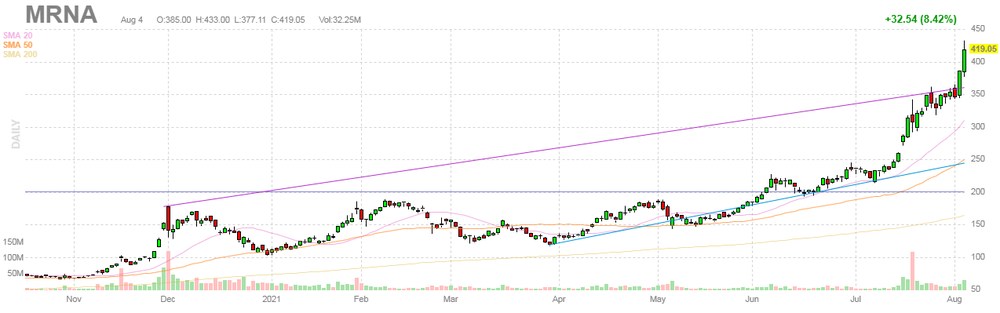
Moderna (MRNA) reported Q2 FY 2021 earnings of $6.46 per share (versus -$0.31 per share in Q2 FY 2020), beating analysts’ consensus estimate of $5.86 per share.
The company’s quarterly revenues amounted to $4.354 bln, beating analysts’ consensus estimate of $4.233 bln.
MRNA rose to $419.99 (+0.22%) in pre-market trading.
FXStreet notes that yen weakness is seen across the board. Nonetheless, the USD/JPY pair posted a Key day reversal which points to stabilization, Axel Rudolph, Senior FICC Technical Analyst at Commerzbank, says.
“USD/JPY slipped below the 109.07 July low but managed to level out above the 108.56 late May low by making a key day reversal at 108.73 yesterday, pointing to short-term stabilization.”
“Minor resistance comes in along the 55-day moving average at 110.02 and is currently in focus.”
“Only a drop through 108.56 would engage the 107.48 April low.”
FXStreet reports that strategists at TD Securities note that global supply chains have been ravaged by an unforgiving series of disruptions. Power generation has been hampered by coal shortages and extreme weather in China. At the same time, Bitcoin mining activity was particularly power-hungry, amid a trading frenzy. Rising metals supply risk and a large global surplus point to structural frictions in the world of commodity trading.
“While electricity generation problems were significant factors, Bitcoin's trading frenzy may have also contributed to the surge in power demand which ultimately forced Beijing to curtail smelters' output.”
“Regardless, China's Bitcoin mining ban should alleviate demand on the grid, while officials work to tackle power supply issues, which should also soon be addressed barring extreme weather.”
“More importantly for commodities will be the world's ability to correct the disruptions in the global supply chain.”
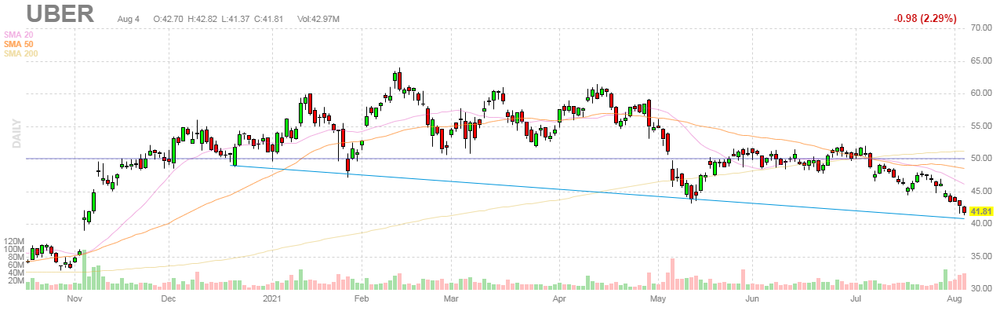
Uber (UBER) reported Q2 FY 2021 GAAP earnings of $0.58 per share (versus -$1.02 per share in Q2 FY 2020), much better than analysts’ consensus estimate of -$0.53 per share.
The company’s quarterly revenues amounted to $3.929 bln (+75.3% y/y), beating analysts’ consensus estimate of $3.762 bln.
UBER fell to $40.20 (-3.85%) in pre-market trading.
CNBC reports that Sean Yokota, Singapore head of markets at the SEB, warns that stock markets are set to see losses ahead, and Japanese stocks could wind up being the hardest hit.
“For the next couple of months, I think you’re going to see some downside risk, especially going into the fall. I think stock markets are in for a correction,” Yokota said.
He said Japanese markets could “suffer the most in this environment” as the country struggles with rising Covid cases as well as lackluster inflation.
Investor sentiment has also been weighed down in recent weeks by concerns over whether the global economic recovery from the pandemic has already peaked. While the U.S. economy is now larger than it was before the pandemic, its growth rate may have peaked at a much slower than expected pace.
SEB’s Yokota said he sees a slowdown in growth ahead.
“You can have transitory inflation, you could have transitory growth as well, where this pent up demand that you had fades away,” he said.
Higher inflation tends to pressure stock prices as it reduces expectations for earnings growth. Rising inflation in the U.S. has sent jitters through the market this year, raising concerns about whether the Federal Reserve may roll back its easy policies earlier than expected.
FXStreet reports that economists at Westpac discuss US Dollar Index (DXY) prospects,
“Fed Vice Chair Clarida added serious heft to the growing chorus of centrist leaning FOMC members in favour of scaling back stimulus, joining Waller, Daly and Bullard in recent weeks.
“Evidence has been building that peak US rebound momentum is in the rear-view mirror. But fresh all-time cycle high for the services ISM suggest that those parts most heavily battered by covid are still finding fresh gears".
“A July payrolls print in the 600-900K range, and another strong CPI next week will likely keep Jackson Hole and September FOMC taper announcement timelines intact.”
“DXY should continue to find support in the 91.5-92.0 area and as taper talk rises to a crescendo in Q3 could see new highs beyond 93.50.”
CNBC reports that President Joe Biden will set a new national target for the adoption of electric vehicles on Thursday, calling for them to represent 40% to 50% of all new auto sales by 2030, according to senior administration officials.
Though the president will sign an executive order, the sales target is not mandatory. Instead, the document encourages the U.S. auto industry and government to promote legislation and the adoption of electrified vehicles. The target includes zero-emission vehicles powered by fuel cells and batteries as well as plug-in hybrid models with internal combustion engines.
The Biden administration also is expected to announce proposed federal fuel economy and emission standards through the 2026 model-year that build on California’s tougher regulations, the officials said. The proposed standards are subject to a public comment period and final approval.
FXStreet reports that economists at Société Générale are discussing pound prospects in the light of the Bank of England meeting.
“Support to maintain the current pace of Gilt purchases and complete the GBP875 B programme in December as originally set out should still be in the majority vs those who think purchases should be curtailed. The bank is of the view that higher inflation is temporary, but inflation expectations one year out have drifted above 3%. A split vote could in theory be read as positive for sterling and a steepening in Gilts and swaps.”
“The covering of short GBP/USD CFTC positions could lend support for a squeeze back to 1.3950 but 1.40 will be a tough slog without concrete guidance that QE will end this year.”
According to the report from IHS Markit/CIPS the recovery in UK construction output lost momentum since June, with slower growth seen in all three main categories of work. Survey respondents often cited difficulties keeping pace with the recent surge in demand for construction projects, especially due to raw material supply shortages and shrinking sub-contractor availability. With demand for construction materials continuing to outstrip supply, latest data signalled another steep increase in purchasing prices. Around 81% of the survey panel reported a rise in their average cost burdens during July, while only 1% signalled a decline.
The headline seasonally adjusted UK Construction PMI Total Activity Index registered 58.7 in July, down sharply from June's 24-year high of 66.3 but still well above the crucial 50.0 no-change threshold. The latest reading signalled the slowest overall increase in construction output since February.
House building was the best-performing category in July (index at 60.3), followed closely by commercial building (59.2). In both cases, the rate of expansion was the weakest since February. Civil engineering activity (55.0) followed the momentum seen elsewhere in the construction sector during July, with growth easing sharply since June and the lowest for five months.
Total order books continued to improve in July, but the latest rise in new work was the weakest since March. Similarly, input buying expanded at the slowest pace since April amid a softer recovery in demand. Construction companies also noted that reduced materials availability had acted as a brake on purchasing volumes in July.
Finally, construction firms continued to hire staff at a strong pace, reflecting rising orders and confidence regarding the near-term outlook. While optimism toward future output growth remained historically high, the index drifted down to its lowest for six months in July.
According to the latest figures from the Society of Motor Manufacturers and Traders (SMMT), July’s new car registrations fell by -29.5% to 123,296 units. The decline was artificially heightened by comparison with the same month last year, when registrations rose dramatically as showrooms enjoyed a full month’s operation following the first 2020 lockdown.
However, the July performance was down -22.3% on the average recorded over the past decade, as the ongoing semiconductor shortage and the ‘pandemic’ impacted on both supply and demand. As a result, this was the weakest July for new car registrations since 1998, prior to the introduction of the two-plate system.
The decline was predominantly within large fleets which, at 61,140 units, was some -28.7% lower than the average recorded over the past decade. Private registrations declined by a lesser extent, -10.7%, to 59,841 units.
The bumper growth in plug-in vehicles continued, however, with battery electric vehicles (BEVs) accounting for 9.0% of registrations, while plug-in hybrids (PHEVs) reached 8.0%. All new car segments experienced declines, but Britain’s most popular types of cars remained superminis (32.9% of registrations), lower medium (28.0%) and dual purpose (27.3%).
Mike Hawes, SMMT Chief Executive, said: "The automotive sector continues to battle against shortages of semiconductors and staff, which is throttling our ability to translate a strengthening economic outlook into a full recovery. The next few weeks will see changes to self-isolation policies which will hopefully help those companies across the industry dealing with staff absences, but the semiconductor shortage is likely to remain an issue until at least the rest of the year. As a result, we have downgraded the market outlook slightly for 2021. The bright spot, however, remains the increasing demand for electrified vehicles as consumers respond in ever greater numbers to these new technologies, driven by increased product choice, fiscal and financial incentives and an enjoyable driving experience".
According to the report from IHS Markit, at 49.8 in July, the Eurozone Construction Total Activity Index fell from 50.3 in June and pointed to a marginal reduction in overall construction activity. This marked the first fall in activity since February, with companies often linking the decline to rising costs and raw material shortages. Sub-sector data showed slightly quicker falls in both commercial and civil engineering activity in July, while home building activity expanded at the softest rate for three months.
Home building in the eurozone increased for the fifth successive month in July. That said, the rate of expansion eased to a modest pace that was the softest recorded since April. Work undertaken on commercial construction projects in the eurozone fell again in July, thereby stretching the current sequence of decline to 17 months. Though modest, the rate of reduction was the quickest seen since April. As has been the case since August 2019, civil engineering activity fell across the eurozone at the start of the third quarter. The pace of reduction quickened slightly since June, and was solid overall.
Eurozone construction firms were confident in July that activity will increase over the next year. Notably, the degree of positive sentiment was little-changed from June's two-year peak.
FXStreet reports that while additional downside risk is possible, strategists at TD Securities see oil as a buying opportunity after rout.
“The petroleum complex will continue to show weakness for as long as the risks from new COVID-19 breakouts are not well defined. However, we also believe that the impact on petroleum product demand may not be as severe as some fear, owing to the fact the world has gotten used to dealing with COVID-19 outbreaks, and that much of the Western world is becoming better protected with vaccines. This includes the US, as vaccine distribution is likely to grow.”
“With demand likely still increasing rapidly into Q3-2021 and shale supply hindered by the lack of meaningful capital expenditure growth, the proposed production increase by OPEC+ imply a deficit market over next couple months, provided that the spread of COVID does not catalyze widespread lockdowns.”
“We believe that the crude market could see prices spike when Delta worries moderate, with WTI and Brent looking toward $80/b again.”
| Time | Country | Event | Period | Previous value | Forecast | Actual |
|---|---|---|---|---|---|---|
| 01:30 | Australia | Trade Balance | June | 9.269 | 10.45 | 10.496 |
| 06:00 | Germany | Factory Orders s.a. (MoM) | June | -3.2% | 1.9% | 4.1% |
| 06:45 | France | Industrial Production, m/m | June | -0.4% | 0.6% | 0.5% |
During today's Asian trading, the US dollar stabilized against the euro, but fell against the pound and the Japanese yen.
The ICE index, which tracks the dynamics of the dollar against six currencies (euro, swiss franc, yen, canadian dollar, pound sterling and swedish krona), rose by 0.01%.
The dollar index rose to weekly highs on the eve of the "hawkish" comments of the deputy chairman of the Federal Reserve System Richard Clarida. Clarida admitted that the rapid spread of the new COVID-19 "delta" strain carries risks for the US economy, but voiced a rather optimistic picture for the coming years. In his opinion, the situation on the US labor market will continue to improve, and inflation will remain above 2%, as a result of which "the necessary conditions for the Fed to raise the rate will be created by the end of 2022," and this will pave the way for its rise in 2023.
The index of business activity in the US services sector from ISM in July rose to a record 64.1 points from 60.1 points a month earlier, according to data from the Institute for Supply Management (ISM), published on Wednesday. Experts expected an increase in the index to 60.5 points.
The pound rose by 0.15% against the US dollar. Market participants are waiting for the results of the Bank of England meeting, which will be announced today.
According to the report from Insee, in June 2021, output recovered in the manufacturing industry (+0.9%, after –0.6%), as well as in the whole industry (+0.5%, after –0.4%). Economists had expected a 0.6% increase in the whole industry. Compared to February 2020 (the last month before the first general lockdown), output remained in sharp decline in the manufacturing industry (–6.2%), as well as in the whole industry (–5.3%).
In June, output rose in “other manufacturing” (+0.8% after stability). It recovered in the manufacture of transport equipment (+2.3% after –5.5%) and in the manufacture of machinery and equipment goods (+0.8% after −1.7%). It expanded again in the manufacture of coke and refined petroleum (+8.3% after +5.2%).
In June 2021, output remained in sharp decline compared to its February 2020 level in most industrial activities. It plummeted in the manufacture of transport equipment (−28.0%), both in the manufacture of other transport equipment (−27.8%) and in the manufacture of motor vehicles, trailers and semi-trailers (−28.3%).
Due to a significant “base effect” owing to the first general lockdown from March to May 2020, cumulative output over the second quarter of 2021 bounced back compared to the same quarter of 2020 in the manufacturing industry (+24.0%), as well as in the whole industry (+22.0%).
Over this one-year period, output increased strongly in the manufacture of transport equipment (+40.2%), in the manufacture of machinery and equipment goods (+28.0%), in “other manufacturing” (+26.0%), in mining and quarrying, energy, water supply (+12.4%), in the manufacture of food products and beverages (+8.5%) and in the manufacture of coke and refined petroleum products (+10.3%).
eFXdata reports that Bank of America Global Research argues that the growth peak has likely passed.
"Economic recoveries are usually followed by corrections…Looking over the past 90 years, we find that every economic recovery has run into a substantial drawdown at some point in the first two years following troughs in US GDP, with the S&P 500 falling an average of 18-20%, and only one episode below 10%. Given this regularity in recovery dynamics, is history bound to repeat?, And peak growth with early tapering is increasing risk. Furthermore, the recovery in risk assets has already matched or exceeded those of the first two years of previous recoveries in half the time. With this confluence of risks and how fast and far markets have gone, caution seems warranted," BofA adds.
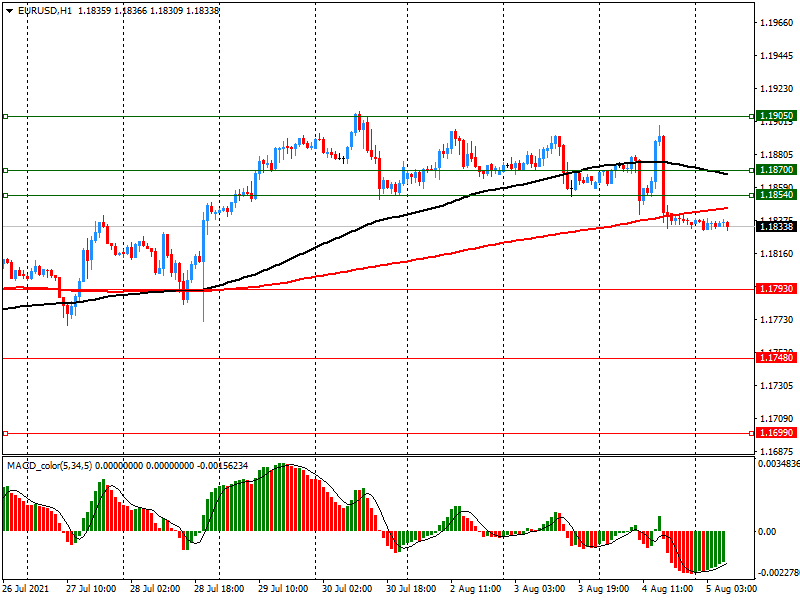
EUR/USD
Resistance levels (open interest**, contracts)
$1.1905 (2393)
$1.1870 (1899)
$1.1854 (1073)
Price at time of writing this review: $1.1834
Support levels (open interest**, contracts):
$1.1793 (2609)
$1.1748 (5296)
$1.1699 (10348)
Comments:
- Overall open interest on the CALL options and PUT options with the expiration date August, 6 is 72616 contracts (according to data from August, 4) with the maximum number of contracts with strike price $1,1700 (10348);
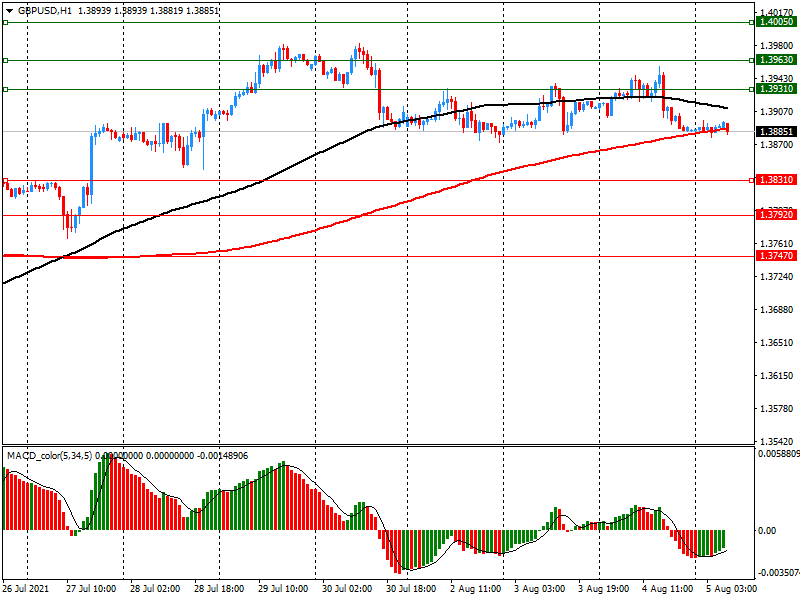
GBP/USD
$1.4005 (1623)
$1.3963 (754)
$1.3931 (1063)
Price at time of writing this review: $1.3885
Support levels (open interest**, contracts):
$1.3831 (283)
$1.3792 (777)
$1.3747 (904)
Comments:
- Overall open interest on the CALL options with the expiration date August, 6 is 16468 contracts, with the maximum number of contracts with strike price $1,4150 (1782);
- Overall open interest on the PUT options with the expiration date August, 6 is 19363 contracts, with the maximum number of contracts with strike price $1,3400 (1677);
- The ratio of PUT/CALL was 1.18 versus 1.17 from the previous trading day according to data from August, 4
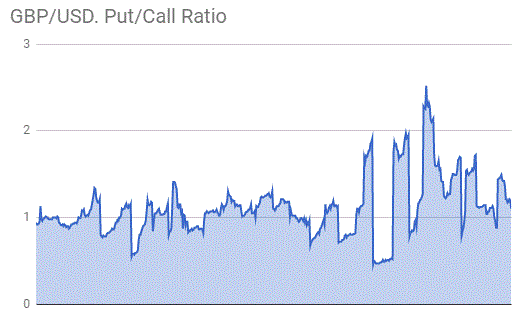
* - The Chicago Mercantile Exchange bulletin (CME) is used for the calculation.
** - Open interest takes into account the total number of option contracts that are open at the moment.
According to provisional results of the Federal Statistical Office (Destatis), real (price adjusted) new orders increased by a seasonally and calendar adjusted 4.1% in June 2021 compared with May 2021. Economists had expected a 1.9% increase. Excluding major orders, real new orders in manufacturing were 1.7% higher than in the previous month.
Compared with February 2020, which was the month before restrictions were imposed due to the corona pandemic in Germany, new orders in June 2021 were 11.2% higher in seasonally and calendar adjusted terms. Compared with June 2020 (-11.4% compared to June 2019), the increase in calendar adjusted new orders amounted to +26.2%.
Domestic orders increased by 9.6%. Major orders had a substantial effect on the domestic result of the month. Foreign orders went up by 0.4% in June 2021 on the previous month. New orders from the euro area increased 1.3%, and new orders from other countries fell by 0.2% compared with May 2021.
In June 2021, the manufacturers of intermediate goods saw new orders increase by 1.4% compared with May 2021. The manufacturers of capital goods saw an increase of 6.8% on the previous month. Regarding consumer goods, new orders fell by 1.1%.
| Raw materials | Closed | Change, % |
|---|---|---|
| Brent | 70.35 | -3.06 |
| Silver | 25.359 | -0.57 |
| Gold | 1811.347 | 0.07 |
| Palladium | 2645.45 | 0.14 |
| Time | Country | Event | Period | Previous value | Forecast |
|---|---|---|---|---|---|
| 01:30 (GMT) | Australia | Trade Balance | June | 9.681 | 10.45 |
| 06:00 (GMT) | Germany | Factory Orders s.a. (MoM) | June | -3.7% | 1.5% |
| 06:45 (GMT) | France | Industrial Production, m/m | June | -0.3% | 0.6% |
| 08:00 (GMT) | Eurozone | ECB Economic Bulletin | |||
| 08:30 (GMT) | United Kingdom | PMI Construction | July | 66.3 | 64 |
| 11:00 (GMT) | United Kingdom | Asset Purchase Facility | 875 | 875 | |
| 11:00 (GMT) | United Kingdom | BoE Interest Rate Decision | 0.1% | 0.1% | |
| 11:00 (GMT) | United Kingdom | Bank of England Minutes | |||
| 12:30 (GMT) | U.S. | Continuing Jobless Claims | July | 3269 | 3260 |
| 12:30 (GMT) | U.S. | Initial Jobless Claims | July | 400 | 384 |
| 12:30 (GMT) | Canada | Trade balance, billions | June | -1.39 | -0.8 |
| 12:30 (GMT) | U.S. | International Trade, bln | June | -71.2 | -73.9 |
| 22:30 (GMT) | Australia | AIG Services Index | July | 57.8 | |
| 23:00 (GMT) | Australia | RBA's Governor Philip Lowe Speaks | |||
| 23:30 (GMT) | Japan | Labor Cash Earnings, YoY | June | 1.9% | |
| 23:30 (GMT) | Japan | Household spending Y/Y | June | 11.6% | 0.1% |
| Pare | Closed | Change, % |
|---|---|---|
| AUDUSD | 0.73784 | -0.2 |
| EURJPY | 129.542 | 0.16 |
| EURUSD | 1.18349 | -0.23 |
| GBPJPY | 151.99 | 0.21 |
| GBPUSD | 1.3885 | -0.18 |
| NZDUSD | 0.70411 | 0.34 |
| USDCAD | 1.25426 | 0.07 |
| USDCHF | 0.90569 | 0.24 |
| USDJPY | 109.46 | 0.39 |







© 2000-2026. All rights reserved.
This site is managed by Teletrade D.J. LLC 2351 LLC 2022 (Euro House, Richmond Hill Road, Kingstown, VC0100, St. Vincent and the Grenadines).
The information on this website is for informational purposes only and does not constitute any investment advice.
The company does not serve or provide services to customers who are residents of the US, Canada, Iran, The Democratic People's Republic of Korea, Yemen and FATF blacklisted countries.
Making transactions on financial markets with marginal financial instruments opens up wide possibilities and allows investors who are willing to take risks to earn high profits, carrying a potentially high risk of losses at the same time. Therefore you should responsibly approach the issue of choosing the appropriate investment strategy, taking the available resources into account, before starting trading.
Use of the information: full or partial use of materials from this website must always be referenced to TeleTrade as the source of information. Use of the materials on the Internet must be accompanied by a hyperlink to teletrade.org. Automatic import of materials and information from this website is prohibited.
Please contact our PR department if you have any questions or need assistance at pr@teletrade.global.


 Bank
Bank transfers


