- Analytics
- News and Tools
- Market News
CFD Markets News and Forecasts — 02-08-2021
| Time | Country | Event | Period | Previous value | Forecast |
|---|---|---|---|---|---|
| 01:00 (GMT) | Australia | MI Inflation Gauge, m/m | July | 0.4% | |
| 01:30 (GMT) | Australia | Building Permits, m/m | June | -7.1% | -4.5% |
| 04:30 (GMT) | Australia | Announcement of the RBA decision on the discount rate | 0.1% | 0.1% | |
| 07:00 (GMT) | Switzerland | SECO Consumer Climate | Quarter III | -7.1 | |
| 09:00 (GMT) | Eurozone | Producer Price Index (YoY) | June | 9.6% | |
| 09:00 (GMT) | Eurozone | Producer Price Index, MoM | June | 1.3% | |
| 14:00 (GMT) | U.S. | Factory Orders | June | 1.7% | 1% |
| 18:00 (GMT) | U.S. | FOMC Member Clarida Speaks | |||
| 22:30 (GMT) | Australia | AiG Performance of Construction Index | July | 55.5 | |
| 22:45 (GMT) | New Zealand | Employment Change, q/q | Quarter II | 0.6% | 0.7% |
| 22:45 (GMT) | New Zealand | Unemployment Rate | Quarter II | 4.7% | 4.5% |
FXStreet reports that senior economist at UOB Group Alvin Liew reviews the latest preliminary figures for U.S. Q2 GDP.
“US 2Q 2021 GDP increased by 6.5% q/q SAAR, accelerating slightly from the revised 6.3% expansion in 1Q, but well missing Bloomberg and our forecasts. Note that the BEA also revised the 2020 full year GDP contraction slightly to -3.4% (from -3.5% previously).”
“Growth in 2Q was fueled by government stimulus, as the US vaccine rollout proceeded at a rapid pace helping the re-opening of many parts of the economy while monetary policy remained very accommodative. But challenges in keeping inventory stocked and bottlenecks in production likely have curbed the pace of growth.”
“On balance, we remain positive about US outlook despite fears of a COVID-19 driven correction. That said, the growth trajectory remains uncertain (i.e. the tapering in the take-up rate of vaccination demand and COVID-19 Delta variant) but for now we still project US GDP will extend its rebound at a slightly faster pace in 2H. The US full-year 2021 GDP is still expected to expand by 6.8%, which is slightly below IMF’s recently revised projection of 7% US growth.”
The
Commerce Department announced on Monday that construction spending edged up 0.1
percent m-o-m in June after a revised 0.2 percent m-o-m drop in May (originally
a 0.3 percent m-o-m decrease).
Economists
had forecast construction spending growing 0.4 percent m-o-m in June.
According
to the report, spending on private construction increased 0.4 percent m-o-m,
while investment in public construction declined 1.2 percent m-o-m.
On a
y-o-y basis, construction spending surged 8.2 percent in June.
A
report from the Institute for Supply Management (ISM) showed on Monday the U.S.
manufacturing sector’s activity continued to grow in July albeit at a
slower pace than in June.
The ISM's index of manufacturing activity came in at 59.5 percent last month, down 1.1 percentage points from an unrevised June reading of 60.6 percent. The July reading pointed to the expansion in the manufacturing sector for the 14th straight month but at the weakest pace since January. Economists' had forecast the indicator to edge up to 60.9 percent. A reading above 50 percent indicates expansion, while a reading below 50 percent indicates contraction.
According
to the report, the New Orders Index decreased 1.1 percentage points to 64.9 percent
in July, while the Production Index fell 2.4 percentage points to 58.4 percent and
the Supplier Deliveries Index dropped 2.6 percentage points to 72.5 percent. Meanwhile,
the Employment Index surged 3.0 percentage points to 52.9 percent and the Backlog
of Orders Index went up 0.5 percentage point to 65.0 percent. On the price
front, the Prices Index declined 6.4 percentage points to 85.7 percent, stepping
back from the June figure of 92.1 percent, which was the index's highest
reading since July 1979.
Timothy
R. Fiore, Chair of the ISM Manufacturing Business Survey Committee, noted that
the Survey Committee members reported that their companies and suppliers
continued to struggle to meet increasing demand levels. “As we enter the third
quarter, all segments of the manufacturing economy are impacted by near
record-long raw-material lead times, continued shortages of critical basic
materials, rising commodities prices and difficulties in transporting products,”
he said. “Worker absenteeism, short-term shutdowns due to parts shortages and
difficulties in filling open positions continue to be issues limiting
manufacturing-growth potential. Optimistic panel sentiment remained strong,
with 13 positive comments for every cautious comment.”
Fiore
also noted that the past relationship between the PMI and the overall economy
indicated that the PMI for July (59.5 percent) corresponded to a 4.7-percent gain
in real gross domestic product (GDP) on an annualized basis.
The
latest report by IHS Markit revealed on Monday the seasonally adjusted IHS
Markit final U.S. Manufacturing Purchasing Managers’ Index (PMI) came in at 63.4
in July, up from 62.1 in June and marginally higher than the earlier released “flash”
reading of 63.1. The July reading pointed to a noticeable improvement in
operating conditions, which was strongest in the 14-year series history.
Economists
had forecast the index to stay unrevised at 63.1.
According
to the report, the July gain in headline figure was supported by stronger expansions
in output and new orders, with the latter growing at the second-quickest pace
since data collection began in May 2007. At the same time, unprecedented
supplier shortages and delays continued to exert upward pressure on input costs
and stymie firms' ability to process incoming new work. As a result, cost
burdens rose at a record-breaking rate and the accumulation of backlogs
accelerated. Elsewhere, employment rose at the sharpest pace for three months,
but some firms continued to note difficulties filling vacancies.
U.S. stock-index futures rose on Monday, as the fact that the U.S. Senate finalized the full text of the $1 trillion infrastructure bill raised hopes for more fiscal stimulus to be approved soon.
Global Stocks:
Index/commodity | Last | Today's Change, points | Today's Change, % |
Nikkei | 27,781.02 | +497.43 | +1.82% |
Hang Seng | 26,235.80 | +274.77 | +1.06% |
Shanghai | 3,464.29 | +66.93 | +1.97% |
S&P/ASX | 7,491.40 | +98.80 | +1.34% |
FTSE | 7,067.96 | +35.66 | +0.51% |
CAC | 6,661.62 | +48.86 | +0.74% |
DAX | 15,555.27 | +10.88 | +0.07% |
Crude oil | $73.06 | -1.20% | |
Gold | $1,813.10 | -0.23% |
(company / ticker / price / change ($/%) / volume)
ALCOA INC. | AA | 40.6 | 0.45(1.12%) | 27314 |
Amazon.com Inc., NASDAQ | AMZN | 3,345.00 | 17.41(0.52%) | 95783 |
American Express Co | AXP | 170.85 | 0.32(0.19%) | 5186 |
Apple Inc. | AAPL | 146.61 | 0.75(0.51%) | 603560 |
AT&T Inc | T | 28.12 | 0.07(0.25%) | 314611 |
Boeing Co | BA | 227.98 | 1.50(0.66%) | 66751 |
Caterpillar Inc | CAT | 207.55 | 0.80(0.39%) | 19103 |
Chevron Corp | CVX | 102.1 | 0.29(0.28%) | 6446 |
Cisco Systems Inc | CSCO | 55.54 | 0.17(0.31%) | 24127 |
Citigroup Inc., NYSE | C | 67.8 | 0.18(0.27%) | 27215 |
Deere & Company, NYSE | DE | 363.99 | 2.40(0.66%) | 1062 |
E. I. du Pont de Nemours and Co | DD | 75.06 | 0.01(0.01%) | 551 |
Facebook, Inc. | FB | 357.85 | 1.55(0.44%) | 121210 |
FedEx Corporation, NYSE | FDX | 280.31 | 0.36(0.13%) | 1234 |
Ford Motor Co. | F | 14.02 | 0.07(0.50%) | 653714 |
Freeport-McMoRan Copper & Gold Inc., NYSE | FCX | 38.52 | 0.42(1.10%) | 78241 |
General Electric Co | GE | 103.11 | -0.49(-0.47%) | 150047 |
General Motors Company, NYSE | GM | 57.2 | 0.36(0.63%) | 73180 |
Goldman Sachs | GS | 376.69 | 1.81(0.48%) | 2903 |
Google Inc. | GOOG | 2,715.00 | 10.58(0.39%) | 2277 |
Hewlett-Packard Co. | HPQ | 29.04 | 0.17(0.59%) | 2615 |
HONEYWELL INTERNATIONAL INC. | HON | 235.28 | 1.49(0.64%) | 699 |
Intel Corp | INTC | 53.91 | 0.19(0.35%) | 79827 |
International Business Machines Co... | IBM | 141.75 | 0.79(0.56%) | 7319 |
International Paper Company | IP | 57.51 | -0.25(-0.43%) | 491 |
JPMorgan Chase and Co | JPM | 152.39 | 0.61(0.40%) | 4686 |
McDonald's Corp | MCD | 243.7 | 0.99(0.41%) | 2002 |
Merck & Co Inc | MRK | 77.09 | 0.22(0.29%) | 5832 |
Microsoft Corp | MSFT | 285.8 | 0.89(0.31%) | 59786 |
Nike | NKE | 168.09 | 0.58(0.35%) | 4382 |
Pfizer Inc | PFE | 43.21 | 0.40(0.93%) | 245304 |
Procter & Gamble Co | PG | 142.14 | -0.09(-0.06%) | 8407 |
Starbucks Corporation, NASDAQ | SBUX | 121.91 | 0.48(0.40%) | 9620 |
Tesla Motors, Inc., NASDAQ | TSLA | 701.68 | 14.48(2.11%) | 553246 |
The Coca-Cola Co | KO | 57.14 | 0.11(0.19%) | 23321 |
Twitter, Inc., NYSE | TWTR | 69.92 | 0.17(0.24%) | 19348 |
Verizon Communications Inc | VZ | 55.96 | 0.18(0.32%) | 46788 |
Visa | V | 246.5 | 0.11(0.04%) | 10587 |
Wal-Mart Stores Inc | WMT | 142.99 | 0.44(0.31%) | 2942 |
Walt Disney Co | DIS | 176.8 | 0.78(0.44%) | 19399 |
Yandex N.V., NASDAQ | YNDX | 68.55 | 0.62(0.91%) | 278 |
FXStreet notes that S&P 500 strength is expected to stall at a cluster of resistances. Economists at Credit Suisse continue to look for a “summer consolidation/correction” to emerge.
“The S&P 500 remains capped at a cluster of key resistances, including importantly our Q3 objective at 4436/56 and trend resistance from April. Whilst we see scope for a retest of this zone, with daily and weekly RSI momentum still holding bearish divergences we maintain our core view of not chasing strength through 4436/56 for now and we continue to look for a ‘summer consolidation/correction’ to emerge.”
“Key near-term support stays at the price gap from Friday morning and now also the rising 13-day exponential average at 4381/64. A close below here remains needed to add weight to our view for a corrective phase for a fall back to support at 4350, then 4331/21.”
Lyft (LYFT) initiated with a Hold at Gordon Haskett; target $59
Uber (UBER) initiated with a Buy at Gordon Haskett; target $65
FXStreet reports that FX Strategists at UOB Group suggest that AUD/USD risks further pullbacks on a break below the 0.7290 level.
24-hour view: “Our expectation for AUD to ‘test 0.7420 first before easing’ did not materialize as it rose to 0.7404 before pulling back (low has been 0.7332). The rapid pullback appears to be overdone and AUD is unlikely to weaken much further. For today, AUD is more likely to trade within a range of 0.7320/0.7370.”
Next 1-3 weeks: “...AUD dropped to 0.7332 last Friday. Downward momentum is beginning to improve and the prospect for a break of 0.7320 has increased. That said, AUD has to close below 0.7290 before a sustained decline can be expected. At this stage, the chance for AUD to close below 0.7290 is not high but it would remain intact as long as AUD does not move above the ‘strong resistance’ level (currently at 0.7395) within these few days."
FXStreet reports that analysts at OCBC Bank note that the investors' focus shifts towards the Bank of England (BoE) monetary policy decision this Thursday where a dovish message would help the cable to break above 1.4000.
“Delta-variant developments in the UK have turned more positive last week, and businesses appear to be notably optimistic after the reopening. These may be supportive of GBP/USD upside, but pandemic-related positives are flimsy and prone to re-emerging cases.”
“The pair may need the BoE to come out clearly less dovish than expected in its Thursday meeting for it to breach 1.4000.”
| Time | Country | Event | Period | Previous value | Forecast | Actual |
|---|---|---|---|---|---|---|
| 06:00 | Germany | Retail sales, real adjusted | June | 4.6% | 2% | 4.2% |
| 06:00 | Germany | Retail sales, real unadjusted, y/y | June | -1.8% | 6.2% | |
| 06:30 | Switzerland | Retail Sales (MoM) | June | -2.3% | -3.5% | |
| 06:30 | Switzerland | Retail Sales Y/Y | June | 2.8% | 0.1% | |
| 06:30 | Switzerland | Consumer Price Index (MoM) | July | 0.1% | -0.1% | -0.1% |
| 06:30 | Switzerland | Consumer Price Index (YoY) | July | 0.6% | 0.7% | 0.7% |
| 07:30 | Switzerland | Manufacturing PMI | July | 66.7 | 71.1 | |
| 07:50 | France | Manufacturing PMI | July | 59.0 | 58.1 | 58 |
| 07:55 | Germany | Manufacturing PMI | July | 65.1 | 65.6 | 65.9 |
| 08:00 | Eurozone | Manufacturing PMI | July | 63.4 | 62.6 | 62.8 |
| 08:30 | United Kingdom | Purchasing Manager Index Manufacturing | July | 63.9 | 60.4 | 60.4 |
EUR rose against other major currencies in the European session on Monday, following the release of the better-than-expected Eurozone’s manufacturing PMI print for July and Germany’s retail sales data for June.
Final data from IHS Markit revealed that Eurozone Manufacturing PMI came in at 62.8 in July, marginally firmer than the flash figure of 62.6, but down slightly from June’s record high reading of 63.4. The July final print, however, was the lowest reading since March. Economists had expected the indicator to stay unrevised at 62.6. According to the report, output grew at the softest rate since February, while the rate of expansion in new business was steep and held close to March’s survey record, and new export orders continued to expand at a sharp pace, albeit one that was the weakest in five months. In addition, employment levels rose at a rate unseen in 24 years of data collection. On the price front, input costs and output charges increased at record rates.
In addition, Destatis reported that retail sales in Germany, the Eurozone’s biggest economy, rose 4.2% m/m in June, following an upwardly revised advance of 4.6% m/m in May. This significantly exceeded economists’ forecast of a 2% m/m gain. In y/y terms, the country’s retail sales surged 6.2% after an upwardly revised 1.8% m/m drop in the previous month.
FXStreet reports that UOB Group’s FX Strategists still see USD/JPY navigating within the 109.20-110.60 range for the next weeks.
24-hour view: “We highlighted last Friday that USD ‘could decline further but a break of the major support at 109.20 is unlikely’. Our view was not wrong as USD dipped to 109.35 before recovering. The price actions are viewed as part of a consolidation and USD is likely to trade within a 109.45/109.85 range for today.”
Next 1-3 weeks: “As highlighted, USD could trade within a 109.20/110.60 range for now. While shorter-term downward momentum has improved somewhat, USD has to close below 109.05 before a sustained decline can be expected. The prospect for USD to close below 109.05 is not high but it would remain intact as long as USD does not move above 110.00 within these few days.”
FXStreet notes that EUR/CHF has broken below a multi-month ascending trend line resulting in a steady downtrend. As analysts at Société Générale suggest, the pair could slide below the 1.0700 level on a loss of the 1.0730 support.
"EUR/CHF is reaching potential support of 1.0730 representing lows of December 2020 and January 2021."
"An initial bounce is likely towards 1.0810."
"Failure to hold above 1.0730 will mean further decline towards 1.0700 and 1.0640, the 78.6% retracement from April 2020."
FXStreet reports that FX Strategists at UOB Group note that the outlook for USD/CNH remains mixed for the time being.
24-hour view: “USD subsequently traded within a narrower range than expected (6.4514/6.4725) before closing little changed at 6.4633 (+0.09%). The movement is deemed as part of a consolidation phase and further sideway-trading would not be surprising, likely between 6.4525 and 6.4750.”
Next 1-3 weeks: “Our update from last Friday (30 Jul, spot at 6.4650) still stands. As highlighted, the recent sharp but short-lived swings have resulted in a mixed outlook and USD could trade within a 6.4400/6.5000 range for now.”
August 3
Before the Open:
Alibaba (BABA). Consensus EPS RMB14.29, Consensus Revenues RMB208673.08 mln
DuPont (DD). Consensus EPS $0.95, Consensus Revenues $3985.27 mln
After the Close:
Amgen (AMGN). Consensus EPS $4.01, Consensus Revenues $6466.99 mln
Lyft (LYFT). Consensus EPS -$0.25, Consensus Revenues $699.30 mln
August 4
After the Close:
Uber (UBER). Consensus EPS -$0.32, Consensus Revenues $3740.27 mln
August 5
Before the Open:
Moderna (MRNA). Consensus EPS $5.86, Consensus Revenues $4233.41 mln
After the Close:
American Intl (AIG). Consensus EPS $1.20, Consensus Revenues $10888.50 mln
Beyond Meat (BYND). Consensus EPS -$0.23, Consensus Revenues $141.04 mln
FXStreet reports that economists at ING expect a marginal upside potential for the sterling, as the Bank of England (BoE) is unlikely to turn more hawkish.
“We don’t expect any new guidance on the interest rate path and look for the repeat of prior language that ‘significant progress’ is needed before stimulus is removed. Only 1-2 members are likely to vote for an early end of the QE.”
“With EUR/USD stabilising and the dollar experiencing some tentative progress, GBP/USD is likely to test the 1.4000 level. However, given that we see an upside to EUR/USD as limited and the UK specific news should not provide too much boost to sterling, we don’t look for a material spike in GBP/USD above the 1.400 level – rather a shallow one, if any.”
FXStreet reports that economists at MUFG Bank note, the strength of the eurozone economic recovery surprises to the upside, which offers support to the common currency.
“The main driver for the recent turnaround in fortunes for the pair has been the USD leg. Fed communication over the past week has set the scene for renewed USD depreciation as faith is restored in global growth and loose monetary policy. The scale of drop in US yields in July coupled with a continued dovish stance as signalled by Powell certainly puts the dollar back on a fragile footing.”
“Evidence of stronger economic recovery should encourage the ECB to discuss starting to phase out emergency support measures in the autumn. However, the ECB’s new dovish policy guidance has signalled strongly that they will maintain looser policy for longer. The net result is that the ECB’s dovish policy stance will dampen support for a stronger EUR from evidence of stronger growth and inflation in the eurozone.”
“We expect EUR/USD to stabilize around the 1.2000-level heading into year-end.”
According to the report from the industry group Plateforme Automobile, French car sales slumped 35% in July as a semiconductor shortage curbed inventory in one of Europe’s biggest markets. France recorded 115,713 passenger-car registrations for the month.
For the first seven months of the year, registrations rose 16% over the same period in 2020, when sales were depressed during the first wave of the pandemic.
The sluggish result is a further indication that Europe’s auto-industry recovery is slower than the rebound seen in the U.S. and China. The latest data from the European Automobile Manufacturers’ Association showed almost 2 million fewer cars were sold in the region during the first half compared with two years ago.
FXStreet reports that economists at HSBC continue to expect GBP/USD to move lower over the medium to long-term, amid weaker post-Brexit UK growth.
“The GBP may face some marginal downside following BoE Deputy Governor Ben Broadbent’s speech on 22 July, looking at mismatches in the economy. Mr. Broadbent appears to be distancing himself from the more hawkish camp within the BoE that has emerged in recent weeks.”
“Rates market pricing is already looking for rate hikes to begin in Q2 next year, as are our economists. However, the GBP appears to have moved even further in anticipating UK outperformance. This pushback against any near-term tightening, although modest, may still cause some froth to come out of the GBP.”
“We continue to see GBP/USD moving lower over the medium-term. Brexit costs could also add to the weakening in potential growth and the broader fall in the GBP’s long-term fair value.”
According to the report from IHS Markit/CIPS, the UK manufacturing upturn remained solid in July. Although rates of expansion in output and new orders slowed, they remained among the best in the survey history amid robust sales to both domestic and export clients. Scarcities remained a prime concern, however, as stretched supply chains and staff shortages were constraints preventing faster growth of output and employment.
The seasonally adjusted PMI posted 60.4 in July, down further from May's record high of 65.6. The PMI has signalled expansion for 14 months. Growth slowed across the consumer, intermediate and investment goods industries. Manufacturing production rose for the fourteenth consecutive month in July, as companies benefited from increased new order intakes, rising client confidence and the re opening of the economy. New business inflows reflected stronger demand from domestic and overseas markets. There were also reports of clients bringing forward purchases to guard against supply chain issues. That said, rates of growth in both output and new work both eased to four-month lows. July saw a further increase in new export business. The investment goods sector saw by far the steepest increase. Companies reported improved demand from the US, the EU, China, Russia and the Middle-East, although some noted that Brexit issues constrained exports to the EU. Scarcities, shortages and price rises remained prominent challenges faced by UK manufacturers during July. Raw material, staff and skill shortages were all major factors stymieing output growth and contributing to a further marked increase in input purchasing. Solid jobs growth continued, but the rate was insufficient to prevent a further increase in backlogs.
The outlook for the manufacturing sector remained on the upside in July, with 63% of companies forecasting output to rise over the coming year. Positive sentiment was linked to improving market conditions and reduced uncertainty surrounding both the post-Brexit and post-pandemic trading environment.
According to the report from IHS Markit, manufacturers in the euro area recorded another resilient outturn in July. At 62.8, the final reading of the PMI was slightly firmer than July’s flash figure of 62.6, but down slightly from 63.4 in June and the lowest since March. Nevertheless, the sector has now recorded successive months of expansion since July 2020, with the latest reading only slightly below June’s survey record high.
The sub-sector splits of the data showed sharp expansions across consumer, intermediate and investment goods makers once again in July, with the latter boasting the fastest upturn of the three. However, a higher PMI reading at consumer goods producers contrasted with lower prints from the other two sectors.
Higher output volumes were underpinned by a continued improvement in demand for euro area goods. As has been the case over the past few months, the rate of growth in new business was steep and held close to March’s survey record. Meanwhile, new export orders expanded at a sharp rate, albeit one that was the weakest in five months. Operating capacities were tested in July, as evidenced by a considerable increase in backlogs of work across euro area goods producers. Firms responded by hiring additional staff at a rate unseen in 24 years of data collection.
Lastly, euro area manufacturers retained their optimistic outlook for the next 12 months as the global economic recovery continues and business adjust to fewer pandemic-related restrictions. Overall, output expectations remained in firm positive territory, although the level of confidence slipped to a seven month low.
| Time | Country | Event | Period | Previous value | Forecast | Actual |
|---|---|---|---|---|---|---|
| 00:30 | Japan | Manufacturing PMI | July | 52.4 | 53.0 | |
| 01:00 | Australia | MI Inflation Gauge, m/m | July | 0.4% | 0.5% | |
| 01:30 | Australia | ANZ Job Advertisements (MoM) | July | 1.5% | -0.5% | |
| 01:45 | China | Markit/Caixin Manufacturing PMI | July | 51.3 | 51 | 50.3 |
| 05:00 | Japan | Consumer Confidence | July | 37.4 | 37.5 | |
| 06:00 | Germany | Retail sales, real adjusted | June | 4.6% | 2% | 4.2% |
| 06:00 | Germany | Retail sales, real unadjusted, y/y | June | -1.8% | 6.2% | |
| 06:30 | Switzerland | Retail Sales (MoM) | June | -2.3% | -3.5% | |
| 06:30 | Switzerland | Retail Sales Y/Y | June | 2.8% | 0.1% | |
| 06:30 | Switzerland | Consumer Price Index (MoM) | July | 0.1% | -0.1% | -0.1% |
| 06:30 | Switzerland | Consumer Price Index (YoY) | July | 0.6% | 0.7% | 0.7% |
During today's Asian trading, the US dollar fell slightly against major currencies, while the dollar index is held near the minimum for the month.
The ICE index, which tracks the dynamics of the dollar against sex currencies (euro, swiss franc, yen, canadian dollar, pound sterling and swedish krona), fell by 0.07%.
Traders are waiting for the results of the meetings of the Reserve Bank of Australia and the Bank of England, as well as statistical data on the US labor market this week.
The US currency was under pressure after the meeting of the Federal Reserve System (Fed). The Federal Reserve said at the end of the meeting on July 27-28 that the US economy continues to recover, despite the renewed increase in the incidence of COVID-19, and the central bank does not intend to rush to curtail incentives.
The Australian dollar rose slightly against the US dollar, as investors prepare for the meeting of the Reserve Bank of Australia, the results of which will be announced tomorrow.
Reuters reports that a Caixin/Markit business survey showed that China’s factory activity growth slipped sharply in July as demand contracted for the first time in over a year in part on high product prices.
The Purchasing Managers’ Index (PMI) fell to 50.3 last month from 51.3 the month before, the lowest level since April 2020. Analysts had expected the index to ease to 51.1.
The Chinese economy has largely recovered from disruptions caused by the coronavirus pandemic, but it has faced new challenges in recent months such as higher raw material costs, which dragged on profit growth at industrial firms in June.
A sub-index for new orders slipped sharply into contraction for the first time since May 2020, while another sub-index for production fell to the slowest pace of expansion since March last year.
Input prices continued to rise, albeit at a slower pace than the previous month but much faster than output prices, putting pressure on margins. Export orders grew slightly faster than the month before but still at a slow pace as the pandemic dampened overseas demand. Factories hired more workers for the fourth month in a row but at a slower pace. An index of confidence in the year ahead slipped to the lowest level in 15 months.
The Federal Statistical Office (FSO) said that the consumer price index (CPI) fell by 0.1% in July 2021 compared with the previous month, reaching 101.0 points (December 2015 = 100). Inflation was +0.7% compared with the same month of the previous year.
The decrease of 0.1% compared with the previous month is due to several factors including falling prices for clothing and footwear due to seasonal sales. The prices for air transport also declined, along with the prices for international package holidays. In contrast, prices for hire of private means of transport and fuel increased.
In July 2021, the Swiss Harmonised Index of Consumer Prices (HICP) stood at 101.12 points (base 2015 = 100). This corresponds to a rate of change of +0.1% compared with the previous month and of +0.5% compared with the same month the previous year. The HICP is a supplementary indicator for inflation based on a harmonised method across EU member countries. It enables inflation in Switzerland to be compared with that of European countries.
According to provisional results of the Federal Statistical Office (Destatis), the real (price-adjusted) turnover of all retail enterprises in Germany was 4.2% higher and the nominal (not price-adjusted) turnover was 4.6% higher, on a calendar and seasonally adjusted basis, in June 2021 than in May 2021. Economists had expected a 2.0% increase (price-adjusted).
This development is probably due to the continuing decline of the coronavirus incidence in all of Germany and, consequently, the easing of restrictions provided for by the federal emergency brake that was applicable until 30 June 2021.
Compared to the pre - crisis month of February 2020, sales in June 2021 were 9.1% higher in real terms on a calendar and seasonally adjusted basis. Compared to June 2020, retail sales increased by 6.2% in real terms and 8.2% in nominal terms in June 2021. However, June 2021 had one more sales day than June 2020 with 26 sales days.
The retail sale of food, beverages and tobacco products in June 2021 was down 3.9% in real terms on May 2021, calendar - adjusted and seasonally adjusted. There were significant increases in the retail trade with non-food products. Real sales in June 2021 were 8.7% higher on a calendar and seasonally adjusted basis than in the previous month. The Internet and mail order business recorded a real, calendar - and seasonally-adjusted decline in sales of 7.5% compared to the previous month.
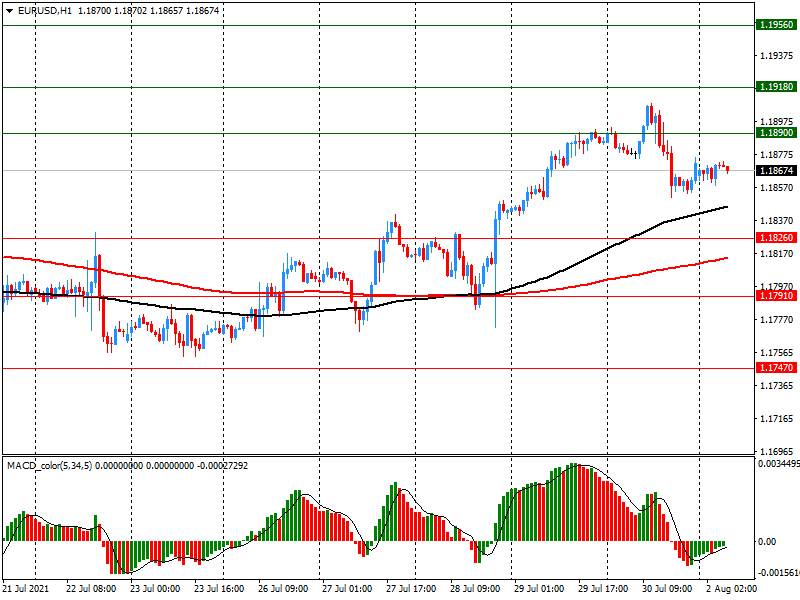
EUR/USD
Resistance levels (open interest**, contracts)
$1.1956 (3389)
$1.1918 (2412)
$1.1890 (1691)
Price at time of writing this review: $1.1867
Support levels (open interest**, contracts):
$1.1826 (2896)
$1.1791 (2887)
$1.1747 (5386)
Comments:
- Overall open interest on the CALL options and PUT options with the expiration date August, 6 is 70392 contracts (according to data from July, 30) with the maximum number of contracts with strike price $1,1700 (10352);
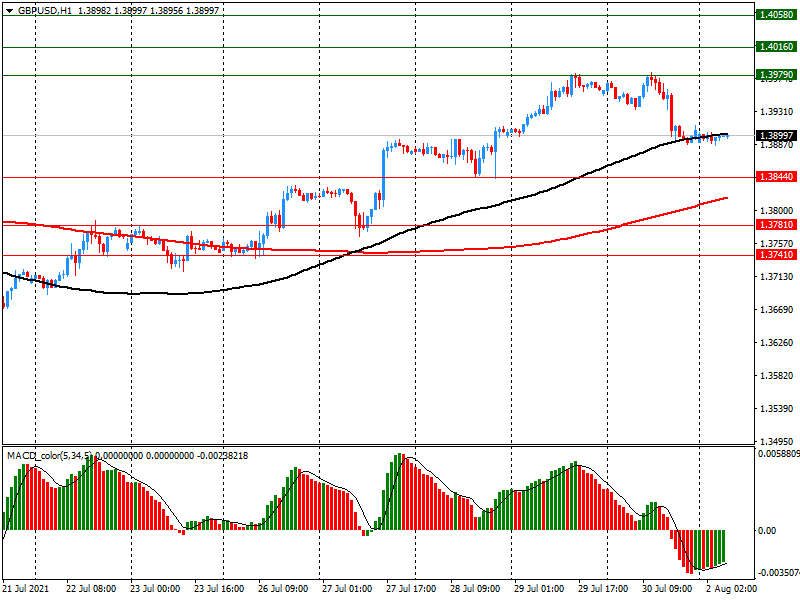
GBP/USD
$1.4058 (453)
$1.4016 (1747)
$1.3979 (736)
Price at time of writing this review: $1.3900
Support levels (open interest**, contracts):
$1.3844 (811)
$1.3781 (825)
$1.3741 (946)
Comments:
- Overall open interest on the CALL options with the expiration date August, 6 is 17102 contracts, with the maximum number of contracts with strike price $1,4150 (1782);
- Overall open interest on the PUT options with the expiration date August, 6 is 18859 contracts, with the maximum number of contracts with strike price $1,3400 (1677);
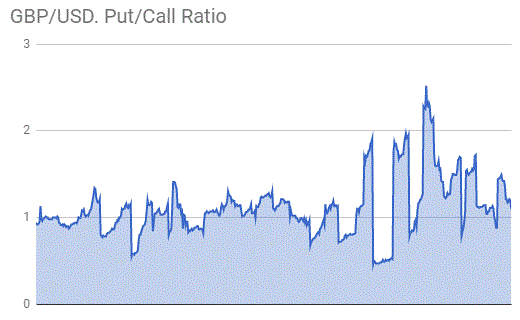
- The ratio of PUT/CALL was 1.10 versus 1.20 from the previous trading day according to data from July, 30
* - The Chicago Mercantile Exchange bulletin (CME) is used for the calculation.
** - Open interest takes into account the total number of option contracts that are open at the moment.
| Raw materials | Closed | Change, % |
|---|---|---|
| Brent | 75.66 | 0.71 |
| Silver | 25.47 | -0.17 |
| Gold | 1814.187 | -0.79 |
| Palladium | 2653.7 | 0.42 |
| Time | Country | Event | Period | Previous value | Forecast |
|---|---|---|---|---|---|
| 00:30 (GMT) | Japan | Manufacturing PMI | July | 52.4 | |
| 01:00 (GMT) | Australia | MI Inflation Gauge, m/m | July | 0.4% | |
| 01:30 (GMT) | Australia | ANZ Job Advertisements (MoM) | July | 3% | |
| 01:45 (GMT) | China | Markit/Caixin Manufacturing PMI | July | 51.3 | 51 |
| 05:00 (GMT) | Japan | Consumer Confidence | July | 37.4 | |
| 06:00 (GMT) | Germany | Retail sales, real adjusted | June | 4.2% | 2% |
| 06:00 (GMT) | Germany | Retail sales, real unadjusted, y/y | June | -2.4% | |
| 06:30 (GMT) | Switzerland | Retail Sales (MoM) | June | -1.8% | |
| 06:30 (GMT) | Switzerland | Retail Sales Y/Y | June | 2.8% | |
| 06:30 (GMT) | Switzerland | Consumer Price Index (MoM) | July | 0.1% | -0.1% |
| 06:30 (GMT) | Switzerland | Consumer Price Index (YoY) | July | 0.6% | 0.7% |
| 07:30 (GMT) | Switzerland | Manufacturing PMI | July | 66.7 | |
| 07:50 (GMT) | France | Manufacturing PMI | July | 59.0 | 58.1 |
| 07:55 (GMT) | Germany | Manufacturing PMI | July | 65.1 | 65.6 |
| 08:00 (GMT) | Eurozone | Manufacturing PMI | July | 63.4 | 62.6 |
| 08:30 (GMT) | United Kingdom | Purchasing Manager Index Manufacturing | July | 63.9 | 60.4 |
| 13:45 (GMT) | U.S. | Manufacturing PMI | July | 62.1 | 63.1 |
| 14:00 (GMT) | U.S. | Construction Spending, m/m | June | -0.3% | 0.4% |
| 14:00 (GMT) | U.S. | ISM Manufacturing | July | 60.6 | 60.9 |
| 23:30 (GMT) | Japan | Tokyo CPI ex Fresh Food, y/y | July | 0.0% | 0% |
| 23:30 (GMT) | Japan | Tokyo Consumer Price Index, y/y | July | 0.0% |
| Pare | Closed | Change, % |
|---|---|---|
| AUDUSD | 0.7346 | -0.63 |
| EURJPY | 130.171 | 0.07 |
| EURUSD | 1.1871 | -0.1 |
| GBPJPY | 152.482 | -0.19 |
| GBPUSD | 1.39051 | -0.38 |
| NZDUSD | 0.69742 | -0.42 |
| USDCAD | 1.24626 | 0.16 |
| USDCHF | 0.90503 | -0.03 |
| USDJPY | 109.647 | 0.18 |







© 2000-2026. All rights reserved.
This site is managed by Teletrade D.J. LLC 2351 LLC 2022 (Euro House, Richmond Hill Road, Kingstown, VC0100, St. Vincent and the Grenadines).
The information on this website is for informational purposes only and does not constitute any investment advice.
The company does not serve or provide services to customers who are residents of the US, Canada, Iran, The Democratic People's Republic of Korea, Yemen and FATF blacklisted countries.
Making transactions on financial markets with marginal financial instruments opens up wide possibilities and allows investors who are willing to take risks to earn high profits, carrying a potentially high risk of losses at the same time. Therefore you should responsibly approach the issue of choosing the appropriate investment strategy, taking the available resources into account, before starting trading.
Use of the information: full or partial use of materials from this website must always be referenced to TeleTrade as the source of information. Use of the materials on the Internet must be accompanied by a hyperlink to teletrade.org. Automatic import of materials and information from this website is prohibited.
Please contact our PR department if you have any questions or need assistance at pr@teletrade.global.


 Bank
Bank transfers


