- Analytics
- News and Tools
- Market News
CFD Markets News and Forecasts — 18-03-2020
| Time | Country | Event | Period | Previous value | Forecast |
|---|---|---|---|---|---|
| 00:30 | Australia | RBA Bulletin | |||
| 00:30 | Australia | Unemployment rate | February | 5.3% | 5.3% |
| 00:30 | Australia | Changing the number of employed | February | 13.5 | 10 |
| 03:00 | Japan | BoJ Interest Rate Decision | -0.1% | -0.1% | |
| 04:30 | Japan | All Industry Activity Index, m/m | January | 0% | 0.2% |
| 06:30 | Japan | BOJ Press Conference | |||
| 06:45 | Switzerland | SECO Economic Forecasts | |||
| 07:00 | Switzerland | Trade Balance | February | 2.8 | |
| 08:30 | Switzerland | SNB Interest Rate Decision | -0.75% | ||
| 10:00 | Eurozone | Construction Output, y/y | January | -3.7% | |
| 12:30 | U.S. | Continuing Jobless Claims | March | 1722 | 1725 |
| 12:30 | U.S. | Philadelphia Fed Manufacturing Survey | March | 36.7 | 10 |
| 12:30 | Canada | New Housing Price Index, MoM | February | 0% | 0.1% |
| 12:30 | U.S. | Current account, bln | Quarter IV | -124.1 | -109 |
| 12:30 | U.S. | Initial Jobless Claims | March | 211 | 220 |
| 12:30 | Canada | New Housing Price Index, YoY | February | 0.2% | |
| 14:00 | U.S. | Leading Indicators | February | 0.8% | 0.1% |
| Time | Country | Event | Period | Previous value | Forecast |
|---|---|---|---|---|---|
| 00:30 | Australia | RBA Bulletin | |||
| 00:30 | Australia | Unemployment rate | February | 5.3% | 5.3% |
| 00:30 | Australia | Changing the number of employed | February | 13.5 | 10 |
| 03:00 | Japan | BoJ Interest Rate Decision | -0.1% | -0.1% | |
| 04:30 | Japan | All Industry Activity Index, m/m | January | 0% | 0.2% |
| 06:30 | Japan | BOJ Press Conference | |||
| 06:45 | Switzerland | SECO Economic Forecasts | |||
| 07:00 | Switzerland | Trade Balance | February | 2.8 | |
| 08:30 | Switzerland | SNB Interest Rate Decision | -0.75% | ||
| 10:00 | Eurozone | Construction Output, y/y | January | -3.7% | |
| 12:30 | U.S. | Continuing Jobless Claims | March | 1722 | 1725 |
| 12:30 | U.S. | Philadelphia Fed Manufacturing Survey | March | 36.7 | 10 |
| 12:30 | Canada | New Housing Price Index, MoM | February | 0% | 0.1% |
| 12:30 | U.S. | Current account, bln | Quarter IV | -124.1 | -109 |
| 12:30 | U.S. | Initial Jobless Claims | March | 211 | 220 |
| 12:30 | Canada | New Housing Price Index, YoY | February | 0.2% | |
| 14:00 | U.S. | Leading Indicators | February | 0.8% | 0.1% |
- Canada now prepared to use its fiscal firepower to fight coronavirus impact on economy
- Measures announced today our first phase of government's plan
- First phase of response is CAD27 billion in direct spending
- Export development Canada is working on specific tools for airline and energy sectors
FXStreet reports that ABN AMRO’s oil price forecast has been revised lower again due to coronavirus-related measures and a much bigger oil demand shock while a high build of inventories will cap much of the upside potential for oil prices.
“We see a sharp drop in global demand. This is leading to higher inventories. The impact on supply will come with a delay. This combination will keep oil prices under pressure and cap upside potential.”
“Our Q2 forecast is similar to the 2016 lows. Further, downside could be seen, but will be temporary. In line with the economic recovery in H2, oil prices are expected to recover in H2 as well.”
“Due to oversupply and even bigger inventories, the upside potential may be limited to USD 50/bbl in 2021.”
- We will destroy this disease
- U.S. will deliver assistance to people affected by closures
- President Trump is working with Congress to help Americans
- Internal Revenue Service (IRS) to announce filing deadline delay shortly
- We are in talks with Congress for additional aid
- Planning injection into exchange stabilization fund
- Has a lot of confidence there will be bipartisan support for coronavirus assistance plans
- Believes economy will come roaring back
- Says Canada to provide up to CAD27 billion to help Canadians and businesses
- Canada to provide CAD55 billion to meet liquidity needs of business and households through tax deferrals Canada to provide temporary wage subsidy for up to 3 months to allow businesses to keep workers on payroll
- Canada aid package totals CAD 82 billion [this represents more than 3% of Canada's GDP]
- Canadians will have until August 2020 to pay taxes
According to sources, the Euro-area officials are considering a plan that would see the European Stability Mechanism (ESM) set up multiple credit lines for the region's governments.
In addition to tapping into EUR 410 billion of ESM money to reduce borrowing costs, such agreements could also pave the way for the European Central Bank (ECB) to buy vast amounts of sovereign bonds through its Outright Monetary Transactions (OMT) program if the stability of the Eurozone is at threat, the Bloomberg notes.
- Helping businesses is best way to protect jobs
- We are working at pace on further support for employment
- Lots of companies feel they will be able to bridge through this period with help from new Treasury/BoE scheme
The U.S. Energy Information Administration (EIA) revealed on Wednesday that crude inventories rose by 1.954 million barrels in the week ended March 13. Economists had forecast an increase of 3.256 million barrels.
At the same time, gasoline stocks declined by 6.180 million barrels, while analysts had expected a drop of 2.890 million barrels. Distillate stocks fell by 2.940 million barrels, while analysts had forecast a decrease of 1.963 million barrels.
Meanwhile, oil production in the U.S. grew by 100,000 barrels a day to 13.100 million barrels a day.
U.S. crude oil imports averaged 6.5 million barrels per day last week, up by 127,000 barrels per day from the previous week.
- Says Senate will not leave until a much stronger virus package is agreed on
Public Health England (PHE) reports: "As of 9am on 18 March 2020, 56,221 people have been tested in the UK, of which 53,595 were confirmed negative and 2,626 were confirmed positive."
At the same time on Tuesday, the figure was at 1,950.
“In this morning’s press conference, the Governor intends to speak to the measures the Bank has taken to ensure the financial system has sufficient liquidity so that credit continues to be available to businesses and households. He will not be announcing any new measures or actions,” the Canadian central bank said in an advisory to reporters, issued on Wednesday.

- Huge amount of uncertainty about economic outlook, working on best estimate is a challenge
- We watch sterling very carefully, we take not of the recent fall
- Covid corporate financing facility is first step, aims to be operation next week, could be expanded
- Effect on big companies has become much starker since last week
- So far, the financial system is standing up well to coronavirus
- Keeping markets open is important, UK markets are not out of control
- Supporting wages can be done by direct measures, Sunak has said more measures to come
- Negative rates in UK would be likely to hurt bank lending and household confidence
(company / ticker / price / change ($/%) / volume)
| 3M Co | MMM | 128 | -6.44(-4.79%) | 8122 |
| ALCOA INC. | AA | 6.42 | -0.58(-8.29%) | 61246 |
| ALTRIA GROUP INC. | MO | 38.15 | -1.70(-4.27%) | 19151 |
| Amazon.com Inc., NASDAQ | AMZN | 1,749.47 | -58.37(-3.23%) | 65165 |
| American Express Co | AXP | 82 | -4.58(-5.29%) | 4597 |
| AMERICAN INTERNATIONAL GROUP | AIG | 20.61 | -1.64(-7.37%) | 12786 |
| Apple Inc. | AAPL | 240.6 | -12.26(-4.85%) | 1050013 |
| AT&T Inc | T | 32.18 | -1.56(-4.62%) | 91578 |
| Boeing Co | BA | 101.3 | -22.84(-18.40%) | 1101682 |
| Caterpillar Inc | CAT | 92.6 | -7.60(-7.58%) | 12032 |
| Chevron Corp | CVX | 66.09 | -4.60(-6.51%) | 23990 |
| Cisco Systems Inc | CSCO | 33.69 | -1.81(-5.10%) | 33967 |
| Citigroup Inc., NYSE | C | 37.4 | -2.85(-7.08%) | 84754 |
| Deere & Company, NYSE | DE | 120.67 | -6.04(-4.77%) | 1146 |
| E. I. du Pont de Nemours and Co | DD | 33.48 | -2.53(-7.03%) | 2123 |
| Exxon Mobil Corp | XOM | 34.4 | -2.41(-6.55%) | 138685 |
| Facebook, Inc. | FB | 139.76 | -9.66(-6.47%) | 241944 |
| FedEx Corporation, NYSE | FDX | 91.1 | -3.86(-4.06%) | 12977 |
| Ford Motor Co. | F | 4.75 | -0.26(-5.19%) | 436366 |
| Freeport-McMoRan Copper & Gold Inc., NYSE | FCX | 5.86 | -0.62(-9.57%) | 116008 |
| General Electric Co | GE | 6.46 | -0.62(-8.76%) | 910361 |
| General Motors Company, NYSE | GM | 19 | -1.32(-6.50%) | 50391 |
| Goldman Sachs | GS | 149.05 | -9.62(-6.06%) | 19804 |
| Google Inc. | GOOG | 1,057.00 | -62.80(-5.61%) | 11946 |
| Hewlett-Packard Co. | HPQ | 13.8 | -0.60(-4.17%) | 21784 |
| Home Depot Inc | HD | 160.99 | -12.65(-7.29%) | 13702 |
| HONEYWELL INTERNATIONAL INC. | HON | 123.01 | -8.79(-6.67%) | 2335 |
| Intel Corp | INTC | 46.95 | -3.13(-6.25%) | 102245 |
| International Business Machines Co... | IBM | 99.82 | -6.83(-6.40%) | 18779 |
| International Paper Company | IP | 31.44 | -2.05(-6.12%) | 118 |
| Johnson & Johnson | JNJ | 130.72 | -5.87(-4.30%) | 7940 |
| JPMorgan Chase and Co | JPM | 87.65 | -6.11(-6.52%) | 98953 |
| McDonald's Corp | MCD | 138 | -9.62(-6.52%) | 17701 |
| Merck & Co Inc | MRK | 71 | -3.48(-4.67%) | 8549 |
| Microsoft Corp | MSFT | 138.35 | -8.22(-5.61%) | 434568 |
| Nike | NKE | 65.28 | -4.56(-6.53%) | 21909 |
| Pfizer Inc | PFE | 30.89 | -1.27(-3.95%) | 59762 |
| Procter & Gamble Co | PG | 112.19 | -6.05(-5.12%) | 14832 |
| Starbucks Corporation, NASDAQ | SBUX | 55 | -3.98(-6.75%) | 39634 |
| Tesla Motors, Inc., NASDAQ | TSLA | 392.93 | -37.27(-8.66%) | 563353 |
| The Coca-Cola Co | KO | 44.59 | -2.59(-5.49%) | 39597 |
| Twitter, Inc., NYSE | TWTR | 23.15 | -1.33(-5.43%) | 131513 |
| United Technologies Corp | UTX | 85 | -7.84(-8.44%) | 9728 |
| UnitedHealth Group Inc | UNH | 230.01 | -14.21(-5.82%) | 4661 |
| Verizon Communications Inc | VZ | 52.2 | -2.11(-3.89%) | 33789 |
| Visa | V | 147.51 | -10.38(-6.57%) | 77883 |
| Wal-Mart Stores Inc | WMT | 114.4 | -4.86(-4.08%) | 44599 |
| Walt Disney Co | DIS | 88.5 | -5.03(-5.38%) | 215250 |
| Yandex N.V., NASDAQ | YNDX | 28.51 | -3.15(-9.95%) | 18874 |
Caterpillar (CAT) upgraded to Neutral from Sell at UBS; target lowered to $100
Tesla (TSLA) upgraded to Neutral from Underperform at BofA/Merrill; target $500
Walmart (WMT) upgraded to Outperform from Neutral at Credit Suisse
Coca-Cola (KO) downgraded to Equal-Weight from Overweight at Morgan Stanley; target $52
The Commerce Department reported on Wednesday the housing starts fell by 1.5 percent m-o-m in February to a seasonally adjusted annual pace of 1.599 million, while building permits tumbled by 5.5 percent m-o-m to an annual rate of 1.464 million.
Economists had forecast both housing starts and building permits decreasing to a pace of 1.500 million units each.
Data for January was revised to show homebuilding growing to a pace of 1.624 million units, instead of increasing at a rate of 1.567 million units as previously reported.
According to the report, permits for single-family homes, the largest segment of the market, increased 1.7 percent m-o-m to a rate of 1.004 million units in February, while approvals for the multi-family homes segment slumped 18.3 percent m-o-m to a 460,000 unit-rate.
In the meantime, groundbreaking on single-family homes climbed 6.7 percent m-o-m to a rate of 1.072 million units in February, while housing starts for the multi-family plumped 17 percent m-o-m to a 508,000 -unit pace.
Statistics Canada reported on Wednesday the country's consumer price index (CPI) rose 0.4 percent m-o-m in February, following a 0.3 percent m-o-m advance in the previous month.
On the y-o-y basis, Canada's inflation rate increased 2.2 percent last month, decelerating from 2.4 percent in December. That was the highest inflation rate since May 2019.
Economists had predicted inflation would increase 0.4 percent m-o-m and 2.1 percent y-o-y in February.
According to the report, prices increased in seven of eight major components on a y-o-y basis in February, with transportation (+4.4 percent) and shelter (+2.3 percent) prices contributing the most to the all-items gain. At the same time, prices for household operations, furnishings and equipment (-0.2 percent in February) decreased for the fifth consecutive month, largely due to lower prices for telephone services and household durable goods. Elsewhere, prices for gasoline rose less in February (+7.0 percent y-o-y) than in January (+11.2 percent y-o-y), reflecting lower crude oil prices amid lower global demand following the COVID-19 outbreak at the end of January. Excluding gasoline, the CPI rose 2.0 percent, matching gains in the two previous months.
Meanwhile, the closely watched the Bank of Canada's core index rose 1.8 percent y-o-y in February, the same pace as in January. Economists had forecast an advance of 1.7 percent y-o-y.
| Time | Country | Event | Period | Previous value | Forecast | Actual |
|---|---|---|---|---|---|---|
| 10:00 | Eurozone | Trade balance unadjusted | January | 23.1 | 3.9 | 1.3 |
| 10:00 | Eurozone | Harmonized CPI ex EFAT, Y/Y | February | 1.1% | 1.2% | 1.2% |
| 10:00 | Eurozone | Harmonized CPI, Y/Y | February | 1.4% | 1.2% | 1.2% |
| 10:00 | Eurozone | Harmonized CPI | February | -1% | 0.2% | 0.2% |
GBP fell against most major currencies in the European session on Wednesday as coronavirus fears renewed, offsetting stimulus hopes. Market participants shrugged aside the UK government's pledge to launch a 330 billion-pound lifeline of loan guarantees and provide a further 20 billion pounds in tax cuts, grants and other help for businesses facing the risk of collapse from the spread of coronavirus. The UK's Chancellor Rishi Sunak said that Tuesday’s package of measures is unprecedented, although the UK issued guarantees of around 1 trillion pounds during the global financial crisis of 2008.
The coronavirus death toll in Britain rose by 16 to 71 on Tuesday, while the number of confirmed Covid-19 cases surged by 407 to 1,950.
Some scientists criticized the UK's government for moving more slowly than other European countries to limit the spread of the coronavirus. Prime Minister Boris Johnson on Monday tightened restrictions, ordering people to avoid pubs, clubs, restaurants, cinemas and theatres.
Investors are also looking for another interest rate cut, possibly before the Bank of England's (BoE) next scheduled meeting on March 26.
The BoE's newly-appointed governor Andrew Bailey made a promise to “prompt action” on Monday, less than a week after an emergency quarter-point interest rate cut. The UK's central bank is also expected to expand its quantitative easing (QE) program.
FXStreet notes that the RBA Governor released an out of schedule statement on Monday, 16th Mar. Details will be released at 06:00 GMT. The RBA will publish its cash rate decision before that announcement at 04:30 GMT, economists at TD Securities apprise.
“We expect the RBA to cut the cash rate to 0.25% to address the dislocation in bond markets via an Asset Purchase Program and formally announce Yield Curve Control for implementing QE.”
“We don't expect the RBA to cut 50bps as this would push the floor of the interest rate corridor into negative territory.”
“With the cash rate at the effective lower bound, we expect the Bank to convey its strong intent to keep the cash rate at 0.25% for a sustained period.”
FXStreet reports that Lee Sue Ann, Economist at UOB Group, reviewed the recently announced stimulus package unveiled by New Zealand.
“The New Zealand government has unveiled a NZD12.1bn support package, in a bid to lessen the impact of the global COVID-19 outbreak on the domestic economy. It includes wage subsidies, bolstering the healthcare sector’s response to the virus, more money for low-income families and those on social welfare, and changes to business tax.”
“The NZD12.1bn billion package is worth 4% of GDP, a larger plan than that implemented in response to the Global Financial Crisis and comparatively larger than relief packages announced to date in Australia, the UK and the US. This cash injection is also on top of the NZD12bn New Zealand Upgrade Programme that was announced in January.”
“Finance Minister Grant Robertson was honest about the economic turmoil to come, stating that a new Treasury forecast now sees New Zealand’s economy slide into contraction. 'We don’t yet know what the full impact on New Zealand’s economy will be, however we do know it will cost us jobs and have a significant impact on business. We are moving quickly to help people stay in work and reduce the blow for business', according to Robertson.”
“For now, much depends on how the COVID-19 outbreak evolves. We note that uncertainty remains high, and we do not exclude the possibility of further stimulus being announced over the coming months should the situation deteriorates. Our New Zealand’s GDP growth estimates now stand at 1.3% y/y for 1Q20, followed by 1.2% y/y in 2Q20. We have also downgraded our full-year growth outlook this year to 1.3%, down from our previous estimate of 2.4%. Risks to our forecasts, nonetheless, remain on the downside.”
The total number of cases now stands at 201,436 as of 7:30 a.m. ET on Wednesday, reports CNBC in its article.

The Mortgage Bankers Association (MBA) reported on Wednesday the mortgage application volume in the U.S. dropped 8.4 percent in the week ended March 13, following a 55.4 percent surge in the previous week. This was the biggest decrease since the week ended November 29 of 2019.
According to the report, refinance applications tumbled 10.4 percent, while applications to purchase a home decreased 0.9 percent.
Meanwhile, the average fixed 30-year mortgage rate rose to 3.74 percent from 3.47 percent.
"The ongoing situation around the coronavirus led to further stress in the financial markets late last week, with unprecedented volatility and widening spreads. This drove mortgage rates back up to their highest levels since mid-February," noted Joel Kan, an MBA economist. "The Federal Reserve's rate cut and other monetary policy measures to help the economy should help to bring down mortgage rates in the coming weeks, spurring more refinancing."
- Global virus outbreak poses new threat to China's economy
- China should adjust policy focus as needed
- Wuhan should gradually push forward with production resumption
FedEx (FDX) reported Q3 FY 2020 earnings of $1.41 per share (versus $3.03 per share in Q3 FY 2019), missing analysts' consensus estimate of $1.46 per share.
The company's quarterly revenues amounted to $17.487 bln (+2.8% y/y), beating analysts' consensus estimate of $16.889 bln.
The company also suspended FY 2020 earnings forecast "due to the uncertainty caused by the coronavirus pandemic".
FDX closed Tuesday's trading session at $94.96 (+4.94%).

FXStreet reports that the AUD/USD pair slid to the 0.6000 region below which lies 0.5795/25, Karen Jones from Commerzbank informs.
"AUD/USD has fallen to the minor psychological 0.6000 region below which the 1986 low can be spotted at 0.5954."
"Further down the January 2001 and June 2002 highs can be found at 0.5795/25".
"Resistance sits at the 0.6312 March 9 low and also at the 0.6434 February trough."
FXStreet reports that we are entering an unprecedented synchronised global slowdown. As this unfolds, the current account is expected to widen over the coming year, though there are a lot of offsetting forces at play, analysts at ANZ Research brief.
"The income deficit will narrow a little with global interest rates now slashed. But this is expected to be overwhelmed by a slump in global trade."
"The NZD has slid lower and we think further weakness will come, given New Zealand's export dependence and with the RBNZ expected to conduct quantitative easing in the not-too-distant future."
"We expect a recovery in exports when global demand picks up and trade resumes. But there is a lot of water to go under the bridge before that happens, with the slowdown likely to be protracted."
According to the report from Eurostat, the euro area annual inflation rate was 1.2% in February 2020, down from 1.4% in January. A year earlier, the rate was 1.5%. Core figures rose by 1.2% versus +1.2% previous. European Union annual inflation was 1.6% in February 2020, down from 1.7% in January. A year earlier, the rate was 1.6%.
The lowest annual rates were registered in Italy (0.2%), Greece (0.4%) and Portugal (0.5%). The highest annual rates were recorded in Hungary (4.4%), Poland (4.1%) and Czechia (3.7%). Compared with January, annual inflation fell in twenty-one Member States, remained stable in one and rose in five.
In February, the largest contribution to the annual euro area inflation rate came from services (+0.72 percentage points, pp), followed by food, alcohol & tobacco (+0.41 pp), non-energy industrial goods (+0.13 pp) and energy (-0.03 pp).
The report says that Italian prime minister Conte may extend a national lockdown beyond 3 April as coronavirus cases continue to climb in the country.
Abe also urges citizens to reconsider overseas travel anywhere in the world
FXStreet reports that sell-off in the yellow metal has held 1452/45, the November 2019 low, Fibo, and 55-week ma. Strategists at Commerzbank analyze the technical outlook of the gold.
"Gold has sold off towards the 1453 Fibonacci retracement, the 1448.33 55 week ma and the 1445.53 November 2019 low. This has so far held the initial test."
"The intraday Elliott wave count is suggesting that rallies will remain capped by the 1561/86 zone. Initial resistance is the 1548 38.2% retracement and 1557/1558, the August high."
"Only above 1613, the 61.8% retracement would be enough to negate the current slide lower."
"Failure at 1445 will see a sell-off to the 1375.39 July 2016 high. This is reinforced by the 1366 January 2018 high."
CNBC reports that DoubleLine Capital CEO Jeffrey Gundlach said that there's a 90% chance the United States will enter a recession before the year is over.
Gundlach said that last week his odds stood at 80%, but that as the coronavirus outbreak continues to halt travel and shutter businesses worldwide, he now places the odds at 90%.
"When you decimate the restaurant industry, the travel industry, the hotel industry, the airline industry .. the cruise line industry, obviously you're going to take a huge divot out of economic activity," he said Tuesday during a webcast with investors.
Gundlach also took aim at Treasury Secretary Steven Mnuchin who on Sunday said he was confident that the economy would weather the downturn from the coronavirus outbreak without entering a recession.
"Obviously we're going to have a very substantial negative quarter," Gundlach said. "I just couldn't believe ... that Secretary Mnuchin actually said he wasn't sure we're going to a recession as a result of this, we might actually avoid a recession. That just seems so ludicrous," he said.
Still, Gundlach added later that he was incrementally less negative on the market's outlook given the magnitude of the federal government's response.
FXStreet reports that USD/CNH is expected to extend its march north and could probe the 7.0567 level in the next weeks, noted FX Strategists at UOB Group.
24-hour view: "USD traded between 6.9958 and 7.0444 yesterday, narrower than our expected range of 6.9800/7.0400. The price action offers no fresh clues and USD is likely to trade sideways for now, likely between 7.0000 and 7.0400."
Next 1-3 weeks: "After the strong surge in USD last Thursday (12 Mar), we highlighted on Friday (13 Mar, spot at 7.0200) that 'further USD strength is likely' and added, 'a break of last month's 7.0567 peak could lead to a move towards 7.0865'. So far, the 7.0567 level is still intact. From here, we continue to hold the same view and only a break of the 6.9500 (no change in 'strong support' level) would indicate that USD is not ready to move above 7.0567 just yet."
FXStreet reports that USD/CAD's latest effort to punch above 1.40 is a key break in the opinion of analysts at TD Securities.
"We think USD/CAD could start to consolidate in the 1.40/1.4330 area as wholesale policy efforts, should over time, alleviate panic. Nonetheless, we note that our positioning metrics suggest that CAD shorts have neared 2008 and 2016 extremes."
"We reckon that as data becomes more available over the next several weeks, USD/CAD will eventually need to adjust higher to reflect the new growth reality/outlook."
"A re-test of the 1.45/47 ranges observed in 2016 is as inevitable as the oil shock compound CAD's woes and USD funding issues persist."
FXStreet reports that in its latest client note, Goldman Sachs Analysts cut its Brent crude oil price forecast for Q2 2020 by a third to $ 20 per barrel.
"Global demand would drop a record of 1.1 million barrels per day (bpd) this year as the coronavirus epidemic slams economic growth.
Such a fall ... would be consistent with the prior large bear markets of 1999, 2009 and 2016.
The demand hit from the virus could peak in late March, at 8 million bpd, forecast a supply surplus of 3.9 million bpd and 5.7 million bpd in the first and second quarters respectively.
While global storage capacity inclusive of the US strategic reserve, at about 1,100 million barrels, could accommodate this surplus, the velocity of the upcoming inventory builds is now certain to overwhelm the ability to fill storage.
The bank kept its third- and fourth-quarter Brent price outlook unchanged at $30 a barrel and $40 a barrel respectively."
The US dollar rose slightly against the euro and the yen after significantly strengthening the day before.
The dollar was supported on Tuesday by the decision of the Federal reserve system to launch a credit mechanism to support the market of short-term commercial debt. The Fed hopes to prevent further problems with financing companies in the context of the spread of the coronavirus. The Fed used a similar mechanism during the 2008 financial crisis.
The US currency will not become cheaper, despite the significant easing of monetary policy by the Federal Reserve recently, given the huge demand for dollars in the world in the crisis caused by the coronavirus pandemic, experts say.
"The demand for dollars in the financial system is just huge, and this puts pressure on the currency market," says Jefferies currency sector analyst brad Bechtel.
"At the same time, it is likely that we are now seeing only the initial stage of closing many sectors of the economy around the world," added Bechtel.
The day before, the dollar jumped almost 2% against the euro and 1.4% against the yen.
-
ECB has tools at its disposal which are more effective than acting on monetary policy.
-
Effects from coronavirus could last for weeks or months.
-
It is very important EU governments act in a coordinated manner.
-
Measures undertaken by the Spanish government to mitigate coronavirus impact are positive.
-
Coronavirus is not a financial crisis, it is a health crisis.
FXStreet reports that in light of the recent price action, Cable could now attempt a move to 1.1960, suggested FX Strategists at UOB Group.
24-hour view: "We highlighted yesterday that GBP 'is still weak' but were of the view any weakness 'may be limited to 1.2160'. The subsequent sharp plunge that sent GBP careening to a low of 1.2000 came as a surprise. The outsized and rapid decline in GBP over the past several days is severely oversold. For today, GBP is likely to take a breather and trade between 1.2020 and 1.2220."
Next 1-3 weeks: "The decline in GBP has been sizeable (to put it mildly) since we indicated exactly one week ago (11 Mar) that 'a short-term top is in place'. At that time, GBP was trading at 1.2905, about 800 pips higher from current level of 1.2110. As GBP plunges, we continue to hold a negative view and our latest narrative from yesterday (17 Mar) was 'the focus is at 1.2060 now'. GBP cracked 1.2060 within 24 hours as it hit a low of 1.2000 during NY hours. Needless to say, the super-sized and lightning-fast drop over the past week is severely oversold. That said, unless GBP can move above 1.2350 ('strong resistance' was at a much higher of 1.2580 yesterday), last year's low near 1.1960 is beckoning to GBP."
-
Italy had at least 2,503 virus-related deaths as of 6 p.m. local time on March 17, according to the country's health ministry.
-
Asia Pacific economic growth for the year will more than halve to less than 3% as the global economy enters a recession, according to S&P Global Ratings.
-
China's National Health Commission said there were 13 new cases of infection in the country and that 11 more people have died from the virus.
-
Global cases: At least 184,976, according to the latest figures from the World Health Organization
-
Global deaths: At least 7,529, according to the latest figures from the WHO
-
It was impossible for ECB to meet market expectations
-
Crisis can have a cleansing effect for the economy
-
Sees ECB consensus that the crisis needs fiscal measures
EUR/USD
Resistance levels (open interest**, contracts)
$1.1193 (2030)
$1.1165 (1256)
$1.1142 (3711)
Price at time of writing this review: $1.1006
Support levels (open interest**, contracts):
$1.0956 (1654)
$1.0935 (1740)
$1.0908 (4078)
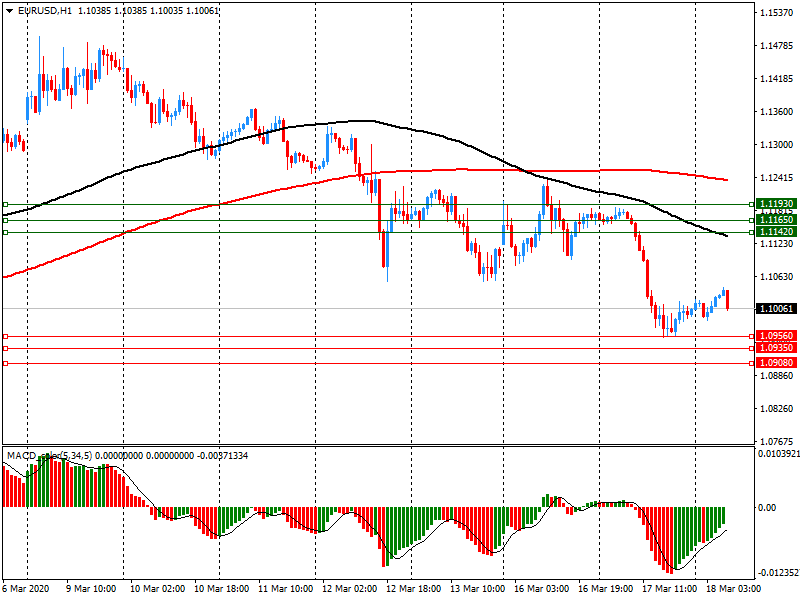
Comments:
- Overall open interest on the CALL options and PUT options with the expiration date April, 3 is 82187 contracts (according to data from March, 17) with the maximum number of contracts with strike price $1,1000 (4078);
GBP/USD
Resistance levels (open interest**, contracts)
$1.3006 (969)
$1.2908 (258)
$1.2811 (206)
Price at time of writing this review: $1.2089
Support levels (open interest**, contracts):
$1.2066 (355)
$1.2053 (183)
$1.2029 (195)
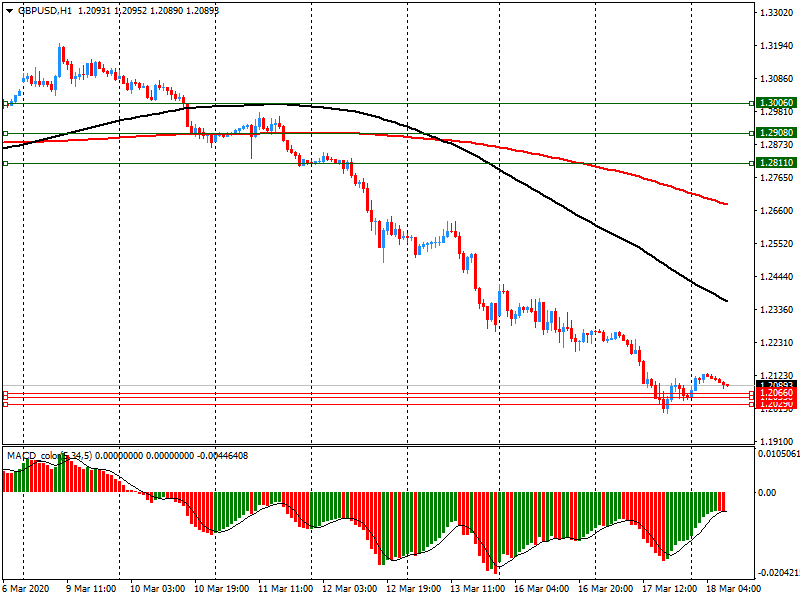
Comments:
- Overall open interest on the CALL options with the expiration date April, 3 is 17834 contracts, with the maximum number of contracts with strike price $1,3200 (2524);
- Overall open interest on the PUT options with the expiration date April, 3 is 21176 contracts, with the maximum number of contracts with strike price $1,2900 (2847);
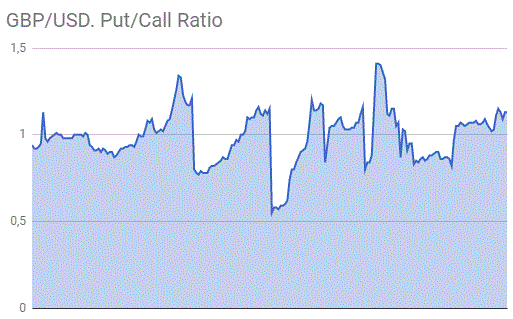
- The ratio of PUT/CALL was 1.19 versus 1.15 from the previous trading day according to data from March, 17
* - The Chicago Mercantile Exchange bulletin (CME) is used for the calculation.
** - Open interest takes into account the total number of option contracts that are open at the moment.
| Raw materials | Closed | Change, % |
|---|---|---|
| Brent | 28.3 | -3.64 |
| WTI | 26.63 | -6.86 |
| Silver | 12.58 | -1.87 |
| Gold | 1527.522 | 1.31 |
| Palladium | 1629.7 | 2.24 |
| Index | Change, points | Closed | Change, % |
|---|---|---|---|
| NIKKEI 225 | -54.54 | 16947.5 | -0.32 |
| Hang Seng | 176.1 | 23239.67 | 0.76 |
| KOSPI | -29.24 | 1685.62 | -1.71 |
| ASX 200 | 291.4 | 5293.4 | 5.83 |
| FTSE 100 | -84.04 | 5067.04 | -1.63 |
| DAX | -115.35 | 8626.9 | -1.32 |
| CAC 40 | -63.84 | 3817.62 | -1.64 |
| Pare | Closed | Change, % |
|---|---|---|
| AUDUSD | 0.60112 | -1.49 |
| EURJPY | 118.428 | 0.1 |
| EURUSD | 1.10044 | -1.54 |
| GBPJPY | 129.793 | -0.06 |
| GBPUSD | 1.20532 | -1.75 |
| NZDUSD | 0.59555 | -1.32 |
| USDCAD | 1.42037 | 1.47 |
| USDCHF | 0.96095 | 1.73 |
| USDJPY | 107.591 | 1.64 |







© 2000-2026. All rights reserved.
This site is managed by Teletrade D.J. LLC 2351 LLC 2022 (Euro House, Richmond Hill Road, Kingstown, VC0100, St. Vincent and the Grenadines).
The information on this website is for informational purposes only and does not constitute any investment advice.
The company does not serve or provide services to customers who are residents of the US, Canada, Iran, The Democratic People's Republic of Korea, Yemen and FATF blacklisted countries.
Making transactions on financial markets with marginal financial instruments opens up wide possibilities and allows investors who are willing to take risks to earn high profits, carrying a potentially high risk of losses at the same time. Therefore you should responsibly approach the issue of choosing the appropriate investment strategy, taking the available resources into account, before starting trading.
Use of the information: full or partial use of materials from this website must always be referenced to TeleTrade as the source of information. Use of the materials on the Internet must be accompanied by a hyperlink to teletrade.org. Automatic import of materials and information from this website is prohibited.
Please contact our PR department if you have any questions or need assistance at pr@teletrade.global.


 Bank
Bank transfers


