- Analytics
- News and Tools
- Market News
CFD Markets News and Forecasts — 19-03-2020
| Time | Country | Event | Period | Previous value | Forecast |
|---|---|---|---|---|---|
| 07:00 | Germany | Producer Price Index (YoY) | February | 0.2% | 0.2% |
| 07:00 | Germany | Producer Price Index (MoM) | February | 0.8% | -0.1% |
| 09:00 | Eurozone | Current account, unadjusted, bln | January | 51.2 | 20.5 |
| 09:30 | United Kingdom | PSNB, bln | February | 10.5 | -0.85 |
| 12:00 | United Kingdom | BOE Quarterly Bulletin | |||
| 12:30 | Canada | Retail Sales YoY | January | 2.4% | |
| 12:30 | Canada | Retail Sales, m/m | January | 0% | 0.3% |
| 12:30 | Canada | Retail Sales ex Autos, m/m | January | 0.5% | 0.2% |
| 14:00 | U.S. | Existing Home Sales | February | 5.46 | 5.50 |
| 17:00 | U.S. | Baker Hughes Oil Rig Count | March |
| Time | Country | Event | Period | Previous value | Forecast |
|---|---|---|---|---|---|
| 07:00 | Germany | Producer Price Index (YoY) | February | 0.2% | 0.2% |
| 07:00 | Germany | Producer Price Index (MoM) | February | 0.8% | -0.1% |
| 09:00 | Eurozone | Current account, unadjusted, bln | January | 51.2 | 20.5 |
| 09:30 | United Kingdom | PSNB, bln | February | 10.5 | -0.85 |
| 12:00 | United Kingdom | BOE Quarterly Bulletin | |||
| 12:30 | Canada | Retail Sales YoY | January | 2.4% | |
| 12:30 | Canada | Retail Sales, m/m | January | 0% | 0.3% |
| 12:30 | Canada | Retail Sales ex Autos, m/m | January | 0.5% | 0.2% |
| 14:00 | U.S. | Existing Home Sales | February | 5.46 | 5.50 |
| 17:00 | U.S. | Baker Hughes Oil Rig Count | March |
FXStreet reports that in the opinion of analysts at Westpac Institutional Bank, it’s all but impossible to have a confident near term outlook for USD/JPY given ongoing developments.
“We remain of the view that USD/JPY should and will be lower; however, that view could take some time to evolve.”
“In the very near term we would be surprised to see strength above the 109/110 and that looks like a logical area to try to fade the market.”
“Over the next few weeks/months our confidence in a move lower in USD/JPY would increase. Thus, we maintain our negative bias on a 1 and 3 month basis.”
- Hydroxychloroquine (MYL) will be available immediately to help fight against COVID-19 as a therapy
- Clinical trials are already underway for new therapies
- Vaccine candidate was launched in record time; long-testing is required to make sure it is safe
- Also mentions Regeneron and Gilead therapies
FXStreet reports that economists at Rabobank have changed their base case to the pandemic scenario and now expect a recession in virtually all G10 countries.
“We estimate that global economic growth will slow to 0.7% in 2020, down from 2.9% before the corona crisis.”
“We expect a rebound of 3.2% in 2021, but this hinges on the assumption that the economic fallout due to the coronavirus is limited to this year, which is far from clear.”
“The largest decline in GDP is expected in Japan (-2.5%), Italy (-1.9%) and Germany (1.2%).”
- We're working to address market problems as they become apparent
- Fed is focused on ensuring liquidity and market function
- Says coming priority should be testing "at scale" so protocols can be put in place for people to safely return to work and re-open businesses
- Takes comfort in economy resuming in China
FXStreet reports that in the opinion of analysts at Westpac Institutional Bank, AUD/USD is probably overshot but 0.54-handle quite possible.
“Illiquid markets and global financial stresses present a very difficult backdrop for the Aussie with no real support ahead of the Sep 2002 low around 0.54, then 0.5265 in Aug 2002.”
“In terms of yield spreads, commodity prices, etc, fair value suggests AUD/USD has overshot.”
“Renewed volatility seems the only safe bet for the week ahead, as huge losses in a range of global markets rebound on risk- and growth-sensitive currencies like AUD.”
- These therapies might help patients but are in very early testing
- Number of deaths increases to 43 from 29
FXStreet reports that in the opinion of Josh Nye, a Senior Economist at the Royal Bank of Canada (RBC), a sharp rise in new unemployment claims last week is just the tip of the iceberg.
“US jobless claims jumped to 281,000 last week, the largest weekly increase since 2012.”
“Today's data covers the week ending March 14, so won't have fully captured this week's escalation in both mandatory and discretionary business closures that will have resulted in significant layoffs.”
“Expect a much larger increase in next Thursday's initial claims report.”
In its monetary policy statement, the BoE said it held an additional special meeting today, at which its Monetary Policy Committe (MPC) judged that a further package of measures was warranted to meet its statutory objectives.
- MPC voted unanimously to increase the BoE's holdings of UK government bonds and sterling non-financial investment-grade corporate bonds by £200 billion to a total of £645 billion and to reduce Bank Rate by 15 basis points to 0.1%;
- MPC also voted unanimously that the central bank should enlarge the TFSME scheme (term funding scheme for small and medium-sized enterprises);
- Majority of additional asset purchases will comprise UK government bonds;
- Purchases announced today will be completed as soon as is operationally possible;
- BoE will issue further guidance to the market in due course.
FXStreet reports that in the opinion of economists at ABN Amro, scale of the ECB new programme and willingness to raise limits show new determination.
“The new programme is big. It dwarfs its current asset purchases. Its new Pandemic Emergency Purchase Programme (PEPP) will total EUR 750bn, with purchases conducted until the end of 2020.”
“The ECB signalled a determination to do more if necessary. In its statement the Governing Council signalled that ‘it is fully prepared to increase the size of its asset purchase programmes and adjust their composition, by as much as necessary and for as long as needed’.”
“We expect GDP to fall by 2.7% this year. We are assuming extra discretionary fiscal stimulus of around 1.2% GDP. That would tend to add half as much to growth. So the macro stimulus so far is around 1% GDP. Both the ECB and governments will likely need to do more.”
The Conference Board announced on Thursday its Leading Economic Index (LEI) for the U.S. edged up 0.1 percent m-o-m in February to 112.1 (2016 = 100), following a downwardly revised 0.7 percent m-o-m advance in January (originally a 0.8 percent m-o-m advance).
Economists had forecast a gain of 0.1 percent m-o-m.
However, Ataman Ozyildirim, Senior Director of Economic Research at The Conference Board, noted that a slight increase in U.S. LEI in February doesn't reflect the impact of the COVID-19 pandemic, which began to hit the U.S. economy in full by early March. "The slight gain in February came only from half of the LEI components. In particular, the recovery in manufacturing, which looked promising until February, will now be short-lived because of the disruption in global supply chains and falling demand," he added. "Declines in stock prices, consumers' outlook on economic conditions, manufacturing new orders, average workweek in manufacturing, and rising unemployment claims will begin to negatively impact the economy. As a result, the economy may already be entering into a period of contraction."
The report also revealed the Conference Board Coincident Economic Index (CEI) for the U.S. rose 0.3 percent m-o-m in February to 107.6, following a 0.1 percent m-o-m gain in January. Meanwhile, its Lagging Economic Index (LAG) for the U.S. increased 0.4 percent m-o-m in February to 109.1, following no change in January.
Statistics Canada reported on Thursday the New Housing Price Index (NHPI) rose 0.4 percent m-o-m in February, following a flat m-o-m performance in the previous month.
Economists had forecast the NHPI to increase 0.1 percent m-o-m in February.
According to the report, new home prices rose in 17 of the 27 census metropolitan areas (CMAs) surveyed in February, led by gains in Ottawa (+1.1 percent m-o-m), St. Catharines-Niagara (+1.1 percent m-o-m), Victoria (+1.0 percent m-o-m) and Kitchener-Cambridge-Waterloo (+0.9 percent m-o-m), which were supported by favourable market conditions. In contrast, new home prices dropped the most in Regina (-0.5 percent m-o-m) in February.
In y-o-y terms, NHPI rose 0.6 in February, following a 0.2 percent uptick in the previous month.
- Extends dollar swap lines to 9 more central banks
U.S. stock-index futures declined on Thursday, as additional measures taken by central banks in response to the coronavirus failed to convince stock markets that a global recession could be averted.
Global Stocks:
| Index/commodity | Last | Today's Change, points | Today's Change, % |
| Nikkei | 16,552.83 | -173.72 | -1.04% |
| Hang Seng | 21,709.13 | -582.69 | -2.61% |
| Shanghai | 2,702.13 | -26.63 | -0.98% |
| S&P/ASX | 4,782.90 | -170.30 | -3.44% |
| FTSE | 5,002.85 | -77.73 | -1.53% |
| CAC | 3,742.82 | -12.02 | -0.32% |
| DAX | 8,365.49 | -76.22 | -0.90% |
| Crude oil | $22.54 | | +8.21% |
| Gold | $1,474.50 | | -0.23% |
(company / ticker / price / change ($/%) / volume)
| 3M Co | MMM | 136.78 | -0.24(-0.18%) | 25513 |
| ALCOA INC. | AA | 5.53 | -0.22(-3.83%) | 26139 |
| ALTRIA GROUP INC. | MO | 37.45 | -0.87(-2.27%) | 18916 |
| Amazon.com Inc., NASDAQ | AMZN | 1,843.00 | 13.00(0.71%) | 109152 |
| American Express Co | AXP | 72.5 | -1.25(-1.69%) | 15551 |
| AMERICAN INTERNATIONAL GROUP | AIG | 18.31 | -0.47(-2.50%) | 4567 |
| Apple Inc. | AAPL | 246 | -0.67(-0.27%) | 470022 |
| AT&T Inc | T | 31.84 | -1.01(-3.07%) | 122204 |
| Boeing Co | BA | 97.03 | -4.86(-4.77%) | 444937 |
| Caterpillar Inc | CAT | 99.6 | -0.52(-0.52%) | 8707 |
| Chevron Corp | CVX | 55.34 | 0.29(0.53%) | 46883 |
| Cisco Systems Inc | CSCO | 36.8 | -0.32(-0.86%) | 93722 |
| Citigroup Inc., NYSE | C | 35.07 | -1.36(-3.73%) | 100596 |
| Deere & Company, NYSE | DE | 114.9 | 0.69(0.60%) | 139 |
| E. I. du Pont de Nemours and Co | DD | 32 | -0.06(-0.19%) | 1691 |
| Exxon Mobil Corp | XOM | 33.18 | 0.06(0.18%) | 175857 |
| Facebook, Inc. | FB | 146.1 | -0.86(-0.59%) | 93211 |
| FedEx Corporation, NYSE | FDX | 98 | -1.68(-1.69%) | 6540 |
| Ford Motor Co. | F | 4.26 | -0.24(-5.33%) | 303856 |
| Freeport-McMoRan Copper & Gold Inc., NYSE | FCX | 5.23 | -0.08(-1.51%) | 37241 |
| General Electric Co | GE | 6.33 | -0.27(-4.09%) | 586131 |
| General Motors Company, NYSE | GM | 16.38 | -0.42(-2.50%) | 59235 |
| Goldman Sachs | GS | 137 | -3.02(-2.16%) | 22685 |
| Google Inc. | GOOG | 1,089.89 | -6.91(-0.63%) | 9995 |
| Hewlett-Packard Co. | HPQ | 13 | -0.11(-0.84%) | 2119 |
| Home Depot Inc | HD | 152.5 | -3.13(-2.01%) | 23239 |
| HONEYWELL INTERNATIONAL INC. | HON | 118.05 | -1.56(-1.30%) | 578 |
| Intel Corp | INTC | 47.71 | 0.10(0.21%) | 78860 |
| International Business Machines Co... | IBM | 102.8 | -0.75(-0.72%) | 18804 |
| International Paper Company | IP | 30.5 | -0.45(-1.45%) | 5021 |
| Johnson & Johnson | JNJ | 133.5 | -1.46(-1.08%) | 14040 |
| JPMorgan Chase and Co | JPM | 81.47 | -2.42(-2.89%) | 167654 |
| McDonald's Corp | MCD | 135.95 | -1.35(-0.98%) | 19815 |
| Merck & Co Inc | MRK | 71.25 | -0.38(-0.53%) | 6461 |
| Microsoft Corp | MSFT | 140.62 | 0.22(0.16%) | 475705 |
| Nike | NKE | 66.4 | -1.64(-2.41%) | 20610 |
| Pfizer Inc | PFE | 31.81 | -0.55(-1.70%) | 80110 |
| Procter & Gamble Co | PG | 117.99 | 0.54(0.46%) | 14822 |
| Starbucks Corporation, NASDAQ | SBUX | 55.56 | -0.77(-1.37%) | 63604 |
| Tesla Motors, Inc., NASDAQ | TSLA | 358.96 | -2.26(-0.63%) | 425445 |
| The Coca-Cola Co | KO | 44.35 | -0.50(-1.11%) | 41444 |
| Travelers Companies Inc | TRV | 80.63 | -1.06(-1.30%) | 1689 |
| Twitter, Inc., NYSE | TWTR | 22.01 | 0.01(0.05%) | 100312 |
| United Technologies Corp | UTX | 78.51 | -0.89(-1.12%) | 9708 |
| UnitedHealth Group Inc | UNH | 212.7 | -4.36(-2.01%) | 4303 |
| Verizon Communications Inc | VZ | 53.5 | -0.82(-1.51%) | 46503 |
| Visa | V | 145.9 | -2.58(-1.74%) | 28476 |
| Wal-Mart Stores Inc | WMT | 122.5 | 0.46(0.38%) | 26490 |
| Walt Disney Co | DIS | 87.2 | -1.60(-1.80%) | 116077 |
| Yandex N.V., NASDAQ | YNDX | 28.97 | 0.06(0.21%) | 50065 |
- We are working to get money to Americans within 3 weeks
- We do not want to be foreclosing on people's mortgages
- Legislation needs to be done quickly, by the beginning of next week
- Treasury and Fed are working around the clock
- Trump is determined to go big and support the economy
- Wants Fed to get back some powers lost after the crisis
- U.S. tariffs are not hampering coronavirus response
Tesla (TSLA) upgraded to Equal-Weight from Underweight at Morgan Stanley; target lowered to $460
The Department of Commerce reported on Thursday that current account (C/A) gap in the U.S. narrowed by 12.4% q-o-q to $109.8 billion in the fourth quarter of 2019 from an upwardly revised $125.4-billion gap in the previous quarter (originally -$124.1 billion). The deficit was 2.0 percent of current-dollar GDP in the fourth quarter, down from 2.3 percent in the third quarter.
Economists had forecast a deficit of $109 billion.
According to the report, the $15.6-billion narrowing of the C/A deficit in the fourth quarter mainly reflected a lower deficit on goods, which was partly offset by an increased deficit on secondary income.
Exports of goods and services to, and income received from, foreign residents fell $5.1 billion, to $936.1 billion, in the fourth quarter. At the same time, imports of goods and services from, and income paid to, foreign residents dropped $20.7 billion, to $1.05 trillion.
Receipts of primary income declined $2.8 billion, to $278.0 billion, and payments of primary income fell $4.2 billion, to $210.7 billion. The decreases in both receipts and payments mainly reflected drops in other investment income, mostly interest on loans and deposits.
Meanwhile, receipts of secondary income fell $2.5 billion, to $34.4 billion, mainly reflecting a decline in private sector fines and penalties, a component of private transfer receipts. Payments of secondary income rose $1.9 billion, to $71.7 billion, mainly reflecting an advance in U.S. government grants.
The data from the Labor Department revealed on Thursday the number of applications for unemployment benefits surged more than forecast last week as the coronavirus outbreak made the employers to start laying off workers.
According to the report, the initial claims for unemployment benefits jumped by 70,000 to a seasonally adjusted 281,000 for the week ended March 14. That was the highest level since September 2, 2017.
Economists had expected 220,000 new claims last week.
Claims for the prior week remained unchanged at 211,000.
Meanwhile, the four-week moving average of claims rose by 16,500 to 232,250, the highest level since January 27, 2018.
| Time | Country | Event | Period | Previous value | Forecast | Actual |
|---|---|---|---|---|---|---|
| 09:00 | Germany | IFO - Expectations | March | 93.4 | 82 | |
| 09:00 | Germany | IFO - Business Climate | March | 96.1 | 87.7 | |
| 09:00 | Germany | IFO - Current Assessment | March | 98.9 | 93.8 | |
| 10:00 | Eurozone | Construction Output, y/y | January | -2.3% | 6% | |
| 12:30 | U.S. | Continuing Jobless Claims | March | 1699 | 1725 | 1701 |
| 12:30 | U.S. | Philadelphia Fed Manufacturing Survey | March | 36.7 | 10 | |
| 12:30 | Canada | New Housing Price Index, MoM | February | 0% | 0.1% | |
| 12:30 | U.S. | Current account, bln | Quarter IV | -125.4 | -109 | -109.8 |
| 12:30 | U.S. | Initial Jobless Claims | March | 211 | 220 | 281 |
| 12:30 | Canada | New Housing Price Index, YoY | February | 0.2% |
USD continued strengthening against other major currencies in the European session on Thursday as funding concerns preserved despite huge dollar injections from the central banks of the world in response to the coronavirus outbreak.
The U.S. currency remains the favored currency across the board amid mounting uncertainty caused by the coronavirus outbreak, which threatens to hit the global economy.
The U.S. Dollar Index (DXY), measuring the value of USD against a basket of foreign currencies, rose 1.17% to 102.35, its highest level since late 2016.
FXStreet notes that the ECB launches a new temporary QE programme to run until the coronavirus crisis is over. The way spreads were exploding, new ECB measures were certainly needed, in the opinion of analysts at Nordea.
“At an emergency meeting last night, the ECB launched a new temporary QE programme totalling EUR 750bn.”
“By its actions and strong wordings, the ECB created space for fiscal policy measures which are key to minimizing the negative impacts of the coronavirus.”
“We believe today’s actions are an important step in order to push the Italian spreads towards more manageable levels.”
“We think that the ECB is finally at a crisis mode and ready to take actions if needed.”
FXStreet notes that the global economy is now in the midst of an unprecedented synchronised slowdown. New Zealand will experience a recession this year, and it could be deep, according to analysts at ANZ Research.
“GDP grew 0.5% q/q in Q4 2019, a little stronger than we expected but in line with market. Per capita GDP growth was modest (0.1%).”
“Annual growth slowed form 2.3% y/y to 1.8%.”
“We are now at the beginning of a significant economic downturn. Our best guess is that GDP will fall 3-4% this year, though the outlook is highly uncertain.”
- There is no prospect of any restriction placed on travel in or out of London
- It is not true households will be limited to one person leaving at a time
FXStreet reports that economists at TD Securities apprise that weekly data will gain more relevance going forward as the coronavirus impact makes its way through the U.S. economy.
“State labor department offices are reportedly being overwhelmed by filings for unemployment benefits this week, suggesting a historic jobless claims reading next week.”
“We expect a sizable rise in this week's report as well. We now forecast a rise to 300K (instead of 225K) from 211K. The latest consensus is 220K.”
“We have changed our forecast for the Philly Fed index as well: We now expect a decline in -25.0 (instead of 0.0) from 36.7. The consensus is 8.0.”
- Governing council agreed that situation requires action
- Agreed that size, composition of stimulus package is right
Reuters reports, citing four policy sources, that trillions of yuan of fiscal stimulus could be unleashed by China to revive its economy, which is expected to contract for the first time in four decades due to coronavirus pandemic. At the same time, the country's planned 2020 growth target could be lowered.
The aim of the ramp-up is to spur infrastructure investment via 2.8 trillion yuan ($394 billion) of local government special bonds. As a result, the national budget deficit ratio could increase to record levels, the sources said.
China is considering proposals to cut its economic growth target for 2020 to as low as 5% from around 6% agreed in December.
FXStreet reports that GBP/USD has collapsed into 35 year lows. Karen Jones, Team Head FICC Technical Analysis Research, takes a look at the cable's technical picture.
"We have eroded the 1.1491 October 2016 low. Further down sits the 1985 low at 1.0463. Rallies are indicated to fail in the 1.1862, 1.2118 band."
"The daily RSI is down to 11 and is in oversold territory and we may see some consolidation ahead of further losses."
"Minor resistance comes in at the 1.1958 September 2019 low and the 1.2194 October low and while capped here rallies will make no impact on the chart."
FXStreet reports that gold broke below $1500/oz amid extremely high volatility and investors covering losses in equity markets, analysts at ANZ Research apprise.
"Gold prices started the session stronger, as the darkening macro backdrop attracted safe haven buying. However, this was once again overtaken by liquidation as investors tried to cover losses from heavy losses in equity markets."
"The stronger USD also helped crimp investor appetite for the precious metals."
"Palladium was under added pressure after reports that China would relax emission standards to provide relief to car markets. The stringent new standards have been driving a surge in buying from China."
According to the report from Eurostat, in January 2020 compared with December 2019, seasonally adjusted production in the construction sector increased by 3.6% in the euro area (EA19) and by 3.9% in the EU27. In December 2019, production in construction fell by 1.8% in the euro area and by 1.7% in the EU27.
In January 2020 compared with January 2019, production in construction increased by 6.0% in the euro area and by 6.2% in the EU27.
In the euro area in January 2020, compared with December 2019, civil engineering increased by 4.6% and building construction by 3.6%. In the EU27, civil engineering increased by 4.7% and building construction by 3.8%.
In the euro area in January 2020, compared with January 2019, civil engineering increased by 12.0% and building construction by 4.9%. In the EU27 civil engineering increased by 11.5% and building construction by 5.3%.
-
We are not a currency manipulator
-
We do not intervene to take advantage of other currencies
-
Central banks around the world are in close contact
-
But monetary policy alone cannot solve this crisis
-
Monetary policy is complementary and can support fiscal measures
CNBC reports that Italy's lockdown is set to be extended beyond the current end-date of April 3, the country's prime minister told the press, as its death toll rises at a record rate.
Speaking to Italian newspaper Corriere della Sera Prime Minister Giuseppe Conte said measures taken to close schools, universities and to restrict movement throughout Italy would have to be prolonged.
"The total blockade will go on," Conte said. "The measures taken, both the closure of (public) activities and the ones concerning schools, can only be extended," he told the paper Thursday.
Conte's comments confirm speculation that the government would extend its current national lockdown further as the coronavirus outbreak in Italy worsens.
Under the lockdown rules, Italian citizens can only leave their homes to get food or medicines (grocery stores and pharmacies are the only stores that remain open), or to perform other essential services or to go to work. Most shops had been forced to close until March 25 but that deadline also looks set to be extended.
German recession could turn out to be much more severe if coronavirus-sparked uncertainty persists
According the preliminary report from Ifo Institute for Economic Research, Germany's IFO Business Climate has dropped to 87.7 points in March, down from 96.1 in February. The IFO expectations index fell to 82.0 from 93.4 in February, while the IFO current conditions index fell to 93.8 from 98.9. The IFO reported that the coronavirus crisis is taking its toll on confidence.
FXStreet reports that Bank of Canada (BoC) commits to do what is necessary to keep system running, Dawn Desjardins, a VP & Deputy Chief Economist at the Royal Bank of Canada reports.
"The BoC Governor did not make any new policy announcements today but ran through the long list of policies put in place to support the financial system and ensure that credit is available to households and businesses."
"The bank has been clear that there are more policy levers that could be pulled in the toolkit. These include lowering the overnight rate to the lower bound of 0.25% and employing additional non-traditional measures."
"The Governor said that what is important is that the programs can be scaled up or down as needed."
"The private sector is also working to help Canadian households with Canada's banks allowing customers to defer mortgage payments for up to six months if faced with disruptions associated with the crisis."
FXStreet reports that FX Strategists at UOB Group now suggested USD/CNH could advance further and reach the 7.1700 area.
24-hour view: "The sudden jump in USD came as a surprise. Upward momentum remains strong and USD could advance to 7.1400. Support is at 7.0650."
Next 1-3 weeks: "We have held the same view since last Friday (13 Mar, spot at 7.0200) wherein 'further USD strength is likely' and 'a break of last month's 7.0567 peak could lead to a move towards 7.0865'. USD took out 7.0567 in a hurry and jumped to a high of 7.0913. The movement is view as the start of the next up-leg in USD. From here, USD could move to 7.1700. Yesterday's low of 7.0180 is expected to come into the picture, at least for several days if not longer. On a shorter-term note, 7.0500 is already a solid support."
-
Swiss financial system has sufficient liquidity
-
To intervene more strongly in the FX market to stabilise the situation
-
Swiss franc is even more highly valued
-
Will take additional steps to ensure liquidity as necessary
-
Examining whether or not to relax the countercyclical buffer
FXStreet reports that crude oil continued to plunge, despite brief bouts of aggressive risk-on trading which pausing the rout periodically, strategists at TD Securities inform.
"The problem is supply-demand fundamentals, not just the lack of risk appetite, illiquid markets, and volatility."
"We can safely say that global demand is likely to drop by 4.3m bpd year-over-year."
"We are well-founded to say that WTI crude prices could go down into the teens if not lower."
"Crude oil will recover toward the low $40s once OPEC+ plus comes to a supply control agreement and there is more certainty surrounding the timing of when the negative impact of COVID-19 will dissipate."
FXStreet reports that prime Minister Trudeau announced fiscal stimulus along with liquidity measures for households and small businesses while Finance Minister Morneau and BoC Governor Poloz didn't offer much new, economists at TD Securities apprise.
"The Canadian government announced $27bn worth of fiscal stimulus along with $55bn worth of liquidity measures for households and businesses through tax deferrals."
"Governor Poloz had little to add in his presser today with no new announcements, though he did state that the BoC is focussed on providing sufficient market liquidity."
"The Governor tried to dull expectations for another intermeeting cut, stating that he would like to have the benefit of a full forecast round before moving interest rates again."
"We look for the Bank to cut by 50 bps next month."
| Time | Country | Event | Period | Previous value | Forecast | Actual |
|---|---|---|---|---|---|---|
| 00:30 | Australia | RBA Bulletin | ||||
| 00:30 | Australia | Unemployment rate | February | 5.3% | 5.3% | 5.1% |
| 00:30 | Australia | Changing the number of employed | February | 12.9 | 10 | 26.7 |
| 04:30 | Japan | All Industry Activity Index, m/m | January | -0.1% | 0.2% | 0.8% |
| 06:45 | Switzerland | SECO Economic Forecasts | ||||
| 07:00 | Switzerland | Trade Balance | February | 2.8 | 2 018 |
During today's Asian trading, the US dollar rose against major currencies in terms of market volatility.
At a certain point in trading, the euro began to rise against the dollar on the announcement of the launch of the European Central Bank (ECB) of an unprecedented 750 billion Euro bond purchase program, under which both government and corporate securities will be purchased. The program, called the Pandemic Emergency Purchase program, is intended to support financial markets and stabilize the public debt market in southern Europe, which has come under heavy pressure in recent days.
Meanwhile, the US Senate is beginning to study the White house's proposal to allocate $1 trillion to support the economy, including direct assistance to American households and financial assistance to airlines. It is assumed that the money (the amount of $1000 per person is being discussed) will be allocated to citizens in two stages - in early April and mid-may, the amount of assistance will depend on income and family size.
The ICE Dollar index, which shows the value of the dollar against six major world currencies, is up 0.10%.
The Australian dollar fell about 2% against the US dollar by more than 2%. The reserve Bank of Australia cut its benchmark interest rate for the second time this month to support the country's economy in the face of the spread of the coronavirus. The rate was reduced by 25 basis points to a record low of 0.25% per annum.
CNBC reports that Australia and New Zealand announced tighter border controls in an attempt to curb imported cases of the new coronavirus, reported Reuters.
-
China's National Health Commission said there were 34 new cases, which were attributed to travelers returning from abroad.
-
London's underground system will be partially shut down beginning Thursday in the city's bid to slow the spread of coronavirus, Sky News reported.
-
Global cases: At least 207,860, according to the latest figures from the World Health Organization
-
Global deaths: At least 8,657, according to the latest figures from the WHO
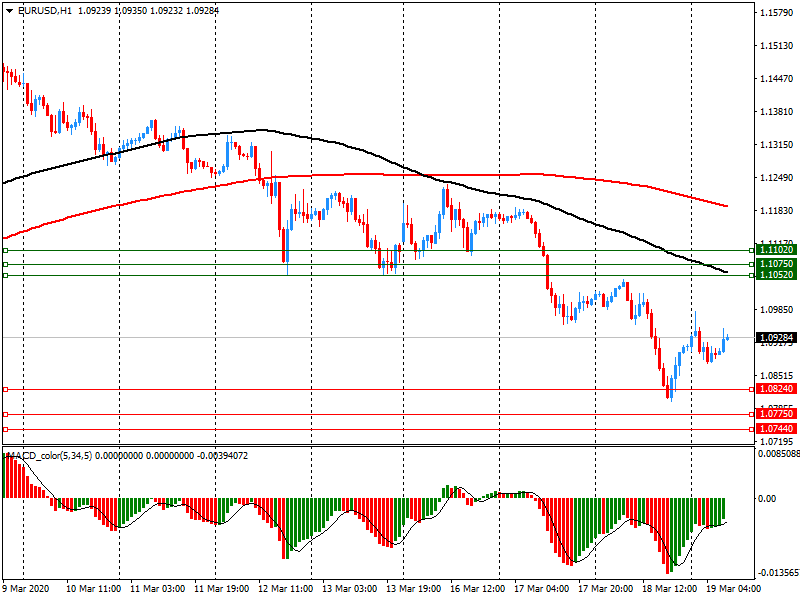
EUR/USD
Resistance levels (open interest**, contracts)
$1.1102 (3700)
$1.1075 (1841)
$1.1052 (1420)
Price at time of writing this review: $1.0928
Support levels (open interest**, contracts):
$1.0824 (4070)
$1.0775 (2692)
$1.0744 (1948)
Comments:
- Overall open interest on the CALL options and PUT options with the expiration date April, 3 is 84298 contracts (according to data from March, 18) with the maximum number of contracts with strike price $1,0800 (4102);
* - The Chicago Mercantile Exchange bulletin (CME) is used for the calculation.
** - Open interest takes into account the total number of option contracts that are open at the moment.
Comments by RBA governor, Philip Lowe:
-
Expects cash rate to remain at current level for some years, but not forever
-
RBA doing all it can to lower funding costs, support supply of credit to businesses
-
RBA will not be buying bonds directly from the government
-
May take some time for yields to fall from current level to 25 bps
-
Expects yield target to be removed before raising the cash rate
-
Expects a recovery once the virus is contained
-
Also expecting significant job losses as the virus fallout hits
-
Will maintain current setting of rates until a strong recovery is in place
-
Nothing is off the table with policy
-
Expects bond yields across term structure to decline
-
Will do whatever is necessary to make sure credit is available
-
Says that we've done all we can do with the cash rate
-
The focus now is on taking other measures to support lending
| Raw materials | Closed | Change, % |
|---|---|---|
| Brent | 25.95 | -8.47 |
| WTI | 21.89 | -17.71 |
| Silver | 11.92 | -5.4 |
| Gold | 1484.732 | -2.87 |
| Palladium | 1585.83 | -2.42 |
| Index | Change, points | Closed | Change, % |
|---|---|---|---|
| NIKKEI 225 | -284.98 | 16726.55 | -1.68 |
| Hang Seng | -971.91 | 22291.82 | -4.18 |
| KOSPI | -81.24 | 1591.2 | -4.86 |
| ASX 200 | -340.2 | 4953.2 | -6.43 |
| FTSE 100 | -214.32 | 5080.58 | -4.05 |
| DAX | -497.39 | 8441.71 | -5.56 |
| CAC 40 | -236.94 | 3754.84 | -5.94 |
| Dow Jones | -1338.46 | 19898.92 | -6.3 |
| S&P 500 | -131.09 | 2398.1 | -5.18 |
| NASDAQ Composite | -344.94 | 6989.84 | -4.7 |
| Pare | Closed | Change, % |
|---|---|---|
| AUDUSD | 0.5783 | -3.79 |
| EURJPY | 117.803 | -0.53 |
| EURUSD | 1.09106 | -0.85 |
| GBPJPY | 125.033 | -3.67 |
| GBPUSD | 1.15774 | -3.95 |
| NZDUSD | 0.57366 | -3.68 |
| USDCAD | 1.45073 | 2.14 |
| USDCHF | 0.96662 | 0.59 |
| USDJPY | 107.998 | 0.38 |







© 2000-2026. All rights reserved.
This site is managed by Teletrade D.J. LLC 2351 LLC 2022 (Euro House, Richmond Hill Road, Kingstown, VC0100, St. Vincent and the Grenadines).
The information on this website is for informational purposes only and does not constitute any investment advice.
The company does not serve or provide services to customers who are residents of the US, Canada, Iran, The Democratic People's Republic of Korea, Yemen and FATF blacklisted countries.
Making transactions on financial markets with marginal financial instruments opens up wide possibilities and allows investors who are willing to take risks to earn high profits, carrying a potentially high risk of losses at the same time. Therefore you should responsibly approach the issue of choosing the appropriate investment strategy, taking the available resources into account, before starting trading.
Use of the information: full or partial use of materials from this website must always be referenced to TeleTrade as the source of information. Use of the materials on the Internet must be accompanied by a hyperlink to teletrade.org. Automatic import of materials and information from this website is prohibited.
Please contact our PR department if you have any questions or need assistance at pr@teletrade.global.


 Bank
Bank transfers


