- Analiza
- Novosti i instrumenti
- Vesti sa tržišta
- Canadian Dollar declines for third day in a row, solid US GDP and Durable Goods beats to blame
Canadian Dollar declines for third day in a row, solid US GDP and Durable Goods beats to blame
- The Canadian Dollar is sinking into the lowest bids of the year as the Greenback rises.
- No economic calendar data for Canada until next Tuesday’s GDP print.
- The US Dollar is bounding higher after a thumper US GDP, Durable Goods order data reading.
The Canadian Dollar (CAD) is setting a new seven-month low against the US Dollar (USD) following a solid print for US economic data on Thursday. US Durable Goods and Gross Domestic Product (GDP) figures soundly trounced forecasts, and the Greenback is pushing higher on the headline data beats, despite a sliver of red from unemployment figures that came in worse than expected.
Canada-centric economic data is left off the calendar until next Tuesday when the latest round of Canadian GDP growth numbers come in. However, market flows are likely to be dominated by the US Federal Reserve (Fed) by that point as traders will be looking ahead to their latest rate decision and whether or not Fed Chairman Jerome Powell and company will raise rates in the face of robust growth numbers.
Daily Digest Market Movers: Canadian Dollar steps back once more as US Dollar gains
-
Thursday markets are fully focused on US data beats.
- Annualized US GDP printed at a solid 4.9% for the third quarter, compared to the forecast of 4.2% and far firmer than the previous quarter’s 2.1%.
- US Durable Goods solidly thumped forecasts, coming in at 4.7% for September, shredding the 1.5% expectation and firmly rebounding from August’s -0.1% (revised down from 0.2%).
- Weak points appeared in US labor and spending data: Core Personal Consumption Expenditures (PCE) for the third quarter came in at 2.4%, below the 2.5% forecast and steepening the decline from the second quarter’s 3.7%.
- US Initial Jobless claims also rose: 210K new jobless benefits applicants were recorded for the week of October 20, more than the forecasted 208K and a step higher on the previous week’s 200K (revised upwards from 198K).
- Crude Oil is on the back foot for Thursday, sapping support for the CAD.
- USD/CAD traders will be pivoting to focus on Friday’s US Core PCE Price Index reading for September.
- The MoM PCE Price Index figure is expected to show an uptick to 0.3% in September after August’s 0.1%.
Technical Analysis: Canadian Dollar inching toward new lows for 2023 as markets broadly bid the Greenback
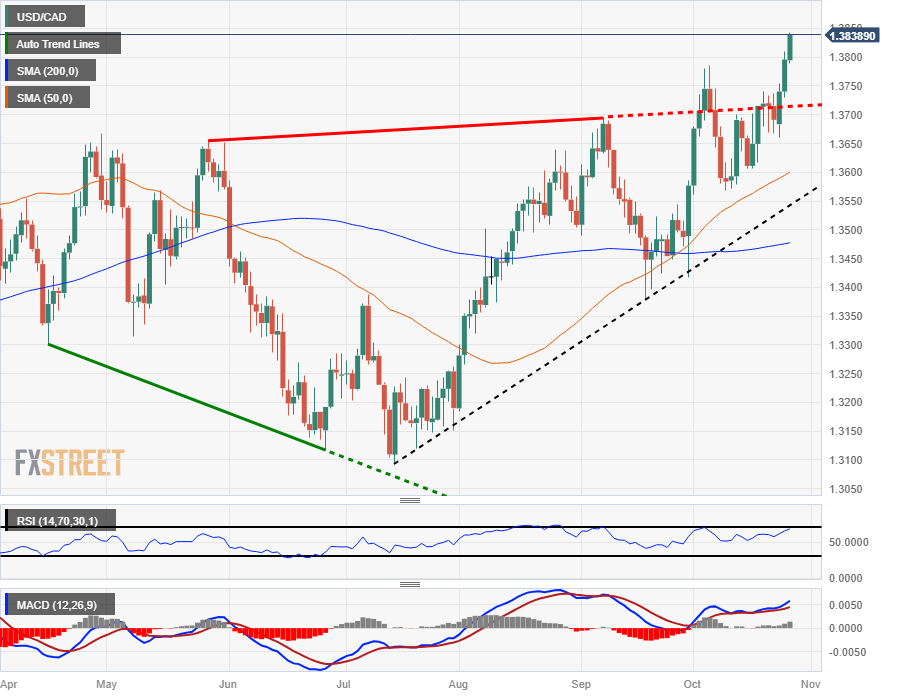
The Canadian Dollar (CAD) is struggling to find a foothold against its close neighbor and currency counterpart as markets pile into the US Dollar (USD) across the board. The USD/CAD is extending Wednesday’s break of the 1.3800 handle, and the pair is now making a run at 2023’s high bid of 1.3861.
If US Dollar bulls can successfully push the USD/CAD into the 1.3900 level, that will leave the charts open for a challenge of 2022’s peaks of 1.3978 set back in October of last year.
The USD/CAD continues to trend firmly upward on the daily candlesticks with a firm pattern of higher lows and a rising trendline from July’s swing low into 1.3100.
The last meaningful swing low sits just below 1.3600, while additional technical support is coming from the 50-day Simple Moving Average (SMA) just north of that same level.
USD/CAD Daily Chart
Canadian Dollar FAQs
What key factors drive the Canadian Dollar?
The key factors driving the Canadian Dollar (CAD) are the level of interest rates set by the Bank of Canada (BoC), the price of Oil, Canada’s largest export, the health of its economy, inflation and the Trade Balance, which is the difference between the value of Canada’s exports versus its imports. Other factors include market sentiment – whether investors are taking on more risky assets (risk-on) or seeking safe-havens (risk-off) – with risk-on being CAD-positive. As its largest trading partner, the health of the US economy is also a key factor influencing the Canadian Dollar.
How do the decisions of the Bank of Canada impact the Canadian Dollar?
The Bank of Canada (BoC) has a significant influence on the Canadian Dollar by setting the level of interest rates that banks can lend to one another. This influences the level of interest rates for everyone. The main goal of the BoC is to maintain inflation at 1-3% by adjusting interest rates up or down. Relatively higher interest rates tend to be positive for the CAD. The Bank of Canada can also use quantitative easing and tightening to influence credit conditions, with the former CAD-negative and the latter CAD-positive.
How does the price of Oil impact the Canadian Dollar?
The price of Oil is a key factor impacting the value of the Canadian Dollar. Petroleum is Canada’s biggest export, so Oil price tends to have an immediate impact on the CAD value. Generally, if Oil price rises CAD also goes up, as aggregate demand for the currency increases. The opposite is the case if the price of Oil falls. Higher Oil prices also tend to result in a greater likelihood of a positive Trade Balance, which is also supportive of the CAD.
How does inflation data impact the value of the Canadian Dollar?
While inflation had always traditionally been thought of as a negative factor for a currency since it lowers the value of money, the opposite has actually been the case in modern times with the relaxation of cross-border capital controls. Higher inflation tends to lead central banks to put up interest rates which attracts more capital inflows from global investors seeking a lucrative place to keep their money. This increases demand for the local currency, which in Canada’s case is the Canadian Dollar.
How does economic data influence the value of the Canadian Dollar?
Macroeconomic data releases gauge the health of the economy and can have an impact on the Canadian Dollar. Indicators such as GDP, Manufacturing and Services PMIs, employment, and consumer sentiment surveys can all influence the direction of the CAD. A strong economy is good for the Canadian Dollar. Not only does it attract more foreign investment but it may encourage the Bank of Canada to put up interest rates, leading to a stronger currency. If economic data is weak, however, the CAD is likely to fall.







© 2000-2026. Sva prava zaštićena.
Sajt je vlasništvo kompanije Teletrade D.J. LLC 2351 LLC 2022 (Euro House, Richmond Hill Road, Kingstown, VC0100, St. Vincent and the Grenadines).
Svi podaci koji se nalaze na sajtu ne predstavljaju osnovu za donošenje investicionih odluka, već su informativnog karaktera.
The company does not serve or provide services to customers who are residents of the US, Canada, Iran, The Democratic People's Republic of Korea, Yemen and FATF blacklisted countries.
Izvršenje trgovinskih operacija sa finansijskim instrumentima upotrebom marginalne trgovine pruža velike mogućnosti i omogućava investitorima ostvarivanje visokih prihoda. Međutim, takav vid trgovine povezan je sa potencijalno visokim nivoom rizika od gubitka sredstava. Проведение торговых операций на финанcовых рынках c маржинальными финанcовыми инcтрументами открывает широкие возможноcти, и позволяет инвеcторам, готовым пойти на риcк, получать выcокую прибыль, но при этом неcет в cебе потенциально выcокий уровень риcка получения убытков. Iz tog razloga je pre započinjanja trgovine potrebno odlučiti o izboru odgovarajuće investicione strategije, uzimajući u obzir raspoložive resurse.
Upotreba informacija: U slučaju potpunog ili delimičnog preuzimanja i daljeg korišćenja materijala koji se nalazi na sajtu, potrebno je navesti link odgovarajuće stranice na sajtu kompanije TeleTrade-a kao izvora informacija. Upotreba materijala na internetu mora biti praćena hiper linkom do web stranice teletrade.org. Automatski uvoz materijala i informacija sa stranice je zabranjen.
Ako imate bilo kakvih pitanja, obratite nam se pr@teletrade.global.


 Банковни
 транcфери


