- Analiza
- Novosti i instrumenti
- Vesti sa tržišta
- Canadian Dollar wavers after US NFP beats the market and Canadian jobs additions slump
Canadian Dollar wavers after US NFP beats the market and Canadian jobs additions slump
- The Canadian Dollar is etching in a broad range on NFP Friday.
- Canada jobs additions crumble, US jobs easily beat the street.
- Despite weak labor figures, Canadian wage pressures persist.
The Canadian Dollar (CAD) slumped to a new low for the week against the US Dollar (USD) before surging to a three-day high as markets whipsaw after a bumper US Nonfarm Payrolls (NFP) report crushes market forecasts.
Canada saw a hamstrung labor market add fewer jobs than the margin of error on the figure itself, coupled with persistent wage growth that accelerated to a two-year high.
Daily digest market movers: Canadian Dollar churns, investors grapple with NFP print
- US Nonfarm Payrolls are dominating the headlines, adding 216K net new jobs to the US employment landscape in December compared to the 160K forecast.
- Despite the beat, revisions continue to plague the data, dragging November’s 199K down to 173K and October’s 150K getting revised even further lower to 105K.
- Average Hourly Earnings in the US ticked up slightly from 4% to 4.1% for the year ended December, and the US Unemployment Rate also held steady at 3.7% in December, where market forecasts expected a tick upwards to 3.8%.
- Despite the overall upshot in US data, the US ISM Services Purchasing Managers’ Index (PMI) in December broadly missed expectations, printing at a stunted 50.6 versus the forecast decline from 52.7 to 52.6.
- On the Canadian side, the Unemployment Rate held flat at 5.8%, snubbing the forecast 5.9%.
- Canadian Average Hourly Wages growth surged from 5.0% to 5.7% in December, a two-year high.
- Forecasts for Canadian Net Change in Employment completely missed the mark, with Canada adding a paltry 0.1K new jobs in December versus the forecast decline from 24.9K to 13.5K.
- Canadian December Ivey PMIs remain upbeat in the seasonally-adjusted figure, moving from 54.7 to 56.3, but cyclical factors are doing a lot of the heavy lifting, with the non-seasonally adjusted PMI slipping from 53.2 into contractionary territory at 43.7, a 12-month low.
Canadian Dollar price today
The table below shows the percentage change of Canadian Dollar (CAD) against listed major currencies today. Canadian Dollar was the strongest against the US Dollar.
| USD | EUR | GBP | CAD | AUD | JPY | NZD | CHF | |
| USD | -0.16% | -0.47% | -0.21% | -0.33% | -0.25% | -0.45% | -0.31% | |
| EUR | 0.17% | -0.28% | 0.00% | -0.15% | -0.07% | -0.26% | -0.13% | |
| GBP | 0.49% | 0.33% | 0.31% | 0.16% | 0.24% | 0.04% | 0.18% | |
| CAD | 0.19% | 0.02% | -0.29% | -0.14% | -0.08% | -0.27% | -0.13% | |
| AUD | 0.33% | 0.16% | -0.15% | 0.11% | 0.06% | -0.13% | 0.01% | |
| JPY | 0.27% | 0.13% | -0.18% | 0.11% | -0.04% | -0.18% | -0.03% | |
| NZD | 0.48% | 0.30% | -0.01% | 0.24% | 0.13% | 0.19% | 0.15% | |
| CHF | 0.30% | 0.15% | -0.16% | 0.13% | -0.01% | 0.05% | -0.15% |
The heat map shows percentage changes of major currencies against each other. The base currency is picked from the left column, while the quote currency is picked from the top row. For example, if you pick the Euro from the left column and move along the horizontal line to the Japanese Yen, the percentage change displayed in the box will represent EUR (base)/JPY (quote).
Technical Analysis: All that effort just to push the Canadian Dollar in a circle, USD/CAD returns to midrange
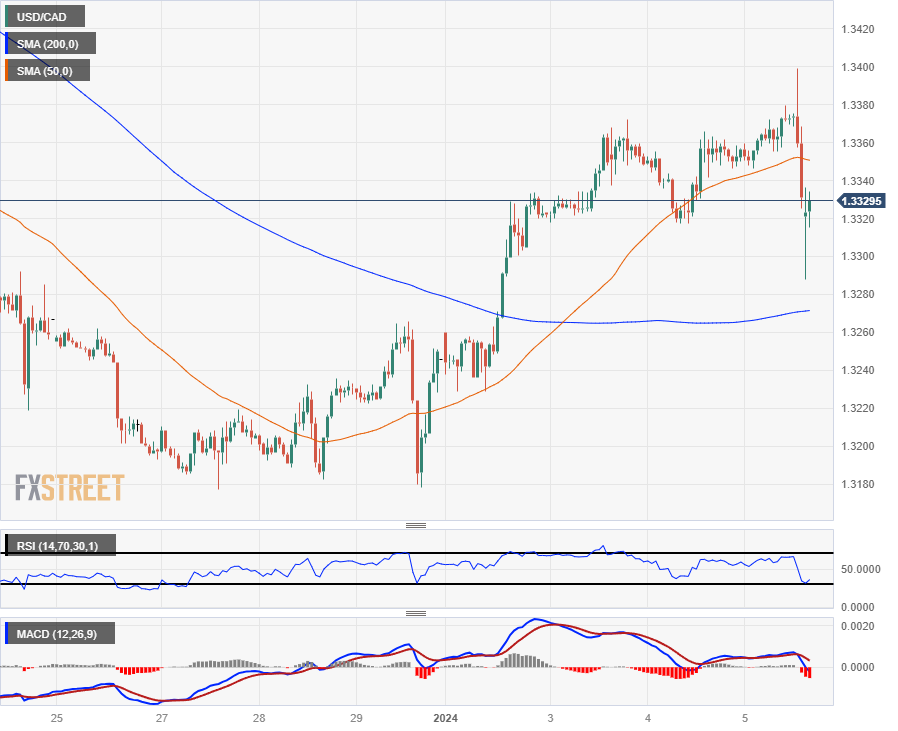
It’s a fundamentals-driven day for the Canadian Dollar, with NFP sparking an initial surge in the USD/CAD towards 1.3400 following the jobs release, however, markets quickly reversed course to plunge into 1.3290 before settling back into familiar territory near 1.3330.
Despite the US Dollar broadly falling against most of major currencies heading into the weekly close, the CAD is struggling to draw interest, underperforming most of its peers, gaining a fifth of a percent against the Greenback.
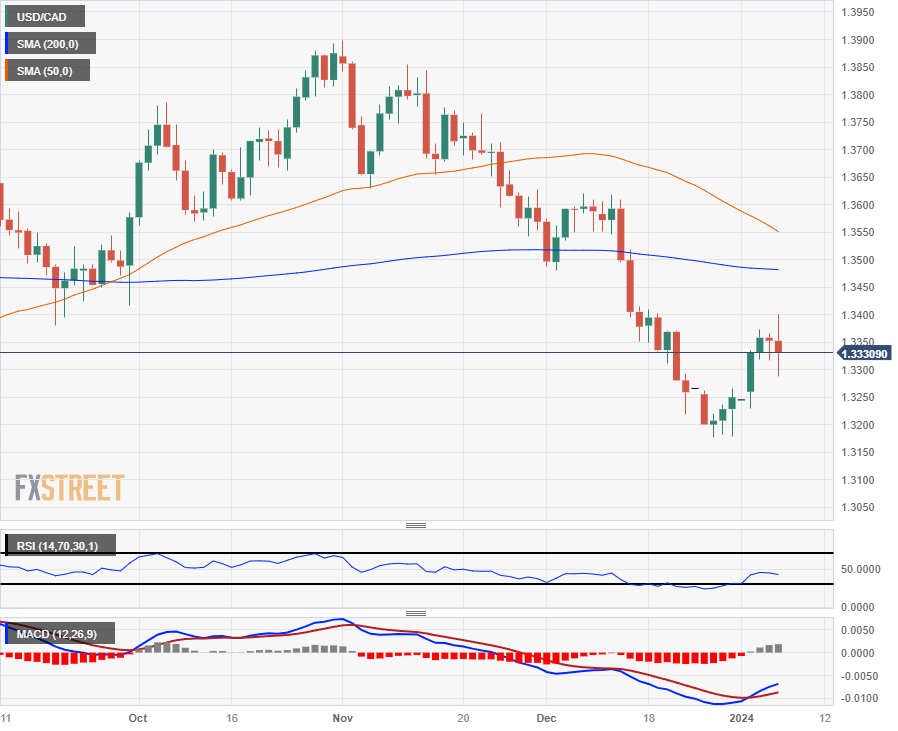
With the USD/CAD pushing into the middle on Friday, the pair is at risk of a pause on the daily candlesticks, hung out to dry in no man’s land below the 200-day Simple Moving Average (SMA) at the 1.3500 handle while the 50-day SMA accelerates into a downside crossover of the longer moving average.
USD/CAD Hourly Chart
USD/CAD Daily Chart
Canadian Dollar FAQs
What key factors drive the Canadian Dollar?
The key factors driving the Canadian Dollar (CAD) are the level of interest rates set by the Bank of Canada (BoC), the price of Oil, Canada’s largest export, the health of its economy, inflation and the Trade Balance, which is the difference between the value of Canada’s exports versus its imports. Other factors include market sentiment – whether investors are taking on more risky assets (risk-on) or seeking safe-havens (risk-off) – with risk-on being CAD-positive. As its largest trading partner, the health of the US economy is also a key factor influencing the Canadian Dollar.
How do the decisions of the Bank of Canada impact the Canadian Dollar?
The Bank of Canada (BoC) has a significant influence on the Canadian Dollar by setting the level of interest rates that banks can lend to one another. This influences the level of interest rates for everyone. The main goal of the BoC is to maintain inflation at 1-3% by adjusting interest rates up or down. Relatively higher interest rates tend to be positive for the CAD. The Bank of Canada can also use quantitative easing and tightening to influence credit conditions, with the former CAD-negative and the latter CAD-positive.
How does the price of Oil impact the Canadian Dollar?
The price of Oil is a key factor impacting the value of the Canadian Dollar. Petroleum is Canada’s biggest export, so Oil price tends to have an immediate impact on the CAD value. Generally, if Oil price rises CAD also goes up, as aggregate demand for the currency increases. The opposite is the case if the price of Oil falls. Higher Oil prices also tend to result in a greater likelihood of a positive Trade Balance, which is also supportive of the CAD.
How does inflation data impact the value of the Canadian Dollar?
While inflation had always traditionally been thought of as a negative factor for a currency since it lowers the value of money, the opposite has actually been the case in modern times with the relaxation of cross-border capital controls. Higher inflation tends to lead central banks to put up interest rates which attracts more capital inflows from global investors seeking a lucrative place to keep their money. This increases demand for the local currency, which in Canada’s case is the Canadian Dollar.
How does economic data influence the value of the Canadian Dollar?
Macroeconomic data releases gauge the health of the economy and can have an impact on the Canadian Dollar. Indicators such as GDP, Manufacturing and Services PMIs, employment, and consumer sentiment surveys can all influence the direction of the CAD. A strong economy is good for the Canadian Dollar. Not only does it attract more foreign investment but it may encourage the Bank of Canada to put up interest rates, leading to a stronger currency. If economic data is weak, however, the CAD is likely to fall.







© 2000-2026. Sva prava zaštićena.
Sajt je vlasništvo kompanije Teletrade D.J. LLC 2351 LLC 2022 (Euro House, Richmond Hill Road, Kingstown, VC0100, St. Vincent and the Grenadines).
Svi podaci koji se nalaze na sajtu ne predstavljaju osnovu za donošenje investicionih odluka, već su informativnog karaktera.
The company does not serve or provide services to customers who are residents of the US, Canada, Iran, The Democratic People's Republic of Korea, Yemen and FATF blacklisted countries.
Izvršenje trgovinskih operacija sa finansijskim instrumentima upotrebom marginalne trgovine pruža velike mogućnosti i omogućava investitorima ostvarivanje visokih prihoda. Međutim, takav vid trgovine povezan je sa potencijalno visokim nivoom rizika od gubitka sredstava. Проведение торговых операций на финанcовых рынках c маржинальными финанcовыми инcтрументами открывает широкие возможноcти, и позволяет инвеcторам, готовым пойти на риcк, получать выcокую прибыль, но при этом неcет в cебе потенциально выcокий уровень риcка получения убытков. Iz tog razloga je pre započinjanja trgovine potrebno odlučiti o izboru odgovarajuće investicione strategije, uzimajući u obzir raspoložive resurse.
Upotreba informacija: U slučaju potpunog ili delimičnog preuzimanja i daljeg korišćenja materijala koji se nalazi na sajtu, potrebno je navesti link odgovarajuće stranice na sajtu kompanije TeleTrade-a kao izvora informacija. Upotreba materijala na internetu mora biti praćena hiper linkom do web stranice teletrade.org. Automatski uvoz materijala i informacija sa stranice je zabranjen.
Ako imate bilo kakvih pitanja, obratite nam se pr@teletrade.global.


 Банковни
 транcфери


