- Analiza
- Novosti i instrumenti
- Vesti sa tržišta
- Japanese Yen drifts lower as Trump’s tariff plans benefit US Dollar
Japanese Yen drifts lower as Trump’s tariff plans benefit US Dollar
- The Japanese Yen retreated further from a multi-week high touched against the USD on Monday.
- Trump’s tariff threats, rebounding US bond yields and modest USD strength support USD/JPY.
- The divergent BoJ-Fed expectations might keep a lid on any further upside for the currency pair.
The Japanese Yen (JPY) attracts heavy selling during the Asian session on Tuesday and moves away from a six-week high touched against its American counterpart the previous day. Investors remain concerned about the potential economic fallout from US President Donald Trump's trade policies, which, in turn, is seen undermining the JPY. Apart from this, a goodish rebound in the US Treasury bond yields turns out to be another factor driving flows away from the lower-yielding JPY.
This, along with a solid US Dollar (USD) recovery from its lowest level since December 18 touched on Monday lifts the USD/JPY pair back closer to the mid-155.00s. Any meaningful JPY depreciation, however, seems elusive in the wake of bets that the Bank of Japan (BoJ) will hike interest rates further. In contrast, the Federal Reserve (Fed) is expected to cut interest rates twice this year, which, in turn, could act as a headwind for the US bond yields, the USD and the currency pair.
Japanese Yen weakens after Trump’s tariff threats; hawkish BoJ expectations could limit losses
- US President Donald Trump said he would soon impose tariffs on producers of pharmaceuticals and computer chips in the near future. I will also place tariffs on aluminum and copper, and look at steel and other industries for tariffs.
- This comes after Trump ordered his administration to impose emergency 25% tariffs on Colombian imports, though the duties were put on hold after the latter agreed to unrestricted acceptance of all illegal migrants returned from the US.
- The Financial Times reported on Monday that Scott Bessent, who was confirmed as the US Treasury Secretary, is pushing for tariffs on all imports to start at 2.5% and to increase it gradually by the same amount every month.
- The yield on the benchmark 10-year US government bond moves away from over a one-month low touched the previous day, which helps revive demand for the US Dollar and undermines the lower-yielding Japanese Yen.
- The Bank of Japan reiterated last week, after raising rates to the highest since 2008, that it will continue to raise the policy rate and adjust the degree of monetary accommodation if the outlook presented at the January meeting is realized.
- Moreover, the leaders of Japan's top business lobby and labor unions have agreed on the need to maintain the momentum for pay hikes again this year, which should allow the BoJ to tighten its policy further and help limit JPY losses.
- The BoJ announced that it would provide ¥200 billion through the outright purchase of commercial paper. Separately, Japan's Economy Minister Ryosei Akazawa said that he will closely monitor the impact of the rate hike on the economy.
- Traders now look to Tuesday's US economic docket – featuring Durable Goods Orders, the Conference Board's Consumer Confidence Index and the Richmond Manufacturing Index – for some impetus later during the US session.
- The focus, however, will remain glued to the outcome of a two-day FOMC monetary policy meeting, starting this Tuesday, which will influence the USD price dynamics and provide a fresh directional impetus to the USD/JPY pair.
USD/JPY might attract sellers near the 156.00 mark, ascending channel breakdown in play
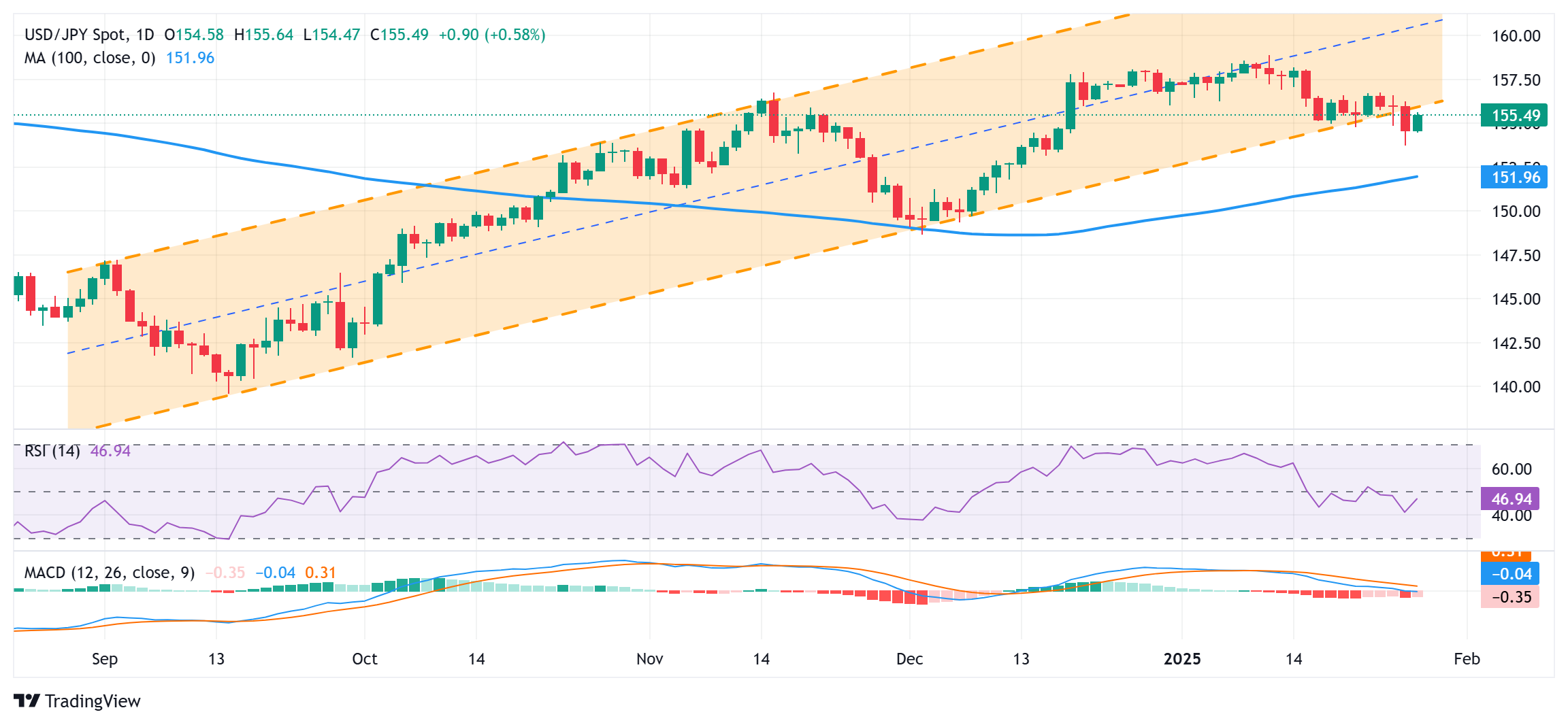
From a technical perspective, the overnight sustained breakdown below a multi-month-old ascending trend-channel support was seen as a key trigger for bearish traders. Moreover, oscillators on the daily chart have just started gaining negative traction. This, in turn, suggests that the path of least resistance for the USD/JPY pair is to the downside. Hence, any subsequent move up could be seen as a selling opportunity near the trend-channel support breakpoint, now turned resistance, around the 156.00 mark, which should cap spot prices near the 156.60-156.70 supply zone.
On the flip side, the 155.00 psychological mark now seems to protect the immediate downside ahead of the 154.55-154.50 horizontal zone, the 154.00 round figure and the overnight swing low, around the 153.70 region. Some follow-through selling will reaffirm the near-term negative outlook and drag the USD/JPY pair further towards the 153.30 intermediate support en route to the 153.00 mark.
Japanese Yen FAQs
The Japanese Yen (JPY) is one of the world’s most traded currencies. Its value is broadly determined by the performance of the Japanese economy, but more specifically by the Bank of Japan’s policy, the differential between Japanese and US bond yields, or risk sentiment among traders, among other factors.
One of the Bank of Japan’s mandates is currency control, so its moves are key for the Yen. The BoJ has directly intervened in currency markets sometimes, generally to lower the value of the Yen, although it refrains from doing it often due to political concerns of its main trading partners. The BoJ ultra-loose monetary policy between 2013 and 2024 caused the Yen to depreciate against its main currency peers due to an increasing policy divergence between the Bank of Japan and other main central banks. More recently, the gradually unwinding of this ultra-loose policy has given some support to the Yen.
Over the last decade, the BoJ’s stance of sticking to ultra-loose monetary policy has led to a widening policy divergence with other central banks, particularly with the US Federal Reserve. This supported a widening of the differential between the 10-year US and Japanese bonds, which favored the US Dollar against the Japanese Yen. The BoJ decision in 2024 to gradually abandon the ultra-loose policy, coupled with interest-rate cuts in other major central banks, is narrowing this differential.
The Japanese Yen is often seen as a safe-haven investment. This means that in times of market stress, investors are more likely to put their money in the Japanese currency due to its supposed reliability and stability. Turbulent times are likely to strengthen the Yen’s value against other currencies seen as more risky to invest in.







© 2000-2026. Sva prava zaštićena.
Sajt je vlasništvo kompanije Teletrade D.J. LLC 2351 LLC 2022 (Euro House, Richmond Hill Road, Kingstown, VC0100, St. Vincent and the Grenadines).
Svi podaci koji se nalaze na sajtu ne predstavljaju osnovu za donošenje investicionih odluka, već su informativnog karaktera.
The company does not serve or provide services to customers who are residents of the US, Canada, Iran, The Democratic People's Republic of Korea, Yemen and FATF blacklisted countries.
Izvršenje trgovinskih operacija sa finansijskim instrumentima upotrebom marginalne trgovine pruža velike mogućnosti i omogućava investitorima ostvarivanje visokih prihoda. Međutim, takav vid trgovine povezan je sa potencijalno visokim nivoom rizika od gubitka sredstava. Проведение торговых операций на финанcовых рынках c маржинальными финанcовыми инcтрументами открывает широкие возможноcти, и позволяет инвеcторам, готовым пойти на риcк, получать выcокую прибыль, но при этом неcет в cебе потенциально выcокий уровень риcка получения убытков. Iz tog razloga je pre započinjanja trgovine potrebno odlučiti o izboru odgovarajuće investicione strategije, uzimajući u obzir raspoložive resurse.
Upotreba informacija: U slučaju potpunog ili delimičnog preuzimanja i daljeg korišćenja materijala koji se nalazi na sajtu, potrebno je navesti link odgovarajuće stranice na sajtu kompanije TeleTrade-a kao izvora informacija. Upotreba materijala na internetu mora biti praćena hiper linkom do web stranice teletrade.org. Automatski uvoz materijala i informacija sa stranice je zabranjen.
Ako imate bilo kakvih pitanja, obratite nam se pr@teletrade.global.


 Банковни
 транcфери


