- Analiza
- Novosti i instrumenti
- Vesti sa tržišta
- AUD/USD Price Forecast: Falls back as US Dollar refreshes weekly high
AUD/USD Price Forecast: Falls back as US Dollar refreshes weekly high
- AUD/USD gives up some intraday gains as the US Dollar posts a fresh weekly high amid Donald Trump’s tariff fears.
- Donald Trump is poised to impose 25% tariffs on Canada and Mexico, and 100% on BRICS.
- Investors expect the RBA to pivot to a policy-easing stance from February.
The AUD/USD pair surrenders a majority of intraday gains after facing selling pressure above 0.6230 in Friday’s European session but is still almost 0.2% higher at the press time. The Aussie pair retreats as the US Dollar (USD) strengthens amid deepening risks of a global trade war, with United States (US) President Donald Trump threatening to impose hefty tariffs on BRICS, and other North American nations.
The US Dollar Index (DXY), which tracks the Greenback’s value against six major currencies, posts a fresh weekly high near 108.35.
Market participants expect higher tariffs would result in an acceleration in inflationary pressures on the assumption that the scenario will boost production domestically, which will increase labor demand and, eventually, wage growth. Such a scenario will allow the Federal Reserve (Fed) to hold interest rates at their current levels for longer.
Meanwhile, investors have underpinned the Australian Dollar (AUD) against the US Dollar even though traders have fully priced in the fact that the Reserve Bank of Australia (RBA) will start reducing interest rates from the policy meeting in February. Analysts at ANZ expect that a “sharper-than-expected” slowdown in inflation would provide the RBA with enough confidence to lower its Official Cash Rate by 25 basis points (bps) at its next meeting.
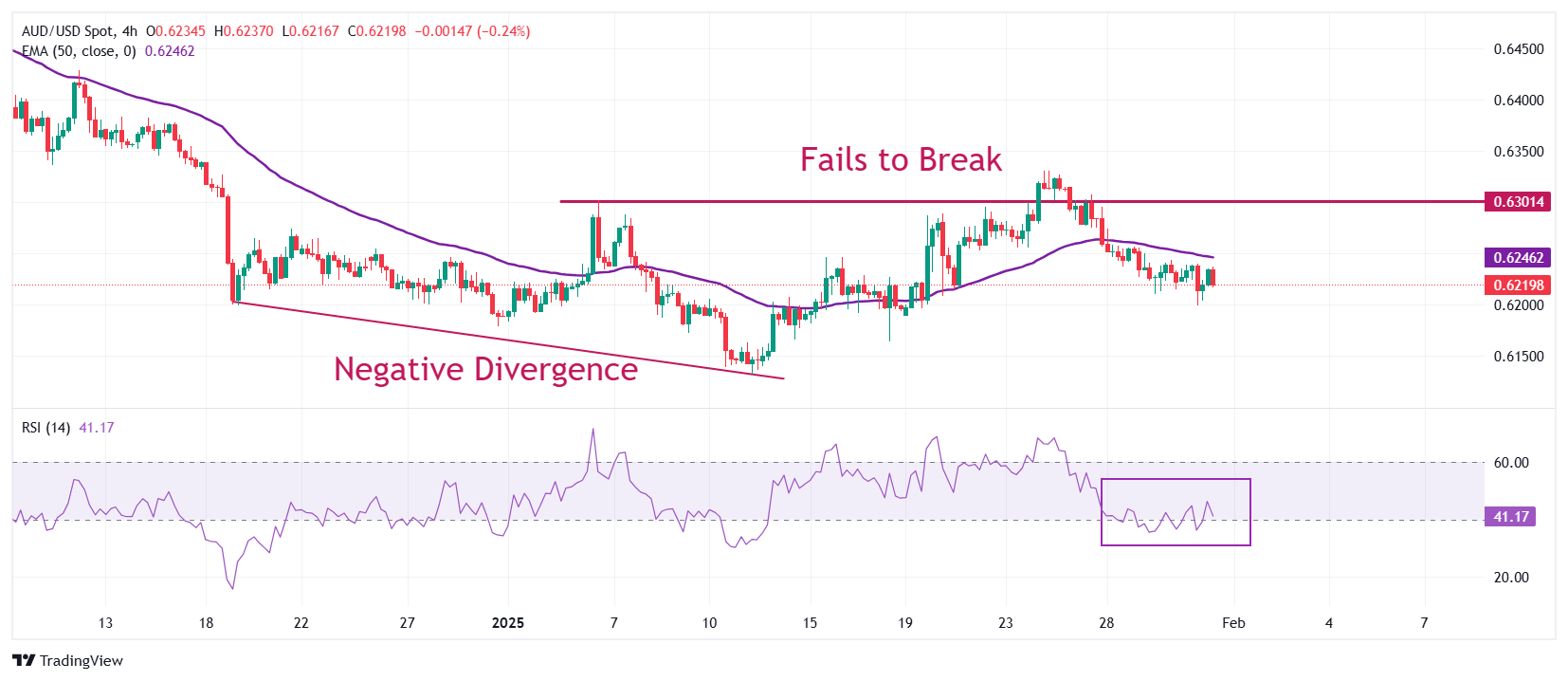
AUD/USD corrects to near 0.6200 after failing to extend the 11-day recovery above 0.6330 from an over-four-year low of 0.6130. The pair rebounded after a divergence in momentum and price action. The 14-period Relative Strength Index (RSI) formed a higher low, while the pair made lower lows on a four-hour timeframe.
The asset has also returned below the 50-period Exponential Moving Average (EMA), which trades around 0.6246.
Going forward, the pair would resume its downside journey if it fails to hold the January 13 low of 0.6130. This will push it lower to the round-level support of 0.6100 and the April 2020 low of 0.5990.
On the flip side, a sustenance move above the January 13 high of 0.6330 will open doors to the round-level resistance of 0.6400 and the December 5 high of 0.6456
AUD/USD four-hour chart
Australian Dollar FAQs
One of the most significant factors for the Australian Dollar (AUD) is the level of interest rates set by the Reserve Bank of Australia (RBA). Because Australia is a resource-rich country another key driver is the price of its biggest export, Iron Ore. The health of the Chinese economy, its largest trading partner, is a factor, as well as inflation in Australia, its growth rate and Trade Balance. Market sentiment – whether investors are taking on more risky assets (risk-on) or seeking safe-havens (risk-off) – is also a factor, with risk-on positive for AUD.
The Reserve Bank of Australia (RBA) influences the Australian Dollar (AUD) by setting the level of interest rates that Australian banks can lend to each other. This influences the level of interest rates in the economy as a whole. The main goal of the RBA is to maintain a stable inflation rate of 2-3% by adjusting interest rates up or down. Relatively high interest rates compared to other major central banks support the AUD, and the opposite for relatively low. The RBA can also use quantitative easing and tightening to influence credit conditions, with the former AUD-negative and the latter AUD-positive.
China is Australia’s largest trading partner so the health of the Chinese economy is a major influence on the value of the Australian Dollar (AUD). When the Chinese economy is doing well it purchases more raw materials, goods and services from Australia, lifting demand for the AUD, and pushing up its value. The opposite is the case when the Chinese economy is not growing as fast as expected. Positive or negative surprises in Chinese growth data, therefore, often have a direct impact on the Australian Dollar and its pairs.
Iron Ore is Australia’s largest export, accounting for $118 billion a year according to data from 2021, with China as its primary destination. The price of Iron Ore, therefore, can be a driver of the Australian Dollar. Generally, if the price of Iron Ore rises, AUD also goes up, as aggregate demand for the currency increases. The opposite is the case if the price of Iron Ore falls. Higher Iron Ore prices also tend to result in a greater likelihood of a positive Trade Balance for Australia, which is also positive of the AUD.
The Trade Balance, which is the difference between what a country earns from its exports versus what it pays for its imports, is another factor that can influence the value of the Australian Dollar. If Australia produces highly sought after exports, then its currency will gain in value purely from the surplus demand created from foreign buyers seeking to purchase its exports versus what it spends to purchase imports. Therefore, a positive net Trade Balance strengthens the AUD, with the opposite effect if the Trade Balance is negative.







© 2000-2026. Sva prava zaštićena.
Sajt je vlasništvo kompanije Teletrade D.J. LLC 2351 LLC 2022 (Euro House, Richmond Hill Road, Kingstown, VC0100, St. Vincent and the Grenadines).
Svi podaci koji se nalaze na sajtu ne predstavljaju osnovu za donošenje investicionih odluka, već su informativnog karaktera.
The company does not serve or provide services to customers who are residents of the US, Canada, Iran, The Democratic People's Republic of Korea, Yemen and FATF blacklisted countries.
Izvršenje trgovinskih operacija sa finansijskim instrumentima upotrebom marginalne trgovine pruža velike mogućnosti i omogućava investitorima ostvarivanje visokih prihoda. Međutim, takav vid trgovine povezan je sa potencijalno visokim nivoom rizika od gubitka sredstava. Проведение торговых операций на финанcовых рынках c маржинальными финанcовыми инcтрументами открывает широкие возможноcти, и позволяет инвеcторам, готовым пойти на риcк, получать выcокую прибыль, но при этом неcет в cебе потенциально выcокий уровень риcка получения убытков. Iz tog razloga je pre započinjanja trgovine potrebno odlučiti o izboru odgovarajuće investicione strategije, uzimajući u obzir raspoložive resurse.
Upotreba informacija: U slučaju potpunog ili delimičnog preuzimanja i daljeg korišćenja materijala koji se nalazi na sajtu, potrebno je navesti link odgovarajuće stranice na sajtu kompanije TeleTrade-a kao izvora informacija. Upotreba materijala na internetu mora biti praćena hiper linkom do web stranice teletrade.org. Automatski uvoz materijala i informacija sa stranice je zabranjen.
Ako imate bilo kakvih pitanja, obratite nam se pr@teletrade.global.


 Банковни
 транcфери


