- Analiza
- Novosti i instrumenti
- Vesti sa tržišta
- USD/INR holds steady as traders brace for RBI rate decision
USD/INR holds steady as traders brace for RBI rate decision
- The Indian Rupee flatlines in Friday’s Asian session.
- Rising RBI rate cut bets, weakness of Asian peers and uncertainties could undermine the INR.
- RBI's interest rate decision will be closely watched on Friday.
The Indian Rupee (INR) holds steady after falling to a fresh all-time low in the previous session. The local currency remains vulnerable amid expectations of a rate cut by the Reserve Bank of India (RBI). Furthermore, a broader decline among Asian currencies, the uncertainties surrounding US trade tariffs and continued portfolio outflows might undermine the INR.
Nonetheless, the routine intervention by the RBI to sell US Dollar via state-run banks might help limit the INR’s losses. The RBI interest rate decision on Friday will be in the spotlight. Investors will also scrutinize the statement from the new RBI Governor Sanjay Malhotra to assess the direction of the central bank’s monetary policy. The attention will shift to the US labour market data later in the day, including Nonfarm Payrolls (NFP), Unemployment Rate and Average Hourly Earnings.
Indian Rupee steadies ahead of RBI rate decision
- The RBI is expected to cut the interest rate by 25 basis points (bps) to 6.25% at the policy meeting concluding on Friday, in what would be its first rate cut in nearly five years.
- “The delay in implementation of universal tariffs by the incoming U.S. administration provides some tactical space for RBI to prioritize domestic growth... and space to cut policy rates,” said Ruhul Bajoria, an economist at Bank of America in India.
- Most of the economists surveyed by Bloomberg anticipate that the Indian central bank will lower the benchmark repurchase rate by at least 25 basis points (bps) to 6.25% on Friday.
- Chicago Fed President Austan Goolsbee noted on Thursday that the uncertainty makes the environment for the Fed foggier, a reason to slow the pace of cuts.
- Dallas Fed President Lorie Logan said that while inflation progress has been significant, the US labor market remains far too firm to push the Fed into rate cuts any time soon.
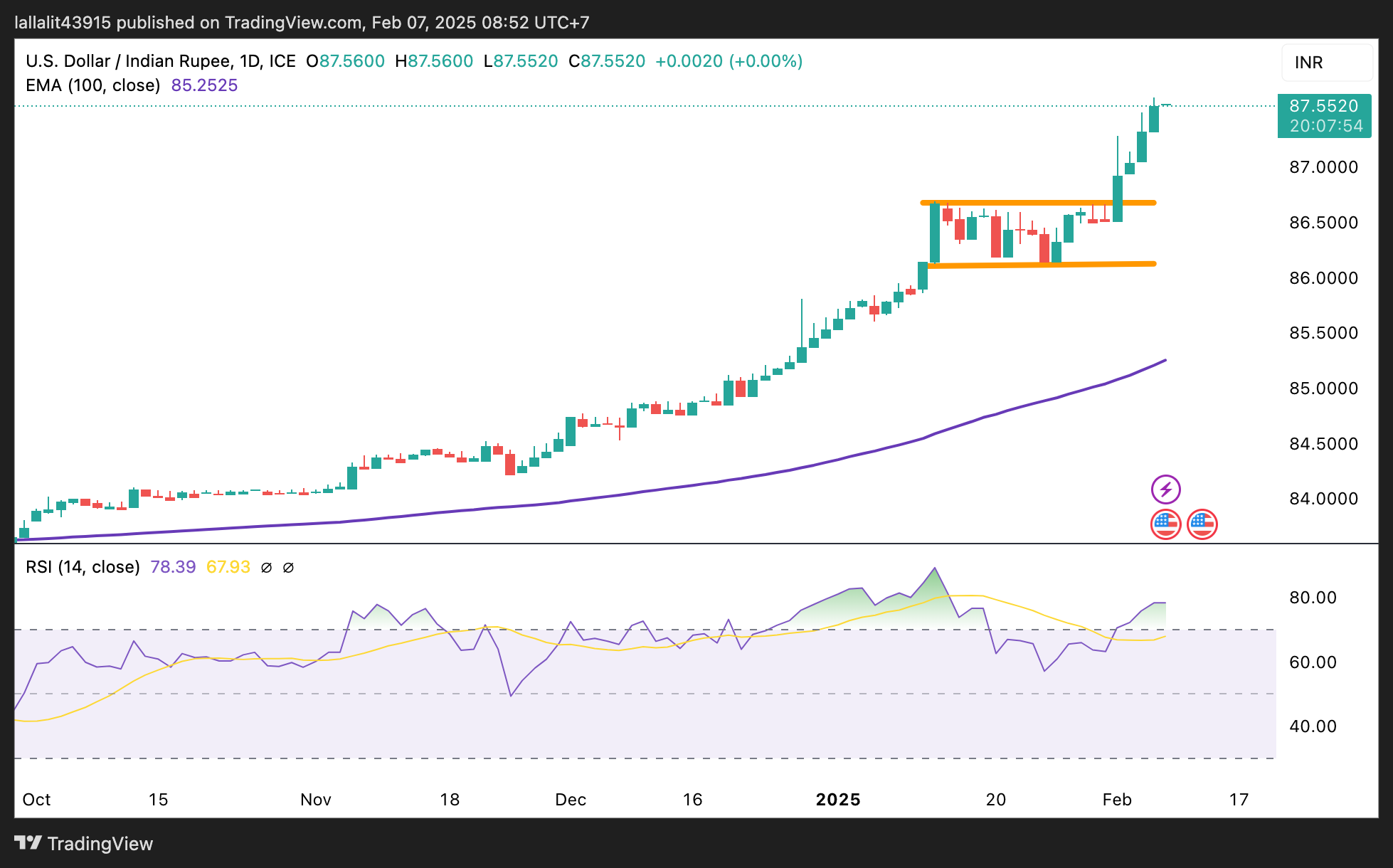
USD/INR paints a positive picture, overbought RSI warrants caution for bulls in the short term
The Indian Rupee trades on a flat note on the day. The constructive outlook of the USD/INR pair remains intact as the price holds above the key 100-day Exponential Moving Average (EMA) on the daily chart. However, the 14-day Relative Strength Index (RSI) reaches overbought territory beyond the 70.00 mark, potentially signaling a temporary weakness or further consolidation in the near term.
The immediate resistance level for USD/INR emerges at 87.62, an all-time high. Sustained trading above this level could pave the way to the 88.00 psychological level.
On the downside, the initial support level for the pair is located in the 87.05-87.00 zone, representing the low of February 5 and the round mark. A breach of the mentioned level could drag USD/INR down to 86.51, the low of February 3.
Indian Rupee FAQs
The Indian Rupee (INR) is one of the most sensitive currencies to external factors. The price of Crude Oil (the country is highly dependent on imported Oil), the value of the US Dollar – most trade is conducted in USD – and the level of foreign investment, are all influential. Direct intervention by the Reserve Bank of India (RBI) in FX markets to keep the exchange rate stable, as well as the level of interest rates set by the RBI, are further major influencing factors on the Rupee.
The Reserve Bank of India (RBI) actively intervenes in forex markets to maintain a stable exchange rate, to help facilitate trade. In addition, the RBI tries to maintain the inflation rate at its 4% target by adjusting interest rates. Higher interest rates usually strengthen the Rupee. This is due to the role of the ‘carry trade’ in which investors borrow in countries with lower interest rates so as to place their money in countries’ offering relatively higher interest rates and profit from the difference.
Macroeconomic factors that influence the value of the Rupee include inflation, interest rates, the economic growth rate (GDP), the balance of trade, and inflows from foreign investment. A higher growth rate can lead to more overseas investment, pushing up demand for the Rupee. A less negative balance of trade will eventually lead to a stronger Rupee. Higher interest rates, especially real rates (interest rates less inflation) are also positive for the Rupee. A risk-on environment can lead to greater inflows of Foreign Direct and Indirect Investment (FDI and FII), which also benefit the Rupee.
Higher inflation, particularly, if it is comparatively higher than India’s peers, is generally negative for the currency as it reflects devaluation through oversupply. Inflation also increases the cost of exports, leading to more Rupees being sold to purchase foreign imports, which is Rupee-negative. At the same time, higher inflation usually leads to the Reserve Bank of India (RBI) raising interest rates and this can be positive for the Rupee, due to increased demand from international investors. The opposite effect is true of lower inflation.







© 2000-2026. Sva prava zaštićena.
Sajt je vlasništvo kompanije Teletrade D.J. LLC 2351 LLC 2022 (Euro House, Richmond Hill Road, Kingstown, VC0100, St. Vincent and the Grenadines).
Svi podaci koji se nalaze na sajtu ne predstavljaju osnovu za donošenje investicionih odluka, već su informativnog karaktera.
The company does not serve or provide services to customers who are residents of the US, Canada, Iran, The Democratic People's Republic of Korea, Yemen and FATF blacklisted countries.
Izvršenje trgovinskih operacija sa finansijskim instrumentima upotrebom marginalne trgovine pruža velike mogućnosti i omogućava investitorima ostvarivanje visokih prihoda. Međutim, takav vid trgovine povezan je sa potencijalno visokim nivoom rizika od gubitka sredstava. Проведение торговых операций на финанcовых рынках c маржинальными финанcовыми инcтрументами открывает широкие возможноcти, и позволяет инвеcторам, готовым пойти на риcк, получать выcокую прибыль, но при этом неcет в cебе потенциально выcокий уровень риcка получения убытков. Iz tog razloga je pre započinjanja trgovine potrebno odlučiti o izboru odgovarajuće investicione strategije, uzimajući u obzir raspoložive resurse.
Upotreba informacija: U slučaju potpunog ili delimičnog preuzimanja i daljeg korišćenja materijala koji se nalazi na sajtu, potrebno je navesti link odgovarajuće stranice na sajtu kompanije TeleTrade-a kao izvora informacija. Upotreba materijala na internetu mora biti praćena hiper linkom do web stranice teletrade.org. Automatski uvoz materijala i informacija sa stranice je zabranjen.
Ako imate bilo kakvih pitanja, obratite nam se pr@teletrade.global.


 Банковни
 транcфери


