- Analiza
- Novosti i instrumenti
- Vesti sa tržišta
- Japanese Yen retreats against USD amid some repositioning ahead of US NFP
Japanese Yen retreats against USD amid some repositioning ahead of US NFP
- The Japanese Yen touched a nearly two-month high against the US Dollar on Friday.
- Repositioning ahead of the US NFP triggers intraday short covering around USD/JPY.
- The narrowing US-Japan rate differential should limit losses for the lower-yielding JPY.
The Japanese Yen (JPY) prolongs its uptrend for the fourth successive day and advances to a nearly two-month high against its American counterpart during the Asian session on Friday. The recent hawkish signals from the Bank of Japan (BoJ) lift market bets on further interest rate hikes. The resultant narrowing of the rate differential between the BoJ and other major central banks, including the Federal Reserve (Fed), turns out to be a key factor that continues to underpin the lower-yielding JPY.
Apart from this, the recent US Dollar (USD) sharp pullback from the vicinity of over a two-year high drags the USD/JPY pair below the 151.00 mark for the first time since December 10. That said, the uncertainty over US President Donald Trump's tariff policies keeps a lid on any further gains for the JPY. Furthermore, traders now seem reluctant and opt to move to the sidelines ahead of the US Nonfarm Payrolls (NFP) report, which assists the currency pair to rebound around 70 pips from the daily low.
Japanese Yen bulls have the upper hand amid rising bets on more BoJ rate hikes
- Kazuhiro Masaki, Director General of the Bank of Japan's monetary affairs department, said on Thursday that the central bank will continue to raise interest rates if underlying inflation accelerates toward its 2% target as projected.
- Japan's Economy Minister Ryosei Akazawa told the parliament that the government's focus would be to eradicate a deflationary mindset with a goal to boost minimum wages and take measures to encourage firms to raise wages.
- This comes on top of the hawkish BoJ Summary of Opinions released on Monday, which showed that policymakers discussed the likelihood of raising interest rates further at the January meeting and continued to boost the Japanese Yen.
- Adding to this, data released this week showed that Japan’s inflation-adjusted real wages rose 0.6% year-on-year in December, marking the second consecutive monthly gain and backing the case for further tightening by the BoJ.
- The yield on Japan’s 10-year government bond remains near a 14-year high, while the benchmark 10-year US Treasury yield hangs near its lowest level since December amid expectations that the Federal Reserve would stick to its easing bias.
- US Treasury Secretary Scott Bessent said on Thursday that President Donald Trump's administration was not particularly concerned about the Fed's trajectory on interest rates and that the focus is on bringing down 10-year Treasury yields.
- Chicago Fed President Austan Goolsbee noted that the appearance that inflation has stalled is largely due to base effects and that the central bank needs to be mindful of overheating and deterioration, but things are largely going well.
- Separately, Dallas Fed President Lorie Logan said that inflation progress has been significant, but the US labor market remains far too firm to push the central bank into rate cuts any time soon. This, however, does little to impress the US Dollar bulls.
- That said, traders opt to lighten their bets and move to the sidelines ahead of the release of the US Nonfarm Payrolls (NFP) report, prompting an aggressive intraday short-covering move around the USD/JPY pair on Friday.
USD/JPY is likely to attract fresh sellers at higher levels amid a bearish technical setup
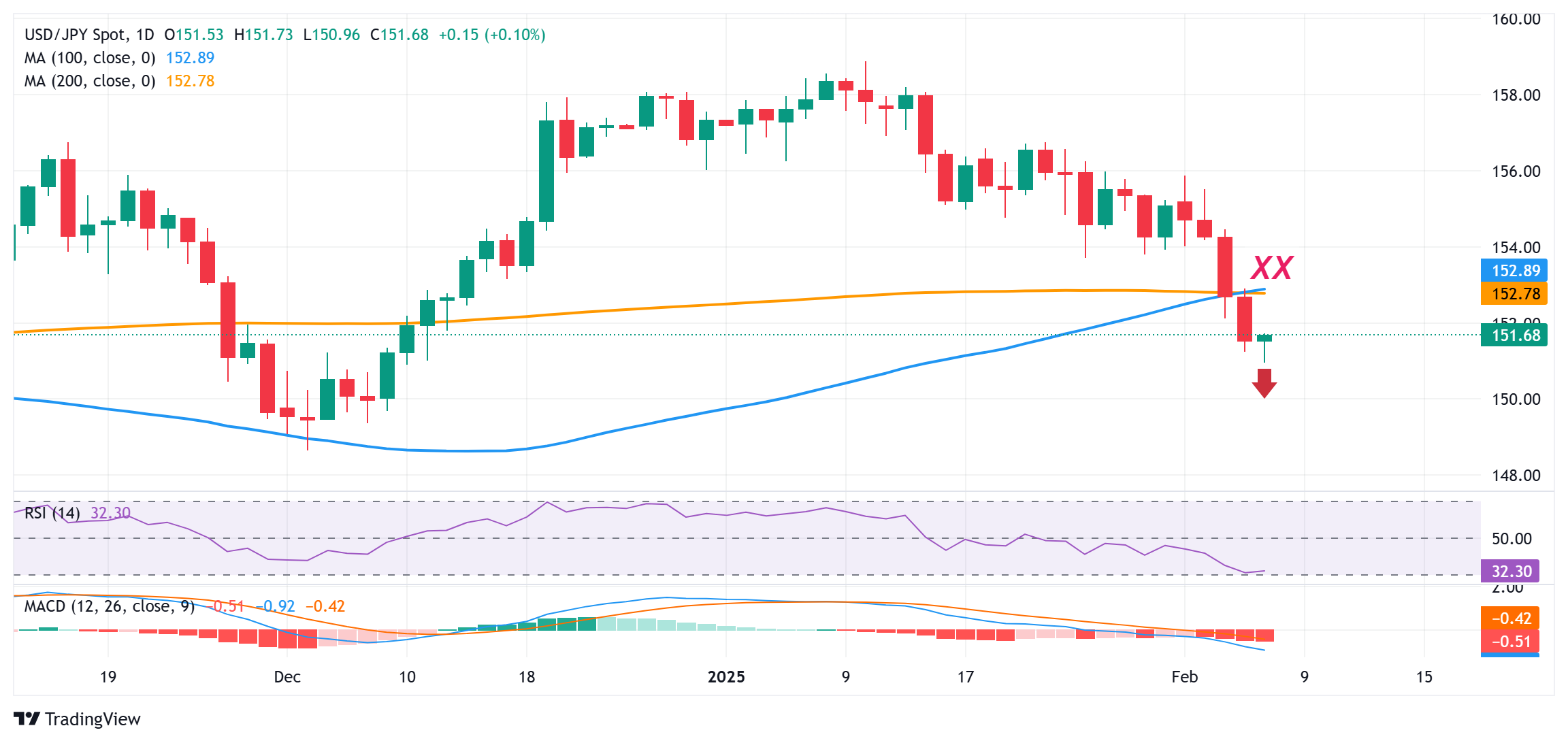
From a technical perspective, this week's breakdown below the 152.50-152.45 confluence – comprising the 100- and the 200-day Simple Moving Averages (SMAs) was seen as a key trigger for bearish traders. Moreover, oscillators on the daily chart are holding deep in negative territory and are still away from being in the oversold zone. This, in turn, suggests that the path of least resistance for the USD/JPY pair remains to the downside. Hence, any subsequent move up could be seen as a selling opportunity and remain capped near the 152.00 mark. Some follow-through buying, however, could lift spot prices further toward the next relevant hurdle near the 152.50-152.45 support-turned-resistance en route to the 153.00 round figure.
On the flip side, the 151.00 mark now seems to have emerged as an immediate support. A sustained break and acceptance below the said handle could drag the USD/JPY pair further towards 150.55-150.50 support. The downward trajectory could extend further towards the 150.00 psychological mark, below which spot prices could slide to the 149.60 horizontal support before aiming to test the 149.00 mark and the December swing low, around the 148.65 region.
Japanese Yen FAQs
The Japanese Yen (JPY) is one of the world’s most traded currencies. Its value is broadly determined by the performance of the Japanese economy, but more specifically by the Bank of Japan’s policy, the differential between Japanese and US bond yields, or risk sentiment among traders, among other factors.
One of the Bank of Japan’s mandates is currency control, so its moves are key for the Yen. The BoJ has directly intervened in currency markets sometimes, generally to lower the value of the Yen, although it refrains from doing it often due to political concerns of its main trading partners. The BoJ ultra-loose monetary policy between 2013 and 2024 caused the Yen to depreciate against its main currency peers due to an increasing policy divergence between the Bank of Japan and other main central banks. More recently, the gradually unwinding of this ultra-loose policy has given some support to the Yen.
Over the last decade, the BoJ’s stance of sticking to ultra-loose monetary policy has led to a widening policy divergence with other central banks, particularly with the US Federal Reserve. This supported a widening of the differential between the 10-year US and Japanese bonds, which favored the US Dollar against the Japanese Yen. The BoJ decision in 2024 to gradually abandon the ultra-loose policy, coupled with interest-rate cuts in other major central banks, is narrowing this differential.
The Japanese Yen is often seen as a safe-haven investment. This means that in times of market stress, investors are more likely to put their money in the Japanese currency due to its supposed reliability and stability. Turbulent times are likely to strengthen the Yen’s value against other currencies seen as more risky to invest in.







© 2000-2026. Sva prava zaštićena.
Sajt je vlasništvo kompanije Teletrade D.J. LLC 2351 LLC 2022 (Euro House, Richmond Hill Road, Kingstown, VC0100, St. Vincent and the Grenadines).
Svi podaci koji se nalaze na sajtu ne predstavljaju osnovu za donošenje investicionih odluka, već su informativnog karaktera.
The company does not serve or provide services to customers who are residents of the US, Canada, Iran, The Democratic People's Republic of Korea, Yemen and FATF blacklisted countries.
Izvršenje trgovinskih operacija sa finansijskim instrumentima upotrebom marginalne trgovine pruža velike mogućnosti i omogućava investitorima ostvarivanje visokih prihoda. Međutim, takav vid trgovine povezan je sa potencijalno visokim nivoom rizika od gubitka sredstava. Проведение торговых операций на финанcовых рынках c маржинальными финанcовыми инcтрументами открывает широкие возможноcти, и позволяет инвеcторам, готовым пойти на риcк, получать выcокую прибыль, но при этом неcет в cебе потенциально выcокий уровень риcка получения убытков. Iz tog razloga je pre započinjanja trgovine potrebno odlučiti o izboru odgovarajuće investicione strategije, uzimajući u obzir raspoložive resurse.
Upotreba informacija: U slučaju potpunog ili delimičnog preuzimanja i daljeg korišćenja materijala koji se nalazi na sajtu, potrebno je navesti link odgovarajuće stranice na sajtu kompanije TeleTrade-a kao izvora informacija. Upotreba materijala na internetu mora biti praćena hiper linkom do web stranice teletrade.org. Automatski uvoz materijala i informacija sa stranice je zabranjen.
Ako imate bilo kakvih pitanja, obratite nam se pr@teletrade.global.


 Банковни
 транcфери


