- Analiza
- Novosti i instrumenti
- Vesti sa tržišta
- Gold price rebounds as US holiday trade keeps volatility low
Gold price rebounds as US holiday trade keeps volatility low
- Gold gains 0.56% despite thin liquidity on US Presidents’ Day.
- Geopolitical risks, US trade policies support bullion’s long-term outlook.
- Traders await FOMC Minutes, Fed speakers, and key US economic data.
Gold price climbed on Monday during the North American session, posting gains of 0.56% amid thin trading as markets in the United States (US) were closed in observance of Presidents’ Day. The XAU/USD traded at $2,898 after hitting a daily low of $2,878.
Last Friday, Gold registered its most significant loss since December 18, yet the outlook for the precious metal looks promising amid geopolitical uncertainties and US trade policies aimed at narrowing the deficit.
Data from the US was mixed last week with the Consumer Price Index (CPI) and the Producer Price Index (PPI) coming slightly hot. Retail Sales disappointed investors, who rushed to price in further easing by the Federal Reserve (Fed).
Fed officials have become cautious as inflation remains above the 2% goal. Philadelphia Fed President Patrick Harker said that policy needs to be “steady” for now and emphasized that monetary policy is in a good place. Harker added that the labor market is solid and that policy should be focused on lowering inflation.
Recently, Fed Governor Michelle Bowman said she expects inflation to decline, though she acknowledged that upside risks remain.
This week, the US economic docket will feature further Fed speakers, housing data, the latest Federal Open Market Committee (FOMC) Meeting Minutes, Initial Jobless Claims, and S&P Global Flash PMIs final reading for February.
Daily digest market movers: Gold price benefits from safe-haven demand
- The US 10-year Treasury bond yield tanked four basis points (bps) on Friday and sits at 4.478%.
- US real yields, which correlate inversely to Bullion prices, dropped four basis points to 2.039%, a tailwind for XAU/USD.
- The World Gold Council revealed that central banks purchased over 1,000 tonnes of Gold for the third consecutive year in 2024. Following Trump's electoral victory, purchases by central banks surged by more than 54% YoY to 333 tonnes, according to WGC data.
- Money market fed funds rate futures are pricing in 43 basis points of easing by the Fed in 2025.
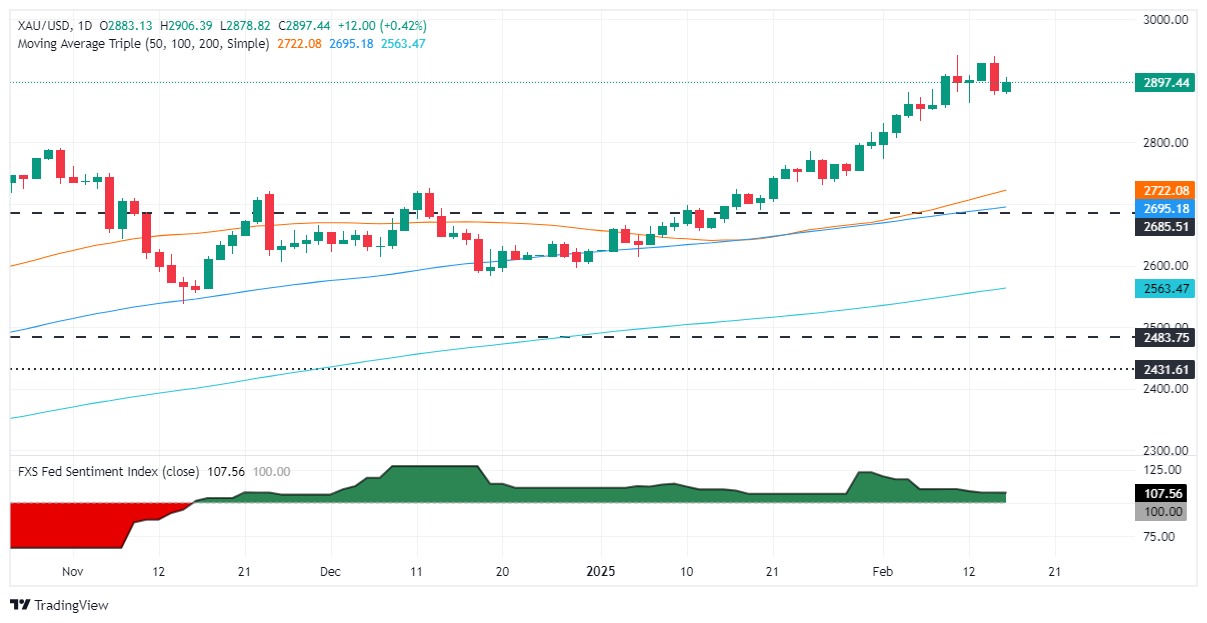
XAU/USD technical outlook: Gold price rises toward $2,900
The uptrend in Gold remains in play, though buyers must clear the $2,900 figure, to remain hopeful of testing the year-to-date (YTD) high of $2,942. If those two levels are cleared, the next ceiling level would be $2,950, followed by the $3,000 mark.
Conversely, XAU/USD daily close below $2,900 could pave the way for challenging the February 14 swing low of $2,877, followed by the February 12 low of $2,864. On further weakness, Gold could fall to test the October 31 swing high at $2,790.
Gold FAQs
Gold has played a key role in human’s history as it has been widely used as a store of value and medium of exchange. Currently, apart from its shine and usage for jewelry, the precious metal is widely seen as a safe-haven asset, meaning that it is considered a good investment during turbulent times. Gold is also widely seen as a hedge against inflation and against depreciating currencies as it doesn’t rely on any specific issuer or government.
Central banks are the biggest Gold holders. In their aim to support their currencies in turbulent times, central banks tend to diversify their reserves and buy Gold to improve the perceived strength of the economy and the currency. High Gold reserves can be a source of trust for a country’s solvency. Central banks added 1,136 tonnes of Gold worth around $70 billion to their reserves in 2022, according to data from the World Gold Council. This is the highest yearly purchase since records began. Central banks from emerging economies such as China, India and Turkey are quickly increasing their Gold reserves.
Gold has an inverse correlation with the US Dollar and US Treasuries, which are both major reserve and safe-haven assets. When the Dollar depreciates, Gold tends to rise, enabling investors and central banks to diversify their assets in turbulent times. Gold is also inversely correlated with risk assets. A rally in the stock market tends to weaken Gold price, while sell-offs in riskier markets tend to favor the precious metal.
The price can move due to a wide range of factors. Geopolitical instability or fears of a deep recession can quickly make Gold price escalate due to its safe-haven status. As a yield-less asset, Gold tends to rise with lower interest rates, while higher cost of money usually weighs down on the yellow metal. Still, most moves depend on how the US Dollar (USD) behaves as the asset is priced in dollars (XAU/USD). A strong Dollar tends to keep the price of Gold controlled, whereas a weaker Dollar is likely to push Gold prices up.







© 2000-2026. Sva prava zaštićena.
Sajt je vlasništvo kompanije Teletrade D.J. LLC 2351 LLC 2022 (Euro House, Richmond Hill Road, Kingstown, VC0100, St. Vincent and the Grenadines).
Svi podaci koji se nalaze na sajtu ne predstavljaju osnovu za donošenje investicionih odluka, već su informativnog karaktera.
The company does not serve or provide services to customers who are residents of the US, Canada, Iran, The Democratic People's Republic of Korea, Yemen and FATF blacklisted countries.
Izvršenje trgovinskih operacija sa finansijskim instrumentima upotrebom marginalne trgovine pruža velike mogućnosti i omogućava investitorima ostvarivanje visokih prihoda. Međutim, takav vid trgovine povezan je sa potencijalno visokim nivoom rizika od gubitka sredstava. Проведение торговых операций на финанcовых рынках c маржинальными финанcовыми инcтрументами открывает широкие возможноcти, и позволяет инвеcторам, готовым пойти на риcк, получать выcокую прибыль, но при этом неcет в cебе потенциально выcокий уровень риcка получения убытков. Iz tog razloga je pre započinjanja trgovine potrebno odlučiti o izboru odgovarajuće investicione strategije, uzimajući u obzir raspoložive resurse.
Upotreba informacija: U slučaju potpunog ili delimičnog preuzimanja i daljeg korišćenja materijala koji se nalazi na sajtu, potrebno je navesti link odgovarajuće stranice na sajtu kompanije TeleTrade-a kao izvora informacija. Upotreba materijala na internetu mora biti praćena hiper linkom do web stranice teletrade.org. Automatski uvoz materijala i informacija sa stranice je zabranjen.
Ako imate bilo kakvih pitanja, obratite nam se pr@teletrade.global.


 Банковни
 транcфери


