- Analiza
- Novosti i instrumenti
- Vesti sa tržišta
- USD/CAD Price Forecast: Bounces back as US Dollar recovers entire intraday losses
USD/CAD Price Forecast: Bounces back as US Dollar recovers entire intraday losses
- USD/CAD bounces back after a strong recovery in the US Dollar.
- Investors shrug off weak US flash S&P Global PMI data for February.
- Investors turn cautious about the Canadian Dollar (CAD) outlook as President Trump reviews 25% tariffs on Canada.
The USD/CAD pair rebounds to near 1.4220 in European trading hours on Monday after sliding to near 1.4180 earlier in the day. The Loonie pair recovers as the US Dollar (USD) recovers almost its entire losses, with the US Dollar Index (DXY) bounces back to near 106.60.
The USD Index gains as investors digest weak United States (US) flash S&P Global Services PMI data for February, which showed that activities in the services sector surprisingly contracted for the first time in 25 months.
Meanwhile, fears of 25% tariffs on Canada by US President Donald Trump looms large. President Trump postponed his plans of imposing 25% tariffs on Canada and Mexico by one month on February 4 after both nations agreed to cooperate for criminal enforcement at borders.
On the monetary policy front, Bank of Canada (BoC) Governor Tiff Macklem warned in a speech in Ontario on Friday that the economic impact would be severe if Trump slaps tariffs on all imports from Canada.
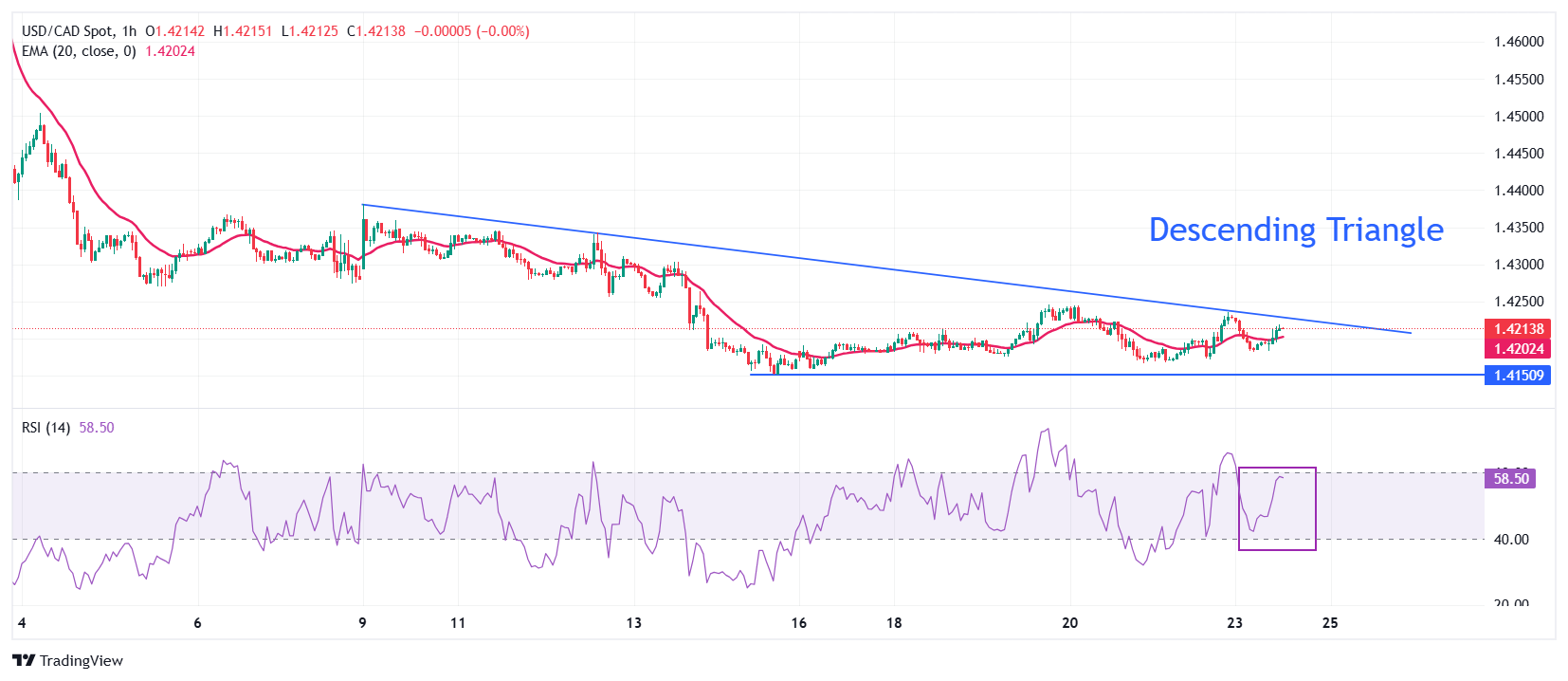
USD/CAD trades in a Descending Triangle chart pattern formed on an hourly timeframe. The downward-sloping border of the above-mentioned chart pattern is plotted from the February 9 high of 1.4380 and the flat border is placed from the February 14 low of 1.4151.
The 20-period Exponential Moving Average (EMA) overlaps the Loonie price, suggesting a sideways trend.
The 14-period Relative Strength Index (RSI) trades inside the 40.00-60.00 range, which indicates indecisiveness among investors.
The pair has remained in a downtrend since the first trading day of February and could see more downside if it breaks below the February 14 low of 1.4151 and moves towards the December 9 low of 1.4094, followed by the December 6 low of 1.4020.
On the contrary, an upside move above the February 19 high of 1.4246 will open the door toward the round-level resistance of 1.4300 and the February 9 high of 1.4380.
USD/CAD hourly chart
Canadian Dollar FAQs
The key factors driving the Canadian Dollar (CAD) are the level of interest rates set by the Bank of Canada (BoC), the price of Oil, Canada’s largest export, the health of its economy, inflation and the Trade Balance, which is the difference between the value of Canada’s exports versus its imports. Other factors include market sentiment – whether investors are taking on more risky assets (risk-on) or seeking safe-havens (risk-off) – with risk-on being CAD-positive. As its largest trading partner, the health of the US economy is also a key factor influencing the Canadian Dollar.
The Bank of Canada (BoC) has a significant influence on the Canadian Dollar by setting the level of interest rates that banks can lend to one another. This influences the level of interest rates for everyone. The main goal of the BoC is to maintain inflation at 1-3% by adjusting interest rates up or down. Relatively higher interest rates tend to be positive for the CAD. The Bank of Canada can also use quantitative easing and tightening to influence credit conditions, with the former CAD-negative and the latter CAD-positive.
The price of Oil is a key factor impacting the value of the Canadian Dollar. Petroleum is Canada’s biggest export, so Oil price tends to have an immediate impact on the CAD value. Generally, if Oil price rises CAD also goes up, as aggregate demand for the currency increases. The opposite is the case if the price of Oil falls. Higher Oil prices also tend to result in a greater likelihood of a positive Trade Balance, which is also supportive of the CAD.
While inflation had always traditionally been thought of as a negative factor for a currency since it lowers the value of money, the opposite has actually been the case in modern times with the relaxation of cross-border capital controls. Higher inflation tends to lead central banks to put up interest rates which attracts more capital inflows from global investors seeking a lucrative place to keep their money. This increases demand for the local currency, which in Canada’s case is the Canadian Dollar.
Macroeconomic data releases gauge the health of the economy and can have an impact on the Canadian Dollar. Indicators such as GDP, Manufacturing and Services PMIs, employment, and consumer sentiment surveys can all influence the direction of the CAD. A strong economy is good for the Canadian Dollar. Not only does it attract more foreign investment but it may encourage the Bank of Canada to put up interest rates, leading to a stronger currency. If economic data is weak, however, the CAD is likely to fall.







© 2000-2026. Sva prava zaštićena.
Sajt je vlasništvo kompanije Teletrade D.J. LLC 2351 LLC 2022 (Euro House, Richmond Hill Road, Kingstown, VC0100, St. Vincent and the Grenadines).
Svi podaci koji se nalaze na sajtu ne predstavljaju osnovu za donošenje investicionih odluka, već su informativnog karaktera.
The company does not serve or provide services to customers who are residents of the US, Canada, Iran, The Democratic People's Republic of Korea, Yemen and FATF blacklisted countries.
Izvršenje trgovinskih operacija sa finansijskim instrumentima upotrebom marginalne trgovine pruža velike mogućnosti i omogućava investitorima ostvarivanje visokih prihoda. Međutim, takav vid trgovine povezan je sa potencijalno visokim nivoom rizika od gubitka sredstava. Проведение торговых операций на финанcовых рынках c маржинальными финанcовыми инcтрументами открывает широкие возможноcти, и позволяет инвеcторам, готовым пойти на риcк, получать выcокую прибыль, но при этом неcет в cебе потенциально выcокий уровень риcка получения убытков. Iz tog razloga je pre započinjanja trgovine potrebno odlučiti o izboru odgovarajuće investicione strategije, uzimajući u obzir raspoložive resurse.
Upotreba informacija: U slučaju potpunog ili delimičnog preuzimanja i daljeg korišćenja materijala koji se nalazi na sajtu, potrebno je navesti link odgovarajuće stranice na sajtu kompanije TeleTrade-a kao izvora informacija. Upotreba materijala na internetu mora biti praćena hiper linkom do web stranice teletrade.org. Automatski uvoz materijala i informacija sa stranice je zabranjen.
Ako imate bilo kakvih pitanja, obratite nam se pr@teletrade.global.


 Банковни
 транcфери


