- Analiza
- Novosti i instrumenti
- Vesti sa tržišta
- Gold stabilizes above $2,900 after deep dive lower
Gold stabilizes above $2,900 after deep dive lower
- Weak US data and President Trump's tariff threats boost hopes for a Federal Reserve interest rate cut and increase haven demand.
- Gold price consolidates the prior day’s losses and is looking for support on Wednesday.
- Market sentiment tries to snap Tuesday’s negativeness and could support Gold price.
Gold’s price (XAU/USD) stabilizes and trades near $2,910 at the time of writing on Wednesday, following a 1.3% drop the previous day after markets got spooked by weak US consumer confidence data and more realistic tariff threats from President Trump’s administration. Meanwhile, United States (US) yields have plunged substantially, with markets projecting a 25 basis points (bps) rate cut in June from the Federal Reserve (Fed). This is supportive for the precious metal and should see price action bottoming out from here.
Markets are looking forward to March 4, when tariffs on Mexico and Canada are set to be enabled. Just ahead of that, the Fed’s preferred inflation gauge, the Personal Consumption Expenditures Price Index (PCE), will be released on Friday. Plenty of moving parts and elements might see traders keeping their powder dry before those events.
Daily digest market movers: March just around the corner
- Gold remained supported in recent days by weak US data that boosted hopes for a Federal Reserve interest rate cut as soon as June and President Donald Trump’s increasing tariff threats that have increased haven demand, Bloomberg reports.
- In an opinion piece from Bloomberg, Lee Baker (owner and president of Claris Financial Advisors, based in Atlanta, and a member of CNBC's Advisor Council) warned that current elevated levels in Gold are setting up markets for a harsh correction with investors willing to buy at any cost. That momentum is often seen as a greed move that usually proceeds to a broad washout, Bloomberg reports.
- The CME Fedwatch Tool sees that the chances of an interest rate cut in June only grow by the day. Currently, the tool projects a 66.2% chance of interest rates being lower than current levels compared to 33.8% for no rate cut.
Technical Analysis: Again below pivot
For the second day in a row, Gold price trades below the daily Pivot Point. Although price action looks flat and consolidation is taking place, the risk still remains that more downside could materialize. The Relative Strength Index indicator in the 4-hour chart has room for more downside, so a drop to $2,880 could be possible if the market rout picks up again this Wednesday.
Looking up, the first level to recover is the daily Pivot Point at $2,918, which failed to provide support in the first hours of trading this Wednesday. In case Gold can get supported should US yields drop off further, the R1 resistance at $2,948 and the all-time high at $2,956 are the best levels to look for on the upside.
On the flip side, revisiting Tuesday’s low at $2,890 is a very plausible outcome. Seeing that the S1 support comes in lower at $2,882, there is really not much in the way for more downside. Further down, watch out for $2,878 (February 17 low), where some substantial support could kick in.
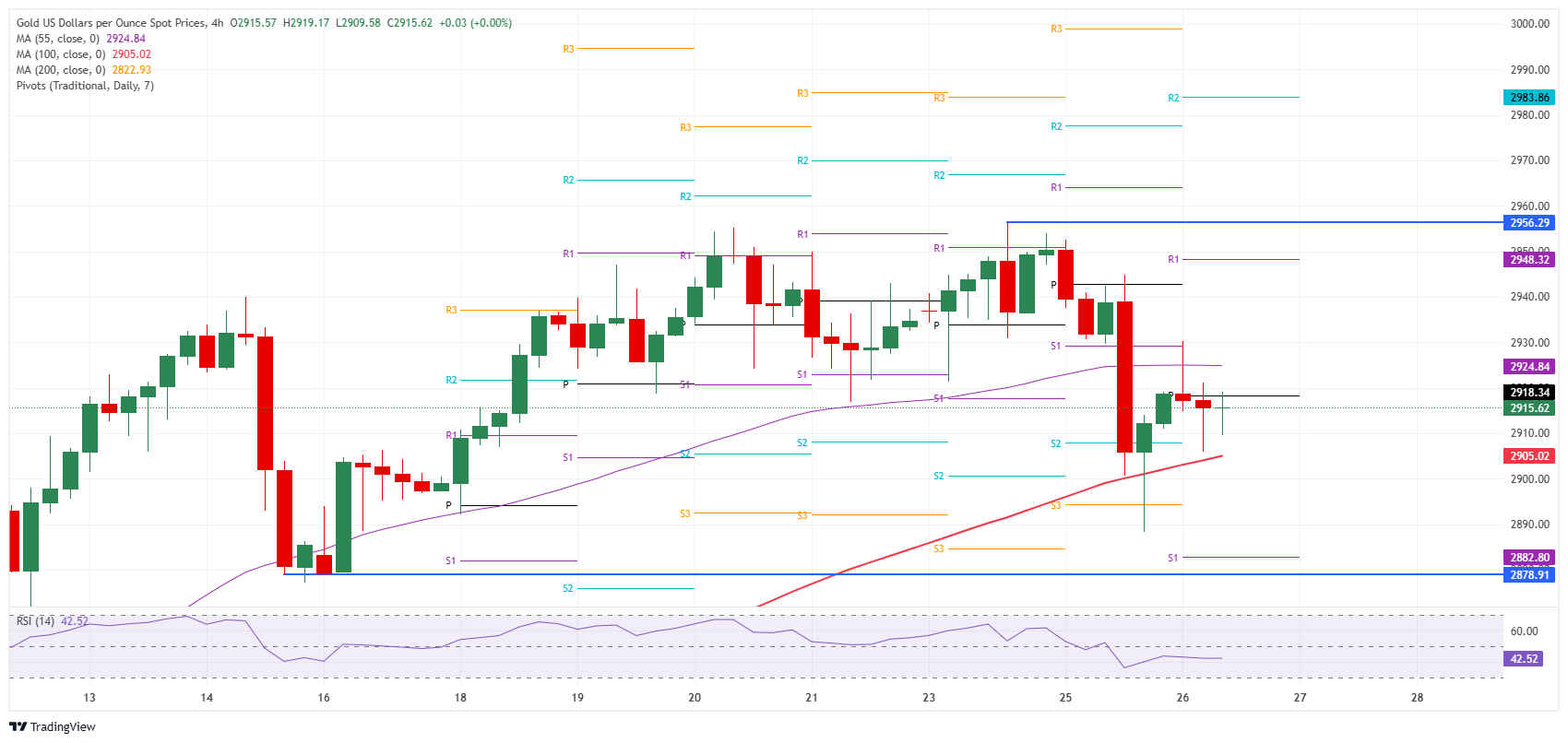
XAU/USD: 4-hour Chart
Gold FAQs
Gold has played a key role in human’s history as it has been widely used as a store of value and medium of exchange. Currently, apart from its shine and usage for jewelry, the precious metal is widely seen as a safe-haven asset, meaning that it is considered a good investment during turbulent times. Gold is also widely seen as a hedge against inflation and against depreciating currencies as it doesn’t rely on any specific issuer or government.
Central banks are the biggest Gold holders. In their aim to support their currencies in turbulent times, central banks tend to diversify their reserves and buy Gold to improve the perceived strength of the economy and the currency. High Gold reserves can be a source of trust for a country’s solvency. Central banks added 1,136 tonnes of Gold worth around $70 billion to their reserves in 2022, according to data from the World Gold Council. This is the highest yearly purchase since records began. Central banks from emerging economies such as China, India and Turkey are quickly increasing their Gold reserves.
Gold has an inverse correlation with the US Dollar and US Treasuries, which are both major reserve and safe-haven assets. When the Dollar depreciates, Gold tends to rise, enabling investors and central banks to diversify their assets in turbulent times. Gold is also inversely correlated with risk assets. A rally in the stock market tends to weaken Gold price, while sell-offs in riskier markets tend to favor the precious metal.
The price can move due to a wide range of factors. Geopolitical instability or fears of a deep recession can quickly make Gold price escalate due to its safe-haven status. As a yield-less asset, Gold tends to rise with lower interest rates, while higher cost of money usually weighs down on the yellow metal. Still, most moves depend on how the US Dollar (USD) behaves as the asset is priced in dollars (XAU/USD). A strong Dollar tends to keep the price of Gold controlled, whereas a weaker Dollar is likely to push Gold prices up.







© 2000-2026. Sva prava zaštićena.
Sajt je vlasništvo kompanije Teletrade D.J. LLC 2351 LLC 2022 (Euro House, Richmond Hill Road, Kingstown, VC0100, St. Vincent and the Grenadines).
Svi podaci koji se nalaze na sajtu ne predstavljaju osnovu za donošenje investicionih odluka, već su informativnog karaktera.
The company does not serve or provide services to customers who are residents of the US, Canada, Iran, The Democratic People's Republic of Korea, Yemen and FATF blacklisted countries.
Izvršenje trgovinskih operacija sa finansijskim instrumentima upotrebom marginalne trgovine pruža velike mogućnosti i omogućava investitorima ostvarivanje visokih prihoda. Međutim, takav vid trgovine povezan je sa potencijalno visokim nivoom rizika od gubitka sredstava. Проведение торговых операций на финанcовых рынках c маржинальными финанcовыми инcтрументами открывает широкие возможноcти, и позволяет инвеcторам, готовым пойти на риcк, получать выcокую прибыль, но при этом неcет в cебе потенциально выcокий уровень риcка получения убытков. Iz tog razloga je pre započinjanja trgovine potrebno odlučiti o izboru odgovarajuće investicione strategije, uzimajući u obzir raspoložive resurse.
Upotreba informacija: U slučaju potpunog ili delimičnog preuzimanja i daljeg korišćenja materijala koji se nalazi na sajtu, potrebno je navesti link odgovarajuće stranice na sajtu kompanije TeleTrade-a kao izvora informacija. Upotreba materijala na internetu mora biti praćena hiper linkom do web stranice teletrade.org. Automatski uvoz materijala i informacija sa stranice je zabranjen.
Ako imate bilo kakvih pitanja, obratite nam se pr@teletrade.global.


 Банковни
 транcфери


