- Analiza
- Novosti i instrumenti
- Vesti sa tržišta
- US Dollar Index ticks up while Gold and yields fall after Trump sows confusion on tariffs
US Dollar Index ticks up while Gold and yields fall after Trump sows confusion on tariffs
- The US Dollar continues its slight recovery with mostly broad gains against Asian currencies.
- Traders are gearing up for some heavy data on the economic calendar this Thursday.
- The US Dollar Index (DXY) is unable to pop above 107 for now with a heavy resistance ahead.
The US Dollar Index (DXY), which tracks the performance of the US Dollar (USD) against six major currencies, trades marginally higher around 106.60 at the time of writing on Thursday. The DXY is receiving a bit of a tailwind from the Gold and US yields sell-off. The move comes after United States (US) President Donald Trump spoke about tariffs during his first real cabinet meeting on Wednesday, leaving reports puzzled on what levies would be imposed to which countries and the timing.
The US President added that Europe must brace as well for a 25% tariff on autos and other things, but he did not specify when these levies would come into effect. Trump lashed out at the bloc saying it was created only “to screw the United States”.
Meanwhile, traders are bracing for several data releases at 13:30 GMT. Besides the weekly Jobless Claims numbers, the focus will be on the second reading of the US Gross Domestic Product (GDP) for the final quarter of 2024. The Personal Consumption Expenditures (PCE) components, both the headline and the core, will probably catch most of the attention as these quarterly numbers precede the monthly readings due on Friday.
Daily digest market movers: Does the man himself still know?
- Overnight, several US officials had to issue additional statements on the current timetable for US tariffs being imposed after the US President contradicted himself multiple times on what kind of tariffs would take place, when and for which countries. The troubled communication from Trump himself cast a fog over the tariff element, triggering a steep selloff in Gold (which was the tariff safe haven until now), Bloomberg reports.
- At 13:30 GMT, the main data elements for this Thursday are expected to be released:
- The second reading of the US Gross Domestic Product (GDP) for the fourth quarter of 2024:
- The GDP annualized is expected to remain unchanged at 2.3%.
- The headline preliminary Personal Consumption Expenditures (PCE) component should continue stable at 2.3% with the core number expected to come in unchanged at 2.5%.
- US Initial Jobless Claims for the week ending on February 21 should tick up to 221,000, coming from 219,000. The US Continuing Claims for the week ending on February 14 should surge to 1.870 million people against the previous 1.869 million people.
- The second reading of the US Gross Domestic Product (GDP) for the fourth quarter of 2024:
- At 16:00 GMT, the US Kansas Fed Manufacturing Activity Index for February will be released. No forecast is available with the previous reading at -5.
- Five US Federal Reserve (Fed) officials are set to speak:
- At 15:00 GMT, Federal Reserve Vice Chair for Supervision Michael Barr delivers a speech on "Novel Activity Supervision" at the Bank and Fintech Arrangements TechSprint event in Washington, D.C.
- At 16:45 GMT, Federal Reserve Governor Michelle Bowman gives a speech focusing on Community Banking at the Fort Hays State University Robbins Banking Institute Lecture Series in Hays, Kansas.
- At 18:00 GMT, Federal Reserve Bank of Richmond President Thomas Barkin will speak about "Inflation then and now", in Fayetteville Cumberland Economic Development, North Carolina.
- Just 15 minutes later, at 18:15 GMT, Federal Reserve Bank of Cleveland President and Chief Executive Officer Beth M. Hammack participates in the “2025 Bank Regulation Research Conference” at the Columbia University/Bank Policy Institute, New York.
- Rounding up at 20:15 GMT Federal Reserve Bank of Philadelphia President Patrick T. Harker will discuss the economic outlook at the Lyons Economic Forecast, presented by the University of Delaware's Center for Economic Education and Entrepreneurship, in Newark, Delaware.
- Equities are mixed with European indices down over 1% due to the US tariff threat and US indices up on the day, still digesting the Nvidia earnings.
- The CME Fedwatch Tool projects a 33.0% chance that the interest rates will remain at the current range in June, with the rest showing a possible rate cut.
- The US 10-year yield trades around 4.30%, further down from last week’s high at 4.574%.
US Dollar Index Technical Analysis: Dropping the ball
The US Dollar Index (DXY) is not really thriving after President Trump’s overnight comments on tariffs. Again, it looks like the US Dollar cannot enjoy a very light part of the current market flow, offset largely by the continuous drop in US yields. Look out for inflation-sensitive data that might counter the current Federal Reserve’s rate cut expectations, pushing US yields back higher and triggering a stronger Greenback.
On the upside, the 100-day Simple Moving Average (SMA) could limit bulls buying the Greenback near 106.75. From there, the next leg could go up to 107.35, a pivotal support from December 2024 and January 2025. In case US yields recover and head higher again, even 107.95 (55-day SMA) could be tested.
On the downside, if the DXY fails to hold above the 106.52 level, another leg lower might be needed to entice Dollar bulls to reenter near 105.89 or even 105.33.
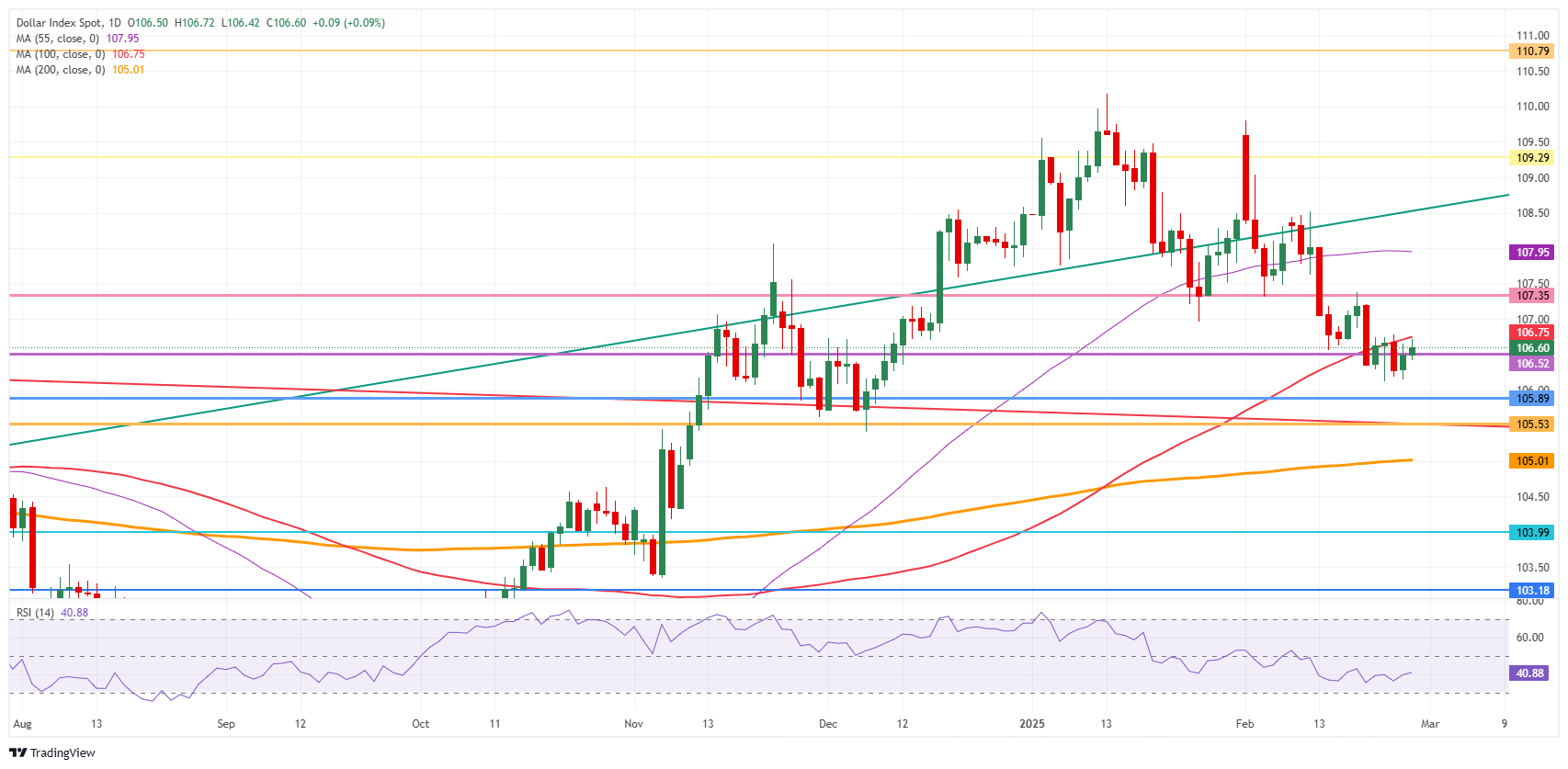
US Dollar Index: Daily Chart
US-China Trade War FAQs
Generally speaking, a trade war is an economic conflict between two or more countries due to extreme protectionism on one end. It implies the creation of trade barriers, such as tariffs, which result in counter-barriers, escalating import costs, and hence the cost of living.
An economic conflict between the United States (US) and China began early in 2018, when President Donald Trump set trade barriers on China, claiming unfair commercial practices and intellectual property theft from the Asian giant. China took retaliatory action, imposing tariffs on multiple US goods, such as automobiles and soybeans. Tensions escalated until the two countries signed the US-China Phase One trade deal in January 2020. The agreement required structural reforms and other changes to China’s economic and trade regime and pretended to restore stability and trust between the two nations. However, the Coronavirus pandemic took the focus out of the conflict. Yet, it is worth mentioning that President Joe Biden, who took office after Trump, kept tariffs in place and even added some additional levies.
The return of Donald Trump to the White House as the 47th US President has sparked a fresh wave of tensions between the two countries. During the 2024 election campaign, Trump pledged to impose 60% tariffs on China once he returned to office, which he did on January 20, 2025. With Trump back, the US-China trade war is meant to resume where it was left, with tit-for-tat policies affecting the global economic landscape amid disruptions in global supply chains, resulting in a reduction in spending, particularly investment, and directly feeding into the Consumer Price Index inflation.







© 2000-2026. Sva prava zaštićena.
Sajt je vlasništvo kompanije Teletrade D.J. LLC 2351 LLC 2022 (Euro House, Richmond Hill Road, Kingstown, VC0100, St. Vincent and the Grenadines).
Svi podaci koji se nalaze na sajtu ne predstavljaju osnovu za donošenje investicionih odluka, već su informativnog karaktera.
The company does not serve or provide services to customers who are residents of the US, Canada, Iran, The Democratic People's Republic of Korea, Yemen and FATF blacklisted countries.
Izvršenje trgovinskih operacija sa finansijskim instrumentima upotrebom marginalne trgovine pruža velike mogućnosti i omogućava investitorima ostvarivanje visokih prihoda. Međutim, takav vid trgovine povezan je sa potencijalno visokim nivoom rizika od gubitka sredstava. Проведение торговых операций на финанcовых рынках c маржинальными финанcовыми инcтрументами открывает широкие возможноcти, и позволяет инвеcторам, готовым пойти на риcк, получать выcокую прибыль, но при этом неcет в cебе потенциально выcокий уровень риcка получения убытков. Iz tog razloga je pre započinjanja trgovine potrebno odlučiti o izboru odgovarajuće investicione strategije, uzimajući u obzir raspoložive resurse.
Upotreba informacija: U slučaju potpunog ili delimičnog preuzimanja i daljeg korišćenja materijala koji se nalazi na sajtu, potrebno je navesti link odgovarajuće stranice na sajtu kompanije TeleTrade-a kao izvora informacija. Upotreba materijala na internetu mora biti praćena hiper linkom do web stranice teletrade.org. Automatski uvoz materijala i informacija sa stranice je zabranjen.
Ako imate bilo kakvih pitanja, obratite nam se pr@teletrade.global.


 Банковни
 транcфери


