- Analiza
- Novosti i instrumenti
- Vesti sa tržišta
- Australian Dollar holds gains following China Manufacturing PMI data
Australian Dollar holds gains following China Manufacturing PMI data
- The Australian Dollar gains ground following the TD-MI Inflation Gauge, and China Manufacturing PMI data released on Monday.
- China's Caixin Manufacturing PMI increased to 50.8 in February from January’s 50.1.
- The US Dollar struggles as US PCE inflation data aligns with expectations, easing concerns over unexpected US inflation spikes.
The Australian Dollar (AUD) halted its six-day losing streak on Monday, buoyed by a weaker US Dollar (USD) following the release of January’s Personal Consumption Expenditures (PCE) inflation data on Friday. The report aligned with expectations, easing fears of unexpected inflation spikes in the US.
Australia’s TD-MI Inflation Gauge fell by 0.2% month-over-month in February, reversing a 0.1% rise in January. This marked the first decline since last August and followed the Reserve Bank of Australia's (RBA) decision to cut its cash rate by 25 basis points to 4.1% during its first monetary policy meeting of the year, reflecting a continued slowdown in underlying inflation. However, on an annual basis, the gauge rose by 2.2%, slightly below the previous 2.3% increase.
The AUD also receives upward support from upbeat Chinese economic data. China's Caixin Manufacturing Purchasing Managers' Index (PMI) rose to 50.8 in February from January’s 50.1, exceeding market expectations of 50.3. Given China’s role as a key trading partner for Australia, the stronger PMI reading provided a boost to the Australian Dollar.
However, the AUD’s upside could be limited by escalating US-China trade tensions. Over the weekend, US President Donald Trump announced an additional 10% tariff on Chinese imports starting Tuesday, adding to the 10% tariff imposed last month. On Thursday, Trump stated on Truth Social that 25% tariffs on Canadian and Mexican goods will take effect on March 4.
Australian Dollar appreciates as concerns over unexpected US inflation ease
- The US Dollar Index (DXY), which tracks the USD against six major currencies, weakens after three consecutive sessions of gains, hovering around 107.30 at the time of writing. The downside of the Greenback could be limited as US Treasury yields improve, with 2-year and 10-year Treasury yields currently standing at 4.02% and 4.24%, respectively.
- The US PCE inflation report met expectations, with the monthly headline PCE holding steady at 0.3%. Core PCE rose slightly to 0.3% from December’s 0.2%, while the annual headline PCE stood at 2.6%, slightly exceeding projections but unchanged from December’s figure. Core PCE eased to 2.6%, down from a revised 2.9% in December.
- Tensions escalated between US President Donald Trump and Ukrainian leader Volodymyr Zelenskyy during peace deal negotiations. Zelenskyy was expected to sign an agreement granting the US greater access to Ukraine's rare earth minerals and participate in a joint press conference, but the plan was abandoned after a heated exchange between the leaders in front of the media. Following the confrontation, in which Trump openly expressed his disdain, top advisers asked Zelenskyy to leave the White House.
- President Trump signed a memorandum on Friday instructing the Committee on Foreign Investment in the United States (CFIUS) to limit Chinese investments in strategic sectors. Reuters cited a White House official saying that the national security memorandum seeks to encourage foreign investment while safeguarding US national security interests from potential threats posed by foreign adversaries like China.
- The S&P Global Australia Manufacturing Purchasing Managers Index (PMI) was revised down to 50.4 in February from an initial estimate of 50.6 but remained above January's 50.2. This marked the second consecutive month of improvement in manufacturing conditions and the strongest growth since February 2023.
- China’s NBS Manufacturing PMI improved to 50.2 in February versus 49.1 prior. This figure came in stronger than the 49.9 expected. Meanwhile, the NBS Non-Manufacturing PMI climbed to 50.4 in February from 50.2 in January, beating the estimation of 50.3.
- According to a Wall Street Journal report on the Australian Dollar’s outlook from the Commonwealth Bank of Australia (CBA), heightened trade war risks driven by Trump have become a major concern. China’s response to these trade threats will be a key factor shaping the future performance of the AUD.
Australian Dollar tests 0.6200 support amid prevailing bearish bias
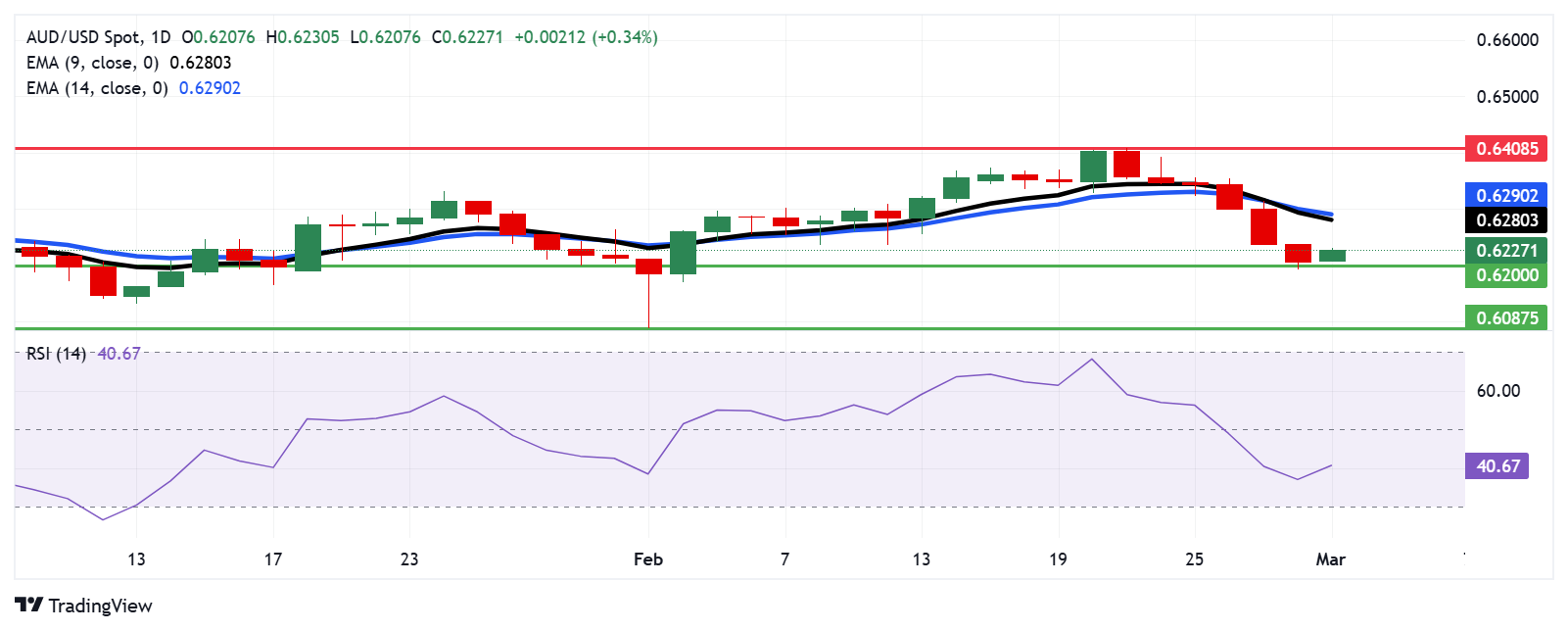
The AUD/USD pair is trading around 0.6220 on Monday. The daily chart analysis suggests that the pair remains under pressure, trading below the nine- and 14-day Exponential Moving Averages (EMAs), indicating weakening short-term momentum. Additionally, the 14-day Relative Strength Index (RSI) remains below 50, reinforcing the bearish outlook.
On the downside, the AUD/USD pair is currently testing key support at the psychological level of 0.6200. A break below this level could drive the price toward 0.6087, its lowest point since April 2020, recorded on February 3.
The initial resistance is seen at the nine-day EMA of 0.6280, followed by the 14-day EMA at 0.6290. A decisive break above these levels could strengthen short-term momentum, potentially leading the pair to retest the three-month high of 0.6408, reached on February 21.
AUD/USD: Daily Chart
Australian Dollar PRICE Today
The table below shows the percentage change of Australian Dollar (AUD) against listed major currencies today. Australian Dollar was the strongest against the US Dollar.
| USD | EUR | GBP | JPY | CAD | AUD | NZD | CHF | |
|---|---|---|---|---|---|---|---|---|
| USD | -0.44% | -0.27% | -0.15% | -0.10% | -0.35% | -0.21% | -0.12% | |
| EUR | 0.44% | 0.06% | 0.06% | 0.15% | -0.01% | 0.04% | 0.14% | |
| GBP | 0.27% | -0.06% | 0.13% | 0.09% | -0.07% | -0.02% | 0.08% | |
| JPY | 0.15% | -0.06% | -0.13% | 0.26% | -0.15% | -0.02% | 0.03% | |
| CAD | 0.10% | -0.15% | -0.09% | -0.26% | -0.09% | -0.11% | -0.01% | |
| AUD | 0.35% | 0.01% | 0.07% | 0.15% | 0.09% | 0.05% | 0.15% | |
| NZD | 0.21% | -0.04% | 0.02% | 0.02% | 0.11% | -0.05% | 0.10% | |
| CHF | 0.12% | -0.14% | -0.08% | -0.03% | 0.00% | -0.15% | -0.10% |
The heat map shows percentage changes of major currencies against each other. The base currency is picked from the left column, while the quote currency is picked from the top row. For example, if you pick the Australian Dollar from the left column and move along the horizontal line to the US Dollar, the percentage change displayed in the box will represent AUD (base)/USD (quote).
Economic Indicator
Caixin Manufacturing PMI
The Caixin Manufacturing Purchasing Managers Index (PMI), released on a monthly basis by Caixin Insight Group and S&P Global, is a leading indicator gauging business activity in China’s manufacturing sector. The data is derived from surveys of senior executives at both private-sector and state-owned companies. Survey responses reflect the change, if any, in the current month compared to the previous month and can anticipate changing trends in official data series such as Gross Domestic Product (GDP), industrial production, employment and inflation.The index varies between 0 and 100, with levels of 50.0 signaling no change over the previous month. A reading above 50 indicates that the manufacturing economy is generally expanding, a bullish sign for the Renminbi (CNY). Meanwhile, a reading below 50 signals that activity among goods producers is generally declining, which is seen as bearish for CNY.
Read more.Last release: Mon Mar 03, 2025 01:45
Frequency: Monthly
Actual: 50.8
Consensus: 50.3
Previous: 50.1
Source: IHS Markit







© 2000-2026. Sva prava zaštićena.
Sajt je vlasništvo kompanije Teletrade D.J. LLC 2351 LLC 2022 (Euro House, Richmond Hill Road, Kingstown, VC0100, St. Vincent and the Grenadines).
Svi podaci koji se nalaze na sajtu ne predstavljaju osnovu za donošenje investicionih odluka, već su informativnog karaktera.
The company does not serve or provide services to customers who are residents of the US, Canada, Iran, The Democratic People's Republic of Korea, Yemen and FATF blacklisted countries.
Izvršenje trgovinskih operacija sa finansijskim instrumentima upotrebom marginalne trgovine pruža velike mogućnosti i omogućava investitorima ostvarivanje visokih prihoda. Međutim, takav vid trgovine povezan je sa potencijalno visokim nivoom rizika od gubitka sredstava. Проведение торговых операций на финанcовых рынках c маржинальными финанcовыми инcтрументами открывает широкие возможноcти, и позволяет инвеcторам, готовым пойти на риcк, получать выcокую прибыль, но при этом неcет в cебе потенциально выcокий уровень риcка получения убытков. Iz tog razloga je pre započinjanja trgovine potrebno odlučiti o izboru odgovarajuće investicione strategije, uzimajući u obzir raspoložive resurse.
Upotreba informacija: U slučaju potpunog ili delimičnog preuzimanja i daljeg korišćenja materijala koji se nalazi na sajtu, potrebno je navesti link odgovarajuće stranice na sajtu kompanije TeleTrade-a kao izvora informacija. Upotreba materijala na internetu mora biti praćena hiper linkom do web stranice teletrade.org. Automatski uvoz materijala i informacija sa stranice je zabranjen.
Ako imate bilo kakvih pitanja, obratite nam se pr@teletrade.global.


 Банковни
 транcфери


