- Analiza
- Novosti i instrumenti
- Vesti sa tržišta
- Mexican Peso sinks as Trump’s tariffs send Peso to four-week low
Mexican Peso sinks as Trump’s tariffs send Peso to four-week low
- The Mexican Peso plunges 1.79% as trade tensions escalate, nearing the 21.00 mark
- Trump enacts 25% tariffs on Mexico, citing fentanyl and immigration concerns.
- President Sheinbaum condemns the move and vows retaliatory tariff and non-tariff measures.
- Mexico’s economy slows as S&P Global Manufacturing PMI contracts to 47.6.
The Mexican Peso (MXN) plunged sharply against the US Dollar (USD) on Tuesday as the 25% tariffs imposed on Mexico by the President of the United States (US), Donald Trump, commenced. This sent the Peso sliding into a four-week low of 20.99, a whisker of clearing the 21.00 handle. At the time of writing, the USD/MXN is trading at 20.89, gaining over 1.79%.
According to Trump, Mexico failed to do enough to stop fentanyl traffic and illegal immigration. Meanwhile, his counterpart, President Claudia Sheinbaum, condemned Trump's decision, saying it was unjustified. Sheinbaum promised to respond with tariff and non-tariff measures and added she would reveal details of the response at an event on Sunday.
As tariffs began, the USD/MXN pair soared sharply to 20.70 during the overnight session before rallying sharply to 20.99 early in the North American session.
Mexico’s economic docket remains absent, yet Monday’s data underscored that the economy is slowing sharply as businesses take measures against US tariffs. The S&P Global Manufacturing PMI for the last month contracted from 49.1 to 47.6. Business Confidence revealed by INEGI deteriorated further, yet it remained above the 50 threshold in February.
Daily digest market movers: Mexican Peso heavy as tariffs on Mexico begin
- Banco de México's (Banxico) private economists' survey indicated that economic growth is expected to remain below 1%, while inflation expectations remained unchanged.
- The poll showed that GDP growth for 2025 is now projected at 0.81%, down from 1%. Headline inflation is forecast to end at 3.71%, slightly lower than the previous 3.83%, while core CPI is expected to finish at 3.75%, unchanged from the prior estimate.
- Economists now predict the USD/MXN exchange rate to close in 2025 at 20.85, slightly lower than the 20.90 projection in the previous survey. However, for 2026, they anticipate a sharper depreciation of the Peso, well beyond the 21.30 level expected in January’s poll.
- Business activity in the US remains mixed, as the ISM shows the economy slowed, while the S&P Global Manufacturing PMI jumped. Nevertheless, the Atlanta Fed GDP Now model foresees the Gross Domestic Product (GDP) for Q1 2025 to slow sharply, by -2.8%.
- Hence, money market traders had priced in 81 basis points of easing in 2025, up from last week’s 70 bps via data from the Chicago Board of Trade (CBOT).
- Trade disputes between the US and Mexico remain front and center. If countries could come to an agreement, this could pave the way for a recovery of the Mexican currency. Otherwise, further USD/MXN upside is seen, as US tariffs could trigger a recession in Mexico.
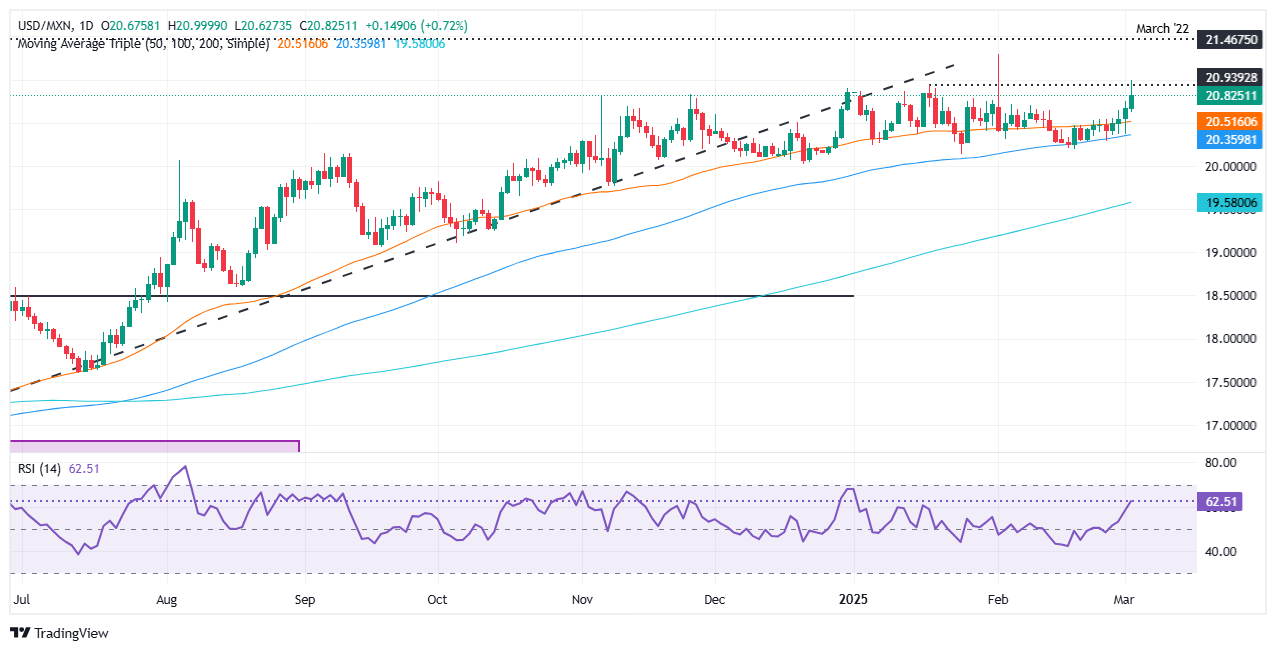
USD/MXN technical outlook: Mexican Peso tanks as USD/MXN hovers near 21.00
The uptrend remains in place, though the USD/MXN pair has retraced the early move shy of 21.00, which if cleared, could’ve exposed the year-to-date (YTD) peak of 21.28. Nevertheless, buyers are in charge, as they surpassed the 20.50 figure, and they are gathering momentum as depicted in the Relative Strength Index (RSI).
With that said, USD/MXN first resistance would be today’s peak at 20.99. On further strength, the YTD high is up next at 21.28, followed by last year’s high of 21.46.
For a bearish continuation, USD/MXN must clear the 20.50 figure, ahead of the 50-day Simple Moving Average (SMA) at 20.48. If cleared, up next is the 100-day SMA at 20.32, followed by the 20.00 figure.
Mexican Peso FAQs
The Mexican Peso (MXN) is the most traded currency among its Latin American peers. Its value is broadly determined by the performance of the Mexican economy, the country’s central bank’s policy, the amount of foreign investment in the country and even the levels of remittances sent by Mexicans who live abroad, particularly in the United States. Geopolitical trends can also move MXN: for example, the process of nearshoring – or the decision by some firms to relocate manufacturing capacity and supply chains closer to their home countries – is also seen as a catalyst for the Mexican currency as the country is considered a key manufacturing hub in the American continent. Another catalyst for MXN is Oil prices as Mexico is a key exporter of the commodity.
The main objective of Mexico’s central bank, also known as Banxico, is to maintain inflation at low and stable levels (at or close to its target of 3%, the midpoint in a tolerance band of between 2% and 4%). To this end, the bank sets an appropriate level of interest rates. When inflation is too high, Banxico will attempt to tame it by raising interest rates, making it more expensive for households and businesses to borrow money, thus cooling demand and the overall economy. Higher interest rates are generally positive for the Mexican Peso (MXN) as they lead to higher yields, making the country a more attractive place for investors. On the contrary, lower interest rates tend to weaken MXN.
Macroeconomic data releases are key to assess the state of the economy and can have an impact on the Mexican Peso (MXN) valuation. A strong Mexican economy, based on high economic growth, low unemployment and high confidence is good for MXN. Not only does it attract more foreign investment but it may encourage the Bank of Mexico (Banxico) to increase interest rates, particularly if this strength comes together with elevated inflation. However, if economic data is weak, MXN is likely to depreciate.
As an emerging-market currency, the Mexican Peso (MXN) tends to strive during risk-on periods, or when investors perceive that broader market risks are low and thus are eager to engage with investments that carry a higher risk. Conversely, MXN tends to weaken at times of market turbulence or economic uncertainty as investors tend to sell higher-risk assets and flee to the more-stable safe havens.







© 2000-2026. Sva prava zaštićena.
Sajt je vlasništvo kompanije Teletrade D.J. LLC 2351 LLC 2022 (Euro House, Richmond Hill Road, Kingstown, VC0100, St. Vincent and the Grenadines).
Svi podaci koji se nalaze na sajtu ne predstavljaju osnovu za donošenje investicionih odluka, već su informativnog karaktera.
The company does not serve or provide services to customers who are residents of the US, Canada, Iran, The Democratic People's Republic of Korea, Yemen and FATF blacklisted countries.
Izvršenje trgovinskih operacija sa finansijskim instrumentima upotrebom marginalne trgovine pruža velike mogućnosti i omogućava investitorima ostvarivanje visokih prihoda. Međutim, takav vid trgovine povezan je sa potencijalno visokim nivoom rizika od gubitka sredstava. Проведение торговых операций на финанcовых рынках c маржинальными финанcовыми инcтрументами открывает широкие возможноcти, и позволяет инвеcторам, готовым пойти на риcк, получать выcокую прибыль, но при этом неcет в cебе потенциально выcокий уровень риcка получения убытков. Iz tog razloga je pre započinjanja trgovine potrebno odlučiti o izboru odgovarajuće investicione strategije, uzimajući u obzir raspoložive resurse.
Upotreba informacija: U slučaju potpunog ili delimičnog preuzimanja i daljeg korišćenja materijala koji se nalazi na sajtu, potrebno je navesti link odgovarajuće stranice na sajtu kompanije TeleTrade-a kao izvora informacija. Upotreba materijala na internetu mora biti praćena hiper linkom do web stranice teletrade.org. Automatski uvoz materijala i informacija sa stranice je zabranjen.
Ako imate bilo kakvih pitanja, obratite nam se pr@teletrade.global.


 Банковни
 транcфери


