- Analiza
- Novosti i instrumenti
- Vesti sa tržišta
Novosti i prognoe: devizno tržište od 07-03-2018
(pare/closed(GMT +2)/change, %)
EUR/USD $1,2410 +0,05%
GBP/USD $1,3904 +0,12%
USD/CHF Chf0,94338 +0,31%
USD/JPY Y106,06 -0,05%
EUR/JPY Y131,63 -0,01%
GBP/JPY Y147,469 +0,07%
AUD/USD $0,7824 -0,04%
NZD/USD $0,7286 -0,11%
USD/CAD C$1,29108 +0,27%
00:30 Australia Trade Balance January -1.358 0.3
03:00 China Trade Balance, bln February 20.34 0.6
06:00 Japan Eco Watchers Survey: Outlook February 52.4
06:00 Japan Eco Watchers Survey: Current February 49.9
06:45 Switzerland Unemployment Rate (non s.a.) February 3.3% 3.4%
07:00 Germany Factory Orders s.a. (MoM) January 3.8% -1.6%
12:45 Eurozone Deposit Facilty Rate -0.4% -0.4%
12:45 Eurozone ECB Interest Rate Decision 0.0% 0%
13:15 Canada Housing Starts February 216.2 216.6
13:30 Eurozone ECB Press Conference
13:30 Canada Building Permits (MoM) January 4.8% 1.3%
13:30 Canada New Housing Price Index, MoM January 0% 0.1%
13:30 Canada New Housing Price Index, YoY January 3.3%
13:30 U.S. Continuing Jobless Claims February 1931 1921
13:30 U.S. Initial Jobless Claims March 210 220
16:00 Canada BOC Gov Stephen Poloz Speaks
20:50 Canada Gov Council Member Lane Speaks
23:30 Japan Household spending Y/Y January -0.1% -1.2%
U.S. commercial crude oil inventories (excluding those in the Strategic Petroleum Reserve) increased by 2.4 million barrels from the previous week. At 425.9 million barrels, U.S. crude oil inventories are in the lower half of the average range for this time of year.
Total motor gasoline inventories decreased by 0.8 million barrels last week, and are in the upper half of the average range. Finished gasoline inventories decreased and blending components inventories remained unchanged last week.
Distillate fuel inventories decreased by 0.6 million barrels last week and are in the middle of the average range for this time of year. Propane/propylene inventories decreased by 1.6 million barrels last week, and are in the lower half of the average range. Total commercial petroleum inventories remained virtually unchanged last week.
-
Q4 GDP slower than expected due to higher imports; 2017 gdp in line with bank's projection
-
New U.S. Govt spending, tax cuts expected to boost U.S. growth in 2018, 2019; global growth "solid and broad-based"
-
Will take time to fully assess impact of regulations on housing demand, prices
-
Wage growth has firmed but is lower than typical in an economy with no labor market slack
-
Implications of federal government budget will be incorporated into forecasts in april
-
Core inflation measures have edged up, consistent with an economy operating near capacity
-
Data shows pulling forward of housing demand ahead of new mortgage rules, other measures
"The Bank of Canada today maintained its target for the overnight rate at 1 1/4 per cent. The Bank Rate is correspondingly 1 1/2 per cent and the deposit rate is 1 per cent.
Global growth remains solid and broad-based. In the United States, new government spending and previously-announced tax cuts are anticipated to boost growth in 2018 and 2019. However, trade policy developments are an important and growing source of uncertainty for the global and Canadian outlooks.
In Canada, the national accounts data show that the economy grew by 3 per cent in 2017, bringing the level of real GDP in line with the projection in the Bank's January Monetary Policy Report (MPR). In the fourth quarter, GDP growth was slower than expected, largely due to higher imports, while exports made only a partial recovery from their third-quarter decline. The gain in imports mainly reflected stronger business investment, which adds to the economy's capacity.
Strong housing data in late 2017, and softer data at the beginning of this year, indicate some pulling forward of demand ahead of new mortgage guidelines and other policy measures. It will take some time to fully assess the impact of these, as well as recently announced provincial measures, on housing demand and prices. More broadly, the Bank continues to monitor the economy's sensitivity to higher interest rates. Notably, household credit growth has decelerated for three consecutive months. The implications of the recent federal budget for the outlook for growth and inflation will be incorporated in the Bank's April projection".
Canada's merchandise trade deficit totalled $1.9 billion in January, narrowing from a $3.1 billion deficit in December. Imports decreased 4.3%, mainly due to lower imports of industrial machinery, equipment and parts. Exports fell 2.1%, primarily on fewer exports of passenger cars and light trucks.
Following a record high in December, total imports were down 4.3% in January to $47.7 billion, with declines in all commodity sections. Industrial machinery, equipment and parts, consumer goods, as well as electronic and electrical equipment and parts were the main contributors to the decline in January. Year over year, imports increased 2.0%.
Nonfarm business sector labor productivity growth was revised to 0.0 percent in the fourth quarter of 2017, the U.S. Bureau of Labor Statistics reported
today, as output increased 3.2 percent and hours worked increased 3.3 percent. From the fourth quarter of 2016 to the fourth quarter of 2017,
productivity increased 1.1 percent, reflecting a 3.2-percent increase in output and a 2.1-percent increase in hours worked. Annual average productivity increased 1.2 percent from 2016 to 2017.
The U.S. Census Bureau and the U.S. Bureau of Economic Analysis announced today that the goods and services deficit was $56.6 billion in January, up $2.7 billion from $53.9 billion in December, revised.
January exports were $200.9 billion, $2.7 billion less than December exports. January imports were $257.5 billion, down less than $0.1 billion from December imports.
The January increase in the goods and services deficit reflected an increase in the goods deficit of $2.8 billion to $76.5 billion and an increase in the services surplus of $0.1 billion to $19.9 billion.
Year-over-year, the goods and services deficit increased $7.9 billion, or 16.2 percent, from January 2017. Exports increased $9.7 billion or 5.1 percent. Imports increased $17.6 billion or 7.4 percent.
"The labor market continues to experience uninterrupted growth," said Ahu Yildirmaz, vice president and co-head of the ADP Research Institute. "We see persistent gains across most industries with leisure and hospitality and retail leading the way as consumer spending kicked up. At this pace of job growth employers will soon become hard-pressed to find qualified workers." Mark Zandi, chief economist of Moody's Analytics, said, "The job market is red hot and threatens to overheat. With government spending increases and tax cuts, growth is set to accelerate."
-
EU states should use current growth to further strengthen foundations of their economies
-
Italy, Croatia, Cyprus are experiencing excessive economic imbalances
Seasonally adjusted GDP rose by 0.6% in both the euro area (EA19) and the EU28 during the fourth quarter of 2017, compared with the previous quarter, according to an estimate published by Eurostat, the statistical office of the European Union. In the third quarter of 2017, GDP grew by 0.7% in both zones.
Compared with the same quarter of the previous year, seasonally adjusted GDP rose by 2.7% in the euro area and by 2.6% in the EU28 in the fourth quarter of 2017, after +2.7% in both zones in the previous quarter. During the fourth quarter of 2017, GDP in the United States increased by 0.6% compared with the previous quarter (after +0.8% in the third quarter of 2017).
Compared with the same quarter of the previous year, GDP grew by 2.5% (after +2.3% in the previous quarter). Over the whole year 2017, GDP rose by 2.3% in the euro area and by 2.4% in the EU28, compared with 1.8% and 2.0% respectively in 2016.
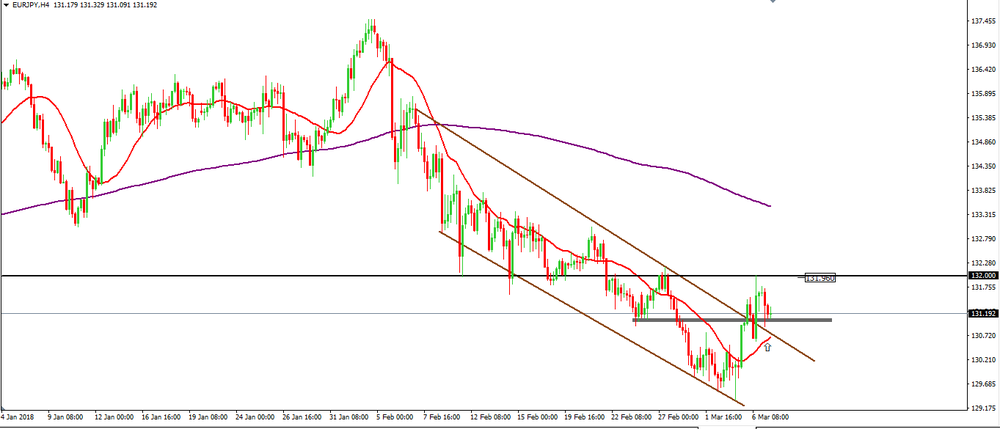
EUR/JPY on 4 hours time frame chart we can see that the price has recently broken the downside channel and at this moment it is re-testing (above) that channel.
We might see a new bullish movement until 132.000.
Therefore, our bias remains long if the price stays above the channel.
Prices in the last three months to February were 1.8% higher than in the same three months a year earlier, slowing from the 2.2% annual growth recorded in January.
Russell Galley, Managing Director, Halifax, said: "House prices continue to remain broadly flat, as they have since the end of last year. The annual rate of growth has slowed from 2.2% in January to 1.8% in February, the lowest rate of growth since March 2013. "The labour market continues to perform strongly with the number of people in employment rising by 88,000 in the three months to December. Notably, this is almost entirely accounted for by full-time jobs. The strength of the jobs market may finally be benefitting wage growth, with the annual growth rate accelerating from 2.3% in November to 2.8% in December. However, earnings are rising at a slower rate than consumer prices".
-
'Headwinds shifting to tailwinds,' but ready to slow or quicken rate hikes if forecasts wrong
-
Encouraged by 'substantial' fiscal stimulus, full employment, above-trend growth
The Australian economy grew 0.4 per cent in seasonally adjusted chain volume terms in the December quarter 2017, according to figures released by the Australian Bureau of Statistics (ABS) today.
Chief Economist for the ABS, Bruce Hockman, said: "Growth this quarter was driven by the household sector, with continued strength in household income matched by growth in household consumption."
Compensation of employees (COE) increased 1.1 per cent in the December quarter, the fourth consecutive quarter of solid growth. "The increase in wages is consistent with stronger employment data reported in Labour Force, as well as a lift in the growth rate in the wage price index observed over the past two quarters." Mr Hockman added.
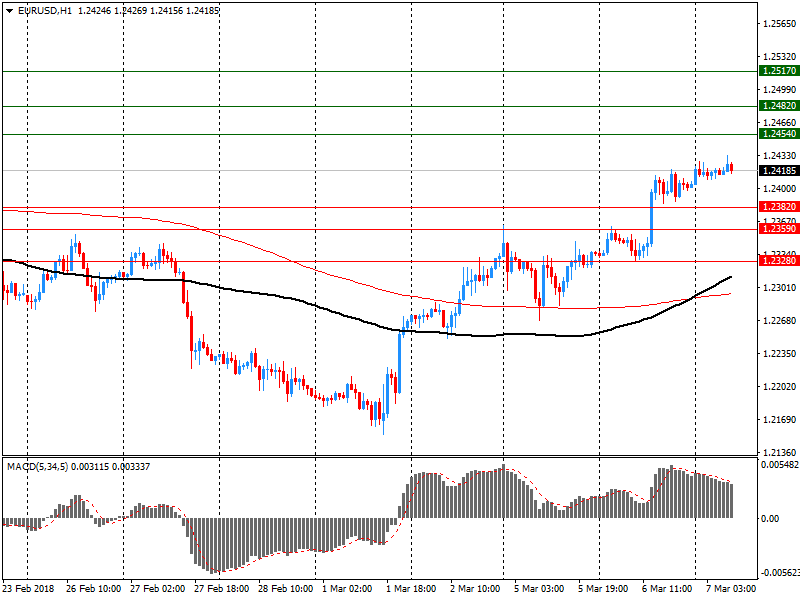
EUR/USD
Resistance levels (open interest**, contracts)
$1.2517 (4500)
$1.2482 (4867)
$1.2454 (4303)
Price at time of writing this review: $1.2418
Support levels (open interest**, contracts):
$1.2382 (2938)
$1.2359 (6765)
$1.2328 (1848)
Comments:
- Overall open interest on the CALL options and PUT options with the expiration date March, 9 is 132592 contracts (according to data from March, 6) with the maximum number of contracts with strike price $1,2400 (6765);
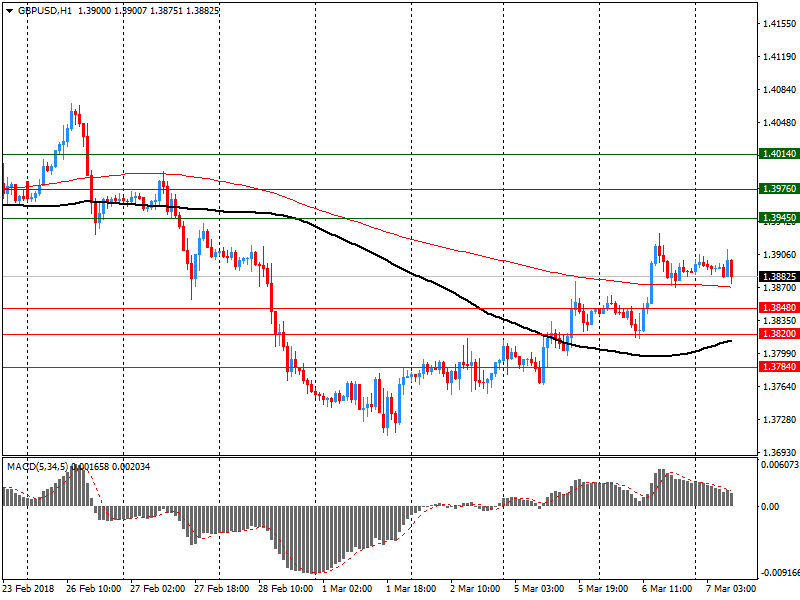
GBP/USD
Resistance levels (open interest**, contracts)
$1.4014 (1453)
$1.3976 (2420)
$1.3945 (3110)
Price at time of writing this review: $1.3883
Support levels (open interest**, contracts):
$1.3848 (2297)
$1.3820 (2076)
$1.3784 (2004)
Comments:
- Overall open interest on the CALL options with the expiration date March, 9 is 48967 contracts, with the maximum number of contracts with strike price $1,3900 (3110);
- Overall open interest on the PUT options with the expiration date March, 9 is 45635 contracts, with the maximum number of contracts with strike price $1,3900 (2297);
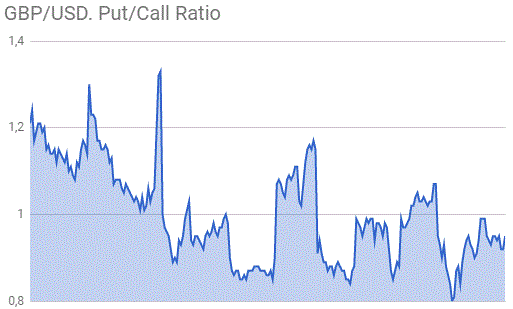
- The ratio of PUT/CALL was 0.93 versus 0.94 from the previous trading day according to data from March, 6
* - The Chicago Mercantile Exchange bulletin (CME) is used for the calculation.
** - Open interest takes into account the total number of option contracts that are open at the moment.







© 2000-2026. Sva prava zaštićena.
Sajt je vlasništvo kompanije Teletrade D.J. LLC 2351 LLC 2022 (Euro House, Richmond Hill Road, Kingstown, VC0100, St. Vincent and the Grenadines).
Svi podaci koji se nalaze na sajtu ne predstavljaju osnovu za donošenje investicionih odluka, već su informativnog karaktera.
The company does not serve or provide services to customers who are residents of the US, Canada, Iran, The Democratic People's Republic of Korea, Yemen and FATF blacklisted countries.
Izvršenje trgovinskih operacija sa finansijskim instrumentima upotrebom marginalne trgovine pruža velike mogućnosti i omogućava investitorima ostvarivanje visokih prihoda. Međutim, takav vid trgovine povezan je sa potencijalno visokim nivoom rizika od gubitka sredstava. Проведение торговых операций на финанcовых рынках c маржинальными финанcовыми инcтрументами открывает широкие возможноcти, и позволяет инвеcторам, готовым пойти на риcк, получать выcокую прибыль, но при этом неcет в cебе потенциально выcокий уровень риcка получения убытков. Iz tog razloga je pre započinjanja trgovine potrebno odlučiti o izboru odgovarajuće investicione strategije, uzimajući u obzir raspoložive resurse.
Upotreba informacija: U slučaju potpunog ili delimičnog preuzimanja i daljeg korišćenja materijala koji se nalazi na sajtu, potrebno je navesti link odgovarajuće stranice na sajtu kompanije TeleTrade-a kao izvora informacija. Upotreba materijala na internetu mora biti praćena hiper linkom do web stranice teletrade.org. Automatski uvoz materijala i informacija sa stranice je zabranjen.
Ako imate bilo kakvih pitanja, obratite nam se pr@teletrade.global.


 Банковни
 транcфери


