- Analiza
- Novosti i instrumenti
- Vesti sa tržišta
Forex-novosti i prognoze od 12-06-2020
On Monday, at 02:00 GMT, China will announce changes in fixed asset investment, industrial production and retail trade for May. At 04:30 GMT, Japan will present the index of activity in the service sector for April. At 06:30 GMT, Switzerland will publish the producer and import price index for May. At 09:00 GMT, the Euro zone will report changes in the foreign trade balance for April. At 12:30 GMT, Canada will announce a change in manufacturing shipments for April. Also at 12: 30 GMT, the US will release the NY Fed Empire State manufacturing index for June. At 20:00 GMT, the US will report changes in the net volume of purchases of long-term US securities by foreign investors for April. At 21:00 GMT, New Zealand will present the economic confidence index from Westpac for the 2nd quarter.
On Tuesday, at 01:30 GMT Australia will release the RBA Meeting's Minutes and the housing price index for the 1st quarter. At 03:00 GMT in Japan, the Bank of Japan's interest rate decision will be announced. At 05:45 GMT, Switzerland will publish the economic forecast from SECO. At 06:00 GMT, Britain will announce changes in the number of applications for unemployment benefits for May, as well as the unemployment rate and average earnings for April. Also at 06:00 GMT, Germany will present the consumer price index for May. At 06:30 GMT, the Bank of Japan will hold a press conference. At 09:00 GMT, Germany and the Euro zone will release the ZEW Economic Sentiment index for June. At 12:30 GMT, Canada will report changes in the foreign securities purchases for April. Also at 12: 30 GMT, the US will announce changes in retail sales for May. At 13:15 GMT, the US will announce changes in the capacity utilization and industrial production for May. At 14:00 GMT, the US will report changes in the business inventories for April and release the NAHB housing market index for June. Also at 14:00 GMT will be released a semi-annual report on monetary policy by Fed Chairman Jerome Powell. At 22:45 GMT, New Zealand will announce a change in the balance of payments for the 1st quarter. At 23:50 GMT, Japan will announce a change in the trade balance for May.
On Wednesday, at 00:30 GMT, Australia will publish an index of leading economic indicators for May. At 06:00 GMT, Britain will release the consumer price index, retail price index, producer purchasing price index and producer selling price index for May. At 09:00 GMT, the Euro zone will present the consumer price index for May. At 12:30 GMT Canada will release the consumer price index for May. Also at 12:30 GMT, the United States will announce changes in the building permits and housing starts for May. At 14:30 GMT, the US will report changes in oil reserves according to the Ministry of energy. At 16:00 GMT will be released a semi-annual report on monetary policy by Fed Chairman Jerome Powell. At 22:45 GMT, New Zealand will announce the change in GDP for the 1st quarter.
On Thursday, at 01:30 GMT, Australia will report changes in the unemployment rate and employment for may, as well as release the RBA's quarterly report. At 06:00 GMT, Switzerland will report changes in the foreign trade balance for May. At 07:30 GMT, the SNB's interest rate decision will be announced, and at 08:30 GMT, the SNB will hold a press conference. Also at 08:00 GMT in the Euro area, the ECB economic Bulletin will be released. at 11:00 GMT in Britain, the Bank of England's interest rate decision will be announced. At 12:30 GMT, Canada will publish the new housing price index for May and report changes in wholesale trade for April. Also at 12: 30 GMT, the US will release the Philadelphia Fed Manufacturing Survey for June and announce a change in the number of initial applications for unemployment benefits. At 14:00 GMT, the US will publish the index of leading indicators for May. At 23:30 GMT, Japan will present the consumer price index for May. At 23:50 GMT in Japan, the Bank of Japan's monetary policy meeting minutes will be released.
On Friday, at 01:30 GMT, Australia will announce changes in retail sales for May. At 06:00 GMT, Britain will report changes in retail trade and net government borrowing sectors for May. Also at 06:00 GMT, Germany will release the producer price index for May. At 08:00 GMT, the eurozone will announce a change in the balance of payments for April. At 12:30 GMT, Canada will announce changes in retail sales for April. Also at 12:30 GMT, the US will announce a change in the balance of payments for the 1st quarter. At 17:00 GMT the US will release a Baker Hughes report on the number of active oil rigs. Also at 17:00 GMT, Fed Chairman Jerome Powell will deliver a speech.
FXStreet reports that strategists at Credit Suisse will be watching the close of the S&P 500 as if the index falls below 3013 would reinforce the near-term trend lower to correct the strong rally of the past three months.
“The close today is seen as critical as to whether we are indeed set for a correction lower as if a close below 3013 is seen today this would not only see the market below its 200-day average but would also see an important bearish ‘key-reversal week’ established. This would then reinforce the view the near-term trend has indeed turned lower with support seen at 2970 next, then 2957/55, which we would look to hold at first. Bigger picture, though, we would look for a move below here with the next meaningful support seen at the 38.2% retracement of the entire March/June rally at 2835.”
“A close above 3027/32 today would remove the threat of a ‘reversal week’ to instead suggest we are likely to see a high-level consolidation phase, with resistance next at 3090/94, then the beginning of yesterday’s gap at 3124.”
- The health crisis has disproportionately affected people of colour
Bert Colijn, a Senior Eurozone Economist at ING, notes that another whopping decline of 17.1% in production in April likely marks the bottom of activity in the eurozone as restrictions on industrial production were eased in May. Still, it’s a long, long road to recovery for the sector, he adds.
"There were huge declines across the board for industry as lockdowns caused production to drop to levels last seen in 1993. Of course, it was to be expected that April would still be much worse than March given the fact that lockdown measures were in place for the full month. The monthly decline was similar in Italy, France, Spain and Germany as roughly a fifth of March production was shaved off. Germany experienced a somewhat milder decline in March though, meaning that the total lockdown decline is smaller. Just like in March, the Netherlands was a positive outlier with a monthly decline of “just” 7%. Overall, the eurozone has now experienced a 27% drop in production since February."
"As restrictions on industry have been gradually lifted since late April, expectations are that May will be the start of a drawn out recovery of output. While expectations of production have indeed improved in surveys, we do see that new orders have continued to come down in May. That means that expectations of a V-shaped recovery for industry would be far too optimistic. As lingering concerns like a new trade war and Brexit continue to be risks to the recovery phase in the months ahead, it could be a long road ahead before industry reaches output seen at the start of 2020. So plenty of risks surrounding industry at the moment, but the recent easing of lockdowns means that activity in April almost certainly marked the bottom."
- GDP fall was dramatic number but not surprising, pretty much in line with our expectations
- We see some signs of recovery in most recent gauges of economy
A report from
the University of Michigan revealed on Friday the preliminary reading for the
Reuters/Michigan index of consumer sentiment rose 9.1 percent m-o-m to 78.9 in
early June.
Economists had
expected the index would increase to 75.0 this month from May’s final reading
of 72.3.
According to
the report, the index of current U.S. economic conditions increased 6.7 percent
m-o-m to 87.8 in June from 82.3 in the previous month. Meanwhile, the index of
consumer expectations surged 10.9 percent m-o-m to 73.1 this month from 65.9 in
May.
The report
noted that: “Consumer sentiment posted its second monthly gain in early June,
paced by gains in the outlook for personal finances and more favorable
prospects for the national economy due to the reopening of the economy. The
turnaround is largely due to renewed gains in employment, with more consumers
expecting declines in the jobless rate than at any other time in the long
history of the Michigan surveys.”
NFXStreet notes that GBP/USD extends its rejection of 1.2817 – the 78.6% retracement of the fall from last December – and analysts at Credit Suisse stay biased lower with support seen at 1.2535/33, then 1.2482/79 before a test of the 55-day average at 1.2409.
“Support is seen at 1.2535/33 initially – the 38.2% retracement of the rally from mid-May – below which can keep the immediate risk lower with support then seen next at 1.2501 and then 1.2482/79 – the 23.6% retracement of the entire uptrend from the March low. Whilst we think this holds at first, we look for a break below here also to see a test of the 55- day average, currently at 1.2409. With the uptrend from March not far below at 1.2384, we look for better support here.”
“Resistance is seen at 1.2619/21 initially then 1.2663, with the 200-day average and price resistance at 1.2685/92 ideally capping to keep the immediate risk lower.”
U.S. stock-index futures rose on Friday, recovering after the worst market drop since March, which came on worries the U.S. economy could take longer to recover if coronavirus infections resurge, as well as the Federal Reserve’s warning of a long road to recovery.
Global Stocks:
Index/commodity | Last | Today's Change, points | Today's Change, % |
Nikkei | 22,305.48 | -167.43 | -0.75% |
Hang Seng | 24,301.38 | -178.77 | -0.73% |
Shanghai | 2,919.74 | -1.16 | -0.04% |
S&P/ASX | 5,847.80 | -112.80 | -1.89% |
FTSE | 6,152.55 | +75.85 | +1.25% |
CAC | 4,903.42 | +87.82 | +1.82% |
DAX | 12,083.35 | +113.06 | +0.94% |
Crude oil | $36.64 | +0.83% | |
Gold | $1,748.60 | +0.51% |
FXStreet reports that analysts at Credit Suisse maintain a higher bias for the EUR to see a medium-term phase of strength on a broad basis following the completion of a base at 0.8866. EUR/GBP trades at 0.8954 and next resistance is seen at 0.9013.
“EUR/GBP continues to move steadily higher after successful tests of key support from the ‘neckline’ to its April base at 0.8866/64 and we maintain our upside bias.”
“A clear break above the top of the recent ‘outside day’ high at 0.9013 remains needed to add weight to our view an important turn higher is indeed underway again with resistance then seen at 0.9025/28 initially, then the recent high and ‘measured base objective’ at 0.9056/57. Whilst a fresh rejection from here should be allowed for, above in due course can see resistance next at the 50% retracement of the March/April fall at 0.9086 and eventually at the 61.8% retracement at 0.9184.”
“Immediate support moves to 0.8940, with 0.8917 now ideally holding to keep the immediate risk higher. A break can see a fall back to 0.8888/82, potentially a retest of 0.8866/64.”
(company / ticker / price / change ($/%) / volume)
3M Co | MMM | 155.04 | 2.66(1.75%) | 6311 |
ALCOA INC. | AA | 11.06 | 0.64(6.14%) | 77447 |
ALTRIA GROUP INC. | MO | 39.4 | 0.95(2.47%) | 42131 |
Amazon.com Inc., NASDAQ | AMZN | 2,597.00 | 39.04(1.53%) | 57584 |
American Express Co | AXP | 102.14 | 3.54(3.59%) | 31411 |
AMERICAN INTERNATIONAL GROUP | AIG | 33.13 | 1.84(5.88%) | 15201 |
Apple Inc. | AAPL | 343.62 | 7.72(2.30%) | 445835 |
AT&T Inc | T | 30.94 | 0.77(2.55%) | 233161 |
Boeing Co | BA | 182.87 | 12.87(7.57%) | 1996096 |
Caterpillar Inc | CAT | 124.5 | 2.95(2.43%) | 9619 |
Chevron Corp | CVX | 92.13 | 2.76(3.09%) | 37460 |
Cisco Systems Inc | CSCO | 44.61 | 0.94(2.15%) | 78323 |
Citigroup Inc., NYSE | C | 51 | 2.61(5.39%) | 592331 |
Deere & Company, NYSE | DE | 155.6 | 4.51(2.99%) | 1472 |
E. I. du Pont de Nemours and Co | DD | 51.65 | 1.67(3.34%) | 6266 |
Exxon Mobil Corp | XOM | 47.55 | 1.37(2.97%) | 257628 |
Facebook, Inc. | FB | 229.01 | 4.58(2.04%) | 177678 |
FedEx Corporation, NYSE | FDX | 133 | 4.19(3.25%) | 11902 |
Ford Motor Co. | F | 6.44 | 0.31(5.06%) | 1110032 |
Freeport-McMoRan Copper & Gold Inc., NYSE | FCX | 10.36 | 0.45(4.54%) | 113161 |
General Electric Co | GE | 7.24 | 0.29(4.17%) | 1114475 |
General Motors Company, NYSE | GM | 28.1 | 1.60(6.04%) | 217005 |
Goldman Sachs | GS | 198.9 | 4.77(2.46%) | 18064 |
Google Inc. | GOOG | 1,428.00 | 24.16(1.72%) | 8883 |
Hewlett-Packard Co. | HPQ | 16.2 | 0.54(3.45%) | 11028 |
Home Depot Inc | HD | 244.5 | 5.03(2.10%) | 16578 |
HONEYWELL INTERNATIONAL INC. | HON | 146.8 | 3.36(2.34%) | 2189 |
Intel Corp | INTC | 59.95 | 0.25(0.42%) | 133985 |
International Business Machines Co... | IBM | 121.25 | 3.24(2.75%) | 29735 |
International Paper Company | IP | 35 | 1.08(3.18%) | 1068 |
Johnson & Johnson | JNJ | 143.44 | 2.57(1.82%) | 34030 |
JPMorgan Chase and Co | JPM | 100.25 | 3.04(3.13%) | 339188 |
McDonald's Corp | MCD | 190.6 | 3.09(1.65%) | 10460 |
Merck & Co Inc | MRK | 77.44 | 0.70(0.91%) | 26314 |
Microsoft Corp | MSFT | 189.8 | 3.53(1.90%) | 434147 |
Nike | NKE | 97.85 | 2.68(2.82%) | 25889 |
Pfizer Inc | PFE | 34.02 | 0.72(2.16%) | 139222 |
Procter & Gamble Co | PG | 116.87 | 0.61(0.52%) | 5064 |
Starbucks Corporation, NASDAQ | SBUX | 74.89 | 2.32(3.20%) | 62886 |
Tesla Motors, Inc., NASDAQ | TSLA | 979.23 | 6.39(0.66%) | 478956 |
The Coca-Cola Co | KO | 46.2 | 1.07(2.37%) | 79854 |
Travelers Companies Inc | TRV | 112.12 | 1.57(1.42%) | 3954 |
Twitter, Inc., NYSE | TWTR | 33.8 | 0.77(2.33%) | 80811 |
UnitedHealth Group Inc | UNH | 289 | 5.27(1.86%) | 7696 |
Verizon Communications Inc | VZ | 56.71 | 0.26(0.46%) | 29734 |
Visa | V | 194.5 | 5.62(2.98%) | 37800 |
Wal-Mart Stores Inc | WMT | 120.56 | 0.47(0.39%) | 19126 |
Walt Disney Co | DIS | 116.39 | 3.75(3.33%) | 120367 |
Yandex N.V., NASDAQ | YNDX | 41.08 | 0.79(1.96%) | 555 |
Tesla (TSLA) downgraded to Neutral from Buy at Goldman
Tesla (TSLA) downgraded to Underweight from Equal-Weight at Morgan Stanley
The Labor
Department reported on Friday the import-price index, measuring the cost of
goods ranging from Canadian oil to Chinese electronics, rose 1.0 percent m-o-m
in May, following an unrevised 2.6 percent m-o-m decrease in April. That was the
largest one-month gain since February 2019. Economists had expected prices to advance
0.6 percent m-o-m last month.
According to
the report, the May surge was driven by higher fuel prices (+20.5 percent m-o-m,
the largest rise since the index was first published monthly in September 1992),
while nonfuel prices (+0.1 percent m-o-m) increased only marginally.
Over the
12-month period ended in May, import prices fell 6.0 percent, due to declines
in both fuel (-49.6 percent) and nonfuel (-0.7 percent) prices.
Meanwhile, the
price index for U.S. exports increased 0.5 percent m-o-m in May, following an unrevised
3.3 percent m-o-m fall in the previous month.
Higher
nonagricultural prices (+0.6 percent m-o-m) in May more than offset lower
prices for agricultural exports (-0.5 percent m-o-m).
Over the past
12 months, the price index for exports plunged 6.0 percent, reflecting drops in
prices of both nonagricultural (-6.3 percent) and agricultural (-3.5 percent)
exports.
FXStreet reports that the Credit Suisse analyst team suggests that if the kiwi closes above 0.6448 would extend the consolidation phase further while a close below 0.6394 would see a small top completed triggering a correction.
“A close back above 0.6448 today, after the unwinding of the oversold RSI momentum, would suggest an extension of the consolidation phase, which then might result in a fresh test of the pivotal 2014 downtrend and current June high at 0.6566/84. Removal of here would then reinforce the view that we are seeing a broader change in trend to the upside, with resistance seen thereafter at 0.6665.”
“A sustained close below the 13-day average at 0.6394 today would mark the completion of a small top, which would then trigger a short-term correction and see a move back to the 21-day exponential average, 200-day average and 23.6% retracement of the 2020 surge at 0.6321, which ideally holds.”
| Time | Country | Event | Period | Previous value | Forecast | Actual |
|---|---|---|---|---|---|---|
| 06:00 | United Kingdom | Manufacturing Production (YoY) | April | -9.7% | -19.9% | -28.5% |
| 06:00 | United Kingdom | Manufacturing Production (MoM) | April | -4.6% | -15.8% | -24.3% |
| 06:00 | United Kingdom | Industrial Production (YoY) | April | -8.2% | -19.3% | -24.4% |
| 06:00 | United Kingdom | Industrial Production (MoM) | April | -4.2% | -15% | -20.3% |
| 06:00 | United Kingdom | GDP m/m | April | -5.8% | -18.4% | -20.4% |
| 06:00 | United Kingdom | GDP, y/y | April | -5.7% | -24.5% | |
| 06:00 | United Kingdom | Total Trade Balance | April | -3.96 | 0.31 | |
| 06:45 | France | CPI, m/m | May | 0% | 0% | 0.1% |
| 06:45 | France | CPI, y/y | May | 0.3% | 0.2% | 0.4% |
| 09:00 | Eurozone | Industrial production, (MoM) | April | -11.9% | -20% | -17.1% |
| 09:00 | Eurozone | Industrial Production (YoY) | April | -13.5% | -29.5% | -28% |
GBP rose against USD, CHF and JPY in the European session on Friday as investors' appetite for risk assets improved. At the same time, it was little changed against EUR, and fell against commodity currencies, such as AUD, NZD and CAD.
However, the further growth of the pound was limited by disappointing UK's GDP data and preserved Brexit-related concerns. The Office for National Statistics (ONS) reported that Britain's gross domestic product (GDP) contracted by a record 20.4 percent m/m in April after a 5.8 percent m/m decline in March as government restrictions on movement to control the spread of the coronavirus dramatically reduced economic activity. GDP was expected to shrink by 18.4 percent m/m. In y/y terms, the UK's economy tumbled by a record 24.5 percent, following a 5.7 percent fall in the previous month and compared to economists' forecast of a 22.6 percent plunge.
Lack of progress in EU-UK post-Brexit trade talks also continued to weigh on GBP. Downing Street confirmed that the UK PM Boris Johnson is to take part in a summit with the EU leaders, including European Commission president Ursula von der Leyen, European Council president Charles Michel and the president of the European Parliament David-Maria Sassoli on Monday, June 15. This high-level call is set to begin at 12:30 GMT. PM Johnson hopes to inject political momentum into the stalled process following weeks of stalemate.
The fourth round of talks on a post-Brexit trade deal ended a week ago without achieving a breakthrough, but the sides agreed to intensify the pace of negotiation in July. European Commission (EC) publishes an addendum for future relationship negotiations, which outlines negotiating rounds for July to September.
FOMC: ‘Looser for longer’ stance unchanged – UOB
FXStreet reports that Senior Economist Alvin Liew and Rates Strategist Victor Yong reviewed the latest FOMC event.
“The FOMC will keep its policy rates at 0.0%-0.25% range (0.1%) until at least 2022, according to its updated summary of economic projections. And it will target Treasury purchases at US$80 billion a month and mortgage-backed securities at US$40 billion.”
“The FOMC’s latest economic projections showed the most drastic changes to its near term growth and unemployment projections, to the downside. US GDP is now expected to contract by 6.5% in 2020 while unemployment will end the year at 9.3%. Growth is subsequently expected to rebound by 5.0% in 2021 and extend its above potential growth into 2022 at 3.5% while unemployment will ease to 6.5% in 2021 and further to 5.5% in 2022.”
“Despite the severity of the downturn caused by COVID-19, the Fed’s long run projections for growth (1.8%) and unemployment rate (4.1%) remain similar versus December’s FOMC, suggesting the Fed does not see the pandemic causing permanent damage to the US economy for now although the road to recovery is expected to be beyond 2022.”
“This latest guidance from the Fed reaffirms our view that yields at the front end of the curve will stay low for an extended period. Monetary accommodation will aid in the eventual economic recovery which will be picked up by longer maturity bonds and translate to a steeper yield curve.”
FXStreet reports that economists at Natixis analyze if the return on European equities is too high as shareholder remuneration captures too much of the value-added at the expense of wages and investment or too low due to the risk associated with holding equities.
“We see a 30-year average total return on equities of 9% in the eurozone, of which two-thirds from capital gains and one-third from dividends. When we look at the change in the total return on equities over time, we see that it has been lower since 2002 than it was before.”
“The criticism is that the return on equities is too high because the remuneration of shareholders is too high but there has been a decline in shareholder remuneration since 2008 going hand-in-hand with an increase in wages paid and an upswing in investment from 2015.”
“The return on equities is too low to compensate for the risk associated with holding equities, which is high given the high variability of the return on equities, and that, as a result, savers have switched to risk-free assets at the expense of equities and, more broadly, financing of companies. We see the low level and decreasing weight of equities in the portfolios, and the high level of the weight of risk-free assets.
"In line with the Terms of Reference agreed on 28 February by the United Kingdom and the European Commission, and taking into account the current state of the negotiations after four rounds, the following forward process is established, in order to intensify the talks and to create the most conducive conditions for concluding and ratifying a deal before the end of 2020:
a. Negotiating rounds will take place in July, August and in September, unless agreed otherwise between the parties. Subject to any constraints required by the relevant national health recommendations, negotiating groups will meet physically, alternately in Brussels and London, in full, in the specialised sessions and in more restricted formats.
b. To accompany and complement the negotiating rounds, and in line with institutional and transparency arrangements in place on each side, the Chief Negotiators from both sides and their teams will meet as necessary in a more restricted format to ensure progress in the negotiations. Specialised sessions may also work under their authority on issues of particular difficulty in the negotiations to ensure that parallel progress is achieved across all workstreams.
The parties have agreed the following calendar in the first instance for July and August, which may be modified or complemented as necessary:
- Restricted round in the format of a meeting of the Chief Negotiators and of specialised sessions: week of 29 June to 3 July (Brussels)
- Meetings of the Chief Negotiators / their teams / specialised sessions: week of 6 July (London)
- Meetings of the Chief Negotiators / their teams / specialised sessions : week of 13 July (Brussels)
- Round 5: week of 20 July to 24 July (London)
- Meetings of the Chief Negotiators / their teams / specialised sessions : week of 27 July (London)
- Round 6: week of 17 August to 21 August (Brussels)"
FXStreet reports that analysts at Deutsche Bank note that some states in the U.S. show worrying signs, particularly California, Texas, Florida and Arizona which could dampen economic activity.
“The states that look most problematic currently are California, Texas, Florida and Arizona. The first three are the largest states in terms of population in the US and all have seen growing cases rates in the last 2 weeks. While Arizona is a somewhat smaller state, it has the fastest growth rate in the last week. While these states have not seen the sort of case numbers that New York has, the total case per million for each of those states is between 2,700-4,100. This is similar to the numbers out of Italy and France and just below the UK even if fatalities in these states are so far relatively low.”
“California enacted shutdowns relatively early but has not been able to bend its curve sufficiently with daily case growth between 1.5-3% for the last 33 days. Texas and Florida both were among the first to open, and have consequently not seen the same drop in case rates as other regions that remained closed. Florida in particular seems to have seen a ‘second wave’ of sorts over the past 2 weeks. Daily cases have risen by 1.9% on average over the past 14 days, while the 14 days prior to that was 1.5% on average. Texan cases have grown by 2.3% over the last 7 days, higher than the daily case rate 2 weeks back of 2.0%. To give an idea of how things have turned in Texas, Houston may need to reopen an emergency hospital that was set up in a stadium to accommodate possible hospital overflow. Arizona is one of the most worrisome states currently, with cases rising an average of 4.6% over the last 7 days, which is considerably higher than the daily rate 2 weeks back at 3.3%.”
“Using the rtlive effective transmission rates (Rt), Florida, Texas and Arizona all have R-values over 1, indicating the virus is still actively spreading. California’s Rt is estimated at 0.97, but the confidence intervals extends north of 1, meaning the virus could still be spreading rather dwindling. An additional concern from this recent spike, or in some cases a lack of plateau, is what it might mean for the seasonality argument. These are some of the warmest states in the US, and if the virus is continuing to spread there it means the northern hemisphere has to perhaps tread more carefully this summer.”
FXStreet reports that after having raised from 0.65 to 0.685 over the last month, Bill Evans, Chief Economist at Westpac, forecasts the AUD/USD pair at the 0.72 by the end of the year and as high as 0.76 by the end of 2021.
“We have significantly lifted our target for the AUD/USD pair by year’s end from 0.68 to 0.72. Over the last month, we moved up our target level for the aussie by end-2020 from 0.66 to 0.68, implying that we had become more circumspect about the likelihood of a significant and sustained retracement of the AUD in the second half of 2020. We still expect a much less smooth uptrend in AUD in the second half of 2020.”
“For 2021, we retain our consistently held expectation that a global growth recovery will support risk and boost the demand for Australia’s key exports. Less reliance on policy support and more endogenous momentum will be the hallmarks of 2021. We are expecting global growth to lift from minus 3% in 2020 to positive 5% in 2021, including a stunning 10% growth momentum in China. So, despite the higher starting point (0.72 rather than 0.68), we are still expecting a lift in AUD/USD in 2021, ending the year at 0.76.”
Reuters reports that Spanish banks borrowed around 176 billion euros ($199.3 billion) from the European Central Bank in May, according to Bank of Spain data released on Friday, the most in more than six years.
The figure marked a rise of 8.5 billion euros from the 167.5 billion euros borrowed in April.
In August 2012, Spanish banks had taken an all-time high of 411 billion euros from the ECB, when the country’s financial turmoil reached a peak and weak lenders were granted a 41.3 billion-euro aid package from the European Union that summer.
Banks in the euro zone are expected to apply for cheap new long-term funding lines later this month to help mitigate the impact from the coronavirus outbreak.
With the euro zone’s economy deep in recession and banks bracing for a new wave of non-payments from clients, the European Central Bank said in April it would make loans to banks even cheaper.
In its latest move to support the sector, the ECB said it would now pay banks at least 0.50% and up to 1% if they tap its three-year loan auctions.
Under the new ECB schemes, they will earn 0.50% for one year from June by simply tapping the targeted longer-term refinancing operations (TLTRO) auction and 1% if they pass on the cash to households or companies.
That may prove enticing particularly for lenders in peripheral countries such as Spain, which can use the cash to buy higher-yielding domestic government bonds and pocket the difference in interest rates.
FXStreet reports that the EUR/CHF remains downside corrective and looks to extend near-term losses before a recovery to test the 1.0903 level again, according to Commerzbank’s Karen Jones.
“EUR/CHF has failed on its initial test of the 1.0903 2018-2020 resistance line. We have seen a fairly aggressive sell-off which has now eroded support at the 1.0709 March high and the near-term uptrend.”
“Currently, the market remains under pressure and we would allow for losses to 55-day ma at 1.0598. Beyond this dip lower we should see 1.0903/15 retested. A close above here will target the 1.1058/75 October 2019 high and the 38.2% retracement down from the 2018 peak. Above here would target the 200-week ma at 1.1146.”
According to the report from Eurostat, in April 2020, the COVID-19 containment measures widely introduced by Member States continued to have a significant impact on industrial production. The seasonally adjusted industrial production fell by 17.1% in the euro area and by 17.3% in the EU, compared with March 2020. These are the largest monthly falls recorded since the start of the series, significantly higher than the 3% to 4% drops seen in late 2008 and early 2009 during the financial crisis.
In April 2020 compared with April 2019, industrial production decreased by 28.0% in the euro area and by 27.2% in the EU. These are the largest annual falls recorded since the start of the series, exceeding the -21.3% in the euro area and -20.7% in the EU observed in April 2009. Overall, industrial production in the euro area and EU has fallen to levels last seen in the mid-1990s.
In the euro area in April 2020, compared with March 2020, production of durable consumer goods fell by 28.9%, capital goods by 26.6%, intermediate goods by 15.6%, non-durable consumer goods by 11.9% and energy by 4.8%. In the EU, production of durable consumer goods fell by 27.8%, capital goods by 27.3%, intermediate goods by 14.9%, non-durable consumer goods by 10.7% and energy by 5.0%.
FXStreet reports that USD/CNH could extend the corrective downside to the 7.0200/7.0000 area, noted FX Strategists at UOB Group.
24-hour view: “USD traded between 7.0507 and 7.0800 yesterday, narrower than out expected range of 7.0400/7.0800. The firm daily closing (7.0795, +0.41%) has resulted in a firmed underlying tone. From here, USD could edge higher but any advance is expected to face solid resistance at 7.0950. Support is at 7.0700 followed by 7.0550”.
Next 1-3 weeks: “We have held the same view since Monday (08 Jun, spot at 7.0800) wherein USD ‘could weaken to 7.0400’. USD briefly touched 7.0400 in overnight trading before rebounding quickly. While oversold short-term conditions could lead to a few days of consolidation first, the negative phase in USD is deemed as intact until 7.0950 is breached (‘strong resistance’ level was previously at 7.1210). Looking ahead, the next support below 7.0400 is at 7.0200 followed by 7.0000.”
Reuters reports that the European Central Bank's top supervisor urged banks on Friday to eat into their capital buffers and continue lending during the coronavirus crisis, insisting the ECB would be slow in raising requirements again.
"I hear sometimes that banks might not be willing to use the buffers because of concerns that the ECB would... ask for a fast replenishment of the buffers," Andrea Enria told a virtual meeting of bankers.
"I want to reassure all parties that we will strive to put in place a well-designed and credible path to normality," he added.
FXStreet reports that short-term US Dollar strength is viewed as corrective and though RSI did not confirm the new 1.1422 high on the EUR/USD chart, Commerzbank’s Karen Jones expects the pair to retest the 1.1495 March peak. UOB, however, sees the 1.142 top as legitimate.
“EUR/USD charted a new high at 1.1422 but this was accompanied by a divergence of the daily RSI and coupled with a 13 count on the 240-minute chart, this implies some consolidation near-term.”
“For now, while EUR/USD holds over the 1.1240/1.1170 December 2019 high and 38.2% retracement, scope remains to retest of the 1.1495 March peak. Above here will target 1.1570, the 2019 high, then 1.1815/22, the 61.8% retracement of the move down from the 2018 peak and the 1.1862 2008-2020 resistance line.”
“Below 1.1172, the 38.2% retracement would allow for 1.1068 the 6-week support line, but we would look for the market to hold down here.”
Reuters reports that Barclays Commodities Research on Friday raised its oil price forecasts for this year by $4 per barrel, citing a bigger deficit in the second half of the year, though the British bank expressed caution on a slow recovery in the near term.
"The rate of change in fundamentals is likely to moderate significantly as incremental demand improvement will depend more on consumer behavior than the easing of enforced movement restrictions," Barclays said in a note.
The private bank now sees Brent oil prices at $41 a barrel and West Texas Intermediate at $37, and expects Brent to average $37 a barrel during the third quarter, while U.S. crude futures are seen averaging $34.
However, oil prices are set for sharp falls this week, with Brent slumping about 11% so far and WTI diving more than 10%. Prices are set for their first weekly decline in seven.
The British lender joins other investments banks, including Goldman Sachs in citing the recovery in oil has been too much and too fast and a pull-back in oil prices was imminent.
"The pace of recovery in prices is likely to slow down, in our view, as the steepest decline in supply and the fastest improvement in demand is likely behind us," Barclays said.
FXStreet reports that FX Strategists at UOB Group noted USD/JPY faces a key support at 106.70 in the next weeks.
24-hour view: “We expected USD to weaken yesterday but were of the view that ‘a break of 106.70 would come as a surprise’. The subsequent weakness exceeded our expectation as USD dropped to a low of 106.56. The weakness in USD is severely oversold now and further sustained weakness in USD is not expected. USD is more likely to consolidate and trade sideways at these lower levels. Expected range for today, 106.50/107.20.”
Next 1-3 weeks: “USD is currently holding just above the bottom of the 107.00/109.00 range that we indicated on Tuesday (09 Jun). The pullback in USD over the past few days has been more ‘aggressive’ than anticipated but we are not convinced that USD is ready to move into a negative phase just yet. Only a daily closing below 106.70 would indicate that USD is ready to move lower in a sustained manner towards the support at 106.00. At this stage, the prospect for a sustained decline in USD is not high but it would continue to increase unless USD can move above 108.00 within these few days. To put it another way, the outlook for USD is deemed as mildly negative for now.”
FXStreet reports that kiwi is on the skids, trades at 0.6427 after losing the 0.6500 support now turned into resistance, showing just how fickle it really is as the Fed painted a gloomy economic picture, per ANZ Bank.
“NZD/USD has retraced considerable ground since the FOMC meeting, with the market blaming Fed Chair Powell’s sobering, yet very realistic, sentiments. More likely some hot air is just being released.”
“We think the overall tone of Fed Chair Powell’s commentary and the Fed’s stance should support risk – they have reaffirmed that the Fed funds rate will stay at zero, committed to maintaining bond purchases at ‘at least the current pace’ and are open minded to yield curve control.”
“With inflation projected to remain low for the next 3 years that potentially paves the way for more easing in the US, which has and will likely continue to buoy the NZD. But it could be a rough weekend.”
“Support 0.6370 Resistance 0.6500”
| Time | Country | Event | Period | Previous value | Forecast | Actual |
|---|---|---|---|---|---|---|
| 04:30 | Japan | Industrial Production (MoM) | April | -3.7% | -9.1% | -9.8% |
| 04:30 | Japan | Industrial Production (YoY) | April | -5.2% | -14.4% | -15% |
| 06:00 | United Kingdom | Manufacturing Production (YoY) | April | -9.7% | -19.9% | -28.5% |
| 06:00 | United Kingdom | Manufacturing Production (MoM) | April | -4.6% | -15.8% | -24.3% |
| 06:00 | United Kingdom | Industrial Production (YoY) | April | -8.2% | -19.3% | -24.4% |
| 06:00 | United Kingdom | Industrial Production (MoM) | April | -4.2% | -15% | -20.3% |
| 06:00 | United Kingdom | GDP m/m | April | -5.8% | -18.4% | -20.4% |
| 06:00 | United Kingdom | GDP, y/y | April | -5.7% | -24.5% | |
| 06:00 | United Kingdom | Total Trade Balance | April | -3.96 | 0.31 | |
| 06:45 | France | CPI, m/m | May | 0% | 0% | 0.1% |
| 06:45 | France | CPI, y/y | May | 0.3% | 0.2% | 0.4% |
The Australian dollar and other risk-sensitive currencies fell, while safe-haven currencies rose. This was due to growing doubts about the rapid recovery of the world economy after the coronavirus pandemic. Soaring levels of new diseases around the world and a bleak economic outlook from the Federal Reserve this week have triggered a sell-off in the stock market and risk aversion.
Recall, after its two-day meeting, on Wednesday, the Fed announced that it plans to conduct emergency support for the US economy for several years, which, according to officials, will shrink by 6.5% in 2020, and the unemployment rate will be 9.3%.
So far, most countries have not managed to contain the coronavirus, and the number of cases is growing worldwide, despite the fact that many developing countries are struggling to keep the outbreak under control. In the United States, the number of new infections has increased, after five weeks of decline. Part of this increase is due to more testing, but recent mass protests against police brutality and racism are thought to have increased the risks.
According to the report from INSEE, in May 2020, the Consumer Price Index (CPI) increased by 0.1% over a month, after a stability in the previous month. Unchanged in April, service prices rose by 0.4%, as those of tobacco (+0.4% after +0.0%). The drop in energy prices (−2.1% after −4.2%) was lesser. Contrariwise, food prices slowed down, to +0.5% after +1.8%, and those of manufactured products edged down by 0.1%, after a stability in the previous month.
Seasonally adjusted, consumer prices were stable in May, after −0.1% in April.
Year on year, consumer prices rose by 0.4%, after +0.3% in the previous month. This slight rise in inflation came from an acceleration in services and tobacco prices, partly offset by an accentuation of the drop in the prices of energy and manufactured products and a slowdown in food prices.
Year on year, core inflation rose, in May, by +0.6% after +0.3% in the previous month. The Harmonised Index of Consumer Prices (HICP) increased by 0.2% over a month, after a stability in the previous month; year on year, it rose by 0.4%, as in the previous month.
Compared with the provisional estimates published on May 29, 2020, the month-on-month change in the CPI was up by 0.1points, those month-on-month in the HICP and year-on-year in the CPI and in the HICP by 0.2points.
According to the report from Office for National Statistics, production output fell by a record 20.3% between March 2020 and April 2020. Economists had expected a 15.0% decrease. Manufacturing providing the largest downward contribution, falling by a record 24.3%; there were also falls from mining and quarrying (12.2%), electricity and gas (9.5%) and water and waste (5.3%).
The monthly decrease of 24.3% in manufacturing output was led by transport equipment, which fell by a record 50.2%, with motor vehicles, trailers and semi-trailers falling by a record 90.3%; of the 13 subsectors, 12 displayed downward contributions.
Total production output decreased by 9.5% for the three months to April 2020, compared with the three months to January 2020; this was led by manufacturing output, which fell by 10.5%.
The three-monthly fall in manufacturing is because of widespread weakness, with 12 of the 13 subsectors providing downward contributions; this was led by transport equipment, which fell by 28.3%.
For the three months to April 2020, production output decreased by 11.9%, compared with the three months to April 2019; this was led by a fall in manufacturing of 14.0% where 12 of the 13 subsectors displayed downward contributions.
According to the report from Office for National Statistics, UK GDP fell by 10.4% in the three months to April, as government restrictions on movement dramatically reduced economic activity. All the headline sectors provided a negative contribution to gross domestic product (GDP) growth in the three months to April 2020. The services sector fell by 9.9%, production by 9.5% and construction by 18.2%. The impacts of the coronavirus (COVID-19) were seen right across the economy, with nearly all sub-sectors falling in the three months to April.
Monthly gross domestic product (GDP) fell by 20.4% in April 2020, the biggest monthly fall since the series began in 1997, following a fall of 5.8% in March 2020. Economists had expected a 18.4% decrease.
Commenting on today’s GDP figures, Jonathan Athow, Deputy National Statistician for Economic Statistics, said:
“April’s fall in GDP is the biggest the UK has ever seen, more than three times larger than last month and almost ten times larger than the steepest pre-covid-19 fall. In April the economy was around 25% smaller than in February. Virtually all areas of the economy were hit, with pubs, education, health and car sales all giving the biggest contributions to this historic fall. Manufacturing and construction also saw significant falls, with manufacture of cars and housebuilding particularly badly affected. The UK’s trade with the rest of the world was also badly affected by the pandemic, with large falls in both the import and export of cars, fuels, works of art and clothing.”
The record ¥31.9 trillion second extra budget has been approved. That roughly amounts to $300 billion and will fund part of the $1.1 trillion relief package that was unveiled by the Japanese government last month to combat the fallout from the coronavirus outbreak.
EUR/USD
Resistance levels (open interest**, contracts)
$1.1462 (1201)
$1.1433 (1447)
$1.1408 (1173)
Price at time of writing this review: $1.1297
Support levels (open interest**, contracts):
$1.1217 (2022)
$1.1187 (635)
$1.1153 (594)
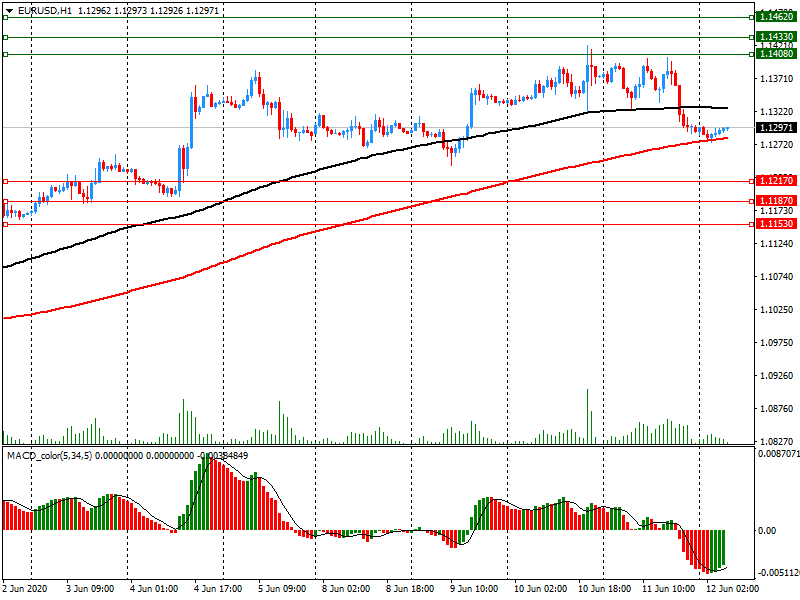
Comments:
- Overall open interest on the CALL options and PUT options with the expiration date July, 2 is 45999 contracts (according to data from June, 11) with the maximum number of contracts with strike price $1,1700 (2340);
GBP/USD
Resistance levels (open interest**, contracts)
$1.2812 (1342)
$1.2781 (1485)
$1.2729 (563)
Price at time of writing this review: $1.2581
Support levels (open interest**, contracts):
$1.2498 (941)
$1.2444 (1492)
$1.2412 (800)
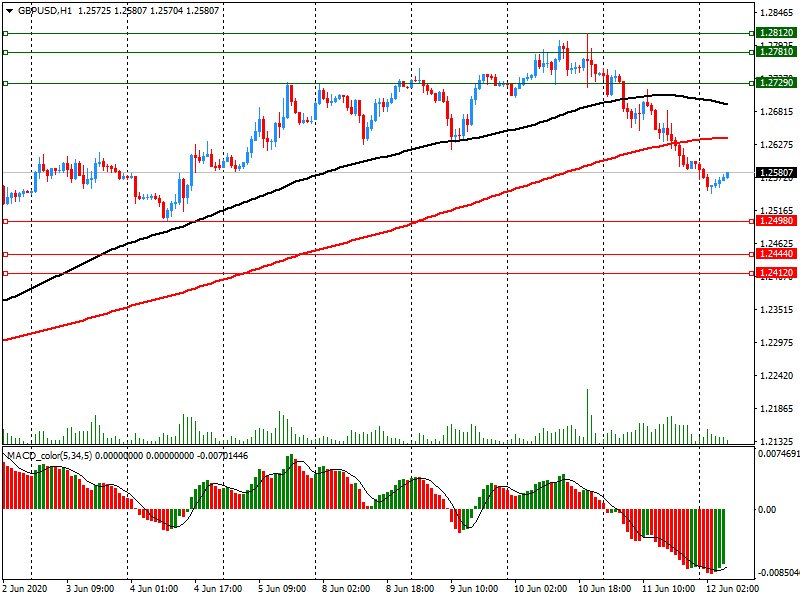
Comments:
- Overall open interest on the CALL options with the expiration date July, 2 is 14567 contracts, with the maximum number of contracts with strike price $1,2900 (1605);
- Overall open interest on the PUT options with the expiration date July, 2 is 16408 contracts, with the maximum number of contracts with strike price $1,2550 (1492);
- The ratio of PUT/CALL was 1.13 versus 1.10 from the previous trading day according to data from June, 11
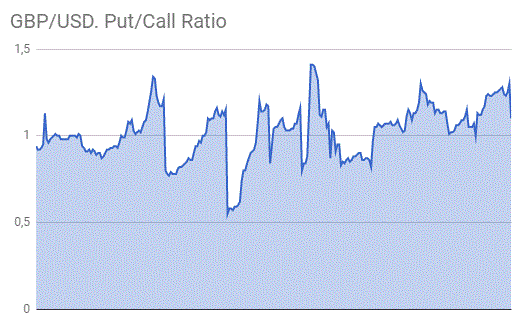
* - The Chicago Mercantile Exchange bulletin (CME) is used for the calculation.
** - Open interest takes into account the total number of option contracts that are open at the moment.
| Raw materials | Closed | Change, % |
|---|---|---|
| Brent | 38.12 | -7.05 |
| Silver | 17.62 | -2.6 |
| Gold | 1728.58 | -0.52 |
| Palladium | 1914.48 | -1.67 |
| Index | Change, points | Closed | Change, % |
|---|---|---|---|
| NIKKEI 225 | -652.04 | 22472.91 | -2.82 |
| Hang Seng | -569.58 | 24480.15 | -2.27 |
| KOSPI | -18.91 | 2176.78 | -0.86 |
| ASX 200 | -187.8 | 5960.6 | -3.05 |
| FTSE 100 | -252.43 | 6076.7 | -3.99 |
| DAX | -559.87 | 11970.29 | -4.47 |
| CAC 40 | -237.82 | 4815.6 | -4.71 |
| Dow Jones | -1861.82 | 25128.17 | -6.9 |
| S&P 500 | -188.04 | 3002.1 | -5.89 |
| NASDAQ Composite | -527.62 | 9492.73 | -5.27 |
| Time | Country | Event | Period | Previous value | Forecast |
|---|---|---|---|---|---|
| 04:30 | Japan | Industrial Production (MoM) | April | -3.7% | -9.1% |
| 04:30 | Japan | Industrial Production (YoY) | April | -5.2% | -14.4% |
| 06:00 | United Kingdom | Manufacturing Production (YoY) | April | -9.7% | -19.9% |
| 06:00 | United Kingdom | Manufacturing Production (MoM) | April | -4.6% | -15.8% |
| 06:00 | United Kingdom | Industrial Production (YoY) | April | -8.2% | -19.3% |
| 06:00 | United Kingdom | Industrial Production (MoM) | April | -4.2% | -15% |
| 06:00 | United Kingdom | GDP m/m | April | -5.8% | -18.4% |
| 06:00 | United Kingdom | GDP, y/y | April | -5.7% | |
| 06:00 | United Kingdom | Total Trade Balance | April | -6.7 | |
| 06:45 | France | CPI, m/m | May | 0% | 0% |
| 06:45 | France | CPI, y/y | May | 0.3% | 0.2% |
| 09:00 | Eurozone | Industrial production, (MoM) | April | -11.3% | -20% |
| 09:00 | Eurozone | Industrial Production (YoY) | April | -12.9% | -29.5% |
| 12:30 | Canada | Capacity Utilization Rate | Quarter I | 81.2% | 80% |
| 12:30 | U.S. | Import Price Index | May | -2.6% | 0.6% |
| 13:00 | United Kingdom | NIESR GDP Estimate | May | -11.8% | -15.7% |
| 14:00 | U.S. | Reuters/Michigan Consumer Sentiment Index | June | 72.3 | 75 |
| 17:00 | U.S. | Baker Hughes Oil Rig Count | June | 206 | |
| 17:00 | U.S. | Fed Barkin Speech |
| Pare | Closed | Change, % |
|---|---|---|
| AUDUSD | 0.68409 | -2.18 |
| EURJPY | 120.632 | -0.99 |
| EURUSD | 1.12919 | -0.73 |
| GBPJPY | 134.532 | -1.44 |
| GBPUSD | 1.25951 | -1.18 |
| NZDUSD | 0.64187 | -1.68 |
| USDCAD | 1.36175 | 1.64 |
| USDCHF | 0.94403 | 0.07 |
| USDJPY | 106.801 | -0.28 |







© 2000-2026. Sva prava zaštićena.
Sajt je vlasništvo kompanije Teletrade D.J. LLC 2351 LLC 2022 (Euro House, Richmond Hill Road, Kingstown, VC0100, St. Vincent and the Grenadines).
Svi podaci koji se nalaze na sajtu ne predstavljaju osnovu za donošenje investicionih odluka, već su informativnog karaktera.
The company does not serve or provide services to customers who are residents of the US, Canada, Iran, The Democratic People's Republic of Korea, Yemen and FATF blacklisted countries.
Izvršenje trgovinskih operacija sa finansijskim instrumentima upotrebom marginalne trgovine pruža velike mogućnosti i omogućava investitorima ostvarivanje visokih prihoda. Međutim, takav vid trgovine povezan je sa potencijalno visokim nivoom rizika od gubitka sredstava. Проведение торговых операций на финанcовых рынках c маржинальными финанcовыми инcтрументами открывает широкие возможноcти, и позволяет инвеcторам, готовым пойти на риcк, получать выcокую прибыль, но при этом неcет в cебе потенциально выcокий уровень риcка получения убытков. Iz tog razloga je pre započinjanja trgovine potrebno odlučiti o izboru odgovarajuće investicione strategije, uzimajući u obzir raspoložive resurse.
Upotreba informacija: U slučaju potpunog ili delimičnog preuzimanja i daljeg korišćenja materijala koji se nalazi na sajtu, potrebno je navesti link odgovarajuće stranice na sajtu kompanije TeleTrade-a kao izvora informacija. Upotreba materijala na internetu mora biti praćena hiper linkom do web stranice teletrade.org. Automatski uvoz materijala i informacija sa stranice je zabranjen.
Ako imate bilo kakvih pitanja, obratite nam se pr@teletrade.global.


 Банковни
 транcфери


