- Analiza
- Novosti i instrumenti
- Vesti sa tržišta
Forex-novosti i prognoze od 22-12-2021
- WTI extends two-day uptrend to refresh the highest level in a fortnight.
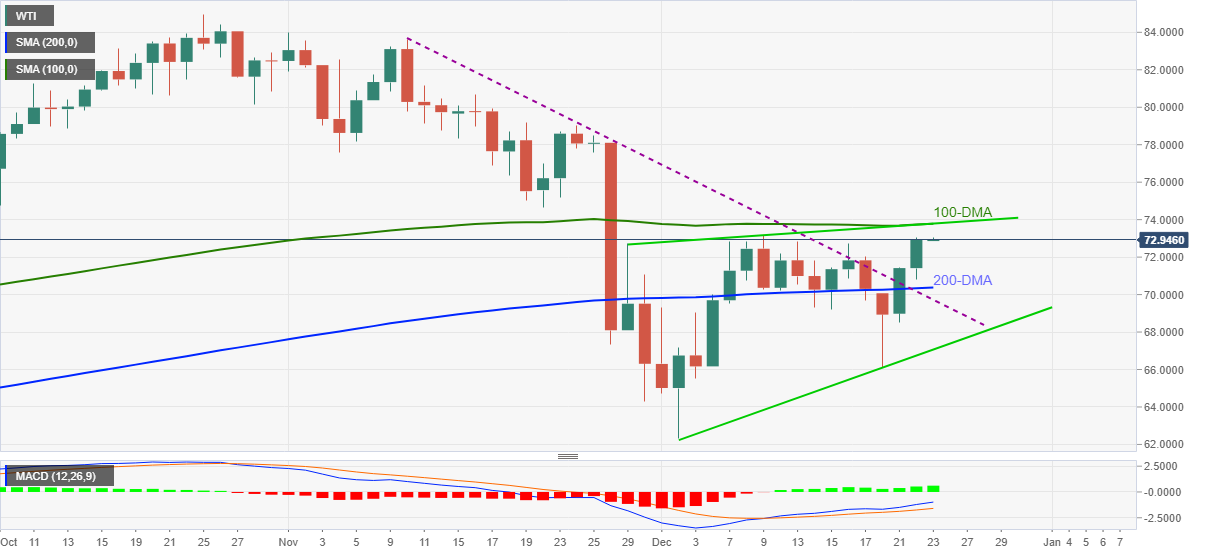
- Bullish MACD signals back sustained break of 200-DMA, previous resistance line from November.
- 100-DMA, rising wedge’s resistance line challenge immediate upside.
WTI crude oil pierces $73.00 threshold to poke monthly high, flashed before two weeks, during Thursday’s Asian session. In doing so, the black gold justifies a clear upside break of the 200-DMA and a descending trend line from November 10.
Given the bullish MACD signals favoring the latest breakout, the present upside momentum is likely to extend.
However, a convergence of the 100-DMA and upper line of a short-term rising wedge bearish chart pattern, near $73.80, becomes crucial for the WTI bulls.
Adding to the upside filter is the November 22 swing low of $74.65, a break of which will direct the oil prices towards the early November’s bottom surrounding $77.60 and then to the $80.00 threshold.
On the contrary, pullback moves may initially aim for the 200-DMA level of $70.37 before retesting the resistance-turned-support line close to $69.70.
Should WTI sellers conquer $69.70 support, the lower line of the stated rising wedge, near $67.00 will be crucial as a break of which will direct the prices towards the monthly low near $62.30.
WTI: Daily chart
Trend: Further upside expected
- NZD/USD seesaws near one-week high after being the second biggest G10 gainer.
- Stimulus hopes, Omicron updates favored risk appetite despite strong US data.
- NZ already reduced booster gap to four months, eyes 90% jabbing.
- US Durable Goods Orders, PCE Inflation for November eyed for fresh impulse, risk catalysts are important too.
NZD/USD remains sidelined after refreshing the weekly top by 0.6823, easing to 0.6800 during the initial Asian session on Thursday. The kiwi pair previously cheered risk-on mood before the latest challenges to the market sentiment and a light calendar tested the bulls.
Recent comments from the White House, shared by the Financial Times (FT), raise concerns over the availability of Pfizer’s drug that earlier favored optimism concerning Omicron’s cure. On the same line was the FT news stating, “France on Wednesday canceled its order of Merck’s drug after data showed it resulted in a reduction of only 30% in the risk of hospitalization and death, significantly lower than earlier expectations.”
Hopes of overcoming the South African covid variant, dubbed as Omicron, joined optimism concerning US President Joe Biden's Build Back Better (BBB) stimulus to favor the market’s mood the previous day.
After US Army conveyed positive updates for a single vaccine to battle covid and all variants, the US Food and Drug Administration (FDA) approved a pill from Pfizer to treat Covid-19.
On the other hand, Reuters quotes White House spokeswoman Jen Psaki while saying, “We believe that Senator Manchin has been engaging with us over the course of time and months in good faith." It’s worth noting that Joe Manchin poured cold water on the face of stimulus expectations by being the only Democrat to oppose the much-awaited aid package that needs all the party members’ support to get through the house.
It’s worth noting that the strong US data also failed to stop the NZD/USD on Wednesday, neither did the Sino-American tension and the US-Russia tussles. That said. the US Q3 GDP rose past the 2.1% forecast to 2.3% whereas the CB Consumer Confidence for December came in better than upwardly revised 111.9 prior to 115.8.
Additionally helping the NZD/USD prices is New Zealand’s push for faster vaccinations to match Australia’s global record of 90%. Recently, Auckland reduced the time for booster shots to four months versus the previous six.
To portray the risk-on mood, the Wall Street benchmarks had a second positive day while the US 10-year Treasury yields and the Dollar Index (DXY) marked a negative daily closing by the end of Wednesday’s North America session. Also, the S&P 500 Futures print mild gains by the press time.
Moving on, a lack of data ahead of the US open might extend the latest pullback moves. However, positive headlines concerning Omicron and US stimulus may help the NZD/USD pair buyers to keep the reins. Following that, the US November PCE inflation and Durable Goods Orders will be crucial to watch amid hopes of a faster Fed rate hike, starting with early 2022.
Technical analysis
Bullish MACD signals join upside break of the 100-SMA and a five-week-old falling trend line to underpin the NZD/USD battle with the monthly resistance line near 0.6820. However, RSI conditions are overbought and may probe further advances.
Should Kiwi pair buyers rise past 0.6820, the 200-SMA level near 0.6880 and late November’s swing high near 0.6960 will be next in the line of the bull’s targets.
Meanwhile, pullback moves may initially aim for the 100-SMA level of 0.6775 before challenging three-week-long horizontal support near 0.6735-30.
- The NZD/JPY extends its gains in the week, up some 1.49%.
- The market sentiment is upbeat on Covid-19 news from South Africa and Pfizer’s pill.
- NZD/JPY Technical Outlook: It has a downward bias, though a break of the 200-DMA could send the NZD/JPY up to 79.00
The NZD/JPY rallies for the second consecutive day, trims losses from December 16, trading at 77.63 as the Asian session begins, at the time of writing. The New York session ended with an upbeat market sentiment spurred by positive news in the Covid-19 front. US equities finished in the green, gaining between 0.74% and 1.21%, led by the heavy-tech Nasdaq. At press time, Asian equity futures eyes towards a higher open, as positive market sentiment get follow-through in Asia.
On Wednesday’s overnight session, the NZD/JPY seesawed around the 76.90-77.20 range in the Asian session. However, as the overlap between Asia and Europe kicked in, the NZD/JPY surged aggressively, printing a daily high at 77.89, a price level not seen since December 16.
NZD/JPY Price Forecast: Technical outlook
The NZD/JPY daily chart depicts the pair still in a downward bias, as the daily moving averages (DMAs) reside well above the spot price, slightly horizontal, and would be strong resistance to overcome for NZD bulls. The NZD/JPY surged aggressively on Wednesday, though the upward move stalled near the 200-DMA at 78.01, to then settling around current levels.
To the upside, the first resistance would be December’s 16 cycle high at 77.96. The breach of the latter would expose the 200-DMA at 78.01, immediately followed by the 100-DMA at 78.28
On the flip side, the first support would be the psychological 77.00. A clear break of that level would add downward pressure on the NZD/JPY, exposing key support levels. The next one would be the December 3 swing low at 75.95, followed by the July 20 swing low at 75.25.
-637758111353223506.png)
“Japan plans to issue 4.2 trillion yen ($37 billion) of 40-year government bonds in the new fiscal year, a 17% increase that comes even as the government plans to cut its bond issuance overall,” said Reuters, quoting anonymous sources, during early Thursday morning in Asia.
Key quotes
It marks a third straight year of increases in issuance of the 40-year bonds, which are closely watched by the market, and reflects solid demand from life insurers at the long end of the yield curve, said the sources.
Prime Minister Fumio Kishida's inaugural debt issuance plan will see overall calendar-based sales of Japanese Government Bonds (JGBs) at around 200 trillion yen, or down about 20 trillion yen from this year, the sources said, reflecting the new premier's push to keep a lid on debt.
The increase in the 40-year bonds would mean sales of around 700 billion yen at auctions every other month, from auctions of 600 billion yen now, the sources said.
The government will keep issuance steady of five-year, 20-year, 30-year and inflation-linked 10-year bonds, the sources said.
The government also plans to boost liquidity-enhancing auctions by 600 billion yen in the next fiscal year, the sources said. In liquidity enhancing auctions, the Ministry of Finance issues additional amounts of existing JGBs to improve liquidity.
Market reaction
The news favored USD/JPY prices to pick up from intraday low to 114.13. However, bulls await Tokyo open amid recent challenges to the previous risk-on mood, raised by the White House.
Read: White House warns Pfizer Covid-19 pill will not be widely available for months – FT
The White House dims optimism over the Omicron cure after the US Food and Drug Administration (FDA) approved a pill from Pfizer to treat Covid-19.
“The White House has warned it will take more than six months to fulfill its initial order for Pfizer’s antiviral Covid-19 pill, as officials damped speculation the drug could immediately turn the tables on the pandemic,” said the Financial Times (FT)
Key quotes (from FT)
The US drugs regulator on Wednesday gave emergency authorization for the pill, called Paxlovid, to be used on people aged 12 and over with mild or moderate Covid-19 who are at risk of more severe symptoms.
But senior health advisers to President Joe Biden quickly warned that it would take months for the company to make and distribute all 10m treatment courses already on order.
Pfizer has said its pill cuts the risk of hospitalisation or death in Covid-19 patients by 89 percent.
It is likely to be especially important in the coming months because early lab tests show it continues to work against the fast-spreading Omicron variant, unlike some of the monoclonal antibody treatments already available.
FX reaction
Given the latest risk-on mood mainly driven by hopes of overcoming the South African covid variant, dubbed as Omicron, the news negatively affects the sentiment and should weigh on the recent gainers, namely Antipodeans and commodities.
Read: AUD/USD: Well-set for 0.7300 on firmer sentiment, US Durable Goods Orders, PCE Inflation eyed
- AUD/USD grinds higher around weekly top after crossing key hurdle to the north.
- Aussie cabinet meeting showed confidence in overcoming the virus variant.
- Omicron, US BBB updates favored risk appetite, mixed data from Australia, US got mostly ignored.
- Key US data, risk catalysts are the key before Christmas Eve.
AUD/USD defends 0.7200 resistance breakout, taking rounds to 0.7215-20 during early Thursday morning in Asia.
In doing so, the Aussie pair remains near the monthly peak of 0.7225, which holds the gate for a rally towards the 0.7300 hurdles. That said, the quote became the biggest currency pair gainer among the Group of Ten (G10) on Wednesday as market sentiment remained firmer.
Although rising virus cases and fears of not so happening year-end celebrations prevail, positive news about the cure and nature of the South African covid variant, dubbed as Omicron, favored the risk appetite of late. After US Army conveyed positive updates for a single vaccine to battle covid and all variants, the US Food and Drug Administration (FDA) approved a pill from Pfizer to treat Covid-19.
Adding to the Omicron-linked market optimism was the Aussie cabinet’s “easy play” to tame the virus strain, by pushing for caution and masks but not reducing the gap between two-shots and booster vaccinations.
Elsewhere, positive updates concerning US President Joe Biden's Build Back Better (BBB) stimulus add to the brighter mood and underpin the AUD/USD prices, due to the pair’s risk barometer status. "We believe that Senator Manchin has been engaging with us over the course of time and months in good faith," White House spokeswoman Jen Psaki told reporters. "There will be more negotiations, no doubt about it. Everybody stay tuned and settle in," per Reuters.
On a different page, hawkish expectations concerning Australia’s main export item iron ore also favor the AUD/USD bulls.
It’s worth noting that the Sino-American tension and the US-Russia tussles remain on the table but were ignored. So do the mostly firmer US data and downbeat Aussie figures. That said. the US Q3 GDP rose past the 2.1% forecast to 2.3% whereas the CB Consumer Confidence for December came in better than upwardly revised 111.9 prior to 115.8. On the other hand, Australia Westpac Leading Index for November dropped below 0.27% to 0.12%.
Amid these plays, the Wall Street benchmarks had a second positive day while the US 10-year Treasury yields and the Dollar Index (DXY) marked a negative daily closing by the end of Wednesday’s North America session.
Looking forward, US November PCE inflation and Durable Goods Orders will be crucial to watch amid hopes of a faster Fed rate hike, starting with early 2022. Also important to watch will be the risk catalysts stated above.
Technical analysis
A clear upside break of the 200-SMA and monthly resistance line, close to 0.7200, gains support from bullish MACD signals and firmer RSI to direct AUD/USD buyers towards a horizontal area stretched from November 11, 0.7295-7300. However, a sustained rise past the monthly high near 0.7225 becomes necessary for the bulls.
- Gold vs. the euro advances some 0.01% as the Thursday Asian session begins.
- XAU/EUR Price Forecast: Bullish-biased though it faces strong resistance around the €1,595-1,600 area.
Gold (XAU/EUR) vs. the euro advances as the New York session ends, trading at €1,592 at the time of writing. During the New York session, the market sentiment was upbeat, spurred in part by good news on the Covid-19 Omicron-variant front. South Africa continues reporting positive news, which according to a study, 80% of the people infected by the newly discovered strain did not need hospitalizations. Furthermore, in the mid-American session, the US Food and Drug Administration (FDA) approved the use of a Pfizer pill, a treatment for the coronavirus, that could be used to treat high-risk patients.
Apart from that, the German 10-year bund yield rises three basis points, from -0.314% to -0.289%, a headwind for the yellow-metal throughout Wednesday's session.
In the meantime, the precious metals segment, XAU/USD, rose to $1,803, while silver failed to cling to the $23.00 threshold, trading at $22.84.
XAU/EUR Price Forecast: Technical outlook
The XAU/EUR daily chart depicts that the non-yielding metal is upward biased, as shown by the daily moving averages (DMAs) residing below the spot price. Further, in the last 17 days, gold has been seesawing around Andrew Pitchfork’s uptrend-channel mid-line, at press time resistance, while the 50-DMA at €1,576 acted as support.
To the upside, the first resistance level is the Pitchfork’s mid-line at €1,595. A breach of the latter would leave December’s 20 daily high at 1603.40, followed by November’s 23 cycle high at €1,612.28.
On the downside, the first support would be the 50-DMA at €1,576. A decisive break of the 50-DMA leaves gold bulls leaning on December’s 15 pivot low at €1,558.32, followed by December’s two cycle low at €1,555.31.
-637758089890567475.png)
- GBP/USD bulls are taking on critical daily resistance.
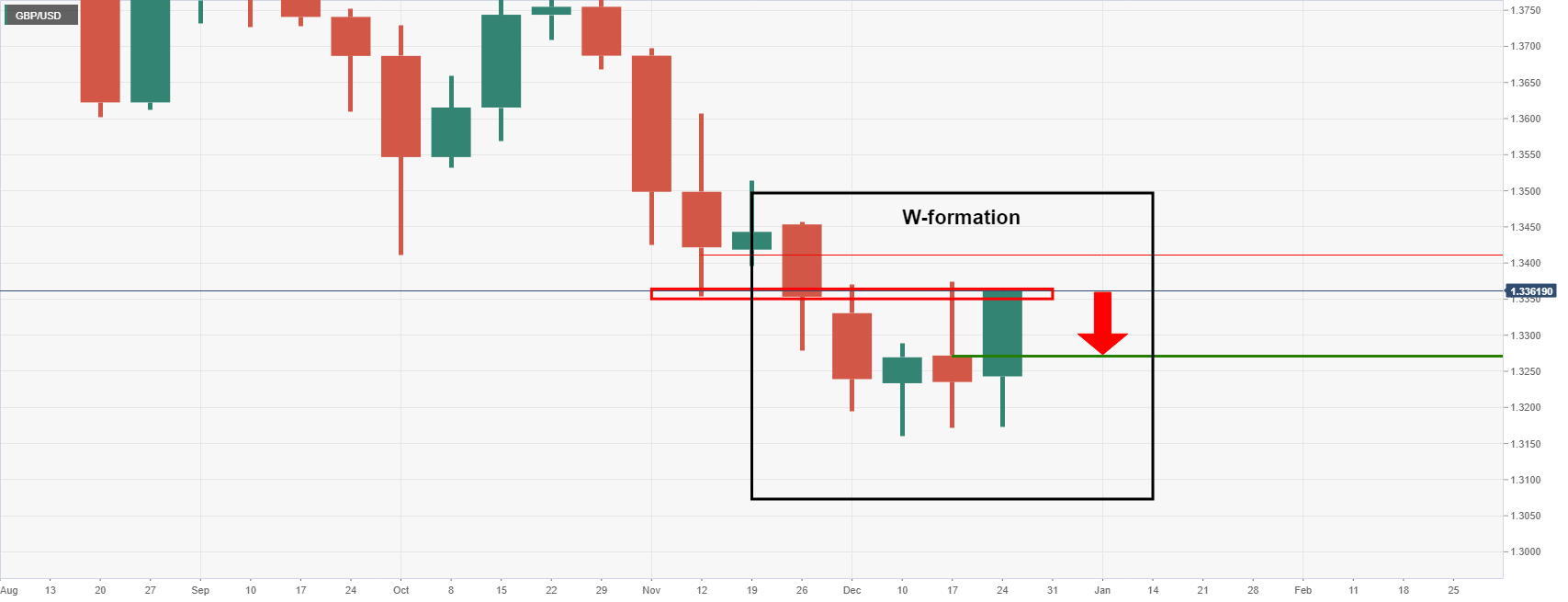
- Bears will be looking for a downside correction, as per the weekly W-formation.
GBP/USD has ended the US sessions firmly bid and has taken out the prior closing highs for the week which leaves the bulls in good stead for the remaining sessions ahead of the holidays. At the time of writing, GBP/USD is higher by some 0.77% after travelling from a low of 1.3239 to a high of 1.3363.
While the 1.34's could be on the cards, the weekly W-formation is noted as a bearish reversion pattern. Therefore, a correction towards 1.3264 as the neckline of the formation could be on the cards for the coming days as illustrated in the following analysis.
GBP/USD daily chart
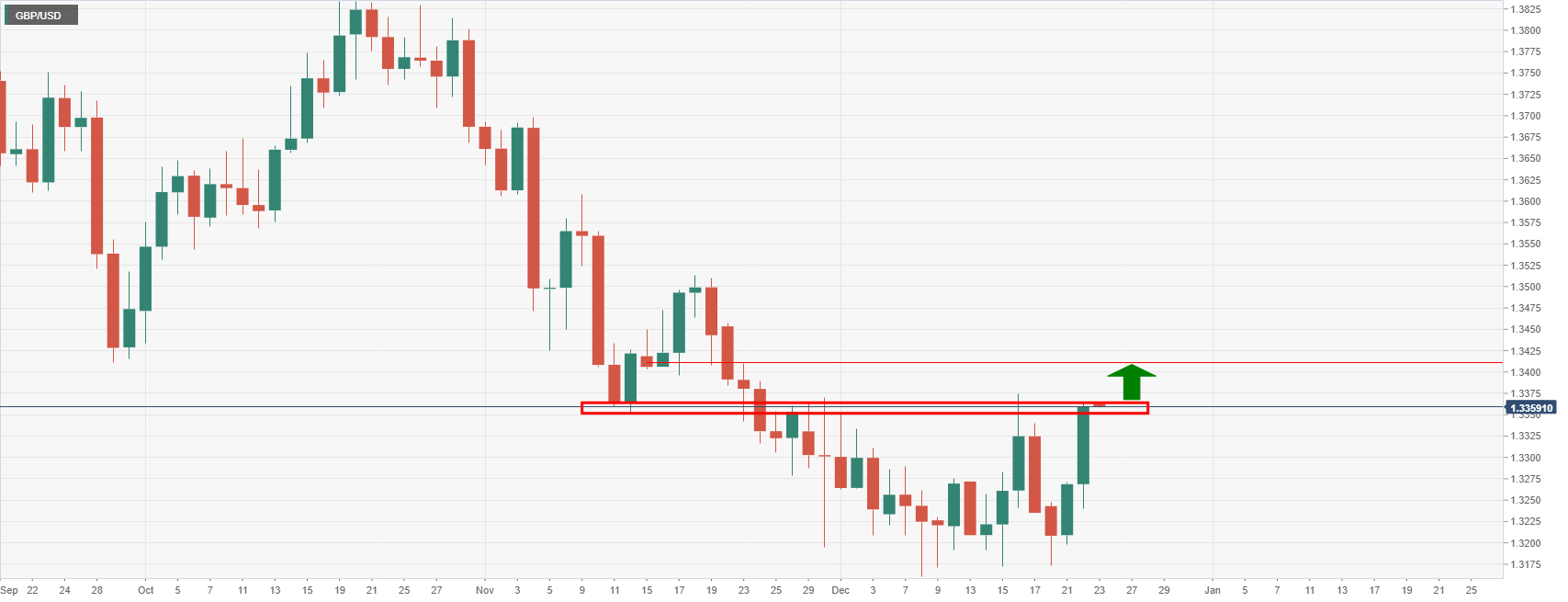
The price can easily continue for a test into the 1.34 area, however ...
GBP/USD weekly chart
The weekly chart has prospects of a downside correction as follows:
Here is what you need to know on Wednesday, December 23:
What began as a relatively subdued session for FX markets turned significantly more risk-on as the US trading session got underway, with the net result for G10 FX being outperformance of risk-sensitive currencies and underperformance of the havens. Sentiment took a turn for the better midway through Wednesday trade following strong US December Consumer Confidence and final Q3 GDP data, and amid a string of positive pandemic-related updates.
The US FDA approved Pfizer’s highly effective Covid-19 treatment pill (for “high risk” patients) and three new studies (one from South Africa, one from Scottish Universities and one from Imperial College London) all showed that infection with Omicron is significantly less likely to result in hospitalisation. Amid the broadly risk-on market tone that also saw global equities and commodities gaining ground, the US dollar thus weakened due to its safe-haven status. That pushed the DXY lower by about 0.4% to trade just above 96.00, though FX strategists will note that this is still well within December ranges and caution against reading too much into FX market moves amid pre-holiday thinned trading conditions.
The yen also performer poorly and, alongside the US dollar, made up the bottom two spots in the G10 performance table. By contrast, the risk-sensitive Aussie, kiwi, NOK and pound were the best G10 performers on the day, gaining between 0.7-0.9% on the session each. AUD/USD rose 60 pips to move back above 0.7200, NZD/USD gained 50 pips to move back above 0.6800 and GBP/USD gained nearly 100 pips to move above 1.3350, with each pair within a few pips of monthly highs. A mixed UK GDP report released early on during European trading hours did not faze GBP traders.
Elsewhere, CAD gained about 0.6% on the session versus the buck, pushing USD/CAD back below 1.2850, more than 100 pips below annual highs printed back on Monday above 1.2950. The euro, Swiss franc and SEK were all up about 0.4% versus the buck on Monday as a result of its risk-on related weakness rather than as a function of any domestic fundamentals. Generally, hawkish vibes from ECB policymakers who spoke on Wednesday does not seem to have shifted the dial much for the euro, with EUR/USD trading well within December’s 1.1240-1.1360ish ranges, though is worth noting.
- The DXY slides some 0.39% but stays above the 96.00 figure as the New York session winds down.
- Positive Covid-19 news improved the market mood weakening the greenback.
- US Dollar Index (DXY) Price Forecast: Upward bias, though testing the bottom-trendline of the ascending triangle.
The US Dollar Index (DXY), which tracks the performance of the US dollar against a basket of six rivals, slides 0.39%, sits at 96.07 during the New York session at the time of writing. A risk-on market mood spurred by positive Covid-19 news.
A study made in South Africa reports that people infected with the Omicron variant are 80% less likely to be hospitalized. Additionally, in the last hour, the US Food and Drug Administration (FDA) approved Pfizer’s Paxlovid pill for home treatment to treat high-risk patients.
Apart from this, the fall in US bond yields dented demand for US dollars, though it did not drag the USD/JPY to follow its steps. US Treasuries led by 10s, the 20s, and 30s, drop between two and a half and four basis points, sitting at 1.462%, 1.8846%, and 1.857%, respectively.
On Wednesday, the US macroeconomic docket featured the Gross Domestic Product for the third quarter. The annual base reading came at 2.3%, higher than the 2.1% estimated, while the quarterly based, uptick to 6.0%, better than the 5.9% foreseen. Furthermore, the Conference Board reported that Consumer Confidence in December rose by 115.8, more than the 110.8 estimated. Since July, it is the best mark before the Delta wave that weakened confidence in the Q3.
US Dollar Index (DXY) Price Forecast: Technical outlook
The US Dollar Index daily chart depicts the strong dollar narrative keeps in place. The DXY broke below the central Pitchfork’s uptrend channel, which confluences with the ascending triangle on an uptrend.
At the time of writing, the DXY is testing the bottom-trendline of the ascending triangle on an uptrend, threatening to break to the downside, which would invalidate the triangle formation sending the DX tumbling towards November 30, 95.55.
To the upside, the first resistance would be the figure at 97.00. A breach of the latter would expose the June 30 high at 97.80, followed by the ascending triangle target at 98.00.
-637758017772906890.png)
- EUR/USD bulls keep control in risk-on environment and eye 1.1350.
- A break of 1.1380 opens prospects towards 1.1513.
EUR/USD is trapped in a sideways daily consolidation following a strong bearish impulse that started in November from the 1.16s. The price fell all the way to 1.1186 before stalling and the question now is whether this is a phase of redistribution or accumulation?
The following illustrates the market structure from a bullish perspective in anticipation of a break of the critical daily support near 1.1380 for the days ahead.
EUR/USD daily chart
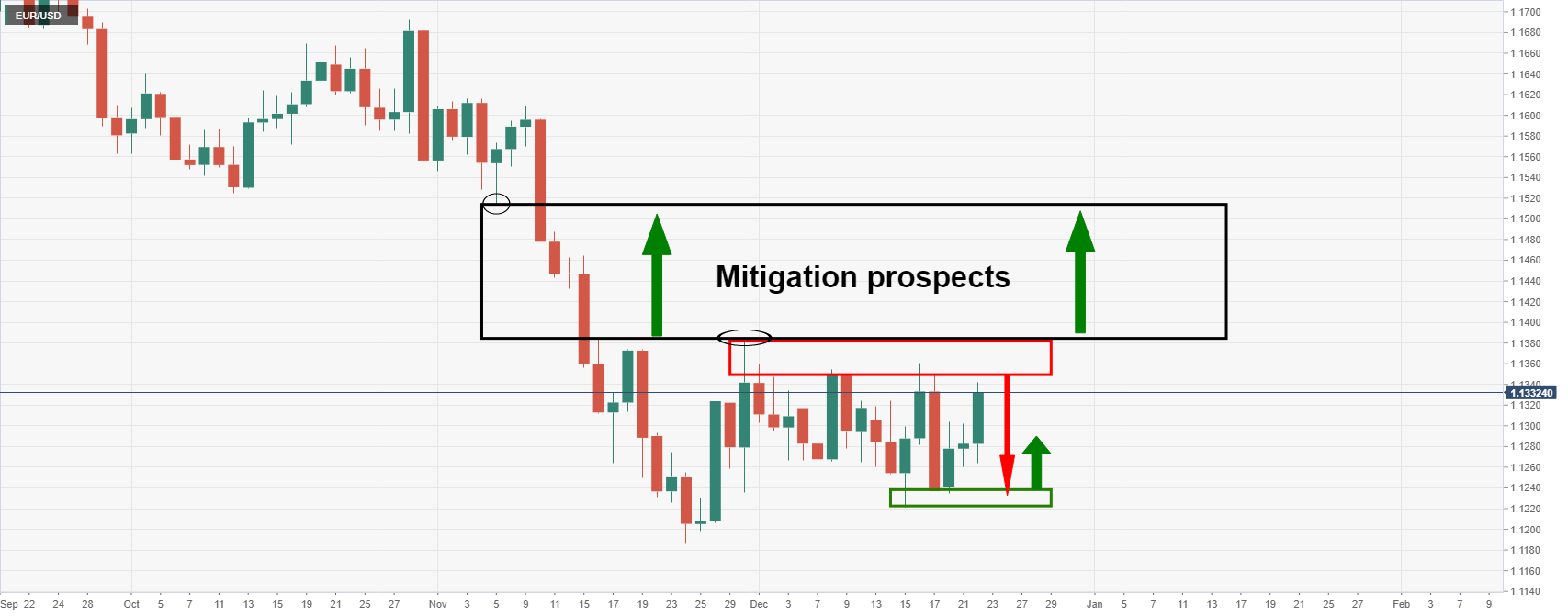
The price has stalled and moved into a sideways consolidation that is yet to be determined as being redistribution or accumulation. A break of 1.1380 would likely confirm the accumulation bias with prospects of the imbalance of the downside being mitigated by the bulls for the weeks ahead. This area comes between 1.1383 and 1.1513.
EUR/USD H1 chart

The bulls are in charge and rallying towards the key resistance zone around 1.1350.
- US equities are higher, with the S&P 500 up 0.8%, the Nasdaq 100 up 1.0% and the Dow up 0.6%.
- Traders are citing strong US data and a string of positive pandemic updates as supporting risk appetite.
US equity markets have maintained/built on Tuesday’s momentum and the S&P 500 index is currently trading 0.8% higher on the session in the 4680s with less than an hour to go until the close. That comes after the index posted an impressive 1.8% rally on Tuesday and means that it is now 3.3% higher versus Monday’s lows close to 4530.
The index still trades about 1.3% below record intra-day highs posted a few weeks ago, but given how far the index has already advanced from lows, equity bulls would be forgiven for hoping that this week’s Santa rally, or Santa recovery, can deliver record levels before the Thursday close. The NYSE and Nasdaq exchanges will be closed on Friday. When a holiday falls on a Saturday (Christmas Day), the two major US equity exchanges close on Friday before.
Looking at the other major US indices; the Nasdaq 100 rose 1.0% and has now reclaimed the 16K level and is now up nearly 4.0% from Monday lows, while the Dow rose 0.6%, up nearly 3.0% from weekly lows. The S&P 500 CBOE volatility index dropped more than 1.50 and is now back below 20.00 and eyeing a test of December lows just above 18.00.
Driving the day
Higher equities in the US reflect a broader risk-on tone to global market trade, with traders citing strong US data and a string of positive pandemic updates as supporting risk appetite. Starting with the pandemic latest, the FDA announced that it had approved Pfizer’s highly effective Covid-19 treatment pill (for “high risk” patients). Elsewhere, three new studies (one out of South Africa, one from Scottish Universities and one from Imperial College London) all showed that infection with Omicron is significantly less likely to result in hospitalisation.
While “we are still struggling for direction in the face of the Omicron outbreak” said analysts at BMO Wealth Management, “but in the past few days ... more and more evidence is building that the strain is potentially less severe than prior strains, specifically Delta, which bodes well for economic momentum in 2022”. Optimism about economic momentum heading into 2022 was given a boost on Wednesday after the US Conference Board released a much stronger than expected Consumer Confidence survey. The survey showed that, versus November, more consumers were planning to buy a house and other “big-ticket” items such as cars and expensive household appliances, as well as to go on holiday over the next six months.
One of the factors attributed as contributing to Monday’s sharp stock market drop was the fact that on Sunday, Democrat Senator Joe Manchin said he would not support the Biden administration’s $1.75T Build Back Better spending bill in its current form, dampening hopes for further US fiscal stimulus in the near-term. But as the week has progressed, it has become increasingly clear that negotiations on the bill, which forms the centre of US President Joe Biden’s economic agenda, will continue. According to the White House on Wednesday, there is broad agreement within the Democrat Party on the requirement to move forward with the bill, and talks with Manchin continue.
- The USD/JPY advances some 0.10% amid a risk-on market mood.
- USD/JPY Technical Outlook: Tilted to the upside as USD bulls have reclaimed the 114.00 figure now eyeing 115.00.
The USD/JPY barely advance during the New York session, trading at 114.19 at the time of writing. US equities remain tilted to the upside, reflecting market participants’ mood to the detriment of safe-haven assets. In the FX market, risk-sensitive currencies rise while safe-haven statuses like the USD and the CHF advance against the low-yielder Japanese yen.
The US Dollar Index, which tracks the greenback’s value against a basket of its peers, slumps 0.35%, sitting at 96.14, clinging with its nails to the 96.00 threshold. In the meantime, the US 10-year Treasury yield drops three basis points, down to 1.458%.
USD/JPY Price Forecast: Technical outlook
In the overnight session, the USD/JPY pair slide slightly towards the daily low aright at the central daily pivot at 113.95. As market sentiment improved, the US dollar strengthened versus the yen, surging towards the R1 daily pivot at 114.34 before settling down at current levels.
The USD/JPY daily chart shows that the pair has an upward bias. The daily moving averages (DMAs) remain under the spot price, with the 50-DMA at 113.86, the closest to the current price action. Additionally, a four-month-old upslope trendline, respected two times, intersects with the aforementioned DMA, leaving the 113.80-90 area as a problematic demand zone to overcome for JPY bulls.
To the upside, the first resistance would be November’s 1 daily high at 114.44. A breach of the latter could send USD/JPY rallying towards October’s pivot high at 114.70, followed by the 115.00 threshold.
On the other hand, the 114.00 figure would be the first line of defense for USD bulls. Once the aforementioned level is breached, the next stop would be the 50-DMA at 113.86, immediately followed by December’s 17 daily low at 113.14.
-637757986470987700.png)
- USD/CAD bears have taken over despite the offer in the greenback.
- Bulls will be looking for critical support to hold at this juncture.
USD/CAD has been on the march in recent days and had broken through an important daily resistance. It would be expected to extend to rally to the upside in due course. The following illustrates the recent price action and market structure.
USD/CAD daily chart
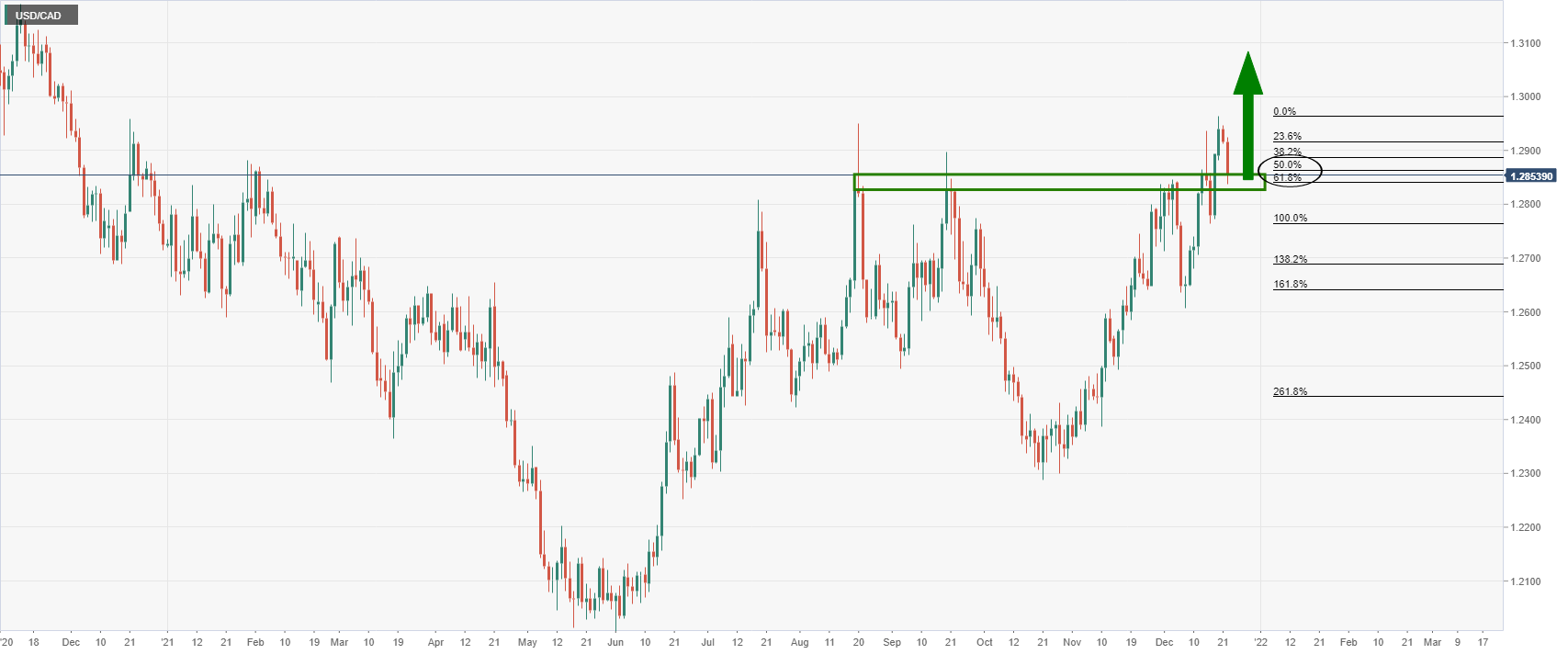
The daily chart's outlook is bullish given the price has already moved in on the 61.8% Fibonacci and broken prior resistance that would now be expected to act as support.
USD/CAD 4-hour chart
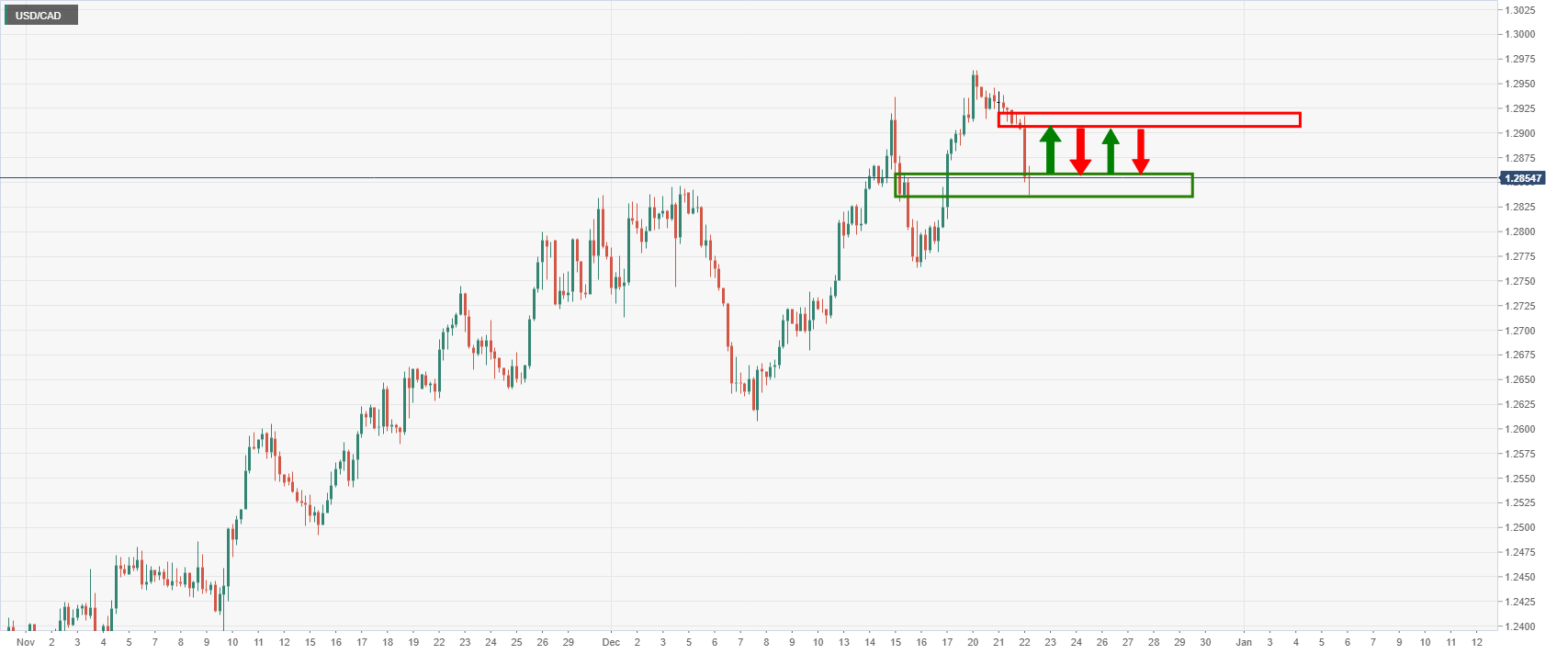
The price, however, from a 4-hour perspective, has dropped hard and the structure offers no bullish tendencies as of yet. There are probabilities of a period of consolidation for the sessions ahead if not a test lower towards 1.28 the figure.
- GBP/JPY has surged from under 151.50 to test 152.50 and is now up nearly 2.0% from weekly lows near 149.50.
- Risk appetite has continued to improve significantly on Wednesday, driving the pair higher.
Risk appetite has picked up in recent hours amid strong US Consumer Confidence and GDP data, as well as following a string of recent positive pandemic-related updates, and this is being reflected in FX markets. Risk-sensitive currencies are, generally speaking, performing better than safe-haven currencies. GBP fits more in the former category, whilst the yen is most certainly viewed as a safe haven asset, so the net result on Wednesday has been a higher GBP/JPY.
Looking at the price action, the pair has rallied from underneath 151.50 during Asia Pacific and early European trade all the way to the 152.50 level and is currently probing last week’s highs. That marks an impressive 0.9% rally on the day and comes on the heels of Tuesday’s 0.8% rally. Indeed, since the Monday low just above 149.50 (when markets were in a much more risk-off mood), the pair has rallied nearly 2.0%, impressive stuff.
A mixed UK Q3 GDP report does not seem to have deterred the bulls on Wednesday. The UK economy grew at a 1.1% QoQ pace in Q3, data this morning showed, slower than the expected pace of 1.3%, though the YoY rate of growth was better than expected at 6.8% (forecasts were for 6.6%). A slowing of the pace of new infection growth in UK Omicron hotspot London and a Scottish study showing the virus is significantly less likely than delta to result in hospitalisation seems to have breather some optimism into sterling. Still, the pandemic is a significant risk to the UK economy and December survey data has shown it has already had a chilling impact that seems likely to last into January.
Whether that is enough to stop GBP/JPY blasting above 152.50, which has been a key balance for the price action area in recent months, is another thing. Given the proximity of Christmas Day on Saturday, North American and European volumes are expected to decline significantly over the next two days as market participants take time off for holiday celebrations. According to analysts at ING, the couple of weeks either side of Christmas day usually see low volatility for currencies, though they caution that “this year some seasonal tendencies will be mixed with the Omicron variant threatening to force new restrictions and markets still processing a week full of key central bank decisions”.
- The New Zealand dollar edges higher some 0.69%.
- Positive Covid-19 news from South Africa and Pfizer’s Covid-19 treatment pill’s approval ease investors’ worries.
- US GDP rose by 2.3%, better than the 1.9% foreseen yearly base, while US Consumer Confidence improved.
The New Zealand dollar follows other risk-sensitive currencies’ footsteps, rallies during the New York session, trading at 0.6815 at the time of writing. The market sentiment was mixed earlier in the day, though improved in the last three hours.
According to a study, positive news in the coronavirus front with South Africa reporting that people infected with the Omicron variant are 80% less likely to be hospitalized. Additionally, in the last hour, the US Food and Drug Administration (FDA) approved Pfizer’s Paxlovid pill for home treatment to treat high-risk patients.
In the overnight session, the NZD/USD dipped as low as 0.6740. Then as the day progresses, it is staging a comeback, jumping 80-pips towards the daily high at 0.6818, as coronavirus positive news crosses the wires, easing investors’ worries of the possibility of a global economic slowdown.
Apart from this, the US Dollar Index, which measures the greenback’s performance against a basket of six rivals, slumps 0.40%, sitting at 96.10, clinging with its nails to the 96.00 threshold. At the same time, the US 10-year Treasury yield drops two and a half basis points, down to 1.460%.
On Wednesday, the US economic docket featured the Gross Domestic Product for the third quarter. The annual base reading came at 2.3%, higher than the 2.1% estimated, while the quarterly based, uptick to 6.0%, better than the 5.9% foreseen. Furthermore, the Conference Board reported that Consumer Confidence in December rose by 115.8, more than the 110.8 estimated. Since July, it is the best mark before the Delta wave that weakened confidence in the Q3.
Therefore, Wednesday’s NZD/USD price action has been subject mainly to market sentiment as the NZD is rallying despite the excellent results of US macroeconomic data. However, NZD/USD downside risks remain unless NZD bulls reclaim the 0.7000 figure, where it lies, the 50 and the 100-DMA.
- AUD/USD holds in positive grounds as the dollar slides in risk-on.
- US stocks have rallied as US data lifts spirits for the holidays.
AUD is the strongest currency on the day in a risk-on environment with US Consumer Confidence coming in higher than forecasted for December as third-quarter economic growth was revised higher. The US stock market has rallied and high beta plays are aligned positively, benefitting from the renewed enthusiasm.
The Nasdaq Composite jumped 0.9% to 15,486.29 intraday, with S&P 500 up 0.8% and the Dow Jones Industrial Average 0.4% higher. All sectors were in the green, with consumer discretionary and technology leading the charge.
UD/USD is firm, 0.9% higher around the highs of the day near 0.7217 at the time of writing. The 10-year US Treasury yield .is down 0.34% points to 1.46% and the US dollar, as measured by the DXY is down 0.39% sliding from 96.602 to a low of 96.036. US rates are starting to normalize. However, analysts at Brown Brothers Harriman explained that the ''market tightening expectations for the Fed still have room to adjust; 2-year yield differentials are moving back in the dollar’s favour.''
''If inflation returns to the 2% target, then that implies a negative real policy rate at the end of a Fed tightening cycle, with the economy near full employment.,'' the analysts added, ''Sure, there are downside risks from more variants but the rates market seems to be pricing in perfection from the Fed. We continue to believe that markets are underestimating the Fed’s propensity to tighten, and this should lead to a further rise in US short-term rates in 2022.''
Meanwhile, the consumer confidence index rose to 115.8 in December from November's upwardly revised 111.9 level, the Conference Board reported Wednesday. The consensus among analysts on Econoday indicated a 110.7 print. The survey's cutoff was Dec. 16. The US Gross Domestic Product was also revised higher in the third estimate for the third quarter, Q3, to 2.3% from 2.1% in the second estimate, versus expectations for no revisions.
- Positive pandemic news is boosting risk appetite and, coupled with bullish inventory data, has pushed WTI above $72.00 per barrel.
- The US FDA approved Pfizer’s effective at-home Covid pill and more studies have shown Omicron to be milder than delta.
Sentiment has taken a turn for the better during US trading hours, with a string of positive Covid-19 developments/stories seemingly injecting a dose of optimism into a market that had otherwise been subdued and in holiday mode. This is giving crude oil a lift and front-month WTI futures recently crossed back to the north of the $72.00 level, where it trades at weekly highs. On the day, WTI is now close to $1.0 higher and the bulls will be eyeing a test of the $73.00 level, a key zone of resistance that has capped the price action for the whole of December thus far.
In terms of the recent positive developments, the US FDA just approved Pfizer’s Paxlovid pill to treat Covid-19 infection in at-risk patients at home. As long as patients begin treatment within five days of infection, the pill allegedly reduces hospitalisation and mortality rates in the at-risk by as much as an incredible 90%. Pfizer said it was ready to begin distributing the drug in the US immediately and other nations will likely approve the drug and start rolling it out soon too.
Elsewhere, more studies on the severity of Omicron have been released (one out of Scotland and one out of South Africa) and both strengthen the narrative that infection with Omicron is significantly less likely to result in hospitalisation. The above news will strengthen investor conviction that the hit to the global economy posed by Omicron will not be catastrophic or long-lasting. Of course, this is great news for crude oil markets, just as it is for other risk assets.
Elsewhere in notable crude oil markets news, official weekly US oil inventories were out and, as indicated by the private weekly API report on Tuesday, the drawdown in headlines stocks was much larger than expected at over 4.7M barrels. This supported crude oil prices, despite a massive, unexpected more than 5.5M build in gasoline stocks and a surprise drop WoW in refinery utilisation rates.
The US Food and Drug Administration on Wednesday authorised Pfizer's Paxlovid pill, the first anti-Covid-19 treatment pill to be authorised in the country. It will be used to treat high-risk patients with moderate to severe disease within five days of symptom onset. Pfizer said it was ready to commence delivery of the pill immediately.
- The Swiss franc appreciates some 0.40% against the US dollar amid broad greenback weakness.
- An upbeat market mood failed to boost the buck vs. the low-yield currencies like the EUR, CHF, and JPY.
- Falling US T-bond yields weighed on the US dollar.
- USD/CHF Technical Outlook: Neutral with no clear bias, though the breakout of the trading range could offer some opportunities in the re-test of those levels.
The USD/CHF edges slightly lower during the New York session, trading at 0.9201 at the time of writing. A risk-on market mood has kept the greenback on the backfoot, undermined by falling US bond yields, with the 10-year Treasury yield down two and a half basis points, sitting at 1.462%.
The cause of investors’ confidence is that the Omicron variant slightly dented the market mood before Wall Street opened. Nevertheless, in the last couple of hours, equities rallied, while in the FX market, risk-sensitive currencies point upwards, to the detriment of the greenback. Moreover, positive news from South Africa, reporting that the current wave of contagious are 80% less likely to be hospitalized if people catch the Omicron strain, according to a study, improved risk appetite.
In the meantime, the US Dollar Index, which tracks the greenback’s performance against a basket of six rivals, falls 0.37%, down to 96.13.
USD/CHF Price Forecast: Technical outlook
The USD/CHF pair has been seesawing around the 0.9160-0.9250 for the last fourteen days. The daily moving averages (DMAs) hover around the spot price, though trendless, almost horizontally providing support/resistance levels for the pair.
If the USD/CHF breaks to the downside, the first support would be the 200-DMA at 0.9176. the breach of the latter would expose the November 30 daily low at 0.9157, followed by a test of the 0.9100 figure.
Upwards, the first resistance would be 0.9250. A decisive break above that level could pave the way for further upside. The next resistance would be the December 15 swing high at 0.9294, followed by 0.9300, and the November 26 daily high at 0.9359.
-637757899865214319.png)
According to experts from Edinburgh and Strathclyde University, "early national data suggests that Omicron is associated with a two-thirds reduction in the risk of Covid-19 hospitalisation when compared to Delta". The study added that a third booster dose of the Covid-19 vaccine offers substantial additional protection against the risk of symptomatic Covid-19 from Omicron infection.
Scottish First Minister Nicola Sturgeon, reacting to the study on Twitter, said that the early data was encouraging, but doubled down on her warning that the Omicron variant still poses a risk to the economy and health care system if enough people catch it all at once.
Market Reaction
Markets were already in a fairly risk-on mood, but the latest study will help to calm some fears about hospitals in developed countries being overwhelmed. The Scottish study comes on the back of a recent South African study which showed the hospitalisation risk with Omicron there to be 80% less versus infection by Delta.
- Spot silver is currently trading just under weekly highs at $22.80, having pushed higher on Wednesday.
- A weaker dollar and lower yields despite strong US data is giving tailwinds to precious metals.
- A test of resistance at $23.00 is on the cards, but may be seen as selling opportunity.
Spot silver (XAG/USD) prices have been pushing higher this Wednesday and, having found support earlier in the session at the $22.50 area, are now trading around weekly/monthly highs just under $22.80. At current levels, spot prices are about 1.0% higher on the day. Dollar weakness is the main driver of the strength being seen across precious metals markets, with the DXY lower by about half a percent, making dollar-denominated precious metals slightly cheaper on the international market.
Slightly lower US nominal and real yields are also liking giving silver some tailwinds, with the 10-year down about 2.5bps and heading back towards 1.45% and the 10-year TIPS yield down a similar amount and back under -1.0%. This reduces the opportunity cost of holding non-yielding precious metals, thus boosting demand. Yields and the dollar are both softer despite strong final US Q3 GDP figures and better than expected December Consumer Confidence numbers.
In truth, both yields and the dollar and just consolidating within recent ranges with markets more broadly trading with a lack of conviction as year-end and Christmas holidays fast approach. That suggests that while silver is trading at monthly highs in the $22.75 area, it may struggle to make further significant upwards strides. A test of $23.00 is certainly on the cards, but has been a key balance area in recent months and will thus offer tough resistance.
With the Fed primed to turn more hawkish in 2022, the scope for future silver (or gold) rallies seems increasingly limited. With the precious metals bears are prowling, any push to $23.00 or beyond may be seen as an opportunity to load up on short positions.
- Canadian dollar strengthens versus US dollar amid risk appetite.
- USD/CAD falls for the second day in a row, turns negative for the current week.
The USD/CAD accelerated the decline during the American session as US stocks rose further and amid a rally in crude oil prices. The pair dropped to 1.2840, hitting the lowest level since Friday. It remains near the lows, under pressure.
On the downside, the 1.2835 region emerges as the next support, followed by 1.2800. The 1.2865 level has become now the immediate resistance.
WTI up, Wall Street green
The Dow Jones is rising 0.50% and the Nasdaq gains 0.71%. The WTI barrel is up by almost 1%, hovering around 71.60%. The improvement in risk sentiment, combined with modestly lower US yields are keeping the US dollar under pressure.
Economic data from the US showed the US economy grew at a 2.3% rate during the third quarter, above the 2.1% previously reported. Conference Board’s index of consumer confidence climbed to 115.8 in December from 111.9 in the prior month. The dollar did not benefit from the numbers. The key day regarding economic data will be Thursday. IN the US, the Core CPE and jobless claims numbers are due.
In Canada, GDP figures are due. “GDP should print slightly below flash estimates at 0.7% in October, with a solid performance across goods and services. Manufacturing (autos) and energy will help drive the former, while services should see slightly softer growth. A 0.7% print will bode well for Q4, but we will also be watching new flash estimates for insight towards November and the early impact of the BC floods”, mentioned analysts at TD Securities.
Technical levels
- The British pound advances sharply up some 0.57%.
- An upbeat market mood, increased demand for risk-sensitive currencies like the GBP, the US dollar weaken.
- US Consumer Confidence risen the most since July, the GBP/USD trended higher on the release.
- GBP/USD Technical Outlook: In the near-term upwards, but it would face strong resistance at 1.3374.
The British pound is rallying during the New York session, trading at 1.3344 at the time of writing. The market sentiment is upbeat, as shown by European and US stock indices, trading in the green while the greenback weakens across the board. Additionally, the US Consumer Confidence increased in December, more than estimations.
Investors’ assessment of the Omicron variant slightly dented the market mood before Wall Street opened. Nevertheless, at the last hour, equities rallied, while in the FX market, risk-sensitive currencies point upwards, led by the GBP. Furthermore, positive news from South Africa, reporting that the current wave of contagious are 80% less likely to be hospitalized if people catch the Omicron strain, according to a study, improved risk appetite.
The Conference Board reported that Consumer Confidence in December rose by 115.8, more than the 110.8 estimated. Since July, it is the best mark before the Delta wave that weakened confidence in the Q3. “Consumer confidence improved further in December, following a very modest gain in November,” said Lynn Franco, Senior Director of Economic Indicators at The Conference Board.
Franco added that “meanwhile, concerns about inflation declined after hitting a 13-year high last month, as did concerns about COVID-19, despite reports of continued price increases and the emergence of the Omicron variant.”
The GBP/USD reacted upwards after the report hit the wires, jumping from 1.3318 to 1.3334.
Looking ahead in the week, the UK economic docket would not report data on Thursday. Meanwhile, across the pond, Durable Goods Orders for November, Initial Jobless Claims, and the Core Personal Consumptions Expenditures, the Fed’s favorite gauge of inflation, will entertain GBP/USD traders.
GBP/USD Price Forecast: Technical outlook
The GBP/USD daily chart depicts that USD bulls have the edge. The daily moving averages (DMAs) reside well above the spot price, confirming the abovementioned. Nevertheless, the near-term trend is upward and will face strong resistance at the December 16 swing high at 1.3374.
In the event of breaking above the previously mentioned level, the GBP/USD would challenge the 1.3400 figure. A breach of the latter could send the pair rallying up to the 50-DMA at 1.3459.
On the other hand, the first support would be 1.3300, which, once broken, would open the door for further losses. The first support would be the December 7 swing high previous resistance-turned-support at 1.3289, followed by the December 21 low at 1.3197.
- EUR/USD is up about 0.3% and trading in the 1.1320s, as technicians eye a move to last week’s 1.1360 highs.
- EUR/USD continues to push higher as FX markets adopt somewhat risk-on posture, though most majors remain within recent ranges.
- Stronger than expected US GDP and Consumer Confidence data was largely ignored.
EUR/USD is extending on earlier session gains and has now convincingly cleared its earlier weekly highs around 1.1304 and is pressing on into the 1.1320s. Despite a broadly subdued tone to trade in other asset classes (like equities and bonds), FX markets have adopted a somewhat more risk-on posture on Wednesday, though most major G10 pairs have not broken out of recent intra-day/week ranges.
That goes for EUR/USD too, though the pair is at weekly highs and now up about 0.3% on the day, it still trades well below last week’s 1.1360ish highs. Moreover, the pair continues to trade well within the 1.1240-1.1360ish trading range that has prevailed throughout the month thus far. Those seeking to play the range would likely see any push towards the middle/upper 1.1300s as an opportunity to add tentative short positions and ride the pair back under the 1.1300 handle.
Just as hawkish rhetoric from ECB members in the Wednesday European morning (ECB’s Peter Kazimir warned of upside inflation risks whilst Robert Holzmann outlined his “extreme” scenario for rate hikes in 2022) failed to impact markets, US data releases did too. The final estimate for US Q3 GDP was better than expected and revised higher to 2.3% form 2.1%. Meanwhile, the headline Conference Board Consumer Confidence index rose more than expected to 115.8 in December from 109.5, its highest levels since July.
The GDP numbers were ignored likely because, at this point, they are very backward-looking. Meanwhile, though it was nice to see US Consumer Confidence rise in December, any improvement is likely to be short-lived, with a wave of Omicron infections and associated higher levels of “pandemic fear” likely to weigh in January.
- EUR/GBP has fallen under 0.8500, though found support at its 50DMA at 0.8480.
- The pair fell despite hawkish ECB rhetoric and mixed UK GDP figures.
EUR/GBP has rebounded from session lows at 0.8480, which coincides with the pair’s 50-day moving average, in recent trade and currently trades close to 0.8490. That means, on the day, the pair trades with losses of about 0.2%, having opened the session to the north of the 0.8500 level and that, on the week, the pair is back to flat.
EUR/GBP’s downside comes despite a mixed UK GDP report released at the start of Wednesday’s European session. The UK economy grew at a 1.1% QoQ pace in Q3, data this morning showed, slower than the expected pace of 1.3%, though the YoY rate of growth was better than expected at 6.8% (forecasts were for 6.6%). The downside also comes despite more hawkish rhetoric from ECB policymakers including Slovakian central bank head Peter Kazimir and Austrian central bank head Robert Holzmann.
The former joined a throng of other ECB members who have been warning about upside inflation risks in the Eurozone, while the latter, who has also recently warned about upside inflation risks, outlined his scenario for 2022 rate hikes. In an extreme scenario, he warned, the ECB could lift rates before the end of next year, adding that if the ECB upgraded its inflation forecast for 2023-24 to above the 2.0% target and axed its bond-buying, that would signal a rate hike within the next two quarters.
EUR/GBP underperformance can be explained by the fact that, despite a subdued feel to trade in other asset classes, FX markets have adopted a somewhat risk-on posture on Wednesday. GBP is more risk-sensitive compared to the euro, so this typically weighs on EUR/GBP. But FX strategists have said that volatility in the coming sessions, or indeed until the start of January 2022, is expected to be mild as markets enter their typical holiday lull.
According to analysts at ING, the couple of weeks either side of Christmas day usually see low volatility for currencies, though they caution that “this year some seasonal tendencies will be mixed with the Omicron variant threatening to force new restrictions and markets still processing a week full of key central bank decisions”. As far as EUR/GBP is concerned, that suggests a meaningful break lower towards last month’s sub-0.8400 lows looks unlikely.
- EUR/JPY attempts to break range, potential double bottom.
- Slide back under 128.50 to remove bullish bias.
- Key resistance awaits at 129.80 and then 130.10.
The EUR/JPY is rising for the third consecutive day on Wednesday and is attempting to break a lateral range that has been in place since the beginning of December. It is trading at weekly highs at 129.30, with a positive tone.
The daily RSI and Momentum point to the upside, supporting a bullish short-term outlook that will hold while EUR/JPY remains above 128.50. A slide below should negate the positive tone, exposing the next support at 127.85.
The 20-day moving average is turning flat, also supporting the euro. A consolidation around current levels should point to a test of the 129.70/80 area, the 100-day simple moving average. The next target is seen at 130.10
The rebound that started three days ago from 127.50 is becoming a potential double bottom that could anticipate more gains ahead. With a neckline at 129.00, the target is 130.50.
EUR/JPY daily chart
-637757829096538652.png)
- Gold advances during the New York session, some 0.19%.
- A mixed market mood and broad US dollar weakness keep investors using gold to hedge higher inflation as US PCE data looms.
- XAU/USD Technical Outlook: Neutral-bearish, unless gold bulls reclaim $1,793.
Gold (XAU/USD) edged higher during the New York session, trading at $1,791.63 at the time of writing. The market sentiment is upbeat, though US equity indices fluctuate between gainers and losers. Additionally, the US dollar weakened across the board, while US T-bond yields, with the 10-year benchmark note, retreats after testing the 1.50% threshold in the overnight session.
Factors like investors assessing the economic impact of the Omicron variant and the delay of the US President Joe Biden Build Back Better agenda dented market participants’ mood.
That said, the US Dollar Index, which measures the greenback’s value against a basket of six currencies, edges lower 0.27%, down to 96.25. Furthermore, as previously mentioned, the 10-year Treasury yield is down some three basis points, at 1.457%, from 1.487% reached on Tuesday’s session.
Before Wall Street opened, the US economic docket featured one of the last waves of data of 2021. The US Bureau of Economic Analysis reported that the US economy in the third-quarters grew at an annualized pace of 2.3%, higher than the 2.1% estimated. Moreover, the Personal Consumption Expenditures Prices rose by 5.3%, according to expectations.
In the overnight session, gold remained subdued in a narrow range, between $1,785-$1,795. In the mid-European session, the non-yielding metal trended up, though faced strong resistance at the 100-hour simple moving average (SMA), retreating at press time to current levels. That said, unless XAU/USD decisively breaks above $1,793, the precious metal would remain bearish biased.
XAU/USD Price Forecast: Technical outlook
The XAU/USD daily chart depicts indecision, as shown by the daily moving averages (DMAs) almost “horizontally” contained in the $1,787-$1,800 range. From a market structure perspective, unless gold bulls reclaim $1,792.95, the bias is bearish, though to resume the trend, USD bulls would need a daily close below the December 16 pivot low at $1,775.40.
On the way south, the first support would be the December 16 low at $1,775.40. A break beneath that level would exert downward pressure on the precious metal, exposing crucial support areas. The next one would be the December 2 low at $1,761.72, followed by the December 15 cycle low at $1,752.44
To the upside, the first resistance would be the December 8 cycle high at $1,792.95. A clear break of that level would immediately expose $1,800, followed by the September 3 swing high at $1,834.
-637757821808833109.png)
According to the latest US Conference Board survey, headline Consumer Confidence rose to 115.8 in December from 109.5 in November, above the expected rise to 110.8. That marked the best such reading since July, prior to the peak of the delta wave that sapped confidence later in Q3. Economists suspect confidence will slip from current levels in January as Omicron takes a firmer foothold in the US.
The Consumer Expectations index rose to 96.9 from November's 90.2 reading, which had been revised higher from 87.6. The Jobs Hard-To-Get index rose slightly to 12.5 in December from 10.8 in November. The 1-year Consumer Inflation Rate expectation fell slightly to 6.9% from 7.3% in November.
Market Reaction
The DXY did not see any notable reaction to the data.
GBP/USD is extending its rejection of sub1.32 levels on Monday to a breach of 1.33 today. Economists at Scotiabank note that the cable is set to turn bullish once above the 1.3350 neighborhood.
Support is seen at the mid-1.32s
“A firm break past the mid-1.33s and a test of 1.34 (solid resistance) would turn the GBP technical picture to bullish after bouncing off the 38.1% Fib retracement of the 2020-21 move at 1.3165.”
“Support is the mid-1.32s zone followed by the figure.”
The loonie reluctantly firms up on a supportive fundamental backdrop. Economists at Scotiabank expect the Canadian dollar to definitely start a race higher after the holidays.
Seasonal trends can make life a little tricky for the CAD
“The CAD has picked up a little support amid firmer stocks and steadier crude oil prices (reflecting weaker US crude stockpiles) but trade is very light and the CAD still looks somewhat undervalued relative to domestic fundamentals supportive, short-term yield spreads and positive terms of trade.”
“We do know that seasonal trends can make life a little tricky for the CAD around this time of year and into January so we will have to remain patient and look for USD gains to remain capped near recent range peaks around 1.2950 and a stronger CAD tone to emerge after the holidays.”
- NZD/USD has rallied on Wednesday, but has now into resistance at the 21DMA at 0.6792.
- Further substantial gains are not expected amid a broader subdued feel to financial market trade pre-holidays.
Despite the subdued tone to trade in global equities and commodity complex as markets enter “holiday mode”, FX markets are adopting an increasingly risk-on bias, and this is supporting NZD. NZD/USD has thus been advancing in recent trade, rallying from overnight lows in the 0.6940s to current levels just shy of the 0.6800 mark. At current levels in the 0.6790s, where the pair trades with on-the-day gains of about 0.4%, the 21-day moving average at 0.6792 is offering some resistance.
Amid the lack of broader financial market conviction and slow newsflow, where focus predominantly remains on the global spread of Omicron and reaction from government authorities, a further spurt above 0.6800 for NZD/USD would be surprising. News on Omicron has been mixed and there hasn’t really been much to alter the macro narrative. European nations continue to assess whether tighter curbs are required to reduce transmission and cases are surging in the US, which is bad, but the good news is that evidence continues to suggest that Omicron is milder than delta.
According to analysts at ING, the couple of weeks either side of Christmas day usually see low volatility for currencies, though they caution that “this year some seasonal tendencies will be mixed with the Omicron variant threatening to force new restrictions and markets still processing a week full of key central bank decisions”. So even if NZD/USD is able to break to the north of the 0.6800 level, it seems unlikely that it would break substantially above earlier December highs in the 0.6830-0.6860 area.
EUR/USD edges above 1.13 on broader USD drop. However, economists at Scotiabank expect the world’s most popular currency pair to turn back lower towards 1.12.
Holding above 1.1250 to take some pressure off the euro
“The EUR is attempting another cross of 1.13 but selling pressure seems to remain at the figure area to prevent a test of the month’s range ceiling at ~1.1350.”
“Sideways trading looks set to continue in the near-term but longer-term signals point to further losses in the EUR toward a re-test of 1.12; holding above 1.1250, which is support after 1.1260/65, does take some pressure off the EUR.”
For years the Bank of Japan (BoJ) has taken the crown as the most dovish central bank in the G10. That is unlikely to change in the foreseeable future, therefore, USD/JPY is set to edge higher towards the 115.00 level, in the view of economists at Rabobank.
Extraordinary easing policies of the BoJ to continue
“In its December policy meeting, the BoJ announced that its monetary policy provisions would remain very generous in terms of its QQE programme and a negative policy rate. That said, the BoJ did confirm that it would complete its additional purchases of CP and corporate bonds at the end of March 2022 as scheduled. From April, purchases will return to about pre-pandemic levels.”
“USD/JPY is likely to trend higher at a gentle pace towards 115 medium-term, with the JPY undermined by the continued extraordinary easing policies of the BoJ.”
- A combination of diverging forces failed to provide any meaningful impetus to USD/CAD.
- The risk-on mood, retreating US bond yields weighed on the USD and capped the upside.
- A softer tone around crude oil prices undermined the loonie and extended some support.
The USD/CAD pair extended its sideways consolidative price move through the early North American session and held steady above the 1.2900 mark post-US GDP.
A combination of factors kept the US dollar bulls on the defensive for the third successive day on Wednesday and acted as a headwind for the USD/CAD pair. The downside, however, remained cushioned amid a modest downtick in crude oil prices, which tend to undermine the commodity-linked loonie.
The optimism led by reports that the Omicron is less severe and that the current vaccines may be more effective than first thought in fighting the new strain weighed on the safe-haven greenback. This, along with a fresh leg down in the US Treasury bond yields, kept the USD bulls on the defensive.
On the economic data front, the final US GDP report showed that the world's largest economy expanded by 2.3% annualized pace during the third quarter as against 2.1% estimated previously. This, however, did little to lend any support to the greenback or provide any impetus to the USD/CAD pair.
Meanwhile, crude oil prices struggled to capitalize on this week's solid rebound from the $68.00 level and witnessed some intraday selling. This, in turn, weighed on the Canadian dollar and helped limit any deeper losses for the USD/CAD pair amid relatively thin liquidity conditions in the markets.
Apart from this, the Fed's hawkish outlook, indicating at least three rate hikes next year, should act as a tailwind for the greenback. This makes it prudent to wait for some follow-through selling before confirming that the USD/CAD pair has topped out and positioning for a deeper pullback.
Technical levels to watch
According to four sources speaking to Reuters, the Turkish government launched its latest scheme to protect lira savings from losses via depreciation against the dollar after deciding that the 18.00 in USD/TRY level was a "red line". According to the sources, the Turkish government came up with the scheme last week, but decided to wait for USD/TRY to hit what they called the "absurd" 18.00 level before unveiling the new scheme.
To recap; the lira surged more than 25% in value on Monday against the US dollar, with USD/TRY dropping from above 18.00 to the 13.00s and has since continued to drop into the 12.00s. That still leaves it about 30% above early November levels, but also more than 30% below Monday's highs. The Turkish government's decision to reimburse the losses incurred by holders of lira savings as a result of exchange rate fluctuations was seen by markets as a "rate hike through the back door". The main difference to a traditional rate hike is that the increased interest rate that Turkish savers will get over the CBRT rate will come from the government and depend on exchange rate fluctuations.
Still, it should encourage savings in the near term, which may help to take some of the sting out of inflation in Turkey. The big concern now will be whether the Turkish government will be able to find the money to reimburse savers their lira exchange rate depreciation incurred losses.
Market Reaction
The lira has not reacted to the reports in recent trade.
According to the US Bureau of Economic Analysis (BEA)'s final GDP estimate, the US economy grew at an annualised QoQ pace of 2.3% in Q3 2021, above the prior estimate for a growth rate of 2.1%.
Market Reaction
The DXY did not see any notable reaction to the final Q3 GDP estimate. The index has fallen back in recent trade to its lowest levels since last Friday around the 96.30 mark, but has, for now, found support in the form of its 21-day moving average, which resides pretty much bang on 96.30.
- A combination of factors assisted AUD/USD to attract some dip-buying on Wednesday.
- A positive risk tone benefitted the perceived riskier aussie amid a modest USD weakness.
- The technical setup warrants some caution before positioning for any meaningful gains.
The AUD/USD pair attracted some dip-buying near the 0.7120 region on Wednesday and turned positive for the second successive day. The intraday move up pushed spot prices to a fresh weekly high, around the 0.7170-75 region, heading into the North American session.
Investors turned optimistic amid reports that the Omicron is less severe than all previous variants of COVID-19 and the current vaccines may be more effective than first thought in fighting the new strain. This was evident from a generally positive risk tone, which, in turn, benefitted the perceived riskier aussie.
On the other hand, retreating US Treasury bond yields undermined the US dollar. This was seen as another factor that contributed to the AUD/USD pair's goodish intraday bounce of over 50 pips. That said, the Fed's hawkish outlook should limit the USD downside and keep a lid on any further gains for the major.
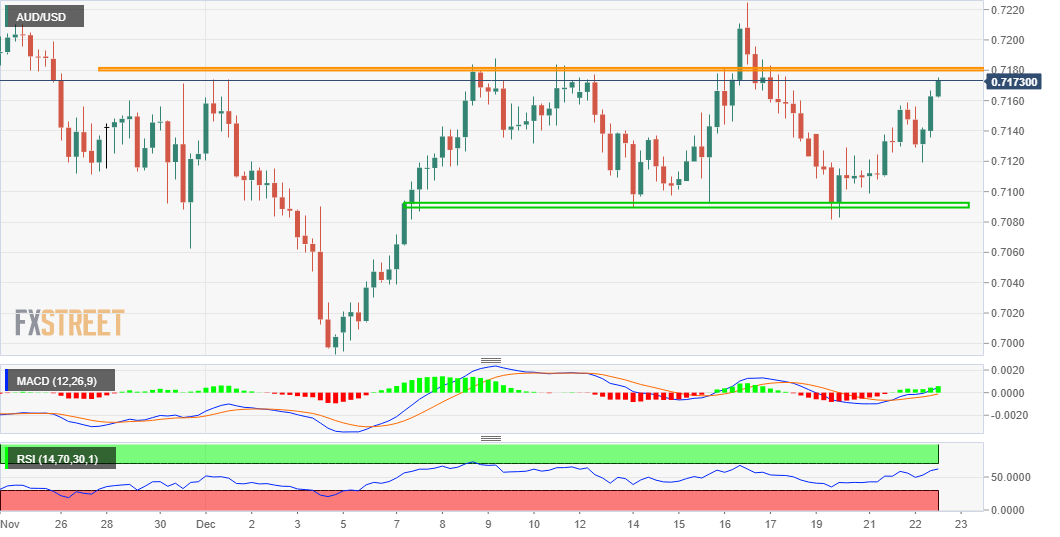
From a technical perspective, any subsequent move up is likely to confront some resistance near the 0.7185 region. This is closely followed by the 0.7200 round-figure mark and the monthly swing high, around the 0.7220-25 region, which if cleared decisively would be seen as a fresh trigger for bullish traders.
Meanwhile, technical indicators on the daily chart – though have recovered from the negative territory – are yet to confirm the bullish bias. This makes it prudent to wait for a strong follow-through buying before positioning for any further gains amid thin liquidity heading into the year-end holiday season.
On the flip side, immediate support is pegged near mid-0.7100s, below which the AUD/USD pair could drop back to retest the daily swing low, around the 0.7120 region. Some follow-through selling, leading to a subsequent break below the 0.7100 mark, could prompt technical selling and turn the pair vulnerable.
That said, bearish traders would still wait for sustained weakness below the 0.7090-80 region. The AUD/USD pair might then accelerate the fall to intermediate support near the 0.7060 region before dropping to challenge the YTD low, around the key 0.7000 psychological mark touched earlier this December.
AUD/USD 4-hour chart
Technical levels to watch
- WTI is ranging to the north of the $71.00 level in subdued Tuesday trade, $5.0 up fom Monday’s lows.
- Record high European nat gas prices and bullish inventory data are likely helping, but Omicron concerns continue to lurk.
Since recovering back to the north of the $71.00 level on Tuesday, front-month WTI futures have been heading sideways within a $71.00-$71.70ish range. For now, the key psychological level and 21-day moving average at $71.09 are acting as support, though if this level was to go, the door would be open to a swift drop back towards $70.00. The crude oil bulls will likely be pleased with how well oil markets were able to recover from Monday’s lows just above $66.00.
Surging natural gas prices in Europe is likely lending some support. Prices there have been hitting fresh record highs this week amid fears of Russia withholding gas deliveries amid political tensions with NATO over Ukraine. There has been a significant build-up of Russian troops on the Ukrainian border as Russia demands no more Eastwards NATO expansions and no more deployment of offensive weapons close to its border. Given European dependence on Russian gas imports, it is not surprising to see Russia flexing this leverage in order to hurt the European economy. Reports over the last few days suggest that industry across the EU has been affected by the surge in prices, with many factories halting production as a result of high energy costs.
With regards to how this relates to crude oil markets, higher gas prices incentivises power producers to substitute in comparatively cheaper crude oil, increasing its demand, thus boosting oil prices. Tuesday also saw the release of the weekly US API crude oil inventory report which saw a much larger drawdown on stocks than expected of 3.67M versus forecasts for 2.6M. The bullish report is for now likely helping to keep WTI supported above $71.00, though oil traders will be looking ahead to the release of official weekly US inventory data at 1530GMT for confirmation.
In the meantime, news of fresh international travel restrictions isn’t helpful to sentiment is likely to stand in the way of further gains from Monday’s lows, with focus on Singapore halting quarantine-free travel and freezing all new airplane ticket sales for flights and buses until 20 January amid Omicron risks. These travel restriction comes as nations across Europe consider or move ahead with fresh restrictions to curb Omicron transmission, with South Korea also imposing fresh measures. Analysts have pointed out that markets look increasingly to be entering “holiday mode” ahead of Christmas day celebrations across the Christian world on Saturday and New Year celebrations next week. For oil markets, that might mean conditions are more rangebound than usual amid lower than normal liquidity.
US Q3 GDP Overview
Wednesday's US economic docket highlights the releases of the final Q3 GDP print, scheduled at 13:30 GMT. The final estimate is expected to match the preliminary release and confirm that the world's largest economy expanded by 2.1% annualized pace during the July-September period.
How Could it Affect EUR/USD?
The backward-looking report is unlikely to provide any impetus as the market focus remains on developments surrounding the coronavirus saga. That said, any significant revision could move the US dollar and produce some meaningful trading opportunities around the EUR/USD pair. The market reaction, however, is likely to remain limited amid relatively thin liquidity conditions heading into the year-end holiday season.
Meanwhile, Eren Sengezer, Editor at FXStreet, offered a brief technical outlook for the EUR/USD pair: “The Relative Strength Index (RSI) indicator on the daily chart returned to 50 early Wednesday, pointing to the pair's indecisiveness in the near term.”
Eren further provided important technical levels to trade the major: “Currently, EUR/USD is testing the static support that is located at 1.1270 and if a four-hour candle closes below that level, additional losses toward 1.1240, the next static level, could be witnessed. 1.1200 (psychological level) aligns as the next target on the downside but an extended decline toward that support is unlikely unless fueled by a fundamental driver.”
“On the upside, key resistance aligns at 1.1295/1.1300 (100-period SMA, psychological level, upper limit of the current trading range) before 1.1320 (static level) and 1.1330 (200-period SMA),” he added further.
Key Notes
• EUR/USD Forecast: Bears to retain control as euro fails to clear key hurdle
• Morgan Stanley slashes 2022 US GDP forecast from 4.9% to 4.6%
• EUR/USD nudges above 1.1300 amid subdued holiday trading conditions
About US GDP
The Gross Domestic Product Annualized released by the US Bureau of Economic Analysis shows the monetary value of all the goods, services and structures produced within a country in a given period of time. GDP Annualized is a gross measure of market activity because it indicates the pace at which a country's economy is growing or decreasing. Generally speaking, a high reading or a better than expected number is seen as positive for equities, while a low reading is negative.
- EUR/USD has pushed above 1.1300 in recent trade and is up about 0.2%.
- Some have suggested that hawkish commentary from ECB’s Kazimir earlier in the session is lifting the euro.
- FX markets are very much in “holiday mode” now, given the proximity to Christmas and New Years' celebrations.
EUR/USD has nudged above the 1.1300 level in recent trade, with the pair now up about 0.2% on the session. The recent push higher marks a decent effort by the pair to break away from its 21-day moving average, which trades in the 1.1280s and had been acting as a magnet to the price action since Monday. Some are suggesting that some hawkish commentary from ECB governing council member and Slovakian central bank head Peter Kazimir, who joined a throng of other hawkish leaning ECB policymakers in warning about upside risks to the ECB’s inflation forecasts, is helping the euro marginally on Wednesday and that could well be the case.
Traders would do well not to read too much into recent moves, or extrapolate too much. FX markets are very much in “holiday mode” now, given the proximity to Christmas and New Years celebrations, which means a lot of market participants are taking time off. Liquidity conditions are thus thin, and markets are expected to trade with a lack of conviction. This can become a self-fulfilling prophecy, with the market participants that are still present opting not to place big bets until activity picks up in the new year. For EUR/USD, that means a break out of recent 1.1250.1.1350ish ranges is unlikely.
Looking ahead, the third estimate of US Q3 GDP data is scheduled for release at 1330GMT, but given how backward-looking it is, shouldn’t garner too much attention. The release of the US Conference Board’s Consumer Confidence survey at 1500GMT is likely to garner more attention given it is much timelier and will be a guage of how badly the arrival of Omicron on US shores has dented sentiment. Still, given holiday conditions, the impact on EUR/USD is likely to be minimal. The latest news on Omicron itself is likely to remain the main market driver as nations across Europe take steps to reimpose varying degrees of restrictions in an attempt to curb transmission.
- GBP/USD gained strong positive traction for the second successive day on Wednesday.
- A positive risk tone, sliding US bond yields undermined the USD and extended support.
- The Fed’s hawkish outlook could act as a tailwind for the greenback and cap the upside.
- The worsening COVID-19 situation in the UK further warrants caution for bullish traders.
The emergence of some selling around the USD pushed the GBP/USD pair to a fresh weekly high, around the 1.3325 region during the mid-European session.
The pair added to the previous day's positive move and gained strong follow-through traction for the second successive day on Wednesday. The momentum allowed the GBP/USD pair to build on this week's bounce from the vicinity of the YTD low and was sponsored by a modest US dollar weakness.
Concerns that the fast-spreading Omicron variant could derail the global economic recovery eased amid reports that the current vaccines may be more effective than first thought in fighting the new strain. This, in turn, boosted investors' confidence and undermined the safe-haven greenback.
Apart from this, a softer tone around the US Treasury bond yields turned out to be another factor that weighed on the greenback. This, along with some technical buying on a sustained strength beyond the 1.3300 round figure, further contributed to the GBP/USD pair's strong intraday move up.
It, however, remains to be seen if bulls are able to capitalize on the move amid the worsening COVID-19 situation in the United Kingdom. In fact, UK Prime Minister Borish Johnson said that the Omicron-related data will be kept under review to see if stricter measures are needed next week.
This, along with the UK-EU impasse over the Northern Ireland Protocol could act as a headwind for the British pound. The UK Foreign Minister Liz Truss – now in charge of Brexit negotiations – reiterated that triggering Article 16 remains an option if the EU does not compromise further.
On the other hand, the Fed's hawkish outlook, indicating at least three rate hikes next year, should attract some USD buying at lower levels and keep a lid on any further gains for the GBP/USD pair. This, in turn, suggests that the intraday move up runs the risk of fizzling out rather quickly.
Market participants now look forward to the US economic docket, highlighting the release of the final Q3 GDP print and the Conference Board's Consumer Confidence Index. This, along with the US bond yields, might influence the USD price dynamics and provide some impetus to the GBP/USD pair.
Technical levels to watch
- USD/CHF struggled to preserve modest intraday gains to the 0.9250 strong resistance zone.
- Retreating US bond yields kept the USD bulls on the defensive and capped gains for the pair.
- The Fed’s hawkish outlook should act as a tailwind for the USD and limit any meaningful slide.
The USD/CHF pair surrendered modest intraday gains and dropped to the lower end of its daily trading range, around the 0.9230 region during the first half of the European session
The pair gained some positive traction during the early part of the trading on Wednesday, albeit continued with its struggle to make it through the 0.9250 resistance zone. A fresh leg down in the US Treasury bond yields kept the US dollar bulls on the defensive and capped the early uptick for the USD/CHF pair, rather prompted some intraday selling.
That said, a combination of supporting factors should lend some support and help limit any deeper losses, at least for now. The Fed's hawkish outlook, indicating at least three rate hikes next year, should lend some support to the greenback. Apart from this, fading safe-haven demand should assist the USD/CHF pair to attract some dip-buying at lower levels.
Investors turned optimistic after reports suggested that the current vaccines may be more effective than first thought in fighting the Omicron variant. The optimism should act as a headwind for the safe-haven Swiss franc and extend some support to the USD/CHF pair. This warrants caution before placing bearish bets and positioning for any meaningful slide.
Wednesday's US economic docket highlights the release of the final Q3 GDP print and the Conference Board's Consumer Confidence Index. This, along with the US bond yields, would influence the USD and provide some impetus to the USD/CHF pair. Traders will further take cues from the broader market risk sentiment to grab some short-term opportunities.
Technical levels to watch
EUR/CHF has been declining since mid-September and is currently trading at the lowest level since 2015. Economists at Danske Bank expect the pair to suffer further losses towards the 1.00 level.
Key upside risks are global yield curves steepening and FX intervention from the SNB
“We believe there is still room for further declines as, 1) persistently diverging price levels favour a fundamentally stronger CHF via PPP 2) the SNB will let CHF appreciate on fundamentals and 3) as a global investment environment characterised by tighter economic policy and global liquidity conditions weighing on growth and inflation momentum favour a stronger CHF.”
“We do a broad revision of our overall forecast of EUR/CHF and now target the cross at 1.00 in 12M (previously 1.08).”
“The key upside risks to our forecast are global yield curves steepening amid a shift in the global investment environment and/or an FX intervention from the SNB in order to avoid EUR/CHF from declining too much.”
- AUD/USD attracted some dip-buying on Wednesday and bounced over 35 pips from the daily low.
- Easing Omicron fears extended support to the perceived riskier aussie and provided a modest lift.
- The Fed’s hawkish outlook acted as a tailwind for the USD and capped any further gains for the pair.
The AUD/USD pair climbed back above mid-0.7100s during the first half of the European session and refreshed the weekly high in the last hour.
The pair attracted some dip-buying near the 0.7120 region on Wednesday and is now looking to build on this week's bounce from the 0.7080 area or the lowest level since December 7. Reports that the current vaccines may be more effective than first thought in fighting the Omicron variant boosted investors' confidence. This, in turn, was seen as a key factor that extended some support to the perceived riskier aussie.
Apart from this, a fresh leg down in the US Treasury bond yields undermined the safe-haven US dollar and contributed to the AUD/USD pair's goodish intraday bounce of around 35 pips. That said, the Fed's hawkish outlook acted as a tailwind for the greenback and capped gains for the major. It is worth recalling that the so-called dot plot indicated that Fed officials expect to raise the fed funds rate at least three times next year.
Investors also seemed reluctant to place aggressive bets amid relatively thin liquidity conditions heading into the end-of-year holiday season. This, in turn, warrants some caution for bullish traders and before positioning for any further gains. Market participants now look forward to the US economic docket, highlighting the release of the final Q3 GDP print and the Conference Board's Consumer Confidence Index for a fresh impetus.
Apart from this, the US bond yields will influence the USD price dynamics. Traders will further take cues from developments surrounding the coronavirus saga and the broader market risk sentiment to grab some short-term opportunities around the AUD/USD pair.
Technical levels to watch
The loonie is ending 2021 on a somewhat sour note, almost exactly unchanged from levels at the end of 2020, even after an early-year pop. Looking into 2022, the Canadian dollar will firm, in the opinion of economists at the Bank of Montreal.
New oil prices highs to lift the loonie
“Even with some modest further firming in the US dollar in the coming year, we still look for a small gain in the Canadian dollar (from an admittedly soft starting point) on a global recovery, on the BoC leading the Fed, and on supportive commodity prices.”
“The CAD could be bolstered by oil prices reaching new multi-year highs in the second half of 2022, as demand recovers more fully, and it becomes apparent that supply is simply not responding. In turn, this could reinforce the upside potential for the loonie, even amid a cloudy growth backdrop.”
Despite the strong year for stocks in 2021, markets have confidently priced in some negative trends gathering more momentum in 2022 that may help the market should these trends reverse. Here are Charles Schwab’s top five global risks for investors in 2022.
Shortages turn into gluts
“Should a supply glut emerge in 2022, it may lead to a fall in inflation with excess inventory prompting price cuts and posing risks to industries that have thrived on the shortage-fueled pricing boost.”
Rate hikes are slower than expected
“Should inflation pressures ease in 2022 as we expect, so may the expectations for the number of rate hikes and the corresponding tightening of financial conditions. Inflation fears may be peaking, along with concerns that central banks may stall the recovery by acting too quickly to raise rates in 2022.”
China goes from cracking down to propping up
“China’s monetary policy is shifting into easing mode, as the rest of the world shifts to tightening. With more stimulus on tap, the news flow on China may go from a focus on a crackdown on some industries in 2021 to propping up other industries in 2022.”
COVID-19 waves may not resemble those of 2021
“Each wave lasts two months and has been driving investors to rotate consistently among these stocks. Yet, this winter’s omicron wave (and future waves) may pose a risk to investors, since they may not be unfolding in the same way in terms of COVID-19 cases or market leadership.”
Geopolitical surprises
“After the globe weathered the COVID-19 crisis without conflict in 2021, the risks of conflict may be higher than expected by the markets in 2022.”
- USD/TRY sidelined around 12.50, as the lira remains unfazed by Erdogan’s speech.
- Erdogan said new economic measures have achieved goal.
- 50-DMA caps losses while 21-DMA is the level to beat for the bulls.
USD/TRY is trading almost unchanged on the day, around 12.50, at the time of writing, as the lira pays little heed to the latest comments from Turkish President Tayyip Erdogan.
Erdogan said that he will not let Turks be crushed under interest rates and inflation.
Additional quotes
Speculative financial games tried to bring down turkey.
Domestic forces also played games against Turkish economy.
Thwarted all games against economy, continues path with god's help.
He will not Turks be crushed under interest rates, inflation.
Turkey will emerge victorious from economic battle.
There are obstacles, risks, traps but turkey's determination will overwhelm these.
There will be no early elections.
New economic measures have achieved goal.
Turkey not doing anything against free market rules, ensuring speculators leave economy alone.
Those calling to buy forex now have had their "brains watered down".
His comments come after the domestic currency staged a historic recovery rally from record lows of 18.37, helped by Erdogan announced a rescue plan to compensate savers for currency moves that have eroded the value of bank deposits held in the lira.
Looking at USD/TRY’s technical chart, the spot is attempting a tepid bounce, holding comfortably above the 50-Daily Moving Average (DMA) support at 11.49.
Meanwhile, the horizontal 21-DMA at 13.63 will continue guarding the upside.
The indecisive price action in USD/TRY is justified by the 14-day Relative Strength Index (RSI), which is trading at coin flip levels.
USD/TRY: Daily chart
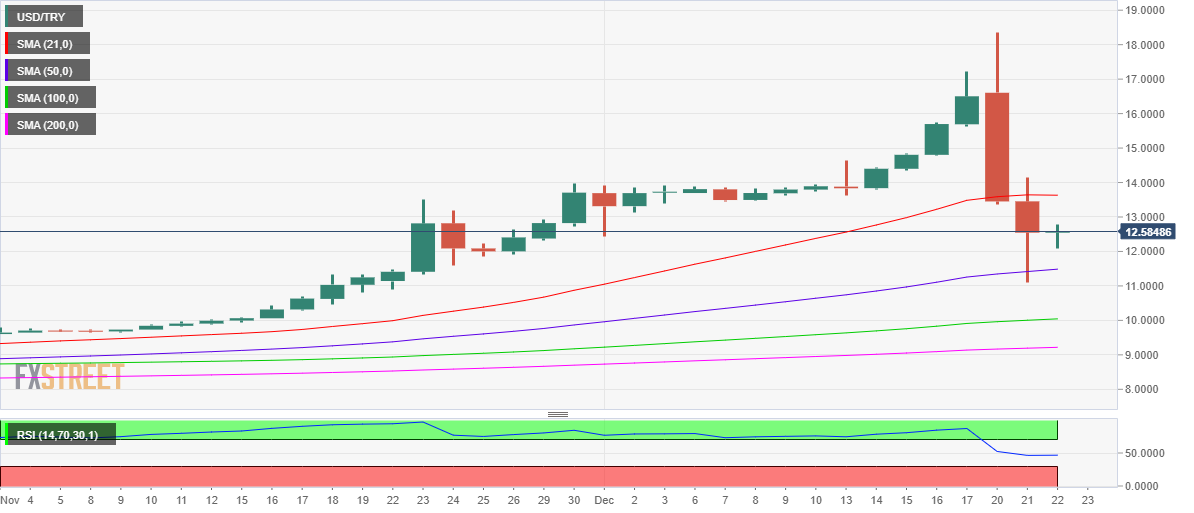
AUD/CAD’s rebound has averted extended sell-off. The pair may reach 0.93, economists at Scotiabank report.
Key support is seen at 0.9155/60
“AUD/CAD’s break under the base of the recent range around 0.91 marked the near-term low point for the cross. Price action subsequently turned bullish; short-term DMI signals suggest that the AUD has further room to appreciate.”
“We target near-term gains towards the 0.93 area.”
“Key AUD/CAD support is 0.9155/60.”
- USD/JPY added to the overnight gains and scaled higher for the second straight day on Wednesday.
- Easing worries about the Omicron variant undermined the safe-haven JPY and extended support.
- The Fed’s hawkish outlook acted as a tailwind for the USD and remained supportive of the move.
- Retreating US bond yields capped the USD and might hold back bulls from placing aggressive bets.
The USD/JPY pair broke out of its intraday consolidation phase and jumped to a fresh monthly high, around the 114.30 region during the early part of the European session.
The pair gained positive traction for the second successive day on Thursday and was supported by a combination of factors. A generally positive risk tone, along with the Bank of Japan's dovish stance undermined the safe-haven Japanese yen and acted as a tailwind for the USD/JPY pair.
Concerns about the rapidly-spreading Omicron coronavirus variant eased amid reports that the current vaccines may be more effective than first thought in fighting the Omicron variant. This, in turn, boosted invesotrs' confidence and drove flows away from traditional safe-haven currencies.
The JPY was further weighed down by a more dovish stance adopted by the Bank of Japan. The minutes of the latest BoJ policy meeting released earlier this Wednesday showed that board members backed the need to maintain ultra-lose policy measures as the 2% inflation target is still far off.
On the other hand, the US dollar drew some support from the Fed's hawkish outlook, indicating at least three rate hikes next year. That said, a fresh leg down in the US Treasury bond yields held back the USD bulls from placing aggressive bets and could cap any further gains for the USD/JPY pair.
Market participants now look forward to the US economic docket, highlighting the release of the final Q3 GDP print and the Conference Board's Consumer Confidence Index. This, along with the US bond yields, will influence the USD price dynamics and provide some impetus to the USD/JPY pair.
Apart from this, traders will further take cues from developments surrounding the coronavirus saga and the broader market risk sentiment for some short-term opportunities. That said, the movement is likely to remain limited amid thin liquidity conditions heading into the year-end holiday season.
Technical levels to watch
The last two months have witnessed a substantive grind lower in EUR/CHF. In the view of economists at ING, the Swiss franc may stay supported on unstable risk sentiment.
A good Omicron hedge
“In the current market environment, it’s hard to imagine the Swiss franc losing any support. Its role as the quintessential risk hedge to European risk makes it an attractive currency as Omicron cases and potential closures rise in the region.”
“The SNB looks set to keep intervening in the FX market to curb CHF appreciation, but it might not draw a line in the sand in EUR/CHF (eg, at 1.04) given the very choppy risk environment. We see more downside risks to the pair into January.”
Despite facing economic headwinds from lingering COVID-19 and related issues, the Chinese yuan has been the strongest major currency through 2021. PBoC pro-active monetary policy, demand for Chinese bonds, and benefits of a steady or stronger currency continue to support CNY outperformance, as reported by economists at CIBC Capital Markets.
Further CNY appreciation in 2022
“Overall asset demand has been bolstered by a reduction in perceived premium to invest in China. Presidents Xi and Biden having started dialogue through the recent virtual summit, calming perceptions of the nations heading toward conflict, and is reason for encouragement that the premium can be reduced. Even if that does not deny that tensions at some level will almost certainly be a feature for some time to come.”
“Chinese monetary policy has been kept ‘basically stable’, though has still been set to be economically supportive throughout the last year. We expect the same approach in 2022, with the mantra of ‘targeted support’ to be prominent. That will mean targeted lending instructions and a possible further RRR cut for banks to support small and medium sized businesses.”
“There is always a risk that the pace of currency gains will raise ire of authorities. But an ongoing strong trade performance, and a widening current account surplus support appreciation, and suggest on these factors, the relative hands-off approach to the currency can continue.”
The Australian dollar has rebounded from a test of major support vs the USD at 0.7000. According to economists at ING there is a couple of factors that should underpin the aussie above the 0.7100 level.
Aussie is looking at an overstretched net-short positioning
“China’s latest efforts to support the domestic economy have turned the narrative to a more supportive one for China-sensitive currencies like AUD.”
“In the commodities sector, latest developments in China are fuelling a rally in iron ore, as hopes that steel restrictions will be eased seem to be brightening the demand outlook.”
“We think all this can help shield the aussie – which is also looking at an overstretched net-short positioning – from the blows to global risk sentiment caused by the Omicron variant spread.”
“AUD/USD may find some good support at 0.7100.”
EUR/CZK struggled to reclaim the upper band of a multi month descending channel near 25.80 resulting in a pullback. A deeper downmove would be on the cards if the pair breaks below the trough of November around 25.16, economists at Société Générale report.
Break above 25.32/25.35 is essential for a meaningful rebound
“EUR/CZK is now retesting the trough of November near 25.16. This is a crucial support. In case this breaks, there would be a risk of a deeper down move towards the lower limit of the channel at 25.00 with next support at 2020 low of 24.75.”
“A break above 25.32/25.35, the 23.6% retracement from November will be essential for a meaningful rebound.”
- Gold price remains depressed below $1,800 amid a lack of fresh catalysts.
- Focus shifts to the US top-tier economic data for fresh trading impetus.
- Gold bears could aim to challenge monthly low, US data awaited.
Gold price is trading listlessly below $1,800 in the lead up to the first top-tier US data for this holiday-shortened Christmas week. Cautious market mood, in the face of uncertainties around the Omicron covid variant, continues to keep investors away from placing any directional bets on the bright metal, leaving it exposed to downside risks.
Read: Gold 2022 Outlook: Correlation with US T-bond yields to drive yellow metal
Gold Price: Key levels to watch
The Technical Confluences Detector shows that the gold price is teasing the previous day’s low at $1,785, eyeing a sustained move below that level to challenge the next support around $1,782.
That area is the intersection of the pivot point one-day S1 and SMA100 four-hour.
A fresh downswing towards the confluence of the Fibonacci 61.8% one-week and pivot point one-day S2 at $1,1776 will be in the offing if the bears clear the previous hurdle.
Alternatively, powerful resistance awaits at $1,792, where the Fibonacci 38.2% one-day and one-week coincide with the SMA10 four-hour.
Further up, gold bulls will try their luck once again with the SMA200 one-day at $1,796, above which the convergence of the previous day’s high and Fibonacci 23.6% one-week around $1,800 will come into play.
Buying resurgence above $1,800 will expose the upside towards the Fibonacci 38.2% one-week at $1,804.
Here is how it looks on the tool
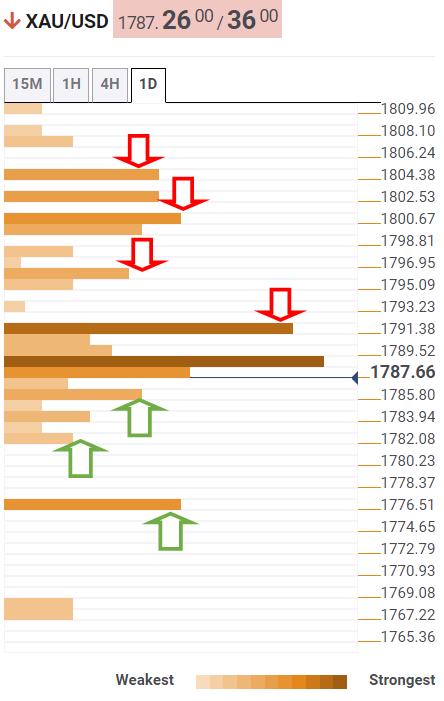
About Technical Confluences Detector
The TCD (Technical Confluences Detector) is a tool to locate and point out those price levels where there is a congestion of indicators, moving averages, Fibonacci levels, Pivot Points, etc. If you are a short-term trader, you will find entry points for counter-trend strategies and hunt a few points at a time. If you are a medium-to-long-term trader, this tool will allow you to know in advance the price levels where a medium-to-long-term trend may stop and rest, where to unwind positions, or where to increase your position size.
There is a clear divergence between the outlook of the Federal Reserve and European Central Bank (ECB) interest policy in 2022. Economists at Rabobank expect that USD upside has further to run in the early months of 2022. Consequently, they have revised down their six-month EUR/USD forecast to 1.10 from 1.12.
Doubts over whether bullish USD momentum can last the whole year
“We expect that USD upside has further to run in the early months of 2022 as the Fed winds down its bond buying programme and moves closer to its first rate rise of the cycle.”
“With a lot of good news already in the price, we are concerned that the momentum behind the Greenback’s rally may run out of steam in the latter part of next year and see scope for the USD to have given back a little ground vs. the EUR on a 12-month horizon.”
“While we see scope for EUR/USD to trend down to the 1.10 level in the coming months, we also see the likelihood of a retreat back towards the 1.12 area by the end of next year.”
The South African rand remains by far the worst-performing major over the last three months. Economists at CIBC Capital Markets expect the ZAR to continue suffering downside momentum.
ZAR negativity compounded by omicron tourism impact
“After hiking to 3.75% at the last meeting, rates look set to advance by a further 25bp in Q1. The trend of policy tightening risks extending towards 5.0% in the next 12 months, further compromising the recovery narrative in the process.”
“With the key travel season appearing to be materially compromised by travel restrictions, an extension in ZAR negativity is likely.”
“Although the currency may longer be burdened by a substantive current account shortfall, and therefore not as dependant on hot money inflows, the prospect for rising US rates, impacting those with USD liabilities, allied to the USD likely generating a degree of safe-haven status, favours ongoing ZAR negativity.”
“The backdrop of low levels of vaccination, well below 30%, suggests that another season of tourist dollars looks set to be missed, encouraging near-term USD/ZAR upside.”
- GBP/USD gained some positive traction for the second successive day on Wednesday.
- A modest USD strength kept a lid on any meaningful upside for the pair, at least for now.
- Investors now look forward to the US macro releases for some short-term opportunities.
The GBP/USD pair shot to a fresh weekly high, albeit quickly retreated a few pips thereafter and was last seen trading with only modest intraday gains, around the 1.3265 region.
Having touched a daily low around the 1.3240 region, the GBP/USD pair attracted some dip-buying on Thursday and moved in the positive territory for the second successive day. The British pound drew some support from the fact that the UK Prime Minister Boris Johnson ruled out the possibility of imposing additional restrictions before Christmas. That said, a combination of factors held back traders from placing aggressive bullish bets and kept a lid on any meaningful upside for the major.
The worsening COVID-19 situations in Britain continued acting as a headwind for the sterling. In fact, Britain reported 90,629 new Covid-19 cases on Tuesday, slightly lower from the all-time high of 91,743 recorded the previous day. Moreover, the UK PM Johnson has said that the Omicron variant related data will be kept under review to see if stricter measures are needed next week. This, along with the UK-EU impasse over the Northern Ireland Protocol, capped gains for the GBP/USD pair, at least for now.
The UK Foreign Minister Liz Truss – now in charge of Brexit negotiations – said that their position on the Northern Ireland Protocol remains unchanged. She further added that we must end the role of the European Court of Justice as a final arbiter in the arrangement and that the UK remains prepared to trigger Article 16 if this does not happen. Apart from this, a modest US dollar strength failed to assist the GBP/USD pair to capitalize on the move and prompted some selling around the 1.3280 area.
The USD remained well supported by the Fed's hawkish outlook, indicating at least three rate hikes next year. This, in turn, warrants some caution before positioning for any further appreciating move amid relatively thin liquidity conditions heading into the year-end holiday season. Traders now look forward to the US economic docket, highlighting the final Q3 GDP print and the Conference Board's Consumer Confidence Index for some short-term opportunities around the GBP/USD pair.
Technical levels to watch
In the view of economists at ING, the Norwegian krone may emerge as the surprise outperformer thanks to surging gas prices.
Extra support from natural gas
“There is some positive seasonality factor for NOK. On top of this, European gas prices continue to soar, this time due to a halt in Russian gas flows from a key route to Germany. Weather forecasts suggest the Christmas week is set to be a particularly cold one in Europe, which should also keep natural gas prices supported.”
“We think NOK may see some delayed benefit from the Norges Bank’s December hike and while growing risk aversion will continue to give some support to EUR/NOK, we could see the pair edge lower in the next two weeks.”
- A modest USD strength prompted some intraday selling around NZD/USD on Wednesday.
- A generally positive risk tone benefitted the perceived riskier kiwi and helped limit losses.
- Investors now look forward to the US economic docket for some short-term trading impetus.
The NZD/USD pair reversed a major part of its intraday losses and was last seen hovering near the top end of its daily trading range, around the 0.6760-65 region.
The pair struggled to capitalize on the previous day's recovery move from the 0.6700 mark or the YTD low instead, witnessed some selling during the early part of the trading on Wednesday amid a modest US dollar strength. That said, a generally positive tone helped limit deeper losses for the perceived riskier kiwi.
Having posted some losses over the past two trading sessions, the greenback attracted some buying on Wednesday and continued drawing support from the Fed's hawkish outlook. It is worth recalling that the so-called dot plot indicated that the Fed officials expect to raise the fed funds rate at least three times next year.
The USD bulls, however, refrained from placing aggressive bets amid a fresh leg down in the US Treasury bond yields. Apart from this, the optimism over the prospects that the current vaccines may be more effective than first thought in fighting the Omicron variant of the coronavirus acted as a tailwind for the NZD/USD pair.
The mixed fundamental backdrop warrants some caution before placing directional bets amid relatively thin liquidity conditions heading into the end-of-year holiday season. Market participants now look forward to the US economic docket, highlighting the release of the final Q3 GDP print and the Conference Board's Consumer Confidence Index.
This, along with the US bond yields, might influence the USD price dynamics and provide some impetus to the NZD/USD pair. Traders will further take cues from developments surrounding the coronavirus saga and the broader market risk sentiment to grab some short-term opportunities around the major.
Technical levels to watch
EUR/SEK has continued its rally upwards currently trading around 10.25. With a global growth slowdown looming and central bank divergence, economists at Danske Bank remain bearish on the Swedish krona forecasting 10.50 in 12 months.
SEK set to weaken in 2022 amid CB divergence
“The seasonal pattern suggests EUR/SEK will go lower in the last two weeks of December. Since 2009, the cross has posted negative returns in December every year except 2014, on average -0.9%, making the best SEK month of the year.
“Fundamentals like central bank divergence and global growth slowdown act as headwinds for broad SEK in 2022. The Riksbank remains in ‘team transitory’, in contrast to a handful of peers. We believe the Riksbank will sit on its hands for the next two years at least, which makes market expectations much too aggressive.”
“We stick to our view of a temporary dip over year-end and a weaker SEK in the 3-12M perspective. We see 10.10 (from 10.00) in 1M, 10.20 (from 10.10) in 3M, 10.30 (unch.) in 6M and 10.50 (unch.) in 12M.”
USD/TRY peaked at an all-time high of 18.3633 (an approximate 12% move up), to then drop to 12.2756 before the end of the day on Monday. In the view of economists at TD Securities, it is likely that the bearish USD/TRY move of the past hours is a move that markets will be fading.
USD/TRY may find some short-term reprieve
“USD/TRY may find some short-term reprieve, possibly strengthened by speculative longs that want to ride the enthusiasm of the moment. But the long-term macro-financial weaknesses of Turkey are still all there until the origins of this TRY debacle is acknowledged and dealt with.”
“With real rates at around -700bps, and likely to dip deeper as inflation rises and rates are maybe eased further, USDTRY has only one direction to go: up.”
USD/JPY has climbed to its strongest level in a week above 114.00. But economists at ING expect the yen to stay supported on unstable risk sentiment, pushing the pair towards 113.00 in the short-term.
Room for a short-term short-squeeze
“Despite not having a supportive seasonal trend around Christmas, we think that the risks are skewed to the upside for the yen in the next two weeks as the Omicron situation looks likely to get worse before getting better.”
“We think we could see some short-term weakness in JPY, which may pull back below 113.00.”
“Still, we expect any JPY strength to prove temporary as the Fed tapering and tightening should put upward pressure on UST yields and energy prices should stay elevated.”
The Federal Reserve is poised to start hiking rates in Q2 2022, and building market expectations for higher terminal rates will support a final act for the USD rally, as reported by economists at CIBC Capital Markets.
US dollar rally has a final act to come
“The Fed elected to accelerate its taper of asset purchases, remove the reference to ‘transitory’ when referencing inflation in the statement, and acknowledge that the risks to price pressures were higher. Additionally, the latest round of dot projections show the Fed lifting off three times in 2022.”
“We still see upside for the USD into next year.”
“From an endogenous perspective, the USD can rally further as markets begin to price the implied terminal rate for the Fed higher. And there’s good reason to believe that this will happen considering that we’re expecting a sharp reacceleration in activity following the winter Covid wave.”
“Any consolidation or retrenchment should be regarded as an opportunity to adjust hedges.”
EUR/USD tested 1.1300 for the second straight day on Tuesday but ended up closing the day virtually unchanged near 1.1280. In the view of economists at ING, EUR/USD may flatten around 1.1300 around Christmas.
Flattening up into the new year
“Despite the ECB being less dovish than expected, last week’s central bank meetings marked a stark policy divergence with the Fed. And while the Fed’s focus seems to have dramatically shifted to the inflation discussion, the ECB will struggle to overlook the Omicron impact – which is already translating into strict lockdowns in some eurozone countries. We think this is a notion that will offer a bearish underlying narrative to EUR/USD in 2022.”
“The dollar tends to underperform around Christmas. However, we think that the recent hawkish turn by the Fed and unstable risk sentiment can mostly offset the negative effect. On the EUR side, we doubt we will see any idiosyncratic rally as the eurozone appears more likely than many other regions (like the US) to tighten containment measures. Incidentally, the EUR is on average the least likely to benefit from any dollar weakness around the end of December.”
“We expect EUR/USD to consolidate around the 1.1300 level into the new year.”
The loonie was on a rollercoaster at the onset of the discovery of the omicron variant but has since come full circle, and is sitting marginally weaker. As markets price matching rate hike cycles across the Canada-US border, USD/CAD is set to rally early in 2022, analysts at CIBC Capital Markets report.
Loonie to start the New Year with a whimper
“We expect that as QE tapering winds down and the first Fed hike is delivered in Q2, markets will move to price in more Fed action, pushing USD/CAD to 1.32 in Q3 2022.”
“Weighing on the loonie in early 2022 will be a lack of upside in commodities. Demand for oil will be hampered in the near term by the spread of omicron globally. Thereafter, the potential for OPEC+ to ramp up oil supply during the recovery will put a cap on prices. A return to more travel will also bring back Canada's typical deficit in tourism services trade.”
“By late 2022, we expect to see a shift in the tides for the loonie, as the market will likely have come around to our view on Fed hikes for the post-2022 period, and the broad trend in the USD could therefore be towards a greenback depreciation as other advanced economy central banks move to normalize rates. However, CAD will still only be a marginal beneficiary of that trend, as the bigger news will be a turn towards tighter monetary policy in lagging regions like the eurozone.”
EUR/GBP has been volatile lately but and is trading close to 0.85 after the Bank of England (BoE) initiated its hiking cycle by hiking 15bp to 0.25%. Economists at Danske Bank remain bullish on the pound and lift their 12-month target to 0.84.
Aggressive BoE market pricing
“We still believe EUR/GBP will move slightly lower in 2022, as the ‘positive USD’ environment is usually also benefitting GBP versus EUR.”
“We have lifted our 12M target to 0.84 (from 0.83) given the aggressive BoE market pricing. The (in our view) too aggressive BoE market pricing and renewed Brexit uncertainties may put some upward pressure on EUR/GBP near-term or at least increase volatility.”
“A hit to global risk sentiment could hit GBP. GBP would also take a hit if the BoE keeps monetary policy accommodative for longer than currently expected. Stagflation may become more pronounced in the UK compared to the euro area. EU-UK tensions remain a risk.”
Fears of Russian invasion to Ukraine have once again resurfaced over the past weeks, yet the situation has so far had limited impact on the ruble. Economists at Danske Bank continue to see downside risk to EUR/RUB, targeting 77.00 in 12 months.
RUB strength is not done yet
“Relocating troops near the Ukrainian border is nothing new compared to last spring, and thus the latest worries are a known risk.”
“With the EUR being exposed amid high energy prices and tempering expectations to the manufacturing sector, we see downside risk as noticeable in EUR/RUB and we look for 77.00 in 12M, while the outlook is more balanced for USD/RUB.”
“The Russian CB continued its hiking cycle by 100bp in December, and signalled a risk of further hikes. The CB has been supportive of RUB and will likely continue to be so into Q1. We hence see EUR/RUB as continuing its downtrend.”
“The key risks appear to be 1) a broad based USD strength and/or 2) a geopolitical event in Russia-Ukraine relations, which may take EUR/RUB towards or above 90.00.”
- GBP/JPY witnessed a subdued/range-bound price action through the early European session.
- COVID-19 woes acted as a headwind for the sterling amid persistent Brexit-related uncertainties.
- A positive risk tone, dovish BoJ minutes undermined the safe-haven JPY and helped limit losses.
The GBP/JPY cross extended its sideways consolidative price move and held steady, comfortably above the 151.00 round-figure mark post-UK macro data.
The cross struggled to capitalize on the previous day's strong move up and seesawed between tepid gains/minor losses through the early European session on Wednesday. The worsening COVID-19 situations in the United Kingdom, along with the UK-EU impasse over the Northern Ireland Protocol acted as a headwind for the sterling and capped the upside for the GBP/JPY cross.
In fact, Britain reported 90,629 new Covid-19 cases on Tuesday, slightly lower from the all-time high of 91,743 recorded the previous day. The UK Prime Minister Boris Johnson ruled out the possibility of imposing additional restrictions before Christmas, though said the Omicron variant related data will be kept under review to see if stricter measures are needed next week.
On the Brexit-related front, the UK Foreign Minister Liz Truss – now in charge of Brexit negotiations – said that their position on the Northern Ireland Protocol remains unchanged. She further added that we must end the role of the European Court of Justice as a final arbiter in the arrangement and that the UK remains prepared to trigger Article 16 if this does not happen.
Meanwhile, data released on Wednesday showed that the UK economy expanded 1.1% during the third quarter of 2021, lower than the 1.3% estimated in the preliminary report. This, however, was offset by an upward revision of the yearly growth rate to 6.8% from 6.6% reported previous. The data did little to impress traders or provide any meaningful impetus to the GBP/JPY cross.
On the other hand, signs of stability in the equity markets and the Bank of Japan's dovish stance undermined the safe-haven Japanese yen. The minutes of the latest BoJ meeting showed that board members backed the need to maintain ultra-lose policy measures as the 2% inflation target is still far off. This, in turn, extended support to the GBP/JPY cross and helped limit the downside.
The mixed fundamental backdrop held traders from placing aggressive bets amid relatively thin liquidity conditions heading into the year-end holiday season. Hence, it will be prudent to wait for a strong follow-through buying before confirming that the GBP/JPY cross has formed a near-term bottom and positioning for any meaningful appreciating move.
Technical levels to watch
Here is what you need to know on Wednesday, December 22:
The greenback struggled to find demand on Tuesday amid a positive shift witnessed in risk sentiment. Rising US Treasury bond yields, however, helped the dollar limit its losses and the US Dollar Index seems to have gone into a consolidation phase around 96.50 early Europe. Later in the day, the US Bureau of Economic Analysis will release its final revision to the annualized GDP growth for the third quarter. The Conference Board's December Consumer Confidence and November Existing Home Sales data will be featured in the US economic docket as well.
Despite a lack of positive developments surrounding the Omicron variant, Wall Street's main indexes managed to register strong gains on Tuesday with investors seeing the latest drop as an opportunity for bargain shopping. The benchmark 10-year US Treasury bond yield came within a touching distance of 1.5% but retreated modestly before turning quiet around 1.46% early Wednesday. US stocks futures are trading flat, suggesting that the risk rally has already lost its momentum.
EUR/USD tested 1.1300 for the second straight day on Tuesday but ended up closing the day virtually unchanged near 1.1280. The monthly data published by the European Commission showed that consumer sentiment deteriorated in the eurozone with the Consumer Confidence Index falling to -8.3 (preliminary) in December from -6.8 in November. The pair is currently trading in the negative territory around 1.1270.
GBP/USD is trading in a tight channel around 1.3250 early Wednesday as investors showed little to no reaction to the latest data releases from the UK. The Office for National Statistics reported that the annualized GDP grew by 6.8% in the third quarter, coming in better than the market expectation of 6.6%. Additionally, Total Business Investment in the UK contracted by 2.5% on a quarterly basis in the third quarter.
USD/JPY capitalized on rising US Treasury bond yields and climbed to its strongest level in a week above 114.00. The pair is consolidating Tuesday's gains around 114.20.
Gold lost its traction after testing $1,800 on Tuesday and retreated to $1,790 area, pressured by recovering US Treasury bond yields. As it currently stands, XAU/USD could find it difficult to attract buyers unless it flips $1,800 into support.
USD/CAD closed modestly lower on Tuesday as the upbeat Canadian data, which showed that Retail Sales rose by 1.6% in October, helped the loonie stay resilient against its American counterpart. The pair is staying quiet around 1.2900 in the early European session.
Bitcoin registered decisive gains on Tuesday and continues to edge higher toward the critical $50,000 mark. Ethereum closed in the green for the second straight day on Tuesday and looks to settle above $4,000.
XAU/USD held steady on Wednesday and was seen oscillating in a narrow trading band, just below the $1,790 level through the Asian session. As FXStreet’s Haresh Menghani notes, the set-up favours bearish traders and supports prospects for a slide to retest the monthly swing low.
XAU/USD bears could aim to challenge monthly low
“Market participants now look forward to the US economic docket, highlighting the release of the final Q3 GDP print and the Conference Board's Consumer Confidence Index. This, along with the US bond yields, will influence the USD and provide some impetus to gold heading into the year-end holiday season.”
“Last week's failures near the $1,814-15 resistance and the emergence of some selling on Tuesday favours bearish traders. Hence, a further downfall back towards testing the monthly swing low, around the $1,753 region, remains a distinct possibility. The $1,772 horizontal level could act as intermediate support on the way down.”
“Momentum beyond the $1,800 mark might continue to face stiff resistance near the $1,814-15 region. Some follow-through buying might trigger a short-covering move and push XAU/USD back towards the $1,832-34 heavy supply zone. The latter should act as a key pivotal point, which if cleared decisively will negate the bearish bias.”
- USD/CHF remains mildly bid, stays inside monthly ascending triangle.
- Seven-week-old support line acts as extra support, RSI conditions hint at trend continuation.
USD/CHF remains firmer around 0.9245, 0.08% intraday ahead of Wednesday’s European session.
The Swiss currency (CHF) pair rises for the second consecutive day while staying inside a short-term ascending triangle bearish chart pattern.
However, a steady RSI line and additional support in the form of an upward sloping trend line from November challenge the bears.
That said, the quote’s latest advances may aim for the stated triangle’s resistance line, near 0.9275 at the latest.
Should USD/CHF buyers cross the 0.9275 hurdle, a horizontal line from November 17, close to 0.9325 and November’s peak of 0.9373 will be in focus.
Alternatively, the stated triangle’s support line and an ascending trend line from November 01, respectively around 0.9195 and 0.9170, will challenge the quote’s short-term declines.
In a case where USD/CHF prices drop below 0.9170, the pair becomes vulnerable to drop towards the last monthly low of 0.9088.
USD/CHF: Four-hour chart
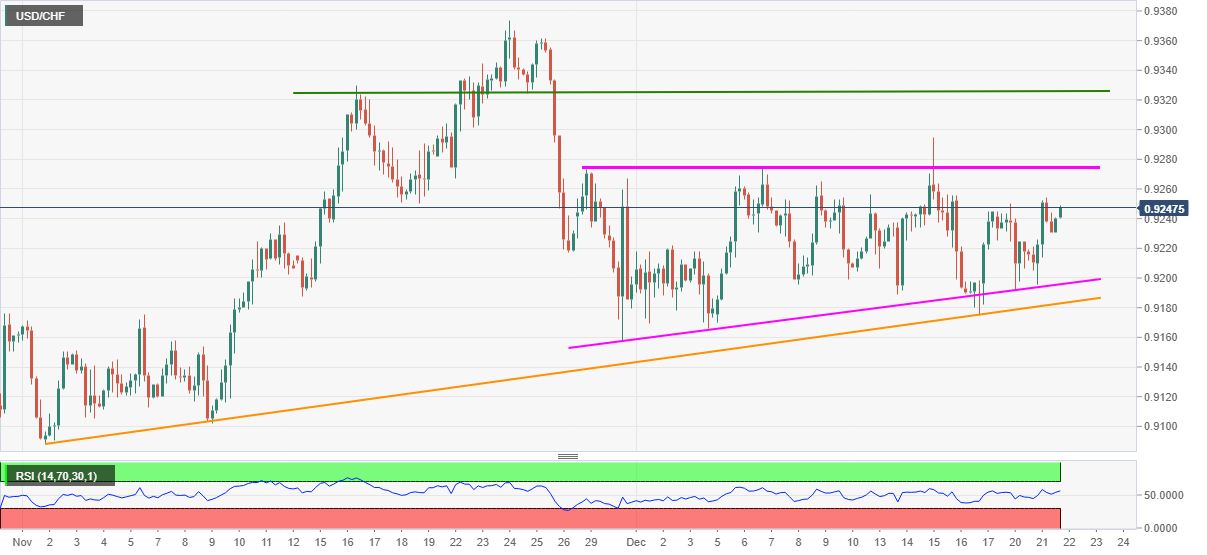
Trend: Further advances expected
- USD/CAD was seen oscillating in a range through the first half of the trading on Wednesday.
- An uptick in crude oil prices underpinned the loonie and kept a lid on any meaningful upside.
- The Fed’s hawkish outlook acted as a tailwind for the USD and extended support to the pair.
The USD/CAD pair lacked any firm directional bias and remained confined in a narrow trading band, just above the 1.2900 mark heading into the European session.
Investors turned optimistic amid the prospects that vaccines may be more effective than first thought in fighting the Omicron variant of the coronavirus. This, in turn, acted as a tailwind for crude oil prices, which underpinned the commodity-linked loonie and capped the upside for the USD/CAD pair.
The downside, however, remains cushioned amid the underlying bullish sentiment surrounding the US dollar, bolstered by the Fed's hawkish outlook. It is worth recalling that the so-called dot plot indicated that the Fed officials expect to raise the fed funds rate at least three times next year.
Meanwhile, a fresh leg down in the US Treasury bond yields failed to impress the USD bulls or provide any meaningful impetus to the USD/CAD pair. Nevertheless, the fundamental backdrop seems tilted in favour of bullish traders and supports prospects for the emergence of some dip-buying around the pair.
Market participants now look forward to the release of the final US Q3 GDP print and the Conference Board's US Consumer Confidence Index, due later during the early North American session. This, along with the US bond yields, will influence the USD and provide some trading impetus to the USD/CAD pair.
Apart from this, traders will further take cues from oil price dynamics to grab some short-term opportunities around the USD/CAD pair. That said, the intraday movement is more likely to remain restricted amid relatively thin liquidity conditions heading into the end-of-year holiday season.
Technical levels to watch
Japan's government reportedly finalizes an annual budget for the next fiscal year from April, the Nikkei Asian Review reports on Wednesday.
The Japanese daily said It would be the largest-ever budget on record, totaling around 107.6 trillion yen ($942.8 billion).
Separately, Prime Minister Fumio Kishida was speaking on wages and Japan-US foreign policy.
Key quotes
“Will achieve a rise in wages by ensuring subcontractors are profitable.”
“Important for public and private sectors to join forces and think together about how to achieve growth and wealth distribution.”
“We must at least continue having talks and discussions with our neighbor China.”
“Japan-US alliance is the axis of Japan’s foreign policy, would like to visit the US as soon as possible to hold summit talks.”
USD/JPY reaction
USD/JPY is little moved by these headlines, as It flirts with daily highs near 114.20, higher by 0.09% on the day.
- Gold snaps two-day downtrend, bounces off weekly low.
- Softer yields, Euro favor buyers even as Omicron, fears of US data test the upside moves.
- EU spending rules challenged, US BBB stays indecisive.
Gold (XAU/EUR) stays positive around €1,586, rejecting the previous two-day declines, ahead of Wednesday’s European session.
The gold prices, in Euro terms, seem to benefit from the downbeat yields and firmer US dollar, which in turn weigh on the EUR. However, challenges to the sentiment are likely testing the XAU/EUR buyers of late.
The US Dollar Index (DXY) rises for the first time in three days, up 0.10% intraday around 96.55 at the latest, as cautious mood ahead of the second-tier US data favors the greenback demand. Adding to the DXY strength is the indecision over President Joe Biden’s Build Back Better (BBB) stimulus plan as policymakers remain hopeful despite Senator Joe Manchin’s rejection to favor the bill.
Elsewhere, European countries might have to rethink over their spending plans after the latest warning from Valdis Dombrovskis, European Commission Executive Vice-President. “EU member states will still need to offer ‘credible’ plans to cut their debts even if they are allowed extra leeway to make green investments,” said EU’s Dombrovskis per the Financial Times (FT).
It’s worth noting that the stronger activity restrictions in the bloc and hopes of the cure to Omicron, recently emanating from the US, seem to challenge the pessimists.
Amid these plays, the US 10-year Treasury yields dropped two basis points (bps) to 1.465% whereas the S&P 500 Futures struggles for moves, reversing early Asian losses, tracking the Wall Street benchmarks that snapped a three-day downtrend.
Moving on, risk catalysts are the key while final Q3 GDP and the CB Consumer Confidence for December will be important to watch looking forward.
Technical analysis
Gold prices remain inside a bullish chart pattern, namely falling wedge, as 200-HMA defends the buyers. Given the steady RSI line, the latest rebound is likely to extend.
However, the 50-HMA adds strength to the resistance surrounding €1,590, a break of which will confirm the bullish trajectory towards €1,610.
It’s worth noting that the monthly high near €1,603 and November’s peak of €1,653 are some extra numbers to the north to consider for XAU/EUR bulls.
Meanwhile, a downside break of the 200-HMA level of €1,583 isn’t a green card for the gold sellers as a lower line of the wedge, near €1,581 will test the further downside.
Even if the quote drops past €1,581, the 61.8% Fibonacci retracement of December 15-20 upside, near €1,575 will act as an additional downside filter.
XAU/EUR: Hourly chart
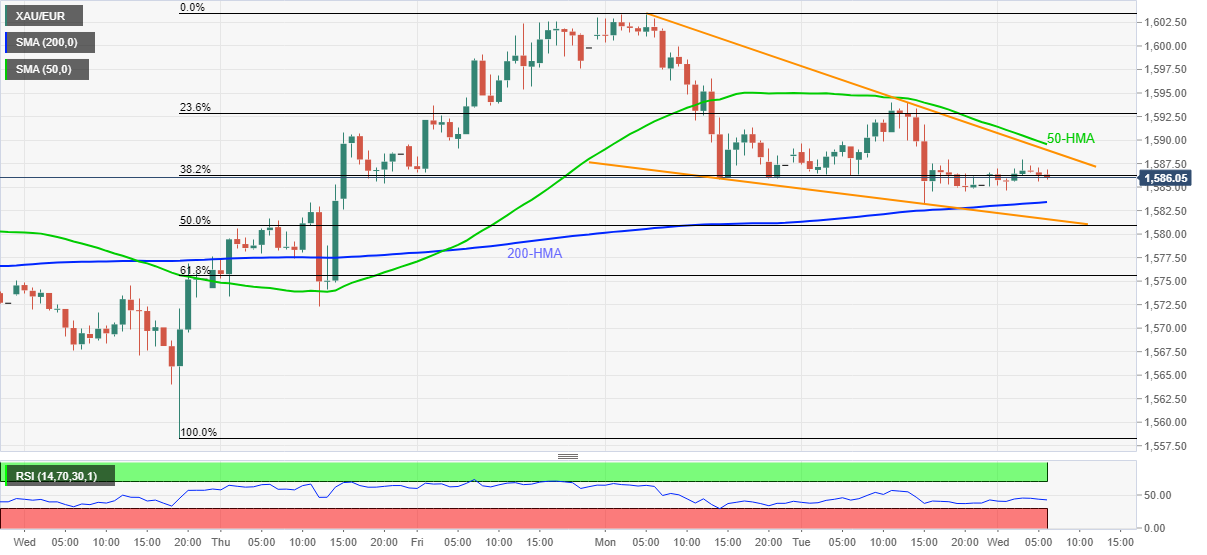
Trend: Further recovery expected
- GBP/USD sellers return amid cautious mood, Omicron woes in the UK lurk.
- 21-DMA caps the rebound, as the pair keeps range within a falling channel.
- A retest of the 1.3200 level remains on the cards amid bearish RSI.
GBP/USD is back in the red on Wednesday, reversing a part of the previous day’s rebound amid a worsening market mood.
The risk-off sentiment is benefiting the US dollar bulls, weighing negative on the cable. Meanwhile, persistent Brexit concerns combined with the risks of the Omicron covid variant-induced restrictions on the UK economy continue to overwhelm GBP traders.
Investors now look forward to the UK and the US GDP revisions for fresh trading while the Omicron updates will be closely followed.
Looking at GBP/USD’s daily chart, the pair has been traversing within a falling channel after peaking out near 1.3515 on November 18.
Meanwhile, the latest rebound from multi-day lows of 1.3173 appears to have faltered at the 21-Daily Moving Average (DMA) at 1.3267.
Subsequently, sellers are making a comeback, eyeing a retest of Tuesday’s low of 1.3198. If the downside momentum gathers traction, then the above-mentioned three-day low could be probed.
The 14-day Relative Strength Index (RSI) is inching lower below the midline, suggesting that the bears are likely to retain control going forward.
GBP/USD: Daily chart
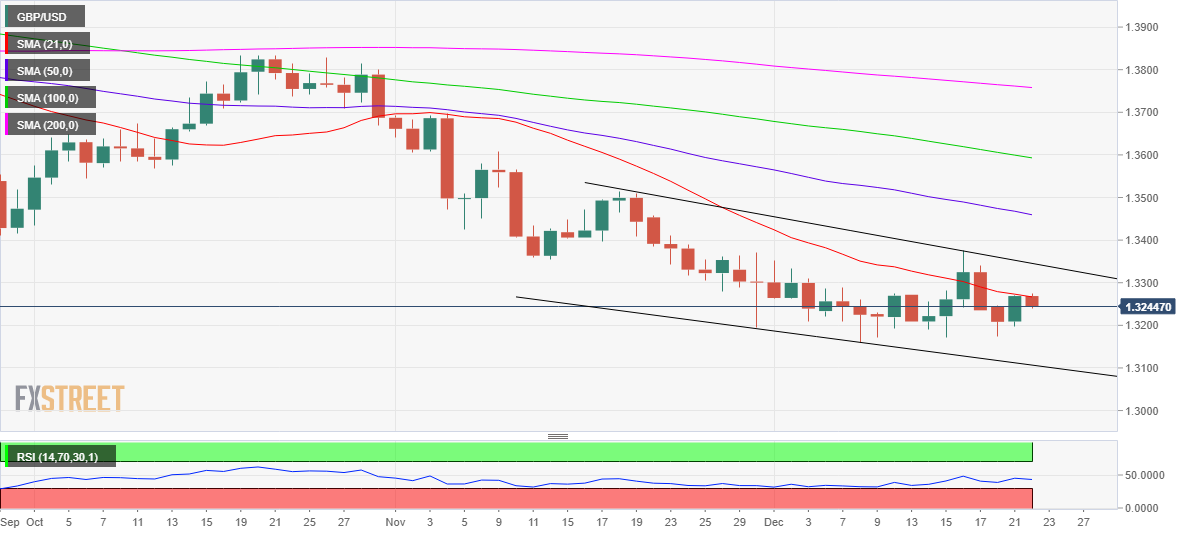
Alternatively, acceptance above the 21-DMA hurdle is needed to revive the recovery attempts, as the buyers will then aim to challenge the falling trendline resistance at 1.3345.
Ahead of that level, GBP bulls will test the bearish commitments at the 1.3300 psychological magnet.
GBP/USD: Additional technical levels
- AUD/USD remains pressured around intraday low, drops the most among G10 currency pairs.
- Bearish MACD signals, failures stay past 100/200 HMAs keep sellers hopeful.
- 61.8% Fibonacci retracement level lures sellers, fortnight-long horizontal area adds to the upside filters.
AUD/USD breaks the weekly support line, down 0.45% intraday, while flashing 0.7125 as a quote heading into Wednesday’s European session. The Aussie pair’s losses are the heaviest among the Group of Ten (G10) currency pairs.
Despite bouncing off 61.8% Fibonacci retracement (Fibo.) of December 03-16 upside, near 0.7080, AUD/USD failed to stay beyond convergence of the 100-HMA and 200-HMA close to 0.7140-45.
That said, the latest pullback moves may initially test the 50.0% Fibo. level of 0.7109 and then the 0.7100 threshold before revisiting the aforementioned key Fibonacci retracement support around 0.7080.
In a case where AUD/USD drops below 0.7080, the 0.7050 and 0.7030 levels may offer intermediate halts before dragging the quote back to the 0.7000 psychological magnet and the yearly low of 0.6993.
Meanwhile, a clear run-up beyond 0.7145 will aim for a two-week-old horizontal resistance zone surrounding 0.7180-90.
Should the quote rises past 0.7190, the monthly top close to 0.7225 will return to the chart.
AUD/USD: Hourly chart
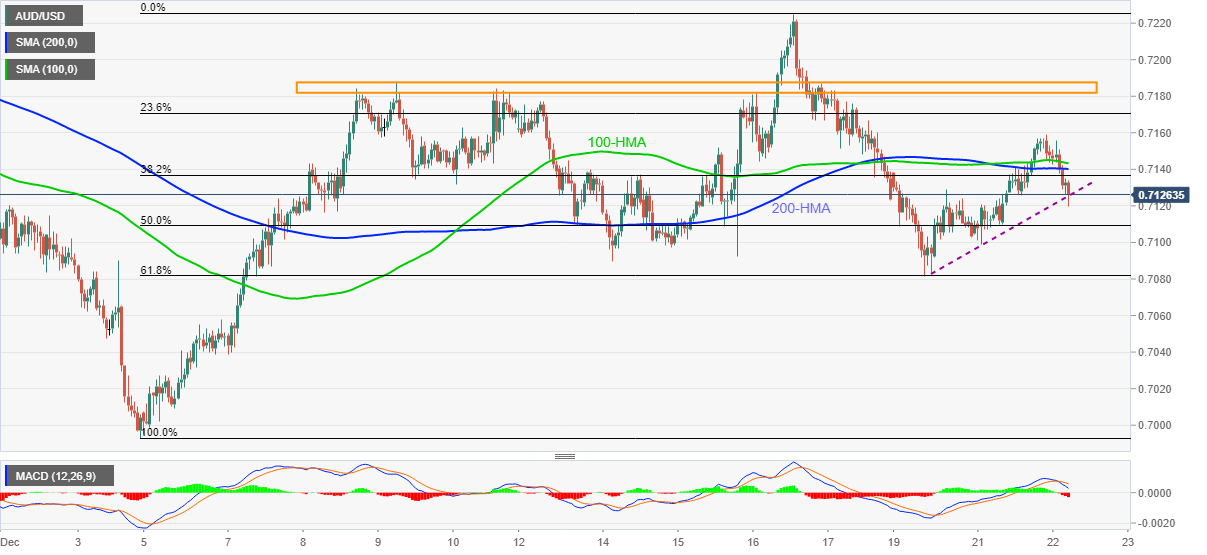
Trend: Further weakness expected
- USD/TRY reverses the late Tuesday’s corrective bounce off monthly low during three-day fall.
- Turkey’s President Erdogan appoints new Deputy Finance Minister, removes Tax Inspection Chief, FinMin Nebati reiterates government’s commitment.
- Market sentiment sours amid thin volume, mixed Omicron updates ahead of key US data.
USD/TRY remains on the back foot for the third consecutive day, down 2.10% intraday near $12.30 ahead of Wednesday’s European session.
In doing so, the Turkish lira (TRY) pair justifies the plethora of measures taken by President Recep Tayyip Erdogan to defend the interest rate cuts. On his back is the recently appointed Finance Minister (FinMin) Nureddin Nebati.
After a slew of ‘dollarization’ measures, Turkey’s Erdogan announced new changes to the finance ministry and income tax office, per the country's official gazette. “Turkish President Tayyip Erdogan appointed Murat Zaman as deputy finance minister and removed the chairman of the Tax Inspection Board, Necmi Keskinsoy, from office on Wednesday,” said Reuters.
On the other hand, FinMin Nebati was also spotted by Reuters while lauding the government’s legal action against speculative market comments. The news quotes Nebati’s interview with the state broadcaster TRT Haber while saying, “Nebati also said that the government is committed to single-digit inflation, high growth and a current account surplus.”
Elsewhere, market sentiment sours as the previous optimism linked to the government’s easy activity restriction measures and vaccine hopes fail to sustain. Adding to the risk-off mood is the wait-and-see mode ahead of the US Q3 GDP and the CB Consumer Confidence for December.
To portray the mood, the US 10-year Treasury yields dropped two basis points (bps) to 1.465% whereas the S&P 500 Futures decline 0.13% intraday even as the Wall Street benchmarks snapped a three-day downtrend.
Moving on, USD/TRY traders may pay more attention to the domestic news, while also watching the US data, for short-term direction.
Technical analysis
A clear downside break of the 21-DMA level of $13.61 keeps USD/TRY sellers hopeful. However, the 61.8% Fibonacci retracement level of August-December upside and 50-DMA, respectively around $12.10 and $11.50, restrict short-term declines.
- USD/INR prints four-day downtrend, refreshes intraday low of late.
- MACD signals turn bearish for the first time since November 22, break of 75.65 adds to the bearish bias.
- Convergence of 100-DMA, ascending trend line from September appears a tough nut to crack for pair sellers.
USD/INR stands on the slippery ground near 75.50, down 0.22% intraday while printing a four-day fall heading into Wednesday’s European session.
The Indian rupee (INR) pair’s latest losses could be linked to its declines below the double-tops marked during April and October, around 75.65. Adding to the bearish bias is the recently flashed red MACD signal.
However, the 21-DMA level surrounding 75.45 challenges short-term downside ahead of directing the USD/INR bears to November’s high of 75.19 and July’s peak of 75.00.
It should be noted, however, that the pair’s weakness past 75.00 will be challenged by the 100-DMA and a three-month-old rising support line, near 74.50.
On the flip side, a daily closing beyond 75.65 will aim for the 76.00 threshold but the 76.30 level could test the USD/INR bulls afterward.
In a case where the pair buyers dominate past 76.30, the recently flashed multi-month high near 76.60 and the 77.00 will be in focus.
USD/INR: Daily chart
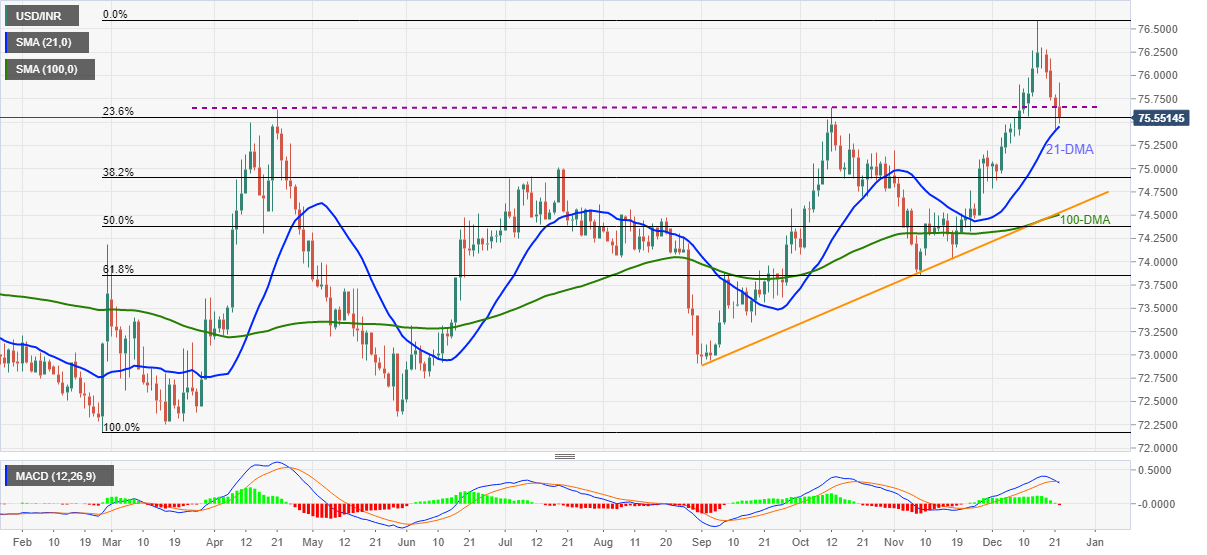
Trend: Further weakness expected
- EUR/USD refreshes intraday low while snapping two-day uptrend.
- Cautious mood recalls USD buyers ahead of the key data, ignoring downbeat yields.
- US inflation expectations recover, ECB policymakers stay divided on next move.
- Final reading of the US Q3 GDP, CB Consumer Confidence for December becomes the key data, Omicron, BBB also in focus.
EUR/USD takes offers to renew intraday low near 1.1270 heading into Wednesday’s European session.
The major currency pair rose during the last two days amid optimism concerning the US stimulus and Omicron. However, fears of worsening virus cases, geopolitical challenges and fiscal stimulus updates weigh on the market sentiment ahead of this week’s key US data.
US President Joe Biden’s expectations of getting the “Build Back Better (BBB)” plan done as well as vaccine/treatment optimism faded after European economies announced fresh virus-linked activity restrictions. Adding to the bearish bias were recently recovering inflation expectations, as measured by the 10-year breakeven inflation rate per the St. Louis Federal Reserve (FRED) data.
Additionally, news that the US appoints a new Tibet Coordinator amid tensions with China joins the tension with Russia to weigh on the risk appetite and underpin the US dollar’s safe-haven demand.
On the contrary, indecision amid the European Central Bank (ECB) policymakers over the inflation stance, versus the Fed’s clear view, weigh on the EUR/USD prices. Recently, ECB policymaker and Slovak central bank Governor Peter Kazimir said, “There is a risk that elevated inflation will stay for a longer time.”
Against this backdrop, the US 10-year Treasury yields dropped two basis points (bps) to 1.465% whereas the S&P 500 Futures decline 0.13% intraday even as the Wall Street benchmarks snapped a three-day downtrend. Further, the US Dollar Index (DXY) snaps a two-day downtrend to gain, up 0.12% intraday around 96.55 at the latest.
It’s worth noting that a lack of market moves during the year-end holiday season may restrict short-term EUR/USD prices even as the bears keep the controls. That said, Omicron updates and US stimulus chatters could entertain traders ahead of the US final Q3 GDP and the CB Consumer Confidence for December.
Read: Conference Board Consumer Confidence December Preview: Where do Americans turn for optimism?
Technical analysis
Repeated failures to cross the 21-DMA, around 1.1290 by the press time, directs EUR/USD sellers towards an ascending support line from November 24, at 1.1230.
- Asian-Pacific equities grind higher as US Treasury yields retreat, Omicron fears fade.
- Australia unveiled battle plan amid record jabbing, UK, US ruled out the need for a complete lockdown.
- Vaccine hopes, expectations of US stimulus add to the upbeat sentiment.
- US data, rising inflation expectations challenge bulls.
Asian markets remain mildly bid during early Wednesday, tracking Wall Street gains, even as cautious mood ahead of the US data tests the bulls. While portraying the mood, MSCI’s index of Asia-Pacific shares outside Japan rises 0.50% whereas Japan’s Nikkei 225 gains 0.15% intraday at the latest.
Minutes of the latest BOJ meeting showed that the policymakers discussed the weak yen and its benefits for the economy. The Minutes also said that the board backed the need for easy money amid a sustained miss of the 2.0% inflation target.
Elsewhere, China’s National Development and Reform Commission (NDRC) released a 10-point strategy to support the world’s second-largest economy. However, thin liquidity and likely short-covering in the tech shares probed bulls to dominate further. That said, stocks in China trade mixed by the press time.
On a different page, Australia’s snap cabinet meeting released mask mandates and vaccine guide as the nation praises the highest jabbing rate in the world. This baffles Aussie equity traders and marks no major moves of the ASX 200. On the contrary, New Zealand’s NZX 50 rises 0.25% at the latest.
It’s worth noting that stocks in Indonesia, South Korea and India tracked Wall Street’s gains amid hopes of a cure to the Omicron. Bloomberg news that the US Food and Drug Administration (FDA) is up for authorizing a pair of pills from Pfizer and Merck to treat Covid-19 as soon as this week favored risk-on mood. On the same line were the updates from the Defense One suggesting, “US army creates single vaccine effective against all covid, sars variants.” Also positive for the sentiment was US President Joe Biden’s push for more vaccinations and cautious optimism during the national address. The US leader also said, per The Hill, “I think there is still a possibility that his Build Back Better (BBB) agenda can get done, despite Sen. Joe Manchin’s opposition of the climate and social spending bill.”
That said, the US 10-year Treasury yields dropped two basis points (bps) to 1.465% whereas the S&P 500 Futures decline 0.20% intraday even as the Wall Street benchmarks snapped a three-day downtrend.
Looking forward, the final reading of the US Q3 GDP and the CB Consumer Confidence for December will be crucial for markets amid recently improving US inflation expectations, per the 10-year breakeven inflation rate per the St. Louis Federal Reserve (FRED) data.
Read: Conference Board Consumer Confidence December Preview: Where do Americans turn for optimism?
"The national cabinet has agreed to respond to the covid surge," Aussie PM Morrison crossed wires while speaking amid a snap cabinet meeting.
More to come
Read: AUD/USD inches closer to 0.7100, focus on Aussie national cabinet meeting, US data
- GBP/JPY consolidates the heaviest daily jump in 12 days.
- Sustained break of two-month-old resistance, bullish MACD signals favor buyers.
- 100/200 DMAs, 61.8% Fibonacci retracement level appears a tough nut to crack for bulls.
- Bearish have a bumpy road to return, 148.95 is the key.
GBP/JPY grinds higher past 151.00, down 0.05% intraday near 151.30 during early Wednesday morning in Europe.
The cross-currency pair jumped the most since December 06 the previous day and crossed the key resistance line from late October. The resistance break also gains support from the bullish MACD signals to keep buyers hopeful despite the latest pullback.
That said, the 152.00 round figure may lure intraday bulls but a convergence of the 100-DMA, 200-DMA and 61.8% Fibonacci retracement (Fibo.) of September-October upside, around 142.50, will be a crucial upside hurdle to watch afterward.
In a case where GBP/JPY rises past 152.50, a 50% mean reversion level of 153.60 may act as an intermediate halt during the likely rush towards the mid-November high close to 154.80.
Meanwhile, pullback moves may initially aim for the resistance-turned-support near 150.95, a break of which will recall the 150.00 threshold to the chart.
However, GBP/JPY bears remain unconvinced until the quote stays beyond the three-week-old support line near 149.60. It’s worth mentioning that September’s low of 148.95 should challenge further downside, if not then a fall towards the yearly bottom of 148.45 can’t be ruled out.
GBP/JPY: Daily chart
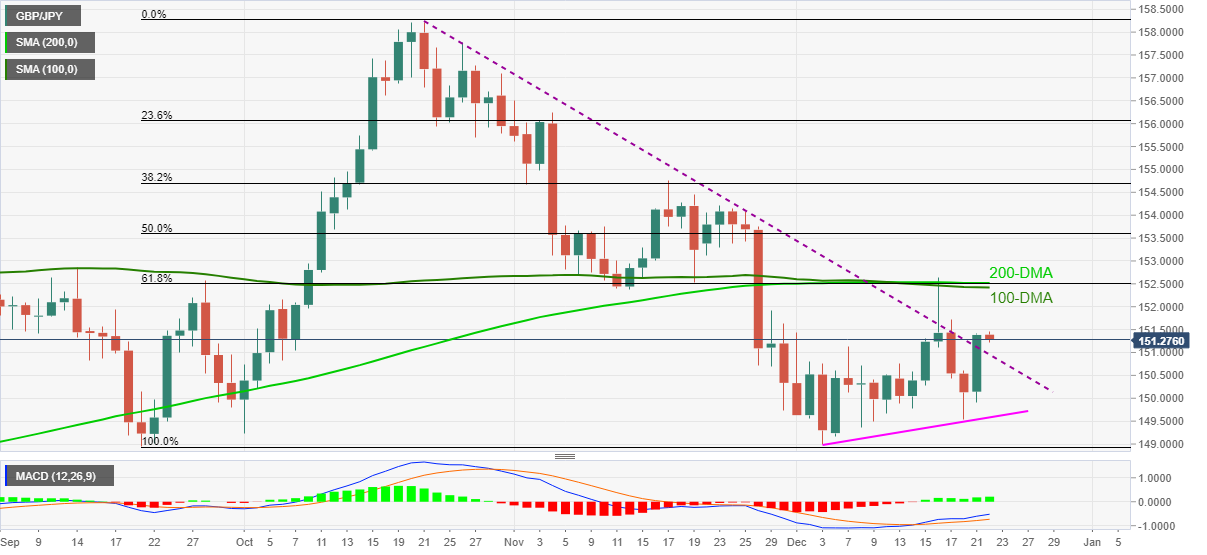
Trend: Further upside expected
- AUD/USD refreshes intraday low as market sentiment sours, pares the previous day’s gains.
- Aussie policymakers called snap cabinet meeting to discuss the Omicron battle plan amid record jabbing and holiday season.
- Doubts over global policymakers’ assurance over virus, cautious sentiment ahead of US data weigh on the market mood.
- US GDP, CB Consumer Confidence will decorate calendar, Aussie policymakers will try to placate bears.
AUD/USD takes offers to refresh intraday low near 0.7135, down 0.27% on a day heading into the European session. The Aussie pair rallied the most in a week the previous day amid risk-on mood. However, risk appetite weakens ahead of the press conference by Aussie Prime Minister Scott Morrison and important US data.
With a steady increase in covid numbers and a 90% vaccination rate, Aussie policymakers called a snap cabinet meeting to discuss mask mandates and vaccine booster strategy on Wednesday. While PM Morrison is more likely to laud the world’s higher jabbing ratio, listeners are more interested in hearing about the activity restrictions during the holiday period.
Elsewhere, US President Joe Biden pushed for more vaccinations and sounded cautiously optimistic during Tuesday’s national address. The US leader also said, per The Hill, “I think there is still a possibility that his Build Back Better agenda can get done, despite Sen. Joe Manchin’s opposition of the climate and social spending bill.” This joins with the Bloomberg news that the US Food and Drug Administration (FDA) is up for authorizing a pair of pills from Pfizer and Merck to treat Covid-19 as soon as this week to favor risk-on mood. On the same line were the updates from the Defense One suggesting, “US army creates single vaccine effective against all covid, sars variants.”
It should, however, be noted that recently improving US inflation expectations, per the 10-year breakeven inflation rate per the St. Louis Federal Reserve (FRED) data, challenges the market bulls ahead of the key US economic data release. Furthermore, the Sino-American and the US-Russia tussles add to the bearish bias for AUD/USD prices.
Amid these plays, the US 10-year Treasury yields dropped two basis points (bps) to 1.465% whereas the S&P 500 Futures decline 0.20% intraday even as the Wall Street benchmarks snapped a three-day downtrend.
Considering the cautious mood in the market, AUD/USD prices are likely to remain pressured until any major positives are announced by Australia PM Morrison or US data favors the need for easing. Among the US data, the final Q3 GDP and the CB Consumer Confidence for December are crucial to watch.
Read: Conference Board Consumer Confidence December Preview: Where do Americans turn for optimism?
Technical analysis
Failures to stay beyond 100-HMA and 200-HMA, around 0.7140-45 by the press time, directs AUD/USD sellers towards 50.0% Fibonacci retracement (Fibo.) of December 03-16 upside near 0.7109. Following that, the 0.7100 threshold and 61.8% Fibo. support around 0.7080 will be in focus. Meanwhile, a clear run-up beyond 0.7145 will aim for a two-week-old horizontal resistance zone surrounding 0.7180-90.
In lieu of the latest wrangling over the US fiscal spending plan, analysts at Morgan Stanley have lowered the US GDP growth forecast for the next year.
Key quotes
"Lowers 2022 forecast to 4.6% from 4.9%, citing failure (so far) of Biden's Build Back Better due to the Manchin "No"."
"Sees unemployment at 3.6% by Q4 (unchanged forecast)."
Read: US 2022 GDP growth seen at 3.8% versus 4.2% prior – Goldman Sachs
In an interview with Xinhua News Agency, Ning Jizhe, Deputy Head of the National Development and Reform Commission (NDRC) enlisted ten crucial measures likely to be undertaken by the state planner to boost its economy.
Key measures
Step up government spending,
Strengthen support to manufacturers and small companies,
Ensure price stability
Work to stabilise industry supply chains,
Focus on solving chip shortage issues,
Step up monitoring of commodity prices,
Continue to implement proactive fiscal policies,
Step up efforts to build an integral domestic market,
While further shorten the "negative list" regarding foreign investment,
Combine cross-cyclical and counter-cyclical measures to prevent wild economic volatility.
Market reaction
USD/CNY is trading modestly flat at 6.3723 on the above comments.
| Raw materials | Closed | Change, % |
|---|---|---|
| Brent | 74.05 | 3.28 |
| Silver | 22.506 | 1.06 |
| Gold | 1788.713 | -0.12 |
| Palladium | 1780.76 | 1.63 |
- NZD/USD eyes to refresh intraday low, pares the biggest daily gains in two months.
- Bearish candlestick formation below the key SMA, amid RSI retreat, favor sellers.
- The 0.6830 becomes the key resistance to watch during further advances.
NZD/USD drops 0.17% intraday, matching its Aussie counterpart, as sellers attack 0.6750 level during early Wednesday. The kiwi pair jumped the most among the G10 pairs, not to forget posted the biggest daily gains since late October.
However, failure to cross the 100-SMA portrayed a bearish Doji candlestick on the four-hour play, which in turn joins the RSI retreat to hint at the quote’s further weakness.
That said, the 0.6725 and the 0.6700 round figure are at the hand’s reach for NZD/USD sellers.
During the pair’s further weakness, the 61.8% Fibonacci Expansion (FE) of November 23 to December 16 moves, around 0.6670, will offer an intermediate halt ahead of a likely slump towards November 2020 low near 0.6590.
Alternatively, a clear upside break of the 100-SMA level of 0.6775 won’t be enough for the NZD/USD buyer’s return as a convergence of two resistance lines, from early December and mid-November, around 0.6830, will be a crucial hurdle for the further upside.
Also acting as a short-term resistance is the monthly high of 0.6868, a break of which will direct the pair towards the late November’s swing high near 0.6960.
NZD/USD: Four-hour chart
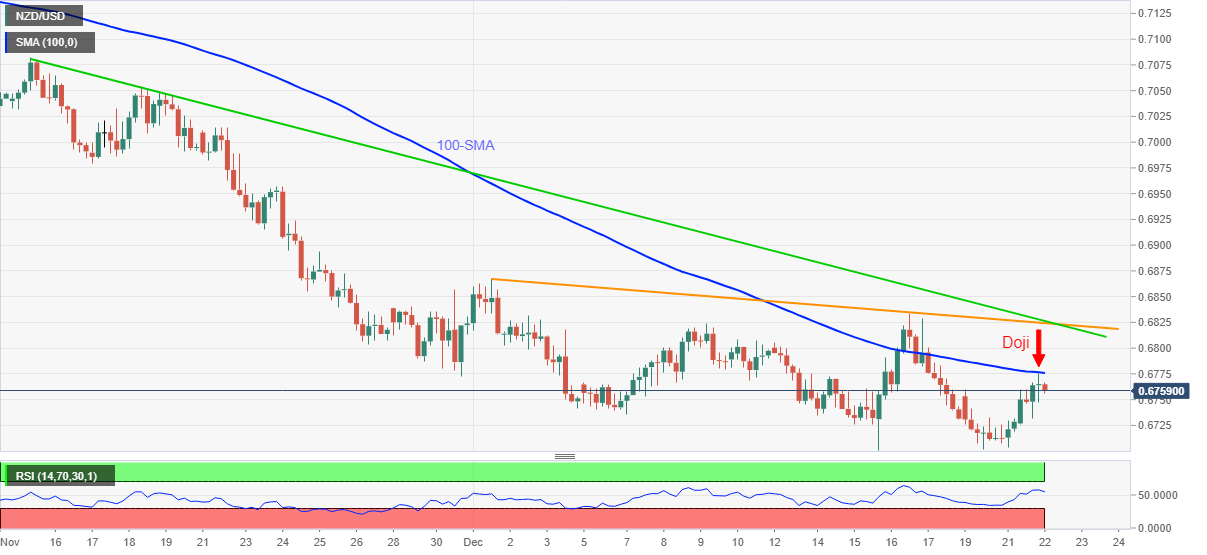
Trend: Further weakness expected
- US 10-year Treasury yields snap two-day rebound, S&P 500 Futures seem indecisive.
- Hopes of Omicron’s cure join easy restrictions due to the virus to favor sentiment.
- Cautious mood ahead of the key US data, rising US inflation expectations and mixed concerns over covid test the optimists.
Risk appetite sours during early Wednesday as market players brace for the US data amid a quiet Asian session. The key barometers, namely the US Treasury bond yields and stock futures print mild losses at the latest.
That said, the US 10-year Treasury yields dropped two basis points (bps) to 1.467% whereas the S&P 500 Futures remain mostly unchanged around 2,640 even as the Wall Street benchmarks snapped a three-day downtrend.
US President Joe Biden pushes for more vaccinations and sounds cautiously optimistic during the national address. The US leader also said, per The Hill, “I think there is still a possibility that his Build Back Better agenda can get done, despite Sen. Joe Manchin’s opposition of the climate and social spending bill.”
It’s worth noting that the news that the US Food and Drug Administration (FDA) is up for authorizing a pair of pills from Pfizer and Merck to treat Covid-19 as soon as this week, per Bloomberg’s sources, also underpinned the risk-on mood. On the same line were the updates from the Defense One suggesting, “US army creates single vaccine effective against all covid, sars variants.”
On the contrary, the escalating tussles between the US and China, as well as with Russia, join the recently improving US inflation expectations, per the 10-year breakeven inflation rate per the St. Louis Federal Reserve (FRED) data, also test the market’s optimism.
Above all, the market’s caution ahead of crucial weekly events and fears emanating from the loose activity restrictions despite a jump in the Omicron cases seem to challenge the sentiment.
Among the key US data are the final Q3 GDP and the CB Consumer Confidence for December.
Read: Conference Board Consumer Confidence December Preview: Where do Americans turn for optimism?
- DXY remains pressured around intraday low, consolidates Friday’s heavy gains.
- Bearish MACD favors further downside targeting 21-DMA.
- Ascending support line from late October becomes the key for sellers.
US Dollar Index (DXY) stays depressed around an intraday low of 96.41, down for the third consecutive day during early Wednesday.
In doing so, the greenback gauge extends the week’s start U-turn from a one-month-old resistance line amid bearish MACD signals, suggesting further weakness towards the immediate support.
That said, the 21-DMA level of 96.30 restricts the quote’s nearby declines ahead of a two-month-long support line near 96.10.
Also acting as a downside filter is an upward sloping trend line from November 16, around 95.80 by the press time.
Should the quote remains below 95.80, it becomes vulnerable to revisit the early November tops near 94.60.
Meanwhile, corrective pullback needs to cross the stated resistance line, near 96.65 at the latest, before challenging the monthly high of 96.91.
Even if the DXY bulls manage to cross the 96.91 hurdle, they need to portray a successful run-up beyond the 97.00 threshold to convince markets.
DXY: Daily chart

Trend: Further weakness expected
- EUR/USD bull stake control in Asia and follow Wall Street's lead.
- The markets will now be looking for US data for the day ahead in the run down to Xams.
EUR/USD is solid on the day so far and the bulls have stepped in to defend the prospects of the downside extensions as they take on the 1.1290's in Tokyo trade.
The euro was firm in the New York session as risk sentiment rallied and US stocks bounced in recovery from the start of the week's supply. The Omicron variant is sweeping its way through the world but governments are reluctant to go back to the dystopia style of lockdowns seen in March 2020.
Wall Street recovered and the Dow Jones Industrial Average rose 1.5% to 35,441.21, the S&P 500 increased 1.6% to 4,639.79, and the Nasdaq Composite was up 2.2% to 15,304.73. The North American government bond markets continued to sell off and the 10-year US yields climbed 4.6bps. The DXY (-0.1%) weakened marginally while most other major FX markets strengthened against the dollar.
Late in the day, US President Joseph Biden addressed the nation at 2:30 pm ET and detailed further efforts to combat the rise of COVID-19 cases. There were no surprises in the speech as the White House had already suggested that lockdown measures are not being considered at this point. Biden confirmed this and encouraged everyone to get vaccinated as soon as possible.
Besides the covid developments, traders will be looking to US data that will be eyed for the day ahead with the Gross Domestic Product revisions, Consumer Confidence, Existing Home Sales on tap.
EUR/USD technical analysis
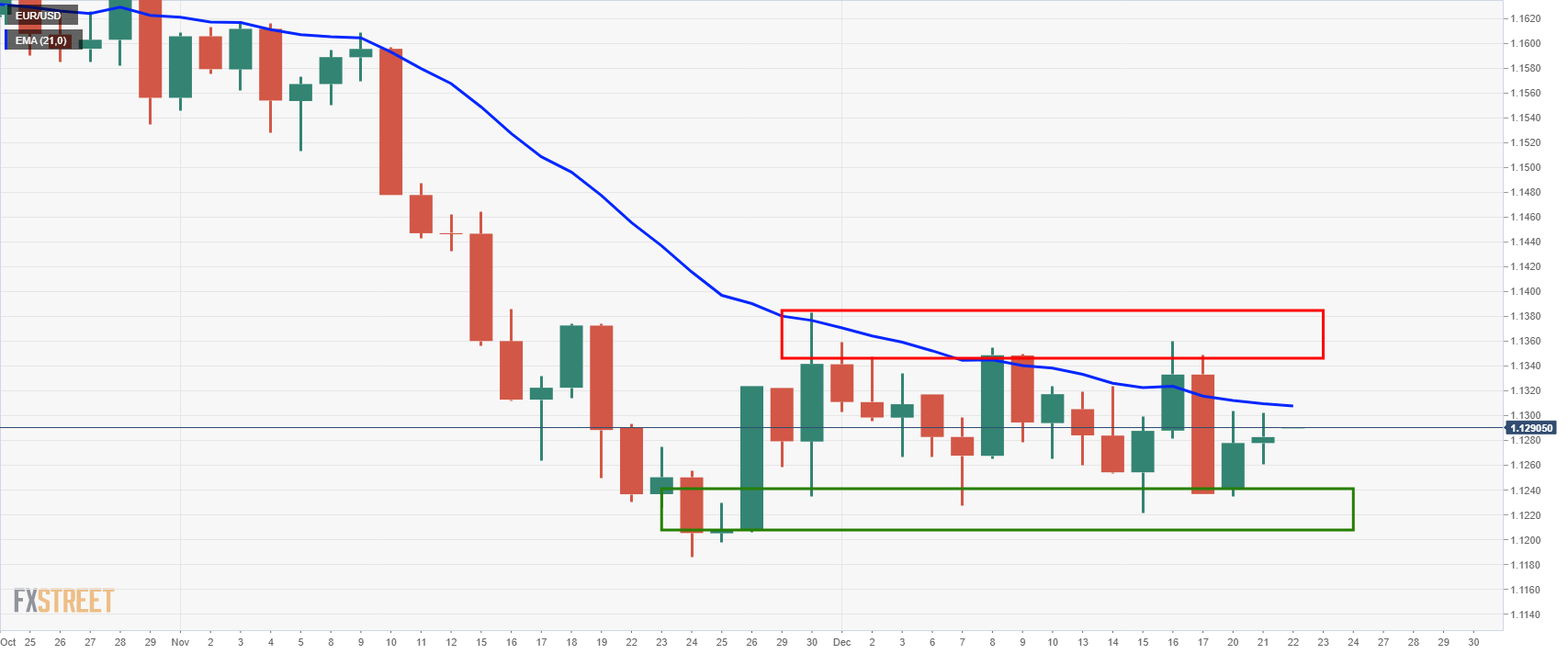
The market is trapped on the daily time frame and there is very little to be done at this point.
- GBP/USD refreshes intraday low, steps back from weekly high.
- UK’s Truss will hold first Brexit talks with EU’s Šefčovič.
- Britain to cut COVID-19 self-isolation period, rules out tougher lockdown before Christmas.
- Omicron updates, Brexit news and UK Q3 GDP can entertain traders ahead of US data.
GBP/USD pulls back from 21-DMA level surrounding 1.3270, down 0.05% intraday near 1.3262 during early Wednesday. The cable pair cheered the market’s optimism the previous day to snap a two-day downtrend. However, fears of Brexit and rising covid cases challenge the British government’s efforts to placate bears ahead of the UK Q3 GDP readings.
A 63% jump in the total covid cases in the seven days to December 21, per Reuters, rejects the No 10’s efforts to play safe, as far as the Omicron-led activity restrictions are concerned.
UK PM Boris Johnson ruled out any tougher lockdown measures ahead of Christmas. Also, Health Secretary Sajid Javid mentioned a reduction in the virus-linked self-isolation period to seven days from previously 10. It’s worth mentioning that UK Chancellor Rishi Sunak unveiled one billion pounds of relief to businesses hurt by the Omicron.
Elsewhere, the newly appointed Brexit Minister Liz Truss said, per Reuters, “London's position remained unchanged and the process needed to speed up in the New Year.” The Guardian cites UK’s Truss as saying that she would speak to her EU counterpart, Maroš Šefčovič amid renewed calls to rip up the controversial Northern Ireland protocol. It’s worth noting that the piece also mentions, “No EU-UK talks had been scheduled in the last days before Christmas until the surprise weekend resignation of Lord Frost, who had been Boris Johnson’s chief Brexit negotiator.” It's worth observing that the UK recently secured a fishing deal with Norway but failed to please domestic companies.
On the other hand, US President Joe Biden pushes for more vaccinations and sounds cautiously optimistic during the national address. The US leader also said, per The Hill, “I think there is still a possibility that his Build Back Better agenda can get done, despite Sen. Joe Manchin’s opposition of the climate and social spending bill.”
It’s worth noting that the news that the US Food and Drug Administration (FDA) is up for authorizing a pair of pills from Pfizer and Merck to treat Covid-19 as soon as this week, per Bloomberg’s sources, also underpinned the risk-on mood and favored the GBP/USD buyers. The recently recovering inflation expectations, as measured by the 10-year breakeven inflation rate per the St. Louis Federal Reserve (FRED) data, also test the pair’s upside.
However, cautious mood ahead of the key US/UK data and Brexit fears seemed to have challenged the GBP/USD buyers of late. The final reading of the UK Q3 GDP is expected to confirm 1.3% earlier forecasts, a slew of US data may shake the cable prices. Among the key US data are the final Q3 GDP and the CB Consumer Confidence for December.
Read: Conference Board Consumer Confidence December Preview: Where do Americans turn for optimism?
Technical analysis
While the 21-DMA level surrounding 1.3270 restricts the GBP/USD pair’s immediate upside, a descending trend line from September, near 1.3310, becomes crucial for short-term buyers. Meanwhile, the 1.3170-60 area, comprising the yearly low, acts as a tough nut to crack for bears.
| Time | Country | Event | Period | Previous value | Forecast |
|---|---|---|---|---|---|
| 07:00 (GMT) | United Kingdom | Business Investment, q/q | Quarter III | 4.5% | 0.4% |
| 07:00 (GMT) | United Kingdom | Business Investment, y/y | Quarter III | 12.9% | 0.8% |
| 07:00 (GMT) | United Kingdom | Current account, bln | Quarter III | -8.605 | -15.6 |
| 07:00 (GMT) | United Kingdom | GDP, y/y | Quarter III | 23.6% | 6.6% |
| 07:00 (GMT) | United Kingdom | GDP, q/q | Quarter III | 5.5% | 1.3% |
| 13:30 (GMT) | U.S. | Chicago Federal National Activity Index | November | 0.76 | |
| 13:30 (GMT) | U.S. | PCE price index ex food, energy, q/q | Quarter III | 6.1% | 4.5% |
| 13:30 (GMT) | U.S. | PCE price index, q/q | Quarter III | 6.5% | 5.3% |
| 13:30 (GMT) | U.S. | GDP, q/q | Quarter III | 6.7% | 2.1% |
| 14:00 (GMT) | Switzerland | SNB Quarterly Bulletin | |||
| 15:00 (GMT) | U.S. | Existing Home Sales | November | 6.34 | 6.52 |
| 15:00 (GMT) | U.S. | Consumer confidence | December | 109.5 | 110.8 |
| 15:30 (GMT) | U.S. | Crude Oil Inventories | December | -4.584 | -2.633 |
In recent trade today, the People’s Bank of China (PBOC) set the yuan (CNY) at 6.3703 vs the estimate of 6.3690 and the prior 6.3729.
About the fix
China maintains strict control of the yuan’s rate on the mainland.
The onshore yuan (CNY) differs from the offshore one (CNH) in trading restrictions, this last one is not as tightly controlled.
Each morning, the People’s Bank of China (PBOC) sets a so-called daily midpoint fix, based on the yuan’s previous day closing level and quotations taken from the inter-bank dealer.
- Silver remains sidelined after stepping back from three-week high.
- Sluggish Momentum line challenges buyers to keep bounce off double-bottom around yearly low.
- 50-DMA, 200-DMA adds to the upside filters, bears can aim for June 2020 levels on a clear break of $21.40.
Silver (XAG/USD) keeps pullback from the monthly top, stays pressured around $22.50 during Wednesday’s Asian session. In doing so, the bright metal registers failures to cross the 21-DMA while staying above the double bottoms marked during September and December.
Given the sluggish Momentum line and failures to cross the immediate DMA, the silver prices are likely to ease further towards the $22.00 threshold.
However, the quote’s weakness past $22.00 will be crucial as the XAG/USD bears will seek a clear downside break of $21.40 to confirm the bearish chart pattern, which in turn will theoretically highlight $17.50 as the next level.
Though, the $20.00 psychological magnet and September 2019 peak near $19.65 will be important to watch during the anticipated fall.
On the flip side, a clear break of 21-DMA level of $22.52 won’t be enough for the silver buyers to tighten the grips as 50-DMA will be a tough nut to crack around $23.50.
It’s worth noting that the XAG/USD bulls will be convinced if the commodity prices trade successfully above the 200-DMA level of $24.85.
Silver: Daily chart
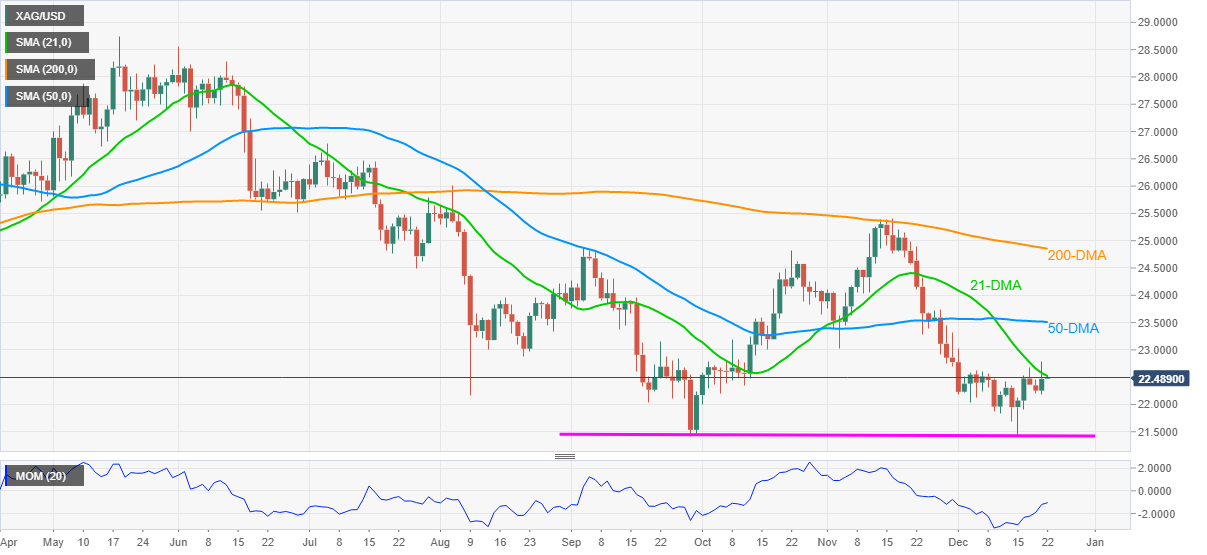
Trend: Pullback expected
- AUD/USD is pulling back into support in Asia.
- The bulls could be looking for a discount at this juncture, with 0.7180 eyed.
Despite bullish equities in Asia, following the lead from overnight and strong performances on both European bourses and Wall Street stocks, AUD/USD is under pressure.
At the time of writing, AUD/USD is down some 0.1% after sliding from the overnight highs of 0.7154 to a low of 0.7143 so far. The US dollar is firming after a modest down day while risk-on sentiment favoured the high beta forex currencies with the kiwi topping the leader board and the Aussie in tow close behind.
The Chinese are helping to elevate the Aussie with their efforts to provide liquidity onshore. The Peoples Bank of China also arrived recently with a loan prime rate cut) to support the domestic economy. Additionally, iron ore has been making a comeback due to the Chinese possibly decreasing the restrictions in the steel industry which is likely to aid the Aussie.
Meanwhile, the Omicron variant is a wild card for forex and the US dollar which has a tendency to stay offered at this time of year, looking back over recent years at least. If new restrictions are implemented in the UK and US, this could be a catalyst for a stronger dollar and weigh on stocks and high-beta currencies, such as the Aussie.
For the day ahead, ''markets will focus on US data (GDP revisions, consumer confidence, existing home sales) along with COVID developments on Wednesday,'' analysts at TD Securities said.
AUD/USD technical analysis
AUD/USD Price Analysis: Bulls step up to target 0.7180
The bulls have been unable to break the 50% mean reversion of the prior daily bearish impulse as follows:
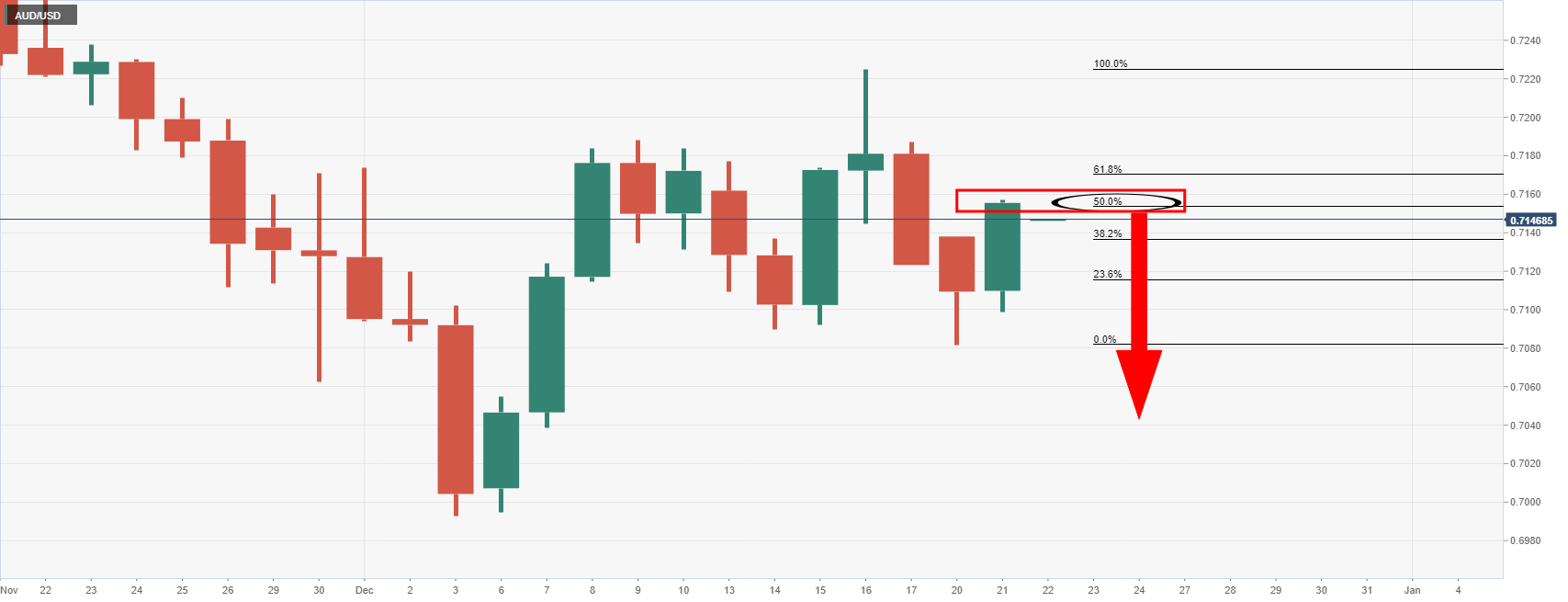
However, if the 50% breaks, then the bulls will be back in play:
AUD/USD H1 chart
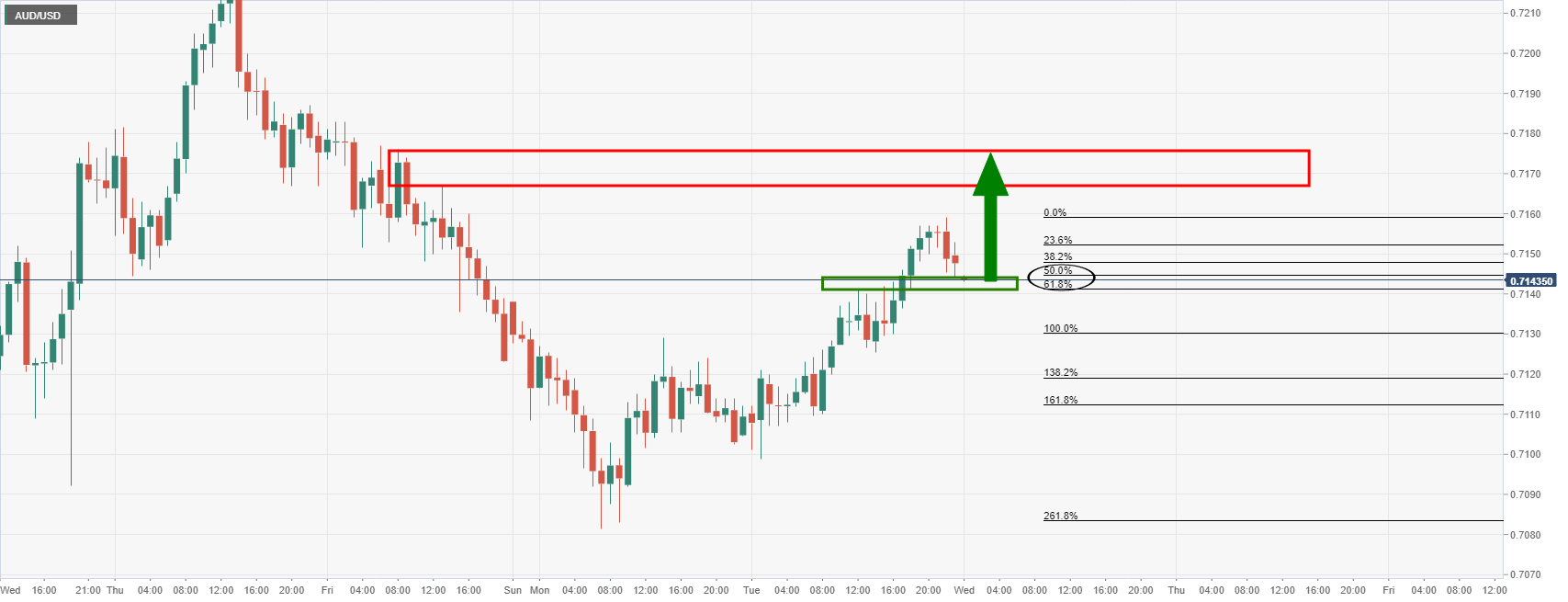
- USD/JPY consolidates the biggest daily gains in 12 days, recently off intraday low.
- BOJ Minutes unveiled conversation on impacts of weak yen on Japanese economy, a few members backed ultra-easy policies.
- Market sentiment dwindles ahead of the key US data-set for the week.
- Yields struggle to extend two-day rebound, US stock futures print mild losses.
USD/JPY pares intraday losses while bouncing off the daily low to keep the 114.00 threshold on the chart during early Wednesday. In doing so, the yen pair portrays the buyer’s indecision following the heaviest daily gains in over two weeks.
The pullback moves could also be linked to the retreat in the US 10-year Treasury yields and stock futures, as well as mixed updates from the Bank of Japan (BOJ) Minutes.
While discussing the impacts of the weaker yen on the economy, a few of the BOJ policymakers backed ultra-easy measures citing the inflation’s multiple failures to reach the 2.0% target. “A few members said weak yen exerting positive effects on Japan's economy as a whole even though effects of pushing up exports are lower than before,” adds the BOJ Minutes.
Read: BoJ Minutes: Members discussed the impact of the weak yen on economy
Elsewhere, markets seem to prepare for a slew of US data amid recently recovering inflation expectations, as measured by the 10-year breakeven inflation rate per the St. Louis Federal Reserve (FRED) data. Also challenging the risk appetite is the ongoing spread of the South African covid variant, dubbed as the Omicron.
It’s worth noting that the push for Japan to spend more and cut taxes could also be considered challenging the USD/JPY traders. “Japan should offer tax breaks in the next fiscal year and spur 10 trillion yen ($88 billion) in investment over the next decade to revive domestic chipmaking, according to the top adviser on a government semiconductor panel,” Bloomberg said.
That said, market sentiment improved the previous day as the key policymakers rejected major lockdown measures ahead of the Christmas holidays, despite the latest spread of the South African covid variant, dubbed as the Omicron, which seemed to have favored the sentiment. Also positive for gold were US President Joe Biden’s expectations of getting the “Build Back Better (BBB)” plan done as well as vaccine/treatment optimism.
Amid these plays, the US Treasury yields dropped three basis points (bps) whereas the S&P 500 Futures decline 0.8% by the press time. Further, Japan’s Nikkei 225 rises 0.30% on a day at the latest.
Moving on, US data US Q3 GDP, Core Personal Consumption Expenditures for the third quarter and Chicago Fed National Activity Index will precede Existing Home Sales to direct short-term USD/JPY moves. Above all, the US CB Consumer Confidence for December will be important.
Read: Conference Board Consumer Confidence December Preview: Where do Americans turn for optimism?
Technical analysis
A three-week-old rising wedge bearish chart pattern restricts short-term USD/JPY moves between 114.40 and 113.30 amid downbeat oscillators.
| Pare | Closed | Change, % |
|---|---|---|
| AUDUSD | 0.71526 | 0.6 |
| EURJPY | 128.714 | 0.47 |
| EURUSD | 1.12807 | 0.06 |
| GBPJPY | 151.377 | 0.96 |
| GBPUSD | 1.32678 | 0.47 |
| NZDUSD | 0.6772 | 0.93 |
| USDCAD | 1.2913 | -0.18 |
| USDCHF | 0.92364 | 0.42 |
| USDJPY | 114.096 | 0.46 |







© 2000-2026. Sva prava zaštićena.
Sajt je vlasništvo kompanije Teletrade D.J. LLC 2351 LLC 2022 (Euro House, Richmond Hill Road, Kingstown, VC0100, St. Vincent and the Grenadines).
Svi podaci koji se nalaze na sajtu ne predstavljaju osnovu za donošenje investicionih odluka, već su informativnog karaktera.
The company does not serve or provide services to customers who are residents of the US, Canada, Iran, The Democratic People's Republic of Korea, Yemen and FATF blacklisted countries.
Izvršenje trgovinskih operacija sa finansijskim instrumentima upotrebom marginalne trgovine pruža velike mogućnosti i omogućava investitorima ostvarivanje visokih prihoda. Međutim, takav vid trgovine povezan je sa potencijalno visokim nivoom rizika od gubitka sredstava. Проведение торговых операций на финанcовых рынках c маржинальными финанcовыми инcтрументами открывает широкие возможноcти, и позволяет инвеcторам, готовым пойти на риcк, получать выcокую прибыль, но при этом неcет в cебе потенциально выcокий уровень риcка получения убытков. Iz tog razloga je pre započinjanja trgovine potrebno odlučiti o izboru odgovarajuće investicione strategije, uzimajući u obzir raspoložive resurse.
Upotreba informacija: U slučaju potpunog ili delimičnog preuzimanja i daljeg korišćenja materijala koji se nalazi na sajtu, potrebno je navesti link odgovarajuće stranice na sajtu kompanije TeleTrade-a kao izvora informacija. Upotreba materijala na internetu mora biti praćena hiper linkom do web stranice teletrade.org. Automatski uvoz materijala i informacija sa stranice je zabranjen.
Ako imate bilo kakvih pitanja, obratite nam se pr@teletrade.global.


 Банковни
 транcфери


