- Analytics
- News and Tools
- Market News
Analytics, News, and Forecasts for CFD Markets: currency news — 02-02-2021.
| Time | Country | Event | Period | Previous value | Forecast |
|---|---|---|---|---|---|
| 00:30 (GMT) | Australia | Building Permits, m/m | December | 2.6% | |
| 01:30 (GMT) | Australia | RBA's Governor Philip Lowe Speaks | |||
| 01:45 (GMT) | China | Markit/Caixin Services PMI | January | 56.3 | |
| 08:50 (GMT) | France | Services PMI | January | 49.1 | 46.5 |
| 08:55 (GMT) | Germany | Services PMI | January | 47 | 46.8 |
| 09:00 (GMT) | Eurozone | Services PMI | January | 46.4 | 45 |
| 09:30 (GMT) | United Kingdom | Purchasing Manager Index Services | January | 49.4 | 38.8 |
| 10:00 (GMT) | Eurozone | Producer Price Index, MoM | December | 0.4% | 0.7% |
| 10:00 (GMT) | Eurozone | Producer Price Index (YoY) | December | -1.9% | -1.2% |
| 10:00 (GMT) | Eurozone | Harmonized CPI ex EFAT, Y/Y | January | 0.2% | 0.9% |
| 10:00 (GMT) | Eurozone | Harmonized CPI | January | 0.3% | |
| 10:00 (GMT) | Eurozone | Harmonized CPI, Y/Y | January | -0.3% | 0.5% |
| 13:15 (GMT) | U.S. | ADP Employment Report | January | -123 | |
| 14:45 (GMT) | U.S. | Services PMI | January | 54.8 | 57.5 |
| 15:00 (GMT) | U.S. | ISM Non-Manufacturing | January | 57.2 | 56.8 |
| 15:30 (GMT) | U.S. | Crude Oil Inventories | January | -9.91 | |
| 18:00 (GMT) | U.S. | FOMC Member James Bullard Speaks | |||
| 19:00 (GMT) | U.S. | FOMC Member Harker Speaks | |||
| 21:45 (GMT) | New Zealand | Building Permits, m/m | December | 1.2% | |
| 22:00 (GMT) | U.S. | FOMC Member Mester Speaks | |||
| 22:00 (GMT) | U.S. | FOMC Member Charles Evans Speaks | |||
| 23:05 (GMT) | U.S. | FOMC Member Kaplan Speak |
FXStreet reports that the Mexican peso depreciated against the US dollar from 19.907 to 20.262 in January. In the view of economists at MUFG Bank, uncertainty over the health outlook and some controversial government policies will continue to weigh on economic recovery, limiting the pace of MXN appreciation expected ahead.
“The pandemic has worsened sharply in Mexico in January, with a high record number of daily deaths... Federal government hesitates to impose stricter measures and potential challenges with vaccine rollout mean the health outlook remains very challenging.”
“The first measures announced by Mr. Biden are favourable to relation with Mexico. Despite this more collaborative relation between the two countries, some tensions might arise especially on security and energy policies. On the latter, AMLO administration to prioritize state-owned companies will keep being criticized by US authorities.”
“As for the MXN path ahead, we keep our view of some appreciation driven by the external environment, but not a sharper appreciation, once it is limited by the health outlook and concerns on AMLO government policies.”
FXStreet notes that the AUD is the main laggard on Tuesday in the aftermath of the Reserve Bank of Australia’s (RBA) surprise decision to extend its QE program. Economists at TD Securities suggest that a sustained move below 0.7590 could be another sign that the market is at the start of a bigger move.
“We are on the lookout for a sustained move below 0.7590. This level corresponds closely with last week's low (0.7592) and trendline support reaching back to the March 2020 trough; the 55-DMA currently stands a few ticks lower (0.7578). A sustained move lower could help confirm a larger move in the dollar could be underway. The medium-term outlook for AUD may remain positive, but we think a more cautious stance is wise for now.”
“Policymakers surprised investors again overnight, announcing a AUD100 B QE extension. This has the RBA now continuing QE beyond mid-April, when the program was initially set to expire.”
FXStreet notes that physical demand for gold fell precipitously despite a spike in gold prices last year. But strategists at Capital Economics think that a brighter economic outlook will boost consumer demand this year and help to prop up the gold price.
“We suspect that physical gold demand will continue to revive throughout 2021 for two reasons. First, we anticipate a strong economic recovery in India this year, which will support physical gold demand. Second, we expect demand to return to more normal levels in China, the world’s largest consumer of physical gold.”
FXStreet reports that economist at UOB Group Ho Woei Chen, CFA, reviews the latest PMI releases in the Chinese economy.
“The private sector Caixin manufacturing Purchasing Manager’s Index (PMI) dropped by 1.5 points to 51.5 in January (Bloomberg est 52.6) from 53.0 in December 2020, its lowest in seven months. This was a sharper decline compared to the official manufacturing PMI from China Federation of Logistics & Purchasing (CFLP) that was released on Sunday (Jan 31). The CFLP manufacturing PMI fell by 0.6 points to 51.3 in January (Bloomberg est 51.6).”
“The outlook for the services sector also turned weaker in January with the CFLP nonmanufacturing PMI slumping a sharper 3.3 points to 52.4 (Bloomberg est 55.0) – its lowest in 10 months and raising concern that consumption could have suffered a greater hit than production in the month as a result of the cold weather and coronavirus resurgence in some parts of China.”
“After repeated outperformance in the Chinese economic indicators, the broad pullback in the survey readings are a timely reminder that the threat from pandemic resurgence remains real, and could worsen with the upcoming Lunar New Year holidays.”
“Despite weakening from end-2020, the CFLP manufacturing PMI is still in its 11th consecutive month of expansion and the Caixin manufacturing PMI its 9th month of expansion, defined as a reading above the threshold of 50.”
FXStreet notes that the euro weakened against the US dollar during January, moving from 1.2228 to 1.2139. In the view of economists at MUFG Bank, EUR/USD correction lower will not last.
“We could well see the correction extended further into February and returning to levels below 1.2000 for a period is certainly plausible. There is a strong seasonal bias favouring EUR weakness in the early part of the calendar year, especially when there have been gains in the final period of the previous year. But the fundamental justification for this correction turning into a more sustained move is less compelling.”
“The ECB’s own December projections highlighted the relatively small impact EUR gains had on inflation. We don’t dismiss the concerns the ECB have – but this should be viewed as pointing to action, but at EUR levels notably higher than where spot trades now.”
“COVID-19 vaccination roll-outs across the eurozone remain well below the UK and the US and with social unrest fuelled by anger over COVID-19 restrictions escalating, there is a real urgency for a quickening of roll-outs. Our current assumption is this is more the eurozone being behind the curve in signing deals but that this will become less of an issue in the coming month or so.”
“We do not see any of the apparent factors weighing on EUR sentiment are credible in reversing the appreciation trend. Rotation into non-USD assets as global growth picks up still appears a plausible scenario that will help support EUR going forward.”
- We're not out of the woods by a longshot
- I'm going to avoid talking about tapering
- I expected improvement in economic mobility from June onwards
- There is a substantial amount of liquidity in markets and we're seeing that in play
- It will be healthy to minimize this liquidity down the road but I'm going to avoid talking about that until down the road
- I do not see systemic risks right now in financial markets
- I think it's wise for us to acknowledge that Fed buying $120 billion a month is part of that
- It wouldn't surprise me to see some inflation spikes this year but believes it will mostly be transitory
- 10-year Treasury yields expected to go up if the economy grows as forecasted; that would be healthy
- Coronavirus vaccine is critical to seeing the economy recover
- Under the base case scenario, OPEC+ sees global oil demand at 97.9 mln bpd in December 2021
- Oil market deficit is expected to reach a peak of 2 mln bpd in May
- Oil stocks are seen dropping in every month of 2021, falling by total of 406 mln barrels in 2021
- Under the alternate, lower demand scenario, market is seen to flip into 600,000 bpd surplus in April 2021 and 100,000 bpd surplus in December 2021
FXStreet notes that gold (XAU/USD) continues to trade sideways as the yellow metal mostly moved in a very tight range in January, hovering from $1825 to $1875. Howie Lee, Economist at OCBC Bank, expects gold to go on trending sideways.
“The rising Treasury yields continue to make a bull run in the gold market challenging. A widening spread between breakevens and nominal yields would be needed to give the bullish gold story legs to run higher. Until then, the precious metal may continue trending sideways.”
FXStreet reports that the NZD/USD pair fell 0.5% to 0.7158 on Monday, below 0.7184 or its end-2020 level for a fourth straight session, and economists at DBS bank expect the kiwi to slide towards the 0.7000 level in the coming months.
“Technically, NZD/USD has been capped at 0.72 but needs to take out its 0.7130 support (50-DMA) before it can test 0.71 or January’s lows again.”
“Ironically, the NZD’s rally stalled after expectations increased for inflation to rise towards the official 2% target by mid-year. The Reserve Bank of New Zealand may, at its meeting on 24 February, rule out more rate cuts.”
FXStreet notes that although last week's market correction was long overdue (and perhaps not finished), two differences separate the tech bubble of 1999-2000 and the present. The similarities are there with respect to elevated prices for many tech stocks, however, economists at Morgan Stanley think the fundamental backdrop is very different.
“2000 was a classic late cycle period: unemployment was very low and the Fed was beginning to tighten policy to stave off excesses in the real economy. Today, we are in a very early cycle, and still in the nascent stages of a recovery from a recession. Unemployment remains elevated and the Fed continues to provide very stimulative policy. In fact, many parts of the economy are still very much in a recession and haven't even begun to recover yet.”
“Our advice continues to recommend patience in the near-term, and try to take advantage of this correction by buying stocks with the most upside to an improving economic backdrop, as the vaccines are distributed and things fully reopen. These would include stocks in the pro cyclical sectors like banks, materials, industrials and consumer. Buy such stocks during this much needed correction that likely isn't finished.”
- State of emergency not extended for Tochigi
- Emergency could be lifted early in prefectures where situation improves
- We plan to begin COVID-19 vaccinations in mid-February, earlier than original plan to start at the end of the month
- We will financially support hospitals dealing with coronavirus patients
- We will expand loans for people in need due to coronavirus crisis
FXStreet reports that economists at MUFG Bank see a number of factors that may extend further the spell of JPY weakness over the short-term.
“The trendline resistance from the post-COVID-19 recovery intraday high in March and the highs in June and earlier this month was broken fuelling a liquidation of short-term short USD/JPY positions. IMM data does not suggest very large leveraged positions but nonetheless, the market is short and these positions are now being cut.
“The fears over the economic outlook in Japan are easing with implications for inflation expectations and hence the monetary stance (in real terms). COVID-19 infections are falling with the state of emergencies having an impact. The 7-day average of daily infections has declined nearly 30% in a week. That will reduce fears over the hit to the economy in Q1."
eFXdata reports that Credit Suisse likes selling USD/CAD on rallies into 1.29 over the coming weeks.
"While we remain medium-term constructive on CAD and hold a 3m 1.2550 USDCAD target, BoC policy risks and US environmental policy unknowns make tactical near-term USDCAD downside prospects unattractive expressions of a pro-risk view in FX space...This particularly applies over the course of this month as the US policy agenda starts to take form in earnest," CS notes.
FXStreet reports that analysts at Credit Suisse discuss EUR/CHF prospects.
“We see near-term resistance next at 1.0841/42, before 1.0864/68, which is the start of a tougher band of resistance that we expect to continue defining the top end of the recent range. Above here would see a test of the key 38.2% retracement of the 2019/2020 fall at 1.0876/78, where we would expect to see a concerted effort to cap. Support moves initially to 1.0809, which ideally holds to keep the immediate upside bias intact. Beyond here could see a move back to 1.0792/91 and then to 1.0761/50.”
According to the report from Eurostat, in the fourth quarter 2020, seasonally adjusted GDP decreased by 0.7% in the euro area and by 0.5% in the EU, compared with the previous quarter. Economists had expected a 1.0% decrease in the euro area.
These declines, related to COVID-19 containment measures, follow a strong rebound in the third quarter of 2020 (+12.4% in the euro area and +11.5% in the EU) and the sharpest decreases since time series started in 1995 observed in the second quarter of 2020 (-11.7% in the euro area and -11.4% in the EU).
According to a first estimation of annual growth for 2020, based on seasonally and calendar adjusted quarterly data, GDP fell by 6.8% in the euro area and 6.4% in the EU.
Compared with the same quarter of the previous year, seasonally adjusted GDP decreased by 5.1% in the euro area and by 4.8% in the EU in the fourth quarter of 2020, after -4.3% in the euro area and -4.2% in the EU in the previous quarter.
Among the Member States, for which data are available for the fourth quarter 2020, Austria (-4.3%) recorded the highest decrease compared to the previous quarter, followed by Italy (-2.0%) and France (-1.3%) while Lithuania (+1.2%) and Latvia (+1.1%) recorded the highest increases. The year on year growth rates were still negative for all countries.
FXStreet reports that FX Strategists at UOB Group discuss USD/CNH prospects.
Next 1-3 weeks: “Last Friday, we highlighted that further USD strength is unlikely. We added, USD ‘is more likely to trade sideways within a broad range 6.4400/6.5500’. USD subsequently dropped to a low of 6.4397. Downward momentum is beginning to improve but USD has to close below 6.4400 before a move towards 6.4130 can be expected. At this stage, the prospect for such a move is not high but it would remain intact as long as it does not move above 6.4900.”
According to the report from ISTAT, in the fourth quarter of 2020 the seasonally and calendar adjusted, chained volume measure of Gross Domestic Product (GDP) decreased by 2 per cent with respect to the previous quarter and by 6.6 per cent over the same quarter of previous year.
The fourth quarter of 2020 has had two working days less than the previous quarter and one more compared to the same quarter of previous year.
The quarter on quarter change is the result of a decrease of value added in all main economic sectors, i.e. agriculture, forestry and fishing, industry and services. From the demand side, there is a negative contribution by both the domestic component (gross of change in inventories) and the net export component.
The carry-over annual GDP growth for 2021 is equal to +2.3%.
CNBC reports that according to the chief Asia economist of Goldman Sachs, China’s growth is likely to moderate in the coming months as the country faces risks on two fronts.
“The first is simply policymakers are quite comfortable with the recovery so far and are starting to pull back on policy stimulus to some degree,” Andrew Tilton said.
“If things do continue to go well, then we could have some inflation risks,” he added.
China is expected to show “spectacular” gross domestic product numbers in the first quarter this year.
Explaining Chinese policymakers’ move to pull back on stimulus, Tilton said: “Credit growth has slowed, fiscal deficit has come in and lately, there’s been a tightening of liquidity, to stem what they may view as excessive speculation in the markets.”
The second challenge to China’s growth recovery is a resurgence of local outbreaks, said Tilton.
“The basic argument is that China’s largely normalized. So there’s more downside if there is a renewed spread of the virus and there’s less upside before you start to reach capacity constraints,” he said.
FXStreet reports that economists at Rabobank expect Switzerland’s FX intervention policy to have more effect at the end of the year.
“Insofar as the CHF is an established safe haven currency, it is reasonable to expect that the SNB’s efforts to undermine the value of the currency may have more effect in the latter half of this year. This assumes that growth levels in the eurozone are then strengthening and that the risks associated with the pandemic have subsided.”
“We have frequently argued that for EUR/CHF to rise enough for the SNB to be able to abandon both negative rates and its FX intervention policy that EMU would have to be stronger, stable and more coherent. Until the EUR can claim a greater share of safe haven flow, EUR/CHF will be prone to moving lower on any whiff of crisis or recession. We maintain our forecast that EUR/CHF could rise to 1.10 towards the end of the year.”
| Time | Country | Event | Period | Previous value | Forecast | Actual |
|---|---|---|---|---|---|---|
| 03:30 | Australia | Announcement of the RBA decision on the discount rate | 0.1% | 0.1% | 0.1% | |
| 07:00 | United Kingdom | Nationwide house price index, y/y | January | 7.3% | 6.9% | 6.4% |
| 07:00 | United Kingdom | Nationwide house price index | January | 0.9% | 0.3% | -0.3% |
| 07:45 | France | CPI, m/m | January | 0.2% | -0.1% | 0.2% |
| 07:45 | France | CPI, y/y | January | 0% | 0.4% | 0.6% |
During today's Asian trading, the US dollar fell against the euro and was almost unchanged against the yen. The pound is growing on the back of the successful implementation of the COVID-19 vaccination program in the country.
Vaccination against COVID-19 in the UK is moving faster than in the US and Europe, and, according to the latest data, about 9 million people have already been vaccinated in the country. Against this background, analysts ' expectations related to the possibility of an early reduction in the base interest rate by the Bank of England are fading. On Thursday, the Bank of England is due to publish the results of consultations on the possible reduction of the base rate to a negative level.
The Australian dollar is rising against the US dollar. The Reserve Bank of Australia has unexpectedly announced the extension of its bond buyback program, thus confirming its desire to support the country's economic recovery after the crisis caused by the coronavirus pandemic. "The economic recovery is on track and is stronger than previously expected," RBA Governor Philip Lowe said.
The ICE dollar index, which tracks its performance against six currencies (euro, swiss franc, yen, canadian dollar, pound sterling and swedish krona), fell 0.06%.
According to the provisional estimate from INSEE, over a year, the Consumer Price Index (CPI) should rise by 0.6% in January 2021, after being stable in the previous month. Economists had expected a 0.4% increase. This increase in inflation should result from the acceleration of service prices and that of tobacco prices and from a rebound in manufactured goods prices, due to the offset of winter sales. The decrease in the energy prices should soften in the wake of petroleum product prices. The food prices should grow, year on year, at the same rate as in the previous month.
Over one month, consumer prices should rise by 0.2%, as in December. The food prices should rebound and those of tobacco should grow after being stable in the previous month. The prices of manufactured goods should fall less than in the last month. The energy prices should rise at the same rate as in the previous month and those of services should slow down.
Year on year, the Harmonised Index of Consumer Prices should rise by 0.8% after being stable in December. Over one month, it should increase by 0.3% after +0.2% in the previous month.
According to the report from Nationwide Building Society, annual house price growth slowed to 6.4%, from 7.3% in December. Prices down 0.3% month-on-month, after taking account of seasonal factors.
Commenting on the figures, Robert Gardner, Nationwide's Chief Economist, said: “January saw the annual rate of house price growth slow modestly to 6.4%, from 7.3% in December. House prices fell by 0.3% month-on-month, after taking account of seasonal effects – the first monthly decline since June. To a large extent, the slowdown probably reflects a tapering of demand ahead of the end of the stamp duty holiday, which prompted many people considering a house move to bring forward their purchase. While the stamp duty holiday is not due to expire until the end of March, activity would be expected to weaken well before that, given that the purchase process typically takes several months (note that our house price index is based on data at the mortgage approval stage). The typical relationship between the housing market and broader economic trends has broken down over the past nine months. This is because many peoples’ housing needs have changed as a direct result of the pandemic, with many opting to move to less densely populated locations or property types, despite the sharp economic slowdown and the uncertain outlook. Indeed, the total number of mortgages approved for house purchases in 2020 actually exceeded the number approved in 2019, and house price growth ended 2020 at a six-year high, even though the economy was probably around 10% smaller than at the start of 2020, with the unemployment rate around a percentage point higher. Looking ahead, shifts in housing preferences are likely to continue to provide some support for the market. However, if the stamp duty holiday ends as scheduled, and labour market conditions continue to weaken as most analysts expect, housing market activity is likely to slow, perhaps sharply, in the coming months".
EUR/USD
Resistance levels (open interest**, contracts)
$1.2161 (597)
$1.2126 (655)
$1.2090 (305)
Price at time of writing this review: $1.2067
Support levels (open interest**, contracts):
$1.2026 (3400)
$1.1988 (3738)
$1.1944 (1086)
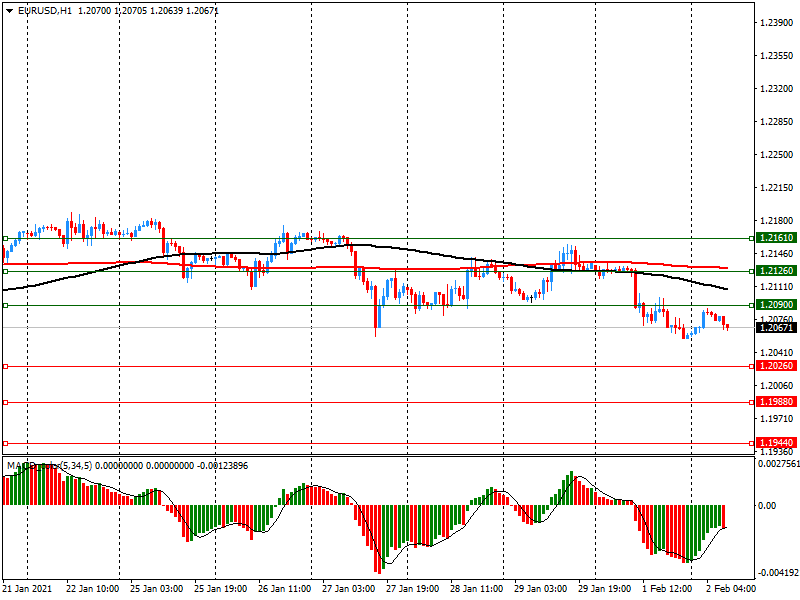
Comments:
- Overall open interest on the CALL options and PUT options with the expiration date February, 5 is 53213 contracts (according to data from February, 1) with the maximum number of contracts with strike price $1,2000 (3753);
GBP/USD
Resistance levels (open interest**, contracts)
$1.3816 (350)
$1.3777 (1496)
$1.3744 (1480)
Price at time of writing this review: $1.3672
Support levels (open interest**, contracts):
$1.3571 (788)
$1.3532 (907)
$1.3489 (1876)
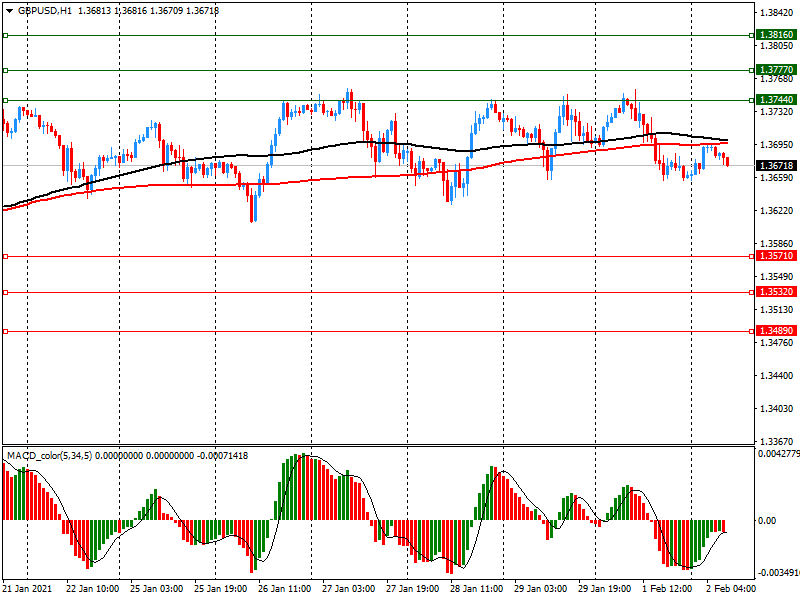
Comments:
- Overall open interest on the CALL options with the expiration date February, 5 is 11003 contracts, with the maximum number of contracts with strike price $1,4000 (1598);
- Overall open interest on the PUT options with the expiration date February, 5 is 21673 contracts, with the maximum number of contracts with strike price $1,2500 (2183);
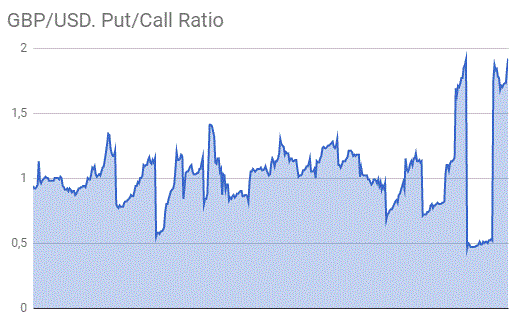
- The ratio of PUT/CALL was 1.97 versus 1.92 from the previous trading day according to data from February, 1
* - The Chicago Mercantile Exchange bulletin (CME) is used for the calculation.
** - Open interest takes into account the total number of option contracts that are open at the moment.
RTTNews reports that Australia's central bank raised the size of its asset purchase programme and signaled that it won't hike interest rates until 2024.
The policy board of the Reserve Bank of Australia decided to leave its cash rate unchanged at a record low of 0.10 percent.
The central bank retained the target yield on the 3-year Australian Government bond at around 0.1 percent and also the parameters of the Term Funding Facility.
But the board decided to buy an additional A$100 billion of bonds issued by the Australian Government and states and territories when the program is completed in mid-April. These additional purchases will be at the current rate of A$5 billion a week.
"The board will not increase the cash rate until actual inflation is sustainably within the 2 to 3 percent target range. For this to occur, wages growth will have to be materially higher than it is currently," the bank said.
Both inflation and wages growth are forecast to pick up, but to do so only gradually, with both remaining below 2 percent over the next couple of years, the board said. In underlying terms, inflation is expected to be 1.25 percent over 2021 and 1.5 percent over 2022.
Policymakers expect the economic recovery to continue, with the central scenario being for GDP to grow by 3.5 percent over both 2021 and 2022. GDP is expected to return to its end-2019 level by the middle of this year.
| Time | Country | Event | Period | Previous value | Forecast |
|---|---|---|---|---|---|
| 03:30 (GMT) | Australia | Announcement of the RBA decision on the discount rate | 0.1% | 0.1% | |
| 07:00 (GMT) | United Kingdom | Nationwide house price index, y/y | January | 7.3% | 6.8% |
| 07:00 (GMT) | United Kingdom | Nationwide house price index | January | 0.8% | 0.2% |
| 07:45 (GMT) | France | CPI, m/m | January | 0.2% | -0.1% |
| 07:45 (GMT) | France | CPI, y/y | January | 0% | 0.3% |
| 10:00 (GMT) | Eurozone | GDP (QoQ) | Quarter IV | 12.5% | -1.2% |
| 10:00 (GMT) | Eurozone | GDP (YoY) | Quarter IV | -4.3% | -5.4% |
| 19:00 (GMT) | U.S. | FOMC Member Williams Speaks | |||
| 19:00 (GMT) | U.S. | FOMC Member Mester Speaks | |||
| 21:30 (GMT) | Australia | AiG Performance of Construction Index | December | 55.3 | |
| 21:45 (GMT) | New Zealand | Employment Change, q/q | Quarter IV | -0.8% | 0% |
| 21:45 (GMT) | New Zealand | Unemployment Rate | Quarter IV | 5.3% | 5.6% |
| Pare | Closed | Change, % |
|---|---|---|
| AUDUSD | 0.76218 | -0.03 |
| EURJPY | 126.547 | -0.42 |
| EURUSD | 1.20588 | -0.56 |
| GBPJPY | 143.361 | -0.14 |
| GBPUSD | 1.36611 | -0.31 |
| NZDUSD | 0.71558 | -0.1 |
| USDCAD | 1.28539 | 0.51 |
| USDCHF | 0.89708 | 0.79 |
| USDJPY | 104.936 | 0.16 |







© 2000-2026. All rights reserved.
This site is managed by Teletrade D.J. LLC 2351 LLC 2022 (Euro House, Richmond Hill Road, Kingstown, VC0100, St. Vincent and the Grenadines).
The information on this website is for informational purposes only and does not constitute any investment advice.
The company does not serve or provide services to customers who are residents of the US, Canada, Iran, The Democratic People's Republic of Korea, Yemen and FATF blacklisted countries.
Making transactions on financial markets with marginal financial instruments opens up wide possibilities and allows investors who are willing to take risks to earn high profits, carrying a potentially high risk of losses at the same time. Therefore you should responsibly approach the issue of choosing the appropriate investment strategy, taking the available resources into account, before starting trading.
Use of the information: full or partial use of materials from this website must always be referenced to TeleTrade as the source of information. Use of the materials on the Internet must be accompanied by a hyperlink to teletrade.org. Automatic import of materials and information from this website is prohibited.
Please contact our PR department if you have any questions or need assistance at pr@teletrade.global.


 Bank
Bank transfers


