- Analytics
- News and Tools
- Market News
Analytics, News, and Forecasts for CFD Markets: currency news — 04-02-2021.
| Time | Country | Event | Period | Previous value | Forecast |
|---|---|---|---|---|---|
| 00:30 (GMT) | Australia | Retail Sales, M/M | December | 7.1% | |
| 00:30 (GMT) | Australia | RBA Monetary Policy Statement | |||
| 05:00 (GMT) | Japan | Leading Economic Index | December | 96.4 | |
| 05:00 (GMT) | Japan | Coincident Index | December | 89.0 | |
| 07:00 (GMT) | Germany | Factory Orders s.a. (MoM) | December | 2.3% | -1% |
| 07:45 (GMT) | France | Non-Farm Payrolls | Quarter IV | 1.6% | |
| 07:45 (GMT) | France | Trade Balance, bln | December | -3.6 | |
| 08:00 (GMT) | Switzerland | Foreign Currency Reserves | January | 891.224 | |
| 08:30 (GMT) | United Kingdom | Halifax house price index 3m Y/Y | January | 6% | |
| 08:30 (GMT) | United Kingdom | Halifax house price index | January | 0.2% | |
| 13:30 (GMT) | U.S. | Manufacturing Payrolls | January | 38 | 30 |
| 13:30 (GMT) | U.S. | Average workweek | January | 34.7 | 34.7 |
| 13:30 (GMT) | U.S. | Government Payrolls | January | -45 | |
| 13:30 (GMT) | U.S. | Average hourly earnings | January | 0.8% | 0.3% |
| 13:30 (GMT) | U.S. | Labor Force Participation Rate | January | 61.5% | |
| 13:30 (GMT) | U.S. | Private Nonfarm Payrolls | January | -95 | -50 |
| 13:30 (GMT) | Canada | Trade balance, billions | December | -3.34 | -2.6 |
| 13:30 (GMT) | Canada | Employment | January | -52.7 | -55 |
| 13:30 (GMT) | Canada | Unemployment rate | January | 8.8% | 8.9% |
| 13:30 (GMT) | U.S. | Unemployment Rate | January | 6.7% | 6.8% |
| 13:30 (GMT) | United Kingdom | BOE Gov Bailey Speaks | |||
| 13:30 (GMT) | U.S. | Nonfarm Payrolls | January | -140 | 20 |
| 13:30 (GMT) | U.S. | International Trade, bln | December | -68.1 | -65.7 |
| 15:00 (GMT) | Canada | Ivey Purchasing Managers Index | January | 46.7 | |
| 18:00 (GMT) | U.S. | Baker Hughes Oil Rig Count | February | 295 | |
| 20:00 (GMT) | U.S. | Consumer Credit | December | 15.27 | 12 |
- We're not locked into anything, and our policy is actually going to be data-driven
- Says his modal forecast is for U.S. GDP to grow by 5% to 6% in 2021
- Does not expect that modal forecast is substantial enough to warrant QE tapering this year
- Emphasizes that Fed does not want to give off the impression that it is “eager” to pull back monetary policy support
- Reiterats that vaccine distribution will be the biggest driver for path of economy
- Few people have been inoculated to see any effect on aggregate performance of economy
- Says top regulators should be looking at GameStop trading saga and how it is impacting markets
- Does not think it’s something that’s influencing her monetary policy views right now
- Thinks that we need to ensure that it’s fair marketplace, as financial markets are important for economy
- Says she is glad that Treasury Secretary Yellen is getting all the regulators together to look at what happened
- Accommodative policy is necessary, as economy continues to climb from the pandemic-induced hole
- Just because unemployment is low, we’re not going to necessarily move monetary policy
- It’s really going to be, we need to see what’s going on with inflation
The U.S.
Commerce Department reported on Thursday that the value of new factory orders
rose 1.1 percent m-o-m in December, following a revised 1.3 percent m-o-m climb
in November (originally a 1.0 percent m-o-m advance). That marked the eighth
consecutive month of gains in factory orders.
Economists had
forecast a 0.7 percent m-o-m gain.
According to
the report, orders for transportation equipment fell 0.8 percent m-o-m in
December compared to a 2.0 percent m-o-m rise in November. This drop, however,
was more than offset by gains in orders for machinery (+2.7 percent m-o-m),
fabricated metals (+1.2 percent m-o-m), primary metals (+0.6 percent m-o-m),
computers and electronic products (+0.1 percent m-o-m) and electrical
equipment, appliances and components (+0.7 percent m-o-m).
Meanwhile,
total factory orders excluding transportation, a volatile part of the overall
reading, rose 1.4 percent m-o-m in December (compared to an upwardly revised 1.1
percent m-o-m gain in November), while orders for nondefense capital goods
excluding aircraft, a measure of business spending plans, increased 0.7 percent
m-o-m (compared to a 1.2 percent m-o-m
advance in the previous month) instead of advancing 0.6 percent m-o-m as
reported last month. The report also showed that shipments of core capital
goods advanced 0.7 percent m-o-m in December, rather than gaining 0.5 percent
m-o-m as previously reported.
The preliminary
data from the U.S. Labour Department showed on Thursday that nonfarm business
sector labor productivity in the United States fell 4.8 percent q-o-q in the
fourth quarter of 2020, as output surged 5.3 percent q-o-q and hours worked
jumped 10.7 percent q-o-q (seasonally adjusted). This was the largest decrease
in productivity since the second quarter of 1981 and was worse than economists’
forecast for a 2.8 percent q-o-q drop after a revised 5.1 percent q-o-q climb
in the third quarter (originally a 4.6 percent q-o-q gain).
In y-o-y terms,
the labor productivity rose 2.5 percent in the third quarter, reflecting a 2.7-percent
decline in output and a 5.0-percent fall in hours worked.
Meanwhile, unit labor costs in the nonfarm business sector in the fourth quarter rose 6.8 percent q-o-q compared to a revised 7.0 percent q-o-q fall in the prior quarter (originally a 6.6 percent q-o-q decline).
Economists
had forecast a 3.5 percent advance in fourth-quarter unit labor costs.
Unit labor
costs quarterly decline reflected a 1.7-percent q-o-q increase in hourly
compensation and a 4.8-percent drop in productivity.
Compared to the
corresponding period of 2019, unit labor costs rose 5.2 percent.
The data from
the Labor Department revealed on Thursday the number of applications for
unemployment declined to the lowest in two months last week, but remained
elevated.
According to
the report, the initial claims for unemployment benefits decreased by 33,000 to
779,000 for the week ended January 30. This was the lowest reading since the
week ended November 28. Still, claims remained well above pre-pandemic levels.
Economists had
expected 830,000 new claims last week.
Claims for the
prior week were revised downwardly to 812,000 from the initial estimate of 847,000.
Meanwhile, the
four-week moving average of jobless claims fell to 848,250 from a downwardly
revised 849,500 in the previous week.
Continuing
claims decreased to 4,592,000 from an upwardly revised 4,785,000 in the
previous week.
- If outlook for inflation weakens, MPC will take whatever action necessary
- Outlook remains unusually uncertain for economy
- On negative rates, there are a range of views on MPC on how PRA should respond
- Economic outlook risks have become more two-sided
- It's not easy to reach a firm view on how much UK households will release savings built during the pandemic
- Don't take any signal from negative rate preparations
- Q4 GDP numbers have turned out stronger than expected
- My message to markets is do not read future MPC decisions based on toolbox moves
| Time | Country | Event | Period | Previous value | Forecast | Actual |
|---|---|---|---|---|---|---|
| 09:00 | Eurozone | ECB Economic Bulletin | ||||
| 09:30 | United Kingdom | PMI Construction | January | 54.6 | 52.9 | 49.2 |
| 10:00 | Eurozone | Retail Sales (MoM) | December | -6.1% | 1.6% | 2% |
| 10:00 | Eurozone | Retail Sales (YoY) | December | -2.2% | 0.3% | 0.6% |
| 12:00 | United Kingdom | Asset Purchase Facility | 875 | 875 | 875 | |
| 12:00 | United Kingdom | BoE Interest Rate Decision | 0.1% | 0.1% | 0.1% | |
| 12:00 | United Kingdom | Bank of England Minutes | ||||
| 12:30 | United Kingdom | BOE Gov Bailey Speaks | ||||
| 13:30 | U.S. | Continuing Jobless Claims | January | 4785 | 4700 | 4592 |
| 13:30 | U.S. | Unit Labor Costs, q/q | Quarter IV | -7% | 4% | 6.8% |
| 13:30 | U.S. | Nonfarm Productivity, q/q | Quarter IV | 5.1% | -2.8% | -4.8% |
| 13:30 | U.S. | Initial Jobless Claims | January | 812 | 830 | 779 |
GBP rose against its major rivals in the European session on Thursday after the announcement of the outcomes of the Bank of England's (BoE) latest monetary policy meeting.
At its February meeting, the BoE's policymakers decided to leave the bank rate unchanged at 0.10% and maintained the asset purchase program at GBP895 billion. They also said that the outlook for the economy remained unusually uncertain, but the rollouts of the Covid-19 vaccination program had improved it. GDP is projected to recover rapidly towards pre-virus levels over 2021, the BoE's officials added.
At the same time, the central bankers warned that preparations for negative interest rates should begin, but added that this message shouldn’t be taken as a signal that the policy is imminent. According to the letter from the BoE's deputy governor Sam Woods, who heads the Prudential Regulation Authority (PRA), consultations with banks found that the implementation of the negative rates within six months would pose heightened operational risks and could adversely impact some firms’ safety and soundness. This statement raised investors' bets that sub-zero rates are not to come any time soon.
- Majority of firms would need to make system changes to implement negative rates
- We need to act big to provide bridge and avoid scarring in the economy
- Small businesses need help to get to the other side
- U.S. president Biden would like to do this on bipartisan basis
- We need to make sure markets are functioning properly
- We will discuss if recent events warrant further action
- We will look to understand what transpired before taking action
- We're faced with not one but two crises, pandemic and economic
- I want to be sure Americans don't suffer needlessly
The Bank of
England (BoE) announced its Monetary Policy Committee (MPC) voted 9-0 to
maintain Bank Rate at 0.1 percent at its February meeting, as widely expected.
The MPC also
voted unanimously to continue with its existing programmes of UK government
bond and sterling non-financial investment-grade corporate bond purchases,
maintaining the target for the total stock of these purchases at GBP895 billion.
In the statement, the BoE notes:
- MPC judged that existing stance of monetary policy remains appropriate;
- Covid-19 (Covid) vaccination programmes are under way, which has improved the economic outlook;
- nevertheless, recent activity has been affected by increase in Covid cases, including from newly identified strains of the virus, and associated reimposition of restrictions;
- UK GDP is expected to have risen little in 2020 Q4 to a level around 8% lower than in 2019 Q4; this is materially stronger than expected in November;
- UK GDP is expected to fall by around 4% in 2021 Q1, in contrast to expectations of rise in November;
- GDP is projected to recover rapidly towards pre-Covid levels over 2021, as vaccination programme is assumed to lead to easing of Covid-related restrictions and people’s health concerns;
- CPI inflation is expected to rise quite sharply towards the 2% target in spring, as reduction in VAT for certain services comes to end and given developments in energy prices;
- CPI inflation is projected to be close to 2% over the second and third years of the forecast period
- Outlook for economy remains unusually uncertain;
- MPC will continue to monitor situation closely; if the outlook for inflation weakens, Committee stands ready to take whatever additional action is necessary to achieve its remit;
- Committee does not intend to tighten monetary policy at least until there is clear evidence that significant progress is being made in eliminating spare capacity and achieving 2% inflation target sustainably.
FXStreet reports that economists at Rabobank continue to see a rocky road for GBP partly because UK Q1 economic data is likely to discourage the bullish outlook and also because Brexit is casting shadows. All in all, the EUR/GBP pair is forecast at 0.87 in the coming months.
“There is a strong risk that relief over the Brexit trade deal will run dry fairly quickly given its limitations.”
“During the course of the year we expect that the bounce back in UK GDP growth should provide moderate support for GBP and we see EUR/GBP moving to 0.87. However, we do not see a straightforward path for GBP bulls in the coming months.”
In a press release, the ECB said on Thursday that it "decided in December 2020 to offer a nine-month extension of its temporary swap and repo lines with non-euro area central banks. "
"The central banks of Albania, Croatia, Hungary, the Republic of North Macedonia, Romania, San Marino and Serbia have agreed to extend the duration of their euro liquidity lines with the ECB to March 2022."
USD/CHF: Poised to see a move to the key resistance at 0.9027/28 - Credit Suisse
FXStreet reports that analysts at Credit Suisse note that the USD/CHF pair maintains its small “head and shoulders” base and a deeper setback is now expected, with key resistance seen at 0.9027/28.
“USD/CHF saw a clear break above the crucial downtrend from September 2020 and psychological inflection point at 0.9000 to suggest further near-term strength is likely as a small ‘head and shoulders’ base is still in place.”
“With daily MACD momentum also still breaking higher, we keep our bias for further near-term strength in place and now look for a test of 0.9027/28, which is a cluster of medium-term retracement levels and where we would expect to see a pause at first. However, it is worth noting that the ‘measured base objective’ is seen much higher at 0.9090/95.”
According to the report from the Society of Motor Manufacturers and Traders (SMMT), the UK new car market fell -39.5% in January with 59,030 fewer registrations compared to the same month last year. Just 90,249 cars were registered as showrooms across the country remained shut, leading to the worst start to the year since 1970.
Demand remained depressed for both private buyers (-38.5%) and large fleets (-39.7%). Declines were also recorded in both petrol and diesel cars registrations, which fell by -62.1% and -50.6% respectively. On a positive, however, battery electric vehicle (BEV) uptake grew by 2,206 units (54.4%) to take 6.9% of the market, as the number of available models almost doubled from 22 in January 2019 to 40 this year. Combined, BEVs and plug-in hybrid vehicles (PHEVs) accounted for 13.7% of registrations.
"Following a GBP 20.4 billion loss of revenue last year, the auto industry faces a difficult start to 2021," Mike Hawes, SMMT chief executive, said. "Lifting the shutters will secure jobs, stimulate the essential demand that supports our manufacturing, and will enable us to forge ahead on the Road to Zero."
FXStreet reports that Jianwei Xu from Natixis discusses USD/CNY prospects.
“As long as global growth (mainly in China and in the US) is improving on the back of vaccines and fiscal stimulus, the dollar will depreciate to the profit of most currencies but particularly the CNY as it is supported by a strong growth. Currently the PBoC would like to stabilize its currency but it would be complicated given current inflows. The USD will continue to depreciate this year against most currencies and particularly the CNY as the USD/CNY could fall towards 6.30 in one year.”
According to the report from Eurostat, in December 2020, the seasonally adjusted volume of retail trade rose by 2.0% in the euro area and by 1.4% the EU, compared with November 2020. Economists had expected a 1.6% increase in the euro area. In November 2020, the retail trade volume fell by 5.7% in the euro area and by 4.9% in the EU.
In December 2020 compared with December 2019, the calendar adjusted volume of retail trade increased by 0.6% in the euro area and by 0.5% in the EU. Economists had expected a 0.3% increase in the euro area.
The annual average retail trade for the year 2020, compared with 2019, fell by 1.2% in the euro area and by 0.8% in the EU.
In the euro area in December 2020, compared with November 2020, the volume of retail trade increased by 5.1% for automotive fuels, by 1.9% for food, drinks and tobacco and by 1.5% for non-food products (within this category textile, clothing and footwear increased by 12.4%). In the EU, the volume of retail trade increased by 4.0% for automotive fuels, by 1.7% for food, drinks and tobacco and by 0.7% for non-food products (textile, clothing and footwear +10.0%).
According to the report from IHS Markit/CIPS, January PMI data indicated a marginal decline in UK construction output, which ended a seven-month period of expansion. The latest survey also signalled a slowdown in new order growth to its weakest since June 2020. Construction companies often noted that the third national lockdown and concerns about the near-term economic outlook had led to greater hesitancy among clients, especially for new commercial projects. Meanwhile, transport shortages and delays at UK ports resulted in another severe downturn in supplier performance during January. Around 45% of the survey panel reported longer lead times for the delivery of construction inputs, while only 1% noted an improvement.
At 49.2 in January, down from 54.6 in December, the headline seasonally adjusted UK Construction Total Activity Index signalled a decline in overall construction output for the first time since May 2020. However, the rate of contraction was only marginal. A renewed fall in commercial activity (index at 46.2) and another drop in work on civil engineering projects (45.0) stood in contrast with strong growth in the residential category (57.1). Nonetheless, the latest increase in house building was the slowest since the rebound began in June 2020.
Finally, latest data indicated that business expectations for the year ahead remained positive in January. However, the degree of confidence eased to a three month low.
Reuters reports that Finance Minister Olaf Scholz - the Social Democrat, who is his party’s candidate to succeed conservative Chancellor Angela Merkel in a national election this year - was asked if the totemic constitutional borrowing ceiling should be suspended for a third year in a row.
“In coming days we will have to decide very concretely on how we deal with the new challenges,” he told. “We are very glad to have a good healthcare system. It would be crazy to cut that.
“And it would be economically wrong to adopt austerity politics and cut investment. So the question is how do we mobilise the funds that we need to have a good growth path and promote social cohesion,” he added.
FXStreet reports that Bart Melek, Head of Commodity Strategy at TD Securities discusses WTI oil prospects.
“Economic data continues to show the negative impact of the second round of COVID-19 and vaccine program rollouts across the world have left much to be desired, which had many observers downgrading their demand estimates for 2021. There is also a risk that OPEC+ discipline and compliance may be peaking in Q1, as the higher price environment incentivizes nations to release the excess capacity into the market down the road. As such, there are risks that crude oil may migrate a few dollars lower over the relative near-term as demand returns into Q2 and OPEC+ responds with new supply. We project WTI to trade at around $55/bbl for most of 2021.”
According to the report from IHS Markit, the Eurozone Construction Total Activity Index fell from 45.5 in December to 44.1 in January, to signal a sharp and accelerated decline in eurozone construction activity. Notably, the rate of contraction was the quickest recorded since last May, and stretched the current sequence of reduction to 11 months. Companies frequently linked the latest drop in activity to the coronavirus disease 2019 (COVID-19) pandemic and weaker sales. Underlying data signalled reduced construction output across each of the three monitored sub-sectors, with civil engineering seeing the sharpest fall.
January survey data revealed a further decline in home building activity across the eurozone, thereby stretching the current period of reduction to 11 months. Commercial building activity fell for the eleventh successive month in January, and at the sharpest rate since last May. Work undertaken on civil engineering projects decreased again in January. The fall stretched the current period of decline to 18 months. Notably, the pace of contraction was the quickest since last May.
New business placed with eurozone construction companies decreased for the eleventh month in a row at the start of 2021. Moreover, the rate of decline quickened from December and was solid. According to anecdotal evidence, restrictions to curb the spread of COVID-19 and relatively weak market conditions had restricted sales and led to delays in the sign-off of projects.
The sustained drops in activity and new work drove a further decline in employment at eurozone construction companies during January. Job cuts have now been recorded in each of the past 11 months. Though modest, the rate of job shedding was the fastest for three months.
Although activity and sales trends remained weak, eurozone construction firms expressed optimism towards the 12-month outlook amid positive vaccine news. This was the first time that firms had forecast growth of activity since July 2020.
CNBC reports that the International Monetary Fund has raised its economic outlook for the Middle East and North Africa region’s growth in 2020 by 1.2 percentage points to an overall contraction of 3.8%, showing that despite some progress since the coronavirus pandemic began, it’s still been a brutal year by any account.
Recovery will be varied and based largely on countries’ investments and strategies for vaccine distribution. But there has been one bright spot for the Gulf states in particular — the lifting of the political and economic blockade of Qatar by other GCC countries, the IMF’s Middle East and Central Asia Director Jihad Azour told CNBC.
Azour told that “any improvement in terms of opening up borders, improving economic relationship will provide an additional potential for growth.”
“Of course, this will improve trade, especially at rates in goods and services,” he added. “It will reduce the cost of procuring for example, for Qatar, it will also help the airlines by reducing the cost. Therefore, there is always benefit from improving economic relationships, especially that we are now entering into a new phase in terms of globalization.”
In the region more broadly, the improvement in outlook was based on “stronger-than-expected performance among oil exporters, as the absence of the second wave in some countries boosted non-oil activity, and the impact of the first wave was lower than expected,” the IMF wrote in its regional outlook report.
| Time | Country | Event | Period | Previous value | Forecast | Actual |
|---|---|---|---|---|---|---|
| 00:30 | Australia | Trade Balance | December | 5.014 | 6.785 |
During today's Asian trading, the US dollar rose against most currencies on the back of an increase in the yield of US treasuries, due to the growing confidence of traders that active vaccination against COVID-19 in the US, as well as additional stimulus measures, will support the recovery of the US economy in 2021.
An increase in interest rates on US Treasury bonds traditionally supports the dollar - the higher the rates, the more attractive the US currency is for buyers. The yield on 30-year US Treasury bonds at the end of trading on Wednesday rose to the highest since February 2020 of 1.928% per annum.
The euro, which rose earlier this year to the highest since 2018 against the dollar, is losing its appeal, and traders are abandoning "bullish" forecasts for the European currency. Slower than in the UK and the US, the pace of vaccination in the EU countries can cost the European economy tens of billions of euros of lost GDP, experts say.
Analysts at Nomura have already announced the curtailment of long positions on the dollar, while Deutsche Bank warns about the possibility of a decline in the euro to lows since November last year.
The ICE index, which tracks the dynamics of the dollar against six currencies (euro, swiss franc, yen, canadian dollar, pound sterling and swedish krona), was 0.16%.
eFXdata reports that MUFG Research discusses NZD outlook.
"Strong labour market provides more evidence of V-shaped recovery in New Zealand...New Zealand’s success in containing the spread of COVID-19 is allowing their economy to recover more strongly. Positive cyclical momentum is encouraging market participants to continue scaling back expectations for further RBNZ easing. The likelihood of negative rates being implemented has diminished. Overall, we continue to believe that the fundamental backdrop remains favourable for a stronger kiwi," MUFG adds.
FXStreet reports that FX Strategists at UOB Group noted that further downside in USD/CNH looks likely in the next weeks.
Next 1-3 weeks: “There is not much to add to our update from Monday. As highlighted, downward momentum is beginning to improve but USD has to close below 6.4400 before a move towards 6.4130 can be expected. The prospect for such a move has increased and would continue to increase as long as USD does not move above 6.4900 (no change in ‘strong resistance’ level). Looking ahead, the support below 6.4400 is at 6.4130.”
RTTNews reports that survey results from NAB showed that Australia business confidence improved sharply in the fourth quarter, suggesting a strong rebound from the large pandemic-related hit to activity in early 2020.
The business confidence index rose 22 points to +14 from -8 in the third quarter. Confidence turned positive in all industries and strongest in retail.
At the same time, the business conditions index climbed 14 points to 9 in the fourth quarter.
The increase in business conditions was driven by an improvement in all three sub-components, with trading conditions and profitability well above average. The employment index remained negative despite recording a solid gain.
Leading indicators also improved further in the fourth quarter. Expected business conditions at the 3- and 12-month horizons rose to high levels and suggest further gains in activity over the next year.
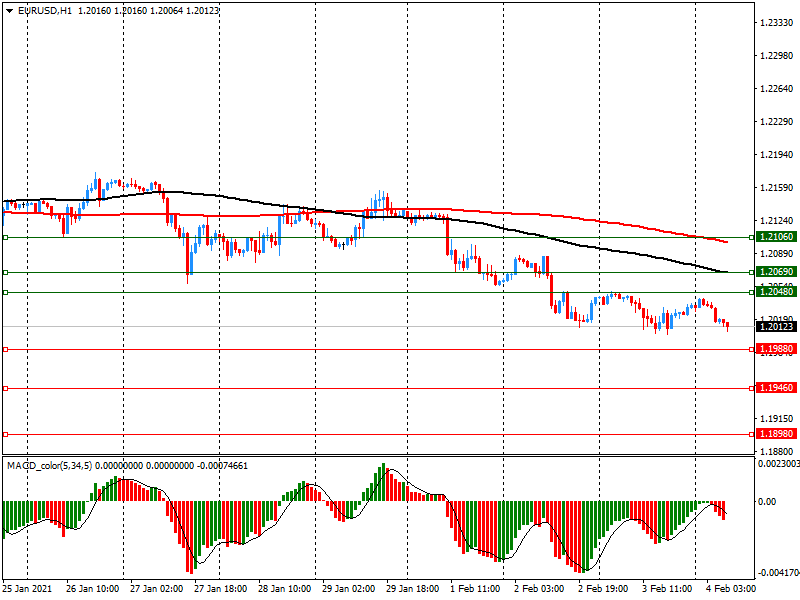
EUR/USD
Resistance levels (open interest**, contracts)
$1.2106 (853)
$1.2069 (188)
$1.2048 (173)
Price at time of writing this review: $1.2012
Support levels (open interest**, contracts):
$1.1988 (3700)
$1.1946 (1082)
$1.1898 (956)
Comments:
- Overall open interest on the CALL options and PUT options with the expiration date February, 5 is 52938 contracts (according to data from February, 3) with the maximum number of contracts with strike price $1,2000 (3700);
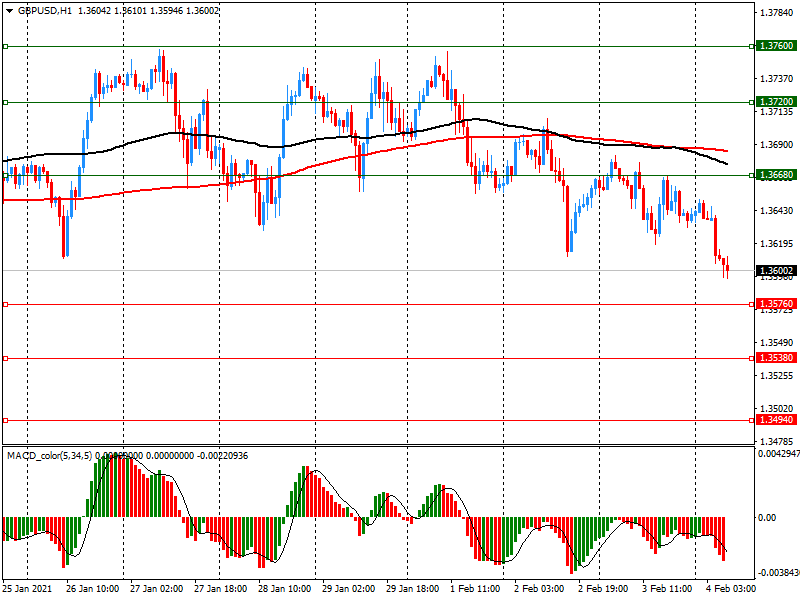
GBP/USD
Resistance levels (open interest**, contracts)
$1.3760 (1448)
$1.3720 (1897)
$1.3668 (932)
Price at time of writing this review: $1.3600
Support levels (open interest**, contracts):
$1.3576 (775)
$1.3538 (868)
$1.3494 (1770)
Comments:
- Overall open interest on the CALL options with the expiration date February, 5 is 11130 contracts, with the maximum number of contracts with strike price $1,3700 (1897);
- Overall open interest on the PUT options with the expiration date February, 5 is 21365 contracts, with the maximum number of contracts with strike price $1,2500 (2183);
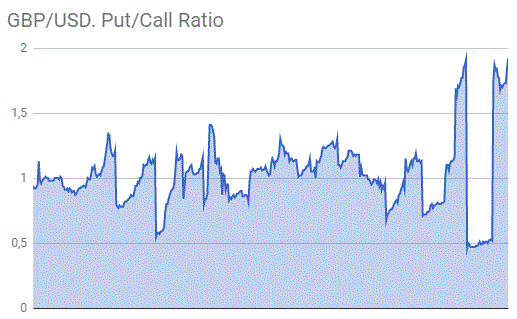
- The ratio of PUT/CALL was 1.92 versus 1.91 from the previous trading day according to data from February, 3
* - The Chicago Mercantile Exchange bulletin (CME) is used for the calculation.
** - Open interest takes into account the total number of option contracts that are open at the moment.
| Time | Country | Event | Period | Previous value | Forecast |
|---|---|---|---|---|---|
| 00:30 (GMT) | Australia | Trade Balance | December | 5.022 | |
| 06:45 (GMT) | Switzerland | SECO Consumer Climate | Quarter I | -12.8 | |
| 09:00 (GMT) | Eurozone | ECB Economic Bulletin | |||
| 09:30 (GMT) | United Kingdom | PMI Construction | January | 54.6 | 52.9 |
| 10:00 (GMT) | Eurozone | Retail Sales (MoM) | December | -6.1% | 1.6% |
| 10:00 (GMT) | Eurozone | Retail Sales (YoY) | December | -2.9% | 0.3% |
| 12:00 (GMT) | United Kingdom | Asset Purchase Facility | 875 | 875 | |
| 12:00 (GMT) | United Kingdom | BoE Interest Rate Decision | 0.1% | 0.1% | |
| 12:00 (GMT) | United Kingdom | Bank of England Minutes | |||
| 12:30 (GMT) | United Kingdom | BOE Gov Bailey Speaks | |||
| 13:30 (GMT) | U.S. | Continuing Jobless Claims | January | 4771 | 4750 |
| 13:30 (GMT) | U.S. | Unit Labor Costs, q/q | Quarter IV | -6.6% | 3.5% |
| 13:30 (GMT) | U.S. | Nonfarm Productivity, q/q | Quarter IV | 4.6% | -2.8% |
| 13:30 (GMT) | U.S. | Initial Jobless Claims | January | 847 | 830 |
| 15:00 (GMT) | U.S. | Factory Orders | December | 1% | 0.7% |
| 19:00 (GMT) | U.S. | FOMC Member Daly Speaks | |||
| 21:30 (GMT) | Australia | AIG Services Index | December | 52.9 | |
| 23:30 (GMT) | Japan | Household spending Y/Y | December | 1.1% | -2.4% |
| Pare | Closed | Change, % |
|---|---|---|
| AUDUSD | 0.76205 | 0.2 |
| EURJPY | 126.391 | 0.02 |
| EURUSD | 1.20342 | -0.06 |
| GBPJPY | 143.253 | -0.07 |
| GBPUSD | 1.36399 | -0.16 |
| NZDUSD | 0.72077 | 0.27 |
| USDCAD | 1.27857 | 0.03 |
| USDCHF | 0.89885 | 0.17 |
| USDJPY | 105.019 | 0.08 |







© 2000-2026. All rights reserved.
This site is managed by Teletrade D.J. LLC 2351 LLC 2022 (Euro House, Richmond Hill Road, Kingstown, VC0100, St. Vincent and the Grenadines).
The information on this website is for informational purposes only and does not constitute any investment advice.
The company does not serve or provide services to customers who are residents of the US, Canada, Iran, The Democratic People's Republic of Korea, Yemen and FATF blacklisted countries.
Making transactions on financial markets with marginal financial instruments opens up wide possibilities and allows investors who are willing to take risks to earn high profits, carrying a potentially high risk of losses at the same time. Therefore you should responsibly approach the issue of choosing the appropriate investment strategy, taking the available resources into account, before starting trading.
Use of the information: full or partial use of materials from this website must always be referenced to TeleTrade as the source of information. Use of the materials on the Internet must be accompanied by a hyperlink to teletrade.org. Automatic import of materials and information from this website is prohibited.
Please contact our PR department if you have any questions or need assistance at pr@teletrade.global.


 Bank
Bank transfers


