- Analytics
- News and Tools
- Market News
Analytics, News, and Forecasts for CFD Markets: currency news — 05-02-2021.
On Monday, at 05:00 GMT, Japan will release an Eco Watchers Survey for January. At 06:45 GMT, Switzerland will report the change in the unemployment rate for January. At 07:00 GMT, Germany will announce the change in industrial production for December. At 09:30 GMT, the eurozone will release the Sentix investor confidence indicator for February. At 16:15 GMT, ECB President Lagarde will deliver a speech. At 23:30 GMT, Japan will report on the change in the level of wages for December.
On Tuesday, at 00:30 GMT, Australia will present the NAB business confidence index for January. At 02:00 GMT, New Zealand will announce a change in expected inflation in two years. At 03:00 GMT, China will report a change in the foreign trade balance for January. At 06:00 GMT, Japan will announce a change in the machine tool orders for January. At 07:00 GMT, Germany will announce a change in the foreign trade balance for December. At 15:00 GMT, the US will report changes in the level of vacancies and labor turnover for December. At 23:30 GMT, Australia will release the Westpac consumer confidence index for February.
On Wednesday, at 01:30 GMT, China will present the consumer price index and the producer price index for January. At 07:00 GMT, Germany will publish the consumer price index for January. At 07:45 GMT, France will announce a change in industrial production for December. At 13:30 GMT, the US will present the consumer price index for January. At 15:00 GMT, the US will report a change in the wholesale inventories for December, and at 15:30 GMT - a change in oil reserves according to the Department of Energy for February. At 19:00 GMT, in the US the monthly budget report for January will be released.
On Thursday, at 00:00 GMT, Australia will announce a change in expectations for consumer price inflation for February. At 10: 00 GMT in the euro area, the forecast for the economy from the European Commission will be released. At 13:30 GMT, the United States will report a change in the number of initial applications for unemployment benefits. At 21:30 GMT, New Zealand will present the Business NZ manufacturing PMI for January.
On Friday, at 07:00 GMT, the UK will announce changes in GDP for December and the 4th quarter, as well as industrial production, manufacturing production and the balance of visible trade for December, and investment for the 4th quarter. At 07:30 GMT in Switzerland, the consumer price index for January will be released. At 10:00 GMT, the euro zone will report a change in industrial production for December. At 13:30 GMT, Canada will announce the change in wholesale trade for December. At 15:00 GMT, the US will release the Reuters/Michigan consumer sentiment index for February. At 18:00 GMT, in the United States, the Baker Hughes report on the number of active oil drilling rigs will be released
On Sunday, at 23:50 GMT, Japan will announce the change in GDP for the 4th quarter.
Statistics Canada announced on Friday that Canada’s merchandise trade deficit stood at CAD1.67 billion in December, narrowing from a revised CAD3.56-billion gap in November (originally a CAD3.34-billion shortfall). This was the lowest trade gap since June 2020. Economists had forecast a deficit of CAD3.00 billion.
According to
the report, Canada’s exports grew by 1.5 percent m-o-m to CAD47.32 billion in December,
mainly driven by higher exports of energy products (+10.2 percent m-o-m).
Meanwhile, imports decreased by 2.3 percent m-o-m to CAD48.98 billion in December,
primarily due to lower imports of consumer goods (-8.0 percent m-o-m).
For the year
2020, Canada's trade deficit totaled CAD36.2 billion, more than double the shortfall
observed in 2019. Its exports declined 12.3 percent in 2020, while imports dropped
8.6 percent.
- President Biden is working on robust infrastructure bill, which is expected to receive bipartisan support
The Ivey
Business School Purchasing Managers Index (PMI), measuring Canada’s economic
activity, increased to 48.4 in January 2021 from 46.7 in December 2020.
A reading above
50 signals expansion, while a reading below 50 indicates contraction.
Within
sub-indexes, the prices index climbed to 82.8 in January from 66.9 in December,
while the inventories indicator rose to 56.7 from 43.8 and the supplier
deliveries gauge increased to 34.7 from 30.1.
At the same
time, the employment measure fell to 41.5 in January from 45.8 in the previous
month. This was the lowest level since April 2020.
The U.S.
Commerce Department reported on Friday that U.S. the goods and services trade
deficit narrowed to $66.6 billion in December from a revised $69.0 billion in
the previous month (originally a gap of $68.1 billion).
Economists had
expected a deficit of $65.7 billion.
According to
the report, the December decline in the goods and services deficit reflected a drop
in the goods deficit of $2.8 billion to $84.2 billion and a decrease in the
services surplus of $0.4 billion to $17.5 billion.
In December,
exports of goods and services from the U.S. rose 3.4 percent m-o-m to $190.0
billion, while imports surged 1.5 percent m-o-m to $256.6 billion, reflecting
both the ongoing impact of the COVID-19 pandemic and the continued economic
recovery from the steep declines earlier in the year.
For 2020, the goods and
services deficit jumped 17.7 percent from 2019. Exports plunged 15.7 percent, while imports tumbled 9.5
percent.
Statistics
Canada reported on Friday that the number of employed people decreased by 212,800
m-o-m in January (or -0.3 percent m-o-m) after an unrevised decline of 52,700
m-o-m in the previous month.
Economists had
forecast a drop of 47,500 m-o-m.
Meanwhile,
Canada's unemployment rate rose to 9.4 percent in January from 8.8 percent in December,
exceeding economists’ forecast for 8.9 percent. This was the highest rate since
August 2020.
According to
the report, full-time employment edged up 12,600 (or +0.1 percent m-o-m) in January,
while part-time jobs declined by 225,400 (or -6.7 percent m-o-m).
In January, the
number of public sector employees fell by 10,700 (or -0.3 percent m-o-m), and
the number of private sector employees plunged by 211,100 (or -1.8 percent
m-o-m). Meanwhile, the number of self-employed increased 9,000 (or +0.3 percent
m-o-m) last month.
Sector-wise,
employment increased in goods-producing sector (+0.6 percent m-o-m) but tumbled
in service-producing business (-1.6 percent m-o-m).
The U.S. Labor
Department announced on Friday that nonfarm payrolls rose by 49,000 in January after
a revised 227,000 decline in the prior month (originally a decrease of 140,000),
reflecting the impact of the coronavirus pandemic and efforts to contain it.
According to
the report, notable job gains in January were recorded in professional and
business services and in both public and private education, which, however, were
offset by losses in leisure and hospitality, in retail trade, in health care,
and in transportation and warehousing.
The
unemployment rate fell to 6.3 percent in January from 6.7 percent in December.
Economists had
forecast the nonfarm payrolls to increase by 50,000 and the jobless rate to remain
at 6.7 percent.
The labor force
participation rate edged down to 61.4 percent from 61.5 percent in December,
while hourly earnings for private-sector workers rose 0.2 percent m-o-m (or
$0.06) to $29.96, following a revised 1.0 percent m-o-m advance in December (originally
a gain of 0.8 percent m-o-m). Economists had forecast the average hourly
earnings to increase 0.3 percent m-o-m in January. Over the year, average
hourly earnings surged by 5.4 percent in January, following a revised 5.4
percent rise in December (originally an advance of 5.1 percent).
The average
workweek increased by 0.3 hour to 35.0 hours in January, being above economists'
forecast for 34.7 hours.
- BoE is giving "absolutely no signal" on near-term policy direction
- Latest BoE's forecasts point out to "pretty strong" recovery both in economic activity and inflation in 2021
- Expecting 4.5 million people to be furloughed in current lockdown
| Time | Country | Event | Period | Previous value | Forecast | Actual |
|---|---|---|---|---|---|---|
| 07:00 | Germany | Factory Orders s.a. (MoM) | December | 2.7% | -1% | -1.9% |
| 07:45 | France | Non-Farm Payrolls | Quarter IV | 1.6% | -0.2% | |
| 07:45 | France | Trade Balance, bln | December | -3.79 | -3.39 | |
| 08:00 | Switzerland | Foreign Currency Reserves | January | 891.224 | 896.149 | |
| 08:30 | United Kingdom | Halifax house price index 3m Y/Y | January | 6% | 5.9% | 5.4% |
| 08:30 | United Kingdom | Halifax house price index | January | 0% | 0.3% | -0.3% |
USD fell against most of its major rivals in the European session on Friday as market sentiment got a boost from heightened optimism surrounding President Joe Biden’s massive COVID-19 relief proposal.
The U.S. Dollar Index (DXY), measuring the U.S. currency's value relative to a basket of foreign currencies, dropped 0.13% to 91.41.
The U.S. Senate approved a budget resolution early Friday that paves the way for the Democrats in the upper chamber to pass Biden's $1.9 trillion stimulus plan without the support of the Republicans. The House would first need to approve the bill since new stimulus amendments were passed.
In addition, market participants prepare for the release of the closely watched U.S. jobs report, which is due at 13:00 GMT. Economists expect employment to rise by 50,000 jobs in January after a drop of 140,000 in December. Meanwhile, the unemployment rate is forecast to remain at 6.7 percent.
FXStreet notes that EUR/USD weakness has extended to the cusp of the 23.6% retracement of the entire 2020/2021 rally at 1.1945/14. Whilst analysts at Credit Suisse similarly look for this to hold at first, the presence of a larger top suggests the pair should see a move below here also and a deeper setback to 1.1800, potentially even 1.1695.
“A further sharp sell-off for EUR/USD following the completion of a larger ‘head & shoulders’ top below key support from the recent low and 38.2% retracement of the rally from early November at 1.2065/54 has brought the pair to the cusp of our target at 1.1945/14 – the 23.6% retracement of the entire 2020/2021 uptrend. Although our bias has been to look for a fresh floor here, at least at first, the threat of a top for the EUR itself maintains the likelihood we will see a move below here also.”
“We would see next support at 1.1800, then more importantly at 1.1695/91 – the 38.2% retracement of the entire 2020/2021 uptrend and rising 200-day average. We would though look for a more important floor here.”
Carsten Brzeski, the Global Head of Macro for ING Research, notes that industrial orders fell in December, suggesting that the stricter lockdown in Gemany, together with ongoing lockdowns in other eurozone countries, has finally impacted German industry.
"Today’s industrial orders data gives a first impression of how the stricter lockdown measures since mid-December have hit the economy. Industrial orders fell by 1.9% month-on-month, from a slightly upwardly revised 2.7% in November. This was the first drop in industrial orders after seven consecutive monthly increases. The December drop was driven by weaker domestic demand and a sharp drop in orders from eurozone peers. "
"On the year, industrial orders are now up by 6.4%. Industrial orders are still some 2 ½ % above their pre-crisis level and despite the pandemic, the year 2020 will be the first year since 2017 in which industrial orders recorded a positive year in terms of average monthly growth."
"Today’s data, however, show that the stricter lockdown measures since mid-December, as well as the Christmas break, have finally hit German industry. At face value, this only looks like a temporary breather. However, with the Chinese New Year break as well as ongoing lockdowns in many main trading partner countries, setbacks for industry seem hard to avoid."
FXStreet reports that FX Strategists at UOB Group note that USD/JPY remains firm and could extend the upside to the 106.00 area in the next weeks.
24-hour view: “There is room for USD extend its gains but the major resistance at 106.00 is unlikely to come into the picture for now (105.80 is already quite a strong level). Support is at 105.30 followed by 105.10.”
Next 1-3 weeks: “We have expected USD to strengthen since last week. Our latest narrative was from Tuesday (02 Feb, spot at 104.85) where we highlighted that ‘upward momentum has improved slightly and while the outlook for USD is still positive, the major resistance at 105.40 may not come into the picture so soon’. In that sense, we did not quite expect the sudden surge in USD yesterday (04 Feb) that sent it soaring to 105.56. Further USD strength appears likely and the next level to focus on is at 106.00. The positive outlook is deemed intact as long as USD does not move below 104.80 (‘strong support’ level previously at 104.50).”
FXStreet reports that analysts at Credit Suisse appraise that the AUD/USD pair is back pressuring the 55-day average at 0.7595, increasing the risk of further near-term weakness again.
“AUD/USD is back under pressure in line with its recently completed small top and is pressuring the crucial 55-day average, currently at 0.7595, with the aussie already prodding beneath this level in early trading today. Although the market has so far managed to essentially hold above here, we see an increased risk of a break lower again as the daily MACD momentum turned negative for the first time in 2021.”
“A clear close beneath 0.7595 would reinforce the top significantly and open up a move to 0.7464/57, just below the ‘measured top objective’ at 0.7503, where we then would expect a more concerted effort to hold.”
The bill was amended several times, which means it will have to go back to the House for another vote.
Approval of a resolution will allow Democrats to forge ahead with the budget reconciliation process, which enables the party to pass Biden's stimulus plan with no Republican votes.
FXStreet reports that strategists at HSBC discuss XAU/USD prospects.
“The gold to silver ratio is back at around 1:71 after hitting 1:63 on February 1, indicating that silver is losing ground again to gold and implies the rally has turned. If silver does not stir higher again, market attention is likely to shift back to gold. This may mean that the focus will return to issues like risk appetite, the USD and US Treasury yields.”
“Gold has some potential support from geopolitical developments. Italy’s president, Sergio Mattarella, has asked Mario Draghi, former president of the European Central Bank (ECB), to begin talks to form a new Italian government of national unity as the country battles against COVID-19. This came after talks looking at reviving the governing coalition led by Prime Minister Giuseppe Conte collapsed earlier. Pandemic-related uncertainty still has the power to trigger ‘safe-haven’ gold buying.”
CNBC reports that Ben Broadbent, the Bank of England’s deputy governor of monetary policy, told that tight borders following the rollout of vaccines would likely be detrimental to the U.K.’s economic recovery.
Broadbent said the possibility of tight external borders but an internal opening once coronavirus vaccines had become ubiquitous would weigh on the economy.
“One of the downside risks we flagged is the possible emergence of new variants that are less susceptible to the vaccines. We haven’t examined precisely the effects of the different sorts of restrictions,” he said.
“My instinct would be that if you close borders, that would be negative for both the demand and the supply side of the economy.”
Broadbent cited the emergence of new variants of Covid-19 in recent months as a key consideration in the Bank’s outlook.
FXStreet reports that UOB Group’s FX Strategists suggested USD/CNH is expected to navigate between 6.4400 and 6.5200 in the next weeks.
Next 1-3 weeks: “Our latest narrative was from Monday where we indicated that ‘downward momentum is beginning to improve but USD has to close below 6.4400 before a move towards 6.4130 can be expected’. USD subsequently traded in a relatively quiet manner. The mild downward pressure has dissipated and USD is likely to trade sideways from here, expected to be between 6.4400 and 6.5200.”
FXStreet reports that the markets have reacted well to the news that Mario Draghi has been tasked with forming a new government. But economists at Capital Economics doubt that he would have as transformative an impact on the Italian economy as he had on the ECB.
“Given that there is not a lot more the ECB can do to loosen financial conditions, and that Italy has implemented a lot less fiscal stimulus than advanced economies outside the eurozone, Mr Draghi may want to increase the government’s fiscal support.”
“Draghi would be unlikely to push for the money to be spent on short-term giveaways that would be rejected by the EU. Italy could receive funds equivalent to nearly 12% of 2019 GDP spread over 6 years, of which just under 5% of GDP are grants.”
“His chances of implementing meaningful reform would depend on how strong the government was and how long it was likely to last. Even a longer lasting government would struggle to make wide ranging and substantial reforms.”
Bloomberg reports that the head of Gunvor Group Ltd. said oil won’t go much beyond $60 a barrel because further gains would trigger an avalanche of shuttered supply.
“Once you hit $60 a barrel, any oil production out there is profitable, and the incentive for oil producers to hold back erodes real fast,” Torbjorn Tornqvist, Gunvor’s chairman and chief executive officer, said in an email.
“The high-$50s are the higher end of our expectation for the first half, and we’re not sure we will see much higher,” the CEO said.
The market is still in the process of rebalancing, according to Tornqvist, who said output cuts by the Organization of Petroleum Exporting Countries and its allies have so far been effective. The current curbs are sufficient to spur a significant draw on crude stocks, while oil-product draws are less pronounced.
“Global products demand is 4 million to 5 million barrels less than it was a year ago,” with the most notable declines seen in jet fuel, gasoline and some diesel markets, Tornqvist said. “Demand for light ends, such as naphtha, remains robust.”
According to the report from Istat, in December 2020 estimates for seasonally adjusted index of retail trade increased by 2.5% in the month on month series, both in value and volume terms.
In the 4th quarter of 2020, value of sales dropped by 1.5% and volume fell by 0.8% when compared with the previous quarter.
Year on year, value of retail trade decreased by 3.1%, with a 9.4% fall in non-food sales and a 6.6% increase in food sales. Volume sales contracted by 3.2%.
In December 2020, all channels of distribution, besides e-commerce, continued their fall when compared with December 2019. Large-scale distribution was down 2.5% year on year, small-scale distribution dropped by 6.6% and non-store retail sales decreased by 12.3%.
Online sales continued their rise in December 2020, with sales up by 33.8% compared with the same period a year earlier.
Looking at the value of sales for non-food products, among all other sectors, clothing reported the largest annual fall at negative 23.4%, followed by shoes, leather goods and travel items (-14.6%). Growths were only reported for computers and telecommunications equipment (+15.3%), tools (+2.3%) and furniture, textile items and household furnishings (+0.5%).
FXStreet reports that economists at ANZ Bank discuss NZD/USD prospects.
“The Kiwi has made an about turn as the USD has stretched its legs amid higher interest rates and rallying equities, but it remains within well-established ranges. This recent fall is somewhat surprising given that the market has adopted the view that the RBNZ will be one of the earlier ‘hikers’ and given the performance of recent economic data. With that in mind, all eyes are on US employment data. Having not completely broken down, we’re more inclined to characterise the overnight as merely a correction.”
According to the report from Halifax Bank of Scotland, on a monthly basis, house prices in January were 0.3% lower than in December. In the latest quarter (November to January) house prices were 1.6% higher than in the preceding three months (August to October). House prices were 5.4% higher than in January 2020.
Russell Galley, Managing Director, Halifax, said: “The average UK house price slipped by -0.3% in January, the biggest monthly fall since April last year. Whilst this pushed the typical property value down to its lowest level since October, at just under £252,000, prices are around £13,000 higher than a year ago. There are some early signs that the upturn in the housing market could be running out of steam, with the annual rate of house price inflation cooling to its lowest level since August. Industry figures for agreed sales remain well above pre pandemic levels but new instructions to sell have decreased noticeably, and total stock held by estate agents has risen to its highest level since before the EU referendum in 2016".
| Time | Country | Event | Period | Previous value | Forecast | Actual |
|---|---|---|---|---|---|---|
| 00:30 | Australia | Retail Sales, M/M | December | 7.1% | -4.1% | |
| 00:30 | Australia | RBA Monetary Policy Statement | ||||
| 05:00 | Japan | Leading Economic Index | December | 96.1 | 94.9 | |
| 05:00 | Japan | Coincident Index | December | 89.0 | 87.8 | |
| 07:00 | Germany | Factory Orders s.a. (MoM) | December | 2.7% | -1% | -1.9% |
| 07:45 | France | Non-Farm Payrolls | Quarter IV | 1.6% | -0.2% | |
| 07:45 | France | Trade Balance, bln | December | -3.79 | -3.39 | |
| 08:00 | Switzerland | Foreign Currency Reserves | January | 891.224 | 896.149 |
During today's Asian trading, the US dollar was virtually unchanged against the world's major currencies.
The ICE Dollar index, which shows the value of the US dollar against the six major world currencies, is trading down 0.02% at 91.50. However, it may show the maximum weekly growth since October.
Expectations that the US economic recovery will outpace growth in other countries are encouraging investors to buy the US currency.
Statistics released yesterday showed that the US labor market is gaining strength, indicating an economic recovery in the country.
The number of Americans who applied for unemployment benefits for the first time last week decreased by 33 thousand - to 779 thousand people, according to a report by the US Department of Labor. Labor productivity in the United States in the 4th quarter fell by 4.8%, according to preliminary data from the Ministry. This is the highest drop since the second quarter of 1981, when it fell by 5.1%. The cost of labor in the United States in the last quarter increased by 6.8%.
According to the report from Insee, between the end of September and the end of December 2020, private payroll employment dropped by 0.2%, or 39,600 net job destructions. It declined again, as a result of the health crisis and second lockdown after a sharp rebound in the summer (+1.6%, that is +312,400 jobs). Private payroll employment remained below its pre-crisis level: except for the low point in the second quarter of 2020, at the end of 2020, it reached its lowest point since mid-2018. Over the year as a whole in 2020, it declined by 1.8% (that is -360,500 jobs), after five years of successive increases.
Temporary employment continues to recover strongly in the fourth quarter of 2020: +5.3% (+37,700 jobs) after +22.9% and +22.8% (that is +107,900 and +131,600 jobs) in the second and third quarters. These three increasing quarters don’t compensate for the historic drop in the first quarter of 2020 (40.3% that is -317,700 jobs) and at the end of 2020, temporary employment remains below its level at the end of 2019 (-5.1% that is -40,500 jobs) and close to its level mid-2017.
Excluding temporary work, private payroll employment decreased by 0.4% (-77,300 jobs).
Excluding temporary work, employment declined in industry and market services but increased in non-market services
Industrial employment (excluding temporary workers) fell again: -0.6% (-17,200 jobs), after -0.2% in the previous quarter (-7,500 jobs). Over one year, the decline in industry reached -2.0%, that is -61,700 jobs. This is the largest annual decline since 2010.
In non temporary market services, private payroll employment declined sharply: -0,7% after +1.2% in the previous quarter (that is -83,400 after +139,600 jobs). It remains below its level a year earlier by 2.5% (-289,600 jobs). This is its first annual decline since 2009.
FXStreet reports that FX Strategists at UOB Group noted EUR/USD could grind lower to the 1.1910 area in the next weeks.
Next 1-3 weeks: “We have expected EUR to weaken since last week. In our latest update from Wednesday, we noted that ‘as long as strong resistance at 1.2105 is not breached; a break of 1.2000 would not be surprising and would open up the way for EUR to move lower to 1.1965’. EUR cracked 1.2000 yesterday (04 Feb) and plunged to 1.1956. Momentum remains strong and further EUR weakness towards the next major support at 1.1910 seems likely. All in, the current weak phase in EUR is deemed intact as long as EUR does not move above 1.2055 (‘strong resistance’ level previously at 1.2105).”
According to provisional results of the Federal Statistical Office (Destatis), real (price adjusted) new orders decreased by a seasonally and calendar adjusted 1.9% in December 2020 compared with November 2020. Economists had expected a 1.0% decrease.
Compared with December 2019, the increase in calendar adjusted new orders amounted to +6.4%. Excluding major orders, real new orders in manufacturing (seasonally and calendar adjusted) were 2.0% lower than in the previous month.
Compared with February 2020, the month before restrictions were imposed due to the corona pandemic in Germany, new orders in December 2020 were 2.6% higher in seasonally and calendar adjusted terms.
Domestic orders decreased by 0.9% and foreign orders decreased by 2.6% in December 2020 on the previous month. New orders from the euro area went down 7.5%, and new orders from other countries increased by 0.5% compared with November 2020.
In December 2020, the manufacturers of intermediate goods saw new orders increase by 0.8% compared with November 2020. The manufacturers of capital goods saw a decrease of 4.6% on the previous month. Regarding consumer goods, new orders rose by 6.4%.
In 2020, new orders in the manufacturing sector were 7.2% lower in calendar-adjusted terms than in the previous year.
For November 2020, revision of the preliminary outcome resulted in an increase of 2.7% compared with October 2020 (provisional: +2.3%)
EUR/USD
Resistance levels (open interest**, contracts)
$1.2051 (258)
$1.2008 (404)
$1.1984 (140)
Price at time of writing this review: $1.1962
Support levels (open interest**, contracts):
$1.1942 (1011)
$1.1898 (921)
$1.1850 (1681)
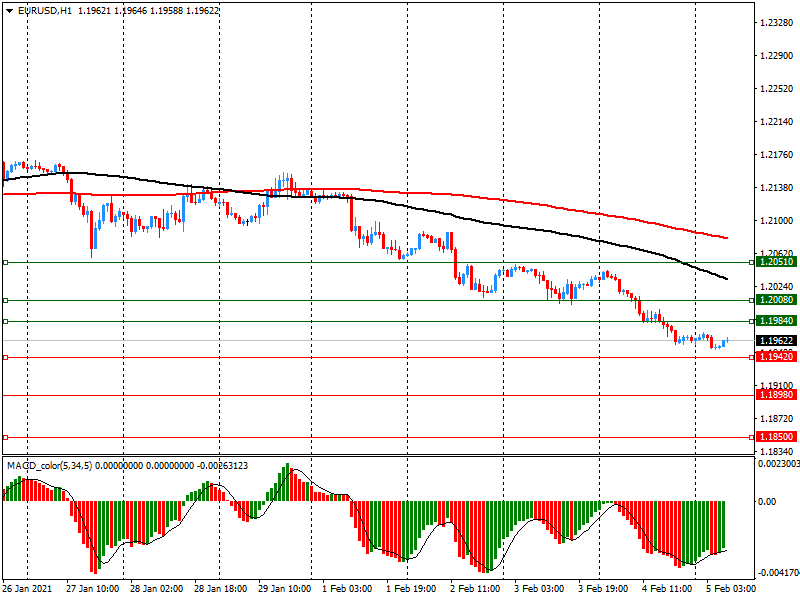
Comments:
- Overall open interest on the CALL options and PUT options with the expiration date February, 5 is 51800 contracts (according to data from February, 4) with the maximum number of contracts with strike price $1,2000 (3273);
GBP/USD
Resistance levels (open interest**, contracts)
$1.3801 (356)
$1.3753 (1311)
$1.3711 (1896)
Price at time of writing this review: $1.3685
Support levels (open interest**, contracts):
$1.3639 (396)
$1.3597 (688)
$1.3549 (909)

Comments:
- Overall open interest on the CALL options with the expiration date February, 5 is 10974 contracts, with the maximum number of contracts with strike price $1,3700 (1896);
- Overall open interest on the PUT options with the expiration date February, 5 is 21350 contracts, with the maximum number of contracts with strike price $1,2500 (2183);
- The ratio of PUT/CALL was 1.95 versus 1.92 from the previous trading day according to data from February, 4

* - The Chicago Mercantile Exchange bulletin (CME) is used for the calculation.
** - Open interest takes into account the total number of option contracts that are open at the moment.
| Time | Country | Event | Period | Previous value | Forecast |
|---|---|---|---|---|---|
| 00:30 (GMT) | Australia | Retail Sales, M/M | December | 7.1% | |
| 00:30 (GMT) | Australia | RBA Monetary Policy Statement | |||
| 05:00 (GMT) | Japan | Leading Economic Index | December | 96.4 | |
| 05:00 (GMT) | Japan | Coincident Index | December | 89.0 | |
| 07:00 (GMT) | Germany | Factory Orders s.a. (MoM) | December | 2.3% | -1% |
| 07:45 (GMT) | France | Non-Farm Payrolls | Quarter IV | 1.6% | |
| 07:45 (GMT) | France | Trade Balance, bln | December | -3.6 | |
| 08:00 (GMT) | Switzerland | Foreign Currency Reserves | January | 891.224 | |
| 08:30 (GMT) | United Kingdom | Halifax house price index 3m Y/Y | January | 6% | |
| 08:30 (GMT) | United Kingdom | Halifax house price index | January | 0.2% | |
| 13:30 (GMT) | U.S. | Manufacturing Payrolls | January | 38 | 30 |
| 13:30 (GMT) | U.S. | Average workweek | January | 34.7 | 34.7 |
| 13:30 (GMT) | U.S. | Government Payrolls | January | -45 | |
| 13:30 (GMT) | U.S. | Average hourly earnings | January | 0.8% | 0.3% |
| 13:30 (GMT) | U.S. | Labor Force Participation Rate | January | 61.5% | |
| 13:30 (GMT) | U.S. | Private Nonfarm Payrolls | January | -95 | -50 |
| 13:30 (GMT) | Canada | Trade balance, billions | December | -3.34 | -2.6 |
| 13:30 (GMT) | Canada | Employment | January | -52.7 | -55 |
| 13:30 (GMT) | Canada | Unemployment rate | January | 8.8% | 8.9% |
| 13:30 (GMT) | U.S. | Unemployment Rate | January | 6.7% | 6.8% |
| 13:30 (GMT) | United Kingdom | BOE Gov Bailey Speaks | |||
| 13:30 (GMT) | U.S. | Nonfarm Payrolls | January | -140 | 20 |
| 13:30 (GMT) | U.S. | International Trade, bln | December | -68.1 | -65.7 |
| 15:00 (GMT) | Canada | Ivey Purchasing Managers Index | January | 46.7 | |
| 18:00 (GMT) | U.S. | Baker Hughes Oil Rig Count | February | 295 | |
| 20:00 (GMT) | U.S. | Consumer Credit | December | 15.27 | 12 |
| Pare | Closed | Change, % |
|---|---|---|
| AUDUSD | 0.75985 | -0.2 |
| EURJPY | 126.25 | -0.06 |
| EURUSD | 1.19613 | -0.58 |
| GBPJPY | 144.278 | 0.77 |
| GBPUSD | 1.36697 | 0.25 |
| NZDUSD | 0.71547 | -0.57 |
| USDCAD | 1.28246 | 0.35 |
| USDCHF | 0.90426 | 0.6 |
| USDJPY | 105.542 | 0.52 |







© 2000-2026. All rights reserved.
This site is managed by Teletrade D.J. LLC 2351 LLC 2022 (Euro House, Richmond Hill Road, Kingstown, VC0100, St. Vincent and the Grenadines).
The information on this website is for informational purposes only and does not constitute any investment advice.
The company does not serve or provide services to customers who are residents of the US, Canada, Iran, The Democratic People's Republic of Korea, Yemen and FATF blacklisted countries.
Making transactions on financial markets with marginal financial instruments opens up wide possibilities and allows investors who are willing to take risks to earn high profits, carrying a potentially high risk of losses at the same time. Therefore you should responsibly approach the issue of choosing the appropriate investment strategy, taking the available resources into account, before starting trading.
Use of the information: full or partial use of materials from this website must always be referenced to TeleTrade as the source of information. Use of the materials on the Internet must be accompanied by a hyperlink to teletrade.org. Automatic import of materials and information from this website is prohibited.
Please contact our PR department if you have any questions or need assistance at pr@teletrade.global.


 Bank
Bank transfers


