- Analytics
- News and Tools
- Market News
Analytics, News, and Forecasts for CFD Markets: currency news — 03-02-2021.
| Time | Country | Event | Period | Previous value | Forecast |
|---|---|---|---|---|---|
| 00:30 (GMT) | Australia | Trade Balance | December | 5.022 | |
| 06:45 (GMT) | Switzerland | SECO Consumer Climate | Quarter I | -12.8 | |
| 09:00 (GMT) | Eurozone | ECB Economic Bulletin | |||
| 09:30 (GMT) | United Kingdom | PMI Construction | January | 54.6 | 52.9 |
| 10:00 (GMT) | Eurozone | Retail Sales (MoM) | December | -6.1% | 1.6% |
| 10:00 (GMT) | Eurozone | Retail Sales (YoY) | December | -2.9% | 0.3% |
| 12:00 (GMT) | United Kingdom | Asset Purchase Facility | 875 | 875 | |
| 12:00 (GMT) | United Kingdom | BoE Interest Rate Decision | 0.1% | 0.1% | |
| 12:00 (GMT) | United Kingdom | Bank of England Minutes | |||
| 12:30 (GMT) | United Kingdom | BOE Gov Bailey Speaks | |||
| 13:30 (GMT) | U.S. | Continuing Jobless Claims | January | 4771 | 4750 |
| 13:30 (GMT) | U.S. | Unit Labor Costs, q/q | Quarter IV | -6.6% | 3.5% |
| 13:30 (GMT) | U.S. | Nonfarm Productivity, q/q | Quarter IV | 4.6% | -2.8% |
| 13:30 (GMT) | U.S. | Initial Jobless Claims | January | 847 | 830 |
| 15:00 (GMT) | U.S. | Factory Orders | December | 1% | 0.7% |
| 19:00 (GMT) | U.S. | FOMC Member Daly Speaks | |||
| 21:30 (GMT) | Australia | AIG Services Index | December | 52.9 | |
| 23:30 (GMT) | Japan | Household spending Y/Y | December | 1.1% | -2.4% |
FXStreet reports that economists at Capital Economics think that the U.S. will return to a more traditional approach to the greenback under Joe Biden and anticipate that the overall effect of his economic policies will favour a weaker dollar.
“If the Biden administration were successful in its ambition to reduce FX intervention, the result probably would be to weaken the dollar, by limiting demand from the foreign official sector.”
“The more important factors for how the dollar fares under Biden will probably be his fiscal policy, and how the Fed responds to it. Our view is that both US fiscal and monetary policy will remain accommodative over the next couple of years – an overall policy stance similar to that in the immediate post-GFC years, as well as in the early 2000s. Just as it did on those occasions, we think that this policy mix will result in a weaker dollar.”
The U.S. Energy
Information Administration (EIA) revealed on Wednesday that crude inventories decreased
by 0.994 million barrels in the week ended January 29. Economists had forecast
a build of 0.446 million barrels.
At the same
time, gasoline stocks surged by 4.466 million barrels, while analysts had
expected an increase of 1.134 million barrels. Distillate stocks edged down 0.009
million barrels, while analysts had forecast a draw of 0.429 million barrels.
Meanwhile, oil
production in the U.S. remained unchanged at 10.900 million barrels a day.
U.S. crude oil
imports averaged 6.5 million barrels per day last week, increased by 1.4
million barrels per day from the previous week.
The Institute
for Supply Management (ISM) reported on Wednesday that its non-manufacturing
index (NMI) came in at 58.7 in January 2021, which was 1.0 percentage point higher
than the revised December 2020 reading of 57.7 percent (originally 57.2). The
reading pointed to the growth in the services sector for the eighth straight
month and at the fastest pace since February 2019.
Economists forecast
the index to decrease to 56.8 last month. A reading above 50 signals expansion,
while a reading below 50 indicates contraction.
Of the 18
manufacturing industries, 14 reported gains last month, the ISM said, adding that
respondents' comments were more optimistic about business conditions and the
economy even though various local- and state-level COVID-19 restrictions
continue to negatively impact companies and industries.
According to
the report, the ISM’s the Employment Index climbed 6.5 percentage points to 55.2
percent from the December reading and the New Orders gauge increased 3.2
percentage points to 61.8 percent. Meanwhile, the non-manufacturing Business
Activity measure fell 0.6 percentage point to 59.9 percent from December’s
figure, the Supplier Deliveries Index dropped 5.0 percentage points to 57.8 percent, and the Inventories index plunged 9.0 percentage points to 49.2 percent.
Elsewhere, the Prices Index edged up 0.2 percentage points to 64.2, indicating that prices increased in
January, and at a slower rate.
Commenting on
the data, the Chair of the ISM Non-Manufacturing Business Survey Committee,
Anthony Nieves, noted, “The past relationship between the Services PMI and the
overall economy indicates that the Services PM for January (58.7 percent)
corresponds to a 3.4 -percent increase in real gross domestic product (GDP) on
an annualized basis.”
- Senate will pass the organizing resolution later Wednesday
The latest
report by IHS Markit revealed on Wednesday the seasonally adjusted final IHS
Markit U.S. Services Business Activity Index (PMI) stood at 58.3 in January
2021, up from 54.8 in December 2020 and higher than the earlier released “flash”
estimate of 57.5. The latest reading pointed to a sharp expansion in services
activity, the pace of which, excluding November's recent high, was the fastest
since March of 2015.
Economists had
forecast the index to stay unrevised at 57.5.
According to
the report, firms linked
the January upturn to stronger client demand and an increase in new business.
- Economic recovery will be slow until pandemic is over
The employment
report prepared by Automatic Data Processing Inc. (ADP) and Moody's Analytics
showed on Wednesday the U.S. private employers added 174,000 jobs in January.
Economists had
expected an increase of 49,000.
The December
number saw an upward revision to -78,000 from the originally reported -123,000.
“The labor
market continues its slow recovery amid COVID-19 headwinds,” noted Ahu
Yildirmaz, vice president and co-head of the ADP Research Institute. “Although
job losses were previously concentrated among small and midsized businesses, we
are now seeing signs of the prolonged impact of the pandemic on large companies
as well.”
| Time | Country | Event | Period | Previous value | Forecast | Actual |
|---|---|---|---|---|---|---|
| 08:50 | France | Services PMI | January | 49.1 | 46.5 | 47.3 |
| 08:55 | Germany | Services PMI | January | 47 | 46.8 | 46.7 |
| 09:00 | Eurozone | Services PMI | January | 46.4 | 45 | 45.4 |
| 09:30 | United Kingdom | Purchasing Manager Index Services | January | 49.4 | 38.8 | 39.5 |
| 10:00 | Eurozone | Producer Price Index, MoM | December | 0.4% | 0.7% | 0.8% |
| 10:00 | Eurozone | Producer Price Index (YoY) | December | -1.9% | -1.2% | -1.1% |
| 10:00 | Eurozone | Harmonized CPI ex EFAT, Y/Y | January | 0.2% | 0.9% | 1.4% |
| 10:00 | Eurozone | Harmonized CPI | January | 0.3% | 0.2% | |
| 10:00 | Eurozone | Harmonized CPI, Y/Y | January | -0.3% | 0.5% | 0.9% |
| 13:15 | U.S. | ADP Employment Report | January | -123 | 174 |
EUR declined against most of its major rivals in the European session on Wednesday, weighed down by expectations that the Eurozone economy would show contraction this quarter due to extended European lockdowns.
Expectations for a decline in the euro area's economy in Q1 heightened after the releases of final services PMI readings for January, which all pointed to the continued contraction in activity in the services sectors of the block's largest economies. However, they were mostly better than feared.
Meanwhile, Some support for the euro was provided by reports that Italy's president Sergio Mattarella called on former ECB's president Mario Draghi to form a new government as it is unclear if he will have enough support from politics after the country's largest party - the Movimento 5 Stelle (M5S) - indicated its opposition. Draghi accepted a mandate to form the Italian government.
FXStreet reports that silver (XAG/USD) spiked to 30.09 and has sold off just as rapidly. Nonetheless, further upside attempts remain on the cards, according to Karen Jones, Team Head FICC Technical Analysis Research at Commerzbank.
“The trend is up and will remain in bull mode while we remain above the 24.21 18th January low.”
“Initial support is the 55-day ma at 25.34 and the uptrend at 25.01.”
“Above 30.09 will target the 50% retracement of the move down from 2011, this is found at 31.7150.”
FXStreet notes that the S&P 500 strong recovery continues, but analysts at Credit Suisse continue to look for a high-level consolidation phase to emerge ahead of an eventual move to 3900.
“A strong recovery for the S&P 500 has seen the market remove resistance from the price gap from last Friday morning and the midpoint of the ‘real body’ of the bearish ‘reversal week’ at 3778/87, leaving the market testing what we see as more important resistance at the 3837/50 price gap. With a large bearish “reversal week” in place our bias remains for this to cap for now for a phase of high-level consolidation.”
“Support is seen at 3813 initially, then the price gap from yesterday morning at 3792/73. Below here is needed to reinforce a sideways ranging phase for a fall back to 3726, then more important support, starting at 3694 and stretching down to the low for the year at 3663.”
The Mortgage
Bankers Association (MBA) reported on Wednesday the mortgage application volume
in the U.S. jumped 8.1 percent in the week ended January 29, following a 4.1
percent plunge in the previous week.
According to
the report, refinance applications climbed 11.4 percent, while applications to
purchase a home edged up 0.1 percent.
Meanwhile, the average fixed 30-year mortgage rate fell from 2.95 percent to 2.92 percent.
“The one-week
reversal in the recent upswing in rates drove an increase in both conventional
and government refinance activity, as borrowers continue to lock in these
historically low rates,” noted
Joel Kan, MBA’s Associate Vice President of Economic and Industry Forecasting. “MBA’s
refinance index hit its highest level since March 2020 and jumped 60 percent
year-over-year.”
- China will maintain consistency and predictability in its macro policies in 2021
- Will execute them in thoughtful and targeted manner to keep major economic indicators in proper range
FXStreet notes that the rising US 10y yield and the outperformance of risky assets have weighed on the safe haven appeal of gold. Recent strength in the USD has created headwinds for the precious metals market. However, rising inflation expectations should provide some support in the medium-term, strategists at ANZ Bank appraise.
“The rising US 10y yield and the risk-on tone of the market have been subduing investor interest in gold for the past few months. Talks around tapering of asset purchases by the central banks have also dented market sentiment.”
“We believe gold remains a relevant risk-diversifier amid rising inflation expectations and expensive equity market valuation. The rise in real interest rates looks constrained this year, as the Fed has signalled that its accommodative stance will continue. This should keep the backdrop benign for gold prices.”
FXStreet notes that the New Zealand dollar weakened very marginally against the US dollar from 0.7198 to 0.7194 in January. In the view of economists at MUFG Bank, the kiwi is set for advance in 2021.
“The New Zealand dollar advanced notably in the final two months of 2020, by 9.0%, which points to the potential for consolidation, or even correction lower, in the early part of this year. But currency support has prevailed to limit the downside given the global growth backdrop remains broadly stable.”
“Some uncertainties persist over the course the COVID-19 virus will take but New Zealand has continued to be successful in sheltering itself from the rest of the world. The faster recovery in NZ due to successful management of coronavirus will inevitably leave investors more sensitive to inflation risks going forward.”
“New Zealand GDP has already surpassed the pre-COVID peak so the spare capacity argument for aggressive monetary easing will dissipate as this year unfolds. The RBNZ will hold off on a communication change for as long as possible but investors are likely to increasingly speculate on a sooner shift in policy away from easing by the RBNZ which will provide the NZD with support.”
Reuters reports that a central banker wrote in article that the People's Bank of China (PBOC) will keep liquidity reasonably ample, and support for an economic recovery in 2021 will be maintained, without resorting to a flood-like stimulus.
Interest rates would be held at an appropriate level, while liquidity would be managed using tools like the reserve requirement ratio (RRR), re-lending, the medium-term lending facility, and open market operations, according to Sun Guofeng, the head of the monetary policy department.
"In 2021, the situation at home and abroad is still very complex, and monetary policy is facing many challenges," Sun wrote in China Finance, a magazine run by the PBOC.
Policy would remain flexible, adjusting intensity, pace and focus according to the economy's needs, Sun said.
FXStreet reports that Credit Suisse analyst team discuss EUR/GBP prospects.
“EUR/GBP maintains its large ‘head & shoulders’ top below medium-term support at 0.8871/61, the key series of price and highs lows seen through 2020 and with resistance from the 13-day exponential average still capping, now seen at 0.8862, we continue to look for a more significant turn lower. Support is seen at 0.8795/91, below which should clear the way for a move to 0.8700 ahead of the April 2020 low at 0.8671. Whilst this latter support should be allowed to hold at first, below in due course should see a move to the ‘neckline’ to the late 2019/early 2020 base at 0.8609.”
According to the report from Eurostat, in December 2020, industrial producer prices rose by 0.8% in the euro area and by 0.9% in the EU, compared with November 2020. In November 2020, prices increased by 0.4% in both the euro area and the EU. In December 2020, compared with December 2019, industrial producer prices decreased by 1.1% in the euro area and by 1.0% in the EU.
The annual average industrial producer prices for the year 2020, compared with 2019, decreased by 2.6% in the euro area and by 2.4% in the EU.
Industrial producer prices in the euro area in December 2020, compared with November 2020, increased by 2.2% in the energy sector, by 0.4% for intermediate goods and by 0.1% for capital goods and for durable consumer goods, while prices remained stable for non-durable consumer goods. Prices in total industry excluding energy increased by 0.3%.
In the EU, industrial producer prices increased by 2.5% in the energy sector, by 0.5% for intermediate goods and by 0.2% for capital goods, while prices remained stable for durable and for non-durable consumer goods. Prices in total industry excluding energy increased by 0.2%.
According to the report from Eurostat, euro area annual inflation is expected to be 0.9% in January 2021, up from -0.3% in December. The core figures came in at 1.4% in January when compared to 0.9% expectations and 0.2% recorded in December.
Looking at the main components of euro area inflation, food, alcohol & tobacco is expected to have the highest annual rate in January (1.5%, compared with 1.3% in December), followed by services (1.4%, compared with 0.7% in December), non-energy industrial goods (1.4%, compared with -0.5% in December) and energy (-4.1%, compared with -6.9% in December).
According to the report from IHS Markit/CIPS, January data pointed to a steep and accelerated fall in UK service sector output, with the rate of decline the fastest recorded since May 2020. Survey respondents overwhelmingly linked lower activity to the impact of restrictions on trade and temporary business closures during the third national lockdown. Despite a sharp downturn in client demand due to the coronavirus disease 2019 (COVID-19) pandemic, the latest survey indicated that business optimism improved for the third consecutive month. The degree of positive sentiment was the strongest since May 2014. This largely reflected the successful UK vaccine rollout so far in 2021 and hopes of a strong rebound in economic conditions as the pandemic situation improves.
At 39.5 in January, the headline seasonally adjusted UK Services PMI Business Activity Index dropped sharply from 49.4 in December and signalled the fastest reduction in business activity for eight months. Around 41% of survey respondents indicated a decline in output during January, while only 15% registered an expansion.
Lower levels of service sector activity were attributed to the third national lockdown in January and a subsequent slump in output among travel, leisure and hospitality businesses. Survey respondents also cited cautious spending patterns among clients and renewed delays to projects due to the pandemic. Where growth was reported, this was often linked to resilient demand for residential property ahead of the stamp duty deadline, alongside rising demand in areas such as digital services and e-commerce.
Looking ahead, around 60% of the survey panel anticipate a rise in business activity over the next 12 months, compared to just 13% that predict a decline. Improved confidence towards the business outlook was strongly linked to the expected trajectory of the pandemic in 2021, with swift progress for the UK vaccine rollout providing hope of a timely return to growth and the release of pent up demand in 2021.
According to the report from IHS Markit, the eurozone’s private sector endured a challenging start to 2021, with output declining for a third successive month and at an accelerated rate. This was highlighted by the seasonally adjusted Eurozone PMI Composite Output Index which recorded 47.8 in January, down from 49.1 in the previous month.
Services was once again the main drag on the economy, with activity in this sector contracting for a fifth successive month and also at a sharper rate than in December. Manufacturing remained a bright spot, with production rising for a seventh successive month albeit at the lowest rate in this growth sequence.
Of the largest eurozone members, only Germany recorded a rise in private sector output during January, although growth here weakened to its lowest level for seven months. All other nations recorded a contraction in activity, although there were noticeable divergences.
Latest eurozone data indicated a solid fall in levels of incoming new work for a fourth month running. Ongoing restrictions related to dealing with COVID19 remained the primary factor weighing on sales across the bloc, especially in local markets as export business continued to improve, rising modestly for a second month in succession. Meanwhile, a net fall in staffing levels was recorded during January, extending the current downturn to 11 months. However, the rate of contraction was marginal and the weakest in the current sequence of falling job numbers. Firms were again able to comfortably keep on top of workloads as evidenced by another drop, albeit marginal, in levels of work outstanding.
Finally, confidence about the future remained in positive territory during January, with the degree of optimism little-changed since the previous month. Sentiment was firmly linked to hopes of a successful rollout of a COVID-19 vaccine in the coming months.
The Eurozone PMI Services Business Activity Index fell further below the 50.0 no-change mark in January, slipping to 45.4 from December’s 46.4. Latest data marked the fifth successive month in which the index has posted a reading below the 50.0 no-change mark.
According to the report from IHS Markit, Spain’s service sector endured a challenging start to 2021 as local restrictions related to dealing with the global coronavirus disease 2019 (COVID-19) pandemic and inclement weather conditions served to restrict activity. Demand from both home and abroad was again down, and a lack of new work meant firms chose to cut employment numbers at their units for an eleventh successive month. Nonetheless, operating expenses increased at an accelerated rate, but the difficult business environment led to another round of falling output charges.
January’s headline Business Activity Index declined sharply to 41.7 in January, from 48.0 in December. By posting below the 50.0 no-change mark for a sixth successive month, the latest index again indicated another month of declining activity in Spain’s service sector and to a considerable degree. In line with recent months, the effects of local restrictions related to dealing with COVID-19 continued to have a noticeable and negative impact on the performance of the services economy. Moreover, the situation was exacerbated by recent snowstorms, which reportedly further weighed on market activity. Subsequently, volumes of new business were also down for a seventh month in succession, with the rate of contraction accelerating since the end of last year. Both domestic and foreign sales were lower: new export business declined for a twenty-first month in a row, and at the sharpest rate since October.
Service providers retained a reasonable degree of confidence that activity will increase over the coming 12 months, although overall optimism was at its lowest in three months amid worries over the long-term economic impact of the pandemic. However, there remained hopes that vaccine rollouts will provide the platform for a return to economic normality and business growth in a year’s time.
| Time | Country | Event | Period | Previous value | Forecast | Actual |
|---|---|---|---|---|---|---|
| 00:30 | Australia | Building Permits, m/m | December | 3.3% | 10.9% | |
| 01:30 | Australia | RBA's Governor Philip Lowe Speaks | ||||
| 01:45 | China | Markit/Caixin Services PMI | January | 56.3 | 52 |
During today's Asian trading, the US dollar showed slight fluctuations against the euro, being near the maximum in 2 months, and also changed slightly against the Japanese yen.
The ICE index, which tracks the dynamics of the dollar against six currencies (euro, swiss franc, yen, canadian dollar, pound sterling and swedish krona), fell by 0.09%.
The recent rally in the dollar is likely to be short-term, CBA experts say, noting that progress in the implementation of vaccination in the United States gives grounds for optimism about the medium-term outlook for the global economy.
According to the US Centers for Disease Control and Prevention (CDC), more than 26 million people had received at least one dose of the COVID-19 vaccine in the country by Monday, and about 6 million had received two doses of the drug.
According to the New York Times, just over 139,000 new infections were reported in the country on Monday. Thus, the daily increase in new cases is reduced. Last week, it averaged 146.4 thousand per day, which is 29% lower than the average of the previous week.
The Australian dollar rose 0.25% against the US dollar. Reserve Bank of Australia (RBA) Governor Philip Lowe said the Australian economy will need a significant amount of monetary policy support over the next few years, with the base rate remaining near zero until at least 2024 amid the coronavirus pandemic.
FXStreet reports that according to economists at Capital Economics, the fall in the unemployment rate to 4.9% in New Zealand means the rate is already past the peak.
“The 0.6% q/q rise in employment was above the Bloomberg median forecast of a 0.1% rise and well above the RBNZ’s forecast of a 0.1% decline in employment. What’s more, the rise in employment was more than enough to offset the 0.1ppt rise in the participation rate which means the unemployment rate fell to 4.9% in Q4 from 5.3% in Q3.”
“The strength in employment growth came despite the ending of the government’s generous wage subsidy for the last of the eligible employees, which should end any concerns that the programme was keeping the unemployment rate artificially low. We think the unemployment rate will fall to near 4% by the end of 2022. That’s much more optimistic than the RBNZ’s forecast that the unemployment rate will rise to a peak of 6.4% in Q2 and still be 5.5% by the end of 2022. Our view that the labour market is set to tighten much faster than the RBNZ anticipates is one reason why we expect the Bank to begin raising rates by the end of next year.”
eFXdata reports that Credit Agricole CIB Research discusses its expectations for the BoE policy meeting on Thursday.
"We expect the MPC to downgrade its economic outlook in view of the latest lockdown measures and the lingering risks after Brexit. We continue to expect the BoE to cut rates in Q221 in contrast to the market consensus that has pared back its expectations of further easing until the end of this year. Evidence that the market has front-loaded its rate cut expectations after the BoE meeting could weigh on the GBP in the near term. Moreover, more persistent risk sentiment could add to the headwinds for the GBP vs the EUR and the USD once again," CACIB adds.
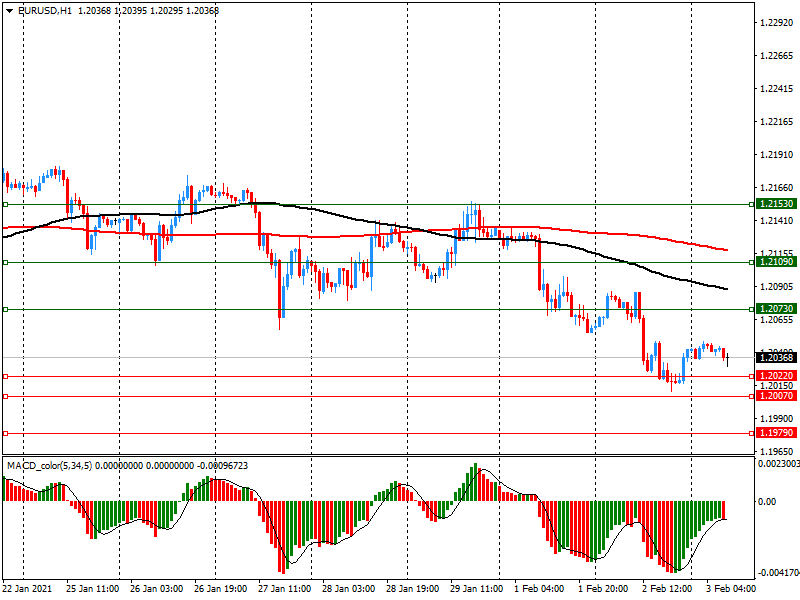
EUR/USD
Resistance levels (open interest**, contracts)
$1.2153 (741)
$1.2109 (826)
$1.2073 (173)
Price at time of writing this review: $1.2037
Support levels (open interest**, contracts):
$1.2022 (1353)
$1.2007 (3075)
$1.1979 (3758)
Comments:
- Overall open interest on the CALL options and PUT options with the expiration date February, 5 is 53297 contracts (according to data from February, 2) with the maximum number of contracts with strike price $1,2000 (3758);
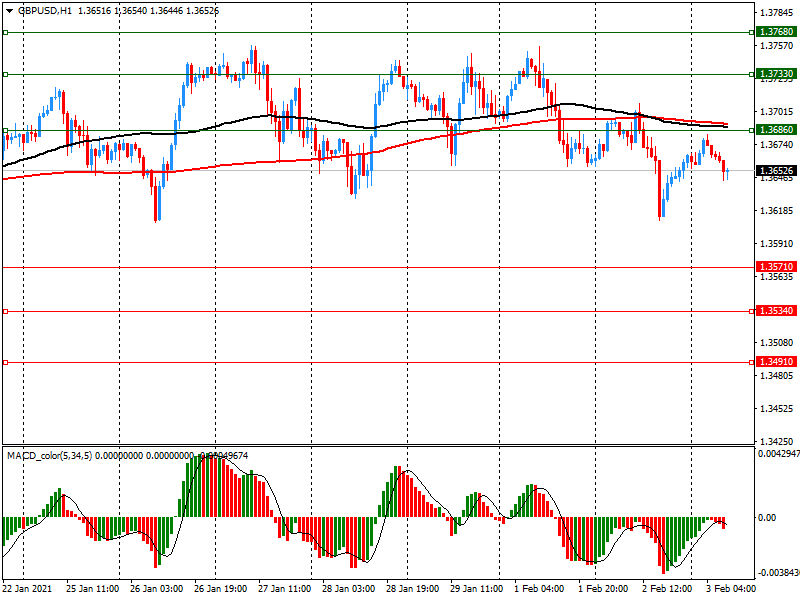
GBP/USD
Resistance levels (open interest**, contracts)
$1.3768 (1447)
$1.3733 (1894)
$1.3686 (1006)
Price at time of writing this review: $1.3653
Support levels (open interest**, contracts):
$1.3571 (774)
$1.3534 (862)
$1.3491 (1749)
Comments:
- Overall open interest on the CALL options with the expiration date February, 5 is 11202 contracts, with the maximum number of contracts with strike price $1,3700 (1894);
- Overall open interest on the PUT options with the expiration date February, 5 is 21416 contracts, with the maximum number of contracts with strike price $1,2500 (2183);
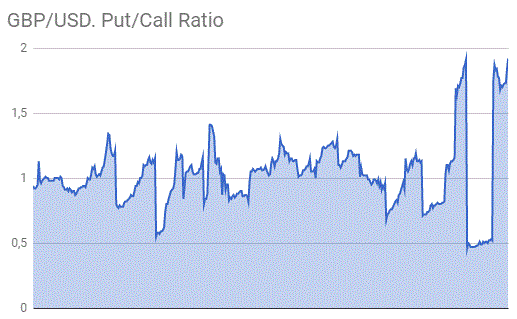
- The ratio of PUT/CALL was 1.91 versus 1.97 from the previous trading day according to data from February, 2
* - The Chicago Mercantile Exchange bulletin (CME) is used for the calculation.
** - Open interest takes into account the total number of option contracts that are open at the moment.
Reuters reports that Bank of Japan Deputy Governor Masazumi Wakatabe said that the Bank of Japan must be ready to cut interest rates further and keep exploring ways to battle economic shocks.
Wakatabe said the BOJ's policy review in March won't lead to a withdrawal of monetary stimulus, but will focus on making its tools "sustainable, effective and nimble".
The key would be to ensure the central bank has sufficient ammunition to combat any future shock to the economy, such as one triggered by the coronavirus pandemic, he added.
"The BOJ must guide policy in a way that ensures real interest rates don't spike abruptly," Wakatabe told.
"We must also maintain our commitment to achieve 2% inflation. Based on the commitment, we'll be ready to lower nominal rates as needed," he said.
RTTNews reports that survey results from IHS Markit showed that China's service sector growth slowed in January as demand was dampened by the ongoing Covid-19 pandemic.
The Caixin services Purchasing Managers' Index fell to 52.0 in January from 56.3 in December. However, a score above 50 indicates expansion in the sector. The reading signaled the slowest rate of growth recorded over the current nine-month period of expansion.
New work received by services companies grew at the slowest rate since last August. New orders from overseas gained at the weakest pace in three months as the recent rise in virus cases weighed on global demand. Services companies in China added to their staffing levels for the sixth month running, but the rate of job creation eased further.
Although business confidence regarding the 12-month outlook for activity remained strong in January, the degree of positive sentiment weakened since December.
The composite output index came in at 52.2 in January, down from 55.8 in December, to signal only a moderate rise in overall output.
| Time | Country | Event | Period | Previous value | Forecast |
|---|---|---|---|---|---|
| 00:30 (GMT) | Australia | Building Permits, m/m | December | 2.6% | |
| 01:30 (GMT) | Australia | RBA's Governor Philip Lowe Speaks | |||
| 01:45 (GMT) | China | Markit/Caixin Services PMI | January | 56.3 | |
| 08:50 (GMT) | France | Services PMI | January | 49.1 | 46.5 |
| 08:55 (GMT) | Germany | Services PMI | January | 47 | 46.8 |
| 09:00 (GMT) | Eurozone | Services PMI | January | 46.4 | 45 |
| 09:30 (GMT) | United Kingdom | Purchasing Manager Index Services | January | 49.4 | 38.8 |
| 10:00 (GMT) | Eurozone | Producer Price Index, MoM | December | 0.4% | 0.7% |
| 10:00 (GMT) | Eurozone | Producer Price Index (YoY) | December | -1.9% | -1.2% |
| 10:00 (GMT) | Eurozone | Harmonized CPI ex EFAT, Y/Y | January | 0.2% | 0.9% |
| 10:00 (GMT) | Eurozone | Harmonized CPI | January | 0.3% | |
| 10:00 (GMT) | Eurozone | Harmonized CPI, Y/Y | January | -0.3% | 0.5% |
| 13:15 (GMT) | U.S. | ADP Employment Report | January | -123 | |
| 14:45 (GMT) | U.S. | Services PMI | January | 54.8 | 57.5 |
| 15:00 (GMT) | U.S. | ISM Non-Manufacturing | January | 57.2 | 56.8 |
| 15:30 (GMT) | U.S. | Crude Oil Inventories | January | -9.91 | |
| 18:00 (GMT) | U.S. | FOMC Member James Bullard Speaks | |||
| 19:00 (GMT) | U.S. | FOMC Member Harker Speaks | |||
| 21:45 (GMT) | New Zealand | Building Permits, m/m | December | 1.2% | |
| 22:00 (GMT) | U.S. | FOMC Member Mester Speaks | |||
| 22:00 (GMT) | U.S. | FOMC Member Charles Evans Speaks | |||
| 23:05 (GMT) | U.S. | FOMC Member Kaplan Speak |
| Pare | Closed | Change, % |
|---|---|---|
| AUDUSD | 0.76087 | -0.13 |
| EURJPY | 126.433 | -0.03 |
| EURUSD | 1.20425 | -0.14 |
| GBPJPY | 143.469 | 0.17 |
| GBPUSD | 1.36653 | 0.06 |
| NZDUSD | 0.71938 | 0.54 |
| USDCAD | 1.27827 | -0.49 |
| USDCHF | 0.8974 | 0.06 |
| USDJPY | 104.982 | 0.12 |







© 2000-2026. All rights reserved.
This site is managed by Teletrade D.J. LLC 2351 LLC 2022 (Euro House, Richmond Hill Road, Kingstown, VC0100, St. Vincent and the Grenadines).
The information on this website is for informational purposes only and does not constitute any investment advice.
The company does not serve or provide services to customers who are residents of the US, Canada, Iran, The Democratic People's Republic of Korea, Yemen and FATF blacklisted countries.
Making transactions on financial markets with marginal financial instruments opens up wide possibilities and allows investors who are willing to take risks to earn high profits, carrying a potentially high risk of losses at the same time. Therefore you should responsibly approach the issue of choosing the appropriate investment strategy, taking the available resources into account, before starting trading.
Use of the information: full or partial use of materials from this website must always be referenced to TeleTrade as the source of information. Use of the materials on the Internet must be accompanied by a hyperlink to teletrade.org. Automatic import of materials and information from this website is prohibited.
Please contact our PR department if you have any questions or need assistance at pr@teletrade.global.


 Bank
Bank transfers


