Analytics, News, and Forecasts for CFD Markets: currency news — 17-06-2022.

ATTENTION: The content in the news and analytics feed is updated automatically, and reloading the page may slow down the process of new content appearing. We recommend that you keep your news feed open at all times to receive materials quickly.
Filter by currency
17.06.2022
21:52
S&P 500 rises slightly but stays below 3700 after a stormy trading week
  • US stocks recovered some ground after a bumpy trading week.
  • The Nasdaq Composite rose and led the pack, followed by the S&P 500, while the Dow Jones fell.
  • The US Dollar Index rose, contrarily to US Treasury yields dropping

US equities recovered some ground after a rough trading week and recorded gains between 0.13% and 1.43% on Friday as investors assessed the Federal Reserve’s monetary policy decision, which hiked rates by 75 bps and reiterated its commitment that the central bank needs to do more to curb the hottest inflation in 4 decades.

Sentiment shifted positive, though failed the lift the Dow Jones

The S&P 500 rose 0.22% and finished at  3,674.84, followed closely by the heavy-tech Nasdaq Composite, jumping 1.43% at 10,798.35. At the bottom of the pile is the Dow Jones Industrial Average, which slipped 0.13%, sitting at 29,888.78.

In the meantime, the US Dollar Index rose after falling from a fresh 20-year high and sits around 104.650, up by 0.82%. US Treasury yields remain elevated but tumbled. The US 10-year note yields 3.231%, down seven basis points.

The market sentiment is positive but remains fragile. During the week, US economic data fell short of estimations, from May retail sales to housing starts. Additionally, the Federal Reserve hiked the Federal funds rate (FFR), with the largest increase since the times of Fed Chair Alan Greenspan in 1994.

In terms of sector specifics, the leading gainers are Communication Services, up 1.31%, followed by Consumer Discretionary and Technology, each recording gains of 1.22% and 0.99%, respectively. The main losers are Energy, Materials, and Consumer Staples, losing 1.45%, 0.05%, and 0.01% each.

In the commodities complex, the US crude oil benchmark, WTI, tumbled 6.05%, trading at $110.48 BPD, while precious metals like gold (XAU/USD) followed suit, dropping 0.43%, exchanging hands at $1841.90 a troy ounce, as US Treasury yields, remained static after the FOMC’s decision.

Key Technical Levels


21:01
USD/CHF Price Analysis: Climbs near 0.9700 snaping two days of losses USDCHF
  • The Swiss franc is on the driver's seat, as shown by the USD/CHF dropping 1.82%.
  • Sentiment in the FX space fluctuated, with safe-haven peers gaining, except for the JPY.
  • USD/CHF Price Forecast: Subject for a mean reversion move towards 0.9850.

The USD/CHF recovered some ground after falling to fresh weekly lows around 0.9620, bounced off, and reclaimed 0.9700 on Friday. At the time of writing, the USD/CHF is trading at 0.9695, up by 0.38%.

US equities reflected a positive market mood, but in the FX space, the sentiment was mixed. The greenback staged a recovery, as the US Dollar Index reflected, gaining 0.80%, sitting at 104.631. US Treasury yields fell, though they remained above the 3% threshold.

USD/CHF Price Forecast: Technical outlook

The USD/CHF shifted neutral biased after tumbling 400 pips from the parity, just above the 50-day moving average (DMA) at 0.9700. Reinforcing the aforementioned is the position of the Relative Strength Index (RSI), dropping from overbought conditions, under the 50-midline at 47.40. Nevertheless, due to the size of the fall and the USD/CHF tumbling towards the 78.6% Fibonacci level, that would open the door for a mean reversion move near 50% or the 38.2% Fibonacci retracement.

That said, the USD/CHF first resistance would be the 50-DMA at 0.9700. A breach of the latter would expose the 61.8% Fibonacci retracement at 0.9737. Once broken, that would send the pair towards the 50% Fibo level at 0.9797, followed by a re-test of the 38.2% Fibonacci retracement at 0.9857.

Key Technical Levels


20:11
United States CFTC Gold NC Net Positions fell from previous $175.3K to $154.6K
20:11
United Kingdom CFTC GBP NC Net Positions: £-65.6K vs £-70.8K
20:11
Japan CFTC JPY NC Net Positions: ¥-69.8K vs ¥-91.6K
20:11
United States CFTC Oil NC Net Positions down to 302.9K from previous 328.3K
20:10
Australia CFTC AUD NC Net Positions increased to $-43.3K from previous $-47.9K
20:10
European Monetary Union CFTC EUR NC Net Positions fell from previous €50.5K to €-6K
20:10
United States CFTC S&P 500 NC Net Positions climbed from previous $-17K to $34.3K
18:47
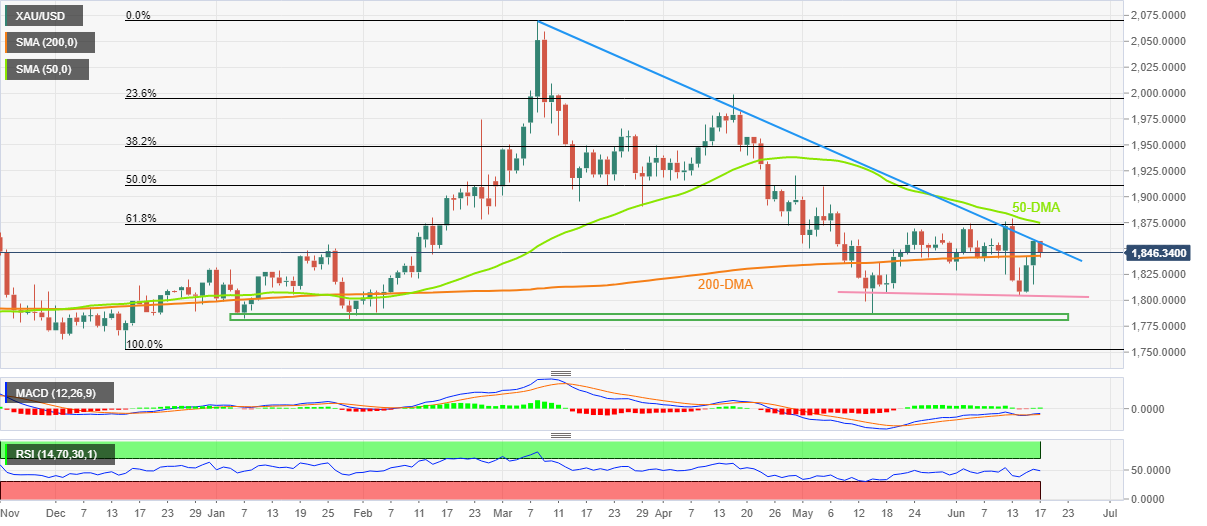
Gold Price Forecast: XAUUSD drops below the 200-DMA at around $1830s
  • The gold spot is falling due to broad US dollar strength and steady US real yields.
  • US Industrial Production expànded at a lower rate than in April, showing that the US economy is slowing.
  • Gold Price Forecast (XAUUSD): To consolidate amid the lack of a catalyst.

Gold spot (XAUUSD) drops courtesy of a buoyant greenback, which is staging a comeback after printing losses of 1% on Thursday, trimming some of those despite that US Treasury yields fall for the second straight day in the week. At the time of writing, XAUUSD is trading at $1839.20 and losses 0.97%.

US Real yields remain steady, weighing on Gold Prices

Sentiment remains positive as US equities recover some ground. The US Dollar Index, a measure of the buck’s value, advances 0.83%, sitting at 104.666. in the meantime, the US 10-year Treasury yield drops to 3.229%, for a loss of seven basis points.

In the meantime, US 10-year TIPS (Treasury Inflation-Protected Securities), a proxy for real yields, is down one basis point, sitting at 0.665%, a headwind for the yellow metal.

Elsewhere, the US economic calendar featured May’s Industria Industrial Production, which expanded by 5.8% YoY, lower than April’s reading at 6.3%, adding signs of an economic slowdown. “The pace at which everything is changing is quite alarming,” according to WSJ sources. They said that the economy still stands on fairly solid ground to withstand inflation, supply-chain issues, and rising interest rates.

Earlier in the day, the Minnesota Fed’s President Neil Kashkari commented that he supported 75 bps in June and could support another in July. He added that a prudent strategy might be to continue with 50 bps increases. St. Louis Fed President James Bullard said a soft landing is feasible if the post-pandemic shift is done well.

Gold Price Forecast (XAUUSD): Technical outlook

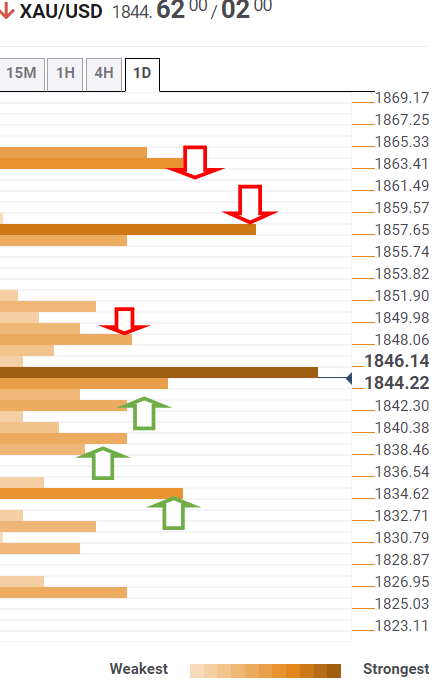
The XAU/USD is in consolidation amidst the lack of a catalyst that could propel the yellow metal prices either way. At the time of writing, XAU/USD sits below the 200-day moving average (DMA), which lies at $1843.48. That would open the door for consolidation in the $1800-$1850  range, where the non-yielding metal remained throughout the last week.

A daily close of XAU/USD beneath the 200-DMA would expose the Jun 1 daily low at $1828.33. A break below would open the door for a May 18 test at a $1807.23 cycle low. Once broken, a fall to $1800 is next.

Upwards, XAU/USD’s first resistance would be the 200-DMA. If XAU bulls achieve a daily close above it, a move towards the 50-DMA at $1874.80 is on the books. Once cleared, the XAU/USD following resistance level would be the 100-DMA at $1891.92.


17:45
AUD/USD plunges below 0.7000 on a buoyant greenback AUDUSD
  • The Australian dollar prepares to finish the week with losses of almost 1.60%.
  • Fluctuating sentiment in the FX space boosts the USD and weighs on the AUD.
  • St. Louis Fed President Bullard: Achieving a soft landing is feasible.

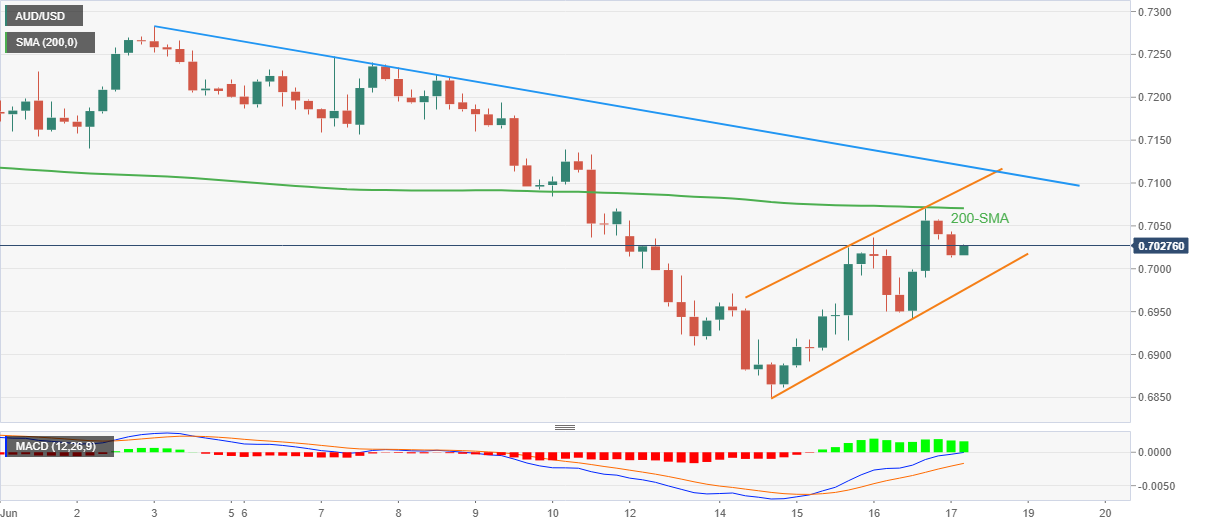
AUD/USD plummets from weekly highs reached on Thursday around 0.7069, down below the 0.7000 mark, after Wednesday’s afternoon Federal Reserve rate hike, which initially lifted the major to fresh weekly highs above 0.7000. However, Friday’s overall US Dollar strength brought the pair down. At 0.6930, the AUD/USD is down 1.58% and will finish the week with losses close to 1.58%.

The mixed mood in the FX complex weighs on the AUD and boosts the USD

US equities are trading barely in the green in a choppy trading session. The Australian dollar is the third weakest currency of the day in the FX complex, while the buck is recovering some ground. The US Dollar Index, a gauge of the buck’s value vs. a basket of six peers, is gaining 0.95%, currently at 104.785.

The AUD/USD remains weak due to falling commodity prices. Also, additional Covid-19 Chinese lockdowns loom. China’s is Australia biggest trading partner, so any slowdown in its economy would hurt the Australian dollar outlook dramatically.

The lack of Australian economic data left AUD/USD traders adrift to the US calendar. US Industrial Production rose by 5.8% YoY, less than April’s 6.3%, adding to signs of economic slowdown.

Elsewhere, Fed speakers begin to dominate headlines. Minneapolis Fed Neil Kashkari said that he supported 75 bps in June and could support another in July. He added that a prudent strategy might be to continue with 50 bps increases. St. Louis Fed President James Bullard said a soft landing is feasible if the post-pandemic shift is done well.

Key Technical Levels


17:12
Colombia Trade Balance: $-1M (April) vs $-1520.7M
17:11
United States Baker Hughes US Oil Rig Count increased to 584 from previous 580
17:04
WTI renews multi-week lows below $110.00

Crude oil prices came under heavy bearish pressure ahead of the weekend and the barrel of West Texas Intermediate (WTI) declined below $110.00 for the first time in three weeks. As of writing, the WTI was down 6.4% on a daily basis at $109.50.

Investors grow increasingly concerned over the energy demand outlook as major central banks continue to tighten their policies to battle inflation despite recession risks. 

Citing Tass news agency, Reuters reported earlier in the day that the Russian deputy energy minister was expecting Russia's oil exports to increase in 2022 despite Western sanctions and the European embargo.

Meanwhile, the weekly data published by oil services firm Baker Hughes revealed that the number of active oil rigs in the US rose by 4 to 584 in the week to June 17. 

16:20
USD/CAD rallies to fresh YTD highs at around 1.3070s on broad USD strength USDCAD
  • The Loonie sustains substantial weekly losses of 2.04%.
  • An upbeat market mood and broad US dollar strength lift the USD/CAD.
  • USD/CAD Price Forecast: A close above 1.3078 would pave the way towards October 2020 highs at around 1.3389.

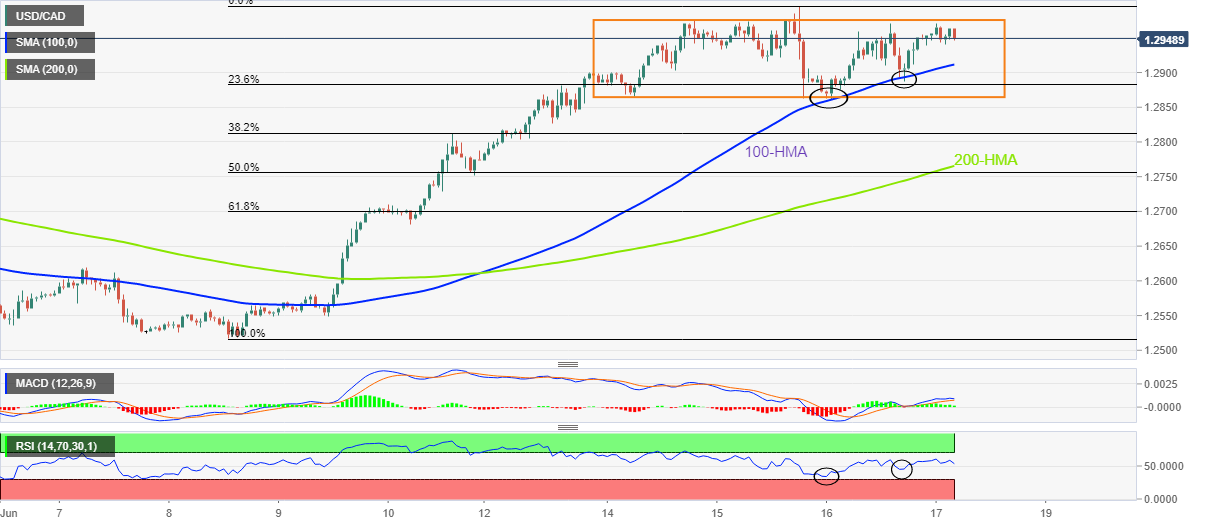
The USD/CAD soars above the 1.3000 mark for the first time since May 12 and records a fresh YTD high at around 1.3078 after Wednesday’s US Federal Reserve 75 bps rate hike, which did not catch traders off guard due to an article on the WSJ on Monday that foresaw an increase of that size. The USD/CAD initially reacted downwards to 1.2880 but was seen as an opportunity for USD/CAD buyers, which lifted the pair higher. At the time of writing, the USD/CAD is trading at 1.3045, up by 0.81%.

Overall US dollar strength, a tailwind for the USD/CAD

The market mood remains upbeat as global equities trimmed some weekly losses. In the FX space mood is mixed, with high-beta currencies down, except for the NZD and the GBP. In the case of safe-haven peers, the JPY is getting battered after the BoJ committed to its ultra-loose dovish stance.

In the meantime, the US Dollar resumed its uptrend and is gaining 1.04%, trading at 104.877. US Treasury yields are taking a breather, particularly the US 10-year benchmark note, down eight basis points, yielding 3.224%.

Data-wise, the Canadian docket reported the May Producer Price Index (PPI), which rose 15%, lower than the 16.4% reading but remains higher. Raw Material Prices increased by 37.4% YoY, though lower than 38.3% in April.

Later, the US docket featured May Industrial Production, which rose by 5.8% YoY, lower than April’s reading, adding to signs of an economic slowdown.

Sources cited by the WSJ said, “The pace at which everything is changing is quite alarming.” Sources added that the economy still stands on fairly solid ground to withstand inflation, supply-chain issues, and rising interest rates.

Meanwhile, Minneapolis Fed Neil Kashkari said that he supported 75 bps in June and could support another in July. He added that a prudent strategy might be to continue with 50 bps increases. St. Louis Fed President James Bullard said a soft landing is feasible if the post-pandemic shift is done well.

USD/CAD Price Forecast: Technical outlook

With the USD/CAD trading at fresh YTD highs, switching to the weekly chart is needed to determine what’s next for the major. It’s worth noting that the USD/CAD is trading above the 200-week simple moving average (SMA), a strong bullish signal that could lift the pair towards October’s 2020 highs at around 1.3390. Nevertheless, the USD/CAD is retreating below the May 12 high at 1.3076.

A daily close below 1.3078 would open the door for further losses. That said, the USD/CAD first support would be the 1.3000 mark. Once cleared, the following support would be the June 16 1.2860 cycle low, followed by 1.2800.

Key Technical Levels


15:09
Fed Monetary Policy Report: GDP on track to rise moderately in Q2

In its semi-annual Monetary Policy Report, the US Federal Reserve said that the Gross Domestic Product (GDP) appears to be on track to rise moderately in the second quarter, per Reuters.

Additional takeaways

"Our commitment to restoring price stability is unconditional."

"Most recent indicators suggest that private fixed investment may be moderating, but consumer spending remains strong."

"Vulnerabilities from nonfinancial leverage are moderate."

"Leverage in the financial sector appears moderate and little changed this year."

"Recent market strains for stable coins and other digital assets show structural fragilities in that rapidly growing sector."

"We are strongly committed to restoring price stability, necessary for sustaining a strong labor market."

"Further risks to global supply chains abound."

"Rapid growth of labor costs is putting upward pressure on the prices of all labor-intensive services."

"About one-half of decline in labor force participation rate since pandemic began is due to baby-boom generation reaching retirement age."

"Some possible signs of modest easing of labor market tightness have recently appeared."

"Some measures of wage growth appear to have moderated."

"If gap between wage growth and productivity growth remains comparably wide in the future, there will be significant upward pressure on firms’ labor costs."

"Broad funding markets proved resilient to geopolitical tensions."

"With direct exposures of US financial institutions to Russia and Ukraine being small, financial spillovers have been limited to date."

"High inflation, supply chain disruptions, and the ongoing geopolitical tensions remain substantial sources of uncertainty with the potential to further stress the financial system."

Market reaction

The dollar preserves its strength ahead of the weekend and the US Dollar Index was last seen rising 1% on the day at 104.85.

15:03
GBP/USD fades Thursday’s rally and drops below 1.2200 post-FED/BoE rate hikes GBPUSD
  • The GBP/USD will finish the week with losses close to 1%.
  • Central bank divergence between the Fed and BoE will favor the greenback.
  • Fed’s Kashkari supported 75 bps in June and July, followed by 50 bps increases.

The British pound extends its losses in the week, set to finish with losses near to 1%, after Thursday’s afternoon rally post the Bank of England (BoE) 25 bps rate hike, with the GBP/USD reaching weekly highs around 1.2400. However, the greenback regained some strength, and USD bulls faded the GBP/USD rally and sold the major at a better level. At the time of writing, the GBP/USD is trading at 1.2181, down 1.36% in the New York session.

Sentiment has improved as global equities rallied, except for the Dow Jones and the S&P 500. In the FX space, the market mood is mixed. The greenback remains in the driver’s seat, with the US Dollar Index recovering Thursday’s losses, up by 1.11% at 104.967.

Fed and BoE divergence might favor the US dollar

On Friday, investors begin to assess central bank divergence between the UK and the US. Initially, it favored the Bank of England (BoE), which was expected to hike rates by 50 bps at the beginning of the week. However, with UK’s economy starting to slow down and the BoE expects a recession by 2023 – the “old lady” backpedaled and raised rates by a nimble 25 bps. It’s also worth noting that the BoE removed forward guidance from the monetary policy statement, shifting the sentence to “the scale, pace and timing of any further increases in Bank Rate would reflect the Committee’s assessment of the economic outlook and inflationary pressures.”

Aside from this, the US Federal Reserve took the bull by its horns and raised rates by 75 bps, the biggest increase since 1994. Although it was a bold move by the Fed, its Chairman Jerome Powell said at his presser that moves of that size would not be “common,” which sounded dovish but opened the door for the July’s meeting for a move of that size or 50 bps.

Meanwhile, once the central bank blackout period finished, BoEs and Fed speakers started to cross wires.

The BoE Chief Economist Pill said that markets will have to make their own judgment as to whether the BoE is considering a 50 bps hike while stressing the conditionality around the inclusion of “forcefully” in the statement in the context of “if necessary.”

In the meantime, Minneapolis Fed Neil Kashkari said that he supported 75 bps in June and could support another in July. He added that a prudent strategy might be to continue with 50 bps increases. Earlier, St. Louis Fed President James Bullard said that a soft landing is feasible if the post-pandemic shift is done well.

Data-wise, the US economic docket reported Industrial Production for May, expanding by 0.2% MoM. Although the reading missed expectations for an increase of 0.4%, it shifted sentiment sour.

Key Technical Levels


14:58
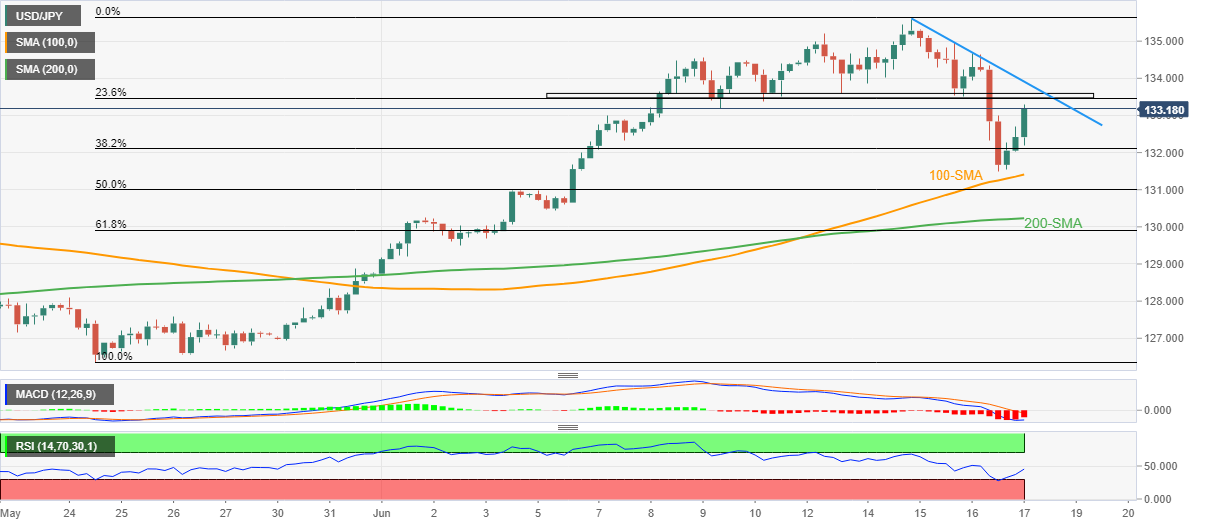
USD/JPY reclaims 105.00 US T-bond yields push higher USDJPY
  • USD/JPY is up more than 2% on a daily basis on Friday.
  • US Dollar Index tests 105.00 on the back of rising T-bond yields.
  • BOJ announced earlier in the day that it left its policy settings unchanged.

USD/JPY extended its daily rally in the second half of the day on Friday and climbed above 135.00. As of writing, the pair was up 2.3% on a daily basis at 135.20.

BOJ's inaction hurts JPY

Earlier in the day, the Bank of Japan (BOJ) announced that it left its policy settings unchanged. Following the Swiss National Bank's (SNB) unexpected rate hike on Thursday, JPY bulls were hoping for the BOJ to at least tweak its Yield Curve Control (YCC) policy. Commenting on the policy outlook, BOJ Governor Haruhiko Kuroda reiterated that they will not hesitate to ease the monetary policy further if needed and triggered a JPY selloff.

In the second half of the day, the benchmark 10-year US Treasury bond yield gained traction and helped the greenback gather strength against its major rivals.

At the time of press, the US Dollar Index was up 1.2% on the day at 105.05. Despite the sharp decline witnessed on Wednesday and Thursday, the index remains on track to close the third straight week in positive territory. 

Assessing USD/JPY's near-term outlook, "above 134.64/68 should add weight to our view for a fresh attempt to see a sustained move above the 135.20 high of 2002," said economists at Credit Suisse. "With a multi-year ‘secular’ base in place, we expect 135.20 to be “decisively cleared in due course with resistance then seen next at 135.85/87 and eventually 147.62/153.01."

Additional levels to watch for


14:48
EUR/USD drops below 1.0450 as dollar recovery picks up steam EURUSD
  • EUR/USD extended its daily slide in the American session.
  • Hawkish Fed commentary helps the greenback continue to gather strength.
  • US Dollar Index extends recovery to 105.00 on Friday.

EUR/USD extended its slide after dropping below 1.0500 and touched a fresh daily low below 1.0450. As the dollar continues to gather strength, the pair looks to close the second straight week in negative territory.

DXY rises to 105.00

Following a two-day drop, the US Dollar Index (DXY), which tracks the dollar's performance against a basket of six major rivals, reversed its direction and erased its weekly losses. At the time of press, the DXY was up more than 1% on the day at 105.00.

The risk-averse market environment, rising US Treasury bond yields and hawkish Fed commentary fuel the dollar's rally ahead of the weekend.

Minneapolis Fed President Niel Kashkari said on Friday that he could support another 75 basis points rate hike in July and added that they could raise rates beyond what is currently forecast if inflation were to drift higher. The benchmark 10-year US Treasury bond yield was last seen rising more than 2% on the day at 3.27%.

Meanwhile, the data from the US showed that Industrial Production expanded by 0.2% on a monthly basis in May. This print missed the market expectation for an increase of 0.4% and didn't allow the market mood to remain upbeat. 

Technical levels to watch for


14:12
Fed's Kashkari: Could support another 75 bps rate hike in July

Minneapolis Fed President Niel Kashkari said on Friday that he could support another 75 basis points rate hike in July, as reported by Reuters.

Additional takeaways

"Need to be cautious about too much front-loading on rate hikes."

"Prudent strategy might be to continue with 50 bps rate hikes after July meeting."

"Fed would still need to be data-dependent."

"If supply shocks subside, may not need to raise rates as high as otherwise."

"I assume we will be able to relax policy somewhat in 2024."

"If inflation drifts higher, or supply side does not improve, might need to continue raising rates beyond what currently is forecasted."

"A steady approach to raising rates may help us avoid tightening more than necessary."

"I do not think a comparison with the 1970s and 1980s is relevant, because the Fed then had to establish its credibility."

Market reaction

The dollar recovery continues after these comments with the US Dollar Index rising nearly 1% on the day at 104.82.

14:09
Fed's George: Inflation has shown no meaningful signs of deceleration

Kansas City Federal Reserve President Esther George explained on Friday that she dissented against a 75 basis point rate hike because she viewed that move as adding to policy uncertainty simultaneous with the start of balance sheet runoff, as reported by Reuters.

Additional takeaways

"With high inflation and a tight economy, the case for continuing to remove policy accommodation is clear-cut."

"Inflation has shown no meaningful signs of deceleration."

"Speed with which we adjust policy rate is important; significant and abrupt changes can be unsettling to households and small businesses."

"Adjustment speed also has implications for yield curve and traditional bank lending models prevalent among community banks."

"Sharing FOMC's strong commitment to bringing down inflation to achieve our mandate for long-run price stability."

Market reaction

The US Dollar Index continues to push higher after these comments and was last seen rising nearly 1% on the day at 104.80.

14:02
Gold Price Forecast: XAUUSD sellers to remain on the sidelines as long as $1,840 holds

Gold Price holds above the 200-day SMA at $1,840. The yellow metal is unlikely to come under downside pressure as long as trades above this level, FXStreet’s Eren Sengezer reports.

Daily close below $1,840 could be seen as a bearish development

“The Fibonacci 23.6% retracement level of the latest downtrend and the 20-day SMA form the first resistance at $1,850. In case gold starts using that level as support, it could target $1,875 (50-day SMA, Fibonacci 38.2% retracement) and $1,890 (100-day SMA).”

“On the downside, a daily close below $1,840 (200-day SMA) could be seen as a bearish development and bring in sellers. In that scenario, interim support aligns at $1,830 (static level) ahead of $1,810 (static level) and $1,800 (psychological level).”


13:57
Gold Price Forecast: XAUUSD to bounce higher if Powell revives expectations for a 50 bps hike

Gold remains on track to post weekly losses. Next week, FOMC Chairman Jerome Powell will testify before Senate on Wednesday. If Powell suggests a 50 basis points (bps) rate hike in July, the yellow metal could gain traction.  

Focus shifts to Powell's testimony

“According to the CME Group FedWatch Tool, markets are currently pricing in an 88.5% probability of a 75 bps rate hike in July. The market positioning suggests that there is room for US yields to fall if Powell revives expectations for a 50 bps hike at the next meeting. On the other hand, another decisive rally in US yields could be hard to come by even if Powell confirms a 75 bps hike.”

“XAUUSD price could also be impacted by next week's PMI reports. If PMI data from the euro area and Germany point to a loss of growth momentum in the private sector, market participants could see that as a reminder of the widening policy gap between the European Central Bank (ECB) and the Fed. In that scenario, XAUUSD could come under renewed bearish pressure.” 

13:50
EUR/NOK to race higher towards the 10.8583 mark – Credit Suisse

EUR/NOK has risen significantly and trades comfortably above the 10.40 area. Economists at Credit Suisse expect the pair to extend its advance towards the 38.2% retracement of the 2020/22 fall at 10.8583.

EUR/NOK looks set for a further upside

“EUR/NOK has recently broken above its highs from late 2021 and May 2022 at 10.4004/10.3828 and looks set for a further upside.”

“With weekly MACD momentum also turning outright bullish, we look for strength to continue to the July 2021 high at 10.7038 and further above to the 38.2% retracement of the 2020/22 fall at 10.8583.”


13:46
Norges Bank: Key rate at 3% by the end of 2023 – Nordea

Economists at Nordea see both faster and more rate hikes from Norges Bank ahead. They expect the key rate at 3% by the end of 2023.

Key rate at 2% by end-2022

“Our new forecast implies a key rate at 2% by the end of 2022 and 3% by the end of 2023. We have raised our end of 2023 forecast by 50 bps and expect the two extra rate hikes of 25 bps to arrive already this year.” 

“Looking beyond 2023, the risks to the rate path are even more to the upside. With higher global rates, it will be hard for Norges Bank to insist that domestic rates should head lower.”

“For 2024 and beyond, we believe rates will end a fair bit higher than implied by market forwards.”


13:38
USD/CHF: 0.9472/60 to serve as a floor to to maintain the 0.95-1.00 range – Credit Suisse

USD/CHF is approaching the bottom of the 0.95 to parity range. Analysts at Credit Suisse look for 0.9472/60 to serve as a floor to maintain the range.

Potential for further near-term weakness to unfold

“We still see some near-term downside potential toward the bottom of the defined range, with support seen at 0.9647 initially and next at 0.9603/9595. A sustained break below here would open the door to a number of retracement supports and the price low from May at 0.9574/43, which we would look to prove a tougher obstacle.”

“Should the 0.9574/43 level break though, 0.9472/60 is expected to serve as a floor to maintain the range.”

“Near-term resistance is seen at 0.9819/46 initially and then way above at 0.9989 and next at 1.0038. Though a break above this level is unlikely, we maintain our base case that an attempt to return back above here will be halted at the YTD high and the downtrend from 2016 at 1.0064/90.”


13:31
EUR/GBP: Support at 0.8530/11 to hold for a retest of key resistance at 0.8722/47 – Credit Suisse EURGBP

EUR/GBP is set to hold support at 0.8530/11 for a retest and break above 0.8722/47. What’s more, analysts at Credit Suisse expect the pair to enjoy an eventual rise toward the “neckline” and the 2020 top at 0.8861/76.

Broader basing process stays seen as underway 

“We continue to view weakness as corrective. Above 0.8638/45 can add weight to our view for strength back to 0.8671/73, ahead of a retest of 0.8722/47. Beyond here in due course should then add weight to our view a broader basing process is underway with resistance seen next at the ‘neckline’ to the 2020 top and 61.8% retracement at 0.8861/76.” 

“Below 0.8511 would see the uptrend break, but only below 0.8489/81 though would be seen to suggest the broader trend is shifting neutral again, with support seen next at 0.8457/43.”


13:27
USD is likely to be stronger for longer – Rabobank

In the opinion of economists at Rabobank, safe-haven flows could keep the US dollar stronger for longer. Subsequently, the euro, the pound and the yen are set to weaken against the greenback.

Cable seen back at 1.20 and potentially below on a three-month view

“While a US recession in 2023 suggests that the market will by then be pricing in Fed rate cuts, the USD could be slow to give back its gains until confidence in global growth and risky assets starts to repair. Consequently, we maintain our view that the USD is likely to be stronger for longer.” 

“We retain our forecast that EUR/USD is at risk of dipping back to the 1.03 area on a three-month view. We also see cable back at 1.20 and potentially below on a three-month view and maintain our one and three-month USD/JPY forecast of 135.00.”


13:27
Fed's Bullard: Fed and ECB may be able to achieve a relatively soft landing

St. Louis Federal Reserve President James Bullard argued on Friday that the US Federal Reserve and the European Central Bank (ECB) may be able to achieve a relatively soft landing, as reported by Reuters."

"Volcker had to earn credibility; the Fed and the ECB have considerable credibility," Bullard added and reiterated that a soft landing was feasible for both central banks.

Market reaction

These remarks don't seem to be having a noticeable impact on the dollar's performance against its major rivals. As of writing, the US Dollar Index was up 0.8% on a daily basis at 104.60.

13:20
USD/JPY eyes a sustained break above the 135.20 high of 2002 – Credit Suisse USDJPY

USD/JPY is rebounding sharply. Economists at Credit Suisse continue to look for an eventual sustained move above the 135.20 high of 2002.

Support at 132.71set to hold

“Above 134.64/68 should add weight to our view for a fresh attempt to see a sustained move above the 135.20 high of 2002.”

With a multi-year ‘secular’ base in place, we expect 135.20 to be “decisively cleared in due course with resistance then seen next at 135.85/87 and eventually 147.62/153.01.” 

“Support is seen at 133.01 initially, with 132.71 ideally holding on a closing basis. A break can see a retreat back to 131.49, with better price support seen at the 131.35/25 April/May highs.”


13:19
US: Industrial Production rises by 0.2% in May vs. 0.4% expected
  • Industrial Production in US grew at a softer pace than expected in May.
  • US Dollar Index clings to strong daily gains above 104.50. 

Industrial Production in the US expanded by 0.2% on a monthly basis in May, the data published by the US Federal Reserve revealed on Friday. This print followed April's expansion of 1.4% and came in weaker than the market expectation of 0.4%. 

"In May, manufacturing output declined 0.1% after three months when growth averaged nearly 1%," The Fed's publication further read. "Capacity utilization edged up to 79.0%, 0.5 percentage point below its long-run (1972–2021) average."

Market reaction

The greenback holds its ground after these data and the US Dollar Index was last seen rising 0.8% on the day at 104.62.

13:15
United States Capacity Utilization came in at 79%, below expectations (79.2%) in May
13:15
United States Industrial Production (MoM) below forecasts (0.4%) in May: Actual (0.2%)
12:49
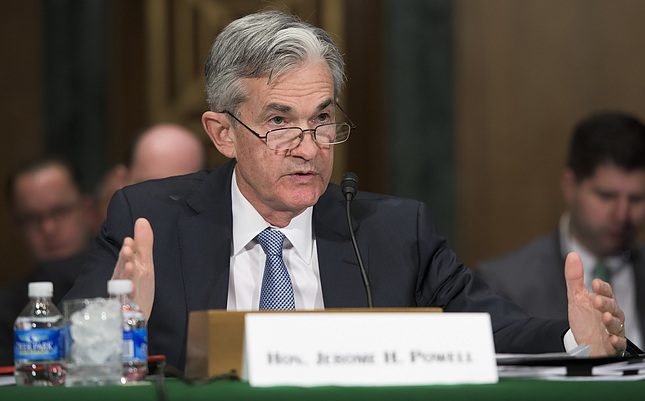
Powell speech: Commitment to price stability contributes to confidence in dollar

The US Federal Reserve's strong commitment to price stability contributes to a widespread in confidence in the US dollar as a store of value, FOMC Chairman Jerome Powell said on Friday, per Reuters.

Additional takeaways

"A US CBDC could potentially help maintain the US dollar's international standing."

"Rapid changes in global monetary system may affect the future international role of the US dollar."

"As Fed considers its own CBDC, will be thinking of how the global financial system will evolve over next decade."

"Fed is acutely focused on returning inflation to 2% goal."

Market reaction

The greenback extends its rebound following these comments and the US Dollar Index was last seen rising 0.75% on the day at 104.55.

12:48
EUR/USD struggles near daily low, just below 1.0500 mark amid broad-based USD strength
  • EUR/USD came under renewed selling pressure on Friday amid resurgent USD demand.
  • Hawkish Fed underpinned the USD, though a combination of factors capped the upside.
  • The ECB’s rate hike signal could extend support to the euro and limit losses for the pair.

The EUR/USD pair extended the overnight rejection slide from the 1.0600 mark, or the weekly high and witnessed some selling on the last day of the week. The downward trajectory extended through the early North American session and dragged spot prices below the 1.0500 psychological mark, though lacked follow-through selling.

The US dollar made a solid comeback on Friday and recovered a part of its post-FOMC losses recorded over the past two trading sessions amid hawkish Fed expectations. The markets seem convinced that the US central bank would continue to tighten its monetary policy at a faster pace to combat stubbornly high inflation. The bets were reaffirmed by the Fed's so-called dot plot, showing that the median projection for the federal funds rate stood at 3.4% for 2022 and 3.8% in 2023. This helped revive demand for the greenback, which, in turn, was seen as a key factor exerting downward pressure on the EUR/USD pair.

That said, a combination of factors might hold back the USD bulls from placing aggressive bets and help limit any deeper losses for the EUR/USD pair, at least for the time being. Investors, however, took comfort from the fact that the Fed forecasted the rate to decline to 3.4% in 2024 and 2.5% over the long run. This was evident from the ongoing decline in the US Treasury bond yields, which, along with the risk-on impulse, could act as a headwind for the safe-haven buck. The shared currency could further draw support from the European Central Bank's explicit signal that it would hike interest rates for the first time since 2011 in July.

The mixed fundamental backdrop warrants some caution before positioning for a firm near-term direction ahead of an extended weekend in the US. Hence, it will be prudent to wait for some follow-through selling before confirming that the recent bounce from the vicinity of the YTD low has run its course and place fresh bearish bets.

Technical levels to watch


12:30
Canada Raw Material Price Index rose from previous -2% to 2.5% in May
12:30
Canada Canadian Portfolio Investment in Foreign Securities rose from previous $-23.98B to $29.2B in April
12:30
Canada Foreign Portfolio Investment in Canadian Securities dipped from previous $46.94B to $22.23B in April
12:30
Canada Industrial Product Price (MoM) registered at 1.7% above expectations (0.5%) in May
12:03
USD/CHF adds to previous day's SNB-inspired heavy losses, drops to two-week low USDCHF
  • USD/CHF witnessed selling for the third straight day and dropped to a two-week low on Friday.
  • The SNB’s surprise 50 bps rate hike continued underpinning the CHF and exerted some pressure.
  • Bulls seemed rather unaffected by a goodish pickup in the USD demand and the risk-on impulse.

The USD/CHF pair met with a fresh supply near the 0.9710 area on Friday and dropped to a two-week low during the mid-European session. The pair was last seen trading around the 0.9630 region, down 0.35% for the day.

The Swiss National Bank (SNB) joined other major central banks in tightening the monetary policy and delivered a surprise interest rate hike of 50 bps on Thursday. In the accompanying policy statement, the SNB left the door open for further rate hikes to counter rising inflationary pressures, which continued lending support to the Swiss franc. This, in turn, was seen as a key factor that exerted downward pressure on the USD/CHF pair for the third successive day.

The ongoing decline seemed rather unaffected by the emergence of fresh buying around the US dollar, bolstered by expectations that the Fed would stick to its policy tightening path to curb soaring inflation. Even the risk-on impulse, which tends to drive flows away from the safe-haven CHF, failed to lend any support to the USD/CHF pair. With the latest leg down, spot prices have now retreated 430 pips from the vicinity of the YTD high, around the 1.0050 region touched on Wednesday.

Some follow-through selling below the 0.9600 round-figure mark would be seen as a fresh trigger for bearish traders and set the stage for additional near-term losses for the USD/CHF pair. Market participants now look forward to the US economic docket, featuring Industrial Production and Capacity Utilization Rate. This, along with the USD price dynamics and the broader market risk sentiment, might provide some meaningful trading impetus to the USD/CHF pair ahead of an extended weekend in the US.

Technical levels to watch


11:49
German Energy Regulator: Gas supply in Germany is currently stable

German Energy Regulator Bundesnetzagenturv said on Friday that the gas supply situation was tense but noted that supply in Germany was currently stable, as reported by Reuters.

"Gas storage has picked up slightly compared with Thursday," Bundesnetzagenturv added.

Market reaction

The market mood remains upbeat following this headline. As of writing, Germany's DAX 30 Index was up 1.5% on a daily basis. Meanwhile, US stock index futures are up between 0.9% and 1.5% on the day, suggesting Wall Street's main indexes remain on track to open decisively higher.

11:30
India FX Reserves, USD fell from previous $601.06B to $596.46B in June 10
10:21
Gold Price Forecast: XAUUSD remains depressed below $1,850, bulls trying to defend 200-DMA
  • Gold met with a fresh supply on Friday and snapped a two-day winning streak.
  • Resurgent USD demand, the risk-on impulse turned out to be a key bearish factors.
  • The ongoing decline in the US bond yields offered some support and helped limit further losses.

Gold struggled to capitalize on its strong gains recorded over the past two trading sessions and witnessed some selling on the last day of the week. The XAUUSD remained depressed through the first half of the European session and was last seen trading just below the $1,850 level. Bulls, however, have managed to defend support at a technically significant 200-day SMA, warranting some caution before positioning for any further losses.

The US dollar caught aggressive bids and reversed a part of this week's retracement slide from a two-decade high amid hawkish Fed expectations. Investors seem convinced that the US central bank will stick to its aggressive policy tightening path to combat stubbornly high inflation. The bets were reaffirmed by the Fed's so-called dot plot, which showed that the median projection for the federal funds rate stood at 3.4% for 2022 and 3.8% in 2023. This, in turn, assisted the USD to snap a two-day losing streak to a one-week low and dented demand for the dollar-denominated gold.

Apart from this, the risk-on impulse - as depicted by a generally positive tone around the equity markets - further undermined the safe-haven precious metal. That said, the ongoing decline in the US Treasury bond yields offered some support to the non-yielding gold. Investors took comfort from the fact that the Fed forecasted the rate to decline to 3.4% in 2024 and 2.5% over the long run. This, in turn, dragged the US bond yields away from over a two-decade high touched earlier this week, which, along with mounting recession fears, could help limit deeper losses for gold, at least for now.

Market participants now look forward to the US economic docket, featuring Industrial Production and Capacity Utilization Rate for a fresh impetus later during the early North American session. Traders will further take cues from the US bond yields, the USD price dynamics and the broader market risk sentiment to grab short-term opportunities around gold on the last day of the week.

Technical levels to watch


10:02
BOE’s Pill: If we act too aggressively, would cause undesirable slowdown

"If we act too aggressively, the Bank of England (BOE) would cause an undesirable slowdown," the central bank’s Chief Economist Huw Pill warned on Friday.

Additional quotes

We are looking at persistence of inflationary pressures.

Price pressures becoming embedded will be trigger for more aggressive BOE action.

Inflation is uncomfortably high for policymakers and public.

I don't think the BOE is behind the curve, we are balancing risks.

Also read: BOE's Pill: Up to markets to decide if we are considering a 50 bps rate hike

GBP reaction

GBP/USD is trimming losses to regain 1.2300 on Pill’s comments, now trading at 1.2318. The pair is still down 0.25% on the day.

09:58
WTI Price Analysis: Recaptures 21 DMA amid demand concerns, risk-on mood
  • WTI price is extending the recovery from 10-day lows on Friday.
  • Oil demand concerns and risk-on market mood boost the black gold.
  • Buyers target $118.50 on the renewed upside amid bullish daily RSI.

WTI (NYMEX futures) is strongly bid in the European session on the final trading day of the week, benefiting from the renewed appetite for risk-sensitive assets such as oil.

Concerns over global demand outlook on one side and supply tightness on the other underpin the sentiment around the black gold. Russian Deputy Prime Minister Novak said early Friday, “we see turbulence in global oil markets, uncertainties over oil production recovery in Iran, Libya, Venezuela.”

The US sanctioned Chinese and Emirati companies and a network of Iranian firms that help export Iran's petrochemicals, which re-ignited fears over supply tightness.

From a short-term technical perspective, WTI is looking to test the bearish wedge support now turned resistance at $118.50 on the road to recovery, as it has reclaimed ground above the critical 21-Daily Moving Average (DMA) at 115.14.

Note that the price confirmed a rising wedge breakdown on Wednesday after closing below the rising trendline support, then at $116.93.

Buying resurgence could see a retest of Wednesday’s high at $116.92 should bulls manage to find acceptance above the $116 mark.

The 14-day Relative Strength Index (RSI) is pointing north above the midline, suggesting that recovery seems to have legs in the near term.

WTI: Daily chart

On the flip side, 21 DMA will guard the immediate downside if sellers jump back into the game. The next stop for sellers is seen at Wednesday’s low of $112.37 before the weekly lows of $110.33 could be attacked once again,

Although the path of least resistance appears to the upside for the US oil, it is set to end the week on a negative note.

WTI: Additional levels to watch


09:56
BOE's Pill: Up to markets to decide if we are considering a 50 bps rate hike

Bank of England (BOE) Chief Economist Huw Pill said in his scheduled appearance on Friday, "it is up to markets to decide if we are considering a 50 bps rate hike."

Additional comments

"The word "forcefully" was put in the context of "if necessary".

"Statement had a level of flexibility to encompass different views."

"We are trying to signal that we may need to act further."

09:44
USD/CAD flirts with monthly peak, bulls await sustained strength beyond 1.3000 mark USDCAD
  • A goodish pickup in the USD demand assisted USD/CAD to gain traction for the second straight day.
  • Declining US bond yields and the risk-on impulse held back the USD bulls from placing fresh bets.
  • Rising crude oil prices underpinned the loonie and kept a lid on any meaningful upside for the pair.

The USD/CAD pair gained some positive traction for the second successive day on Friday and inched back closer to a one-month high touched earlier this week, though lacked follow-through. The pair was last seen trading around the 1.2970-1.2975 region, just a few pips below the daily peak touched during the early part of the European session.

The US dollar was back in demand on Friday and drew some support from growing market acceptance that the Fed would stick to its aggressive policy tightening path to curb soaring inflation. The bets were reaffirmed by the Fed's so-called dot plot, which showed that the median projection for the federal funds rate stood at 3.4% for 2022 and 3.8% in 2023. This assisted the USD to stall this week's sharp retracement slide from a two-decade, which, in turn, acted as a tailwind for the USD/CAD pair.

Investors, however, took comfort from the fact that the Fed forecasted the rate to decline to 3.4% in 2024 and 2.5% over the long run. This was evident from the ongoing decline in the US Treasury bond yields, which, along with the risk-on impulse, held back the USD bulls from placing aggressive bets. Apart from this, a goodish pickup in crude oil prices underpinned the commodity-linked loonie and further contribute to capping any meaningful upside for the USD/CAD pair, at least for the time being.

Even from a technical perspective, spot prices, so far, have struggled to make it through the 1.3000 psychological mark. This makes it prudent to wait for sustained move beyond the said handle before positioning for an extension of the recent strong rally witnessed over the past one-and-half-week or so. Traders now eye the US economic docket, featuring Industrial Production and Capacity Utilization Rate. This, along with the USD/oil price dynamics should provide some impetus to the USD/CAD pair.

Technical levels to watch


09:16
GBP/USD struggles to find demand near 1.2350, Powell eyed GBPUSD
  • GBP/USD stalls its recovery mode just below 1.2350.
  • US dollar holds the rebound despite the upbeat market mood.
  • Fed-BOJ policy divergence keeps GBP bulls on the defensive.

GBP/USD is fading its recovery momentum from the daily low of 1.2253, as bulls run into strong resistance just shy of the 1.2350 barrier.

The further upside in the pair remains capped, as investors reassess the BOE’s gradual approach to policy tightening, as it hiked the key rates by 25 bps on Thursday. Meanwhile, the Fed has left doors open for a 75 bps lift-off in July after delivering a 75 bps increase on Wednesday. The BOE remains way behind the curve when compared to the US central bank, which remains a drag on the pound.

“The 10-year UK T-bond yield is down 1.5% and the 10-year US T-bond yield is rising 1%, making it difficult for the pair to preserve its bullish momentum,” FXStreet’s Senior Analyst, Eren Sengezer, explains.  

Earlier on, the recovery in the major was triggered by the return of risk flows in the European session, reflective of the 1% rally in the S&P 500 futures. Markets ignored the renewed upside in the US dollar, as nerves settle over fears over a potential recession, helping lift the overall risk sentiment.

Looking ahead, the BOE Quarterly Bulletin will be eyed for fresh insights on the economy and monetary policy. Later in the NA session, Fed Chair Jerome Powell’s speech will stand out amid other minority US economic releases.

GBP/USD: Technical levels to consider


09:03
Italy Trade Balance EU: €-0.955B (April) vs previous €0.42B
09:02
Eurozone final inflation revised upwards to 0.8% MoM in May vs. 0.8% expected
  • Eurozone inflation arrives at 8.1% YoY in May, meets estimates.
  • Monthly HICP in the bloc rises by 0.8% in May.
  • EUR/USD is keeping its range above 1.0500 on the expected Eurozone data.

Eurozone’s Inflation surged 8.1% in May, on an annualized basis, according to Eurostat’s final reading of the Eurozone Harmonised Index of Consumer Prices (HICP) report for the month.

The reading disappointed expectations of 8.1% while against the 8.1% previous. Core figures rose by 3.8%, meeting the 3.8% market estimates and 3.8% last.       

The bloc’s HICP rose by 0.8% versus 0.8% expected and 0.6% booked in April while the core HICP numbers came in at 0.5% versus 0.5% expected and 0.5% seen previously.

Key details (via Eurostat):

The lowest annual rates were registered in France, Malta (both 5.8%) and Finland (7.1%). The highest annual rates were recorded in Estonia (20.1%), Lithuania (18.5%) and Latvia (16.8%). Compared with April, annual inflation fell in one Member State and rose in twenty-six.

In May, the highest contribution to the annual euro area inflation rate came from energy (+3.87 percentage points, pp), followed by food, alcohol & tobacco (+1.59 pp), services (+1.46 pp) and non-energy industrial goods (+1.13 pp).

FX implications:

At the press time, EUR/USD is trading at 1.0525, lower by 0.22% on the day.

09:02
Italy Global Trade Balance down to €-3.666B in April from previous €-0.084B
09:00
European Monetary Union HICP-X F,E,A,T (MoM) meets expectations (0.5%) in May
09:00
European Monetary Union HICP (YoY) meets forecasts (8.1%) in May
09:00
European Monetary Union HICP (MoM) in line with expectations (0.8%) in May
09:00
European Monetary Union HICP-X F,E,A,T (YoY) in line with expectations (3.8%) in May
09:00
ECB's Knot: Several 50 bps hikes possible in inflation worsens

European Central Bank (ECB) policymaker Klaas Knot said on Friday that the ECB could opt for several 50 basis points (bps) rate hikes in case the inflation situation in the euro area were to worsen.

Market reaction

This comment doesn't seem to be having a noticeable impact on the shared currency's performance against its major rivals. As of writing, the EUR/USD pair was down 0.25% on a daily basis at 1.0520.

In the meantime, the market mood remains upbeat on the last trading day of the week with the Euro Stoxx 600 Index rising more than 1%. 

08:57
USD/JPY sticks to BoJ-inspired strong intraday gains, around mid-134.00s USDJPY
  • USD/JPY gained strong positive traction on Friday after the BoJ’s monetary policy update.
  • The US-Japan rate differential, the risk-on impulse weighed heavily on the safe-haven JPY.
  • The emergence of fresh USD buying provided an additional boost and remained supportive.

The USD/JPY pair caught aggressive bids on Friday and snapped a two-day losing streak to a nearly two-week low, also stalling this week's retracement slide from a 24-year high. The pair held on to its strong intraday gains through the early part of the European session and was last seen just a few pips below mid-134.00s.

The Japanese yen weakened across the board after the Bank of Japan decided to leave its ultra-lose policy settings unchanged and reiterated its guidance to keep borrowing costs at "present or lower" levels. The Japanese central bank also pledged to guide the 10-year government bond yield to around 0%, which resulted in a further widening of the Japan-US interest rate differential and acted as a tailwind for the USD/JPY pair.

It is worth recalling that Federal Reserve on Wednesday raised interest rates by 75 bps - the biggest hike since 1994 - and indicated a faster policy tightening path to bring price pressures under control. Moreover, the so-called dot plot showed that the median year-end projection for the federal funds rate moved up to 3.4% from 1.9% in the March estimate and 3.8% in 2023. This, in turn, helped revive the US dollar demand.

Apart from this, a goodish recovery in the equity markets undermined the JPY and was seen as another factor that contributed to the USD/JPY pair's strong intraday rally of nearly 250 pips. That said, the ongoing fall in the US Treasury bond yields might cap gains for the USD. Investors took comfort from the Fed's view that the rate could decline to 3.4% in 2024 and 2.5% over the long run, which, in turn,  dragged the US bond yields lower.

Nevertheless, the USD/JPY pair has now climbed back to the overnight swing high and some follow-through buying would set the stage for a move back towards reclaiming the 135.00 psychological mark. Market participants now look forward to the US economic docket, featuring Industrial Production and Capacity Utilization Rate. Apart from this, the US bond yields, the USD price dynamics and the market risk sentiment might provide some impetus to the USD/JPY pair.

Technical levels to watch


08:50
GBP/USD to regain traction if buyers continue to defend 1.23

GBP/USD has gone into a consolidation phase following Thursday's upsurge. Pound needs to defend 1.23 to regain traction, according to FXStreet’s Eren Sengezer.

Buyers to retain control if 1.23 stays intact

“In case cable manages to hold above 1.2300 (Fibonacci 50% retracement of the latest downtrend), it could climb toward 1.2370 (Fibonacci 61.8% retracement), 1.2420 (200-period SMA on the four-hour chart) and 1.2450 (100-period SMA).”

“On the downside, immediate support is located at 1.2300 before 1.2220 (Fibonacci 38.2% retracement) and 1.2170 (ascending trend line).”


08:31
Hong Kong SAR Unemployment rate fell from previous 5.4% to 5.1% in May
08:21
EUR/USD to suffer additional losses toward 1.0460 as support at 1.0520 fails EURUSD

EUR/USD has turned south after having tested 1.06 on Thursday. The pair could extend downward correction as 1.0520 support fails, FXSTreet’s Eren Sengezer reports.

1.0560 aligns as interim resistance

“In case the pair starts using the 1.0520 level as resistance, 1.0460 (Fibonacci 23.6% retracement, 20-period SMA) could be seen as the next bearish target ahead of 1.0400 (static level, psychological level).”

“On the upside, 1.0560 (Fibonacci 50% retracement) aligns as interim resistance before 1.0600 (Fibonacci 61.8% retracement, 200-period SMA) and 1.0640 (100-period SMA).”


08:13
AUD/USD drops to fresh daily low, weakens further below 0.7000 mark amid stronger USD AUDUSD
  • AUD/USD witnessed some selling on Friday and snapped a two-day winning streak to the weekly high.
  • The emergence of fresh USD buying turned out to be a key factor that exerted downward pressure.
  • Retreating US bond yields, a positive risk tone might cap gains for the USD and lend support to the pair.

The AUD/USD pair struggled to capitalize on its strong gains recorded over the past two trading sessions and met with a fresh supply on Friday. The pair continued losing ground through the early European session and weakened further below the 0.7000 psychological mark, hitting a fresh daily low in the last hour.

Expectations that the Fed would stick to its policy tightening path to curb soaring inflation revived demand for the US dollar, which, in turn, prompted fresh selling around the AUD/USD pair. It is worth recalling that the so-called dot plot showed that the median projection for the federal funds rate stood at 3.4% for 2022 and 3.8% in 2023.

The greenback, for now, seems to have stalled the post-FOMC retracement slide from a two-decade high and snapped a two-day losing streak to a one-week low touched the previous day. That said, a combination of factors might hold back the USD bulls from placing aggressive bets and offer some support to the AUD/USD pair, at least for the time being.

Investors took comfort from the Fed's view that the rate could decline to 3.4% in 2024 and 2.5% over the long run. This led to a further decline in the US Treasury bond yields. Apart from this, signs of stability in the financial markets could undermine the greenback's safe-haven demand and help limit deeper losses for the risk-sensitive aussie.

Hence, it will be prudent to wait for strong follow-through selling before confirming that the AUD/USD pair's bounce from a monthly low touched earlier this week has run its course. Market participants now look forward to the US economic docket - featuring Industrial Production and Capacity Utilization Rate later during the early North American session.

Apart from this, the US bond yields, might influence the USD price dynamics and provide some impetus to the AUD/USD pair. Traders will further take cues from the broader market risk sentiment to grab short-term opportunities on the last day of the week.

Technical levels to watch


07:43
US Dollar Index to find continued demand under 104 – ING

Following Thursday's heavy selloff, the greenback is holding its ground against its rivals early Friday. Economists at ING expect the US Dollar Index (DXY) to find demand on dips below 104.

US economy can best handle higher rates

“We think the pricing of the Fed tightening cycle has the longest staying power –  keeping short-end US rates and the dollar bid this summer.”

“Expect DXY to find continued demand under 104.”


07:39
GBP/USD could sink into a 1.22-1.23 range for the time being – ING GBPUSD

The Bank of England (BoE) hiked interest rates by 25 bps to 1.25%, as was widely anticipated. The pound initially declined but then rallied when the market re-read the MPC statement about some 'forceful' adjustment in policy. Looking ahead, economists at ING expect GBP/USD to move within a 1.22-1.23 range.

Market pricing of the Bank rate at year-end rose to 3.00%

“Despite only hiking 25 bps yesterday, market pricing of the Bank rate at year-end rose to 3.00% from 2.84%! It seems the BoE is not in the mood to fight this market pricing at present and the next big opportunity only comes at the 4 August MPC meeting.”

“Cable could sink into a 1.22-1.23 range for the time being.”


07:35
EUR/USD could well bounce around in a 1.04-1.06 range for the near-term – ING EURUSD

EUR/USD enjoyed a good rally on Thursday. Economists at ING expect the world’s most popular currency pair to trade within a 1.0400-1.0600 range for the near-term.

Volatility to remain high

We do not see any reason for EUR/USD to embark on a sizable rally this summer – perhaps the only cause for such a move could be 8-10% declines in equity markets such that the Fed cycle is substantially re-priced.”

“Expect volatility to remain high and EUR/USD could well bounce around in a 1.0400-1.0600 range for the near-term.”


07:31
EUR/USD remains on the defensive amid modest USD strength, downside seems cushioned EURUSD
  • EUR/USD witnessed fresh selling on Friday and eroded a part of the overnight gains to a weekly high.
  • The emergence of some USD buying was seen as a key factor that exerted pressure on spot prices.
  • Sliding US bond yields, a positive risk tone could cap gains for the USD and help limit deeper losses.

The EUR/USD pair came under renewed selling pressure on the last day of the week and moved further away from the weekly high, around the 1.0600 mark touched on Thursday. The pair extended its steady intraday descent through the early European session and was last seen trading near the daily low, around the 1.0500 psychological mark.

The US dollar stalled the post-FOMC retracement slide from a two-decade high and was back in demand on Friday, which, in turn, was seen as a key factor exerting downward pressure on the EUR/USD pair. The USD uptick comes amid expectations that the Fed would stick to its aggressive policy tightening path to combat stubbornly high inflation.

In fact, the Fed's so-called dot plot showed that the median projection for the rate stood at 3.4% for this year and 3.8% in 2023. Investors, however, took comfort from the view that the rate is forecast to decline to 3.4% in 2024 and 2.5% over the long run, which was evident from the ongoing downfall in the US Treasury bond yields.

Apart from this, signs of stability in the financial markets could act as a headwind for the safe-haven USD and help limit deeper losses for the EUR/USD pair, at least for the time being. Market participants now look forward to the release of the final Eurozone CPI print for a fresh impetus ahead of Fed Chair Jerome Powell's speech later this Friday.

Technical levels to watch


07:01
Austria HICP (YoY) increased to 7.7% in May from previous 7.1%
07:01
Austria HICP (MoM) rose from previous 0.6% to 0.7% in May
07:01
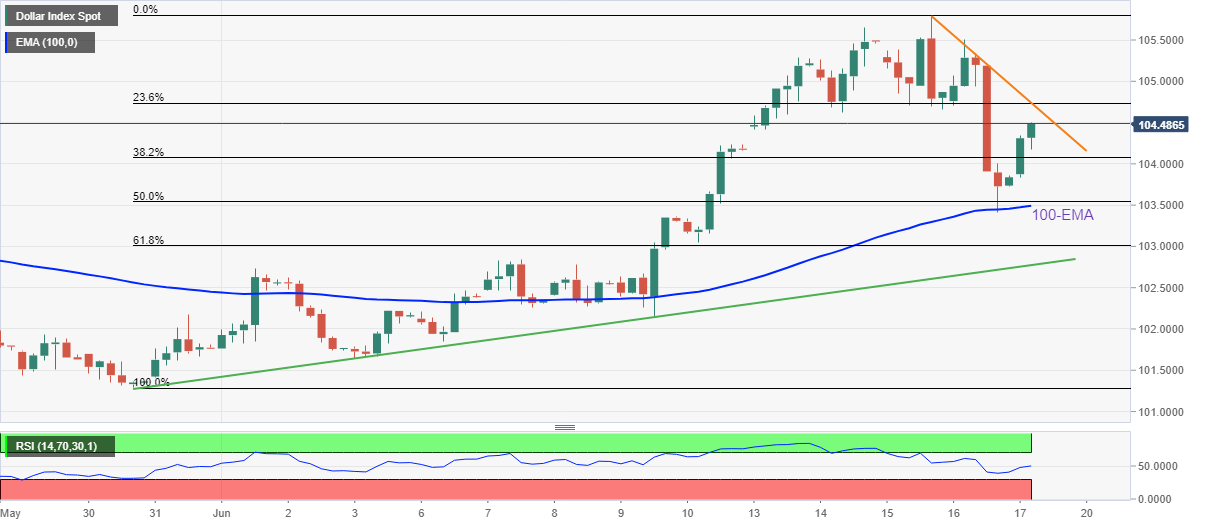
US Dollar Index Price Analysis: Bulls approach 104.75 resistance confluence
  • US Dollar Index bounces off weekly low to snap two-day downtrend.
  • Two-day-old descending trend line, 23.6% Fibonacci retracement guards immediate upside.
  • 100-EMA restricts short-term declines ahead of monthly support line.
  • Steady RSI, sustained bounce off key EMA favor buyers.

US Dollar Index (DXY) takes the bids to refresh its intraday high around 104.50 heading into Friday’s European session.

The greenback’s gauge versus the six major currencies refreshed the weekly low before bouncing off the 100-EMA level the previous day. That said, steady RSI (14) also backs the DXY recovery and hints at the quote’s sustained run-up moving forward.

However, a convergence of the descending trend line from Wednesday joins the 23.6% Fibonacci retracement level of May 30 to mid-June’s advances, around 104.75, appears a tough nut to crack for the DXY bulls.

Should the greenback buyers manage to cross the 104.75 hurdle, the odds of witnessing a fresh multi-month high, currently around 105.80, can’t be ruled out.

On the contrary, pullback moves could retest the 100-EMA level of 103.50, with the 38.2% Fibonacci retracement near 104.10 acting as immediate support.

Even if the quote drops below 103.50, the 61.8% golden ratio of Fibonacci and an upward sloping support line from late May, respectively near 103.00 and 102.75, will be crucial to invite the bears.

DXY: Four-hour chart

Trend: Further upside expected


06:49
BOJ’s Kuroda: Not aiming for specific currency level

Having said that the recent rapid yen weakening is negative for the economy, Bank of Japan (BOJ) Governor Haruhiko Kuroda added that they are not aiming for a specific currency level.

Further comments

Don't see limit in yield curve control.

No change to idea that yield curve control strongly supports economic recovery.

Rapidly rising US, European long-term yields have had substantial impact on Japan’s yields, making YCC necessary.

Forex fluctuations may not have immediate impact on capex.

FX moves may not have bad big impact on business confidence as Japan’s capex remains solid.

Don't see need for further monetary easing now.

Raising implicit cap for 10-year JGB yield target would weaken economy.

Not thinking raising cap on BOJ’s long-term yield target above current 0.25% as it may result in higher yields, weaken effect of monetary easing.

Closely watching the US economy and prices.

No country executes monetary policy targeting currency.

Market reaction

USD/JPY was last seen trading at 134.38, up 1.65% on the day.

06:43
Yields poke weekly low, stock futures print mild gains as traders await Fed’s Powell
  • Market sentiment remains divided amid central banks’ moves, growth fears.
  • US Treasury yields remain pressured for third consecutive day.
  • S&P 500 Futures, Euro Stoxx 50 Futures consolidate recent losses.
  • Fed’s bi-annual monetary policy report, Powell’s speech will be crucial for fresh directions.

Global markets remain dicey as central banks flex muscles to battle inflation. However, the aggressiveness in the Western policymakers’ efforts seems to underpin the recession fears, especially when the supply chain woes join covid and geopolitical catalysts.

While portraying the mood, the US 10-year Treasury yields remain pressured around 3.25%, down for the third consecutive day, whereas the S&P 500 Futures dribble around an 18-month low, up 0.50% intraday to 3,688 by the press time. Further, Euro Stoxx 50 Futures also copy the US moves and rise 0.58%, around 3,442 at the latest.

US Treasury bond yields stay depressed for the third consecutive day, despite defending the weekly bottom marked the previous day.

Downbeat US data seem to weigh on the US bond coupons of late. On Thursday, US Building Permits and Housing Starts eased in May to 1.695M and 1.549M respectively while the Initial Jobless Claims 4-week average inched up to 218.5K versus 215K expected during the period ended on June 10. Further, Philadelphia Fed Manufacturing Survey printed a negative figure of -3.3 for June, the first such contraction since May 2020.

It’s worth noting that aggressive momentary policy actions from the Swiss National Bank (SNB) and the Fed, not to forget the steady rate hike from the Bank of England (BOE), in contrast with the Asian central banks like the Bank of Japan (BOJ) and the People’s Bank of China (PBOC). The imbalance in the monetary policy actions and fears that tighter monetary policy in the west could weigh on growth especially when the economy is fragile seems to weigh on the market’s sentiment.

On the positive, the World Trade Organization’s (WTO) efforts to facilitate easy trade deals tried to tame the pessimism. Reuters came out with the news from the WTO as it said, “Representatives of the 164 countries cheered after the package was passed before Director-General Ngozi Okonjo-Iweala addressed them early on Friday.”

Moving on, the US Industrial Production for May, expected at 0.4% versus 1.1% prior, will be the first to entertain traders ahead of the Fed’s Monetary Policy Report and Powell’s speech.

06:39
USD to strengthen further, notably against the EUR and GBP – HSBC

The Federal Reserve stepped up the pace of hikes with a 75 bps increase; economists at HSBC now expect more rate rises ahead. What’s more, they still expect a stronger USD over the medium-term.

Federal funds target range to be 3.50-3.75% by year-end 2022

“We now expect the Fed to deliver rate hikes of 75 bps in July, 50 bps in September, 50 bps in November and 25 bps in December, bringing the federal funds target range to 3.50-3.75% by the end of 2022, (i.e., 25bp above the FOMC’s median projections implied by the dot plot) in response to elevated inflation.”

“Over the medium-term, we continue to expect the USD to strengthen further, notably against the EUR and GBP, built on the Fed’s ongoing marked tightening compared to more measured steps at the European Central Bank and the Bank of England. A slowing global economy is also likely to add further to the USD’s gains.”

06:38
BOJ’s Kuroda: Won't hesitate to ease monetary policy further if necessary

Bank of Japan (BOJ) Chief Haruhiko Kuroda reiterated that they will not hesitate to ease the monetary policy further if the need arises while addressing the post-monetary policy decision press conference.

Additional quotes

Appropriate to maintain current powerful monetary easing to support economy.

Upward pressure seen in bond yields.

Important for FX to move stably reflecting fundamentals.

Recent rapid yen weakening is negative for economy.

Will closely watch impact of forex moves on economy, prices.

Important for profitable companies benefited from weak yen to ramp up capex, raise wages, to strengthen virtuous cycle from income to spending.

Future financial, economic outlooks are extremely uncertain.

Market reaction

With Governor Kuroda warning against the recent rapid yen fall, USD/JPY is moving back towards 134.00, reversing the renewed upside to near 134.30. The spot is still up 1.38% on the day.

06:36
FX option expiries for June 17 NY cut

FX option expiries for June 17 NY cut at 10:00 Eastern Time, via DTCC, can be found below.

- EUR/USD: EUR amounts        

  • 1.0425 292m
  • 1.0490 1.1b
  • 1.0600 315m
  • 1.0650 317m
  • 1.0700 528m

- GBP/USD: GBP amounts        

  • 1.1800 381m
  • 1.2000 398m
  • 1.2110 406m
  • 1.2200 329m
  • 1.2400 318m
  • 1.2450 610m

- USD/JPY: USD amounts                     

  • 130.75 250m
  • 131.50 200m
  • 132.00 365m

- AUD/USD: AUD amounts  

  • 0.6750 258m
  • 0.6925 255m
  • 0.7000 385m
  • 0.7150 894m
  • 0.7250 695m

- USD/CAD: USD amounts       

  • 1.2635 722m
  • 1.2850 549m
  • 1.3100 309m
  • 1.3125 250m

- EUR/GBP: EUR amounts

  • 0.8535 291m
  • 0.8610 269m
  • 0.8630 387m
  • 0.8650 566m
06:32
RBNZ: Raising OCR terminal to 4% – TDS

Economists at TD Securities expect the Reserve Bank of New Zealand (RBNZ) to hike consecutively in 50 basis points (bps) clips at its April and May meetings. The 4% terminal is expected to be reached in February 2023.

Lifting terminal OCR to 4%

“Our new forecasts have the RBNZ hiking in 50 bps clips at the July, Aug and Oct'22 meetings with 25 bps hikes in Nov'22 and Feb'23. This takes the year-end 2022 OCR to 3.75% and the final hike in Feb'23 takes the terminal rate to 4%.”

“We discuss the upside and downside risks to our 4% terminal call and it rests heavily on how the RBNZ prirotises the Growth vs inflation outlook.”

“From a market's perspective, a deterioration in market liquidity could bring an early end to the tightening cycle.”


06:30
Forex Today: Dollar rebounds alongside yields ahead of Powell speech

Here is what you need to know on Friday, June 17:

Following Thursday's heavy selloff, the greenback is holding its ground against its rivals early Friday. The benchmark 10-year US Treasury bond yield, which lost nearly 3% on Thursday, is now up more than 1% on the day and the US Dollar Index edges higher toward 104.50. Eurostat will release the Harmonised Indices of Consumer Prices (HICP) inflation figures for the euro area and the US economic docket will feature May Industrial Production data. More importantly, FOMC Chairman Jerome Powell is scheduled to deliver a speech at 12:45 GMT.

In the European morning, US stock index futures are up between 0.7% and 0.9%, pointing to an improving market mood. The S&P 500 Index touched its weakest level since December 2020 at 3,639 and ended up losing more than 3% on a daily basis. 

The Bank of Japan (BOJ) announced on Friday that it left its monetary policy settings unchanged. In its policy statement, the BOJ reiterated that it will be paying close attention to developments in forex markets and their impact on Japan's economic activity. The bank's policy inaction triggered a JPY selloff and USD/JPY erased a large portion of the heavy losses it suffered in the previous two days. As of writing, the pair was trading near 134.00, rising more than 1% on a daily basis.

EUR/USD gained more than 100 pips on Thursday and touched its highest level in nearly a week at 1.0602 before going into a consolidation phase. The pair was last seen trading slightly above 1.0500. The annual HICP in the euro area is expected to arrive at 8.1% in May, matching the flash estimate.

Following the impressive rally that was fueled by the Bank of England's (BOE) hawkish policy outlook on Thursday, GBP/USD turned south early Friday and dropped below 1.2300.

Gold managed to build on Wednesday's gains and climbed above $1,850 on Thursday. With the US T-bond yields edging higher early Friday, however, XAU/USD lost its traction and started to retreat toward $1,840.

USD/CHF fell nearly 300 pips on Thursday after the Swiss National Bank (SNB) unexpectedly announced that it hiked its policy rate by 50 basis points to -0.25%. The pair was last seen consolidating its losses at around 0.9700. 

Bitcoin fell nearly 10% on Thursday and came within a touching distance of the key $20,000 level. BTC/USD stays relatively quiet on Friday and seems to be having a difficult time recovering its losses. Ethereum is down more than 20% so far this week and trades near $1,100 in the European morning.

06:21
Fed to raise rates well north of 4% during next year, ECB will stop its hikes at 1.75% – Nordea

In response to increasing inflation risks, the Federal Reserve and the European Central Bank (ECB) have transitioned into a more aggressive policy stance. Economists at Nordea expect the Fed to hike rates to a restrictive level above 4%, while a neutral rate at around 1.75% may be enough for the ECB.

EUR/USD set to move towards parity

“We expect the Fed to hike by 75 bps in July, followed by 50 bps in September and November, and then by 25 bps in December, January and March to end at 4.25% for the upper bound.”

“We forecast a very flat US Treasury curve at 4% from early next year.”

“The ECB is set to follow the signalled 25 bps July rate hike with 50 bps moves in September and October, 25 bps in December and further three times in 25 bps steps in H1 2023.”

“The dollar is expected to keep strengthening as the Fed hikes, with EUR/USD to moving to parity.”


06:15
The criticism of share buybacks seems justified – Natixis

The rise in corporate earnings in the recent period has enabled a sharp rise in share buybacks. This increase in share buybacks has been heavily criticised, and in the view of analysts at Natixis, seems justified.

Share buybacks have not led to additional investment

“Share buybacks have been made possible by the skewing of income distribution against wage earners; Not led to the transfer of savings into financing more efficient investments; Primarily driven up share prices.”

“The criticism of share buybacks is justified. It is regrettable that they have not led to additional investment, especially in the energy transition.” 


06:12
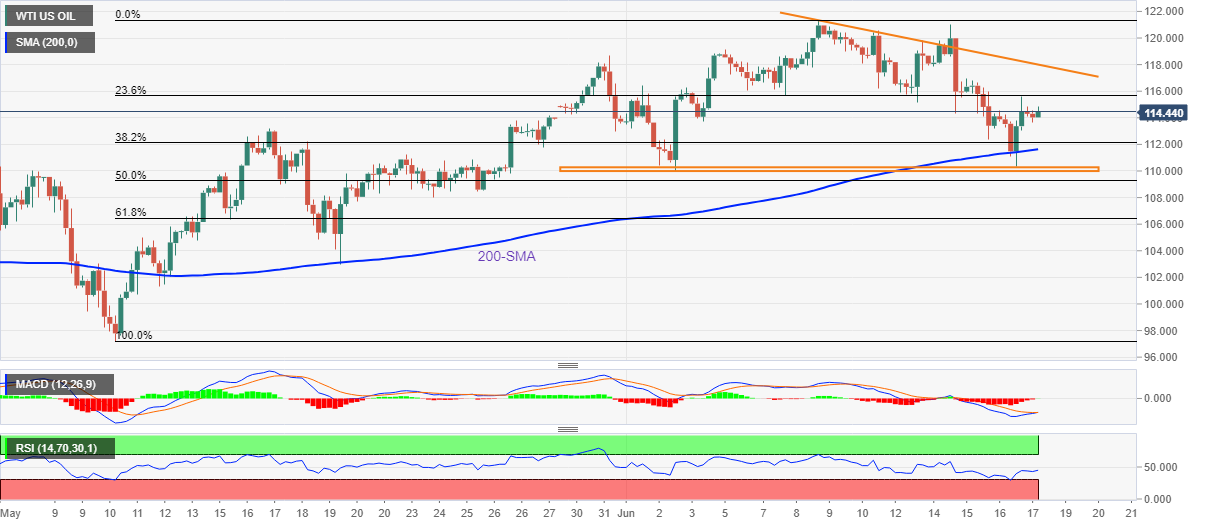
WTI Price Analysis: Bulls approach $115.00 inside fortnight-old descending triangle
  • WTI extends recovery from weekly low as triangle’s support, 200-SMA defend bulls.
  • MACD, RSI adds strength to the upside bias but bulls need validation from $118.00.
  • Bears have a bumpy road to travel before retaking control.

WTI remains on the front foot heading into Friday’s European session, after bouncing off a two-week low the previous day. That said, the black gold picks up bids around $114.64, up 0.13% by the press time.

The oil benchmark refreshed its weekly low the previous day before recovering from the 200-SMA. In doing so, the commodity prices also rebounded from the early June levels.

Thursday’s U-turn could be joined with the quote’s gradual easing since June 08 to portray a short-term descending triangle bullish chart pattern.

In addition to the chart pattern and the recovery from 200-SMA, steady RSI and impending bull-cross on the MACD also keep buyers hopeful.

It’s worth noting, however, that the WTI needs to cross the triangle’s upper line, around $118.00 by the press time, to convince the bulls to challenge the monthly top near $121.35.

Failing to do so can again drag it back to the 200-SMA level of $111.65.

Should the quote drops below $111.65, the lower-end of the stated triangle, near $110.00, could lure the WTI sellers.

Following that, 61.8% Fibonacci retracement (Fibo.) of the May-June downturn and mid-May swing low, respectively around $106.50 and $103.00 may entertain the energy benchmark ahead of highlighting the $100.00 psychological magnet.

WTI: Four-hour chart

Trend: Further upside expected


06:11
A 75 bps move from the BoC next meeting looks like the path of least resistance – TDS

Governor Macklem and Deputy Governor Beaudry deliberately opened the door to potential 75 bps moves earlier this month. Economists at TD Securities expect a 75 bps move by the Bank of Canada (BoC) next month. 

3.25% is a materially restrictive rate in Canada

“We look for the Bank of Canada to lift the overnight rate by 75 bps in July, followed by 50 bps moves in September and October.” 

“We look for a terminal rate of 3.25%, as we expect tighter policy will have a more significant impact in Canada than in the US due to high household debt levels.”

“With central bank credibility already on shaky ground, we think it would be needlessly risky to fall short of market expectations.”

06:10
NZD/USD Price Analysis: Pullback seems over at 20-EMA, needs establishment above 200-EMA NZDUSD
  • The kiwi bulls are strengthened on finding bids at the 20-EMA.
  • A balancing mode above the 200-EMA and 38.2% Fibo retracement will expose the asset for more upside.
  • The RSI (14) is expected to display a range shift from 40.00-60.00 to 60.00-80.00.

The NZD/USD pair has attracted some bids around 0.6327 after a corrective move from Thursday’s high at 0.6395. On a broader note, the kiwi bulls have displayed a power-back buying action from a low of 0.6196 recorded on Wednesday.

The availability of bids around the 20-period Exponential Moving Average (EMA) at 0.6333 signals an initiative buying structure. The asset is attempting to establish above the 200-EMA at 0.6344, which will bring a positive imbalance move in the major. Also, the kiwi bulls are defending the 38.2% Fibo retracement (which is placed between June’s high and low at 0.6576 and 0.6196 respectively) at 0.6342.

The Relative Strength Index (RSI) (14) is displaying some range shift signals from a 40.00-60.00 range to a bullish range of 60.00-80.00, which will strengthen the antipodean further.

For confirmation of an upside move, the kiwi bulls need to drive the asset above Friday’s high at 0.6362. This will send the major towards Thursday’s high at 0.6395, followed by 61.8% Fibo retracement at 0.6430.

On the flip side, a slippage below Wednesday’s high at 0.6313 will support the greenback bulls for a downside move towards Thursday’s low and June’s low at 0.6233 and 0.6196 respectively.

NZD/USD hourly chart


06:05
Gold Price Forecast: XAUUSD bulls keep eyes on $1,858 so long as 200 DMA guards the downside

Gold price recaptured the critical horizontal 200-Daily Moving Average (DMA) at $1,842 on a daily closing basis on Thursday. In the view of FXStreet’s Dhwani Mehta, XAUUSD could retest $1,858.

Below the 200 DMA next support aligns at $1,829, then $1,816

“Bears are back this Friday, challenging the bullish commitments at the resistance now turned support at the 200 DMA at $1,842. If the latter caves in, then a drop towards the previous day’s low of $1,816 cannot be ruled out. Ahead of that the June 1 low of $1,829 could be tested.”

“So long as the 200 DMA support holds, bulls keep their sight on the weekly highs of $1,858 but the $1,850 level needs to be scaled on a sustained basis before.”

05:43
Gold Price looks set to test $1,800 ahead of Fed’s Powell
  • Gold Price reverses from a three-month-old resistance line, sellers attack 200-DMA.
  • Technical hurdle joins US dollar rebound to weigh on prices.
  • Fed’s bi-annual Monetary Policy Report, Powell’s report will be crucial for fresh impulse.

Gold Price (XAUUSD) extends pullback from a short-term key resistance line as sellers attack the 200-DMA heading into Friday’s European session. In doing so, the precious metal prints 0.50% intraday losses of around $1,847 by the press time. The bullion’s latest weakness could be linked to the US dollar rebound, as well as a technical pullback, amid the market’s indecision ahead of the key catalysts.

Gold Price contrasts with US dollar moves

US Dollar Index (DXY) snaps a two-day downtrend as market players await Fed Chair Jerome Powell. The greenback gauge versus six major currencies bounces off a weekly low amid an indecision phase after two consecutive weeks of gains. It’s worth noting that the DXY rises 0.37% by the press time to 104.30. That said, the US Dollar Index dropped during the last two days amid downbeat yields and softer data while paying a little heed to the Fed’s strongest rate hike since 1994.

Also read: Gold Price Forecast: $1,857 appears a tough nut to crack for XAUUSD bulls – Confluence Detector

Yields remain pressured

US Treasury bond yields stay depressed for the third consecutive day, despite defending the weekly bottom marked the previous day. The benchmark 10-year Treasury yields dropped during the last two consecutive days, down 6.8 basis points (bps) to 3.237% by the press time, as traders rush to bonds amid economic fears and higher rates.

US data favored XAUUSD bulls

Downbeat US data also underpinned the Gold Price strength the previous day as the statistics eased pressure on the Fed after it marked an aggressive rate hike. US Building Permits and Housing Starts eased in May to 1.695M and 1.549M respectively while the Initial Jobless Claims 4-week average inched up to 218.5K versus 215K expected during the period ended on June 10. Further, Philadelphia Fed Manufacturing Survey printed a negative figure of -3.3 for June, the first such contraction since May 2020.

China, Japan fail to impress buyers

Central banks in China and Japan defend the easy money policies despite the rush to tame inflation in the west. The higher funds in Asia, the largest customer of gold, should have favored gold buyers but could not. The reason could be linked to the economic fears due to the covid woes and the Bank of Japan’s (BOJ) readiness to act.

All eyes are on Powell

Federal Reserve Chairman Jerome H. Powell

Federal Reserve (Fed) Chairman Jerome Powell is all set to fuel the XAUUSD moves while speaking at the Inaugural Conference on the International Roles of the US Dollar, in Washington DC. In addition to Fed’s Powell, Fed’s bi-annual Monetary Policy Meeting will also be important to track for the gold traders amid hopes of witnessing hawkish signals, which in turn could direct Gold Price further towards the south.

Technical analysis

Gold Price extends pullback from a downward sloping trend line from early March as it drops back to the 200-DMA level surrounding $1,845.

Given the quote’s failures to cross the key resistance line, coupled with the sluggish MACD and RSI retreat, XAUUSD is likely to extend the latest weakness towards monthly horizontal support near $1,800.

However, an area comprising multiple lows marked since January, around $1,785-80, could challenge the gold bears afterward.

On the flip side, a clear break of the immediate resistance line, close to $1,856-57, isn’t an open call to the buyers as a convergence of the 50-DMA and 61.8% Fibonacci retracement level of December 2021 to March 2022 upside will challenge further run-up near $1,875. Also acting as an upside filter is the monthly peak of around $1,880.

Overall, Gold Price is likely to witness further downside but the fundamental catalysts, mentioned above, are crucial to watch.

Time’s up for the dollar, gold takes centre stage


05:36
USD/JPY Price Analysis: Faces barricades at Rising Channel, upside looks likely on prudent BOJ USDJPY
  • A decisive breach of the 20- and 50-EMAs adds to the upside filters.
  • The RSI (14) is attempting to violate 60.00, which will fetch a fresh leg of the rally.
  • A breach of 135.60 will expose the asset to printing a fresh two-decade high.

The USD/JPY pair is showing exhaustion signals after failing to sustain above the crucial resistance of 134.00. Earlier, the asset displayed a swift upside move from a low of 131.50 recorded on Thursday. The greenback bulls have attracted offers despite the continuation of an ultra-loose monetary policy by the Bank of Japan (BOJ).

On an hourly scale, a responsive buying action by the greenback bulls to near the Rising Channel chart formation has met with significant offers. The upper portion of the above-mentioned chart pattern is placed from June 8 high at 134.48 while the lower portion is plotted from June 9 low at 133.19.

The asset has crossed the 20- and 50-period Exponential Moving Averages (EMAs) at 133.22 and 133.55 respectively. It is worth noting that the asset’s price is auctioning above the short-term EMAs while the 20-EMA is trading lower than the 50-EMA. This indicates that the buying action in the asset is very much firmer.

Meanwhile, the Relative Strength Index (RSI) (14) is attempting to cross the 60.00 mark to confirm a fresh leg of a rally. An occurrence of the same will expose the asset to more upside.

Should the asset oversteps Friday’s high at 134.65, the greenback bulls will negate the Rising Channel’s breakdown, which will empower them to recapture a two-decade high at 135.60. A breach of the latter will expose the asset to record a fresh two-decade high to near 5 October 1998 high at 136.06.

Alternatively, the yen bulls could regain strength if the asset drops below Friday’s low at 132.18. This will drag the asset towards Thursday’s low at 131.50, followed by June 6 low at 130.43.

USD/JPY hourly chart


05:12
USD/CAD Price Analysis: 100-HMA defends bulls inside nearby trading range below 1.3000 USDCAD
  • USD/CAD grinds higher inside three-day-old trading range, stays above 100-HMA.
  • Bullish RSI divergence, sustained trading above key HMA keep buyers hopeful.
  • 200-HMA holds the key for seller’s entry, yearly top adds to the upside filters.

USD/CAD remains sidelined in a 110-pip trading range for the last three days, retreating to 1.2950 during early Friday morning in Europe.

However, the quote’s ability to stay beyond the 100-HMA joins the bullish RSI signals to underpin the hopes of further upside. That said, the higher low on the prices joins the higher low of the RSI to keep buyers hopeful.

The Loonie pair’s latest weakness again drags it towards the 100-HMA support, near 1.2910 by the press time, a break of which will can direct the bears to the stated trading range’s lower end, around 1.2860.

In a case where USD/CAD breaks the 1.2860 support, June 10 swing high near 1.2810 and the 200-HMA level surrounding 1.2765 will be crucial for bears to watch.

Meanwhile, 1.2975 and the 1.3000 psychological magnet guard short-term upside moves of the pair.

Also acting as the key hurdle is the previous monthly high of 1.3076, also the highest level since late 2020.

To sum up, USD/CAD is likely to extend the two-week uptrend but the road to the north is a bumpy one.

USD/CAD: Hourly chart

Trend: Further upside expected


04:46
Asian Stock Market: Bears keep reins despite BOJ’s inaction, RBI’s hopes
  • Asian equities remain pressured despite efforts of Asian central banks to keep investors hopeful.
  • BOJ held monetary policy intact but reference of FX weighs on sentiment in Japan.
  • RBI hints that Indian economy is likely to improve despite the risk to global growth.
  • WTO trade deals also fail to impress bulls amid Western central bankers’ hawkish play.

Markets in Asia track Wall Street’s losses, despite mildly positive catalysts at home, as investors remain worried over the future economic outlook amid aggressive central bank actions in the west.

That said, the MSCI’s index of Asia-Pacific shares ex-Japan remains pressured around the monthly low, down 0.50% intraday near 647.00 by the press time of early Friday morning in Asia. Japan’s Nikkei, on the same line, drops around 1.5% even as the Bank of Japan (BOJ) left monetary policy unchanged despite the inflation fears and downbeat yen.

India’s BSE Sensex also tracks the MSCI’s gauge, with around 0.50% intraday losses at the latest even as the Reserve Bank of India cited hopes of economic recovery in its monthly bulletin. “Gross domestic product (GDP) for 2021-22 surpassed its pre-pandemic (2019-20) level by 1.5% and activity is gaining strength in 2022-23 so far as gauged from high-frequency indicators,” RBI’s monthly bulletin said on Thursday. "Domestic economic activity has been gaining traction in spite of formidable headwinds from external developments," adds the Indian central bank.

It’s worth noting that, China’s covid woes and readiness for mass testing join hopes of further stimulus to challenge the bears. Even so, stocks in Hong Kong and Shanghai post mild losses by the press time.

Stocks in Australia and New Zealand drop the most as market players brace for aggressive rate hikes from the Reserve Bank of New Zealand (RBNZ) and the Reserve Bank of Australia (RBA), especially following the latest hawkish moves of the Fed, BOE and SNB.

Elsewhere, Indonesian equities also remain in the red palm oil prices hint the biggest weekly fall in six.

Other than the individual catalysts, the mildly bid S&P 500 Futures, softer yields and news from the World Trade Organization (WTO) also failed to renew optimism in Asia. Reuters came out with the news from the WTO as it said, “Representatives of the 164 countries cheered after the package was passed before Director-General Ngozi Okonjo-Iweala addressed them early on Friday.”

Looking forward, a speech from the BOJ Governor Haruhiko Kuroda and Fed Chair Jerome Powell will be crucial to watch for clear directions.

04:44
GBP/USD slips below 1.2300 on souring market mood, Fed Powell eyed GBPUSD
  • GBP/USD has tumbled below 1.2300 as the negative market mood has trimmed the risk appetite.
  • The DXY has climbed above 104.00 and is expected to balance above the same.
  • The BOE is unable to explore more tightening measures amid lower GDP and higher unemployment.

The GBP/USD pair is scaling gradually lower after failing to sustain above the critical hurdle of 1.2400 on Thursday.  The asset has recorded an intraday low of 1.2286 and is expected to slip further as the risk-off impulse has rebounded sharply and investors are underpinning the safe-haven assets.

A rebound in the negative market sentiment has fetched significant bids for the US dollar index (DXY). The DXY is auctioning above 104.00 and is expected to extend its gains towards the psychological resistance of 105.00. The Federal Reserve (Fed) has announced a rate hike by 75 basis points (bps) on Wednesday and considering the momentum in the inflation parameter, investors should brace for more rate hikes going forward.

In today’s session, the speech from Fed chair Jerome Powell is on the radar. Fed Powell is expected to dictate the roadmap of more rate hike announcements and other measures to fix the inflation mess.

On the pound front, pound bulls are expected to perform lackluster on a broader note. The Bank of England (BOE) has accelerated the rate cycle by 25 bps and its interest rates have reached to 1.25%.

The downbeat Gross Domestic Product (GDP) and higher Unemployment Rate released this week restricted the BOE to explore extreme policy tightening measures. Considering the annual inflation figure of 9.1%, the BOE has to paddle up its interest rates swiftly.


04:20
AUD/USD Price Analysis: Extends pullback from 200-SMA inside weekly bullish channel AUDUSD
  • AUD/USD refreshes intraday low during the first loss-making day in three.
  • Bullish chart formation, MACD conditions keep buyers hopeful.
  • Fortnight-old descending trend line adds to the upside filter.

AUD/USD takes offers to refresh intraday low around 0.7020, snapping a two-day rebound during early Friday morning in Europe.

The Aussie pair’s latest weakness could be linked to the pullback from the 200-SMA. However, an upward sloping trend channel from Tuesday challenges the pair bears. That said, the bullish MACD signals also keep buyers hopeful.

The pair’s latest retreat from the 200-SMA remains less important until AUD/USD prices stay above the support line of the aforementioned rising channel, around 0.6975 by the press time.

Following that, the 0.6900 round figure could act as the last defense of the bulls before directing the quote toward the yearly low, marked earlier in the week surrounding 0.6850, will be in focus.

On the contrary, the 200-SMA and upper line of the channel, near 0.7070 and 0.7100 in that order, challenge the short-term upside of the AUD/USD.

In a case where the quote rises past 0.7100, a downward sloping trend line from June 03, near 0.7120, will be a decisive point for the bulls to watch before retaking the control.

Overall, AUD/USD remains on the bullish trend despite the latest pullback moves.

AUD/USD: Four-hour chart

Trend: Pullback expected


04:07
EUR/USD skids to near 1.0520 ahead of Eurozone inflation and Fed Powell EURUSD
  • EUR/USD has corrected to near 1.0520 amid a rebound in the risk-off impulse.
  • Investors are awaiting the release of the eurozone HICP and Fed Powell’s speech for further guidance.
  • A preliminary estimate for the eurozone HICP is a stabilization of the prior print.

The EUR/USD pair is witnessing a corrective move after a vertical rally to a high of 1.0600 on Thursday. The pair displayed a juggernaut upside move on puzzled market sentiment in which risk-sensitive currencies and gold prices are scaling higher while the global equities and the US dollar index (DXY) are facing the headwinds of dumping.

The eurozone bulls have shifted their focus to the Harmonized Index of Consumer Prices (HICP) to be released by Eurostat on Friday.  A preliminary estimate shows that the annual HICP figure is expected to remain unchanged at 8.1%. Also, the core HICP that doesn’t include food, energy, alcohol, and tobacco is seen unchanged at 3.8%.

Investors are likely to find the stable inflation rate quite cheerful as various economies are reporting their price pressures report beyond their prior prints. But still, this will compel the European Central Bank (ECB) to sound extremely hawkish in its monetary policy dictation in July.

On the dollar front, the US dollar index (DXY) has rebounded sharply and is aiming to stabilize above 104.00 on a rebound in the negative market sentiment. The DXY is attempting to regain its mojo ahead of the speech from Fed chair Jerome Powell. Fed Powell is expected to dictate the ideology behind announcing a 75 basis point (bps) rate hike. Also, the dictation of the roadmap for containing the price pressures will be keenly watched.


03:53
USD/INR Price News: Indian rupee fails to cheer RBI’s optimism near 78.00, Fed’s Powell eyed
  • USD/INR picks up bids to refresh intraday high, extend the previous day’s rebound.
  • RBI highlights upbeat economic prospects for India despite risks to global growth.
  • WTO’s passage of trade deals also gains less accolades from the market.
  • US dollar rebounds ahead of Fed’s bi-annual Monetary Policy Report, Powell’s speech, ignores downbeat Treasury yields.

USD/INR extends the previous day’s rebound from the weekly low, grinding higher around 78.00 as Indian markets open for Friday’s trading.

The Indian rupee (INR) pair’s latest gains respect for the US dollar’s recovery while paying a little heed to the Reserve Bank of India’s (RBI) economic optimism. Also could have favored the INR was the news from the World Trade Organization (WTO).

“Gross domestic product (GDP) for 2021-22 surpassed its pre-pandemic (2019-20) level by 1.5% and activity is gaining strength in 2022-23 so far as gauged from high-frequency indicators,” RBI’s monthly bulletin said on Thursday. "Domestic economic activity has been gaining traction in spite of formidable headwinds from external developments," adds the Indian central bank.

On a different page, Reuters came out with the news from the WTO as it said, “Representatives of the 164 countries cheered after the package was passed before Director-General Ngozi Okonjo-Iweala addressed them early on Friday.”

Elsewhere, the US Treasury yields remain pressured for the third consecutive day but fail to compress the US dollar as it bounces off the weekly low.

That said, the US Dollar Index (DXY) recovers from the weekly low near 103.40 to 104.10 by the press time. That said, US 10-year Treasury yields dropped during the last two consecutive days and remains down 5.3 basis points (bps) to 3.253% by the press time, as the Fed’s 0.75 rate increase couldn’t impress bulls.

Moving on, the US Industrial Production for May, expected at 0.4% versus 1.1% prior, will precede the Fed’s Monetary Policy Report and Powell’s speech to entertain USD/INR traders. However, major attention will be given to yields.

Technical analysis

A bullish flag chart pattern on the four-hour play hints at the further upside momentum of the USD/INR pair. However, a clear break of the 78.20 hurdle becomes necessary to witness a fresh record top.


03:31
AUD/JPY returns to 94.00 after BOJ-led wild swings, keeps policy unchanged
  • AUD/JPY is turning sideways around 94.00 after loud non-directional moves on BOJ’s stable policy.
  • The BOJ has kept its ultra-loose monetary policy stance stable to spurt the growth projections.
  • Aussie bulls are enjoying bids on generating higher employment than the forecasts.

The AUD/JPY pair has displayed extremely volatile moves after the announcement of the interest rate policy by the Bank of Japan (BOJ). The asset has returned back to near 94.00 and is expected to cool off its standard deviation first and will choose a direction later.

The BOJ has kept its policy stance unchanged and has dictated no change in its interest rates. A similar kind of dictation was expected from the BOJ as the central bank is dedicated to restoring its pre-pandemic growth levels. The BOJ is struggling to spurt aggregate demand in its economy and for that, the central bank is continuously flushing liquidity.

The Japanese yen has been a major underperformer in the last few months and no meaningful intervention has been recorded by the BOJ, which states that the Japanese economy is enjoying higher fund inflows from massive export numbers due to the weak yen.

Meanwhile, Japan's Finance Minister has reappointed Japan's Vice Finance Minister Masato Kanda for international affairs as a top currency diplomat in the mid-year personnel reshuffle. This might be a material action from Tokyo to provide a cushion to the falling yen.

On the aussie front, significant job creation by the Australian economy is supporting the aussie bulls. The Australian labor market has added 60.6k jobs in May, more than doubled the expectations of 25k and the prior print of 4k. The jobless rate remained unchanged at 3.9% but higher than the consensus of 3.8%.


03:18
GBP/JPY Price Analysis: Pierces 200-HMA as BOJ leaves monetary policy unchanged
  • GBP/JPY prints three-day uptrend despite the latest pullback from intraday high.
  • Immediate support line, bullish MACD signals and BOJ’s inaction together help buyers.
  • Sellers have a bumpy road to travel before taking control.

GBP/JPY reverses the knee-jerk reaction to the Bank of Japan’s (BOJ) monetary policy meeting while staying firmer around 164.60 during Friday’s Asian session. In doing so, the cross-currency pair rises for the third consecutive day as buyers poke the 200-HMA hurdle.

In addition to the BOJ’s refrain from following the major central banks, bullish MACD signals and upward sloping trend line from Thursday’s low also keep GBP/JPY buyers hopeful.

Read: BOJ leaves unchanged its guidance on policy bias, maintains dovish rhetoric

That said, a clear upside break of the 200-HMA level surrounding 165.10 appears necessary for the bulls to keep reins.

Also challenging the immediate advance is the 61.8% Fibonacci retracement of the June 09-16 downtrend.

Following that, a run-up towards the monthly peak of 168.73, as well as the 170.00 threshold, can’t be ruled out.

On the contrary, pullback moves remain elusive until the quote stay beyond the aforementioned support line, near 164.00 by the press time.

In a case where GBP/JPY remains pressured after 164.00, multiple supports around 163.80, 162.30 and 161.40 could challenge the pair’s further downside.

GBP/JPY: Hourly chart

Trend: Further upside expected


03:03
EUR/JPY reverses BOJ-inspired gains, plunges to near 139.50 on BOJ’s unchanged policy EURJPY
  • EUR/JPY has surrendered its gains and has slipped to near 139.50.
  • The BOJ has announced an unchanged interest rate policy to keep liquidity injection intact.
  • Eurozone HICP is seen stable at 8.1% on an annual basis.

The EUR/JPY pair touched a high of 141.73 swiftly, reversed its gains with an equal opposite reaction, and plunged to near 139.50. The Bank of Japan (BOJ) has maintained its status quo and has announced no change in its policy stance. The announcement has remained in line with the estimates as the BOJ has kept its interest rates flat at -0.1%.

Considering its oil-contaminated 2% inflation rate, a continuation of an ultra-loose monetary policy was expected by the market participants. The economy achieved its inflation targets, however, the majority of the price pressures were contributed by costly fossil fuels. The BOJ will keep on flushing helicopter money into the Japanese economy in order to spurt the growth forecasts.

It is worth noting that the Japanese economy has yet not achieved its pre-pandemic growth levels. Therefore, the BOJ is keeping on restricting its yields at 0.25% to accelerate its exports swiftly.

On the eurozone front, the shared currency bulls are awaiting the release of the Harmonized Index of Consumer Prices (HICP). An annual HICP figure is expected to remain stable at 8.1%. Also, the core HICP that excludes food, energy, alcohol, and tobacco is seen unchanged at 3.8%.


03:02
USD/JPY seesaws around 134.00 on BOJ’s status-quo, Kuroda, Fed’s Powell eyed USDJPY
  • USD/JPY initially refreshed intraday high before a knee-jerk reaction to BOJ’s inaction.
  • BOJ kept monetary policy unchanged but mentioned readiness to watch FX reaction for the first time.
  • Downbeat yields, firmer equities and US dollar rebound are extra catalysts helping the yen pair buyers.

USD/JPY refreshed its intraday high before falling to 132.40, also bouncing back to 134.00 by the press time, as the Bank of Japan (BOJ) matches wide market expectations of announcing no change to its monetary policies on Friday. In doing so, the USD/JPY pair extends the early Asian session rebound from the weekly low to reverse the week’s losses and poke 134.50 level, around 134.25 by the press time.

BOJ kept its benchmark rate near -0.10% while also holding the 0.0% target for the Japanese Government Bond (JGBs) at the end of two-day monetary policy meeting.

While the inaction was widely anticipated, a mention of the FX in the BOJ statement teased the yen sellers on announcement. “Need to watch impact of fx on economy, prices,” the BOJ statement mentioned. This could be the first such hint from the BOJ in a long time that directly connects to the FX intervention.

It’s worth noting that the US dollar rebound and market’s indecision also favored the USD/JPY bulls of late.

The US Dollar Index (DXY) recovers from the weekly near 103.40 to 104.10 at the latest. In doing so, the greenback gauge ignores downbeat Treasury yields. That said, US 10-year Treasury yields dropped during the last two consecutive days, to 3.243% by the press time, as the Fed’s 0.75 rate increase couldn’t impress bulls.

Moving on, BOJ Governor Haruhiko Kuroda is up for a press conference around 06:00 GMT and will be eyed for further directions. Following that, the US Industrial Production for May, expected at 0.4% versus 1.1% prior, will be the first to entertain traders ahead of the Fed’s Monetary Policy Report and Powell’s speech.

Technical analysis

USD/JPY stretches the bounce off 100-SMA on the four-hour chart as it crosses the one-week-old horizontal resistance area, surrounding 133.50-60. Given the RSI rebound from the oversold territory, coupled with the receding bearish bias of the MACD, the USD/JPY prices are likely to defend the latest recovery.

Alternatively, pullback moves may remain elusive until the quote stays beyond the 100-SMA level of 131.40.


02:50
BOJ leaves unchanged its guidance on policy bias, maintains dovish rhetoric

In its policy statement, the Bank of Japan (BOJ) noted that it left unchanged its guidance on policy bias, adding that it will take additional easing steps without hesitation as needed with an eye on the pandemic's impact on the economy.

Additional takeaways

April guidance of offering to buy 10-year JGBs at 0.25% every business day unless it is highly likely no bids will be submitted.

Must carefully watch impact of forex moves on Japan’s economy, prices.

Exports, output continue to rise as a trend but impact of supply constraints heightening.

Japan's consumer inflation to move around 2% for time being but narrow pace of increase thereafter.

Japan's economy picking up as a trend, though some weakness has been seen.

Japan's inflation expectations, particularly short-term ones, have risen.

Japan's core consumer inflation has been at around 2%, mainly due to rises in energy and food prices.

Japan's economy is likely to recover with impact of covid-19 and supply-side constraints waning.

Japan's core consumer inflation likely to be at around 2% for time being, but expected to decelerate thereafter.

Japan's economy faces extremely high uncertainties including from covid-19 trends at home and abroad, developments in Ukraine situation.

Market reaction

USD/JPY is off the daily highs of 134.59 but adds 1.59% on the day to now trade at 134.24.


02:46
Japan BoJ Interest Rate Decision meets forecasts (-0.1%)
02:46
Singapore Unemployment rate in line with forecasts (2.2%) in 1Q
02:45
Breaking: USD/JPY leaps above 134.00 as BOJ keeps policy unchanged USDJPY

The Bank of Japan (BOJ) monetary policy board concluded its 2-day June policy review meeting on Friday and decided to leave its monetary policy settings unchanged, holding rates at -10bps while maintaining 10yr JGB yield target at 0.00%.

The BOJ vote was 8 to 1, leaving its pledge to buy JGBs unchanged so that its holdings increase at an annual pace of around 80 trln yen.

BOJ left its forward guidance on interest rates and policy bias unchanged, citing that it expects short- and long-term policy rates to remain at 'present or lower' levels.

Market reaction

The yen was smashed by the BOJ announcement, driving the USD/JPY pair through the 134.00 level. The pair was last seen trading up 1.58% on the day at 134.25.

About BOJ Interest Rate Decision

BoJ Interest Rate Decision is announced by the Bank of Japan. Generally, if the BoJ is hawkish about the inflationary outlook of the economy and rises the interest rates it is positive, or bullish, for the JPY. Likewise, if the BoJ has a dovish view on the Japanese economy and keeps the ongoing interest rate, or cuts the interest rate it is negative, or bearish.
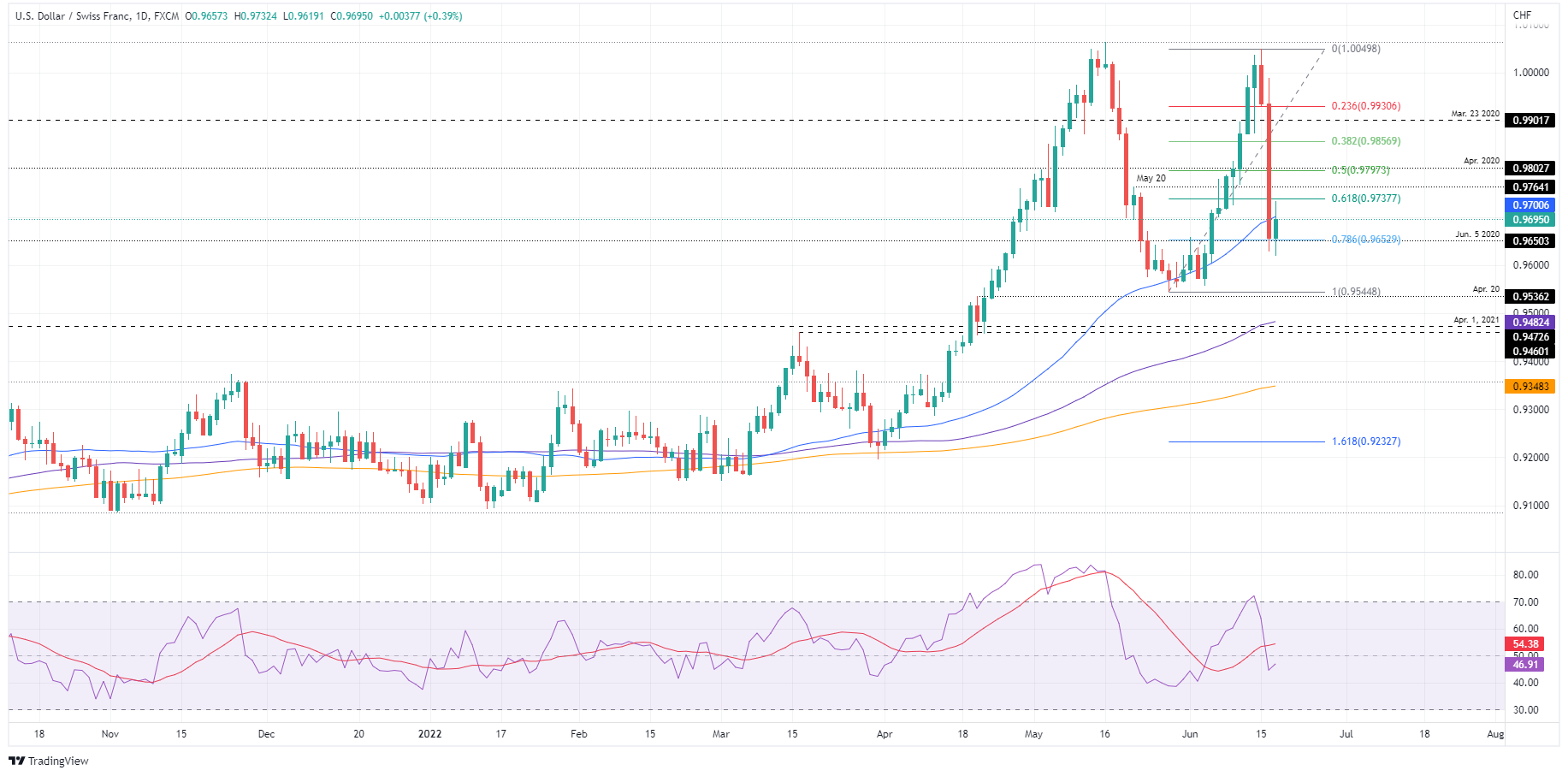
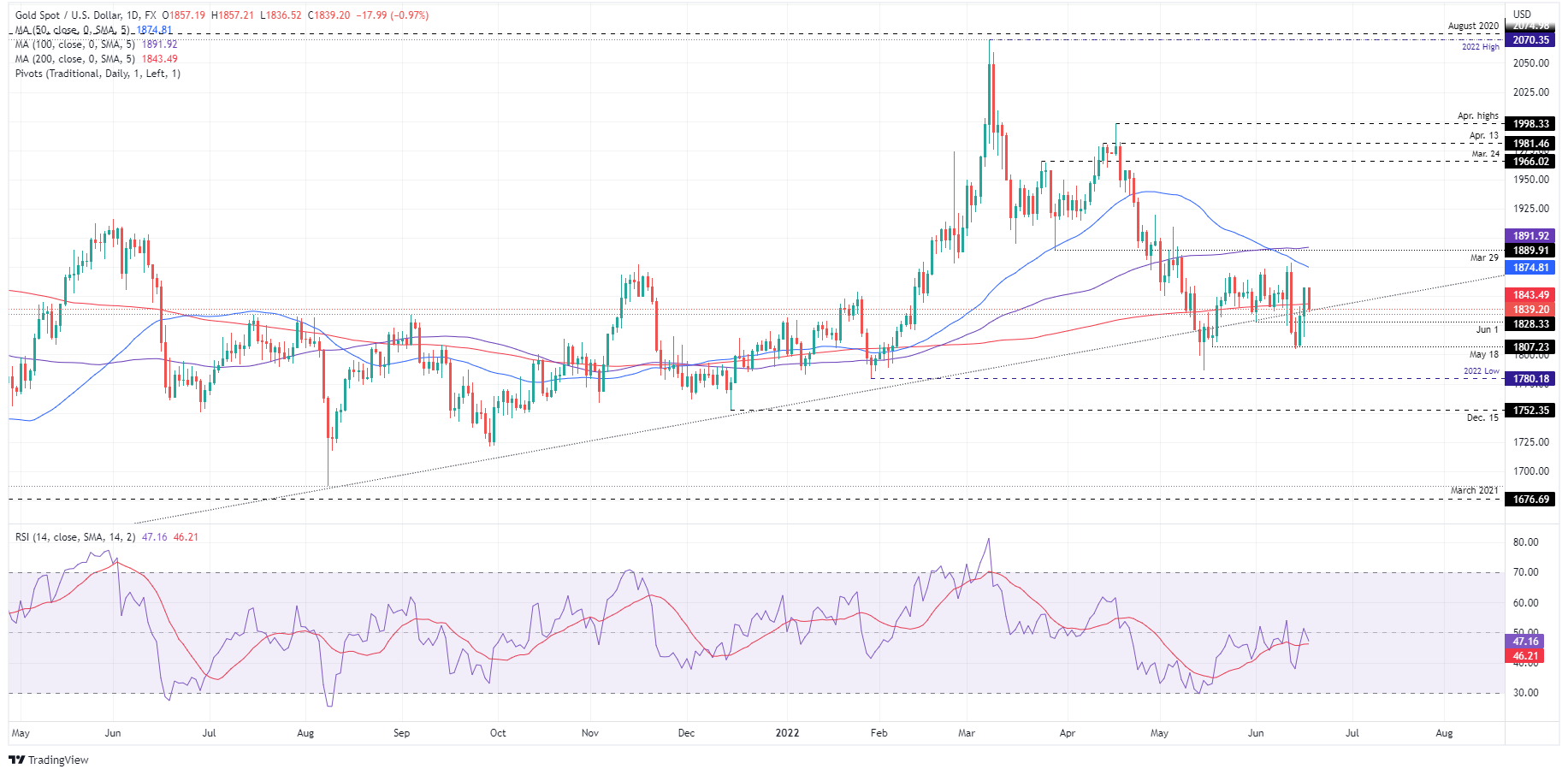
02:22
Gold Price Forecast: $1,857 appears a tough nut to crack for XAUUSD bulls – Confluence Detector
  • Gold Price remains at the mercy of the USD and Treasury yields.
  • Risk sentiment and end of the week flows could also affect XAUUSD.
  • The path of least resistance appears to the upside for the bright metal.

Global central banks showcased their resolve to tackle the inflation monster this week, with the Fed and SNB going in for bigger rate hikes, re-kindling recession fears. Risk-sensitive assets were heavily thrashed while the safe haven also failed to capitalize on the sour market mood, as long-dated US Treasury yields fell sharply. The sell-off in the dollar, helped gold price extend the post-Fed turnaround. The same underlying narrative is likely to remain in play going forward, as the yellow metal’s fate hinges on the dynamics of the dollar, as well as, the yields.

Also read: Is a recession now inevitable?

Gold Price: Key levels to watch

The Technical Confluence Detector shows that Gold Price is testing bids at $1,844, where the SMA10 one-day coincides with the Fibonacci 61.8% one-week.

If that latter caves in, then a dense cluster of healthy support levels is stacked up around $1,842, the confluence of the SMA200 one-day, SMA50 four-hour and Fibonacci 38.2% one-day.

Under that support, the pivot point one-week S1 at $1,839 could be put to test. The additional downside will challenge the bullish commitments at $1,835, the Fibonacci 38.2% one-month.

Alternatively, the Fibonacci 23.6% one-day at $1,848 will be the initial line of defense for gold sellers, above which a fresh advance towards the previous day’s high of $1,858 cannot be ruled out.

Powerful resistance appears at around $1,864, the convergence of the Fibonacci 61.8% one-month and Fibonacci 23.6% one-week. That demand area will be the level to beat for XAU bulls.

Here is how it looks on the tool

 fxsoriginal

About Technical Confluences Detector

The TCD (Technical Confluences Detector) is a tool to locate and point out those price levels where there is a congestion of indicators, moving averages, Fibonacci levels, Pivot Points, etc.  If you are a short-term trader, you will find entry points for counter-trend strategies and hunt a few points at a time. If you are a medium-to-long-term trader, this tool will allow you to know in advance the price levels where a medium-to-long-term trend may stop and rest, where to unwind positions, or where to increase your position size.

02:02
When is the BOJ rate decision and how could it affect USD/JPY?

Early on Friday, around 03:00 AM GMT, the Bank of Japan (BOJ) will announce routine monetary policy meeting decisions taken after a two-day brainstorming. Following the rate decision, BOJ Governor Haruhiko Kuroda will attend the press conference, around 06:00 AM GMT, to convey the logic behind the latest policy moves.

The Japanese central bank is widely expected to keep the short-term interest rate target at -0.1% while directing 10-year Japanese Government Bond (JGB) yields toward zero.

Although the BOJ isn’t expected to offer any change in its monetary policy, the latest hawkish moves of the major central banks and the inflation fears highlight today’s BOJ as the key event for the USD/JPY traders. Also increasing the importance of the BOJ announcements is the recent market intervention by the Japanese central bank.

Ahead of the event, Westpac said,

As global bond yields have surged, the BoJ’s -0.25% to +0.25% yield target range for the 10-year bond has come under heavy pressure, but the bank has defended the 0.25% area and is expected to reaffirm this policy today. Officials continue to insist that the rise in inflation to 2.5%yr in April 2022 from -1%yr in early 2021 is overwhelmingly cost-push and not likely to be sustained. But of course markets will be on edge, especially after the surprise hike in Switzerland.

Additionally, FXStreet’s Dhwani Mehta said,

Unless the increase in the yield target is accompanied by a strong intervention by the government to buy the yen, any adjustment to the yield cap will be self-defeating. It’s also worth noting that managing the exchange rate value is under the purview of Japan’s Ministry of Finance (MOF).

How could it affect the USD/JPY?

USD/JPY takes the bids to refresh intraday high around 133.30, consolidating the first weekly loss in three, amid broad US dollar strength, as well as the pair traders’ anxiety ahead of the BOJ’s announcement.

Japanese policymakers have already turned down the expectations of any major moves from the Bank of Japan (BOJ). However, the latest comments from Japanese Finance Minister Shunichi Suzuki saying, “Government must respect the independence of BOJ,” tease the traders.

Even so, the BOJ’s 0.25% yield cap and the 2.0% inflation target hint at the inaction of the Japanese central bank. It’s worth noting, however, that the efforts to tweak the Yield Curve Control (YCC) policy could offer a knee-jerk strength to the Japanese yen (JPY).

On a broader front, the wide division between the policymakers of the US Federal Reserve (Fed) and the BOJ keeps favoring the carry trade opportunities and hence the USD/JPY is likely to remain firmer until the BOJ takes any drastic measures. In an alternative case, the USD/JPY reaction will depend upon Fed’s bi-annual Monetary Policy Report and Powell’s speech, up for publishing later in the day.

Technically, USD/JPY stretches the bounce off 100-SMA while approaching a one-week-old horizontal resistance area, surrounding 133.50-60. Given the RSI rebound from the oversold territory, coupled with the receding bearish bias of the MACD, the USD/JPY prices are likely to defend the latest recovery. Alternatively, pullback moves may remain elusive until the quote stays beyond the 100-SMA level of 131.40.

Key Notes

USD/JPY Price Analysis: Bulls approach 133.60 hurdle ahead of BOJ

BOJ set to maintain ultra-low rates, sound warning over weak yen

USD/JPY stays defensive above 132.00 on softer yields, BOJ, Fed’s Powell eyed

BOJ Preview: Slim chance for a tweak in YCC policy

About BoJ Rate Decision

BoJ Interest Rate Decision is announced by the Bank of Japan. Generally, if the BoJ is hawkish about the inflationary outlook of the economy and rises the interest rates it is positive, or bullish, for the JPY. Likewise, if the BoJ has a dovish view on the Japanese economy and keeps the ongoing interest rate, or cuts the interest rate it is negative, or bearish.
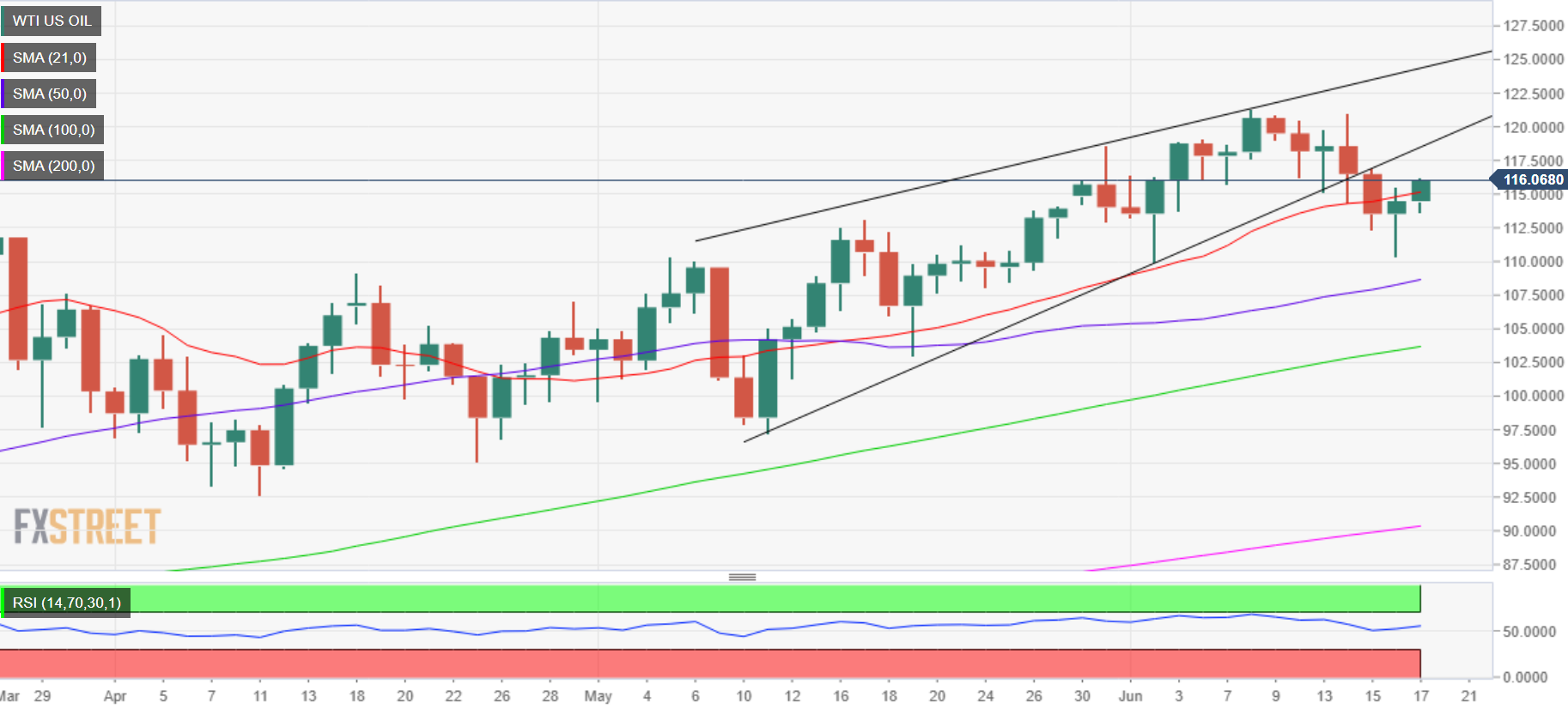
01:41
WTI stays depressed around $114.00 with eyes on Fed’s Powell, oil refiners’ meeting
  • WTI picks up bids to consolidate daily losses, looks set for the consecutive second weekly loss.
  • US dollar rebound, hawkish central banks test oil buyers.
  • US Energy Secretary calls emergency meeting of oil refiners during the next week.
  • Russia hints at further oil supplies while also confirming market’s uncertainty.

WTI crude oil price fades the previous day’s bounce off a two-week low as sellers attack $114.00 during Friday’s Asian session.

The black gold cheered mixed updates on oil markets and a softer US dollar to rebound the previous day. However, chatters surrounding the US Energy Secretary Jennifer Granholm’s meeting with the oil refiners during the next week join the US dollar’s recovery ahead of a speech from the Fed Chairman Jerome Powell to weigh on the quote of late.

That said, Russia’s readiness to increase oil production in July joins the nation’s determination to keep the oil-for-roubles scheme to keep oil buyers hopeful. Though, Russian Deputy Prime Minister Alexander Novak’s comments like, “Oil market is balanced but there are lots of uncertainties,” seem to probe the commodity prices of late.

Elsewhere, US Dollar Index (DXY) takes the bids to refresh its intraday high around 104.00 while posting the first daily gain in three. In doing so, the greenback gauge bounces off the weekly low by paring the biggest daily fall in a month, flashed the previous day.

Downbeat US Treasury yields joined softer US data to weigh on the US dollar prices and helped trigger the WTI’s rebound.

US 10-year Treasury yields dropped during the last two consecutive days, to 3.243% at the latest as the Fed’s 0.75 rate increase couldn’t impress bulls. On the other hand, US Building Permits and Housing Starts eased in May to 1.695M and 1.549M respectively while the Initial Jobless Claims 4-week average inched up to 218.5K versus 215K expected during the period ended on June 10. Further, Philadelphia Fed Manufacturing Survey printed a negative figure of -3.3 for June, the first such contraction since May 2020.

Looking forward, the US Industrial Production for May, expected at 0.4% versus 1.1% prior, will be the first to entertain traders ahead of the Fed’s Monetary Policy Report and Powell’s speech.

It’s worth noting that the oil refiners are likely to discuss capacity and pricing issues with US President Joe Biden during the next week’s meeting, which in turn can help witness volatile energy markets.

Technical analysis

A first daily closing below the 21-DMA in over a month keeps WTI crude oil sellers hopeful until the quote trades successfully beyond the immediate DMA hurdle surrounding $115.00.


01:22
PBOC sets USD/CNY reference rate at 6.6923 on Friday

The People’s Bank of China (PBOC) sets the USD/CNY reference rate at 6.6923 on Friday, compared to the previous close at 6.7034 and Thursday's PBOC fix of 6.7099. It's worth noting that markets expected 6.6933 as a fix for Friday.

PBOC injects 10 billion yuan via 7-day reverse repos at 2.10% versus prior 2.10%, said the statement per Reuters. The update also mentioned that the Chinese central bank makes no fund injection or withdrawal on a net basis for the week via open market operations.

About the fix

China maintains strict control of the yuan’s rate on the mainland.

The onshore yuan (CNY) differs from the offshore one (CNH) in trading restrictions, this last one is not as tightly controlled.

Each morning, the People’s Bank of China (PBOC) sets a so-called daily midpoint fix, based on the yuan’s previous day's closing level and quotations taken from the inter-bank dealer.

01:15
GBP/JPY surpasses 164.00 firmly as odds of a BOJ’s prudent policy advances
  • GBP/JPY has scaled above 164.00 swiftly on BOE-BOJ policy divergence.
  • An unchanged policy stance is expected from the BOJ to keep injecting money into the economy.
  • The BOE raised its interest rates by 25 bps to 1.25%.

The GBP/JPY pair has overstepped its two-day high and has crossed the critical resistance of 164.00 swiftly on advancing odds of an ultra-loose monetary policy by the Bank of Japan (BOJ). A policy divergence between the Bank of England (BOE) and the BOJ has strengthened the pound bulls against the Japanese yen.

The BOE elevated its interest rates by 25 basis points (bps) in its monetary policy meeting on Thursday. Officially, the interest rates have increased to 1.25%. The decision by BOE Governor Andrew Bailey and its co. was in-line with the expectations of the market participants. Considering the price pressures in the UK economy, a rate hike by 50 bps should have been featured but lower growth prospects keep on restricting the BOE to tighten its policy at full capacity.

The UK Consumer Price Index (CPI) has climbed above 9% on an annual basis and higher price pressures are eating the paychecks of the households vigorously. Therefore, the BOE is badly needed to restore lower inflation levels sooner rather than later.

Coming back to the Tokyo front, the BOJ will continue to release helicopter money into the economy as their 2.5% annual inflation rate is majorly contaminated by costly oil prices. The saga of advancing price pressures will continue for the BOJ and an unchanged policy is expected.


01:09
USD/JPY Price Analysis: Bulls approach 133.60 hurdle ahead of BOJ USDJPY
  • USD/JPY takes the bids to refresh daily top, snaps a two-day downtrend.
  • Weekly horizontal resistance, descending trend line from Tuesday test buyers.
  • MACD, RSI hints at further recovery moves until the quote stays beyond 100-SMA.
  • BOJ is widely anticipated to keep the monetary policy intact.

USD/JPY extends the bounce off weekly low while refreshing intraday high around 133.30 during Friday’s Asian session.

In doing so, the yen pair stretches the bounce off 100-SMA while approaching a one-week-old horizontal resistance area, surrounding 133.50-60.

Given the RSI rebound from the oversold territory, coupled with the receding bearish bias of the MACD, the USD/JPY prices are likely to defend the latest recovery.

However, a downward sloping resistance line from Tuesday, around 133.95, as well as the 134.00 threshold, will act as additional upside filters, other than the immediate 133.50-60 zone, to challenge the pair buyers.

Also, the Bank of Japan (BOJ) is likely to keep its easy-money policy untouched and may add strength to the USD/JPY upside.

Read: BOJ set to maintain ultra-low rates, sound warning over weak yen

Alternatively, pullback moves may remain elusive until the quote stays beyond the 100-SMA level of 131.40.

Following that, the 200-SMA and the early June swing high, around 130.25-20, could challenge the USD/JPY bears.

USD/JPY: Four-hour chart

Trend: Further upside expected


00:54
US Dollar Index rebounds from weekly low to pierce 104.00, Fed Chair Powell eyed
  • US Dollar Index pares weekly losses, snaps two-day downtrend amid sluggish session.
  • Yields remain pressured but fears of hawkish central banks calling recession seem to renew US dollar demand.
  • US Industrial Production for May, Fed’s bi-annual Monetary Policy Report and Powell’s speech could provide fresh impetus.

US Dollar Index (DXY) takes the bids to refresh its intraday high around 104.00 while posting the first daily gain in three during Friday’s Asian session. The greenback’s latest run-up could be linked to the market’s indecision amid a light calendar, as well as the cautious mood ahead of Fed’s bi-annual Monetary Policy Report and Fed Chairman Jerome Powell’s speech.

The greenback gauge posted the biggest daily loss in a month the previous day as downbeat US Treasury yields joined softer US data. US 10-year Treasury yields dropped during the last two consecutive days, to 3.243% at the latest as the Fed’s 0.75 rate increase couldn’t impress bulls.

On the other hand, US Building Permits and Housing Starts eased in May to 1.695M and 1.549M respectively while the Initial Jobless Claims 4-week average inched up to 218.5K versus 215K expected during the period ended on June 10. Further, Philadelphia Fed Manufacturing Survey printed a negative figure of -3.3 for June, the first such contraction since May 2020.

It’s worth noting, however, that aggressive momentary policy actions from the US Federal Reserve (Fed), Swiss National Bank (SNB) and Bank of England (BOE) seem to renew fears surrounding the global recession. The same should have weighed on the riskier assets and underpinned the US dollar but could not.

While portraying the mood, the S&P 500 Futures print 0.30% intraday gains after losing around 3.25% on Wall Street.

Looking forward, traders appear to be in a dilemma over the US dollar’s latest moves amid a quiet session. As a result, the upcoming catalysts should gain major attention for near-term trade directions. Among them, the US Industrial Production for May, expected at 0.4% versus 1.1% prior, will be the first to entertain traders ahead of the Fed’s Monetary Policy Report and Powell’s speech.

Technical analysis

The 10-DMA restricts the immediate downside of the US Dollar Index to around 103.80 but recovery moves need validation from May’s top of 105.00 to convince buyers.


00:37
AUD/USD pulls back from weekly top towards 0.7000 with eyes on Fed’s Powell AUDUSD
  • AUD/USD takes offers from weekly high to pare recent gains after two-day uptrend.
  • US Dollar Index consolidates weekly losses amid market’s indecision.
  • WTO’s push for 'unprecedented package' of trade agreements joins softer yields to test intraday bears.
  • Fed’s Powell needs to defend 75 bp rate hike to recall US dollar bulls.

AUD/USD takes offers to renew intraday low around 0.7030, snapping a two-day uptrend while stepping back from the weekly top. In doing so, the risk-barometer pair portrays the market’s lack of clarity, as well as the US dollar’s rebound, amid a quiet Asian session on Friday.

That said, the US Dollar Index (DXY) recovers from the weekly near 103.40 to 104.00 at the latest. In doing so, the greenback gauge ignores downbeat Treasury yields. The reason could be linked to the market’s fears that central bank aggression could trigger the global recession, as well as the cautious mood ahead of the Fed’s bi-annual Monetary Policy Report and Fed Chairman Jerome Powell’s speech.

US 10-year Treasury yields dropped during the last two consecutive days, to 3.243% at the latest as the Fed’s 0.75 rate increase couldn’t impress bulls. Additionally, Aggressive momentary policy actions from the Swiss National Bank (SNB) and Bank of England (BOE) seem to join the downbeat US data to weigh on the US bond coupons.

US Building Permits and Housing Starts eased in May to 1.695M and 1.549M respectively while the Initial Jobless Claims 4-week average inched up to 218.5K versus 215K expected during the period ended on June 10. Further, Philadelphia Fed Manufacturing Survey printed a negative figure of -3.3 for June, the first such contraction since May 2020.

On the contrary, the latest comments from the World Trade Organization (WTO) Chief Ngozi Okonjo-Iweala also seem to underpin the market’s optimism about overcoming the latest supply crunch problems and should have favored the AUD/USD buyers but could not. “The World Trade Organization (WTO) Chief presented countries with a series of draft trade agreements early on Friday that included pledges on health, food security and urged that they be accepted as a major meeting stretched into its second day of overtime,” said Reuters during early Friday’s Asian session.

While portraying the mood, the S&P 500 Futures print 0.30% intraday gains after losing around 3.25% on Wall Street.

Given the lack of major data at home, AUD/USD traders will pay attention to the risk catalysts and the US Industrial Production for May, expected at 0.4% versus 1.1% prior, for intermediate directions ahead of a speech from Fed’s Powell.

Technical analysis

AUD/USD retreats from the 10-day EMA, around 0.7050 by the press time, which in turn joins bearish MACD signals and steady RSI (14) to keep sellers hopeful of retesting the monthly low surrounding 0.6850. 


00:37
AUD/JPY rebounds firmly from 93.00 on expectations of ultra-loose BOJ policy
  • AUD/JPY has recovered its intraday losses and is advancing to recapture the day’s high at 93.54.
  • The BOJ is expected to keep flushing liquidity into its economy.
  • Higher price pressures in Japan are majorly contributed by costly fossil fuels.

The AUD/JPY pair has rebounded strongly after plunging to near 93.00 in the early Tokyo session. The risk barometer has been in the grip of bulls, which can be confirmed with a firmer rally from 91.97 recorded on Thursday. Giant wild moves are expected from the risk barometer in today’s session as investors are awaiting the announcement of the interest rate decision by the Bank of Japan.

Maintenance of an ultra-loose monetary policy is expected from the BOJ amid lower demand in the economy. The BOJ is keep flushing liquidity into the economy to spurt the aggregate demand. Also, the BOJ remained worried about lower price pressures.

It is worth noting that the Japanese economy has accomplished its tricky task of elevating the inflation rate above 2%. The annual inflation rate has crossed 2% in the Japanese economy backed by advancing oil prices. Costly fossil fuels have worsened the situation for the BOJ. On one side, the unavailability of all-around improvement in aggregate demand is making the job more difficult for the BOJ while on the other side, higher oil prices are eating the paychecks of the household.

Meanwhile, Japan's Finance Minister has reappointed Japan's Vice Finance Minister Masato Kanda for international affairs as a top currency diplomat in the mid-year personnel reshuffle.

On the aussie front, higher employment generation by the Australian economy has supported the antipodean. The Australian economy has added 60.6k jobs in May, much higher than the expectations of 25k and the prior print of 4k. However, the Unemployment Rate remained unchanged at 3.9% but higher than the consensus of 3.8%.


00:23
WTO chief urges countries to accept 'unprecedented package' of trade agreements

“The World Trade Organization (WTO) Chief presented countries with a series of draft trade agreements early on Friday that included pledges on health, food security and urged that they be accepted as a major meeting stretched into its second day of overtime,” said Reuters during early Friday’s Asian session.

The news also adds that the package, which WTO Chief Ngozi Okonjo-Iweala described as "unprecedented", did not currently include two of the most important deals under consideration: fisheries and a partial waiver for intellectual property rights for COVID-19 vaccines.

“However, delegates said they may be added later ahead of a final meeting scheduled for 0100 GMT on Friday,” mentioned Reuters.

Market implications

Following the news, AUD/USD bounced off intraday low to 0.7035 but stayed pressured while the S&P 500 Futures print mild gains around 3,685 at the latest.

00:15
Currencies. Daily history for Thursday, June 16, 2022
Pare Closed Change, %
AUDUSD 0.70471 0.59
EURJPY 139.552 -0.27
EURUSD 1.05519 0.99
GBPJPY 163.362 0.2
GBPUSD 1.23517 1.46
NZDUSD 0.63618 1.23
USDCAD 1.29493 0.48
USDCHF 0.96573 -2.89
USDJPY 132.255 -1.25
00:10
Japan’s Finance Minister Suzuki: Carefully watching impact of changes in US monetary policy

“Carefully watching impact of changes in US monetary policy on Japan's economy,” Japanese Finance Minister Shunichi Suzuki said on Friday.

Additional comments

Watching fx market moves with even more sense of urgency while working with BOJ.

Expects BOJ to continue efforts to achieve price target sustainably, stably.

Rapid yen weakening seen in fx market recently.

Monetary policy up to BOJ to decide.

Government must respect independence of BOJ.

Expects BOJ to strive to achieve price target based on economy, prices and bond market.

BOJ Governor Kuroda has stated that he will maintain policy persistently.

USD/JPY bounces off intraday low

Following the news, USD/JPY snaps a two-day downtrend while bouncing off the intraday low to 132.60 by the press time.

It’s worth noting that the news of Japan’s top currency diplomat Masato Kanda’s reappointment during the mid-year personnel reshuffle also seem to favor the USD/JPY pair’s latest rebound.

Read: USD/JPY stays defensive above 132.00 on softer yields, BOJ, Fed’s Powell eyed

00:03
EUR/USD retreats towards 1.0500 amid quiet markets, EU inflation, Fed’s Powell in focus EURUSD
  • EUR/USD snaps two-day uptrend while stepping back from a weekly top.
  • Mixed sentiment, quiet markets allow traders to consolidate recent moves.
  • Recession fears, ECB’s lack of aggression exert additional downside pressure.
  • Final readings of Eurozone inflation, Fed’s bi-annual Monetary Policy Report and a speech from Powell will be the key catalysts.

EUR/USD bulls take a breather around 1.0545, after a two-day uptrend to refresh the weekly top, amid calmer markets during Friday’s Asian session. In doing so, the major currency pair eases from the weekly top surrounding 1.0600 despite portraying inaction of late.

The quote’s latest retreat could be linked to the mixed concerns in the market, despite downbeat Treasury yields and mildly bid stock future. Also challenging the pair buyers could be the European Central Bank’s (ECB) failure to keep up with the major central banks, as far as the recent hawkish trajectory is concerned.

It should be noted that downbeat US Treasury yields and softer US data joined hawkish comments from the ECB policymakers to propel the EUR/USD prices on Thursday.

The US benchmark 10-year Treasury yields dropped during the last two consecutive days to 3.195% at the latest. S&P 500 Futures, on the other hand, print 0.25% intraday gains after losing around 3.25% on Wall Street.

On the other hand, the US Building Permits and Housing Starts eased in May to 1.695M and 1.549M respectively while the Initial Jobless Claims 4-week average inched up to 218.5K versus 215K expected during the period ended on June 10. Further, Philadelphia Fed Manufacturing Survey printed a negative figure of -3.3 for June, the first such contraction since May 2020.

Furthermore, ECB Governing Council member Ignazio Visco and policymaker Francois Villeroy de Galhau preceded President Christine Lagarde while trying to impress bulls on Thursday. ECB’s Visco said that he expects the ECB to continue to hike the policy rate in a gradual and sustained way after September, as reported by Reuters. On the same line, ECB’s Villeroy de Galhau highlighted inflation fears and indirectly signaled the need for higher rates as he said, "We're seeing inflation in Europe which is not only higher, which is also broader," Villeroy said. "If it was only about energy prices, some economists would say you can look through, as they say, you can wait until these supply shocks stop."

Following that, ECB’s Lagarde mentioned, "Doubting our commitment would be a serious mistake," Lagarde reportedly added. "The goal of anti-fragmentation tool is not to close spreads, but to normalize spreads." Her comments also hint at the ECB’s readiness to act.

Moving on, EU Norm Inflation for May and the final readings of Eurozone HICP for the stated month could entertain EUR/USD traders ahead of the US Industrial Production for May, expected at 0.4% versus 1.1% prior. However major attention will be given to Fed’s bi-annual Monetary Policy Report and Fed Chairman Jerome Powell’s speech.

Technical analysis

A failure to provide daily closing beyond the 10-DMA, around 1.0565 by the press time, teases EUR/USD pullback. Also acting as an upside filter is the horizontal area comprising multiple levels marked since early May, near 1.0640.


© 2000-2025. All rights reserved.

This site is managed by Teletrade D.J. LLC 2351 LLC 2022 (Euro House, Richmond Hill Road, Kingstown, VC0100, St. Vincent and the Grenadines).

The information on this website is for informational purposes only and does not constitute any investment advice.

The company does not serve or provide services to customers who are residents of the US, Canada, Iran, The Democratic People's Republic of Korea, Yemen and FATF blacklisted countries.

AML Website Summary

Risk Disclosure

Making transactions on financial markets with marginal financial instruments opens up wide possibilities and allows investors who are willing to take risks to earn high profits, carrying a potentially high risk of losses at the same time. Therefore you should responsibly approach the issue of choosing the appropriate investment strategy, taking the available resources into account, before starting trading.

Privacy Policy

Use of the information: full or partial use of materials from this website must always be referenced to TeleTrade as the source of information. Use of the materials on the Internet must be accompanied by a hyperlink to teletrade.org. Automatic import of materials and information from this website is prohibited.

Please contact our PR department if you have any questions or need assistance at pr@teletrade.global.

Bank
transfers
Feedback
Live Chat E-mail
Up
Choose your language / location