- Analytics
- News and Tools
- Market News
Analytics, News, and Forecasts for CFD Markets: currency news — 16-06-2022.
- Gold price is holding itself above the critical support of $1,850.00 amid weaker yields.
- The 10-year US Treasury yields have slipped below 3.20% on the bumper rate hike announcement by the Fed.
- Investors await Fed chair Jerome Powell’s speech in today’s session.
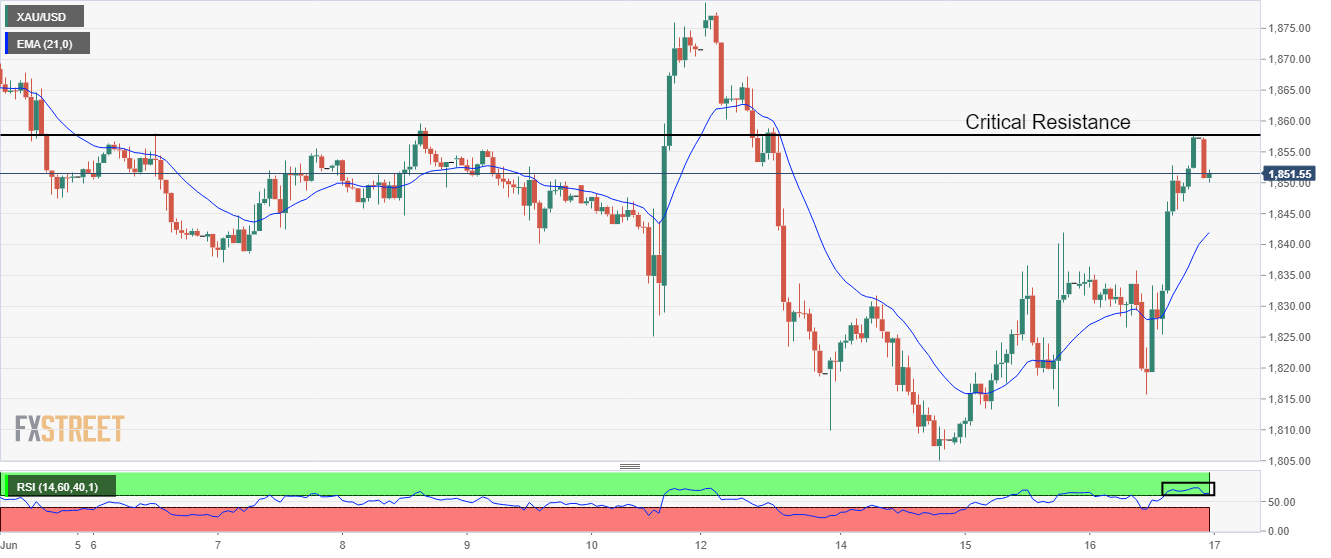
Gold price (XAU/USD) is going through a corrective move after a juggernaut rally to a high of $1,857.64, recorded in the early Asian session. The precious metal displayed a perpendicular upside move on Thursday after hitting a low of $1,815.66 as yields plunged. It s worth noting that this time the risk-aversion theme has underpinned the gold prices and other currencies, however, the US dollar index (DXY) and global equities are facing turmoil.
Investors doubt that the Federal Reserve (Fed) will stop the recession arrival, which has trimmed the DXY’s appeal and expectations of lower profits due to recession fears have brought an extreme sell-off in the global equities.
The 10-year US Treasury yields have plunged by 3.32% to near 3.19% and the ongoing price action is warranting more downside. Vulnerable yields will weaken the DXY further. The DXY is already balancing below 104.00 and is expected to continue its two-day losing streak after slipping below Thursday’s low at 103.42.
In today’s session, the speech from Fed chair Jerome Powell will remain the major event. Investors will get the ideology of the Fed behind a 75 basis point (bps) rate hike announcement. Along with this, guidance for July monetary policy will be of significant importance.
Gold technical analysis
On an hourly scale, gold prices are facing a hurdle around the critical resistance at $1,857.73. A sheer upside move is generally followed by a minor pullback. The precious metal is expected to witness a minor correction towards the 21-period Exponential Moving Average (EMA), which is placed at $1,842.35. Meanwhile, the Relative Strength Index (RSI) (14) has shifted into a bullish range of 60.00-80.00, which underpins a bullish momentum. A minor correction could drag the RSI (14) below 60.00, however, a bullish momentum will remain intact.
Gold hourly chart
- GBP/USD bulls take a breather after two-day uptrend, pokes eight-day-old descending trend line.
- Clear break of 50-SMA joins bullish MACD signals, firmer RSI to keep buyers hopeful.
- 100-SMA, monthly resistance line lures bulls, sellers need validation from weekly support for fresh entry.
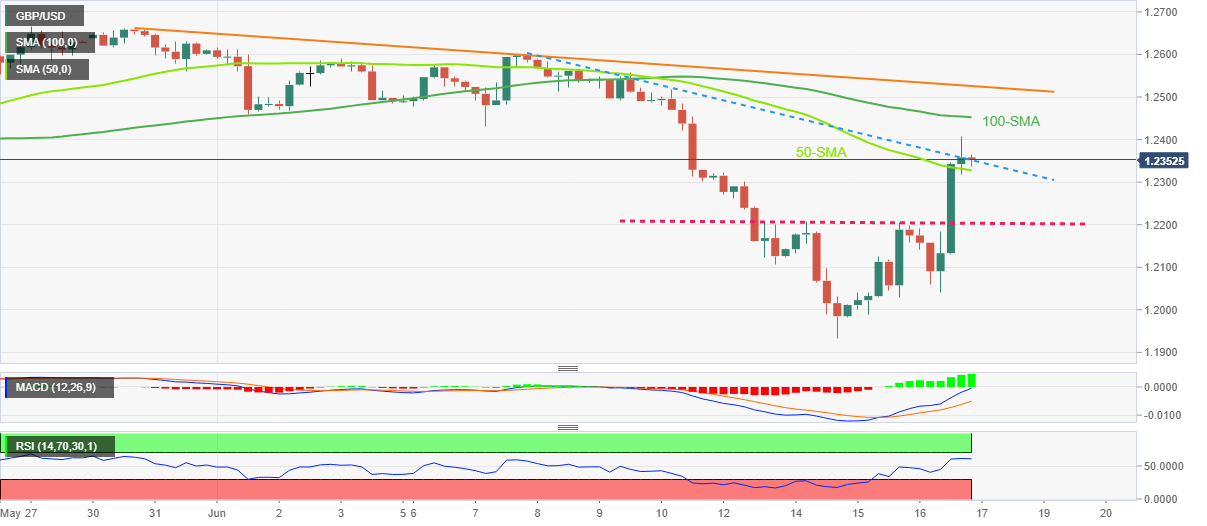
GBP/USD dribbles around 1.2350 amid Friday’s Asian session, after refreshing the weekly top during a two-day uptrend the previous day.
In doing so, the Cable pair jostles with an eight-day-old descending trend line resistance while keeping the latest upside break of the 50-SMA and the weekly horizontal resistance area, now support.
Other than the latest breakouts, the firmer RSI (14) conditions, not oversold, join the bullish MACD signals to keep GBP/USD buyers hopeful.
However, a clear upside break of the 1.2350 becomes necessary for the cable pair to aim for the immediate hurdles, namely the 100-SMA and a descending trend line from May 30, respectively around 1.2450 and 1.2530.
It’s worth noting that the clear upside break of 1.2530 won’t hesitate to propel the GBP/USD prices beyond the monthly high around 1.2600.
Alternatively, pullback moves remain elusive until the quote drops back below the 50-SMA level near 1.2325.
Also acting as short-term key support is the previous horizontal resistance area comprising multiple tops marked since Monday, near 1.2210-2200.
GBP/USD: Four-hour chart
Trend: Further upside expected
- USD/CHF consolidates the biggest daily fall in seven years within a tight range.
- Market sentiment dwindles amid a quiet Asian session.
- SNB’s surprise 0.50% rate hike propelled CHF, broad US dollar weakness strengthened bearish bias.
- Fed Monetary Policy report, Chairman Powell’s speech will be crucial for short-term directions, yields are important too.
USD/CHF traders lick their wounds around 0.9670 after posting the biggest daily slump since 2015, led by the SNB’s surprise rate hike. The Swiss currency (CHF) pair’s latest inaction could be linked to the traders’ wait for more clues during early Friday’s quiet Asian session.
It’s worth noting that a pause in the US Treasury yields’ weakness and mildly bid US stock futures seem to have favored the quote’s latest corrective pullback from a two-week low.
That said, the US benchmark 10-year Treasury yields dropped during the last two consecutive days to 3.195% at the latest. S&P 500 Futures, on the other hand, print 0.25% intraday gains after losing around 3.25% on Wall Street.
Aggressive momentary policy actions from the Swiss National Bank (SNB) and the downbeat US data weighed on the US bond coupons, as well as the USD/CHF prices the previous day. In doing so, the Treasury yields fail to pay respect to the US Federal Reserve’s (Fed) 0.75% rate hike, the biggest move since 1994.
It’s worth noting that the SNB surprised global markets with a 0.50% rate hike on Thursday. “It cannot be ruled out that further increases in the SNB policy rate will be necessary in the foreseeable future to stabilize inflation in the range consistent with price stability over the medium term,” mentioned the SNB Statement after the rate announcement. Additionally, SNB Chairman Thomas Jordan also said that the Swiss franc was no longer highly valued because of the recent depreciation, per Reuters. "Central bank is ready to intervene in markets to check excessive appreciation or weakening of the Swiss franc," added SNB’s Jordan.
On the other hand, the US Building Permits and Housing Starts eased in May to 1.695M and 1.549M respectively while the Initial Jobless Claims 4-week average inched up to 218.5K versus 215K expected during the period ended on June 10. Further, Philadelphia Fed Manufacturing Survey printed a negative figure of -3.3 for June, the first such contraction since May 2020.
Moving on, the US Industrial Production for May, expected at 0.4% versus 1.1% prior, will join the Fed’s bi-annual Monetary Policy Report and Powell’s speech to entertain USD/CHF traders. Should Fed’s Powell defend the latest moves, the USD bulls may return to the table.
Technical analysis
Despite the latest plunge, USD/CHF remains supported by an upward sloping trend line from late March, near 0.9635 by the press time, which in turn suggests a corrective pullback towards the 50-DMA level surrounding 0.9705.
- USD/CAD is sensing offers around 1.2950 as investors await a speech from Fed chair Jerome Powell.
- Oil prices are mildly offered after hitting a high of $118.00, an upside bias is still intact.
- The odds of a higher Canada CPI will restrict the loonie bulls.
The USD/CAD pair has witnessed a minor selling pressure around 1.2950 and has slipped a little lower for now. On a broader note, the greenback bulls are facing barricades in a range of 1.2974-1.2995 from the last three trading sessions.
Despite a broad-based weak performance by the greenback bulls in the last two trading sessions after the Federal Reserve (Fed) announced a rate hike by 75 basis points (bps), the asset has failed to display any meaningful downside move like the other risk-sensitive assets. One could state that the loonie bulls are also weak and have remained vulnerable. A vulnerable performance by the loonie bulls could bank upon higher expectations for Canada Consumer Price Index (CPI), which is due next week.
On an annual basis, Canada's inflation is seen at 7.5%, and a significant jump is expected against the prior print of 6.8%. While the core CPI that excludes oil and food prices is expected to land at 5.9% vs. 5.7% recorded earlier.
The oil prices are mildly offered after hitting a critical hurdle of $118.00. A bumper rate hike announcement by the Federal Reserve (Fed) has triggered recession fears which kept the oil prices on the tenterhooks.
Meanwhile, the US dollar index (DXY) is expected to remain on the sidelines as investors are awaiting the speech from Fed chair Jerome Powell. The speech may guide investors above the likely monetary policy action going further along with the rationale behind announcing the 75 bps rate hike.
“The Bank of Japan (BOJ) is likely to maintain ultra-low interest rates on Friday and stress its resolve to support a fragile economy with massive stimulus, a move that may further weaken the yen by highlighting a policy divergence with the rest of the world,” said Reuters ahead of Friday’s BOJ monetary policy announcement.
Key quotes
While a modest, technical tweak to its yield cap or guidance on the future policy path cannot be ruled out, the BOJ is seen sustaining its massive monetary support for now to ensure the economy is fully out of the doldrums.
At the two-day policy meeting ending on Friday, the BOJ is widely expected to maintain its -0.1% target for short-term rates and its pledge to guide the 10-year yield around 0%.
The central bank may also deepen its resolve to defend the 0.25% upper limit by targetting a wider range of debt maturities for its unlimited fixed-rate bond-buying operation, which currently covers only 10-year bonds, some analysts said.
The BOJ is caught in a dilemma. With Japan’s inflation well below that of Western economies, its focus is to support the stil-weak economy with low rates. But the dovish policy has triggered sharp yen falls, hurting an economy heavily reliant on fuel and raw material imports.
BOJ Governor Haruhiko Kuroda has repeatedly stressed the need to keep interest rates ultra-loose, and that the central bank won’t target exchange-rates in guiding policy.
Prime Minister Fumio Kishida appeared to defend Kuroda’s stance. In a news conference on Wednesday, Kishida said the BOJ will likely take into account various factors besides yen moves, such as the impact on small firms’ borrowing costs, in setting policy.
Kuroda is likely to warn against a weak yen at his post-meeting briefing, such as by highlighting the damage the currency’s sharp falls could inflict on the economy, analysts said.
USD/JPY pares recent losses
USD/JPY picks up bids to refresh intraday high around 132.70 by the press time. The yen pair’s latest gains could also be linked to the market’s consolidation amid a quiet Asian session on Friday.
Also read: USD/JPY stays defensive above 132.00 on softer yields, BOJ, Fed’s Powell eyed
- NZD/USD has remained flat despite a higher release of the NZ PMI at 52.9.
- The DXY is performing vulnerable after a 75 bps rate hike announcement by the Fed.
- Next week, the kiwi bulls will react to the interest rate decision by the PBOC.
The NZD/USD pair has not displayed any wild or one-sided moves after the release of the Business NZ PMI. Business NZ has reported the PMI at 52.9, higher than the expectations and the prior print of 52.7 and 51.2 respectively.
The kiwi bulls are performing strongly from the last two trading sessions despite the downbeat Gross Domestic Product (GDP) numbers. A country’s GDP data states its overall economic growth and possess significant importance. The GDP has tumbled to 1.2%, significantly lower than the estimates of 3.3% and the prior print of 3.1%on an annual basis. More adverse, the quarterly figures have shifted to negative territory. The quarterly GDP has landed at -0.2%, much lower than the consensus and the former figure of 0.6% and 3% respectively.
Next week, the kiwi dollar will be guided by the interest rate decision from the People Bank of China (PBOC). Officially, the one-year loan prime rate of the PBOC stands at 3.7% while the five-year rate is at 4.6%.
Meanwhile, the US dollar index (DXY) has recorded a two-day losing streak after the Federal Reserve (Fed) announced a rate hike by 75 basis points (bps). A 75 bps rate hike option gained popularity on the release of the four-decade-high US Consumer Price Index (CPI) at 8.6%. A tight labor market and firm growth prospects have supported the Federal Reserve (Fed) to announce an extremely tight policy. In today’s session, investors will keep an eye on the speech from Fed chair Jerome Powell, which will provide more insights of the monetary policy dictated on Wednesday.
- AUD/NZD struggles to extend the previous day’s bounce off short-term key support.
- Business NZ PMI rose to 52.9 in May versus 52.7 expected.
- Sluggish oscillators, upbeat NZ data favor sellers but 50-DMA adds to the downside filters.
- Bulls need to cross descending resistance line from early May for conviction.
AUD/NZD steadies around 1.1080, pausing the recovery from a three-month-old support line, after New Zealand (NZ) data came in firmer during early Friday.
That said, the Business NZ PMI rose past 52.7 forecasts and 51.2 prior, to 52.7 during May.
The firmer NZ data joins sluggish MACD and steady RSI to weigh on the AUD/NZD prices.
However, the 50-DMA level of 1.1005 acts as an extra challenge for the pair bears, in addition to the immediate support line near 1.1020.
Should the quote drops below 1.1005, the 1.1000 psychological magnet may act as an extra filter to the south before directing the quote towards late May’s swing low around 1.0920.
Alternatively, recovery moves could aim for 1.1125-30 ahead of challenging a downward sloping resistance line from May 04, close to 1.1175 by the press time.
In a case where the AUD/NZD prices rally beyond 1.1175, bulls can aim for 2017 peak surrounding 1.1290.
AUD/NZD: Daily chart

Trend: Further weakness expected
- The euro recovered some ground vs. the Japanese yen amidst the scenario of Japanese authorities intervening in the FX markets.
- EUR/JPY Price Analysis: The bounce at weekly lows might open the door for a re-test of 142.00.
The EUR/JPY is paring some of Thursday’s losses as the Asian session begins and is posting decent gains of 0.22%. At the time of writing, the EUR/JPY is trading at 139.62.
The market mood remains negative. On Wednesday afternoon, the US Federal Reserve hiked rates by 0.75%, opening the door for further hikes. Also, the Bank of England (BoE) and the Swiss National Bank (SNB) followed suit, hiking 0.25% and 0.50%, respectively. That, alongside dismal US housing data, reignited recession fears on the traders’ minds.
Reflecting the abovementioned were US equities tumbling between 3 and 5 percent. Asian futures are trading in the red, meaning bourses get ready for a lower open.
EUR/JPY Price Analysis: Technical outlook
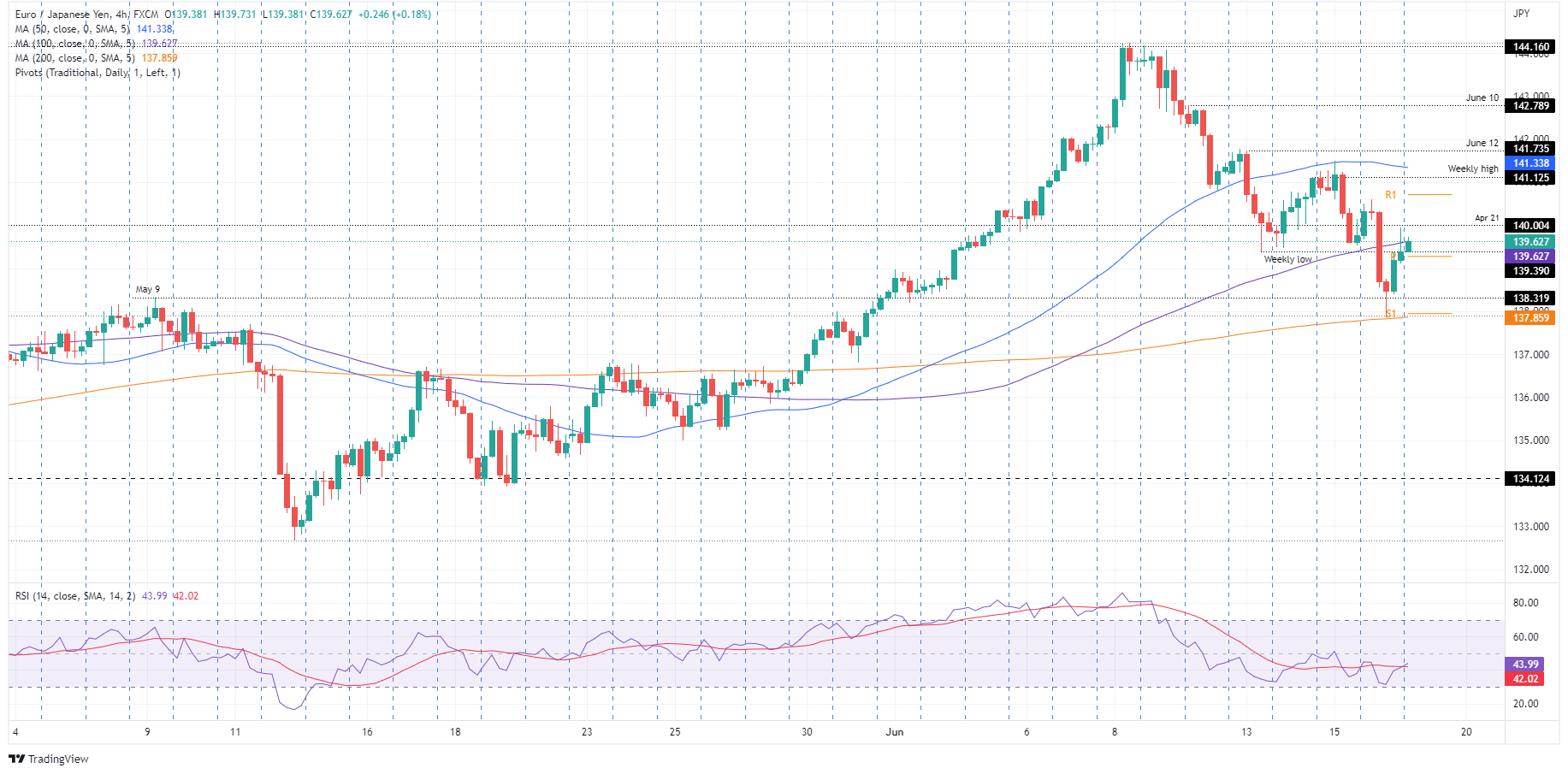
The EUR/JPY daily chart illustrates the pair as upward biased. Even though Thursday’s price action recorded a fresh weekly low at around 137.84, the pair bounced off weekly lows and settled around the 139.40-60 area.
The EUR/JPY’s 4-hour chart illustrates that the pair broke below the bullish flag and aimed lower towards 137.84 weekly lows, at around the 200-4H simple moving average (SMA). Nevertheless, the EUR/JPY surged towards the 100-4H SMA at around 139.62, a difficult dynamic resistance level, on its way towards a re-test of June 12 highs at around 141.73.
Hence, the EUR/JPY is upward biased. That said, the EUR/JPY’s first resistance would be June 16 high at 139.95. Break above would expose the R1 daily pivot at 140.74. Once cleared, the EUR/JPY’s next resistance would be 50-4H SMA at 141.33, followed by the aforementioned June 12 high.
Key Technical Levels
President Joe Biden said a recession is "not inevitable" and he is confident the United States can overcome inflation, the Associated Press (AP) reported on Thursday, per Reuters.
US President Biden gave two main statements during the AP interview while saying, “First of all, it’s not inevitable,” Biden adds, “Secondly, we’re in a stronger position than any nation in the world to overcome this inflation.”
Market reaction
EUR/USD extends the latest pullback from the weekly high, after a three-day uptrend, towards 1.0540 following the news. However, the softer yields and downbeat US dollar probed the pair sellers by the press time.
Also read: EUR/USD Forecast: Potential gains limited by fear
- USD/JPY picks up bids to pare two-day losses ahead of the key events.
- Yields dropped amid mixed sentiment, softer data, US dollar failed to cheer risk-aversion.
- Central banks’ aggression contrast downbeat US data to challenge traders.
- BOJ is widely expected to keep monetary policy unchanged, Powell should defend the latest action to restrict volatile moves.
USD/JPY pares recent losses around a fortnight low, snapping a two-day downtrend, as yen buyers take a pause ahead of the Bank of Japan’s (BOJ) monetary policy report on early Friday morning in Asia. Also challenging the pair’s pullback moves could be the market’s cautious mood ahead of a speech from Fed Chairman Jerome Powell. That said, the major currency pair bounces off a fortnight low to refresh an intraday high around 132.40 by the press time.
While portraying the pre-event anxiety, the USD/JPY pair ignores downbeat Treasury yields that drowned the quote during the last two days.
The US benchmark 10-year Treasury yields dropped during the last two consecutive days to 3.195% at the latest. Aggressive momentary policy actions from the Swiss National Bank (SNB) and Bank of England (BOE) seem to join the downbeat US data to weigh on the US bond coupons. In doing so, the Treasury yields fail to pay respect to the US Federal Reserve’s (Fed) 0.75% rate hike, the biggest move since 1994.
That said, the US Building Permits and Housing Starts eased in May to 1.695M and 1.549M respectively while the Initial Jobless Claims 4-week average inched up to 218.5K versus 215K expected during the period ended on June 10. Further, Philadelphia Fed Manufacturing Survey printed a negative figure of -3.3 for June, the first such contraction since May 2020.
It’s worth noting that the downbeat US data and yields weighed on the US Dollar Index (DXY) as it refreshed its weekly low with 103.41 before closing Thursday’s trading session around 103.83 during the second negative daily performance.
However, the Wall Street benchmarks failed to cheer the downbeat US dollar, neither they could benefit from the softer yields as fears of faster monetary policy tightening weigh on investor sentiment, which in turn allowed USD/JPY to remain depressed.
Looking forward, USD/JPY traders will pay attention to the BOJ monetary policy meeting even as the Japanese policymakers have clearly shown their intent to keep the easy money flowing until witnessing the 2.0% inflation on a successive basis. The reason making today’s BOJ interesting are the surprises from the Fed and the SNB, as well as the yen’s heavy weakness.
Also read: BOJ Preview: Slim chance for a tweak in YCC policy
Other than the BOJ, the US Industrial Production for May, expected at 0.4% versus 1.1% prior, will join the Fed’s bi-annual Monetary Policy Report and Powell’s speech to offer a busy end to the crucial week. Fed’s Powell need to defend the latest moves to recall the USD bulls.
Technical analysis
A sustained downside break of a fortnight-old ascending trend line directs USD/JPY towards the tops marked during late April and early May, surrounding 131.25-35. Alternatively, multiple supports around 133.50 guards immediate upside.
- AUD/USD is balancing above 0.7040 as DXY has turned bearish ahead of Fed Powell’s speech.
- The aussie bulls have ignored the subdued aussie jobless rate.
- Higher aussie Employment Change will provide more room for the RBA to stretch interest rates.
The AUD/USD pair has displayed a mild correction after hitting a fresh weekly high of 0.7070 in the late New York session. The aussie dollar is advancing gradually this week after sensing a responsive buying action near 0.6850 on Wednesday. The antipodean has ignored the mixed employment data and has got strengthened against the greenback.
The Australian Bureau of Statistics reported the Unemployment Rate at 3.9%, unchanged from the prior print but came higher than the expectation of 3.8%. However, the economy has managed to generate significant job opportunities in May. The Employment Change has landed at 60.6k, extremely higher than the expectations of 25k and the prior print of 4k.
An unchanged Unemployment Rate and higher job additions in the labor market will support the Reserve Bank of Australia (RBA) to tighten policy without any hesitation. A tight labor market delights the central bank in policy tightening measures as it feels the least slowdown worries. The RBA would be able to consider rate hike options beyond the 25 basis points (bps) rate.
Meanwhile, the US dollar index (DXY) extended its weakness on Thursday after slipping below the crucial support of 104.67. Falling US Treasury yields have brought a sell-off in the DXY. The 10-year US Treasury yields have eased 5.9% and have slipped to 3.19%. A 75 bps rate hike announcement by the Federal Reserve (Fed) has trimmed the DXY’s appeal vigorously. Going forward, investors’ focus will remain on the speech from Fed chair Jerome Powell, which is due on Friday. The speech is expected to dictate the rationale behind featuring a bumper rate hike.
- The EUR/USD shifted positively in the week and is gaining 0.34%.
- US recession fears shifted sentiment negatively, though boosted appetite for safe-haven peers, except for the US Dollar.
- EUR/USD Price Forecast: Failure at 1.0600 will pave the way for further losses.
EUR/USD soars sharply above the 1.0500 mark for the first time in the week and extends its gains for the third consecutive day after Fed Wednesday’s afternoon hike, that tumbled the major towards weekly lows around 1.0350, though staged a comeback and now is trading at weekly highs near 1.0601. At the time of writing, the EUR/USD is trading at 1.0552.
Risk aversion is the name of the game in the financial markets. US equities tumbled between 2.40% and 4.98%, while Asian stocks futures are set for a lower open. Weaker than expected US housing data reignited recession fears as more central banks were added to the list of the ones that are tightening monetary conditions. On Thursday, the Bank of England (BoE) raised rates by 25 bps, while the Swiss National Bank (SNB) surprised everybody by hiking 50 bps.
In the meantime, some ECB speakers crossed the wires, though they did not help the EUR/USD, which is rallying on the back of pure US Dollar weakness. The US Dollar Index, a measure of the buck’s value against a basket of six currencies, plunged 1%, down at 103.813, underpinned by falling US Treasury yields.
- Read also: EUR/USD climbs above the 1.0500 figure due to a softer US dollar
EUR/USD Price Forecast: Technical outlook
In the news piece mentioned above, I wrote, “The EUR/USD 1-hour chart depicts the pair trading above a double bottom neckline in the near term,” and added that the EUR/USD might pull back before reaching the double bottom target at 1.0550. The truth is that the EUR/USD extended its gains, fulfilled the double bottom target, and extended its gains towards 1.0600 before retreating towards the 1-hour chart double bottom target, at around 1.0550.
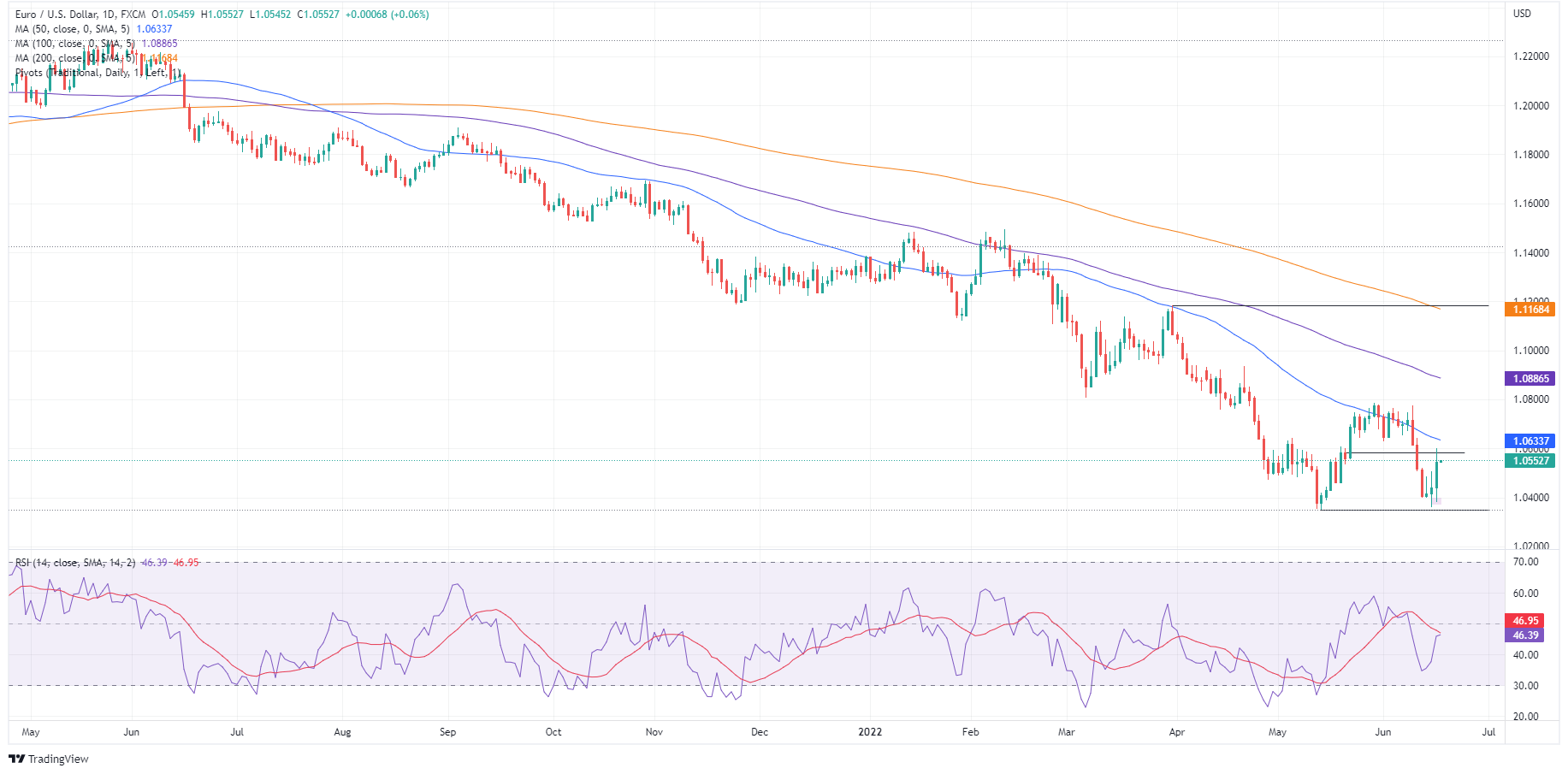
Despite Thursday’s late EUR/USD rally, the downward bias remains unless EUR bulls recover the 1.0800 mark. Also, the EUR/USD retracement from weekly highs around 1.0600 and the RSI shifting trendless at 4629 within negative territory could open the door for further losses.
Therefore, the EUR/USD first support would be 1.0500. Once cleared, the EUR7USD next support would be 1.0400, followed by the YTD Low at 1.0348
Key Technical Levels
- Gold is trimming weekly losses but remains down by 0.89%.
- Sentiment remains dismal, and the greenback fell, underpinned by plummeting US Treasury yields; gold rose.
- Gold Price Forecast (XAUUSD): Neutral-upwards above $1880; otherwise, would be exposed to selling pressure.
Gold spot (XAU/USD) remains steady above the 200-day moving average (DMA), which lies around $1843.19, as the Wall Street close approaches. Safe-haven demand and US dollar buyers taking profits weakened the greenback and lifted Gold prices, with XAU/USD trading at $1854.60, gaining 1.14%.
US equities remain on the backfoot, posting hefty losses. Risk aversion is keen late in the week after the US Federal Reserve raised rates by 75 bps on Wednesday afternoon, followed by Fed Chair Jerome Powell’s press conference.
Chair Jerome Powell said that he does not expect a move of 75 bps to be “common” but mentioned that the July meeting is open for a 50 or 75 bps rate hike. He also said that ongoing increases to the Federal funds rate (FFR) are appropriate and emphasized that inflation is extremely high.
In the meantime, the US Dollar Index, a gauge of the greenback’s value vs. a basket of peers, continues drifting lower, currently at 103.697, plunging 1.10%, underpinned by falling US Treasury yields
Besides the buck’s value and the US 10-year Treasury nominal yield, Gold traders need to be aware of real yields. The US 10-year Treasury Inflation-Protected Securities (TIPS) yield, a proxy for real yields, sits at 0.651%, down from daily highs at 0.893%.
Meanwhile, harmful US housing data shifted traders’ attention towards a recession scenario. Housing Starts in the US for May dropped by -14.4%, while Building Permits followed suit, edging lower by -7%. Furthermore, the Philadelphia Fed Manufacturing Index for June showed signs of a slowing US economy contracting by -3.3, much lower than estimations of 5.5.
Gold Price Forecast (XAUUSD): Technical outlook
Gold’s daily chart depicts the pair as neutral. On Thursday, Gold buyers reclaimed the 200-DMA, but to further cement the upward bias, they need a daily close above the June 13 high at $1878.65. Otherwise, XAUUSD would remain vulnerable to further selling pressure.
Upwards, the XAUUSD’s first resistance would be the 50-day moving average (DMA) at 1876.91. Break above would expose the aforementioned June 13 high, followed by the $1900 mark. On the other hand, XAUUSD’s first support would be June’s 16 low at $1814.68. A breach of the latter would expose the June 14 low at $1804.95, followed by the May 16 cycle low at $1786.50.

Key Technical Levels
What you need to take care of on Friday, June 17:
Central banks spurred panic, but the American dollar could not take advantage of the panic scenario, ending the day with losses against most major rivals.
The Switzerland National Bank surprised markets with an unexpected 50 bps hike, while the Bank of England moved as planned and made its fifth consecutive 25 bps hike. Two things we learned from this. On the one hand, the Fed is far more aggressive than any other central bank. On the other, global policymakers are much more scared about the economic situation than what they let see.
Stocks resumed their declines, with Wall Street plummeting to fresh 2022 lows. The DJIA and the S&P 500 traded at levels last seen in January 2021. The FTSE 100 also plummeted as the BOE’s decision fell short of the market’s expectations. Recession fears are behind stocks’ collapse.
Demand for government bonds sent yields to the lower end of their weekly range, which in turn undermined demand for the greenback. The yield on the 10-year Treasury note currently stands at around 3.30% after flirting with 3.50% earlier in the day. The dollar’s weakness may well be temporal if the demand for safety continues.
The EUR/USD pair trades around 1.0570, while GBP/USD hovers around 1.2350. The AUD/USD pair surged to 0.7070, holding nearby, while the USD/CAD changes hands at 1.2920. Save-haven currencies were firmly up against the dollar, with USD/CHF down roughly 300 pips, now trading in the 0.9630 region. Ahead of the Bank of Japan monetary policy decision, the USD/JPY battles around 132.00.
Gold surged to a fresh 3-day high of $1,852.74 a troy ounce, holding nearby ahead of the Asian opening, while crude oil prices recovered some ground. WTI is now trading at $117.70 a barrel.
Like this article? Help us with some feedback by answering this survey:
- The Bank of England hiked 25 bps and initially tumbled the pound, though later rallied due to a weaker US dollar.
- The BoE decided not to give any forward guidance regarding the pace and time of monetary policy adjustments.
- Negative US housing data fueled speculations that the US might be headed into a recession.
The British pound is rallying sharply following a 25 bps rate hike by the Bank of England (BoE), which now plays catch up vs. the US Federal Reserve, with the former lifting rates to 1.25%, while the latter surpassing the BoE, with the Federal funds rate (FFR) at 1.75%. Nevertheless, despite the previously mentioned, the GBP/USD is up 1.47%, trading at 1.2352 at the time of writing.
Market sentiment remains negative, as portrayed by US equities recording losses between 2.70% and 5%. Fears that the Federal Reserve might trigger a recession after reacting late to high inflation figures loom.
The BoE hikes rates, though expect UK’s economy to contract
On Thursday, the Bank of England lifted rates by 0.25%, initially sending the GBP/USD towards daily lows at around 1.2050. Nevertheless, GBP/USD buyers lifted the pair around that area, which is rallying close to 200 pips in the day.
In its monetary policy statement, the BoE updated its projections about CPI and expects inflation to peak at 10% in Q4 of 2022. The Monetary Policy Committee (MPC) estimates inflation would tame at around the 2% target in two years as external factors dilute. Concerning UK’s growth, the bank expects a contraction in Q2, by -0.3%, weaker than anticipated in its May report.
It’s worth noting that the statement gave no forward guidance regarding further hikes in the near term. The BoE emphasized that the “scale, pace and timing will reflect the Committee’s assessment of the economic outlook and inflationary pressures.”
Despite the aforementioned, some banks in the street expect the BoE would lift the Bank’s Rate to 2.25%.
In the meantime, bad US housing economic data further raise speculations of a recession in the US. US House Starts shrank by -14.4%, while Building Permits followed suit, down -by 7%. Additionally, the Philadelphia Fed Manufacturing Index for June showed signs of a slowing US economy contracting by -3.3, much lower than estimations of 5.5.
Key Technical Levels
Citing an EU source familiar with the matter, Reuters reported on Thursday that European Central Bank President Christine Lagarde told the eurozone finance minister that fragmentation risk was a serious threat to the price stability mandate.
"Doubting our commitment would be a serious mistake," Lagarde reportedly added. "The goal of anti-fragmentation tool is not to close spreads, but to normalise spreads."
Market reaction
These comments were largely ignored by market participants and the EUR/USD pair was last seen rising 1.25% on the day at 1.0570.
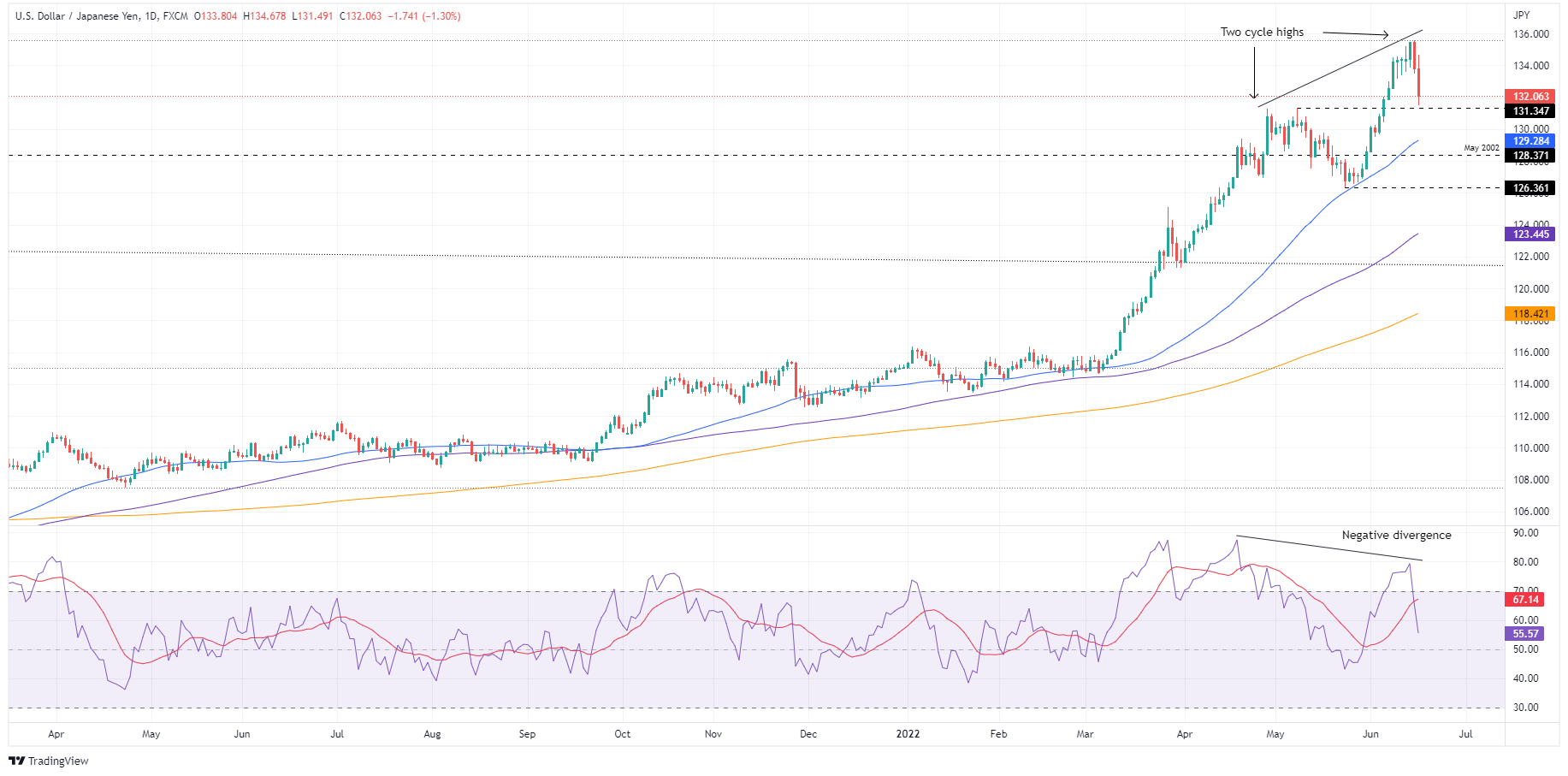
- Negative divergence on the USD/JPY daily chart caused a drop of 200-pips, right above May 9 high at around 131.34.
- A risk-off market mood favors the Japanese yen, despite the Fed rate hike.
- A USD/JPY move above 133.00 opens the door towards 135.00, otherwise, a fall towards 131.00 is on the cards.
The USD/JPY extends its losses for the second consecutive day, despite a larger than initially expected 75 bps rate hike by the Federal Reserve, which initially boosted the greenback, with the USD/JPY jumping near 135.00, but gave way for JPY bulls, which since then, dragged the pair down below the 132.00 area. At the time of writing, the USD/JPY is trading at 132.06.
US equities remain on the backfoot as recession fears mount. In the meantime, the greenback remains on the defensive, as illustrated by the US Dollar Index (DXY), down 1.1%, at 103.698. US Treasury yields, led by the 10-year benchmark note, is down six basis points, yielding 3.330%.
Also read: USD/JPY Price Analysis: Hovers around 133.80s as a negative divergence emerges
USD/JPY Price Forecast: Technical outlook
Daily chart
In an article on June 15, a technical analysis piece on the USD/JPY, I wrote that “the last couple of cycle highs were recorded as the Relative Strenght Index (RSI) registered two peaks, but the second peak was lower than the previous one, meaning a negative divergence formed. That said, the USD/JPY might be headed for a pullback.”
That said, during Thursday’s trading session, the USD/JPY tanked 200 pips from the daily high at 134.67 towards the daily low at around 131.49, 15 pips above the May 9 daily high-turned-support at 131.34.
4-hour chart
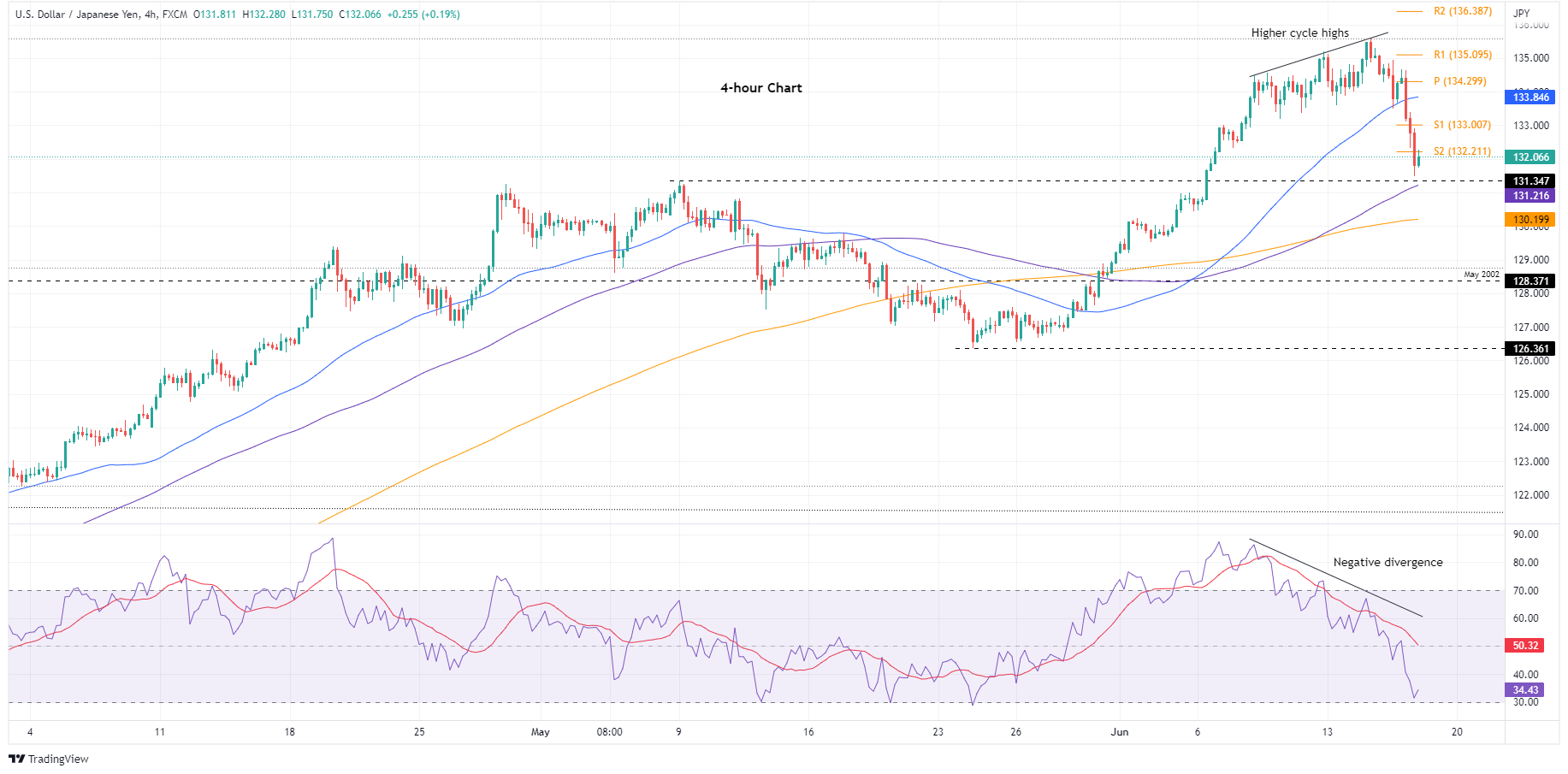
The USD/JPY is neutral-upward biased, as illustrated by the 4-hour chart. Once the negative divergence tumbled the pair towards 131.40s, buying pressure lifted the pair back above the 132.00 mark. Nevertheless, a move of the Relative Strength Index (RSI) above the 50-midline, alongside a USD/JPY rally towards 133.00, is needed if USD/JPY bulls would like to remain in control.
Upwards, the USD/JPY’s first resistance would be the S2 daily pivot at 132.21. Break above would expose the S1 pivot point at 133.00, followed by the 50-simple moving average (SMA) at 133.84. On the flip side, the USD/JPY first support would be 132.00. A breach of the latter would send the pair towards the May 9 high at 131.34, followed by the 100-SMA at 131.21 and then the 200-SMA at 130.19
Key Technical Levels
- The greenback is under pressure as recession fears mount, as the Fed lifts rates to the 1.75% threshold.
- The US housing market started to weaken as Housing Starts shrank.
- Australia’s labor market strengthens and further cement a scenario of an RBA rate hike.
AUD/USD climbs during the North American session. Earlier, the major reached a daily high near 0.7035 though the rally was short-lived as traders recoiled its bullish bets, amidst a dampened market mood, with global equities falling. However, after reaching a daily low at around0.6940s, the AUD/USD bounced off that level and is gaining some 0.36%, trading at around 0.7025.
Harmful US economic data weighs on the buck
Of late, the AUD/USD pared some of its earlier losses on the back of worst-than-expected US economic data. US Housing Starts declined -by 14.4%, while Building Permits followed suit, down -by 7%. The Philadelphia Fed Manufacturing Index for June shrank for the first time, since May 2020, down -3.3 in June, against estimations of a 5.5 reading.
During the Asian session, Australia’s employment figures were better than expected. The Aussie economy added 61K new jobs to the economy, more than the 25K estimated, and the Unemployment rate held steadily around 3.9%.
Details of the report were also strong reinforcing market wagers the Reserve Bank of Australia (RBA) will deliver another half-point rate hike in July to reach 1.35%.
Analysts at ANZ said, “This continued strength in the labour market supports our view that the RBA will hike the cash rate a further 50bp in July.”
Elsewhere, US equities are plummeting, illustrating a gloomy market mood resulting from the Fed rate hike. On Wednesday, Fed Chair Jerome Powell said that although rate hikes of that size (75 bps) are not common, he reiterated that the July meeting is open for a move of that size or 50 bps.
Meanwhile, US Treasury yields, albeit heading down, remain steady above the 3% threshold. Contrarily the greenback remains soft, as illustrated by the US Dollar Index, at 103.699, down 1.10%.
Key Technical Levels
Italian Prime Minister Mario Draghi said on Thursday that the European Central Bank's (ECB) decision to hike the interest rate is inevitable, as reported by Reuters.
"ECB interest rise is bound to be more gradual than in the US," Draghi added and said that it was totally counterproductive for politicians to comment on the ECB's policy.
Market reaction
The shared currency continues to outperform its rivals on Thursday and the EUR/USD pair was last seen trading at its highest level in nearly a week at 1.0550, rising more than 1% on a daily basis.
The Bank of England announced on Thursday a new increase in the interest rate. It raised the key rate by 25 basis points to 1.25%, with three members voting for a 50 bps hike. Analysts from Rabobank expect one more 25 bps hike in August, before the Monetary Policy Committee (MPC) takes a pause and re-assesses.
Key Quotes:
“With GDP set to contract this quarter, the MPC is hiking into a slowdown. It risks inflicting a deeper recession on the economy; bringing down inflation creates a lot of collateral damage.”
“We expect one more 25 bps hike in August, before the MPC takes a pause and re-assesses. The risk is that the market will not allow the central bank to pause. In an environment where almost all other central banks are ramping up their hiking schedules, and where countries want stronger instead of weaker currencies in order to fend off imported inflation, the value of the currency increasingly becomes a risk factor.”
“The sterling effective exchange rate has fallen by 5% year-todate, with particular weakness against the US dollar. This could not only be attributed to a weakening growth and political outlook, but also to widening interest rate differentials with the United States. This places the central bank in a perilous spot: if it does too little, imported cost pressures keep flowing in, if it does too much, it will only intensify the recession.”
- Gold rises to the highest level in four days, eyes $1850.
- Silver erases losses, and approaches Wednesday's high near $21.90.
- US yields slide as demand for Treasuries picks up amid risk aversion.
Gold gained momentum boosted by a context of risk aversion and a weaker US dollar. XAU/USD rose from under $1820 to the $1850 area.
In Wall Street, stocks are falling sharply. The Dow Jones is losing 2.50% while the Nasdaq drops by more than 4%. Recession concerns are driving prices lower. At the same time, the demand for safe-haven assets boosted Treasuries. The US 10-year yield pulled back from 3.49% to 3.32%.
The US dollar is falling versus its G10 rivals, particularly against the Swiss franc and the yen. The DXY drops by 0.90%, and trades below 105.00.
The combination of lower yields and a weaker dollar pushed XAU/USD to the upside. The yellow metal trades at $1846, the highest level since Monday and is looking at the $1850. A break above could open the doors to more gains.
XAG/USD also hit multi-day highs at $21.89. Earlier on Thursday, bottomed at $21.35. On the contrary, cryprocurrencies remain under pressure. Bitcoin continues to trade dangerously close to the $20,000 level.
Technical levels
- Swiss franc among top performers after SNB surprise rate hike.
- USD/CHF extends slide amid risk aversion and a weaker dollar.
- EUR/CHF heads for the lowest close in two months.
The Swiss franc is having the best day in months on Thursday on the back of an unexpected rate hike from the Swiss National Bank. The USD/CHF dropped further during the American session and reached the lowest level in ten days, under 0.9700.
From a stronger CHF to a weaker USD
The Swiss franc jumped across the board earlier on Thursday following a 50 basis points rate hike from the Swiss National Bank from -0.75 to -0.25. Also, comments about the exchange rate, with references to the Swiss franc not being “highly valued”, triggered the CHF’s rally. “The updated forecasts don’t suggest any rush to tighten. However, the swaps market is pricing over 350 bp of tightening over the next 12 months that would see the policy rate peak near 3.25% vs. 1.25-1.50% at the start of this week,” explained analysts at BBH.
During the American session, the driver in the USD/CHF slide was a weaker US dollar. The greenback lost momentum despite risk aversion and amid a pullback in US yields. The USD/CHF is trading at 0.9680/85, at the lowest level in ten days, down more than 250 pips for the day. The move faces a support area at 0.9640 and then the May low at 0.9540.
The pair is back under the 20-day moving average and has made a sharp reversal after being rejected again from above 1.0000. The greenback needs to recover 0.9725 initially to alleviate the bearish pressure. Above the next resistance is seen at 0.9800 and 0.9870.
The EUR/CHF is falling more than 200 pips. It bottomed at 1.0127, the weakest since April 13 and then rebounded modestly to 1.0175. Below 1.0125, attention would turn to the April low of 1.0085.
Technical levels
"There is no need for Russia to cut its oil output," Russian Deputy Prime Minister Alexander Novak told RBC media on Thursday.
"OPEC+ role is on the rise due to uncertainties with demand and supply in China, Iran, Libya and Venezuela," Novak added. "We don't have plans to switch to an oil-for-roubles scheme."
Market reaction
Crude oil prices edged slightly lower following these comments. As of writing, the barrel of West Texas Intermediate (WTI) was trading at $115.15, where it was down 0.6% on a daily basis.
- The shared currency remains trims some of its weekly losses but remains down 0.21%.
- Hawkish ECB speaking will keep the common currency supported.
- EUR/USD Price Forecast: A double bottom in the 1-hour chart targets 1.0550.
EUR/ÜSD advances above the 1.0400-1.0500 range, and it is trading with gains of 0.68% during the New York session, at around 1.0509 at the time of writing.
ECB speakers and negative US economic data, weighed on the USD
The shared currency is gaining traction as USD buyers book profits after the Federal Reserve’s 0.75% rate hike. Furthermore, worse-than-expected US economic data crossed the wires. US Home Sales for May dropped to their lowest level in a year, and Building Permits contracted by -7%. Additionally, the Federal Reserve Bank of Philadelphia Manufacturing Business Outlook Surve index shrank by -3.3 in June from 5.5 estimations.
ECB speakers have dominated the headlines. Francois Villeroy the Galhau was the first to hit the headlines, commenting that inflation remains higher and is broadening beyond energy prices. Later the ECB Vice-President Luis de Guindos said that inflation expectations in the Euro area were “quite anchored.”
The Bank of Italy President and ECB member Ignazio Visco said that he expects the ECB to hike rates in a gradual and sustained way after September. He added that normalization could continue to be gradual, which could mean 25 or 50 bps rate hikes.
In the meantime, US equities are plunging, depicting a negative market sentiment resulting from the Fed rate hike. On Wednesday, Fed Chair Jerome Powell said that although rate hikes of that size (75 bps) are not common, he reiterated that the July meeting is open for that jumbo rate hike or 50 bps.
Meanwhile, US Treasury yields, albeit heading down, remain steady above the 3% threshold. Contrarily the greenback remains soft, as illustrated by the US Dollar Index, at 104.316, down 0.51%.
EUR/USD Price Forecast: Technical outlook
The EUR/USD daily chart depicts the pair as downward biased unless it recovers the 1.0800 mark. Furthermore, the Relative Strenght Index at 43 remains in negative territory, despite Tuesday’s jump, which propelled the consolidation in the EUR/USD.
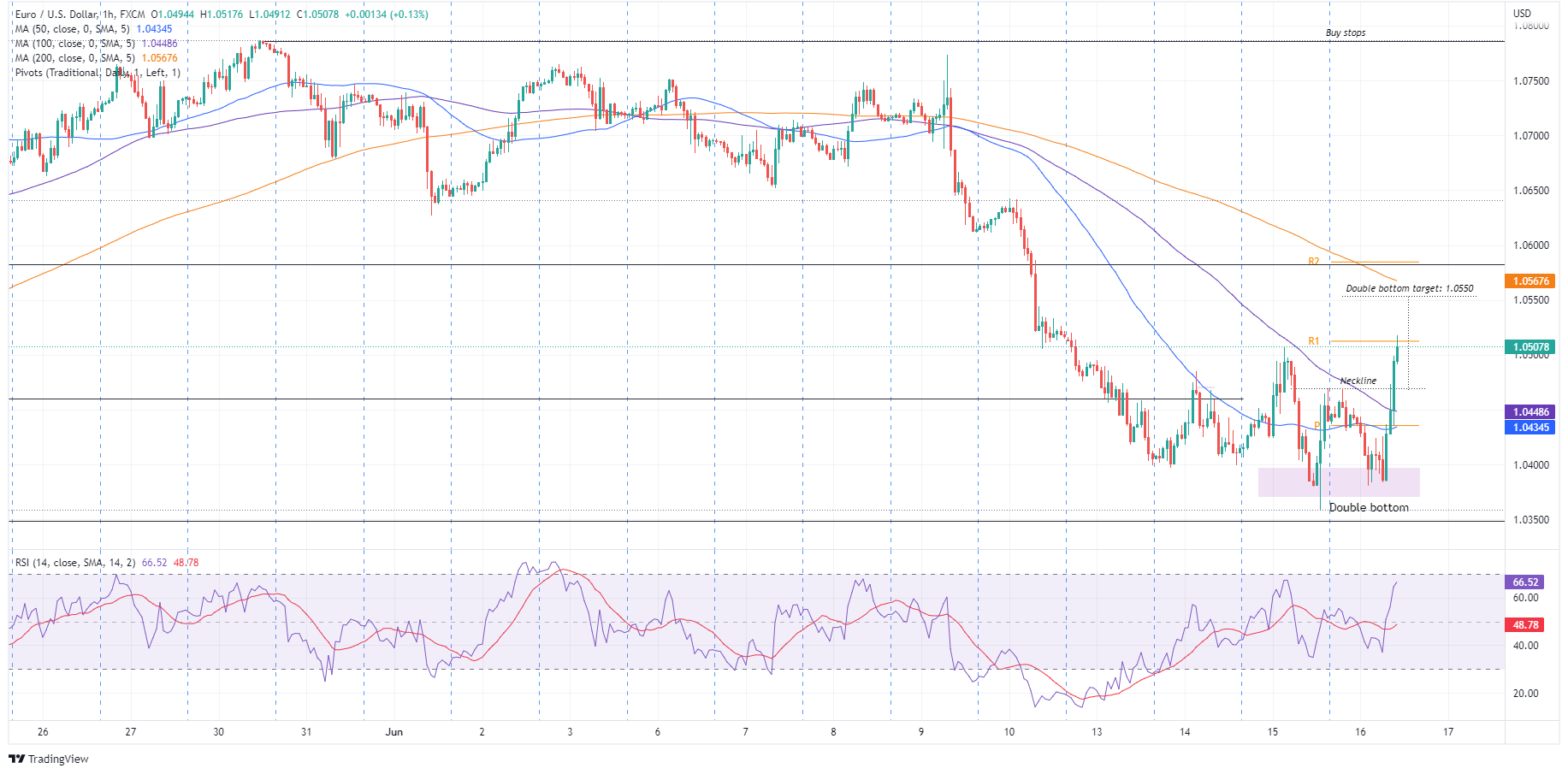
The EUR/USD 1-hour chart depicts the pair trading above a double bottom neckline in the near term. However, the last candle shows price exhaustion, and with the Relative Strength Index (RSI) at 67.66 accelerating toward overbought conditions, a pullback towards the neckline around 1.0470 is on the cards. That said, the EUR/USD will find some resistance levels at the R1 daily pivot at 1.0512, followed by the double bottom target at 1.0550.
- GBP/USD caught aggressive bids and rallied to a three-day high in the last hour.
- Softer US macro data weighed on the USD and prompted a short-covering move.
- Elevated US bond yields, the risk-off mood to limit the USD losses and cap the pair.
The GBP/USD pair witnessed a short-covering bounce on Thursday and rallied nearly 150 pips from the 1.2040 area, or the daily low touched in the aftermath of the Bank of England policy decision. The momentum pushed spot prices to a three-day high, around the 1.2280-1.2285 region during the early North American session.
The intraday US dollar positive move lost steam following the disappointing release of the US macro data, which, in turn, was seen as a key factor that offered support to the GBP/USD pair. The US Department of Commerce reported that Housing Starts declined by 14.4% and Building Permits fell by 7% in May. Adding to this, the Federal Reserve Bank of Philadelphia's Manufacturing Business Outlook Survey's diffusion index for current general activity declined to -3.3 in June from 2.5 in May. The data added to worries about softening US economic growth and prompted some selling around the greenback.
That said, elevated US Treasury bond yields, bolstered by hawkish Fed expectations, should help limit any deeper USD pullback. Fed Chair Jerome Powell said on Wednesday the US central bank is “absolutely determined” to keep inflation expectations anchored to 2% and reaffirmed another big hike in July. Moreover, the so-called dot plot showed that the median year-end projection for the federal funds rate moved up to 3.4% from 1.9% in the March estimate and 3.8% in 2023. This, along with the risk-off impulse, could lend support to the safe-haven buck and cap the GBP/USD pair, at least for now.
Apart from this, expectations that the BoE would opt for a more gradual approach to raising interest rates amid recession fears could act as a headwind for the British pound. Bulls might also be reluctant to place aggressive bets amid the UK-EU impasse over the Northern Ireland Protocol of the Brexit agreement. The fundamental backdrop favours bearish traders, suggesting that any subsequent move up runs the risk of fizzling out rather quickly. Hence, it will be prudent to wait for strong follow-through buying before confirming that the GBP/USD pair has formed a near-term bottom.
Technical levels to watch
The Bank of Japan (BoJ) will announce its monetary policy decision on Friday, June 17 at 03:00 GMT and as we get closer to the release time, here are the expectations forecast by the economists and researchers of six major banks.
The BoJ to remain a dovish outlier by maintaining policy settings. What’s more, the central bank is unlikely to offer anything on FX but may tweak the yield curve control (YCC) cap.
ING
“No change is expected. Governor Kuroda and other members have publicly stated on several occasions that the BoJ will retain its current accommodative monetary policy stance, as the recent cost-push inflation will be temporary and that a weak yen benefits the economy as a whole. The current JPY weakness is expected to deepen with rate differentials widening.”
UOB
“Although Japan’s inflation has climbed in recent months, BoJ Governor Kuroda does not see 2% inflation in Japan as sustainable ‘when it’s triggered by a rise in commodity prices and worsening trade factors’ with wage growth still absent. So, both Japan’s lacklustre economic recovery and the challenging growth outlook will imply the BoJ will not be tightening or signalling to do so anytime in 2022.”
Standard Chartered
“We expect the BoJ to keep the policy balance rate unchanged in June. Rising US and global bond yields have turned yield differentials further against the JPY, pushing the currency to multi-year lows. However, the BoJ does not see JPY weakness as detrimental to Japan’s economy; instead, a weak JPY is expected to support exports and improve firms’ profitability. While core CPI inflation has risen to over 2%, the BoJ sees the rise as transient as it is mainly driven by base effects. The central bank is likely to maintain its dovish stance, aiming to achieve sustainable CPI.”
Danske Bank
“The BoJ has made it very clear that they do not see the weak yen as a problem. With still modest inflation pressure, we expect no changes to the bank’s accommodative stance. In other words, the BoJ remains an outlier among advanced central banks.”
TDS
“BoJ likely to leave all policy levers unchanged. The central bank is leveraging a weak JPY to break the deflationary mindset, but pressure is growing to make a change to YCC in the coming months.”
SocGen
“We expect the BoJ to maintain its main monetary policy. Going forward, our main scenario is for the USD/JPY rate to stop exceeding 130 yen and for the core CPI to continue to be greater than 2.5% YoY. Therefore, we expect the BoJ to maintain its current policies – at least under Governor Kuroda.”
The Swiss National Bank (SNB) surprised the market with an unexpected 50 basis points (bps) rate hike. Subsequently, economists at Rabobank have lowered their one-month forecast for EUR/CHF to 1.02 from 1.03.
SNB would likely desire to move away from negative rates completely
“The news of a 50 bps move came as a big surprise to the vast majority of participants. That shock was evident in the knee-jerk plunge in EUR/CHF this morning – a move only softened by the warning from SNB President Jordan that FX intervention was still a policy option for the central bank.”
“Looking ahead, the SNB would likely desire to move away from negative rates completely (from the current level of -0.25 bps). Not only would this likely have to be preceded by an upward revision on inflation forecasts, but signs that EUR/CHF would not fall dramatically would also likely be a condition.”
“Any sniff of crisis in the Eurozone would likely send EUR/CHF sharply lower on safe-haven flows which could close the SNB’s window of opportunity for any further rate moves.”
“We have lowered our one-month forecast for EUR/CHF to 1.02 from 1.03 on account of today’s move.”
- Gold Price edged lower on Thursday and was pressured by more hawkish major central banks.
- But recession fears weighed on investors’ sentiment and limited losses for the safe-haven metal.
- Intraday USD selling revived demand for the XAUUSD, though the uptick lacked follow-through.
Gold Price struggled to capitalize on the previous day's goodish recovery move from a one-month low and came under some fresh selling pressure on Thursday. The XAUUSD remained depressed heading into the North American session, albeit managing to recover a major part of its intraday losses, and was last seen trading around the $1,830 region.
Gold Price weighed down by hawkish Central Banks
The Federal Reserve on Wednesday raised interest rates by 75 bps - the biggest hike since 1994 - and also indicated a faster policy tightening path to bring price pressures under control. In the post-meeting press conference, Fed Chair Jerome Powell reaffirmed the central bank will deliver another big hike in July. Moreover, the so-called dot plot showed that the median year-end projection for the federal funds rate moved up to 3.4% from 1.9% in the March estimate and 3.8% in 2023.
Also read: After Powell’s decision, the outlook for gold remains bearish
Adding to this, the Swiss National Bank surprised markets with a 50 bps rate hike this Thursday and also left the door open for further rate hikes to counter rising inflationary pressures. Separately, the Bank of England also decided to hike interest rates for the fifth consecutive time and said that it remains ready to act "forcefully" to curb soaring inflation. This, in turn, was seen as a key factor that continued acting as a headwind for the non-yielding yellow metal.

Gold bar
Risk-off mood offered support
The global risk sentiment took a hit amid doubts that major central banks can hike interest rates to curb inflation without impacting economic growth. Powell also projected a slowing economy and rising unemployment in the months to come amid concerns about the global supply chain disruptions caused by the Russia-Ukraine war and the latest COVID-19 lockdowns in China. The worsening global economic outlook tempered investors' appetite for riskier assets, which was evident from a sea of red across the equity markets. This, in turn, extended some support to the safe-haven precious metal.
Modest USD-selling helped limit losses
The US dollar struggled to preserve/capitalize on its intraday gains and witnessed some selling in reaction to disappointing US macro releases. The US Department of Labor reported that 229K individuals filed for unemployment insurance for the first time in the week ending June 11 and the previous week's reading was revised higher to 232K. Adding to this, data published by the US Department of Commerce revealed that Housing Starts in the US declined by 14.4% and Building Permits fell by 7% in May.
Furthermore, the Federal Reserve Bank of Philadelphia's Manufacturing Business Outlook Survey's diffusion index for current general activity declined to -3.3 in June from 2.5 in May. The data added to worries about softening US economic growth and weighed on the buck, which, in turn, helped the dollar-denominated commodity to attract some buying at lower levels. That said, the intraday uptick lacked bullish conviction, warranting some caution before positioning for any further gains.
Gold Price technical outlook
Gold Price on Wednesday faced rejection near a technically significant 200-day SMA. The said barrier is currently pegged near the $1,842 region and should act as a pivotal point for short-term traders. Sustained strength beyond might trigger a short-covering move and lift the XAUUSD towards the $1,870 supply zone. Some follow-through buying above the monthly peak, around the $1,879 region, would shift the bias in favour of bullish traders and set the stage for a move towards reclaiming the $1,900 round figure.
On the flip side, the daily swing low, around the $1,815 region, now seems to protect the immediate downside ahead of the $1,805 area, or a one-month trough touched on Tuesday. Failure to defend the said support levels, leading to a subsequent break below the $1,800 mark, would be seen as a fresh trigger for bearish traders and expose the YTD low, around the $1,780 region.
-637909820257328331.png)
Bias remains bearish in the short term
A spread of over 200 bps in the 10-year Germany and Italy bond yield would be unjustified, European Central Bank (ECB) Governing Council member Ignazio Visco said on Thursday.
Additional takeaways
"Wage growth is contained so far."
"We're capable of sterilising liquidity without selling securities."
"Overly gradual monetary shift would compromise ECB credibility."
"Overly rapid policy normalisation would jeopardise financial stability."
"I think normalisation can continue to be gradual, it can mean 25 or 50 bps hikes."
"Fragmentation warrants concern."
"Spreads are not due to monetary policy normalisation."
"Today a spread of less than 150 bps would be justified, referring to Italy-Germany 10-year bond yield spread."
"Monetary policy normalisation and fighting fragmentation are complementary."
Market reaction
The EUR/USD pair extended its rebound after these comments and was last seen trading in positive territory above 1.0450.
European Central Bank (ECB) Governing Council member Ignazio Visco said on Thursday that he expects the ECB to continue to hike the policy rate in a gradual and sustained way after September, as reported by Reuters.
Additional takeaways
"Future rate hikes after September will depend on new data and its impact on medium-term price stability prospects."
"Markets perceive a hawkish ECB stance which in my view is not appropriate."
ECB will continue to focus on economic developments, which are currently very uncertain."
"Convinced ECB's determination will help restore more order to markets."
"More orderly markets will help investors better assess the real conditions of our economy."
Market reaction
The EUR/USD pair showed no immediate reaction to these comments and was last seen losing 0.15% on a daily basis at 1.0428.
The S&P 500 has seen a near-term bounce post the FOMC as suspected, but this has been capped at resistance from the beginning of the gap lower from Monday at 3838. Analysts at Credit Suisse stay negative for 3666/63 next and eventually the 50% retracement of the 2020/2021 uptrend at 3505.
Initial resistance moves to 3815
“We look for 3838 to ideally continue to cap for a move below the current low at 3706 with support then seen next at 3666/63 ahead of potential trend channel support at 3637/33.”
“Big picture, we continue to look for a fall to our core objective at the 50% retracement at 3505, also the location of the 200-week average.”
“Resistance is seen moving to 3815 initially, with 3838 ideally capping. Above can see a deeper rebound toward the top of the price gap at 3900, but with fresh sellers expected here.”
- Philadelphia Fed Manufacturing Index fell into negative territory in June.
- US Dollar Index continues to fluctuate below 105.00 after this data.
The Federal Reserve Bank of Philadelphia's Manufacturing Business Outlook Survey's diffusion index for current general activity declined to -3.3 in June from 2.5 in May. This print missed the market expectation of 5.5 by a wide margin.
Additional takeaways
"The new orders index fell 35 points to -12.4, and the shipments index fell 25 points but remained positive at 10.8."
"On balance, the firms continued to report increases in employment, and the employment index moved up from 25.5 to 28.1."
"The indicators for prices paid and prices received continue to indicate widespread price increases but decreased this month. The prices paid index declined for the second consecutive month, down 14 points to 64.5."
Market reaction
The US Dollar Index stays below 105.00 after this data and Wall Street's main indexes remain on track to open sharply lower.
The Bank of England's MPC voted 6-3 to raise Bank Rate by 25 bps to 1.25%. GBP has initially fallen back against both EUR and USD, reflecting the disappointment on the BoE move. In the view of economists at TD Securities, the pound is likely at the whims of risk sentiment.
Three members voted for a 50 bps rise
“The BoE voted to raise Bank Rate by 25 bps to 1.25%. Three members dissented for a stronger 50 bps hike, the same as at May's meeting.”
“GBP initially gave back some early gains on the announcement, reflecting the disappointment with the BoE's 25bps move. Nevertheless, the door remains open for further hikes, which has likely limited GBP's sell-off.”
“The sheer pessimism built into GBP remains the one source of support with positioning and valuations stretched.”
- Housing Starts in the US declined sharply in May.
- US Dollar Index continues to edge lower after dropping below 105.00.
The data published by the US Department of Commerce revealed on Thursday that Housing Starts in the US declined by 14.4% on a monthly basis in May following April's increase of 5.5%. In the same period, Building Permits fell by 7%.
Underlying details of the publication showed that Housing Permits decreased by 7%.
Market reaction
The dollar weakens modestly against its major rivals in the early American session on Thursday with the US Dollar Index posting small losses near 104.80. Meanwhile, US stock index futures were last seen losing between 1.6% and 2.1%.
A choppy session has seen EUR/USD fall to retest and again hold for now the YTD and 2017 lows at 1.0350/41. Economists at Credit Suisse continue to look for an eventual break below here for a fall to parity.
Initial resistance aligns at 1.0470
“Whilst we see scope for further consolidation above the YTD and 2017 lows at 1.0350/41, our core bias stays negative for an eventual clear and sustained break lower. We would expect this to then act as the catalyst for a resumption of the core downtrend with support seen next at 1.0281 then 1.0217/09, which we look to hold at first.”
“Big picture, we maintain our core negative outlook for an eventual sustained break lower for an eventual fall to parity/0.99.”
“Resistance is seen at 1.0470 initially, with a break above 1.0508 needed to clear the way for a recovery back to the 13-day exponential average at 1.0554, which we look to prove tougher resistance.”
“A sustained close above the 55-day average at 1.0672 is needed to warn of a potentially more important low.”
EUR/CHF has plummeted aggressively lower. A close below the 1.0189/69 support would open the door for a fall below parity and a move to Credit Suisse’s core medium-term objective at 0.9839/30
Scope for near-term ranging on quick return above 1.0339
“A sustained close below the key medium-term support at late April lows at 1.0189/69 would trigger a larger bearish ‘triangle’ continuation pattern to significantly reinforce our core bearish view.”
“Below 1.0189/69 support is seen at 1.0133 and then at 1.0086, which we expect to eventually break to open a move to parity, ahead of our long -held core objective at 0.9839/30.”
“We note that the potential ‘measured triangle objective’ is seen at 0.9609/00.
“A quick return above 1.0339 would negate the potential triangle formation and see scope for near-term ranging to occur.”
- Initial Jobless Claims declined by 3,000 in the week ending June 11.
- US Dollar Index retreats below 105.00 in the early American session.
There were 229,000 initial jobless claims in the week ending June 11, the weekly data published by the US Department of Labor (DOL) showed on Thursday. This print followed the previous week's print of 232,000 (revised from 229,000).
Further details of the publication revealed that the advance seasonally adjusted insured unemployment rate was 0.9% and the 4-week moving average was 218,500, an increase of 2,750 from the previous week's revised average.
"The advance number for seasonally adjusted insured unemployment during the week ending June 4 was 1,312,000, an increase of 3,000 from the previous week's revised level," the DOL said.
Market reaction
The greenback stays on the back foot after this report and the US Dollar Index was last seen posting small daily losses at 104.82.
Following his meeting with Saudi Arabia's energy minister, Russian Deputy Prime Minister Alexander Novak said on Thursday that they have discussed forecasts on oil prices.
"It is important to continue joint work at OPEC+ to avoid collapse on the oil market," Novak added and noted that the oil market is currently balanced while acknowledging that there were lots of uncertainties.
Market reaction
Crude oil prices showed no immediate reaction to these comments and the barrel of West Texas Intermediate (WTI) was last seen trading at $113.50, where it was down 2% on a daily basis.
- USD/CAD finds support from USD rebound, WTI weakness.
- The pair sights a potential bull pennant on the 4H chart.
- 50 and 100 SMAs bullish crossover backs the upswing.
USD/CAD is holding higher ground near the mid-1.2900s, as bulls continue to capitalize on the risk-off flows-driven renewed US dollar upswing.
Meanwhile, the 1% drop in WTI prices, amid risk-aversion and a potential increase in the Russian oil output, weighs negatively on the resource-linked Canadian dollar. Therefore, USD/CAD cheers the oil price weakness heading into a bunch of the US housing and jobs data. Investors also look forward to the Canadian Wholesale Sales data for fresh trading cues.
From a short-term technical perspective, USD/CAD is poised for the additional upside as bulls have spotted a bull pennant formation on the four-hour chart, which will be confirmed on a sustained break above the falling trendline resistance at 1.2947.
On an upside break validation, the pair could advance to retest the 1.3000 supply zone, above which the 1.3050 psychological level could be tested.
The 14-day Relative Strength Index (RSI) is turning lower but holds well above the midline, supporting the case for the upside.
Adding credence to the bullish potential, a 50 and 100-Simple Moving Averages (SMA) bullish crossover, confirmed on Wednesday, remains in play.
USD/CAD: Four-hour chart
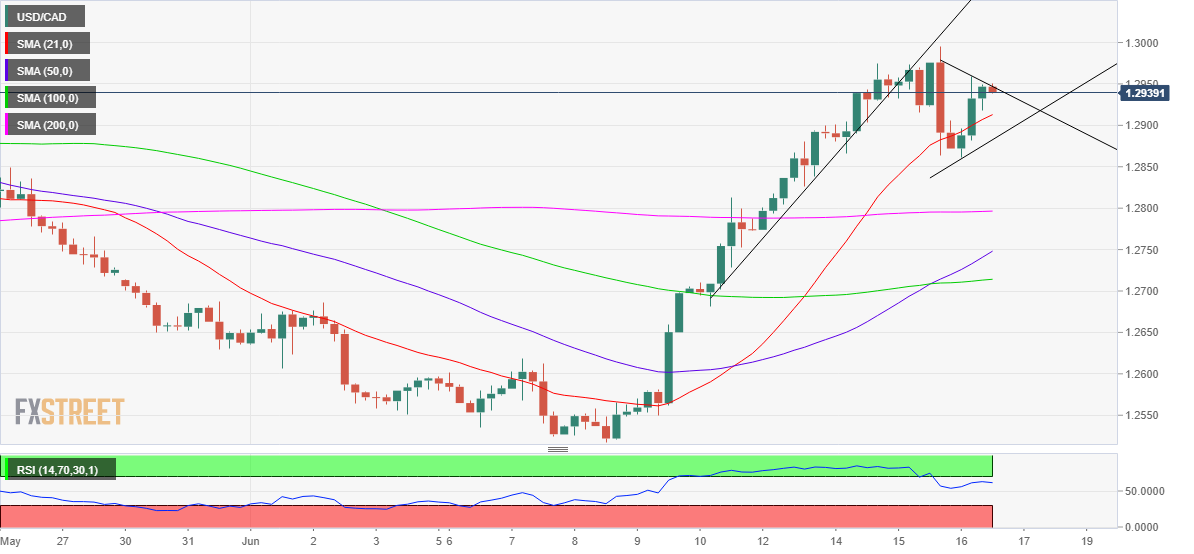
On the other side, the bullish 21 SMA at 1.2913 will limit any pullback, a break below which will open floors towards the rising trendline support at 1.2882.
A four-hourly candlestick closing below the latter will lead to the pattern failure, exposing the further downside towards the horizontal 200 SMA at 1.2796.
USD/CAD: Additional levels to consider
- GBP/JPY witnessed aggressive intraday selling on Thursday and dived to over a three-week low.
- The risk-off impulse benefitted the safe-haven JPY amid some repositioning trade ahead of BoJ.
- The British pound lost ground after the BoE announced the expected 25 bps interest rate hike.
The GBP/JPY cross attracted some intraday selling near the 163.75-163.80 region on Thursday and dived to its lowest level since May 27 after the Bank of England announced its policy decision. The cross, however, quickly recovered over 100 pips and was last seen trading above the 161.00 round figure.
The US central bank projected a slowdown in economic growth and rising unemployment in the months to come on Wednesday. The Fed's gloomy outlook added to market concerns that a more aggressive move by major central banks to curb inflation would pose challenges to the global economic recovery.
Apart from this, the global supply chain disruptions caused by the Russia-Ukraine war and the latest COVID-19 lockdowns in China further fueled recession fears. This, in turn, took its toll on the risk sentiment, which boosted demand for traditional safe-haven assets and benefitted the Japanese yen.
This, along with some repositioning trade ahead of the Bank of Japan meeting on Friday, forced investors to lighten their bearish bets around the JPY. This was seen as a key factor that exerted some downward pressure on the GBP/JPY cross, which lost additional ground after the BoE announcement.
As was widely anticipated, the UK central bank decided to hike interest rates for the fifth consecutive time to curb soaring inflation. The nine-member Monetary Policy Committee (MPC) voted 6-3 for the 25 bps hike in the bank rate from 1.0% to 1.25%, with the minority voting for a 50 bps increase.
In the accompanying policy statement, the BoE noted that it was ready to act "forcefully" to stamp out dangers posed by the persistent rise in inflationary pressures. This suggested that the central bank would opt for a more gradual approach amid recession fears and weighed on the British pound.
Despite the negative factors, the GBP/JPY cross showed some resilience near the 160.00 psychological mark and found some support just ahead of the 100-day SMA. This warrants caution before positioning for an extension of the recent sharp pullback from a multi-year peak touched earlier this month.
Technical levels to watch
- EUR/USD is struggling to extend the recovery above 1.0400.
- The US dollar remains choppy despite risk-aversion at full speed.
- ECB officials said to want new policy instrument ready by the July meeting
EUR/USD is attacking 1.0400, unable to sustain the recovery near the 1.0425 region, as EUR bulls remain unimpressed by the latest European Central Bank (ECB) news.
Reuters reported that European Central Bank (ECB) officials are said to want a new instrument, which will be used to counter the fragmentation issue, ready by the July Governing Council meeting.
Further, the upside attempts in the pair remain elusive, as the risk-on market profile keeps the sentiment around the US dollar buoyed. The rebound in the longer-dated US Treasury yields on the 75 bps Fed rate hike is also underpinning the dollar demand.
Meanwhile, investors assess the cautious policy guidance adopted by the Bank of England (BOE) this Thursday after it hiked rates by 25 bps, as expected. The GBP/USD slump-induced support received by EUR/GBP is cushioning the losses in the shared currency against the dollar, as of writing.
Attention now turns towards a slew of second-tier US economic releases and the Wall Street open for fresh trading impetus on EUR/USD.
EUR/USD technical levels to consider
European Central Bank (ECB) officials reportedly want the new instrument that will be used to battle against fragmentation to be ready by the July Governing Council meeting.
Under the new anti-crisis tool, the ECB is said to offset bond-buying and policymakers are worried that market stress may hinder the monetary policy.
Market reaction
The shared currency is struggling to find demand following this headline. As of writing, the EUR/USD pair was trading at 1.0412, where it was down 0.26% on a daily basis.
- GBP/USD met with a fresh supply after the BoE hiked interest rates by 25 bps, as expected.
- Rising US bond yields, the risk-off impulse underpinned the USD and further exerted pressure.
- A break below the 1.2000 mark is needed to confirm a fresh breakdown and any further losses.
The GBP/USD pair witnessed some selling during the mid-European session and dropped to a fresh daily low, around the mid-1.2000s after the Bank of England announced its policy decision.
As was widely expected, the UK central bank decided to hike interest rates for the fifth consecutive time to curb soaring inflation. The nine-member Monetary Policy Committee (MPC) voted 6-3 for the 25 bps hike in the bank rate from 1.0% to 1.25%, with the minority voting for a 50 bps increase.
In the accompanying policy statement, the BoE noted that it was ready to act "forcefully" to stamp out dangers posed by the persistent rise in inflationary pressures. This suggested that the central bank would opt for a more gradual approach amid recession fears and weighed on the British pound.
On the other hand, a combination of factors assisted the US dollar to regain positive traction and reversed the post-FOMC losses. A fresh leg up in the US Treasury bond yields, along with the risk-off impulse, underpinned the safe-haven buck. This exerted additional pressure on the GBP/USD pair.
With the latest leg down, spot prices have eroded a part of the overnight goodish recovery gains. That said, the lack of a significant selling warrants caution for bearish traders. Hence, it will be prudent to wait for a sustained break below the 1.2000 psychological mark before positioning for further losses.
Technical levels to watch
- EUR/GBP gained nearly 100 pips with the initial reaction to BOE policy decisions.
- BOE hiked its policy rate by 25 bps to 1.25% as expected.
- Three BOE policymakers voted for a 50 bps hike.
EUR/GBP rose sharply and touched a daily high of 0.8630 in the European trading hours on Thursday before retreating slightly. The pair was last seen trading at 0.8620, where it was up 0.55% on a daily basis.
The Bank of England (BOE) announced on Thursday that it hiked its policy rate by 25 basis points to 1.25%. Some experts were expecting the BOE to raise its rate by 50 bps. Three policymakers voted for a 50 bps hike but failed to help the British pound find demand.
In its policy statement, the BOE said that it expects Consumer Price Index (CPI) inflation to be over 9% over the next few months before reaching 11% in October. "BOE will act forcefully in response, if necessary," the publication further read.
Reflecting the negative impact of the BOE's policy announcements on the GBP, the GBP/USD pair is down more than 1% on the day at around 1.2050.
Technical levels to consider
The Bank of England (BoE) announced its monetary policy decision this Thursday and hiked rates for the fifth consecutive time to curb soaring inflation. The nine-member Monetary Policy Committee (MPC) voted 6-3 for the 25 bps hike in the bank rate to 1.25%, with the minority - Catherine Mann, Jonathan Haskel and Michael Saunders - voting for a 50 bps increase. The UK benchmark rate is now at its highest since January 2009.
In the accompanying monetary policy statement, the BoE noted that the path for interest rates had risen materially since the May meeting, even though there had been relatively little news since then. The BoE further said that it was ready to act "forcefully" to stamp out dangers posed by an inflation rate heading above 11%.
Market Reaction
The latest monetary policy update by the UK central bank, however, failed to impress the GBP bulls. In fact, the GBP/USD pair dropped back below the 1.2100 round-figure mark after the announcement and was last seen hovering near the daily low.
- USD/JPY came under some fresh selling pressure on Thursday and dived to over a one-week low.
- The downward trajectory confirmed a bearish break below the ascending trend-channel support.
- A subsequent fall below the 200-hour SMA might have already set the stage for additional losses.
The USD/JPY pair witnessed aggressive selling near the 134.65-134.70 region on Thursday and extended the previous day's retracement slide from a 24-year peak. This marked the second successive day of decline and dragged spot prices to a one-and-half-week low, around the 132.30 region during the early part of the European session.
The risk-off impulse - as depicted by a sea of red across the equity markets - boosted demand for the traditional safe-haven assets. This, along with some repositioning trade ahead of the Bank of Japan meeting on Friday, forced investors to lighten their bearish bets around the JPY and exerted heavy downward pressure on the USD/JPY pair.
From a technical perspective, the sharp intraday decline on Thursday confirmed a breakdown through the lower end of a one-week-old ascending trend channel. Subsequent fall below the 200-hour SMA support, around the 133.75 region, and the 23.6% Fibonacci retracement level of the 126.55-135.60 rally could be seen as a fresh trigger for bearish traders.
That said, a big divergence in the monetary policy stance adopted by the BoJ and the Federal Reserve held back traders from positioning for any deeper losses. Apart from this, the emergence of fresh US dollar buying assisted the USD/JPY pair to quickly rebound around 80-85 pips from the daily low and climb back above the 133.00 mark.
This makes it prudent to wait for some follow-through selling below the 132.30 zone before confirming that the USD/JPY pair has formed a near-term top and positioning for deeper losses. Spot prices might then decline further below the 38.2% Fibo. level, around the 132.00 mark, and accelerate the slide towards testing sub-131.00 levels.
On the flip side, recovery back above the 133.40-133.45 region (23.6% Fibo.) might now confront stiff resistance near the 133.75 region (200-hour SMA). This is closely followed by the 134.00 mark and the ascending channel support breakpoint, which should act as a pivotal point and help determine the next leg of a directional move for the USD/JPY pair.
Sustaiend strength beyond the aforementioned levels would suggest that the correct fall has run its course and shift the bias back in favour of bullish traders. The USD/JPY pair might then surpass the daily high, around the 134.65-134.70 region, and aim to reclaim the 135.00 psychological mark before climbing further to the 135.45-135.50 supply zone.
USD/JPY 1-hour chart
-637909717808078769.png)
Key levels to watch
Russian chief negotiator said on Thursday that Russia is ready to hold peace talks with Ukraine but added that they are yet to receive a response to their proposals from Kyiv, as reported by Reuters.
Market reaction
These comments don't seem to be having a noticeable impact on risk sentiment during the European trading hours. As of writing, the Euro Stoxx 600 Index was down 2.2% on a daily basis. Additionally, US stock index futures were losing between 2% and 2.8%, suggesting that Wall Street's main indexes are likely to open deep in negative territory.
BoE Monetary Policy Decision – Overview
The Bank of England (BoE) is scheduled to announce its monetary policy decision this Thursday at 11:00 GMT and looks poised to hike rates for the fifth consecutive time to rein in soaring inflation. It is worth mentioning that the headline UK CPI surged to a 40-year high of 9% in April, fueling concerns about a major cost of living crisis in the country. Moreover, the BoE inflation to rise above 10% later this year.
That said, the incoming UK macro data, especially the latest GDP report that showed that the economy contracted by 0.3% in April, suggests that the BoE may opt for a cautious approach to raising interest rates. Hence, the market focus will remain glued to the MPC vote distribution and the accompanying monetary policy statement. In absence of the post-meeting press conference, the central bank’s forward guidance will be closely examined.
As Yohay Elam, Senior Analyst at FXStreet, notes: “The Bank of England is between the rock of elevated inflation and a hard place – potentially being the first developed economy to experience a cost-induced recession. I see the BOE's move as a dovish hike, a bearish outcome for the pound.”
How could it affect GBP/USD?
Heading into the key central bank event risk, the GBP/USD pair continued with its struggle to find acceptance above the 1.2200 mark and edged lower on Thursday amid resurgent US dollar demand. According to Yohay Elam, the British pound is unlikely to gain any meaningful traction and is more likely to fall even further.
“A faster rate increase would likely have two drivers. First, the BOE would try to catch up with other central banks such as US Federal Reserve. Markets would see through that and dismiss it as being disingenuous. Secondly and more importantly, it would be an attempt to crush inflation while the BOE has room to move – before the recession strikes. In other words, it would be seen as increasing borrowing costs now to have more room to cut them later down the line,” Yohay explained.
Meanwhile, Eren Sengezer, Editor at FXStreet, offered a brief technical outlook and outlined important technical levels to trade GBP/USD: “The pair was last seen trading near 1.2120, where the 20-period SMA on the four-hour chart and the Fibonacci 23.6% retracement of the latest downtrend align. In case this support fails, additional losses toward 1.2050 (static level) and 1.2000 (psychological level) could be witnessed. Meanwhile, the Relates Strength Index (RSI) indicator on the same chart stays below 50 despite Wednesday's rebound, suggesting that buyers remain hesitant to commit additional gains in the near term.”
“On the upside, stiff resistance is located at 1.2200 (Fibonacci 38.2% retracement). A four-hour close above that level could be seen as a bullish development and open the door for an extended rebound toward 12300 (Fibonacci 50% retracement) and 1.2350 (50-period SMA),” Eren added further.
Key Notes
• BOE Preview: Why GBP/USD set to suffer even in response to a 50 bps hike, a lose-lose event
• BOE Preview: A surprise 50 bps rate hike on the table?
• GBP/USD Forecast: Pound could attack 1.2200 on a hawkish BOE surprise
About the BoE interest rate decision
The BoE Interest Rate Decision is announced by the Bank of England. If the BoE is hawkish about the inflationary outlook of the economy and raises the interest rates it is positive, or bullish, for the GBP. Likewise, if the BoE has a dovish view on the UK economy and keeps the ongoing interest rate, or cuts the interest rate it is seen as negative, or bearish.
Eurozone money markets now price in around 190 basis points (bps) of European Central Bank (ECB) rate hikes by December, compared to 140 bps on Wednesday, Reuters reported on Thursday.
Earlier in the day, ECB policymaker Francois Villeroy de Galhau noted that inflation in the euro area was not only higher but also broader.
Market reaction
The shared currency is having a difficult time finding remand in the risk-averse market environment on Thursday. Although the EUR/USD pair managed to recover modestly from daily lows, it was last seen losing 0.3% on the day at 1.0412.
- AUD/USD met with a fresh supply near the 0.7035 area on Thursday amid resurgent USD demand.
- Recession fears took its toll on the global risk sentiment and benefitted the safe-haven greenback.
- The lack of follow-through selling warrants some caution before positioning for any further decline.
The AUD/USD pair witnessed an intraday pullback from the vicinity of the weekly high and now seems to have stalled its solid recovery move from a one-month low touched earlier on Tuesday. The retracement slide extended through the early part of the European session and dragged spot prices to a fresh daily low, around mid-0.6900s in the last hour.
The mixed Australian employment figures, along with the emergence of fresh US dollar buying, turned out to be key factors that exerted some downward pressure on the AUD/USD pair. The Australian Bureau of Statistics reported that the unemployment rate held steady at 3.9% in May as against consensus estimates pointing to a dip to 3.8%. This, to a larger extent, overshadowed the headline figures, which showed that the number of employed people rose by 60.6K versus the 25.0K rise anticipated.
Apart from this, a fresh wave of the global risk-aversion trade helped the USD to reverse the overnight post-FOMC losses and further weighed on the risk-sensitive. The Fed on Wednesday projected a slowdown in the economic growth and rising unemployment in the months to come. Against the backdrop of global supply chain disruptions caused by the Russia-Ukraine war and the COVID-19 outbreak in China, the gloomy outlook further fueled recession fears and took its toll on the risk sentiment.
The fundamental backdrop favours bearish traders, though the lack of follow-through selling warrants some caution before positioning for any further depreciating move for the AUD/USD pair. Traders now look forward to the US economic docket - featuring the Philly Fed Manufacturing Index, Weekly Initial Jobless Claims and housing market data. This, along with the US bond yields and the broader risk sentiment, would influence the USD and provide a fresh impetus to the AUD/USD pair.
Technical levels to watch
European Central Bank (ECB) Vice President Luis de Guindos said on Thursday that inflation expectations in the eurozone were "quite anchored," as reported by Reuters.
"Fragmentation goes beyond sovereign spreads, affects household loans," de Guindos added. "If inflation starts to decline, yields on government bonds will start to stabilise."
Market reaction
EUR/USD recovered modestly but continues to trade deep in negative territory. As of writing, the pair was down 0.3% on the day at 1.0410. Meanwhile, the Euro Stoxx 600 Index is down more than 1.5%, showing that safe-haven flows continue to dominate the financial markets.
The UK's Office for National Statistics (ONS) reported on Thursday that visits to "retail and recreation" declined by 12% over the past week, as reported by Reuters.
The ONS further noted that credit and debit card purchases decreased by 6% in the same period and added that online job adverts decreases across all parts of the UK compared to three weeks prior.
Market reaction
The GBP/USD pair showed no immediate reaction to this headline and was last seen losing 0.7% on the day at 1.2090. Meanwhile, the UK's FTSE 100 Index is down nearly 1.5% on a daily basis ahead of the Bank of England's (BOE) policy announcements.
- EUR/CHF came under intense selling pressure in reaction to the SNB’s surprise 50 bps rate hike.
- Stronger USD weighed on the shared currency and further exerted some pressure on the cross.
- Acceptance below the 1.0200 round figure would be seen as a fresh trigger for bearish traders.
The EUR/CHF cross witnessed aggressive selling during the early European session and plunged nearly 250 pips from the daily high in reaction to a surprise hawkish shift by the Swiss National Bank. The cross was last seen trading below the 1.0200 mark, just a few pips above a two-month low touched in the last hour.
The SNB stunned investors with a 50 bps rate hike and left the door open for further rate hikes to counter rising inflationary pressures. This, in turn, provided a strong boost to the Swiss franc and exerted heavy downward pressure on the EUR/CHF cross. The downward trajectory accelerated further after the SNB Chairman Thomas Jordan - in the post-meeting press conference - said that the Swiss franc was no longer highly valued because of the recent depreciation.
On the other hand, the shared currency was pressured by resurgent US dollar demand and nervousness over fragmentation risks. It is worth recalling that the European Central Bank on Wednesday deliver any new measures to support highly indebted nations in the bloc. The ECB issued an underwhelming statement that it would apply flexibility to reinvestments of the PEPP. This further weighed on the euro and contributed to the heavily offered tone surrounding the EUR/CHF cross.
With the latest leg down, spot prices now seem to have confirmed a near-term bearish breakdown through the 1.0230 horizontal support. Acceptance below the 1.0200 round figure will reaffirm the negative bias and pave the way for a further depreciating move. The EUR/CHF cross could then accelerate the slide towards challenging the 1.0100 psychological mark.
Technical levels to watch
European Central Bank (ECB) policymaker Francois Villeroy de Galhau said on Thursday that inflation in the euro area was impacting items beyond energy prices, as reported by Reuters.
"We're seeing inflation in Europe which is not only higher, which is also broader," Villeroy said. "If it was only about energy prices, some economists would say you can look through, as they say, you can wait until these supply shocks stop."
Market reaction
The shared currency stays on the back foot on Thursday and the EUR/USD pair was last seen losing 0.55% on the day at 1.0386.
Crude prices have remained elevated in June. Strategists at UBS expect crude prices to remain well-supported and have lifted their forecasts.
Oil prices set to remain high for longer
“Demand for crude from China, the world’s largest importer, looks set to recover gradually.”
“A global pickup in travel is providing additional support for crude.”
“Crude supplies are likely to remain tight amid limited spare capacity among producers.”
“We have lifted our forecasts for Brent to $130/bbl by end-September, and to $125/bbl for the subsequent three quarters, up from our previous forecast of $115/bbl over this period.”
- EUR/USD came under fresh selling pressure on Thursday and dropped closer to the monthly low.
- Recession fears triggered a fresh wave of the risk-aversion trade and boosted the safe-haven USD.
- The post-SNB slump in the EUR/CHF cross weighed on the euro and contributed to the selling bias.
The EUR/USD pair met with a fresh supply near the 1.0470 region on Thursday and continued losing ground through the early European session. The downward trajectory dragged spot prices further below the 1.0400 mark, back closer to over a one-month low touched the previous day.
The US dollar made a solid comeback and reversed the overnight post-FOMC losses amid a fresh wave of the global risk-aversion trade. The Fed on Wednesday projected a slowdown in the economic growth and rising unemployment in the months to come. Against the backdrop of global supply chain disruptions caused by the Russia-Ukraine war and the COVID-19 outbreak in China, the gloomy outlook further fueled recession fears and took its toll on the risk sentiment.
The anti-risk flow was evident from a steep fall in the US equity futures, which drove haven flows towards the greenback. The shared currency was also pressured by the fact that the European Central Bank failed to ease nervousness over fragmentation risks and deliver any new measures to support highly indebted nations in the bloc. Adding to this, some cross-driven weakness stemming from the post-SNB selloff in the EUR/CHF cross weighed on the euro.
The fundamental backdrop favours bearish traders, though it will be prudent to wait for some follow-through selling below mid-1.0300s, or the YTD low, before positioning for any further losses. Traders now look forward to the US economic docket - featuring the Philly Fed Manufacturing Index, Weekly Initial Jobless Claims and housing market data. This, along with the US bond yields and the broader risk sentiment, would influence the USD and provide a fresh impetus to the EUR/USD pair.
Technical levels to watch
Following the Swiss National Bank's (SNB) decision to hike its policy rate by 50 basis points on Thursday, Chairman Thomas Jordan noted that the Swiss franc was no longer highly valued because of the recent depreciation, per Reuters.
Additional takeaways
"Tighter monetary policy aims to prevent the spread of inflation more broadly in Switzerland."
"Without policy rate rise today, forecast inflation would be much higher."
"There are signs inflation is spreading to goods and services not affected by Ukraine and pandemic."
"Price increases are being passed on more quickly and more readily accepted than in the past."
"There was a risk of second-round effects if inflation stays above 2% for a long time."
"Central bank is ready to intervene in markets to check excessive appreciation or weakening of the Swiss franc."
Market reaction
The USD/CHF pair stays under heavy bearish pressure following these comments and was last seen losing 1.3% on the day at 0.9817.
- USD/CHF came under intense selling pressure on Thursday after SNB’s surprise rate hike move.
- The risk-off impulse further benefitted the safe-haven CHF and contributed to the steep decline.
- Resurgent USD demand might hold back traders from placing aggressive bets and limit losses.
The USD/CHF pair witnessed a dramatic turnaround on Thursday and tumbled nearly 200 pips from the 0.9990 area after the Swiss National Bank (SNB) announced its policy decision. The sharp downfall - marking the second successive day of a negative move - dragged spot prices below the 0.9800 mark, or a fresh weekly low during the early European session.
The SNB surprised markets with a 50 bps rate hike, bringing the policy rate to -0.25% at the end of the June monetary policy meeting. In the accompanying policy statement, the SNB left the door open for further rate hikes to counter rising inflationary pressures. This, in turn, provided a strong boost to the Swiss franc and prompted aggressive selling around the USD/CHF pair.
Apart from this, the risk-off impulse - as depicted by a generally weaker tone surrounding the equity markets - further drove haven flows towards the CHF and contributed to the USD/CHF pair's downfall. That said, resurgent US dollar demand might hold back traders from placing aggressive bearish bets and help limit deeper losses for the major, at least for the time being.
Market participants now look forward to the post-meeting press conference, where comments by the SNB Governor Thomas Jordan and Governing Board Members will influence the CHF. Apart from this, the broader market risk sentiment and the USD price dynamics should produce some meaningful trading opportunities around the USD/CHF pair.
Technical levels to watch
EUR/USD has dropped below 1.04 again. Economists at MUFG Bank note that further concerns over energy supply in Europe and fragmentation risk in the eurozone are weighing on the shared currency.
Energy supply and eurozone fragmentation risks in focus
“Significant energy supply disruptions to major euro-zone economies continue to pose the main downside risks to the euro and could trigger a deeper slowdown in regional growth.”
“The reemergence of fragmentations risk has provided an additional downside risk for the euro in the near-term, and it is important that the ECB continues to take action to address it effectively.”
In its latest quarterly monetary policy assessment, the Swiss National Bank (SNB) hiked its benchmark sight deposit interest rate to -0.25% from -0.75% previous.
The SNB surprised markets to the upside by raising the key rates by 50 bps, in an unprecedented move.
Summary of the statement
The SNB is tightening its monetary policy and is raising the SNB policy rate and the interest rate on sight deposits at the SNB by half a percentage point to -0.25% to counter increased inflationary pressure.
The tighter monetary policy is aimed at preventing inflation from spreading more broadly to goods and services in Switzerland.
To ensure appropriate monetary conditions, the SNB is also willing to be active in the foreign exchange market as necessary.
It cannot be ruled out that further increases in the SNB policy rate will be necessary in the foreseeable future to stabilise inflation in the range consistent with price stability over the medium term.
Market reaction
USD/CHF slumped over one big figure in a delayed reaction to the 50 bps SNB rate hike. The pair is now trading at 0.9876, down 0.60% on the day.
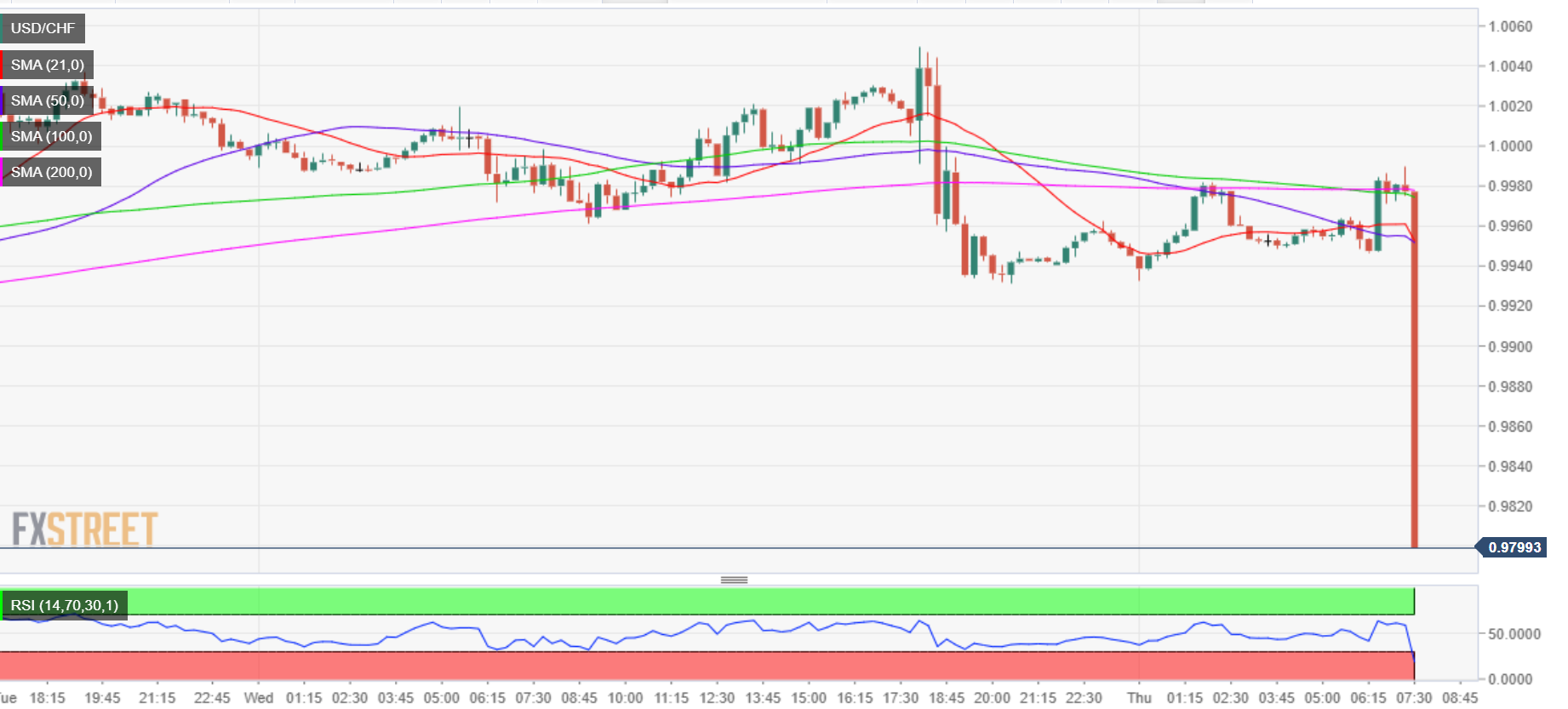
USD/CHF: 15-minutes chart
About SNB Rate Decision
The Swiss National Bank conducts the country’s monetary policy as an independent central bank. It is obliged by the Constitution and by statute to act in accordance with the interests of the country as a whole. Its primary goal is to ensure price stability, while taking due account of economic developments. In so doing, it creates an appropriate environment for economic growth.
The FOMC delivered a 75 bps hike. The US Dollar Index (DXY) snapped a five-day winning streak on Wednesday following the Federal Reserve's policy announcements. Economists at Scotiabank expect DXY to struggle to surpass the 105 area.
USD may struggle to improve
“For now, with the Fed looking fully priced and spreads not making new ground in the USD’s favour, the USD may struggle to improve.”
“Supportive cash bond spreads suggest the USD may not fall too far for now but unless yield differentials can make new highs, we still rather think the DXY will struggle to better the 105 area, where it peaked in May.”
European Central Bank (ECB) Governing Council member Ignazio Visco said on Thursday, the rise in inflation is mostly driven by energy–gas prices.
Key quotes
Inflation not driven by increase in demand.
We're acting to stop inflation genie to get out of bottle.
Market reaction
EUR/USD is back under 1.0400, as the US dollar springs back to life in the European session. The pair is down 0.45% on the day.
In the near-term, economists at Westpac look for AUD/USD to slip back to 0.69 or below, but the pair is still seen higher in Q3.
Aussie’s domestic fundamentals remain broadly supportive
“The Reserve Bank of Australia (RBA) is likely to reinforce the hawkish message in Lowe’s speech and minutes on Tuesday. Lowe will be comforted by the 60K jump in jobs in May and a record high employment/population ratio. But the nasty global combination of soaring inflation and slowing growth should cap equity prices.”
“Over the week we look for A$ to slip back to 0.6900 or below, but keep our 0.74 Q3 target.”
The Bank of England (BoE) will announce its interest rate decision and publish the Monetary Policy Summary later in the session. As markets expectations as set to remain unchanged, GBP/USD could recover to the 1.2250 region, economists at ING report.
25 bps from the BoE and no day of reckoning
“We look for a 25 bps hike from the BoE, taking the Bank rate to 1.25%. The market prices the Bank rate at 2.80% by the end of this year. Most of us think that at some point there will be a 'day of reckoning' for sterling when the BoE aggressively wants to correct market expectations. But we do not think that will be today.”
“EUR/GBP could correct back to the low 0.85s if the BoE leaves market expectations unchanged, while GBP/USD could be a pair to recover from a temporary lift in equity markets – potentially drifting up to the 1.2250 area.”
See – BoE Preview: Forecasts from nine major banks, hikes to continue until inflation improves
A proactive European Central Bank (ECB), recent yield surges with inflation and growth concerns are heightening “fragmentation” risks for indebted nations and will pressure EUR, according to economists at Westpac. They highlight that the EUR/USD pair could slide towards parity.
ECB needs to address the risks of “fragmentation”
“Higher debt servicing will exacerbate the cost of living crisis and broader inflation pressures from the conflict in Ukraine.”
“Eurozone dependency on Russian energy is acute in Germany but also across indebted periphery and southern nations, notably Italy and Greece. Consequently, ECB needs to address the risks of spread widening (or ‘fragmentation’) destabilising the eurozone. ECB has called on internal committees to draw up new instruments for ECB to consider.”
“EUR/USD is now vulnerable as it threatens to test 1.0340-50 (lows of past 7 years) amidst risk of sliding towards 1.01 if not parity, EUR needs to regain levels above 1.0550 to reduce current downside risks.”
The Swiss National Bank (SNB) meets today to set monetary policy. A hike would send the EUR/CHF pair 1-2% lower, economists at ING report.
SNB to guide EUR/CHF to the 0.98/1.00 area over the coming quarters
“A hike today would certainly be a big surprise and send EUR/CHF 1-2% lower. But even if the SNB does not hike today, it does have the FX firepower to strengthen its domestic currency.”
“Our call this year is that EUR/CHF upside is limited to the 1.05 area and that the SNB, one way or another, will guide EUR/CHF to the 0.98/1.00 area over the coming quarters.”
- USD/JPY attracted some buying on Thursday and was supported by modest USD strength.
- The Fed-BoJ policy divergence provided an additional lift, though the upside seems limited.
- The risk-off impulse, retreating US bond yields might hold back bulls from placing fresh bets.
The USD/JPY pair regained positive traction on Thursday and reversed a part of the overnight corrective pullback from a 24-year peak. The pair maintained its bid tone through the early European session and was last seen trading near the top end of its daily range, just below mid-134.00s.
As investors digest the FOMC policy decision, the emergence of some dip-buying around the US dollar turned out to be a key factor that extended some support to the USD/JPY pair. Apart from this, a big divergence in the monetary policy stance adopted by the Federal Reserve and the Bank of Japan acted as a tailwind for spot prices.
As was expected, the Fed on Wednesday raised interest rates by 75 bps - the biggest hike since 1994 - and also indicated a faster policy tightening path to bring price pressures under control. The so-called dot plot showed that the median year-end projection for the federal funds rate moved up to 3.4% from 1.9% in the March estimate.
On the other hand, the BoJ has repeatedly said that
it will stick to its ultra-loose policy settings until core inflation in Japan can stabilize near the 2% level. This, in turn, supports prospects for a further appreciating move for the USD/JPY pair, though a combination of factors might hold back bulls from placing aggressive bets.
In the post-meeting press conference, Fed Chair Jerome Powell said that he does not expect hikes of 75 bps to be common. Investors further took comfort from the view that the rate is forecast to decline to 2.5% over the long run. The outlook led to a further pullback in the US Treasury bond yields, which might cap gains for the USD/JPY pair.
Meanwhile, the Fed projected a slowing economy and rising unemployment in the months to come. Apart from this, concerns about the global supply chain disruptions caused by the Russia-Ukraine war and the latest COVID-19 outbreak in China took its toll on the global risk sentiment, which extended some support to the safe-haven JPY.
Traders also seemed reluctant and might prefer to wait for the BoJ monetary policy meeting on Friday, warranting some caution before positioning for any further gains. In the meantime, the US macro data - Philly Fed Manufacturing Index and the usual Weekly Initial Jobless Claims - should provide some impetus to the USD/JPY pair.
Technical levels to watch
Burgeoning political tensions both within the UK and with the EU and the increasing challenges the UK faces over high inflation and recession risks will continue to weigh on GBP, according to economists at Westpac. They note that cable is at risk of tumbling to 1.1410-25.
Political pressures are building again
“Markets are pricing in a steady series of rate hikes from BoE. The OIS market indicates over 30 bps pricing for this week, reflecting the bias for a more proactive BoE to fight surging inflation with the next updates for May inflation being released next week.”
“Not only is Johnson’s premiership remaining under question, but there are building pressures within the broader UK. Meanwhile, Scotland’s SNP First Minister Sturgeon has begun the process to try to hold another independence referendum. Both are likely to smoulder into through UK’s summer and sustain downside pressure on GBP.”
“Despite prospects of higher rates, GBP remains vulnerable to flushing towards 2020’s low of 1.1410-25, unless it can regain levels above 1.2275.”
The dollar is consolidating after yesterday's well-flagged 75 bps hike from the Federal Reserve. As the Fed wants policy rates in the 3.00/3.50% region by year-end, economists at ING expect the USD to trade near the highs this summer.
Dollar to remain bid on dips
“Powell said he wants the policy rate at 3.00-3.50% by year-end and the Fed dots tell us that the policy rate could be closer to 4.00% by the end of 2023. With inflation proving sticky this summer, there seems no reason for the Fed to back away from this hawkish messaging over coming months. That should keep the dollar supported on dips.”
“An additional factor favouring some dollar consolidation could be the temporary support to be found by equity markets into the end of June – as buy-side portfolio managers re-balance portfolios into equities.”
“For today, some softer US housing starts could drag the dollar a little lower, but a hawkish Fed should keep it bid on dips.”
“DXY should find support around the 104.50/60 area.”
In the view of economists at Westpac, JPY’s depreciation path is set to continue. The 137 level is the near-term target for USD/JPY.
USD/JPY’s path higher is set to continue
“Despite offering historic long-term value USD/JPY’s path higher is set to continue.”
“A clean break of 135.20 opens up a lot of fresh upside, perhaps initially eyeing 137.”
- GBP/USD remains pressured inside a short-term ascending triangle bearish formation.
- Impending bear-cross on the MACD also keeps sellers hopeful.
- Key HMAs guard upside momentum, yearly low on bear’s radar.
GBP/USD takes offers to refresh intraday low around 1.2125 heading into the Thursday’s London open.
In doing so, the cable pair sellers attack the support line of a three-day-old ascending triangle bearish chart pattern.
Also keeping the GBP/USD bears hopeful is the pair’s inability to cross the 100-HMA, as well as the bear cross between the MACD line and the Signal line.
That said, the quote’s clear break of the 1.2120 support could re-direct it towards the yearly low of 1.1933, marked on Tuesday.
However, 1.2040 and the 1.2000 psychological magnet may offer intermediate halts during the anticipated downturn.
Meanwhile, recovery moves may initially fade around the 100-HMA level of 1.2180, a break of which could challenge the aforementioned bearish triangle formation by poking the horizontal resistance line around 1.2210.
In a case where the GBP/USD prices rally beyond 1.2210, the 200-HMA level near 1.2355 might lure the pair buyers. Though, the 50% Fibonacci retracement of the June 07-14 downturn, near 1.2270, as well as the 1.2300 round figure, may act as buffers.
GBP/USD: Hourly chart
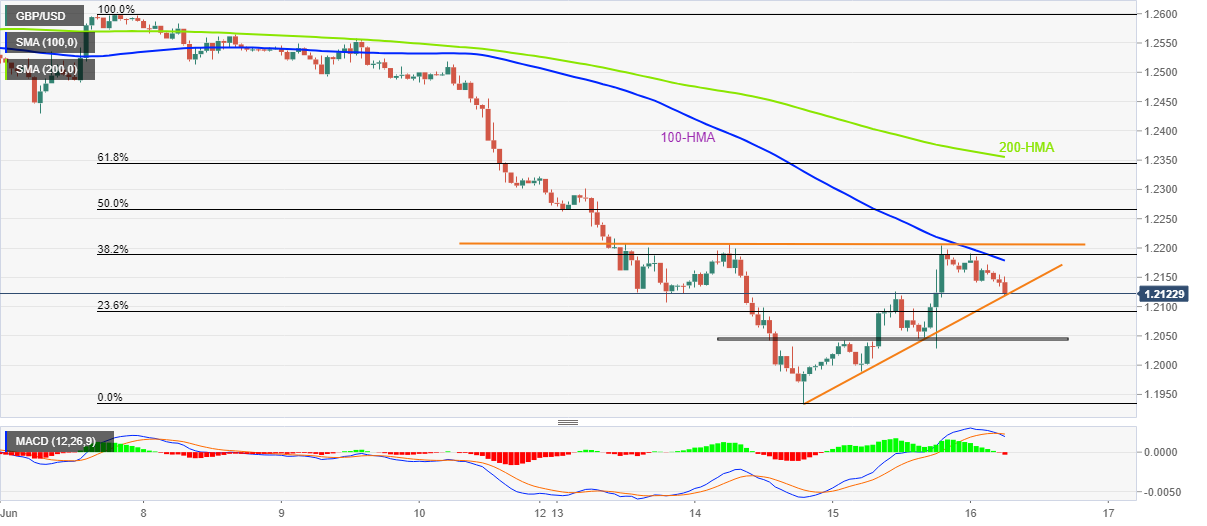
Trend: Further weakness expected
GBP/USD has lost its bullish momentum following Wednesday's rally. The British pound's fate depends on the Bank of England's policy decisions and the pair could test 1.22 if there is a hawkish surprise, FXStreet’s Eren Sengeze reports.
Pound could attack 1.22 on a hawkish BoE surprise
“Markets expect the bank to hike its policy rate by 25 basis points (bps) to 1.25% in June. In case the vote is unanimous on such a rate increase, this could be seen as a dovish development and cause the British pound to suffer losses against its rivals.”
“If the press release unveils that three or four policymakers have voted for a 50 bps hike, the initial reaction is likely to fuel a leg higher in GBP/USD. A surprise 50 bps hike should also boost the sterling.”
“The BoE could acknowledge the worsening economic outlook and refrain from committing to further aggressive tightening moves in the future. In that scenario, GBP/USD is likely to come under renewed bearish pressure even if the vote split were to point to a hawkish rate outlook.”
“In case the 1.2120 support fails, additional losses toward 1.2050 (static level) and 1.20(psychological level) could be witnessed.”
“Stiff resistance is located at 1.22 (Fibonacci 38.2% retracement). A four-hour close above that level could be seen as a bullish development and open the door for an extended rebound toward 123 (Fibonacci 50% retracement) and 1.2350 (50-period SMA).”
See – BoE Preview: Forecasts from nine major banks, hikes to continue until inflation improves
Economists at Commerzbank do not expect the Swiss National Bank (SNB) to hike today. Subsequently, the franc could see come under appreciation pressure.
Why act if it is not strictly necessary?
“We do not expect a rate hike. This is likely to put appreciation pressure on the franc, and why would the SNB risk that if it isn’t strictly necessary? The inflation rate for domestic goods stands at 1.5% and core inflation at 1.7%. That means price pressure is not high everywhere yet. As a result, the SNB might take some more time before hiking its key rate and might at least allow the ECB to take the first step.”
“No doubt the SNB will send out clear signals today indicating that the lift-off in Switzerland is imminent. Negative interest rates are clearly no longer justifiable under the current conditions. The market might nonetheless seem disappointed today if the SNB does not hike its key rate. However, external factors are likely to soon regain control again, determining the franc’s exchange rates once again.”
The Bank of England (BOE) is expected to hike its policy rate by 25 basis points to 1.25%. A hawkish “Old Lady” could fuel concerns of a hard landing and put pressure on sterling, according to economists at Commerzbank.
It is difficult to predict how sterling is going to react
“The BoE is likely to hike its key rate from 1% to 1.25%, with some market participants expecting a 50 bps hike, which cannot be excluded considering high inflation rates of recently 9%.”
“At present, the market expects a number of further rate hikes this year. It will have to be seen whether the BoE supports these expectations today.”
“It is difficult to predict how sterling is going to react. Is it positive for Sterling if the BoE is hawkish? Or would this fuel concerns of a hard landing and put pressure on sterling? Considering the current market sentiment, I would expect the latter.”
See – BoE Preview: Forecasts from nine major banks, hikes to continue until inflation improves
The Federal Reserve hiked its policy rate by 75 basis points in June to the range of 1.5% to 1.75%. Save for a decent risk reprieve, economists at TD Securities do not think this necessarily marks an inflection point for the FX complex or even risk sentiment more generally.
Nimbler still
“Fed officials delivered a 75 bps increase in the Fed Funds target range to 1.50%-1.75%. The Fed Chair argued that recent strong CPI data and rising inflation expectations led the Committee to opt for a larger rate increase at this meeting despite guiding markets for a 50 bps rate hike prior to the blackout period. The Fed remains nimble and ever more data-dependent.”
“We remain of the view that the Committee wants to get to their longer-term neutral policy rate rather quickly in the face of still robust demand and an unbalanced labor market. We expect them to do so with another 75 bps rate increase next month. In addition, while the Fed remains highly data-dependent, we do not anticipate inflation data will offer any respite in the short-term.”
“The Fed tries to buy optionality by more explicitly linking the size of hiking increments to MoM core CPI. We likely see a mild USD reprieve, but it remains premature to strategically fade the USD given the outlook for core is still troubling. We see growing risks of a perverse effect of higher rates to FX.”
- DXY pares the heaviest daily fall in a fortnight as Treasury yields struggle to extend Fed-inspired losses.
- Treasury yields fail to recover much but remain above post-Fed trough.
- Markets struggle to hold recent optimism amid a lack of major data/events.
- Second-tier US data, Friday’s speech from Fed Chair Powell eyed for clear directions.
US Dollar Index (DXY) reverses the post-Fed losses during early Thursday morning in Europe. That said, the greenback gauge versus the six major currencies retreat from an intraday high of 105.11 to 105.00 by the press time. Even so, the DXY prints 0.15% daily gains at the latest.
US 10-year Treasury yields fade rebound from an intraday low of 3.288% to 3.30% while posting daily losses for the second consecutive day, down 8.6 basis points (bps) at the latest. It’s worth noting that the bond coupons dropped the most since early March after the US Federal Reserve announcements.
On Wednesday, the US Federal Reserve (Fed) unveiled the biggest interest rate hike since 1994 to battle inflation fears. The US central bank also revised inflation forecasts for this year and the next while cutting down the inflation expectations. Further, the policymakers also signaled either a 50 bp or 75 bp rate hike in the next meeting. However, the Fed’s rejection of the odds of a 100 bp rate increase and Chairman Jerome Powell’s measured comments seem to have downed the Treasury bond yields afterward.
It’s worth noting that the downbeat US data also weighed on the US Dollar Index the previous day. US Retail Sales marked a contraction of 0.3% MoM versus an anticipated growth of 0.2% and downwardly revised 0.7% in previous readings. Also, the NY Empire State Manufacturing Index dropped to -1.2 compared to 3.0 market consensus and -11.6 prior.
Looking forward, the second-tier housing and activity data from the US may entertain equity traders ahead of Friday’s speech from Fed Chair Jerome Powell. Should the policymaker reiterate hawkish expectations from the US economy and turns down expectations of witnessing 100 bps rate hikes, as some in the markets expect, the DXY could have further upside to track.
Technical analysis
A daily closing below the 5-DMA level surrounding 104.95 appears necessary for the DXY to convince short-term sellers. Otherwise, further upside momentum towards the 106.00 threshold can’t be ruled out.
Making some comments on the country’s oil production levels, Russian Deputy Prime Minister Alexander Novak said that they can increase oil output next month.
Novak added that the Russian oil production is restored as oil flows are redirected.
more to come ...
The Federal Reserve hiked the target range by 75 bps to 1.50-1.75%. Economists at Danske Bank still expect EUR/USD to move to parity in 12 months.
Big rate hikes until inflation pressure eases
“Fed Chair Jerome Powell mentioned that the Fed can hike by another 75 bps in July but that we should not expect a series of 75 bps rate hikes. This sounds very similar to the May meeting when Powell mentioned that the committee was not ‘actively considering’ 75 bps. As long as inflation remains high, the Fed is forced to deliver.”
“We change our Fed call now expecting the Fed to hike by 75 bps in July and 50 bps in September, November and December. If we are right, the Fed funds target range would be 3.75-4.00% by year-end (vs. Fed dot of 3.375% and market pricing of 3.5%).”
“We still see risks skewed towards faster and more tightening given the inflation outlook. Our base case is that the US falls into a recession in Q2 23 but the faster hiking pace increases the risk that it starts earlier.”
“We see inflation prints as remaining high amid a cyclical slowdown. If data confirms this, then we also expect Fed to underpin our forecast for seeing EUR/USD towards parity in 12M..”
“We see upside risks to our UST 10yr yield target of 3.50% in 3-6M.”
The FOMC raised the Fed Funds Target Range by 75 bps to 1.50-1.75%. What’s more, the committee is transitioning into a more aggressive policy stance by pulling policy rates into restrictive levels by next year and keeping them there for two years, economists at Nordea report.
Catching the inflation curve
“The FOMC raised the Fed Funds Target Range by 75bps to 1.50-1.75% with only one dissenter (Esther George, the otherwise hawkish official, who opted for a 50 bps hike).”
“The new dot plot shows a median Fed Funds Target Range at 3.25-3.50% at end-2022; 3.75-4.0% at end- 2023; followed by two cuts in 2024 to 3.25-3.50%, and the longer-run median dot edging back up to 2.5% from 2.375%.”
“The FOMC statement dropped the expectation of a strong labor market, instead it emphasized that the committee is ‘strongly committed’ to returning inflation to the target.”
“The Summary of Economic Projections now show a substantial downgrade to GDP growth, an increase in the unemployment rate, and slightly higher inflation before returning to the target range at 2%.”
Here is what you need to know on Thursday, June 16:
The US Dollar Index (DXY) snapped a five-day winning streak on Wednesday following the Federal Reserve's policy announcements. The dollar selloff, however, seems to have eased early Thursday with the benchmark 10-year US Treasury bond yield regaining its traction. The Bank of England (BOE) will announce its interest rate decision and publish the Monetary Policy Summary later in the session. The weekly Initial Jobless Claims, May Housing Starts and Building Permits will be featured in the US economic docket.
The Fed hiked its policy rate by 75 basis points in June to the range of 1.5% to 1.75%. During the press conference, FOMC Chairman Jerome Powell refrained from confirming another 75 bps hike in July and caused US T-bond yields to retreat. In turn, the dollar struggled to preserve its strength. “It does appear the US economy is strong and well-positioned to withstand higher interest rates," Powell said.
Commenting on the FOMC event, "Mr. Powell managed to reassure markets, which are his main audience, but his words will do little to buoy spirits across the country," noted FXStreet Analyst Joseph Trevisani. "Americans will make their own decisions. Unless there is a swift and dramatic improvement in inflation, the window for a soft-landing has probably already closed."
The Fed does not want to induce a recession but is there any choice?
The BOE is expected to hike its policy rate by 25 basis points to 1.25%. There won't be a press conference after the bank releases its statement and the vote split could trigger a significant market reaction.
BOE Preview: A surprise 50 bps rate hike on the table?
EUR/USD closed modestly higher on Wednesday and seems to have gone into a consolidation phase above 1.0400 early Thursday. Following its ad hoc meeting, the European Central Bank (ECB) announced that it will apply flexibility in reinvesting the Pandemic Emergency Purchase Programme (PEPP) redemptions with a view to preserving the functioning of monetary policy transmission mechanisms.
GBP/USD gained nearly 200 pips and rose above 1.2200 on Wednesday. The pair trades in negative territory in the European morning near mid-1.2100s.
BOE Preview: Why GBP/USD set to suffer even in response to a 50 bps hike, a lose-lose event.
USD/CHF reversed its direction and closed in negative territory below 1.0000 on Wednesday after having registered gains in the previous eight trading days. The Swiss National Bank (SNB) will announce its interest rate decision at 0730 GMT.
AUD/USD capitalized on risk flows and recovered above 0.7000 late Wednesday. During the Asian trading hours, the data from Australia showed that Employment Change was +60.6K in May, compared to the market expectation of +25K. The pair stays relatively quiet at around 0.7000 early Thursday.
USD/JPY fluctuates in a narrow range above 134.00 after having lost more than 100 pips on Wednesday. In the early trading hours of the Asian session on Friday, the Bank of Japan will announce its monetary policy decisions.
BOJ Preview: Slim chance for a tweak in YCC policy.
Gold benefitted from the sharp decline witnessed in US Treasury bond yields and registered impressive gains on Wednesday. The yellow metal moves sideways slightly above $1,830 in the European session.
Bitcoin managed to stage a rebound after having tested $20,000 on Wednesday. BTC/USD was last seen trading at around $22,000. Despite having registered small gains on Thursday, Ethereum is down 17% so far this week and stays on the back foot near $1,200 early Thursday.
European Central Bank (ECB) Vice President Luis de Guindos looks to calm markets on growing concerns over fragmentation while speaking in a media interview on Thursday.
Key quotes
Markets should not doubt how determined we are to address fragmentation.
Fragmentation has always been a concern for the ECB.
PEPP was launched with flexibility in mind, and this applies to the reinvestment phase as well.
We also decided yesterday to mandate the relevant committees to accelerate the completion of the design of a new anti-fragmentation instrument.
Inflation is very high, more persistent and broad-based than we thought some months ago.
We intend to raise rates by 0.25% in July.
For September, we can consider a bigger increase if inflation is defined as a quantitative measure of the rate in which the average price level outlook persists or deteriorates.
Related reads
- ECB bond-buying scheme likely to have loose conditions – Reuters
- EUR/USD faces hurdle around 1.0450 as DXY turns sideways, Eurozone HICP eyed
Gold Price has entered a phase of consolidation so far this Thursday. Where is XAUUSD headed next? As FXStreet’s Dhwani Mehta notes, bulls face exhaustion at the 200-Daily Moving Average (DMA) around $1,842.
Sustained move below $1,820 to revive selling interests
“If the sentiment around the yields continues to remain undermined, in the Fed’s aftermath, it could also keep the dollar broadly under pressure. Risk sentiment, however, is weakening and could likely revive the haven demand for the greenback, which in turn, may extend the retreat in gold.”
“The daily chart shows that the rebound in gold price remains capped below the critical horizontal 200-DMA at $1,842. Bulls need acceptance above the latter on a daily closing basis to extend the recovery moment. The next stop for bulls is seen at the mildly bullish 21 DMA at $1,847. Further up, the $1,850 psychological level will be challenged.”
“A sustained move below the $1,820 round figure will revive selling interests, calling for a towards Monday’s low of $1,810. Strong support appears near $1,807-$1,805, which will be the level to beat for gold bears.”
- Gold Price consolidates the biggest daily gains in four weeks, mildly offered of late.
- DXY recovers as US Treasury yields fail to extend post-Fed losses despite holding lower ground.
- Risk catalysts and second-tier data may entertain traders ahead of Friday’s speech from Fed Chair Powell.
Gold Price (XAUUSD) fades the Fed-inspired recovery as it retreats to $1,830 ahead of Thursday’s European session. The yellow metal rallied the most in a month the previous day after the Federal Reserve (Fed) roiled the markets. The bullion’s latest weakness, however, could be linked to the US dollar’s recovery moves amid a sluggish trading session.
Yields keep XAUUSD bears hopeful
The US 10-year Treasury yields rebound from an intraday low of 3.288% to 3.32% by the press time. Even so, the benchmark bond coupons remain negative for the second consecutive day, down 7.3 basis points (bps) at the latest. It’s worth noting that the bond coupons dropped the most since early March after the US Federal Reserve announcements.
Also read: Gold Price Forecast: XAUUSD bulls face exhaustion at 200 DMA, what’s next?
Gold Price cheered Fed action but bulls stay cautious

Bank note and a gold bullion
On Wednesday, the US Federal Reserve (Fed) announced the biggest interest rate hike since 1994 to battle inflation fears. The US central bank also revised inflation forecasts for this year and the next while cutting down the inflation expectations. Further, the policymakers also signaled either a 50 bp or 75 bp rate hike in the next meeting. However, the Fed’s rejection of the odds of a 100 bp rate increase and Chairman Jerome Powell’s measured comments seem to have triggered a relief rally in the Gold Price. However, major central banks remain on the path of higher rates, which in turn favors the bond sellers and weighs on XAUUSD prices.
China-linked headlines to test buyers
Headlines from China seem to exert downside pressure on the gold prices of late. Be it the coronavirus fears or the Sino-American rivalry, recently over Taiwan, the pessimism surrounding one of the world’s biggest gold consumers challenges the XAUUSD rebound. It’s worth noting that overseas investors appear to have lost confidence in China, which in turn suggests further hardships for the dragon nation. “Overseas investors reduced holdings of Chinese bonds for a fourth consecutive month in May, and at the fastest rate in nearly five-and-a-half years, as diverging monetary policy kept Chinese yields pinned below their U.S. counterparts,” said Reuters.
Options market portrays seller’s dominance
The options market continues to flash the traders’ bearish bias, despite the previous day’s corrective pullback in Gold Price. That said, an index to gauge options market mood, namely the risk reversal (RR) braces for the biggest weekly fall in a month with the current print of -1.120. It’s worth noting that the RR is a difference between the market bullish and bearish bets, respectively known as calls and puts.
Fed’s Powell eyed
Fed Chairman Jerome Powell is up for a speech at the Inaugural Conference on the International Roles of the US Dollar, in Washington DC, on Friday. The US central banker recently praised the US economic transition and tamed the market’s fears of higher rates while showing readiness to reach a 2.0% inflation target. Should the policymaker reiterate hawkish expectations from the US economy and turns down expectations of witnessing 100 bps rate hikes, as some in the markets expect, the XAUUSD will have more downside to track.
Gold Price technical outlook
Gold Price fades the Fed-inspired rebound from a one-month-old horizontal resistance while reversing from 23.6% Fibonacci retracement of April-May downside. The pullback moves, however, remain doubtful amid a recovery in the RSI (14) line and recently firmer MACD signals.
Even so, an upside clearance of the $1,837 immediate resistance may not be enough to recall the XAUUSD buyers as a convergence of the 100-SMA and 200-SMA, around $1,848, will be a strong resistance to watch. Should the quote rises past $1,848, an upward sloping trend line from May 24, near $1,880, will act as an extra filter to the north.
Alternatively, pullback moves could eye to retest the aforementioned monthly support near $1,805. Following that, the $1,800 threshold will act as a validation point for the further downside of the Gold Price.
In that case, the previous monthly low near $1,786 and 61.8% Fibonacci Expansion (FE) of April-May moves, near $1,748, will gain the market’s attention.
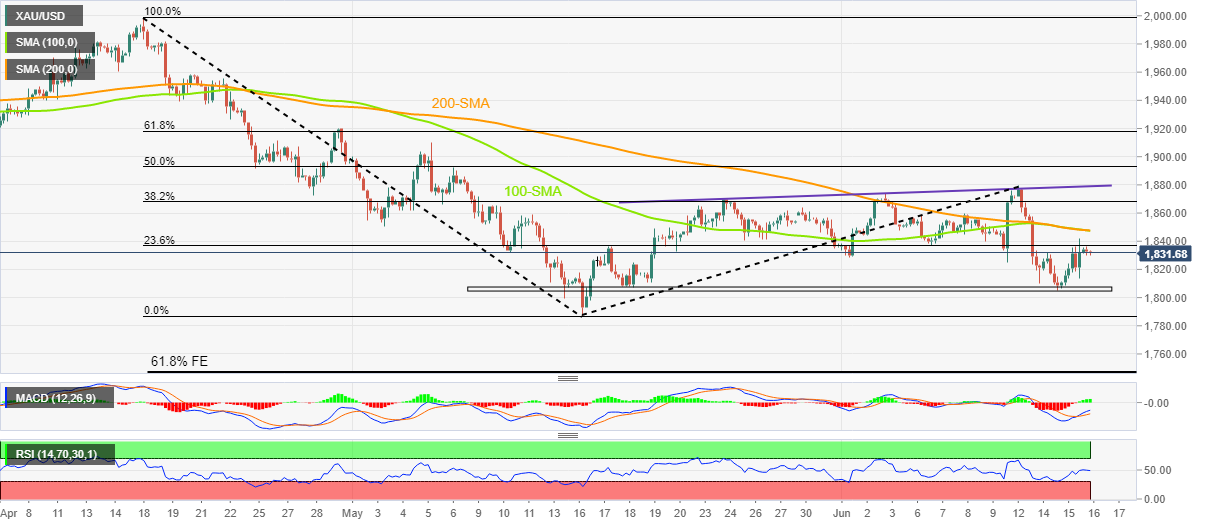
The Fed to set gold surging?
FX option expiries for June 16 NY cut at 10:00 Eastern Time, via DTCC, can be found below.
- EUR/USD: EUR amounts
- 1.0500 325m
- USD/CAD: USD amounts
- 1.2700 490m
- 1.3200 470m
- GBP/JPY is expected to find buyers around 163.00 ahead of the hawkish BOE.
- Lower GDP and higher jobless rate may restrict the BOE to see beyond a 25 bps rate hike.
- The BOJ will continue with its ultra-loose monetary policy on Friday.
The GBP/JPY pair is gauging cushion around 163.00 after a corrective move from 163.80 in the late Tokyo session. On a broader note, the cross is gradually advancing higher after hitting a two-week low of 161.66 on Tuesday.
In today’s session, the interest rate decision by the Bank of England (BOE) will dictate the further price action. Considering the estimates, the BOE may announce a rate hike by 25 basis points (bps), which will push its benchmark rate to 1.25%. The UK economy is facing the headwinds of soaring inflation. Tackling an annual inflation figure of 9% is not a cakewalk in times when the economy is failing to generate employment opportunities and elevate growth prospects.
The UK Office for National Statistics reported a slump in the Gross Domestic Product (GDP) figures. The monthly UK GDP turned negative, landing at -0.3% against the expectation of 0.2%. On the labor market front, the economy reported the jobless rate at 3.8%, however, the Average Earnings excluding bonuses remained stable at 4.2% against its prior print.
Meanwhile, the yen bulls are expected to underperform as the Bank of Japan (BOJ) is expected to withstand with its ultra-loose monetary policy. The BOJ will announce its monetary policy on Friday. Despite the fact that the inflation rate in Tokyo has crossed the 2% target, the BOJ will flush liquidity into the economy. Higher price pressures are majorly contributed by firmer oil prices, however, broad-based recovery in the aggregate demand is demanded in the Japanese economy.
- USD/KRW takes the bids to snap two-day downtrend, extends bounce off weekly low.
- South Korean FinMin announces worrisome GDP, inflation forecasts.
- US dollar rebound adds strength to the pair’s recovery moves amid a sluggish session.
USD/KRW justifies the South Korean government’s pessimistic economic forecasts as it jumps back to $1,287 while snapping a two-day downtrend, heading into Thursday’s European session.
Early Thursday morning in Asia, South Korea Finance Minister (FinMin) Choo Kyung-ho announced multiple measures to ward off the economic fears, as well as tame inflation woes. The official statement lowers the 2022 growth forecast to 2.6% from the previous projection of 3.1%. the inflation predictions were also increased to 4.7% from 2.2%.
The Asian nation also planned to extend USD/KRW trading hours, improve access for foreign dealers. Further, Reuters also said, “South Korea plans to cut maximum corporate tax rate to 22% from 25%.”
It’s worth noting that the chatters surrounding hopes of more market intervention also grew stronger on the South Korean FinMin’s comments. “We are putting our utmost priority in stabilizing prices as that's our shared understanding," finance minister Choo Kyung-ho said, referring to Bank of Korea (BOK) Governor Rhee Chang-Yong and other top policymakers, with whom he had met early on Thursday,” per Reuters.
On the other hand, the US Dollar Index (DXY) pares the Fed-inspired losses as the US Treasury yields fail to extend post-Fed downside under the previous day’s low of 3.28%. despite losing seven basis points (bps) on a day to 3.32% by the press time.
Technical analysis
Despite the latest rebound, the double tops surrounding $1,295-96, as well as the $1,300 threshold, challenge the USD/KRW buyers. On the contrary, a weekly support line of around $1,272 restricts the short-term downside.
The European Central Bank (ECB) is likely to attach some loose conditions to a potential scheme designed to cap borrowing costs for the eurozone's most indebted states in a bid to avoid fragmentation risks, Reuters reported, citing sources.
Key takeaways
“The scheme would likely have conditions, such as that countries comply with the European Commission's economic recommendations.”
“The ECB will spell out that the scheme's goal is simply to keep bond spreads in line with their economic fundamentals, rather than bringing them to near-zero like they were before a crisis of confidence a decade ago.”
Market reaction
EUR/USD holds steady below 1.0450 on these above headlines, mainly at the mercy of the dollar dynamics.
- USD/CAD picks up bids to consolidate the biggest daily fall in two weeks.
- Treasury yields fail to extend post-Fed downside despite being pressured of late.
- Oil prices remain pressured amid growth fears, hopes that US can help recede the supply crunch.
- US housing numbers, activity data to entertain intraday traders.
USD/CAD regains upside momentum, following the post-Fed pullback from a monthly high, as oil buyers and yields both fade the latest corrective moves. That said, the Loonie pair recovers from its intraday low to 1.2890 during early Thursday morning in Europe.
The US 10-year Treasury yields rebound from an intraday low of 3.288% to 3.32% by the press time. Even so, the benchmark bond coupons remain negative for the second consecutive day, down 7.3 basis points (bps) at the latest.
Elsewhere, WTI crude oil prices retreat towards an intraday low of $113.40, around 113.65 at the latest.
While the bond coupons’ sluggish moves could be linked to the fears of more interest rate hikes from global central bankers, oil had an additional reason, emanating from the US, to pare the latest gains.
US President Joe Biden, in a letter, demanded oil companies explain why they aren't putting more gasoline on the market, sharply escalating his rhetoric against the industry. The same joins fears of energy demand amid rising interest rates and concerns surrounding economic slowdown.
Amid these plays, US stock futures remain firmer while tracking the Wall Street benchmarks whereas the Asia-Pacific equities also grind higher during a sluggish session.
Looking forward, the second-tier housing and activity data from the US, as well as Canada’s Manufacturing Sales, may entertain equity traders ahead of Friday’s speech from Fed Chair Jerome Powell.
Technical analysis
USD/CAD bears need validation from the 1.2880-70 resistance area comprising multiple levels marked since late February. Until then, the Loonie pair remains directed towards an upward sloping resistance line from August 2021, at 1.2985 by the press time.
- EUR/GBP is oscillating below 0.8600 as investors await an interest rate decision by the BOE.
- The BOE is expected to raise its interest rates by 25 bps to 1.25%.
- The inflation figures in the eurozone are expected to remain stable.
The EUR/GBP is displaying back and forth moves in a narrow range of 0.8569-0.8596 from the late New York session. Earlier, the pair witnessed a perpendicular downside move after failing to surpass the critical hurdle of 0.8520 on Wednesday. A minor consolidation range after a sheer downside fall indicates an initiative selling structure, which may bring further downside in the cross.
Investors are expected to remain on the sidelines until the announcement of the interest rate decision by the Bank of England (BOE). As per the market consensus, the BOE is expected to elevate its interest rate by 25 bps. Considering the mounting price pressures, the BOE should go for an unconventional rate hike. However, the downbeat Gross Domestic Product (GDP) and higher Unemployment Rate released this week, has restricted the BOE to explore extreme policy tightening measures.
This week, the UK Office for National Statistics reported the monthly GDP at -0.3% vs. 0.2% forecasted. While the UK jobless rate climbed to 3.8% from the expectations of 3.6%.
On the eurozone front, the release of the Harmonized Index of Consumer Prices (HICP) will be the major event, which will be on investors’ radar. The HICP figure is expected to remain stable at 8.1% on an annual basis. Also, the core HICP that doesn’t include food, energy, alcohol, and tobacco is seen unchanged at 3.8%.
- Asia-Pacific shares remain firmer as Wall Street tracked downbeat Treasury yields after Fed’s 75 bp rate hike.
- MSCI’s gauge of equity rises for the first time in six days.
- Mixed Aussie jobs report test Aussie bulls, pre-BOE cautious, light calendar add to the trading filters.
Asian markets post the biggest daily gains in over a week during early Thursday as Fed’s 75 basis points (bps) rate hike appears a one-time affair. The regional equities also cheered downbeat Treasury yields and an absence of major negatives from the macro front. However, the cautious mood ahead of the Bank of England’s (BOE) monetary policy meeting and a speech from Fed Chair Jerome Powell seems to poke the bulls.
That said, the MSCI’s index of Asia-Pacific shares ex-Japan snaps a five-day downtrend with a 0.30% daily gain while Japan’s Nikkei 225 rose 1.15% by the press time.
The stocks in Australia and New Zealand (NZ) fail to portray the bull’s dominance amid downbeat NZ Q1 GDP and mixed Aussie employment numbers. Australia’s ASX has further negatives to consider as China looks for a centrally-controlled iron ore seller. Further, shares in China and South Korea were also positive, like in Japan, as technology companies reaped the benefits of the post-Fed bond buying.
Elsewhere, India and Indonesia are on the same line while posting mild gains as markets cheer post-Fed declines in the US Treasury yields.
On a broader front, the US 10-year Treasury yields rebound from an intraday low of 3.288% to 3.364% by the press time. Even so, the benchmark bond coupons remain negative for the second consecutive day, down 3.1 basis points (bps) at the latest. Additionally, the S&P 500 Futures track Wall Street’s gains with a 0.54% intraday run-up to 3,813 by the press time.
It’s worth noting that the US Federal Reserve (Fed) announced the biggest interest rate hike since 1994 to battle inflation fears. The US central bank also revised up inflation forecasts for this year and the next while cutting down the inflation expectations. Further, the policymakers also signaled either a 50 bp or 75 bp rate hike in the next meeting. However, the Fed’s rejection of the odds of a 100 bp rate increase and Chairman Jerome Powell’s measured comments seem to have drowned the Treasury yields and the US dollar afterward.
Moving on, the Bank of England’s (BOE) monetary policy, the second-tier housing and activity data from the US and risk catalysts may entertain equity traders ahead of Friday’s speech from Fed Chair Jerome Powell.
Also read: S&P 500 Futures stay firmer even as US Treasury yields struggle to keep post-Fed losses
- EUR/USD is oscillating below 1.0450 as investors await Eurozone HICP.
- The eurozone inflation is expected to remain unchanged at 8.1% on an annual basis.
- Last week’s upbeat US inflation compelled the Fed to dictate a 75 bps rate hike.
The EUR/USD pair is experiencing barricades around 1.0450 as the US dollar index (DXY) has turned sideways after a pullback move from 104.66. The shared currency bulls witnessed a responsive buying action after hitting a low of 1.0370 on Wednesday.
A responsive buying action was recorded after the announcement of a bumper rate hike by the Federal Reserve (Fed). The Fed paddled its interest rates by 75 basis points (bps), higher than the consensus of 50 bps. It is worth noting that the release of the upbeat US inflation last week had pushed the consensus wheel to 75 bps as an 8.6% inflation figure demands a quick response from the authorities.
A bumper rate hike announcement brought an extreme sell-off in the DXY. The DXY is attempting a break above the psychological resistance of 105.00 but is likely to meet with significant offers by the initiative sellers.
Going forward, the asset will be driven by the Eurozone Harmonized Index of Consumer Prices (HICP), which will release on Friday. An annual HICP figure is expected to remain stable at 8.1%. Also, the core HICP that excludes food, energy, alcohol, and tobacco is seen unchanged at 3.8%.
EUR/USD technical analysis
The asset has formed a Spring near its potential support at 1.0397 on an hourly scale, which represents a buying tail. A buying tail is a responsive buying action, which takes place when investors find the asset a value bet. The 50-period Exponential Moving Average (EMA) is overlapping with the asset price, which signals a consolidation ahead. Meanwhile, the Relative Strength Index (RSI) (14) has shifted to 40.00-60.00, which adds to the consolidation filters.
EUR/USD hourly chart
-637909511347798029.png)
- AUD/USD remains mildly bid despite retreating from the daily top.
- Convergence of 100-HMA, two-day-old support line restrict immediate downside.
- 200-HMA, 61.8% Fibonacci retracement level join overbought RSI to challenge upside momentum.
AUD/USD stays defensive above 0.7000, up 0.21% intraday as it retreats from the daily top during early Thursday in Europe.
The Aussie pair’s latest weakness could be linked to the nearly overbought RSI conditions, as well as failure to cross the 50% Fibonacci retracement (Fibo.) of June 08-14 downside.
However, the quote remains above the 0.6980 support confluence, including the 100-HMA and an upward sloping trend line from Tuesday, which in turn tests sellers.
In addition to the 0.6980 level, the previous resistance line from June 08, near 0.6945, will also challenge the AUD/USD bears before directing them to the 0.6850-55 support area.
On the flip side, the 50% Fibo. level surrounding 0.7040 lures the intraday buyers of the AUD/USD pair. Though, a confluence of the 200-HMA and 61.8% Fibonacci retracement, around 0.7085, appears a tough nut to crack for the bulls.
Should the quote rises past 0.7085, the last Friday’s high near 0.7140 and the monthly top surrounding 0.7230 will be in the spotlight.
To sum up, AUD/USD prices remain pressured despite the latest rebound. However, the fresh downside needs validation from 0.6980.
AUD/USD: Hourly chart
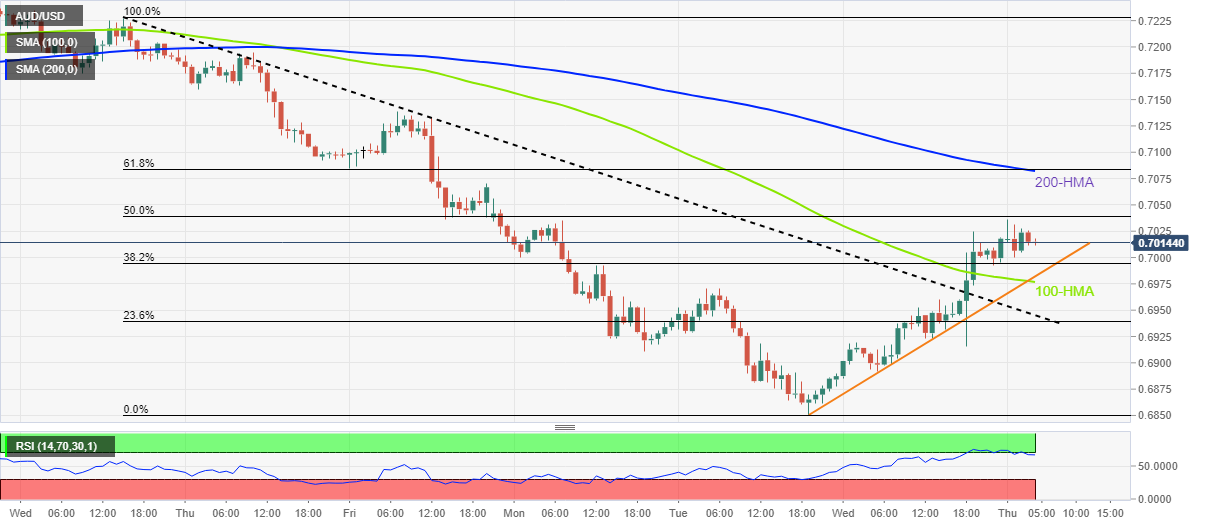
Trend: Limited upside expected
- USD/INR is expected to remain weaker on positive market sentiment.
- A 75 bps rate hike by the Fed has activated the ‘Buy on Rumor and Sell on News’ indicator for the DXY.
- Weak oil prices are expected to benefit the Indian rupee.
The USD/INR pair is displaying a subdued performance at the open amid an overnight rate hike by the Federal Reserve (Fed). The Fed elevated its interest rates by 75 basis points (bps), which cheered the market mood and sent the US dollar index (DXY) into a negative trajectory.
This week the pair has remained sideways in a range of 77.92-78.30 as investors were awaiting a rate hike announcement by the Fed and the constant outflow of Foreign Institutional Investors (FIIs)’s funds from the Indian bourses. The Fed went beyond the consensus of 50 bps and elevated its interest rates to 1.50-1.75% considering the mounting price pressures. Thanks to the solid growth prospects and a tight labor market which supports Powell and Co. to dictate a bumper rate hike.
The US dollar index (DXY) slipped heavily on activation of the ‘Buy on Rumor and Sell on News’ indicator. The DXY is establishing below the psychological support of 105.00 on the announcement of a 75 bps rate hike for the first time since 1994. A slippage in the safe-haven’s appeal has benefitted the risk-sensitive currencies.
Meanwhile, a slippage in oil prices is expected to support the Indian rupee further. A higher interest rate announcement by the Fed has trimmed the growth forecasts significantly. As per Powell’s press conference after the monetary policy announcement, the Fed would be happy with a 4.1% jobless rate too if inflation gets cool down. An increase in the jobless rate will shrink the aggregate demand and henceforth the demand for oil.
- Kiwi bulls look firmer above 23.6% Fibo retracement placed at 0.6286.
- The 20- and 50-period EMAs have displayed a bull cross at 0.6265, which strengthens the antipodean.
- A decisive move by the RSI (14) above 60.00 will confirm an upside momentum.
The NZD/USD pair has turned sideways after a vertical upside move on Wednesday. The asset attracted significant bids to near 0.6200 and advanced firmly and now has turned sideways in a 0.6262-0.6310 range.
On an hourly scale, the asset has surpassed the 23.6% Fibonacci retracement (which is placed from June 3 high at 0.6576 to Tuesday’s low at 0.6196) at 0.6286. The pair is expected to display a consolidation phase going forward, which will turn into a fresh leg of upside momentum. Also, an establishment above 23.6% Fibo retracement warrant a bullish reversal.
The 20- and 50-period Exponential Moving Averages (EMAs) have displayed a bull cross at 0.6265, which adds to the upside filters.
Meanwhile, the Relative Strength Index (RSI) (14) is attempting to cross the 60.00 hurdle, which will infuse an adrenaline rush into the kiwi bulls.
A decisive move above Thursday’s high at 0.6311 will drive the asset towards 38.2% Fibo retracement at 0.6341, followed by June 9 low at 0.6379.
Alternatively, the greenback bulls could regain control if the asset drops below Wednesday’s low at 0.6214, which will drag the asset towards Tuesday’s low at 0.6196. A breach of the latter will expose the major to more downside towards the 26 May 2020 low at 0.6094.
NZD/USD hourly chart
-637909464210189229.png)
- GBP/USD fades post-Fed rebound amid Brexit woes, pre-BOE anxiety.
- EU’s legal action over UK’s Brexit move rejuvenates the old and slow play.
- Fed’s 75 bp move pushes BOE to announce something more than 0.25% rate hike.
- Second-tier US data, risk catalysts eyed for extra directions.
GBP/USD remains mildly offered around 1.2160, despite the latest bounce off intraday lows, as the cable traders brace for the Bank of England’s (BOE) monetary policy meeting during early Thursday. The cable pair’s latest losses could also be linked to the US dollar rebound and sluggish Treasury yields, not to forget Brexit woes.
UK’s decision to unilaterally alter the Northern Ireland Protocol (NIP) witnessed legal retaliation from the European Union (EU), as expected. In this regard, European Commission vice-president Maros Sefcovic said the UK’s move had “no legal or political justification”, per The Independent. On the same line were comments from European Central Bank President Christine Lagarde who said, "Reneging on a rule of law that has been established by mutual agreement, without any duress, without proper consideration is a very big issue, and one that we should all be concerned about for the future," per Reuters.
Additionally weighing on the GBP/USD could be the chatters surrounding the UK’s food inflation to 15% as the BOE’s 0.25% rate hike seems less effective for such a heavy price increase. “Food price inflation in Britain is likely to peak at up to 15% this summer and high levels will persist into 2023, industry researcher the Institute of Grocery Distribution (IGD) said on Thursday,” per Reuters.
On the other hand, the US Dollar Index (DXY) regains the 105.00 level after reversing from a 20-year high the previous day despite the Fed’s 0.75% rate hike. On Wednesday, the US Federal Reserve (Fed) announced the biggest interest rate hike since 1994 to battle inflation fears. The US central bank also revised inflation forecasts for this year and the next while cutting down the inflation expectations. Further, the policymakers also signaled either a 50 bp or 75 bp rate hike in the next meeting. However, the Fed’s rejection of the odds of a 100 bp rate increase and Chairman Jerome Powell’s measured comments seem to have drowned the Treasury yields and the US dollar afterward.
Also previously helped the GBP/USD buyers were the downside US data, namely Retail Sales and NY Empire State Manufacturing gauge. That said, US Retail Sales marked a contraction of 0.3% MoM versus an anticipated growth of 0.2% and downwardly revised 0.7% in previous readings. Also, the NY Empire State Manufacturing Index dropped to -1.2 compared to 3.0 market consensus and -11.6 prior.
Looking forward, further consolidation of the post-Fed moves could weigh on the GBP/USD prices as the US Treasury yields bounce off intraday low to 3.35% by the press time.
However, major attention will be given to the BOE’s likely actions. It’s worth noting that the “Old Lady” is expected to announce 0.25% rate hike but may not be able to please the GBP/USD buyers.
Also read: BOE Preview: Why GBP/USD set to suffer even in response to a 50 bps hike, a lose-lose event
Technical analysis
GBP/USD pair’s failure to cross the 1.2200 immediate hurdle on a daily closing basis keeps the sellers hopeful of witnessing a fresh 2022 low, currently around 1.1933. However, the 1.2000 psychological magnet may offer an intermediate halt during the fall.
- Gold Price consolidates the Fed-led rebound amid an upbeat mood.
- Fed’s resolve to fight inflation calm nerves, 10-year yields tumble.
- Will XAUUSD find acceptance above critical resistance at $1,842?
Fed Chair Jerome Powell presented a 75 bps rate hike at its June monetary policy meeting, offering the much-needed comfort to the market. Longer-dated yields tumbled on the Fed’s resolve to fight inflation, knocking off the US dollar while helping Gold Price stage a solid comeback. Although sellers remained positioned at higher levels, as we head towards another central bank (BOE) day. On Wednesday, the ECB announced that it will apply flexibility in PEPP reinvestment at its unscheduled meeting.
Also read: The Fed does not want to induce a recession but is there any choice?
Gold Price: Key levels to watch
The Technical Confluence Detector shows that Gold Price is striving hard to recapture $1,836, which is the meeting point of the Fibonacci 23.6% one-day and Fibonacci 38.2% one-month.
Acceptance above the latter will trigger a fresh upswing towards the pivot point one-week S1 at $1,839.
The next strong resistance is aligned near $1,842, the confluence of the SMA200 one-day, the previous day’s high and the Fibonacci 38.2% one-day.
Further up, the convergence of the Fibonacci 61.8% one-week and the SMA10 one-day at $1,845 will challenge the bearish commitments, as bulls keep their sight on the pivot point one-day R1 at $1,849.
Alternatively, the Fibonacci 38.2% one-day at $1,828 offers immediate support, below which the previous week’s low of $1,825 will be in the picture.
The Fibonacci 61.8% one-day at $1,820 could rescue bulls if the downside pressure intensifies.
The line in the sand for gold buyers is pegged at $1,816, the Fibonacci 23.6% one-month.
Here is how it looks on the tool
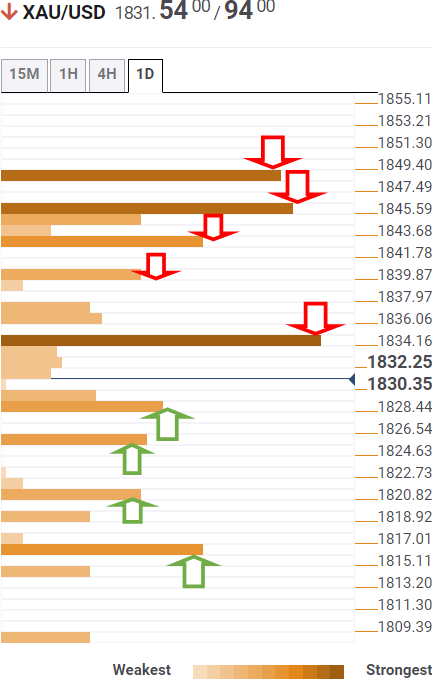
About Technical Confluences Detector
The TCD (Technical Confluences Detector) is a tool to locate and point out those price levels where there is a congestion of indicators, moving averages, Fibonacci levels, Pivot Points, etc. If you are a short-term trader, you will find entry points for counter-trend strategies and hunt a few points at a time. If you are a medium-to-long-term trader, this tool will allow you to know in advance the price levels where a medium-to-long-term trend may stop and rest, where to unwind positions, or where to increase your position size.
- USD/JPY reverses the previous day’s pullback from the highest levels since 1998.
- Market sentiment remains mixed as yields fail to extend post-Fed downside while stock futures and Asian equities remain firmer.
- Japan’s Chief Cabinet Secretary hopes BOJ coordinates with government policies.
- Japan’s Merchandise Trade Deficit widened in May, BOJ’s bond-buying hints eyed.
USD/JPY picks up bids to refresh intraday high around 134.60 as yields fade the Fed-inspired weakness during early Thursday. The yen’s latest gains could also be linked to the comments from Japanese Chief Cabinet Secretary Hirokazu Matsuno.
The US 10-year Treasury yields rebound from an intraday low of 3.288% to 3.364% by the press time. Even so, the benchmark bond coupons remain negative for the second consecutive day, down 3.1 basis points (bps) at the latest.
On the other hand, the Japanese policymaker said, “(He) hopes that the Bank of Japan (BOJ) guides policy appropriately in close coordination with government,” when asked about BOJ’s policy meeting this week.
It’s worth noting that an increase in Japan’s Merchandise Trade Balance Total for May, to ¥-2,384.7B versus ¥-2,022.6B expected and ¥-842.8B prior also contributed to USD/JPY strength.
The yen pair dropped the most in over a month the previous day after the US Federal Reserve (Fed) announced the biggest interest rate hike since 1994 to battle inflation fears. The US central bank also revised inflation forecasts for this year and the next while cutting down the inflation expectations. Further, the policymakers also signaled either a 50 bp or 75 bp rate hike in the next meeting. However, the Fed’s rejection of the odds of a 100 bp rate increase and Chairman Jerome Powell’s measured comments seem to have drowned the Treasury yields and the US dollar afterward.
Also helping the USD/JPY sellers were downbeat US data, US Retail Sales marked a contraction of 0.3% MoM versus an anticipated growth of 0.2% and downwardly revised 0.7% in previous readings. Also, the NY Empire State Manufacturing Index dropped to -1.2 compared to 3.0 market consensus and -11.6 prior.
Moving on, risk catalysts could entertain USD/JPY traders ahead of Friday’s BOJ. Given the hawkish mood at major central banks, the BOJ’s bond-buying and rate clues will be crucial to watch.
Technical analysis
Unless declining below May’s high of 131.34, USD/JPY remains on the front foot. That said, the latest high of 135.59 lures intraday buyers by the press time.
Japanese Chief Cabinet Secretary Hirokazu Matsuno said on Thursday that the authorities watching the impact of the Fed interest rate rise on Japan and the world economy, given its impact on financial markets.
Matsuno said he “hopes that the Bank of Japan (BOJ) guides policy appropriately in close coordination with government” when asked about BOJ’s policy meeting this week.
His comments come ahead of Friday’s BOJ monetary policy decision when the central bank is unlikely to alter its ultra-dovish stance on policy.
Market reaction
USD/JPY is rebounding to near 134.60 amid a risk-on market mood, up 0.55% so far.
- Global traders take a breather after Fed-inspired volatility recedes amid a lack of major data/events.
- S&P 500 Futures defend the latest gains in hopes of overcoming the inflation/growth fears.
- US Treasury yields fail to stretch post-Fed declines as traders eye more central banks to join the hawkish line.
Market sentiment dwindles during early Thursday, after witnessing a heavy dose of Fed-led volatility the previous day. The traders’ inaction could also be linked to the presence of not-so-impressive data/news during the Asian session, as well as the cautious mood ahead of the Bank of England (BOE) monetary policy meeting.
While portraying the mood, the US 10-year Treasury yields rebound from an intraday low of 3.288% to 3.364% by the press time. Even so, the benchmark bond coupons remain negative for the second consecutive day, down 3.1 basis points (bps) at the latest.
That said, the S&P 500 Futures track Wall Street’s gains with a 0.54% intraday run-up to 3,813 by the press time.
On Wednesday, the US Federal Reserve (Fed) announced the biggest interest rate hike since 1994 to battle inflation fears. The US central bank also revised up inflation forecasts for this year and the next while cutting down the inflation expectations. Further, the policymakers also signaled either a 50 bp or 75 bp rate hike in the next meeting. However, the Fed’s rejection of the odds of a 100 bp rate increase and Chairman Jerome Powell’s measured comments seem to have drowned the Treasury yields and the US dollar afterward.
Talking about the data, US Retail Sales marked a contraction of 0.3% MoM versus an anticipated growth of 0.2% and downwardly revised 0.7% in previous readings. Also, the NY Empire State Manufacturing Index dropped to -1.2 compared to 3.0 market consensus and -11.6 prior.
It’s worth noting that the market’s fears of central bankers’ aggression seem to have run out of steam as the higher interest rates are likely to be the new norm, especially after the recent hawkish performances of the major central banks including the Fed. The same should have helped the equity bulls to keep reins amid a sluggish session despite a rebound in yields.
Moving on, second-tier US data and the Bank of England’s (BOE) ability to surprise markets will be important to watch for intraday traders. However, Friday’s Bank of Japan (BOJ) monetary policy report and a speech from Fed Chairman Jerome Powell will be more important.
Also read: US recession in 2023 now seems more likely than not
- EUR/USD takes offers to refresh intraday low, pares the Fed-inspired gains.
- Sluggish RSI, MACD joins key HMA hurdles to challenge buyers.
- Further widening of bearish consolidation move appears more likely.
EUR/USD consolidates post-Fed gains as it retreats from the 100-HMA inside a trend widening pattern near the yearly low. That said, the quote renews its daily low around 1.0435 by the press time of Thursday’s Asian session.
Considering the pair’s pullback from the 100-HMA, as well as the RSI retreat, the EUR/USD prices are likely to witness further downside, which in turn highlights the 1.0400 threshold as the immediate support.
The quote’s further downside, however, could be challenged by the support line of the weekly megaphone formation, near 1.0375, if not then the yearly low of 1.0359 will regain the bear’s attention.
On the contrary, an upside break of the 100-HMA level of 1.0475 isn’t an open call to EUR/USD buyers as a one-week-old horizontal resistance near 1.0510 will challenge the advances.
Even if the quote rises past 1.0510, the upper line of the stated trend-widening pattern, near 1.0525, will precede the 200-HMA level of 1.0588 to offer a bumpy ride to the EUR/USD pair bulls.
Overall, EUR/USD remains in a bearish trajectory but the megaphone formation hints at more volatility ahead.
EUR/USD: Hourly chart
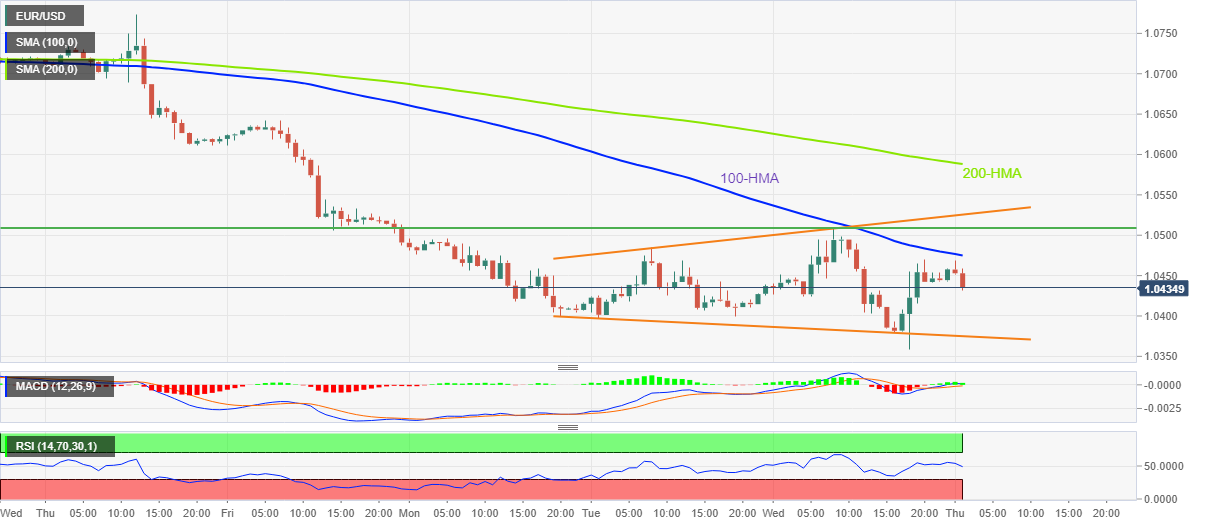
Trend: Further weakness expected
The People's Bank of China (PBOC) “is likely to keep the benchmark Loan Prime Rate (LPR) unchanged next Monday, after it skipped moving the anchored rate of the medium-term lending facility this week,” the Shanghai Securities Journal reported, citing analysts.
Additional quotes
"Also, policymakers are observing stimulus effects after making the largest ever 15 bps cut to the five-year LPR last month."
"The room for MLF rate cut will be limited in the future amid the rapid tightening of monetary policy by the Federal Reserve, and the PBOC may resort to lowering LPR to stimulate loan demand in the next stage."
Market reaction
USD/CNY was last seen trading down 0.21% on the day at 6.6981, pressured by a broadly weaker US dollar, in the face of the expected 75 bps Fed rate hike.
The US Department of Energy has requested to meet with refiners to discuss prices no later than June 21, Reuters reported, citing sources with knowledge of the matter.
The sources also reported that the US Energy Secretary has requested a meeting with refining executives about gas prices no later than June 21.
This comes after US President Joe Biden wrote to energy refiners on Wednesday, asking them to explain why they are not putting more fuel on the market as they reap windfall profits. Biden is under immense political pressure over sky-high gasoline prices.
Exxon Mobil, in response to repeated calls from the US administration, said: We’ve been investing through the downturn to increase refining capacity…kept investing even during the pandemic when we lost >$20B and had to borrow >$30B to maintain investment to increase capacity to be ready for post-pandemic demand.”
Related reads
- US President Biden asks Energy Secretary to hold emergency meeting on oil refining capacity
- WTI oscillates around $116.00, downside looks likely on Fed’s mega rate hike announcement
- AUD/JPY has slipped to near 94.25 on a lower-than-expected jobless rate.
- The Unemployment Rate landed at 3.9%, lower than the consensus of 3.8%.
- Employment generation of more than 60k jobs in May will support the RBA to tighten policy further.
- A continuation of an ultra-loose monetary policy is expected from the BOJ.
The AUD/JPY pair is scaling sharply lower as the Australian Bureau of Statistics has reported a lower-than-expected Unemployment Rate. The Australian economy has added 60.6k jobs in its labor force, more than doubled than the estimates of 25k and the prior print of 4k. However, the Unemployment Rate remained unchanged at 3.9% but lower than the forecasts of 3.8%.
A higher Employment Change has delighted the Reserve Bank of Australia (RBA) to dictate a bumper rate hike again in its July monetary policy meeting. It is worth noting that the RBA elevated its Official Cash Rate (OCR) by 50 basis points (bps) in the first week of June. The announcement was higher than the consensus of 25 bps. In times when the Australian economy was facing hurdles in generating employment opportunities, the RBA dictated an aggressive interest rate hike, which could have its own repercussions. The economy generated only 4k jobs in April, which indicates its efficiency in economic growth prospects.
On the Tokyo front, investors’ focus has shifted to the monetary policy by the Bank of Japan (BOJ), which is due on Friday. BOJ Governor Haruhiko Kuroda is expected to keep continue its ultra-loose monetary policy. The inflation rate in Japan has crossed the target rate of 2%, however, the price pressures are much guided by costly fossil fuels rather than a broad-based recovery in the aggregate demand.
- AUD/USD extends pullback from intraday high after Australia’s May month job numbers.
- Australia’s Employment Change rose to 60.6K, Unemployment Rate remained static at 3.9%.
- Yields, US dollar extend post-Fed losses to put a floor under the prices.
- China’s search for centralized iron ore seller challenges Aussie bulls, RBA’s Lowe appeared hawkish and keeps buyers hopeful.
AUD/USD pares Fed-inspired gains after the Australian Bureau of Statistics flashed mixed employment data for May during early Thursday. In doing so, the Aussie pair stretches the pullback from intraday high to 0.7013 by the press time.
That said, Australia’s Employment Change rose to 60.6K versus 25.0K expected whereas the Unemployment Rate rose past 3.8% forecasts to 3.9% while matching the previous readings. Further, the Participation Rate also improved to 66.7% versus 66.4% market consensus and 66.3% prior. Earlier in the day, Australia’s Consumer Inflation Expectations rose past 5.0% prior readings to 6.7%.
Read: Australian Unemployment Rate steadies at 3.9% in May vs. 3.8% expected
On Tuesday, Reserve Bank of Australia (RBA) Governor Philip Lowe warned that Australians should be ready for significant interest rate hikes in the balance of this year.
Elsewhere, headlines from the Financial Times (FT) highlight the China-Australia tussles and tested the AUD/USD bulls ahead of the data release. “China is moving to consolidate the country’s iron ore imports through a new centrally controlled group by the end of this year, as Xi Jinping’s administration seeks to increase Beijing’s pricing power over the industry,” said the FT. The news also mentioned that China could in theory reduce its dependency on Australian iron ore by increasing purchases from big Brazilian producers, such as Vale. The news gains major attention as Australia relies heavily on iron ore exports as the key source of income, as well as due to China’s dominance in metal buying.
It should be noted that the US 10-year Treasury yields extend the post-Fed losses, down seven basis points (bps) to 3.33% by the press time, which in turn weighed on the US dollar and enables the AUD/USD bulls to remain positive. However, a lack of major data/events seems to have probed the quote’s immediate upside. While portraying the mood, the S&P 500 Futures track Wall Street’s gains with a 0.82% intraday run-up at the latest.
Looking forward, second-tier US data and the Bank of England’s (BOE) ability to surprise markets, which is less likely, may entertain AUD/USD traders.
Technical analysis
AUD/USD battles with a short-term resistance confluence surrounding 0.7030-35, comprising the multiple levels marked since early May. Given the recent price-positive signals from the RSI and MACD, the buyers are likely to cross the immediate hurdle and brace for the 0.7100 mark.
On the contrary, a downside break of January’s low near 0.6965 could be enough to recall the bears. That said, the 0.7000 threshold acts as an immediate support to watch during the quote’s pullback.
The People’s Bank of China (PBOC) set the USD/CNY reference rate at 6.7099 on Thursday when compared to the previous fix and the previous close at 6.7518 and 6.7158 respectively.
The Australian Unemployment Rate arrived at 3.9% in May, the Australian Bureau of Statistics (ABS) showed in its latest data published on Thursday. In April, the jobless rate hit the lowest since 1974 at 3.9%. The market consensus was for a drop to 3.8% in the reported month.
The economy created a massive 60.6K jobs in May vs. +25K expected and +4K reported in April. The country’s Full-Time Employment for May came in at 69.4K vs. 92.4K while the Part-Time Jobs figures arrived at -8.7K when compared to April’s -88.4K.
The Participation Rate rose to 66.7% vs. 66.4% expected and 66.3% last.
Market reaction
AUD/USD kept its range around 0.7025 in an immediate reaction to the mixed Australian jobs report.
Why Australian employment data matters to traders?
The Australian Bureau of Statistics (ABS) publishes an overview of trends in the Australian labor market, with uthe nemployment rate a closely watched indicator. It is released about 15 days after the month end and throws light on the overall economic conditions, as it is highly correlated to consumer spending and inflation. Despite the lagging nature of the indicator, it affects the Reserve Bank of Australia’s (RBA) interest rate decisions, in turn, moving the Australian dollar. Upbeat figure tends to be AUD positive.
GBP/USD holds onto the post-Fed gains while picking up bids towards the recent peak surrounding 1.2200, close to 1.2185 by the press time of Thursday’s Asian session.
In addition to the broad US dollar weakness after the US Federal Reserve’s (Fed) action, options market signals also back the cable pair’s latest strength.
That said, a one-month risk reversal (RR) of the GBP/USD pair, a spread between the calls and the puts, jumps the most in five weeks by the end of Wednesday’s North American session, with the latest RR figure being +0.265. In doing so, the options market signal snap the previous three-day downtrend.
It’s worth noting, however, that the weekly scenario remains in favor of the GBP/USD bears as the week-on-week RR prints a three-week downtrend while also flashing the most negative figures since late April, around -0.620 by the press time.
Given the short-term bullish bias for the GBP/USD pair, in contrast to a bit broader bearish forecasts, the traders may wait for the Bank of England’s (BOE) monetary policy decision for taking fresh positions.
Read: BOE Preview: Why GBP/USD set to suffer even in response to a 50 bps hike, a lose-lose event
- Oil prices are trading lackluster after a two-day losing streak.
- Fed’s mega rate hike announcement has sidelined the oil bulls.
- Supply constraints will remain effective as no oil supplier could cover the truckload oil supply by Russia.
West Texas Intermediate (WTI), futures on NYMEX, is displaying back and forth moves around $116.00 after a vertical downside move. The black gold faced a sell-off after failing to overstep the psychological resistance of $120.00. The oil prices are expected to shift into a negative trajectory as the Federal Reserve (Fed) has underpinned lower growth forecasts for the coming quarters.
A rate hike by 75 basis points (bps) to fix the inflation mess quickly is going to shrink liquidity from the market. The corporate houses will access costly money from the commercial banks for investing in projects. The unavailability of helicopter money will compel the corporate houses to stick to ultra-filtered investment opportunities only.
Lower investment opportunities will worsen the unemployment rate and henceforth result in lower funds for disposal in the palms of the households. Also, it will lead to lower aggregate demand and eventually lower demand for oil.
Meanwhile, the resurgence of the Covid-19 in China has renewed fears of lower demand. Shanghai and Beijing in China have recently opened again after a two-month long lockdown period and the reversal of lockdown curbs will dampen the sentiment of the market participants towards the demand structure.
On the supply front, lower oil supply from Russia will continue to keep the oil bulls resilient. After the embargo on oil imports from Russia by the Eurozone, investors are worried over the fact which oil suppliers will cater to their whooping oil demand. The ongoing Eurogroup meeting is expected to discuss the same and may come out with a list of new oil suppliers.
- USD/CAD remains on the back foot after reversing from a 10-month-old resistance line.
- 38.2% Fibonacci retracement lures bears ahead of the 20-DMA support.
- Multiple hurdles around 1.3050, May’s peak adds to the upside filters.
USD/CAD keeps Fed-impressed losses, staying pressured around the intraday low of 1.2862, during Thursday’s Asian session.
The Loonie pair’s latest weakness could be linked to the sustained reversal from an upward sloping resistance line from August 2021. The stated pullback also gains support from the RSI retreat, which in turn solidifies bearish bias.
That said, the quote currently eyes the 38.2% Fibonacci retracement of October 2021 to May 2022 upside, around 1.2775. However, the 1.2800 threshold may offer an intermediate halt.
Should the quote USD/CAD bears keep reins past 1.2775, the 20-DMA support near 1.2730 could challenge the further downside.
Meanwhile, recovery moves need to cross the aforementioned resistance line, at 1.2985 by the press time, to recall the USD/CAD buyers.
Even so, the 1.3000 psychological magnet and multiple levels marked in May near 1.3050 could test the upside momentum before challenging the yearly top of 1.3076.
Overall, the USD/CAD pair’s retreat has a further downside to track but the sellers should not expected the trend reversal.
USD/CAD: Daily chart
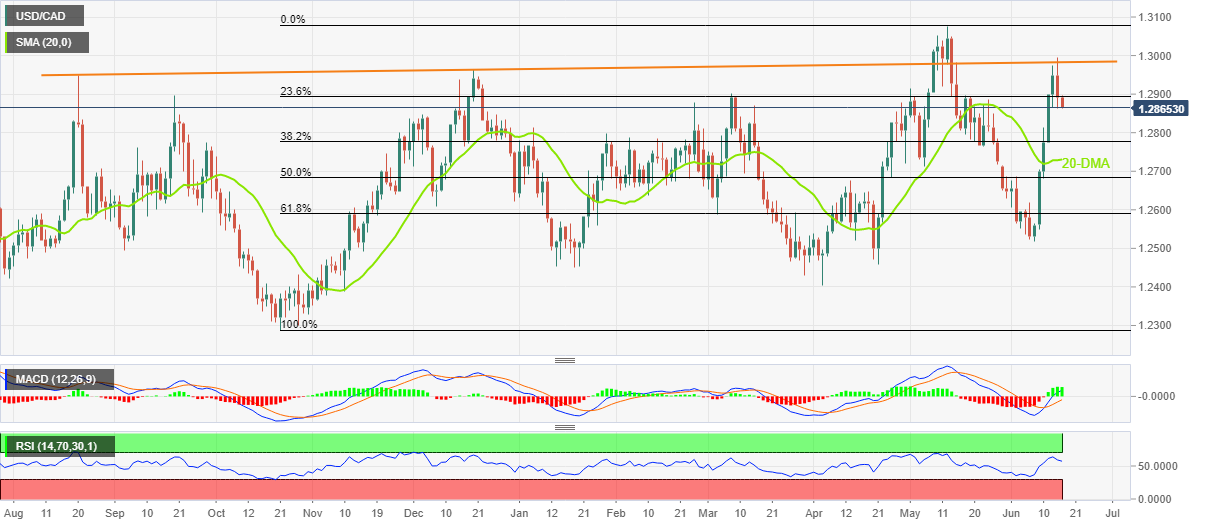
Trend: Further weakness expected
Financial Times (FT) came out with a story signaling more disputes between Australia and China as Beijing searches for a centralized iron ore producer.
“China is moving to consolidate the country’s iron ore imports through a new centrally controlled group by the end of this year, as Xi Jinping’s administration seeks to increase Beijing’s pricing power over the industry,” said the FT.
Key quotes
The initiative, led by the China Iron and Steel Association and the planning ministry, involves large state-owned mining and steel groups such as Baowu, China Minmetals Corp and Aluminium Corporation of China, according to people familiar with the effort.
China is the world’s biggest consumer of iron ore with its 1bn tonne a year steel industry absorbing about 70 percent of global production, most of it supplied by Australia. Any move to gain control over prices will probably alarm Canberra given iron ore’s status as the country’s top export.
Government officials and policy advisers told the Financial Times that Xi’s administration had grown frustrated by large price swings over recent years in an industry dominated by Australian producers such as Fortescue Metals Group and BHP, which are likely to be highly concerned by the move.
China could in theory reduce its dependency on Australian iron ore by increasing purchases from big Brazilian producers, such as Vale.
Some analysts, however, are skeptical that Beijing can impose discipline on the hundreds of smaller mills scattered across the country.
AUD/USD retreats
Following the news, AUD/USD prices retreat from an intraday high of 0.7036. The pair’s latest pullback could also be linked to the Aussie traders’ anxiety ahead of the key Australia employment data for May.
Read: When is the Australian employment report and how could it affect AUD/USD?
- The DXY has displayed a steep fall at open on weaker yields and downbeat Retail Sales.
- A rate hike by 75 bps has brought intense volatility in the DXY.
- The Fed sees an elevation in the Unemployment Rate for bringing price stability.
The US dollar index (DXY) has witnessed a steep fall after a flat open and is expected to extend its losses after slipping below Wednesday’s low at 104.66. The DXY turned extremely volatile after the Federal Reserve (Fed) announced a rate hike by 75 basis points (bps). Although the long-term consensus was 50 bps, a higher US inflation print of 8.6%, reported last week had bolstered the odds of a mega rate hike. A significant slippage in the US Treasury yields brought extreme selling pressure on the asset. The 10-year US Treasury yields slipped 5.50% on Wednesday. At the press time, the benchmark yields are at 3.29%. The Fed has announced a rate hike of 75 bps after almost 28 years.
Powell’s conference after the monetary policy announcement
Fed chair Jerome Powell was seen thankful to the strong and well-positioned economic growth, which has backed the Fed to dictate a mega rate hike. Also, higher employment generation by the US economy on a constant basis has supported the Fed to take a bold decision on the interest rates. An extreme tightening policy by an economy results in lower growth forecasts. The Fed believes that a reduction in inflation rates to near 2% while keeping the jobless rate at 4.1% will be an achievement for the Fed.
Downbeat US Retail Sales data
More focus on the Fed’s interest rate decision trimmed the attention of the US Retail Sales, which also reported on Wednesday. The monthly Retail Sales turned negative, landing at -0.3%, much worse than the expectations and the prior print of 0.2% and 0.7% respectively. While, the Retail Sales Control group released at 0%, lower than the expectations and the former print of 0.5%.
Key events this week: Building permits, Initial Jobless Claims, and Industrial Production.
Major events this week: Swiss National Bank (SNB) interest rate decision, Bank of England (BOE) interest rate, Bank of Japan (BOJ) rate decision.
- Gold buyers take a breather after the biggest run in a month.
- Pullback in USD, Treasury yields allowed gold to post a stellar run-up.
- Bullish chart pattern, risk-on mood keep XAU/USD buyers hopeful.
Gold Price (XAU/USD) remains sidelined at around $1,835 as bulls pause for a break after the Fed-inspired rally, the biggest in four weeks. Even so, downbeat US Treasury yields and a bullish chart pattern keeps the metal buyers hopeful.
That said, the US 10-year Treasury yields extend the post-Fed losses, down seven basis points (bps) to 3.33% by the press time, which in turn weighed on the US dollar and enables the XAU/USD bulls to remain positive. However, a lack of major data/events seems to have probed the metal’s immediate upside. While portraying the mood, the S&P 500 Futures track Wall Street’s gains with 0.82% intraday run-up at the latest.
On Wednesday, the US Federal Reserve (Fed) announced the biggest interest rate hike since 1994 to battle inflation fears. The US central bank also revised up inflation forecasts for this year and the next while cutting down the inflation expectations. Further, the policymakers also signaled either a 50 bp or 75 bp rate hike in the next meeting. However, the Fed’s rejection of the odds of a 100 bp rate increase and Chairman Jerome Powell’s measured comments seem to have drowned the Treasury yields and the US dollar afterward.
It’s worth noting that the US data also probed the US dollar bulls ahead of the Fed. US Retail Sales marked a contraction of 0.3% MoM versus an anticipated growth of 0.2% and downwardly revised 0.7% previous readings. Also, the NY Empire State Manufacturing Index dropped to -1.2 compared to 3.0 market consensus and -11.6 prior.
Moving on, risk catalysts will entertain the XAU/USD as the upside momentum seeks validation.
Technical analysis
Gold prices managed to keep the post-Fed gains towards the neckline of the weekly inverse Head-and-Shoulders (H&S) bullish chart pattern, backed by the upbeat MACD signals.
It should be noted, however, that the 200-HMA level of $1,843 needs to validate the XAU/USD advances even if it manages to confirm the inverse H&S, by crossing the neckline figure of $1,838.
Following that, a run-up towards the monthly high near $1,880 can’t be ruled out.
Alternatively, pullback moves remain elusive beyond $1,819 immediate support, a break of which could recall gold sellers targeting the $1,800 threshold.
Gold: Hourly chart
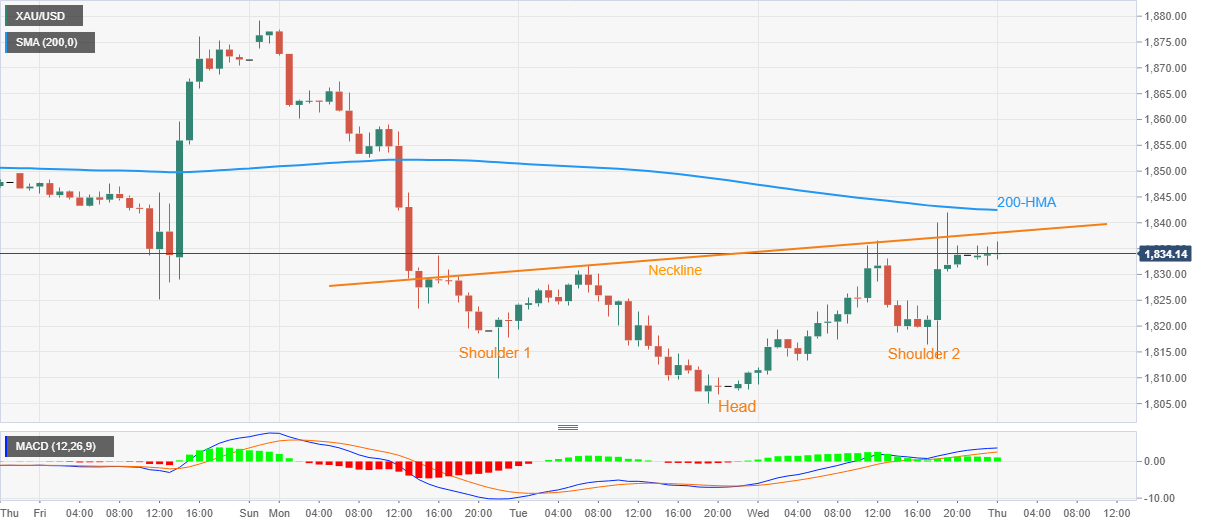
Trend: Further upside expected
May month employment statistics from the Australian Bureau of Statistics, up for publishing at 01:30 GMT on Thursday, will be the immediate catalyst for the AUD/USD pair traders.
Market consensus suggests that the headline Unemployment Rate may ease to 3.8% from 3.9% on a seasonally adjusted basis whereas Employment Change could rise to 25K from 4K. Further, the Participation Rate may also improve to 66.4% from 66.3% previous readings.
In addition to the Aussie jobs report, the quarterly release of the Reserve Bank of Australia (RBA) Bulletin will also be important for the AUD/USD traders considering the recently mixed data and the central bank’s hawkish bias.
Ahead of the event, analysts at Westpac said,
Despite the robust demand for labor as evinced by job vacancies, weekly payrolls remain weak; Westpac therefore anticipates employment to lift by 5k in May (vs. consensus +25k) with a clear risk of a negative print. A very small decline in participation should see the unemployment rate round down to 3.8%. MI inflation expectations should continue to hold at an elevated level in June.
TD Securities said,
A strong May labour market print may concern the RBA further on the wages front, with accelerating wages growth complicating their fight to bring inflation back to target. Thus, we expect the RBA to hike again by 50bps in July due to the risks to wages growth from the minimum wage decision and a very tight labour market.
How could the data affect AUD/USD?
AUD/USD extends the post-Fed gains, the biggest in six weeks, towards the weekly top surrounding 0.7050 ahead of the Aussie employment report for May. The risk barometer pair’s latest gains could be linked to the market’s upbeat mood due to the sustained downturn in yields and the US dollar.
That said, the recently mixed Aussie data challenges the RBA to move forward on its hawkish path. However, the Fed’s latest 75 bp moves allow the AUD/USD bulls to remain hopeful should the scheduled jobs report print upbeat figures.
Considering this, FXStreet’s Valeria Bednarik says
A scenario of solid job creation alongside expectations for rising inflation would surely be a boost for the Aussie, moreover after the dust settles post-Fed. However, if employment figures disappoint and inflation pressures ease, the Aussie could suffer a major setback.
Technically, AUD/USD battles with short-term resistance confluence surrounding 0.7030-35, comprising the multiple levels marked since early May. Given the recently positive oscillators, the buyers are likely to cross the immediate hurdle and brace for the 0.7100 mark, provided the scheduled data support the bulls. On the contrary, a downside break of January’s low near 0.6965 could be enough to recall the bears.
Key Notes
Australian Employment Preview: Job creation could pick up, but what about inflation?
AUD/USD defends post-Fed gains around 0.7000 with eyes on Australia Employment
About the Employment Change
The Employment Change released by the Australian Bureau of Statistics is a measure of the change in the number of employed people in Australia. Generally speaking, a rise in this indicator has positive implications for consumer spending which stimulates economic growth. Therefore, a high reading is seen as positive (or bullish) for the AUD, while a low reading is seen as negative (or bearish).
About the Unemployment Rate
The Unemployment Rate released by the Australian Bureau of Statistics is the number of unemployed workers divided by the total civilian labor force. If the rate hikes, indicates a lack of expansion within the Australian labor market. As a result, a rise leads to weaken the Australian economy. A decrease of the figure is seen as positive (or bullish) for the AUD, while an increase is seen as negative (or bearish).
| Pare | Closed | Change, % |
|---|---|---|
| AUDUSD | 0.70038 | 1.88 |
| EURJPY | 139.784 | -1 |
| EURUSD | 1.04441 | 0.26 |
| GBPJPY | 162.891 | 0.17 |
| GBPUSD | 1.21699 | 1.44 |
| NZDUSD | 0.62831 | 1.08 |
| USDCAD | 1.28865 | -0.51 |
| USDCHF | 0.99358 | -0.76 |
| USDJPY | 133.86 | -1.25 |
- NZD/JPY bulls are hard-pressed following poor growth data but could be on the verge of breaking the hourly resistance.
- New Zealand Q1 GDP -0.2 QoQ versus 0.6% expected, NZD/USD retreats towards 0.6250
- The bears will be lurking on any bull breakout.
NZD/JPY is testing the limits of the support and resistance channel on the hourly chart as follows:
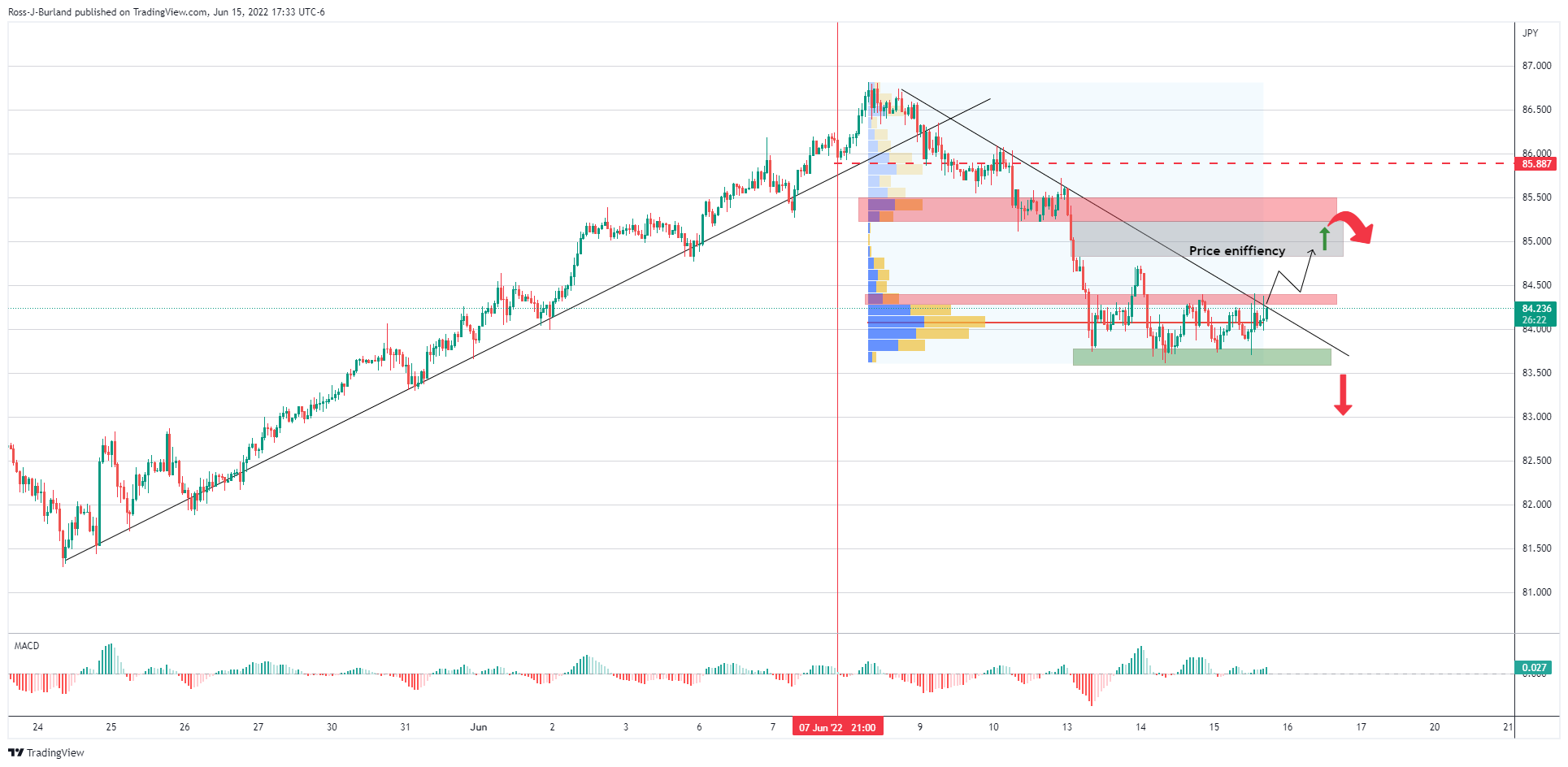
A break of the resistance opens the risk of a trendline breakout and a run towards the price inefficiency between 84.82 and 85.23. There would be expected to be a fair bit of resistance thereafter which could potentially lead to a downside correction and even a full-on continuation on the higher time frames such as the following daily chart's illustration:
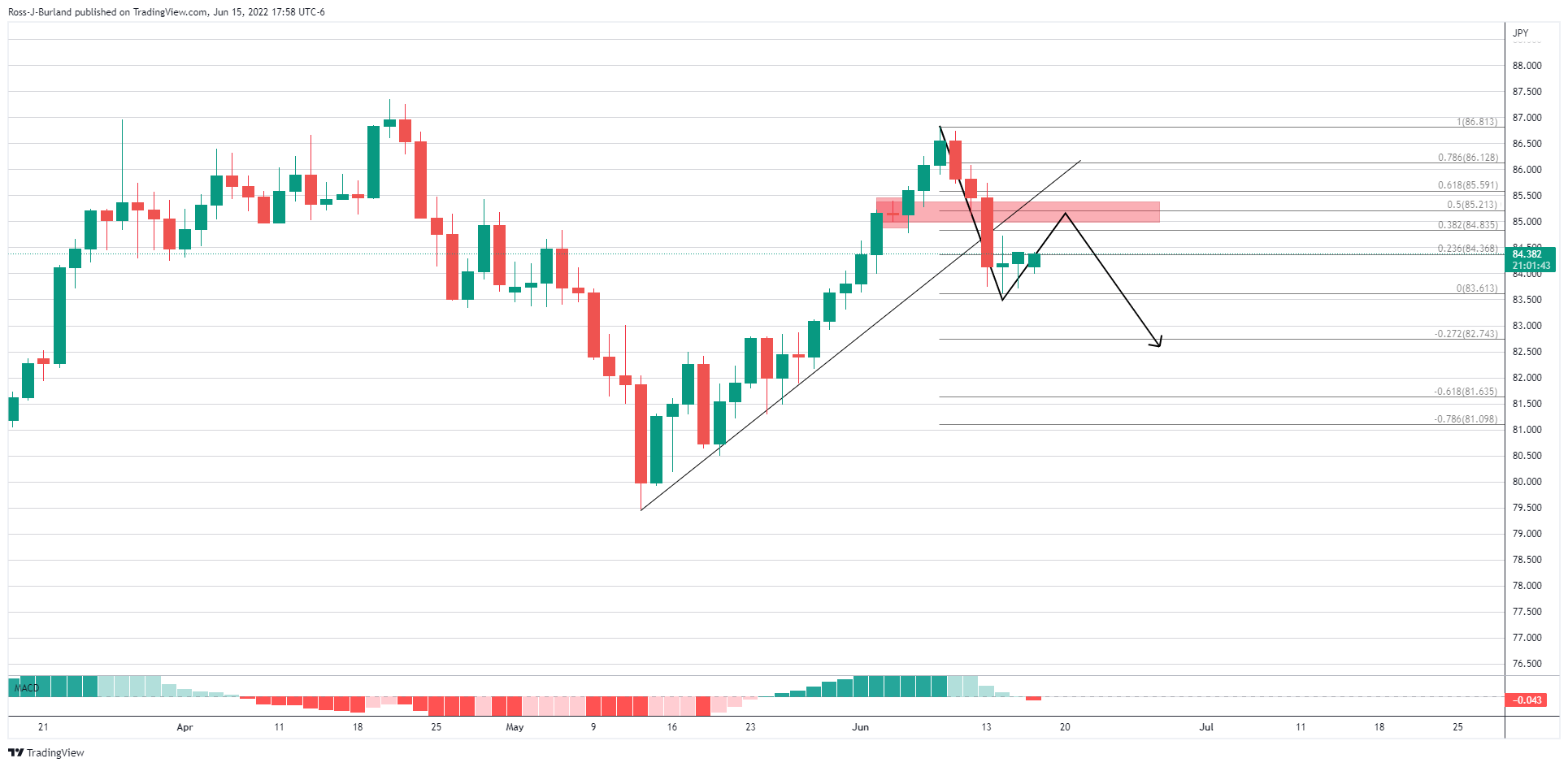
The price is accumulating and a retracement into the said target area meets the prior structure looking left, the break between the bull rally, and this would be expected to act as a resistance zone. This also has a confluence with the 38.2% Fibonacci retracements of the prior bearish impulse range that lead to a break of the trendline support.







© 2000-2026. All rights reserved.
This site is managed by Teletrade D.J. LLC 2351 LLC 2022 (Euro House, Richmond Hill Road, Kingstown, VC0100, St. Vincent and the Grenadines).
The information on this website is for informational purposes only and does not constitute any investment advice.
The company does not serve or provide services to customers who are residents of the US, Canada, Iran, The Democratic People's Republic of Korea, Yemen and FATF blacklisted countries.
Making transactions on financial markets with marginal financial instruments opens up wide possibilities and allows investors who are willing to take risks to earn high profits, carrying a potentially high risk of losses at the same time. Therefore you should responsibly approach the issue of choosing the appropriate investment strategy, taking the available resources into account, before starting trading.
Use of the information: full or partial use of materials from this website must always be referenced to TeleTrade as the source of information. Use of the materials on the Internet must be accompanied by a hyperlink to teletrade.org. Automatic import of materials and information from this website is prohibited.
Please contact our PR department if you have any questions or need assistance at pr@teletrade.global.


 Bank
Bank transfers


