- Analytics
- News and Tools
- Market News
Analytics, News, and Forecasts for CFD Markets: currency news — 14-06-2022.
- USD/CAD is hovering around 1.2950 as investors are sidelined ahead of the Fed’s interest rate meet.
- The BOC may elevate its interest rates to 3% to tame the soaring inflation.
- Oil prices have tumbled on advancing odds of a slump in the aggregate demand.
The USD/CAD pair is oscillating in a narrow range of 1.2944-1.2959 in the early Asian session after registering a fresh four-week high at 1.29751 on Tuesday. The asset has displayed a five-day winning streak and is expected to extend the same after violating Tuesday’s high at 1.2975.
An expectation of an aggressive hawkish monetary policy by the Federal Reserve (Fed) is strengthening the greenback bulls against loonie. The Fed is set to announce a strong rate hike after incorporating the sky-rocketing Consumer Price Index (CPI) and a tight labor market. Price pressures have reached the rooftop and are denting the paychecks of the households. Therefore, the market participants are expecting a rate hike by 75 basis points (bps) this time.
On the loonie front, research firm Fitch believes that the growth rate in Canada could decline to 2.2% in CY 2023 from 3.8% in CY2023. Also, the global rating giant has dictated that the Bank of Canada could accelerate its interest rates by 150 bps to 3%, which is beneficial for containing higher prices.
Meanwhile, oil prices have tumbled vigorously on soaring recession fears due to higher inflationary pressures. A liquidity shrinking program by the Fed is going to bring a serious drop in aggregate demand. This will eventually dampen the demand for oil in the global market and investors have started considering the same, which is capping the oil bulls. Investors should be aware of the fact that Canada is a leading exporter of oil to the US and lower oil prices result in lower fund flows into the US economy.
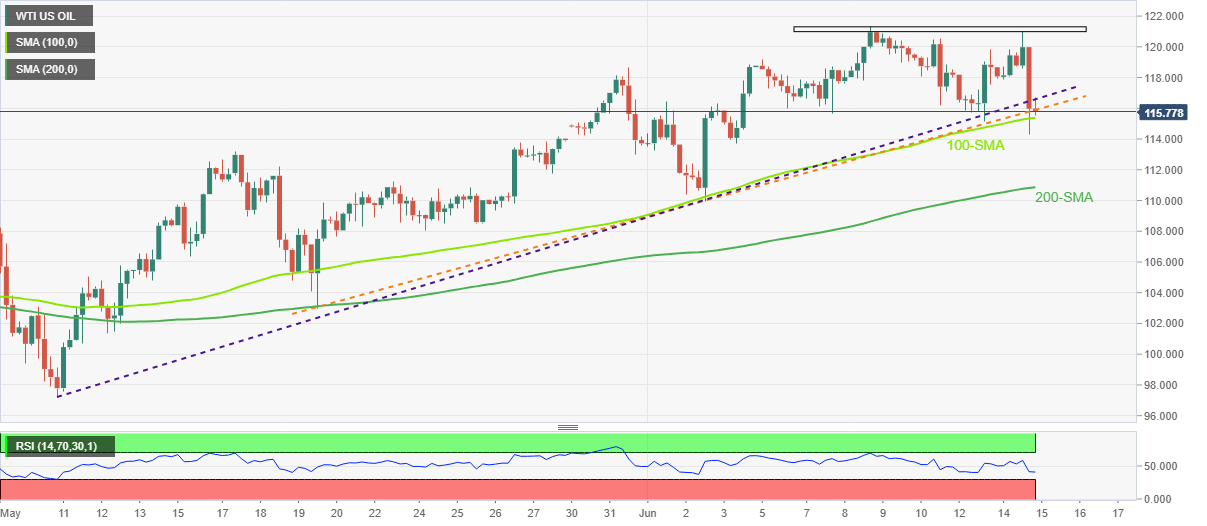
- WTI remains pressured around weekly low after breaking short-term key support lines.
- Downbeat RSI (14), not oversold, keeps oil bears hopeful.
- Clear downside break of $115.00 will confirm a ‘double top’ formation, which could facilitate further declines.
- Bulls remain cautious until witnessing a sustained run-up beyond 121.35.
WTI crude oil prices stay depressed at the weekly bottom, recently sidelined near $115.60-50, as sellers cheer a clear downside break of the short-term key support during Wednesday’s Asian session.
It’s worth noting that the black gold broke two support lines stretched from May but the 100-SMA challenges the bears. However, RSI (14) line joins the trend line breakdowns to keep the sellers hopeful.
In addition to the 100-SMA level near $115.30, Monday’s bottom surrounding $115.15 and the $115.00 threshold also challenge the commodity sellers.
Though, a sustained break of the $115.00 will confirm the double-top bearish chart pattern and direct the quote further south. In that case, the 200-SMA level of $110.86 and the monthly low near $110.00 could gain the market’s attention.
Following that, a downward trajectory towards May 19 swing low near $103.00 can’t be ruled out.
Alternatively, the monthly support-turned-resistance line near $115.85 appears the immediate hurdle to challenge the WTI rebound. After that, an upward sloping trend line from May 10, previous support around $116.55, will be crucial to watch for recovery moves.
Above all, the commodity buyers should wait for a clear upside break of the recent double tops before taking the driver’s seat, which in turn highlights $121.35 as the key level.
WTI: Four-hour chart
Trend: Further weakness expected
- NZD/USD struggles to extend the bounce off 25-month low after NZ data.
- New Zealand’s Q1 Current Account – GDP Ratio widened, Current Account deficit increased.
- Risk-off mood exerts additional downside pressure on the Antipodeans.
- China’s Industrial Production, Retail Sales may entertain traders ahead of FOMC.
NZD/USD fades bounce off a two-year low as it flirts with 0.6220-25 during Wednesday’s initial Asian session. The Kiwi pair’s latest inability to rebound could be linked to the downbeat New Zealand (NZ) data, as well as the market fears ahead of the Federal Open Market Committee (FOMC).
NZ Current Account – GDP Ratio dropped to -6.5% versus -6.3% expected and -5.8% prior. Further, the Current Account balance also depleted to $-6.143B compared to $-5.5B market forecasts and $-7.26B previous readings.
On the other hand, the US Producer Price Index (PPI) matched 0.8% MoM forecasts for May, also easing to 10.8% YoY figures versus 10.9% expected and prior readouts. The PPI ex Food & Energy, known as Core PPI, dropped below 8.6% YoY forecasts to 8.3%.
While portraying the mood, the US stock futures remain sluggish around the lowest levels since early 2021 while the Treasury bond yields dribble at the 11-year top near 3.5%, around 3.475% at the latest.
It should be noted that chatters surrounding China’s worsening virus conditions and the Sino-American tussles over Taiwan join the fears of the Fed’s aggressive rate hike to exert additional downside pressure on the NZD/USD prices.
Moving on, China’s monthly prints of Industrial Production and Retail Sales for May could entertain NZD/USD traders due to Auckland’s trade ties with Beijing. However, major attention will be given to the Fed’s ability to tame inflation and not disappoint the markets as it walks on a tight rope.
Read: Fed Preview: Powell to plunge markets or raise yields, a win-win for the dollar, five scenarios
Technical analysis
The late 2019 low surrounding 0.6200 precedes April 2020 peak near 0.6175 to restrict short-term NZD/USD downside amid oversold RSI conditions. The recovery moves, however, remain elusive until the quote crosses the immediate 0.6300 hurdle.
Confidence among Japanese manufacturers rose in June and was steady in the services sector as resilient demand helped firms withstand pressure from high raw material prices, a Reuters poll showed, in a sign of a gradual economic recovery.
Reuters Tankan strongly correlates with the Bank of Japan’s (BOJ) quarterly Tankan survey, which found sentiment among manufacturing and service-sector firms was expected to improve over the next three months, though companies reported pressure from rising costs aggravated by a weaker yen.
Key quotes
The monthly poll of 499 large and mid-sized firms, of which 238 responded between June 1-10, comes amid uncertainty over the economic outlook in Asia as a result of China’s heavy-handed approach to stamping out COVID-19 outbreaks.
The Reuters Tankan sentiment index for manufacturers rose to 9 in June from 5 in the previous month, driven by chemical firms as well as metal products and machinery makers. It was expected to rise further to 12 in September.
The service-sector index was flat from the previous month at 13 in June, though firms in the sector also said they were burdened by higher input costs, which have been made worse by a weakening of the yen.
USD/JPY struggles
The news fails to gain any major attention from markets as the USD/JPY struggles to extend the latest run-up towards 136.00.
Read: USD/JPY faces hurdles around 135.60 as DXY turns sideways, the spotlight is on Fed
- USD/JPY has failed to extend its upside above 135.60 as DXY is consolidating ahead of Fed’s policy.
- Higher price pressures are advocating a rate hike of 75 bps by the Fed.
- The BOJ is expected to stand with its prudent monetary policy to accelerate aggregate demand.
The USD/JPY pair has slipped below 135.30 after facing barricades around 135.60. On a broader note, the asset has remained in the grip of bulls therefore minor exhaustion doesn’t resemble a bearish reversal. It won’t be early to state that the asset is heading for a fresh new high ahead of the interest rate policy by the Federal Reserve (Fed).
The Fed is expected to dictate a rate hike by 75 basis points (bps). Fed chair Jerome Powell in his previous testimonies stated that a rate hike by 75 bps is not into consideration, which doesn’t rule out the odds of a 75 bps rate hike this time. The inflation situation has much worsened now as the annual figure has climbed to 8.6%, thanks to the advancing oil and food prices. To fix the inflation mess, the Fed will tighten its policy further and will elevate interest rates aggressively.
Meanwhile, the US dollar index (DXY) has turned sideways ahead of Fed’s policy and is expected to display a lackluster performance going forward. The DXY is hovering around 105.50 after registering a fresh 19-year high at 105.65.
On the Tokyo front, investors are awaiting the interest rate policy by the Bank of Japan (BOJ), which is due on Friday. The BOJ is expected to continue with its prudent monetary policy to keep flushing liquidity into the economy. The inflation rate in Japan has reached to its target but is majorly contributed by higher oil prices rather than a broad-based demand recovery.
- GBP/USD picks up bids to consolidate recent losses at multi-month low, snaps five-day uptrend.
- UK PM Johnson's eyes to repeal corporate tax raid, tells cabinet to ‘de-escalate’ protocol stand-off with Brussels.
- US Dollar cheers risk-off mood, strong Treasury yields ahead of the Fed’s verdict.
- Markets anticipate big moves, making it a source of disappointment and anxiety ahead of the Fed.
GBP/USD prints a corrective pullback from a 27-month low as traders brace for the key Fed meeting during the early Asian session on Wednesday. In addition to the market’s consolidation, positive news from UK Prime Minister (PM) Boris Johnson also underpins the cable pair’s latest rebound.
“Boris Johnson wants to reverse Rishi Sunak’s planned multibillion-pound tax raid on business as he tries to firm up support on the Tory right in the aftermath of last week’s confidence vote,” said the UK Times.
News from the UK Telegraph saying, “Boris Johnson has told his Cabinet ministers to ‘de-escalate’ the war of words with Brussels over the Northern Ireland Protocol to avoid a trade war,” also should have helped the GBP/USD prices to rebound from a two-year low.
It’s worth noting that the downbeat UK data and concerns over the Bank of England’s (BOE) ability to tame the inflation without hurting the GDP seems to weigh on the GBP/USD prices.
On Tuesday, the UK’s employment numbers hint at the higher Unemployment Rate of 3.8% versus 3.6% expected for three months to April. Further, the Claimant Count Change improved to -19.7K from -49.4K expected and -65.5K prior
Elsewhere, the US Producer Price Index (PPI) matched 0.8% MoM forecasts for May, also easing to 10.8% YoY figures versus 10.9% expected and prior readouts. The PPI ex Food & Energy, known as Core PPI, dropped below 8.6% YoY forecasts to 8.3%.
Although the factory-gate inflation data eased, the fears of an aggressive Fed rate hike during today’s FOMC haven’t faded as the US 10-year Treasury yields refreshes the 11-year high to 3.497%, around 3.479% by the press time. With this, the Wall Street benchmarks witnessed another day of losses.
Moving on, GBP/USD may witness lackluster moves around the multi-month low as markets are likely to portray the pre-Fed anxiety.
Read: Federal Reserve Interest Rate Decision Preview: Damn the inflation, full speed ahead
Technical analysis
GBP/USD takes a U-turn from a six-month-old descending support line, around 1.1935 by the press time. Given the oversold RSI, as well as the likely USD retreat ahead of the Fed, the cable pair may witness a corrective pullback ahead of the key Federal Open Market Committee (FOMC).
Global rating giant Fitch affirmed Canada’s Long-Term Foreign-Currency and Local-Currency Issuer Default Ratings (IDR) at 'AA+' with a Stable Rating Outlook.
Fitch expects firm Canadian economic growth of 3.8% in 2022, decelerating to 2.2% in 2023.
“Fitch's baseline is that BOC will lift the overnight rate another 150bps to 3% by YE2022 and sustain it through YE2023, as it seeks to lower demand and stabilize inflation expectations amid strong price rises,” said the official update.
Key quotes (from Fitch)
Inflation has run thirteen months above the upper threshold of the inflation-control target range driven by supply-chain shocks and strong domestic demand.
The Canadian housing market is slowing after a period of rapidly rising house prices.
In Fitch's view, the seven largest Canadian banks are adequately capitalized to sustain rapidly increasing credit losses even under an unlikely severely adverse scenario.
The spring FY2022-2023 federal and provincial budgets place Canada's general government balance on a faster deficit reduction path than Fitch expected at its last review in June 2021.
Federal and provincial governments medium-term budgets together will keep the gross consolidated general government debt/GDP on a downward trajectory, despite increased monetary policy tightening (275 bps) during 2022 in the June baseline scenario.
In February, the governing minority Liberal Party signed a 'supply and confidence agreement' with the New Democratic Party (NDP), which assures the mutual policy support for confidence votes, including budget measures during 2022-2025.
USD/CAD eases from monthly top
Following the news, USD/CAD retreats from a monthly high surrounding 1.2975, also probing the five-day uptrend, at 1.2955 by the press time.
Also read: Canada's PM Trudeau: We're watching rising interest rates 'with concern'
- The shared currency is down almost 1% in the week.
- A risk-off market mood caused a bloodbath in equities, but the Asian stocks are poised for a higher open.
- EUR/USD Price Analysis: The pair would remain range-bound ahead of June’s Fed meeting.
The EUR/USD tanks for the third straight day as traders prepare for an aggressive rate hike by the Federal Reserve, with Wall Street’s expecting a 75 bps increase to the Federal Funds Rate (FFR) on Wednesday. The aforementioned shifted sentiment sour since late Monday and has carried on. At the time of writing, the EUR/USD is trading at 1.0420, set to range-bound ahead of the FOMC’s monetary policy decision.
Sentiment remains negative. US equities finished with hefty losses, while Asian stocks are set to open higher. US Treasury yields spiked, led by the US 10-year benchmark note coupon at 11-year highs above 3.49%, as bets that the Federal Reserve would hike more than 50 bps. The greenback followed suit and is rising, as depicted by the US Dollar Index, up 0.26%, at 105.477.
During the Tuesday trading session, the EUR/USD opened near the session’s lows around 1.0406 and edged higher as a reaction to German inflation data, printing a daily high around 1.0485. However, the EUR/USD erased those losses and settled near 1.0415.
EUR/USD Price Analysis: Technical outlook
From a daily chart perspective, the EUR/USD is still downward pressured. Last Friday’s dip below the 50-day moving average (DMA) at 1.0687 exacerbated the downtrend since the major dropped almost 300 pips. Despite the size of the move, the Relative Strength Index (RSI) at 35.88 still has some room to spare before reaching oversold readings.
The EUR/USD in the near term would remain trapped in the 1.0400-1.0490 range, as it usually happens, ahead of the FOMC’s monetary policy meeting. Nevertheless, some levels could be tested into the FOMC meeting and after the decision is revealed. Upwards, the EUR/USD’s first resistance would be the daily pivot point at 1.0432. Break above would expose the 50-hour simple moving average (SMA) at 1.0443, followed by the R1 pivot point at 1.0468 and the June 14 high at 1.0484. On the flip side, the EUR/USD first support would be 1.0400. A breach of the latter would expose the S1 daily pivot at 1.0379, followed by the May 13 daily low at 1.0348.
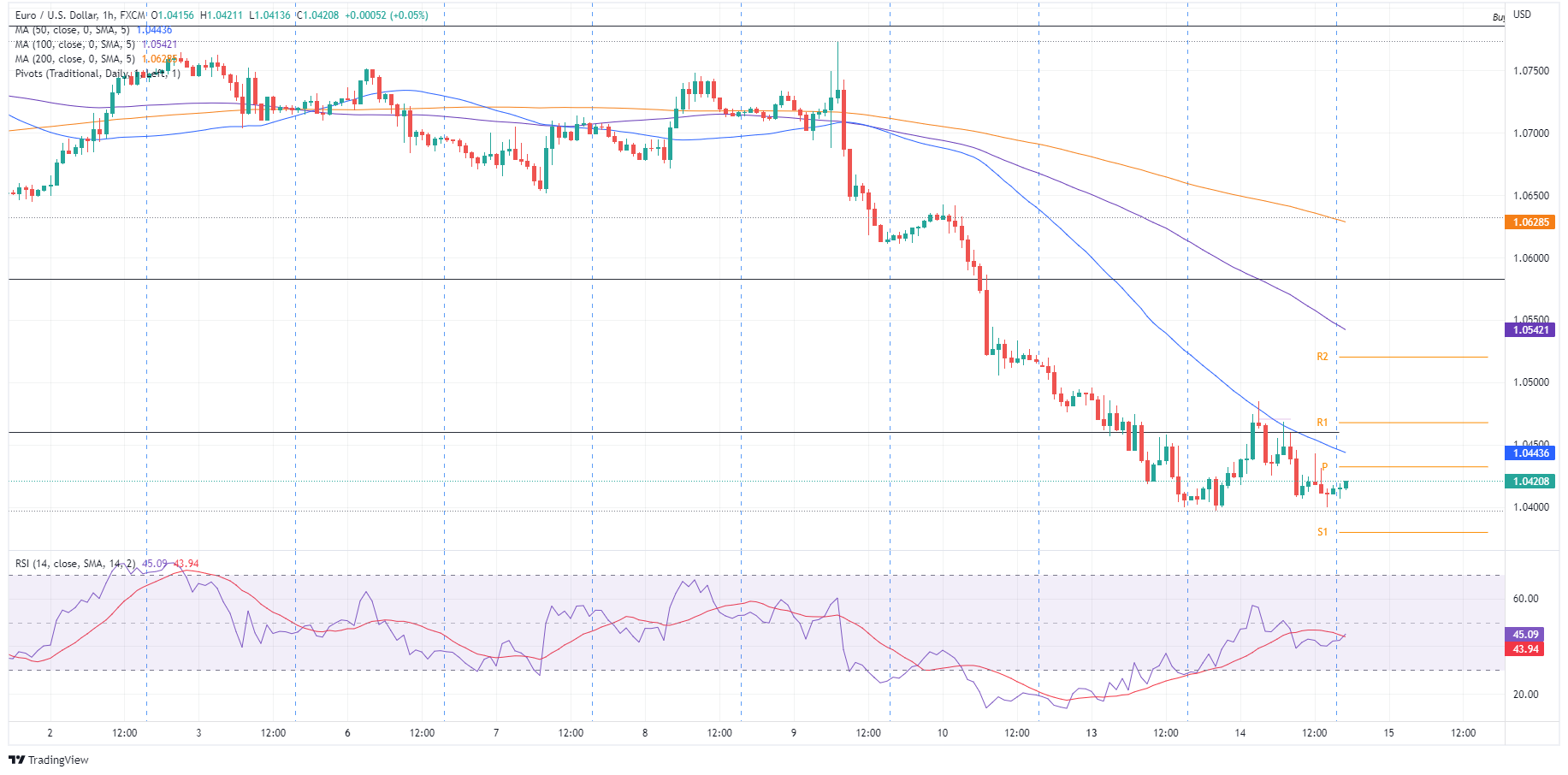
Key Technical Levels
“US economy is in a transition,” said White House (WH) Economic Adviser Brian Deese during an interview with CNN on Tuesday.
The policymaker also signaled the WH's aim to ease the price pressure and the Federal deficit during the interview.
Market implications
Such comments from the key diplomat ahead of the Federal Open Market Committee (FOMC), up for Wednesday, exert additional pressure on the Fed to act, which in turn adds to the risk-off mood.
It’s worth noting that earlier in the day, National Economic Council Deputy Director Bharat Ramamurti also crossed wires and signaled inflation as the key problem.
Also read: WH Economic Adviser Ramamurti: Inflation is a global problem – Bloomberg
US Treasury Secretary Wally Adeyemo said on Tuesday that Russia's oil profits have likely risen despite lower crude exports, and the United States and its allies must find ways to reduce Moscow's oil revenue, possibly by capping prices, per Reuters.
Adeyemo told a U.S. Senate Appropriations subcommittee hearing.
Additional comments
US goal needs to be limiting the amount of revenue Russia earns from oil exports.
There are a number of options in terms of reducing Russia’s revenue.
There are things like introducing a price cap, such moves must be taken in cooperation with U.S. allies and partners.
Russian economy is 'getting smaller every day' due to sanctions.
Full US. trade embargo on Russia would have marginal impact on Russia's economy 'at best'.
Market implications
The news adds to the risk-off mood and weighs on the US equity benchmarks, as well as allowing the US Treasury yields to refresh an 11-year high of around 3.5%. However, major attention is on the Fed.
Read: Forex Today: Dollar retains its strength ahead of the Fed
- Gold price is displaying a minor pause above $1,800.00 after a steep rally.
- A 75 bps rate hike by the Fed will have a significant impact on the inflationary pressures.
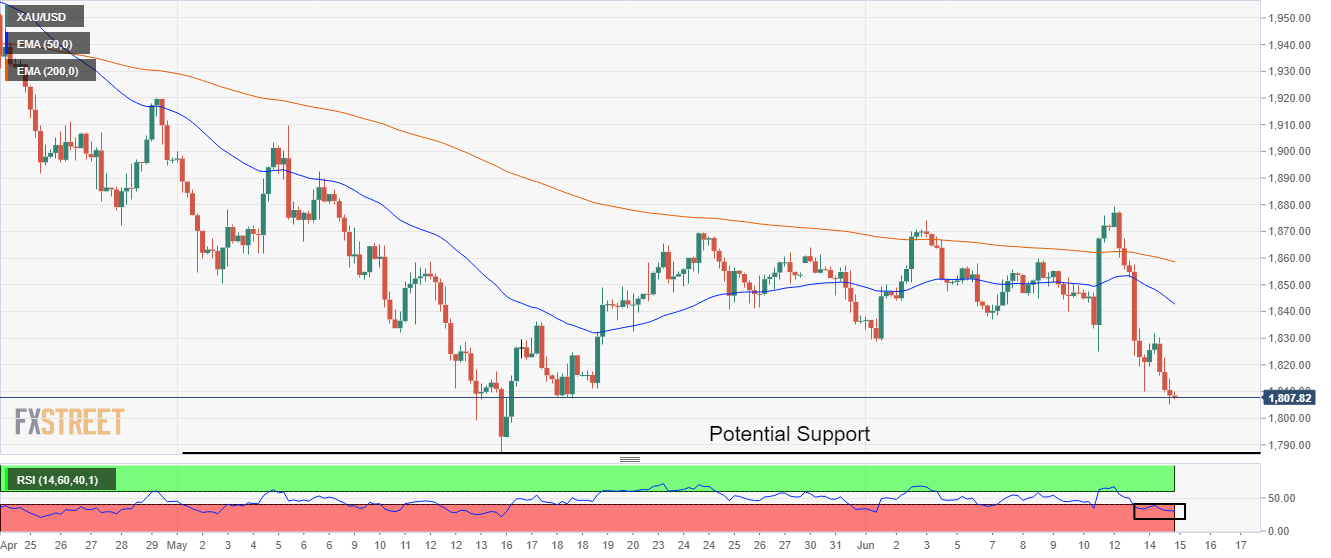
- The precious metal is declining towards $1,786.00 as the RSI (14) has shifted into a bearish range.
Gold price (XAU/USD) is displaying a minor pause above the psychological support of $1,800.00 after a perpendicular fall. The market participants have dumped the precious metal on expectations of an interest rate hike above 50 basis points (bps) figure this time.
The gold prices faced extreme selling pressure after a pullback move towards $1,830.00 on Tuesday, which dragged the bright metal sharply to near $1,800.00. The annual US inflation figure has risen to 8.6% on annual basis. It looks like the quantitative tightening yet done by the Federal Reserve (Fed) has failed to impact materially on the price pressures.
Meanwhile, the US dollar index (DXY) is oscillating around 105.50 and is expected to display more upside on expectations of an extreme hawkish tone by Fed chair Jerome Powell. The DXY is advancing firmly on a broader basis and has refreshed its 19-year high at 105.65. Also, the 10-year US Treasury yields have jumped to 3.8% as a big rate hike by the Fed is on the cards.
Gold technical analysis
On a four-hour scale, the gold prices are declining towards the potential support that is placed at $1,786.94. The 50- and 200-period Exponential Moving Averages (EMAs) at $1,842.80 and $1,859.90 respectively have turned lower again after remaining sideways, which signals an initiative selling structure. The Relative Strength Index (RSI) (14) has shifted into a bearish range of 20.00-40.00, which signals more pain ahead.
Gold four-hour chart
“Canadian Prime Minister (PM) Justin Trudeau on Tuesday said his government was watching rising interest rates ‘with concern,’ when asked about the impact higher borrowing costs are having on housing affordability in the country,” said Reuters on late Tuesday.
“We know full well that housing prices are a real concern, especially for middle-class Canadians hoping to buy their first home,” Canadian PM Trudeau spoke to Parliament by video conference after testing positive for COVID-19.
USD/CAD retreats below 1.3000
Following the news, USD/CAD eases from a monthly high surrounding 1.2975, also probing the five-day uptrend.
Also read: USD/CAD marches firmly to fresh multi-week highs around 1.2960s, ahead of FOMC, US Retail Sales
- AUD/USD is expected to continue its five-day losing streak after slipping below Tuesday’s low at 0.6850.
- Investors are cautious as the Fed is expected to elevate its interest rates by 75 bps.
- The Australian economy may have added 25k jobs to the labor force in May.
The AUD/USD pair has witnessed some bids around 0.6850 as the US dollar index (DXY) has entered into a pullback phase after an upside move. The asset displayed a steep fall on Tuesday after slipping below the critical support of 0.6911. A four-day losing streak was carry-forwarded on Tuesday as investors are uncertain over the interest rate decision by the Federal Reserve (Fed).
After the release of a higher print by the US Consumer Price Index (CPI), the market participants have turned more cautious amid advancing odds of a recession situation in the upcoming quarters. The Fed tightened its policy by elevating its interest rates by 75 basis points (bps) in total in its last two monetary policy meetings along with balance sheet reduction. Despite the restrictive quantitative measures, the US CPI landed above the expectations at 8.6%.
Taking into account, higher inflation and a tight labor market, the Fed is expected to dictate a 75 bps rate hike as stronger tightening measures would do the job more efficiently.
On the aussie front, investors are awaiting the release of the employment data. As per the market consensus, the Australian economy has 25k jobs in the labor market vs. 4k reported earlier. Also, the Unemployment Rate will slip to 3.8% from the prior print of 3.9%.
- The euro recovered some ground vs. the Japanese yen amidst the scenario of Japanese authorities intervening in the FX markets.
- EUR/JPY Price Analysis: The formation of a bearish flag pattern in the 1-hour chart would open the door for further losses.
The EUR/JPY is snaping three days of consecutive losses, courtesy of last Friday’s verbal intervention by Japanese authorities, which spurred a dip from YTD highs at around 144.18 to 139.38, almost a 500 pip fall. However, on Tuesday, the EUR/JPY is recovering and erases 150 pips of losses, gaining 1.06%, and is trading at 141.06, as the New York session winds down.
Sentiment remains negative. Expectations that the US Federal Reserve would hike 75 bps mounted. Banks in Wall Street updated their Fed calls on Tuesday after an article by the WSJ that stated that due to high inflationary indicators, the US central bank would “surprisingly” hike 75 bps.
The aforementioned triggered a bloodbath in global equities, which remain on the defensive. US Treasury yields remain elevated, and the greenback rose.
The EUR/JPY got a boost, despite a dismal than expected EU data. As expected, inflation in Germany rose by 7.9% YoY in May, alongside other inflationary numbers that came in line as estimated. However, the Zew Economic Sentiment Index in the Euro area and Germany missed expectations. Nevertheless, it was ignored by traders.
EUR/JPY Price Analysis: Technical outlook
The EUR/JPY’s daily chart depicts the cross-currency as upward biased, but the RSI, albeit in the bullish territory, is trendless. That said, the EUR/JPY might consolidate in the near term in the 139.40-141.00 area.
The EUR/JPY’s 1-hour chart illustrates that the pair is confined to an uptrend channel, forming a bearish flag. Nevertheless, a break above the bearish flag-top trendline, which confluences with the 200-hour simple moving average (SMA) at 141.34, would open the door for a test of June’s 12 high, which confluences with the 100-hour SMA and the R1 daily pivot point around 141.76. If that scenario is completed, the following resistance would be June’s 10 high at 142.79.
However, the EUR/JPY path of least resistance is downwards. The EUR/JPY’s first support would be the confluence of the 50-hour SMA and the daily pivot at around 140.54. Break below would expose the bottom trendline of the bearish flag around 140.30-40, followed by the S1 daily pivot at 140.00.
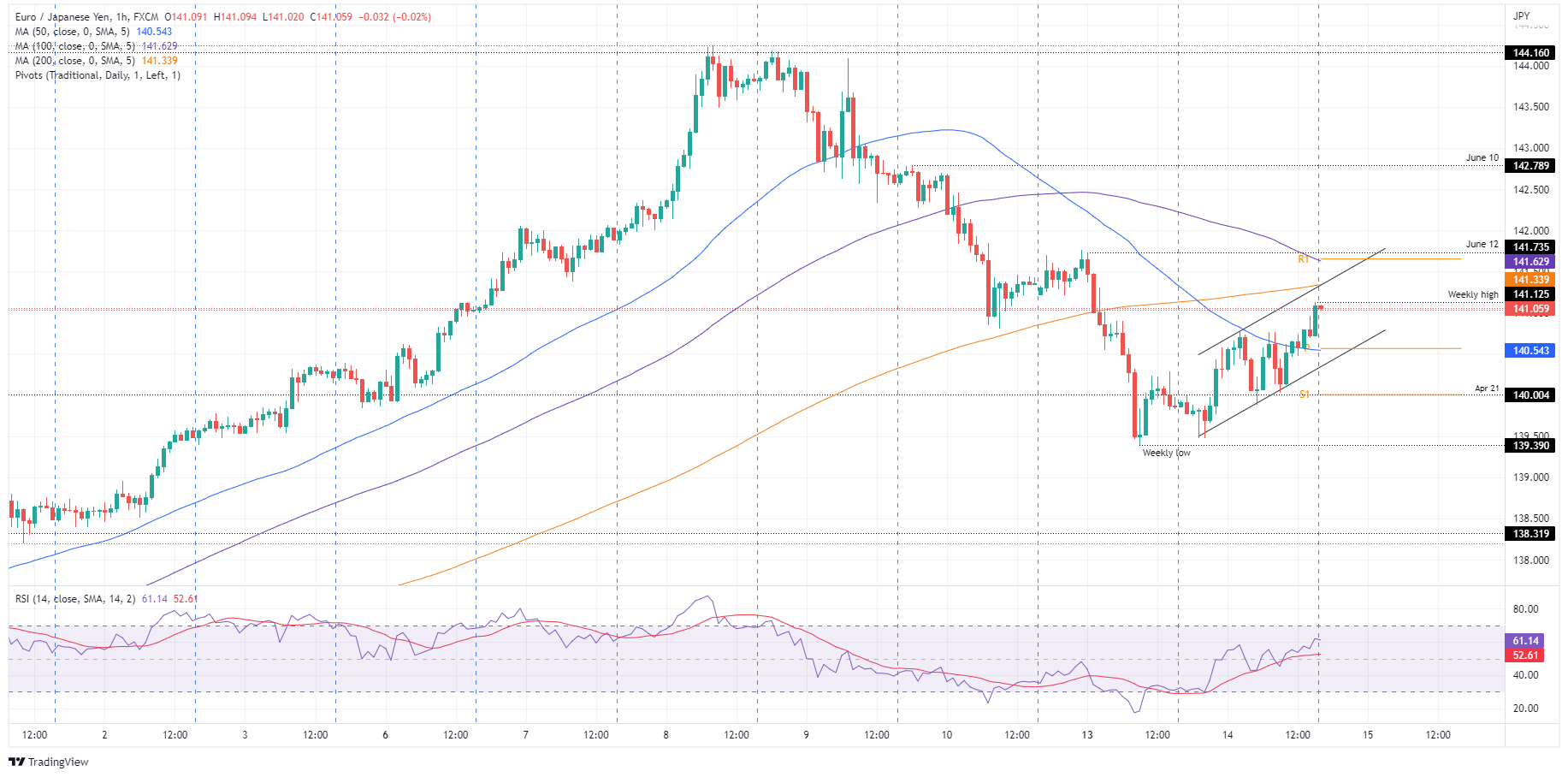
Key Technical Levels
- The USD/CHF extended its gains on Tuesday, up by 0.50% courtesy of expectations of the US Fed hiking 75 basis points.
- The major seesawed around a 160 pip range, with the USD taking the upper hand.
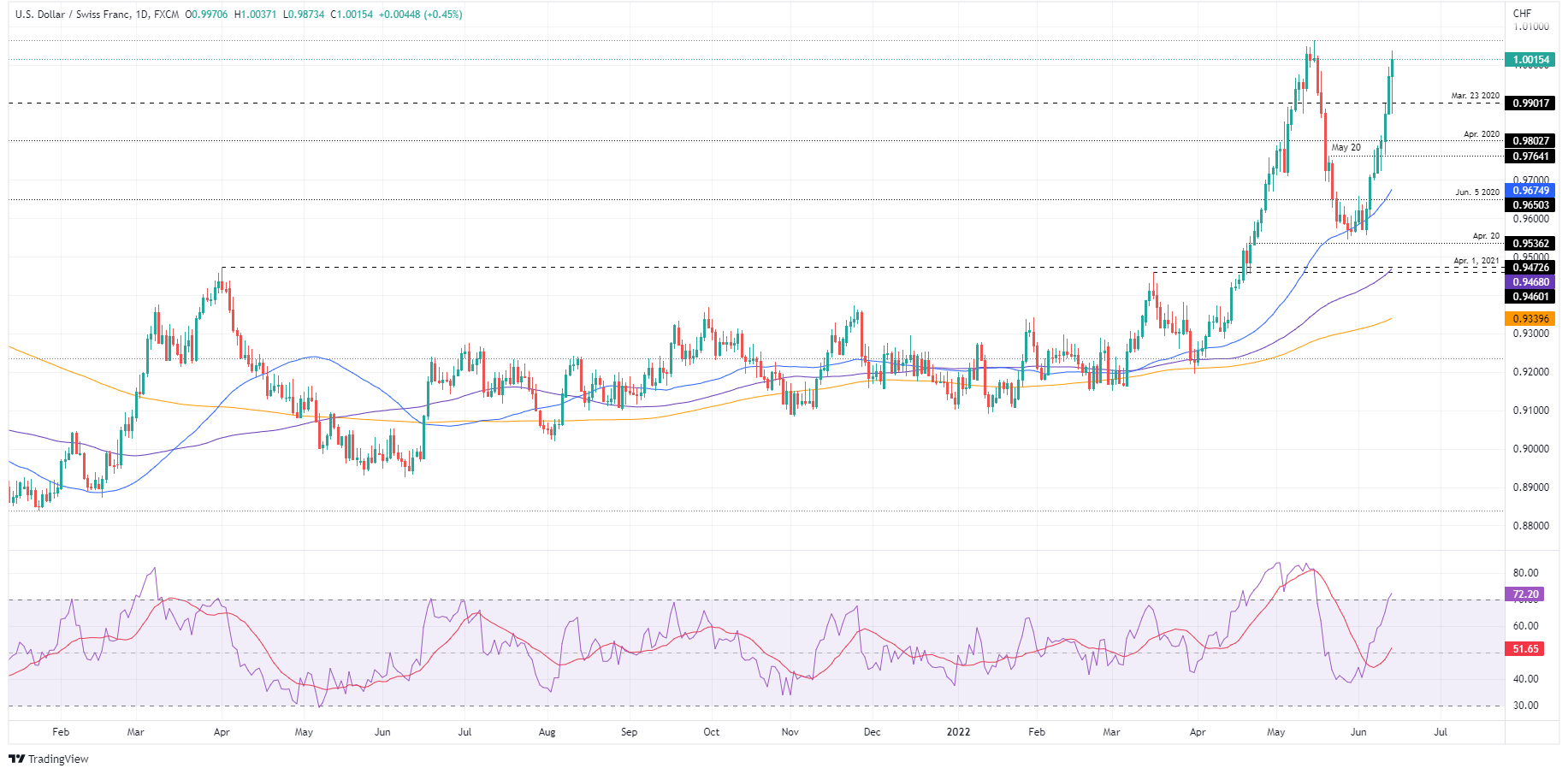
- USD/CHF Price Analysis: A daily close above the parity might open the door for a YTD high challenge at around 1.0064.
The USD/CHF climbs towards parity for the fifth time in the year, courtesy of a negative sentiment surrounding the financial markets, as traders prepare for an “aggressive” rate hike of the Federal Reserve on Wednesday, which could probably increase 75 bps, the Federal Funds Rate (FFR) to 1.75%. At 1.0015, the USD/CHF gains 0.45%.
The Swiss franc remains weak for the reasons above-mentioned. Additionally, another Covid-19 outbreak in China summed up the factors remaining in the backdrop, like global inflation and Russia’s invasion of Ukraine.
In the meantime, the US Dollar Index advanced 0.26% during the day, currently at 105.473, underpinned by high US Treasury yields. The US 10-year benchmark note yields 3.477%, gaining eleven basis points.
USD/CHF Price Analysis: Technical outlook
USD/CHF Tuesday’s price action witnessed a sharp U-turn. The major opened around 0.9970 and dipped sharply towards daily lows at 0.9874 before rallying to fresh monthly highs above the parity at 1.0037. That said, the USD/CHF remains upward biased in the near term.
Therefore, due to the upward bias of the pair, the USD/CHF first resistance would be the MTD high at 1.0037. A breach of the latter would expose the YTD high at 1.0064, followed by the 1.0100 figure, which, once cleared, would send the pair towards the May 2019 swing highs at around 1.0226.
Key Technical Levels
What you need to take care of on Wednesday, June 15:
The American dollar kept advancing on Tuesday, and retains its strength early Wednesday, as fear rules financial markets ahead of the US Federal Reserve decision.
Market players had long ago anticipated a 50 bps hike, but on Monday, market talks suggested the central bank may go for a steeper hike of 75 bps. Also, US policymakers will present fresh Economic Projections, which may lead to a sustained aggressive stance, should the new scenario hint at stagflation.
Across the pond, ECB’s member Klaas Knot hinted at more rate hikes in October and December, although sticking to a 25 bps move in September.
The UK released mixed employment data, as the jobless rate rose to 3.8% in April from 3.7% in the previous month, while the number of people claiming jobless benefits fell by 19.7K in May.
The EUR/USD pair hovers around 1.0400 while GBP/USD trades at its lowest since March 2020 at 1.1980. The AUD/USD pair extended its slump to 0.6850, while USD/CAD trades around 1.2955 as the poor performance of equities and plummeting gold and oil prices undermined demand for commodity-linked currencies.
Wall Street remained under selling pressure, although the Nasdaq Composite was able to post a modest gain of 0.10%.
US government bond yields continued to rally, with that on the 10-year Treasury note peaking at 3.489%, its highest in over a decade.
Like this article? Help us with some feedback by answering this survey:
- The NZD is nosediving during the week, almost 2.30%.
- The market sentiment dampened on expectations that the Fed may hike 0.75% in June, increasing investors’ appetite for safe-haven assets, thus boosting the greenback.
- US Wednesday calendar will be busy reporting Retail Sales and the FOMC’s monetary policy decision.
Dismal market mood spurred by fears that the US Federal Reserve might raise rates by 75 bps, but it would trigger the US into a recession, has risk-sensitive currencies like the New Zealand dollar on the defensive. At the time of writing, the NZD/USD is down 0.69% daily, trading at 0.6211, at new 2-year lows.
Sentiment and safe-haven flows, a headwind for the NZD
Global equities are tumbling for the second consecutive day. In the meantime, the appetite for safe-haven peers has grown, as the US Dollar Index, a gauge of the greenback’s value vs. six currencies, advances 0.42%, currently at 105.636, at 20-year highs, a headwind for the NZD/USD.
Last Friday’s high US inflation report, topping at around 8.6% YoY, caused a reaction on Monday. Since the opening of the Asian session, the market mood shifted to risk-off, with US Treasury yields skyrocketing above the 3% threshold, and during the day, the 2s-10s yield curve inverted, a signal of a US recession. Also, the re-emergence of China’s Covid-19 outbreak added another piece to the already battered sentiment.
In the meantime, reports surfaced that the Fed might accelerate the pace of tightening and lift rates by 75 bps, loom. Most Wall Street analysts updated their calls for the Federal Funds Rate (FFR) to finish June at 1.75%, contrary to the 1.50% estimated on Monday.
That said, the NZD/USD extended its losses. So far is down 2.25% in the week, with just two trading days, almost matching last week’s losses.
Data-wise, the US economic docket featured prices paid by producers, which heightened at around 10.8% YoY, though they were ignored by traders, with their focus on the Fed. The CME FedWatch Tool reports that investors have priced in a 93.2% chance of a US Federal Reserve 0.75% rate hike in the June meeting.
In the week ahead, the New Zealand economic docket will reveal the Current Account for Q1, estimated at NZ$-5.5 billion. The US calendar will feature May’s Retail Sales, estimated to grow by 0.2% MoM, alongside the highlight of the week, the US Federal Reserve Open Market Committee (FOMC) interest rates decision.
Key Technical Levels
- The USD/CAD is gaining close to 1.50% during the week.
- Investors’ sentiment shifted sour on expectations of a higher than estimated FOMC rate hike; global equities fall.
- USD/CAD Price Forecast: The pair is upward biased, and a break above 1.3000 opens the door for a challenge of the YTD high at 1.3076.
The USD/CAD marches firmly and is reaching a new four-week high, extending its gains for the fifth consecutive day, with investors worried that the Federal Reserve might trigger the US economy into a recession as they tighten monetary policy to abate inflation. The USD/CAD is trading at 1.2962 at the time of writing, up by 0.49%.
Global equities remain under pressure, reflecting a dampened market mood. Consequently, demand for the greenback rose due to its safe-haven status. Reflection of that is the US Dollar Index, a basket of the performance of six currencies vs. the buck, advancing 0.15%, sitting at 105.360.
The USD/CAD remains upward pressured for the reason mentioned above. The US economic calendar reported prices paid by producers, which rose by 10.8% YoY, in line with estimations, triggering no action as traders’ focus is on the Fed. The CME FedWatch Tool reports that investors have priced in a 93.2% chance of a US Federal Reserve 0.75% rate hike in the June meeting.
Meanwhile, oil prices drop for the first time in the week. Western Texas Intermediate (WTI), the US crude oil benchmark, falls more than 1%, exchanging hands at $119.64 per barrel, a tailwind for the USD/CAD.
Data-wise, the Canadian economic docket reported factory sales, which climbed 1-7% in April, with sales volumes up 0.9%, adding evidence of firm economic activity in the second quarter.
In the week ahead, the Canadian economic docket will feature Housing Starts on Wednesday, estimated at 252.6K. On the US front, May’s Retail Sales are estimated to grow by 0.2% MoM, alongside the highlight of the week, the US Federal Reserve Open Market Committee (FOMC) interest rates decision.
USD/CAD Price Forecast: Technical outlook
The USD/CAD fourth-day rally lifted the major from 1.2550 to 1.2960s. After being above the exchange rate, the daily moving averages (DMAs) shifted the USD/CAD bias upwards during a high-volatility three-day trading session. The RSI is aiming higher, though shy of reaching overbought conditions, opening the door for further gains.
Therefore, the USD/CAD first resistance would be the 1.3000 mark. Break above would expose the YTD high at 1.3076, followed by November 13, 2020 swing high at 1.3172.
Key Technical Levels
- West Texas Intermediate traded as high as $123.66 a barrel before retreating.
- The sour tone of equities undermines demand for black gold.
- The OPEC+ downwardly revised Russian oil output for the year.
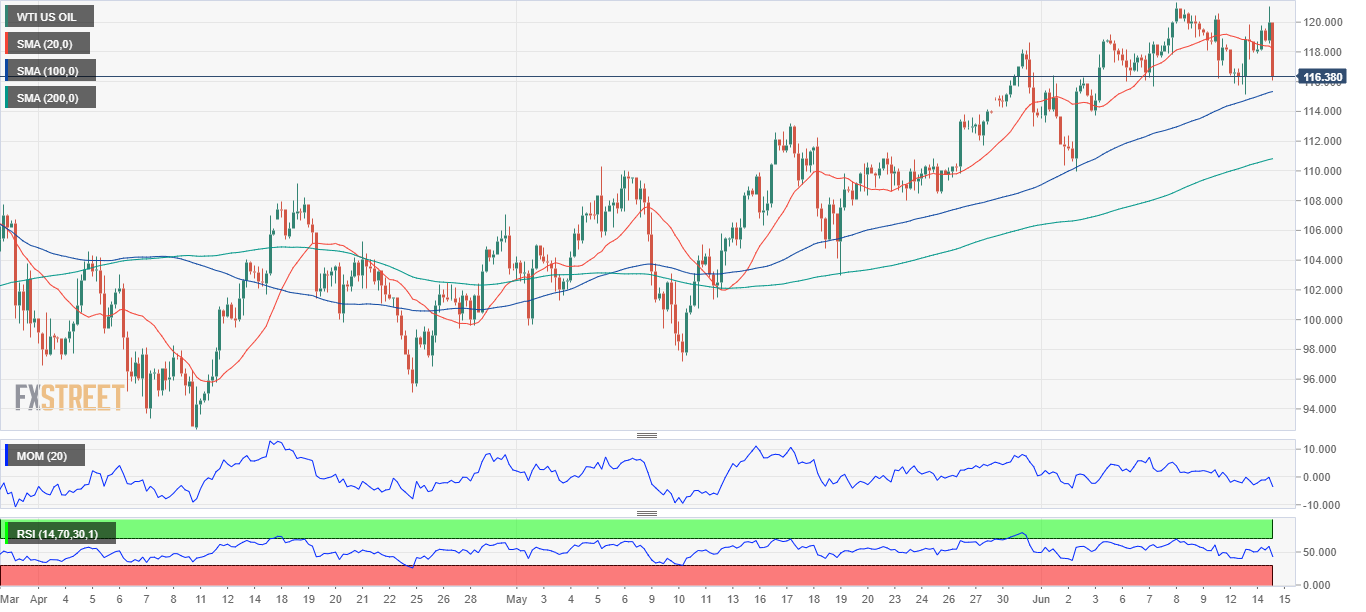
Crude oil prices are in retreat mode after reaching fresh three-month highs. The barrel of West Texas Intermediate hit an intraday high of $123.66, now trading at around $119.38. The initial rally came after the OPEC+ reported that it produced a total of 28.5 million barrels per day in May, down by 176K bpd compared to April.
The organism´s Monthly Oil Market Report also showed that members expect demand to keep rising, while downwardly revised Russian liquids output forecast by 250K bpd, which means they expect the country’s production to contract by 170 bpd on the year. Additionally, OPEC is hopeful that the Chinese decision to lift lockdown measures should increase imports from the country.
The commodity turned south with Wall Street’s opening, as US indexes extend their bearish route amid fears of a US recession and ahead of the US Federal Reserve monetary policy decision. The central bank has been widely anticipated to hike the benchmark rate by 50 bps, although the latest inflation figures pushed market players to lift their bets, now anticipating a 75 bps hike.
- Gold spot slides for the second consecutive day and extends its weekly losses to 3.12%.
- Higher US Treasury yields and real rates weigh on the appeal of the yellow metal.
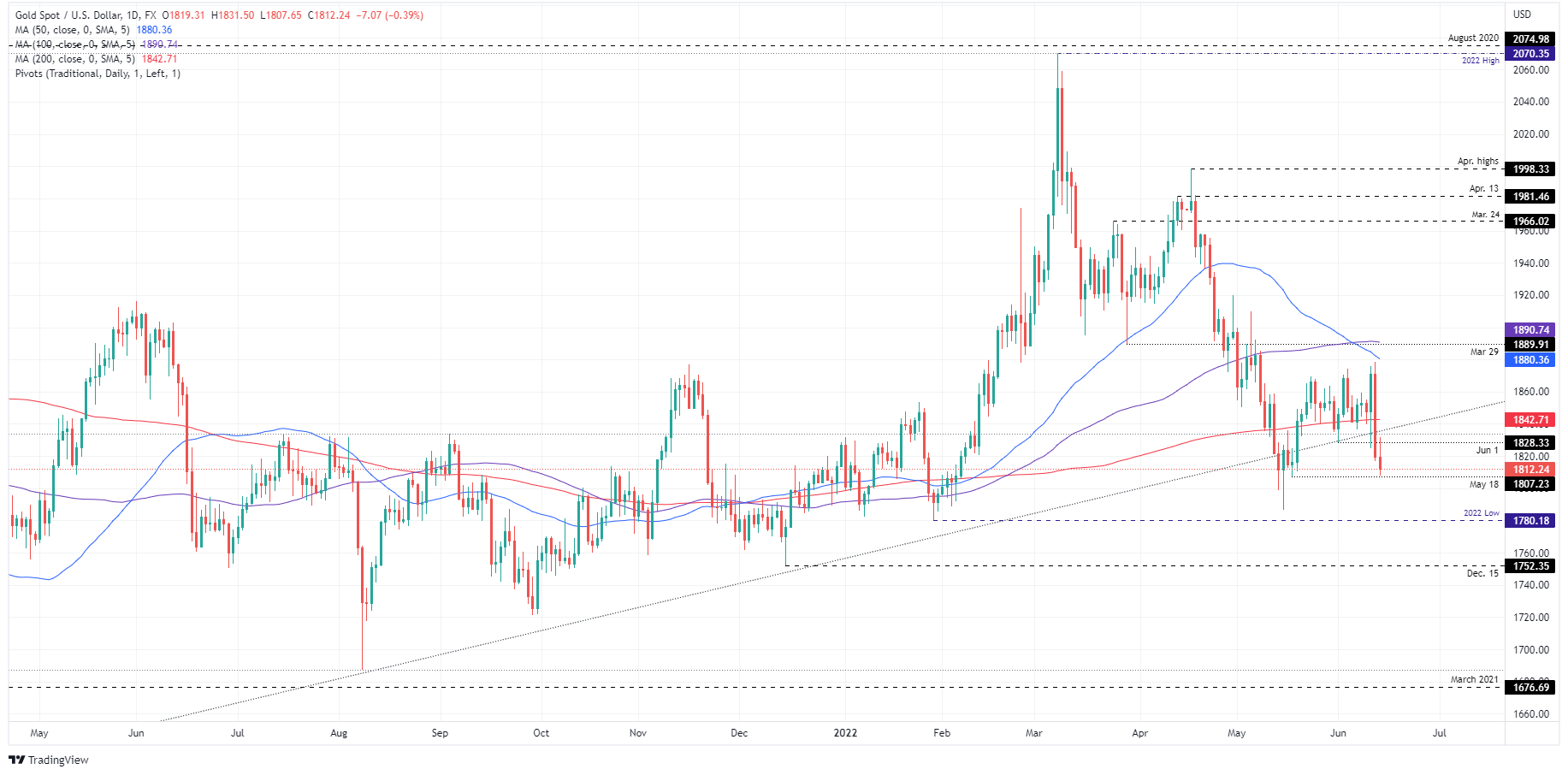
- Gold Price Forecast (XAUUSD): Remains downward pressured, and a break of $1800 to open the door for a challenge of the YTD Low at around $1780.
Gold spot (XAUUSD) grinds lower in the midday of the North American session, down by 0.27%, as the US Dollar continues printing fresh 20-year highs on Tuesday, weighing on the non-yielding metal appeal as US Treasury yields rise. At the time of writing, XAU/USD is trading at $1812.24 a troy ounce.
In the meantime, the US Dollar Index, a measure of the greenback’s value vs. a basket of peers, rises by 0.16%, sitting at 105.379, underpinned by the yields of US Treasuries. Reflection of the aforementioned is the 10-year benchmark note rate at 3.439%, up 6.8 bps.
Risk-aversion extends for the second consecutive day, as reflected by the bloodbath in global equities. On Monday, near the Wall Street close, reports emerged that the US Federal Reserve might hike 75 bps the Federal Funds Rates (FFR) on Wednesday as a response to last Friday’s hot US CPI of around 8.6%. Traders are braced for an upward move, as shown by the CME FedWatch tool, which sits at a 96.1% chance of a 0.75% rate increase.
Therefore, Gold prices are due for a further correction lower. Commerzbank analysts, in a note, wrote, “Gold is facing headwind from the persistently firm US dollar and, above all, from the further rapid rises in bond yields. Yields on two-year US Treasuries have surged by around 30 basis points. Yields on ten-year US Treasuries climbed for a time above 3.4%, their highest level in more than eleven years. As a result, real interest rates have also picked up significantly and at 0.68% now find themselves at their highest level in over three years.”
At the time of publishing, the US 10-year Treasury Inflation-Protected Securities (TIPS), which are also a proxy for real rates, sit at 0.803%, extending its gains, spurring a fall in Gold spot (XAUUSD) towards a daily ow at $1807.65
Before Wall Street opened, the Producer Price Index (PPI) for May, rose by 10.8% YoY, in line with expectations, and up 0.5% from April. The market players’ reaction was muted as investors focused on Wednesday’s Retail Sales in advance of the Federal Reserve Open Market Committee (FOMC) monetary policy decision.
Gold Price Forecast (XAUUSD): Technical outlook
On Monday, XAU/USD prices collapsed sharply below the 200-day moving average (DMA) and broke below a 4-year-old upslope support trendline that passed around July 15, 2021, high at $1834, a significant support/resistance level for gold traders, exacerbating the fall towards the $1820 area.
That said, the XAU/USD first support level would be the May 18 low at $1807.23. Break below would expose the $1800 psychological level, which, if it gives way, XAU/USD bears could prepare an attack towards the YTD low at $1780.18.
Key Technical Levels
European Central Bank (ECB) Governing Council member Isabel Schnabel said on Tuesday that the monetary policy can and should respond to a disorderly repricing of risk premia, as reported by Reuters.
Additional takeaways
"We will react to new emergencies with existing and potentially new tools."
"Tools might again look different, with different conditions, duration and safeguards to remain firmly within our mandate."
"There can be no doubt that, if and when needed, we can and will design and deploy new instruments to secure monetary policy transmission."
"Flexibility will remain an element of monetary policy whenever threats to monetary policy transmission jeopardise the attainment of price stability."
"Monetary policy will need to respond to destabilising market dynamics."
"We will not tolerate changes in financing conditions that go beyond fundamental factors and that threaten monetary policy transmission."
"We are therefore monitoring current market developments closely."
Market reaction
The EUR/USD pair showed no immediate reaction to these comments and was last seen posting modest recovery gains at 1.0430.
- The yield on the 10-year Treasury note soared to its highest in over a decade.
- Skyrocketing inflation is behind the market’s turmoil amid recession fears.
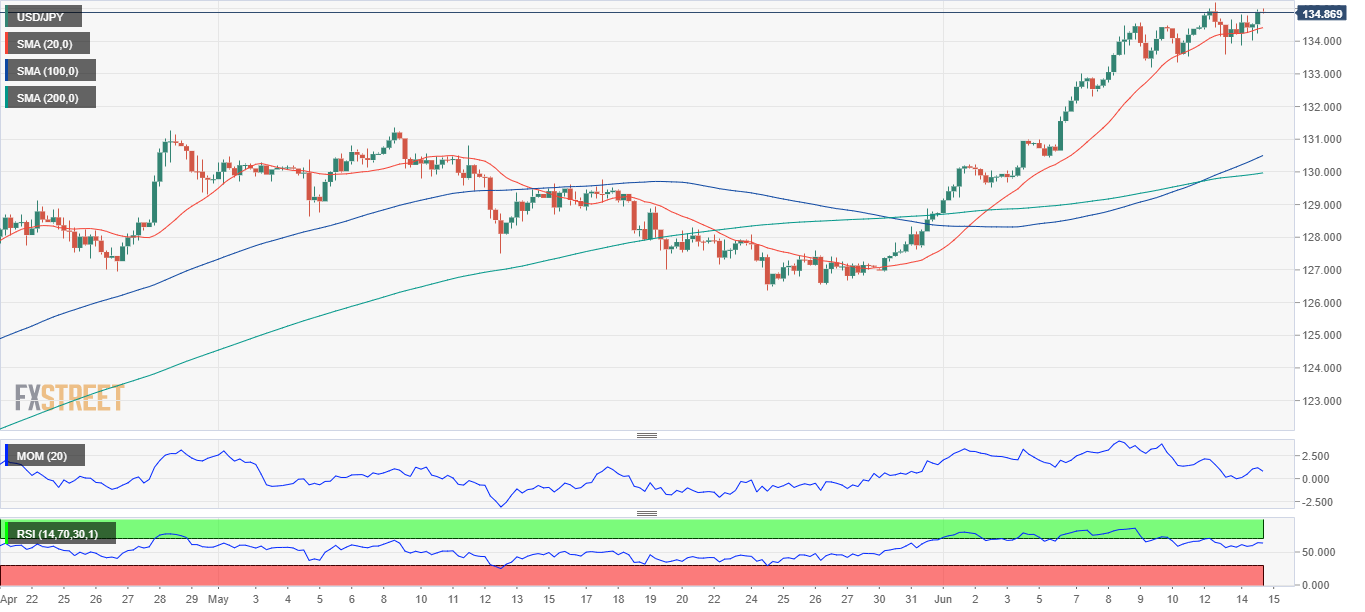
- USD/JPY is on its way to reaching fresh multi-decade highs beyond 135.20.
Risk aversion retains control of financial markets on Wednesday, as market participants speculate about the US Federal Reserve escalating quantitative tightening to fight stubbornly high inflation. The Consumer Price Index in the country soared to 8.6% YoY in May, the highest in over four decades.
At the same time, investors keep an eye on slowing economic growth, as economies keep struggling to stand back on its feet following the tough global measures imposed in March 2020, when the coronavirus pandemic stormed the world.
US government bond yields provide support to USD/JPY, as the 10-year Treasury note currently yields 3.44% after touching 3.456%, its highest in over a decade.
Levels to watch
The USD/JPY pair trades near a weekly high of 135.19, a level that was last seen in October 1998, and despite extreme overbought conditions in the daily chart, there are no signs of bullish exhaustion. The pair is gathering directional momentum in the near term, after consolidating around the current price zone since early June.
Beyond the mentioned weekly high, the next relevant resistance level is 136.90, October 1998 monthly high. A strong static support area comes around 133.30/40 where buyers have been appearing in the last few days.
National Economic Council Deputy Director Bharat Ramamurti told Bloomberg TV on Tuesday that inflation was a global problem but added that the United States was "well prepared."
Ramamurti further argued that oil refiners were to blame for high prices.
Market reaction
Markets remain risk-averse following these comments. As of writing, the S&P 500 Index was down 0.4% on a daily basis at 3,734. In the meantime, the US Dollar Index clings to modest daily gains and trades at its highest level since December 2002 at 105.40.
- The S&P 500 and the Dow Jones recorded losses in a risk-off market mood.
- The Nasdaq Composite is recovering some ground and remains above the 10,000 figure.
- Expectations of a bigger than foreseen Fed rate hike shifted sentiment sour, underpinned the greenback.
- US Treasury yields reach fresh multi-year highs, above the 3% threshold.
US stocks continue their rout, losing between 0.26% and 0.56%, except for the heavy tech Nasdaq Composite, which pares some of its losses, up by 0.25%.
US Fed expectations of a larger rate increase weighed on sentiment, US equities fell
The S&P 500 and the Dow Jones Industrial Average are slipping 0.26% and 0.56% each, sitting at 3,739.23 and 30,345.10, respectively, at the time of writing. Meanwhile, the Nasdaq Composite is rising 0.25%, up at 10,836.09.
In the meantime, the US Dollar Index advances to a fresh 20-year high at around 105.433, gaining 0.22%, on Tuesday. US Treasury yields remain elevated. The 10-year benchmark note rate is at 3.441%, up to six basis points, reflecting traders’ expectations of a 75 bps rate hike.
Investors’ mood remains negative, weighed by a WSJ news that revealed that US Fed officials might “surprise” the markets with a larger than expected 0.75% bps rate hike. Also, US economic data crossing the wires were mixed, led by the rise in the Producer Price Index, which showed that prices surged in May by 10.8% YoY, though lower than expected, indicating that it’s not slowing down, further cementing the Fed’s rate hike.
Later, the US IBD/TIPP Economism optimism for June dropped to 38.1 from 41.2 in May. Raghavan Mayur, president of TechnoMetrica, who directed the poll, wrote, “The June numbers are quite bleak. Most Americans (53%) feel we are now in a recession, and two-thirds (67%) feel the economy is not improving.
In terms of sector specifics, the leading gainers are Energy, up 1.9%, propelled by high oil prices, followed by Technology and Consumer Discretionary, each recording gains of 0.29% and 0.05%, respectively. Contrarily, Utilities, Consumer Staples, and Health are losing 3.04%, 1.68 %, and 1.2% each.
In the commodities complex, the US crude oil benchmark, WTI, is gaining 0.88%, trading at $122.00 BPD, while precious metals like gold (XAU/USD) are falling 0.99%, exchanging hands at $1813.45 a troy ounce, as US Treasury yields, keep rising to multi-year highs.
Key Technical Levels
The GBP/USD pair hit levels under 1.2000 for the first time since March 2020. The pound remains under pressure even as market participants expect a rate hike from the Bank of England on Thursday.
- EUR/USD drops back toward 1.0400 after being unable to hold above 1.0450.
- Euro posts strong gains versus the Swiss franc and the pound.
- FOMC meeting: Expectations of a 75 bps hike continue to rise.
The EUR/USD continue to pull back after the beginning of the American session and it is hovering around 1.0410, slight above Monday’s close. Earlier on Tuesday, the pair peaked at 1.0485 but then lost momentum as Wall Street turned to the downside and as US yields printed fresh highs.
After a positive opening, the Dow Jones is falling by 0.42% and the S&P 500 by 0.11%. The US 10-year bond yield stands at 3.45%, the highest since April 2011. The FOMC meets and will announce on Wednesday a rate hike. Speculations of a 75 basis points rate hike rose after CPI inflation data on Friday; the PPI numbers today came below expectation but did not alleviate tightening expectations.
“After yesterday's market carnage, the curve looks to have largely priced in this expectation. We are wary that the short EURUSD trade is a bit exhausted given the repricing in the FF curve (though this could remain fluid). EUR is also trading a bit better on the crosses ahead of the Fed decision. That suggests to us that we may see a sell the rumor, buy the fact dynamic into and out of the Fed”, explained analysts at TD Securities.
Dead cat bounce?
The EUR/USD is back near the daily low reached at 1.0396 during the Asian session. A break lower should trigger more losses targeting the YTD low at the 1.0350 zone. Below the next support might be located at 1.0300. The negative bias will likely persist until the FOMC statement. A recovery of the euro faces initial resistance at 1.0435 and above below the 1.0500 zone.
Technical levels
- The AUD/USD fell 0.54% on Tuesday, ahead of the US Fed meeting.
- Sentiment and US Federal Reserve expectations of a bigger than foreseen rate hike weighed on the AUD/USD.
- AUD/USD Price Analysis: Might re-test 0.6900 before challenging the YTD low at 0.6828.
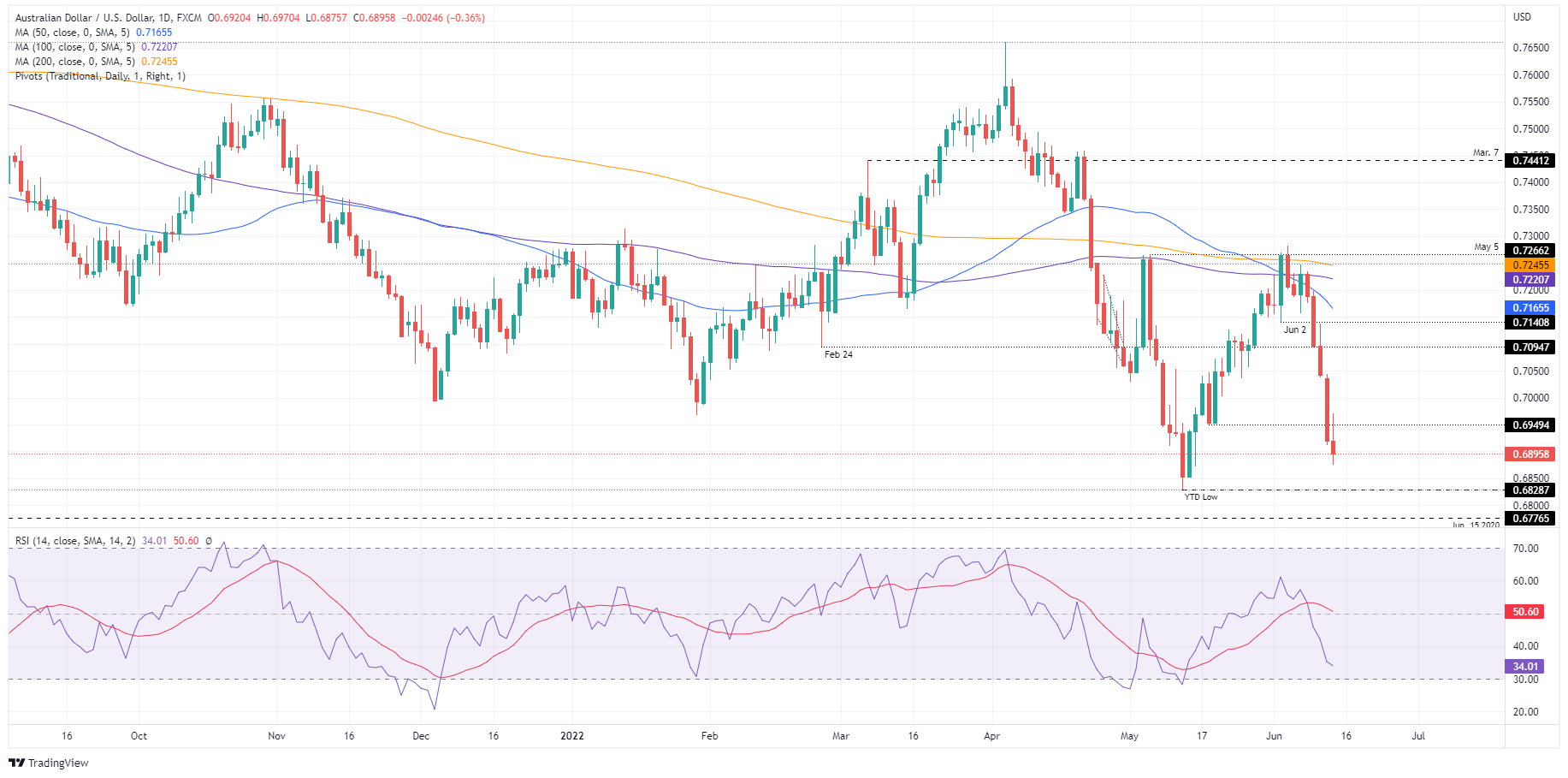
The Australian dollar plunges to fresh four-week lows after news that the Federal Reserve would hike 75 bps in the June meeting, the largest since 1994, as US inflation hit 8.6%, showing signs of not abating in the near term. After reaching a daily high near 0.6970, the Aussie dollar collapsed and trades at 0.6894 at the time of writing.
AUD/USD falls on US Federal Reserve 75 bps hike expectations and negative sentiment
The AUD/USD fell on the back of a WSJ news piece that said that “a string of troubling inflation reports in recent days is likely to lead Federal Reserve officials to consider surprising markets with a larger-than-expected 0.75-percentage-point interest rate.” The sentiment was already sour on Monday and carried on to Tuesday’s session, weighing on the AUD/USD, which has plummeted close to 3% in the first two days of the week.
Also, US data released on Tuesday saw the May prices paid by producers in the US rose by 0.8% MoM, aligned with expectations. On an annual basis, the figure downtick to 10.8%, from 10.9% estimations. The AUD/USD approached the 0.6900 figure on the PPI news but dipped towards 0.6880s before extending its losses to a new daily low at 0.6876.
Of late, the US IBD/TIPP Economism optimism for June dropped to 38.1 from 41.2 in May. Raghavan Mayur, president of TechnoMetrica, who directed the poll, wrote, “The June numbers are quite bleak. Most Americans (53%) feel we are now in a recession, and two-thirds (67%) feel the economy is not improving.”
Mayur added that “A full 90% are worried about inflation. Pain is particularly acute at the pump. Gasoline prices have taken over as the top economic issue for 59% of respondents, up from 47% last month. With more Americans cutting back on spending and the Personal Financial Outlook component hitting a record low, people are scared about what the coming months will hold.”
During the Asian session, the Australian NAB’s May business survey showed that business confidence and conditions fell, though they remained elevated compared to the trend. The report showed that total and retail prices continued in solid form, suggesting that upward pressure would keep mounting.
The Australian economic calendar will feature at around 12:30 GMT the Westpac Consumer Confidence for June. On the US front, May’s Retail Sales, alongside Imports and Exports Prices, would shed some light on the US economic outlook. Later at around 18:00 GMT, the Federal Reserve will reveal its monetary policy decision.
AUD/USD Price Analysis: Technical outlook
The AUD/USD is downward biased, reinforced by the break below the June 2 low at 0.7140, extending the pair losses towards the 0.7030s area. Nevertheless, on Monday, the major collapsed in tandem with most G8 currencies vs. the greenback on Federal Reserve news.
Therefore, the AUD/USD might re-test the 0.6900 before resuming the uptrend. Then the AUD/USD first support would be the May 16 low at 0.6872. A breach of the latter would expose the May 13 daily low at 0.6853, followed by the YTD low at 0.6828.
- Technical factors and a weaker pound boost EUR/GBP to highest since May 2021.
- Cross breaks multi-day range and soars.
- UK data below expectations, BoE decision on Thursday.
The EUR/GBP broke a multi-day range and jumped to 0.8681, reaching the highest level since May 2021. The cross is rising almost a hundred pips on Tuesday, rising for the third consecutive day. The euro is also rising versus the Swiss franc on Tuesday. EUR/CHF climbed above 1.0420 reaching the highest level since June 9.
The break of the critical resistance area of 0.8600 and also above 0.8650, boosted the euro further to the upside. The next level to watch now is 0.8700. The bullish tone in EUR/GBP will remain in place while above 0.8600.
Economic data from the UK came in below expectations with the unemployment rate rising unexpectedly to 3.8%. The figures contributed weakening the pound ahead of the Bank of England (BoE) on Thursday.
The central bank is expected to raise the key rate by 25 basis points to 1.25%. “There won’t be updated macro forecasts until the next meeting on August 4. WIRP suggests around 35% odds of a 50 bp move, down from over 50% at the start of this week. However, odds of 50 bp moves at the August 4 and November 3 meetings have risen,” explained analysts at Brown Brothers Harriman. The pound remains under pressure despite tightening expectations.
Technical levels
- NZD/USD is eyeing a test of yearly lows in the low-0.6200s having erased earlier session gains.
- The buck remains in the ascendency ahead of Wednesday’s expected 75 bps rate hike from the Fed.
- NZD/USD has now dropped over 5.0% in the last eight sessions, with recession fears and China lockdowns woes also weighing.
One day out from what is now expected to be a 75 bps rate hike from the Fed plus a new hawkish spin on longer-term interest rate guidance in face of the recent rise in US price pressures (as per last Friday’s US Consumer Price Inflation figures), the US dollar is back in the ascendency. NZD/USD has subsequently reversed earlier session gains that saw the pair attempt to claw its way back to the 0.6300 level and has fallen to test its earlier annual lows in the 0.6220s.
At current levels, the pair is trading lower by about 0.5% and is on course for an eighth successive session in the red during which time it has shed over 5.0% and fallen back from above 0.6550. While inflation’s failure to subside as hoped and the subsequent build-up of Fed tightening bets is one of the key reasons for recent downside, it should also be noted that NZD/USD is also vulnerable to broader macro risk appetite given the kiwi’s status as highly risk-sensitive.
Recession fears have been amping up in recent days, not least in wake of last Friday’s record bad US Consumer Sentiment data from the University of Michigan. Given New Zealand is a small open economy, it (and its currency) is seen as exposed to global growth conditions. China lockdown fears are also hurting the kiwi given its importance as a regional trade partner, as China continues to struggle to stamp out Covid-19 cases.
The US Federal Reserve will announce its monetary policy decision on Wednesday, June 15 at 18:00 GMT and as we get closer to the release time, here are the expectations as forecast by analysts and researchers of 12 major banks.
The world's most powerful central bank is expected to go off-script and hike by 75 basis points (bps) in June. What’s more, markets fully price in another 75 bps rate increase in July.
Commerzbank
“The Fed is likely to raise its key interest rate by 50 bps, as it did at its last meeting. we continue to expect the Fed to raise key rates by 50 bps in September as well, moving to smaller steps of 25 bps only thereafter. In spring 2023, the key rate would then be 3.50%.”
ANZ
“We expect the Fed will raise rates by 50 bps and reiterate guidance that it intends to return rates to neutral quickly. We also expect it to maintain its guidance that rates will rise by 50 bps in July to 2.0%. The Fed will remain open to raising rates by 50 bps in September, with post-summer policy moves contingent on inflation and labour market data. We maintain our target of 3.75% fed funds by mid-2023. We expect the Fed to lower its 2022 GDP forecast and make a modest upward revision to its 2022 and 2023 inflation profiles. The median fed funds profile over the forecast horizon is set to move higher.”
UOB
“Given the clear indications for ongoing hikes to combat inflation spelled out in the May FOMC minutes but no intentions of cranking up the size of the hikes, we are comfortable maintaining our FFTR forecast for another 50 bps each in the Jun and July FOMC. We continue to expect 25 bps in every remaining meeting of this year. This will bring the FFTR higher to the range of 2.50-2.75% by end of 2022, a range largely viewed as the range for neutral stance.”
Westpac
“The second of three consecutive 50 bps increases in the fed funds rate is expected to be delivered, taking the cash rate to 1.375%, on the way to 1.875% in July. These moves have been well telegraphed by the Committee. What comes next is less certain, however, and is likely to be the focus of questioning by the journalists at Chair Powell’s post-meeting press conference. We are likely to see a more balanced assessment of the risks pertaining to inflation and growth through Q3, culminating in the throttling back of rate hikes to a 25 bps pace from September. This shift will be all the more apparent in Q4 as the FOMC ends the tightening cycle at 2.625% in December.”
Danske Bank
“We expect the Fed to hike by another 50 bps and signal that at least one more 50 bps rate hike is likely in July. With still high underlying inflation pressure and high labour demand, risk is skewed towards the Fed signalling that more 50 bps is needed, not least after Fed’s Waller opened the door for continuing with larger 50 bps rate hikes in the autumn.”
TDS
“We are now looking for the Fed to lift rates by 75 bps despite giving clear prior guidance of 50 bps increases for the June and July FOMC. According to media outlets (highly unusual for the Fed), the FOMC is now leaning toward a more front-loaded hiking cycle after another hot CPI and inflation expectations showing signs of de-anchoring. We believe this shows the Fed is more determined to do what it takes to end the inflation overshoot as rapidly as possible even if that raises the chance of a hard landing in 2023. We also expect the Fed to tighten policy by 75 bps in July and then, after reaching neutral, to slow the pace to 50 bps in September and November. We pencil in two further 25 bps increases for the December and February meetings to reach a terminal rate of at least 3.75%-4.00%.”
RBC Economics
“The Fed is widely expected to hike its target rate by another 50 bps, taking it into the 1% range. And it’s not done yet. We expect another 50 bps hike at the next meeting in July on the way up to a 2.75% to 3% range by the end of the year. Slower growth in the economy is expected to follow against the risk that more aggressive rate hikes than we expect will be needed to tame inflation pressures that continue to stoke recession fears. Markets will be watching updated policy rate expectations from FOMC members. As of March, most members did not expect to hike rates above 3%, but that share likely moved higher.”
NBF
“The Fed is all but guaranteed to deliver a second consecutive 50 bps rate hike, bringing the target range for the federal funds rate to 1.25%-1.50%. We’ll be looking for the Fed and Chair Powell to guide markets towards another 50 bps hike at the subsequent July meeting. Thereafter the trajectory becomes less clear. Fortunately, we’re also set to receive fresh guidance on the medium-term policy path as the FOMC is set to release an updated Summary of Economic Projections. As a reminder, the Fed’s previous dot plot (released in March) signaled an expected fed funds target of 1.75%-2% in December. That’s surely to rise but the question is by how much. The market is priced for a 3% policy rate target by year-end, while we’re looking for a slightly less aggressive 2.5%.”
CIBC
“The funds rate is far enough below its final destination that the Fed could opt for a 75 bps move, but we favour a 50 bps hike as more likely given the risks of a financial market overreaction to a larger move.”
ING
“The Fed is widely expected to raise interest rates by 50 bps and confirm that a further 50 bps hike in July is the most likely path ahead. However, there is a debate as to what happens after July. We remain optimistic about near-term growth and we also think inflation will be sticky given ongoing geopolitical strife, supply chain issues, and labour market shortages. As such, a September hike is still our base case, but there is a growing chance the Bank switches to 25 bps moves at that meeting and beyond. We expect the Fed funds rate to peak at around 3% in early 2023.”
Nordea
“We change our Fed call to include a 75 bps hike. Rate markets are prepared for such a message but stock markets could have more downside in store for them. Higher USD rates and more risk-off will be in favour of the USD, which could strengthen somewhat more against the other G10 currencies. However, if the Fed does not hike by 75 bps on Wednesday rates will fall, stock should rally and the USD will likely weaken against most G10 currencies.”
ABN Amro
“We expect the Fed to deliver its second 50 bps rate hike, taking the target range for the fed funds rate to 1.25-1.50%. However, we also see a significant risk that the Fed makes an even bigger move in rates of 75 bps, given the upside surprise in the May CPI reading on Friday. We expect month-on-month inflation readings to remain far above the Fed’s target over the coming months, and somewhat above target later in the year, and this should keep the Fed hiking at a 50 bps pace for all remaining meetings of 2022, and likely once more in 2023. We expect the upper bound of the fed funds rate to peak at 4% by February. We suspect the median projected peak in the fed funds rate will fall somewhat short of our expectation of 4%, but be well above the current consensus expectation, i.e. perhaps signalling an upper bound of 3.75%. Should the Committee deliver a 75 bps hike, it is possible that its projected peak might be even higher than our new base case. At the press conference, we expect Chair Powell to continue to be incrementally more hawkish in the face of the mounting inflation challenge, perhaps flagging the risk to markets that the Fed has to move even more aggressively than the June projections might suggest. We also expect him to continue to emphasise the priority the Fed places on achieving price stability, even if this comes at the expense of a near-term rise in unemployment. The Fed will want to ensure there is no doubt among market participants over its resolve to fight inflation.”
- WTI has broken to fresh multi-month highs in the $123s on Tuesday, in keeping with the recent bullish trend.
- OPEC supply woes were in focus after the cartel said output fell in May (versus the planned hike).
- Traders will be watching the China lockdown situation and macro reaction to this Wednesday’s Fed meeting.
In fitting with the recent bullish trend, oil prices broke higher on Tuesday, with front-month WTI futures rallying into the $123s per barrel, where they trade up more than $2 on the day and nearly $6 higher versus Monday’s lows near $118. Concerns about a tight global oil market as demand in the northern hemisphere continues to rise during peak summer driving season, but supply fails to keep up, is keeping prices supported in the face of downside in risk assets such as stocks and other economically sensitive commodities.
OPEC said on Tuesday that its output fell by 176,000 barrels per day in May, a large miss on the output hike that had been targeted under its deal with OPEC+ members. Smaller (mainly African producers) continue to struggle to lift output as much as permitted under the supply pact. Meanwhile, non-OPEC but OPEC+ member nation Russia, the world’s third-largest oil producer, continues to see its output fall as a result of Western sanctions over its invasion of Ukraine.
WTI bulls continue to eye a test of early March highs in the $130 area, which looks likely given the bullish technicals, where dips have been consistently bought into since mid-April. The main threat to higher prices right now is if major Chinese cities go back into another strict lockdown like a few months ago, which would hit demand in the world’s second-largest oil-consuming nation. Wednesday’s Fed meeting also risks triggering fresh downside in global risk assets/upside in the US dollar, though oil has been resilient to these headwinds in recent weeks. US weekly Private API crude oil inventory data out at 20:30 GMT is also worth a watch.
- USD/CAD turned positive for the fifth straight day and shot to a near one-month high.
- The technical set-up favours bullish traders and supports prospects for additional gains.
- Any meaningful pullback below the 1.2865 zone would be seen as a buying opportunity.
The USD/CAD pair attracted some dip-buying near the 1.2865 area, the 61.8% Fibonacci retracement level of the 1.3077-1.2518 fall and turned positive for the fifth successive day on Tuesday. The momentum lifted spot prices to a near one-month high, closer to mid-1.2900s during the early North American session.
The US dollar reversed modest intraday losses and inched back closer to a nearly two-decade high touched the previous day. This was seen as a key factor that acted as a tailwind for the USD/CAD pair. Bulls seemed rather unaffected by a fresh leg up in crude oil prices, which tend to underpin the commodity-linked loonie.
The emergence of fresh buying near the previous resistance breakpoint now turned support, and some follow-through strength beyond the 1.2900 mark favours bullish traders. Given that oscillators on the daily chart have been gaining positive traction, the USD/CAD pair seems all set to prolong a one-week-old appreciating move.
Spot prices might now aim to surpass an intermediate hurdle near the 1.2980 region and reclaim the key 1.3000 psychological mark. The upward trajectory could further get extended and allow the USD/CAD pair to challenge the YTD peak, around the 1.3075 region touched on May 12, though the pre-Fed anxiety might cap the upside.
On the flip side, the 1.2870-65 region now becomes immediate strong support to defend. Any further pullback is likely to find decent support near the 1.2820 horizontal zone. This is closely followed by the 1.2800 round-figure mark, which coincides with the 50% Fibo. level and should now act as a strong base for the USD/CAD pair.
A convincing break below could make the pair vulnerable to weaken further below the 1.2760 support zone and drop to the 38.2% Fibo. level, around the 1.2730 area. Some follow-through selling, leading to a subsequent break through the 1.2700 mark, would negate the near-term positive bias and shift the bias in favour of bearish traders.
USD/CAD daily chart
-637908111624293884.png)
Key levels to watch
- Gold Price staged modest recovery from a near one-month low touched earlier this Tuesday.
- Aggressive Fed rate hike bets underpinned the USD and kept a lid on any meaningful upside.
- Recession fears extended some support ahead of the crucial FOMC decision on Wednesday.
Gold Price attracted some buying near the $1,810 region, or a near one-month low set earlier this Tuesday, albeit struggled to capitalize on the attempted recovery move. The XAUUSD seesawed between tepid gains/minor losses heading into the North American session and was last seen trading in neutral territory, just below the $1,820 level.
Gold Price weighed down by Fed rate hike bets
Investors seem convinced that the Federal Reserve will get more aggressive to combat stubbornly high inflation, which surged to over a four-decade high in May. In fact, the markets are now pricing in a 175 bps of tightening over the next three meetings, implying at least one 75 bps rate hike by the September meeting. Moreover, investors now expect the officials to raise rates to nearly 4% by next spring, up from last month’s expected to peak at around 3%, which, in turn, acted as a headwind for the non-yielding gold.
Bullish USD further undermined XAUUSD
The US dollar quickly reversed modest intraday losses and stood tall near a two-decade peak touched the previous day amid elevated US Treasury bond yields. This was seen as another factor that kept a lid on any meaningful upside for the dollar-denominated commodity. Expectations that the US central bank would tighten its monetary policy at a faster pace pushed the US government bond yields to their highest levels in more than a decade on Monday. This, in turn, continued lending some support to the greenback.

USD and Gold
Gloomy economic outlook helped limit losses
The prospect of a more aggressive policy tightening by the Fed and other major central banks has reignited fears of a global recession. Apart from this, worries about the supply chain disruptions caused by the Russia-Ukraine war and the latest COVID-19 outbreak in China capped the initial optimistic move in the equity markets. This, in turn, was seen as the only factor that helped limit deeper losses for Gold Price, at least for the time being.
Focus remains on FOMC
Market participants keenly await the outcome of a two-day FOMC monetary policy meeting, scheduled to be announced during the US session on Wednesday. A 75 bps hike would be the biggest since 1994 and would send shockwaves across asset classes. This should be enough to provide a fresh lift to the USD and exert downward pressure on the XAUUSD. Traders, however, seemed reluctant to place aggressive bets and preferred to wait on the sidelines heading into the key central bank event risk.
According to Yohay Elam, Senior Analyst at FXStreet: “A "buy the dip" in stocks has now turned into one for the US dollar. The Fed decision on June 15 will likely include several gut-wrenching twists, and I think the dollar would be able to stomach every move and come out on top.”
Gold Price technical outlook
Gold Price now seem to have found acceptance below a technically significant 200-day SMA and seems vulnerable to weakening further. The negative outlook is reinforced by the fact that oscillators on the daily chart are holding deep in the bearish territory and are still far from being in the oversold zone. Some follow-through selling below the daily swing low, around the $1,810 area, will reaffirm the bearish bias and drag the XAUUSD further below the $1,800 mark. Bears might eventually aim to test the May monthly low, around the $1,786 region, which is closely followed by the YTD low, near the $1,780 zone.
On the flip side, the $1,831-$1,832 region now seems to act as an immediate resistance ahead of the $1,842 area (200-DMA). Sustained strength beyond might trigger a short-covering rally back towards the $1,870 supply zone. Some follow-through buying above the monthly peak, around the $1,879 region, would shift the bias in favour of bullish traders and set the stage for a move towards reclaiming the $1,900 round figure.
-637908082417963111.png)
Expect volatility with the Fed decision
USD/CAD has surged above the 1.29 level. Economists at Scotiabank expect the pair to test the 1.2945 mark next.
Scant signs from the charts that the USD rally is slowing
“There is scant sign from the charts that the USD rally is slowing, let alone reversing.”
“The strong rise in the USD overcame 1.29 easily to put 1.2945 (76.4% Fibonacci of the 1.3077/1.2518 decline) on the radar for today. Above there, the May peak is the only thing standing between current levels and the 1.33+ zone.”
“Intraday support is 1.2890/00.”
EUR/USD has bounced back from sub-1.04 levels. However, the pair has struggled to surpass the 1.0485 mark, that stands as key resistance, economists at Scotiabank report.
Support past 1.04 does not come in until the mid-1.03s
“The EUR’s daily gains stalled around 1.0485, that stands as key resistance ahead of the 1.05 zone, that triggered fresh selling.”
“Support past ~1.0420 and the big figure area does not come in until the mid-1.03s that marked the EUR’s low in mid-May – and could prevent losses to its 2017 low of 1.0341.”
Gold lost more than 2% on Monday and posted its largest one-day drop since March. The yellow metal could suffer a substantial drop fueled by a hawkish Federal Reserve, economists at TD Securities report.
XAUUSD trades below the bull-market defining uptrend
“The composition of gold markets has changed in the aftermath of the pandemic, leaving proprietary traders as the dominant speculative force. This cohort holds a massive amount of complacent length in gold, acquired during the pandemic. Under the weight of a hawkish Fed, these positions are incredibly vulnerable and pose a risk for a substantial correction in gold as a result. With XAUUSD now trading below their bull-market defining uptrend, a technical breakdown could be the catalyst needed to squeeze this cohort.”
“Prices have broken below the threshold for CTA liquidations, which we expect will result in substantial selling flow from systematic trend followers.”
“The growing valuation gap between gold and real rates might eventually exacerbate the repricing lower in the yellow metal, despite it being attributed to both an undue rise in real rates given quantitative tightening, and to the still-massive complacent length in the yellow metal which has kept the prices elevated.”
- GBP/USD remained under pressure on Tuesday, hitting fresh annual lows under 1.2100 though recently bouncing a little post-soft US PPI data.
- The pair has dropped hard this week with soft UK data weighing on BoE tightening bets as Fed tightening bets rise.
- The Fed and BoE’s policy announcements on Wednesday and Thursday are this week’s key events.
The pound remains under pressure on Tuesday, with GBP/USD dipping to fresh annual lows under 1.2100 to print lows in the 1.2070s, after the latest monthly UK labour market data release revealed the unemployment rate rose for the first time since 2020 in the three months to April. The pair was last trading lower by about 0.3% just under 1.2100, after finding support in the form of the May 2020 lows in the 1.2070s. Slightly weaker than expected US Producer Price Index data has helped it recover from lows in recent trade.
GBP/USD decline on Tuesday comes after the pair fell just under 1.5% on Monday as a result of safe-haven demand for the US dollar and after monthly GDP data showed the UK economy shrank in April. This week’s poor UK data has compounded fears about the UK economy being in or close to recession, with growth in the UK seen as likely to be amongst the weakest in the G20 this year. Fears about UK economic weakness go hand in hand with decreasing confidence about how much more monetary tightening the BoE can get away with, just as the Fed and ECB look likely to pivot in a more hawkish direction, hence sterling underperformance.
Indeed, the BoE is likely to only deliver a meager 25 bps rate hike on Thursday versus a 75 bps hike from the Fed on Wednesday. These two central bank meetings will be the main events of the week and GBP/USD risks falling under 1.20 if the divergence between the two’s monetary stance (the Fed being more hawkish and BoE less) is greater than expected. Wednesday’s US Retail Sales data will also be crucial in the context of recession fears, which have had an important impact on macro sentiment in recent sessions (also weighing heavily on sterling).
Another theme to watch this week is rising UK/EU tensions over the former’s proposal to unilaterally alter the Northern Ireland Protocol, which some think puts the post-Brexit trade deal and London’s financial equivalence with the EU at risk. This risk has also been weighing on sterling as of late.
The annual pace of producer price inflation in the US according to the Producer Price Index (PPI) fell slightly to 10.8% from 10.9% a month earlier, a tad below expectations for it to remain unchanged at 10.9%. MoM, PPI showed prices rising 0.8% in May, in line with expected, but up from 0.4% a month earlier (revised lower from 0.5%).
The Core PPI showed the annual inflation rate at 8.3%, below the expected 8.6%, while the MoM gain in Core PPI was 0.5%, below the expected 0.6%, but still up from last month's 0.2%.
Market Reaction
The US dollar has been pulling back a tad in wake of slightly weaker than expected PPI data, recently dipping back below 105.00, but still remains at fairly elevated levels.
- EUR/USD has recovered to the 1.0450 area on Tuesday after briefly dipping under 1.0400 and eyeing annual lows on Monday.
- Hawkish ECB speak might be helping for now, but most traders will refrain from placing big bets pre-Fed.
- The potential for further risk-off flows means the pair remains at risk of hitting fresh annual lows.
After dipping briefly below 1.0400 on Monday and eyeing a test of previous annual lows in the 1.0350 region as the broader Dollar Index (DXY) hit fresh multi-year highs, EUR/USD has mounted a reasonable recovery on Tuesday. The pair was last trading in the 1.0450 region, higher by about 0.4% on the day, despite slightly softer than expected German ZEW Economic Sentiment survey data for June released during the European morning.
The euro seems to be benefitting from hawkish ECB speak, with Dutch central bank head and ECB governing council member Klaas Knot having earlier hinted at the prospect of a larger than 25 bps rate hike from the ECB next month “if conditions remain the same as today”. Indeed, with markets having moved to swiftly price in an additional 25 bps of tightening from the Fed at this Wednesday since last Friday’s hot US inflation figures, there is no reason they won’t move to price a 50 bps hike from the ECB next month.
In terms of calendar events for the remainder of the day, US Producer Price Inflation (PPI) data at 1230GMT will be worth watching in the context of ongoing concerns about persistently high inflation. Meanwhile, a speech from influential ECB policymaker Isabel Schnabel at 1700GMT on the topic of Eurozone fragmentation will be interesting in the context of the recent rise in the German-Italian yield spread (which surpasses 250 bps on Monday).
Ahead of key macro events later this week, traders would be wise not to chase any big moves in either direction. The prospect of renewed downside in risk assets on central bank tightening fears, which tends to weigh on EUR/USD (because the buck is seen as a safe-haven currency) could yet send the pair to fresh annual lows under 1.0350.
- Silver struggled to preserve/capitalize on its modest recovery gains from a one-month low.
- The technical set-up favours bearish traders and supports prospects for additional losses.
- Sustained move beyond the $22.00 mark is needed to negate the near-term negative bias.
Silver surrendered a major part of its intraday gains and retreated to the lower boundary of the daily trading range during the first half of the European session. The white metal was last seen trading just above the $21.00 mark, well within the striking distance of a nearly one-month low touched the previous day.
Given the overnight break through the 61.8% Fibonacci retracement level of the $20.46-$22.52 bounce, acceptance below the $21.00 handle would be seen as a fresh trigger for bearish traders. Moreover, oscillators on the daily chart are holding deep in the negative territory and are still far from being in the oversold zone.
The technical set-up supports prospects for an extension of the recent decline from the $22.50 region, or a one-month high touched on June 6. Hence, a subsequent fall back towards challenging the YTD low, around the $20.45 area touched on May 13, now looks like a distinct possibility amid the emergence of some US dollar dip-buying.
On the flip side, the daily swing high, around the $21.35-$21.40 region, now seems to act as immediate resistance ahead of the 50% Fibo. level. Any further move up might still be seen as a selling opportunity and remain capped near the $22.00 confluence hurdle, comprising 200-period SMA on the 4-hour chart and the 23.6% Fibo. level.
That said, some follow-through buying would negate the near-term negative outlook and shift the bias in favour of bullish traders. The XAG/USD might then surpass an intermediate resistance near the $22.30 area and test the $22.50-$22.60 supply zone.
Silver 4-hour chart
-637907995167330829.png)
Key levels to watch
In his first appearance after the 50 bps June interest rate hike, Reserve Bank of Australia (RBA) Governor Dr. Phillip Lowe warned that Australians should be ready for significant interest rate hikes in the balance of this year.
Key quotes
“The RBA would do "what's necessary" to get inflation back to between 2 to 3 percent.”
"It's unclear at the moment how far interest rates will need to go up to get that."
"I'm confident that inflation will come down over time but we'll have to have higher interest rates to get that outcome."
it was "reasonable" to think interest rates would reach about 2.5 percent at some point.”
"I say that because the midpoint of our inflation target is 2.5 percent, so an interest rate of 2.5 percent in inflation-adjusted terms is really an interest rate of zero, which in historical terms is a very low number.”
"How fast we get to 2.5 percent, indeed whether we get to 2.5 percent, is going to be determined by events."
- GBP/USD struggled to preserve its modest recovery gains amid the emergence of USD dip-buying.
- Recession fears kept a lid on the optimistic move in the markets and benefitted the safe-haven buck.
- Fed rate hike bets favour the USD bulls and support prospects for additional losses for the major.
The GBP/USD pair surrendered modest intraday recovery gains and dropped to the lower boundary of its daily trading range during the first half of the European session. The pair was last seen hovering around the 1.2115-1.2110 area, just a few pips above a two-year low touched the previous day.
The early optimistic move in the equity markets fizzled out rather quickly amid concerns that a more aggressive move by major central banks to curb inflation would pose challenges to the global economy. This assisted the safe-haven US dollar to trim a part of its intraday losses, which, in turn, was seen as a key factor that attracted fresh selling around the GBP/USD pair.
The greenback further drew support from firming expectations the Fed would raise interest rates at a faster pace than expected to cool price pressures. The bets were reaffirmed by the latest US consumer inflation figures, which surged to over a four-decade high in May. In fact, Fed funds futures indicate the possibility of at least one jumbo 75 bps rate hike by the September meeting.
Moreover, investors now expect the officials to raise rates to nearly 4% by next spring, up from last month’s expected peak of around 3%. This should continue to act as a tailwind for the US bond yields and the USD. The fundamental backdrop supports prospects for a further decline for the GBP/USD pair, though traders might prefer to wait ahead of the key central bank event risk.
The Fed is scheduled to announce the outcome of a two-day monetary policy meeting on Wednesday. This will be followed by the Bank of England decision on Thursday, which will help determine the next leg of a directional move for the GBP/USD pair. In the meantime, traders might take cues from the broader market risk sentiment to grab short-term opportunities on Tuesday.
Technical levels to watch
- USD/JPY bounces off 134.00 as USD bulls fight back control.
- European indices return to the red, propping up the dollar demand.
- US PPI eagerly awaited, as a 75 bps June Fed rate hike seems likely.
USD/JPY is attempting a minor recovery in the European session, reversing a sell-off to the 134.00 area.
The US dollar is regaining its safe-haven appeal, as the European equities return to the red zone, erasing their opening gains. The German and Eurozone ZEW Economic Sentiment data failed to impress markets, keeping recessionary risks on the table.
In light of this, the greenback stalled its pullback from near 20-year highs vs. its major peers, helping USD/JPY find a floor ahead of the critical US Producer Price Index (PPI) release later in the NA session.
Hot US PPI print would add to the ongoing speculation that the Fed will deliver a 75 bps rate hike this week, overriding its pre-commitment of a 50 bps increase. This could be taken negatively by the global stock markets, triggering another risk aversion wave across the board.
The dollar remains in a win-win situation alongside the Treasury yields, which could fuel a fresh upturn in the spot. Additionally, the monetary policy divergence between the Fed and the Bank of Japan (BOJ) will also continue weighing on the Japanese currency, boding well for the pair.
Despite the verbal intervention efforts undertaken by the Japanese authorities, the BOJ’s measures to defend the yields target have failed to offer any support to the domestic currency in recent times.
The Fed is set to announce its interest rate decision on Wednesday while the BOJ will conclude its policy meeting on Friday.
USD/JPY: Technical levels to consider
- AUD/USD staged modest recovery from a near one-month low, though lacked follow-through.
- The risk-on impulse, retreating US bond yields undermine the USD and extended some support.
- Recession fears kept a lid on the optimistic move in the markets and the risk-sensitive aussie.
- Fed rate hike bets favour the USD bulls and support prospects for further losses for the major.
The AUD/USD pair struggled to capitalize on its modest recovery gains and has now retreated nearly 40 pips from the daily peak. The pair was last seen hovering near the 0.6930-0.6935 region, up less than 0.15% for the day.
The early optimistic move in the markets ran out of steam amid concerns that a more aggressive policy tightening by major central banks to curb inflation would pose challenges to the global economy. This, in turn, was seen as a key factor that acted as a headwind for the risk-sensitive aussie, though modest US dollar weakness could help limit further losses for the AUD/USD pair, at least for now.
Following the recent strong bullish run, the US dollar witnessed some profit-taking from a fresh two-decade peak touched on Monday amid retreating US Treasury bond yields. Apart from this, a generally positive tone around the equity markets undermined the greenback's relative safe-haven status. That said, hawkish Fed expectations should continue to lend support to US bond yields and the buck.
Investors now seem convinced that the Fed would raise interest rates at a faster pace than expected to curb soaring inflation. In fact, the markets are pricing in a 175 bps of tightening over the next three meetings, implying at least one 75 bps rate hike by September. Hence, the market focus will remain glued to the outcome of a two-day FOMC meeting, scheduled to be announced on Wednesday.
In the meantime, the US bond yields, along with the broader market risk sentiment, will influence the USD price dynamics and provide a fresh impetus to the AUD/USD pair. Nevertheless, the fundamental backdrop seems tilted firmly in favour of the USD bulls and supports prospects for an extension of the recent downfall witnessed since the beginning of this month.
Technical levels to watch
The Federal Reserve could deliver a 75 basis points (bps) hike this week. Subsequently, the EUR/USD could test its year-to-date low of 1.0350, economists at Rabobank report.
US to see recession in 2023
“The US now has an inflation rate of 8.6% and over the past couple of sessions, speculation has been building that the Fed will be willing to up the ante at this week’s policy meeting. Expectations of a 75 bps hike have been on the rise for June and a more aggressive pace of rate hikes is now expected through the remainder of the year. The implication is that the USD could be stronger for longer.”
“We remain of the view that EUR/USD has the capacity to retest its recent low in the 1.0350 area and in line with this maintain a one and three-month forecast of EUR/USD 1.03.”
“By the end of this year, it seems likely that the market will increasingly be focussed on 2023 US recession risks. In reflection of this our forecast profile for the USD has for some time outlined a weaker USD on a six to 12-month view. However, in Q2 we moderated how much ground the USD is likely to give back this year. Our 12-month forecast for EUR/USD stands at 1.10.”
- German ZEW Economic Sentiment arrived at -34.3 in June vs. –34.3 previous.
- The ZEW Current Situation for Germany came in at -36.5 in June vs. -36.5 prior.
- EUR/USD keeps its range below 1.0500 on downbeat German and Eurozone data.
The German ZEW headline numbers for June showed that the Economic Sentiment Index unexpectedly remained unchanged at-34.3 while missing estimates of -27.5.
Meanwhile, the Current Situation sub-index also held steady at -36.5 in June vs. -31.0 expectations.
The Eurozone ZEW Economic Sentiment Index stood at -28.0 in the current month as compared to the -29.5 previous reading and -24.3 expected.
Key takeaways
Indicator of economic sentiment increased moderately this month but still remains at a relatively low level.
Economy still exposed to numerous risks such as effects of sanctions against Russia.
The strong restrictions in China to fight against new COVID-19 infections lead to a strong reduction in the assessment of the current economic situation in China.
FX market reaction
The euro pares back gains on disappointing ZEW Surveys from Germany and Eurozone. EUR/USD was last seen trading at 1.0454, up 0.47% on the day.
“There is a real probability that rates will continue to rise in October and December,” European Central Bank (ECB) policymaker Klaas Knot said in an interview on Tuesday.
Additional quotes
"If conditions remain the same as today, ECB has to raise by more than 25 bps in September."
"The next level is to raise rates by 50 bps but our options are not limited to that."
"It all depends on the data and economic situation."
A majority of the economists polled by Reuters revealed on Tuesday, the Swiss National Bank (SNB) is unlikely to change its negative interest rate policy this Thursday even as the country’s inflation rate remains at a 14-year high.
Key takeaways
“Twenty-four of 26 economists expect the SNB to keep its policy rate steady at minus 0.75%, the lowest in the world and the rate it has maintained since 2015.”
“Two respondents expect a 25 basis point rate rise from the SNB, which last raised rates 15 years ago.”
“A further 19 of 26 economists forecast the SNB policy rate to reach -0.50%, where the ECB's rate is now, or higher at the September meeting.”
“Four of those expect rates at -0.25% by then, implying two quarter-point or one half-point rate rises.”
“Only 6 of 26 expect the rate to be at zero or higher by the end of the year.”
“A majority, 17 of 23, said rates would be zero or higher only by the end of the first quarter of next year.”
Gold came under considerable pressure on Monday and fell by almost 3% to around $1,820. As strategists at Commerzbank note, gold is facing headwind from the persistently firm US dollar and, above all, from the further rapid rises in bond yields.
Fed could hike interest rates by 75 bps at its June meeting
“Yields on two-year US Treasuries have surged by around 30 basis points. Yields on ten-year US Treasuries climbed for a time above 3.4%, their highest level in more than eleven years. As a result, real interest rates have also picked up significantly and at 0.68% now find themselves at their highest level in over three years. This makes gold less attractive as a non-interest-bearing alternative investment.”
“According to the Wall Street Journal, the US Federal Reserve will be raising interest rates by 75 basis points tomorrow, which the market immediately priced in. The market now anticipates rate hikes totalling 200 basis points by September.”
See – Gold Price Forecast: XAUUSD set to dive below the $1,800 level – TDS
EUR/USD has staged a rebound following Monday's sharp decline. However, the pair could have a difficult time attracting buyers as investors brace for a hawkish Fed surprise, FXStreet’s Eren Sengezer reports.
Buyers are unlikely to commit to a steady recovery
“Several news outlets reported on Monday that the Fed could opt for a 75 bps rate hike this week, triggering a rally in US Treasury bond yields.”
“EUR/USD is facing initial resistance at 1.05, where the Fibonacci 23.6% retracement of the latest downtrend is located. In case the pair managed to reclaim that level, it could edge higher toward 1.0520 (20-period SMA) and 1.0540 (Fibonacci 38.2% retracement).”
“On the downside, 1.04 (static level, psychological level) aligns as first support ahead of 1.0380 (static level) and 1.0350 (multi-year low set in May).”
See: EUR/USD to test 1.05 on upbeat German ZEW – ING
- Gold staged a goodish rebound from a near four-week low touched earlier this Tuesday.
- Retreating US bond yields prompted some USD profit-taking and benefitted the XAUUSD.
- Aggressive Fed rate hike bets could cap the upside for the metal amid the risk-on impulse.
Gold attracted some buying near the $1,810 region and staged a solid rebound from a near four-week low touched earlier this Tuesday. The XAUUSD built on its steady intraday ascent and climbed to the $1,830 area during the early part of the European session, reversing a part of the previous day's steep fall.
Following the recent strong bullish run, the US dollar witnessed some profit-taking from a fresh two-decade peak touched on Monday amid retreating US Treasury bond yields. This, in turn, was seen as a key factor that extended some support to the dollar-denominated gold, though a combination of factors might hold back traders from placing aggressive bullish bets. A turnaround in the global risk sentiment - as depicted by a generally positive tone around the equity markets - could act as a headwind for the safe-haven precious metal. Apart from this, expectations for a more aggressive policy tightening by the Fed might further contribute to capping gains for the non-yielding gold.
The red-hot US consumer inflation figures released on Friday fueled speculations that the Fed would raise interest rates at a faster pace than expected to cool price pressures. In fact, the markets are pricing in a 175 bps of tightening over the next three meetings, implying at least one 75 bps rate hike by September. The expectations lifted the yield on the two-year Treasury note — seen as a proxy for the Fed's policy rate — to a new 15-year high and the benchmark 10-year US government bond to its highest level since April 2011 on Monday. Hence, the focus will remain glued to the outcome of a two-day FOMC monetary policy meeting, scheduled to be announced on Wednesday.
Nevertheless, the fundamental backdrop seems tilted firmly in favour of bearish traders and supports prospects for additional near-term losses. This, in turn, any further move up might still be seen as a selling opportunity and runs the risk of fizzling out rather quickly. In the absence of any major market-moving economic releases from the US, the US bond yields will continue to play a key role in influencing the USD price dynamics. Apart from this, traders might take cues from the broader market risk sentiment to grab short-term opportunities around gold.
Technical levels to watch
The Brexit factor is about to re-emerge for sterling. However, global market conditions overshadow this theme for now. A relief in risk sentiment could allow the GBP/USD pair to recover to the 1.2250/2300 region, economists at ING report.
Not much impact from Brexit headlines
“PM Boris Johnson published a plan yesterday to give ministers the power to unilaterally suspend parts of the Northern Ireland Protocol between the UK and the EU. This is surely a thread to keep an eye on as it might exacerbate the ongoing bad momentum for sterling. However, global market conditions are likely to overshadow the Brexit factor for now.”
“Cable may correct slightly higher (to the 1.2250-1.2300 area) today if risk sentiment takes a breather.”
- NZD/USD staged an intraday recovery from a near one-month low amid modest USD weakness.
- Retreating US bond yields, the risk-on impulse undermined the buck and extended some support.
- Aggressive Fed rate hike bets should help limit the USD losses and cap the upside for the major.
The NZD/USD pair attracted some buying near mid-0.6200s amid modest US dollar downtick on Tuesday and recovered a part of the overnight slump to a near one-month low. The pair held on to its intraday recovery gains through the early European session and was last seen trading just a few pips below the 0.6300 round-figure mark.
Having scaled a two-decade peak on Monday, the US dollar witnessed some profit-taking amid retreating US Treasury bond yields. Apart from this, a turnaround in the global risk sentiment - as depicted by a generally positive tone around the equity markets - further undermined the safe-haven greenback. This, in turn, was seen as a key factor that extended some support to the NZD/USD pair.
That said, any meaningful recovery seems elusive amid firming market expectations for a more aggressive policy tightening by the Fed. The red-hot US consumer inflation figures released on Friday fueled speculations that the Fed would raise rates at a faster pace than expected. In fact, Fed funds futures indicate the possibility of at least one jumbo 75 bps rate hike by the September meeting.
Moreover, investors now expect the officials to raise rates to nearly 4% by next spring, up from last month’s expected peak of around 3%. This should continue to act as a tailwind for the US bond yields and the USD. This, in turn, might hold back traders from placing fresh bullish bets around the NZD/USD pair, warranting some caution before confirming that a near-term bottom is in place already.
Hence, the market focus will remain glued to the outcome of a two-day FOMC monetary policy meeting, scheduled to be announced on Wednesday. The Fed decision will influence the USD and help determine the near-term trajectory for the NZD/USD pair. In the meantime, the US bond yields will drive the USD demand, which, along with the broader market risk sentiment might provide some impetus.
Technical levels to watch
USD/JPY stays in a consolidation phase below 135.00 on Tuesday. The Bank of Japan (BoJ) maintains its dovish stance, therefore, the pair could surge above the 135 level in the coming days, economists at ING report.
BoJ under attack
“With the Fed now looking more likely to hike by 75 bps than 50 bps at tomorrow’s meeting, it is surely possible to see additional pressure on JGBs and indirectly on the BoJ to start unwinding its huge monetary stimulus.”
“A hawkish shift would help stabilise the yen, but the BoJ has so far reiterated its ultra-dovish commitment. This means that the yen remains vulnerable, especially if some stabilisation in risk sentiment lifts safe-haven support to the currency and leaves it exposed to the evidence of sharply rising yields and hawkish Fed tightening.”
“We continue to flag the elevated risk of USD/JPY breaking significantly above 135.00 in the coming days unless Japanese authorities step in with FX intervention.”
Today, the German ZEW will be watched closely. Improved economic sentiment could lift the EUR/USD pair to 1.05, economists at ING report.
All eyes on the ZEW
“The consensus expects some improvement in both the expectations and current situation surveys. This is unlikely to materially mitigate the market’s concerns about the upcoming slowdown in the eurozone economy, but may help EUR/USD climb back to 1.05 if risk sentiment stabilises.”
“On the European Central Bank side, we’ll hear from Isabel Schnabel, one of the central bank’s most hawkish members. Still, it will mostly be down to global sentiment to drive EUR/USD moves today.”
Here is what you need to know on Tuesday, June 14:
Fueled by hawkish Fed bets, the US Dollar Index (DXY) gained nearly 1% on Monday and touched its highest level since December 2002 above 105.00. Ahead of the Producer Price Index (PPI), NFIB Business Optimism Index and IBD/TIPP Economic Optimism Index data from the US, the DXY consolidates its gains. The European economic docket will feature the ZEW Survey - Economic Sentiment for the euro area and Germany.
The 10-year US Treasury bond yield gained more than 6% on Monday and the 2-year yield rose nearly 10%. Both references climbed above 3.3% and are now about to invert. Several news outlets claimed that the Fed could opt for a surprise 75 basis points (bps) rate hike at this week's meeting after the latest inflation data. Economists at JP Morgan and Goldman Sachs both revised their forecasts and now see the Fed raising its rate by 75 bps on Wednesday. Finally, the CME Group FedWatch Tool shows that markets are pricing in a 98% probability of a 75 bps rate hike this week, compared to only 4% last week.
Wall Street's main indexes suffered heavy losses on Monday but US stock index futures are rising between 1% and 1.7% early Tuesday. In the current market environment, however, a rally in US stocks should remain as a technical correction of Monday's slump.
EUR/USD dropped below 1.0400 on Monday but managed to recover above 1.0450 early Tuesday. The data from Germany showed that the Consumer Price Index (CPI) remained unchanged at 7.9% on a yearly basis in May.
GBP/USD touched its lowest level since May 2020 at 1.2107 on Monday. The pair gained traction in the European morning and was last seen rising toward the 1.2200 mark. The UK's Office for National Statistics reported earlier in the day that the ILO Unemployment Rate edged higher to 3.8% in three months to April, compared to the market expectation of 3.6%. In May, the Claimant Count Change arrived at -19.7K, missing analysts' estimate of -49.4K by a wide margin.
USD/JPY stays in a consolidation phase below 135.00 on Tuesday. The Bank of Japan (BOJ) announced on Tuesday that it has set a new offer for its bond-buying programme on June 15. Meanwhile, Japanese Finance Minister Suzuki reiterated the recent rapid weakening in the yen was concerning and that they will take appropriate steps on FX if necessary.
Gold lost more than 2% on Monday amid surging US yields and posted its largest one-day drop since March. XAU/USD moves up and down in a relatively narrow channel below $1,830 early Tuesday.
Bitcoin fell 15% on Monday and extended its slide on Tuesday. After coming within a touching distance of $20,000, BTC/USD rose above $22,000. Ethereum is trading at its lowest level since January 2021 near $1,200.
- EUR/USD staged a goodish bounce from near a one-month low touched earlier this Tuesday.
- The risk-on impulse, retreating US bond yields undermined the USD and extended support.
- Aggressive Fed rate hike bets should act as a tailwind for the USD and cap gains for the pair.
The EUR/USD pair showed some resilience below the 1.0400 mark and staged a goodish bounce from a near one-month low touched earlier this Tuesday. The pair built on its steady intraday ascent through the early European session and climbed to a fresh daily peak, around mid-1.0400s in the last hour.
A turnaround in the global risk sentiment - as depicted by a generally positive tone around the equity markets - held back traders from placing fresh bullish bets around the safe-haven US dollar. Apart from this, retreating US Treasury bond yields undermined the greenback, which, in turn, was seen as a key factor that assisted the EUR/USD pair to attract some buying.
Spot prices, for now, have snapped a three-day losing streak, though any further upside seems elusive. Market participants seem convinced that the Fed would tighten its monetary policy at a faster pace to combat soaring inflation, which rose to over a four-decade high in May. This should act as a tailwind for the US bond yields and the USD, which should cap the EUR/USD pair.
This makes it prudent to wait for strong follow-through buying before confirming that the recent slide from the post-ECB swing high, around the 1.0775 region, has run its course. Traders now look forward to the release of the German ZEW Economic Sentiment for some impetus ahead of the US Producer Price Index (PPI), due later during the early North American session.
The focus, however, will remain glued to the outcome of a two-day FOMC policy meeting, scheduled to be announced on Wednesday. The markets have been pricing in the possibility of at least one jumbo hike by the September meeting. Hence, a 75 bps rise would send shockwaves across asset classes, which should lift the USD and exert downward pressure on the EUR/USD pair.
Technical levels to watch
- USD/CAD stays pressured around daily bottom during the first downbeat day in five.
- Oil prices cheer a pullback in USD, market’s consolidation to stretch previous day’s recovery.
- DXY traces Treasury yields to retreat from multi-day high despite hawkish Fed concerns.
- Canada Manufacturing Sales, US PPI can entertain intraday traders.
USD/CAD drops 0.16% as it snaps the four-day uptrend around 1.2870 during early Tuesday morning in Europe. The Loonie pair’s latest weakness could be linked to the US dollar pullback, as well as firmer prices of Canada’s main export item, namely the WTI crude oil.
That said, the US Dollar Index (DXY) drops 0.26% to 104.93 while consolidating the recent gains. The greenback gauge rallied to the highest levels since 2002 the previous day on hawkish Fed bets. On the other hand, WTI crude oil prices rise 0.50% towards regaining the $120.00 by the press time.
It’s worth noting that the US rate futures imply a 96% chance of the Fed raising rates by 75 bps at the June meeting, versus not more than 30% a few days back, per Reuters.
The pullback in the DXY could be linked to the easy US Treasury yields. The benchmark US 10-year Treasury bond yields pare recent gains around 3.36%, down 1.1 basis points (bps) from the highest levels since April 2011, marked the previous day.
Also likely to have triggered the USD/CAD pullback could be the risk-positive headlines concerning the US-China relations. “Senior Chinese diplomat Yang Jiechi held talks with US National Security Advisor Sullivan in Luxembourg. The two agreed to reduce misunderstanding and miscalculation, and properly manage differences, saying it is necessary & beneficial to keep communication channels open,” said the Global Times.
Alternatively, the covid woes in China and firmer expectations of the Fed’s aggression keep USD/CAD bulls hopeful. Beijing covid cases hit a three-week high, per Bloomberg, which in turn propels the virus woes and should have underpinned the US dollar’s safe-haven demand. “The city recorded 74 infections for Monday, the most since May 22, when Beijing saw a record number of cases for the current outbreak,” said Bloomberg.
Moving on, Canada’s Manufacturing Sales for April, expected to ease from 2.5% to 1.6%, will join the US Producer Price Index (PPI) for the stated month, expected 10.9% YoY versus 11.0% prior, to direct short-term USD/CAD moves. However, major attention will be given to Wednesday’s Federal Open Market Committee (FOMC).
Technical analysis
An area comprising multiple levels marked since March, around 1.2900, restricts the immediate upside of the USD/CAD pair. However, pullback moves remain elusive until the quote stays beyond the 50-DMA level of 1.2743.
Economists at HSBC examine how the US dollar is likely to behave if the US economy slows, and also how it would respond to slowing global growth. In their view, slower does not mean lower.
When the global economy is slowing meaningfully, the USD strengthens
“The USD reaction to slower US growth depends on the severity of the decline. Looking at links between the US Dollar Index (DXY) and US composite leading indicator (CLI) over the past 50 years shows that if the US economy shows signs of a steep deceleration, the USD tends to strengthen, while a more modest US slowdown generally leads to a weaker USD.”
“‘Too tight’ or ‘too loose’ would be USD positive. The implications of a US slowdown for the USD hinge on whether the Fed can deliver the goldilocks outcome, not too tight, not too loose. The risk is that the US economy falls into recession either because this is what it takes to bring inflation under control, or because the Fed makes a policy error and over-tightens.”
“Other economies face similar problems. We are not just facing a US slowdown, but a global one. History shows weaker aggregate CLI for all Organisation for Economic Co-operation and Development (OECD) countries is generally USD positive. A slowing US economy could also be especially problematic for the rest of the world, given their own struggles.”
“While there are many routes to a stronger USD, the single path to USD weakness is a narrow one. It requires an assumption that the US economy slows enough to temper Fed hikes but not so much as to induce a US recession, and that all of this happens while the rest of the world delivers better economic outcomes. It is not an impossible path, but we suspect it is not the most likely outcome.”
AUD/USD has reversed lower from a recent 0.7283 high. Potentially, weakness could be extended towards 0.6759, the 50% Fibonacci retracement of 0.5510-0.8007 range, Benjamin Wong, Strategist at DBS Bank, reports.
Extending recent weakness, await dips to engage
“On the weekly Ichimoku charts, prices linger under the cloud, which is a bearish signal. Tenkan resistance stands at 0.7243 which tangents with the cloud resistance at 0.7286 – such levels need to see a break and sustained over; before AUD can neutralise the current bearish vibes.”
“An intersecting trendline on the monthly charts puts AUD support into 0.6776. This nicely tangents into a 50% Fibonacci retracement of the 0.5510-0.8007 range extremes at 0.6759. Recent weakness would be extended, we await dips to engage.”
The US Dollar Index (DXY) surged above the 105 level. Economists at Westpac expect DXY to race higher towards 107.
DXY to continue its ascent
“An aggressively risk-averse climate, on the heels of another strong CPI and record low consumer sentiment reading late last week, should see the DXY continuing its ascent.”
“DXY is breaking out sooner than expected but we wouldn’t fight this move, especially into this week’s FOMC. Chair Powell and the FOMC will surely stick to their resolutely hawkish stance.”
“From here DXY can make a run at 107.”
Dampened market sentiment is once again putting pressure on the Swedish krona. Economists at Commerzbank expect today’s inflation to provide little positive momentum for SEK.
Covid concerns in China and global recession fears weigh on SEK
“It is possible that the data might cause rattled market participants to come to their senses again and illustrate to them that the Riksbank might raise its rate path significantly again at the end of June. In particular, if inflation was to come in even higher than expected.”
“As long as the concerns about China and global growth dominate, high inflation is only likely to contribute to the upmove in EUR/SEK coming to a stop for now. Much more seems unlikely for SEK short-term.”
FX option expiries for June 14 NY cut at 10:00 Eastern Time, via DTCC, can be found below.
- EUR/USD: EUR amounts
- 1.0385-90 460M
- 1.0415-20 1.22b
- 1.0425-30 880m
- 1.0435-40 366m
- GBP/USD: GBP amounts
- 1.2200 407m
- EUR/GBP: EUR amounts
- 0.8535 255m
- USD/CHF: USD amounts
- 0.9755 355m
- AUD/USD: AUD amounts
- 0.7100 262m
- 0.7140 331m
- 0.7300 472m
- NZD/USD: NZD amounts
- 0.6250 381m
The economy in Great Britain continues to weaken. Subsequently, the environment for sterling is difficult, economists at Commerzbank report.
Bank of England to act too cautiously over the coming months
“We see the risk that despite high inflation levels, which reached 9% in April, the BoE will act too cautiously over the coming months due to economic concerns and that it will fall behind the curve.”
“It seems questionable whether it would help Sterling if the BoE sounded surprisingly hawkish on Thursday, though, as a more decisive approach might fuel concerns about a recession, which in turn would put pressure on sterling.”
“Developments in connection with the Northern Ireland protocol are causing additional pressure. A trade conflict with the EU would probably intensify the recession risk further. As a result, sterling is likely to remain under pressure over the coming months.”
- GBP/USD consolidates recent losses around two-year low after upbeat UK jobs report.
- UK Claimant Count Change improved to -19.7K during May, Unemployment Rate rose to 3.8% for three months to April.
- Pullback in Treasury yields, market’s positioning for Fed and BOE adds strength to the rebound.
- US PPI data, risk catalysts eyed for fresh impulse but the central bankers are crucial to observe for clear directions.
GBP/USD buyers cheer the US dollar pullback while paying a little heed to the not-so-impressive UK jobs report. That said, the cable pair takes the bids to refresh the daily top surrounding 1.2200, extending the bounce off the multi-day low flashed on Monday, heading into Tuesday’s London open.
UK’s Claimant Count Change improved to -19.7K from -49.4K expected and -65.5K prior while the Unemployment Rate also rose past 3.6% expected to 3.8%. It’s worth noting that better-than-forecast Average Earnings Excluding Bonus, to 4.2% versus 4.0% market consensus, seem to have favored the GBP/USD buyers.
Read: UK ILO Unemployment Rate rises to 3.8% in April vs. 3.6% expected
It’s worth noting that the US Dollar Index (DXY) extends pullback from the highest levels since 1998, marked the previous day, as traders brace for Wednesday’s Federal Open Market Committee (FOMC). Also exerting downside pressure on the greenback gauge, as well as fueling the GBP/USD prices, could be a pullback in the US Treasury yields.
The benchmark US 10-year Treasury bond yields pare recent gains around 3.36%, down 1.1 basis points (bps) from the highest levels since April 2011, marked the previous day. The pullback in yields contradicts the recently firmer chatters surrounding the Fed’s 75 bps rate hike. As per Reuters, the US rate futures imply a 96% chance of the Fed raising rates by 75 bps at the June meeting, versus not more than 30% a few days back.
The cable pair slumped to the multi-month lows the previous day after the UK’s monthly GDP printed the second consecutive negative figures. Also weighing on the GBP/USD prices could be the UK Government’s presentation of the proposal to alter the Northern Ireland Protocol (NIP). “The UK government has published plans to get rid of parts of the post-Brexit deal it agreed with the EU in 2019,” said the BBC. The news also said that the proposal needs to be voted in the British Parliament while saying, “The government is promising to remove "unnecessary" paperwork on goods checks and that businesses in Northern Ireland will get the same tax breaks as those elsewhere in the UK.”
Moving on, the US Producer Price Index (PPI) for Apri, expected 10.9% YoY versus 11.0% prior, could also entertain traders. However, major attention remains on the Bank of England (BOE) versus Fed moves.
Technical analysis
A daily closing beyond the last month’s bottom surrounding 1.2155, also the previous yearly low, appears necessary for the GBP/USD bulls. Until then, the cable pair remains vulnerable to witnessing a slump towards the 1.20000 psychological magnet.
The dollar continued its upward movement on Monday. Ahead of the Federal Reserve decision on Wednesday, the EUR/USD pair is expected to trade subdued, according to economists at Commerzbank.
Waiting for the Fed
“The inflation surprise from the US on Friday fueled expectations for even stronger interest rate hikes by the US Fed and led to a sell-off in equity markets yesterday. On the one hand, the USD may have benefited from this negative sentiment. On the other hand, the expectation of an even tighter course by the Fed may also have supported the USD.”
“Today, trading in EUR/USD could be subdued. However, if the market sentiment continues to be poor today, the USD could tend to receive support. However, market participants may prefer to exercise caution ahead of the highlight of the week.”
- EUR/GBP is scaling higher on lower-than-expected UK Claimant Count Change data.
- The jobless claims have plunged to -19.7k from the prior print of 65.5k.
- This week, investors’ focus will remain on the monetary policy of the BOE.
The EUR/GBP pair is displaying wild moves and has finally moved on the upside as the UK Office for National Statistics have reported mixed UK employment data. A meaningful slippage has been witnessed in the Claimant Count Change as the economic data has slipped to -19.7k vs. the expectations of 49.4k and the prior print of 65.5k. The Unemployment Rate has increased further to 3.8% from the consensus of 3.6%.
The cross was trending lower earlier after multiple failed attempts of kissing the psychological resistance of 0.8600. On a broader note, wild swings were featured by the cross after the European Central Bank (ECB) kept its interest rates unchanged at -0.1%. The market participants didn’t cheer the neutral interest rate policy by ECB President Christine Lagarde as inflationary pressures are mounting in the eurozone and are required to be contained sooner.
This week, the interest rate policy by the Bank of England (BOE) will be the mega event to look after. As per the market consensus, a rate hike by 25 basis points (bps) is expected to be announced. Mounting price pressures are compelling for a 50 bps rate hike by the BOE, however, lower growth forecasts and a resurgence in the recession fears is restricting the BOE to go beyond a quarter-to-a-percent rate hike.
Gold Price rebounds from multi-month lows but is not out of the woods yet. In the view of FXStreet’s Dhwani Mehta, XAUUSD remains a ‘sell the bounce’ trade.
Hawkish Fed expectations to keep any rebound limited
“Sellers continue to lurk amid persistent recession fears, as a 75 bps June Fed rate hike seems to be a done deal.”
“On the upside, the previous week’s low at $1,829 will need to be scaled to kick in any meaningful turnaround. The next critical resistance is pegged near the June 7 low of $1,837, above which the 200 DMA will be retested.”
“If XAU sellers return then the daily lows could be taken out, at first. The horizontal trendline support at $1,807 will be the line in the sand for gold optimists, below which the $1,800 threshold could be at risk.”
See – Gold Price Forecast: XAUUSD to suffer substantial downside pressure on a break below $1,810 – TDS
- The Unemployment Rate in the UK rose to 3.8% in April.
- UK Claimant Count Change arrived at -19.7K in May.
- The UK wages excluding bonuses rose by 4.2% YoY in April vs. 4.0% expected.
The Office for National Statistics (ONS) showed on Tuesday, the UK’s official jobless rate rose to 3.8% in April vs. the previous 3.7% and 3.6% expected while the claimant count change showed a smaller than the expected drop last month.
The number of people claiming jobless benefits fell by 19.7K in May when compared to -42.5K expectations and -65.5K booked previously.
The UK’s average weekly earnings, excluding bonuses, arrived at +4.2% 3Mo/YoY in April versus +4.2% last and +4.0% expected while the gauge including bonuses came in at +6.8% 3Mo/YoY in April versus +7.0% previous and +7.6% expected.
Key points (via ONS)
Payrolled employment increased by 90,000 employees (0.3%) in May 2022 when compared with April 2022, though this should be treated as a provisional estimate and is likely to be revised when more data is received next month.
UK vacancies rose to new record of 1.3 million in three months to May.
UK real total pay, using CPIH measure of inflation, rose by 0.4% in three months to April.
GBP/USD reaction
GBP/USD is fading its rebound amid the mixed UK employment data.
The spot was last seen trading at 1.2182, up 0.37% on the day, having briefly recaptured 1.2200 just ahead of the data release.
About UK jobs
The UK Average Earnings released by the Office for National Statistics (ONS) is a key short-term indicator of how levels of pay are changing within the UK economy. Generally speaking, the positive earnings growth anticipates positive (or bullish) for the GBP, whereas a low reading is seen as negative (or bearish).
- Gold Price probes bears at monthly low as US dollar pulls back before the FOMC.
- DXY traces US Treasury yields to ease from multi-year high as traders position for Fed.
- Hawkish Fed expectations, China’s covid woes keep sellers hopeful.
Gold Price (XAUUSD) fades the corrective pullback from a one-month low, retreating around $1,825 ahead of Tuesday’s European session, as market sentiment dwindles before the Federal Open Market Committee (FOMC). Even so, hawkish expectations from the Fed and pessimism surrounding China keep the gold sellers hopeful.
Gold Price stays bearish on hawkish Fed concerns
Hawkish Fed bets are on the spree after Friday’s hot inflation data from the US. That said, the US rate futures imply a 96% chance of the Fed raising rates by 75 bps at the June meeting, versus not more than 30% a few days back. The jump in the US Fed rate hike calls could also be witnessed in the CME’s FedWatch Toll as it backs a 50 bps move during Wednesday’s FOMC.
Also read: Gold Price Forecast: XAUUSD remains a ‘sell the bounce’ trade amid hawkish Fed bets
Yields retreat from multi-year high despite inflation woes
Inflation fears
US Treasury yields while snapping a four-day uptrend near the multi-year high. That said, the benchmark US 10-year Treasury bond yields pare recent gains around 3.36%, down 1.1 basis points (bps) from the highest levels since April 2011, marked the previous day. The pullback in yields contradicts the recently firmer chatters surrounding the Fed’s 75 bps rate hike. On Friday, the headline US Consumer Price Index (CPI) rose to 8.6% YoY versus 8.3% expected while the Core CPI jumped 6.0% YoY compared to the expected drop to 5.9% from 6.2% a month earlier.
US-China jitters weigh on XAUUSD
US-China relations remain sour despite the Global Times (GT) news suggesting a positive development when the representatives of the US and China talked in Luxembourg. “Senior Chinese diplomat Yang Jiechi held talks with US National Security Advisor Sullivan in Luxembourg. The two agreed to reduce misunderstanding and miscalculation, and properly manage differences, saying it is necessary & beneficial to keep communication channels open,” said the GT. The latest reason for the Sino-American tussles could be linked to the US trade discussions with Taiwan and Beijing’s dislike for the same.
Beijing’s covid woes favor gold sellers
China’s status as a prominent gold buyer put the metal prices at risk of falling due to Beijing’s covid fears. Beijing covid cases hit a three-week high, per Bloomberg, which in turn propels the virus woes and the resulted economic fears that recently weighed on the risk barometer AUD/USD pair. “The city recorded 74 infections for Monday, the most since May 22, when Beijing saw a record number of cases for the current outbreak,” said Bloomberg.
Options market reprints bearish bias
Options market signals continue to tease the gold sellers, after snapping the two-week-old bearish bias by the end of Friday. That said, the daily risk reversal (RR), the spread between the calls and the puts, dropped the most since May 25 by the end of Monday’s North America trading session. As per the latest Reuters data for gold options, the RR prints -0.260 figures versus +0.285 the previous day.
Gold Price technical outlook
Gold Price takes clues from the RSI (14) while bouncing off a one-month low. The recovery moves, however, remain doubtful as to the support-turned-resistance zone from May 18, near $1,825-30, challenge the bulls. Also keeping the sellers hopeful are the bearish MACD signals.
Even if the yellow metal crosses the $1,830 hurdle, the 200-SMA and a three-week-old resistance line, respectively around $1,853 and $1,878, will challenge the XAUUSD buyers before giving them control.
Until then, the metal prices are likely to remain pressured towards the previous monthly low near $1,786, quickly followed by yearly bottom surrounding $1,780.
In a case where Gold Price remains bearish past $1,780, the odds of witnessing a slump towards the 61.8% Fibonacci Expansion (FE) of April-June moves, close to $1,745, can’t be ruled out
-14062022-637907827477464045.png)
Gold higher on recession fears, indices open lower with a gap
- USD/JPY regains upside momentum after crossing the multi-month high the previous day.
- Overbought RSI, bearish candlestick formation challenges further upside.
- Weekly support line restricts immediate downside ahead of the 10-DMA.
USD/JPY grinds higher around intraday top near 134.70 heading into Tuesday’s European session.
In doing so, the yen pair ignores the previous day’s Doji candlestick, as well as overbought RSI (14) line. However, the quote’s failure to refresh the multi-day top, after rising to the highest since 1998 the previous day, keeps sellers hopeful.
That said, a one-week-old ascending support line, near 133.80 restricts immediate USD/JPY downside ahead of the 10-DMA support of 132.75.
It’s worth noting that the USD/JPY pair’s weakness past 132.75 highlights the key horizontal support around 131.30, comprising tops marked during late April and early May, a break of which could recall the bears.
Meanwhile, multiple tops marked during early 2002 challenge the USD/JPY pair’s immediate upside moves near 135.15-20, not to forget Monday’s Doji and overbought RSI line.
Should the yen portrays a daily closing beyond 135.20, the odds of witnessing a run-up towards the late 1998 peak surrounding 137.25 can’t be ruled out.
To sum up, USD/JPY bulls seem running out of steam but the sellers need validation before retaking the control.
USD/JPY: Daily chart
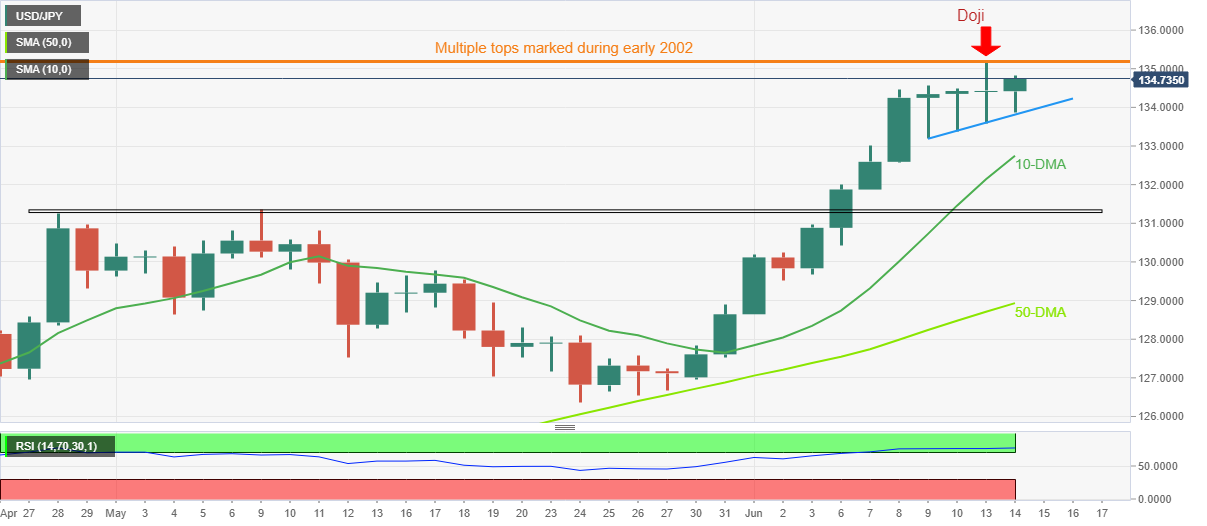
Trend: Pullback expected
UK Jobs report overview
Early Tuesday, the UK’s Office for National Statistics (ONS) will release the April month Claimant Count figures together with the Unemployment Rate in the three months to April at 06:00 AM GMT.
Taking into account, the announcement of the interest rate decision by the Bank of England (BOE), which is due on Thursday, the employment data holds significant importance. Most probably, the BOE won’t accelerate its interest rates beyond 25 basis points (bps) as the growth rate in the economy is not much lucrative currently amid advancing oil prices.
The consensus for the UK employment data is indicating that the labor market will tighten further as the Claimant Count Change will slip further to -42.5k vs. -56.9k reported earlier. The economic catalyst dictates the number of individuals who have claimed jobless benefits.
Also, the Unemployment Rate is expected to slip to 3.6% from the former print of 3.7%. A decline in the jobless rate bolsters the labor market condition in the UK economy.
The economic data that investors are worried about is the Average Earnings Excluding Bonus. A meaningful fall is seen in the catalyst to 4% from the prior print of 4.2%. In times, when inflation is at its peak in the UK economy, a decline in wages will dent the paychecks of the households. This will bring a serious decline in the aggregate demand and eventually in the Gross Domestic Product (GDP) of the economy.
Deviation impact on GBP/USD

How could they affect GBP/USD?
The pound bulls have rebounded after hitting a low of 1.2107 in the late New York session. A recovery in the asset is backed by a minor fall in the US dollar index (DXY) and higher seen UK employment data. The estimated figures are hinting at an improvement in the labor market, which calls for a buying action in the asset, however, a broad-based strength in the DXY will restrict gains for cable.
Although the US employment data holds significant importance for the cable investors, the major focus will remain on the monetary policies from the Federal Reserve (Fed) and the Bank of England (BOE), which are due on Wednesday and Friday respectively.
Technically, the asset has displayed exhaustion signals after a sheer downside move in the last two trading sessions. A modest recovery in the cable is expected to extend further after violating the round-level resistance of 1.2200, which will send the asset towards the May 16 high at 1.2300, followed by the May 19 low at 1.2330.
Alternatively, the greenback bulls will strengthen if the asset drops below Tuesday’s low at 1.2107. An occurrence of the same will drag the asset towards the 18 May 2020 low at 1.2075. A breach of the latter will unleash the asset to find a cushion around the psychological support at 1.2000.
Key notes
GBP/JPY Price Analysis: Bounces off 162.60 support confluence ahead of UK jobs report
UK business confidence tumbles to one-year low over inflation fears – Times
About UK jobs
The UK Average Earnings released by the Office for National Statistics (ONS) is a key short-term indicator of how levels of pay are changing within the UK economy. Generally speaking, the positive earnings growth anticipates positive (or bullish) for the GBP, whereas a low reading is seen as negative (or bearish).
- USD/TRY remains firmer for the third consecutive day despite DXY retreat from 20-year high.
- Türkiye’s 5-year Credit Default Swaps renew all-time high of 895 bps.
- Turkish Industrial Production recovered but inflation woes, Fed-led chatters favor pair buyers.
- US PPI, risk catalysts may offer immediate directions.
USD/TRY hesitates in portraying the US dollar weakness as it takes rounds to 17.30 ahead of Tuesday’s European session. In doing so, the Turkish lira (TRY) pair justifies the fears among the TRY traders as the country’s Credit Default Swaps (CDS) jump to an all-time high.
That said, Reuters conveyed 29 basis points (bps) of a jump in the 5-year Turkish credit default swaps to a new record high of 854 bps by the end of Monday, quoting S&P Global. The fears of credit default in Türkiye ignore the slump in the April month’s Industrial Production, to 10.8% versus 7.95% expected and 9.8% prior.
The reason for the pessimism surrounding TRY could be linked to the nearly 70% inflation and President Tayyip Erdogan’s rejection of rate hike.
It’s worth noting that the liralization appears to offer intermediate pauses to the USD/TRY uptrend. Recently, the Central Bank of the Republic of Türkiye (CBRT) announced that firms using Turkish lira rediscount credits will be offered longer maturities and must commit to selling at least 30% of their export proceeds to banks, per Reuters.
Elsewhere, a jump in the Fed’s 75 bps rate hike expectations joins China’s covid fears to keep the USD/TRY buyers hopeful.
While Wednesday’s Federal Open Market Committee (FOMC) is the key catalyst for the USD/TRY traders, the US Producer Price Index (PPI) for Apri, expected 10.9% YoY versus 11.0% prior, could entertain intraday traders.
Technical analysis
Unless breaking the resistance-turned-support line from January near 16.50, quickly followed by the 20-DMA support near 16.40, USD/TRY bears remain off the table.
Meanwhile, the upper line of the five-week-old bullish channel, around 17.45, challenges the USD/TRY upside ahead of the yearly top surrounding 17.50.
- AUD/USD dribbles around intraday high during the first positive day in five.
- RSI rebound, bullish MACD signals hint at further recovery from monthly low.
- Descending trend line from late Wednesday appears a tough nut to crack for buyers.
- Bears need to break immediate support to retake control.
AUD/USD fades rebound from monthly low as it retreats to 0.6950 heading into Tuesday’s European session.
In doing so, the Aussie pair jostles with a downward sloping resistance line from Friday, around 0.6970 by the press time.
However, bullish MACD signals and the RSI (14) recovery from the oversold territory hints at the AUD/USD pair’s further rebound.
That said, the 0.7000 psychological magnet and the 50-HMA level near 0.7015 seem to lure the pair buyers.
Following that, a one-week-long resistance line, close to 0.7050 at the latest, will be crucial for the AUD/USD bulls to watch.
Meanwhile, fresh downside needs validation from an immediate support line surrounding 0.6930, as well as the 0.6900 round figure, before directing AUD/USD bears towards the yearly low near 0.6830, marked in May.
Should the quote remains bearish past 0.6830, March 2020 high near 0.6685 will gain the market’s attention.
AUD/USD: Hourly chart
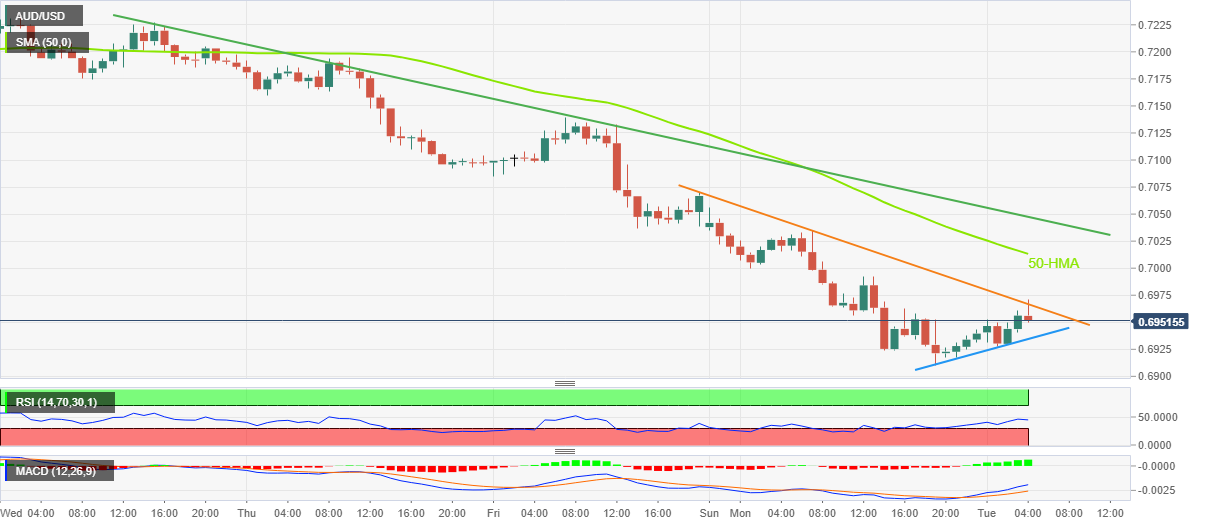
Trend: Further recovery expected
- DXY consolidates recent gains around multi-year high, snaps four-day uptrend.
- Hawkish Fed concerns keep buyers hopeful ahead of Wednesday’s FOMC.
- US 10-year Treasury yields ease from the highest levels since late 1998 amid sluggish session.
- US PPI for May, China covid updates may offer immediate clues but Fed-related chatters remain in the driver’s seat.
US Dollar Index (DXY) bulls take a breather after refreshing a two-decade top, dropping back to 105.00 during early Tuesday morning in Europe, amid the market’s positioning for Wednesday’s Federal Open Market Committee (FOMC).
That said, the greenback gauge tracks the US Treasury yields while snapping a four-day uptrend near the multi-year high.
The benchmark US 10-year Treasury bond yields pare recent gains around 3.36%, down 1.1 basis points (bps) from the highest levels since April 2011, marked the previous day.
The pullback in yields contradicts the recently firmer chatters surrounding the Fed’s 75 bps rate hike.
It’s worth noting that the US rate futures imply a 96% chance of the Fed raising rates by 75 bps at the June meeting, versus not more than 30% a few days back.
Also likely to have favored the DXY, but could not, are the covid woes in China. Beijing covid cases hit a three-week high, per Bloomberg, which in turn propels the virus woes and should have underpinned the US dollar’s safe-haven demand. “The city recorded 74 infections for Monday, the most since May 22, when Beijing saw a record number of cases for the current outbreak,” said Bloomberg.
Alternatively, Global Times raised expectations of easing US-China tension as it said, “Senior Chinese diplomat Yang Jiechi held talks with US National Security Advisor Sullivan in Luxembourg. The two agreed to reduce misunderstanding and miscalculation, and properly manage differences, saying it is necessary & beneficial to keep communication channels open.”
Above all, DXY traders brace for the Fed meeting with high hopes and a likely 75 bps move.
On an intraday basis, the US Producer Price Index (PPI) for Apri, expected 10.9% YoY versus 11.0% prior, could entertain traders.
Technical analysis
Although overbought RSI conditions seem to have triggered the DXY pullback, the downside remains elusive until the quote stays beyond May’s low surrounding 101.30. That said, an upward sloping resistance line from November 2021, close to 106.50 at the latest, lures the bulls.
After a high-profile meeting between the two countries on Sunday, Australian Prime Minister Anthony Albanese dismissed the possibility of a reset in relations with its closest trading partner, China.
Key quotes
It was “always a good thing that people have dialogue and have discussions,” something which he said had been “missing” under the previous Australian government.
“They need to remove those sanctions in order to improve relations between Australia and China.”
“It is China that have imposed sanctions, it is China that has changed, and it’s China that needs to remove those sanctions.”
Market reaction
AUD/USD keeps its recovery momentum intact from monthly lows, despite the Australian-China gloom, as the US dollar bulls take a breather.
The aussie was last seen trading up 0.60% on the day at 0.6965.
The Bank of Japan (BOJ) announced on Tuesday that it has set a new offer for its bond-buying programme on June 15.
Additional details
To buy about 250 bln yen of JGBs with maturity of 10-25 years on June 15.
To buy about 800 bln yen of JGBs with maturity of 5-10 years on June 15.
To buy 150 bln yen of JGBs with maturity of over 25 years on June 15.
To offer buying 625 bln yen of JGBs with maturity of 1-3 years on June 15.
To offer buying 625 bln yen of JGBs with maturity of 3-5 years on June 15.
To continue to conduct additional and increased bond buying taking into account market moves.
Market reaction
USD/JPY is unfazed by the above announcement, as it adds 0.17% on the day to trade at 134.62, at the press time.
- A Symmetrical Triangle formation is advocating volatility contraction going forward.
- The RSI (14) has shifted to a 40.00-60.00 range which bolsters auctioning in a consolidation phase.
- The asset is trading below the 20- and 50-EMA, which firms a short-term corrective mode.
The USD/INR pair has turned sideways in a narrow range of 78.03-78.30 from Monday after failing to cross the critical resistance of 78.40. A responsive selling action dragged the greenback bulls and underpinned a volatility contraction. It is worth noting that after a sheer upside move a price or time correction takes place but that should not be mixed with a bearish reversal.
On an hourly scale, the major is auctioning in a Symmetrical Triangle that signals for slippage in the standard deviation respective to the asset followed by a breakout in the same. The advancing trendline is placed from Monday’s low at 77.98 while the downward sloping trendline is plotted from Monday’s high at 78.41.
The asset has tumbled below the 20- and 50-period Exponential Moving Averages (EMAs) at 78.11 and 78.05 respectively, which signals a short-term correction in the counter.
Meanwhile, the Relative Strength Index (RSI) (14) is oscillating in a 40.00-60.00 range, which signals a continuation of sideways movement.
Should the asset oversteps Tuesday’s high at 78.30, an upside breach of the Symmetrical Triangle will strengthen the greenback bulls and will drive the asset towards Monday’s high at 78.40, followed by the round-level resistance at 78.50.
Alternatively, the Indian rupee bulls could dictate the asset if it delivers a downside break of the above-mentioned chart pattern at the psychological support of 78.00. This will drag the asset towards Thursday’s average price at 77.85. A slippage below Thursday’s average price will send the asset towards Thursday’s low at 77.68.
USD/INR hourly chart
-637907764486921429.png)
- GBP/JPY takes the bids to refresh intraday high while snapping three-day downtrend.
- Convergence of the 50-DMA, 20-DMA and monthly support line challenge immediate downside.
- Bulls need validation from March’s high, UK employment numbers.
GBP/JPY refreshes intraday high around 164.00 as traders await the UK’s employment data during early Tuesday morning in Europe.
The pair’s latest rebound could be linked to the failures to conquer the 162.60-50 support confluence including the 50-DMA, the 20-DMA and a one-month-old ascending trend line.
Also keeping the GBP/JPY sellers hopeful are the bullish MACD signals, as well as softer US Treasury yields. It’s worth noting that he hopes downbeat UK data limits the cross-currency pair’s recovery moves of late.
Also read:
Additionally, March’s high of 164.65 offers an extra filter to the north before giving control to the GBP/JPY bulls, a break of which can direct the prices towards the double tops surrounding 168.45-75.
Meanwhile, pullback moves remain elusive until staying beyond 162.50, a break of which could quickly break the 160.00 threshold while directing the GBP/JPY sellers towards April’s low near 159.65.
However, an upward sloping support line from early March, near 157.80-75 by the press time, could challenge the pair sellers past 159.65.
GBP/JPY: Daily chart
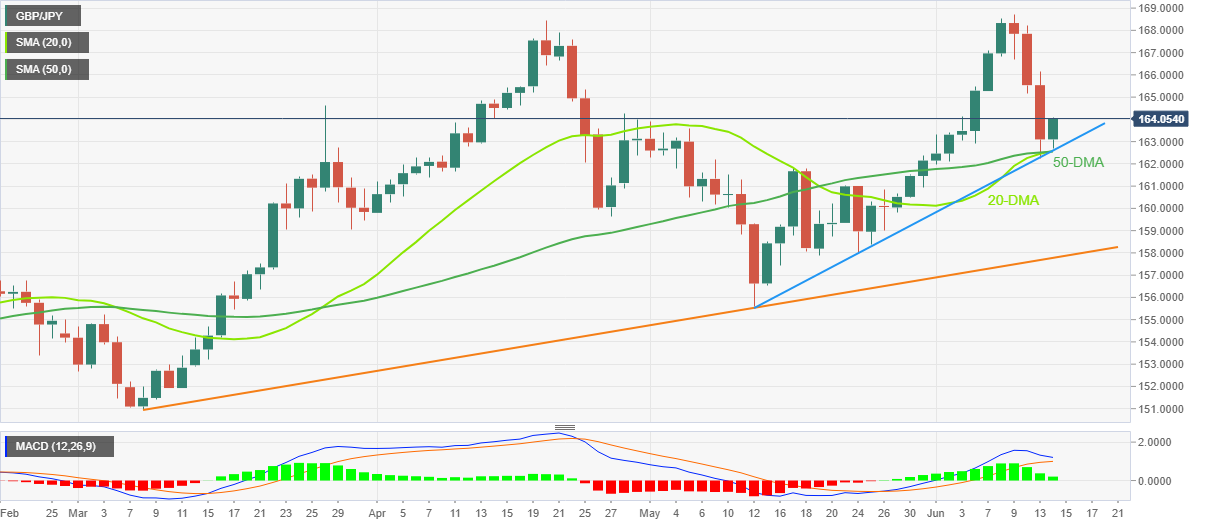
Trend: Further recovery expected
According to the latest Bloomberg survey of 24 economists, the Reserve Bank of Australia (RBA) remains on track for its first-ever consecutive 50 basis point interest-rate hikes, as they step up their efforts to contain inflation.
Key takeaways
“The RBA will raise its cash rate to 1.35% next month from a current 0.85%.“
“They have been revising up their forecasts following Governor Philip Lowe’s bigger-than-expected hike last week.”
developing story ...
- Equities in Asia-Pacific fail to track US stock futures as talks over Fed’s 0.75 rate-lift grow stronger.
- S&P 500 confirmed bear market with a 20% fall from recent record high.
- ASX 200 leads regional bears as hawkish hopes from RBA exert additional downside pressure on the Aussie shares.
- China’s covid conditions remain grim as Beijing reports the highest cases in three weeks.
Market sentiment remains grim in the Asia-Pacific zone following a bear market signal from Wall Street. The risk-aversion wave takes clues from increasing chatters surrounding the Fed’s 75 basis points (bps) rate hike, as well as the coronavirus woes emanating from China. In doing so, the investors ignore mildly bid S&P 500 Futures.
That said, the MSCI’s index of Asia-Pacific shares ex-Japan drops 1.04% whereas Japan’s Nikkei 225 declines around 2.0% to refresh a monthly low near 26,350.
It should be noted that Australia’s ASX 200 leads the bearish impulsive with around 5.0% fall as downbeat sentiment figures at home joins escalating chatters surrounding the Reserve Bank of Australia’s (RBA) aggressive rate hikes than what’s fears. It’s worth noting that the National Australia Bank’s (NAB) Business Conditions and Business Confidence gauges eased in May to 16 and 6 respectively versus the previous readouts of 20 and 10 in that order. Additionally, the Commonwealth Bank of Australia (CBA) mentioned that the RBA interest rate hiking cycle has started and is now expected to be more aggressive than earlier anticipated.
Elsewhere, Beijing covid cases hit a three-week high, per Bloomberg, which in turn propels the virus woes and the resulted economic fears that recently weighed on the risk barometer AUD/USD pair. “The city recorded 74 infections for Monday, the most since May 22, when Beijing saw a record number of cases for the current outbreak,” said Bloomberg.
With this, stocks in New Zealand drop nearly 4.0% while those from China and Hong Kong remain pressured with close to a 2.0% daily loss.
Further, equities in South Korea refrain from respecting the Bank of Korea’s (BOK) concerns for softer prices and inflation fears at home. As a result, the KOSPI drops 1.22% by the press time.
Additionally, stocks in Indonesia and India fail to buck the bearish trend even as the S&P 500 Futures rise 0.30% around the yearly low, mainly due to the retreat in the US Treasury yields ahead of Wednesday’s Federal Open Market Committee (FOMC).
Looking forward, the US Producer Price Index (PPI) for April, expected at 10.9% YoY versus 11.0% prior, could entertain traders ahead of the Fed meeting. Also important will be the Retail Sales data from the US and China.
Also read: S&P 500 Futures, US Treasury yields portray market’s consolidation ahead of Fed
- Gold Price licks its wounds after hitting four-month lows at $1,810.
- Wall Street enters bear market, as a 75 bps June Fed rate hike looks likely.
- US dollar, yields to keep the upper hand, as XAU bulls remain under threat.
Gold Price is seeing a dead cat bounce above $1,800, having hit the lowest level in four months earlier this Tuesday. Increasing bets of a 75 bps Fed rate hike this week keep the sentiment around the US dollar, as well as, the Treasury yields buoyed. The safe-haven buck also draws support from the blood bath on global stocks amid growing fears of higher rates leading to a US recession, which tripped Wall Street into a bear market. The non-yielding XAUUSD is unlikely to attract solid bids heading into Wednesday’s Fed showdown.
Also read: Fed Preview: Powell to plunge markets or raise yields, a win-win for the dollar, five scenarios
Gold Price: Key levels to watch
The Technical Confluence Detector shows that Gold Price is struggling to extend its recovery near the $1,826 hurdle, where the previous week’s low aligns.
Acceptance above the latter could initiate a fresh upswing towards the powerful resistance around $1,833, the confluence of the Fibonacci 38.2% one-month and Fibonacci 23.6% one-day.
The pivot point one-week S1 at $1,839 will challenge the bulls on the road to recovery. Further up, the convergence of the Fibonacci 38.2% one-day and SMA200 one-day at $1,841 will come into play.
The last line of defense for XAU sellers is pegged at $1,846, which is the Fibonacci 61.8% one-week.
On the flip side, the immediate support awaits at the $1,820 round figure, below which bears will look out for the strong support around $1,816, where the Fibonacci 23.6% one-month collides into the Bollinger Band one-day Lower.
The previous low four-hour at $1,810 will come to the rescue of gold buyers on selling resurgence.
The next and the final stop for bears is seen at $1,807, the pivot point one-week S2.
Here is how it looks on the tool
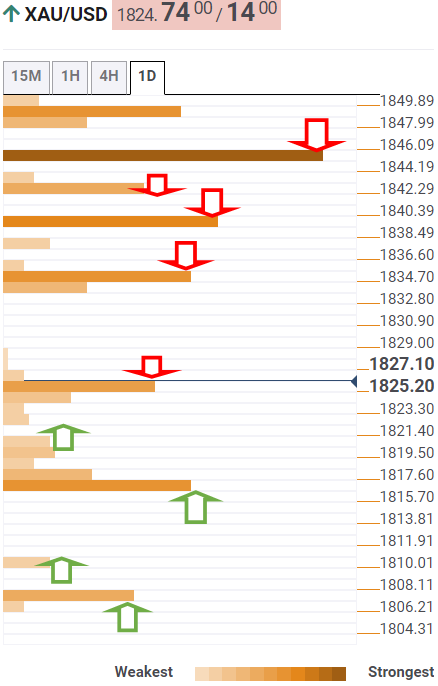
About Technical Confluences Detector
The TCD (Technical Confluences Detector) is a tool to locate and point out those price levels where there is a congestion of indicators, moving averages, Fibonacci levels, Pivot Points, etc. If you are a short-term trader, you will find entry points for counter-trend strategies and hunt a few points at a time. If you are a medium-to-long-term trader, this tool will allow you to know in advance the price levels where a medium-to-long-term trend may stop and rest, where to unwind positions, or where to increase your position size.
- USD/JPY is sensing resistance around 134.40 as DXY is facing correction after a juggernaut rally.
- To tame the galloping inflation, the Fed is expected to raise its interest rates by 75 bps.
- The BOJ will continue with its prudent monetary policy despite the inflation rate above 2%.
The USD/JPY pair has faced some offers while overstepping the critical resistance of 134.40 in the Asian session. The asset is oscillating in a narrow range of 133.59-134.66 after forming a fresh two-decade high at 135.16. A volatility contraction is expected in the major going forward amid crucial events ahead. The interest rate announcement by the Federal Reserve (Fed) on Wednesday will be followed by the monetary policy of the Bank of Japan (BOJ).
Fed chair Jerome Powell is going to feature a strict monetary policy considering the price pressures. Investment Banks and marquee investors have started betting over a rate hike announcement by 75 basis points (bps) this time. The market participants have elevated their rate hike expectation over 50 bps as inflation is at a galloping pace now and is needed to be tamed sooner rather than later. The Fed has already elevated its rate cycle by 25 bps and 50 bps in March and May respectively and even a minute impact is not visible.
Meanwhile, the US dollar index (DXY) has attracted some offers after hitting a high of 105.26 in the Asian session. The asset is holding itself firmly above the psychological support of 105.00.
On the Japanese yen front, investors are bracing for a continuation of an accommodative stance by the Bank of Japan (BOJ). The inflation rate has crossed the critical figure of 2%, however, the price pressures are much guided by firmer oil prices rather than an all-round surge in goods and services.
- EUR/USD is mildly bided around 1.0400 amid a minor correction in the DXY.
- The Fed is expected to dictate a rate hike by 75 bps to fix the inflation mess.
- ECB Lagarde’s speech may provide a roadmap for elevating the rate cycle from July.
The EUR/USD pair is witnessing a minor cushion marginally below 1.0400 in the Asian session, however, more downside is still favored amid broader strength in the US dollar index (DXY). The major has extended its three-day losing streak after slipping below Monday’s low at 1.0400 and is expected to recapture its five-year low at 1.0345.
Investors are bracing for a tight monetary policy environment as price pressures are soaring in the US economy and households are facing the headwinds of lower-valued paychecks. Last week, the US Consumer Price Index (CPI) landed at 8.6%, much higher than the expectations of 8.3%. This has surprisingly raised the odds of a rate hike by 75 basis points (bps). It is worth noting that Fed chair Jerome Powell in his testimony stated that a 75 bps rate hike is not into consideration. However, to tame the roaring inflation, an extreme hawkish policy stance is highly required.
Meanwhile, the US dollar index (DXY) has witnessed a minor correction after failing to overstep the fresh 19-year high at 105.29.
On the euro front, the shared currency bulls have remained in the grip of bears after the European Central Bank (ECB) kept its monetary policy unchanged last week. ECB President Christine Lagarde decided to take the bullet itself despite soaring inflationary pressures. However, the guidance was hawkish and a rate hike by 25 bps in July is on the cards. This week, the speech from ECB Lagarde will remain in focus. The speech is expected to dictate the likely monetary policy action by in July.
Economists at JPMorgan Chase believe that the Federal Reserve could raise interest rates by 75 basis points (bps) on Wednesday after a survey showed Americans’ inflation expectations rising, per Bloomberg.
Key quotes
“An increase of 100 basis points is also “a non-trivial risk.”
“Cited a Wall Street Journal report on Monday saying Fed officials were likely to consider a 75 basis-point move. Previously, the Fed had signaled it would probably raise borrowing costs by 50 basis points at this month’s gathering.”
Meanwhile, JPMorgan Chase & Co. strategist Marko Kolanovic reiterated his view that the US stock market is poised for a gradual recovery in 2022 and the S&P 500 Index will likely end the year unchanged.
“The move in markets prices in more than enough recession risk, and we believe a near-term recession will ultimately be avoided thanks to consumer strength, Covid reopening/recovery, and policy stimulus in China,” Kolanovic said.
- AUD/USD fails to extend corrective pullback from monthly low.
- Australia’s NAB Business Confidence, Business Conditions eased for May.
- Risk appetite remains jittery as yields seesaw around multi-year high, Australia’s ASX 200 drop 5.0%.
- Jump in expectations of the Fed’s 75 bp rate hike favor bears, US PPI, China’s covid updates eyed for intraday directions.
AUD/USD retreats towards the monthly low flashed the previous day, paring the first daily gains in five around 0.6930 during early Tuesday morning in Europe. The pair’s latest weakness could be linked to the downbeat Aussie data, as well as covid fears emanating from China, amid a sluggish Asian session.
The National Australia Bank’s (NAB) Business Conditions and Business Confidence gauges eased in May to suggest the pessimism surrounding the Aussie markets. That said, the sentiment indices recently dropped to 16 and 6 respectively for Business Conditions and Business Confidence versus the previous readouts of 20 and 10 in that order.
Elsewhere, Beijing covid cases hit a three-week high, per Bloomberg, which in turn propels the virus woes and the resulted economic fears that recently weighed on the risk barometer AUD/USD pair. “The city recorded 74 infections for Monday, the most since May 22, when Beijing saw a record number of cases for the current outbreak,” said Bloomberg.
Above all, the US rate futures imply a 96% chance of the Fed raising rates by 75 bps at the June meeting, versus not more than 30% a few days back, which in turn acts as the key bearish catalyst for the AUD/USD traders.
It's worth observing that the US 10-year Treasury yields remain mildly bid near the highest levels since 2011, tested the previous day, whereas Australia's benchmark equity index ASX 200 dropped nearly 5.0% at the latest to keep bears hopeful.
On the contrary, Global Times raised expectations of easing US-China tension as it said, “Senior Chinese diplomat Yang Jiechi held talks with US National Security Advisor Sullivan in Luxembourg. The two agreed to reduce misunderstanding and miscalculation, and properly manage differences, saying it is necessary & beneficial to keep communication channels open.”
Furthermore, chatters that the Reserve Bank of Australia (RBA) will need to adhere to aggressive rate action than recently suggested also restrict short-term AUD/USD downside.
Moving on, the US Producer Price Index (PPI) for April, expected 10.9% YoY versus 11.0% prior, could entertain traders ahead of Wednesday’s Federal Open Market Committee (FOMC). Also important will be the Retail Sales data from the US and China.
Technical analysis
Unless regaining the 0.7000 threshold, AUD/USD remains vulnerable to refreshing the yearly low, around 0.6830 by the press time.
- USD/CNH retreats from four-week-old horizontal resistance, tests weekly support line.
- Bullish MACD signals, sustained trading above 200-SMA keeps buyers hopeful.
- Buyers have multiple hurdles to cross stay on merit versus the sellers.
USD/CNH consolidates recent gains around the monthly high, retreating from a short-term horizontal resistance towards 6.7700 during Tuesday’s Asian session.
In doing so, the offshore Chinese yuan (CNH) pair eases from a four-week-long hurdle as sellers attack the weekly support line near the 6.7700 threshold.
It’s worth noting, however, that the bullish MACD signals and the quote’s ability to stay beyond the 200-SMA keep the USD/CNH buyers hopeful until the prices drop below the stated key SMA level of 6.7100.
Even so, a downside break of the immediate support can direct the 61.8% and 50% Fibonacci retracements of the May-June downturn, respectively around 6.7540 and 6.7280.
Alternatively, recovery moves need to cross the nearby resistance surrounding 6.7865-85, as well as cross the 6.7900 round figure, to recall the USD/CNH buyers.
Following that, multiple resistances around 6.8200 and 6.8300 could probe the pair bulls before directing them towards the yearly peak of 6.8384.
USD/CNH: Four-hour chart
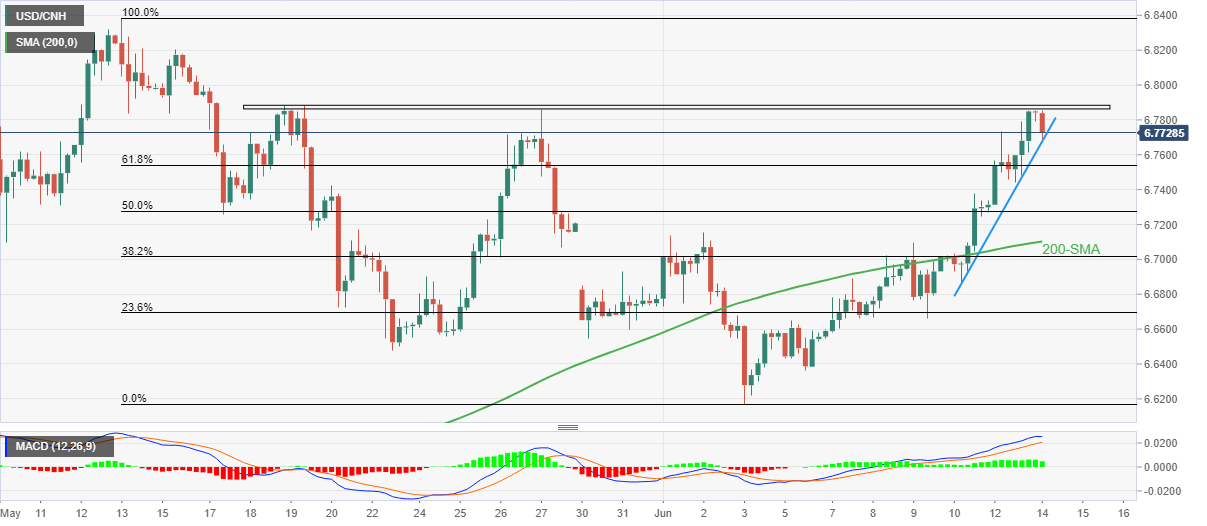
Trend: Pullback expected
- NZD/USD bulls are meeting bears in correction attempts.
- Risk off markets keeps the bird pinned down ahead of the Fed.
At 0.6263, NZD/USD remains pressured in Asia as the US dollar refuses to give back any more ground than it already has in the early attempts of a correction. The kiwi has ranged traded between 0.6252 and 0.6281 so far in the session on Tuesday.
The Kiwi, among all currencies risk-related, was thrown under a bus on Monday as the US dollar soared to fresh cycle highs in what was a rout in global markets that saw bond yields surge and key equity indices sink.
''Markets are still reeling from Friday’s surprise rebound in US inflation; that’s seen a string of forecasters either up their terminal Fed Funds rate assumptions, call for more 50bp hikes or pencil in 75bp hikes (or all three!), and that, in turn, is crushing risk appetite,'' analysts at ANZ Bank said,
''It’s as simple as that. There’s nothing Kiwi about it; rather it’s all about the USD, which is making (an understandable) comeback amid surging interest rates and its safe-haven appeal amid extreme volatility. Expect ongoing volatility ahead of Thursday’s Fed decision.''
An article by the Wall Street Journal was doing the rounds and added to the volatility in the late Us session with speculation of a 75bps or even a 100bps rate hike at this week's Fed meeting, reported here: Investors weigh the probabilities of three Fed scenarios: A 50bps, 75bps or even a 100bps hike
Domestically, the analysts at ANZ Bank said, ''We (and the Reserve Bank of New Zealand) are forecasting a 7% peak in inflation in Q2, but with global and domestic inflation pressures continuing to rise, risks remain firmly to the upside.''
''If those risks are realised, it could increase the RBNZ’s resolve to continue with the aggressive series of interest rate rises implied by their May OCR forecast.''
- GBP/USD fades the bounce off multi-day low as hawkish Fed expectations battle doubts over BOE’s capacity.
- Fears of UK’s recession, Brexit and the political turmoil also exert downside pressure on the cable.
- UK jobs report is likely to show sign of resilience and can trigger corrective pullback, US PPI eyed as well.
GBP/USD fails to extend the early Asian session rebound from a two-year low as it eases back to 1.2150 on Tuesday. The cable pair’s latest weakness could be linked to the growing fears surrounding the UK’s economic hardships, as well as the Bank of England’s (BOE) ability to tame inflation and avoid recession, ahead of the monthly employment data from Britain.
A second monthly fall in the UK’s Gross Domestic Product (GDP) bolstered expectations of an economic slowdown in Britain. The economic pessimism takes clues from the likely negative impacts of Brexit, as well as hardships connected to the Russia-Ukraine crisis and China’s covid woes.
Elsewhere, doubts over the Bank of England’s (BOE) capacity to avoid recession and aptly tame the inflation woes also exert downside pressure on the GBP/USD prices. However, the “Old Lady” is likely to announce another rate hike during Thursday’s meeting. “With UK annual inflation surging to 9% in April, the disappointing GDP print does not change the need for further BoE rate rises. We expect the MPC will raise rates by 25bps to 1.25% when it meets on Thursday,” said analysts at the Australia and New Zealand Banking Group (ANZ).
On the other hand, Friday’s US inflation data propelled calls for faster/heavier rate increases and spread the market fears as hawkish central bank actions tease recession woes. The same pushed multiple analysts ranging from JP Morgan to Goldman Sachs to revise their Fed forecasts and include expectations of a 75 bp rate hike in June and July. “Our Fed forecast is being revised to include 75bps hikes in June and July,” said Goldman Sachs in its latest Fed forecasts per Reuters.
It should be observed that Beijing covid cases hit a three-week high, per Bloomberg, which in turn propels the virus woes and the resulted economic fears that can weigh on the GBP/USD prices even if the Global Times (GT) raised expectations of easing US-China tension. “Senior Chinese diplomat Yang Jiechi held talks with US National Security Advisor Sullivan in Luxembourg. The two agreed to reduce misunderstanding and miscalculation, and properly manage differences, saying it is necessary & beneficial to keep communication channels open,” said GT.
Moving on, the UK’s headline Claimant Count Change is likely to improve from -56.9K to -42.5K in April. Also suggesting firmer jobs situation in Britain is the expected decline in the Unemployment Rate to 3.6% from 3.7% prior during the three months to May.
Following the UK data, the US Producer Price Index (PPI) for Apri, expected 10.9% YoY versus 11.0% prior, could also entertain traders. However, major attention remains on the BOE versus Fed moves.
Technical analysis
GBP/USD remains vulnerable to slump towards the 1.2000 psychological magnet unless closing beyond the previous yearly low surrounding 1.2155.
As China continues with its Covid Zero strategy, Beijing is once under the threat of a lockdown, as new coronavirus infections rise to the highest level in three weeks.
The city recorded 74 infections for Monday, the most since May 22, when Beijing saw a record number of cases for the current outbreak.
Most schools in Beijing delayed a reopening that was planned for Monday, while all sports competitions were halted. Many shopping centres, gyms and other venues were closed, parts of the public transport system were suspended and millions of people were urged to work from home.
The Chaoyang district in eastern Beijing, where the bar is located, began a three-day mass Covid testing drive from Monday.
Meanwhile, most districts in Shanghai suspended dine-in services at restaurants, with the country’s financial hub reporting 17 cases for Monday, down from 37 on Sunday.
Market reaction
Risk sentiment in Asia is seeing a bit of a relief after being hammered on aggressive Fed tightening expectations.
The S&P 500 futures are up 0.25% on the day while AUD//USD is holding the bounce above 0.6900.
- USD/CAD seesaws around a three-month-old horizontal resistance, pauses four-day uptrend.
- Bullish MACD, absence of overbought RSI favor the pair’s further upside.
- Horizontal resistance area from late 2021 act as an additional upside hurdle, bears need validation from 50-DMA to take entries.
USD/CAD bulls take a breather around the monthly high, making rounds to 1.2900 as a short-term key resistance challenge further upside during Tuesday’s Asian session.
Even so, bullish MACD signals and an absence of overbought RSI (14) hint at the quote’s capacity to cross the immediate hurdle, namely an area comprising multiple levels marked since March, around 1.2900.
It should be noted, however, that the RSI may turn overbought past 1.2900, which in turn highlights the 1.2965-75 as the key resistance zone.
If at all the USD/CAD bulls manage to cross the 1.2975 hurdle, the 1.3000 psychological magnet and the yearly high of 1.3076 should return to the charts.
On the contrary, pullback moves remain elusive until the quote stays beyond the 50-DMA level of 1.2743.
Following that, the 1.2700 round figure and mid-April swing high near 1.2675 could gain the USD/CAD bear’s attention.
USD/CAD: Daily chart
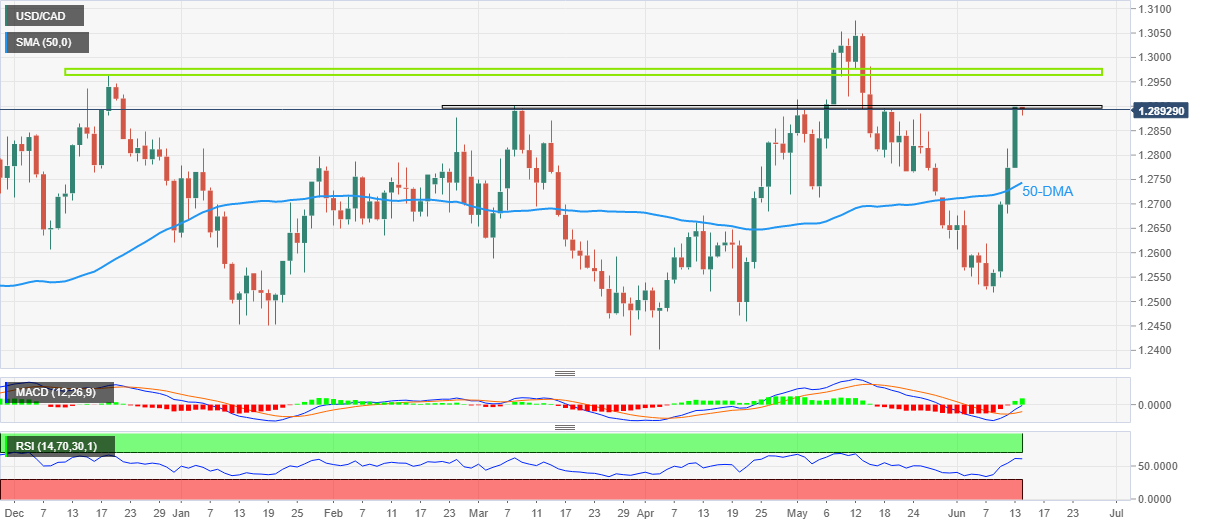
Trend: Further upside expected
In recent trade today, the People’s Bank of China (PBOC) set the yuan (CNY) at 6.7482 vs. the previous fix of 6.7182 and then prior close of 6.7530.
About the fix
China maintains strict control of the yuan’s rate on the mainland.
The onshore yuan (CNY) differs from the offshore one (CNH) in trading restrictions, this last one is not as tightly controlled.
Each morning, the People’s Bank of China (PBOC) sets a so-called daily midpoint fix, based on the yuan’s previous day's closing level and quotations taken from the inter-bank dealer.
Japanese Finance Minister Suzuki has expressed concern about the recent rapid yen weakening and said they will take appropriate steps on FX if necessary.
He said it is important for FX to move stably reflecting fundamentals.
Meanwhile, the yen is trying to correct:

(Daily chart)
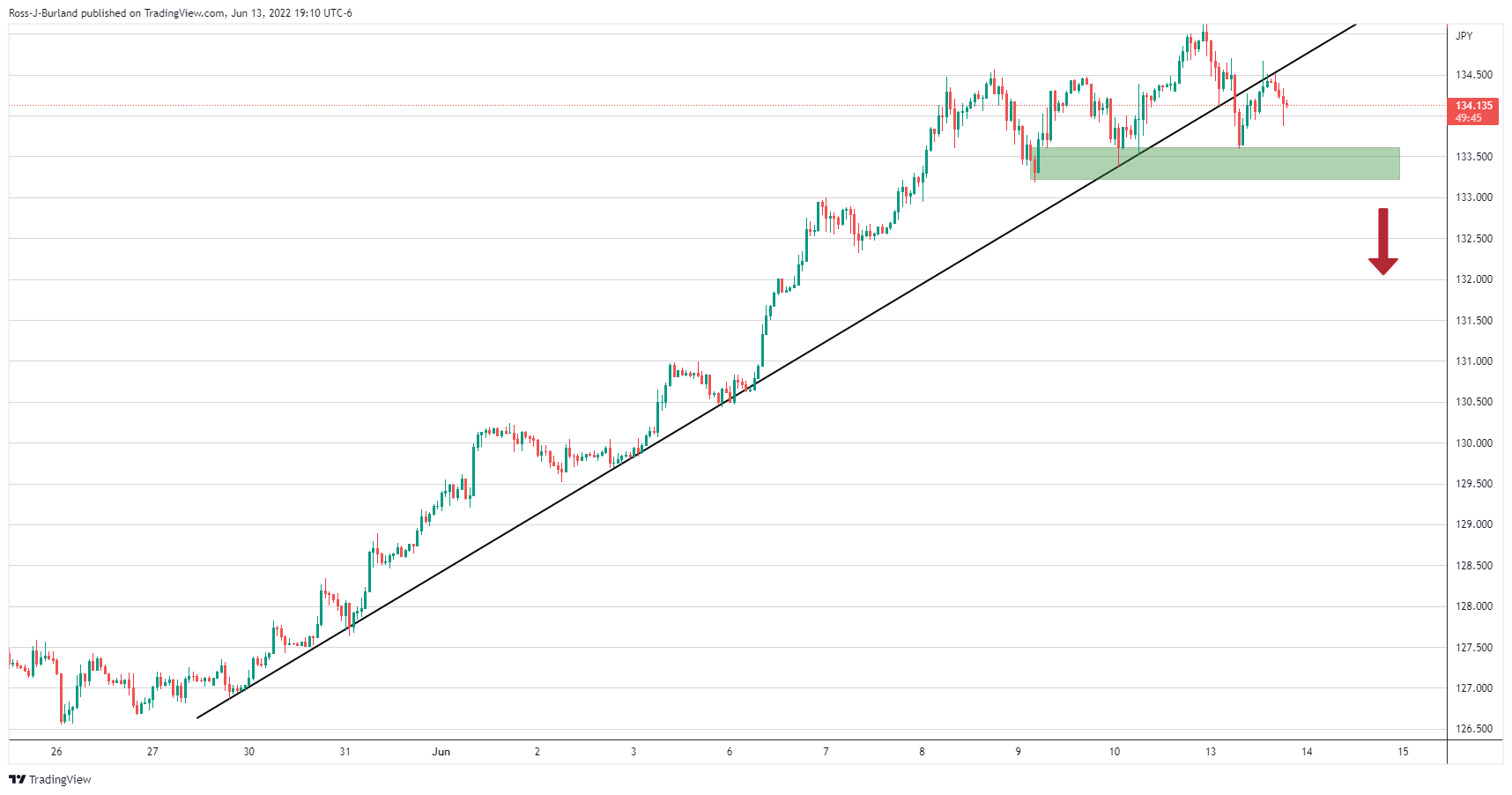
(Hourly chart)
It is doing so following a test of prior highs on the monthly chart as follows:
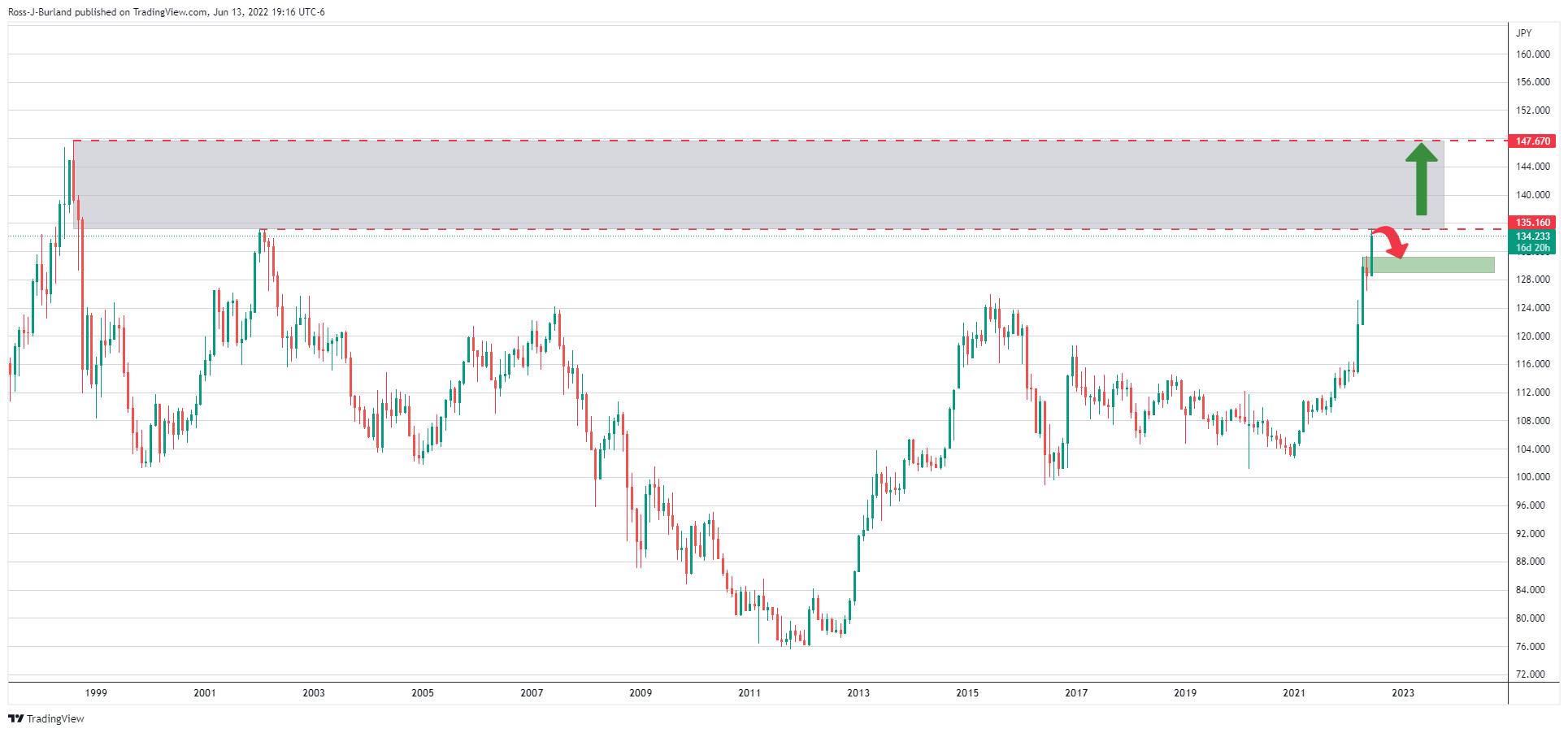
- Markets turn dicey amid sluggish Asian session, allowing traders to pare recent moves.
- S&P 500 Futures lick its wounds near yearly low, stays around the lowest levels since early 2021.
- US 10-year Treasury bond yields dribble around the highest levels since 2011.
- Hawkish Fed bets, China-linked pessimism keep bears hopeful.
After a heavy selloff and bear’s dominance, traders took a sigh of relief during early Tuesday’s Asian session. In doing so, the traders avail the opportunity to brace for the Fed amid a quiet session.
While portraying the mood, the S&P 500 Futures bounces off a nearly 15-month low to regain the 3,772 level, snapping a four-day downtrend at the multi-month low. However, the US 10-year Treasury yields remain indecisive around 3.375%, following the run-up to the highest levels since early 2011.
Although a light calendar and the market’s pre-Fed anxiety allow the traders to portray the recent corrective pullbacks, escalating fears of the Fed’s hawkish action on Wednesday keep the sellers hopeful. On the same line are the recent covid woes from China and the Sino-American tussles over Taiwan.
Friday’s US inflation data propelled calls for faster/heavier rate increases and spread the market fears as hawkish central bank actions tease recession woes. The same pushed multiple analysts ranging from JP Morgan to Goldman Sachs to revise their Fed forecasts and include expectations of a 75 bp rate hike in June and July. “Our Fed forecast is being revised to include 75bps hikes in June and July,” said Goldman Sachs in its latest Fed forecasts per Reuters.
Elsewhere Beijing covid cases hit a three-week high, per Bloomberg, which in turn propels the virus woes and the resulted economic fears. On the other hand, Global Times raised expectations of easing US-China tension as it said, “Senior Chinese diplomat Yang Jiechi held talks with US National Security Advisor Sullivan in Luxembourg. The two agreed to reduce misunderstanding and miscalculation, and properly manage differences, saying it is necessary & beneficial to keep communication channels open.”
Looking forward, the US Producer Price Index (PPI) may entertain traders ahead of Wednesday’s heavy load of data and the Fed meeting. Should the Fed matches wide market expectations of a 75 bp rate hike, the odds of witnessing further pessimism can’t be ruled out.
Also read: Powell to follow Volcker, Oil traders quick to take profits
- Gold price is auctioning around the $1,823.54-1,825.40 range, downside is expected on firmer DXY.
- A minor correction in the DXY has supported the precious metal.
- Investors should brace for an extreme hawkish tone by the Fed.
Gold price (XAU/USD) has displayed a minor reversal after hitting a low of $1,812.24 in the Asian session. The precious metal has witnessed exhaustion on the downside as the US dollar index (DXY) is facing offers after a juggernaut rally. A minor correction was highly expected to take place in the DXY as a perpendicular rally is followed by a correction but that doesn’t warrant a bearish reversal.
The DXY has faced selling pressure at the open, which has supported the gold prices. The former has slipped to near 105.00 after remaining rangebound in a 105.14-105.29 area. The upside bias in the DXY is solid as the Federal Reserve (Fed) is expected to sound extremely hawkish in its June monetary policy. The households in the US are facing hurdles in handling price pressures as the higher inflation rate is depreciating their paychecks, which is resulting in lower purchases and less confidence in the economy.
The market participants have started considering a rate hike announcement by 75 basis points (bps) as stiff quantitative measures will aim for containing the soaring inflation.
Gold technical analysis
On an hourly scale, the gold prices are hovering around the supply zone, which is placed in a narrow range of $1,823.54-1,825.40. The prices of the precious metal are extremely lower than the 50-period Exponential Moving Average (EMA), which is trading at $1,844.10. Also, the Relative Strength Index (RSI) (14) has shifted into a bearish range of 20.00-40.00, which adds to the downside filters.
Gold hourly chart
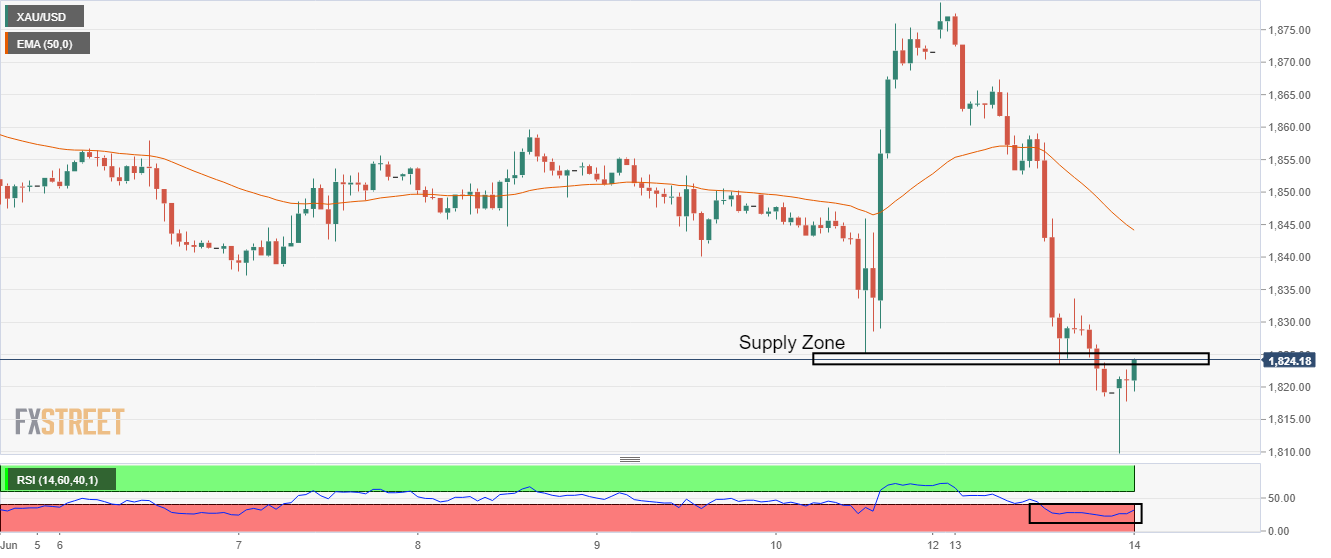
- AUD/USD is meeting a 23.6% Fibonacci in a correction of 4-hour supply.
- There is the possibility that the price stalls considering the prospects of deeper mitigation to 0.6890.
AUD/USD is trading on the bid to 0.6950 as the bulls move in to correct some of the supply that has been flowing throughout the month of June. The following illustrates this on a 4-hour time frame and the prospects of a 50% mean reversion towards 0.6980 if not higher to 0.7010.
AUD/USD H4 chart
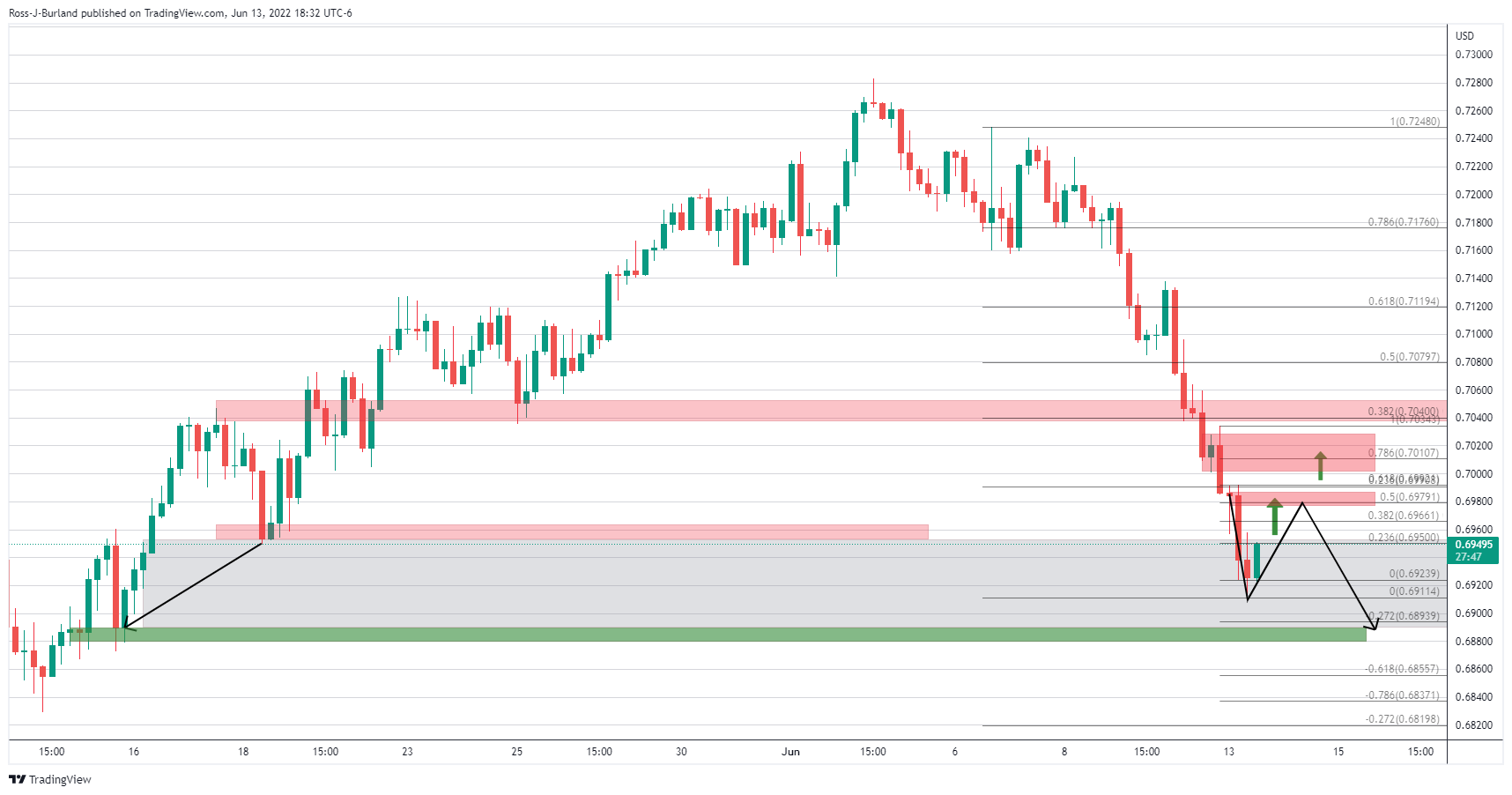
The price has moved in on the 23.6% Fibonacci already in a firm bid from which a continuation would be expected over the next 4-hour candle. However, there is the possibility that the price stalls considering the prospects of deeper mitigation of the price imbalance between here and 0.6890.
- EUR/USD consolidates recent losses around one-month low, snaps three-day downtrend.
- Four-month-old bearish channel, sustained break of six-week-old horizontal support keep sellers hopeful.
- 1.0350-40 region appears a tough nut to crack for bears amid nearly oversold RSI.
EUR/USD picks up bids to refresh intraday high around 1.0420, consolidating recent losses at monthly low, during Tuesday’s Asian session.
While nearly oversold RSI (14) might have triggered the quote’s latest rebound, it stays below the six-week-long horizontal support, now resistance around 1.0460-70, amid bearish MACD signals. Also favoring the EUR/USD sellers is a downward sloping trend channel formation since February.
That said, the corrective pullback’s upside break of the 1.0470 hurdle could also fail to recall the bulls as the 21-DMA and upper line of the stated channel, near 1.0640 and 1.0730 in that order, could test the upside momentum.
Even if the EUR/USD prices stay firmer beyond the 1.0730 resistance, May’s high of 1.0786 acts as a validation point for the pair’s additional upside.
Alternatively, the yearly low and the January 2017 bottom together highlights the 1.0350-40 as the short-term key support. The odds of a corrective pullback from the said support also take clues from the RSI conditions.
If at all the EUR/USD prices drop below 1.0340, it’s south-run towards the support line of the bearish channel, around 1.0180 by the press time, can’t be ruled out.
EUR/USD: Daily chart
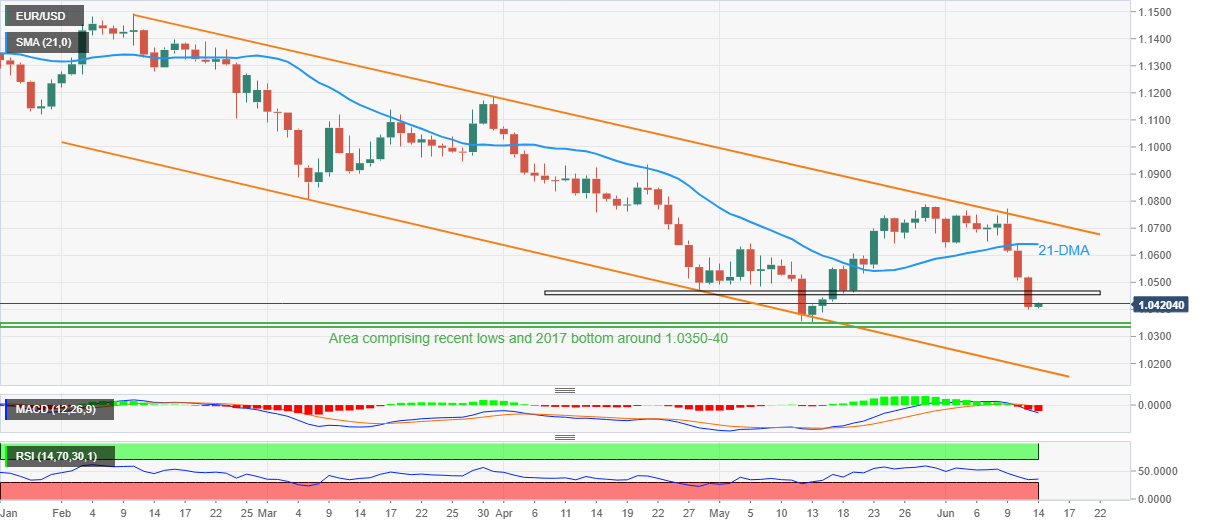
Trend: Bearish
- The DXY is expected to extend its gains on expectations of an extreme hawkish stance by the Fed.
- A 75 bps rate hike expectation has backed the DXY for refreshing its 19-year high at 105.29.
- Higher US NFP has provided more room for the Fed to tighten its policy.
The US dollar index (DXY) is auctioning in a narrow range of 105.13-105.29 in the Asian session as the entire investing community is focusing on the interest rate decision by the Federal Reserve (Fed). Considering the galloping inflation and the upbeat US labor market, a rate hike by at least 50basis points (bps) looks imminent. Therefore, the market participants are pouring liquidity into the DXY, which has elevated the asset above 105.00 comfortably.
Refreshes 19-year high at 105.29 on higher bets over a 75 bps rate hike
The asset has refreshed its 19-year high at 105.29 on advancing odds of a 75 basis point (bps) interest rate hike by the Fed. Observing the dictations from the testimonies by Fed chair Jerome Powell, a rate hike by 75 bps is not into consideration, however current price pressures are needed to be tamed quickly and higher NFP provides more liberty to the Fed for policy tightening. The DXY is expected to extend its four-day winning streak by overstepping Monday’s high at 105.29.
Key events this week: Producer Price Index (PPI), Retail Sales, Building permits, Initial Jobless Claims.
Major events this week: Fed interest rate decision, Eurogroup meeting, Swiss National Bank (SNB) interest rate decision, Bank of England (BOE) interest rate, Bank of Japan (BOJ) rate decision.
- USD/JPY renews intraday low but stays around the highest levels since late 1998.
- Treasury yields seesaw around 11-year high, stock futures print mild gains amid market’s consolidation.
- Hawkish Fed expectations, BOJ intervention challenge traders ahead of the key central bank meetings.
- Japan Industrial Production may entertain traders, risk catalysts are important as well.
USD/JPY takes offers to refresh intraday low around 134.15 as markets calibrate for the key central bank decisions during a quiet Asian session on Tuesday. The quote refreshed a two-decade high the previous day before reversing from 135.20. However, a pullback in the yields and the Bank of Japan’s (BOJ) intervention portrayed a Doji candlestick for Monday.
That said, US 10-year Treasury yields extend pullback from the highest levels since April 2011, marked the previous day, while staying indifferent near 3.37% by the press time.
The bond moves seem to ignore the latest hawkish Fed expectations, or might be preparing for the same, while refraining from further upside.
The market’s fears of faster/heavier rate hikes during this week’s Federal Open Market Committee (FOMC) underpinned the USD/JPY upside the previous day before the BOJ intervention dragged it down. The pullback moves could also be linked to the yen’s traditional safe-haven appeal.
Friday’s US inflation data propelled calls for faster/heavier rate increases and spread the market fears as hawkish central bank actions tease recession woes. The same pushed multiple analysts ranging from JP Morgan to Goldman Sachs to revise their Fed forecasts and include expectations of a 75 bp rate hike in June and July. “Our Fed forecast is being revised to include 75bps hikes in June and July,” said Goldman Sachs in its latest Fed forecasts per Reuters.
It should be noted that the US stock futures also print mild gains while consolidating the recent heavy downside moves amid the market’s indecision. However, Japan’s Nikkei 2255 remains 2.0% down to around 26,250 during the initial hour of Tokyo opening.
Moving on, USD/JPY traders will pay attention to Japan’s Industrial Production for April, expected to remain unchanged at -4.8% YoY and -1.3% MoM.
Above all, the monetary policy moves of the Fed and the BOJ will be crucial to determining near-term USD/JPY moves.
Technical analysis
Monday’s Doji at multi-year top joins overbought RSI (14) to keep sellers hopeful of witnessing further downside towards April’s peak of 131.25. However, the 133.00 round figure offers immediate support to the yen pair before recalling the sellers.
| Pare | Closed | Change, % |
|---|---|---|
| AUDUSD | 0.69257 | -1.45 |
| EURJPY | 139.902 | -1.09 |
| EURUSD | 1.04084 | -0.93 |
| GBPJPY | 163.088 | -1.54 |
| GBPUSD | 1.21338 | -1.38 |
| NZDUSD | 0.62614 | -1.26 |
| USDCAD | 1.2896 | 0.8 |
| USDCHF | 0.99691 | 0.85 |
| USDJPY | 134.41 | -0.16 |
- WTI is caught between supply and demand risks in higher US rates, China lockdowns and Russian embargos.
- The Federal Open Markets Committee will end a two-day meeting on Wednesday.
At $120.56, the price of West Texas Intermediate (WTI) crude oil is lower by 0.45% after sliding from a high of $121.13 to a low of $120.50. However, WTI ended Monday higher even as investors moved away from risk ahead of the highly anticipated Federal Reserve meeting.
The Federal Open Markets Committee will end a two-day meeting on Wednesday by raising interest rates, with most observers expecting a 50-basis point hike, though a 75-basis point rise remains a possibility as May inflation rose to 8.6%, a 40-year high.
Prospects of higher US interest rates and the warnings over China's lockdowns due to higher Covid-19 infections in Beijing are speculated to keep demand for crude oil low. However, while Chinese lockdowns are weighing on energy prices, analysts at TD Securities argued that ''there is little evidence that the global industry has made progress with respect to the structural supply challenge ahead. With energy markets increasingly discounting rising supply risks, we took profits on our tactical length in Dec23 Brent crude as prices approached our profit target, acknowledging Chinese lockdowns as a risk to the trade's performance.''
Analysts at ANZ Bank also argued that the European ban on Russian oil is expected to tighten the market further, even without a strong rebound in demand from China. The analysts acknowledged that ''inventories continue to fall in most major consuming nations, with product fuel prices subsequently rising to record highs. The lack of response from oil producers to the tightness in oil market was reflected by EIA data that showed they spent only USD244bn on exploration and development in 2021. This is 28% below the average over the five years before the pandemic.''
- Silver prices remain pressured at one-month low after the biggest daily fall since early May.
- Impending bear cross on MACD, clear downside break of horizontal support from late 2021 favor sellers.
- 10-DMA, five-week-old descending trend line adds to the upside filters.
Silver (XAG/USD) fails to overcome the bearish bias, even as the sellers take a breather around monthly low following the biggest daily slump in five weeks. That said, the bright metal stays defensive at around $21.00 during Tuesday’s Asian session.
A clear downside break of the seven-month-old horizontal support, now resistance around $21.40, favors the XAG/USD bears. Also keeping sellers hopeful is the MACD line that teases a cross of the signal line from above, suggesting a downside momentum.
Hence, the silver bears are on their way to retesting the yearly low surrounding $20.45, a break of which will highlight the $20.00 threshold.
In a case where XAG/USD drops below $20.00, the late 2019 peak of $19.65 could gain the market’s attention.
Alternatively, recovery moves need to stay beyond the support-turned-resistance around $21.40 to recall intraday buyers of silver.
Following that, the 10-DMA and a downward sloping trend line from May 05, respectively near $21.85 and $22.30, should lure the XAG/USD buyers.
Silver: Daily chart
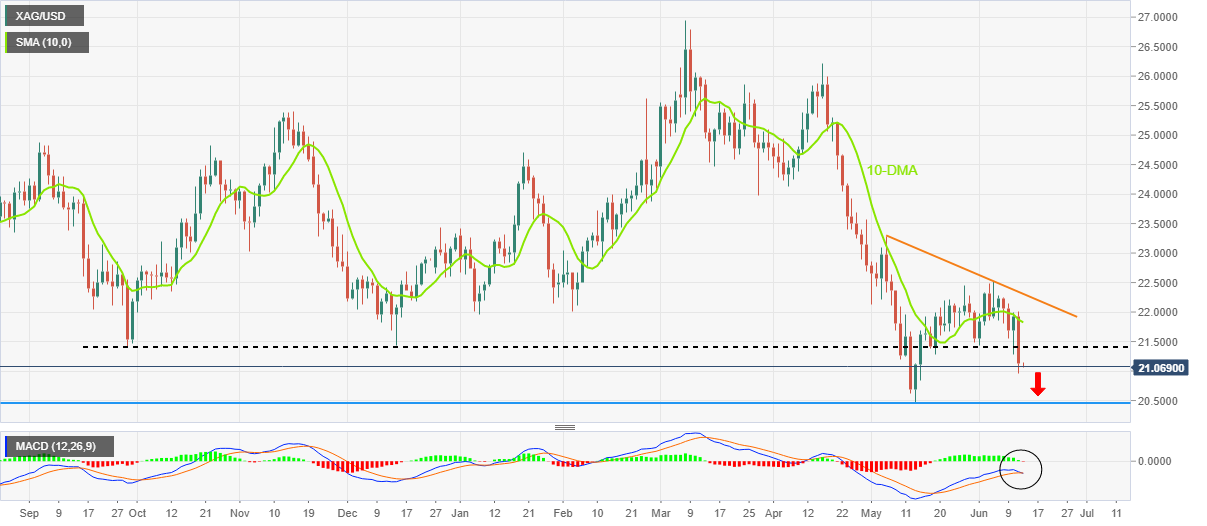
Trend: Further weakness expected







© 2000-2026. All rights reserved.
This site is managed by Teletrade D.J. LLC 2351 LLC 2022 (Euro House, Richmond Hill Road, Kingstown, VC0100, St. Vincent and the Grenadines).
The information on this website is for informational purposes only and does not constitute any investment advice.
The company does not serve or provide services to customers who are residents of the US, Canada, Iran, The Democratic People's Republic of Korea, Yemen and FATF blacklisted countries.
Making transactions on financial markets with marginal financial instruments opens up wide possibilities and allows investors who are willing to take risks to earn high profits, carrying a potentially high risk of losses at the same time. Therefore you should responsibly approach the issue of choosing the appropriate investment strategy, taking the available resources into account, before starting trading.
Use of the information: full or partial use of materials from this website must always be referenced to TeleTrade as the source of information. Use of the materials on the Internet must be accompanied by a hyperlink to teletrade.org. Automatic import of materials and information from this website is prohibited.
Please contact our PR department if you have any questions or need assistance at pr@teletrade.global.


 Bank
Bank transfers


