- Analytics
- News and Tools
- Market News
Analytics, News, and Forecasts for CFD Markets: currency news — 10-06-2022.
- On Friday, the USD/JPY climbs 0.11%, and in the week, 2.80%.
- Risk-aversion initially weighed on the USD, but late in the North American session, higher US Treasury yields lifted the USD/JPY.
- USD/JPY Price Analysis: The USD/JPY might retrace as intervention looms, towards 131.00s.
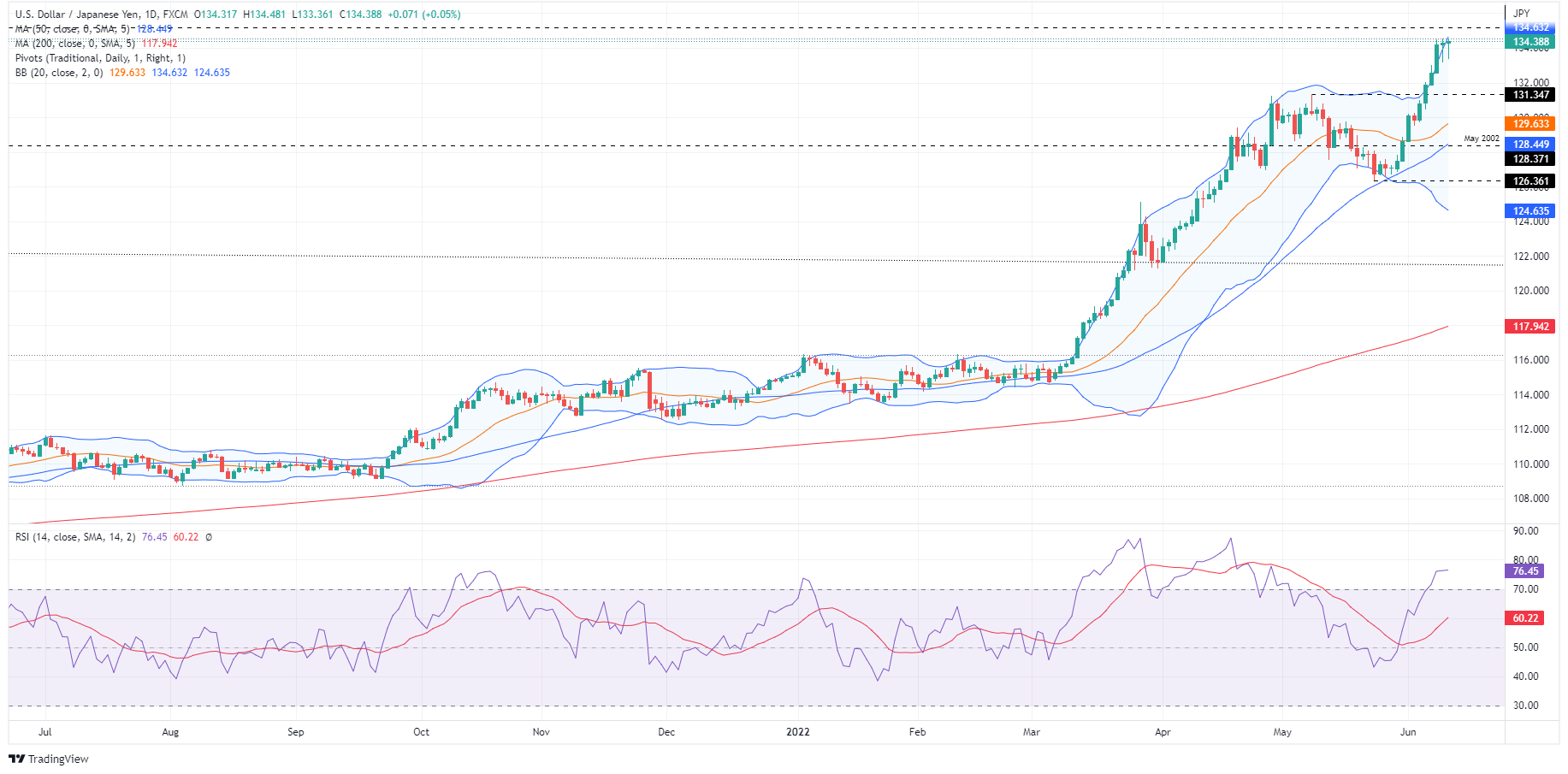
The USD/JPY is registering gains close to 2.80% during the week, and on Friday is edging up after reaching a daily low at 133.36, following the statement’s release by Japanese authorities, which acknowledged the yen weakness. The pair fell, though late as the New York session wanes, recovered, and the USD/JPY is trading at 134.43, up 0.11%.
Wall Street finished the last trading day of the week with losses between 2.53% and 3.56%, portraying the dismal market mood. Meanwhile, US Treasuries rose, with the 10-year benchmark note up at 3.163%, gaining 11 basis points. The greenback followed suit, with the US Dollar Index rallying towards 104.185, up by 0.85%.
USD/JPY Price Analysis: Technical outlook
The major’s daily chart illustrates that the uptrend remains intact, though the rally appears overextended. The top Bollinger band, at 134.62, would be a challenging resistance level to overcome. The Relative Strength Index (RSI) making lower higher-highs, contrary to the USD/JPY’s price action, might create a negative divergence. That said, the USD/JPY might pull back towards the 131.00 area as JPY’s weakness begins to gather Japanese authorities’ attention near the 135.00 mark.
Therefore, the USD/JPY’s first support would be June’s 9 daily low at 133.18. A breach of the latter would expose June’s 8 low at 132.54. Once cleared, the USD/JPY’s next demand zone would be May 9 high-turned-support at 131.34.
Key Technical Levels
- Financial Japanese authorities met regarding a weaker JPY and accorded to act if the yen continues weakening.
- Despite falling on threats of an FX intervention by Japan, the GBP/JPY gained 1.30% weekly.
- GBP/JPY Price Analysis: To continue falling towards 164.25 before resuming to the upside.
The GBP/JPY plunged on Friday and trimmed weekly gains of almost 4%, on an announcement by the Ministry of Finance and the Bank of Japan, regarding a weaker yen and said that Japan “will take appropriate measures when necessary while maintaining close communication with the monetary authorities of each country.” At 165.51, the GBP/JPY collapses 1.31% as the New York session winds down.
Japan’s authorities verbal intervention worked; the JPY strengthened
Negative sentiment weighed on global equities. US stocks fall off the cliff recording losses between 2% and 2.80%, as Wall Street head into the weekend. Worries that inflation might last longer than expected despite efforts of global central banks, which tighten monetary policy, kept investors’ flows flying toward safe-haven assets.
In the case of the GBP/JPY, traders braced for safety and booked profits, validating the words from government authorities in Japan. The GBP/JPY seesawed around 168.00 at the beginning of Friday’s Asian session and tumbled on the statement’s release, reaching a daily low of 165.16.
GBP/JPY Price Analysis: Technical outlook
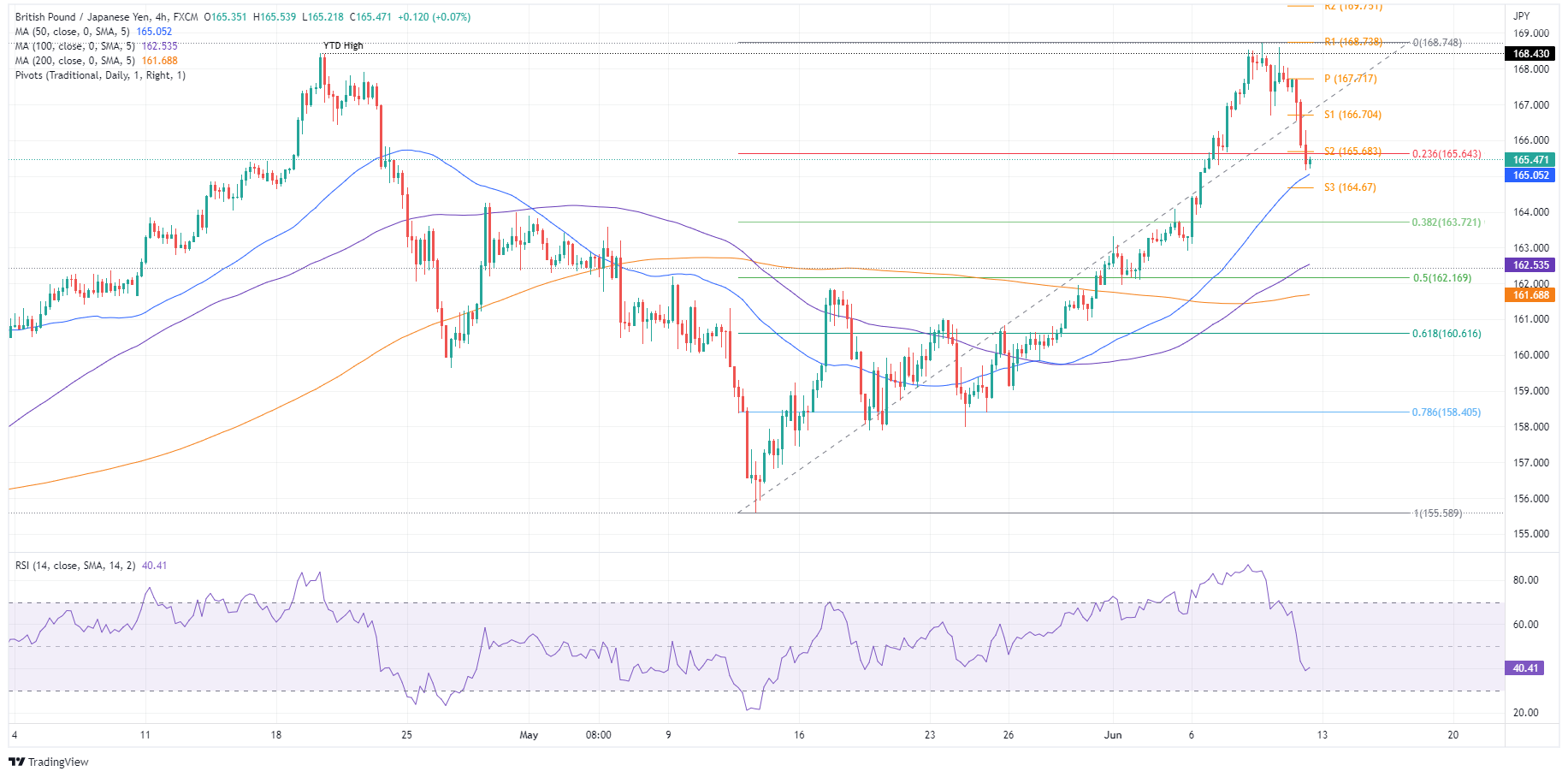
The GBP/JPY retreated from fresh YTD highs printed on June 9 near 168.72 and fled towards the 23.6% Fibonacci retracement, drawn from the May 12 low towards June 9 high. Nevertheless, the GBP/JPY daily chart depicts the pair as upward biased, but Friday’s pullback might extend towards April’s 28 daily high at 164.25.
In the short-term, the GBP/JPY’s 4-hour chart cross probed the 50-simple moving average (SMA) but failed to break below it and bounced shy of the S2 daily pivot point at 165.68. Also, the Relative Strength Index (RSI), albeit in negative territory, shifted upwards, opening the door for a cross over the 50 mid-line.
Upwards, the GBP/JPY would face resistance at the S2 pivot at 165.68. Break above would expose the 166.00 barrier, followed by the S1 pivot level at 166.70. On the flip side, the GBP/JPY first support would be the 50-SMA at 165.05. Once cleared, it would open the door towards the S3 pivot level at 164.67, followed by the 164.00 mark.
- As investors expect an aggressive US Fed, USD/CHF rallies 0.80% post US hot inflation.
- Elevated US Treasury yields lifted the greenback and weighed on stocks.
- USD/CHF Price Forecast: The pair is upward biased and would aim towards parity if buyers achieve a daily close above 0.9885.
The USD/CHF rallies sharply following a US inflation report that showed CPI is approaching the 9% threshold, increasing the bets of a US Federal Reserve 50 bps hike added to the June and July’s penciled by the US central bank. At 0.9882, the USD/CHF approaches 0.9900 and opens the door for a parity challenge for the second time in the year.
US CPI increased, lifting US Treasury yields on US Fed hike expectations, and stocks fall
Reflection on US data is better illustrated by the equity markets. European bourses plunged and finished with losses, while US equities nosedive, slashing between 2.12% and 3% of their value. The US dollar rose while US Treasury yields skyrocketed, while the Treasury curve inverts.
The US Dollar Index, a measure of the buck’s value, is advancing 0.84%, sitting at 104.177, while the US 10-year benchmark note rises 21 basis points and is up at 3.154%.
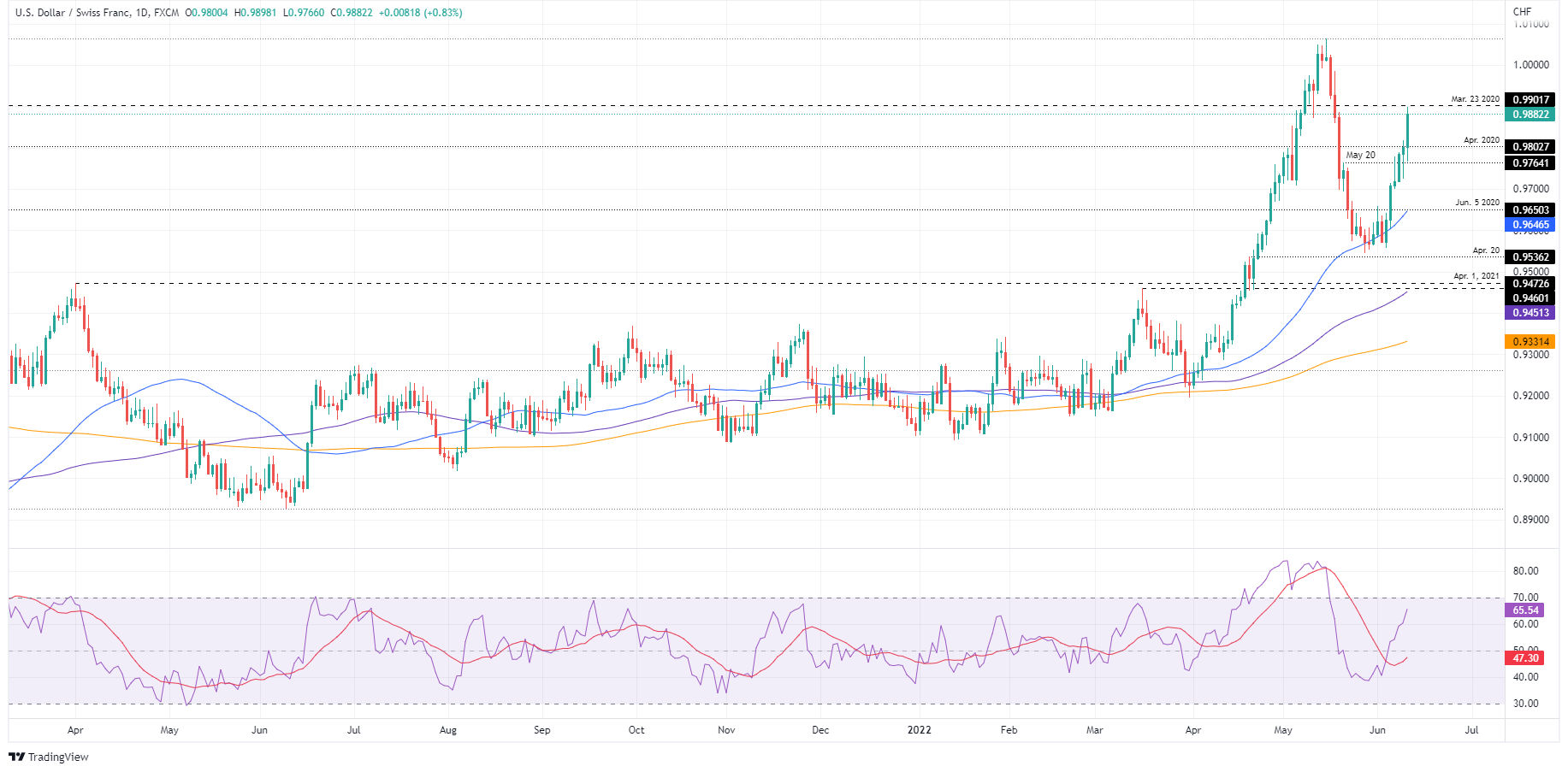
On Friday, the USD/CHF opened around 0.9800 and dipped below the figure on the news from Japan, particularly BoJ’s and finance officials, unveiling a document threatening to intervene in the FX markets. The USD/CHF dipped towards daily’s low at 0.9766 but rallied on US data towards highs of 0.9890s
USD/CHF Price Forecast: Technical outlook
The USD/CHF remains upward biased, though at the time of writing, retraced from daily highs near 0.9898. However, buyers are in control and would keep it if they achieve a daily close above the May 19 daily high at 0.9885. If that scenario plays out, the USD/CHF first resistance would be 0.9900. Break above would expose the May 18 high at 0.9984, followed by a challenge of the YTD high at 1.0007.
- The euro records substantial losses vs. the greenback, down 1.81% in the week.
- Stagflation looms as US inflation accelerates, and consumers’ pessimism increases.
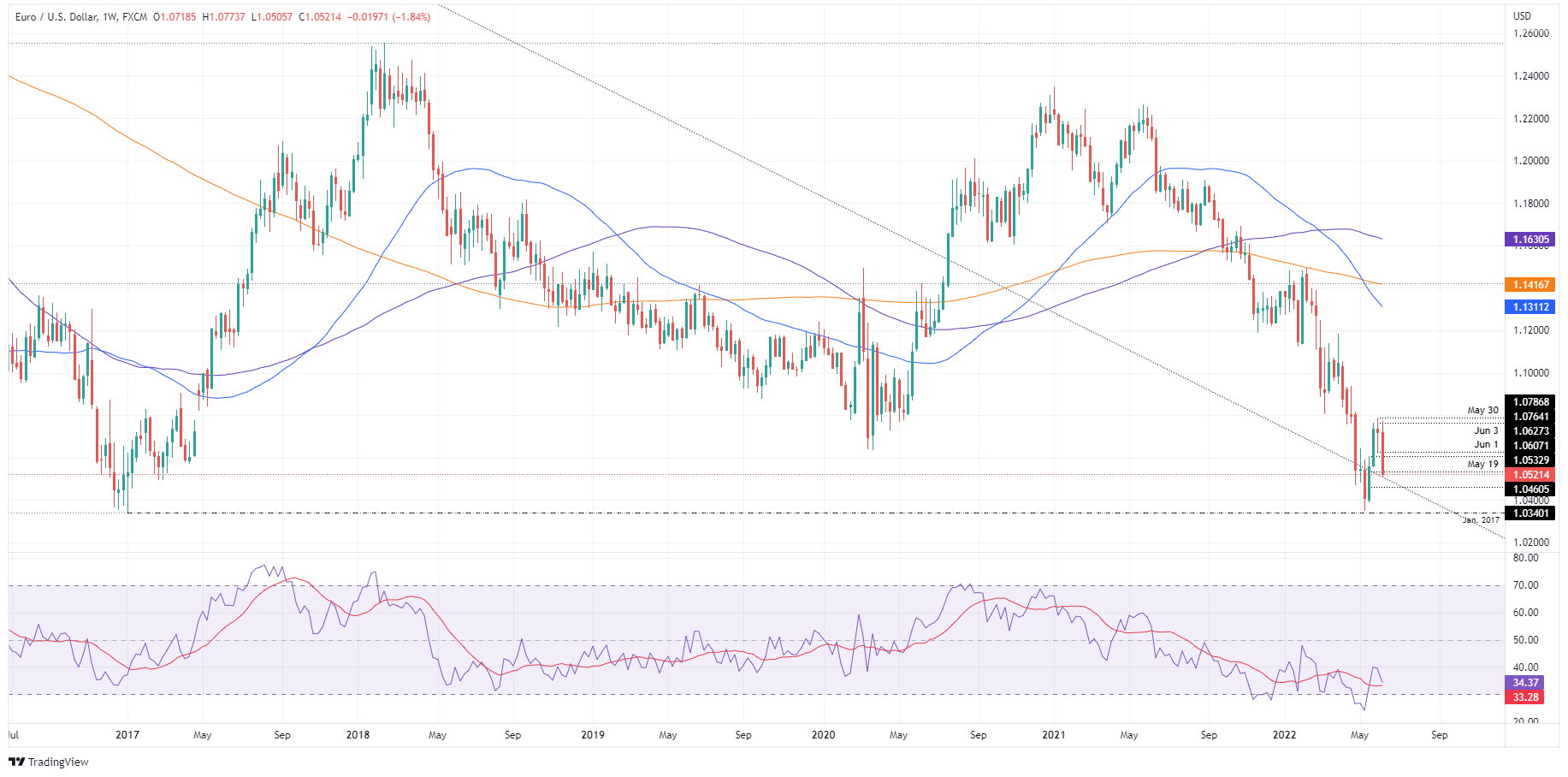
- EUR/USD Price Forecast: Daily close below 1.0532 would send the major tumbling for a retest of YTD lows at around 1.0340.
The EUR/USD nosedives and approaches the 1.0500, a level not seen since mid-May, following a higher-than-expected US inflation report, which topped estimations and opened the door for an aggressive Fed tightening cycle. At 1.0521, the EUR/USD trades near three-week lows, down 0.82% during the North American session.
US inflation approaching 9% paves the way for an aggressive Fed
Risk-aversion struck the markets following the release of May’s Consumer Price Index (CPI), which is getting closer to hitting 9% YoY after stabilizing for two months at around 8.3%. In the same report, the core CPI, which excludes volatile items like food and energy, increased by 6% YoY, higher than the 5.9%.
The greenback is rising on expectations that the US Federal Reserve will keep hiking rates faster. Reflection of the previously-mentioned is the US 10-year Treasury yields, rising to 3.178%, up by 23 basis points, underpinning the buck. The US Dollar Index reclaimed the 104.000 mark and is gaining almost 2%.
Analysts at Capital Economics wrote, “The surge in energy prices this month means that headline inflation will remain close to 8.6% in June. Together with the continued strength of the latest activity data, that bolsters the argument of the hawks at the Fed to continue the series of 50bps rate hikes into September and beyond, or even to step up the size of rate hikes at coming meetings.”
“The bigger increases in core prices a year ago means that core inflation still edged down to 6.0%, from 6.2%, but there is very little in the details of this report to suggest that inflationary pressures are easing,” Capital Economics wrote.
Late in the day, the University of Michigan reported June’s consumer sentiment preliminary numbers. The survey plunged to 50.2, lower than the 58.4 in May, showing consumer pessimism. Additionally, inflation expectations uptick to 5.4% from 5.3% in the previous study.
Now with the ECB meeting in the rearview mirror and elevated inflation in the US, the scenario of the Fed hiking 50 bps in June, July, and September is on the cards. So in the near-term, additional USD strength is expected, opening the door for further losses and a retest of EUR/USD’s 2022 YTD lows.
EUR/USD Price Forecast: Technical outlook
The EUR/USD remains on the defensive, battling at May 20 daily lows at 1.0532. A daily close below the latter leaves the major vulnerable to further selling pressure. The RSI around 40, with enough room before reaching oversold conditions, reinforces the previously mentioned scenario.
Therefore, the EUR/USD first support would be 1.0500. Break below would expose the May 19 daily low at 1.0460. Once cleared, the EUR/USD might tumble to challenge the YTD low at 1.0340.
- The GBP/USD tanks close to 180 pips after elevated US inflation data.
- Consumer sentiment in the US has collapsed to a 5-decade low.
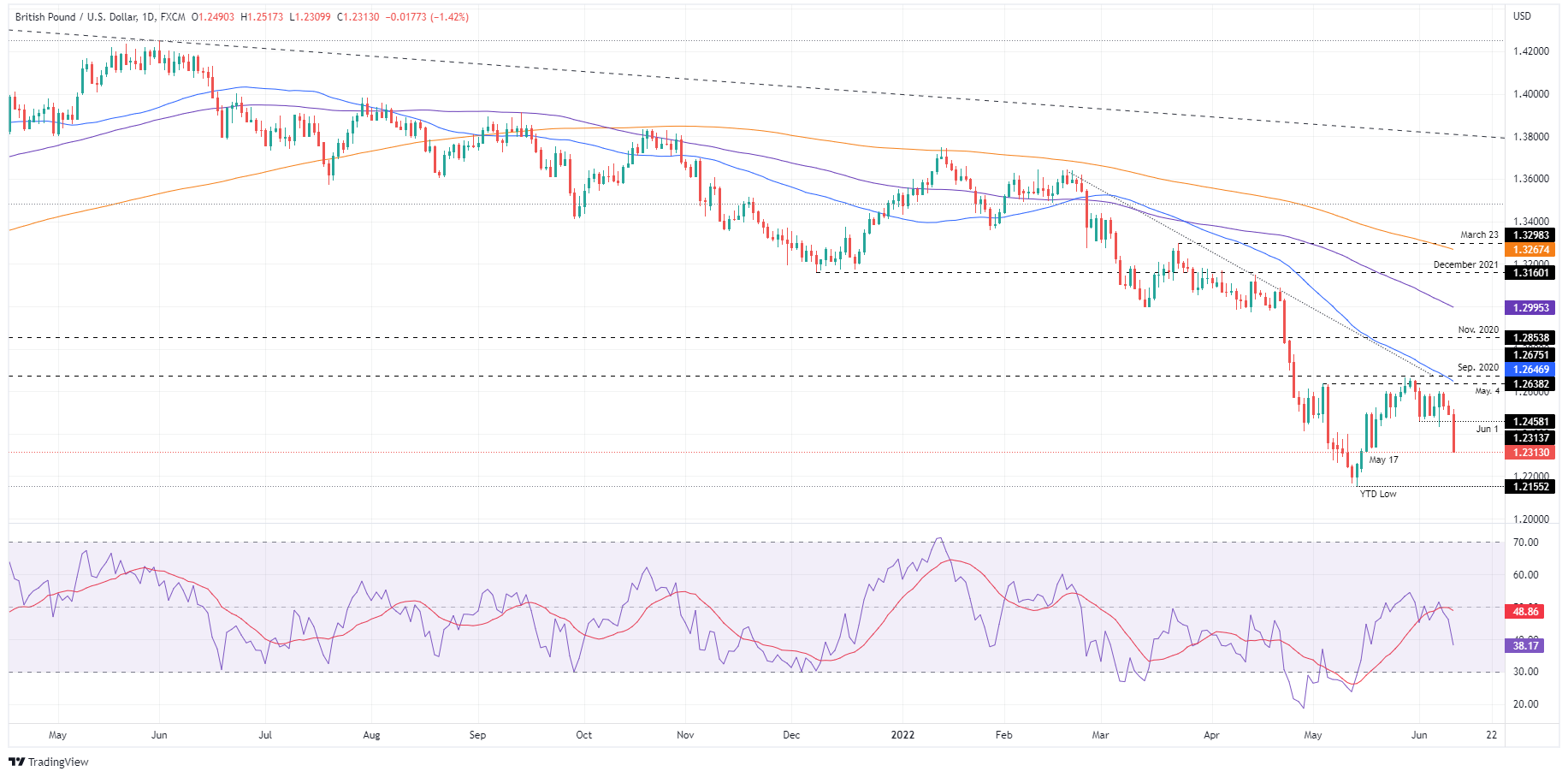
- GBP/USD Price Forecast: In the near term will test the YTD low at 1.2155.
The GBP/USD plummets following a hotter than expected US inflation report and extends its losses in the week, dropping from around 1.2500 to fresh three-week lows at around 1.2320s. At 1.2313, the GBP/USD remains on the defensive and would extend its downtrend towards the following week’s Fed monetary policy meeting.
The pound collapses on expectations of aggressive Fed rate hikes
On Friday, the US Bureau of Labor Statistics (BLS) reported that May’s Consumer Price Index (CPI) increased by 8.6% YoY, higher than the 8.3% estimation. Inflation excluding volatile items like food and energy, the so-called Core CPI, also uptick by 6%, smashing expectations. That would likely pressure the Federal Reserve to act aggressively and hike rates faster, despite spurring a recession.
Analysts at TD Securities said that US inflation data should be of “great concern for the Fed” as both readings showed no signs of peaking; instead, inflation is broadening, and they expect prices to rise further. They added, “We expect the Fed to maintain its aggressive tightening bias in the months ahead, look for the Committee to hike rates by 50bp both next week and in the July FOMC meeting, and believe a 50bp hike in September may not be out of the question.”
Later in the day, US consumer sentiment also printed a dismal reading, nosediving to a 50-year low reading, with the UoM survey sliding to 50.2 vs. 58.4 in May. The University of Michigan’s survey also collects inflation expectations, with prices expected to rise by 5.4% over the next year, higher than 5.3% in the previous study. Regarding price expectancy in the next five to 10 years, the poll shows an advance of 3.3%.
GBP/USD Price Forecast: Technical outlook
The GBP/USD is accelerating its downtrend and is testing the May 17 daily low at 1.2313. The Relative Strength Index (RSI) is aiming lower, and despite the GBP/USD’s aggressive drop, it still has enough room before reaching oversold readings.
The GBP/USD next support would be the figure at 1.2300. Once cleared, the next support would be 1.2200, followed by the YTD low at 1.2155.
Next week, the Bank of England will have its monetary policy meeting. Analysts at MUFG Bank consider it poses some upside risk for the pound but they warn any rally should be short-lived in light of the still unfavourable UK cyclical backdrop.
Key Quotes:
“The GBP has been consolidating at weaker levels after correcting lower in April and May. It has seen cable fluctuate around the 1.2500-level since late April while EUR/GBP has been trading just above the 0.8500-level over the same period. The recent pick-up in UK political uncertainty after Prime Boris Johnson faced and narrowly survived a vote of no confidence in parliament at the start of this week had only a limited and fleeting impact on GBP performance.”
“The weak outlook for UK growth combined with elevated inflation continues to be a negative mix for GBP performance, and is making it more difficult for the BoE to set monetary policy. We expect the BoE to continue tightening policy in the week ahead in response to the risk that elevated inflation could become more embedded without policy action.”
“We believe next week’s MPC meeting poses some upside risk for the GBP, but any rally should be short-lived in light of the still unfavourable UK cyclical backdrop.”
- Gold hits weekly highs despite higher yields.
- XAU/USD is testing the $1870 resistance area.
- DXY and US yields are at the highest level since May 9.
Despite higher US yields and a stronger dollar, gold prices are soaring on Friday. XAU/USD rebounded again at the $1830 but this time it broke $1850 and a few minutes later reach $1870.
Gold finally reacting to inflation?
After the US May CPI report, XAU/USD bottomed at $1824, the lowest level in three weeks as Treasury yields move higher. After moving sideways in a wide range, gold broke above $1850 and gained more strength.
Technical factors and probably the yellow metal finally reacting to inflation, are boosting gold. In the short term, bears appear to be capitulating. The rally in gold is taking place even as the dollar and US yields soar.
The DXY is up by 0.80%, at 104.15, the highest level since May 17. The US 10-year yield stands at 3.15% and the 30-year at 3.22%, both at the highest since May 9. At the same time, the Dow Jones and the S&P 500 are falling by more than 2%.
Usually, a context of higher yields, risk aversion and a stronger dollar is negative for gold. During the last hour, it has not been the case. From the daily low, XAU/USD has risen so far $45.
Form a technical perspective, if XAU/USD holds above $1870 it would point to more gains. The next strong barrier is seen at $1890. On the contrary, a reversal from current levels, back under $1850 would put gold back under pressure.
Technical levels
The annual inflation rate in the US rose to 8.6%, the highest level since December 1981 in May according to data released on Friday. The CPI rose 1% m/m, surpassing expectations. Until inflation is demonstrably on the downswing, analysts at Wells Fargo, expect the FOMC to fight back aggressively with tighter policy. They see likely 50 bps hikes next week, and again in July and September.
Key Quotes:
“Inflationary pressures were seen nearly everywhere. Energy prices surged, led by a 4.1% increase in gasoline prices, while grocery prices increased 1.4% and pushed the year-ago rate to a pace not seen since the 1970s.”
“Simply put, inflation remains far too high for the Federal Reserve's liking. It is true that there are still one-off factors putting upward pressure on inflation beyond the central bank's control. Tighter monetary policy will not help much with surging global commodity prices or structural changes in the way people spend and live in the post-pandemic economy.”
“Monthly core CPI inflation has been 0.5% or higher in seven of the past eight months. These monthly readings roughly translate to a 6%-7% pace of annualized core inflation. There was a period of time when top policymakers at the Fed would look through this, but we no longer believe that is the case. Until inflation is demonstrably on the downswing, we expect the FOMC to fight back with tighter policy.”
“Another 50 bps rate hike is all but assured at next week's FOMC meeting, and a couple more 50 bps hikes in July and September seem highly likely.”
- Silver climbs on Friday but is still down in the week by 0.24%.
- US inflation rebounded from April’s 8.3% dip and rose strongly.
- The UoM consumer sentiment is at a 50-year low; stagflation looms?
Silver (XAG/USD) advances after seesawing earlier in the day, reaching a three-week low at $21.27, but staged a recovery after the University of Michigan Consumer Sentiment slumped the most in 5 decades. At the time of writing, XAG/USD is trading at $21.82, erasing earlier losses and now gaining 0.57%.
In the meantime, the US Dollar is rallying to fresh three-week highs, at 104.174, gaining 1.96%. At the same time, the US 10-year Treasury yield is rallying to new four-week highs at 3.14%, up by twenty basis points.
US consumer sentiment plunges, and US inflation rose to 4-decades highs
US consumer sentiment plummeted the most in 5-decades, following an inflation report that in the previous two months before May reading fell though rebounded to 8.6% YoY.
The University of Michigan’s consumer sentiment dipped towards 50.2, from 58.4, the lowest slump in 52 years. Joanne Hsu, director of the survey, said, “Throughout the survey, consumers signaled strong concerns that inflation will continue to erode their incomes, and the factors they cited are unlikely to abate soon.”
“While consumer spending has remained robust so far, the broad deterioration of sentiment may lead them to cut back on spending and thereby slow down economic growth,” Hsu said.
Earlier in the day, the Department of Labor reported that the Consumer Price Index (CPI) for May rose by 8.6%, higher than the 8.3% expected, data showed on Friday. The so-called core CPI, which excludes food and energy prices, increased by 6% YoY, also above expectations.
That further reinforces the necessity for Fed’s aggressive action if they are going to tackle inflation down.
Commerzbank analysts, in a note, expressed that the Federal Reserve is behind the curve. They added, “It is becoming increasingly clear that the Fed was too late in raising interest rates. Everything therefore points to further significant rate hikes. We expect interest rate hikes of 50 basis points at each of the next three Fed meetings. At the end of the year, the key interest rate should stand at 3.00%, and at 3.50% in spring 2023. But even with this forecast, the risks are now clearly on the side of even stronger hikes.”
Key Technical Levels
The USD/JPY hit levels not seen since 2002 and then pulled back only modestly. Analysts at MUFG Bank point out that the USD/JPY move higher may slow down on an increased risk of intervention to curb yen’s weakness. They see short-term risks in USD/JPY to the upside.
Key Quotes:
“USD/JPY has corrected lower in part in reaction to a meeting today in Tokyo attended by MOF Vice Finance Minister Masato Kanda and the FSA Commissioner and two BoJ Executive Directors. The meeting was convened to discuss international financial markets and the statement that followed from that meeting clearly illustrated the heightened level of concern over the scale of yen depreciation. The statement referenced in particular the view in Tokyo that “current excessive moves aren’t aligned with fundamentals”. The statement also included that Tokyo officials “were watching FX with greater urgency”. Kanda-san’s position traditionally has the responsibility on FX policy and the meeting and Kanada-san’s attendance and comments certainly have elevated the risks of FX intervention to stem the depreciation of the yen.”
“The risks over the short-term is for USD/JPY to drift further higher. The CPI data and the Fed meeting next week will provide support for US yields, underlining the lack of change to the policy divergence driver, especially given Governor Kuroda’s speech this week. The threat of intervention is certainly now much higher following the statement today expressing concern, which may result in increased reluctance for speculative yen selling and result in non-dollar yen strength in circumstances of broader US dollar strength into the FOMC and BoJ meetings next week.”
Economic data released on Friday showed the jobs in Canada rose by 39,800 in May, surpassing expectations. Analysts at CIBC, consider that recent economic data means that the Bank of Canada could raise its interest rates a little higher.
Key Quotes:
“A further solid rise in employment, decline in the jobless rate and sharp acceleration in wage growth in May places more pressure on the Bank of Canada to continue raising interest rates aggressively. Employment rose by 40K, modestly ahead of the 27.5K expected by the consensus, which was enough to drive the unemployment rate down to a fresh record low of 5.1%. With wage growth now also accelerating, the Bank of Canada will feel increased pressure to continue raising interest rates to, and maybe now above, the mid-point of its neutral bound (2-3%).
“Continued solid momentum in the economy, combined with signals that inflationary pressures may be worsening rather than easing, means that the Bank of Canada could well raise interest rates a little higher than we had previously expected. We now see a peak of 2.75% (previously 2.5%) before the end of the year, although we still expect that growth and inflation will slow enough later in the year to prevent the Bank from having to take rates above the 3% upper bound of its neutral range.”
- US dollar rises across the board on risk aversion.
- US yields advance sharply after inflation data.
- USD/MXN heads for biggest weekly gain since March.
The USD/MXN is having the best day in weeks, boosted by a rally of the US dollar across the board. The pair jumped from under 19.70 to 19.96, hitting the highest level since May 19.
Following US inflation data, Wall Street resumed the decline, and US bond yields rose further. The Consumer Confidence report from the University of Michigan contributed to risk aversion. The Dow Jones is falling by more than 2%, and the Nasdaq tumbles by 3.40%.
Bullish outlook
The USD/MXN rose back above the 20-day Simple Moving Average. The daily chart shows bullish signs with the RSI moving north, far from overbought levels, and the Momentum above the 100 level.
If the pair holds above the 19.90 resistance area, a test of the 20.00 level seems likely. The bullish tone will remain in place while above 19.70. Under the mentioned level, the Mexican peso will recover strength, exposing the 19.50 area.
Technical levels
-637904708915707853.png)
- WTI prices have fallen back below $120 on Friday as China lockdown worries return and amid risk-off Wall Street flows.
- Oil now looks on course to close out the week in the red for the first time since early May.
- But WTI remains locked within an uptrend in play since April and dips remain subject to being bought.
Front-month WTI futures fell back below the $120 per barrel mark on Friday and now trade just over $2.0 on the day and around $3.50 lower versus earlier weekly peaks in the $123 area. Both Shanghai and Beijing were back in Covid-19 alert on Thursday as cases started rising again, while parts of Shanghai have gone back into lockdown and the city has restarted mass testing.
The recent negative news serves as a reminder that China’s zero-Covid-19 policy remains a major threat to oil demand in the country, with lockdowns there in March through to May having a chilling effect on regional oil consumption, and is being cited as one factor weighing on prices on the final trading day of the week.
A sharp deterioration in risk appetite on Wall Street after data showed headline US inflation hitting a fresh four-decade peak and a widely followed Consumer Sentiment survey’s headline index fell to a new record low (going all the way back to the 70s is also weighing on crude oil prices, which tend to be sensitive to macro risk appetite.
Friday’s tumble means that WTI is now trading lower on the week by about $2.50, the first weekly decline since early May. But the US benchmark for sweet light crude oil look still to very much be locked within an uptrend that has supported prices going all the way back to early April.
China lockdown risk aside, global demand is looking very strong right now at a time when OPEC+ output is struggling, mostly as a result of Western sanctions against Russia for its invasion of Ukraine. Another development that seemed to go under the radar a little this week is Iran’s decision to start removing nearly all of the monitoring equipment installed by the International Atomic Energy Agency as part of the 2015 nuclear pact. That dents the prospect of the US and Iran agreeing to return to the deal, making the removal of sanctions on Iranian crude oil exports less likely.
Against this backdrop, dips will probably continue to be bought into in the short term, aside from any significant worsening of the China lockdown situation once again. Specifically, any dips back to the 21DMA at $115 would be particularly attractive as this level has offered strong support twice since mid-May.
The University of Michigan's headline Consumer Sentiment Index slumped to 50.2 in June, its worst level since records began back in the 1970s, according to the preliminary release of the university's widely followed monthly consumer survey. That was a large miss on the expected slight decline to 58.0 from 58.4 in May.
The Consumer Expectations Index fell to 46.8 from 55.2 in May, well below the expected decline to 54.5 and also a new record low. Meanwhile, the Current Conditions Index fell to 55.4 from 63.3, well below the expected decline to 62.5, its worst level since May 1980. One-year inflation expectations rose to 5.4% from 5.3% in May, while five-year inflation expectations jumped to 3.3% from 3.0%.
Market Reaction
The latest weak consumer sentiment figures and rise in inflation expectations have exacerbated some of the moves triggered in wake of the hotter-than-expected US inflation data. Equity market downside has worsened and US bond yields are extending to the upside, which is dragging the US dollar higher with it as traders price in a more stagflationary US economy (weaker growth, but higher inflation and a still hawkish Fed).
- USD/JPY has pared earlier losses and is eyeing a test of multi-decade highs hit earlier in the week near 134.50.
- Yen strength after a joint Japanese government/BoJ statement of concern about currency weakness was short-lived.
- As US yields rise in wake of hotter-than-expected US CPI, USD/JPY remains at risk of further upside.
The yen’s earlier strength that at one point saw the currency recoup as much as 0.7% on the day versus the US dollar after Japan’s government and central bank issued a rare joint statement expressing concern about recent yen weakness has proven short-lived. USD/JPY is back to close to flat on the day and trading comfortably above the 134.00 level, not many pips below the multi-decade highs it reached near-134.50 earlier in the week.
Hotter than expected US Consumer Price Inflation data that saw the headline YoY inflation rate hit a new four-decade high in May and a smaller than expected decline in the YoY rate of core price pressures has resulted in the market rebuilding some Fed tightening bets, pushing US yields higher. USD/JPY, especially in wake of recent commentary from the BoJ, who are doubling down on their dovish policy of negative interest rates and yield curve control, is sensitive to higher a widening of US/Japan rate differentials.
Even though Japan’s top currency diplomat Masato Kanda on Friday told the Japanese press that the government will take action as needed to avoid disorderly currency market moves, a hint towards outright FX intervention (i.e. JPY buying), USD/JPY remains at risk of hitting fresh multi-decade highs before the week is out. The main focus next week will be on the Fed’s policy announcement on Wednesday.
- GBP/USD witnessed heavy selling for the third successive day amid broad-based USD strength.
- Stronger US CPI print for May reaffirmed hawkish Fed expectations and boosted the greenback.
- The risk-off impulse further underpinned the safe-haven buck and exerted pressure on the pair.
The GBP/USD pair extended this week's rejection slide from the 1.2600 neighbourhood and witnessed some follow-through selling for the third successive day on Friday. The intraday selling picked up pace during the early North American session and dragged spot prices to over a three-week low, below the 1.2400 round-figure mark.
The US dollar added to its intraday gains and shot to the highest level since May 19 in reaction to stronger-than-expected US consumer inflation figures. In fact, the headline US CPI climbed 1.0% MoM in May as against 0.7% expected and the yearly rate jumped to a fresh 40-year high level of 8.6%. Adding to this, core inflation, which excludes food and energy prices, rose 0.6% MoM and 6.0% YoY, surpassing consensus estimates for a reading of 0.5% and 5.9%, respectively.
The data lifted bets for a more aggressive policy tightening by the Fed, which was evident from a sharp spike in the shorter-dated US bond yields. Moreover, the markets are now pricing in a 50 bps rate hike each in June, July and September meetings. This, along with the worsening global economic outlook, triggered a fresh wave of the global risk-aversion trade, which further benefitted the safe-haven buck and contributed to the heavily offered tone surrounding the GBP/USD pair.
From a technical perspective, the intraday break through the previous weekly low, around the 1.2430 area, was seen as a fresh trigger for bearish traders. The subsequent slide and acceptance below the 1.2400 mark might have already set the stage for additional losses towards the 1.2330-1.2325 support. The downward trajectory could further get extended towards the 1.2300 round figure en-route the 1.2240 zone before the GBP/USD pair eventually drops to sub-1.2200 levels.
Technical levels to watch
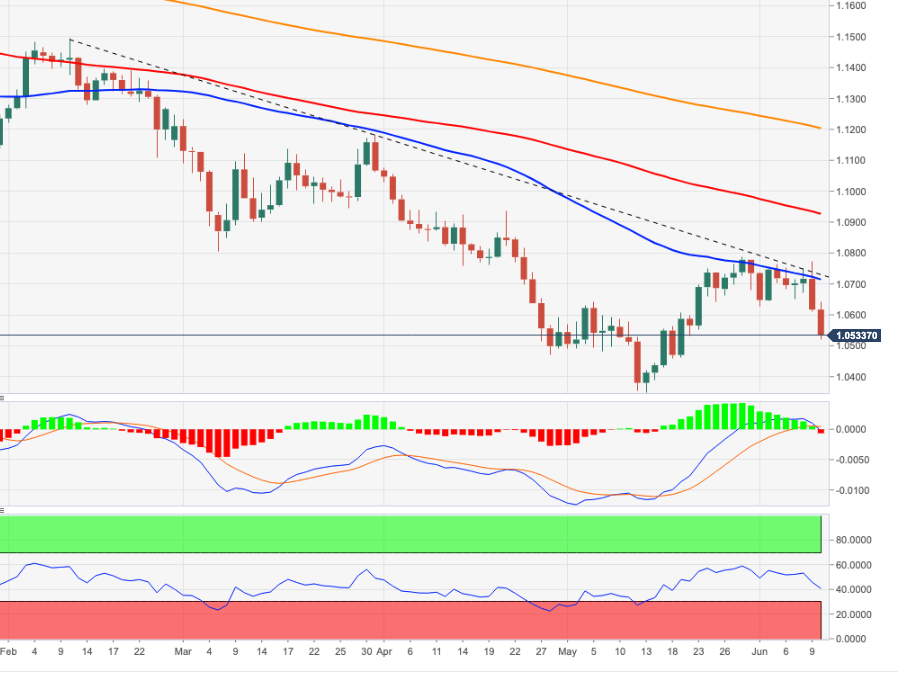
- EUR/USD drops sharply to the 1.0520 area on Friday.
- Further downside could see the 2022 low revisited.
EUR/USD adds to Thursday’s losses and prints new multi-week lows near 1.0520 at the end of the week.
The inability of spot to surpass the 4-month resistance line near 1.0730, the lack of surprise from the ECB and May’s US CPI were just too much for the European currency.
Against that, the continuation of the pullback could open the door to a probable visit to the 2022 low near 1.0350 (May 13).
In the longer run, the pair’s bearish view is expected to prevail as long as it trades below the 200-day SMA at 1.1202.
EUR/USD daily chart
NZD/USD is showing further weakness below 0.6568/76. Economists at Credit Suisse look for a further downside to develop from here.
Further downside
“NZD/USD is showing further weakness following its rejection of the May highs at 0.6568/76. We thus stay with our tactically negative position, supported by the falling 55-day and 200-day moving averages, as well as by daily MACD momentum turning lower. “
“Immediate support moves to 0.6378/62 and then further below to 0.6310/6288, which we expect to eventually break and enable a retest of major retracement support and the YTD low at 0.6230/13.”
“A sustained close above the May highs and the 55-day moving average at 0.6568/86 would negate our tactically bearish view and indicate yet another mean-reversion within the broader 2021/22 downtrend, similar to the July/Oct 2021 and Jan/April 2022 recoveries. However, this is not our base case.”
USD/CAD has pushed higher to a fresh two-week high. Economists at Scotiabank expect the pair to extend its gains back to the 1.2775/1.2875 range.
Drop back under 1.2685 to relieve near-term upside pressure
“A high close on the week for the USD will confirm a bullish outside range week which will ease downward pressure on the USD.”
“We note that shorter-term trend momentum indicators have flipped to more USD-supportive readings now.”
“The charts suggest some risk of USD gains extending back to the 1.2775/1.2875 range.”
“A drop back under 1.2685 will relieve near-term upside pressure on the USD but technically safer ground for the CAD remains distant (low 1.26s).”
- NZD/USD slipped to fresh multi-week lows under 0.6400 on Friday after hot US CPI data.
- The annual rate of headline inflation hit a fresh four-decade high.
- In response, risk appetite soured, US yields rose and the buck strengthened as traders upped Fed tightening bets.
NZD/USD hit fresh multi-week lows under the 0.6400 level on Friday after a hotter-than-expected US Consumer Price Inflation report for May injected a dose of strength into the US dollar. The headline annual pace of inflation unexpectedly rose to 8.6% from 8.3%, marking a new four-decade high, while the annual pace of core inflation fell less than expected.
The data triggered a hawkish market reaction as traders rebuilt Fed tightening bets (having pared back on them recently in anticipation the data would show inflation in the US having “peaked”). US 2-year yields were last trading 10 bps higher on the session, a reflection of this.
Fed tightening fears are weighing on sentiment, with major US equity index futures coming under selling pressure in pre-market trade and risk sending NZD/USD from current levels in the 0.6380s, where the pair still trades flat on the day, into the red. From a technical standpoint, the fact that the pair tested its 21-Day Moving Average at 0.6440 earlier in the session but was rejected suggests a negative short-term trading bias. The door is open for a drop lower towards 0.6300.
Economist at UOB Group Enrico Tanuwidjaja evaluates the Consumer Confidence gauge in Indonesia.
Key Takeaways
“Indonesia’s Consumer Confidence Index rose to an all-time high of 128.9 in May, up by 15.8pts from Apr’s 113.1.”
“The Current Economic Condition Index improved to 116.4 in May from Apr’s 98.9.”
“Consumer sentiment generally remains upbeat on the economy in the next 6 months, supported by an increase in the 6-month ahead Index to 141.5 in May from 127.2 in Apr.”
- EUR/USD loses further ground and revisits 1.0520.
- The US Dollar Index stays bid and approaches 104.00.
- US CPI rose at the fastest pace in the last 40 years in May.
The European currency comes under further pressure and motivates EUR/USD to slip back to the 1.0520 region on Friday, or new 3-week lows.
EUR/USD weaker post-US CPI
EUR/USD sheds further ground after the greenback saw its upside exacerbated in response to higher-than-expected US inflation figures measured by the CPI for the month of May.
Indeed, the headline CPI rose 1.0% MoM in May and 8.6% over the last twelve months. The Core CPI, in the meantime, went up by 6.0% from a year earlier.

The release of US inflation figures reaffirmed the idea of an aggressive tightening by the Federal Reserve in the near-term horizon, with a 50 bps rate hike already priced in at the June and July gatherings.
Furthermore, Fed Funds futures now point to nearly 3.00% by end of 2022.
Later in the NA session, the flash US Consumer Sentiment is due.
What to look for around EUR
EUR/USD came under extra pressure in response to the multi-decade highs in US inflation recorded in May.
The resumption of the selling bias in the pair followed the accelerated inflows into the greenback on the back of now firmer conviction of a tighter Fed policy in coming months.
EUR/USD remains far away from exiting the woods and it is expected to remain at the mercy of dollar dynamics, geopolitical concerns and the Fed-ECB divergence, while higher German yields, persistent elevated inflation in the euro area and a decent pace of the economic recovery in the region are also supportive of an improvement in the mood around the euro.
Eminent issues on the back boiler: Speculation of the start of the hiking cycle by the ECB as soon as this summer. Asymmetric economic recovery post-pandemic in the euro bloc. Impact of the war in Ukraine on the region’s growth prospects.
EUR/USD levels to watch
So far, spot is losing 0.69% at 1.0542 and a breach of 1.0521 (monthly low June 10) would target 1.0500 (round level) en route to 1.0459 (low May 18). On the other hand, immediate up barrier emerges at 1.0786 (monthly high May 30) seconded by 1.0925 (100-day SMA) and finally 1.0936 (weekly high April 21).
- Gold prices saw a choppy reaction to the latest hotter-than-expected US CPI data.
- XAU/USD was last trading just above $1840 versus initial post-data lows around $1825.
- Prices are currently higher versus pre-data levels, but at risk of falling given strength in US yields and USD.
Spot gold (XAU/USD) prices saw a choppy reaction in wake of the just-released US Consumer Price Inflation (CPI) data for May, which came in above expectations across the board. As a result, the kneejerk reaction for gold was to dip to fresh session lows in the $1825 area, though prices have now swung higher once again to trade closer to $1840, above pre-data levels. However, XAU/USD still trades with on-the-day losses of about 0.3%.
The move higher versus pre-data levels in spot gold might reflect a combination of safe-haven demand as US equities come under pressure as markets rebuild Fed tightening bets and fears about inflation after the headline CPI rate jumped to 8.6%, a new four-decade high. Gold is seen by many investors as a hedge against inflation.
But the move higher cuts against moves seen in US bond and currency markets. US yields, particularly at the short-end, have spiked to reflect a build-up of Fed tightening bets and this is also boosting the buck. Gold has a negative correlation to both yields and the dollar. Perhaps that means that gold’s next stop will be a retest of session lows in the mid-$1820s rather than a retest of session highs in the upper-$1840s.
- The USD strengthened across the board and pushed USD/CAD to a fresh two-week high.
- Stronger US CPI reaffirmed hawkish Fed expectations and provided a strong lift to the buck.
- Better-than-expected Canadian CPI did little to benefit the loonie or hinder the move up.
The USD/CAD pair added to its intraday gains and shot to a fresh two-week peak, around the 1.2770 region in reaction to stronger US consumer inflation figures.
The headline US CPI climbed 1.0% MoM in May as against 0.7% expected and the yearly rate jumped to a fresh 40-year high level of 8.6%. Adding to this, core inflation, which excludes food and energy prices, rose 0.6% MoM and 6.0% YoY, surpassing consensus estimates for a reading of 0.5% and 5.9%, respectively.
The data reaffirmed market bets that the Fed would need to tighten its policy at a faster pace to curb soaring inflation. In fact, the markets are now pricing in about 215 bps of cumulative hikes in 2022, with 50 bps hikes each in June, July and September meetings. This, in turn, boosted the US dollar and the USD/CAD pair.
On the other hand, the Canadian dollar failed to gain any meaningful traction following the release of better-than-expected domestic employment data. Statistics Canada reported that the number of employed people rose 39.8K in May (30K anticipated) and the unemployment rate edged lower to 5.1% from the 5.1% in the previous month.
With the latest leg up, the USD/CAD pair has now rallied nearly 250 pips from its lowest level since April 21, around the 1.2520-1.2515 region touched on Wednesday and seems poised to appreciate further. Hence, a subsequent move towards the 1.2800 mark, en-route the 1.2825-1.2830 supply zone, now looks like a distinct possibility.
Technical levels to watch
- AUD/USD turned lower for the third straight day in reaction to stronger US inflation figures.
- The latest US CPI report reaffirmed hawkish Fed expectations and boosted the greenback.
- The risk-off impulse further underpinned the buck and weighed on the risk-sensitive aussie.
The AUD/USD pair witnessed aggressive selling during the early North American session and turned lower for the third successive day in reaction to stronger US consumer inflation figures. The pair was last seen trading around the 0.7080-0.7075 region, or over a two-week low, down 0.25% for the day.
According to the data released this Friday, the headline US CPI rose to 1.0% MoM in May as against 0.7% expected and the yearly rate unexpectedly jumped to a fresh 40-year high level of 8.6%. Adding to this, core inflation, which excludes food and energy prices, came in at 0.6% MoM and 6.0% YoY rate versus consensus estimates for a reading of 0.5% and 5.9%, respectively.
The data reaffirmed market bets that the Fed would need to tighten its monetary policy at a faster pace to curb soaring inflation. This was reinforced by a fresh leg up in the US Treasury bond yields, which, along with a steep fall in the equity markets, pushed the safe-haven US dollar to a fresh three-week high and exerted heavy downward pressure on the AUD/USD pair.
Given the overnight break below the 0.7150 horizontal support, the emergence of fresh selling on Friday favours bearish traders and supports prospects for further losses. Hence, some follow-through weakness, towards testing the 0.7000 psychological mark, now looks like a distinct possibility. The downward trajectory could further get extended towards the 0.6945 support zone.
Technical levels to watch
- Canada added 39.8K jobs in May, more than expected.
- The loonie strengthened against most of its peers in wake of the robust data.
The Canadian economy added 38,900 jobs in May, according to the latest data released by Statistics Canada on Friday. That was above expectations for a 30,000 rise and above last month's 15,300 reading.
The gain in full-time employment was a robust 135,400 while part-time employment fell by 95,800. Meanwhile, the unemployment rate fell unexpectedly to 5.1% in May from 5.2% a month earlier. The participation rate was unchanged at 65.3%.
Market Reaction
The loonie saw immediate strength versus the majority of its major G10 peers in wake of the robust labour market data, which supports the case for aggressive BoC tightening.
- US CPI rose to 8.6% YoY in May, higher than expected.
- Markets saw a hawkish reaction to the data.
The annual pace of inflation in the US rose to 8.6% in May according to the latest Consumer Price Index data released by the US Bureau of Labour Statistics on Friday. That was above the expected reading of 8.3%. MoM, the headline inflation rate was 1.0%, well above the expected rise to 0.7% from 0.3% back in April.
Core measures of the CPI also came in hotter than expected. YoY, core prices were up 6.0%, above the expected drop to 5.9% from 6.2% a month earlier. MoM, the rise in core prices was also higher than expected at 0.6% and unchanged versus one month ago, versus expectations for a drop to 0.5%.
Market Reaction
In response to the hotter-than-forecast US inflation figures, markets saw an immediate hawkish reaction, with the US dollar and US yields spiking, while US equity index futures and rate-sensitive assets like gold and crypto came under pressure.
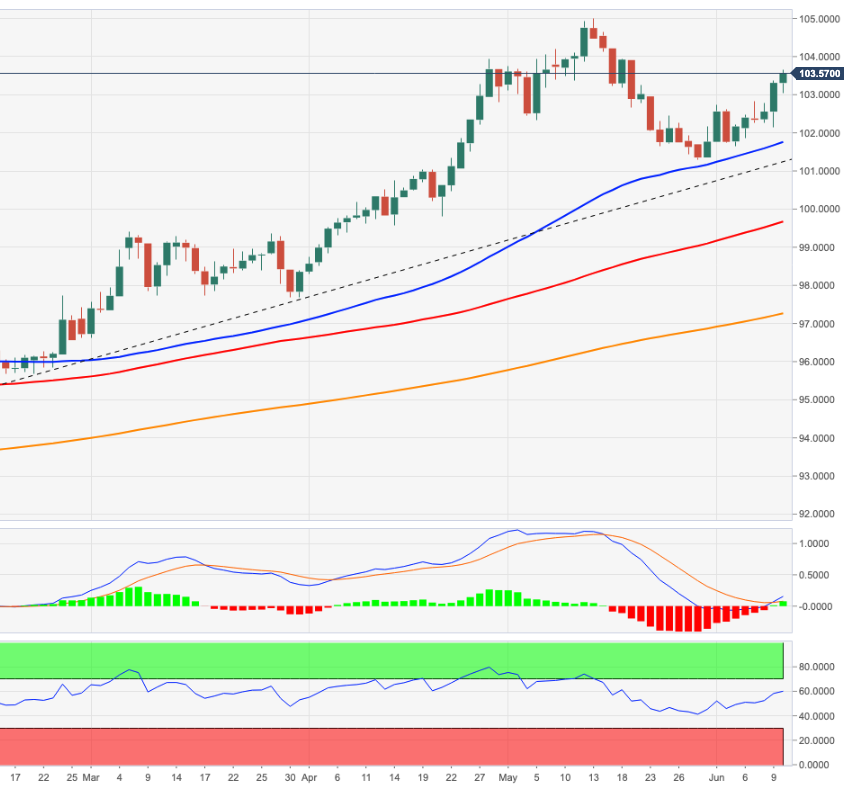
- DXY adds to the weekly rebound above 103.00 on Friday.
- Further gains face an interim hurdle at the Fibo level at 104.21.
DXY keeps the march north unabated and extends the recover to the 103.70 zone at the end of the week.
Considering the ongoing price action, further gains now look probable. Against that, the next interim barrier comes at the Fibo level (of the 105.00-101.29 drop) at 104.21ahead of the 2022 peak at 105.00 recorded on May 13.
As long as the 3-month line around 101.30 holds the downside, the near-term outlook for the index should remain constructive.
Looking at the longer run, the outlook for the dollar is seen bullish while above the 200-day SMA at 97.24.
DXY daily chart
Gold has been in the range of $1,800-1,850 since mid-May. Strategists at ANZ Bank expect the yellow metal to confirm an upside move on a break past $1,900.
XAUUSD is consolidating, the range looks indecisive
“The current price range of $1,800-1,900 will not provide any clear direction until prices break either side of the range.”
“A convincing break of above $1,900, which is also a trend break-out, will be required before a short-term bullish outlook can be called. Once this level breaks, prices could touch the previous highs of $1,950 and $2,000.”
“Key supports are at $1,800 and $1,760.”
Economist at UOB Group Ho Woei Chen, CFA, comments on the latest trade balance figures in China.
Key Takeaways
“In USD-terms, China’s exports expanded 16.9% y/y (Bloomberg est: 8.0% y/y; Apr: 3.9% y/y) in May and while imports also came in above expectation, the outperformance was less as it rose by 4.1% y/y (Bloomberg est: 2.8% y/y; Apr: 0.0% y/y).”
“Stronger-than-expected rebound in China’s trade in May confirms that the economy has bottomed out and we should expect the recovery to continue into Jun as Shanghai’s easing COVID measures will provide a temporary boost to trade flows.”
“However, the high comparison base and increasing headwinds to global economic growth due to factors such as higher commodity prices and an acceleration in central banks’ tightening as well as logistics challenges, are likely to lead to a moderation in China’s trade growth in 2H22. Domestically, there are also concerns of a recurrence of widespread COVID lockdowns as China stays on its dynamic zero-COVID policy which may encourage further diversification of supply-chain to the ASEAN region.”
“The main upside to the outlook is a potential lowering of Trump era’s tariffs on US$300 bn of Chinese goods as the Biden administration looks to ease inflationary pressures in the US.”
- USD/CHF scaled higher for the sixth straight day and shot to over a three-week high on Friday.
- Elevated US Treasury bond yields continued underpinning the USD and remained supportive.
- A softer risk tone could drive haven flows towards the CHF and keep a lid on any further gains.
- The market focus will remain glued to the release of the US consumer inflation figures for May.
The USD/CHF pair attracted some dip-buying near the 0.9765 region on Friday and turned positive for the sixth successive day. The momentum pushed spot prices to over a three-week high, around the 0.9840 region heading into the North American session.
The US dollar quickly reversed modest intraday losses and shot to its highest level since May 19 amid a fresh leg up in the shorter-dated US bond yields. In fact, the 2-year Treasury note rose to the highest level since November 2018 amid expectations that the Fed would tighten its monetary policy at a faster pace to curb soaring inflation.
Hence, the market focus would remain glued to the release of the crucial US CPI report, due in a short while from now, which is expected to show that the headline inflation held steady at the 8.3% YoY rate in May. Meanwhile, core inflation, which excludes food and energy prices, is projected to edge down to 5.9% YoY versus 6.2% in April.
Investors, however, remain concerned that the global supply chain disruption caused by the Russia-Ukraine war and COVID-19 restriction in China would push consumer prices even higher. This, in turn, points to the risk of stronger print, which would be enough to boost the USD and set the stage for additional gains for the USD/CHF pair.
That said, the worsening global economic outlook continued weighing on investors' sentiment and led to a further decline in the equity markets. This could drive some haven flows towards the Swiss franc and cap gains for the USD/CHF pair. Nevertheless, the fundamental backdrop favours bullish traders and supports prospects for an extension of the ongoing move up.
Technical levels to watch
- GBP/USD hit multi-week lows on Friday in the low 1.2400s, with bears eyeing a push lower into the 1.2300s.
- Near-term focus is on the upcoming US CPI release and whether it will impact Fed tightening expectations.
GBP/USD broke out to fresh multi-week lows in the 1.2420 area on Friday amid mixed FX market conditions and somewhat risk-averse pre-US inflation data trading conditions. The pair was last trading with losses of roughly 0.5% on the day, with bears eyeing a push lower into the 1.2300s in the week ahead should fears about the weakening UK economy linger.
According to a REC survey cited by Reuters on Friday, UK employers hired staff at the slowest pace since early 2021 in May, with the hiring pace having now declined for a sixth successive month. Sterling also has domestic politics to worry about, with the UK government reiterating its intention to pass legislation that would unilaterally amend the Northern Ireland Protocol (putting the UK’s free trade deal with the EU at risk) and with UK PM Boris Johnson’s authority having been weakened after a no-confidence vote on Monday that saw a larger than expected rebellion from his own MPs.
In the near-term, focus will be on US Consumer Price Inflation data scheduled for 1230GMT and analysts think that the data might ease inflation worries, which could (at the margin) relieve some pressure being felt by the Fed to tighten monetary policy so quickly in the quarters ahead. This could provide GBP/USD with some short-term support. But given Fed/BoE policy divergence and a comparatively weak UK growth story, traders may be inclined to sell any sterling rallies.
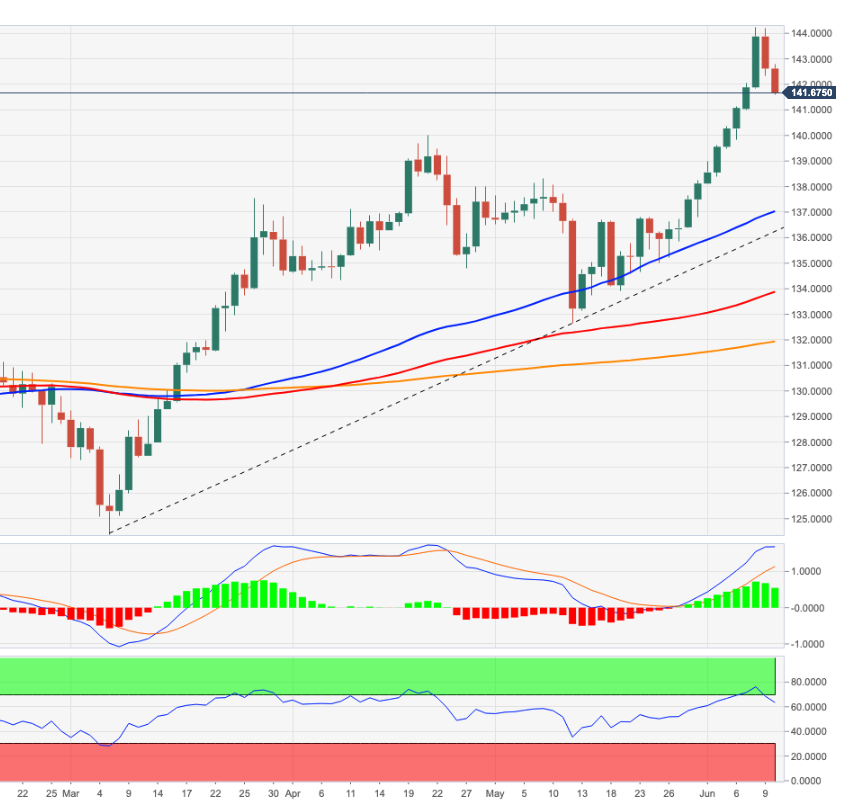
- EUR/JPY adds to Thursday’s losses and breaches 142.00.
- The next support of note comes at 140.00.
EUR/JPY extends the rejection from recent peaks past the 144.00 mark at the end of the week.
Overbought conditions and renewed demand for the Japanese yen now force the cross to shed further ground and re-shift its attention to the 140.00 neighbourhood, which emerges as the next magnet for bears in the short-term horizon.
So far, while above the 3-month support line near 136.20, the near-term outlook for the cross should remain bullish.
EUR/JPY daily chart
Latvian central bank head and European Central Bank governing council member Martins Kazaks on Friday said that inflation in the Eurozone is unacceptably high and that when the ECB talks about being gradual with policy tightening, it does not mean slow, reported Reuters. The ECB will do what it can to return inflation to 2.0%, he continued.
His remarks come after the ECB formally announced plans to end its QE program at the start of July and then hike interest rates by 25 bps at the July meeting. The bank also signaled that if inflation fails to sufficiently abate in the months ahead, a larger than 25 bps rate hike is on the table for September (i.e. a 50 bps hike).
Canadian employment details overview
Statistics Canada is scheduled to publish the monthly employment details for May later this Friday at 12:30 GMT. The Canadian economy is anticipated to have added 30K jobs during the reported month, up from the 15.3K rise reported in April. Meanwhile, the unemployment rate is expected to hold steady at 5.2% in May.
Analysts at RBC Economics sounded less optimistic and offered a brief preview of the report: “We expect a gain of 15K jobs – matching the increase in April. Employment growth has slowed dramatically in recent months, but not due to any shortfall in labour demand. Canada's number of job openings was still running ~70% above pre-pandemic levels in May. But the number of workers available for hire is now minimal, with the unemployment rate at 5.2% in April, its lowest level since at least 1976. And labour shortages are widespread by sector. That means additional demand for workers from now on will show up more in wage growth than in employment counts.”
How could the data affect USD/CAD?
The data is likely to be overshadowed by the simultaneous release of the crucial US consumer inflation figures, which would determine the Fed's monetary policy tightening path. That said, a significant divergence from the expected readings should influence the Canadian dollar and provide some meaningful impetus to the USD/CAD pair. Heading into the key data risks, the pair shot to a fresh two-week high, closer to mid-1.2700s amid modest US dollar strength. Bulls seemed rather unaffected by an uptick in crude oil prices, which tend to benefit the commodity-linked loonie.
Some follow-through buying beyond the 1.2765-1.2770 region should allow bulls to reclaim the 1.2800 mark. The said handle coincides with the 50% Fibonacci retracement level of the 1.3077-1.2518 downfall, which if cleared decisively will suggest that the USD/CAD pair has formed a near-term bottom and pave the way for additional gains. Spot prices could then accelerate the momentum further towards the next relevant hurdle near the 1.2765-1.2770 supply zone en-route the 1.2800 round figure.
On the flip side, the 1.2700 mark now seems to protect the immediate downside ahead of the 1.2655 confluence support, comprising the very important 200-day SMA and the 23.6% Fibo. level. Failure to defend the said support could drag the USD/CAD pair back towards the 1.2600 round figure en-route the 1.2520-1.2515 support, or the monthly low touched earlier this week.
Key Notes
• Canadian Employment Preview: Forecast from four major banks, additional jobs gain in May
• USD/CAD Analysis: Bulls likely to seize control above 1.2700, US CPI/Canadian jobs data eyed
• USD/CAD: Limited appreciation potential for the loonie in the medium-term – Commerzbank
About the Employment Change
The employment Change released by Statistics Canada is a measure of the change in the number of employed people in Canada. Generally speaking, a rise in this indicator has positive implications for consumer spending which stimulates economic growth. Therefore, a high reading is seen as positive, or bullish for the CAD, while a low reading is seen as negative or bearish.
About the Unemployment Rate
The Unemployment Rate released by Statistics Canada is the number of unemployed workers divided by the total civilian labour force. It is a leading indicator for the Canadian Economy. If the rate is up, it indicates a lack of expansion within the Canadian labour market. As a result, a rise leads to weaken the Canadian economy. Normally, a decrease of the figure is seen as positive (or bullish) for the CAD, while an increase is seen as negative or bearish.
US CPI Overview
Friday's US economic docket highlights the release of the critical US consumer inflation figures for May, scheduled later during the early North American session at 12:30 GMT. The headline CPI is anticipated to rise by 0.7% during the reported month, up sharply from the 0.3% in April. The yearly rate, however, is expected to hold steady at 8.3% in May. Meanwhile, core inflation, which excludes food and energy prices, is projected to rise 0.5% MoM and come in at a 5.9% YoY as compared to 0.6% and 6.2%, respectively, in April.
Analysts at Nordea offered a brief preview of the report and explained: “Headline inflation is likely to stay flat printing at 8.3% YoY, while core inflation will fall towards 6.1% YoY with a slight risk to the downside. The primary driver of headline inflation will be energy prices, which are poised to show a large contribution to YoY headline CPI on the back of a 9% gasoline price increase in May. Another contributing factor will be service inflation, which has accelerated on a month-on-month basis and will start contributing more and more to the YoY numbers. Today’s inflation problem began as a surge in goods prices during the pandemic, but it has now turned into sticky and broad-based service inflation, which really highlights the Fed’s delay in withdrawing accommodative policy.”
How Could it Affect EUR/USD?
Ahead of the key release, the US dollar continued drawing support from the recent run-up in the US Treasury bond yields and was further underpinned by a generally weaker risk tone. Stronger-than-expected US CPI print would reaffirm market bets that the Fed would need to tighten its monetary policy at a faster pace to curb soaring inflation. This, in turn, would push the US bond yields higher, along with the greenback. Conversely, the reaction to a softer reading is more likely to remain muted amid concerns about the worsening global economic outlook, which should continue to act as a tailwind for the safe-haven buck. This, in turn, suggests that the path of least resistance for the EUR/USD pair is to the downside.
Eren Sengezer, Editor at FXStreet, outlined important technical levels to trade the EUR/USD pair: “The 200-period SMA on the four-hour chart forms dynamic support at 1.0600. In case the pair falls below that level and starts using it as resistance, it could target 1.0570 (Fibonacci 50% retracement of the latest uptrend) and 1.0520 (Fibonacci 61.8% retracement) next.”
“On the upside, 1.0650 (static level) aligns as first resistance ahead of 1.0680 (Fibonacci 23.6% retracement) and 1.0700 (psychological level, 100-period SMA). Meanwhile, the Relative Strength Index (RSI) indicator on the four-hour chart stays near 40, suggesting that there is more room on the downside before the pair turns technically oversold,” Eren added further.
Key Notes
• US Consumer Price Index May Preview: Fed policy is set but there is room for surprise
• US CPI Preview: Soft core set to drive dollar down, and two other scenarios
• EUR/USD Forecast: Sellers could attack 1.0600 on hot US inflation data
About the US CPI
The Consumer Price Index released by the US Bureau of Labor Statistics is a measure of price movements by the comparison between the retail prices of a representative shopping basket of goods and services. The purchasing power of the USD is dragged down by inflation. The CPI is a key indicator to measure inflation and changes in purchasing trends. Generally speaking, a high reading is seen as positive (or bullish) for the USD, while a low reading is seen as negative (or Bearish).
Senior Economist Julia Goh and Economist Loke Siew Ting at UOB Group comment on the release of the labour market figures in the Malaysian economy.
Key Takeaways
“The transition into endemicity with a full reopening of the economy and country borders on 1 Apr provided a big boost to Malaysia’s labour market during the month. The national unemployment rate dropped below 4.0% for the first time since Mar 2020 to 3.9% in Apr (Mar: 4.1%), while the labour force participation rate hit an all-time high of 69.4% (Mar: 69.2%).”
“Total employment also recorded the largest gain in six months by 84.1k or 0.5% m/m to a fresh high of 15.85mn (Mar: +38.5k or +0.2% m/m to 15.77mn). This robust improvement was primarily driven by persistent hiring in services, manufacturing and constructions sectors, as well as the resumption of employment in the agriculture sector for the first time in 23 months. The mining & quarrying sector was the only laggard, which still posted a reduction in employment for the 21th straight month.”
“Although the labour market continued to show signs of strength, the recovery is facing significant headwinds due to factors such as global recession fears, elevated business costs, prolonged supply chain bottlenecks, and China’s economic slowdown. Hence, a full labour market recovery back to pre-pandemic levels is still unlikely for now. We maintain our outlook for the unemployment rate to ease further but remain above the pre-pandemic levels at 3.6% by end-2022 (BNM est: ~4.0%, end2021: 4.2%, end-2019: 3.3%).”
The Central Bank of Russia announced on Friday that it cut its policy rate by 150 basis points to 9.5% from 11%. In its policy statement, the central bank noted that it will consider the necessity of key rate reductions at its upcoming meetings.
Additional takeaways per Reuters
"According to the Bank of Russia’s forecast, given the current monetary policy stance, annual inflation will total 14.0–17.0% in 2022, decline to 5.0–7.0% in 2023 and return to 4% in 2024."
"This comes as a result of ruble exchange rate movements and the tailing-off of the surge in consumer demand in the context of a marked decline in inflation expectations of households and businesses."
"Moving forward, in its key rate decision-making the Bank of Russia will take into account actual and expected inflation dynamics relative to the target and economic transformation processes, as well as risks posed by domestic and external conditions and the reaction of financial markets."
"Monetary conditions are overall tight, having softened unevenly across various segments of the financial market."
"High-frequency indicators point to a halt in the decline in business activity in May after it dropped sharply in April."
"Enterprises are still struggling to fix production and logistics."
"Consumer activity in real terms is on the decline as households show a high propensity to save and real incomes shrink."
"The external environment for the Russian economy remains challenging and significantly constrains economic activity."
Market reaction
The USD/RUB pair is down more than 3% at 57.3250 following this announcement.
- Gold Price is extending a two-day bearish momentum on Friday.
- The US dollar reigns supreme as risk-aversion remains at full steam.
- XAUUSD appears vulnerable, with all eyes on next week’s Fed decision.
Gold Price is trading with size-able losses on the final trading day of the week, as investors continue to seek refuge in the safe-haven US dollar amid persistent fears over rising inflation and a potential recession. Central banks tightening worldwide to quell inflation have re-ignited growth fears. The yellow metal is leaning bearish, despite a minor pullback in the US Treasury yields, as hot inflation and pre-Fed meeting anxiety keep the sentiment around the dollar underpinned.
Also read: Gold Price Forecast: XAUUSD at a critical juncture, US inflation holds the key
Gold Price: Key levels to watch
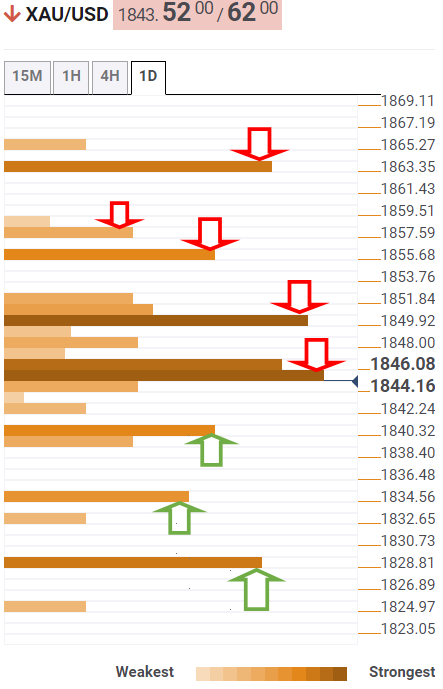
The Technical Confluence Detector shows that Gold Price is teasing the crucial SMA200 one-day support at $1,842.
A sustained move below the latter will put the previous day’s low of $1,840 at risk. At that level, the pivot point one-day S1 and Fibonacci 23.6% one-week merge.
The next relevant downside target is seen at $1,833; the confluence of the Fibonacci 38.2% one-month and the pivot point one-day S2.
The line in the sand for gold buyers is aligned at the intersection of the previous week’s low and the pivot point one-week S1 at $1,829.
On the upside, powerful resistance appears around the $1,845 region, where the SMA5 four-hour, Fibonacci 38.2% one-day and one-week coincide.
Further up, bulls will challenge the SMA5 one-day, Fibonacci 61.8% one-day and SMA10 one-day convergence at $1,850.
Acceptance above the latter will open doors for a fresh advance towards the previous day’s high of $1,855, above which the Fibonacci 61.8% one-week at $1,857 will be probed.
The meeting point of the Fibonacci 61.8% one-month and the pivot point one-day R2 at $1,863 will be a tough nut to crack for XAU bulls.
Here is how it looks on the tool
About Technical Confluences Detector
The TCD (Technical Confluences Detector) is a tool to locate and point out those price levels where there is a congestion of indicators, moving averages, Fibonacci levels, Pivot Points, etc. If you are a short-term trader, you will find entry points for counter-trend strategies and hunt a few points at a time. If you are a medium-to-long-term trader, this tool will allow you to know in advance the price levels where a medium-to-long-term trend may stop and rest, where to unwind positions, or where to increase your position size.
- EUR/USD remains under pressure and breaches 1.0600.
- The greenback extends Thursday’s ECB-led recovery.
- Chair Lagarde, US CPI, Consumer Sentiment next on tap.
The selling pressure remains well and sound around the European currency and forces EUR/USD to break below the 1.0600 mark to clinch new 2-week lows.
EUR/USD weaker post-ECB, looks to US CPI
EUR/USD adds to Thursday’s post-ECB slump and breaches the 1.0600 support, as sentiment remains sour and the rebound in the greenback picks up extra pace.
So far, Friday’s pullback in the pair comes pari passu with the knee-jerk in the German 10y Bund yields, while the US cash markets also see a modest decline in the 10y and 30y bond yields.
Investors, in the meantime, keep selling the euro after the ECB’s event came short of hawkish expectations on Thursday despite the central bank announced a 25 bps rate hike in July and left the door open to a probable 50 bps move at the September meeting (depending on the inflation outlook).
Earlier in the session, ECB’s Holzmann suggested that the neutral rate could be around 1.5%, a view shared by his colleague Villeroy; while member Nagel stressed that a resolute action by the central bank is needed to tackle inflation in the region.
Absent releases of note in the domestic calendar, the release of US inflation figures for the month of May will take centre stage later in the NA session seconded by the U-Mich preliminary print for the current month.
What to look for around EUR
EUR/USD came under renewed and unexpected downside pressure following the ECB gathering on Thursday.
The resumption of the selling bias came in response to accelerated inflows into the greenback, particularly exacerbated after the ECB sounded less hawkish than expected at its meeting, despite confirming a rate hike next month as well as the end of the net asset purchases under the APP.
However, EUR/USD is still far away from exiting the woods and it is expected to remain at the mercy of dollar dynamics, geopolitical concerns and the Fed-ECB divergence, while higher German yields, persistent elevated inflation in the euro area and a decent pace of the economic recovery in the region are also supportive of an improvement in the mood around the euro.
Eminent issues on the back boiler: Speculation of the start of the hiking cycle by the ECB as soon as this summer. Asymmetric economic recovery post-pandemic in the euro bloc. Impact of the war in Ukraine on the region’s growth prospects.
EUR/USD levels to watch
So far, spot is losing 0.12% at 1.0601 and a breach of 1.0590 (monthly low June 10) would target 1.0532 (low May 20) en route to 1.0459 (low May 18). On the other hand, immediate up barrier emerges at 1.0786 (monthly high May 30) seconded by 1.0925 (100-day SMA) and finally 1.0936 (weekly high April 21).
- USD/CAD scaled higher for the third straight day and shot to a fresh two-week high on Friday.
- Softer oil prices undermined the loonie and extended support, despite subdued USD demand.
- Traders await the US CPI report and Canadian monthly jobs data for a fresh directional impetus.
The USD/CAD pair built on the previous day's strong move-up and gained some follow-through traction for the third successive day on Friday. The momentum lifted spot prices to a fresh two-week high, around the 1.2720-1.2725 region during the first half of the European session.
The new mini-lockdown in Shanghai - China’s biggest city and a global financial hub - renewed worries about fuel demand and dragged crude oil prices away from a three-month high touched on Wednesday. This, in turn, undermined the commodity-linked loonie and was seen as a key factor that assisted the USD/CAD pair to prolong this week's goodish rebound from its lowest level since April 21.
On the other hand, the US dollar was seen consolidating near a three-week top and failed to provide any meaningful impetus to the USD/CAD pair. That said, elevated US Treasury bond yields, along with the prevalent cautious market mood, acted as a tailwind for the safe-haven buck. The yield on the benchmark 10-year US government bond held steady above 3.0% amid hawkish Fed expectations.
Investors remain concerned that the global supply chain disruption caused by the Russia-Ukraine war and COVID-19 restriction in China would push consumer prices even higher. This might force the US central bank to tighten its monetary policy at a faster pace, which remained supportive of the recent runup in the US bond yields. Hence, the focus will remain on the US consumer inflation figures.
The crucial US CPI report should play a key role in determining the Fed's policy tightening path and influence the near-term USD price dynamics. Investors will also take cues from the simultaneous release of the monthly Canadian employment details later during the early North American session. Apart from this, oil price dynamics would provide a fresh directional impetus to the USD/CAD pair.
Technical levels to watch
Keeping prices in check will be an uphill battle if there is hesitation in tackling record euro-zone inflation, Bloomberg reported, citing comments from European Central Bank (ECB) Governing Council member Madis Muller noted in a blog post on Friday.
Key quotes
“Inflation is spreading from energy to other goods and services, with Russia’s war in Ukraine driving up food and raw-materials costs.”
“Loose ECB monetary policy is largely not to blame for elevated inflation, and that the full impact of its decisions this week will only be seen in a few years.”
These comments come a day after the ECB pledged to raise interest rates for the first time since 2011 at its July policy meeting.
Market reaction
EUR/USD is uninspired by the latest ECB-speak, turning back in the red near 1.0600.
The results of the Bank of England/ Ipsos latest quarterly survey of public attitudes to inflation showed that they see inflation rising to 4.6% in the next 12 months vs. 4.3% expected in February 2022.
Key takeaways
“Asked about expectations of inflation in the longer term, say in five years’ time, respondents gave a median answer of 3.5%, up from 3.3% in February 2022.”
“By a margin of 66% to 9%, survey respondents believed that the economy would end up weaker rather than stronger if prices started to rise faster, compared with 59% to 7% in February 2022.“
“When asked about the future path of interest rates, 15% said they expected rates to stay about the same over the next twelve months, compared with 16% in February 2022. 70% of respondents expected rates to rise over the next 12 months, up from 65% in February 2022.”
Market reaction
GBP/USD is holding the lower ground, unfazed by the above survey findings. At the press time, cable is trading at 1.2480, losing 0.08% on the day.
Economist at UOB Group Enrico Tanuwidjaja reviews the latest monetary policy meeting by the BoT.
Key Takeaways
“As widely expected, the Bank of Thailand (BOT) kept rates unchanged at its Jun MPC decision today despite soaring inflation in May.”
“BOT kept rates unchanged at 0.50% in order to ensure a steadier recovery as tourism picked up pace, supporting domestic economic recovery.”
“We revise the timing of our forecast for BOT to hike rates by 25bps to 0.75% at its Nov MPC meeting, from previous projection of first lift-off in Jun.”
EUR/USD has failed to stage a meaningful rebound after having lost more than 100 pips on Thursday. The pair stays within a touching distance of 1.06 and a hot inflation report from the US could cause it to suffer additional losses ahead of the weekend, FXStreet’s Eren Sengezer reports.
Sellers could attack 1.06 on hot US inflation data
“The US Bureau of Labor Statistics will release the Consumer Price Index (CPI) data. On a yearly basis, the CPI is expected to stay unchanged at 8.3% in May. The Core CPI, which strips volatile food and energy prices, is forecast to decline to 5.9% from 6.2% in April.”
“Stronger-than-expected CPI readings could remind investors of the policy divergence with the Fed and trigger another leg lower in EUR/USD. On the other hand, a soft inflation report should cause investors to book their profits ahead of the weekend and help EUR/USD stage a rebound.”
“In case the pair falls below 1.06 and starts using it as resistance, it could target 1.0570 (Fibonacci 50% retracement of the latest uptrend) and 1.0520 (Fibonacci 61.8% retracement) next.”
“On the upside, 1.0650 (static level) aligns as first resistance ahead of 1.0680 (Fibonacci 23.6% retracement) and 1.07 (psychological level, 100-period SMA).”
See – US CPI Preview: Forecasts from eight major banks, inflation peaked but faces challenges to moderate
- DXY wobbles around the 103.30 region.
- US yields show a mixed performance on Friday.
- Markets’ attention will be on the US CPI release.
The greenback, when tracked by the US Dollar Index (DXY), exchanges gains with losses in the 103.30 region at the end of the week.
US Dollar Index capped by 103.35/40
The index trades in an erratic fashion on Friday following Thursday’s strong advance to the area beyond 103.00 the figure.
Indeed, the intense sell-off in the risk complex gathered extra steam after the ECB did not sound as hawkish as many were expecting at its event on Thursday, lending extra wings to the buck and propelling the index to fresh multi-week highs past the 103.00 yardstick.
In the US cash markets, yields in the belly and the long end of the curve appear to be taking a breather on Friday vs. the continuation of the uptrend in the short end.
In the US data space, it will be all about inflation later in the session with the publication of May’s CPI figures.
What to look for around USD
The index reclaimed the 103.00 mark and beyond after the ECB failed to surprise market participants on Thursday.
The dollar, in the meantime, appears supported in the short term following the resumption of the selling bias in the risk-associated space, while the Fed’s divergence vs. most of its G10 peers coupled with bouts of geopolitical effervescence, higher US yields and a potential “hard landing” of the US economy are all factors still supportive of a stronger dollar in the next months.
Key events in the US this week: Inflation Rate, Flash Consumer Sentiment, Monthly Budget Statement (Friday).
Eminent issues on the back boiler: Powell’s “softish” landing… what does that mean? Escalating geopolitical effervescence vs. Russia and China. Fed’s more aggressive rate path this year and 2023. US-China trade conflict. Future of Biden’s Build Back Better plan.
US Dollar Index relevant levels
Now, the index is gaining 0.01% at 103.32 and a break above 103.36 (monthly high June 9) would open the door to 105.00 (2022 high May 13) and finally 105.63 (high December 11 2002). On the other hand, the next contention emerges at 101.75 (55-day SMA) followed by 101.64 (monthly low June 3) and then 101.29 (monthly low May 30).
“Even if we had started with a 50 bps rate hike it might have an effect on credibility but it would have raised expectations of bigger rate rises afterwards, “European Central Bank (ECB) Governing Council member Robert Holzmann said on Friday.
Holzmann added, “financial markets reacted very well to yesterday’s announcement.”
Also read: ECB's Holzmann: September rate hike will be at least 25 basis points
Market reaction
EUR/USD was last seen trading at 1.0615, almost unchanged on the day.
- Silver remained depressed near the weekly low touched the previous day.
- The set-up favours bearish traders and supports prospects for further losses.
- Sustained move beyond the $22.00 mark is needed to negate the bearish bias.
Silver oscillated in a range, just above mid-$21.00s through the first half of the European session and consolidated the previous day's decline to over a one-week low.
Given the recent failures near the 200-period SMA on the 4-hour chart, acceptance below the $22.00 round-figure mark could be seen as a fresh trigger for bearish traders. Moreover, technical indicators on hourly/daily charts are holding in the bearish territory and add credence to the near-term negative outlook for the XAG/USD.
Some follow-through selling below the $21.50-$21.45 area would reaffirm the bearish bias and pave the way for additional losses. The XAG/USD could then fall to the $21.00 mark with some intermediate support near the $21.30 zone. The downward trajectory could get extended towards the YTD low, around the $20.45 region touched on May 13.
On the flip side, any attempted recovery move might now confront stiff resistance near the $21.90-$22.00 support breakpoint. The said region also marks a confluence barrier comprising the 200-period SMA on the 4-hour chart and the $20.46-$22.52 corrective bounce, which should now act as a key pivotal point for short-term traders.
Sustained strength beyond might trigger a short-covering move and lift spot prices back towards the monthly peak, around the mid-$22.00s touched earlier this week. The momentum could then allow bulls to reclaim the $23.00 round-figure mark and lift the XAG/USD further towards the next relevant hurdle near the $23.30 region.
Silver 4-hour chart
-637904474303309920.png)
Key levels to watch
Following the meeting between the Japanese financial authorities, the country’s top currency diplomat Masato Kanda said that he “cannot disclose what was discussed.”
But he said that “we will take appropriate action if needed,” adding that “there are various options in mind.”
Earlier this Friday, the Bank of Japan (BOJ), the Ministry of Finance (MOF) and the Financial Services Authority (FSA) released a joint statement after their high-level talks.
Key takeaways
It is important for currency market to move stably reflecting fundamentals
Rapid swings are undesirable.
Rapid yen weakening is seen recently in the currency market, concerned about it.
Government, BOJ will watch closely moves in the currency market.
Will watch for impact on the economy and prices with a sense of urgency.
Will respond appropriately as needed in the currency market based on G7 agreement.
Market reaction
Japanese verbal intervention combined with a pause in the US dollar advance has dragged USD/JPY sharply lower.
The pair is now trading 0.46% lower at 133.70.
According to FX Strategists at UOB Group Lee Sue Ann and Quek Ser Leang, USD/CNH could now attempt a move to the 6.7440 region in the next weeks.
Key Quotes
24-hour view: “Our expectations for USD to ‘advance to 6.7200’ yesterday were incorrect it dropped to 6.6688 before rebounding strongly to close unchanged at 6.7000. The underlying tone still appears to firm and we see chance for USD to edge higher. However, a clear break of 6.7200 appears unlikely. Support is at 6.6850 followed by 6.6700.”
Next 1-3 weeks: “We continue to hold the same view as from yesterday (09 Jun, spot at 6.7030). As highlighted, there is scope for the short-term USD strength to extend to 6.7440. At this stage, a sustained rise above this level is unlikely. Overall, only a break of 6.6630 (no change in ‘strong support’ level from yesterday would indicate the current mild upward pressure has eased.”
European Central Bank (ECB) Governing Council member Robert Holzmann said on Friday that the September rate hike will be at least 25 basis points. Holzmann further added that the rate increase could also be 50 bps or something in between, per Reuters.
Market reaction
EUR/USD is having a difficult time staging a meaningful rebound following Thursday's sharp decline. The pair was last seen trading flat on the day at 1.0615. Meanwhile, safe-haven flows dominate the markets ahead of the weekend with the Euro Stoxx 600 Index losing more than 1% in the European morning.
The US dollar touched a 19-year high last month, which saw gold prices coming under pressure. But as economists at ANZ Bank see a decisive peak in the greenback, the yellow metal should enjoy some relief.
Current USD cycle has likely peaked
“The current USD cycle has likely peaked. The US Federal Reserve may be on track to deliver further rate hikes, but markets are now reassessing how high the fed funds rate will go, considering the sharp tightening in financial conditions.”
“Growth concerns are rising, with the US equity market discounting a reasonable chance of a recession.”
“Further eroding the dollar’s appeal is the European Central Bank’s hawkish pivot, which is prepping the market for rate hikes and pushing the EUR higher. This should provide some relief for gold prices.”
- USD/JPY witnessed fresh selling on Friday amid reviving demand for the safe-haven JPY.
- The Fed-BoJ policy divergence should cap the JPY and lend some support to the major.
- Investors look forward to the US consumer inflation figures for a fresh directional impetus.
The USD/JPY pair came under some renewed selling pressure on Friday and dropped back closer to the overnight swing low during the early European session. The pair was last seen trading just below mid-133.00s, down 0.65% for the day.
The market sentiment remains fragile amid concerns that a more aggressive move by major central banks to normalize monetary policy to curb inflation would pose challenges to global economic growth. This was evident from a generally weaker tone around the equity markets, which drove some haven flows towards the Japanese yen. This, along with extremely overbought conditions, prompted traders to take some profits off the table following the recent strong bullish run.
The downside, however, remains cushioned amid a big divergence in the monetary policy stance adopted by the Bank of Japan (dovish) and the Fed (hawkish). In fact, BoJ Governor Haruhiko Kuroda reiterated on Wednesday that the central bank must continue its support for the economic activity by keeping its existing ultra-loose policy settings. Adding to this, the BoJ has promised to conduct unlimited bond purchase operations to defend its near-zero target for 10-year yields.
In contrast, the yield on the benchmark 10-year US government bond held steady above the 3.0% threshold amid worries about the persistent rise in inflationary pressures. Investors remain concerned that the global supply chain disruption caused by the Russia-Ukraine war would push consumer prices even higher. This might force the Fed to tighten its monetary policy at a faster pace, which remained supportive of elevated US bond yields and acted as a tailwind for the US dollar.
Hence, the market focus will remain glued to the latest US consumer inflation figures, due for release later during the early North American session. The crucial US CPI report would play a key role in influencing the Fed's policy tightening path and the near-term USD price dynamics. This, in turn, should provide a fresh directional impetus to the USD/JPY pair. Nevertheless, the fundamental backdrop favours bullish traders and supports prospects for the emergence of some dip-buying.
Technical levels to watch
Here is what you need to know on Friday, June 10:
The euro selloff that was triggered during European Central Bank President (ECB) Christine Lagarde's press conference on Thursday seems to have taken a break early Friday. Ahead of the May Consumer Price Index (CPI) data from the US, the market mood stays upbeat with US stock index futures trading in positive territory in the European morning. There won't be any high-tier data releases from the euro area but comments from ECB officials on the policy outlook will be watched closely by market participants.
Following its June policy meeting, the ECB left its key rates unchanged as expected and unveiled that it would hike the rates by 25 basis points (bps) in July. The bank refrained from committing to a 50 bps hike in September and lowered its growth forecast for 2022 to 2.8%. from 3.7%.
ECB Quick Analysis: EUR/USD selling opportunity? Dovish short-term guidance outweighs everything.
Investors forecast the annual CPI in the US to remain unchanged at 8.3% in May while expecting the Core CPI to retreat to 5.9% from 6.2%. Previewing this event, "even though Fed policy for at least the next two meetings will not be affected by the CPI results for May or June, there is considerable room for a market response depending on the deviation from forecasts," said FXStreet Analyst Joseph Trevisani. "There are good reasons to suspect that a portion of the May oil and gas price increases were not captured in the analysts' surveys that produce the forecasts."
US CPI Preview: Soft core set to drive dollar down, and two other scenarios.
EUR/USD lost more than 100 pips on Thursday before staging a modest rebound toward 1.0650 early Friday. ECB policymaker Francois Villeroy de Galhau said earlier in the day that the ECB will gradual interest rate increases until they reach the neutral rate, which is somewhere between 1% and 2%.
USD/CAD climbed to its highest level in more than 10 days on broad dollar strength on Thursday and was last seen moving sideways near 1.2700. Statistics Canada will release its May jobs report later in the session. Investors see the Unemployment Rate in Canada staying unchanged at 5.2% with the Net Change in Employment rising by 30,000.
USD/JPY turned south during the Asian trading hours on Friday and fell below 133.50. The benchmark 10-year US Treasury bond yield is edging lower, making it difficult for the pair to gain traction.
GBP/USD extended its slide for the second straight day on Thursday and closed below 1.2500. The pair stays on the back foot on Friday.
Gold registered small daily losses on Thursday before going into a consolidation phase below $1,850 on Friday. The US T-bond yields' reaction to the US inflation data could ramp up XAU/USD's volatility ahead of the weekend.
Bitcoin continues to fluctuate in a tight range near $30,000 and Ethereum extends its sideways grind at around $1,800.
GBP/USD is trading just below the 1.25 psychological mark, nearly unchanged for the day. Economists at ING expect the cable to break down to 1.2350 next week.
Seven BoE hikes priced by year-end
“The fact that sterling money markets still price a further 175 bp of Bank of England (BoE) tightening by year-end goes to show that investors struggle to buy into the idea of a pause anywhere.”
GBP/USD one-month volatility is trading at 9.4% – not too far away from one-month realised volatility – and we could easily see traded volatility rising back to 11-12% levels given huge uncertainty over coming weeks.”
“Right now we would favour the dollar over sterling and could see GBP/USD breaking down to 1.2350 next week.”
- AUD/USD gained some positive traction on Friday and snapped a two-day losing streak.
- Signs of stability in the equity markets benefitted the aussie amid subdued USD demand.
- The market focus remains glued to the release of the crucial US consumer inflation data.
The AUD/USD pair staged a modest recovery from sub-0.7100 levels, or a two-week low touched earlier this Friday and for now, seems to have snapped a two-day losing streak. The pair built on its steady intraday ascent through the early European session and climbed to a fresh daily high, around the 0.7125-0.7130 region in the last hour.
As investors digested the ECB's hawkish forward guidance and looked past softer Chinese inflation figures, signs of stability in the financial markets extended support to the risk-sensitive aussie. Apart from this, subdued US dollar price action was seen as another factor that assisted the AUD/USD pair to gain some positive traction on the last day of the week.
The USD was seen consolidating the overnight gains to a three-week top as traders preferred to wait for the release of the US consumer inflation figures, due later during the early North American session. Investors remain concerned that the global supply chain disruption caused by the Russia-Ukraine war and COVID-19 restriction in China would push consumer prices even higher.
Furthermore, the recent rally in crude oil prices to a three-month high further ramped up inflation fears and fueled speculations that the Fed would tighten its policy at a faster pace. Hence, the crucial US CPI report would influence the Fed's monetary policy tightening path. This would drive the USD and provide a fresh directional impetus to the AUD/USD pair.
Technical levels to watch
Canadian jobs data for the month of May will be released today. Economists at ING expect the USD/CAD pair to dip below as a strong headline figure is set to endorse a fast-paced tightening cycle in Canada.
Jobs data to support good momentum
“We expect a stronger headline figure than the 15K increase in April, fuelled by a rebound in full-time employment, as well as some further acceleration in wage growth.”
“The notion of a tight market has been central in allowing the Bank of Canada to push forward with 50bp rate increases, and we think today’s release will continue to endorse a fast-paced tightening cycle.”
“With rate expectations supported and crude prices enjoying good momentum, we think the Canadian dollar can stay on an appreciating path.”
“We think a break below 1.2500 is likely in the coming days, and we expect sub-1.2500 levels to be the norm for the second half of the year.”
See – Canadian Employment Preview: Forecast from four major banks, additional jobs gain in May
Gold prices are struggling to hold above $1,850. Does this suggest the beginning of a bearish trend? Geopolitical risks and emerging stagflation should see haven flows, but the yellow metal is at risk of suffering a sharp downmove if these flows disappear, economists at ANZ Bank report.
Rising real rates and a stronger USD cap the upside
“We acknowledge that hawkish central banks, rising real rates and a stronger US dollar have taken the shine off the gold market. Withdrawal of unprecedented fiscal and monetary support is also weighing on sentiment.
“It’s likely that haven buying is propping-up gold, from a geopolitical view and an economic one. If this buying dissipates, gold could suffer a sharp correction.”
“Mounting geopolitical and economic risks, due to the ongoing Russia-Ukraine war, should see gold reasserting its haven status.”
“Supply shock-driven inflation could offset the impact of rising rates, limiting a rotation back to yielding assets. Fears are rising that economic growth will fall if central banks hold their tightening stance. With such an uncertain economic backdrop, investors may look for a safe store of value.”
Canada will release May employment figures on Friday, June 10 at 12:30 GMT and as we get closer to the release time, here are forecasts from economists and researchers at five major banks regarding the upcoming employment data.
Another 30K new workers are expected in May, following April’s gain of 15,3K. The unemployment rate should remain at 5.2% and the participation rate is also forecast to be unchanged at 65.3% just 0.3 points below its final pre-pandemic level.
TDS
“We look for the Canadian labour market to rebound with 35K jobs created in May following the muted performance in April. This reflects a solid increase for mobility trends, record job vacancies, and the sharp drop for COVID-19 infections after the post-Omicron wave. A 35K print would leave UE unchanged at 5.2% (after rounding), but we should see wage growth firm into the high 3s.”
RBC Economics
“We expect a gain of 15K jobs – matching the increase in April. Employment growth has slowed dramatically in recent months, but not due to any shortfall in labour demand. Canada's number of job openings was still running ~70% above pre-pandemic levels in May. But the number of workers available for hire is now minimal, with the unemployment rate at 5.2% in April, its lowest level since at least 1976. And labour shortages are widespread by sector. That means additional demand for workers from now on will show up more in wage growth than in employment counts.”
NBF
“Employment gains should still be more modest than those seen earlier this year given the limited number of workers still on the sidelines. Our call is for a 20K increase. Such an improvement of the labour market would leave the unemployment rate unchanged at 5.2%, assuming the participation rate remained at 65.3%.”
CIBC
“Employment likely continued to move higher in May, albeit much more muted than seen earlier in the year. Hiring in rebounding service areas such as food and accommodation and transportation likely drove the increase, but sectors such as construction and real estate, which appear to already be slowing down due to higher interest rates, may have stalled or moved in the opposite direction. A 30K gain in jobs overall would be close to the pace of population growth and leave the unemployment rate unchanged at 5.2%, assuming no move in labour force participation.”
The loonie has recovered somewhat against the USD since mid-May. However, economists at Commerzbank continue to see limited CAD appreciation potential.
Challenging environment
“In the short-term, the CAD should find it difficult to make up further ground against the USD, especially if the interest rate cycles of the US Federal Reserve and the Bank of Canada (BoC) as important drivers appear similar. Also, in phases of heightened risk aversion, the USD remains favoured as a safe haven.”
“In the medium-term, we see limited CAD appreciation potential given the robust economy and active BoC. This is because Canada, as a commodity exporter, benefits from higher commodity prices. After recovering from the pandemic, the economy is in danger of overheating. The tight labour market poses the risk of a wage-price spiral.”
At today's policy meeting, the Russian central bank is expected to reduce its policy rate from 11% to 10%. The USD/RUB pair is unlikely to react to such a move, economists at Commerzbank report.
CBR set to cut rate at regular meeting
“Today brings the next scheduled meeting of CBR, at which markets widely the base rate to be cut once again. For some weeks, a 100bp cut had been widely discounted.”
“Since Russia’s inflation rate dropped from c.20% to c.17% in May, and the rouble resumed its appreciation streak in recent days, some expectations of 150bp or 200bp cut have also crept in. Nevertheless, 100bp still is an overwhelming favourite – perhaps because CBR is viewed as an ultra-cautious central bank.”
“We doubt that the magnitude of a rate cut today will have much effect on the (now rather exotic) USD/RUB exchange rate.”
- GBP/JPY extends the previous day’s pullback from six-year high.
- Fears of NIP alteration join political chaos in the UK to favor sellers.
- Yields struggle amid market’s anxiety ahead of the US inflation.
- Japan policymakers’ meeting to discuss global financial markets will direct immediate moves.
GBP/JPY sellers attack 167.00, intraday low 167.16, heading into Friday’s London open. The cross-currency pair’s latest weakness could be linked to the pessimism in the UK, as well as a lack of action in the bond markets.
It’s worth noting that the poor signals concerning the UK’s employment situations exert immediate downside pressure on the quote. “British employers added staff in May at the slowest pace since early 2021, according to a survey that adds to signs that the labor market is losing some of its heat,” said Reuters. The news cites a measure of permanent staff hiring, by accountants KPMG and the Recruitment and Employment Confederation (REC), to portray the recently downbeat employment conditions in the UK. That said, the private employment gauge fell for the sixth consecutive month to 59.2, 59.8 flashed in April but remained above the 50 threshold for growth.
Additionally, UK PM Boris Johnson’s readiness to unilaterally repeal the Brexit deal concerning the Northern Ireland Protocol (NIP), as well as the European Union’s (EU) warning to levy harsh sanctions and cut trade ties with Britain, also weigh on the GBP/JPY prices.
On Thursday, UK PM Johnson tried to regain the market’s confidence after successfully overcoming the no-confidence vote. However, traders remain skeptical over Britain’s economic conditions amid Brexit, covid and the Russia-Ukraine tussles.
On a broader front, fears concerning China’s covid conditions and faster/heavier rate hikes, as well as their negative economic repercussions, weigh on the market sentiment of late, which in turn exert downside pressure on the GBP/JPY prices.
Amid these plays, the stock futures from the US print mild gains whereas those from Europe print losses by the press time. That said, the US 10-year Treasury yields remain sidelined near 3.05% after refreshing the monthly high the previous day.
Looking forward, a meeting of Senior Officials from the Bank of Japan (BOJ), Japan’s Ministry of Finance (MOF) and the Financial Services Agency (FSA), at 07:00 GMT, to discuss global financial markets, will be important for the GBP/JPY traders.
Above all, the US CPI will be crucial to watch for the market players amid expectations of no change in the headline figure of 8.5% YoY. However, the White House has already signaled a higher number, which in turn could propel the yields and recall the GBP/JPY buyers in case of strong inflation data.
Technical analysis
GBP/JPY pair’s failure to provide a daily closing beyond April’s top, surrounding 168.50, triggered the quote’s pullback the previous day. However, an upward sloping support line from May 24, near 165.15 by the press time, challenges the short-term downside of the pair.
The publication of the May inflation data by the Bureau of Labor Statistics is expected for the US today. Monthly prices are projected to rise 0.7%, more than double their 0.3% gain in April. The US dollar might react to any deviation from the forecast in an unusual manner, economists at Commerzbank report.
Risk of hard landing is the most relevant USD-dampening factor
“If the result is anything between +0.6% and +0.8%, that is likely to be within the market’s expectations. If it is much less, in conjunction with the low April result, that might be interpreted as a trend reversal by some observers.”
“The risk of a hard landing is likely to be the most relevant USD-dampening factor at present. It is difficult for anyone to imagine (a) that inflation pressure will ease on its own accord and how (b) the Fed is to stop inflation without a ‘hard landing’. Anything that then smells of inflation pressures easing, after all, is positive.”
“There is a chance that USD exchange rates might react to surprises in an unusual manner.”
See – US CPI Preview: Forecasts from eight major banks, inflation peaked but faces challenges to moderate
- GBP/USD witnessed subdued/range-bound price moves on the last trading day of the week.
- Oscillators on daily/hourly charts support prospects for a break below the trading range.
- Sustained move beyond the 1.2600 mark is needed to negate the near-term bearish outlook.
The GBP/USD pair struggled to gain any meaningful traction and seesawed between tepid gains/minor losses through the early European session on Friday. The pair was last seen trading just below the 1.2500 psychological mark, nearly unchanged for the day.
The US dollar continued drawing support from elevated US Treasury bond yields and turned out to be a key factor that acted as a headwind for the GBP/USD pair. The British pound was further undermined by the UK political jitters, though signs of stability in the equity markets capped the safe-haven buck and helped limit the downside for the major.
Looking at the broader picture, the GBP/USD pair has been oscillating in a familiar range over the past two weeks or so. The 1.2470-1.2460 region has been lending some support to spot prices and should now act as a pivotal point. Meanwhile, technical indicators on daily/hourly charts are holding in the negative territory and support prospects for an eventual breakdown.
It, however, would be prudent to wait for sustained weakness below the trading range support before positioning for any meaningful downside. The next relevant support is pegged near the weekly low, around the 1.2430 region touched on Tuesday, below which the GBP/USD pair could turn vulnerable to accelerate the fall further below the 1.2400 round-figure mark.
Some follow-through selling would expose the 1.2335-1.2330 support zone, which is closely followed by the 1.2300 mark. Failure to defend the latter would make the GBP/USD pair vulnerable to extending the downward trajectory towards the 1.2245 intermediate support and slide further to retest sub-1.2200 levels in the near term.
On the flip side, immediate resistance is pegged near the 1.2530 region. Any subsequent move up might continue to confront stiff resistance and remain capped near the 1.2600 round figure. That said, sustained strength beyond might trigger a short-covering move and lift the GBP/USD pair back towards May monthly swing high, around the 1.2660-1.2665 zone.
GBP/USD 4-hour chart
-637904407213626796.png)
Key levels to watch
What information did the European Central Bank (ECB) meeting contain on EUR/USD? Economists at Commerzbank analyze the future of the world’s most popular currency pair.
ECB's guidance to support the euro
“The ECB provided certainty about the future rate path to an extent that could not have been predicted beforehand. That is at least moderately EUR-positive.”
“There are 100 other factors that will move the EUR exchange rate from now on. That is why nobody can guarantee that in the end EUR/USD will trade at higher levels than pre-ECB. Anyone who believes anything else should stay clear off exchange rate management.”
“Ceteris paribus the combination of ECB statement and market reaction points towards a recovery in EUR/USD.”
European Central Bank (ECB) Governing Council member and German central bank head Joachim Nagel said Friday, “Eurozone inflation won't fall by itself,” adding that "resolute" ECB action is needed
Further quotes
Bundesbank sees 2022 inflation at 7.1% in Germany vs 3.6% seen in Dec.
The latest inflation jump not fully reflected in projection update.
Current trends could push full-year inflation figure "considerably" above 7% in Germany.
Bundesbank sees 2023 inflation at 4.5% vs 2.2%; 2024 at 2.6% vs 2.2%.
Bundesbank cuts 2022 growth projection to 1.9% from 4.2%, sees GDP expanding by 2.4% in 2023.
Market reaction
As of writing, EUR/USD is holding onto the recent upside near 1.0635, up 0.20% on the day.
A visit to the key up barrier at 135.00 in USD/JPY seems to have lost some momentum as of late, suggested FX Strategists at UOB Group Lee Sue Ann and Quek Ser Leang.
Key Quotes
24-hour view: “Our expectations for ‘further USD strength’ did not materialize as it dropped to 133.27 before rebounding to close little changed at 134.33 (+0.07%). Overbought conditions coupled with tentative signs of slowing momentum suggests that the bias for today is tilted to the downside. That said, any weakness is expected to face solid support at 133.20 (minor support is at 133.60). Resistance is at 134.55 followed by 134.80.”
Next 1-3 weeks: “Yesterday (09 Jun, spot at 134.35), we highlighted that the relentless rally could continue to extend. We indicated that the next resistance is at 135.00, a major level. USD subsequently dropped to 133.27 before rebounding to close little changed at 134.33 (+0.07%). Shorter-term upward momentum is beginning to wane and this coupled with overbought conditions has decreased the chance for USD to break above 135.00. That said, the USD strength that started early last week is deemed intact as long as 132.20 (no change in ‘strong support’ level from yesterday) is not breached.”
Gold Price is nursing losses below $1,850. A daily close below the confluence of the horizontal 21 and 200-Daily Moving Averages (DMA) at $1,842 would open up additional losses, FXStreet’s Dwhani Mehta reports.
Bears fight back control
“Sellers await a firm daily closing below the $1,842 support to initiate a fresh downswing towards the $1,820 round level. Ahead of that bears will challenge Tuesday’s low of $1,837, followed by the previous week’s low of $1,829.”
“The immediate upside now remains capped by the falling trendline resistance at $1,850. Any further upside will XAU bulls will need to find acceptance above this week’s high of $1,860. The previous week’s high of $1,870 will guard the further upside, as bulls will then keep their sight on the monthly top of $1,874.”
FX option expiries for June 10 NY cut at 10:00 Eastern Time, via DTCC, can be found below.
- EUR/USD: EUR amounts
- 1.0700 647m
- 1.0790 1.1b
- 1.0900 1.2b
- USD/JPY: USD amounts
- 131.00 260m
- 133.00 295m
- USD/CHF: USD amounts
- 0.9460 400m
- 0.9700 400m
- AUD/USD: AUD amounts
- 0.6900 559m
- 0.7200 608m
- 0.7225 299m
- 0.7300 338m
- 0.7400 792m
- USD/CAD: USD amounts
- 1.2500 274m
- 1.2600 435m
- 1.2750 820m
- 1.2820 682m
- 1.2900 570m
- EUR/GBP: EUR amounts
- 0.8750 297m
Current levels of EUR/PLN represent overshooting to the downside, according to economists at Commerzbank. They forecast EUR/PLN to edge higher towards 4.70 in coming quarters.
EUR/PLN to drift upwards from here
“We see risk that volatility will remain high because of regional geopolitical developments, a rate hike step size reduction from 100 bp to 75 bp by the central bank, and EU disputes.”
“The current zloty exchange rate levels appear slightly stronger than our expectations: our base-case is that EUR/PLN will drift up towards the 4.70 level by year-end.”
“In 2023, we see EUR/PLN gravitate back towards the 4.65 level assuming that the worst of the inflation cycle will come into view by then.”
Considering preliminary readings from CME Group for natural gas futures markets, traders scaled back their open interest positions by around 21.8K contracts on Thursday, reaching the third daily pullback in a row. In the same line, volume shrank by around 28.8K contracts after two consecutive daily builds.
Natural Gas meets support around $8.00
Prices of natural gas dropped and rebounded from the $8.00 neighbourhood on Thursday, ending the session with decent gains. The move, however, was on the back of diminishing open interest and volume and suggests that extra upside lacks sustainability in the very near term at least.
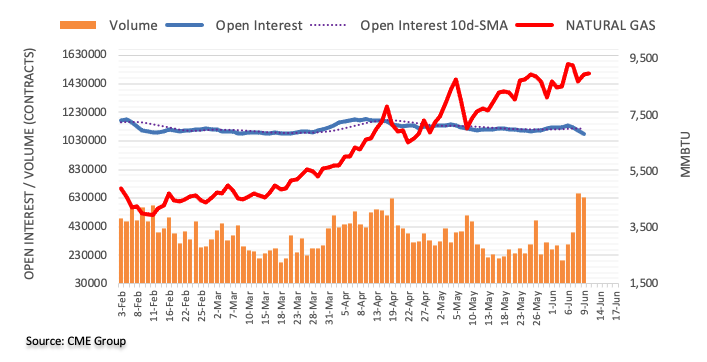
USD/INR held at the upper end of the 77-78 range in the past month. Economists at Commerzbank expect the Indian rupee to remain under pressure.
Reserve Bank of India to hike further
“RBI has a real battle on its hands and has hiked rates by 90bp to 4.90% in just the past one month. However, this won’t be the end and another 125bp is expected by year-end. Inflation is projected to average well above RBI’s upper threshold of 6%.”
“INR is expected to remain under pressure along with the rest of Asian currencies due to capital outflows, the cautious risk backdrop, and firm USD tone.”
“We continue to look for a supportive tone for USD/INR near term at the upper end of the 76-78 range. RBI is also expected to step up intervention to mitigate INR’s weakness but not offset it altogether.”
Gold Price is testing bearish commitments at the key $1,842 support. As FXStreet’s Dhwani Mehta notes, the all-important US inflation release, which will provide fresh hints on the Fed’s rate hike guidance, holds the key.
Gold could rebound firmly on a surprise drop in the US CPI
“The US Consumer Price Index (CPI) is seen steady at 8.3% YoY in May while the core CPI is seen easing to 5.9% YoY vs. 6.2% previous. Should the inflation print surprise markets to the upside, it could flag rapid and bigger Fed rate hike bets, fuelling a fresh upswing in the dollar at gold’s expense.”
“Gold price could rebound firmly on a surprise drop in the US CPI, reviving the debate of peak inflation and lifting pressure off the Fed to act aggressively in September.”
See – US CPI Preview: Forecasts from eight major banks, inflation peaked but faces challenges to moderate
- EUR/USD fades recover from three-week low, pares the biggest daily loss in a month.
- Impending bear cross on MACD hints at further downside.
- Four-month-old resistance line holds the key to the bull’s entry.
EUR/USD takes a U-turn from its intraday high as it pares the daily gains around 1.0630 heading into Friday’s European session.
In doing so, the major currency pair fails to cross the 21-DMA despite consolidating the biggest daily loss in a month.
That said, bearish MACD signals and lower-high formation keeps the EUR/USD sellers hopeful to revisit the mid-June high surrounding 1.0600.
It’s worth noting, however, that a clear downside break of the 1.0600 could make the pair vulnerable to test the six-week-old horizontal support around 1.0460-75.
Meanwhile, the 50-DMA level of 1.0685 and a downward sloping resistance line from February, close to 1.0730, challenge the pair’s recovery moves beyond the 21-DMA level of 1.0650.
Even if the EUR/USD prices rise past 1.0685, the late May top near 1.0785 acts as an extra filter to the north.
EUR/USD: Daily chart

Trend: Further weakness expected
In the opinion of FX Strategists at UOB Group Lee Sue Ann and Quek Ser Leang, AUD/USD still risks further downside to probably 0.7030 in the next weeks.
Key Quotes
24-hour view: “The sharp drop in AUD to 0.7094 and the subsequent weak closing at 0.7097 (-1.29%) came as a surprise (we were expecting sideway trading). While oversold, the rapid drop has scope to extend to 0.7060. The major support at 0.7030 is unlikely to come into the picture for now. On the upside, 0.7150 is likely strong enough to contain any rebound (minor resistance is at 0.7125).”
Next 1-3 weeks: “Two days ago (07 Jun, spot at 0.7190), we highlighted that the recent AUD strength has come to an end and we held the view that AUD is likely to consolidate and trade between 0.7100 and 0.7260. Yesterday (09 Jun), AUD dipped below 0.7100 (low of 0.7094). Downward momentum has improved and instead of consolidating, AUD could decline to 0.7030. At this stage, the chance for a sustained decline below this level is not high. The downside risk is intact as long as AUD does not move above the ‘strong resistance’ level, currently at 0.7180.”
The US Bureau of Labor Statistics will release the May Consumer Price Index (CPI) data on Friday, June 10 at 12:30 GMT and as we get closer to the release time, here are the forecasts by the economists and researchers of eight major banks regarding the upcoming US inflation print.
The (CP) is forecast to remain at 8.3% after April’s inflation rate dropped from a four-decade high at 8.5% in March. Monthly prices are projected to rise 0.7%, more than double their 0.3% gain in April.
Core inflation, without the food and energy costs that have been in advance of general prices for more than a year, is expected to fall to 5.9% from 6.2% in April. The month’s increase is predicted to be 0.5%, just below the 0.6% gain in April.
Commerzbank
“The inflation rate for May looks set to remain at 8.3%. From April to May consumer prices probably rose by 0.8% (consensus 0.7%). Inflation is not expected to fall below 8% until October. Therefore, pressure on the Fed to raise interest rates sharply is likely to remain high.”
Nordea
“Headline inflation is likely to stay flat printing at 8.3% YoY, while core inflation will fall towards 6.1% YoY with a slight risk to the downside. The primary driver of headline inflation will be energy prices, which are poised to show a large contribution to YoY headline CPI on the back of a 9% gasoline price increase in May. Another contributing factor will be service inflation, which has accelerated on a month-on-month basis and will start contributing more and more to the YoY numbers. Today’s inflation problem began as a surge in goods prices during the pandemic, but it has now turned into sticky and broad-based service inflation, which really highlights the Fed’s delay in withdrawing accommodative policy.”
TDS
“Core prices likely stayed strong in May, with the series registering a second consecutive 0.5% MoM increase. A drag on inflation recently, we now expect used vehicle prices to be a contributor, advancing for the first time in four months. We also look for continued momentum in airfares and shelter inflation. Our MoM forecasts imply 8.4%/5.9% YoY for total/core prices.”
RBC Economics
“US inflation report is expected to show the headline YoY rate little changed after edging lower for the first time in almost a year in April, falling to 8.3% from 8.5% in March. Gasoline prices jumped to almost $4.50 per gallon on average in May – up 49% from a year ago and over 4% (seasonally adjusted) from April. That should push energy inflation even higher. Food prices are expected to have risen at a faster rate again, driven by more expensive farm products and rising processing and transport costs. Higher food and energy prices alone would be enough to make consumers feel the pinch of higher prices, but pressures have been far broader than that. Ex-food and energy (core) CPI growth likely moved a touch lower YoY but should still hold at around 6%. Wages in comparison have still increased more compared to pre-pandemic levels – at 4.7%, annualized growth in average hourly earnings in the US from 2019 still remains above the annualized inflation increase over the same period (4.2%). But the gap is closing, quickly.”
SocGen
“US CPI likely decelerate in May (8.0% YoY from 8.3%), albeit mainly thanks to base effects. Moderation is set to be slow, reinforcing the Fed’s determination to quickly raise the fed funds rates. There was a brief pause on energy price increases in April, but by late May oil prices again surged. These increases are likely to add materially to headline CPI, which we expect to rise by 0.6%."
NBF
“The food component likely remained very strong given severe supply constraints globally, and this increase may have been compounded by sharply higher gasoline prices. As a result, headline prices could have increased by 0.8% MoM, leaving the YoY rate unchanged at 8.3%. Core prices, meanwhile, should have continued to be supported by rising rent prices and advanced 0.5%. Thanks to a strongly negative base effect, this healthy gain should still translate into a two-tick drop of the 12-month rate to 6.0%. Several indicators for April will also be published, notably consumer credit and the trade balance.”
ANZ
“We expect US core CPI to rise by 0.6% MoM in May and headline to rise by 0.8%. Energy prices rose strongly after a brief respite in April. COVID-sensitive prices, like airline fares and accommodation, are expected to contribute to inflation. So too rents. Our supply-side dashboard suggests goods prices inflation intensified in May. There are tentative signs that labour market conditions are softening, so wage pressures should ease. There is a long way to go before inflation pressures align with the Fed’s 2% target. The Fed is set to hike by 50bp at both its June and July meetings, and probably also in September, as it looks to bring uncomfortably high inflation back to its 2% price stability target.”
CIBC
“With gasoline prices higher in May, total monthly inflation likely accelerated to 0.7%. However, that would still leave the annual rate slightly slower at 8.2%, given base effects. Excluding energy and food prices, core monthly inflation could have decelerated but remained lofty at 0.5%, as high-frequency indicators showed that demand for flights and dining out were held back by the rise in Omicron cases. Higher goods prices tied to the lockdowns in China, and further upside in the shelter component that’s playing catch up to earlier increases in home prices will therefore be behind the monthly increase. Still, base effects will result in a deceleration in the annual rate to 5.9%.”
- USD/CHF is mildly offered after failing to sustain above the psychological resistance of 0.9800.
- Higher price pressures will force the Fed to squeeze more liquidity from the market.
- Next week, the SNB will dictate its June monetary policy.
The USD/CHF pair has modestly slipped to near 0.9786 after failing to sustain above the psychological resistance of 0.9800. An upside bias is still intact as investors are awaiting the release of the US Inflation.
As per the market consensus, the US Consumer Price Index (CPI) is seen at 8.3% on annual basis, similar to the prior print. While the core CPI that doesn’t include food and oil prices is seen lower at 5.9% against the former figure of 6.2%. This dictates that higher fossil fuel and food prices are majorly responsible for elevated inflation levels.
Investors are cautious over the fact that despite the adaptation of policy tightening measures by the Federal Reserve (Fed), the expectations for the inflation rate have not been trimmed. A stable inflation rate is advocating more quantitative restrictions and more filters on liquidity leakage into the economy, which will diminish the growth forecasts as the corporate sector will use more filters while doing an investment.
Meanwhile, higher price pressures have brought a rebound in the US dollar index (DXY). After a minor correction, the DXY is resuming its upside journey and is expected to recapture its three-week high at 103.37.
On the Swiss franc front, investors are awaiting the interest rate decision by the Swiss National Bank (SNB) next week. The Swiss CPI has climbed above 2% in May, which could pause the SNB to continue with a neutral stance. However, a report from Citibank states that the Swiss central bank could raise interest rates next week”.
CME Group’s flash data for crude oil futures markets noted open interest dropped for the third session in a row on Thursday, now by around 18.6K contracts. Volume followed suit and went down for the second straight day, this time by around 78.8K contracts.
WTI now targets the 2022 high
Prices of the barrel of the WTI corrected lower on Thursday following fresh multi-week highs. The daily decline came amidst shrinking open interest and volume, leaving the downside limited in the very near term. That said, the bullish view in crude oil remains well in place and with the next target at the YTD tops past the $129.00 mark.

ECB’s Villeroy: "Neutral rate" is somewhere between 1% and 2%
More to come
GBP/USD is predicted to remain side-lined in the next weeks, noted FX Strategists at UOB Group Lee Sue Ann and Quek Ser Leang.
Key Quotes
24-hour view: “We highlighted yesterday that ‘momentum indicators are turning neutral’ and we expected GBP to ‘trade sideways within a range of 1.2490/1.2590’. Our view for sideway-trading was not wrong even though GBP traded within a narrower range than expected (1.2488/1.2557). The underlying tone has softened somewhat and GBP could drift lower from here. However, the major support at 1.2430 is unlikely to come into the picture (there is another support at 1.2460). Resistance is at 1.2525 followed by 1.2550.”
Net 1-3 weeks: “Last Friday (03 Jun, spot at 1.2570), we highlighted the outlook for GBP is mixed and we expected GBP to trade between 1.2430 and 1.2670. GBP subsequently traded well within the range. While shorter-term downward momentum has improved somewhat, we expect GBP to trade sideways for now, albeit within a narrower range of 1.2430/1.2600.”
Open interest in gold futures markets resumed the downtrend and shrank by around 2.5K contracts on Thursday, according to advanced prints from CME Group. Volume, on the other hand, rose for the third session in a row, this time by nearly 10K contracts.
Gold keeps navigating around $1,840
Gold prices dropped to the $1,840 region on Thursday before ending the session a tad above this level. The bounce off this zone was amidst shrinking open interest and hints at the idea that further upside appears unlikely, leaving the ongoing consolidation largely in place for the time being.

- Gold Price remains pressured towards a convergence of 200-DMA, three-week-old support line.
- US dollar retreats as market sentiment dwindle ahead of key inflation data, Treasury yields grind near monthly top.
- Hopes of higher US CPI, growth fears favor XAUUSD sellers ahead of next week’s Fed meeting.
Gold Price remains depressed at around $1,845, keeping the previous day’s bearish bias as the metal approaches the key support confluence heading into Friday’s European session. The bullion’s latest weakness ignores the pullback in the US Dollar. That said, the market’s indecision ahead of the key US Consumer Price Index (CPI) data seems to join the firmer US Treasury yields to weigh on the quote.
Gold Price bears the burden of strong Treasury bond yields
US 10-year Treasury bond yields rise 1.7 basis points (bps) to 3.057% during the three-day uptrend. In doing so, the benchmark bond coupons brace for the second weekly gain while poking the monthly top marked the previous day. Fears of aggressive central bank actions could be linked to the recent run-up in the bond yields.
Also read: Gold Price Forecast: XAUUSD at a critical juncture, US inflation holds the key
Coronavirus woes in China weigh on XAUUSD
The return of covid fears in China, due to the latest activity restrictions in Shanghai and Beijing, appears to weigh on the Gold Price due to the dragon nation’s status as one of the world’s top bullion consumers. “China's commercial hub of Shanghai faces an unexpected round of mass COVID-19 testing for most residents this weekend - just 10 days after a city-wide lockdown was lifted - unsettling residents and raising concerns about the impact on business,” said Reuters.
ECB couldn’t impress gold buyers
The European Central Bank (ECB) signaled that the fears of inflation challenge the old continent’s growth, via the economic forecasts. The bloc’s central bank also matched market consensus while announcing an end of Quantitative Easing from July 1 and 25 basis points (bps) of a rate hike on July 25. However, the market’s expectations of a 50 bps move in July were pushed back and hence drowned the gold prices after the ECB announcements.
Options market signals continue to tease the gold sellers as the daily risk reversal (RR), the spread between the calls and the puts, brace for the third weekly fall. That said, the weekly RR’s latest figures of -0.195 also appear the smallest count in a month. Details also suggest that the monthly RR signal a three-day downtrend with -0.250 level while the daily figures remain negative as well, at -0.35 by the press time, per Reuters data.
US inflation is the key
Inflation
US Consumer Price Index (CPI) data is likely to print no change in the headline figure of 8.5% YoY. However, the core CPI, theoretically known as CPI ex Food & Energy, is expected to retreat from the 6.2% level to 5.9% and can challenge the gold sellers. Though, the White House has already signaled a higher inflation number, due to a jump in energy prices, which in turn raise hopes of a disappointment and a rebound in the gold prices should the actual US inflation figures recede.
Gold Price technical outlook
Gold Price portrays a one-week-old downtrend as sellers attack a confluence of the 200-DMA and an upward sloping support line from May 18, around $1,842 by the press time. The metal’s recent weakness takes clues from the RSI divergence, as well as the bear cross between the 50-DMA and the 100-DMA.
That said, the RSI’s failure to back the higher low of prices signals that bears are flexing muscles. It’s worth noting that the 50-DMA’s sustained trading below the 100-DMA also keeps the sellers hopeful.
Even so, a clear downside break of the $1,842 support confluence becomes necessary for the XAUUSD sellers before challenging the monthly low near $1,828. Following that, a downward trajectory towards the $1,800 threshold and then to the yearly bottom surrounding $1,786 can’t be ruled out.
Alternatively, a one-week-old resistance line near $1,851 guards the recovery moves of Gold Price ahead of the recent peak surrounding $1,874. In a case where the commodity prices rally beyond $1,874, the 50-DMA and the 100-DMA, respectively around $1,883 and $1,890, could challenge the XAUUSD buyers.
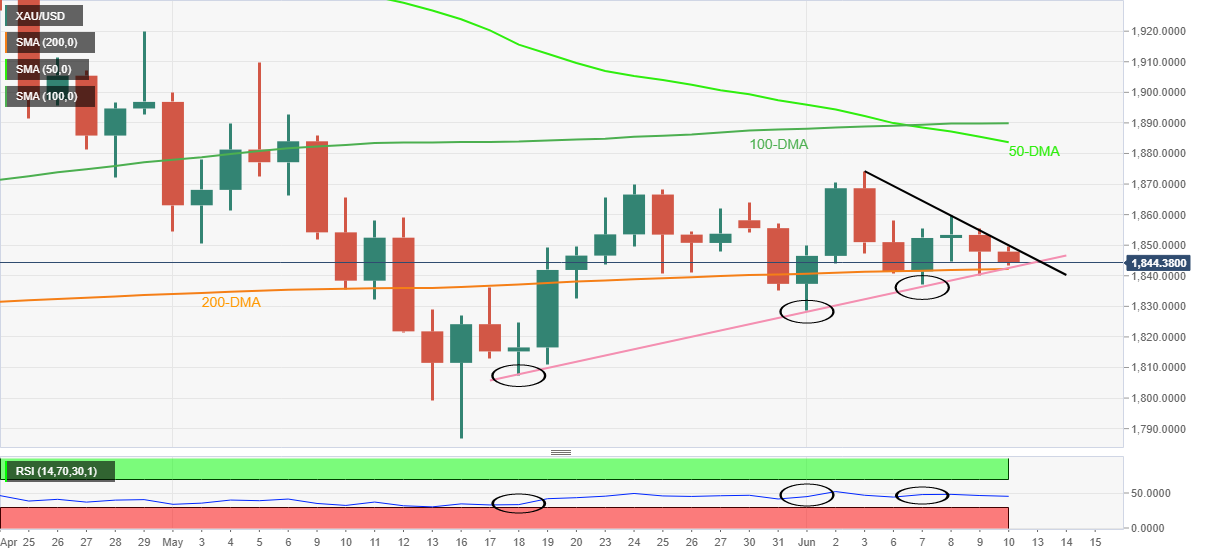
Gold may be on verge of another selloff
- EUR/JPY is expected to tumble further as the market has turned cautious ahead of US inflation.
- The ECB kept its policy rates unchanged but sounded extremely hawkish on guidance.
- Japan has reached its inflation goals, however, the BOJ will stick to its prudent monetary policy.
The EUR/JPY pair is attempting a downside break of its consolidation formed in a narrow range of 142.28-14.70 in the Asian session. The cross witnessed a decent fall on Thursday after failing to overstep the seven-year high at 144.21. The ongoing negative market sentiment has underpinned the Japanese yen against the shared currency bulls.
The eurozone is expected to remain vulnerable as the European Central Bank (ECB) ignored the soaring inflation fears and dictated a neutral stance on the interest rates on Thursday. Market veterans were awaiting retaliation by ECB President Christine Lagarde against the galloping price pressures, however, the ECB stuck to its accommodative policy stance but dictated hawkish guidance for the remaining year.
As per the statement from ECB’s Lagarde, the central bank will end its Asset Purchase Program (APP) before July and will step up its interest rate cycle. A rate hike by 25 basis points (bps) in July and may be more than 50 bps rate hike in September. Also, the inflation situation will continue to torture the households in eurozone as a higher inflation rate will be majorly contributed by soaring oil prices due to Russia’s invasion of Ukraine and supply chain disruptions.
On the Japanese yen front, a continuation of ultra-loose monetary policy will keep the yen bulls on the sidelines. The Bank of Japan (BOJ) is continuously capping its 10-year Japanese bond yields at 025%, significantly lower than the respective G-10 countries. Also, Japan has finally reached its inflation goals above 2% but doesn’t warrant an end to the prudent monetary policy as higher price pressures are fueled by higher fossil fuel and commodity prices.
FX Strategists at UOB Group Lee Sue Ann and Quek Ser Leang noted that further downside in EUR/USD is expected to meet strong support around 1.0540 in the near term.
Key Quotes
24-hour view: “We expected EUR to strengthen yesterday but we were of the view ‘any advance is expected to face strong resistance at 1.0750’. We noted, ‘there is another strong level at 1.0785’. EUR spiked to a high of 1.0773 during London hours before staging a sharp sell-off to a low of 1.0609. There is scope for EUR to drop below 1.0600 but a clear break of 1.0570 appears unlikely for now. Resistance is at 1.0650 followed by 1.0690.”
Next 1-3 weeks: “Yesterday (09 Jun, spot at 1.0715), we highlighted that shorter-term upward momentum is beginning to build and the risk of a break of 1.0785 has increased. However, EUR did not break 1.0785 as it spiked to a high of 1.0773 during London hours before plunging. The ‘failure’ to break the major resistance at 1.0785 coupled with the sharp sell-off has shifted the risk to the downside. That said, any weakness is expected to face solid support at 1.0540. In order to maintain the surge in downward momentum, EUR should not move above 1.0720 (‘strong resistance’ level) within these few days.”
- USD/CAD is juggling around 1.2700 as investors await US CPI and Canada’s labor market data.
- Stable or higher US CPI will strengthen the greenback bulls further.
- Canada’s administration may have generated 30k additional jobs in May.
The USD/CAD pair is oscillating in a narrow range of 1.2694-1.2710 in the early Tokyo session after a vertical upside move from 1.2550. The greenback bulls have witnessed a firmer buying tail after recording a monthly low at 1.2518 on Wednesday. A buying tail represents a responsive buying action, which triggers when the market participants find the asset a value bet.
The greenback bulls are strengthened as investors have underpinned the negative market sentiment ahead of the US inflation. The upcoming US Consumer Price Index (CPI) event has created havoc in the FX domain. The expectation of stability in the annual inflation rate is firming the odds of a prolonged hawkishness by the Federal Reserve (Fed). Stable or higher US CPI will bolster the odds of more 50 basis points (bps) rate hikes than expected earlier, which may trim the growth forecasts vigorously.
The loonie bulls have been dumped by investors on falling oil prices. The black gold has displayed a vulnerable performance in the Asian session and is expected to carry forward a similar sentiment in the European session. The oil prices have witnessed a corrective move after printing a two-month high of $123.12, however, the upside is intact on supply concerns. It is worth noting that Canada is a leading exporter of oil to the US and lower oil prices result in lower fund flows for Canada.
Apart from the US CPI, investors are awaiting the release of Canada‘s labor market data. As per the market consensus, Canada’s economy has added 30k new jobs on the labor market in May, almost double the prior print of 15.3k. Also, the Unemployment Rate is seen stable at 5.2%.
- USD/TRY reverses the previous day’s pullback from yearly top.
- CBRT teases increased weigh on TRY assets in collateral pool, Turkish banking watchdog sets maximum maturities for consumer loans.
- US dollar retreat challenges upside momentum, US CPI in focus.
USD/TRY picks up bids to reverse the U-turn from a six-month high, registered the previous day, as traders ignore the Turkish government’s ‘liralization’ efforts. That said, the Turkish lira (TRY) pair rises 0.65% intraday to regain the 17.23 level heading into Friday’s European session.
Central Bank of the Republic of Türkiye (CBRT) joined the national capital market board, banking watchdog and Treasury to announce a slew of measures to defend the TRY earlier in the Asian session. However, fears of heavy inflation and Turkish President Recep Tayyip Erdogan’s push for no rate hikes seem to keep the USD/TRY buyers hopeful.
“Turkey's central bank said on Friday it was increasing the weight of lira fixed assets in the collateral pool, with banks to establish long-term fixed-rate securities in the lira in addition to their foreign currency deposits and participation funds,” said Reuters.
The capital market board also reduced fees to encourage public offerings held in Türkiye whereas the Turkish BDDK banking watchdog said on Thursday, per Reuters, that it had decided to set a maximum 24-month maturity for consumer loans between 50,000 and 100,000 lira and a maximum 12-month maturity for consumer loans over 100,000 lira ($5,814).
Elsewhere, The Turkish treasury and finance ministry said on Thursday it will issue income-indexed domestic bonds for individual investors to encourage Turkish citizens to make savings in lira assets and to broaden the investor base.
On a broader front, the US Dollar Index (DXY) pares weekly gains ahead of the key Consumer Price Index (CPI) data. However, fears concerning China’s covid conditions and faster/heavier rate hikes, as well as their negative economic repercussions, weigh on the market sentiment of late, which in turn challenges the USD/TRY bears.
Looking forward, the US CPI will be crucial to watch for the USD/TRY traders as market expectations suggest no change in the headline figure of 8.5% YoY. However, the White House has already signaled a higher number, which in turn could help the USD/TRY sellers in case of a negative surprise from the data.
Technical analysis
Overbought RSI and an upward sloping resistance line from February, near 17.35, seem to play their roles in challenging the USD/TRY bulls as they stepped back from 17.50. However, bears need validation from May’s peak of 16.46 to retake control.
- Asian equities are facing intense selling pressure on the souring market mood.
- Lower-than-expected Chinese inflation has supported the respective indices.
- Oil prices are subdued, however, the upside looks favored on extreme shortage of oil supply.
Markets in the Asian domain are trading weak as investors are cautious over the release of the US inflation. A preliminary estimate for the annual US Consumer Price Index (CPI) states that the inflation rate will stick to the previously reported figure of 8.3%. The US CPI is expected to sustain above 8% consecutively for the third month. This will keep the odds of a prolonged hawkish stance by the Federal Reserve (Fed) higher.
At the press time, Japan’s Nikkei225 erased 1.40%, Nifty50 tumbled 1.23%, and Hang Seng slipped 0.23%. While China A50 jumped 0.30% on mixed inflation data.
China’s National Bureau of Statistics has reported the annual inflation at 2.1%, similar to the prior print but a little lower than the estimates of 2.2%. While the Producer Price Index (PPI) has come in line with the forecast of 6.4% and is significantly lower than the prior print of 8%. This has delighted the People’s Bank of China (PBOC) to keep up with the prudent monetary policy.
On the oil front, oil prices are trading subdued in the Asian session, however, the upside is intact as the shortage of oil in the global supply due to the prohibition of oil imports from Russia won’t get offset with the additional oil promised by the OPEC+. The oil cartel promised to add 648k barrels of oil in July and August, which is extremely low against the mega oil supply by Moscow. Also, the higher oil demand forecasts in the US economy due to the upcoming summer will keep oil prices in the grip of bulls.
- AUD/USD picks up bids to consolidate the biggest daily fall in a month.
- Sustained break of 21-DMA, downbeat RSI, MACD signals keep sellers hopeful.
- 200-DMA appears a tough nut to crack for buyers.
AUD/USD licks its wounds around the lowest levels in two weeks, picking bids to pierce 0.7100 during early Friday morning in Europe.
Even so, the Aussie pair’s successful downside break of the 21-DMA, the first in three weeks, joins the sluggish RSI and MACD’s impending bear cross to favor sellers until the quote stays below the 21-DMA hurdle of 0.7115.
That said, the pair’s recovery past 0.7115 won’t be an open invitation to the AUD/USD bulls as a convergence of the 200-DMA and a 50% Fibonacci retracement of April-May fall, around 0.7245-50, appears strong resistance to challenge the further upside.
Alternatively, fresh downside moves can aim for early May’s swing low near 0.7030 ahead of challenging the 0.7000 round figure.
Following that, a one-month-old horizontal area surrounding 0.6950 will be crucial to watch for the AUD/USD bears.
Overall, AUD/USD prices are likely to witness further downside despite the latest attempts to recover the weekly loss, the first in four weeks.
AUD/USD: Daily chart
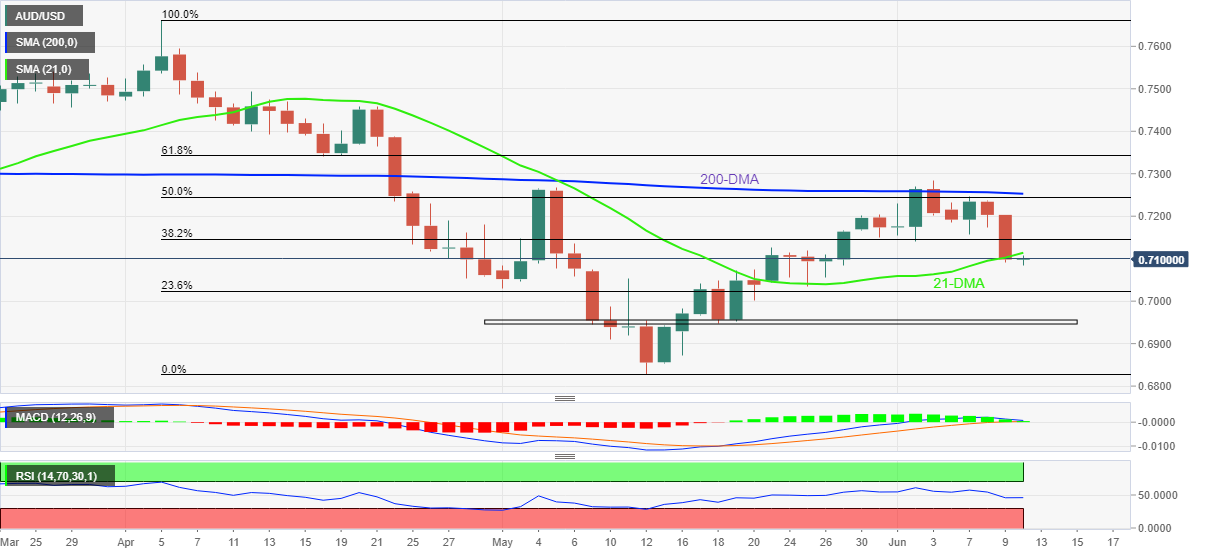
Trend: Further weakness expected
- GBP/USD snaps two-day downtrend around weekly low, struggles to recover amid sluggish markets.
- UK PM Johnson failed to impress bulls, NIP chatters grow stronger on fears of a repeal.
- Private gauge for UK employment dropped for the sixth month in May.
- US CPI is widely anticipated to arrive strong and hence a softer figure can extend the latest recovery moves.
GBP/USD fades the corrective pullback from the weekly low, easing to 1.2495 during early Friday morning in Europe, as market fears and Brexit headlines challenge buyers ahead of the US inflation data. In addition to the Brexit woes and pre-CPI anxiety, lackluster trading session and poor signals concerning the UK’s employment situations also probe the Cable pair buyers of late.
“British employers added staff in May at the slowest pace since early 2021, according to a survey that adds to signs that the labor market is losing some of its heat,” said Reuters. The news cites a measure of permanent staff hiring, by accountants KPMG and the Recruitment and Employment Confederation (REC), to portray the recently downbeat employment conditions in the UK. That said, the private employment gauge fell for the sixth consecutive month to 59.2, 59.8 flashed in April but remained above the 50 threshold for growth.
On the other hand, UK PM Boris Johnson tried to regain the market’s confidence after successfully overcoming the no-confidence vote. However, traders remain skeptical over Britain’s economic conditions amid Brexit, covid and the Russia-Ukraine tussles.
It’s worth observing that UK PM Johnson’s readiness to unilaterally repeal the Brexit deal concerning the Northern Ireland Protocol (NIP) joins the bloc’s warning to levy harsh sanctions on the UK and cut trade ties to keep GBP/USD buyers on their toes.
Elsewhere, the fresh covid fears in China, due to the return of activity restrictions in Shanghai and Beijing, challenge market sentiment in Asia. “China's commercial hub of Shanghai faces an unexpected round of mass COVID-19 testing for most residents this weekend - just 10 days after a city-wide lockdown was lifted - unsettling residents and raising concerns about the impact on business,” said Reuters.
On a broader front, escalating fears of faster/heavier rate hikes and the negative economic repercussions of the same seem to weigh on the market’s performance of late. The growing concerns over hot inflation and the Russia-Ukraine tussles are some of the extra catalysts that test the GBP/USD buyers.
Looking forward, the US CPI, expected to remain static at around 8.5% YoY, will be important to watch as the White House has already signaled a higher number, which in turn could recall the GBP/USD buyers in case of a negative surprise.
Also read: US CPI Preview: Soft core set to drive dollar down, and two other scenarios
Technical analysis
GBP/USD trades below the 21-DMA for the first time since May 19, suggesting further downside towards six-week-old horizontal support near 1.2400.
Alternatively, recovery moves beyond the 21-DMA hurdle, around 1.2510 by the press time, needs validation from the 50-DMA level surrounding 1.2655 to convince buyers.
Ahead of Friday’s US inflation data, due at 1230 GMT, Citi Global Wealth Investments released its Mid-Year Outlook 2022 report, with the key takeaways found below.
“The worst of US consumer price inflation has already passed, with a decline to around 3.5% likely in 2023.”
“Across developed economies, consumer prices have been rising faster than they have in decades. In response, policymakers are withdrawing the fiscal and monetary boost they provided when COVID struck.”
“The US Federal Reserve is leading the way, signaling some of the biggest annual interest rate rises in its history. We think that the Fed’s actions will determine if there is going to be a recession or sustained growth. The economy can stand higher rates, but not an abrupt withdrawal of liquidity.”
Also read: US Consumer Price Index May Preview: Fed policy is set but there is room for surprise
- The asset is prepared to record all-time highs at 79.00.
- A Bullish Flag formation has underpinned the greenback bulls.
- Advancing 200-EMA adds to the upside filters.
The USD/INR pair has moved above 77.80 in its early trade. The pair is expected to rebound after a mild corrective move from Thursday’s high at 78.00. On a broader note, the asset is oscillating in a range of 77.34-78.12 for the past three weeks.
A Bullish Flag formation on a four-hour scale is underpinning the greenback bulls. The formation of a Bullish Flag denotes a consolidation phase after a vertical upside move. The north-side sheer move is been recorded from May’s low at 75.98. The consolidation phase of a Bullish Flag indicates an initiative buying structure in which the buyers initiate longs after the establishment of a bullish bias.
The asset is holding above the 50-period Exponential Moving Average (EMA) at 77.68, which confirms a short-term bullish momentum. While, the 200-EMA at 77.31 is advancing swiftly, which warrants a longer trend is intact.
However, the Relative Strength Index (RSI) (14) is oscillating in the 40.00-60.00 range, which signals that the asset is awaiting a trigger for a decisive move.
Should the asset oversteps May’s high at 78.12, a breakout of a Bullish Flag will trigger, which will send the major into an uncharted territory towards the round-level resistance at 78.15, followed by the psychological resistance at 79.00.
On the flip side, the Indian rupee bulls could dictate the asset price if it drops below May 17 low at 77.34 decisively, which will send the asset towards May 3 high at 76.82. A breach of the latter will drag the asset further towards May 6 low at 75.98.
USD/INR four-hour chart
-637904302447250413.png)
- USD/IDR snaps four-day uptrend while reversing from a fortnight top.
- Indonesia Retail Sales eased to 8.5% in April, versus 9.3% prior.
- US dollar’s retreat ahead of the key inflation data seems to unpin the pullback moves.
USD/IDR pares weekly gains around $14,570 even as Indonesia Retail Sales eased in April, per the latest release on Friday. The reason for the Indonesia Rupiah (IDR) pair’s latest weakness could be linked to the broad US dollar pullback ahead of the US Consumer Price Index (CPI) for May.
As per the latest survey from the Bank Indonesia, the nation’s Retail Sales eased to 8.5% in April, versus 9.3% previous readouts.
That said, the US Dollar Index (DXY) pares the biggest daily gains in a week amid anxiety prior to the crucial inflation data.
It’s worth noting, however, that the fresh covid fears in China, due to the return of activity restrictions in Shanghai and Beijing, challenge market sentiment in Asia. “China's commercial hub of Shanghai faces an unexpected round of mass COVID-19 testing for most residents this weekend - just 10 days after a city-wide lockdown was lifted - unsettling residents and raising concerns about the impact on business,” said Reuters.
On a broader front, escalating fears of faster/heavier rate hikes and the negative economic repercussions of the same seem to weigh on the market’s performance of late. The growing concerns over hot inflation and the Russia-Ukraine tussles are some of the extra catalysts that test the USD/IDR bears.
Moving on, the US CPI, expected to remain static at around 8.5% YoY, will be important to watch as the White House has already signaled a higher number, which in turn could recall the USD/IDR bulls.
Technical analysis
Despite the latest pullback, USD/IDR holds onto the early week’s rebound from the 100-DMA, around $14,420 by the press time, which in turn keeps the pair buyers hopeful.
- EUR/USD is bided around 1.0610 as DXY eases mildly after hitting a fresh weekly high at 103.37.
- A neutral policy stance by the ECB has weakened the shared currency bulls.
- The DXY is expected to resume upside as the US inflation is seen stable at above 8%.
The EUR/USD pair has been mildly bided around 1.0610 after nose-diving from Thursday’s high at 1.0774. The shared currency bulls have been weakened by a neutral policy announcement from European Central Bank (ECB) President Christine Lagarde.
Considering the rising price pressures in the eurozone, market pundits were expecting a rate hike announcement. On the contrary, the ECB came forward with hawkish guidance and the ending of the Asset Purchase Program (APP) by June itself. Last week, the eurozone Harmonized Index of Consumer Prices (HICP) landed at 8.1% vs. 7.4%, as previously reported.
Economies that are operating at an annual inflation rate above 8% have already paddled up their interest rates to safeguard the paychecks receive by the households. So, the rationale behind not elevating the interest rates by the ECB could be lower growth forecasts as the adaptation of restrictive quantitative measures could dampen the growth rate further.
ECB’s Lagarde dictated that the inflation rate has climbed rooftop and to tackle the same the ECB will announce a 25 basis point (bps) rate hike in July and may be more than 50 bps rate hike in September. A neutral approach adopted this time has elevated the inflation forecasts to much higher levels.
Meanwhile, the US dollar index (DXY) has shown some signs of exhaustion and a minor recovery in the risk appetite of the market participants. The DXY has been offered around 103.37, however, the upside is intact on expectations of a stable inflation rate above 8%.
- Gold price is eyeing a cushion around $1,845.00 after a corrective move as DXY loses momentum.
- The forecast of a stable US CPI is stating the Fed’s quantitative measures have failed to trim price pressures.
- The precious metal is displaying back and forth moves in a broader range of $1,828.55-1,874.16.
Gold price (XAU/USD) is looking for a firmer cushion around $1,845.00 after a mild correction from $1,850.37. The precious metal displayed a responsive buying action after slipping to near $1,840.00. A responsive buying action generally takes place when the market participants find the asset a value bet.
On a broader note, the bright metal is trading lackluster, however, the release of the US inflation will bring a power-pack action in the counter. Investors are worried about the fact that the US Consumer Price Index (CPI) is not displaying any impact despite quantitative tightening measures by the Federal Reserve (Fed).
As per the market consensus, the annual US CPI is seen stable at 8.3%. The Fed has hiked its interest rates by 0.75% in the last three months along with a quick balance sheet reduction program. One could state that the price pressures are so strong and demand extreme quantitative tightening measures for displaying a meaningful plunge.
Meanwhile, the US dollar index (DXY) has shown some signs of exhaustion after failing to surpass Thursday’s high at 103.37. A higher-than-expected inflation figure will strengthen the DXY bulls and will set them for a faster ride northwards.
Gold technical analysis
On a four-hour scale, the gold prices are showing a prolonged consolidation. The precious metal is displaying topsy-turvy moves in a $1,828.55-1,874.16 range. The 21-period Exponential Moving Average (EMA) at $1,849.70 is overlapping with the gold prices. Also, the Relative Strength Index (RSI) (14) is oscillating in the 40.00-60.00 range, which signals that the asset is awaiting a trigger for a decisive move.
Gold four-hour chart
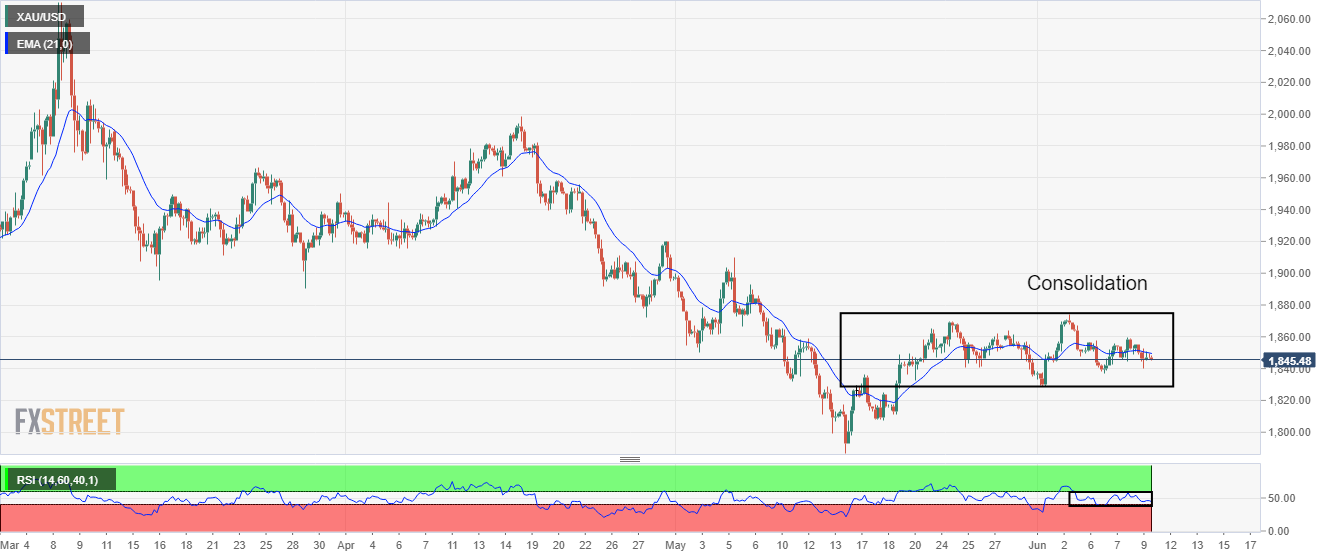
According to the CNBC CFO Council Survey, an incoming recession is more likely in the first of the next year amid persistently high inflation, which could down the Dow Jones Industrial Average below the 30,000 level.
Key findings
“Over 40% of chief financial officers cite inflation as the No. 1 external risk to their business, and going deeper into the results from the Q2 survey.”
“Almost one-quarter (23%) of CFOs cite Federal Reserve policy as the biggest risk factor.”
“Additional CFOs cited supply chain disruptions (14%) and the Russia-Ukraine war specifically as their No. 1 business risk.”
“68% of CFOs responding to the survey, predict a recession will occur during the first half of 2023.“
“The 10-year Treasury, which has already doubled this year to roughly 3%, is expected to flirt with 4% by the end of 2022, according to 41% of CFOs. An equal percentage of CFOs expect the 10-year to rise to no higher than 3.49% by year-end.”
“77% of CFOs expect the Dow Jones Industrial Average to fall below 30,000 before ever setting a new high, which would represent a decline of over 9% from its current level, and would represent an 18% decline from its 2022 high.”
- USD/JPY snaps a five-day uptrend around a 20-year high.
- Multiple failures to cross 134.50 joins sluggish RSI to tease sellers.
- Bears need validation from 133.18 to extend the fall.
USD/JPY consolidates recent gains around a two-decade high, refreshing intraday low near 134.00 during Friday’s Asian session.
The yen pair portrays a triple top bearish chart pattern on the hourly play. However, a clear downside break of the recent bottom surrounding 133.20 becomes necessary to recall the pair sellers. While facilitating the pair’s further fall, the RSI prints a downward trajectory.
That said, the 50-HMA and weekly support line, respectively near 133.95 and 133.65, could act as immediate supports during the quote’s further weakness.
In a case where the USD/JPY prices drop below 133.18, the weekly low of 130.43 could lure the bears.
Meanwhile, recovery moves remain elusive until the quote offers a sustained run-up beyond the 134.50 hurdle. Following that, 2002’s yearly top near 135.20 will gain the market’s attention.
Overall, USD/JPY bulls seem tired but the bearish trend is far from the reach.
USD/JPY: Hourly chart
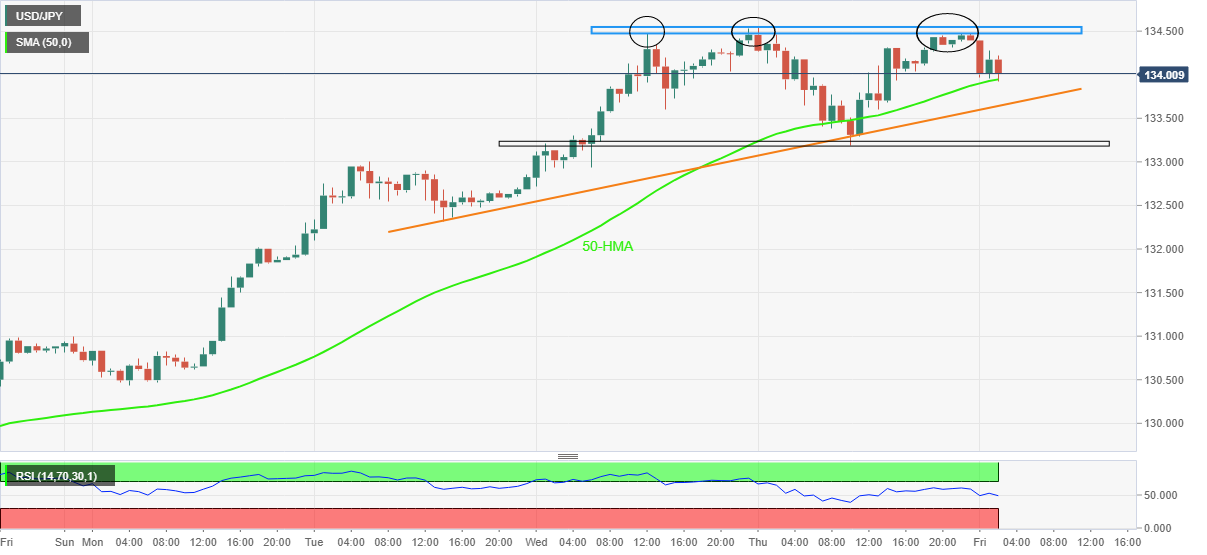
Trend: Further weakness expected
A week after easing covid outbreaks-induced restrictions, Shanghai city is once again battling the virus resurgence with many areas back under lockdown.
Shanghai will lock down eight city districts this weekend to mass test millions of people as COVID-19 cases continue to emerge.
The restrictions will apply to roughly 15.3 million residents of Pudong, Huangpu, Jing’an, Xuhui, Hongkou, Baoshan, Yangpu and Minhang districts of Shanghai during the testing.
Meanwhile, Christophe Lauras, president of the French Chamber of Commerce in China, "the business climate is not positive because despite the fact that the cities opened, there is still the problem of the zero-COVID policy. That is to say that every morning people don't know if they’ll be locked down."
Market reaction
Markets are licking their wounds after Thursday’s broad sell-off although the S&P 500 futures are adding 0.09% on the day. AUD/USD is treading water around 0.7100, awaiting the US inflation release for a fresh direction.
- USD/CNH snaps three-day uptrend following unimpressive China CPI, PPI.
- Shanghai and Beijing unveiled fresh activity restrictions after dialing back some a few days back, mass testing is on the way.
- Risk-off mood ahead of US inflation data challenge bears.
USD/CNH pulls back from a weekly top, refreshing an intraday low around 6.6950, even as China’s inflation data came in mixed for May. The reason could be linked to the US dollar’s pullback ahead of the key Consumer Price Index (CPI) figures for May.
China’s headline inflation number, namely the Consumer Price Index (CPI), reprints 2.1% figures to ease below the 2.2% market consensus. Further, the factory-gate inflation gauge, namely the Producer Price Index (PPI), matches the 6.4% forecasts for May.
It’s worth noting, however, that the fresh covid fears in China, due to the return of activity restrictions in Shanghai and Beijing, challenge the USD/CNH bears. “China's commercial hub of Shanghai faces an unexpected round of mass COVID-19 testing for most residents this weekend - just 10 days after a city-wide lockdown was lifted - unsettling residents and raising concerns about the impact on business,” said Reuters.
Furthermore, Escalating fears of faster/heavier rate hikes and the negative economic repercussions of the same seem to weigh on the market’s performance of late. The growing concerns over hot inflation and the Russia-Ukraine tussles are some of the extra catalysts that keep USD/CNH bulls hopeful.
Talking about the US inflation data, the CPI is expected to remain static at around 8.5% YoY but the White House has already signaled a higher number, which in turn could renew the US dollar buying and push back the USD/CNH sellers.
Technical analysis
Thursday’s Doji candlestick below the short-term hurdle, namely the 21-DMA level of 6.7075, directs USD/CNH bears towards revisiting the previous month’s low near 6.6475.
- AUD/JPY picks up bids from intraday low after China’s mixed inflation data.
- Overbought RSI, failure to rebound from April’s top favor sellers.
- Ascending trend line from late March, 92.20-10 support confluence act as extra filters.
AUD/JPY licks its wounds around 95.25 after posting the biggest daily fall in three weeks. The cross-currency pair’s latest rebound from the 95.00 threshold could be linked to China’s mixed inflation data, as well as the market’s anxiety ahead of the key US inflation figures. However, the bears remain hopeful.
China’s Consumer Price Index (CPI) reprints 2.1% YoY figures to ease below the 2.2% market consensus. Further, the factory-gate inflation gauge, namely the Producer Price Index (PPI), matches the 6.4% forecasts for May. Earlier in the day, Australia’s HIA New Home Sales dropped to -5.5% MoM in May versus -1.2% prior.
Also read:
Technically, RSI’s (14) retreat from the overbought territory and the quote’s failure to bounce off April’s top favor the AUD/JPY sellers.
That said, a broad horizontal area between 93.77 and 94.13, stretched from early April, appears a tough nut to crack for the pair sellers. Should the quote break the 93.77 support, a convergence of the 21-DMA and monthly support line, near 92.20-10, could challenge the AUD/JPY’s further downside.
Meanwhile, recovery moves need to offer a daily closing beyond April’s top surrounding 95.75 to recall the AUD/JPY buyers.
Following that, the recent highs close to 96.90 and an upward sloping trend line from late March, near 95.50 at the latest, will be in focus.
AUD/JPY: Daily chart
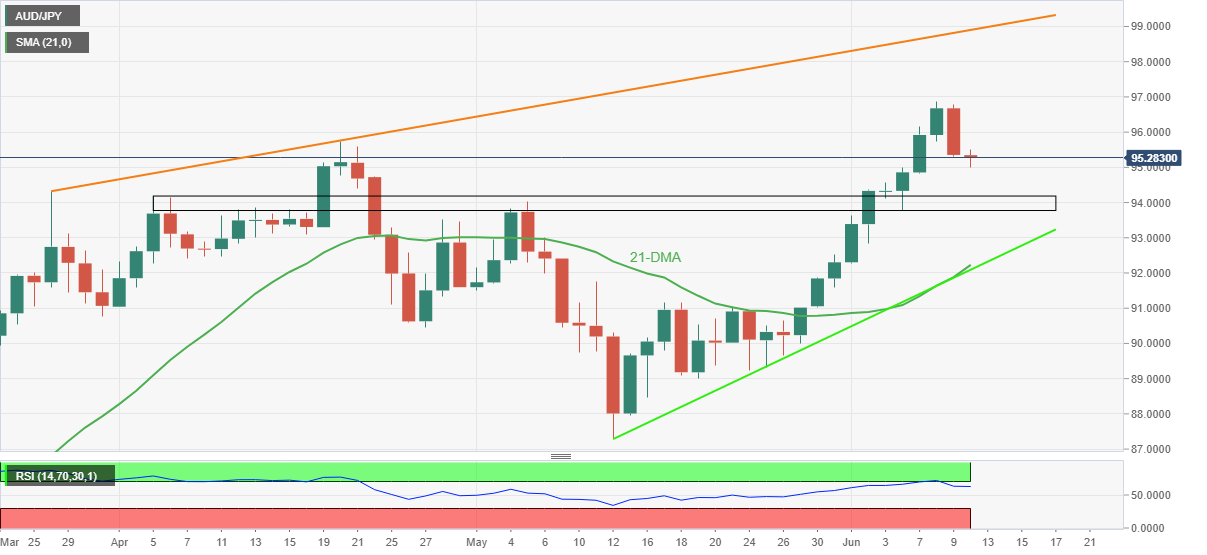
Trend: Further weakness expected
- NZD/USD bulls move in, correcting from fresh 3-week lows.
- The markets will now look ahead to the US CPI.
At 0.6394, NZD/USD is higher and correcting on the day so far, moving up from the lows printed overnight when investor demand for the greenback sank commodity-FX, sending the bird to a 3-week low of 0.6379.
It was another volatile night in global FX markets that saw the EUR sink after the ECB meeting, analysts at ANZ Bank noted:
''The ECB meeting was always the focus of this week, and while they gave fairly explicit forward guidance, EUR fell anyway. It’s almost as though market hawks and doves both got their way – the hawks will be pleased that tightening is finally coming, but the doves will be disappointed that it may be too little too late.''
''Either way, EUR didn’t like it, and as it fell, it took the Kiwi with it. Today we get NZ manufacturing data, which is one piece of the GDP puzzle. But amid all the market volatility, chances are it is overlooked as the focus shifts to next week’s US Fed meeting, into which the USD is inexplicably strengthening. Expect more NZD volatility.''
Meanwhile, traders will now look ahead to the US inflation data in the May Consumer Price Index (CPI). The consensus forecast calls for a year-over-year inflation increase of 8.3%, unchanged from April.
A stronger CPI ''reading could put downward pressure on risky assets as investors look for the Fed to remain aggressive in its fight against inflation,'' analysts at TD Securities said.
''Tactically, we see growing signs of an adverse risk backdrop in the coming weeks, as US real rates and equity correlations wane further and the USD peels away from relative US equity performance.'' Given the kiwi's high beta status, this could be a headwind for the bird.
The Fed is scheduled to announce its next policy statement on Wednesday. A rate hike of at least 50 basis points from the central bank is already being priced in, according to CME's FedWatch Tool.
New Zealand (NZ) Finance Minister Grant Robertson is on the wires now, via Reuters, making some comments on the economic and inflation outlook.
Key takeaways
New Zealand's economy is strong and resilient.
A firm believer in targeting inflation.
The Reserve Bank of New Zealand will continue as an inflation-fighting bank.
Market reaction
NZD/USD was last seen trading at 0.6392, almost unchanged on the day.
A White House official said in a Fox News interview late Wednesday, they expect headline inflation to be elevated because gas prices were 8.5% greater in April than in May.
Key takeaways
Will seep into CORE inflation through airline tickets because of the price of jet fuel.
They believe that inflation will moderate and finish lower at the end of this year than the rate at the end of 2021.
The gains in the labor market & demand for goods don’t indicate we are in a recession. They said it is “very unlikely”.
The administration is in a “good spot to transition” the economy to stable growth.
They are tracking a shift is spending habits from buying goods to buying services.
They believe that shift will relieve pressure on supply chains as money moves from buying stuff to buying services.
Related reads
- US inflation expectations stabilize around 2.75% ahead of US CPI
- US CPI Preview: Soft core set to drive dollar down, and two other scenarios
- AUD/USD grinds near the fortnight low, paring the biggest daily fall in a month after China's inflation data.
- China CPI eased on YoY basis but improved versus downbeat MoM forecast in May, PPI matches 6.4% expectations.
- Sour sentiment, anxiety ahead of the key statistics keep traders on their toes.
- US CPI will be important amid hawkish hopes from the next week’s Fed meeting.
AUD/USD dribbles around 0.7100, following the heaviest daily slump in four weeks, as the market’s cautious mood joins unimpressive China inflation numbers during early Friday.
China’s headline inflation number, namely the Consumer Price Index (CPI), reprints 2.1% figures to ease below the 2.2% market consensus. Further, the factory-gate inflation gauge, namely the Producer Price Index (PPI), matches the 6.4% forecasts for May. Earlier in the day, Australia’s HIA New Home Sales dropped to -5.5% MoM in May versus -1.2% prior.
Also read: Breaking: China CPI 2.1%, AUD/USD steady below 0.7100
Talking about the US data, weekly Jobless Claims rose past 210K forecasts to 229K for the week ended on June 3 while the US inflation expectations per the 10-year breakeven inflation rate of the St. Louis Federal Reserve (FRED) data clings to 2.75% in the last two days.
Escalating fears of faster/heavier rate hikes and the negative economic repercussions of the same seem to weigh on the market’s performance of late. The growing concerns over hot inflation and China’s covid conditions, not to forget the Russia-Ukraine tussles, are some of the extra catalysts that weigh on the AUD/USD prices.
That said, the US Federal Reserve will hike its key interest rate by 50 basis points in June and July, with rising chances of a similar move in September, according to a Reuters poll of economists who see no pause in rate rises until next year. In addition to the firmer belief over the Fed’s aggression, the White House's expectations of a stronger inflation figure and downbeat economic forecast from the Organisation for Economic Co-operation and Development (OECD), as well as fears of recession conveyed by the World Bank (WB), also roils the most.
Also read: US Consumer Price Index May Preview: Fed policy is set but there is room for surprise
Technical analysis
In addition to a U-turn from the monthly horizontal resistance surrounding 0.7260-65, AUD/USD bears also cheer a clear downside break of the 21-DMA, near 0.7115 by the press time. That said, the 0.7000 threshold and 0.6955-50 support zone, comprising multiple levels marked during May 09-19, could lure the pair sellers during the further downside.
The Aussie is steady on the Consumer Price Index data that is released by the National Bureau of Statistics of China is out as follows:
China CPI
- May CPI +2.1 pct from a year ago (Reuters poll +2.2 pct).
- May CPI -0.2 pct from the previous month (Reuters poll -0.3 pct).
- China says may food CPI +2.3 pct from a year ago; non-food CPI +2.1 pct.
AUD/UD update
AUD/USD has been pressured in the last sessions of the week by a strong US dollar in risk-off markets. The pair slipped below 0.7100 to score a fresh low of 0.7084 ahead of the data.
Markets will be paying more attention to the US inflation data later today in the North America session.
''The US May CPI report dominates the global calendar today. Although annual consumer inflation looks to have crested at 8.5%year in March, households are still expected to see a solid lift in prices. Consensus is 0.7%mth, 8.3% year (April 8.3%) and on CPI ex-food and energy, a rise of 0.5%month, 5.9%year (from 6.2%year in April),'' analysts at Westpac explained.
About China CPI
The Consumer Price Index is released by the National Bureau of Statistics of China. It is a measure of retail price variations within a representative basket of goods and services. The result is a comprehensive summary of the results extracted from the urban consumer price index and rural consumer price index. The purchase power of the CNY is dragged down by inflation. The CPI is a key indicator to measure inflation and changes in purchasing trends. A substantial consumer price index increase would indicate that inflation has become a destabilizing factor in the economy, potentially prompting The People’s Bank of China to tighten monetary policy and fiscal policy risk. Generally speaking, a high reading is seen as positive (or bullish) for the CNY, while a low reading is seen as negative (or Bearish) for the CNY.
In recent trade today, the People’s Bank of China (PBOC) set the yuan (CNY) at 6.6994 vs. the last close of 6.6920.
About the fix
China maintains strict control of the yuan’s rate on the mainland.
The onshore yuan (CNY) differs from the offshore one (CNH) in trading restrictions, this last one is not as tightly controlled.
Each morning, the People’s Bank of China (PBOC) sets a so-called daily midpoint fix, based on the yuan’s previous day's closing level and quotations taken from the inter-bank dealer.
- Market sentiment remains sour as traders await US inflation data amid recession fears.
- S&P 500 Futures stabilize around fortnight low after falling the most in three weeks.
- US 10-year Treasury bond yields grind high around monthly top.
Markets portray a typical cautious mood ahead of the US inflation data on Friday. Even so, the risk-aversion wave remains in play amid fears that hawkish central bank moves could take a toll on the global economic conditions.
While portraying the mood, the S&P 500 Futures stays defensive at around 4,015, following the heaviest daily slump since late May, whereas the US 10-year Treasury bond yields take rounds to 3.05% figure after refreshing the monthly high the previous day. It’s worth noting that the Wall Street benchmarks dropped the most in a week while the US Dollar Index (DXY) jumped to the highest levels in three weeks, down 0.05% around 103.25 by the press time.
Escalating fears of faster/heavier rate hikes and the negative economic repercussions of the same seem to weigh on the market’s performance of late. The growing concerns over hot inflation and China’s covid conditions, not to forget the Russia-Ukraine tussles, are some of the extra catalysts that weigh on the sentiment.
The US Federal Reserve will hike its key interest rate by 50 basis points in June and July, with rising chances of a similar move in September, according to a Reuters poll of economists who see no pause in rate rises until next year. In addition to the firmer belief over the Fed’s aggression, the White House's expectations of a stronger inflation figure and downbeat economic forecast from the Organisation for Economic Co-operation and Development (OECD), as well as fears of recession conveyed by the World Bank (WB), also roils the most.
On Thursday, the European Central Bank (ECB) conveyed fears of inflation weighing on growth, via their forecasts. The bloc’s central bank also matched market consensus while announcing an end of Quantitative Easing from July 1 and 25 basis points (bps) of a rate hike on July 25, versus expectations of a 50 bps move. Further, the US Jobless Claims rose past 210K forecasts to 229K for the week ended on June 3 while US inflation expectations, as per the 10-year breakeven inflation rate per the St. Louis Federal Reserve (FRED) data, remain steady at around 2.75% in the last two days.
Looking forward, the market’s anxiety ahead of the US inflation data may exert downside pressure on the riskier assets like commodities, equities and Antipodeans. However, expectations of a steady US Consumer Price Index (CPI) for May, at 8.5% YoY, test the US dollar bulls who might have cheered the risk-aversion otherwise.
Also read: US Consumer Price Index May Preview: Fed policy is set but there is room for surprise
- A Double Top formation displays exhaustion in the uptrend after a prolonged rally.
- The RSI (14) has sensed resistance at 60.00 which signals that the pound bulls are not bullish anymore.
- The yen bulls are attempting to drag the asset below the 50-EMA at 167.50.
The GBP/JPY pair has given a downside break of its consolidation formed in a 167.90-168.07 range in the late New York session. Earlier, the asset witnessed a steep fall after failing to refresh its six-year high, which is placed at 168.73.
A formation of a Double Top chart pattern after a prolonged rally on an hourly scale indicates exhaustion in the uptrend. This also advocates a bearish reversal but a reversal seeks more downside filters. The asset experienced a sell-off while attempting to overstep the six-year high at 168.73. It seems a weak attempt by the pound bulls is responsible for the loss of momentum in the upside rally.
The cross has violated the 20-period Exponential Moving Average (EMA) at 167.81 and is eyeing an imbalance move below the 50-EMA at 167.50.
The Relative Strength Index (RSI) (14) displayed a sheer downside move while shifting its range below 60.00-80.00. Also, the momentum oscillator has sensed barricades around 60.00, which signals that the market participants are not bullish on the cross anymore.
A firmer drop below Thursday’s low at 166.69 will trigger the Double Top formation and activate the yen bulls for a downside move towards Monday’s high at 165.67. Breach of the latter will drag the cross towards the round-level support at 164.00.
Alternatively, pound bulls could regain control if the cross oversteps a six-year high at 167.83. This will drive the asset towards the 8 February 2016 high at 170.63, followed by a 13 April 2015 low at 174.88.
GBP/JPY hourly chart
-637904200856241861.png) .
.
Japan's Finance Minister Suzuki repeats that FX stability is important, and rapid moves are undesirable. There has been no comment on fx intervention even as the yen falls to the lowest levels since 2002.
''Japan's government will respond appropriately to the exchange rate following the G7 agreement on currencies,'' it was stated.
Meanwhile, the Bank of Japan is committed to conducting fixed-rate operations, which will be expected to keep this sharp Japanese yen depreciation going for the time to come. After all, the BoJ’s efforts to anchor the yield target around 0% is more important to it than the cost of living and the central bank has made it clear that it firmly believes that higher yields would impose bigger costs on the economy more than FX depreciation.
The US Federal Reserve will hike its key interest rate by 50 basis points in June and July, with rising chances of a similar move in September, according to a Reuters poll of economists who see no pause in rate rises until next year, published during Friday’s Asian session.
Key findings
All 85 economists in a June 6-9 Reuters poll predicted a 50 basis point federal funds rate hike to 1.25%-1.50% on Wednesday, after a similar move last month. Another such hike was penciled in for July by all but a handful of survey contributors.
While more than two-thirds of respondents, 59 of 85, expected a 25 basis point hike in September, more than one-quarter, 23, saw the Fed hiking again by half a point. That is up from one-fifth of the sample last month.
The median of 43 responses to an additional question showed a 50% probability of a 50 basis point hike in September. The median probability for a similar move in November and December was 30% and 25%, respectively.
Nearly 60% of respondents to an additional question, 24 of 41, said the Fed would pause raising rates in either the first or second quarter of next year. Nine said the second half or beyond, while the rest said sometime this year.
Still, analysts saw the fed funds rate breaching the estimated 2.4% neutral level by year-end to 2.50-2.75%, slightly below market expectations of 2.75%-3.00%.
The poll expects it to reach a terminal level of 3.00%-3.25% or higher by end-Q2 2023, three months earlier than a poll taken just a few weeks ago.
That would be at least 75 basis points above the neutral rate and above the 2.25%-2.50% peak in the last cycle.
The survey showed a steady median 40% probability of a U.S. recession over the next two years, with a 25% chance of that happening in the coming year.
Also read: US Consumer Price Index May Preview: Fed policy is set but there is room for surprise
- USD/CAD is pushing higher as the bulls take on the bears towards key 4-hour resistance.
- The daily W-formation is a compelling feature on the charts.
In prior analysis, It was explained that the price was correcting the latest thrust to the downside from the channel lows. the analysis noted, however, that there was still a price imbalance that the bears are seeking to mitigate until April 21 lows, 1.2458, which could be exploited.
USD/CAD prior analysis, daily chart
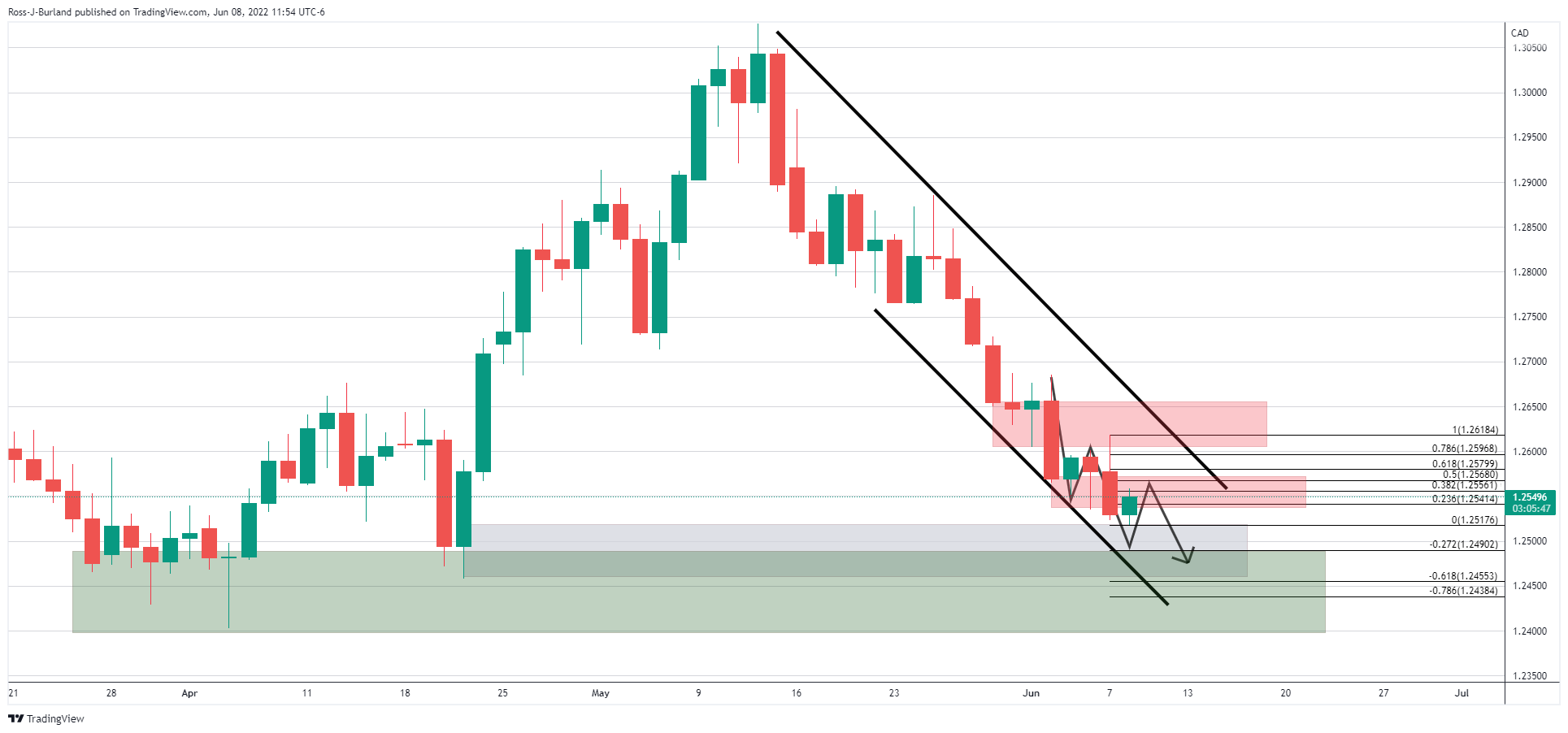
Nevertheless, the bulls have moved in ahead of the long term support area and it was warned that ''should the bulls commit to the correction, a break of resistance and if the 61.8% Fibonacci fails to draw in supply, then there will be prospects of a deeper correction towards 1.26 the figure and possibly beyond.''
USD/CAD daily W-formaiton
We are seeing the price dart significantly higher, marking a high so far for Friday of 1.2709. In doing so, however, the price has printed a W-formation on the daily chart as follows:
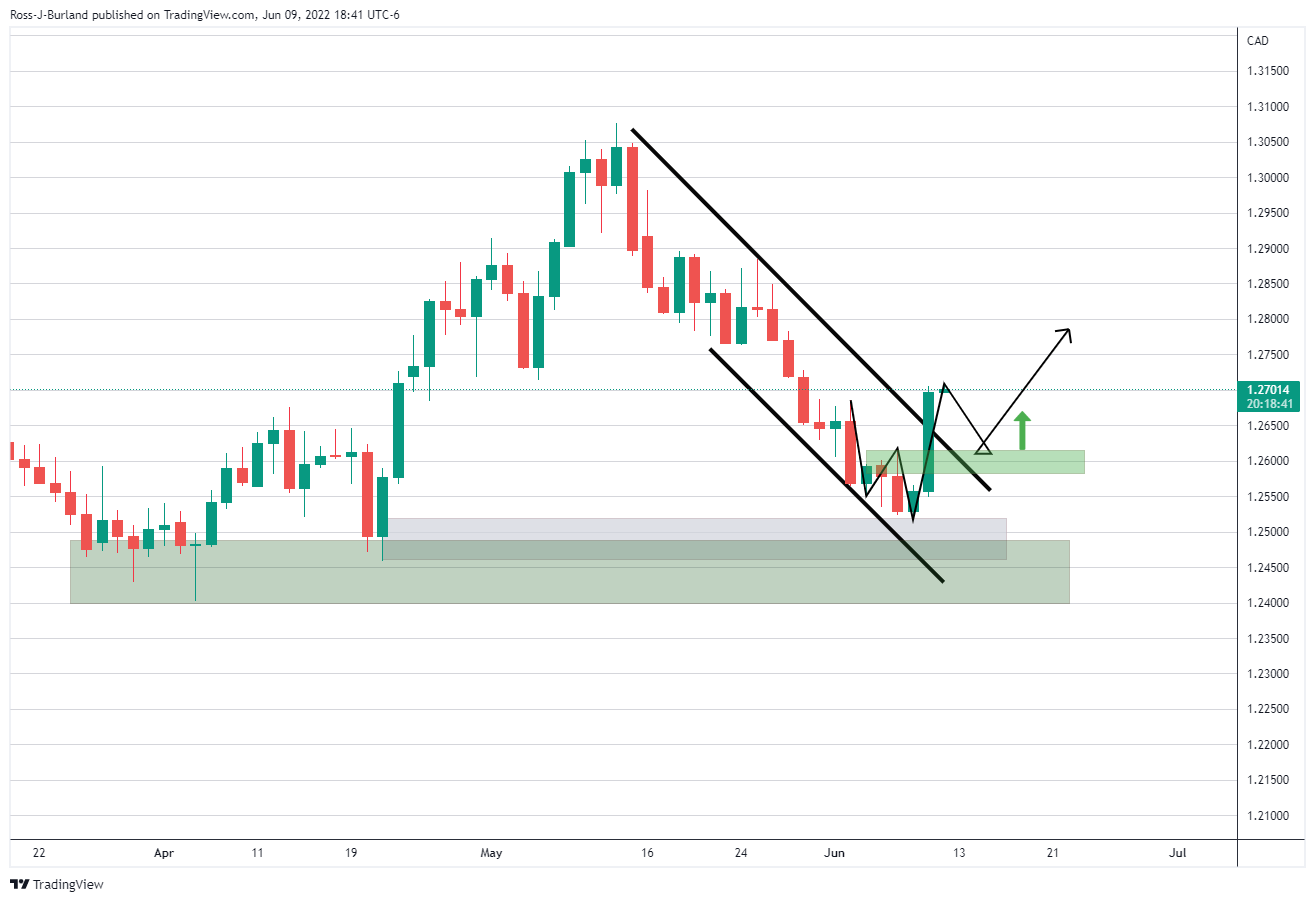
The W-formation is a reversion pattern which would be expected to draw in the price towards the neckline in due course. However, according to the 4-hour chart, there is a price imbalance which could yet be filled prior to a correction:
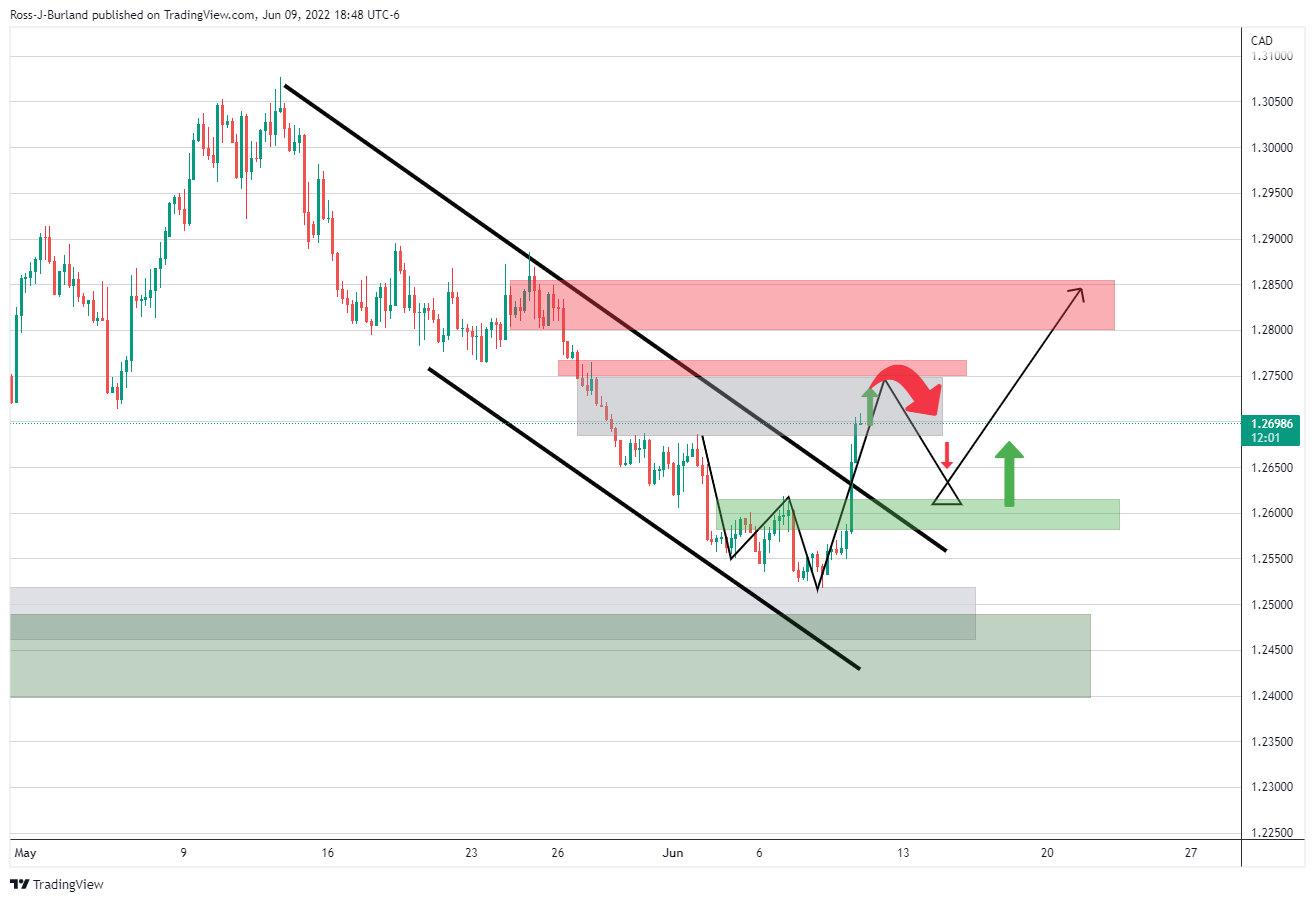
- EUR/USD holds lower ground after posting the biggest daily loss in a month.
- RSI (14), 200-SMA challenge bears despite downside break of five-week-old horizontal support.
- Bulls need validation from a two-week-old resistance line to retake control.
EUR/USD dribbles around a three-week low near 1.0615-20 as bears take a breather following the biggest daily fall in a month. Even so, the major currency pair remains on the bear’s radar during Friday’s Asian session, with eyes on the US inflation data.
Also read: US CPI Preview: Soft core set to drive dollar down, and two other scenarios
Given the clear downside break of a horizontal support region from early May, now resistance around 1.0630-40, the EUR/USD prices are likely to decline further.
However, RSI (14) remains sidelined around the oversold territory and joins the 200-SMA support near 1.0600 to challenge the pair bears.
Also likely to test the EUR/USD sellers are the multiple supports around 1.0590 and 1.0550, before portraying a south-ruin towards the 1.0460 level comprising May 18 low.
Alternatively, recovery moves above the support-turned-resistance area around 1.0630-40 won’t convince the EUR/USD bulls.
The reason is the presence of the 100-SMA and downward sloping trend line from May-end, respectively around 1.0690 and 1.0735.
EUR/USD: Four-hour chart
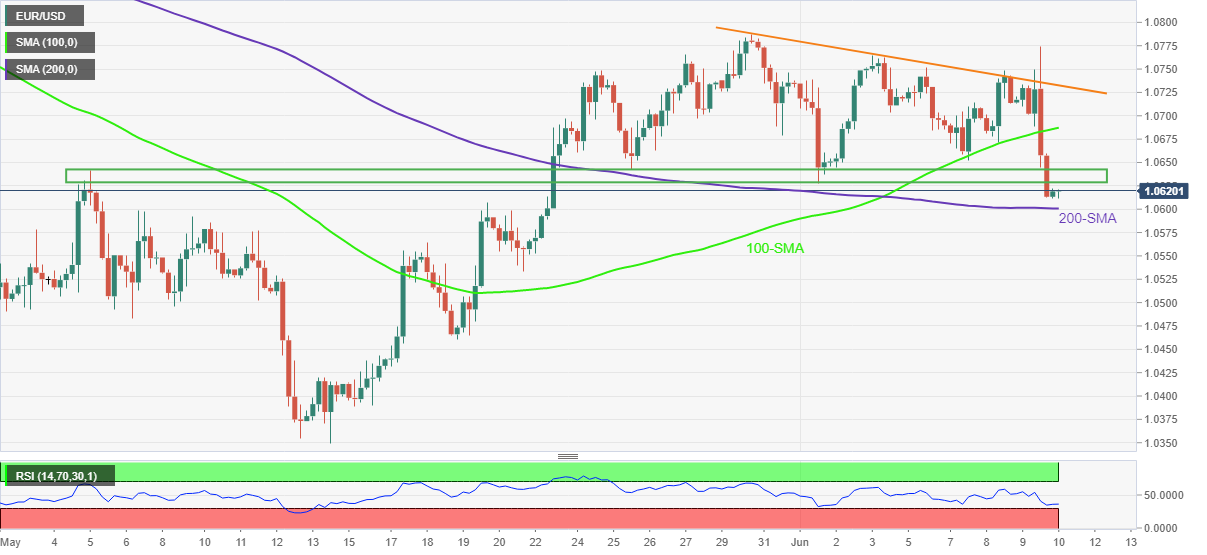
Trend: Further weakness expected
- GBP/USD is likely to witness more downside as stable US inflation forecasts have underpinned the risk-off impulse.
- There is no visible impact on the US CPI despite balance sheet reduction and two rate hikes by the Fed.
- The inflation in the UK economy is expected to kiss the double-digit mark.
The GBP/USD pair is balancing below the psychological support of 1.2500 and is expected to imbalance lower as investors are dumping the risk-sensitive assets amid uncertainty over the release of the US inflation. The cable witnessed a steep fall on Thursday after failing to overstep the critical hurdle of 1.2560.
The Federal Reserve (Fed) has tightened its policy by elevating the interest rates and a steep reduction in its balance sheet. The Fed announced rate hikes in March and May by 25 basis points (bps) and 50 bps respectively and one more jumbo rate hike is expected next week. No doubt, the central bank has quickly paddled its quantitative tightening measures, however, there is no visible impact on the price pressures.
The US Consumer Price Index (CPI) is seen stable at 8.3% on annual basis. A meaningful impact on the inflationary pressures after necessary quantitative measures would have trimmed uncertainty in the FX domain. So, the unavailability of any countable impact on the US CPI has escalated uncertainty to a great extent. The US economy added decent job opportunities in the labor market in May. A stable US inflation along with a tight labor market will compel the Fed to keep up the extreme hawkish stance next week.
On the pound front, the Bank of England (BOE) looks unable to clean up the inflation mess. The market participants are seeing the price pressures climbing to near double-digit figures. It looks like the BOE should have inculcated extra pace while turning the interest rate wheel. Also, the soaring inflation is trimming the growth forecasts in the UK economy.
- AUD/USD bears staying the course in risk-off markets.
- The US and China CPI data will now be the focus for the end of the week.
At 0.7088, AUD/USD is printing a fresh low within the daily bearish impulse and extending the overnight losses from when supply hit the market in a risk-off environment. Wall Street's and European bourses were a sea of red on Thursday following the European Central Bank meeting and ahead of Friday's important US and Chinese inflation data.
Markets were risk-off around the European Central Bank event and announcements that signalled it would hike interest rates next month for the first time since 2011. Consequently, eurozone borrowing costs hit an eight-year high when the ECB said inflation would remain "undesirably elevated" for some time. However, the ECB's steps to tackle inflation are not as hawkish as its counterparts at the Federal Reserve nor the Reserve Bank of Australia which earlier this week hiked more than expected.
US stocks fell deep into negative territory at market close on Thursday. The Dow Jones Industrial Average fell 1.9% to 32,272.79, the S&P 500 was down 2.4% to 4,017.82 and the Nasdaq Composite was 2.8% lower at 11,754.23. Additionally, the US Treasury's 30-year auction hit a high yield of 3.185% on Thursday, up from the 2.997% high in the previous auction and the US 10-year yield climbed to a fresh high of 3.07% intraday. The DXY index that measures the US dollar vs. a basket of currencies has rallied from a low of 102.152 to score a high of 103.367 for where it currently trades in Tokyo.
US CPI in focus
Investors will get a look at the latest reading on U.S. inflation on Friday in the form of the May Consumer Price Index (CPI). The consensus forecast calls for a year-over-year inflation increase of 8.3%, unchanged from April. While some investors have been hopeful that inflation may have peaked, a recent run higher in oil prices to a 13-week high has dented that optimism, boosting the appeal of the safe-haven US dollar. US inventories continue to fall as demand rises early in the driving season.
However, we could see more USD resilience in the very short-term ''especially if US core CPI surprises to the upside,'' analysts at TD Securities argued.
''Tactically, we see growing signs of an adverse risk backdrop in the coming weeks, as US real rates and equity correlations wane further and the USD peels away from relative US equity performance.''
A stronger CPI ''reading could put downward pressure on risky assets as investors look for the Fed to remain aggressive in its fight against inflation.''
The Fed is scheduled to announce its next policy statement on Wednesday. A rate hike of at least 50 basis points from the central bank is already being priced in, according to CME's FedWatch Tool.
- Gold remains pressured after snapping two-day uptrend the previous day.
- US dollar strength weighs on metal prices but traditional safe-haven status argues with bears.
- China inflation numbers, covid updates can entertain traders ahead of US CPI data.
Gold (XAU/USD) traders keep the previous day’s bearish bias while refreshing the intraday low at around $1,845 during Friday’s Asian session as risk-aversion remains in play.
The risk-off mood could be linked to the growing concerns that the surging price pressure to challenge the global economic growth; Additionally weighing the XAU/USD is the cautious mood ahead of the key inflation data from China and the US. It’s worth noting that the European Central Bank (ECB) failed to lift the market’s optimism despite announcing an end to the Quantitative Easing (QE) and a 0.25% rate hike in July.
That said, the White House has already conveyed the risk of higher inflation ahead of today’s US Consumer Price Index (CPI) data while the World Bank (WB) and the Organisation for Economic Co-operation and Development (OECD) have amplified the global recession woes. Furthermore, the return of activity restrictions and mass testing in China, due to the resurgence of covid cases, also weighs on the market sentiment and the gold prices.
Against this backdrop, the Wall Street benchmarks dropped the heaviest in the week whereas the US 10-year Treasury yields also refreshed their monthly high before retreating to 3.04%, around 3.057% at the latest. Further, the US Dollar Index (DXY) also rallied the most in a week while cheering the greenback’s safe-haven status.
Moving on, China’s CPI and Producer Price Index (PPI) data for May, expected 2.2% and 6.4% versus 2.1% and 8.0% in that order, will offer immediate directions to the gold traders ahead of the US CPI. Also important to watch will be the chatters surrounding covid and global economic growth.
Technical analysis
Gold’s sustained trading below a two-day-old resistance line, as well as the convergence of the 200 and 50 HMAs, join steady RSI (14) to keep sellers hopeful.
However, a one-week-old support line near $1,843 tests the pair bears ahead of directing them to the monthly low surrounding $1,828. Following that, the $1,810 and the $1,800 can as the last defenses for the gold buyers.
Alternatively, the aforementioned nearby resistance line, at $1,849 by the press time, precedes the HMA confluence near $1,851 to challenge the precious metal’s recovery. Also acting as an upside barrier is the weekly resistance line surrounding $1,855.
Overall, gold prices eye further downside but needs a trigger to activate the sell-off.
Gold: Hourly chart
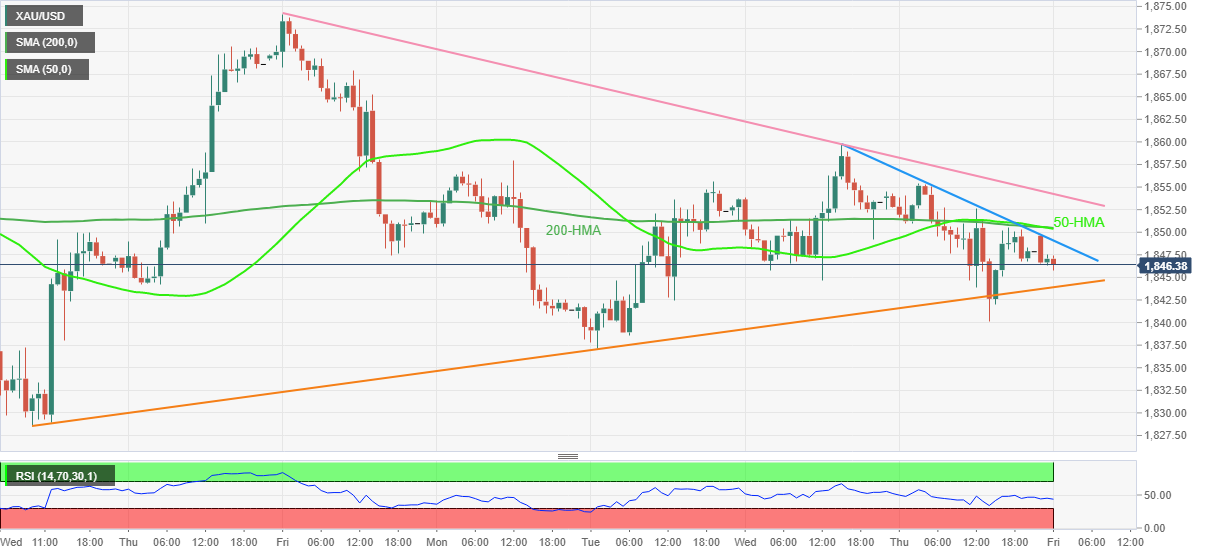
Trend: Further weakness expected
| Pare | Closed | Change, % |
|---|---|---|
| AUDUSD | 0.70986 | -1.27 |
| EURJPY | 142.669 | -0.84 |
| EURUSD | 1.06184 | -0.92 |
| GBPJPY | 167.913 | -0.23 |
| GBPUSD | 1.24944 | -0.34 |
| NZDUSD | 0.63844 | -0.97 |
| USDCAD | 1.26996 | 1.14 |
| USDCHF | 0.98026 | 0.18 |
| USDJPY | 134.381 | 0.1 |
- A pullback towards the supply zone in a 0.6420-0.6423 range will be a bargain sell.
- The RSI (14) has shifted into a bearish range of 20.00-40.00, which bolsters the greenback bulls.
- The 20- and 50-EMAs are sloping lower, which adds to the downside filters.
The NZD/USD pair is juggling in a narrow range of 0.6382-0.6391 in the early Asian session. The asset has turned sideways after a sheer downside move from Thursday’s high at 0.6461. A vertical downside move is expected to bring a pullback move that will provide an opportunity for the initiative sellers to create shorts at optimal levels.
On an hourly scale, the kiwi bulls have witnessed a steep fall after a Double Top formation that dictates a weak attempt of surpassing previous highs. The greenback bulls have dragged the asset below 0.6400 after violating the supply zone, which is placed in a narrow range of 0.6420-0.6423.
Declining 20- and 50-period Exponential moving Averages (EMAs) at 0.6412 and 0.6436 respectively with a wider gap indicating that the downside momentum is intact.
Meanwhile, the Relative Strength Index (RSI) (14) has shifted into a bearish range of 20.00-40.00, which signals a dominant downside momentum.
A pullback move towards the above-mentioned supply zone will trigger a supply action which will drag the asset towards a fresh two-week low at 0.6379, followed by the round level support at 0.6350.
On the flip side, the kiwi bulls could regain their glory if the asset oversteps Thursday’s high at 0.6461, which will send the asset towards Tuesday’s high at 0.6500. A breach of the latter will drive the asset towards Monday’s high at 0.6538.
NZD/USD hourly chart
-637904161047642816.png)







© 2000-2026. All rights reserved.
This site is managed by Teletrade D.J. LLC 2351 LLC 2022 (Euro House, Richmond Hill Road, Kingstown, VC0100, St. Vincent and the Grenadines).
The information on this website is for informational purposes only and does not constitute any investment advice.
The company does not serve or provide services to customers who are residents of the US, Canada, Iran, The Democratic People's Republic of Korea, Yemen and FATF blacklisted countries.
Making transactions on financial markets with marginal financial instruments opens up wide possibilities and allows investors who are willing to take risks to earn high profits, carrying a potentially high risk of losses at the same time. Therefore you should responsibly approach the issue of choosing the appropriate investment strategy, taking the available resources into account, before starting trading.
Use of the information: full or partial use of materials from this website must always be referenced to TeleTrade as the source of information. Use of the materials on the Internet must be accompanied by a hyperlink to teletrade.org. Automatic import of materials and information from this website is prohibited.
Please contact our PR department if you have any questions or need assistance at pr@teletrade.global.


 Bank
Bank transfers


