- Analytics
- News and Tools
- Market News
Analytics, News, and Forecasts for CFD Markets: currency news — 18-05-2021.
| Time | Country | Event | Period | Previous value | Forecast |
|---|---|---|---|---|---|
| 00:30 (GMT) | Australia | Westpac Consumer Confidence | May | 118.8 | |
| 01:30 (GMT) | Australia | Leading Index | April | 0.38% | |
| 01:30 (GMT) | Australia | Wage Price Index, q/q | Quarter I | 0.6% | 0.5% |
| 01:30 (GMT) | Australia | Wage Price Index, y/y | Quarter I | 1.4% | 1.4% |
| 04:30 (GMT) | Japan | Industrial Production (YoY) | March | -2.0% | |
| 04:30 (GMT) | Japan | Industrial Production (MoM) | March | -1.3% | |
| 06:00 (GMT) | United Kingdom | Producer Price Index - Input (YoY) | April | 5.9% | |
| 06:00 (GMT) | United Kingdom | Producer Price Index - Input (MoM) | April | 1.3% | 1.1% |
| 06:00 (GMT) | United Kingdom | Producer Price Index - Output (MoM) | April | 0.5% | 0.4% |
| 06:00 (GMT) | United Kingdom | Producer Price Index - Output (YoY) | April | 1.9% | 3.5% |
| 06:00 (GMT) | United Kingdom | Retail Price Index, m/m | April | 0.3% | 0.8% |
| 06:00 (GMT) | United Kingdom | HICP ex EFAT, Y/Y | April | 1.1% | |
| 06:00 (GMT) | United Kingdom | Retail prices, Y/Y | April | 1.5% | 2.4% |
| 06:00 (GMT) | United Kingdom | HICP, Y/Y | April | 0.7% | 1.4% |
| 06:00 (GMT) | United Kingdom | HICP, m/m | April | 0.3% | 0.6% |
| 09:00 (GMT) | Eurozone | Harmonized CPI ex EFAT, Y/Y | April | 0.9% | 0.8% |
| 09:00 (GMT) | Eurozone | Harmonized CPI, Y/Y | April | 1.3% | 1.6% |
| 09:00 (GMT) | Eurozone | Harmonized CPI | April | 0.9% | 0.6% |
| 12:30 (GMT) | Canada | Bank of Canada Consumer Price Index Core, y/y | April | 1.4% | |
| 12:30 (GMT) | Canada | Consumer price index, y/y | April | 2.2% | 3.2% |
| 12:30 (GMT) | Canada | Consumer Price Index m / m | April | 0.5% | 0.4% |
| 14:30 (GMT) | U.S. | Crude Oil Inventories | May | -0.427 | 1.68 |
| 15:35 (GMT) | U.S. | FOMC Member Bostic Speaks | |||
| 18:00 (GMT) | U.S. | FOMC meeting minutes | |||
| 23:50 (GMT) | Japan | Core Machinery Orders, y/y | March | -7.1% | -2.6% |
| 23:50 (GMT) | Japan | Core Machinery Orders | March | -8.5% | 6.4% |
| 23:50 (GMT) | Japan | Trade Balance Total, bln | April | 663.7 | 140 |
According to ActionForex, analysts at TD Bank Financial Group note that the U.S. housing starts pulled back in April, giving back a part of the gain recorded in March.
"U.S. housing starts fell by 9.5% to 1.57 million units (annualized) in April from a downwardly-revised 1.73 million units in the month prior. The outturn came in below market expectations, which called for a decline to 1.71 million units. Looking past the month-to-month volatility, starts have trended near the 1.6 million mark since December."
"The decline was concentrated in the single-family segment, where starts fell by 13.4% (or 164k) to 1.09 million units. Starts in the smaller, more volatile multi-family segment, meanwhile, rose by 0.8% to 482k units, adding to the 26.5% gain in the month prior."
"A pullback in homebuilding activity in April was expected given the outsized (20%) gain that occurred in the month prior. The flat trend near the 1.6 million mark that has developed over the last several months is solid, but nothing to write home about."
"A confluence of factors suggest that homebuilding should resume a more positive trend in the months ahead. Indeed, as more Americans get vaccinated, the reopening of the economy and the continued healing of the labor market will lend additional support to housing demand. Meanwhile, alongside this improving demand environment, a dearth of inventory, which sits at a record low when it comes to existing homes, will continue to encourage the building of more homes in the months ahead."
FXStreet reports that GBP/USD has today moved in the direction of its February high in the 1.4237 region and Jane Foley, Senior FX Strategist at Rabobank, notes that the broad-based weakness of the USD is largely responsible for the move in cable. In addition, expectations surrounding the reopening of the economies will also have an impact on how the pound can perform vs. USD.
“After a generally strong set of data for Mar/April, the market is expecting the forthcoming round to extend the picture of economic recovery. A key question for GBP is how much of this good news is already in the price. The vaccine trade already lifted the pound significantly in Q1 suggesting that investors may need fresh incentives to persuade them to build fresh long positions.”
“There is speculation in the market that the Fed’s Jackson Hole symposium could provide a backdrop for policymakers to dip their toe into the topic of tapering. This, however, will depend on the path of inflation data and, since it is not scheduled until August, it is likely that the market is coming to terms with the likelihood that USD weakness could extend further in the coming weeks. While this could leave cable well supported near-term, we see scope for another move below 1.40 later in the year.”
FXStreet notes that USD/JPY is drifting lower. The pair traded as low as 108.84, bouncing just modestly from this last but still below 109.00. However, economists look for the uptrend from January and 55-day average at 109.00/108.55 to hold to keep the risks higher.
“We look for USD/JPY to hold above the key 55-day average at 109.00 and the uptrend from January just below at 108.55 and for the risks to turn back higher, reinforced by the tentative turn back higher in daily MACD momentum.”
“Key near-term resistance moves to 109.29, above which would relieve the recent downside pressure, with more important resistance remaining at 109.71/75, above which is needed to clear the way for strength back to the late March high and potential downtrend from February 2020 at 110.82/97.”
“Whilst a fresh rejection from 110.82/97 should be expected, above in due course can open the door to a test of much important resistance at 111.96/112.40.”
James Smith, a Developed Market economist at ING, believes that green shoots in the UK's jobs market suggest the forthcoming peak in unemployment may not be as high as first feared.
"The latest UK employment data provides further signs that the jobs market has begun to turn a bit of a corner since the turn of the year. Despite the recent lockdown, the unemployment rate slipped to 4.8% in the three months to March. And actually, if we look at more timely weekly data, the rate averaged 4.6% in the last six weeks of the first quarter – going briefly as low as 3.9%."
"While the furlough scheme has succeeded in stemming the tide of redundancies we saw in the hard-hit sectors last autumn, we’re seeing some tentative improvement elsewhere. Admin and support roles, for instance, have seen a strong rebound according to payroll data."
"Having said that, there is little doubt that we will see a rise in the jobless rate when the furlough scheme ends in September, though the peak is likely to be significantly lower than feared a few months ago. Barring a return to tighter Covid-19 restrictions, the fact that the job support is being offered until well after the April/May reopening phases should give firms enough time to rebuild their finances to be able to return most, if not all, of their staff from furlough. Where jobs are lost, it’s likely to be largely where roles no longer exist, for example, because of structural change created by the pandemic."
"We expect the jobless rate to peak at around 6% in the autumn, though we think things are likely to be improving again by year-end."
FXStreet reports that the Credit Suisse analyst team тщеуы ерфе GBP/USD has broken out above its 1.4162/67 recent highs, opening up a move to the 2021 highs at 1.4238 next, then 1.4377.
“We stay biased higher, reinforced by the latest breakout above the 1.4155/69 May highs and the sharply accelerating daily MACD momentum. Beyond here can see a move to next resistance at the 1.4238 YTD high, ahead of our first core upside target of 1.4302/77 – the 2018 highs and 50% retracement of the 2014/2020 bear trend.”
“It’s worth noting that above 1.4302/77, there is a real ‘air pocket’ and death of meaningful technical resistance, reinforcing our longer-term bias for an eventual move to 1.49/1.51.”
The
Commerce Department reported on Tuesday the housing starts plunged by 9.5
percent m-o-m in April to a seasonally adjusted annual pace of 1.569 million, while building
permits rose by 0.3 percent m-o-m to a seasonally adjusted annual rate of 1.760.
Economists
had forecast housing starts decreasing to a pace of 1.710 million units last
month and building permits rising to a pace of 1.770 million units.
Data
for March was revised to show homebuilding growing to a pace of 1.733 million
units, instead of increasing at a rate of 1.739 million units as previously
reported, and permits advancing to a pace of 1.755 million units, instead of
rising at a rate of 1.766 million units as previously reported.
According
to the report, permits for single-family homes, the largest segment of the
market, dropped 3.8 percent m-o-m in April, while approvals for the multi-family homes
segment surged 11.1 percent m-o-m.
In
the meantime, groundbreaking on single-family homes tumbled 13.4 percent m-o-m in April, while
housing starts for the multi-family increased 4.0 percent m-o-m.
| Time | Country | Event | Period | Previous value | Forecast | Actual |
|---|---|---|---|---|---|---|
| 06:00 | United Kingdom | Average earnings ex bonuses, 3 m/y | March | 4.4% | 4.6% | 4.6% |
| 06:00 | United Kingdom | Average Earnings, 3m/y | March | 4.5% | 4.5% | 4% |
| 06:00 | United Kingdom | ILO Unemployment Rate | March | 4.9% | 4.9% | 4.8% |
| 06:00 | United Kingdom | Claimant count | April | -19.4 | -15.1 | |
| 09:00 | Eurozone | Employment Change | Quarter I | 0.4% | -0.3% | |
| 09:00 | Eurozone | Trade balance unadjusted | March | 23 | 15.8 | |
| 09:00 | Eurozone | GDP (QoQ) | Quarter I | -0.7% | -0.6% | -0.6% |
| 09:00 | Eurozone | GDP (YoY) | Quarter I | -4.9% | -1.8% | -1.8% |
| 12:30 | U.S. | Building Permits | April | 1.755 | 1.77 | 1.76 |
| 12:30 | U.S. | Housing Starts | April | 1.733 | 1.71 | 1.569 |
USD fell against its major rivals in the European session on Tuesday as the Fed policymakers managed to reassure market participants that the U.S. monetary policy would remain accommodative in the near future.
The U.S. Dollar Index (DXY), measuring the U.S. currency's value relative to a basket of foreign currencies, dropped 0.44% to 89.77.
April’s surge in the U.S. consumer prices heightened worries last week that an acceleration in inflation could force the U.S. central bank to pull back on its monetary stimulus and hike interest rates sooner than expected. However, the Fed’s representatives have continued to repeat their views that any surge in inflation will be temporary. The Fed's vice chairman Richard Clarida said on Monday that he believes that most of the price rises will be transitory but the Fed has to be attuned and attentive to incoming data. Meanwhile, Atlanta Fed president Raphael Bostic said that now is not the time to worry about rising inflation, adding that he thinks that a healthy level of inflation is healthy for the economy, particularly at a time when unemployment remains a problem. He also supported the Fed’s current ultra-loose policy stance. Elsewhere, Dallas Fed president Robert Kaplan reiterated yesterday that he does not expect rates to rise until next year.
Investors are now awaiting the release of the minutes from the Fed's last meeting, due this Wednesday, which could provide some clues on policymakers’ views on recovery of the U.S. economy and rising inflation pressures as well.
FXStreet notes that we are past the peak of repricing U.S. exceptionalism, global growth should broaden and the vaccine and growth laggards should bounce back. This should be conducive to a return of broader USD weakness, according to economists at Deutsche Bank who see European currencies as the prime beneficiaries - they forecast EUR/USD breaking 1.25 by September.
“Despite the big rise in US yields, the trade-weighted dollar is sitting at the bottom end of a range that has prevailed since 2015. The divergence speaks to extreme macro imbalances – booming consumption but lagging job creation. As a result, the Fed is likely to be the last G10 central bank to taper this year while the US current account deficit continues to deteriorate.”
“The euro has shown significant positive non-linearities to the interest rate differential when bond yields turn positive and if the ECB tapers ahead of the Fed, this should further help the euro.”
“The trade-weighted dollar is at a big technical level: the low-end of a range that has prevailed since 2015. The risks are skewed towards a break-out lower. We see EUR/ USD reaching 1.25 over the summer months.”
FXStreet notes that the USD is weakening sharply across the board, with USD/CAD testing below key long-term support at 1.2062/47. According to economists at Credit Suisse, the breakdown should be sustained, although a weekly close is needed to confirm a multi-year “double top”. Next supports would then be seen at 1.1916, before their long-term objective at 1.1424/1.1318.
“USD/CAD is testing below regime defining support at 1.2062/47. Short-term momentum is reinforcing this move, reaching the strongest levels since June 2020 and showing no signs of tiring. This suggests the breakdown should be sustained and we, therefore, look for a resumption of the strong medium-term downtrend, with a weekly close below 1.2062/47 also confirming a multi-year ‘double top’ to dramatically reinforce our medium-term bearish outlook, with the next level at 1.1916.”
“Bigger picture, we scope for an eventual move to 1.1424/1318."
FXStreet notes that the S&P 500 is already trading above the 3900 year-end price target of economists at Morgan Stanley. However, they are not raising that target. Instead, the economists are doubling down on why they think the upside for the main U.S. index is capped for the rest of the year.
“The primary reason we think valuation will prove to be a headwind is we've left the early cycle part of this recovery. We call it the mid-cycle transition, and it tends to coincide with the peak rate of change in policy and growth. Typically, during this period, the price/earnings multiple for the S&P 500 falls by approximately 20%. So far, it's declined by just 5%.”
“Long-term interest rates have moved significantly higher this year, as many of the most expensive and speculative parts of the equity market have de-rated significantly, some by as much as 50%. That tells us the de-rating is well underway and will eventually drive the multiple for the S&P 500 down by another 10-15%.”
“Earnings expectations have finally caught up to the reality of this V-shaped recovery... The recovery in profitability is a function of the unprecedented policy support that amounted to a giant corporate subsidy in labor costs. But now the reopening of the economy is likely to put upward pressure on costs and downward pressure on margins.”
“Higher corporate taxes are likely coming this fall. While it's unlikely the administration will get the full hike to 28% it's seeking, we do think a compromise is likely to be passed. Our best guess is that these changes will negatively affect S&P 500 earnings estimates for next year by approximately 5%. When combined with the margin pressure we see from continued supply chain issues and labor availability, it's unlikely earnings can offset the valuation reduction we still think is to come.”
FXStreet reports that gold has been hovering around $1,870, extending its recovery. The yellow metal tends to outperform when economic data is weakening, and underperforms when economic prospects improve. Now that there have been numerous data disappointments, forecasters will likely extend projections still lower. Subsequently, Bart Melek, Head of Commodity Strategy, believes XAU/USD is likely to near the $1,900 level.
“Given that the Fed still has an aggressive full employment mandate, inflation expectations may do what they did when data was beating expectations, but in reverse – dropping less than yields. Low real yields should send gold higher again.”
“Given gold broke through the 200-DMA ($1,846/oz), technicians and other money managers may grow exposure. As such, gold may well move within striking distance of our $1,900+/oz target, should US economic data continue to disappoint.”
FXStreet notes that NZD/AUD is currently trading near the 0.93 level. However, economists at Westpac expect the pair to slide below the 0.90 mark – not due to New Zealand dollar weakness, but because they see relatively more upside for the Australian dollar.
“We expect the NZD/AUD exchange rate to drop below 90 cents next year.”
“Australia’s economic recovery was initially slower than New Zealand’s, due to a more prolonged period of covid lockdowns, but it is now gaining substantial momentum. The closure of international borders has proven to be more of a net benefit to domestic spending in Australia.”
“Both economies will benefit from stronger export commodity prices, fed by the rapid rebound in GDP growth and continued increases in demand from Asia. While commodity prices will eventually decline from their highs, Australia is better positioned to deliver an increase in export volumes as well.”
FXStreet notes that EUR/USD is rebounding from trendline support at 1.2082. Karen Jones, Team Head FICC Technical Analysis Research at Commerzbank, targets the 1.2243 February high and then the 1.2349 2021 high.
“We are unable to rule out some slippage to the 1.1994/86 band of support (mid-March highs and the 22nd April low).”
“While underpinned at the 1.1994/86 band of support (mid-March highs and the 22nd April low), the pair should remain steady and we look for a re-test 1.2210/43, the 78.6% retracement of the move seen this year. This is regarded as the last defence for 1.2349, the 2021 high."
FXStreet reports that economist at UOB Group Ho Woei Chen, CFA, reviews the latest set of Chinese data releases.
“China’s April economic data including the credit growth released last week, pointed to a moderation in growth outlook in 2Q21. The biggest let-down was the sharp slowdown in retail sales growth to 17.7% y/y (Bloomberg est: 25.0%) from 34.2% in March, as investors pinned hopes on a stronger recovery in private consumption to drive the growth momentum in 2H21.”
“Despite the moderation in the economic indicators, the survey jobless rate improved further to 5.1% in April (Bloomberg est: 5.2%) from 5.3% in March. The survey jobless rate is at its lowest since November 2019 when it was at the same rate. Our 2Q21 GDP growth forecast for China remains at 8.0% y/y from 18.3% y/y in 1Q21, as the low base effect continues to diminish.”
Eurostat said that the first estimate for euro area exports of goods to the rest of the world in March 2021 was €212.1 billion, an increase of 8.9% compared with March 2020 (€194.7 bn), which had been affected by the COVID-19 containment measures widely introduced by the Member States. Imports from the rest of the world stood at €196.3 bn, a rise of 19.2% compared with March 2020 (€164.7 bn). As a result, the euro area recorded a €15.8 bn surplus in trade in goods with the rest of the world in March 2021, compared with +€29.9 bn in March 2020. Intra-euro area trade rose to €199.0 bn in March 2021, up by 27.5% compared with March 2020.
In January to March 2021, euro area exports of goods to the rest of the world fell to €564.0 bn (a decrease of 0.6% compared with January-March 2020), and imports rose to €514.4 bn (an increase of 0.3% compared with JanuaryMarch 2020). As a result the euro area recorded a surplus of €49.5 bn, compared with +€54.6 bn in January March 2020. Intra-euro area trade rose to €514.2 bn in January-March 2021, up by 6.2% compared with January-March 2020.
According to a flash estimate published by Eurostat, in the first quarter of 2021, seasonally adjusted GDP decreased by 0.6% in the euro area and by 0.4% in the EU, compared with the previous quarter. These declines follow falls in the fourth quarter of 2020 (-0.7% in the euro area and -0.5% in the EU) after a strong rebound in the third quarter of 2020 (+12.5% in the euro area and +11.7% in the EU) and the sharpest decreases since the time series started in 1995 observed in the second quarter of 2020 (-11.6% in the euro area and -11.2% in the EU).
Compared with the same quarter of the previous year, seasonally adjusted GDP decreased by 1.8% in the euro area and by 1.7% in the EU in the first quarter of 2021, after -4.9% and -4.6% respectively in the previous quarter.
During the first quarter of 2021, GDP in the United States increased by 1.6% compared with the previous quarter (after +1.1% in the fourth quarter of 2020). Compared with the same quarter of the previous year, GDP increased by 0.4% (after -2.4% in the previous quarter).
The number of employed persons decreased by 0.3% in both the euro area and in the EU in the first quarter of 2021, compared with the previous quarter. In the fourth quarter of 2020, employment had increased by 0.4% in both the euro area and the EU.
Compared with the same quarter of the previous year, employment decreased by 2.1% in the euro area and by 1.8% in the EU in the first quarter of 2021, after -1.9% and -1.6% respectively in the fourth quarter of 2020.
According to the report from National Institute of Statistics (ISTAT), in March 2021 seasonally-adjusted data, compared to February 2021, increased by +3.2% for outgoing flows and by +6.0% for incoming flows. Exports rose for both EU countries (+3.7%) and non EU countries (+2.6%). Imports increased by +5.4% for EU countries and by +6.8% for non EU countries.
Over the last three months, seasonally-adjusted data, compared to the previous three months, increased by +2.6% for exports and by +5.0% for imports.
In March 2021, compared with the same month of the previous year, both exports and imports grew (+28.1% and +35.1% respectively). Outgoing flows increased by +32.6% for EU countries and by +23.2% for non EU countries. Incoming flows rose by +35.2% for EU area and by +35.1% for non EU area. The trade balance in March 2021 amounted to +5,190 million Euros (+384 million Euros for EU countries and +4,806 million Euros for non EU countries).
FXStreet reports that economists at MUFG Bank maintain a bullish GBP/USD stance.
“Higher inflation is only US dollar positive if it prompts the Fed to bring forward monetary tightening plans and lifts US yields. But those initial hopes have been dampened for now by the dovish response from Fed officials in recent days. Overall, the comments reinforce the Fed’s dovish message that it remains too soon to even think about tapering QE at the current juncture. The combination of still loose Fed policy and higher US inflation leaves the US dollar vulnerable to further weakness in the near-term.”
“The pound has shown little reaction to the UK government’s recent concern over the spread of the new Indian COVID-19 variant in the UK. For now market participants remain optimistic that the UK economy will continue to rebound robustly this year by around 7%.
“Our bullish outlook for the pound is based on the assumption that the UK economy will bounce back strongly, so we will need to monitor the latest COVID-19 developments closely as they potentially pose downside risks.”
Reuters reports that Germany's constitutional court rejected a complaint against the ECB's 2.4 trillion euro Public Sector Purchase Programme, saying the ECB had shown the scheme was appropriate.
The court had ruled last May that lawmakers failed to exercise sufficient control over the Bundesbank, which buys bonds on behalf of the ECB, and ordered the German central bank to quit the scheme unless the ECB provided fresh justification that prove the programme was necessary and appropriate.
Since that ruling, the ECB has provided a trove of documents to the German government and parliament, which accepted its arguments.
CNBC reports that Moody’s Investors Service that american businesses are bearing most of the cost burden from the elevated tariffs imposed at the height of the U.S.-China trade war.
The ratings agency said that U.S. importers absorbed more than 90% of additional costs resulting from the 20% U.S. tariff on Chinese goods.
That means U.S. importers pay around 18.5% more in price for a Chinese product subject to that 20% tariff rate, while Chinese exporters receive 1.5% less for the same product, according to the report.
“A majority of the cost of tariffs have been passed on to US importers,” Moody’s said in the report.
“If the tariffs remain in place, pressure on US retailers will likely rise, leading to a greater pass-through to consumer prices,” the agency added.
Higher trade tariffs came into force during former U.S. President Donald Trump’s term. Most of those tariffs have remained in place and affect over half of all trade flows between the U.S. and China, said Moody’s.
Before the U.S.-China trade war in early 2018, U.S. tariffs on Chinese goods were on average 3.1% while China’s tariffs on American goods were at 8%, the data showed.
| Time | Country | Event | Period | Previous value | Forecast | Actual |
|---|---|---|---|---|---|---|
| 01:30 | Australia | RBA Meeting's Minutes | ||||
| 04:30 | Japan | Tertiary Industry Index | March | 0.3% | 1.1% | |
| 06:00 | United Kingdom | Average earnings ex bonuses, 3 m/y | March | 4.4% | 4.6% | 4.6% |
| 06:00 | United Kingdom | Average Earnings, 3m/y | March | 4.5% | 4.5% | 4% |
| 06:00 | United Kingdom | ILO Unemployment Rate | March | 4.9% | 4.9% | 4.8% |
| 06:00 | United Kingdom | Claimant count | April | -19.4 | -15.1 |
During today's Asian trading, the US dollar declined against most major currencies amid a general weakening of risk appetite in global markets, as well as "dovish" statements by members of the Federal Reserve System (Fed).
Fed Vice Chairman Richard Clarida noted yesterday that the US labor market is still far from the levels it was at before the pandemic. The weak U.S. employment data for April, Clarida said, showed that the States have not yet made "sufficient progress" toward the maximum employment goal that would allow the Fed to begin reducing the volume of asset repurchases, currently $ 120 billion a month.
Meanwhile, the head of the Federal Reserve Bank of Atlanta, Raphael Bostic, noted that the moment when the Fed will need to consider the possibility of changing the parameters of monetary policy has not yet come. "The number of jobs in the U.S. is still 8 million fewer than before the pandemic, and until we make serious progress in closing that gap, I think we need to maintain a very high level of stimulus," Bostic said.
Clarida's statements on inflation did not sound seriously concerned about the acceleration in the pace of growth in consumer prices in the United States, noted in April. Clarida said that the increase in inflationary pressure in the US this year is due to the opening of the economy, and is likely to be temporary.
The minutes of the April 27-28 meeting of the Federal Open Market Committee (FOMC), which will be released on Wednesday, are likely to confirm Clarida's statements, experts say.
The ICE index, which tracks the dollar's performance against six currencies (euro, swiss franc, yen, canadian dollar, pound sterling and swedish krona), fell 0.25%.
FXStreet reports that economists at Capital Economics think China’s economy slowdown – in the face of surging economic activity in much of the rest of the world – has three implications for China’s financial markets.
“We expect the country’s stock market to continue to underperform those elsewhere. It has already fared relatively poorly so far this year as domestic economic growth has slowed, and as investors have begun to factor in an unwinding of the boost its large information technology sector received from pandemic-related demand. We suspect these factors will continue to weigh on earnings growth in China’s stock market for some time and doubt there is much scope for this to be offset by higher valuations, either.”
“We expect the renminbi to depreciate against the US dollar. We suspect the dollar’s recent broad-based weakness will prove temporary. And we think the fundamentals point to a significantly weaker renminbi. The upshot is that we forecast the renminbi to fall to 6.7/$ by the end of the year, compared with ~6.4/$ at present.”
EUR/USD
Resistance levels (open interest**, contracts)
$1.2315 (163)
$1.2276 (1893)
$1.2242 (4310)
Price at time of writing this review: $1.2181
Support levels (open interest**, contracts):
$1.2123 (327)
$1.2100 (799)
$1.2070 (977)
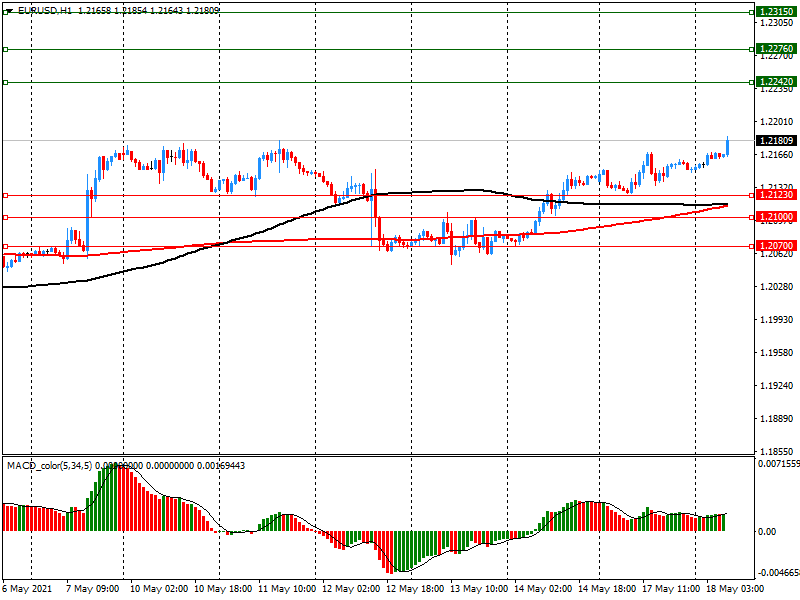
Comments:
- Overall open interest on the CALL options and PUT options with the expiration date June, 4 is 63930 contracts (according to data from May, 17) with the maximum number of contracts with strike price $1,2200 (4310);
GBP/USD
$1.4260 (1473)
$1.4232 (956)
$1.4210 (1888)
Price at time of writing this review: $1.4178
Support levels (open interest**, contracts):
$1.4035 (419)
$1.4002 (291)
$1.3966 (245)
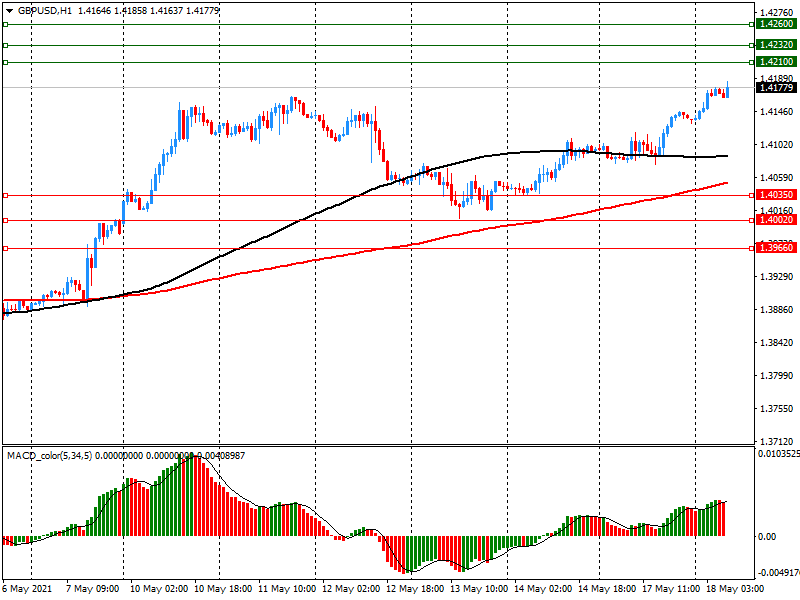
Comments:
- Overall open interest on the CALL options with the expiration date June, 4 is 20934 contracts, with the maximum number of contracts with strike price $1,5000 (2696);
- Overall open interest on the PUT options with the expiration date June, 4 is 32539 contracts, with the maximum number of contracts with strike price $1,3500 (4605);
- The ratio of PUT/CALL was 1.55 versus 1.54 from the previous trading day according to data from May, 17
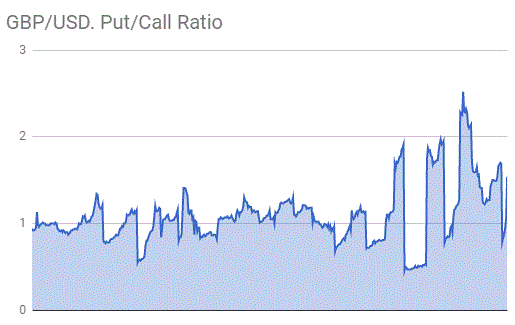
* - The Chicago Mercantile Exchange bulletin (CME) is used for the calculation.
** - Open interest takes into account the total number of option contracts that are open at the moment.
eFXdata reports that Bank of America Global Research discusses the USD outlook.
"The end-game we still see is a much stronger US recovery that will eventually support the USD, particularly against the EUR, where the recovery is much slower. The US is following the loosest fiscal and monetary policies ever. The US general government structural balance is at the highest deficit in recent decades. The Fed balance sheet is the largest ever. The Fed monetary policy stance according to a simple Taylor rule is extremely accommodative. If macro policies matter and all this spending is not going to waste, the US economy has to perform strongly," BofA notes.
According to the report from Office for National Statistics, January to March 2021 estimates show a quarterly decrease in the unemployment rate (the largest quarterly decrease since September to November 2015), while the economic inactivity rate increased, as it did during the first coronavirus (COVID-19) restrictions, and the employment rate increased for the first time since December 2019 to February 2020.
The UK employment rate was estimated at 75.2%, 1.4 percentage points lower than before the pandemic (December 2019 to February 2020) but 0.2 percentage points higher than the previous quarter.
The UK unemployment rate was estimated at 4.8%, 0.8 percentage points higher than December 2019 to February 2020 but 0.3 percentage points lower than the previous quarter.
The UK economic inactivity rate was estimated at 21.0%, 0.8 percentage points higher than December 2019 to February 2020 and 0.1 percentage point higher than the previous quarter.
Annual growth in average employee pay continued - driven in part by compositional effects of a fall in the number and proportion of lower-paid employee jobs.
Growth in average total pay (including bonuses) among employees for the three months January to March 2021 was 4.0%, and growth in regular pay (excluding bonuses) was 4.6%.
Average total pay growth for the public sector was 5.6%, whereas for the private sector was 3.7%; the large increase in public sector pay growth was mainly accounted for by a strong growth in the health and social work industry (5.8%).
All sectors saw positive pay growth in January to March 2021, however, within these sectors some industry groups have seen negative pay growth, for example, accommodation and food service activities (negative 7.0%).
| Time | Country | Event | Period | Previous value | Forecast |
|---|---|---|---|---|---|
| 01:30 (GMT) | Australia | RBA Meeting's Minutes | |||
| 04:30 (GMT) | Japan | Tertiary Industry Index | March | 0.3% | |
| 06:00 (GMT) | United Kingdom | Average earnings ex bonuses, 3 m/y | March | 4.4% | 4.6% |
| 06:00 (GMT) | United Kingdom | Average Earnings, 3m/y | March | 4.5% | 4.6% |
| 06:00 (GMT) | United Kingdom | ILO Unemployment Rate | March | 4.9% | 4.9% |
| 06:00 (GMT) | United Kingdom | Claimant count | April | 10.1 | |
| 09:00 (GMT) | Eurozone | Employment Change | Quarter I | 0.3% | |
| 09:00 (GMT) | Eurozone | Trade balance unadjusted | March | 17.7 | |
| 09:00 (GMT) | Eurozone | GDP (QoQ) | Quarter I | -0.7% | -0.6% |
| 09:00 (GMT) | Eurozone | GDP (YoY) | Quarter I | -4.9% | -1.8% |
| 12:30 (GMT) | U.S. | Building Permits | April | 1.766 | 1.77 |
| 12:30 (GMT) | U.S. | Housing Starts | April | 1.739 | 1.71 |
| 22:45 (GMT) | New Zealand | PPI Input (QoQ) | Quarter I | 0.0% | |
| 22:45 (GMT) | New Zealand | PPI Output (QoQ) | Quarter I | 0.4% |
| Pare | Closed | Change, % |
|---|---|---|
| AUDUSD | 0.77668 | -0.07 |
| EURJPY | 132.685 | 0.03 |
| EURUSD | 1.21511 | 0.11 |
| GBPJPY | 154.347 | 0.23 |
| GBPUSD | 1.4135 | 0.27 |
| NZDUSD | 0.72118 | -0.44 |
| USDCAD | 1.20669 | -0.34 |
| USDCHF | 0.9029 | 0.17 |
| USDJPY | 109.187 | -0.06 |







© 2000-2026. All rights reserved.
This site is managed by Teletrade D.J. LLC 2351 LLC 2022 (Euro House, Richmond Hill Road, Kingstown, VC0100, St. Vincent and the Grenadines).
The information on this website is for informational purposes only and does not constitute any investment advice.
The company does not serve or provide services to customers who are residents of the US, Canada, Iran, The Democratic People's Republic of Korea, Yemen and FATF blacklisted countries.
Making transactions on financial markets with marginal financial instruments opens up wide possibilities and allows investors who are willing to take risks to earn high profits, carrying a potentially high risk of losses at the same time. Therefore you should responsibly approach the issue of choosing the appropriate investment strategy, taking the available resources into account, before starting trading.
Use of the information: full or partial use of materials from this website must always be referenced to TeleTrade as the source of information. Use of the materials on the Internet must be accompanied by a hyperlink to teletrade.org. Automatic import of materials and information from this website is prohibited.
Please contact our PR department if you have any questions or need assistance at pr@teletrade.global.


 Bank
Bank transfers


