- Analytics
- News and Tools
- Market News
Analytics, News, and Forecasts for CFD Markets: currency news — 21-05-2021.
On Monday at 11:05 GMT Bank of Japan Governor Haruhiko Kuroda will deliver a speech. At 12:30 GMT, the US will release the Chicago Fed's economic activity index for April. At 14:30 GMT, the head of the Bank of England Andrew Bailey will deliver a speech.
On Tuesday, at 01:30 GMT, Australia will announce a change in the trade balance for April. At 06:00 GMT, Britain will report a change in the net amount of public sector debt for April. At 06:00 GMT, Germany will announce the change in GDP for the 1st quarter. At 08:00 GMT, Germany will publish the IFO business environment indicator, the IFO assessment of the current situation indicator, and the IFO economic expectations indicator for May. At 10:00 GMT, Britain will release the retail sales index according to the CBI for May. At 13:00 GMT, the US will present the S&P/Case-Shiller home price index for March. At 14:00 GMT, the US will publish the consumer confidence indicator and the Fed-Richmond manufacturing index for May, as well as announce changes in new home sales for April. At 22:45 GMT, New Zealand will report a change in the foreign trade balance for April.
On Wednesday, at 00:30 GMT, Australia will present the leading economic indicators for April, and at 01:30 GMT, it will announce changes in the construction work done for the 1st quarter. At 02:00 GMT, the RBNZ interest rate decision will be announced, and the RBNZ press conference will be held at 03:00 GMT. At 08:00 GMT, Switzerland will present the Credit Suisse ZEW Survey for May. At 14:30 GMT, the US will announce changes in oil reserves according to the Ministry of Energy.
On Thursday, at 01:30 GMT, Australia will report a change in private sector capital expenditure for the 1st quarter. At 06:00 GMT, Switzerland will announce a change in the foreign trade balance for April. Also at 06:00 GMT, Germany will release the Gfk consumer climate index for June. At 12:30 GMT, the US will report changes in the volume of GDP for the 1st quarter, the volume of durable goods orders for April and the number of initial applications for unemployment benefits. At 14:00 GMT, the US will announce a change in pending home sales for April. At 23:30 GMT, Japan will release the Tokyo consumer price index for May and report the unemployment rate for April.
On Friday, at 06:45 GMT, France will announce changes in consumer spending for April and GDP for the 1st quarter, as well as release the consumer price index for May. At 09:00 GMT, the euro zone will present the industrial confidence index, economic sentiment index and consumer confidence index for May. At 12:30 GMT, the US will report changes in personal income and expenses for April. At 13:45 GMT, the US will present the Chicago Purchasing Managers ' Index for May. At 14:00 GMT, the US will release the Reuters/Michigan consumer sentiment index for May. At 17:00 GMT, in the United States, the Baker Hughes report on the number of active oil drilling rigs will be released.
On Sunday, at 23:50 GMT, Japan will announce changes in the volume of capital expenditures for the 1st quarter and retail trade volume for April.
The
European Commission (EC) reported on Friday its flash estimate showed the
consumer confidence indicator for the Eurozone rose by 3.0 points to -5.1 in May
from an unrevised -8.1 in the previous month. This was the highest reading since October 2018.
Economists
had expected the index to increase to -6.8.
Considering
the European Union (EU) as a whole, consumer sentiment also improved by 3.0 points to -6.0.
Given
this month’s gains, the Eurozone’s measure is slightly above its
pre-pandemic level, while EU’s indicator is back to its pre-pandemic level.
The
National Association of Realtors (NAR) announced on Friday that the U.S.
existing home sales declined 2.7 percent m-o-m to a seasonally adjusted rate of
5.85 million in April from an unrevised 6.01 million in March. This was the lowest reading
since June 2020.
Economists
had forecast home resales increasing to a 6.09 million-unit pace last month.
In
y-o-y terms, existing-home sales climbed 33.9 percent in April.
According
to the report, three of the four major regions recorded m-o-m drops in
existing-home sales in April but each registered double-digit advances in y-o-y
terms. The median existing-home price for all housing types in April was $341,600,
up 19.1 percent y-o-y, as prices increased in every region. This was a record
high and marks 110 straight months of y-o-y gains.
Single-family
home sales stood at a seasonally-adjusted annual rate of 5.13 million in April,
down 3.2 percent from 5.30 million in March, but up 28.9 percent from one year
ago. The median existing single-family home price was $347,400 in April, up
20.3 percent from April 2020. Meanwhile, existing condominium and co-op sales
were recorded at a seasonally-adjusted annual rate of 720,000 units in April,
up 1.4 percent from March and up 84.6 percent from one year ago. The median
existing condo price was $300,400 in April, a gain of 12.6 percent from a year
ago.
"Home
sales were down again in April from the prior month, as housing supply
continues to fall short of demand," noted Lawrence Yun, NAR's chief
economist. "We'll see more inventory come to the market later this year as
further COVID-19 vaccinations are administered and potential home sellers
become more comfortable listing and showing their homes. The falling number of
homeowners in mortgage forbearance will also bring about more inventory.”
Preliminary
data released by IHS Markit on Friday revealed that U.S. private sector
business activity demonstrated an unprecedented expansion in May.
According
to the report, the Markit flash manufacturing purchasing manager's index (PMI)
came in at 61.5 in May, up from 60.5 in April. The latest reading pointed to a
record expansion in factory activity. Economists had expected the reading to decrease
to 60.2. A reading above 50 signals an expansion in activity, while a reading
below this level signals a contraction. The increase in the headline figure was
supported by quicker expansions in output and new orders, with new orders also growing
at the sharpest rate on record. Nonetheless, a further marked deterioration in
vendor performance limited operating capacity and reportedly held back output increase.
The rate of job creation eased to the slowest for five months. At the same
time, input costs rose in May at a pace not seen since July 2008, driven by higher
logistics, raw material and fuel costs, with firms commonly reporting soaring vendor
prices and difficulties sourcing materials amid a further severe lengthening of
supplier delivery times.
The
Markit flash services purchasing manager's index (PMI) jumped to 70.1 in May,
up from 64.7 in the previous month. Economists had expected the reading to drop
to 64.5. The rate of expansion was the fastest since data collection for the
series began in October 2009, driven by stronger client demand amid improved
customer confidence and the reopening of non-essential businesses. New order
growth also accelerated to the quickest on record. Total sales were supported
by the sharpest increase in new export business since August 2020. On the cost
front, inflationary pressures continued to mount in May, as rates of increase
in input prices and output charges quickened to the steepest on record.
Overall,
IHS Markit Flash U.S. Composite PMI Output Index came in at 68.1 in May, up
from 63.5 in April, signaling an unprecedented expansion in business activity.
“The
US economy saw a spectacular acceleration of growth in May, the rate of
expansion of business activity soaring well above anything previously recorded
in recent history as the economy continued to reopen from COVID19 restrictions,”
said Chris Williamson, Chief Business Economist at HIS Markit. “The May survey
also brings further concerns in relation to inflation, however, as the growth
surge continued to result in ever-higher prices. Average selling prices for
goods and services are both rising at unprecedented rates, which will feed
through to higher consumer inflation in coming months,”
he added.
Statistics
Canada announced on Friday that the Canadian retail sales rose 3.6 percent
m-o-m to CAD57.61 billion in March, following an unrevised 4.8 percent m-o-m surge
in February.
Economists
had forecast a 2.3 percent m-o-m gain for March.
According
to the report, sales increased in 10 of 11 subsectors in March, accounting for 79.1
percent of total retail sales, led by higher sales at building material and
garden equipment and supplies dealers (+19.8 percent m-o-m) and clothing and
clothing accessories stores (+23.6 percent m-o-m). Meanwhile, sales at food and
beverage stores (-1.3 percent m-o-m) declined. Core retail sales, which
excludes gasoline stations and motor vehicle and parts dealers, increased 4.7
percent m-o-m in March after growing 3.8 percent m-o-m in February.
In
y-o-y terms, Canadian retail sales climbed 23.7 percent in March, following an unrevised
6.0 percent jump in February.
In
the first quarter, retail sales rose 1.8 percent/ This marked the third
consecutive quarterly increase in retail sales.
- Believes that Eurozone is in a recovery process
- But the recovery is still uncertain
- Given uncertainty, supportive policies remain necessary for months to come
- Euro area will go back to pre-virus levels in 2022
- Inflation rise this year is temporary
- ECB is closely monitoring the rise in yields
- It's too early to debate long-term issues, too early to ask medium-to-long-term questions
| Time | Country | Event | Period | Previous value | Forecast | Actual |
|---|---|---|---|---|---|---|
| 06:00 | United Kingdom | Retail Sales (MoM) | April | 5.1% | 4.5% | 9.2% |
| 06:00 | United Kingdom | Retail Sales (YoY) | April | 7.2% | 36.8% | 42.4% |
| 07:15 | France | Manufacturing PMI | May | 58.9 | 58.5 | 59.2 |
| 07:15 | France | Services PMI | May | 50.3 | 53 | 56.6 |
| 07:30 | Germany | Services PMI | May | 49.9 | 52 | 52.8 |
| 07:30 | Germany | Manufacturing PMI | May | 66.2 | 65.9 | 64 |
| 08:00 | Eurozone | Eurogroup Meetings | ||||
| 08:00 | Eurozone | Manufacturing PMI | May | 62.9 | 62.5 | 62.8 |
| 08:00 | Eurozone | Services PMI | May | 50.5 | 52.3 | 55.1 |
| 08:30 | United Kingdom | Purchasing Manager Index Manufacturing | May | 60.9 | 60.5 | 66.1 |
| 08:30 | United Kingdom | Purchasing Manager Index Services | May | 61.0 | 62 | 61.8 |
| 10:00 | Germany | Bundesbank Monthly Report | ||||
| 11:00 | Eurozone | ECB President Lagarde Speaks |
GBP appreciated against most of its major rivals in the European session on Friday, supported by a slew of upbeat economic data out of the UK, including PMIs, retail sales and consumer confidence, which reinforced market optimism that the country’s economic recovery is firmly on track.
IHS Markit reported its preliminary estimates showed that the UK’s private sector expanded in May at the fastest pace since records began in January 1998, reflecting strong contributions from both manufacturing and services activity. The headline seasonally adjusted IHS Markit / CIPS Flash UK Composite Output Index increased to 62.0 in May from 60.7 in April, supported by looser pandemic restrictions and high levels of pent-up demand.
Meanwhile, the Office for National Statistics (ONS) announced that Britain’s retail sales surged 9.2% m/m in April after a 5.1% m/m jump in March. This represented the biggest monthly gain since June 2020. Economists had forecast a 4.5% increase. On y/y basis, retail sales climbed by 42.4% after rising 7.2% in March. Economists had expected an increase of 36.8% y/y.
The latest survey from GfK revealed that the UK’s consumer confidence improved by six points to -9 in May. This was the highest reading since March 2020, indicating that consumer confidence has made up all the ground lost to COVID-19. According to the report, the improvement was driven by continued optimism for future personal finances and for the wider UK economy in the next 12 months.
James Smith, a Developed Markets economist at ING, notes that the UK PMIs are the latest indicators to suggest the economy is already in a better place than after the first wave last summer.
"The latest rise in the UK PMIs rounds off what has been a pretty buoyant week for UK data. While the lofty level of the services index, now at 61.8, heavily reflects the recent reopenings, it also paints a picture of consumers and businesses that are more confident in the forthcoming recovery. Most data points – from consumer confidence to transport usage – are now back to, or exceeding, the levels we saw last summer when restrictions were at their lowest."
"Here are a few things that stand out from the latest PMIs:"
"Firstly, hiring is clearly picking up quickly. We know from Adzuna job advert data that the number of adverts in the hardest-hit catering/hospitality sector are now above pre-virus levels, while the PMIs noted the highest employment reading since 2014, putting some pressure on salaries."
"Secondly, the PMIs make it pretty clear that cost pressures are rising and that firms feel comfortable with passing these onto consumers. There was limited evidence of reopening-linked price spikes in the April CPI report, though there’s little doubt that some demand/supply imbalances (amplified by global pressures) will help push inflation above target towards the end of the summer/early autumn."
"Finally, the manufacturing sector has continued to bounce back from the Brexit-related disruption earlier in the year. New export orders were the fastest on record, which is linked to the rebound in global trade. Admittedly, this doesn’t necessarily tell us that UK trade has fully bounced back to its pre-trade deal levels. Official data shows that manufacturing-linked exports to the EU have bounced back more quickly than other products, most notably food/agriculture. And the UK’s share of the total EU’s imports is still lower than it was last year."
FXStreet reports that Senior Economist at UOB Group Alvin Liew reviews the latest GDP figures in the Japanese economy.
“Hopes for a sustained recovery into early 2021 was dashed with the resurgence of COVID19 infections in Japan. Its 1st preliminary estimate of 1Q 2021 GDP slipped back into decline as it recorded -5.1% q/q annualized rate (-1.3% q/q) after two quarters of expansion in 2H 2020. All the main engines of the economy faltered in 1Q and domestic demand fell by 1.1% q/q led by weaker private consumption spending which accounted for nearly half of the fall in headline GDP.”
“The resurgence of COVID-19 infections, and the tightening of restriction measures to contain its spread (again) continues to plague Japan, clouding its outlook as it puts private consumption on hold and a big question mark on the upcoming rescheduled Tokyo Olympic Games. A major stumbling block to Japan’s recovery could be the slow pace to its COVID19 vaccine rollout.”
“We still expect Japan to resume its growth trajectory from 2Q (3.7% q/q SAAR) onwards but we have lowered the full-year GDP growth to 2.5% in 2021 (from +3.2% previously estimated), compared to the revised 4.7% contraction in 2020. Growth is thereafter expected to ease further to 2.2% in 2022.”
FXStreet reports that USD/CHF is back eyeing TD support at 0.8953. Karen Jones, Team Head FICC Technical Analysis Research at Commerzbank, expects the pair to slump towards the 0.8780 January low on a break below the 0.8950-region.
“USD/CHF is once again approaching the 0.8953 TD support, we have no strong bias here but below 0.8950, we would allow for losses to extend to the 78.6% retracement at 0.8911. This is regarded as the last defence for the 0.8872 mid-February low and the 0.8780 January low.”
“Should the 0.8950/10 area hold, we are unable to rule out some near term consolidation/retracement higher towards 0.9094, the 12th May high and possibly 0.9151, the 38.2% retracement.”
FXStreet reports that UOB Group’s FX Strategists note that USD/CNH is still seen attempting a move to the 6.4015 level in the next weeks.
24-hour view: “Indicators are mostly ‘flat’ and further consolidation would not be surprising. Expected range for today, 6.4250/6.4400.”
Next 1-3 weeks: “Our view from Wednesday (19 May, spot at 6.4255) still stands. As highlighted, USD is under mild downward pressure and could grind lower to 6.4015. At this stage, the prospect for a sustained decline below this level is not high. On the upside, a breach of 6.4460 (‘strong resistance’ level) would indicate that the current mild downward pressure has eased.”
EUR/USD: Above 1.2243 targets 1.2349, the 2021 high - Commerzbank
FXStreet notes that EUR/USD is again probing 1.2243, the February high, as the U..S dollar is back under pressure. Karen Jones, Team Head FICC Technical Analysis Research at Commerzbank, expects the pair to test the 2021 high at 1.2349 next.
“EUR/USD is underpinned by the near term uptrend at 1.2116 and stays immediately bid above here.”
“Above 1.2243 targets 1.2349, the 2021 high.”
“Our longer term target is 1.2556/1.2619, the 2018 high.”
eFXdata reports that Bank of America Global Research discusses EUR/USD and USD/JPY prospects.
"In the case of EUR in particular, we see two key drivers for the EUR in the short term and two in the long term....Although these drivers, as well as USD forces could go either way, we keep a bearish EUR bias. The main reason is expectations for a weaker Eurozone recovery compared with the US, which eventually should be consistent with diverging monetary policies. EURUSD is somewhat above our 2Q forecast, but we stick to 1.15 forecast by year-end. The consensus has been slowly adjusting lower and is now close to current spot. Our year-end USDJPY forecasts remains 113".
FXStreet reports that Alvin Liew, Senior Economist at UOB Group, assesses the FOMC minutes of the April 27-28 meeting.
“The key highlight of the 27-28 April FOMC policy meeting minutes was a number of the participants “suggested that if the economy continued to make rapid progress toward the Committee's goals, it might be appropriate at some point in upcoming meetings to begin discussing a plan for adjusting the pace of asset purchases”".
“While the latest FOMC meeting minutes provided hints that some Fed officials are thinking about beginning the taper conversation, they remain in the minority and it is not signaling a Fed policy shift or any impending Fed policy tightening. Recent commentary from various FOMC voters remain aligned with FOMC Chief Powell to keep the current accommodative policy stance intact despite the increasingly positive US economic outlook.”
Reuters reports that The Bank of England set out plans on Friday to make its 20 billion pounds ($28.4 billion) of holdings in sterling corporate bonds better aligned with government goals to achieve net zero carbon emissions, starting later this year.
However, the central bank will not embark on an immediate sell-off of bonds issued by businesses that have high carbon emissions, such as power utilities and oil companies.
"Divestment is a powerful tool, and should remain squarely in the toolkit. But it should be used as a credible threat to reinforce incentives, not an indiscriminate 'quick fix'," BoE executive director for markets Andrew Hauser said.
The central bank said it would set targets for the overall emissions of its corporate bond holdings, invest in 'green' corporate bonds as they became available, and require bond issuers to publish their emissions to be eligible.
The BoE doubled its corporate bond holdings during last year's COVID pandemic. Bonds were chosen to be representative of sterling issuance by non-financial companies that make a material contribution to the British economy, and represent roughly 10% of issuance that falls into this category.
FXStreet reports that on Thursday, the Bank of Canada released its Annual Financial Stability Review, honed in on developments in the housing market that pointed to “extrapolative expectations.” Regarding the loonie, economists at MUFG Bank expect USDC/AD to move below the 1.20 mark.
“Purchases are partly fuelled by an expectation that house prices will continue to rise. Toronto, Hamilton and Montreal were cited as the areas showing this with others close behind and if maintained posed a threat of financial market stability.”
“The report was released the day after Canada’s CPI data and while the data was not as shocking as the US CPI data last week, it was still considerably higher than expected and helped reinforce expectations of the BoC moving further ahead of the Fed in reversing the current monetary stance.”
“Based on domestically priced crude oil prices (Canada Select), USD/CAD has extended beyond implied fair-value but we maintain an optimistic view on the outlook for crude oil prices and hence, the potential for a near-term break in USD/CAD below the 1.2000-level remain realistic.”
According to the report from IHS Markit / CIPS, business activity across the UK private sector expanded at a rapid pace in May. The rate of expansion was the fastest since the UK Composite Output Index began in January 1998, reflecting strong contributions from both manufacturing and services activity.
Looser pandemic restrictions and high levels of pent up demand meant that a swift turnaround in labour market conditions continued in May, with private sector employment rising at the quickest pace since June 2014. However, cost pressures were the strongest for nearly thirteen years. Subsequent efforts to protect margins resulted in the sharpest increase in average prices charged by UK private sector firms since this index began in November 1999.
The headline seasonally adjusted IHS Markit / CIPS Flash UK Composite Output Index rose to 62.0 in May, from 60.7 in April, to signal the fastest rate of growth since the index was first compiled more than two decades ago. Survey respondents widely commented on a post-lockdown bounce in business and consumer confidence, alongside higher output levels due to the phased reopening of customer-facing areas of the UK economy.
May data pointed to the fastest increase in average cost burdens across the UK private sector since August 2008. Manufacturers mostly commented on price pressures due to shortages of raw materials and high shipping costs, while service providers often noted increased staff salaries. Strong customer demand helped to confer a greater degree of pricing power to private sector businesses in May, as signalled by the strongest rate of output charge inflation since this index began nearly 22 years ago.
According to the report from IHS Markit, eurozone business activity grew at a sharply faster rate in May as economies continued to open up from virus restrictions. The rate of expansion hit the highest for over three years as new order inflows surged to an extent not seen for almost 15 years. Business optimism about the year ahead continued to break new highs, but price gauges rose further – hitting all-time highs in manufacturing – as demand continued to outstrip supply for many goods and services.
The headline Eurozone Composite PMI rose from 53.8 in April to 56.9 in May. The latest reading was the highest since February 2018 and indicated a third successive month of output growth.
New order growth meanwhile surged to the highest since June 2006, outpacing growth of output to the greatest extent in the survey’s 23-year history. Backlogs of uncompleted orders consequently rose to a degree not surpassed since that series began in November 2002, underscoring the growing shortfall of current output relative to demand. Businesses meanwhile view the outlook as increasingly positive, with optimism about the year ahead the brightest since comparable data on future sentiment were available in 2012, most commonly linked to the vaccine roll-out permitting a further relaxation of COVID-19 restrictions in the coming months.
The strengthening of demand and brighter outlook prompted firms to again take on extra staff, with employment rising for a fourth successive month in May. However, although the rate of job creation remained the second-highest in just under two years, it waned slightly due to instances of difficulties in filling job vacancies.
By sector, the upturn continued to be led by manufacturing, where output grew for an eleventh straight month with the rate of expansion easing only modestly further from March’s all-time high.
According to the report from IHS Markit, Germany’s private sector economy saw a slight pickup in growth in May, reflecting an improved performance across services. The survey pointed to a further loss of momentum in the manufacturing sector, however, as record supply delays caused disruption to production at an increasing number of businesses. Severe supply-chain bottlenecks meanwhile contributed to an intensification in inflationary pressure, with firms’ costs and output prices rising at the quickest rates on record in May.
May’s headline Germany PMI Composite Output Index came in at 56.2, up slightly from 55.8 in April. The rise in the index was driven by a return to growth in services activity after the sector stagnated at the beginning of the second quarter as measures to curb the spread of COVID-19 infections were tightened (index at 52.8 from 49.9 in April). The increase in services activity was only moderate, but nevertheless the strongest recorded since July 2020, as a number of firms reported stronger demand linked in part to the renewed easing of some lockdown restrictions during the month.
The Manufacturing Output Index meanwhile fell notably to 62.7, from 67.6 in April and further from the record high at the end of the first quarter. While the number of firms reporting improved output levels remained elevated by historical standards, there was a growing incidence of companies attributing lower output to supply disruption and associated downtime at customers.
Businesses’ expectations for activity over the next 12 months remained strongly positive in May. The degree of optimism was unchanged on the month and remained just below the record high seen at the end of the first quarter. Sectorally , confidence in manufacturing remained at its highest since the series began in July 2012 and was stronger than that recorded across services.
| Time | Country | Event | Period | Previous value | Forecast | Actual |
|---|---|---|---|---|---|---|
| 00:30 | Japan | Manufacturing PMI | May | 53.6 | 52.5 | |
| 00:30 | Japan | Nikkei Services PMI | May | 48.3 | 45.7 | |
| 01:30 | Australia | Retail Sales, M/M | April | 1.3% | 0.5% | 1.1% |
| 06:00 | United Kingdom | Retail Sales (MoM) | April | 5.1% | 4.5% | 9.2% |
| 06:00 | United Kingdom | Retail Sales (YoY) | April | 7.2% | 36.8% | 42.4% |
During today's Asian trading, the US dollar was trading steadily against major currencies.
The ICE index, which tracks the dynamics of the dollar against six currencies (euro, swiss franc, yen, canadian dollar, pound sterling and swedish krona), fell by 0.02%.
Traders continue to evaluate the statistical data on the US economy, trying to predict the future actions of the Federal Reserve System (Fed).
Earlier this week, the minutes of the April meeting of the Fed were published, in which many economists saw "hawkish" signals.
Some of the leaders of the Federal Reserve during the meeting held on April 27-28, noted the need to discuss the possibility of reducing incentives in the event of further improvement of the situation, according to the minutes.
Statistics on the US labor market were stronger than expected, which increased risk appetite in global markets. The number of Americans applying for unemployment benefits for the first time last week decreased by 34 thousand - to 444 thousand people, the lowest since the beginning of the COVID-19 pandemic. Analysts expected a reduction in the number of applications to 450 thousand.
Meanwhile, UK data showed that retail sales volumes grew sharply in April 2021 with a monthly increase of 9.2%, reflecting the effect of the easing of coronavirus (COVID-19) restrictions including the re-opening of all non-essential retail from 12 April in England and Wales and from 26 April in Scotland. Economists had expected a 4.5% increase.
eFXdata reports that Danske Research discusses its expectations for the Fed policy trajectory.
"The most important takeaway from the FOMC minutes was that the Fed may only be a few meetings away from starting discussing "a plan for adjusting the pace of asset purchases", assuming the economy continued to make rapid progress. We still expect a shift in rhetoric at the September meeting, as the Fed by then has seen several (in our view strong) jobs reports," Danske notes.
"All in all, the current weakness markets is quite reminiscent of what we saw ahead of PMIs last month, the new set of which is due this Friday and may not amount to more than nervousness, once we see PMIs. Looking ahead though, we continue to expect manufacturing PMIs will be peaking out during these months (and at some point, that Fed will turn more hawkish); and for both of these factors to add up to a stronger dollar, eventually," Danske adds.
EUR/USD
Resistance levels (open interest**, contracts)
$1.2327 (2721)
$1.2294 (1806)
$1.2269 (3575)
Price at time of writing this review: $1.2224
Support levels (open interest**, contracts):
$1.2181 (169)
$1.2156 (368)
$1.2124 (510)
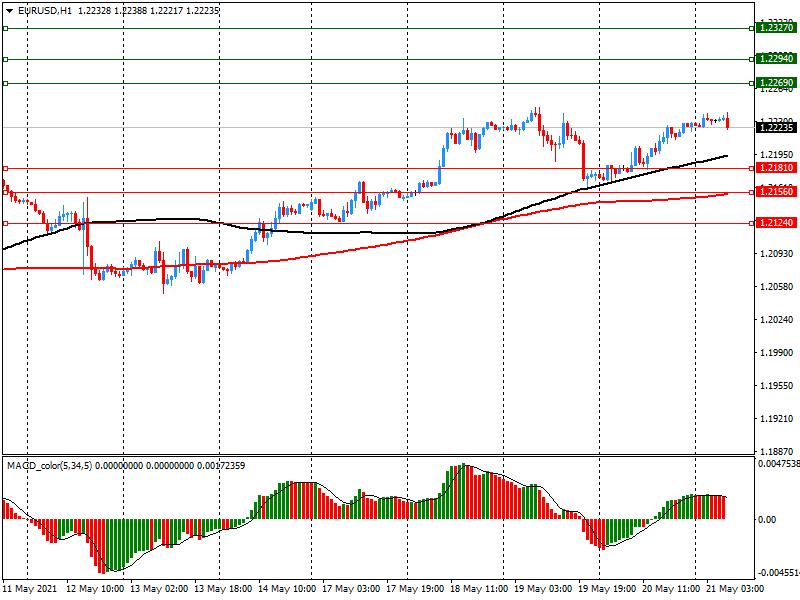
Comments:
- Overall open interest on the CALL options and PUT options with the expiration date June, 4 is 62369 contracts (according to data from May, 20) with the maximum number of contracts with strike price $1,2100 (3620);
GBP/USD
$1.4271 (1462)
$1.4248 (957)
$1.4230 (1863)
Price at time of writing this review: $1.4178
Support levels (open interest**, contracts):
$1.4057 (409)
$1.4021 (297)
$1.3981 (266)
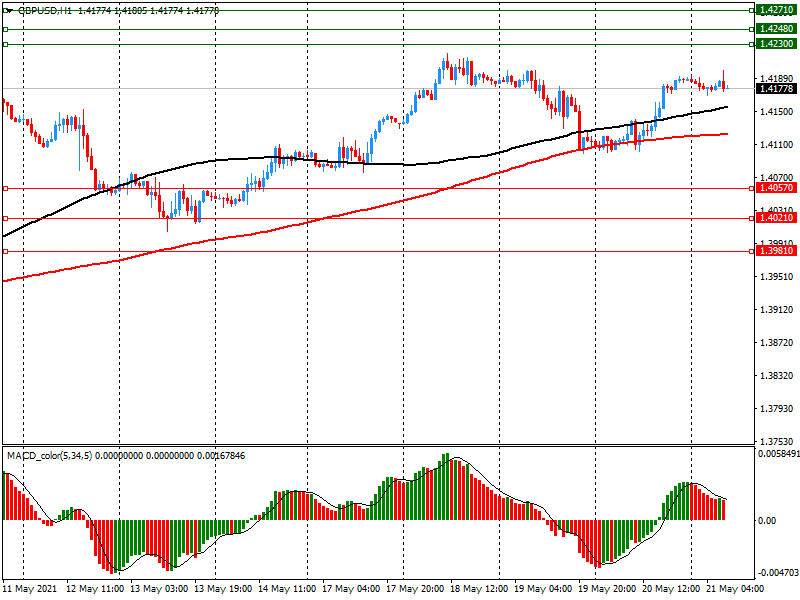
Comments:
- Overall open interest on the CALL options with the expiration date June, 4 is 21582 contracts, with the maximum number of contracts with strike price $1,4350 (2980);
- Overall open interest on the PUT options with the expiration date June, 4 is 32175 contracts, with the maximum number of contracts with strike price $1,3100 (3957);
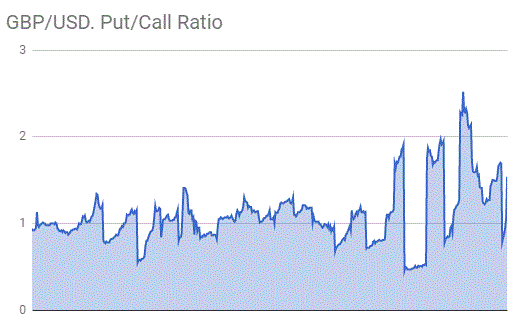
- The ratio of PUT/CALL was 1.49 versus 1.50 from the previous trading day according to data from May, 20
* - The Chicago Mercantile Exchange bulletin (CME) is used for the calculation.
** - Open interest takes into account the total number of option contracts that are open at the moment.
FXStreet reports that Oliver Jones, Senior Markets Economist at Capital Economics, discusses S&P 500 Index prospects.
“The data do not support the idea that equities are bound to struggle if inflation is higher than over the past decade and inflation expectations increase a bit further. Higher inflation would be a problem if it were accompanied by a substantial deterioration in the outlook for real growth, and/or a sharp tightening of the real stance of monetary policy. But we do not expect that to happen soon, even though our inflation forecasts are above consensus.”
“We still expect the S&P 500 to make some more headway over the next couple of years (albeit much less than over the past year or so given its valuation). Our end-2022 forecast is 4,500.”
“We are expecting the composition of gains in the stock market to be very different to the low-inflation, low-growth environment of the 2010s. We have made the case that the tech and growth stocks that thrived over the past decade are more likely to lag than lead the market if inflation is higher and growth a little faster, and that other areas where the Biden administration is seeking to change policy, including corporate tax and antitrust, may also push in the same direction.”
According to the report from Office for National Statistics, retail sales volumes grew sharply in April 2021 with a monthly increase of 9.2%, reflecting the effect of the easing of coronavirus (COVID-19) restrictions including the re-opening of all non-essential retail from 12 April in England and Wales and from 26 April in Scotland. Economists had expected a 4.5% increase.
Non-food stores provided the largest contribution to the monthly growth in April 2021 sales volumes, aided by strong increases of 69.4% and 25.3% in clothing stores and other non-food stores respectively.
Retail sales volumes were 42.4% higher than in April 2020, which was affected by the first national lockdown when the tightest restrictions were in place; however, these growth rates are distorted by base effects and are not a reliable guide; sales volumes were 10.6% higher than February 2020, before the impact of the coronavirus pandemic.
All retail sectors reported a fall in their proportions of online sales as physical stores re-opened during the month; as a consequence, the total proportion of sales online decreased to 30.0% in April 2021, down from 34.7% in March 2021.
In the three months to April 2021, the volume of sales increased by 2.6% when compared with the previous three months, with strong growth in department stores and automotive fuel retailers of 9.9% and 8.9% respectively.
| Time | Country | Event | Period | Previous value | Forecast |
|---|---|---|---|---|---|
| 00:30 (GMT) | Japan | Manufacturing PMI | May | 53.6 | |
| 00:30 (GMT) | Japan | Nikkei Services PMI | May | 49.5 | |
| 01:30 (GMT) | Australia | Retail Sales, M/M | April | 1.3% | 0.5% |
| 06:00 (GMT) | United Kingdom | Retail Sales (MoM) | April | 5.4% | 4.5% |
| 06:00 (GMT) | United Kingdom | Retail Sales (YoY) | April | 7.2% | 36.8% |
| 07:15 (GMT) | France | Services PMI | May | 50.3 | 53 |
| 07:15 (GMT) | France | Manufacturing PMI | May | 58.9 | 58.5 |
| 07:30 (GMT) | Germany | Services PMI | May | 49.9 | 52 |
| 07:30 (GMT) | Germany | Manufacturing PMI | May | 66.2 | 65.9 |
| 08:00 (GMT) | Eurozone | Eurogroup Meetings | |||
| 08:00 (GMT) | Eurozone | Manufacturing PMI | May | 62.9 | 62.5 |
| 08:00 (GMT) | Eurozone | Services PMI | May | 50.5 | 52.3 |
| 08:30 (GMT) | United Kingdom | Purchasing Manager Index Manufacturing | May | 60.9 | 60.5 |
| 08:30 (GMT) | United Kingdom | Purchasing Manager Index Services | May | 61.0 | 62 |
| 10:00 (GMT) | Germany | Bundesbank Monthly Report | |||
| 11:00 (GMT) | Eurozone | ECB President Lagarde Speaks | |||
| 12:30 (GMT) | Canada | Retail Sales, m/m | March | 4.8% | 2.3% |
| 12:30 (GMT) | Canada | Retail Sales YoY | March | 6% | |
| 12:30 (GMT) | Canada | Retail Sales ex Autos, m/m | March | 4.8% | 2.2% |
| 13:15 (GMT) | U.S. | FOMC Member Kaplan Speak | |||
| 13:45 (GMT) | U.S. | Manufacturing PMI | May | 60.5 | 60.2 |
| 13:45 (GMT) | U.S. | Services PMI | May | 64.7 | 64.5 |
| 14:00 (GMT) | Eurozone | Consumer Confidence | May | -8.1 | -6.8 |
| 14:00 (GMT) | U.S. | Existing Home Sales | April | 6.01 | 6.09 |
| 17:00 (GMT) | U.S. | Baker Hughes Oil Rig Count | May | 352 | |
| 17:30 (GMT) | U.S. | FOMC Member Daly Speaks | |||
| 20:55 (GMT) | U.S. | FOMC Member Kaplan Speak |
| Pare | Closed | Change, % |
|---|---|---|
| AUDUSD | 0.77703 | 0.63 |
| EURJPY | 132.995 | 0.06 |
| EURUSD | 1.22281 | 0.44 |
| GBPJPY | 154.316 | 0.15 |
| GBPUSD | 1.41883 | 0.53 |
| NZDUSD | 0.71927 | 0.33 |
| USDCAD | 1.20558 | -0.58 |
| USDCHF | 0.89707 | -0.67 |
| USDJPY | 108.755 | -0.38 |







© 2000-2026. All rights reserved.
This site is managed by Teletrade D.J. LLC 2351 LLC 2022 (Euro House, Richmond Hill Road, Kingstown, VC0100, St. Vincent and the Grenadines).
The information on this website is for informational purposes only and does not constitute any investment advice.
The company does not serve or provide services to customers who are residents of the US, Canada, Iran, The Democratic People's Republic of Korea, Yemen and FATF blacklisted countries.
Making transactions on financial markets with marginal financial instruments opens up wide possibilities and allows investors who are willing to take risks to earn high profits, carrying a potentially high risk of losses at the same time. Therefore you should responsibly approach the issue of choosing the appropriate investment strategy, taking the available resources into account, before starting trading.
Use of the information: full or partial use of materials from this website must always be referenced to TeleTrade as the source of information. Use of the materials on the Internet must be accompanied by a hyperlink to teletrade.org. Automatic import of materials and information from this website is prohibited.
Please contact our PR department if you have any questions or need assistance at pr@teletrade.global.


 Bank
Bank transfers


