- Analytics
- News and Tools
- Market News
Analytics, News, and Forecasts for CFD Markets: currency news — 20-05-2021.
| Time | Country | Event | Period | Previous value | Forecast |
|---|---|---|---|---|---|
| 00:30 (GMT) | Japan | Manufacturing PMI | May | 53.6 | |
| 00:30 (GMT) | Japan | Nikkei Services PMI | May | 49.5 | |
| 01:30 (GMT) | Australia | Retail Sales, M/M | April | 1.3% | 0.5% |
| 06:00 (GMT) | United Kingdom | Retail Sales (MoM) | April | 5.4% | 4.5% |
| 06:00 (GMT) | United Kingdom | Retail Sales (YoY) | April | 7.2% | 36.8% |
| 07:15 (GMT) | France | Services PMI | May | 50.3 | 53 |
| 07:15 (GMT) | France | Manufacturing PMI | May | 58.9 | 58.5 |
| 07:30 (GMT) | Germany | Services PMI | May | 49.9 | 52 |
| 07:30 (GMT) | Germany | Manufacturing PMI | May | 66.2 | 65.9 |
| 08:00 (GMT) | Eurozone | Eurogroup Meetings | |||
| 08:00 (GMT) | Eurozone | Manufacturing PMI | May | 62.9 | 62.5 |
| 08:00 (GMT) | Eurozone | Services PMI | May | 50.5 | 52.3 |
| 08:30 (GMT) | United Kingdom | Purchasing Manager Index Manufacturing | May | 60.9 | 60.5 |
| 08:30 (GMT) | United Kingdom | Purchasing Manager Index Services | May | 61.0 | 62 |
| 10:00 (GMT) | Germany | Bundesbank Monthly Report | |||
| 11:00 (GMT) | Eurozone | ECB President Lagarde Speaks | |||
| 12:30 (GMT) | Canada | Retail Sales, m/m | March | 4.8% | 2.3% |
| 12:30 (GMT) | Canada | Retail Sales YoY | March | 6% | |
| 12:30 (GMT) | Canada | Retail Sales ex Autos, m/m | March | 4.8% | 2.2% |
| 13:15 (GMT) | U.S. | FOMC Member Kaplan Speak | |||
| 13:45 (GMT) | U.S. | Manufacturing PMI | May | 60.5 | 60.2 |
| 13:45 (GMT) | U.S. | Services PMI | May | 64.7 | 64.5 |
| 14:00 (GMT) | Eurozone | Consumer Confidence | May | -8.1 | -6.8 |
| 14:00 (GMT) | U.S. | Existing Home Sales | April | 6.01 | 6.09 |
| 17:00 (GMT) | U.S. | Baker Hughes Oil Rig Count | May | 352 | |
| 17:30 (GMT) | U.S. | FOMC Member Daly Speaks | |||
| 20:55 (GMT) | U.S. | FOMC Member Kaplan Speak |
- Says EU inflation is driven by raw material shortages
- Expects to raise Italy's 2021 growth forecast
- Many households have taken on large mortgages compared with their income, so have less flexibility to deal with unexpected events
- Some people may be buying homes now because they expect prices to keep climbing, and this is a concern
- If house prices and household incomes were to fall in the future, some households could need to cut back on spending; this would slow the economy and possibly put stress on financial system
- Potential demand for liquidity in bond market is growing faster than what banks can supply in times of high stress
- Financial system could be vulnerable to sudden spike in demand for cash
- Assets that are exposed to climate risks are generally mispriced. This can leave investors and financial institutions exposed to sudden losses due to severe weather events and transition to low-carbon economy
- Other challenges on horizon include: viability of some businesses when government supports end; continued reliance of some firms on high-yield debt; growing threat of cyber attacks; rapid evolution of cryptoasset markets
The
Conference Board announced on Thursday its Leading Economic Index (LEI) for the
U.S. rose 1.6 percent m-o-m in April to 113.3 (2016 = 100), following an unrevised
1.3 percent m-o-m gain in March.
Economists
had forecast an increase of 1.4 percent m-o-m.
“With
April’s large monthly gain to start the second quarter, the U.S. LEI has now
recovered fully from its COVID-19 contraction - surpassing the index’s previous
peak, reached at the very onset of the global pandemic in January 2020,” noted
Ataman Ozyildirim, Senior Director of Economic Research at The Conference
Board. “While employment and production have not recovered to their
pre-pandemic levels yet, the U.S. LEI suggests the economy’s upward trend
should continue and growth may even accelerate in the near term. The Conference
Board now forecasts real GDP could grow around 8 to 9 percent (annualized) in
the second quarter, with year-over-year economic growth reaching 6.4 percent
for 2021.”
The
report also revealed the Conference Board Coincident Economic Index (CEI) for
the U.S. went up 0.3 percent m-o-m in April to 104.1, following a 0.9 percent
m-o-m advance in March. Meanwhile, its Lagging Economic Index (LAG) for the
U.S. climbed 1.8 percent m-o-m in April to 104.7, following a 3.7 percent drop
in March.
The
Manufacturing Business Outlook Survey, released by the Federal Reserve Bank of
Philadelphia on Thursday, revealed the region's manufacturing activity continued
to grow in May, albeit at a slower pace than in April.
According
to the survey, the diffusion index for current general activity fell from a near 50-year high of 50.2 in April to 31.5 this month.
Economists
had forecast the index to decrease to 43.0.
A
reading above 0 signals expansion, while a reading below 0 indicates
contraction.
According
to the report, the new orders index dropped 3.5 points to 32.5 this month,
while the current shipments index decreased 4.3 points to 21.0 and the current
employment index plunged 11.5 points to 19.3. Elsewhere, the survey’s price
indicators suggest that price increases were more widespread this month: the
prices paid index went up 8 points to 76.8, its highest reading since March
1980, and the prices received index increased 7 points to 41.0, its highest
reading since May 1981.
Statistics
Canada reported on Thursday the New Housing Price Index (NHPI) surged 1.9
percent m-o-m in April, following a 1.1 percent m-o-m gain in the previous month,
as demand for housing remains strong, despite increasing construction costs.
According
to the report, new home prices increased in 22 out of the 27 census
metropolitan areas (CMAs) surveyed in April, with Windsor (+8.5 percent m-o-m,
its highest increase since February 1981) recording the largest monthly advance
in new home prices, as house prices in this area remained relatively more
affordable compared with other hot markets in Canada.
In
y-o-y terms, NHPI surged 9.9 percent in April, following a 7.9 percent climb in
the previous month. This was the largest y-o-y increase since February 2007.
The
data from the Labor Department revealed on Thursday the number of applications
for unemployment fell more than expected last week, hitting a fresh
pandemic-era low.
According
to the report, the initial claims for unemployment benefits decreased by 34,000
to 444,000 for the week ended May 15. This was the lowest reading since the
week ended March 15, 2020.
Economists
had expected 450,000 new claims last week.
Claims
for the prior week were revised upwardly to 478,000 from the initial estimate
of 473,000.
Meanwhile,
the four-week moving average of jobless claims dropped to 504,750 from an
upwardly revised 535,250 in the previous week.
Continuing
claims rose to 3,751,000 from a downwardly revised 3,640,000 in the previous
week.
| Time | Country | Event | Period | Previous value | Forecast | Actual |
|---|---|---|---|---|---|---|
| 06:00 | Germany | Producer Price Index (MoM) | April | 0.9% | 0.8% | 0.8% |
| 06:00 | Germany | Producer Price Index (YoY) | April | 3.7% | 5.1% | 5.2% |
| 08:00 | Eurozone | Current account, unadjusted, bln | March | 13.2 | 31 | |
| 09:00 | Eurozone | Construction Output, y/y | March | -5.4% | 18.3% | |
| 09:05 | United Kingdom | MPC Member Cunliffe Speaks | ||||
| 10:00 | United Kingdom | CBI industrial order books balance | May | -8 | 17 |
EUR traded mixed against its major rivals in the European session on Thursday as investors digested U.S. Federal Reserve’s hints at near-term discussions to trim monthly bond purchases and higher-than-expected factory-gate inflation data out of Germany.
The minutes from April's meeting of the Federal Reserve hinted that at considering tapering its asset purchase programs in upcoming meetings. This triggered a broad-based decline in the U.S. dollar.
Meanwhile, hotter-than-expected inflation data out of Germany, the EU's biggest economy, lifted concerns about accelerating inflation and the potential reaction of the ECB. Destatis reported producer prices in Germany climbed 5.2 percent y/y in April, accelerating from a 3.7 percent y/y jump in March. Economists had forecast a growth of 5.1 percent y/y. This was the biggest gain since September 2011. On a monthly basis, however, producer price inflation eased slightly to 0.8 percent in April from 0.9 percent in the previous month. This was in line with forecasts.
The ECB's chief economist Philip Lane, however, reiterated a dovish stance, stating that he doesn't see an environment in the Eurozone for persistent inflation. According to Lane, a lot of the inflation rise now is the unwinding of the downside shocks of the last year. He also added that the ECB still has a “lot of work to do” to raise inflation to 2%.
FXStreet notes that the recent depreciation in the U.S. dollar has helped to boost commodity prices. But while strategists at Capital Economics expect a stronger dollar to weigh on most commodity prices later this year, oil prices will still rise.
“We think that oil prices will overlook dollar strength and that other factors will drive the price. Oil has a relatively weak relationship with the dollar and we expect that this will continue to be the case.”
“If we are right and the US dollar appreciates, this would drag on the prices of both industrial and precious metals. Nevertheless, we doubt that the price of oil would fall as other factors, primarily strong growth in demand, should support prices.”
FXStreet notes that EUR/CHF surged higher on Wednesday after completing a small base above 1.0990/93. Despite the reversal this morning, analysts at Credit Suisse stay biased higher.
“EUR/CHF maintains a small base despite this morning’s reversal lower following the recent break above 1.0990/93, which keeps the risks tactically higher within the downward channel of the past couple of months. This is reinforced by the tentative turn higher in daily MACD momentum.”
“Next resistance is seen at 1.1022/29, which capped the market yesterday, before 1.1060/77, which we would expect to cap to keep the market in its downward channel."
FXStreet notes that attention is on trendline support at 0.7710 as the AUD/USD pair needs to hold off this level to maintain an upside bias. Karen Jones, Team Head FICC Technical Analysis Research at Commerzbank, expects the aussie to enjoy further gains towards the 0.8007 February high.
“AUD/USD sold off yesterday but remains above the uptrend, today at 0.7710, which continues to hold the downside. While it holds, we should see the market reattempt the 0.7837/91 band of resistance (recent highs), and we will need a close above here to confirm upside intent.”
“The aussie should remain underpinned by the 0.7710 support line to maintain an upside bias.”
“For now, we will maintain a positive bias and allow for gains to the end of February high at 0.8007.”
“Longer term, the 0.8135 2018 high is in play.”
EUR/USD remains well supported above 1.2105, on course for 1.2350 - Credit Suisse
FXStreet notes that EUR/USD reversed sharply from the 1.2243/46 February high on Wednesday. Nevertheless, the pair remains well supported above the uptrend from the March low at 1.2105, keeping the market on course for 1.2324/50, in the view of analysts at Credit Suisse.
“The EUR/USD pair remains well supported above the confirmed uptrend from the 2021 low at 1.2105/03 and we therefore maintain an upward bias.”
“A break above 1.2243/45 would then expose the top of the broader range, the YTD high and the potential downtrend from 2018 at 1.2324/1.2350, which is expected to be an even tougher resistance.”
“A key driver of the recent move higher in our view has been the tightening in US/Germany spreads, which we believe can continue further yet.”
“Short-term support moves to 1.2159, then intraday support at 1.2125, which ideally holds to keep the risks directly higher."
- Supply bottlenecks causing price rise is not real inflation
- Does not see environment in Eurozone for persistent inflation
- A lot of the inflation rise now is the unwinding of downside shocks of last year
The
latest survey by the Confederation of British Industry (CBI) revealed on Thursday
the UK manufacturers' order books improved strongly in May.
According
to the report, the CBI's monthly factory order book balance increased to +17 in
May from -8 in the previous month. This was the highest reading since December 2017
and marked the first time order books have been considered to be “above normal”
since February 2019. Economists had forecast the reading to come in at 0. Meanwhile,
export order books (-17) were broadly unchanged from April (-18), but this
nonetheless represented the strongest outturn since February 2020 and was
around the long-run average.
The
CBI also reported that output volumes in the three months to May grew at the
fastest pace since December 2018 (+18, up from +3 in April). It was also expected that output
(+33) would accelerate further in the next three months.
In
other survey results, present stocks of finished goods (-6 from +5 in April) declined
to their weakest position since July 2017. This was also the first time since
July 2017 that stocks were considered “less than adequate”. Meanwhile, price
growth was seen to pick up rapidly in the next three months (+38 from +27 in
April), with expectations at their strongest since January 2018.
“Manufacturing
activity rebounded this month, with strong improvements seen across total order
books and output volumes,” noted Anna Leach, CBI Deputy Chief Economist. “But
firms are still feeling the chill as supply shortages fuel cost pressures,
reflected in expectations for strong output price inflation in the coming
quarter.”
FXStreet reports that economists at Credit Suisse believe the S&P 500 Index choppy current consolidation can continue over the coming weeks, however the underlying bull trend remains strong and the index is eventually expected to move up to 4350.
“We maintain our base case of looking for a corrective/consolidation phase to emerge over the next few weeks, however we still believe the November uptrend at 4071, as well as the 63-day average and gap support at 4034/19 will floor the market to avoid a larger drawdown and keep the market in a consolidative range. A close below 4020/19 though would instead warn of a more protracted and concerted setback. Above 4188 is needed to suggest the correction is already over for strength back to 4238, then 4260. Big picture, we look for a move to 4350.”
According to first estimates from Eurostat, in March 2021 compared with February 2021, seasonally adjusted production in the construction sector increased by 2.7% in the euro area and by 2.2% in the EU. In February 2021, production in construction fell by 2.0% in the euro area and by 1.7% in the EU.
In March 2021 compared with March 2020, production in construction increased by 18.3% in the euro area and by 14.9% in the EU.
In the euro area in March 2021, compared with February 2021, civil engineering increased by 9.4% and building construction by 1.3%. In the EU, civil engineering increased by 7.7% and building construction by 1.1%.
In the euro area in March 2021, compared with March 2020, civil engineering increased by 23.2% and building construction by 16.8%. In the EU civil engineering increased by 19.0% and building construction by 13.7%.
Among Member States for which data are available, the highest increases in production in construction were observed in Italy (+74.5%), France (+46.3%) and Belgium (+36.3%). The largest decreases were recorded in Spain (-13.2%), Poland (-12.6%) and Finland (-4.0%).
FXStreet reports that according to economists at Westpac, kiwi’s current consolidation phase is set to eventually give way to gains above 0.7300.
“We expect a break of the top at 0.7300 during the next week or two, which will then signal a multi-month move towards 0.7600.”
“Today’s Budget disappointed our expectations: a modestly improved set of fiscal metrics, only slightly less borrowing, and an unchanged fiscal impulse. The latter will have a negligible impact on RBNZ's monetary policy.”
“Next week’s RBNZ MPS is likely to extend the ‘long time on hold’ theme, with all settings (OCR, FLP, LSAP) unchanged. That said, we see risks of a surprise as skewed to a hawkish one. We see this event as potentially NZD-positive.”
According to the report from European Central Bank, the current account of the euro area recorded a surplus of €18 billion in March 2021, a decrease of €8 billion from the previous month. Surpluses were recorded for goods (€24 billion) and services (€8 billion). These were partly offset by deficits for secondary income (€12 billion) and primary income (€2 billion).
In the 12 months to March 2021, the current account recorded a surplus of €267 billion (2.4% of euro area GDP), compared with a surplus of €247 billion (2.1% of euro area GDP) in the 12 months to March 2020. This increase reflected a larger surplus in services (up from €20 billion to €75 billion) and, to a lesser extent, a larger surplus in goods (up from €334 billion to €344 billion). These developments were partly offset by a reduction in the surplus for primary income (down from €42 billion to €18 billion) and a larger deficit for secondary income (up from €149 billion to €169 billion).
In financial account, euro area residents’ net acquisitions of foreign portfolio investment securities totalled €1.1 trillion and non-residents’ net acquisitions of euro area portfolio investment securities totalled €123 billion in 12 months to March 2021
FXStreet reports that economists at ANZ Bank discuss GBP/USD prospects.
“Following the release of Q1 GDP data (-1.5% QoQ), we have updated our UK recovery profile to better reflect the timing of the re-opening. In absolute terms, we make no material change to our end 2022 GDP estimate. However, the important nuance is that the UK can now close the output gap sooner. We now expect GDP will return to pre-pandemic levels by the middle of 2022 and forecast growth at 6.2% this year and 5.3% next.”
“If, as we expect, the economy continues to recover, we think the BoE will reduce QE further in Q3. However, it will be much more patient in raising interest rates, and we do not anticipate any adjustment to the bank rate over our forecast horizon to the end of 2022.”
“Within the framework of expected USD weakness, we anticipate further GBP appreciation and our 12-month forecast remains 1.50.”
“Whilst we are constructive on the pound’s prospects, price action has the potential to be volatile in coming months.”
| Time | Country | Event | Period | Previous value | Forecast | Actual |
|---|---|---|---|---|---|---|
| 01:30 | Australia | Changing the number of employed | April | 77 | 15 | -30.6 |
| 01:30 | Australia | Unemployment rate | April | 5.6% | 5.6% | 5.5% |
| 06:00 | Germany | Producer Price Index (MoM) | April | 0.9% | 0.8% | 0.8% |
| 06:00 | Germany | Producer Price Index (YoY) | April | 3.7% | 5.1% | 5.2% |
During today's Asian trading, the US dollar declined slightly against the major currencies, as market participants continued to analyze the minutes of the Federal Reserve meeting.
The leaders of the Fed during the April meeting expressed cautious optimism about the prospects for the US economy, and some of them noted the need to discuss the possibility of reducing support measures in the event of further improvement of the situation, according to the minutes of the meeting.
"Several participants in the meeting noted that if the US economy continues to move quickly towards the goals set by the Federal Reserve, it will be necessary at some point in the upcoming meetings to start discussing a plan to adjust the volume of asset repurchases," the minutes of the meeting showed.
"This is the first hint of tightening, but the process will be gradual. All statements are made with reservations. The Fed leaves plenty of room for maneuver," analysts at Charles Schwab said.
The ICE index, which tracks the dollar's performance against six currencies (euro, swiss franc, yen, canadian dollar, pound sterling and swedish krona), fell 0.13%.
CNBC reports that Deputy Prime Minister Grant Robertson told that New Zealand’s economic recovery from the Covid-19 pandemic has been “a lot better than expected.”
That has allowed New Zealand to spend “large sums of money” on helping its low-income population while still keeping its net debt in check, Robertson told.
Robertson delivered New Zealand’s latest government budget earlier on Thursday.
One highlight of the budget was boosting weekly welfare payments by up to 55 New Zealand dollars (around $39.50) per adult to tackle inequality and child poverty. Robertson said in his budget speech that the planned increase will be the largest in “more than a generation.”
The budget also allocated spending for Covid-19 vaccines, infrastructure, education and welfare of the indigenous Maori.
The planned spending is estimated to raise the budget deficit to 18.4 billion New Zealand dollars ($13.2 billion) in the fiscal year ending June 2022 before declining in subsequent years, according to New Zealand’s Treasury.
FXStreet reports that Jane Foley, Senior FX Strategist at Rabobank, expects the EUR/USD to move back lower to the 1.20 level over the next months.
“On our central view regarding the re-opening of the Eurozone economy, there is scope for some of the market’s hawks to be disappointed over the pace of policy moves from the ECB. While that has implications for our EUR outlook, how that plays out in EUR/USD depends on how market expectations develop with respect to how monetary policy settings are shaping up in the US.”
“There is speculation in the market that the Fed’s Jackson Hole symposium could provide a backdrop for policy makers to dip their toe into the topic of tapering. This, however, will depend on the path of inflation data and, since it is not scheduled until August, it is likely that the market is coming to terms with the likelihood that USD weakness could prevail in the near-term.”
“On the assumption that the ECB manages tapering expectations in the Eurozone carefully and given the likelihood that reflation/inflation fears will rise again in the US, we see risk on another move below EUR/USD 1.20 on a one-to-month view.”
According to the report from the Federal Statistical Office, in April 2021, the index of producer prices for industrial products increased by 5.2% compared with April 2020. This was the highest increase compared to the corresponding month of the preceding year since August 2011 (+5.2%), when prices rose strongly after the end of the finance crisis. Economists had expected a 5.1% increase.
Compared with the preceding month March 2021 the overall index increased by 0.8% in April 2021.
Prices of intermediate goods increased by 8.2% compared to April 2020. This was the highest price increase compared to the previous year since February 2011 (+8.9%). Compared to March 2021 these prices were up 1.8 %. Compared to April 2020 intermediate goods’ prices increased especially regarding metallic secondary raw material (+62.7%), sawn and planed wood (+27.1%) and metals (+17.3%). Prices of basic iron, steel and ferro-alloys increased by 23.5%, prices of non-ferrous metals were up 21.7%.
Energy prices as a whole increased by 10.6% compared to April 2020 and by 0.6 compared to March 2021. The price increase from April 2020 to April 2021 is mainly due to the increase of electricity prices (+10.7%), furthermore to the high increase of prices for mineral oil products (+30.9%), which is mainly caused by a base effect resulting from the sharp drop in prices in spring 2020 in the course of the pandemic.
Prices of durable consumer goods increased by 1.6% compared to April 2020 (+0.4% compared to March 2021), capital goods, such as machines and vehicles, by 1.0% (+0.3% compared to March 2021).
Prices of non-durable consumer goods decreased by 0.6% compared to April 2020 but increased by 0.6% compared to March 2021. Food prices decreased from April 2020 to April 2021 by 1.3%, caused by price decreases of pork until February 2021. Though pork prices increased from February until April 2021 by 19.3% they still were 14.3% down compared to April 2020. By contrast, prices of butter increased by 10.1%, prices of sugar were up 13.3% and prices of vegetable crude oils 29.6%.
EUR/USD
Resistance levels (open interest**, contracts)
$1.2282 (1839)
$1.2250 (4109)
$1.2225 (2030)
Price at time of writing this review: $1.2186
Support levels (open interest**, contracts):
$1.2147 (169)
$1.2129 (359)
$1.2104 (513)
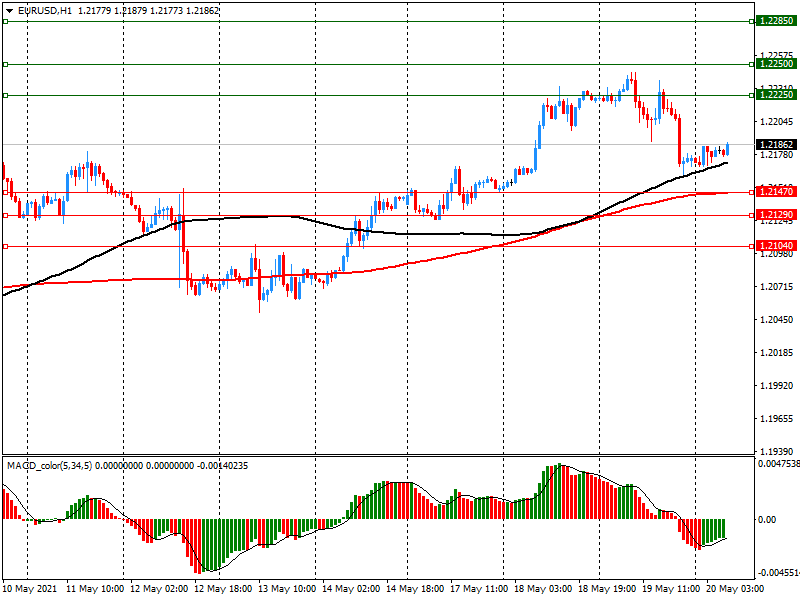
Comments:
- Overall open interest on the CALL options and PUT options with the expiration date June, 4 is 62849 contracts (according to data from May, 19) with the maximum number of contracts with strike price $1,2200 (4109);
GBP/USD
$1.4279 (1537)
$1.4256 (953)
$1.4238 (1886)
Price at time of writing this review: $1.4123
Support levels (open interest**, contracts):
$1.4054 (404)
$1.3977 (254)
$1.3944 (319)
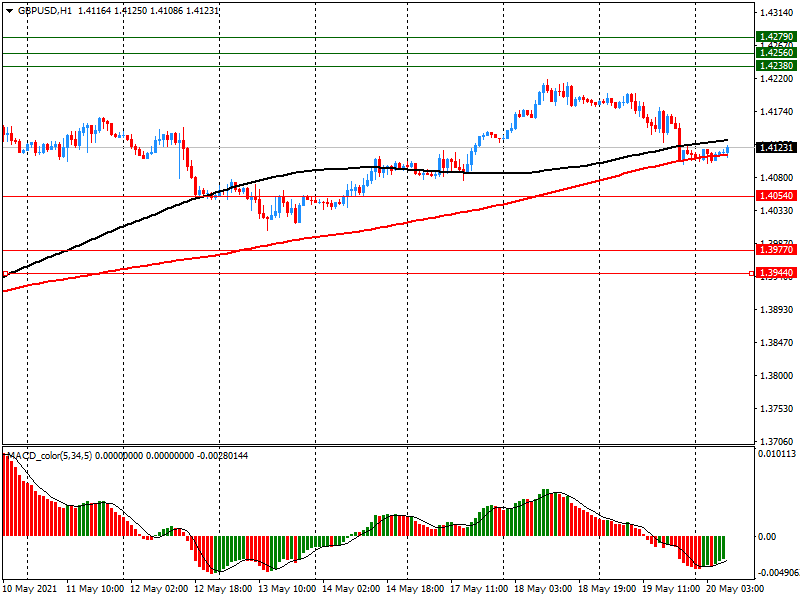
Comments:
- Overall open interest on the CALL options with the expiration date June, 4 is 21671 contracts, with the maximum number of contracts with strike price $1,4350 (3024);
- Overall open interest on the PUT options with the expiration date June, 4 is 32588 contracts, with the maximum number of contracts with strike price $1,3500 (4545);
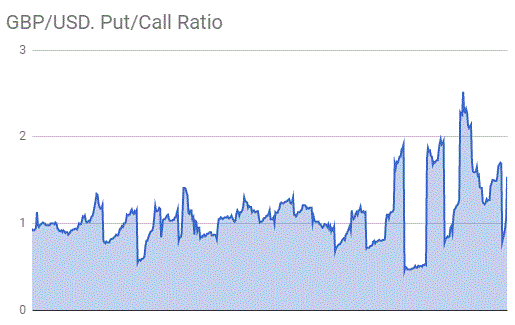
- The ratio of PUT/CALL was 1.50 versus 1.50 from the previous trading day according to data from May, 19
* - The Chicago Mercantile Exchange bulletin (CME) is used for the calculation.
** - Open interest takes into account the total number of option contracts that are open at the moment.
| Time | Country | Event | Period | Previous value | Forecast |
|---|---|---|---|---|---|
| 01:30 (GMT) | Australia | Changing the number of employed | April | 70.7 | 15 |
| 01:30 (GMT) | Australia | Unemployment rate | April | 5.6% | 5.6% |
| 06:00 (GMT) | Germany | Producer Price Index (MoM) | April | 0.9% | 0.8% |
| 06:00 (GMT) | Germany | Producer Price Index (YoY) | April | 3.7% | 5.1% |
| 08:00 (GMT) | Eurozone | Current account, unadjusted, bln | March | 13.3 | |
| 09:00 (GMT) | Eurozone | Construction Output, y/y | March | -5.8% | |
| 09:05 (GMT) | United Kingdom | MPC Member Cunliffe Speaks | |||
| 10:00 (GMT) | United Kingdom | CBI industrial order books balance | May | -8 | |
| 12:30 (GMT) | U.S. | Continuing Jobless Claims | May | 3655 | 3640 |
| 12:30 (GMT) | Canada | New Housing Price Index, YoY | April | 7.9% | |
| 12:30 (GMT) | Canada | New Housing Price Index, MoM | April | 1.1% | |
| 12:30 (GMT) | U.S. | Initial Jobless Claims | May | 473 | 450 |
| 12:30 (GMT) | U.S. | Philadelphia Fed Manufacturing Survey | May | 50.2 | 43 |
| 14:00 (GMT) | U.S. | Leading Indicators | April | 1.3% | 1.4% |
| 23:01 (GMT) | United Kingdom | Gfk Consumer Confidence | May | -15 | -12 |
| 23:30 (GMT) | Japan | National CPI Ex-Fresh Food, y/y | April | -0.1% | -0.2% |
| 23:30 (GMT) | Japan | National Consumer Price Index, y/y | April | -0.2% |
| Pare | Closed | Change, % |
|---|---|---|
| AUDUSD | 0.77216 | -0.89 |
| EURJPY | 132.915 | -0.13 |
| EURUSD | 1.21748 | -0.4 |
| GBPJPY | 154.085 | -0.23 |
| GBPUSD | 1.41136 | -0.5 |
| NZDUSD | 0.71688 | -0.94 |
| USDCAD | 1.21259 | 0.53 |
| USDCHF | 0.90306 | 0.69 |
| USDJPY | 109.164 | 0.27 |







© 2000-2026. All rights reserved.
This site is managed by Teletrade D.J. LLC 2351 LLC 2022 (Euro House, Richmond Hill Road, Kingstown, VC0100, St. Vincent and the Grenadines).
The information on this website is for informational purposes only and does not constitute any investment advice.
The company does not serve or provide services to customers who are residents of the US, Canada, Iran, The Democratic People's Republic of Korea, Yemen and FATF blacklisted countries.
Making transactions on financial markets with marginal financial instruments opens up wide possibilities and allows investors who are willing to take risks to earn high profits, carrying a potentially high risk of losses at the same time. Therefore you should responsibly approach the issue of choosing the appropriate investment strategy, taking the available resources into account, before starting trading.
Use of the information: full or partial use of materials from this website must always be referenced to TeleTrade as the source of information. Use of the materials on the Internet must be accompanied by a hyperlink to teletrade.org. Automatic import of materials and information from this website is prohibited.
Please contact our PR department if you have any questions or need assistance at pr@teletrade.global.


 Bank
Bank transfers


