- Analytics
- News and Tools
- Market News
Analytics, News, and Forecasts for CFD Markets: currency news — 19-05-2021.
| Time | Country | Event | Period | Previous value | Forecast |
|---|---|---|---|---|---|
| 01:30 (GMT) | Australia | Changing the number of employed | April | 70.7 | 15 |
| 01:30 (GMT) | Australia | Unemployment rate | April | 5.6% | 5.6% |
| 06:00 (GMT) | Germany | Producer Price Index (MoM) | April | 0.9% | 0.8% |
| 06:00 (GMT) | Germany | Producer Price Index (YoY) | April | 3.7% | 5.1% |
| 08:00 (GMT) | Eurozone | Current account, unadjusted, bln | March | 13.3 | |
| 09:00 (GMT) | Eurozone | Construction Output, y/y | March | -5.8% | |
| 09:05 (GMT) | United Kingdom | MPC Member Cunliffe Speaks | |||
| 10:00 (GMT) | United Kingdom | CBI industrial order books balance | May | -8 | |
| 12:30 (GMT) | U.S. | Continuing Jobless Claims | May | 3655 | 3640 |
| 12:30 (GMT) | Canada | New Housing Price Index, YoY | April | 7.9% | |
| 12:30 (GMT) | Canada | New Housing Price Index, MoM | April | 1.1% | |
| 12:30 (GMT) | U.S. | Initial Jobless Claims | May | 473 | 450 |
| 12:30 (GMT) | U.S. | Philadelphia Fed Manufacturing Survey | May | 50.2 | 43 |
| 14:00 (GMT) | U.S. | Leading Indicators | April | 1.3% | 1.4% |
| 23:01 (GMT) | United Kingdom | Gfk Consumer Confidence | May | -15 | -12 |
| 23:30 (GMT) | Japan | National CPI Ex-Fresh Food, y/y | April | -0.1% | -0.2% |
| 23:30 (GMT) | Japan | National Consumer Price Index, y/y | April | -0.2% |
- U.S. has a big economic boom going on
- I wouldn't be surprised if 2021 GDP estimates were raised from +6.5%
- I would like to see more inflation data before changing my forecast. The data is very noisy
- I think inflation will remain above 2% in 2022 but that will be consistent with framework
- Fed will tolerate inflation above 2% throughout 2022
- Fed should be nimble as pandemic draws to a close
- Labor market is tighter than is being represented
- Jobs out there when people feel it is appropriate to return
- Expectations of a million jobs per month have been hyped up, half a million is more realistic
- Trading in inflation-protected securities shows faith in the Fed's inflation outlook
- We're going to have to allow higher inflation in the boom time than we normally would have
- I will leave it up to the chair Powell to determine when to start the taper talk
The
U.S. Energy Information Administration (EIA) revealed on Wednesday that crude
inventories rose by 1.321 million barrels in the week ended May 14, following a
drop of 0.427 million barrels in the previous week. Economists had forecast a build
of 1.623 million barrels.
At
the same time, gasoline stocks declined by 1.963 million barrels, while
analysts had expected a decrease of 0.886 million barrels. Distillate stocks plunged
2.324 million barrels, while analysts had forecast a draw of 0.386 million
barrels.
Meanwhile,
oil production in the U.S. remained unchanged at 11.000 million barrels a day.
U.S.
crude oil imports averaged 6.4 million barrels per day last week, increased by
0.9 million barrels per day from the previous week.
Canada: Inflation jumps to 3.4% in April - TD Bank Financial Group
ActionForex reports that analysts at TD Bank Financial Group discuss Canada's April CPI data.
"The Consumer Price Index (CPI) jumped to 3.4% year-on-year (y/y) in April, up over a percentage point from 2.2% in March, and above of the median forecast for 3.2%."
"Gasoline prices were a big part of the year-on-year gain, up 62.5% from their lows in April 2020. Other energy prices were also higher relative to a year ago."
"Excluding energy, inflation would have been softer at 1.6% (still up from 1.1% in March). Clothing and footwear saw the first year-on-year gain since March 2020, jumping to positive 1.8% y/y from -5.4% in March. Food price growth, on the other hand, slowed in April to 0.9% (from 1.8% in March)."
"The Bank of Canada’s core inflation measures all ticked up in April, CPI-common rose to 1.7% (from 1.5%), CPI-median and CPI-trim both rose to 2.3% (from 2.1%) in April."
"With the economy still getting over the coronavirus pandemic, the aftermath of the virus and the policy response to it are beginning to come into view. The jump in prices reflects both the plunge a year ago and the recovery from it in the year hence. In April, there were also more clear signs of recovery in the most deeply impacted sectors like travel, healthcare (dental especially) and clothing. Price pressures are likely to continue to percolate as demand accelerates and supply takes time to catch up."
By eFXdata reports that Credit Agricole CIB Research discusses its expectations for today's FOMC minutes from the April meeting.
"On the day, focus will be on the release of the April FOMC minutes and a speech by Fed’s Bullard and Bostic. We think that we will get to more of the same with the FOMC still of the view that this is not the right time to debate QE taper or frontloading policy normalisation."
"With many negatives in the price of the USD by now, we suspect that the impact of the dovish Fed speak on the USD could be limited."
FXStreet reports that Quek Ser Leang at UOB Group’s Global Economics & Markets Research, assesses the outlook for the US Dollar Index (DXY).
“USD Index broke the rising trend-line support about 2 weeks ago, rebounded but over the past few days, it staged a rather swift and impulsive decline and is currently holding just above 89.68. Weekly MACD is turning negative and the improved downward momentum suggests that a breach of 89.68 would not be surprising and would indicate that USD Index is heading towards the early January low of 89.21. That said, for USD Index to move to 89.21, it has to maintain the current rapid pace of decline and should not move above the declining trend-line resistance (currently at 90.65). Looking ahead, the next support below 89.21 is at 88.85 followed by the 2018 low of 88.25.”
FXStreet reports that FX Strategists at UOB Group note that USD/JPY is still expected to keep the 108.50-109.55 trading range in the next weeks.
24-hour view: “USD dropped to 108.82 before rebounding. The rapid drop appears to be running ahead of itself and further sustained USD weakness is not expected. For today, USD is more likely to consolidate and trade between 108.80 and 109.30.”
Next 1-3 weeks: “We have held the same view since Monday (17 May, spot at 109.35) where USD ‘is likely to consolidate and trade between 108.50 and 109.95’. While the shorter-term underlying tone has weakened somewhat, the prospect for USD to break 108.50 is not high. Meanwhile, a 108.50/109.55 range is likely enough to contain the price actions in USD, at least for a few days.”
Statistics
Canada reported on Wednesday the country’s consumer price index (CPI) rose 0.5
percent m-o-m in April, the same pace as in the previous month.
On
the y-o-y basis, Canada’s inflation rate surged 3.4 percent last month after climbing
2.2 percent in March. This was the highest inflation rate since May 2011.
Economists
had predicted inflation would increase 0.4 percent m-o-m and 3.2 percent y-o-y
in April.
According
to the report, a significant proportion of April’s year-over-year increase was
attributable to a sharp drop in prices in April 2020, triggered by the COVID-19
pandemic.
Compared
with April 2020, prices rose in all eight major components, with transportation
(+9.4 percent y-o-y) and shelter (+3.2 percent y-o-y) prices contributing the
most to CPI growth.
Meanwhile, the closely watched the Bank of
Canada's core index jumped 2.3 percent y-o-y in April, following a 1.4 percent
y-o-y advance in March.
| Time | Country | Event | Period | Previous value | Forecast | Actual |
|---|---|---|---|---|---|---|
| 06:00 | United Kingdom | Producer Price Index - Input (YoY) | April | 6.4% | 9% | 9.9% |
| 06:00 | United Kingdom | Producer Price Index - Input (MoM) | April | 1.9% | 1.1% | 1.2% |
| 06:00 | United Kingdom | Producer Price Index - Output (MoM) | April | 0.8% | 0.5% | 0.4% |
| 06:00 | United Kingdom | Producer Price Index - Output (YoY) | April | 2.3% | 3.5% | 3.9% |
| 06:00 | United Kingdom | Retail Price Index, m/m | April | 0.3% | 0.8% | 1.4% |
| 06:00 | United Kingdom | HICP ex EFAT, Y/Y | April | 1.1% | 1.3% | |
| 06:00 | United Kingdom | Retail prices, Y/Y | April | 1.5% | 2.4% | 2.9% |
| 06:00 | United Kingdom | HICP, Y/Y | April | 0.7% | 1.4% | 1.5% |
| 06:00 | United Kingdom | HICP, m/m | April | 0.3% | 0.6% | 0.6% |
| 09:00 | Eurozone | Harmonized CPI ex EFAT, Y/Y | April | 0.9% | 0.8% | 0.7% |
| 09:00 | Eurozone | Harmonized CPI, Y/Y | April | 1.3% | 1.6% | 1.6% |
| 09:00 | Eurozone | Harmonized CPI | April | 0.9% | 0.6% | 0.6% |
USD appreciated against its major rivals in the European session on Wednesday as inflation fears resurfaced ahead of the release of minutes from the Federal Reserve's latest policy meeting (due at 18:00 GMT).
The U.S. Dollar Index (DXY), measuring the U.S. currency's value relative to a basket of foreign currencies, rose 0.23% to 89.95.
April’s bigger-than-anticipated climb in the U.S. consumer prices heightened worries last week that an acceleration in inflation could force the U.S. central bank to pull back on its monetary stimulus and hike interest rates sooner than expected. However, the Fed’s policymakers have continued to repeat their thoughts that any spike in inflation will be temporary.
Market participants will be monitoring the minutes to determine the Fed officials’ thinking on price pressures and hints on when they might begin tightening monetary policy.
- If there is a recovery, yields will go up
- If there is an unwarranted rise in yields, we will act
FXStreet reports that UOB Group’s FX Strategists see USD/CNH grinding lower to the 6.4015 level in the next weeks.
24-hour view: “We did not expect the sharp drop in USD to 6.4182 (we were expecting a consolidation). Despite the decline, downward momentum has not improved by much and USD is unlikely to weaken much further. For today, USD is more likely to consolidate and trade between 6.4180 and 6.4380.”
Next 1-3 weeks: “USD could grind lower and test the month-to-date low near 6.4015. At this stage, the prospect for a sustained decline below this level is not high. On the upside, a breach of 6.4460 (‘strong resistance’ level) would indicate that the current mild downward pressure has eased.”
The
Mortgage Bankers Association (MBA) reported on Wednesday the mortgage
application volume in the U.S. rose 1.2 percent in the week ended May 14,
following a 2.1 percent gain in the previous week.
According
to the report, refinance applications surged 4.0 percent, while applications to
purchase a home declined 4.1 percent.
Meanwhile,
the average fixed 30-year mortgage rate increased from 3.11 percent to 3.15
percent.
“A
decline in purchase applications was seen for both conventional and government
loans,” noted Joel Kan, an MBA economist. “There continues to be strong demand
for buying a home, but persistent supply shortages are constraining purchase
activity, and building material shortages and higher costs are making it more
difficult to increase supply.”
FXStreet reports that Karen Jones, Team Head FICC Technical Analysis Research at Commerzbank, notes that silver (XAG/USD) has reached Fibonacci retracement at $28.73 and this is seen as the last defence for the 30.09 2021 high.
“Silver has reached $28.73, the 78.6% retracement (Tuesday’s high was $28.80). This is regarded as the last defence for the $30.09 1st February high.”
“We have a near-term uptrend at $26.83, ahead of a near-term pivot at $25.65, the 8th April high. While above here we will maintain an immediate positive bias.”
“Longer-term, we are bullish and a break above $30.09 will target the $30.76/50% retracement of the entire move down from 2011."
FXStreet notes that EUR/USD has seen a sharp acceleration higher over the past few sessions, with the market closing above the 78.6% retracement of the 2021 fall at 1.12212 on Tuesday – exposing the February high at 1.2243. A break above here would open up a move to the 1.2324/50 high and potential downtrend from 2018, economists at Credit Suisse suggest.
"The pair is now testing the February high at 1.2243, with a break above exposing the top of the broader range, the YTD high and the potential downtrend from 2018 at 1.2324/1.2350, which is expected to be an even tougher resistance.”
“Short-term support moves to the broken high at 1.2182, then intraday support at 1.2125, which ideally holds to keep the risks directly higher. The next support below here is at the uptrend from the 2021 lows at 1.2093, with only a breaking below here raising concern of a more pronounced turn back lower within the range.”
FXStreet reports that gold (XAU/USD) has taken out the 2020-2021 downtrend. Karen Jones, Team Head FICC Technical Analysis Research at Commerzbank, expects the yellow metal to extend its rise towards the $2072 2020 peak.
“We target the $1959/65 November 2020 high and the 2021 high. These guard the 187/78.6% retracement and the $2072 2020 peak. Longer-term, we believe that this will also be overcome.”
“Dips lower will ideally be contained by the $1807 six-week uptrend. This guards the 20-day ma at $1762 and while above here the market should continue to maintain upside pressure.”
FXStreet reports that the Credit Suisse analyst team discusses GBP/USD prospects.
“GBP/USD maintains its latest breakout above the 1.4155/69 May highs and a sharply accelerating daily MACD momentum, which keeps our bias directly higher. Beyond here can see a move to next resistance at the 1.4238 YTD high, ahead of our first core upside target of 1.4302/77 – the 2018 highs and 50% retracement of the 2014/2020 bear trend.”
“It is worth noting that above the 1.4302/77 levels, there is a real ‘air pocket’ and death of meaningful technical resistance, reinforcing our longer-term bias for an eventual move to 1.49/1.51.”
Reuters reports that ECB Vice President Luis de Guindos said that euro zone governments, households and companies can still borrow cheaply despite a recent rise in yields, but the European Central Bank should be cautious in removing support for the debt market.
De Guindos said the present level of bond yields was still conducive to "favourable" financing conditions - ECB-speak for a level of borrowing costs it is comfortable with.
"The present level of yields permits that the financing conditions of the governments as well as... for households and corporates are favourable," de Guindos told a news conference.
But he repeated his call for erring on the side of caution when it comes to withdrawing monetary stimulus.
"It has to be gradual, it has to be very prudent, it has to be in parallel with the evolution of the recovery of the economy," de Guindos said.
According to the report from Eurostat, the euro area annual inflation rate was 1.6% in April 2021, up from 1.3% in March. A year earlier, the rate was 0.3%. European Union annual inflation was 2.0% in April 2021, up from 1.7% in March. A year earlier, the rate was 0.7%.
The lowest annual rates were registered in Greece (-1.1%), Portugal (-0.1%) and Malta (0.1%). The highest annual rates were recorded in Hungary (5.2%), Poland (5.1%) and Luxembourg (3.3%). Compared with March, annual inflation fell in three Member States, remained stable in one and rose in twenty-three.
In April, the highest contribution to the annual euro area inflation rate came from energy (+0.96 percentage points, pp), followed by services (+0.37 pp), food, alcohol & tobacco (+0.16 pp) and non-energy industrial goods (+0.12 pp).
Bloomberg reports that the European Union’s executive arm will present a proposal to the World Trade Organization calling on other countries to help boost vaccine production capacity in developing countries and export more shots while they explore a possible waiver on patents.
Valdis Dombrovskis, vice president of the European Commission, told the European Parliament that “universal and fair access to vaccines and treatments must be the global community’s number one priority.”
Specifically this would mean committing to limit the application of export restrictions in order to keep supply chains open, and applying no restrictions to exports toward developing countries covered by the Covax aid program.
Dombrovskis said he expected all vaccine producers and developers to make concrete pledges to support increased supplies to vulnerable and developing countries.
CNBC reports that European Central Bank warned that the 19 nations that share the euro are facing financial risks that are elevated and uneven, and more targeted stimulus could be required as the region recovers from the coronavirus crisis.
The pandemic has hit different economic sectors with varying degrees of severity and speed, with tourism and hospitability among the most impacted. In its latest financial stability review, the ECB warned that this uneven shock is concentrating risks in very specific nations and parts of the euro zone economy.
The euro zone’s central bank is particularly concerned about a higher corporate debt burden in countries with larger services sectors, because this could increase pressure on governments and lenders in these nations.
This could be a headache in the short term as governments lift their pandemic-related stimulus, such as furlough programs.
“As this support is gradually removed, considerably higher insolvency rates than before the pandemic cannot be ruled out, especially in certain euro area countries,” the ECB said in a statement.
Another risk on the ECB’s radar is the recent surge in U.S. benchmark bond yields. This has already led the central bank to step up its government bond purchases in recent weeks, but the Frankfurt-based institution is still concerned that higher borrowing costs across the Atlantic will affect indebted corporates, households and nations in the euro area.
Reuters reports that Bank of Japan Governor Haruhiko Kuroda said that the Bank of Japan will consider extending its pandemic-relief programme beyond the current September deadline if necessary, as the country struggles with a spike in COVID-19 infections that is crippling the economy.
Kuroda said the world’s third-largest economy remains on a path toward recovery as robust exports and corporate profits offset some of the pandemic’s damage to consumption.
But he warned that there was high uncertainty about the pace of vaccine rollouts, which could inflict longer-than-expected pain on the economy.
“For the time being, risks to Japan’s economic outlook are skewed to the downside,” Kuroda said .
“Taken into account the impact of the pandemic, we will consider extending further” the deadline for the BOJ’s measures to ease corporate funding strains caused by the crisis, he said.
FXStreet reports that Benjamin Wong, Strategist at DBS bank, discusses USD/CAD prospects.
“Eventually, all would boil down to fundamentals, if we adjudge Bank of Canada Governor Tiff Macklem’s comments uttered last Thursday. While Macklem argued recent CAD appreciation reflected in part higher commodity gains, he was quick to point out continued gains would jeopardise the BoC’s most recent forecasts which assumed a 1.25 rate. In any case, any sustained USD rally still looks miles away with the key 40-week moving averages at 1.2802. Until such levels are crossed, the inherent big picture trend stays CAD friendly.”
“The Overnight Indexed Swap (OIS) market currently anticipates that the BoC would stage three 25 bps rate hikes over the next two years – this keeps the CAD 2Y government bond yield over its US equivalent ratio stepping higher..”
| Time | Country | Event | Period | Previous value | Forecast | Actual |
|---|---|---|---|---|---|---|
| 00:30 | Australia | Westpac Consumer Confidence | May | 118.8 | 113.1 | |
| 01:30 | Australia | Wage Price Index, q/q | Quarter I | 0.6% | 0.5% | 0.6% |
| 01:30 | Australia | Wage Price Index, y/y | Quarter I | 1.4% | 1.4% | 1.5% |
| 04:30 | Japan | Industrial Production (YoY) | March | -2.0% | 3.4% | |
| 04:30 | Japan | Industrial Production (MoM) | March | -1.3% | 1.7% | |
| 06:00 | United Kingdom | Producer Price Index - Input (YoY) | April | 6.4% | 9% | 9.9% |
| 06:00 | United Kingdom | Producer Price Index - Input (MoM) | April | 1.9% | 1.1% | 1.2% |
| 06:00 | United Kingdom | Producer Price Index - Output (MoM) | April | 0.8% | 0.5% | 0.4% |
| 06:00 | United Kingdom | Producer Price Index - Output (YoY) | April | 2.3% | 3.5% | 3.9% |
| 06:00 | United Kingdom | Retail Price Index, m/m | April | 0.3% | 0.8% | 1.4% |
| 06:00 | United Kingdom | HICP ex EFAT, Y/Y | April | 1.1% | 1.3% | |
| 06:00 | United Kingdom | Retail prices, Y/Y | April | 1.5% | 2.4% | 2.9% |
| 06:00 | United Kingdom | HICP, Y/Y | April | 0.7% | 1.4% | 1.5% |
| 06:00 | United Kingdom | HICP, m/m | April | 0.3% | 0.6% | 0.6% |
During today's Asian trading, the dollar declined against the euro and rose against the yen on expectations of the publication of the minutes of the April meeting of the US Fed. Experts note that the minutes of the meeting may clarify the regulator's attitude to inflationary pressure and give signals about the timing of the beginning of the curtailment of stimulus measures.
The euro is supported, in particular, by the easing of quarantine measures in some European countries. In France, from Wednesday, non-essential goods stores, theaters, museums, terraces of bars and restaurants will resume their work.
In the first quarter, the dollar was supported by the beginning of a strong recovery in the US economy, while in other countries vaccination against coronavirus was slower, but this trend may now change.
The pound traded steadily against the dollar, despite the inflation data. Consumer prices in the UK rose by 1.5% in April compared to the same month last year. Thus, inflation accelerated compared to the March 0.7%. Analysts on average expected inflation to rise to 1.4%.
The ICE index, which tracks the dollar's performance against six currencies (euro, swiss franc, yen, canadian dollar, pound sterling and swedish krona), fell 0.04%.
FXStreet reports that in the view of economists at Capital Economics, the real yields of long-dated Treasuries are set to rise, subsequently, XAU/USD should retreat during the remainder of this year.
“While the recent rebound in the price of gold may owe something to greater demand for safe havens in response to faltering equity prices, as well as to cryptocurrencies coming under pressure, most of it can probably be explained by a marked pull-back in the real yields of long-dated Treasuries after their surge earlier this year. We doubt the pull-back will last, though, and are sticking to our forecast that the price of gold will end 2021 at $1,600/oz.”
“The retreat of real yields of long-dated Treasuries so far in the second quarter of 2021 probably reflects a feeling that good news on growth – after a successful vaccine rollout and huge fiscal stimulus – is largely discounted and might be hampered by supply shortages. We don’t expect it to continue, though, which leads us to expect that gold will lose some of its lustre.”
EUR/USD
Resistance levels (open interest**, contracts)
$1.2335 (2689)
$1.2304 (1839)
$1.2280 (4109)
Price at time of writing this review: $1.2237
Support levels (open interest**, contracts):
$1.2182 (169)
$1.2156 (359)
$1.2123 (513)
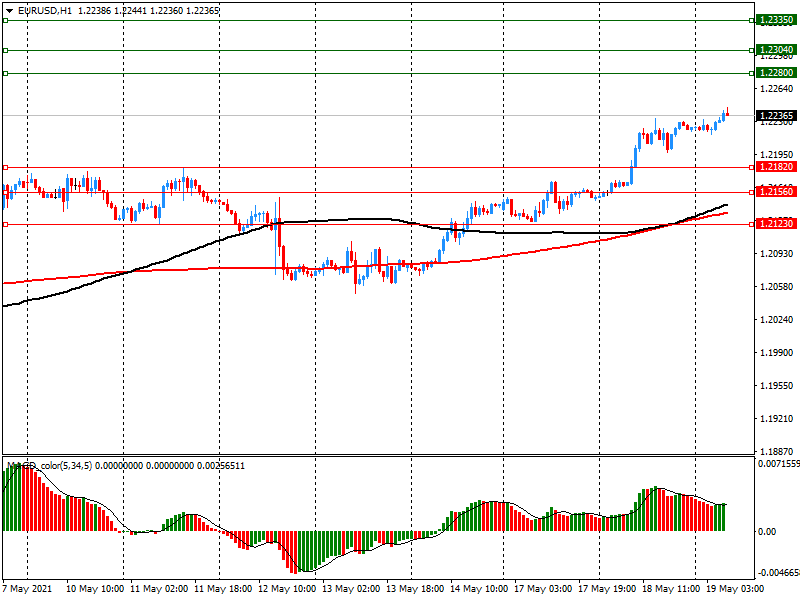
Comments:
- Overall open interest on the CALL options and PUT options with the expiration date June, 4 is 62850 contracts (according to data from May, 18) with the maximum number of contracts with strike price $1,2200 (4109);
GBP/USD
$1.4279 (1537)
$1.4256 (953)
$1.4238 (1886)
Price at time of writing this review: $1.4182
Support levels (open interest**, contracts):
$1.4113 (112)
$1.4054 (404)
$1.3977 (254)
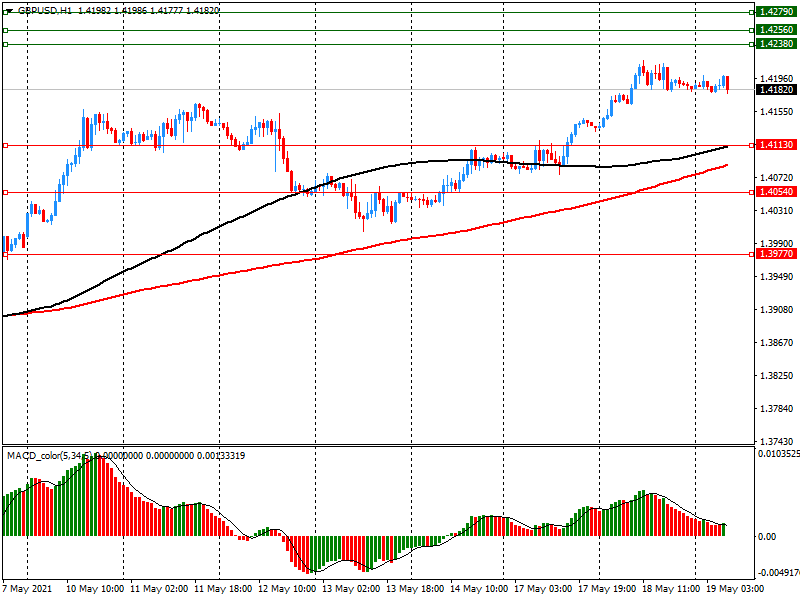
Comments:
- Overall open interest on the CALL options with the expiration date June, 4 is 21671 contracts, with the maximum number of contracts with strike price $1,4350 (3024);
- Overall open interest on the PUT options with the expiration date June, 4 is 32588 contracts, with the maximum number of contracts with strike price $1,3500 (4545);
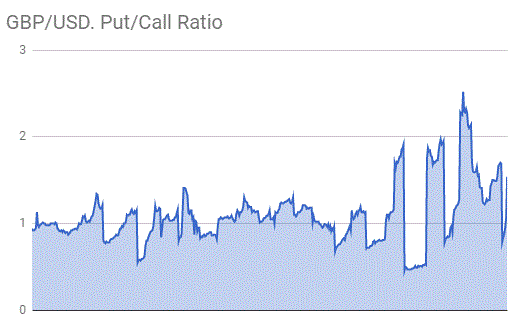
- The ratio of PUT/CALL was 1.50 versus 1.55 from the previous trading day according to data from May, 18
* - The Chicago Mercantile Exchange bulletin (CME) is used for the calculation.
** - Open interest takes into account the total number of option contracts that are open at the moment.
European Automobile Manufacturers Association (ACEA) said that in April 2021, new car registrations surged by 218.6% in the European Union because of last year’s low base of comparison due to coronavirus restrictions. Indeed, despite this big percentage increase, last month’s sales volume was almost 300,000 units lower than that recorded in April 2019. Many markets across the EU region posted double- or even triple-digit percentage gains in April. Italy recorded the biggest uplift (+3,276.8%) of the major markets, followed by Spain (+1,787.9%). France (+568.8%) and Germany (+90.0%) also showed strong gains compared to last year.
From January to April 2021, EU demand for passenger cars increased by 24.4% to reach 3.4 million units registered in total, with the last two months providing a substantial boost. Looking at the four largest markets, Italy and France posted the biggest gains (up 68.4% and 51.0% respectively). At the same time, positive April results brought the cumulative performances of Spain (+18.8%) and Germany (+7.8%) into positive territory for the first time this year.
According to the report from the Office for National Statistics, the Consumer Prices Index (CPI) rose by 1.5% in the 12 months to April 2021, up from 0.7% growth in March. Economists had expected a 1.4% increase. On a monthly basis, the CPI rose by 0.6% in April 2021, following a 0.3% increase in March 2021.
The Consumer Prices Index including owner occupiers’ housing costs (CPIH) rose by 1.6% in the 12 months to April 2021, up from 1.0% growth to March.
The largest upward contributions to the CPIH 12-month inflation rate came from housing and household services (0.57 percentage points), and transport (0.56 percentage points).
On a monthly basis, the CPIH rose by 0.7% in April 2021, following a 0.2% increase in March 2021.
Rising household utility, clothing, and motor fuel prices made the largest upward contributions to CPIH growth in April 2021; these were partially offset by a large downward contribution from recreation and culture.
As a result of the easing of coronavirus (COVID-19) restrictions, the number of CPIH items identified as unavailable in April 2021 fell to 28, accounting for 3.1% of the basket by weight; we collected a weighted total of 77.2% of comparable coverage collected before the first lockdown (excluding unavailable items).
| Time | Country | Event | Period | Previous value | Forecast |
|---|---|---|---|---|---|
| 00:30 (GMT) | Australia | Westpac Consumer Confidence | May | 118.8 | |
| 01:30 (GMT) | Australia | Leading Index | April | 0.38% | |
| 01:30 (GMT) | Australia | Wage Price Index, q/q | Quarter I | 0.6% | 0.5% |
| 01:30 (GMT) | Australia | Wage Price Index, y/y | Quarter I | 1.4% | 1.4% |
| 04:30 (GMT) | Japan | Industrial Production (YoY) | March | -2.0% | |
| 04:30 (GMT) | Japan | Industrial Production (MoM) | March | -1.3% | |
| 06:00 (GMT) | United Kingdom | Producer Price Index - Input (YoY) | April | 5.9% | |
| 06:00 (GMT) | United Kingdom | Producer Price Index - Input (MoM) | April | 1.3% | 1.1% |
| 06:00 (GMT) | United Kingdom | Producer Price Index - Output (MoM) | April | 0.5% | 0.4% |
| 06:00 (GMT) | United Kingdom | Producer Price Index - Output (YoY) | April | 1.9% | 3.5% |
| 06:00 (GMT) | United Kingdom | Retail Price Index, m/m | April | 0.3% | 0.8% |
| 06:00 (GMT) | United Kingdom | HICP ex EFAT, Y/Y | April | 1.1% | |
| 06:00 (GMT) | United Kingdom | Retail prices, Y/Y | April | 1.5% | 2.4% |
| 06:00 (GMT) | United Kingdom | HICP, Y/Y | April | 0.7% | 1.4% |
| 06:00 (GMT) | United Kingdom | HICP, m/m | April | 0.3% | 0.6% |
| 09:00 (GMT) | Eurozone | Harmonized CPI ex EFAT, Y/Y | April | 0.9% | 0.8% |
| 09:00 (GMT) | Eurozone | Harmonized CPI, Y/Y | April | 1.3% | 1.6% |
| 09:00 (GMT) | Eurozone | Harmonized CPI | April | 0.9% | 0.6% |
| 12:30 (GMT) | Canada | Bank of Canada Consumer Price Index Core, y/y | April | 1.4% | |
| 12:30 (GMT) | Canada | Consumer price index, y/y | April | 2.2% | 3.2% |
| 12:30 (GMT) | Canada | Consumer Price Index m / m | April | 0.5% | 0.4% |
| 14:30 (GMT) | U.S. | Crude Oil Inventories | May | -0.427 | 1.68 |
| 15:35 (GMT) | U.S. | FOMC Member Bostic Speaks | |||
| 18:00 (GMT) | U.S. | FOMC meeting minutes | |||
| 23:50 (GMT) | Japan | Core Machinery Orders, y/y | March | -7.1% | -2.6% |
| 23:50 (GMT) | Japan | Core Machinery Orders | March | -8.5% | 6.4% |
| 23:50 (GMT) | Japan | Trade Balance Total, bln | April | 663.7 | 140 |
| Pare | Closed | Change, % |
|---|---|---|
| AUDUSD | 0.7791 | 0.31 |
| EURJPY | 133.087 | 0.3 |
| EURUSD | 1.22231 | 0.59 |
| GBPJPY | 154.435 | 0.06 |
| GBPUSD | 1.41839 | 0.35 |
| NZDUSD | 0.72371 | 0.35 |
| USDCAD | 1.20621 | -0.04 |
| USDCHF | 0.89691 | -0.66 |
| USDJPY | 108.879 | -0.29 |







© 2000-2026. All rights reserved.
This site is managed by Teletrade D.J. LLC 2351 LLC 2022 (Euro House, Richmond Hill Road, Kingstown, VC0100, St. Vincent and the Grenadines).
The information on this website is for informational purposes only and does not constitute any investment advice.
The company does not serve or provide services to customers who are residents of the US, Canada, Iran, The Democratic People's Republic of Korea, Yemen and FATF blacklisted countries.
Making transactions on financial markets with marginal financial instruments opens up wide possibilities and allows investors who are willing to take risks to earn high profits, carrying a potentially high risk of losses at the same time. Therefore you should responsibly approach the issue of choosing the appropriate investment strategy, taking the available resources into account, before starting trading.
Use of the information: full or partial use of materials from this website must always be referenced to TeleTrade as the source of information. Use of the materials on the Internet must be accompanied by a hyperlink to teletrade.org. Automatic import of materials and information from this website is prohibited.
Please contact our PR department if you have any questions or need assistance at pr@teletrade.global.


 Bank
Bank transfers


