- Analytics
- News and Tools
- Market News
Analytics, News, and Forecasts for CFD Markets: currency news — 24-12-2020.
| Time | Country | Event | Period | Previous value | Forecast |
|---|---|---|---|---|---|
| 05:00 (GMT) | Japan | Construction Orders, y/y | November | -0.1% | |
| 05:00 (GMT) | Japan | Housing Starts, y/y | November | -8.3% | -4.9% |
- Arguments with EU were sometimes fierce but this is good deal for whole of Europe
- It will not be bad thing for EU to have prosperous UK on its doorstep
- It will not be bad thing if UK does things differently
- Our basic goals are the same
- Stimulus of the regulatory competition will benefit us both
- There is clause in deal on level playing field that if either dumps/undercuts, they can put on tariffs
- I think its a great treaty
- There opportunity because whole world will be treated the same for export purposes
- This is jumbo Canada-style free trade deal
- There will be real changes
- We have built a new partnership
- Britain has new status as an independent coastal state
- EU will support fishermen
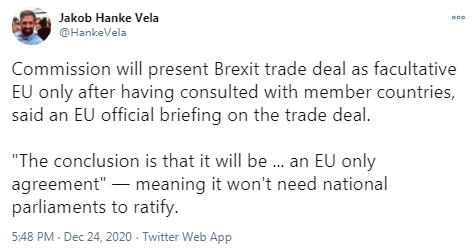
- The proposal will be put to EU Council, EU parliament
- Deal is unprecedented in scope, complexity
“Deal is done.
Everything that the British public was promised during the 2016 referendum and in the general election last year is delivered by this deal
- We have taken back control of our money, borders, laws, trade and our fishing waters
- The deal is fantastic news for families and businesses in every part of the UK. We have signed the first free trade agreement based on zero tariffs and zero quotas that has ever been achieved
- The deal is the biggest bilateral trade deal signed by either side, covering trade worth £668bn in 2019.
- The deal also guarantees that we are no longer in the lunar pull of the EU, we are not bound by EU rules, there is no role for the European Court of Justice and all of our key red lines about returning sovereignty have been achieved. It means that we will have full political and economic independence on 1st January 2021.
- A points-based immigration system will put us in full control of who enters the UK and free movement will end
- We have delivered this great deal for the entire United Kingdom in record time, and under extremely challenging conditions, which protects the integrity of our internal market and Northern Ireland’s place within it.
- We have got Brexit done and we can now take full advantage of the fantastic opportunities available to us as an independent trading nation, striking trade deals with other partners around the world. “
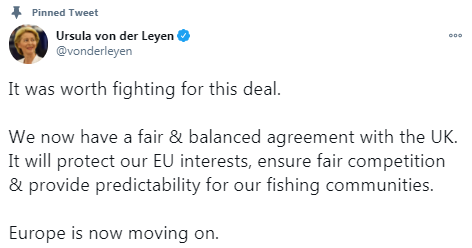

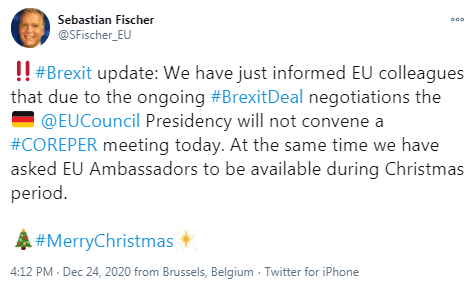
The accord will now go to the UK's Prime Minister (PM) Boris Johnson and European Commission's (EC) president Ursula von der Leyen for their formal approval, the officials, who spoke on condition of anonymity told Bloomberg.

FXStreet notes that the euro has outperformed during 2020 but economists at Credit Suisse see more limited upside potential during 2021, as much as anything due to overcrowded positioning. The 1.2518/98 area is expected to cap the EUR/USD pair.
“We maintain our long-held bias for a higher EUR/USD following the completion of its base above the 1.1495 March high, with the “measured base objective” remaining at 1.2355, with 1.2518/98 still our core objective – the 2018 high, 38.2% retracement of the entire 2008/2017 bear market and 61.8% retracement of the 2014/2017 fall. With heavy long positioning still in place, we expect this to remain a formidable barrier, suggesting the EUR may not be the best expression of USD weakness during 2021.”
Statistics
Canada announced on Thursday that the value of building permits issued by the
Canadian municipalities surged 12.9 percent m-o-m in November, following a
revised 12.6 percent m-o-m tumble in October (originally a plunge of 14.6
percent m-o-m).
Economists had
forecast a 3.0 percent increase in November from the previous month.
According to
the report, the value of residential permits climbed 10.0 percent m-o-m in November,
as single-family permits rose 4.4 percent m-o-m, while permits for multi-family
dwellings surged 14.8 percent m-o-m.
At the same
time, the value of non-residential building permits jumped 19.5 percent m-o-m
in November, due to gains in commercial (+31.2 percent m-o-m) and institutional
(+23.2 percent m-o-m) permits, which more than offset a decline in industrial permits
(-9.3 percent m-o-m).
In y-o-y terms,
building permits rose 16.2 percent in November.
FXStreet reports that economists at Credit Suisse maintain an existing core bearish USD outlook and look for further significant weakness in 2021 as part of a structural USD bear market, although early 2021 is likely to see a pause in the bear trend.
“The early December acceleration in the USD decline leaves the BBG DXY reversing from just ahead of our next core objective and what we see as significant support at 1110/05 – the key 2018 low and the 50% retracement of the entire 2011/2020 bull market. Given the importance of this support, we look for it to hold at first for a consolidation phase and more likely some form of USD recovery, which may well come to dominate the very early part of 2021.”
“USD bears should be alert to the risk that such a consolidation/recovery could last quite some time, possibly months. Crucially though, the ‘measured objective’ from the 2020 top is below the 2018 low and our base case is still for a clear and sustained move below 1110/05 later in 2021 for a move to our ‘measured top objective’ at 1074.”
FXStreet reports that analysts at Credit Suisse expect the USD to depreciate on a broad basis and the preferred expression of this view is still the pro-cyclical Commodity currencies such as the aussie. AUD/USD is forecast to be capped by the 0.7574/7638 area in early 2021 but the pair should reach the 2018 high of 0.8136 later in the year.
“AUD/USD remains in a clear medium-term uptrend after completing a major ‘head and shoulders’ base in July and has already reached our first core upside objective at a cluster of long-term Fibonacci retracements at 0.7574/7638, which is expected to cap the market early on in 2021.”
“The basing structure is substantial enough in size to suggest that AUD/USD has the potential to test the key 0.8136 high of 2018 later in the year. This, in addition to the 50% retracement of the entire 2011/2020 fall just above at 0.8296, is likely to be a tougher barrier.”
GBP rose against its major rivals in the European session on Thursday, as the UK and the EU's officials are expected to confirm a much-anticipated Brexit trade deal today.
In the morning, Ireland’s foreign minister Simon Coveney said that a “last-minute hitch” related to “small text” of a fisheries agreement delayed an announcement of the deal, but it is still expected "later on day".

eFXdata reports that CitiFX Technicals discusses EUR/USD long-term outlook and flags a scope for a move into 1.40 in 2021.
"A 3 rd bullish outside year (Potentially) in the history of floating exchange rates will come on a yearly close above 1.1570. This also comes off long-term trend line support from 1985".
"Yearly momentum is turning up and crossing over from levels only seen twice before- 1986, 17 years later in 2003 and 17 years later in 2020... The 2002-2004 move was a mere 60%."
- However, recovery will be gradual, and won’t happen in quarter or two
- Rollout of coronavirus vaccines and improvement in U.S.-China ties are likely to improve demand for oil
- UAE isn’t concerned about new mutations of coronavirus; global health sector can find solution to this virus
- OPEC+ alliance of oil producers has successfully mitigated impact of reduced demand
- UAE hopes more producers would join in the future
FXStreet notes that currently we have a choice between two types of monetary assets: currencies whose supply increases without limit and currencies whose supply is exogenous. Investors do not want to hold both types of currencies: the former are losing their value, the latter have abnormally high price volatility. What would be needed is an intermediate currency between public currencies and Bitcoin, according to economists at Natixis.
“The money supply corresponding to public currencies (dollar, euro, yen, pound sterling, Swiss franc, etc.) has increased considerably. This considerable increase in the supply of central bank money may lead to a decline in the value of money (the same amount of money has a lower capacity to purchase goods or assets; it is well known that in contemporary economies it is mainly asset prices that are rising, i.e. it is the value of money in its capacity to purchase assets that is falling) and a loss of confidence in money as economic agents anticipate the loss in value of money, they try to get rid of the money they hold.”
“The number of Bitcoins supplied is exogenous, predetermined and increases less and less. This raises a serious problem: since the supply of Bitcoin is exogenous, any shock to the demand for Bitcoin results in a drastic fluctuation in its price. This explains the recent very strong rise in the price of Bitcoin, but this rise could be much stronger, as it would be sufficient for a small fraction of the world's money supply to be invested in Bitcoin. So the result is massive volatility in the price (exchange rate) of all currencies – such as Bitcoin – whose supply is exogenous.”
“Investors do not want to hold both types of currencies: the former are losing their value, the latter have an abnormally high price volatility. An intermediate currency, whose supply is managed, would be needed: the money supply would not increase excessively, and would respond to demand shocks to stabilise prices (i.e., interest rates and exchange rates). This is what central banks used to do in the past, not what they are doing nowadays.”
eFXdata reports that Danske Research discusses EUR/CHF outlook.
"Following the relief rally in EUR/CHF since early summer, spot remains largely unchanged. The SNB is preparing to continue sweating out the deflationary pressure in the Swiss economy and intervention remains the key policy tool. With the ECB set to hold rates and opt for other easing tools, Swiss policy rates are also set to stay unchanged at the longstanding -0.75% for an extended period of time," Dasnke notes.
"Towards Q1, our base case is another jump higher in EUR/CHF," Danske adds.
Reuters reports that French medical regulator HAS said on Thursday it had approved the vaccine developed by Pfizer and BioNTech for France's vaccination rollout, after the European Medicines Agency gave its go-ahead on Monday.
The European Union is gearing up for a vaccination campaign of unprecedented scale following regulatory approval for the shot. France plans to start its vaccination programme on Dec. 27.
Reuters reports that China has issued guidelines on developing its social credit system, which is aimed at promoting trust in companies and individuals, amid public concerns over data management and invasion of privacy.
The cabinet issued guidelines on Thursday saying the government will promote high-quality development of its social credit system and build a long-term mechanism to deter dishonest behaviours to help create a "fair and honest market environment".
According to the guidelines, data and information on any dishonest behaviour among firms or individuals and related punishments will be handled according to law, the guidelines said.
In the guidelines, the cabinet said China will learn from global experience in building its credit system and follow international standards, treading cautiously in areas where there are significant public concerns.
FXStreet reports that according to Zac Tate, Joe Little and Hussain Mehdi, HSBC’s Global Investment Strategy Team, with bond yields ultra-low, the case for “new diversifiers” in the portfolios is compelling.
“In a year of restoration, allocating to equities still makes sense, but we will need to be dynamic in tilting between countries and regions. We also believe there are good opportunities in emerging markets fixed income – which should benefit from a weaker dollar and low US real interest rates – and also in a range of alternative asset classes such as private equity.”
Bloomberg reports that currency strategists are delivering a reality check on how far the pound rally can go if the U.K. and European Union finally clinch an historic trade deal.
The general consensus is that much of the optimism is already priced in, with the currency up more than 9% since the end of June while the relative cost of hedging pound weakness over the next year at its lowest since March.
The pound will probably advance to $1.37 if the U.K. and European Union finalize a trade deal on Christmas Eve, according to Credit Agricole SA.
Canadian Imperial Bank of Commerce says sterling could touch $1.3715, although it recommends selling the rally.
“The upside is pretty marginal now,” said Adam Cole, RBC Europe Ltd.‘s head of currency strategy. “Taking the bookies’ quotes as a proxy, the probability of a deal rose from 50% at the weekend to 90% yesterday, so I think the repricing is largely done.”
Reuters reports that the Chinese foreign ministry on Thursday denied that talks on an investment pact between the European Union and China had run into complications due to Chinese demands on nuclear power investment.
“As I understand, talks are goings smoothly,” Chinese foreign ministry spokesman Wang Wenbin told a news briefing on Thursday.
“The news about talks being stuck because China has put up more requests about nuclear energy is fake,” Wang said.
He did not deny or confirm that China had made fresh demands on nuclear energy investment.
“China wants to invest in European nuclear power plants and use Chinese technology in this area,” WirtschaftsWoche cited EU sources as saying.
During the negotiations, China had indicated to its European counterparts that it viewed its own technology in this field as more advanced, the report said.
FXStreet reports that according to economists at Westpac, a Brexit deal appears to be imminent with only seven days remaining in the transition period.
“This time it really does appear that a deal will be struck just in time for Christmas.”
“If a deal does transpire on 24th December, GBP is likely to make further gains. GBP/USD is likely to push into a 1.37-1.40 range but potential for a more substantial move towards 1.4500 now seems unlikely given how positions exhaustion is so prevalent. Similarly, EUR/GBP is likely to slide below 0.9000 towards 0.8800 but scope for a shift to 0.8500 also seems unlikely.”
“Risks remain though. Contentious issues from either side could still derail negotiations. Also, once approved by UK Parliament and EU Parliament, the EU-27 nations need to ratify this and it could throw up surprise opposition to the deal and so create uncertainty about its sustainability and full implementation.”
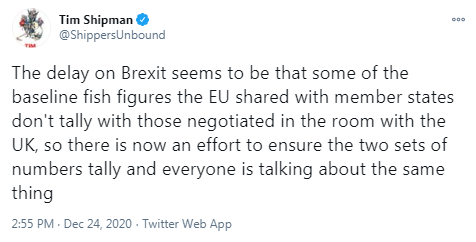
Reuters reports that Irish Foreign Minister Simon Coveney said that a last minute hitch related to fishing has delayed the agreement of a British-European Union trade deal, but an announcement is expected later on Thursday.
British Prime Minister Boris Johnson "had been due to hold a news conference around now. That hasn't happened. So there is some sort of last-minute hitch" related to "small text" of a fisheries agreement, Coveney told Ireland's RTE radio.
FXStreet reports that loonie’s recovery is losing momentum and though economists at RBC Economics expect the Cadandian dollar to stay robust in the first half of 2021, the USD/CAD is set to recover toward end-2021.
“A partial recovery in WTI and stronger pickup in other commodity prices has helped the Canadian dollar, but it’s a broadly weaker US dollar that is really flattering the loonie.”
“With the US likely to lead the recovery among developed economies next year, we don’t see the US dollar continuing to lose ground. The Canadian dollar is expected to hold onto its recent gains over the first half of next year before drifting lower toward the end of 2021 and into 2022 as markets begin to contemplate rate hikes by the Fed.”
| Time | Country | Event | Period | Previous value | Forecast | Actual |
|---|---|---|---|---|---|---|
| 00:00 | Japan | BOJ Governor Haruhiko Kuroda Speaks |
During today's Asian trading, the US dollar fell against the euro, stabilized against the yen amid weakening demand for safe haven assets after reports about the prospect of a post-Brexit agreement between the UK and the European Union.
The ICE index, which tracks the dollar's performance against six currencies (euro, swiss franc, yen, canadian dollar, pound sterling and swedish krona), fell 0.23%.
Market participants hope that the UK and the EU will sign an agreement before Christmas, the growth of confidence puts pressure on the US national currency, experts say, CMC Markets.
European media yesterday reported with references to diplomatic sources about the approach of the UK and the EU to the successful completion of negotiations and alleged concessions from the British side, in particular, on fishing, although no official information from the EU institutions was received.
Investors did not seem to react to US President Donald Trump's remarks about new stimulus measures. Trump called the new fiscal stimulus package a "disgrace" and expressed his desire for the U.S. Congress to amend the COVID-19 pandemic relief bill and increase payments to Americans and small businesses.
U.S. lawmakers this week agreed on a new $900 billion program to support the economy, including direct payments to citizens in the amount of $600.
eFXdata reports that Credit Suisse discusses NZD/USD technical outlook.
"We might see another near -term consolidation phase over the next few days, prior to a resumption of the core bull trend. A clear and closing break above .7151 would ensure a direct continuation of the core bull trend, with resistance then seen at .7171 and then .7200, with a lack of meaningful medium -term resistance above here until .7395," CS notes.
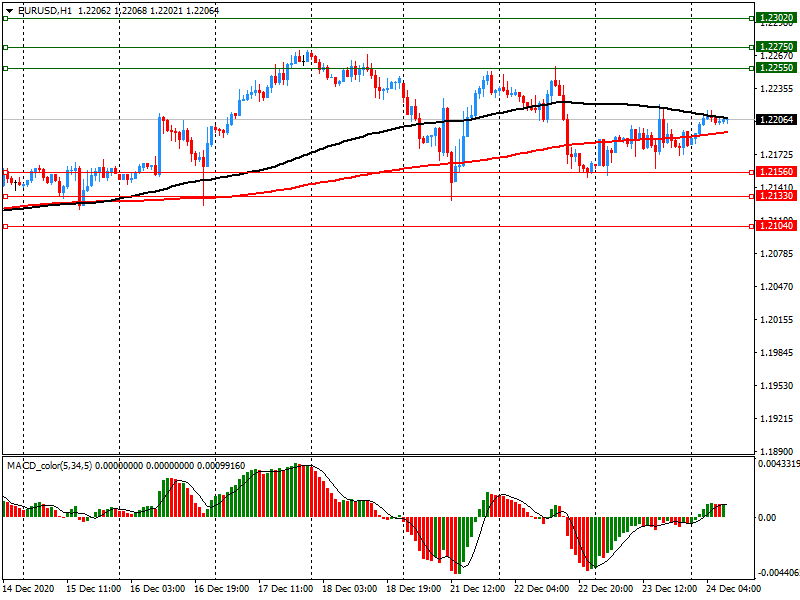
EUR/USD
Resistance levels (open interest**, contracts)
$1.2302 (1448)
$1.2275 (1291)
$1.2255 (949)
Price at time of writing this review: $1.2206
Support levels (open interest**, contracts):
$1.2156 (3535)
$1.2133 (1419)
$1.2104 (2247)
Comments:
- Overall open interest on the CALL options and PUT options with the expiration date January, 8 is 77668 contracts (according to data from December, 23) with the maximum number of contracts with strike price $1,2100 (4842);
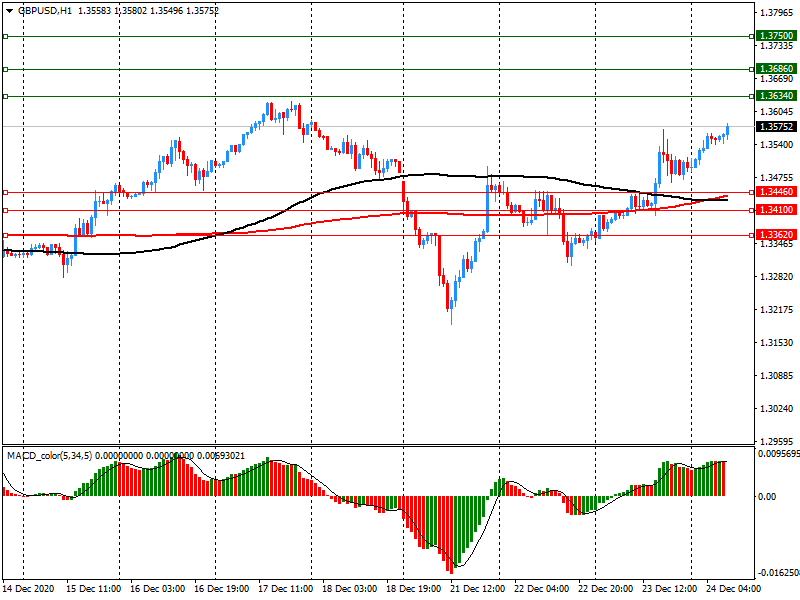
GBP/USD
Resistance levels (open interest**, contracts)
$1.3750 (2175)
$1.3686 (1135)
$1.3634 (1231)
Price at time of writing this review: $1.3575
Support levels (open interest**, contracts):
$1.3446 (285)
$1.3410 (426)
$1.3362 (523)
Comments:
- Overall open interest on the CALL options with the expiration date January, 8 is 58770 contracts, with the maximum number of contracts with strike price $1,4000 (33096);
- Overall open interest on the PUT options with the expiration date January, 8 is 28841 contracts, with the maximum number of contracts with strike price $1,2800 (2941);
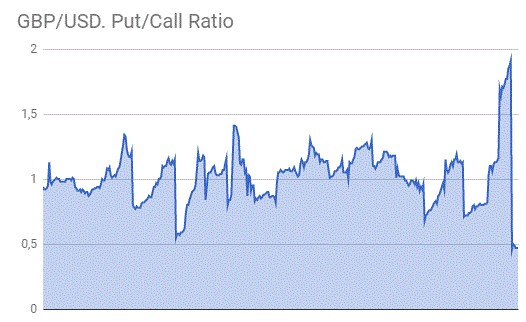
- The ratio of PUT/CALL was 0.49 versus 0.49 from the previous trading day according to data from December, 23
* - The Chicago Mercantile Exchange bulletin (CME) is used for the calculation.
** - Open interest takes into account the total number of option contracts that are open at the moment.
eFXdata reports that ANZ Research discusses its outlook for the BoJ policy trajectory.
"The BoJ continues to stand ready to do more if needed, but it hasn’t made any notable adjustment for some time. The BoJ recently offered 0.1% interest on some of its reserves to regional banks that made decisions to merge and/or demonstrated cost savings," ANZ notes.
"The move reflects growing concern over the health of regional banks after a prolonged period of negative rates and a very flat yield curve. Governor Kuroda has played down the significance of the move for monetary policy. He says the adjustment is needed for prudential reasons. This possibly keeps the door open to take rates deeper into negative territory if the currency appreciates sharply," ANZ adds.
Reuters reports that Bank of Japan Governor Haruhiko Kuroda said the central bank’s planned policy examination will seek to make its stimulus programme “nimble” to counter future shocks, such as the coronavirus crisis that has deepened the country’s recession.
While the BOJ will not overhaul its yield curve control (YCC) policy, it will examine whether its operations, tools and asset purchases are working well, Kuroda said on Thursday.
“If there is anything more that can be done to make our policy more effective and sustainable, we’ll put it into place,” he told a meeting of business lobby Keidanren.
Simply maintaining YCC for a prolonged period is not enough, Kuroda said, stressing the examination will seek to address any rigidity that may have emerged from years of massive stimulus.
In a rare acknowledgement of the disadvantages of prolonged easing, Kuroda said the BOJ’s stimulus was not without costs such as market distortions caused by its huge asset buying and the hit to bank profits from ultra-low interest rates.
| Time | Country | Event | Period | Previous value | Forecast |
|---|---|---|---|---|---|
| 00:00 (GMT) | Japan | BOJ Governor Haruhiko Kuroda Speaks | |||
| 13:30 (GMT) | Canada | Building Permits (MoM) | November | -14.6% | 3% |
| 23:30 (GMT) | Japan | Tokyo CPI ex Fresh Food, y/y | December | -0.7% | -0.8% |
| 23:30 (GMT) | Japan | Tokyo Consumer Price Index, y/y | December | -0.7% | |
| 23:30 (GMT) | Japan | Unemployment Rate | November | 3.1% | 3.1% |
| 23:50 (GMT) | Japan | Retail sales, y/y | November | 6.4% | 1.7% |
| Pare | Closed | Change, % |
|---|---|---|
| AUDUSD | 0.75772 | 0.76 |
| EURJPY | 126.138 | 0.12 |
| EURUSD | 1.21826 | 0.19 |
| GBPJPY | 139.736 | 0.96 |
| GBPUSD | 1.34962 | 1.05 |
| NZDUSD | 0.70934 | 0.77 |
| USDCAD | 1.28448 | -0.47 |
| USDCHF | 0.88825 | -0.09 |
| USDJPY | 103.532 | -0.07 |







© 2000-2026. All rights reserved.
This site is managed by Teletrade D.J. LLC 2351 LLC 2022 (Euro House, Richmond Hill Road, Kingstown, VC0100, St. Vincent and the Grenadines).
The information on this website is for informational purposes only and does not constitute any investment advice.
The company does not serve or provide services to customers who are residents of the US, Canada, Iran, The Democratic People's Republic of Korea, Yemen and FATF blacklisted countries.
Making transactions on financial markets with marginal financial instruments opens up wide possibilities and allows investors who are willing to take risks to earn high profits, carrying a potentially high risk of losses at the same time. Therefore you should responsibly approach the issue of choosing the appropriate investment strategy, taking the available resources into account, before starting trading.
Use of the information: full or partial use of materials from this website must always be referenced to TeleTrade as the source of information. Use of the materials on the Internet must be accompanied by a hyperlink to teletrade.org. Automatic import of materials and information from this website is prohibited.
Please contact our PR department if you have any questions or need assistance at pr@teletrade.global.


 Bank
Bank transfers


