- Analytics
- News and Tools
- Market News
Analytics, News, and Forecasts for CFD Markets: currency news — 21-12-2020.
| Time | Country | Event | Period | Previous value | Forecast |
|---|---|---|---|---|---|
| 00:30 (GMT) | Australia | Retail Sales, M/M | November | 1.4% | -0.6% |
| 07:00 (GMT) | Germany | Gfk Consumer Confidence Survey | January | -6.7 | -9 |
| 07:00 (GMT) | United Kingdom | PSNB, bln | November | -22.3 | -29 |
| 07:00 (GMT) | United Kingdom | Business Investment, q/q | Quarter III | -26.5% | |
| 07:00 (GMT) | United Kingdom | Business Investment, y/y | Quarter III | -26.1% | |
| 07:00 (GMT) | United Kingdom | Current account, bln | Quarter III | -2.8 | -9.5 |
| 07:00 (GMT) | United Kingdom | GDP, y/y | Quarter III | -21.5% | -9.6% |
| 07:00 (GMT) | United Kingdom | GDP, q/q | Quarter III | -19.8% | 15.5% |
| 13:30 (GMT) | U.S. | PCE price index, q/q | Quarter III | -1.6% | 3.7% |
| 13:30 (GMT) | U.S. | PCE price index ex food, energy, q/q | Quarter III | -0.8% | 3.5% |
| 13:30 (GMT) | U.S. | GDP, q/q | Quarter III | -31.4% | 33.1% |
| 15:00 (GMT) | U.S. | Richmond Fed Manufacturing Index | December | 15 | |
| 15:00 (GMT) | U.S. | Existing Home Sales | November | 6.85 | 6.7 |
| 15:00 (GMT) | U.S. | Consumer confidence | December | 96.1 | |
| 23:50 (GMT) | Japan | Monetary Policy Meeting Minutes |
FXStreet notes that the Norwegian krone has underperformed relative to the euro and the Swedish krona in 2020. Economists at MUFG Bank expect higher oil prices to offer more support for NOK in 2021 while yield spreads should move back more in favour of NOK in 2021. Therefore, the NOK is set to rebound in the year ahead against both the EUR and SEK.
“We expect the NOK to continue to gradually recover lost ground against the EUR and SEK in the year ahead as the negative COVID-19 shock fades. EUR/NOK and NOK/SEK are currently testing important resistance levels at 10.500 and at just above 0.9600 which could open the door to further NOK gains.”
“The price of Brent crude oil has risen back above $50/barrel. The performance of the NOK has become more closely correlated with the price of oil this year and we expect the NOK to remain more tightly linked to the price of oil in the year ahead.”
“The NOK should continue to benefit from the Norges Bank’s relatively hawkish policy stance. The Norges Bank brought forward plans for the first rate hike by around six months on the back of earlier vaccine roll-out, a relatively well contained second COVID-19 wave in Norway and a strong housing market. In contrast, the ECB and Riksbank are facing increasing pressures from strengthening currencies to consider lowering rates further.”
- Says Pfizer-BioNTech vaccine is safe and effective against Covid-19
- It will take time to roll out vaccines in sufficiently large numbers to enable all our citizens to be protected
- Vaccines alone will not be silver bullet that will allow us to return to normal life
- But the authorization of this first vaccine is definitely a major step in right direction and indication that 2021 can be brighter than 2020
FXStreet notes that a new coronavirus strain in the UK triggered flight bans and heightened concerns but the pound weakness also partly reflects some disappointment that the EU and UK have again failed to make a breakthrough in Brexit trade talks over the weekend. Economists at MUFG Bank expect the GBP/USD pair to decline to around 1.25 in a no-deal outcome.
“The European Parliament, which has a veto over the whole agreement, has warned it won’t be able to ratify any deal in time for the end of the transition period on 31 December unless it was presented with one by midnight on Sunday.”
“The trade talks are set to resume today. We are still hopeful that a last-minute trade deal will be struck to avoid introducing further self-imposed economic disruption on top of the ongoing COVID-19 crisis.”
“Even if a last-minute trade deal is reached upside potential for the pound has now been dampened by recent negative COVID-19 developments in the UK. Cable could now struggle to advance much beyond the 1.3500-level whereas a no-deal outcome would see a return to the mid-1.2000’s.”
The European
Commission (EC) said on Monday its flash estimate showed the consumer
confidence indicator for the Eurozone rose by 3.7 points to -13.9 in December from
an unrevised -17.6 in the previous month. That was the highest reading
since September.
Economists had
expected the index to increase to -16.8.
Considering the
European Union (EU) as a whole, consumer sentiment improved by 3.4 points to -15.3.
Despite this
month’s gains, both indicators remained well below their long-term averages of
-11.2 (Eurozone) and -10.7 (EU).
- We couldn't be more pleased that we got this deal done in time
- We restored the destructibility of meal expenses for businesses
- $600 payments will be quickly recycled back into the economy
- Small businesses that are down 25% will get a second check from PPP
- Bill includes rental assistance
- There is bipartisan support for the airline industry
- Majority of Fed facilities were not spent
The Chicago
Federal Reserve announced on Monday the Chicago Fed national activity index
(CFNAI), a weighted average of 85 different economic indicators, came in at
0.27 in November, down from an upwardly revised 1.01 in October (originally
0.83), pointing to slower growth in economic activity than in the previous month.
That was the lowest reading since the sharp decline in April.
At the same
time, the index’s three-month moving average fell to +0.56 in November from
+0.85 in October.
According to
the report, three of the four broad categories of indicators used to construct
the index made positive contributions in November, but all four categories declined
from October.
Production-related
indicators made a positive contribution of +0.14 to the CFNAI in November, down
from +0.36 in October. Employment-related indicators contributed +0.15 to the
CFNAI in November, down from +0.45 in the previous month. The contribution of
the sales, orders, and inventories category to the CFNAI reduced to +0.07 in November
from +0.17 in October. Meanwhile, the contribution of the personal consumption
and housing category to the CFNAI worsened to -0.09 in November from +0.02 in October.
Statistics
Canada reported on Monday the New Housing Price Index (NHPI) rose 0.6 percent
m-o-m in November, following a 0.8 percent m-o-m gain in the previous month.
According to
the report, new home prices rose in 21 out of the 27 census metropolitan areas
(CMAs) surveyed in November, with Kitchener-Cambridge-Waterloo (+2.1 percent
m-o-m), Ottawa (+2.1 percent m-o-m) and Gatineau (+2.0 percent m-o-m) recording
the largest monthly gains. On the
contrary, Regina (-0.1 percent m-o-m) was the only CMA with decreased new home
prices in November.
In y-o-y terms,
NHPI climbed 4.6 percent in November, following a 3.9 percent advance in the
previous month. This was the largest y-o-y increase since April 2008.
- Says significant gaps remain in trade talks with EU
- Britain will continue to work to try to bridge those gaps
- UK would need to ratify any agreement before January 1
- Time is in very short supply
- UK government is working closely with international partners to minimize travel disruption due to new variant of COVID-19
- People should stop panic buying; we have resilient supply chains
GBP declined against its major rivals in the European session on Monday, as a discovery of a new COVID variant in the UK triggered additional lockdown measures in London and travel restrictions across the Europe, and there was no sign of a breakthrough in trade negotiations between the UK and the EU as the end of Brexit transition period looms.
The UK's Prime Minister (PM) Boris Johnson was prompted to order additional lockdown measures for London and the southeast of England ahead of the Christmas holidays to contain a new strain of Covid-19, which spreads more quickly than its predecessor. The European countries also imposed strict travel bans to stop the new variant of coronavirus.
Adding to pessimism, the EU-UK talks on post-Brexit trade relations appeared stalled as significant differences remain between the two sides just days before the transition period ends at the end of the year. Ireland’s Foreign Minister Simon Coveney said that the Brexit talks were not in a good place, with fishing remaining the main sticking point. "There needs to be a middle-ground position found on fishing," he noted. "It's very unlikely that EU states will support a further offer on fishing from that offered at the weekend." The two sides have less than two weeks to make a deal.
FXStreet notes that EUR/USD has gapped lower and with a bearish RSI momentum divergence in place, the Credit Suisse analyst team looks for a correction to the uptrend but with the broader trend still seen higher.
“EUR/USD strength looks to have peaked near-term with the market gapping lower at the open this morning and with daily RSI momentum having failed to confirm the latest high, we look for a correction to the core uptrend to emerge, but with this seen as a temporary pause within the broader uptrend.”
“Support is seen initially at the 13-day exponential average at 1.2145/41 ahead of price support at 1.2126/16, which we look to try and hold. A break though would raise the prospect of a more concerted setback and a fall back to the 1.2059 recent low, potentially as far as what we expect to be better support at 1.2017/11 – the 38.2% retracement of the November/December rally and September high – with a better floor expected here.”
“Resistance is seen at 1.2213 initially, then the price gap from the open this morning at 1.2236/59."
FXStreet reports that economists at HSBC note that the AUD, CAD and NZD have been amongst the best performing G7 currencies so far in Q4 2020 and will continue to capitalize on a ‘V-shaped’ global recovery.
“The AUD, CAD and NZD have been amongst the best performing G7 currencies so far in Q4 2020, with the NZD at the top of the list. Their outperformance against the USD will likely extend into 2021, as the three currencies will capitalize on a ‘V-shaped’ upswing in global economic activity, given their commodity-based personality and positive correlation with risk appetite. However, the CAD may be less well placed than the AUD and NZD, for example, to capitalize on this synchronized upswing theme, barring a surge in oil prices, which is not our base case.”
“While we are wary about high debt levels through the many segments of the Canadian economy, they are likely to manifest as CAD underperformance against the less indebted AUD and NZD, rather than outright CAD weakness against the USD.”
“We expect a better year ahead for the AUD, CAD and NZD against the USD amid an improving global economy, while relative growth prospects and debt profiles should see the CAD underperform the AUD and NZD.”
FXStreet reports that analysts at Credit Suisse note that EUR/GBP remains above the key 200-day average and price support at 0.8988/82 and is honing in on the key 0.9230 high following sharp strength this morning.
“EUR/GBP again held key support from its recent low and 200-day average at 0.8988/82 last week and with the market gapping higher this morning, a sideways trend has been reinforced, albeit with the immediate risk higher.”
“Key resistance remains seen at the recent high at 0.9230. Above here would end any lingering thoughts of a potential top and clear the way for a likely panicky move to test of the more important September high at 0.9292, where we would expect to see fresh sellers to maintain the sideways range.”
“Immediate support is seen at 0.9102, then the price gap from this morning at 0.9078/61."
The
Confederation of British Industry (CBI) reported on Monday its latest survey of
retailers showed retail sales volume balance stood at -3 in the year to December,
up sharply from -23 in November. That was the highest reading since the positive
one in September, pointing to a recovery in retail sales volumes that brought them broadly flat for the year to December after two months of sharp declines.
Economist had
forecast the reading to improve to 0.
However, retail sales volumes are expected to fall steeply in the year to January (-33).
The report also revealed that orders placed on suppliers were broadly flat (balance of -4, from -10 in November), but are seen to decrease again next month (-21). Meanwhile, stock levels in relation to expected sales were seen as broadly adequate (balance of +3, from +14), however, this was the lowest balance since September 2009. Relative stock levels are forecast to advance next month (+8).
“It says something about the challenges the retail sector has faced during 2020 that stable sales volumes in the run-up to Christmas were seen as a good result for the time of year”, noted Ben Jones, CBI Principal Economist. “The new year looks set for an unpromising start, with retailers anticipating a sharp fall in sales in January. An expected deterioration in the labour market will likely weigh on household spending, even assuming the roll-out of Covid-19 vaccines paves the way for a gradual lifting of restrictions as the year progresses.”
FXStreet suggests that for financial markets the pandemic has meant unprecedented levels of fiscal and monetary policy support. Real yields have dropped in the US and this has resulted in a weak USD. According to economists at Rabobank, the US dollar is set to remain on the back foot into 2021.
“Since investors are anticipating that central banks are ready to use expanding balance sheets to protect them from the downdraught of bad economic news, it seems likely that sell offs could run into good support. This implies that the USD is likely to remain soft against a basket of currencies in the New Year.”
“Few central banks will welcome an appreciation in their currencies vs the USD. This suggests very generous policy settings from a number of central banks and a hint of a currency war theme.”
“The Fed has encouraged the consensus to expect that it is willing to lean on the yield curve to ensure rates remain low until it is comfortable that it has made further progress towards its targets for maximum employment and price stability. Real interest rates in the US could remain low for a protracted period.”
FXStreet reports that according to economists at MUFG Bank, the new covid variant challenges optimism over stronger global recovery and dampens sterling’s appeal in the end of the year.
“The new strain has already triggered a spike in new COVID-19 cases in the South of England prompting the UK government to place much of South East England, the east of England and London into tougher Tier 4 restrictions including shutting non-essential shops and personal services again and restricting travel between regions in attempt to slow the spread of the new virus strain across the country. In time the new Tier 4 restrictions will be imposed across the rest of the country as the new strain continues to spread.”
“The new tougher restrictions will likely have to remain in place until there has been greater vaccine roll out which could take months.”
“The negative developments clearly have increased downside risks for the UK economy and the pound, and will dampen the scope for any gains on the back of a Brexit trade deal before year end. The failure to contain the less contagious covid strains does not give us much hope that the new strain will not spread across the world creating similar disruption as in the UK. It provides some much needed relief for the US dollar following the recent heavy sell off.”
Bloomberg reports that according to mortgage lender Halifax, U.K. home prices could slump as much as 5% next year as unemployment rises and government incentives end.
House prices surged the most since 2016 this year as demand for more space, state support for wages and a temporary reduction in a property transaction tax offset the economic damage from the Covid-19 pandemic. That won’t last, Halifax said Monday.
“The post-summer surge in house prices is unlikely to be sustained,” said Managing Director Russell Galley. Because of “lower levels of demand,” market “activity is likely to slow.”
FXStreet reports that economists at Nordea discuss the EUR/USD outlook.
“Relative financial conditions between the Euro area and the US are pointing to a substantial possibility of US outperformance of the euro area in 2021 but as long as the global growth rebound is perceived as synchronized and broad-based, the USD smile is telling you to buy EUR vs. USD. This narrative may be tested if the gap between US and RoW growth grows too big during H2-2021.”
“We believe in a move towards 1.25-1.27 but we also find it worthwhile considering accepting a take-profit level around 1.25-1.27 in return for a put around 1.19 in EUR/USD.”
The economy is likely to contract 1% in the fourth quarter of 2020,
Economy to shrink by even more in Q1 2021
Second hard lockdown in Germany will hit economic output in the winter
Only if the situation stabilizes will the economy return to a recovery path in February.
Reuters reports that China said on Monday it firmly opposed U.S. President Trump signing a bill that would kick Chinese companies off U.S. stock exchanges unless they adhere to U.S. auditing standards.
“This is nothing but an unjustified political crackdown on Chinese enterprises listed in the United States,” foreign ministry spokesman Wang Wenbin told a daily new briefing in Beijing.
“It will seriously hinder the normal listing of Chinese companies and distort the basic market economy rules that the U.S. has always touted,” Wang said.
FXStreet reports that China is set to continue to implement ‘proactive fiscal policy’ and ‘prudent monetary policy’ in 2021 while economists at Standard Chartered continue to expect gradual credit tightening and fiscal consolidation in 2021, but no policy rate hikes.
“Economic policy must maintain continuity, stability and sustainability in 2021, as the foundation of the economic recovery is not solid, according to the CEWC. China should maintain ‘proactive fiscal policy’ and ‘prudent monetary policy’, with no sharp policy turns in 2021; ‘flexible, accurate and appropriate’ monetary policy to keep money supply and total social financing (TSF) growth consistent with nominal economic growth to stabilise the macro leverage ratio; and aim fiscal policy at improving efficiency and sustainability, maintaining appropriate expenditure and ensuring support for major national strategic objectives.”
“We expect the official budget deficit to be lowered to 2.8% of GDP in 2021 from 3.6% budgeted in 2020. The broad budget deficit is likely to be lowered to c.6% of GDP in 2021, from an expected actual deficit of 8% in 2020.”
FXStreet reports that according to economists at Rabobank, the 1.45 mark would be an ambitious target for investors.
“The 38.2% Fibonacci retracement of the 2008-2017 trend lower is the next objective for the EUR bulls, around 1.25.”
“Given that the previous two major moves higher this year were followed by pullbacks, another correction is most likely to unfold in the coming weeks.”
“We are not particularly bullish on the euro, but those market participants who expect the single currency to perform particularly well in the coming years may have an ambitious target at around 1.45 obtained by measuring the distance between the 2017/16 low and the key trendline. Note that using the same simple technic in reverse provided an accurate bearish target in 2015.”
| Time | Country | Event | Period | Previous value | Forecast | Actual |
|---|---|---|---|---|---|---|
| 00:00 | Japan | BOJ Governor Haruhiko Kuroda Speaks |
During today's Asian trading, the US dollar rose strongly against major world currencies amid growing demand for safe haven currencies after information emerged about the spread of a new type of coronavirus in the UK. The news overshadowed reports that U.S. lawmakers have finally agreed on a new package of measures to support the economy.
The British authorities decided on Sunday to introduce the most stringent restrictive measures on the movement of residents of London and almost the entire south-east of England due to a new type of coronavirus infection. Some of the European countries have announced the restriction or termination of transport links with the UK.
Reducing risk appetite in global markets is also contributing to growing expectations that Britain and the EU will not be able to conclude an agreement governing their future relationship before the Brexit transition period expires on January 31, 2020. Last Sunday, negotiators from the UK and the EU were unable to complete work on the agreement, which means that MEPs will most likely not have time to vote on it before the end of the year.
Leaders of the US Congress on Sunday agreed on a new package of anti-crisis measures totaling $900 billion, said the Republican majority in the Senate, Mitch McConnell. Votes on the issue in the US Senate and House of Representatives are expected to be held on Monday.
The ICE dollar index, which tracks its performance against six currencies (euro, swiss franc, yen, canadian dollar, pound sterling and swedish krona), rose 0.73%.
eFXdata reports that Danske Research discusses EUR/USD outlook.
"The near-term direction of EUR/USD remains in the hand of a declining USD versus all crosses and we lift our 1M forecast to 1.24 to reflect this. Among other things, we see the drivers as (1) rising Brexit deal expectations, (2) additional fiscal easing in the US seeming likely and (3) vaccines seeming to be well on track to improving the global situation. Looking ahead, the key tailwind from Chinese easing is fading as we go in to Q1, the European recovery remains two-paced and the US is likely more resilient towards a Chinese slowing," Danske notes.
Reuters reports that the Ministry of Finance said that Japan's cabinet approved on Monday a record $1.03 trillion budget draft for the next fiscal year starting in April 2021, as the coronavirus and stimulus spending puts pressure on already dire public finances.
The 106.6 trillion yen ($1.03 trillion) annual budget also got a boost from record military and welfare outlays. It marked a 4% rise from this year's initial level, rising for nine years in a row, with new debt making up more than a third of revenue.
In Japan, fiscal reform has been shelved as Prime Minister Yoshihide Suga prioritised efforts to contain the pandemic and boost growth, despite public debt at more than twice the size of Japan's $5 trillion economy.
The spending plan must be approved by parliament early next year.
It will be rolled out along with a third extra budget for this fiscal year as a combined 15-month budget aimed for seamless spending to ease the virus pain and back Suga's goal of achieving carbon neutrality and digital transformation.
CNBC reports that economist from Moody’s Analytics said that the U.S. economy could experience a “slight downturn” in the first quarter of 2021 if the Covid stimulus bill is not passed.
Senate Majority Leader Mitch McConnell announced Sunday that Congress had agreed on a $900 billion coronavirus relief package after months of failed negotiations. American lawmakers are expected to vote on the bill on Monday.
“This is really a critical factor, perhaps the most important factor right now in terms of the very near-term outlook for the U.S. economy,” Steve Cochrane, chief Asia-Pacific economist at Moody’s Analytics, told CNBC.
He explained that the U.S. economy appeared to be on a “downward trajectory” coming into this month, with moderating retail sales and rising claims for unemployment benefits.
Without another Covid relief package, the economy could see a “slight downturn” instead of a “mild positive growth” in the first quarter of next year, added Cochrane.
“And then we get beyond the first quarter, maybe the vaccine gets spread at least enough to begin creating some improved confidence in the economy and we continue moving on,” he said.
RTTNews reports that China's benchmark lending rates were left unchanged as the economy continued to recover strongly from the coronavirus driven downturn.
The one-year loan prime rate was retained at 3.85 percent and the five-year loan prime rate was maintained at 4.65 percent.
As the PBoC had not adjusted the rate on its medium-term lending facility early this month, commercial banks were widely expected to retain the LPR today.
The loan prime rate is fixed monthly based on the submission of 18 banks, though Beijing has influence over the rate-setting. This new lending rate replaced the central bank's traditional benchmark lending rate in August 2019.
With the economy now back on track, the PBoC is shifting its focus away from supporting growth back towards reining in financial risks, Julian Evans-Pritchard and Sheana Yue, economists at Capital Economics, said.
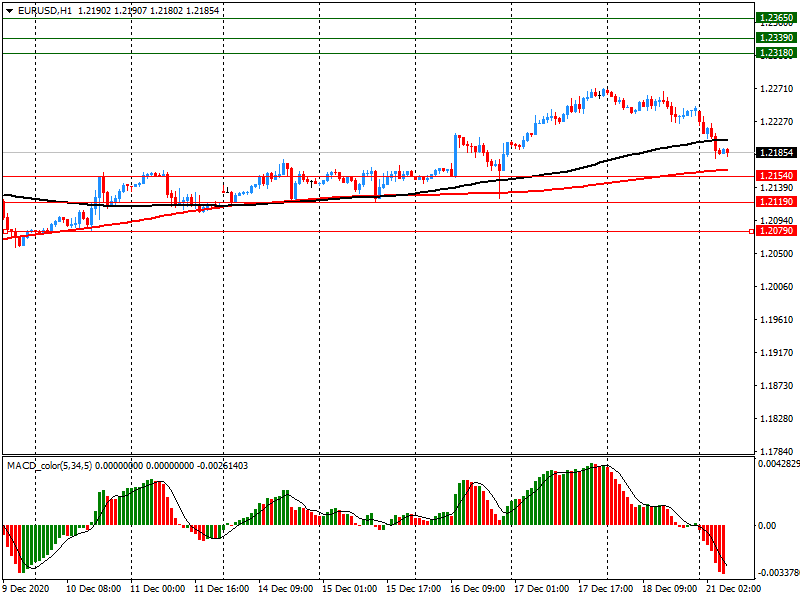
EUR/USD
Resistance levels (open interest**, contracts)
$1.2365 (2557)
$1.2339 (1455)
$1.2318 (1257)
Price at time of writing this review: $1.2185
Support levels (open interest**, contracts):
$1.2154 (1524)
$1.2119 (2154)
$1.2079 (4801)
Comments:
- Overall open interest on the CALL options and PUT options with the expiration date January, 8 is 75713 contracts (according to data from December, 18) with the maximum number of contracts with strike price $1,2100 (4801);
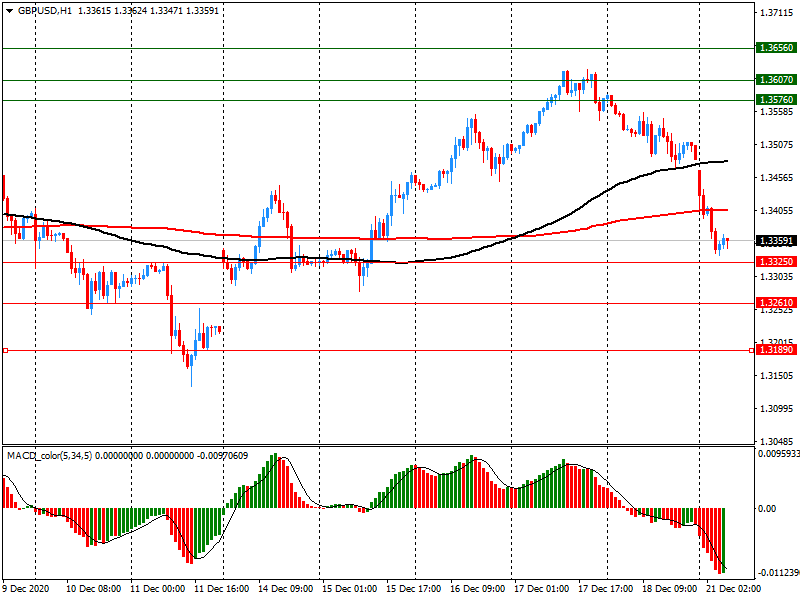
GBP/USD
Resistance levels (open interest**, contracts)
$1.3656 (963)
$1.3607 (303)
$1.3576 (1532)
Price at time of writing this review: $1.3359
Support levels (open interest**, contracts):
$1.3325 (523)
$1.3261 (732)
$1.3189 (1631)
Comments:
- Overall open interest on the CALL options with the expiration date January, 8 is 58779 contracts, with the maximum number of contracts with strike price $1,4000 (33106);
- Overall open interest on the PUT options with the expiration date January, 8 is 28973 contracts, with the maximum number of contracts with strike price $1,2800 (4017);
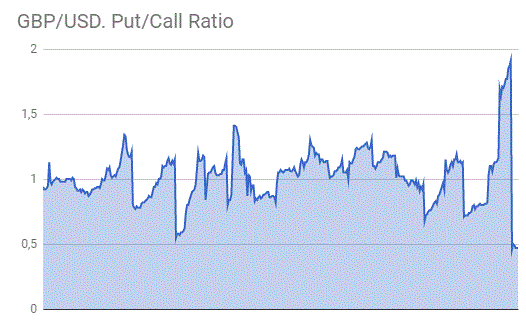
- The ratio of PUT/CALL was 0.49 versus 0.48 from the previous trading day according to data from December, 18
* - The Chicago Mercantile Exchange bulletin (CME) is used for the calculation.
** - Open interest takes into account the total number of option contracts that are open at the moment.
| Time | Country | Event | Period | Previous value | Forecast |
|---|---|---|---|---|---|
| 00:00 (GMT) | Japan | BOJ Governor Haruhiko Kuroda Speaks | |||
| 11:00 (GMT) | United Kingdom | CBI retail sales volume balance | December | -25 | |
| 13:30 (GMT) | U.S. | Chicago Federal National Activity Index | November | 0.83 | |
| 13:30 (GMT) | Canada | New Housing Price Index, YoY | November | 3.9% | |
| 13:30 (GMT) | Canada | New Housing Price Index, MoM | November | 0.8% | |
| 15:00 (GMT) | Eurozone | Consumer Confidence | December | -17.6 | -16.8 |
| Pare | Closed | Change, % |
|---|---|---|
| AUDUSD | 0.76177 | -0.09 |
| EURJPY | 126.507 | 0.04 |
| EURUSD | 1.22457 | -0.15 |
| GBPJPY | 139.305 | -0.51 |
| GBPUSD | 1.34849 | -0.7 |
| NZDUSD | 0.71335 | -0.2 |
| USDCAD | 1.27766 | 0.45 |
| USDCHF | 0.88398 | -0.02 |
| USDJPY | 103.304 | 0.19 |







© 2000-2026. All rights reserved.
This site is managed by Teletrade D.J. LLC 2351 LLC 2022 (Euro House, Richmond Hill Road, Kingstown, VC0100, St. Vincent and the Grenadines).
The information on this website is for informational purposes only and does not constitute any investment advice.
The company does not serve or provide services to customers who are residents of the US, Canada, Iran, The Democratic People's Republic of Korea, Yemen and FATF blacklisted countries.
Making transactions on financial markets with marginal financial instruments opens up wide possibilities and allows investors who are willing to take risks to earn high profits, carrying a potentially high risk of losses at the same time. Therefore you should responsibly approach the issue of choosing the appropriate investment strategy, taking the available resources into account, before starting trading.
Use of the information: full or partial use of materials from this website must always be referenced to TeleTrade as the source of information. Use of the materials on the Internet must be accompanied by a hyperlink to teletrade.org. Automatic import of materials and information from this website is prohibited.
Please contact our PR department if you have any questions or need assistance at pr@teletrade.global.


 Bank
Bank transfers


