- Analytics
- News and Tools
- Market News
CFD Markets News and Forecasts — 04-05-2020
| Time | Country | Event | Period | Previous value | Forecast |
|---|---|---|---|---|---|
| 04:30 | Australia | Announcement of the RBA decision on the discount rate | 0.25% | 0.25% | |
| 04:30 | Australia | RBA Rate Statement | |||
| 05:45 | Switzerland | SECO Consumer Climate | Quarter II | -9.4 | |
| 06:30 | Switzerland | Consumer Price Index (MoM) | April | 0.1% | -0.1% |
| 06:30 | Switzerland | Consumer Price Index (YoY) | April | -0.5% | -0.8% |
| 08:30 | United Kingdom | Purchasing Manager Index Services | April | 34.5 | 12.3 |
| 08:40 | Eurozone | ECB's Yves Mersch Speaks | |||
| 09:00 | Eurozone | Producer Price Index, MoM | March | -0.6% | -1.2% |
| 09:00 | Eurozone | Producer Price Index (YoY) | March | -1.3% | -2.4% |
| 12:30 | Canada | Trade balance, billions | March | -0.98 | -2.5 |
| 12:30 | U.S. | International Trade, bln | March | -39.9 | -44.2 |
| 13:45 | U.S. | Services PMI | April | 39.8 | 27.0 |
| 14:00 | U.S. | FOMC Member Charles Evans Speaks | |||
| 14:00 | U.S. | ISM Non-Manufacturing | April | 52.5 | |
| 18:00 | U.S. | FOMC Member James Bullard Speaks | |||
| 18:00 | U.S. | FOMC Member Bostic Speaks | |||
| 22:45 | New Zealand | Employment Change, q/q | Quarter I | 0% | |
| 22:45 | New Zealand | Unemployment Rate | Quarter I | 4% |
FXStreet reports that UOB Group’s economist Ho Woein Chen, CFA, reviewed the latest PMI prints in the Chinese economy.
“China’s official Purchasing Manager’s Index (PMI) for both the manufacturing and nonmanufacturing stayed in the positive territory (above-50 reading) in April after having turned around sharply in March. However, the official manufacturing PMI fell 1.2 point to 50.8 in April (consensus forecast: 51.0; March: 52.0) while the non-manufacturing PMI edged up 0.9 point to 53.2 in April (consensus forecast: 52.5; March: 52.3).”
“The components of the official manufacturing sub-index showed a worrying but not unexpected drop in new export orders to 33.5 in April from 46.4 in March though it was still holding above the record-low of 28.7 in February.”
“Overall, the outlook for manufacturing as seen in both the official and Caixin surveys weakened in April, stemming from the COVID-19 lockdowns in a number of global economies even as China has gradually resumed its factory production. Notably, Wuhan, the epicentre of the coronavirus outbreak in China, had reopened on 7 April after a 76-day lockdown. Given the relatively stronger outlook for services sector as shown in the April’s official PMI, we are cautiously optimistic that the recovery momentum in China will remain in place into the second quarter. The services industries account for 54% of the economy and could continue to improve with government’s support for consumption and investment.”
- Says Secondary Market Corporate Credit Facility (SMCCF) is expected to begin purchasing eligible ETFs in early May
- Primary Market Corporate Credit Facility (PMCCF) is expected to become operational and the SMCCF is expected to begin purchasing eligible corporate bonds soon thereafter
FXStreet reports that according to strategists at TD Securities, while volatility remains prevalent in the prompt months for crude, which remain under pressure, some semblance of stability could start to return to the market.
“With OPEC+ production curtailments underway, along with substantial production declines from non-OPEC nations and ETF restructuring eliminating some left tail risk from the market structure, prices have found some support.”
“As the year progresses beyond June with some 8m bpd worth of OPEC+ cuts, as much as 4m bpd worth of market-driven declines, along with some normalization in demand, the market should soon return to deficit conditions.”
“The extreme contangos observed in recent history should begin to ease. To express this view, we are long Dec-Dec WTI spreads, anticipating that the left tail may have narrowed sufficiently for market participants to begin eyeing opportunities.”
- Without more support, many employees risk leaving workforce
- Says he is worried about U.S. productivity levels
- New productivity investments will need some government incentive to restore confidence in uncertain environment
The U.S. Commerce Department reported on Monday that the value of new factory orders tumbled 10.3 percent m-o-m in March, following a revised 0.1 percent m-o-m drop in February (originally unchanged m-o-m). That was the biggest fall in new orders on record.
Economists had forecast a 9.8 percent m-o-m plunge.
According to the report, orders for transportation equipment led the March decrease, plummeting 41.3 percent m-o-m. Meanwhile, orders for computers and electronic products were unchanged m-o-m, and orders for machinery rose 0.5 percent.
Total factory orders excluding transportation, a volatile part of the overall reading, declined 3.7 percent m-o-m in March compared to a revised 1.1 percent m-o-m fall in February.
Overall, durable goods orders fell 14.7 percent m-o-m in March, while orders for nondurable goods dropped 5.8 percent m-o-m.
FXStreet reports that Jane Foley from Rabobank suggests that, while the Eurozone’s huge current account surplus may continue to lend support, sentiment in the EUR will be eroded if politics turn sour on the issue of fiscal coherence within the region.
“There are a number of hurdles to be overcome in the coming days. One relates to Moody’s credit rating review of Italy on May 8, another relates to a ruling by a German court on ECB policy. A shock decision has the potential to undermine the single currency.”
“We see the risk of another dip towards EUR/USD 1.08 in the coming weeks, and cannot rule out a drop towards the 1.05 area this summer if Eurozone politics sour.”
"The one-month period is designed for us to prepare for the next step and put an end to the state of emergency," Shinzo Abe said during a televised press conference.
- Says that president is focused on tax changes to help business and stimulating travel
- Expects China to make good on its trade agreement; adds there will be very significant consequences if they don't
- Says Trump continues to review options on China
- Expects oil markets to rebound; says that Trump administration is looking for more storage capacity
U.S. stock-index futures fell on Monday as deteriorating U.S.-China relations overshadowed the reopening of the U.S. economy.
Global Stocks:
| Index/commodity | Last | Today's Change, points | Today's Change, % |
| Nikkei | - | - | - |
| Hang Seng | 23,613.80 | -1,029.79 | -4.18% |
| Shanghai | - | - | - |
| S&P/ASX | 5,319.80 | +73.90 | +1.41% |
| FTSE | 5,763.78 | +0.72 | +0.01% |
| CAC | 4,393.96 | -178.22 | -3.90% |
| DAX | 10,481.87 | -379.77 | -3.50% |
| Crude oil | $19.36 | | -2.12% |
| Gold | $1,708.70 | | +0.46% |
(company / ticker / price / change ($/%) / volume)
| 3M Co | MMM | 147.01 | -1.59(-1.07%) | 3172 |
| ALCOA INC. | AA | 7.57 | -0.12(-1.56%) | 29569 |
| Amazon.com Inc., NASDAQ | AMZN | 2,256.20 | -29.84(-1.31%) | 92868 |
| American Express Co | AXP | 86.61 | -1.71(-1.94%) | 10177 |
| AMERICAN INTERNATIONAL GROUP | AIG | 23.68 | -0.22(-0.92%) | 4867 |
| Apple Inc. | AAPL | 289.21 | 0.14(0.05%) | 368986 |
| AT&T Inc | T | 29.77 | -0.13(-0.43%) | 108292 |
| Boeing Co | BA | 127.6 | -5.77(-4.33%) | 720685 |
| Caterpillar Inc | CAT | 109.55 | -1.33(-1.20%) | 184855 |
| Chevron Corp | CVX | 88.5 | -0.94(-1.05%) | 91037 |
| Cisco Systems Inc | CSCO | 40.7 | -0.22(-0.54%) | 24620 |
| Citigroup Inc., NYSE | C | 44.56 | -0.96(-2.11%) | 376839 |
| Deere & Company, NYSE | DE | 136.81 | -1.38(-1.00%) | 777 |
| E. I. du Pont de Nemours and Co | DD | 43.41 | -1.66(-3.68%) | 4816 |
| Exxon Mobil Corp | XOM | 42.36 | -0.78(-1.81%) | 145256 |
| Facebook, Inc. | FB | 200.97 | -1.30(-0.64%) | 99698 |
| FedEx Corporation, NYSE | FDX | 117.24 | -0.96(-0.81%) | 3303 |
| Ford Motor Co. | F | 4.87 | -0.05(-1.02%) | 537843 |
| Freeport-McMoRan Copper & Gold Inc., NYSE | FCX | 8.36 | -0.10(-1.18%) | 23399 |
| General Electric Co | GE | 6.32 | -0.18(-2.77%) | 1503495 |
| General Motors Company, NYSE | GM | 20.25 | -0.65(-3.11%) | 56012 |
| Goldman Sachs | GS | 174.7 | -2.40(-1.36%) | 9896 |
| Google Inc. | GOOG | 1,312.70 | -7.91(-0.60%) | 3795 |
| Hewlett-Packard Co. | HPQ | 14.65 | -0.06(-0.41%) | 5140 |
| Home Depot Inc | HD | 217.24 | -1.33(-0.61%) | 7781 |
| HONEYWELL INTERNATIONAL INC. | HON | 134.76 | -2.49(-1.81%) | 4102 |
| Intel Corp | INTC | 57.28 | -0.19(-0.33%) | 31924 |
| International Business Machines Co... | IBM | 121 | -0.87(-0.71%) | 9486 |
| International Paper Company | IP | 33.61 | -0.30(-0.88%) | 424 |
| Johnson & Johnson | JNJ | 147.42 | -0.87(-0.59%) | 192159 |
| JPMorgan Chase and Co | JPM | 91.57 | -1.68(-1.80%) | 74668 |
| McDonald's Corp | MCD | 181.08 | -1.58(-0.87%) | 10388 |
| Merck & Co Inc | MRK | 77.44 | -0.23(-0.30%) | 3387 |
| Microsoft Corp | MSFT | 173.69 | -0.88(-0.50%) | 198434 |
| Nike | NKE | 84.48 | -1.06(-1.24%) | 10747 |
| Pfizer Inc | PFE | 37.36 | -0.28(-0.74%) | 55252 |
| Procter & Gamble Co | PG | 115.75 | -1.07(-0.92%) | 4384 |
| Starbucks Corporation, NASDAQ | SBUX | 72.97 | -0.82(-1.11%) | 43125 |
| Tesla Motors, Inc., NASDAQ | TSLA | 697.5 | -3.82(-0.54%) | 329503 |
| Travelers Companies Inc | TRV | 95.57 | -0.48(-0.50%) | 2469 |
| Twitter, Inc., NYSE | TWTR | 27.54 | -0.30(-1.08%) | 96176 |
| Verizon Communications Inc | VZ | 56.46 | -0.37(-0.65%) | 15171 |
| Visa | V | 172.62 | -2.95(-1.68%) | 62644 |
| Wal-Mart Stores Inc | WMT | 122.65 | -0.27(-0.22%) | 10665 |
| Walt Disney Co | DIS | 101.85 | -3.65(-3.46%) | 111822 |
| Yandex N.V., NASDAQ | YNDX | 37.55 | 0.15(0.39%) | 5237 |
| Time | Country | Event | Period | Previous value | Forecast | Actual |
|---|---|---|---|---|---|---|
| 08:00 | Eurozone | Manufacturing PMI | April | 44.5 | 33.6 | 33.4 |
| 08:30 | Eurozone | Sentix Investor Confidence | May | -42.9 | -41.8 |
USD rose against most major currencies in the European session on Monday as markets fret over a growing potential for renewed tensions between the world's two biggest economies. The U.S. dollar index (DXY), measuring the value of the U.S. currency against other major global currencies traded 0.31% higher at 99.39.
During a Fox News interview on Sunday night, the U.S. President Donald Trump again blamed China for the coronavirus outbreak. "I think they [China] made a horrible mistake and didn't want to admit it," Trump said. He also suggested the U.S. could "terminate the deal", which was signed in January, and added that "tariffs at a minimum are the greatest negotiating tool that we have ever devised and we never used for negotiation".
Trump's comments came hours after the U.S. Secretary of State Mike Pompeo stated that there was "a significant amount of evidence" that the virus emerged from a laboratory in the Chinese city of Wuhan.
The latest attacks of the U.S. top officials raised worries over another spat between China and the U.S., overshadowing the beginning of the re-start of business and factory activity in the U.S.
FXStreet reports that UOB Group’s Senior Economist Alvin Liew assessed the latest FOMC meeting.
“The Federal Reserve in April 2020 FOMC further reinforced its forward guidance to be more explicit about how long rates will stay low, saying that the “Committee expects to maintain this target range until it is confident that the economy has weathered recent events and is on track to achieve its maximum employment and price stability goals.”
“Powell also maintained that the Fed is not “in any hurry to withdraw these measures or to lift off. We’re going to wait until we’re quite confident that the economy is well on the road to recovery.”
“US 1Q 2020 GDP, contracted more than expected at -4.8% q/q SAAR but Powell warned that 2Q could see an unprecedented decline.”
“Going forward, as Powell has pledged, the Fed will do more especially when the expectations of a “unprecedented” 2Q comes to pass. That said, we continue to believe the Fed will do more except negative policy rates.”
“In terms of growth outlook, we now factor a 28% decrease in 2Q (but markets are looking at a sharper contraction, the most bearish estimate being -65%). The projected 2H rebound (+6.6% in 3Q and 10.4% in 4Q) will not offset the 1H contraction, so US overall GDP will now contract by 5.0% in 2020 (from previous estimate of -4.1%).”
FXStreet reports that analysts at Rabobank believe that the price action in the S&P 500 Index implies that the corrective rebound witnessed since the end of March has run its course and the next leg lower could be in the making in the coming weeks.
“The corrective rally from the March 23 low run out of steam around the Fibonacci 61.8% retracement level at 2934.49. This is a critical pivot around which markets tend to swing and start moving in the opposite direction. Another crucial element supporting this short-term technical scenario is that recent gains fit into the rising wedge, which is a bearish pattern.”
“Given that the second leg lower should at least match the length of the initial wave, the S&P 500 Index may fall below the March 23 low at 2191.86 in the near-term.”
“For short-sellers, it is an opportunity to establish positions in anticipation of a new leg down driven by another wave of negative news dominated by rising joblessness and bankruptcies.”
FXStreet reports that according to economists at Westpac Institutional Bank, the durability of the rebound in risk appetite is of course the key question for AUD crosses.
“Supportive factors include open-ended QE programs by major central banks, FX swaps lines to avoid further scrambles for US$ and plans by many OECD governments to loosen coronavirus restrictions. The latter raises the prospect of a considerable rebound in the global economy in H2 2020.”
“We expect that the extended period of brutal economic data and waves of earnings downgrades globally will weigh on risk appetite including equities in coming weeks. Moreover, doubts over the scale of the expected recovery may grow.”
“Both the RBA and BoE are pursuing very expansionary monetary policy and fiscal support is substantial, especially in Australia. Australia’s C/A position is much more supportive and Australia’s much lower Covid-19 case count should mean a quicker restarting of economic activity in Australia.”
“Given our baseline view on global risk appetite, we see AUD softening to GBP 0.5050/0.5100 or AUD 1.96-1.98 multi-week.”
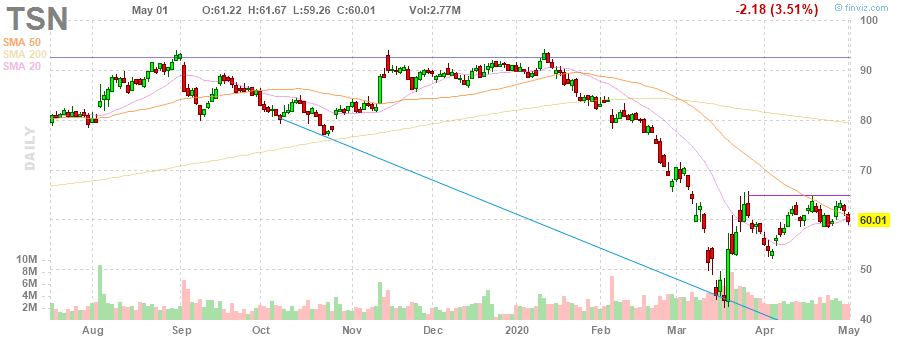
Tyson Foods (TSN) reported Q2 FY 2020 earnings of $0.77 per share (versus $1.20 per share in Q2 FY 2019), missing analysts' consensus estimate of $1.12 per share.
The company's quarterly revenues amounted to $10.888 bln (+4.3% y/y), missing analysts' consensus estimate of $11.014 bln.
TSN fell to $57.50 (-4.18%) in pre-market trading.
EUR/USD: Strength capped ahead of the 200-day average at 1.1033 – Credit Suisse
FXStreet notes that EUR/USD’s strength has been capped ahead of the 200-day average and analysts at Credit Suisse look for a move back to the neckline to the base.
“We continue to view current price action as consolidation ahead of the trend eventually turning lower again and near-term, we look for weakness back to 1.0907, then the ‘neckline’ to the base and 13-day average at 1.0897/84.”
“Back beneath 1.0833 will confirm that the recovery is over, opening the door for a move back to the April low at 1.0727 initially.”
“Resistance moves to 1.0977 initially, then 1.1019/21. A close above 1.1033 would suggest strength can extend further with resistance seen next at the 50% retracement of the March fall at 1.1065.”
FXStreet reports that FX Strategists at UOB Group see USD/JPY navigating within the 106.00-107.50 range in the short-term horizon.
24-hour view: “USD eased off from a high of 107.40 last Friday and subsequently traded mostly sideways. Momentum indicators are neutral and for today, USD is likely to consolidate and trade between 106.40 and 107.10.”
Next 1-3 weeks: “Our expectation for USD ‘to weaken to 106.00’ from last Thursday (29 Apr, spot at 106.65) did not materialize as it rebounded strongly and took out the ‘strong resistance’ level at 107.35. Downward pressure has eased and USD has likely moved into a consolidation phase. In other words, USD is likely to trade sideways from here, expected to be within 106.00/107.50 range. Looking further ahead, USD has to close below 106.00 before a sustained weakness can be expected.”
- Italy's April industrial output fell 45% y/y
FXStreet reports that economists at JP Morgan Asset Management remain intensely focused on what is happening with corporate profits, as over the long-run, earnings are the main driver of equity returns.
“Nearly half of S&P 500 companies have reported 1Q20 earnings, and our current estimate is for a -20% decline relative to a year prior.”
“At the end of the day, the stock market seems to be focused on three things: slower growth in the number of cases of COVID-19, the massive amount of fiscal and monetary stimulus that has been announced in recent weeks and the expectation of a v-shaped recovery in the economy and corporate profits. The first two drivers of the market rally are fact, but the third seems to be fiction.”
“While we anticipate a recovery into the end of 2020 and beginning of 2021, we do not think it will be as robust as consensus expects.”
May 4
Before the Open:
Tyson Foods (TSN). Consensus EPS $1.12, Consensus Revenues $11013.52 mln
After the Close:
American Intl (AIG). Consensus EPS $0.82, Consensus Revenues $11527.71 mln
May 5
Before the Open:
DuPont (DD). Consensus EPS $0.77, Consensus Revenues $5143.43 mln
Fiat Chrysler (FCAU). Consensus EPS $0.05, Consensus Revenues $21120.92 mln
After the Close:
Walt Disney (DIS). Consensus EPS $0.90, Consensus Revenues $17493.15 mln
May 6
Before the Open:
Barrick (GOLD). Consensus EPS $0.16, Consensus Revenues $2790.06 mln
General Motors (GM). Consensus EPS $0.44, Consensus Revenues $31368.38 mln
After the Close:
Lyft (LYFT). Consensus EPS -$0.57, Consensus Revenues $905.73 mln
PayPal (PYPL). Consensus EPS $0.75, Consensus Revenues $4719.31 mln
May 7
Before the Open:
Raytheon Technologies (RTX). Consensus EPS $1.05, Consensus Revenues $17030.91 mln
After the Close:
Baidu (BIDU). Consensus EPS RMB3.92, Consensus Revenues RMB21938.02 mln
Uber (UBER). Consensus EPS -$0.50, Consensus Revenues $3140.59 mln
FXStreet reports that according to economists at Westpac Institutional Bank, the durability of the rebound in risk appetite is, of course, the key question for AUD crosses.
“Supportive factors include open-ended QE programs by major central banks, FX swaps lines to avoid further scrambles for US$ and plans by many OECD governments to loosen coronavirus restrictions. The latter raises the prospect of a considerable rebound in the global economy in H2 2020.”
“We expect that the extended period of brutal economic data and waves of earnings downgrades globally will weigh on risk appetite including equities in coming weeks. Moreover, doubts over the scale of the expected recovery may grow.”
“Both the RBA and BoE are pursuing very expansionary monetary policy and fiscal support is substantial, especially in Australia. Australia’s C/A position is much more supportive and Australia’s much lower Covid-19 case count should mean a quicker restarting of economic activity in Australia.”
“Given our baseline view on global risk appetite, we see AUD softening to GBP 0.5050/0.5100 or AUD 1.96-1.98 multi-week.”
FXStreet reports that analysts at Credit Suisse note that EUR/GBP has recovered strongly after reversing its albeit brief move below the bottom of its April range at 0.8688/81 and is now back above its 13, 55 and 200-day averages.
“Daily MACD momentum looks to be seeing a bullish cross and we remain of the view the decline is exhausted and we look for a fresh attempt to establish a base.”
“Key resistance remains at 0.8863/67 – the recent highs and 23.6% retracement of the March/April fall. Above here stays needed to see a base confirmed to mark a more important turn higher, with resistance then seen next at 0.8928, then the 38.2% retracement and ‘neckline’ to the March top at 0.8976/94.”
“Support moves to 0.8778/75 initially, with 0.8757/43 now ideally holding to keep the immediate risk higher.”
FXStreet reports that the apparent disconnect between what the economy is doing and what financial markets are doing might not be as unusual as it initially appears, per Morgan Stanley.
"We see April's moves consistent with past periods where markets led the economy and cared more about the coming change to economic growth than the level of that growth. For markets to hold these gains, keeping that change positive is essential."
"We think the biggest risk is not that the recovery is slow, but rather a scenario where growth weakens again, perhaps later this year, which would mean that the positive rate of economic change is no longer in place."
"Perhaps somewhat counterintuitively, we think a slower, more cautious reopening for the economy could actually be better for markets than a faster and more rapid one."
CNBC reports that a vaccine for Covid-19 will not be ready until the end of next year, according to Dale Fisher, chair of the World Health Organization (WHO) Global Outbreak Alert and Response Network.
That timeline would be a "very reasonable" expectation because of the necessary Phase 2 and 3 trials of any vaccine to guarantee both safety and efficacy, Fisher explained. There would also need to be a ramp up in production and distribution, as well as actually administering the vaccine, he said.
Fisher said "we are currently on target" for a vaccine in 2021 with five Phase 1 studies currently underway.
"We've always felt that by about April, May, we would be in Phase 1 studies, so this means a potential vaccine has been invented if you like; we're now trying it on individuals, basically to see if it's safe," Fisher told CNBC.
The current trials would allow "early collection of data" to assess whether the potential vaccine "actually works," before larger trials on safety and efficacy could be carried out, said Fisher, who is also a senior consultant at the infectious disease division at the National University Hospital in Singapore.
Fisher also said President Donald Trump's comments on Sunday - that he was confident a coronavirus vaccine would be developed by the end of 2020 - were "a bit premature."
FXStreet reports that investors should be positioning themselves for a weaker dollar over time, according to Matthew Hornbach, Global Head of Macro Strategy at Morgan Stanley.
"We see a dramatic increase in supply meeting, and then exceeding, demand. And while the demand for US dollars is at a fever pitch today, we don't think that demand is going to last forever either."
"We don't expect US dollar weakness to happen overnight, or against all currencies at the same time. The US dollar, right now, is going through a topping process after a multi-year bull market."
FXStreet reports that economists at Standard Chartered Bank lower the 2020 US GDP forecast to -5.4% (previously -2.8%) and expect Q2-2020 GDP to contract by 49% q/q SAAR, after a decline of 4.8% in Q1.
"We expect the economy to contract by 5.4% in 2020 (previously -2.8%). With most states planning to maintain restrictions until the first or second week in May, and certain restraints remaining in place through Q2, economic activity will likely stay subdued."
"We expect GDP to contract by 49% q/q SAAR in Q2, before picking up in H2, but see year-end GDP still below its end-2019 level (-2.3% Q4/Q4). We continue to expect growth of 4.6% in 2021, the headline number flattered by the recovery in H2-2020."
According to the report from Sentix, the economy in Euroland is in the middle of a deep crisis. For the fourth time in a row, the economic situation is falling to an all-time low of -73 points. The fact that the overall index nevertheless improves slightly to - 41.8 is due to expectations that are rising by 12.8 points.
The global situation continues to fall at the beginning of May, marking new all-time lows in many regions of the world. The Global Aggregate Index is also at an all-time low of -60.5 points. Nevertheless, there are glimmers of hope. Expectations may improve across the board. In some regions, they are even positive again, giving rise to hopes that a stabilization phase will begin. Compared to the hard impact of the situation, the upswing is proceeding rather gently. Austria deserves special attention.
The economy in the euro zone has experienced a breath-taking crash in recent weeks. The administrative order to halt social and economic activities has led to a considerable economic slump. In the meantime, this collapse goes far beyond the distortions caused by the financial crisis. At the beginning of May, the assessment of the situation by the investors surveyed by sentix falls to an all-time low of -73 points, a further drop of 7 index points. But whenever the night is at its darkest, dawn is approaching. This also applies to the economy now. This dawn comes in the guise of easing the hard restrictions on economic activity. Countries like Germany and Austria are in a position to gradually lift the often drastic measures. In the sentix economic index, this light at the end of the tunnel is shown by an increase in the expectation values from -15.8 to -3 points.
-
2020 GDP growth forecast -5.5% (previously +1.1%)
-
2021 GDP growth forecast +4.3% (previously +1.2%)
-
2022 GDP growth forecast +1.7% (previously +1.4%)
-
2020 inflation forecast +0.4% (previously +1.2%)
-
2021 inflation forecast +1.2% (previously +1.4%)
-
2022 inflation forecast +1.4% (previously +1.5%)
According to the report from IHS Markit, euro area manufacturing experienced a substantial deterioration in operating conditions during April as government restrictions to limit the spread of the global coronavirus disease (COVID-19) weighed on the sector. Output, new orders, export sales, and purchasing activity all fell at record rates, whilst supply side constraints intensified to an unprecedented extent. Confidence about the future sank to a fresh series low.
The Eurozone Manufacturing PMI registered 33.4 in April, down sharply from March's 44.5. Below the earlier flash reading, the latest PMI was the lowest ever recorded by the series (which began in June 1997), surpassing readings seen during the depths of the global financial crisis and indicative of a considerable deterioration in operating conditions.
Market groups data indicated that all categories recorded considerable deteriorations in operating conditions. Investment goods producers suffered the sharpest contraction.
At the country level, PMIs were down across the region, with numbers either at record lows (Austria, France, Greece, and Italy) or registering readings only surpassed during the worst of the global financial crisis. Greece and Spain recorded the lowest PMI numbers, followed by Italy and France. Netherlands fared the best, but even here the rate of contraction was considerable.
FXStreet reports that Lee Sue Ann, Economist at UOB Group, ruled out any change in the monetary stance from the RBA at its meeting on Tuesday.
"The RBA had left its OCR at record-low of 0.25% after cutting twice in March. Overall, the minutes offered little guidance as officials insist that "a recovery was expected once he COVID-19 outbreak was contained", with the RBA pledging to "do what was necessary to achieve the three-year yield target" for Australian government bonds. The minutes also suggest the RBA is in no rush to implement more unconventional measures for now".
FXStreet reports that Karen Jones, Team Head FICC Technical Analysis Research at Commerzbank, notes the RSI has not confirmed the new high and, thus, the AUD/USD has topped.
"AUD/USD's high last week of 0.6570 was not confirmed by the daily RSI and the market has now eroded the short-term uptrend. This increasingly looks like the market has topped."
"Minor support is seen along the 55-day moving average at 0.6324 and also at the 0.6265/55 recent lows. Should the 0.6265/55 support area give way, the 0.6213 late March high and then 0.5981, the current April low, would be back in focus."
CNBC reports that according to UBS Investment Bank's Joni Teves, gold prices could "break the highs" seen earlier this year, after declining in March along with assets across the board.
"There is growing potential (for gold) to break $1,800 (per ounce) in my view," Joni Teves, precious metal strategist at UBS Investment Bank, told CNBC. In the near term, the firm has a target price for gold at $1,790 per ounce.
That comes as "investor interest continues to grow in this environment of uncertainty and negative real rates," Teves said.
Last week, the World Gold Council released its first-quarter 2020 demand trends report for the precious metal, where it highlighted that the global coronavirus outbreak was "the single biggest factor influencing gold demand."
"As the scale of the pandemic - and its potential economic impact - started to emerge, investors sought safe-haven assets," the report said. "Gold ETFs saw the highest quarterly inflows for four years amid global uncertainty and financial market volatility."
For her part, UBS' Teves said the move in gold had been drive by a "pickup in investor interest, particularly from institutional investors."
"Gold is becoming attractive in this environment where uncertainty is very high, growth is expected to weaken, and at the same time you have negative real rates which make gold attractive to hold as a diversifier in investor portfolios," Teves said.
-
It is important France resumes work on 11 May
-
If possible, advises to keep working remotely
-
Must succeed in properly ending the lockdown
FXStreet reports that cable's stance still looks constructive, although a breach of 1.2370 should leave an interim top in place, suggested FX Strategists at UOB Group.
24-hour view: "After soaring to a high of 1.2641 last Thursday (30 Apr), the subsequent abrupt and sharp decline from the high came as a surprise. While the rapid drop appears to be running ahead of itself, there is room for GBP to test 1.2410 first before the current downward pressure should ease. For today, the next support at 1.2370 is unlikely to come into the picture. Resistance is at 1.2500 followed by 1.2530."
Next 1-3 weeks: "We held a slightly positive view on GBP since last Tuesday (28 Apr, spot at 1.2425) and indicated that GBP 'could edge higher to 1.2535'. We added, 'GBP has to crack 1.2535 before a stronger and more sustained advance can be expected'. GBP surged past 1.2535 on Thursday (30 Apr) and jumped to a high of 1.2644 before staging a surprisingly sharp and rapid retreat. For now, the overall outlook for GBP still appears to be positive and only a breach of 1.2370 ('strong support' level) would indicate that 1.2644 is a short-term top."
Reuters reports that the Trump administration is "turbocharging" an initiative to remove global industrial supply chains from China as it weighs new tariffs to punish Beijing for its handling of the coronavirus outbreak, according to officials familiar with U.S. planning.
President Donald Trump, who has stepped up recent attacks on China ahead of the Nov. 3 U.S. presidential election, has long pledged to bring manufacturing back from overseas.
Now, economic destruction and the massive U.S. coronavirus death toll are driving a government-wide push to move U.S. production and supply chain dependency away from China, even if it goes to other more friendly nations instead, current and former senior U.S. administration officials said.
"We've been working on [reducing the reliance of our supply chains in China] over the last few years but we are now turbo-charging that initiative," Keith Krach, undersecretary for Economic Growth, Energy and the Environment at the U.S. State Department told Reuters.
"I think it is essential to understand where the critical areas are and where critical bottlenecks exist," Krach said, adding that the matter was key to U.S. security and one the government could announce new action on soon.
The U.S. Commerce Department, State and other agencies are looking for ways to push companies to move both sourcing and manufacturing out of China. Tax incentives and potential re-shoring subsidies are among measures being considered to spur changes, the current and former officials told Reuters.
"There is a whole of government push on this," said one. Agencies are probing which manufacturing should be deemed "essential" and how to produce these goods outside of China.
Nishimura confirms that the motion will go through parliament later today
FXStreet reports that FX Strategists at UOB Group do not ruled out EUR/USD testing the 1.1070 region in the next weeks.
24-hour view: "EUR cracked the strong resistance level at 1.1000 yesterday before retreating sharply from 1.1017. The rapid pull-back amid overbought conditions suggests a short-term top could be in place. However, the current price action is viewed as part of a broad consolidation phase and not the start of a reversal. In other words, EUR is expected to trade sideways for today, likely between 1.0920 and 1.1000."
Next 1-3 weeks: "EUR surged above the top of our expected 1.0725/1.0940 range last Thursday and extended its gain to 1.1017 on Friday (01 May). The rapid rise appears to have room to test the 1.1070. That said, overbought short-term conditions suggest EUR could consolidate for a few days first. Overall, EUR is expected to trade with an upside bias unless it moves below 1.0870."
-
CNBC reports that more than 3.5 million people have now been infected worldwide by the coronavirus and over 247,000 people have died from the respiratory disease Covid-19, according to data from Johns Hopkins University.
-
U.S. President Donald Trump said on Sunday he was confident that a vaccine would be available by the end of 2020.
-
India has 40,263 confirmed cases of infection as of Sunday evening, according to data on the health ministry's website, as the country prepares for another two weeks of extended lockdown with some ease of restrictions.
-
Most cases reported: United States (over 1.15 million), Spain (over 217,400), Italy (over 210,700), United Kingdom (over 187,800), France (over 168,800)
EUR/USD
Resistance levels (open interest**, contracts)
$1.1109 (1517)
$1.1068 (1559)
$1.1036 (1245)
Price at time of writing this review: $1.0937
Support levels (open interest**, contracts):
$1.0923 (1290)
$1.0886 (1911)
$1.0842 (1557)

Comments:
- Overall open interest on the CALL options and PUT options with the expiration date May, 8 is 72627 contracts (according to data from May, 1) with the maximum number of contracts with strike price $1,1200 (2959);
GBP/USD
Resistance levels (open interest**, contracts)
$1.2707 (1388)
$1.2620 (1011)
$1.2557 (1120)
Price at time of writing this review: $1.2441
Support levels (open interest**, contracts):
$1.2402 (509)
$1.2366 (763)
$1.2283 (610)

Comments:
- Overall open interest on the CALL options with the expiration date May, 8 is 17267 contracts, with the maximum number of contracts with strike price $1,3000 (1441);
- Overall open interest on the PUT options with the expiration date May, 8 is 18073 contracts, with the maximum number of contracts with strike price $1,2850 (1070);
- The ratio of PUT/CALL was 1.05 versus 1.15 from the previous trading day according to data from May, 1

* - The Chicago Mercantile Exchange bulletin (CME) is used for the calculation.
** - Open interest takes into account the total number of option contracts that are open at the moment.
| Raw materials | Closed | Change, % |
|---|---|---|
| Brent | 24.63 | -0.57 |
| Silver | 14.91 | 0.07 |
| Gold | 1698.804 | 0.77 |
| Palladium | 1885.67 | -4.45 |
| Index | Change, points | Closed | Change, % |
|---|---|---|---|
| NIKKEI 225 | -574.34 | 19619.35 | -2.84 |
| ASX 200 | -276.5 | 5245.9 | -5.01 |
| FTSE 100 | -138.15 | 5763.06 | -2.34 |
| Dow Jones | -622.03 | 23723.69 | -2.55 |
| S&P 500 | -81.72 | 2830.71 | -2.81 |
| NASDAQ Composite | -284.6 | 8604.95 | -3.2 |
| Time | Country | Event | Period | Previous value | Forecast |
|---|---|---|---|---|---|
| 01:00 | Australia | MI Inflation Gauge, m/m | April | 0.3% | |
| 01:30 | Australia | ANZ Job Advertisements (MoM) | April | -10.3% | |
| 01:30 | Australia | Building Permits, m/m | March | 19.9% | -15% |
| 07:30 | Switzerland | Manufacturing PMI | April | 43.7 | 34.6 |
| 07:50 | France | Manufacturing PMI | April | 43.2 | 31.5 |
| 07:55 | Germany | Manufacturing PMI | April | 45.4 | 34.4 |
| 08:00 | Eurozone | Manufacturing PMI | April | 44.5 | 33.6 |
| 08:30 | Eurozone | Sentix Investor Confidence | May | -42.9 | |
| 14:00 | U.S. | Factory Orders | March | 0.0% | -9.8% |
| 22:30 | Australia | AiG Performance of Construction Index | April | 37.9 | |
| 22:45 | New Zealand | Building Permits, m/m | March | 4.7% |
| Pare | Closed | Change, % |
|---|---|---|
| AUDUSD | 0.64193 | -1.27 |
| EURJPY | 117.391 | 0.05 |
| EURUSD | 1.09794 | 0.28 |
| GBPJPY | 133.527 | -1.04 |
| GBPUSD | 1.24907 | -0.82 |
| NZDUSD | 0.60592 | -0.97 |
| USDCAD | 1.40841 | 1.05 |
| USDCHF | 0.96103 | -0.47 |
| USDJPY | 106.908 | -0.22 |







© 2000-2026. All rights reserved.
This site is managed by Teletrade D.J. LLC 2351 LLC 2022 (Euro House, Richmond Hill Road, Kingstown, VC0100, St. Vincent and the Grenadines).
The information on this website is for informational purposes only and does not constitute any investment advice.
The company does not serve or provide services to customers who are residents of the US, Canada, Iran, The Democratic People's Republic of Korea, Yemen and FATF blacklisted countries.
Making transactions on financial markets with marginal financial instruments opens up wide possibilities and allows investors who are willing to take risks to earn high profits, carrying a potentially high risk of losses at the same time. Therefore you should responsibly approach the issue of choosing the appropriate investment strategy, taking the available resources into account, before starting trading.
Use of the information: full or partial use of materials from this website must always be referenced to TeleTrade as the source of information. Use of the materials on the Internet must be accompanied by a hyperlink to teletrade.org. Automatic import of materials and information from this website is prohibited.
Please contact our PR department if you have any questions or need assistance at pr@teletrade.global.


 Bank
Bank transfers


