- Analytics
- News and Tools
- Market News
CFD Markets News and Forecasts — 01-05-2020
On Monday, at 01:00 GMT, Australia will release inflation data from MI and the ANZ vacancy index for April, and at 01:30 GMT, it will report changes in the building permits for March. Then, the focus will be on the manufacturing PMI for April: Switzerland will report at 07:30 GMT, France at 07:50 GMT, Germany at 07:55 GMT, and the Eurozone at 08:00 GMT. At 08:30 GMT in the Eurozone, the investor confidence indicator from Sentix for May will be released. At 14:00 GMT, the US will announce a change in the volume of production orders for March. At 22:30 GMT Australia will present the index of activity in the construction sector from AiG for April. At 22:45 GMT, New Zealand will report changes in the building permits for March.
On Tuesday,at 04:30 GMT in Australia, the RBA's interest rate decision will be announced. At 05:45 GMT in Switzerland, the SECO consumer sentiment index for the 1st quarter will be released, and at 06:30 GMT - the consumer price index for April. At 08:30 GMT, UK will publish the PMI for the services sector for April. At 09:00 GMT, the Eurozone will present the producer price index for March. At 12:30 GMT, the US and Canada will report changes in the trade balance for March. At 13:45 GMT, the US will release the PMI for the services sector from Markit for April, and at 14:00 GMT - the ISM index for the non-manufacturing sector for April. At 22:45 GMT, New Zealand will report changes in the unemployment rate and employment for the 1st quarter.
On Wednesday, at 01:30 GMT, Australia will report changes in retail sales for March. At 06:00 GMT, Germany will announce changes in industrial orders for March. Then the focus will be on the services PMI for April: France will report at 07:50 GMT, Germany at 07:55 GMT, and the Eurozone at 08:00 GMT. At 08:30 GMT UK will release PMI construction for April. At 09:00 GMT, the Eurozone will report changes in retail sales for March. At 12:15 GMT, the US will report changes in the number of employees from ADP for April, and at 14: 30 GMT- changes in oil reserves according to the Ministry of energy. At 22:30 GMT, Australia will release the AIG services activity index for April.
On Thursday, at 01:30 GMT, Australia will announce a change in the foreign trade balance for March. At 01:45 GMT China will publish the Markit/Caixin Services PMI for April. At 03:00 GMT, China will report changes in the foreign trade balance for April. At 06:00 GMT Germany will report the change in the volume of industrial production for March. Also at 06: 00 GMT in UK, the Bank of England interest rate decision will be announced. At 06:45 GMT, France will announce changes in industrial production for March, non-farm payrolls for the 1st quarter and the balance of foreign trade for March. At 07:00 GMT, Switzerland will announce changes in the volume of the SNB's foreign currency reserves for April. At 07:30 GMT, UK will release the Halifax house price index for April. At 12: 30 GMT, the US will announce changes in the initial jobless claims, as well as the level of labor productivity in the non-manufacturing sector and the level of labor costs for the 1st quarter. At 14:00 GMT in Canada, the Ivey Purchasing Managers Index will be released. At 19:00 GMT the U.S. will report on the change in the volume of consumer credit for March. At 23:30 GMT, Japan will announce changes in the level of wages and household spending for March.
On Friday, at 01:30 GMT in Australia, the RBA's monetary policy report will be released. At 05:45 GMT, Switzerland will announce the change in the unemployment rate for April. At 06:00 GMT, Germany will report a change in the trade balance for March. At 12:15 GMT, Canada will announce changes in the housing starts for April, and at 12:30 GMT, changes in the unemployment rate and number of employees for April, as well as the building permits for March. Also at 12: 30 GMT, the US will announce changes in the unemployment rate and the nonfarm payrolls for April. At 14:00 GMT the U.S. will report on changes in the wholesale inventories for March. At 17:00 GMT the US will release a Baker Hughes report on the number of active oil rigs.
FXStreet notes that the European Central Bank (ECB) held on Thursday its policy meeting. Analysts at Danske Bank point out the central bank decided not to change the modalities of either the PEPP or the APP in size, composition or similar, however, made a pseudo rate cut for banks in the period between June this year and June next year by lowering the TLTRO rate by 25bp in the period. They expect the ECB to step up its PEPP by another EUR 250bn and extend the APP at the June meeting.
“We expect the ECB to continue its APP beyond the end of 2020, at a monthly purchase of EUR20bn at least until September 2021. At the same time, we expect it to announce an increase and extension of the PEPP for another EUR250bn until Q1 20 next year. We expect the announcement to come at the June meeting but we also highlight that the ECB could wait for the September meeting.”
“With the sweetened TLTRO terms, which now offer liquidity at the deposit rate -50bp (25bp reduction compared with March decision) and increased collateral rules/sweetened terms, the ECB has raised the incentive for euro area banks to increase the risk appetite and support any financial fragmentation. This also means that if euro area banks’ risk departments allow banks to take more risk, banks have an incentive to buy, for example, BTPs rather than the ECB. In our view, this reduces the risk of a PEPP increase. However, we expect the ECB ultimately to lift the envelope.”
“We believe today’s ECB measures to boost credit growth are an important step to support the economic ‘restart’ once lockdown measures are lifted. We – and the ECB – still look for a rebound of the economy in H2 20 but we believe it will take some time before pre-crisis GDP levels are reached, especially in Italy, where GDP has fallen to the lowest since 2000 in level terms.”
Usually, the BoE announces its decisions at 11:00 GMT.
- BoC will continue to provide essential liquidity
- Doesn't make sense to introduce more uncertainty
- Negative rates among tools at BoC
- Sees downside risks to recovery scenario
The Commerce Department announced on Friday that construction spending rose 0.9 percent m-o-m in March after a revised 2.5 percent m-o-m decline in February (originally a 1.3 percent m-o-m drop).
Economists had forecast construction spending decreasing 3.5 percent m-o-m in March.
According to the report, spending on private construction increased 0.7 percent m-o-m, while investment in public construction climbed 1.6 percent m-o-m.
On a y-o-y basis, construction spending jumped 4.7 percent in March.
For the first quarter of 2020, construction spending surged 6.7 percent y-o-y.
A report from the Institute for Supply Management (ISM) showed on Friday the U.S. manufacturing sector's activity contracted sharply in April.
The ISM's index of manufacturing activity came in at 41.5 percent last month, down 7.6 percentage points from the February reading of 49.1 percent. The latest reading pointed to the steepest pace of contraction in the manufacturing sector since April 2009. Economists' had forecast the indicator to fall to 36.9 percent.
A reading above 50 percent indicates expansion, while a reading below 50 percent indicates contraction.
According to the report, the New Orders Index stood at 27.1 percent in April, a decline of 15.1 percentage points from the March reading, while the Production Index registered 27.5 percent, down 20.2 percentage points compared to the March reading, the Backlog of Orders Index posted 37.8 percent, a drop of 8.1 percentage points compared to the March reading, and the Employment Index came in at 27.5 percent, a fall of 16.3 percentage points from the March reading. Meanwhile, the Supplier Deliveries Index registered 76 percent, up 11 percentage points from the March reading, limiting the decline in the composite PMI.
Timothy R. Fiore, Chair of the ISM Manufacturing Business Survey Committee, noted that comments from the panel were strongly negative regarding the near-term outlook, with sentiment clearly impacted by the coronavirus pandemic and continuing energy market recession. He also added that the past relationship between the PMI and the overall economy indicates that the PMI for April (41.5 percent) corresponds to a 0.4-percent decrease in real GDP on an annualized basis.
The latest report by IHS Markit revealed on Friday the seasonally adjusted IHS Markit final U.S. Manufacturing Purchasing Managers' Index (PMI) stood at 36.1 in April, down from 48.5 in March and down from the earlier released "flash" figure of 36.9. The reading signaled the worst contraction in the manufacturing sector in over eleven
years.
Economists had forecast the index to stay unrevised at 36.9.
According to the report, the drop in headline indicator was driven by the steepest decline in output in the series history, which was widely linked to factory and other business closures following the implementation of COVID-19 related emergency public health measures. Meanwhile, new orders, employment and inventories fell at sharpest rates since the global financial crisis. In addition, both input costs and output charges decreased significantly as companies and their suppliers offered discounts to boost sales.
U.S. stock-index futures fell on Friday after U.S. President Donald Trump threatened to use tariffs to punish China for its handling of the coronavirus outbreak, while Apple (AAPL) and Amazon (AMZN) warned of more pain in the future.
Global Stocks:
| Index/commodity | Last | Today's Change, points | Today's Change, % |
| Nikkei | 19,619.35 | -574.34 | -2.84% |
| Hang Seng | - | - | - |
| Shanghai | - | - | - |
| S&P/ASX | 5,245.90 | -276.50 | -5.01% |
| FTSE | 5,784.20 | -117.01 | -1.98% |
| CAC | - | - | - |
| DAX | - | - | - |
| Crude oil | $20.08 | | +6.58% |
| Gold | $1,688.10 | | -0.36% |
- Says they want to see what happens with latest tranche of financial help
- White House emphasis will be on future growth incentives
- Will take another bad hit in Q2 because of virus
- Expects very strong growth in H2
- Says White House wants to remove regulatory handcuffs on businesses
(company / ticker / price / change ($/%) / volume)
| 3M Co | MMM | 149.45 | -2.47(-1.63%) | 5223 |
| ALCOA INC. | AA | 7.94 | -0.21(-2.58%) | 31575 |
| ALTRIA GROUP INC. | MO | 38.9 | -0.35(-0.89%) | 6360 |
| Amazon.com Inc., NASDAQ | AMZN | 2,355.64 | -118.36(-4.78%) | 186958 |
| American Express Co | AXP | 87.8 | -3.45(-3.78%) | 12248 |
| AMERICAN INTERNATIONAL GROUP | AIG | 24.52 | -0.91(-3.58%) | 16908 |
| Apple Inc. | AAPL | 286.8 | -7.00(-2.38%) | 551815 |
| AT&T Inc | T | 30.2 | -0.27(-0.89%) | 96532 |
| Boeing Co | BA | 143.5 | 2.48(1.76%) | 777908 |
| Caterpillar Inc | CAT | 113.5 | -2.88(-2.47%) | 132788 |
| Chevron Corp | CVX | 91.16 | -0.84(-0.91%) | 217308 |
| Cisco Systems Inc | CSCO | 41.71 | -0.67(-1.58%) | 25552 |
| Citigroup Inc., NYSE | C | 46.3 | -1.75(-3.64%) | 136972 |
| E. I. du Pont de Nemours and Co | DD | 46 | -1.02(-2.17%) | 7538 |
| Exxon Mobil Corp | XOM | 45.9 | -0.57(-1.22%) | 217132 |
| Facebook, Inc. | FB | 200.99 | -3.72(-1.82%) | 160733 |
| FedEx Corporation, NYSE | FDX | 123.7 | -3.07(-2.42%) | 4205 |
| Ford Motor Co. | F | 5.01 | -0.08(-1.57%) | 1363417 |
| Freeport-McMoRan Copper & Gold Inc., NYSE | FCX | 8.48 | -0.35(-3.96%) | 45456 |
| General Electric Co | GE | 6.63 | -0.17(-2.50%) | 625249 |
| General Motors Company, NYSE | GM | 21.8 | -0.49(-2.20%) | 40410 |
| Goldman Sachs | GS | 177.7 | -5.72(-3.12%) | 16034 |
| Google Inc. | GOOG | 1,324.40 | -24.26(-1.80%) | 7591 |
| Hewlett-Packard Co. | HPQ | 15.47 | -0.04(-0.26%) | 2510 |
| Home Depot Inc | HD | 215.69 | -4.14(-1.88%) | 12944 |
| HONEYWELL INTERNATIONAL INC. | HON | 139.1 | -2.80(-1.97%) | 13510 |
| Intel Corp | INTC | 58.8 | -1.18(-1.97%) | 48837 |
| International Business Machines Co... | IBM | 123.74 | -1.82(-1.45%) | 7083 |
| International Paper Company | IP | 33.7 | -0.55(-1.61%) | 1509 |
| Johnson & Johnson | JNJ | 148.12 | -1.92(-1.28%) | 157757 |
| JPMorgan Chase and Co | JPM | 92.76 | -3.00(-3.13%) | 109942 |
| McDonald's Corp | MCD | 184.5 | -3.06(-1.63%) | 6789 |
| Merck & Co Inc | MRK | 78.5 | -0.84(-1.06%) | 5972 |
| Microsoft Corp | MSFT | 175.77 | -3.44(-1.92%) | 339359 |
| Nike | NKE | 85.4 | -1.78(-2.04%) | 43291 |
| Pfizer Inc | PFE | 37.8 | -0.56(-1.46%) | 30022 |
| Procter & Gamble Co | PG | 116.43 | -1.44(-1.22%) | 3370 |
| Starbucks Corporation, NASDAQ | SBUX | 74.85 | -1.88(-2.45%) | 25269 |
| Tesla Motors, Inc., NASDAQ | TSLA | 755.35 | -26.53(-3.39%) | 185682 |
| The Coca-Cola Co | KO | 45.35 | -0.54(-1.18%) | 40202 |
| Twitter, Inc., NYSE | TWTR | 27.84 | -0.84(-2.93%) | 275609 |
| UnitedHealth Group Inc | UNH | 286.92 | -5.55(-1.90%) | 1266 |
| Verizon Communications Inc | VZ | 57.2 | -0.25(-0.44%) | 22680 |
| Visa | V | 173.75 | -4.97(-2.78%) | 143769 |
| Wal-Mart Stores Inc | WMT | 120.9 | -0.65(-0.54%) | 20001 |
| Walt Disney Co | DIS | 105.98 | -2.17(-2.01%) | 81296 |
Dow (DOW) downgraded to Neutral from Outperform at Credit Suisse; target lowered to $34
Dow (DOW) downgraded to Neutral from Buy at Citigroup; target $38
Twitter (TWTR) downgraded to Hold from Buy at Pivotal Research Group; target lowered to $32
- Says Fed's Main street program offers relief, not stimulus
- Main street facility is intended to bridge businesses through this period
- There will be need for more stimulus, likely from fiscal
- Likely to get 20% unemployment rate, to end year at rate of 8-10%
- U.S. could decline at 30% annual rate in Q2; contraction for the year likely 4.5-5%
- It will take until second half of 2021 or into 2022 to work off excess oil inventory
- In near term, disinflation is more likely than inflation
| Time | Country | Event | Period | Previous value | Forecast | Actual |
|---|---|---|---|---|---|---|
| 06:00 | United Kingdom | Nationwide house price index, y/y | April | 3% | 2.5% | 3.7% |
| 06:00 | United Kingdom | Nationwide house price index | April | 0.8% | -0.3% | 0.7% |
| 08:30 | United Kingdom | Net Lending to Individuals, bln | March | 5.2 | 1.0 | |
| 08:30 | United Kingdom | Mortgage Approvals | March | 73.67 | 60 | 56.2 |
| 08:30 | United Kingdom | Consumer credit, mln | March | 0.9 | 0.7 | -3.8 |
| 08:30 | United Kingdom | Purchasing Manager Index Manufacturing | April | 47.8 | 32.8 | 32.6 |
EUR traded mixed in the European session on Friday, when large parts of Europe closed for Labor Day.
The European single currency dropped slightly against safe-haven JPY and CHF, as the U.S. President Trump's threat to use tariffs to punish China for its handling of the coronavirus outbreak raised U.S.-China trade woes, weighing on market sentiment.
Meanwhile, the euro rose against most other major currencies, as it continued to receive support from yesterday's ECB generous measures to cushion the economic blow from the COVID-19.
After its April meeting, the ECB announced that conditions on the targeted longer-term refinancing operations (TLTRO) had been further eased and announced the new series of non-targeted pandemic emergency longer-term refinancing operations (PELTROs) to support liquidity conditions in the euro area financial system. The Bank also stated that the purchases under the new pandemic emergency purchase program (PEPP) would continue to be conducted in a flexible manner over time, across asset classes and among jurisdictions, and the net purchases under the asset purchase program (APP) would continue at a monthly pace of €20 billion, together with the purchases under the additional €120 billion temporary envelope until the end of the year. In addition, the ECB said it was fully prepared to increase the size of the PEPP by as much as necessary and for as long as needed.
FXStreet reports that according to strategists at UOB Group’s Quarterly Global Outlook, the likeliness of another round of QE by the RBNZ should not be ruled out just yet.
“Encouragingly, the RBNZ has been quick to react in the current environment. On 23 March, policymakers announced that it would conduct large-scale asset purchases of New Zealand government bonds (NZGBs) “to provide further support to the economy, build confidence, and keep interest rates on government bonds low”. The RBNZ will purchase NZD30bn worth of NZGBs across the yield curve in the next 12 months, because “financial conditions have tightened unnecessarily over the past week.” They have also said that they stand ready to “make adjustments and additions if needed.”
“The latest move follows on from the RBNZ’s provision of significant additional liquidity, and freeing up of bank capital (of around NZD47bn by delaying the imposition of tougher bank capital requirements by a year). More importantly, the RBNZ in an emergency and bold move on 16 March – lowered the OCR by 75bps from 1.00% to 0.25%. It gave explicit forward guidance, committing to keep the OCR there for at least 12 months. Our view is that it will remain there even longer.”
“Depending on how the current financial market situation develops, more QE may be required down the road, perhaps buying other assets, or aimed at facilitating lending to certain segments. We strongly believe the RBNZ will be watching this space very closely.”
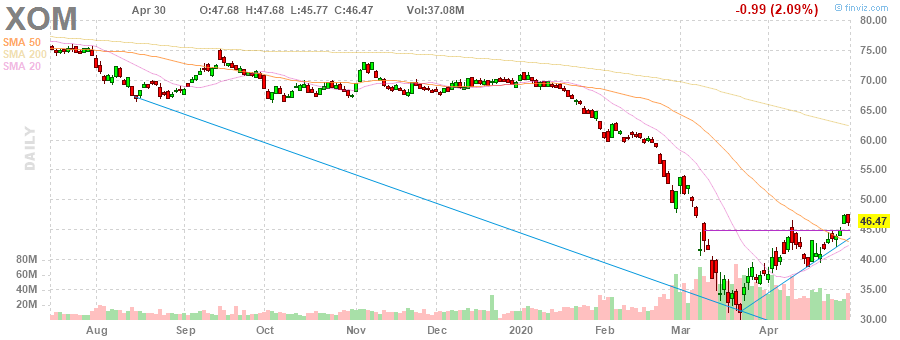
Exxon Mobil (XOM) reported Q1 FY 2020 earnings of $0.53 per share (versus $0.55 per share in Q1 FY 2019), beating analysts' consensus estimate of $0.06 per share.
The company's quarterly revenues amounted to $56.158 bln (-11.7% y/y), missing analysts' consensus estimate of $58.254 bln.
XOM fell to $45.60 (-1.87%) in pre-market trading.
ING's strategists note that an old financial market adage "Sell in May and go away" suggests that investors take a more conservative approach to risk during the summer months.
"Whether it applies this year remains to be seen, although for reference the S&P 500 has rallied in seven of the last eight years during the May-October period for an average gain of 4%."
"What may concern investors today, however, is that market favourites such as Amazon and Apple (stocks that have led the 35% rally from the lows in S&P 500) struggled to provide guidance when releasing 1Q earnings yesterday. Apple did not provide a forecast for the first time in 10 years, while Amazon gave a 2Q profit forecast of anywhere between a $1.5 billion profit and a $1.5 billion loss."
With the S&P 500 seemingly stalling at a 62% technical retracement of the February-March sell-off and the market perhaps too conservative in only looking for a 20% fall in S&P 500 earnings this year, it looks as though investors will take a cautious attitude to risk."
"Thus, it may be too early to expect the kind of benign environment that can allow the dollar to sink across the board."
"For today, the US data calendar will see April ISM manufacturing, expected to drop back to the lows seen in December 2008. DXY could move back into a 99.00-99.50 trading range."
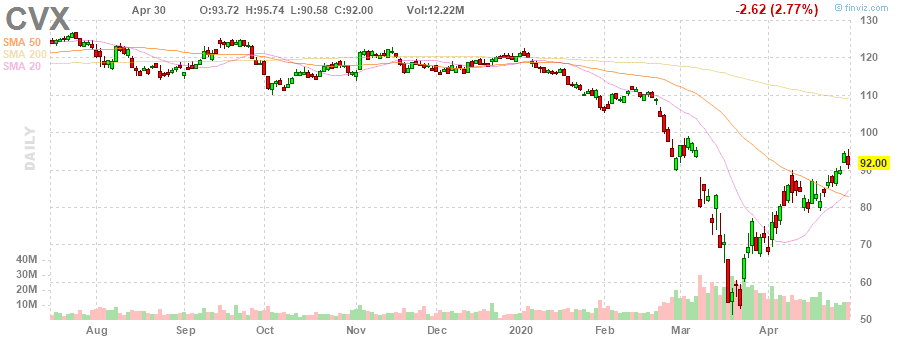
Chevron (CVX) reported Q1 FY 2020 earnings of $1.93 per share (versus $1.39 per share in Q1 FY 2019), beating analysts' consensus estimate of $0.67 per share.
The company's quarterly revenues amounted to $31.501 bln (-10.5% y/y), beating analysts' consensus estimate of $30.464 bln.
CVX fell to $89.54 (-2.67%) in pre-market trading.
- End of lockdown on May 11 will not signal return to normal life
- There will be several phases and May 11 will be one of them
- It is only first step to move out of coronavirus crisis
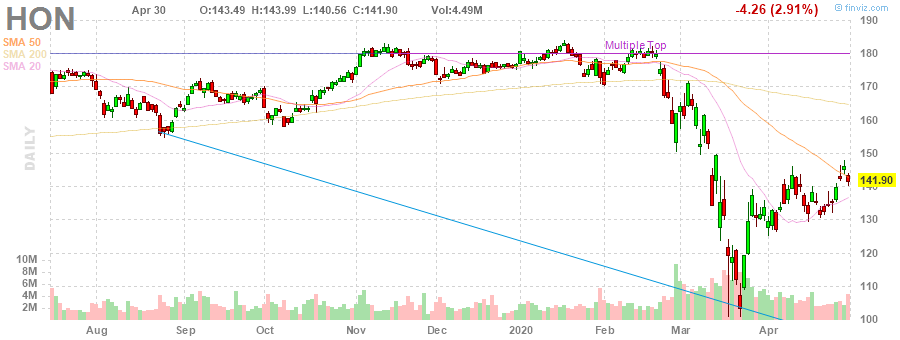
Honeywell (HON) reported Q1 FY 2020 earnings of $2.21 per share (versus $1.92 per share in Q1 FY 2019), beating analysts' consensus estimate of $1.94 per share.
The company's quarterly revenues amounted to $8.463 bln (-4.7% y/y), missing analysts' consensus estimate of $8.555 bln.
Due to the evolving nature of the COVID-19 pandemic and related supply chain and market disruptions, Honeywell announced that it had temporarily suspended its FY 2020 financial guidance until the economic impact of COVID-19 stabilized.
HON fell to $141.85 (-0.04 %) in pre-market trading.
FXStreet reports that analysts at Wells Fargo expect the European Central Bank (ECB) to further expand its asset purchases at its July meeting. They argue inflation in April slowed and the Eurozone registered a record decline in GDP growth during the first quarter. According to them, the risk is clearly for an earlier policy move.
“Eurozone Q1 GDP shrank 3.8% quarter-over-quarter in Q1, the largest decline on record in data back to the mid-1990s, and fell 3.3% year-over-year.”
“We currently expect the ECB to increase the size of its PEPP program a further €500 billion at its July meeting and likely extend that program by a few months. Before easing monetary policy further, we think the ECB would ideally like to monitor the economy and COVID-19, as well as assess the impact of its various LTRO operations, through Q2. The risk is clearly for an earlier policy move though, likely depending on the stability of Italy’s bond market in the interim.”
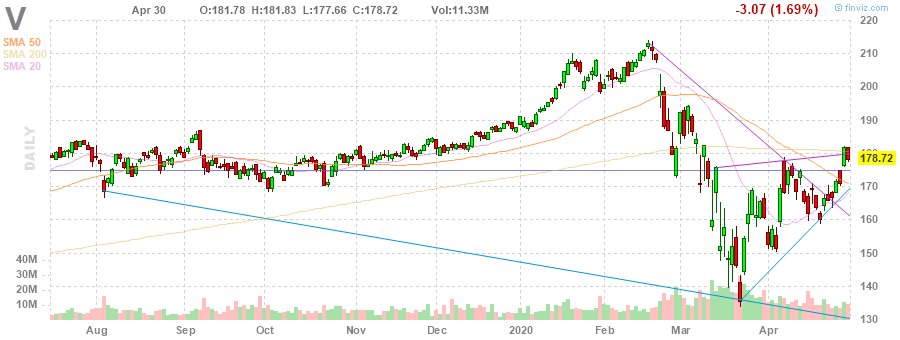
Visa (V) reported Q2 FY 2020 earnings of $1.39 per share (versus $1.31 per share in Q2 FY 2019), beating analysts' consensus estimate of $1.35 per share.
The company's quarterly revenues amounted to $5.854 bln (+6.6% y/y), beating analysts' consensus estimate of $5.753 bln.
The company did not provide FY 2020 outlook due to COVID-19 uncertainty.
V fell to $176.01 (-1.52 %) in pre-market trading.
FXStreet reports that according to strategists at UOB Group’s Quarterly Global Outlook, cable is expected to depreciate further in the next months, although it is seen returning to the 1.20-neighbourhood in Q3/Q4 2020.
“GBP/USD has dropped from 1.28 at the start of March to 1.15 by the third week of March, surpassing the 1.20 low reached during the depth of the Brexit negotiations last September and for its lowest since 1985. The cliff-edge drop puts the GBP as one of the most oversold currencies in the G-7 Majors space”.
“That said, strong USD demand is likely to persist in the coming months, pinning GBP/USD at multi-decade lows. Similar to EUR/USD, whilst we expect a 2H20 recovery for GBP/USD, the trajectory is likely to more modest, further weighed by uncertainties over the Brexit transition”.
“Overall, our updated GBP/USD forecasts are 1.15 in 2Q20, 1.17 in 3Q20, and 1.20 for both 4Q20 and 1Q21.”
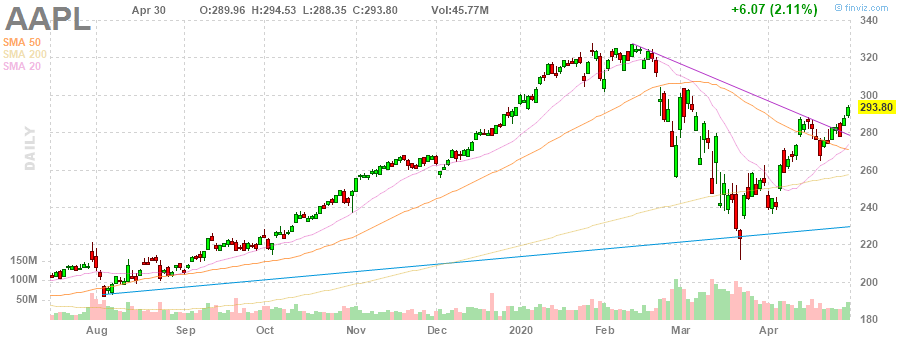
Apple (AAPL) reported Q2 FY 2020 earnings of $2.55 per share (versus $2.46 per share in Q2 FY 2019), beating analysts' consensus estimate of $2.26 per share.
The company's quarterly revenues amounted to $58.313 bln (+0.5% y/y), beating analysts' consensus estimate of $54.643 bln.
The company did not provide Q3 FY 2020 guidance for revenues or gross margins. Apple's CEO Tim Cook told CNBC they were not giving guidance due to a lack of visibility.
Meanwhile, Apple raised its dividends by 6.5% to $0.82/share from $0.77/share and authorized an increase of $50 bln to its existing share repurchase program.
AAPL fell to $286.00 (-2.65 %) in pre-market trading.
- We will adjust PEPP composition as much as necessary, for as long as needed
- Non-fundamental volatility in spreads impairs smooth transmission of policy
- It is basic task for central bank to counter such destabilizing forces
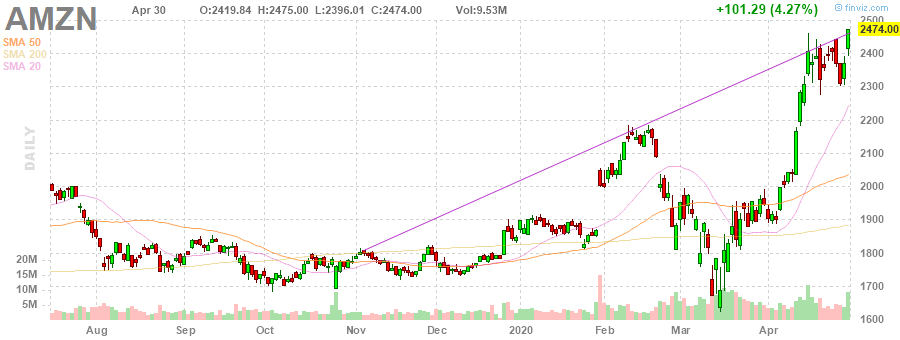
Amazon (AMZN) reported Q1 FY 2020 earnings of $5.01 per share (versus $7.09 per share in Q1 FY 2019), missing analysts' consensus estimate of $6.23 per share.
The company's quarterly revenues amounted to $75.452 bln (+26.4% y/y), beating analysts' consensus estimate of $74.145 bln.
The company also issued an in-line Q2 FY 2020 revenue guidance of $75.00-81.00 bln versus analysts' consensus estimate of $78.86 bln; guided Q2 FY 2020 operating income of $(1.5)-1.5 bln versus analysts' consensus estimate of $3.73 bln.
AMZN fell to $2,335.50 (-5.60%) in pre-market trading.
FXStreet reports that Barnabas Gan, Economist at UOB Group, reviewed the prospects for the labour market figures in Singapore.
"Singapore's overall unemployment rate rose to 2.4% in the first quarter of 2020, according to preliminary estimates by the Ministry of Manpower. Higher unemployment rates for both residents (from 3.2% to 3.3%) and citizens (from 3.3% to 3.5%) were also observed."
"Retrenchment numbers also rose in 1Q20 to 3,000 persons, up from 2,670 in the previous quarter. The level of retrenchment remains significantly lower compared to Global Financial Crisis (GFC) where retrenchments surged to 12,760 in 1Q09."
"Total employment in Singapore however plunged by 19,900 jobs, led by a significant reduction in foreign employment. All three major industries (Manufacturing, Services & Construction) saw reduction in employment."
"Labour conditions are still expected to worsen especially in the upcoming quarter considering the circuit breaker measures as well as the sharp decline in global demand. We expect unemployment to rise to 3.5% in 2020, with upside risks should the COVID-19 pandemic be more severe and protracted than anticipated."
Bloomberg reports that Spain's government expects the economy to shrink by 9.2% in 2020, due to the impact of the coronavirus outbreak.
Following this year's contraction, Madrid expects the economy to rebound in 2021, with 6.8% growth, Economy Minister Nadia Calvino said in a press conference, in which she announced the annual economic outlook the government sent Thursday to European Union officials in Brussels.
The government's forecast for 2020 is in line with the central scenario presented April 20 by the Bank of Spain in its outlook.
FXStreet reports that strategists at UOB Group's Quarterly Global Outlook estimate the US GDP could contract 4.1% during the current year.
"Indeed, the price to pay to contain COVID-19 is a heavy economic cost. Strong, draconian measures that are absolutely necessary to break the transmission chains are also clearly disastrous for businesses and consumers (the pillar of US economy). We factor in two consecutive quarters of GDP contraction in 1H, of which we now project a 2% (annualised rate) decline in 1Q followed by a deeper 26.8% contraction in 2Q."
"This now implies that we see US falling into a severe technical recession (i.e. 2 consecutive quarters of sequential q/q declines) in 1H 2020. The subsequent 2H will resume q/q growth (we assume the COVID-19 situation will improve/be partly under control by mid-2020) but the rebound (+6.1% in 3Q and 10.4% in 4Q) in the latter half of the year will not offset the 1H contraction, so US overall GDP will now contract by 4.1% in 2020 (from previous forecast of +0.6%), and will be the first full year contraction since 2008 and 2009. The significant impact on economic and day-to-day activities could see a sharp spike in US job losses (4-5 million) and unemployment could surge above 10% in 2Q before easing to end the year at 8.5%. Inflation is likely to be subdued, averaging below 1% in 2020."
-
Leaning towards extending state of emergency for about one month
-
Coronavirus experts panel judges Japan as having achieved some success
According to the report from Bank of England, mortgage approvals for house purchase fell in March to 56,200, their lowest level since March 2013. Economists had expected a decline to 60,000 from 73,670 in February.
The rate on new variable-rate mortgage borrowing fell by 17 basis points in March, while the cost of fixed-rate mortgages was little changed.
Sterling money holdings and borrowing both rose to their all-time series highs, of £57.4 billion and £55.3 billion respectively.
Within that, UK businesses' deposits rose by £34.0 billion and their bank loans borrowing rose by £34.1 billion, also both record increases.
The interest rate paid on businesses' new borrowing fell by 20 basis points, with SMEs seeing larger falls.
Households repaid £3.8 billion of consumer credit, on net, in March.
In March, interest rates paid on businesses' new deposits fell by up to 26 basis points, but household deposit rates were little changed.
According to the report from IHS Markit/CIPS, the public health emergency caused by the outbreak of coronavirus disease 2019 (COVID-19) caused substantial disruption across the UK manufacturing sector and its supply chains in April. Manufacturing production, new orders and employment all contracted at the fastest rates in the 28-year survey history, while vendor lead times lengthened to the greatest extent so far. The global pandemic also hit overseas demand, leading to a series-record drop in new export business.
The seasonally adjusted Manufacturing PMI fell to a record low of 32.6 in April, down from 47.8 in March. Economists had expected a drop to 32.8. The fall in the PMI was softened by a comparatively modest reduction in stocks of purchases and record lengthening of vendor lead times (which has an inverse contribution to the PMI level). Survey data were collected between 7-27 April. Response levels were similar to those observed before the outbreak.
The survey-record contractions in output, new orders, employment and new export business were felt across the manufacturing sector, with series-record declines in each of these variables seen across the consumer, intermediate and investment goods sub-industries. Companies linked the declines to the consequences of the COVID-19 outbreak, particularly regarding company closures, weak domestic and global demand and labour shortages (following job losses and staff furloughs). In the few cases where companies reported an increase in either output or new orders, this was generally from those producing (or repurposed to produce) medical- or food-related goods.
Business sentiment also remained low by the historical standards of the survey in April. Although companies still forecast (on average) that output would be higher one year from now, the degree of positive sentiment was up only slightly from March's record low.
-
Euro area real GDP could fall by around 5% (mild scenario), 8% (medium scenario), and 12% (severe scenario) this year
-
Under the severe scenario, Q2 quarterly real GDP growth could be -15%, followed by a protracted and incomplete recovery; +6% in Q3, +3% in Q4
-
Under the severe scenario, real GDP is expected to remain well below the level observed at the end of 2019 until the end of 2022
FXStreet reports that the Reserve Bank of New Zealand (RBNZ) announced on Friday, it plans an unchanged level of bond-buying next week.
The central bank said it will keep the amount of bond-buying unchanged at NZD1.35 billion.
This comes after the Reserve Bank of Australia (RBA) is seeking to lower bond purchase volumes in its QE program.
RNBZ said on Thursday, the board has decided to remove mortgage loan-to-value ratio (LVR) restrictions for 12 months.
Reuters reports that Australian Prime Minister Scott Morrison, who has angered Beijing by calling for a global inquiry into the coronavirus outbreak, said he had no evidence to suggest the disease originated in a laboratory in the Chinese city of Wuhan.
U.S. President Donald Trump said on Thursday he was confident the coronavirus may have originated in a Chinese virology lab, but declined to describe the evidence he said he had seen.
Morrison said on Friday that Australia had no information to support that theory, and said the confusion supported his push for an inquiry to understand how the outbreak started and then spread rapidly around the world.
"What we have before us doesn't suggest that that is the likely source," Morrison told a news conference in Canberra when asked about Trump's comments.
"There's nothing we have that would indicate that was the likely source, though you can't rule anything out in these environments," he said.
"We know it started in China, we know it started in Wuhan, the most likely scenario that has been canvassed relates to wildlife wet markets, but that's a matter that would have to be thoroughly assessed."
CNBC reports that Bank of America strategist Savita Subramanian said that bank stocks are undervalued and investors should buy them as the United States economy looks to dig out of the hole caused by the pandemic.
"This is a sector that's probably going to recover faster than others in an upturn. It's also priced relatively conservatively," Subramanian said.
Bank stocks have been one of the hardest-hit sectors since the pandemic sparked a global selloff in equity markets. Financial companies have been hit by both the economic downturn and the lowered interest rates from central banks around the world. Major U.S. banks took big hits from increased loan loss reserves in the first quarter as they prepared for possible loan defaults during the recession.
Subramanian pointed to the shape of the economic recovery in China as a reason to be bullish on bank stocks, saying that financials are bouncing back stronger than consumer businesses in that country.
"We've seen activity start to normalize in China. They're maybe a month or two ahead of us ... and what's interesting is that in China the sectors that have come back to full capacity - what they were running at in April of last year - are financial companies, banks," Subramanian said.
| Time | Country | Event | Period | Previous value | Forecast | Actual |
|---|---|---|---|---|---|---|
| 00:30 | Japan | Manufacturing PMI | April | 44.8 | 43.7 | 41.9 |
| 01:30 | Australia | Producer price index, q / q | Quarter I | 0.3% | 0.2% | |
| 01:30 | Australia | Producer price index, y/y | Quarter I | 1.4% | 1.3% | |
| 06:00 | United Kingdom | Nationwide house price index, y/y | April | 3% | 2.5% | 3.7% |
| 06:00 | United Kingdom | Nationwide house price index | April | 0.8% | -0.3% | 0.7% |
During today's Asian trading, the US dollar rose slightly against major currencies after a significant decline the day before as investors focused on month-end rebalancing of their portfolios.
The U.S. dollar was weak against most major currencies on Thursday, continuing to be weighed down by the Federal Reserve's pledge on Wednesday to use its full range of tools to support the economy. Promising trial results of Gilead Sciences' potential coronavirus treatment remdesivir also contributed to dollar's weakness.
The Euro rose slightly against the US dollar, while the focus remained on the results of the ECB meeting. European Central Bank President Christine Lagarde warned of an "unexpected" downturn in the euro area that is likely to steepen further during this year, and urged coordinated policy action to protect against downside risks and support the recovery. In her customary press conference, Lagarde said that euro area GDP could fall by between 5% and 12 percent this year, depending on the duration of the containment measures and the success of policies to mitigate the economic consequences for businesses and workers.
According to the survey from Australian Bureau of Statistics (ABS), nearly half (45 per cent) of Australians aged 18 years and over had their household finances impacted by COVID-19 in the period mid-March to mid-April.
"One third of Australians (31 per cent) reported that their household finances had worsened over this period, while one in seven (14 per cent) reported an improvement," said Michelle Marquardt, ABS Program Manager for Household Surveys.
While the majority of Australians (81 per cent) said their household could raise $2,000 for something important within a week, lower than the 84 per cent reported in the 2014 General Social Survey, a small number of Australians reported experiencing financial hardship.
"One in 13 Australians (7.5 per cent) said their household lacked the money to pay one or more bills on time, and one in ten (10 per cent) had to draw on accumulated savings to support basic living expenses," added Ms Marquardt.
A quarter of Australians aged 18 years and over (28 per cent) said they received the first one-off $750 economic support payment, announced by the Commonwealth Government in March as part of the COVID-19 economic stimulus package.
"Those aged 65 years and over were more likely than those aged 18 to 64 to have received the first one-off $750 economic support payment (60 per cent compared with 19 per cent)" said Ms Marquardt.
"Around half (53 per cent) of persons who received the economic support payment added it to savings, with persons aged 65 years and over more likely to do so than persons aged 18 to 64 (71 per cent compared with 37 per cent)."
Reuters reports that british factory output risks falling by more than half during the current quarter after 80% of manufacturers reported a collapse in orders due to the coronavirus, trade body Make UK said .Make UK said a survey of 297 members, conducted from April 20-27, showed that more than three quarters had already suffered a drop in sales.
Britain's Office for Budget Responsibility said on April 14 that factory output could fall by 55% in the second quarter, as part of a scenario for the broader economy that showed a 35% plunge in total output if lockdown restrictions stay in place.
"The extent of the collapse in demand is such it means that the recent OBR forecast could be an underestimate unless there is a quite remarkable turnaround which, to be frank, just isn't going to happen," Make UK chief executive Stephen Phipson said.
Some 87% of manufacturers are still carrying out some operations, but more than a third had put staff members on leave under a government wage guarantee scheme which was likely to be needed beyond its planned end-June closing date, Make UK said.
One in five manufacturers have seen orders drop by more than half, it added.
eFXdata reports that NAB Research discusses AUD/NZD outlook and sees a scope for a dip into 1.05 over the coming weeks before resuming its upmove through 1.09 by year-end.
"The RBNZ is seen ready to buy up to as much as 50% of the NZ government bond market, which will see the QE programme upscaled significantly at the May MPS. The deeper economic hole that NZ has created for itself as well as the massive QE programme - likely more than twice as great as the RBA's government bond buying when measured as a percent of GDP on our estimates - are two reasons why we see AUD/NZD headed higher," NAB notes.
"With the upside revision to AUD forecasts, our new projections reflect those macro forces. A case for a nearterm reversal of the cross (driven mainly from the AUD side after its recent exceptional strength) can be made after the strong recovery from parity at its lows, but macro forces suggest a higher plane through the second half of the year," NAB adds.
CNBC reports that lawmakers in countries like Germany, Sweden and Australia have called for a probe into how the virus started, which has so far infected over 3.2 million people and killed over 230,000.
Speaking to CNBC, Ursula von der Leyen, the head of the EU's executive arm, said she would like to see China work together with her organization, and others, to get to the bottom of exactly how it emerged.
According to the report from Nationwide Building Society, annual house price growth edges up to 3.7%, the strongest since February 2017. Economists had expected a 2.5% increase. On a monthly basis, home prices increased 0.7%, after taking account of seasonal factors. Economists had expected a 0.3% decrease.
Commenting on the figures, Robert Gardner, Nationwide's Chief Economist, said: "Annual house price growth increased to 3.7% in April, up from 3% in March - the fastest pace since February 2017 (when annual growth was 4.5%). There have been month on-month gains for the last seven months in a row, after taking account of seasonal effects. It's important to note that the impact of the pandemic is not fully captured in this month's figures. This is because our index is constructed using mortgage approval data, and there is a lag between mortgage applications being submitted and approved. Indeed, c80% of cases in the April sample relate to mortgage applications that commenced prior to the lockdown, and hence before the full extent of the impact of the pandemic became clear".
-
CNBC reports that Over 3.2 million people have been infected worldwide by the coronavirus and more than 233,000 people have died from the respiratory disease Covid-19, according to data from Johns Hopkins University.
-
Major carriers in the U.S. will start requiring passengers and employees who meet customers to wear cloth face coverings throughout the flight, announced trade group Airlines for America. This includes check-in, boarding, in-flight and deplaning, the statement said.
-
President Donald Trump said, without offering any evidence, that he had reason to believe that the coronavirus outbreak originated from a laboratory in China.
EUR/USD
Resistance levels (open interest**, contracts)
$1.1026 (1297)
$1.1000 (1120)
$1.0983 (1040)
Price at time of writing this review: $1.0947
Support levels (open interest**, contracts):
$1.0912 (1248)
$1.0879 (1847)
$1.0839 (1443)
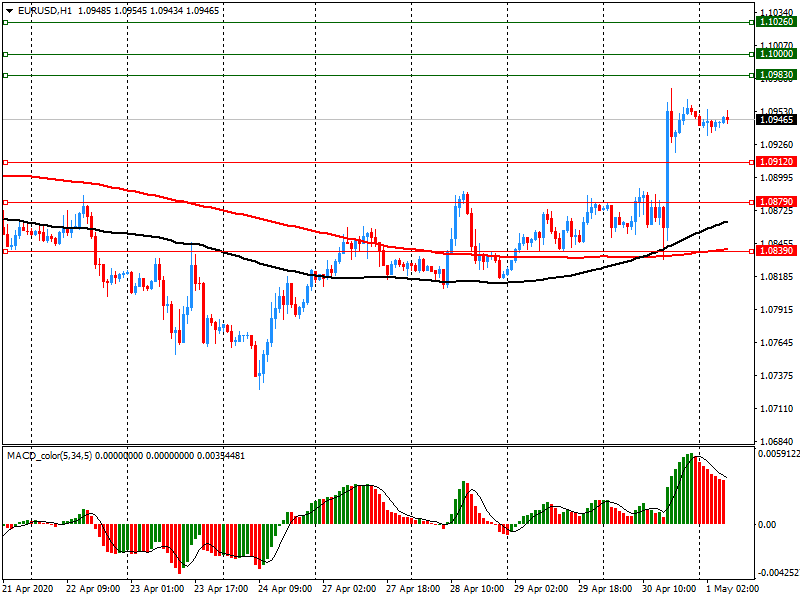
Comments:
- Overall open interest on the CALL options and PUT options with the expiration date May, 8 is 70563 contracts (according to data from April, 30) with the maximum number of contracts with strike price $1,0600 (2890);
GBP/USD
Resistance levels (open interest**, contracts)
$1.2722 (1380)
$1.2662 (955)
$1.2630 (640)
Price at time of writing this review: $1.2553
Support levels (open interest**, contracts):
$1.2472 (339)
$1.2431 (494)
$1.2386 (731)
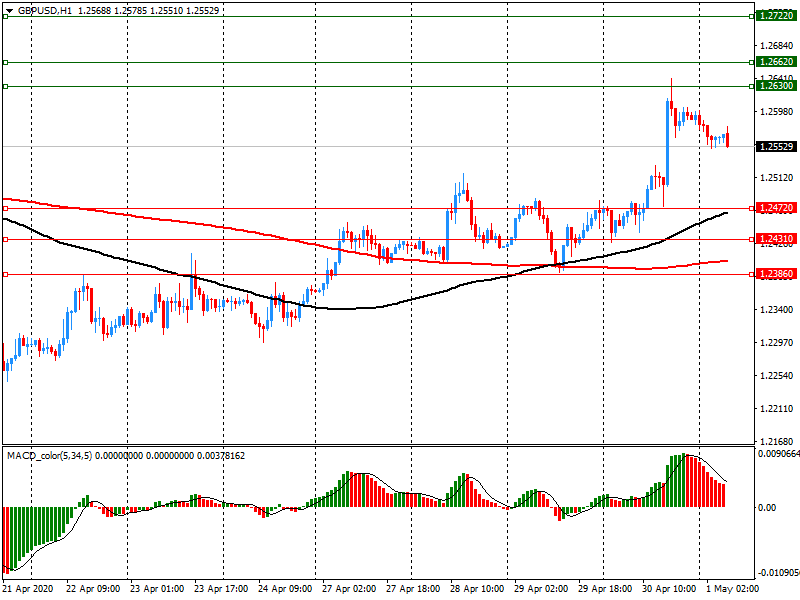
Comments:
- Overall open interest on the CALL options with the expiration date May, 8 is 16157 contracts, with the maximum number of contracts with strike price $1,3000 (1441);
- Overall open interest on the PUT options with the expiration date May, 8 is 18607 contracts, with the maximum number of contracts with strike price $1,2850 (1073);
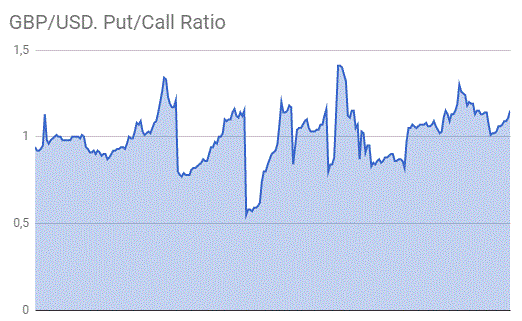
- The ratio of PUT/CALL was 1.15 versus 1.11 from the previous trading day according to data from April, 30
* - The Chicago Mercantile Exchange bulletin (CME) is used for the calculation.
** - Open interest takes into account the total number of option contracts that are open at the moment.
| Raw materials | Closed | Change, % |
|---|---|---|
| Brent | 24.68 | 12.85 |
| Silver | 14.9 | -2.42 |
| Gold | 1685.795 | -1.51 |
| Palladium | 1968.96 | 1.22 |
| Index | Change, points | Closed | Change, % |
|---|---|---|---|
| NIKKEI 225 | 422.5 | 20193.69 | 2.14 |
| ASX 200 | 129 | 5522.4 | 2.39 |
| FTSE 100 | -214.04 | 5901.21 | -3.5 |
| DAX | -246.1 | 10861.64 | -2.22 |
| CAC 40 | -98.93 | 4572.18 | -2.12 |
| Dow Jones | -288.14 | 24345.72 | -1.17 |
| S&P 500 | -27.08 | 2912.43 | -0.92 |
| NASDAQ Composite | -25.16 | 8889.55 | -0.28 |
| Time | Country | Event | Period | Previous value | Forecast |
|---|---|---|---|---|---|
| 00:30 | Japan | Manufacturing PMI | April | 44.8 | 43.7 |
| 01:30 | Australia | Producer price index, q / q | Quarter I | 0.3% | |
| 01:30 | Australia | Producer price index, y/y | Quarter I | 1.4% | |
| 06:00 | United Kingdom | Nationwide house price index, y/y | April | 3% | 2.5% |
| 06:00 | United Kingdom | Nationwide house price index | April | 0.8% | -0.3% |
| 08:30 | United Kingdom | Net Lending to Individuals, bln | March | 5.2 | |
| 08:30 | United Kingdom | Mortgage Approvals | March | 73.55 | 60 |
| 08:30 | United Kingdom | Consumer credit, mln | March | 0.9 | 0.7 |
| 08:30 | United Kingdom | Purchasing Manager Index Manufacturing | April | 47.8 | 32.8 |
| 13:45 | U.S. | Manufacturing PMI | April | 48.5 | 36.9 |
| 14:00 | U.S. | Construction Spending, m/m | March | -1.3% | -3.5% |
| 14:00 | U.S. | ISM Manufacturing | April | 49.1 | 36.9 |
| 17:00 | U.S. | Baker Hughes Oil Rig Count | May | 378 |
| Pare | Closed | Change, % |
|---|---|---|
| AUDUSD | 0.65023 | -0.81 |
| EURJPY | 117.335 | 1.22 |
| EURUSD | 1.09494 | 0.7 |
| GBPJPY | 134.929 | 1.53 |
| GBPUSD | 1.25933 | 1.01 |
| NZDUSD | 0.61187 | -0.24 |
| USDCAD | 1.3938 | 0.43 |
| USDCHF | 0.96552 | -0.85 |
| USDJPY | 107.143 | 0.5 |







© 2000-2026. All rights reserved.
This site is managed by Teletrade D.J. LLC 2351 LLC 2022 (Euro House, Richmond Hill Road, Kingstown, VC0100, St. Vincent and the Grenadines).
The information on this website is for informational purposes only and does not constitute any investment advice.
The company does not serve or provide services to customers who are residents of the US, Canada, Iran, The Democratic People's Republic of Korea, Yemen and FATF blacklisted countries.
Making transactions on financial markets with marginal financial instruments opens up wide possibilities and allows investors who are willing to take risks to earn high profits, carrying a potentially high risk of losses at the same time. Therefore you should responsibly approach the issue of choosing the appropriate investment strategy, taking the available resources into account, before starting trading.
Use of the information: full or partial use of materials from this website must always be referenced to TeleTrade as the source of information. Use of the materials on the Internet must be accompanied by a hyperlink to teletrade.org. Automatic import of materials and information from this website is prohibited.
Please contact our PR department if you have any questions or need assistance at pr@teletrade.global.


 Bank
Bank transfers


