- Analytics
- News and Tools
- Market News
CFD Markets News and Forecasts — 16-08-2021
| Time | Country | Event | Period | Previous value | Forecast |
|---|---|---|---|---|---|
| 01:30 (GMT) | Australia | RBA Meeting's Minutes | |||
| 04:30 (GMT) | Japan | Tertiary Industry Index | June | -2.7% | |
| 06:00 (GMT) | United Kingdom | Average earnings ex bonuses, 3 m/y | June | 6.6% | 7.4% |
| 06:00 (GMT) | United Kingdom | Average Earnings, 3m/y | June | 7.3% | 8.7% |
| 06:00 (GMT) | United Kingdom | ILO Unemployment Rate | June | 4.8% | 4.8% |
| 06:00 (GMT) | United Kingdom | Claimant count | July | -114.8 | |
| 09:00 (GMT) | Eurozone | Construction Output, y/y | June | 13.6% | |
| 09:00 (GMT) | Eurozone | Employment Change | Quarter II | -0.3% | |
| 09:00 (GMT) | Eurozone | GDP (YoY) | Quarter II | -1.3% | 13.7% |
| 09:00 (GMT) | Eurozone | GDP (QoQ) | Quarter II | -0.3% | 2% |
| 12:15 (GMT) | Canada | Housing Starts | July | 282.1 | |
| 12:30 (GMT) | Canada | Foreign Securities Purchases | June | 20.79 | |
| 12:30 (GMT) | U.S. | Retail sales | July | 0.6% | -0.3% |
| 12:30 (GMT) | U.S. | Retail Sales YoY | July | 18.0% | |
| 12:30 (GMT) | U.S. | Retail sales excluding auto | July | 1.3% | 0.2% |
| 13:15 (GMT) | U.S. | Capacity Utilization | July | 75.4% | 75.7% |
| 13:15 (GMT) | U.S. | Industrial Production YoY | July | 9.8% | |
| 13:15 (GMT) | U.S. | Industrial Production (MoM) | July | 0.4% | 0.5% |
| 14:00 (GMT) | U.S. | NAHB Housing Market Index | August | 80 | 80 |
| 14:00 (GMT) | U.S. | Business inventories | June | 0.5% | 0.8% |
| 17:30 (GMT) | U.S. | Fed Chair Powell Speaks | |||
| 22:45 (GMT) | New Zealand | PPI Output (QoQ) | Quarter II | 1.2% | |
| 22:45 (GMT) | New Zealand | PPI Input (QoQ) | Quarter II | 2.1% | |
| 23:50 (GMT) | Japan | Core Machinery Orders, y/y | June | 12.2% | 15.8% |
| 23:50 (GMT) | Japan | Trade Balance Total, bln | July | 383.2 | 202.3 |
| 23:50 (GMT) | Japan | Core Machinery Orders | June | 7.8% | -2.8% |
ActionForex reports that analysts at TD Bank Financial Group discuss the June data on Canada’s manufacturing sales.
"Canada’s manufacturing sales grew 2.1% (m/m) in June, slightly above Statistics Canada’s flash estimate for a 1.9% increase. The picture was similar after accounting for price effects, with manufacturing shipment volumes up 2.2% on the month."
"The increase in manufacturing shipments was predominantly led by the motor vehicles industry, where sales increased 25.6% on the month. Sales of petroleum and coal products (+5.2%) and aerospace products and parts (+21.7%) were also notably strong. A decline in wood product sales (-5.7%) provided some offset."
"After an unusually weak May report, Canada’s manufacturing sales showed some signs of life in June. However, while output in the auto industry has partially recovered, production levels remain low as a result of the global shortage in semiconductor chips. Recent reports from auto manufacturers suggest that we aren’t out of the woods yet, with some citing that shortages may continue to cloud the outlook into next year."
"Looking ahead, the macro backdrop remains supportive for the manufacturing sector, with near-term indicators pointing to continued expansion. New orders posted a solid increase in June, and manufacturing sentiment remains firmly in expansion territory, as evidenced by recent PMI readings... Importantly, the strong economic performance in Canada’s largest trading partner (the U.S.) bodes well for the sector."
eFXdata reports that analysts at Citi offer their expectations for NZD outlook around this week's RBNZ policy meeting.
"The potential OCR rate hike from 0.25% to 0.5% at the monetary policy meeting on August 18 this week. A 0.5% rate hike is the risk scenario, but this would be a bigger risk than the probability the local rate market currently prices in. There will be limited room for interest rates to rise in the near future even if a rate hike is officially announced, but NZD/USD is likely to bounce."
"The correction of the pair in July was limited to the –1σ band from the 200d MA, which implies its long-term trend is still upward. The 200d MA (around 0.711) will be achievable on the rate hike delivered by the RBNZ this Wednesday, and we see another scope to appreciate toward the +1σ band (around 0.723) over the following days."
Statistics
Canada reported on Monday the wholesale sales fell 0.8 percent m-o-m to CAD71.53
billion in June, following an unrevised 0.5 percent m-o-m advance in May. This marked the
first decline in wholesale sales since February.
Economists
had forecast a 1.8 percent m-o-m drop for June.
According
to the report, sales went down in three of the seven subsectors, led by building
material and supplies (-5.4 percent m-o-m), and machinery, equipment and
supplies (-3.5 percent m-o-m) subsectors. These declines, however, were partially
offset by gains in the personal and household goods (+4.3 percent m-o-m), and
motor vehicles and motor vehicle parts and accessories (+3.1 percent m-o-m) subsectors.
Excluding
motor vehicle and motor vehicle parts and accessories subsector, wholesale
sales declined 1.4 percent m-o-m.
In
y-o-y terms, wholesale sales surged 14.7 percent in June.
Meanwhile,
wholesale inventories dropped 0.6 m-o-m in June to CAD94.62 billion. Notwithstanding this decline, June's
inventories were the second-highest on record. Inventories decreased in four of
the seven subsectors, with the motor vehicle and motor vehicle parts and
accessories subsector (-4.7 percent m-o-m) registering the largest decrease
that generated more than 90% of the overall fall.
In
y-o-y terms, wholesale inventories increased 4.6 percent in June.
The inventory-to-sales ratio remained constant
at 1.32 in June.
FXStreet reports that S&P 500 extends its low volatility grind higher and analysts at Credit Suisse continue to look for trend resistance from April, today seen at 4475 to cap at first for a corrective pullback.
“S&P 500 has edged higher again as the market extends its relentless low volatility grind higher although still on very low ‘summer’ volume.”
“Strength is still capped for now by trend resistance from April, today seen at 4475. We continue to look for an attempt to see a corrective pullback from here.”
“Support is seen at 4451/49 initially, then the ‘outside day’ low and 13-day exponential average at 4436/25, which we look to ideally hold.”
“A direct and closing break above 4475 can see the immediate risk stay higher for a move to the psychological 4500 level next, with the upper end of its ‘typical’ extreme (15% above the 200-day average) now at 4585.”
U.S. stock-index futures fell on Monday, as a raft of disappointing data from China heightened concerns about a COVID-linked slowdown in global economic growth and ongoing supply chain disruptions.
Global Stocks:
Index/commodity | Last | Today's Change, points | Today's Change, % |
Nikkei | 27,523.19 | -453.96 | -1.62% |
Hang Seng | 26,181.46 | -210.16 | -0.80% |
Shanghai | 3,517.34 | +1.05 | +0.03% |
S&P/ASX | 7,582.50 | -46.40 | -0.61% |
FTSE | 7,133.44 | -85.27 | -1.18% |
CAC | 6,838.03 | -58.01 | -0.84% |
DAX | 15,906.80 | -70.64 | -0.44% |
Crude oil | $66.61 | -2.67% | |
Gold | $1,780.70 | +0.14% |
(company / ticker / price / change ($/%) / volume)
3M Co | MMM | 200 | -0.58(-0.29%) | 804 |
ALCOA INC. | AA | 44.45 | -0.80(-1.77%) | 21745 |
ALTRIA GROUP INC. | MO | 48.56 | -0.04(-0.08%) | 19155 |
Amazon.com Inc., NASDAQ | AMZN | 3,288.00 | -5.97(-0.18%) | 14891 |
American Express Co | AXP | 164.97 | -1.11(-0.67%) | 4233 |
AMERICAN INTERNATIONAL GROUP | AIG | 54.5 | -0.11(-0.20%) | 29934 |
Apple Inc. | AAPL | 148.52 | -0.58(-0.39%) | 360844 |
AT&T Inc | T | 28.11 | -0.08(-0.28%) | 44511 |
Boeing Co | BA | 232.5 | -1.96(-0.84%) | 42608 |
Caterpillar Inc | CAT | 216 | -2.57(-1.18%) | 13656 |
Chevron Corp | CVX | 100.86 | -1.10(-1.08%) | 51463 |
Cisco Systems Inc | CSCO | 56.42 | -0.05(-0.09%) | 12713 |
Citigroup Inc., NYSE | C | 72.36 | -0.75(-1.03%) | 38540 |
Deere & Company, NYSE | DE | 380 | -4.00(-1.04%) | 691 |
Exxon Mobil Corp | XOM | 56 | -0.77(-1.36%) | 94057 |
Facebook, Inc. | FB | 361.33 | -1.85(-0.51%) | 25958 |
FedEx Corporation, NYSE | FDX | 275.95 | -1.23(-0.44%) | 1003 |
Ford Motor Co. | F | 13.45 | -0.14(-1.03%) | 365357 |
Freeport-McMoRan Copper & Gold Inc., NYSE | FCX | 37 | -1.10(-2.89%) | 88499 |
General Electric Co | GE | 104.25 | -0.67(-0.64%) | 13692 |
General Motors Company, NYSE | GM | 53.23 | -0.42(-0.78%) | 50639 |
Goldman Sachs | GS | 408.86 | -1.92(-0.47%) | 4134 |
Google Inc. | GOOG | 2,760.00 | -8.12(-0.29%) | 1843 |
Hewlett-Packard Co. | HPQ | 28.93 | -0.08(-0.28%) | 15707 |
Home Depot Inc | HD | 330 | -1.32(-0.40%) | 60668 |
HONEYWELL INTERNATIONAL INC. | HON | 231.5 | -0.26(-0.11%) | 846 |
Intel Corp | INTC | 53.37 | -0.12(-0.22%) | 25443 |
International Business Machines Co... | IBM | 142.7 | -0.48(-0.34%) | 3578 |
International Paper Company | IP | 59 | -0.22(-0.37%) | 507 |
Johnson & Johnson | JNJ | 176.6 | 0.35(0.20%) | 1686 |
JPMorgan Chase and Co | JPM | 158.64 | -1.34(-0.84%) | 15846 |
McDonald's Corp | MCD | 237.6 | -1.22(-0.51%) | 1142 |
Merck & Co Inc | MRK | 76.82 | 0.10(0.13%) | 11185 |
Microsoft Corp | MSFT | 292.1 | -0.75(-0.26%) | 91924 |
Pfizer Inc | PFE | 48.16 | -0.32(-0.66%) | 480138 |
Procter & Gamble Co | PG | 143.07 | -0.57(-0.40%) | 876 |
Starbucks Corporation, NASDAQ | SBUX | 116.5 | -0.26(-0.22%) | 9177 |
Tesla Motors, Inc., NASDAQ | TSLA | 703.6 | -13.57(-1.89%) | 592859 |
The Coca-Cola Co | KO | 57.16 | -0.07(-0.12%) | 15475 |
Twitter, Inc., NYSE | TWTR | 64.4 | -0.42(-0.65%) | 11066 |
Verizon Communications Inc | VZ | 55.85 | -0.02(-0.04%) | 40484 |
Visa | V | 231.75 | -0.90(-0.39%) | 8514 |
Wal-Mart Stores Inc | WMT | 149.35 | -0.18(-0.12%) | 36520 |
Walt Disney Co | DIS | 180.3 | -0.78(-0.43%) | 41215 |
Yandex N.V., NASDAQ | YNDX | 68.03 | 0.09(0.13%) | 1015 |
The
report from the New York Federal Reserve showed on Monday that manufacturing
activity in the New York region continued to grow in early August, albeit at a much slower
pace than in July.
According to the survey, NY Fed Empire State manufacturing index plunged from 43.0 in July to 18.3 in August, pointing to a continuation of business activity growth in the region.
Economists
had expected the index to come in at 29.0.
Anything
below zero signals contraction.
According
to the report, the new orders index fell 18.4 points to 14.8, still pointing to
a solid increase in orders, and the shipments index tumbled 39.4 points to 4.4,
suggesting a slight advance in shipments. Meanwhile, the delivery times index rose
8.1 points to 28.3, indicating significantly longer delivery times, as has been
the case for the past several months. Elsewhere, the employment index declined
7.8 points to 12.8, indicating a modest rise in employment. On the price front,
both price indexes were at/near record highs, indicating that price gains
remain significant: the prices paid index edged down 0.7 points to 76.1, while
the prices received index climbed 6.6 points to 46.0, setting a new record.
Statistics
Canada released its Monthly Survey of Manufacturing, which showed that the
Canadian manufacturing sales rose 2.1 percent m-o-m in June to CAD59.23
billion, following a revised 0.3 percent m-o-m drop in May (originally a 0.6
percent m-o-m decrease).
Economists
had anticipated a jump of 2.1 percent m-o-m for June.
According
to the survey, sales increased in 13 of 21 industries, with most of the gain
attributable to higher sales of motor vehicles (+25.6 percent m-o-m) and petroleum
and coal products (+5.2 percent m-o-m). Meanwhile, wood product sales (-5.7
percent m-o-m) were the major drag.
Overall,
sales of durable goods climbed 2.8 percent m-o-m in June, while sales of
non-durable goods went up 1.5 percent m-o-m.
In
y-o-y terms, manufacturing sales surged 20.0 percent in June.
USD strengthened against most of its major rivals in the European session on Monday, as market participants moved into the safe-haven currencies after a raft of disappointing data from China heightened concerns about a COVID-linked slowdown in economic growth and ongoing supply chain disruptions.
The U.S. Dollar Index (DXY), measuring the U.S. currency's value relative to a basket of foreign currencies, rose 0.14% to 92.65.
China's July data on retail sales, fixed-asset investment, and industrial output were below economists' forecasts and showed slower growth rates than what was recorded in June, suggesting a growth deceleration in the world's second-largest economy.
Sentiment also was dented by increased geopolitical concerns sparked by a fall of Afghanistan to the Taliban.
In addition, investors also took a cautious stance, awaiting the speech of the Federal Reserve Chairman Jerome Powell at a virtual event on Tuesday and the release of the minutes of the U.S. the central bank's latest meeting on Wednesday, hoping to receive clues on the timing of changes to its $120 billion in monthly bond purchases.
The safe-haven CHF and JPY also appreciated, with both currencies trading higher against USD.
- We will improve policies to counter increase in commodity prices
- We will step up cross-cyclical adjustments, keep economic operations within reasonable range
- We will make effective use of funds freed up by RRR cut to help smaller businesses
FXStreet reports that economists at Credit Suisse suggest that USD/JPY is set to retest August lows and potential trend support at 108.86/73
“Whilst resistance at 109.76 caps the immediate risk is seen lower with support seen at 109.24 initially, then the August low and potential trend support at 108.86/70. We would look for an attempt to find a fresh floor here.”
“Below 108.70 would see the immediate risk stay lower with support seen next at 108.57.”
“Above 109.76 can ease the immediate downside bias for a recovery back to the 55-day average at 110.16.”
FXStreet notes that EUR/GBP seems to have moved to a post-Brexit era and is tracking rate differentials and shifting growth expectations rather more confidently now. On that basis, economists at Société Générale expect the pair to edge lower towards 0.80 by autumn.
“EUR/GBP diverged from yields and spiked in 2019 as the EU departure date approached and the domestic political backdrop got very clouded. Since the initial COVID-related volatility calmed down, the two lines have moved in harmony.”
“The likelihood that the UK will tighten monetary policy well before the ECB suggests that EUR/GBP is now more likely to drift towards 0.80.”
FXStreet reports that analysts at DBS Bank suggest that USD/JPY will remain susceptible unless the USD surmounts its long-term resistance levels at 111.66 and 112.40.
“USD/JPY continues to hold below its key resistance marked at 111.66. Together with 112.40, these are key long-term resistance levels to break to forge a topside break.”
“USD/JPY has to consider the 38.2% Fibonacci retracement of the 102.59-111.66 range at 108.20, and just above that the Donchian Channel support at 108.72. The former should carry some significance given it converges with the 108.29 Ichimoku cloud support on the weekly charts. Without the clarity of guidance from Jackson Hole, USD is likely to respect these interim parameters.”
FXStreet reports that strategists at OCBC Bank expect gold price to attempt the $1800 level this week if the bullish momentum within the precious metal complex continues.
“Our model sees a fair value range for gold from $1735 to $1845, so at the current level, gold is somewhere near the middle of this range.”
“The FOMC minutes is likely to determine gold’s next near-term direction, where a hawkish report may send gold tumbling once more.”
“From now till the report, we expect the upward momentum in gold to carry it towards the $1800 resistance.”
FXStreet reports that economists at Société Générale discusses EUR/CHF prospects.
“EUR/CHF is now correlating with EUR/USD, which will be a very big headache for the SNB if the euro does crumble as Fed tightening draws closer.”
“Our forecasts suggest that the SNB’s FX reserves are going to grow again in the year ahead.”
“EUR/CHF is set to remain below 1.10, but the central bank is most likely to vigorously absorb any downside acceleration towards 1.05, limiting bouts of franc strength.”
FXStreet reports that as polls show a potential majority for the current Prime Minister Justin Trudeau, economists at ING expect the Canadian dollar to take advantage of it.
“Trudeau’sparty has seen a rebound in popularity during the pandemic and latest polls suggest it could reach the 170 parliament seats needed for a majority government at the September elections. This should be generally good news for CAD, especially if investors expect Trudeau to secure a majority in the parliament, although the magnitude of the FX impact should not be very significant.”
“We continue to expect, by year-end, to see the end of QE in Canada, and to see USD/CAD trade close to 1.20.”
CNBC reports that U.S. Treasury yields fell on Monday morning, with investor focus on minutes from the Federal Reserve’s latest meeting, due to be published on Wednesday.
The yield on the benchmark 10-year Treasury note fell 2.4 basis points to 1.273%. The yield on the 30-year Treasury bond gave up nearly 1.6 basis points, falling to 1.932%.
Investors’ focus this week will likely be on the Fed’s latest meeting minutes, as they search for any clues as to when the central bank might start paring back its asset purchases.
There are no major data releases due out on Monday.
Reuters reports that China’s central bank injected billions of yuan through medium-term loans into the financial system on Monday, which many market participants interpreted as an effort to prop up the economy.
The People’s Bank of China (PBOC) kept the rate on a one-year medium-term lending facility (MLF) loan worth 600 billion yuan ($92.64 billion) to some financial institutions steady at 2.95% from previous operations.
The central bank said the loan operation was meant to “fully meet financial institutions’ liquidity demand” while keeping the fund conditions “reasonably ample”.
The move “took into account that financial institutions could use part of the funds freed from a reduction to reserve requirement ratio (RRR) in July to pay back MLF loans due this month”, the PBOC added.
eFXdata reports that ANZ Research discusses its expectations for RBNZ policy meeting.
"In New Zealand, the RBNZ faces a different set of circumstances. The need to dampen over-exuberance has led to wide-spread expectations that it will soon deliver the first OCR hike since 2014. For the NZD, the question is how much is already in the price. The market is pricing a roughly 25% chance of 50 basis point move, we think this is unlikely. With such aggressive expectations heading into the meeting, it’s difficult to see how the RBNZ can deliver a hawkish surprise," ANZ adds.
FXStreet reports that MUFG Bank said that the release of latest FOMC minutes is the main event risk for the week ahead.
“The release of the latest FOMC minutes (Wed) from the July policy meeting could provide further insight into the Fed’s plans. Over the past year, the trend has been for the USD to strengthen initially following the release of FOMC minutes but only modestly. As the Fed moves closer to a policy pivot, there is a risk of a bigger market reaction.”
“We continue to see risks as tilted to the upside for the USD in the week ahead. Any hawkish policy signal in the FOMC minutes could reinforce the USD’s upward momentum especially if key resistance levels are taken out. USD/JPY is poised to rise back towards and test July’s high at 111.66.”
Reuters reports that data released by the National Bureau of Statistics (NBS) showed that China’s new home prices rose at the slowest clip in six months in July, as authorities further tightened rules in the property sector.
Average new home prices in China’s 70 major cities rose 0.3% in July from a month earlier, slowing from a 0.5% gain in June.
Separate data showed property investment also rose at a slower pace in January-July from a year earlier, amid tightened financing rules.
China’s property market rebounded quickly from the COVID-19 crisis last year, triggering concerns about financial risks in an overheated market.
That has prompted authorities to step up curbs this year, including restrictions on borrowing by developers, caps on banks’ lending to the sector, guiding banks to raise mortgage rates and a crackdown on illegal funding in the market.
Price growth in China’s biggest cities such as Shanghai and Beijing eased in July to 0.4% from June’s 0.7% growth, the NBS said.
In Beijing, which has China’s most stringent property curbs, residents are not allowed to buy additional homes after owning two properties.
Prices in smaller tier-three cities rose 0.2% on-month, versus a 0.3% gain in June. Tier-two cities, which include some provincial capitals, gained 0.4%, slowing from June’s 0.5% rise.
FXStreet reports that economists at ING discuss EUR/USD prospects.
“We doubt that the jump in EUR/USD on Friday to the 1.1800 level was the start of a more extended rally.”
“Not only do we continue to expect some pressure on the pair coming from a strong dollar in the short term, but the EUR also seems to be lacking strong bullish drivers: the ECB’s ultra-dovish stance is generating a stark policy divergence with the Fed, and any stabilisation in sentiment may see the EUR suffer from its funding character if interest for carry trades re-emerges.”
“We could see the EUR/USD moving back to the lower half of the 1.1700/1.1800 range.”
| Time | Country | Event | Period | Previous value | Forecast | Actual |
|---|---|---|---|---|---|---|
| 02:00 | China | Retail Sales y/y | July | 12.1% | 11.5% | 8.5% |
| 02:00 | China | Industrial Production y/y | July | 8.3% | 7.8% | 6.4% |
| 02:00 | China | Fixed Asset Investment | July | 12.6% | 11.3% | 10.3% |
| 04:30 | Japan | Industrial Production (YoY) | June | 21.1% | 23.0% | |
| 04:30 | Japan | Industrial Production (MoM) | June | -6.5% | 6.2% | 6.5% |
During today's Asian trading, the US dollar rose slightly against a basket of major currencies, but remains near a one-week low after a record fall in almost seven weeks on Friday. The sharp weakening of consumer confidence in the US has tempered expectations about the imminent curtailment of the Fed's stimulus measures.
A study published on Friday by the University of Michigan showed that consumer confidence has fallen to its lowest level since 2011 amid a rapid increase in the number of coronavirus cases.
The ICE index, which tracks the dynamics of the dollar against six currencies (euro, swiss franc, yen, canadian dollar, pound sterling and swedish krona), rose by 0.08%.
The market is focused on data on retail sales in the United States, which will be published on Tuesday.
The New Zealand dollar fell 0.2% against the US dollar before the Reserve Bank of New Zealand meeting on Wednesday. Economists expect the first increase in the interest rate since 2014.
FXStreet reports that in the view of economists at ING. the worrying covid situation in Australia is set to weigh on the AUD/USD pair.
“Along with a worsening sentiment in Asia and in China in particular, Australia is facing its worst covid crisis so far, with major cities having to enter or extend lockdowns.”
“The fact that only 16% of the population in Australia has been fully vaccinated argues against a quick resolution to the current epidemic crisis.”
“Along with the RBA minutes on Tuesday, we will see July jobs data on Thursday. Any signs of a less dovish RBA in the minutes or another marginal drop in unemployment may give little help to AUD as they would both be seen as outdated considering the material worsening of the COVID-19 situation in Australia in August.”
Bloomberg reports that Japanese Prime Minister Yoshihide Suga is poised to expand and extend for about another two weeks a virus state of emergency in Tokyo now set to expire at the end of August.
The decision to extend the emergency to mid-September could take place as soon as Tuesday. The emergency, currently in force in Tokyo and five other prefectures, will be expanded to include the western regions of Kyoto, Hyogo and Fukuoka, the Sankei added.
Tokyo reported 4,295 new cases Sunday, while the country as a whole saw almost 18,000, just under a record of more than 20,000 reached last week.
Japan’s states of emergency, which have few legal teeth, have become less effective in changing people’s behavior over time, and have had fewer economic implications.
Economy Minister Yasutoshi Nishimura told reporters his feelings about the growth figures were “complicated,” given that the government’s top priority is to rein in the virus.
Suga has rejected the idea of a mandatory lockdown, saying it wouldn’t be accepted in Japan and that he would instead rely on a rapid vaccine rollout.
Reuters reports that data from the National Bureau of Statistics (NBS) showed that China's factory output and retail sales growth slowed sharply in July, as new COVID-19 outbreaks and floods disrupted business operations.
Industrial production increased 6.4% year-on-year in July. Analysts had expected output to rise 7.8% after growing 8.3% in June. Retail sales increased 8.5% in July from a year ago, far lower than the forecast 11.5% rise and June's 12.1% uptick.
China's economy has rebounded to its pre-pandemic growth levels, but the expansion is losing steam as businesses grapple with higher costs and supply bottlenecks. New COVID-19 infections in July also led to fresh restrictions.
Data earlier this month also showed export growth, which has been a key driver of China's impressive rebound from the COVID-19 slump in early 2020, unexpectedly slowed in July.
Fu Linghui, an NBS spokesperson, said at a briefing on Monday that China's recovery remains uneven due to sporadic COVID-19 outbreaks and natural disasters.
A growing number of analysts have been cutting their third quarter growth estimates for China. The country's gross domestic product (GDP) expanded 7.9% in the April-June quarter from a year earlier.
ANZ downgraded its GDP forecast for 2021 to 8.3% from 8.8% after the disappointing July data.
RTTNews reports that according to the report from the Cabinet Office, Japan's gross domestic product expanded an annualized 1.3 percent on year in the second quarter of 2021. That beat forecasts for an increase of 0.7 percent following the 3.9 percent contraction in the first quarter.
On a seasonally adjusted quarterly basis, gross domestic product rose 0.3 percent - again exceeding expectations for 0.2 percent following the 1.0 percent drop in the three months prior.
External demand was down 0.3 percent on quarter versus forecasts for a fall of 0.1 percent after slipping 0.2 percent in Q1.
Private consumption climbed 0.8 percent on quarter, beating forecasts for a loss of 0.1 percent after sinking 1.5 percent in the previous three months.
EUR/USD
Resistance levels (open interest**, contracts)
$1.1887 (1530)
$1.1858 (1452)
$1.1837 (911)
Price at time of writing this review: $1.1790
Support levels (open interest**, contracts):
$1.1765 (1355)
$1.1743 (2571)
$1.1715 (2993)
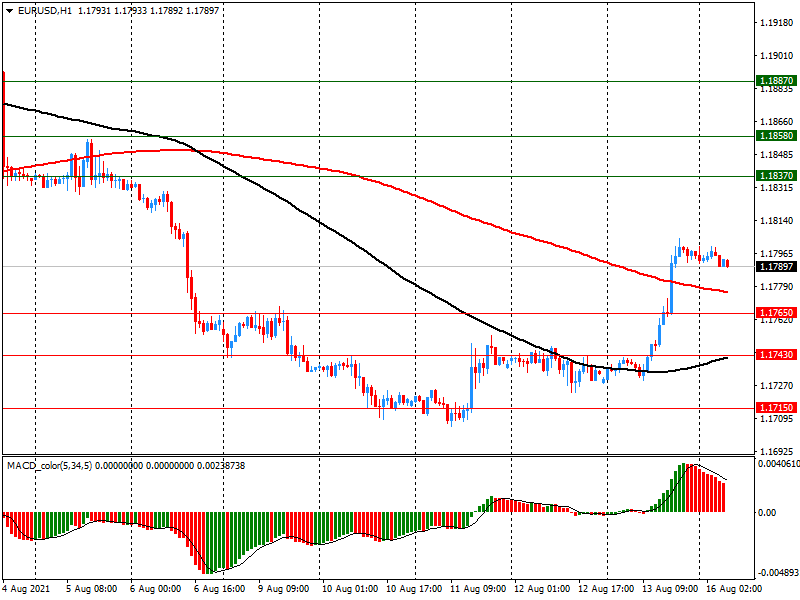
Comments:
- Overall open interest on the CALL options and PUT options with the expiration date September, 3 is 85977 contracts (according to data from August, 13) with the maximum number of contracts with strike price $1,2000 (8571);
GBP/USD
$1.3989 (1634)
$1.3958 (550)
$1.3934 (706)
Price at time of writing this review: $1.3847
Support levels (open interest**, contracts):
$1.3811 (640)
$1.3785 (438)
$1.3755 (1126)
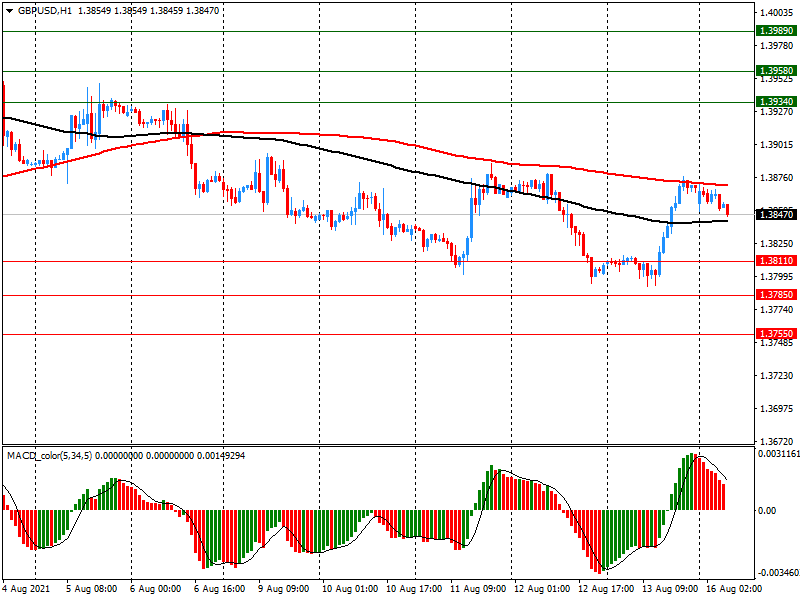
Comments:
- Overall open interest on the CALL options with the expiration date September, 3 is 15655 contracts, with the maximum number of contracts with strike price $1,4300 (2169);
- Overall open interest on the PUT options with the expiration date September, 3 is 13037 contracts, with the maximum number of contracts with strike price $1,3800 (1126);
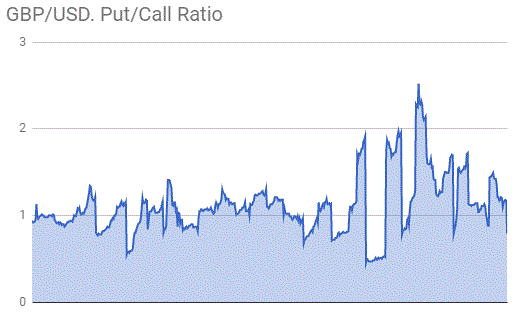
- The ratio of PUT/CALL was 0.83 versus 0.86 from the previous trading day according to data from August, 13
* - The Chicago Mercantile Exchange bulletin (CME) is used for the calculation.
** - Open interest takes into account the total number of option contracts that are open at the moment.
| Raw materials | Closed | Change, % |
|---|---|---|
| Brent | 70.2 | -1.27 |
| Silver | 23.707 | 2.26 |
| Gold | 1779.538 | 1.52 |
| Palladium | 2637.51 | 0.48 |
| Time | Country | Event | Period | Previous value | Forecast |
|---|---|---|---|---|---|
| 02:00 (GMT) | China | Retail Sales y/y | July | 12.1% | 11.5% |
| 02:00 (GMT) | China | Industrial Production y/y | July | 8.3% | 7.8% |
| 02:00 (GMT) | China | Fixed Asset Investment | July | 12.6% | 11.3% |
| 04:30 (GMT) | Japan | Industrial Production (YoY) | June | 21.1% | |
| 04:30 (GMT) | Japan | Industrial Production (MoM) | June | -6.5% | 6.2% |
| 12:30 (GMT) | Canada | Manufacturing Shipments (MoM) | June | -0.6% | |
| 12:30 (GMT) | Canada | Wholesale Sales, m/m | June | 0.5% | |
| 12:30 (GMT) | U.S. | NY Fed Empire State manufacturing index | August | 43 | 30 |
| 20:00 (GMT) | U.S. | Net Long-term TIC Flows | June | -30.2 | |
| 20:00 (GMT) | U.S. | Total Net TIC Flows | June | 105.3 |
| Pare | Closed | Change, % |
|---|---|---|
| AUDUSD | 0.73682 | 0.44 |
| EURJPY | 129.269 | -0.18 |
| EURUSD | 1.17951 | 0.56 |
| GBPJPY | 151.981 | -0.31 |
| GBPUSD | 1.38672 | 0.42 |
| NZDUSD | 0.70367 | 0.52 |
| USDCAD | 1.2513 | -0.07 |
| USDCHF | 0.91512 | -0.86 |
| USDJPY | 109.589 | -0.73 |







© 2000-2026. All rights reserved.
This site is managed by Teletrade D.J. LLC 2351 LLC 2022 (Euro House, Richmond Hill Road, Kingstown, VC0100, St. Vincent and the Grenadines).
The information on this website is for informational purposes only and does not constitute any investment advice.
The company does not serve or provide services to customers who are residents of the US, Canada, Iran, The Democratic People's Republic of Korea, Yemen and FATF blacklisted countries.
Making transactions on financial markets with marginal financial instruments opens up wide possibilities and allows investors who are willing to take risks to earn high profits, carrying a potentially high risk of losses at the same time. Therefore you should responsibly approach the issue of choosing the appropriate investment strategy, taking the available resources into account, before starting trading.
Use of the information: full or partial use of materials from this website must always be referenced to TeleTrade as the source of information. Use of the materials on the Internet must be accompanied by a hyperlink to teletrade.org. Automatic import of materials and information from this website is prohibited.
Please contact our PR department if you have any questions or need assistance at pr@teletrade.global.


 Bank
Bank transfers


