- Analytics
- News and Tools
- Market News
CFD Markets News and Forecasts — 16-12-2021
- USD/CAD remains pressured after two-day downtrend, sidelined of late.
- 50% Fibonacci retracement, RSI rebound challenge sellers around the key moving average.
- Buyers will wait for a successful run-up beyond previous support line.
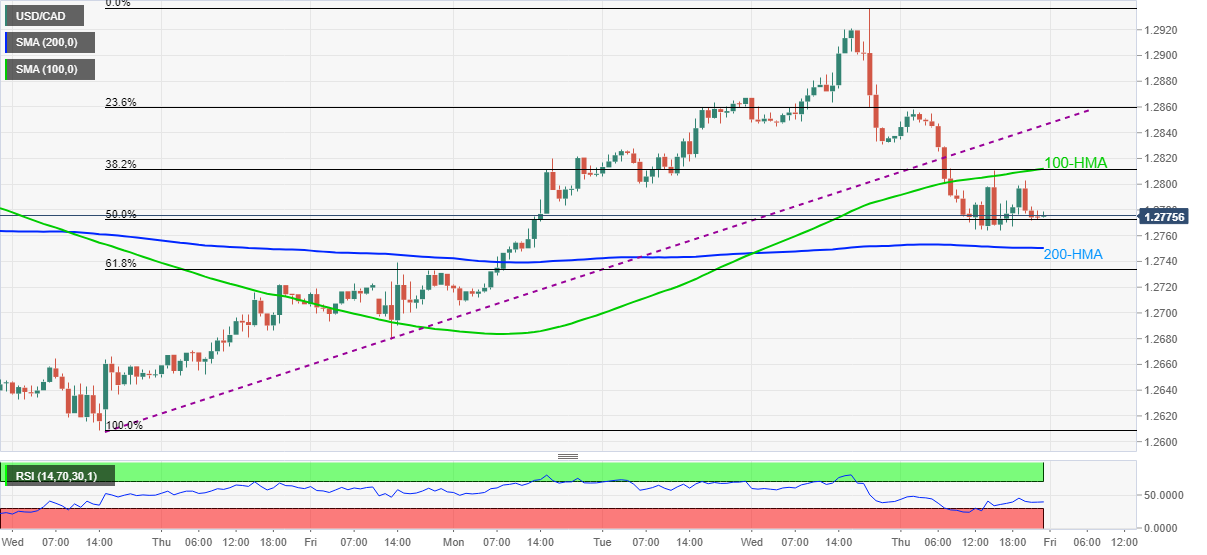
USD/CAD sellers keep reins around 1.2775, despite recently sidelined performance during Friday’s Asian session.
In doing so, the Loonie pair takes rounds to 50% Fibonacci retracement (Fibo.) of December 08-15 upside as the RSI line improves from oversold territory.
However, the corrective pullback has limited room to the north as a convergence of the 100-HMA and 38.2% Fibo. near 1.2815 will be a tough nut to crack for intraday buyers.
Even if the USD/CAD buyers manage to cross the 1.2815 hurdle, the support-turned-resistance line surrounding 1.2845 will challenge the advances before highlighting the 1.2900 threshold and the multi-month top of 1.2937 marked on Wednesday.
Meanwhile, a clear downside break of the 50% Fibonacci retracement level close to 1.2770 will be challenged by the 200-HMA and 61.8% Fibo., respectively around 1.2750 and 1.2730.
In a case where USD/CAD prices remain bearish past 1.2730, the December 10 swing low near 1.2680 can offer an intermediate halt during the fall to the monthly low near 1.2600.
USD/CAD: Hourly chart
Trend: Sideways
- GBP/USD grinds higher after posting the biggest daily gains in a month.
- BOE announced 0.15% rate hike, while giving more importance to inflation target.
- UK reports record daily covid infections, signs FTA deal with Australia but to drop key ECJ demand on NI.
- UK Retail Sales for November, risk catalysts will be important to follow.
GBP/USD defends the post-BOE run-up past 1.3300, near 1.3325 during Friday’s Asian session. While the “Old Lady” pleased bulls with a rate hike the previous day, coronavirus woes and Brexit jitters stay on the table to challenge the immediate upside.
The UK, unfortunately, reports the second consecutive day with all-time high daily covid infections, recently up by 88,376. The government has already levied activity restrictions but the faster spread of the South African covid variant seems to trouble the authorities ahead of the holiday period. “England's Chief Medical Officer warned daily hospital admissions could also hit new peaks due to the fast-spreading Omicron coronavirus variant,” said Reuters.
Elsewhere, London and the European Union (EU) recently made good progress on the Brexit talks as the UK eases its stance on fishing for Fresh and pushed back the border checks on the goods from Ireland beyond January 01 deadline. On the same line is the Financial Times (FT) news saying, “The UK government is on Friday expected to drop its demand to remove the European Court of Justice as the ultimate arbiter of trade rules in Northern Ireland as it seeks to de-escalate tensions with Brussels.”
FT also mentions that the European Commission will on Friday propose a law to ensure Northern Ireland continues to receive medicines from the UK.
Not only with the EU, but the Brexit talks with Australia are also positive as Britain and Canberra recently signed a Free Trade Agreement (FTA) deal. “It is described as the first post-Brexit deal negotiated from scratch and not "rolled over" from trade terms that the UK enjoyed while in the EU. The government estimated it would unlock £10.4bn of additional trade while ending tariffs on all UK exports,” said the BBC.
Markets remain cautious amid the faster spread of Omicron and rethink over the recent central bank actions. That said, the Bank of England (BOE) announced a 0.15% hike in the benchmark rate and favored the bulls. “Relative to the November Report projection, there has been significant upside news in core goods and, to a lesser extent, services price inflation…The MPC’s remit is clear that the inflation target applies at all times, reflecting the primacy of price stability in the UK monetary policy framework," per the BOE MPC Statement.
Amid these plays, equities closed negative and the S&P 500 Futures struggle for fresh clues by the press time.
Looking forward, UK Retail Sales for November, prior -1.3% YoY, will be important for the GBP/USD traders to watch. It should be noted, however, that the BOE has already announced the much-awaited rate hike and hence the data may have a little positive impact but negative surprises can join the covid woes to recall short-term sellers.
Technical analysis
A clear upside break of a five-week-old descending trend line needs validation from early November’s swing lows, near 1.1.3355-60, before targeting September’s bottom surrounding 1.3410 and 50-DMA level of 1.3483. Alternatively, a downside break of 1.3270 should recall the short-term sellers targeting the yearly low of 1.3160.
Reuters has reported that the remaining parties to the 2015 Iran nuclear deal plan to meet on Friday at 1300 GMT to adjourn talks on salvaging the deal, three diplomats said on Thursday.
''The indirect US-Iran talks on bringing both back into full compliance with the deal are in their seventh round. One of the diplomats said they were due to resume on Dec. 27, while another gave a time frame between Christmas and the New Year.''
The news agency has explained that ''under the agreement, Iran had limited its nuclear program in return for relief from U.S., European Union and United Nations economic sanctions.''
Marke implications
Iran has been the wild card for the oil markets before Omicron came along. However, an unconstrained return of Iranian barrels remains a significant downside risk for the new year.
- The New Zealand dollar retreats amid a risk-aversion mood, post-Federal Reserve monetary policy meeting.
- NZD/JPY Technical Outlook: Tilted to the upside so that any dips could be opportunities for NZD bulls.
After printing a new weekly high at around 78.00, the NZD/JPY slumps as the Asian session begins, trading at 77.31 at the time of writing. Since Wall Street closed, market sentiment has not improved, as depicted by Asian equity futures indices mixed, fluctuating between gainers and losers.
During Thursday’s overnight session, the NZD/JPY pair jumped towards 78.00 as the market mood improved, once Fed’s monetary policy decision crossed the wires, which came as some investors expected. The US central bank decided to increase its QE’s reduction by $30 Billion beginning in mid-January 2022, while the dot-plot, which represents the 18 Federal Reserve members’ expectations of the Federal Fund Rates (FFR), foreseen three hikes in 2022.
The market’s reaction to that initially was towards a stronger dollar. Nevertheless, the greenback’s move was faded, to the detriment of other safe-haven peers like the JPY, spurring a rally in US equities, while risk-sensitive currencies like the AUD and the NZD climbed.
In the case of the NZD/JPY, the pair advanced sharply, peaking around 78.00, then retreated the upward move towards 77 flat, once market mood worsened throughout the New York session.
NZD/JPY Price Forecast: Technical outlook
The NZD/JPY daily chart depicts the cross-currency trading near a 13-month old upslope trendline, briefly pierced four times, though at the end respected by NZD/JPY traders, lying around 76.80s. The daily moving averages (DMAs) reside above the spot price, and in fact, the upward move was capped at the 200-DMA at 79.42.
From a market structure perspective, as long as it remains above the August 19 low at 74.55, the NZD/JPY is tilted to the upside, but in the near term it is downwards.
On the downside, the first support would be the upslope trendline around 76.80. A break of the latter would open the way for a test of the structure low around 74.55, but firstly crucial support levels would need to be broken. The next demand zone would be the December 14 low at 76.43, followed by December 3 low at 75.95, and then the July 20 cycle low at 75.26.
Any dips could be viewed as an opportunity for NZD bulls, though cautions remain, as the NZD is subject to market sentiment, so-any risk aversion looming in the financial markets could spur some downside pressure on the New Zealand dollar.
-637752927594608550.png)
“In the face of a pandemic, the economy remains resilient, said New Zealand’s Finance Minister (FinMin) Grant Robertson during early Friday morning in Asia.
FinMin Robertson adds, “New Zealand is almost at the peak of inflation.”
FX reaction
NZD/USD cheers broad US dollar weakness, in the face of major central bank actions, while keeping the 0.6800 threshold, up 0.10% intraday by the press time. It's worth noting that China's dislike for the US actions against Chinese entities over Xinjiang-related issues and the record daily COVID-19 infections in the UK challenges the market sentiment and the Kiwi pair of late.
Read: NZD/USD holding ground sub 0.68 the figure
- EUR/USD holds onto biggest daily gains in a week around monthly high.
- Clear break of seven-week-old falling trend line, bullish MACD signals favor buyers.
- One-month-old horizontal area challenges further upside, ascending trend line from late November restricts short-term declines.
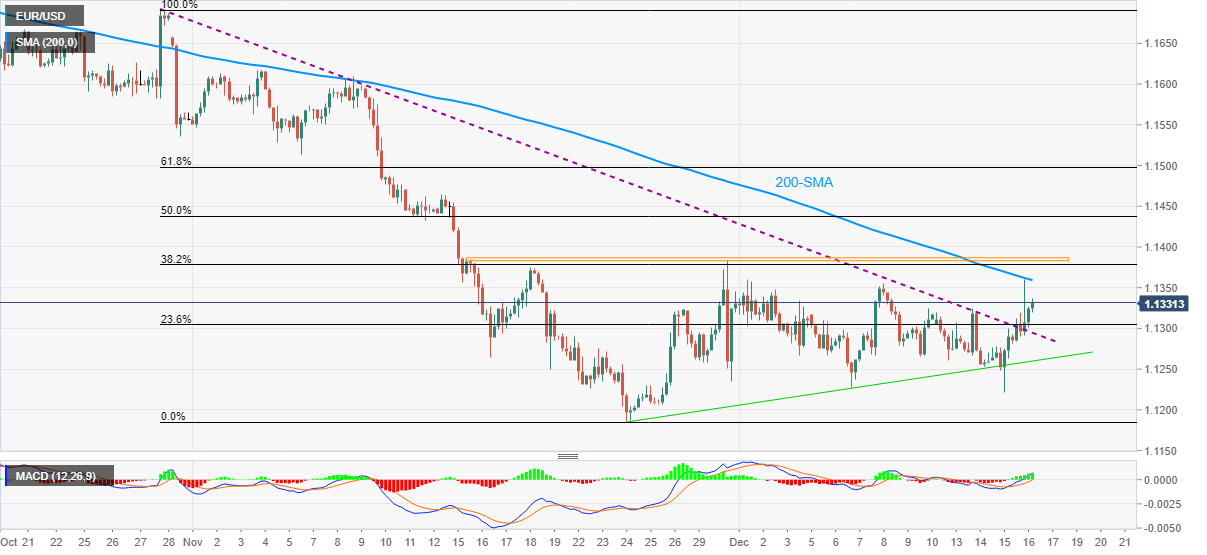
Although 200-SMA probe EUR/USD bulls around a monthly peak, a clear break of the short-term key resistance line, now support, joins bullish MACD signals to favor the further upside. That said, the major currency pair trades around 1.330 during early Friday morning in Asia.
In addition to the 200-SMA hurdle around 1.1360, a horizontal region comprising multiple tops marked since mid-November, around 1.1380-85, also tests the near-term upside of the pair.
Should EUR/USD prices rally beyond 1.1385, 50% Fibonacci retracement (Fibo.) of late October-November declines, around 1.1500, will probe the EUR/USD advances targeting the last month’s high near 1.1616.
Meanwhile, pullback moves remain elusive beyond the previous resistance line near 1.1290.
Also acting as a downside filter is an upward sloping support line from November 24, near 1.1260.
During the EUR/USD weakness past 1.1260, the 1.1230 level and the yearly low of 1.1186 will entertain the bears.
EUR/USD: Four-hour chart
Trend: Further upside expected
“Omicron is here and going to start spreading more rapidly”, said US President Joe Biden crossed wires while speaking from Roosevelt Room in the White House.
US President Biden adds “It's past time for people to get booster shots, which they should do as quickly as possible.”
US looking at a winter of severe illness and death for those not vaccinated against COVID-19.
It’s worth noting that the UK reported, unfortunately, another day of record-breaking covid infections with a daily count of 88,376 new coronavirus cases.
FX implications
Omicron fears probe the major central banks’ that have recently tightened their monetary policy stance, which in turn challenge optimists.
Read: Forex Today: Central banks’ marathon coming to an end
- AUD/USD bulls are back in play into the Asian open.
- Bulls eye an extension on the hourly and daily time frames for the end of this and the start of next week.
AUD/USD was ending the day higher by some 0.3% and had moved between a low of 0.7145 and a high 0.7223. The central banks were in focus again and both the BoE and ECB turned more hawkish overnight. Nevertheless, equities saw the glass as half full and sold off which hurt the higher beta currencies, such as AUD.
AUD/USD was falling throughout the New York session until the final hours where it met a key technical support area and started to correct, as illustrated in the technical analysis below. The US dollar was also making a come back which did not help the commodity bloc as traders began to question the reaction to the Federal Reserve, putting it down to holiday irregular markets and profit-taking.
Buy the rumour sell the fact
Many analysts believe that the US dollar can continue higher despite yesterday's setback. ''The dollar is clearly suffering from some “buy the rumour, sell the fact” price action right now. Looking ahead, we believe the underlying trend for a stronger dollar remains intact,'' analysts at Brown Brothers Harriman argued.
Meanwhile, in a speech yesterday, the Reserve Bank of Australis's Governor, Phillip Lose, laid out three options in terms of the timing for the end of QE, as analysts at ANZ Bank spelt out as follows:
''Once option was to end QE altogether in February. For that to happen he flagged that stronger-than-expected data and an upgrade to the RBA’s November forecasts would be needed. With the November labour market data coming in much stronger than the RBA expected and a revision in other forecasts likely, an end to QE altogether in February is the most likely option in our view,'' analysts at ANZ Bank explained.
AUD/USD technical analysis
- AUD/USD Price Analysis: Bulls looking for H1 continuation from daily support
As per the earlier analysis, the price has met hourly support and is now turning higher. This could lead to a continuation in the daily charts northerly trajectory as follows:

AUD/USD H1 chart

The hourly chart is moving in the right direction, as illustrated by the price action in the chart above from hourly support.
- Gold extends gains as the market continues to trade the central banks and lower real yield environment.
- A break of $1,180 opens the risk to $1,850 for the weeks ahead.
The price of gold is stronger again on Thursday which highlights the asymmetry present in precious metal markets to the hawkish Federal Reserve outlook. At the time of writing, XAU/USD is trading 1.21% higher on the day and has rallied from a low of $1,775.60 to a high of $1,799.46.
The Federal Reserve delivered on the expected doubling of the taper pace and said Wednesday it will begin reducing its asset purchases by $30 billion per month starting in January, up from the current $15 billion pace, amid rising inflation and continued recovery in employment. The central bank's Federal Open Market Committee said after its two-day meeting it would cut monthly Treasury securities purchases by $20 billion and agency mortgage-backed securities acquisitions by $10 billion per month.
Meanwhile, Fed policymakers lifted their projections for core inflation, expecting to finish this year at 5.3%, up sharply from the 4.2% average forecast in September. Next year, inflation is expected to slow to 2.6%, but that was higher than the 2.2% seen three months ago.
However, the dot plot was far more hawkish than the market had expected and above where it was priced. The dot plot now shows a 75bp increase in 2022, above the 50bp consensus, and the Chairman also made it clear that officials are ready to start raising rates well before the labor market returns to its pre-COVID state.
Nonetheless, the stock market rallied. 'The idea that a gradual tightening in policy can put the economy on a smooth glide-path back to growth and inflation equilibrium is implausible, but after 20 years of ‘buy the dip' the equity market is trained to look on the bright side of life,'' analysts at Societe Generale argued.
This sank the US dollar which has been unable to crack the 97 figure as measured by the DXY index. Real yields falling also culminated in gold prices rising. ''We continue to see the balance of risks tilted towards the upside for the near-term precious metals outlook as positioning that has skewed mainly to the short side in recent weeks is unwound somewhat,'' analysts at TD Securities said.
''With that said, while marginal CTA selling is underway, if the yellow metal can hold the post-FOMC rally north of the $1,787/oz range, systematic funds are likely to target net long positions once again.''
Gold technical analysis
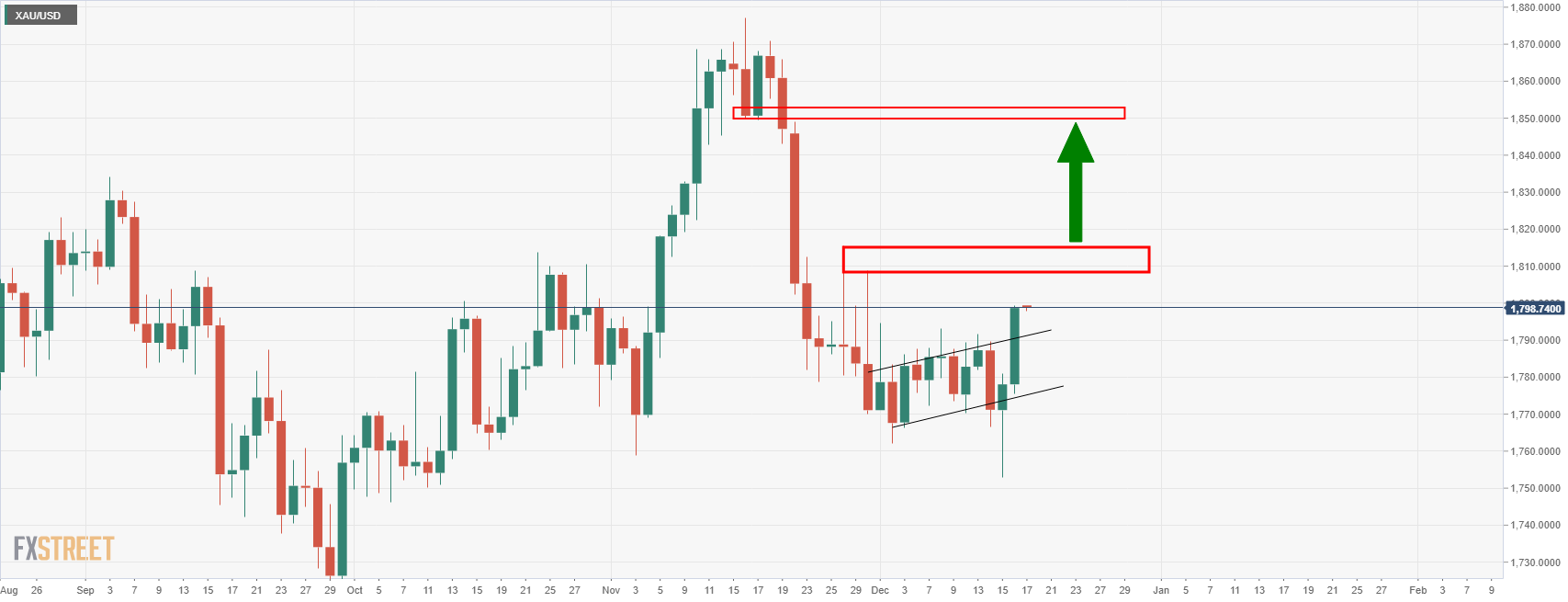
The price would be expected to continue to $1,810 but a restest of the prior resistance near $1,790 could be on the cards imminantly. A break of $1,180 opens the risk to $1,850 for the weeks ahead.
- A risk-off market mood favors the safe-haven Japanese yen, the Aussie falls.
- The AUD/JPY rally was capped around the 200-DMA, around 82.50
- AUD/JPY Technical Outlook: In consolidation, respecting the current downward market structure.
As the New York session winds down, the risk-sensitive Australian dollar falls, against the Japanese yen, trading at 81.65 at the time of writing. Market mood is risk-off, as witnessed by US stock indices recording losses between 0.04% and 2.37%.
On Thursday during the overnight session, the AUD/JPY rallied strongly amid a risk-on environment triggered by the Fed, which, as expected, will taper faster than previously thought, while most of their members expect at least three rate hikes in 2022. Despite the fact of being a “hawkish” monetary policy statement, the event was a “buy the rumor, sell the fact.” Why? Because equities rallied, while risk-sensitive currencies like the AUD, the NZD, and the CAD, followed their footsteps, to the detriment of safe-haven peers.
That said, the pair peaked around mid 82.00s, to then as the American session progressed, the market mood dampened, as market participants reshuffle their portfolios as the year-end looms.
AUD/JPY Price Forecast: Technical outlook
The AUD/JPY daily chart depicts the pair is in consolidation, trapped around the 77.88-86.25 range, sideways, without threatening to break the prevailing market structure since November 2020. Furthermore, Thursday’s upward move capped at the 200-day simple moving average (SMA) showed that AUD bulls do not have the strength of breaking to the upside so that we could be eyeing a downward move ahead of the year-end.
On the downside, the first support would be December 14 pivot low at 80.47. A breach of the latter would extend AUD/JPY losses. The next support would be the December 1 cycle low at 78.78, followed by the August 20 low at 77.89.
-637752867760564469.png)
- NZD/USD comes back under pressure as the fade plays out.
- The Fed surprised markets but the US dollar was sold off due to stubbornly bullish US stocks.
NZD/USD is up on the day following a slide from the lows of 0.6833 to a low of 0.6757 from where the price has started to recover, currently trading near 0.6798. The bulls have been pressured as the greenback attempts to recover the Federal reserve aftermath losses.
The Federal reserve, despite being uber hawkish on Wednesday, has led to a sell-off in the US dollar. This has been put down to a ''buy the rumour sell the fact'' outcome of the event in irregular holiday markets conditions. Volatility in the forex space is at a year's high, so this to might have played into the counterintuitive outcome for the greenback and stocks.
''The idea that a gradual tightening in policy can put the economy on a smooth glide-path back to growth and inflation equilibrium is implausible, but after 20 years of ‘buy the dip' the equity market is trained to look on the bright side of life,'' analysts at Societe Generale argued.
The Fed's Chair Powell noted the economy is “making rapid progress toward maximum employment” and all committee members see that test being met next year. (The unemployment rate is now expected to fall to 3.5% in late-2022, matching the past cycle’s low.)
The most hawkish of all was the significant shift in the dot plot—whereas committee members were previously evenly split on raising rates once next year, today’s projections show most now expect three rate hikes in 2022 and another three in 2023. This means that there is a clear risk of earlier liftoff than what markets had been anticipating. Nevertheless, the slump in the USD saw the Kiwi rise above 0.68 the figure before it was quickly sold off from there in what was a bearish engulfing candle.
Meanwhile, analysts at ANZ Bank explained that now we are past the halfway mark in December and in past years that have been associated with seasonal NZD strength (even if that should be priced in). ''Having bounced nicely off 0.67, the technical picture is also looking a bit more composed as we head into the holidays.''
What you need to know on Friday, December 17:
Following the US Federal Reserve announcement on Wednesday, the Swiss National Bank, the Bank of England and the European Central Bank, have announced their monetary policy decisions, and except for the SNB, all of them announced tighter monetary policies.
The European Central Bank announced a cautious taper pretty much in line with the market’s expectations. The ECB kept rates on hold and confirmed the Pandemic Emergency Purchase Program will end in March 2022. The Government Council also decided to expand its Assets Purchase Program to €40 billion per month in the second quarter and to €30 billion in the third quarter, to partially compensate the end of the monthly €60 billion bond-buying through PEPP
The Bank of England Monetary Policy Committee voted by a majority of 8-1 to increase the benchmark rate to 0.25% and by a majority of 9-0 to maintain the amount of quantitative easing at £895b.
The SNB maintained its expansionary monetary policy to ensure price stability, and support the local economy in its recovery from the impact of the coronavirus pandemic. It is keeping the SNB policy rate and interest on sight deposits at SNB at −0.75%.
A note of colour, Turkey’s central bank cut the main interest rate to 14% from 15%, pushing TRY to a new record low of 15.74.
The EUR/USD pair peaked at 1.3360, while GBP/USD reached 1.3374. Both retreated during US trading hours, to settle at 1.1320 and 1.3310 respectively. The AUD/USD pair trades around 0.7180 down from the 0.7220 region. The aussie benefited from upbeat local employment figures. The USD/CAD pair is down to 1.2780.
Finally, the USD/JPY pair trades at 113.70 ahead of the Bank of Japan monetary policy decision, widely anticipated to remain on hold.
Gold was among the best performers, advancing for a second consecutive day and currently trading around $1,795 a troy ounce. Crude oil prices were also up, with the barrel of WTI currently trading at $72.50.
European indexes posted substantial gains, but Wall Street was unable to follow the lead, and traded mixed. US Treasury yields spent the day consolidating, showing little reaction to central banks’ news.
Meanwhile, multiple countries continue to report record cases of coronavirus contagions, related to the Omicron variant. Tighter measures are being imposed in places such as the UK and South Korea, to try to curve the spread and prevent the collapse of health systems.
Top 3 Price Prediction Bitcoin, Ethereum, Ripple: Cryptos ready for Christmas rally
Like this article? Help us with some feedback by answering this survey:
- USD/CAD stabilises the offer near 1.2790 as markets consolidate the volatility.
- The BoC is tipped for a more aggressive approach given the tight labour market and sky-high inflation.
USD/CAD is lower on the day but is stalling the decline in the New York session finding a bottom near 1.2763 after sliding from the day's high of around 1.2857. The bulls are stepping in although the greenback is better offered across the board as per the DXY index. At the time of writing, USD/CAD is trading 0.35% lower at 1.2787.
The greenback has been sliding in the middle of the month in what tends to be irregular market flows considering the holiday period. This might go some way to explaining why the US dollar was so heavily offered following what was a strongly hawkish outcome of the Federal Reserve. The DXY index, which measures the greenback vs a basket of major currencies, including the Canadian dollar, has been unable to cross the 97 figure and has since fallen to as low as 95.85. The weakness in the greenback is welcomed by the commodity complex and high beta currencies, breeding life into USD/CAD's downside of late.
Focus turns to the BoC
On the domestic front, earlier this week, the headline Consumer Price Index held at 4.7% YoY in November, in line with the market consensus. This is its highest level in 30-year high including 2 decimals. Core inflation saw a slight pickup, with the average of the Bank of Canada's measures edging higher to 2.73% YoY from 2.67% in October. ''This is unlikely to faze the BoC however given the stable headline print which leaves inflation tracking near MPR projections for 4.8% in Q4,'' analysts at TD Securities argued.
In other events, governor Tiff Macklem discussed the Bank of Canada's mandate renewal in his final speech of 2021 and provided more insight into the mandate renewal process. ''However'', analysts at TD Securities argued, ''the BoC's new mandate is unlikely to have any impact on policy in the near-term; as discussed on Monday, the Bank's assessment of maximum sustainable employment should not delay liftoff with inflation well above the target range, although it does raise the bar for hikes once inflation moderates (ie. 2023).''
The convergence of the Fed and BoC would be expected to keep the pair contained within familiar ranges, especially when taking into account the most recent LFS data that indicated a strong labour market being essentially at full employment. This would be expected to see wages push inflation even higher in the coming months as workers appear to have the bargaining power to demand higher compensation.
''Given this backdrop, the central bank appears to be late in its normalization of monetary policy,'' analysts at the National Bank of Canada said in a note at the start of the week. ''We expect five rate hikes next year with the kick-off occurring in March. Of course, this assumes that Omicron does not substantially undermine confidence and leads to more stringent health restrictions.
- EUR/CHF has reversed sharply back from earlier session highs in the 1.0460s and now trades in the 1.0410s.
- The pair may be moving lower amid focus on Swiss/Eurozone inflation differentials in wake of ECB and SNB policy announcements.
EUR/CHF has reversed back from earlier session highs in the 1.0460s and current trades at session lows in the 1.0410s, with the bears eyeing an imminent test of the psychologically important 1.0400 level. Its been an unusually choppy session for the pair given that both the Swiss National Bank and European Central Bank both announced monetary policy decision on the session.
Initially, the SNB meeting appeared to weigh on the Swiss franc, though in wake of the ECB meeting, this weakness reversed and CHF is now the best performing G10 currency on the day. For reference, interest rates were held as expected at -0.75% and Governor Thomas Jordan pledged that rates will remain there given comparatively modest inflationary pressures in Switzerland versus most other developed nations. The characterisation of CHF was maintained at “highly valued” and the SNB pledged to continue FX interventions where necessary
In terms of the ECB meeting; the bank confirmed as expected the end of the PEPP by the end of Q1 2022 and announced that, in order to avoid a cliff-edge drop off in bond purchases, the APP would be upped to EUR 40B in Q2 and EUR 30B in Q3 and then at a pace of EUR 20B indefinitely afterward. The ECB’s inflation forecast for 2022 was substantially upgraded (to 3.2% from 1.7%) but ECB President Christine Lagarde was keen to emphasise that a hike in 2022 was very unlikely. Why this weighed on EUR/CHF at the time was not quite clear, with some suggesting the upgrade to Eurozone inflation highlighted Eurozone/Swiss inflation differentials.
Indeed, inflation differentials between the Eurozone and Switzerland have seen EUR/CHF fall in recent months (i.e. as the value of the euro is eroded faster than the value of the Swiss franc), a phenomenon the SNB made a nod to in order to justify why they have let the pair fall so much since its pre-pandemic levels above 1.10. ING noted that “there seems to be a clear desire to justify why the SNB is allowing the franc to strengthen as much as it is now and to reinforce its credibility that it will continue to act” before adding that “the comment about the risk of negative inflation if the franc were to strengthen too much is for me a real signal about its intentions to act in the coming months.” That implies EUR/CHF’s ride lower from here might not be quite as easy.
- The USD/JPY retreats under the 114.00 figure, falls some 0.30%.
- The US 10-year Treasury yield falls three basis points, sitting at 1.429%.
- USD/JPT Technical Outlook: It has an upward bias, as long as it trades above 112.53.
After piercing the 114.00 figure on Wednesday, the USD/JPY slides, trading at 113.67 during the New York session at the time of writing. As the American session progresses, the market sentiment is mixed, as US equity indexes fluctuate between gainers and losers after the last Federal Reserve monetary policy meeting.
On Wednesday, the US central bank revealed that they would increase the speed of the bond taper, beginning by the middle of January 2022. Moreover, the dot-plot, which projects the Federal Funds Rate expectations among Fed policymakers, shows that the FFR is expected to be at 0.90% by the end of 2022, meaning that the Fed would hike at least three times in 2022.
The USD/JPY reacted upwards after the monetary policy statement. However, the upward move was faded, as investors were fully priced in, per the market’s reaction.
In the meantime, US T-bond yields in the short-term are falling, led by 2s, 5s, and t0s, sliding between three and seven basis points, sitting at 0.6269%, 1.1848%, and 1.429%, respectively, a headwind for the greenback.
Meanwhile, the US Dollar Index, which measures the greenback’s performance against six peers, slumps 0.47%, cling to 96.05.
USD/JPY Price Forecast: Technical outlook
The USD/JPY is trading under the 50-day moving average (DMA), at 113.80. Furthermore, as long as the spot price is above the 100 and the 200-DMAs, alongside the November 13 cycle low at 112.53, the bias is upward, so any retracement towards the aforementioned support level should be viewed as opportunities for USD bulls.
The first demand on the way down would be the December 10 cycle low at 113.22, followed by the figure at 113.00. The breach of the latter would expose the November 13 swing low at 112.53.
-637752791509631205.png)
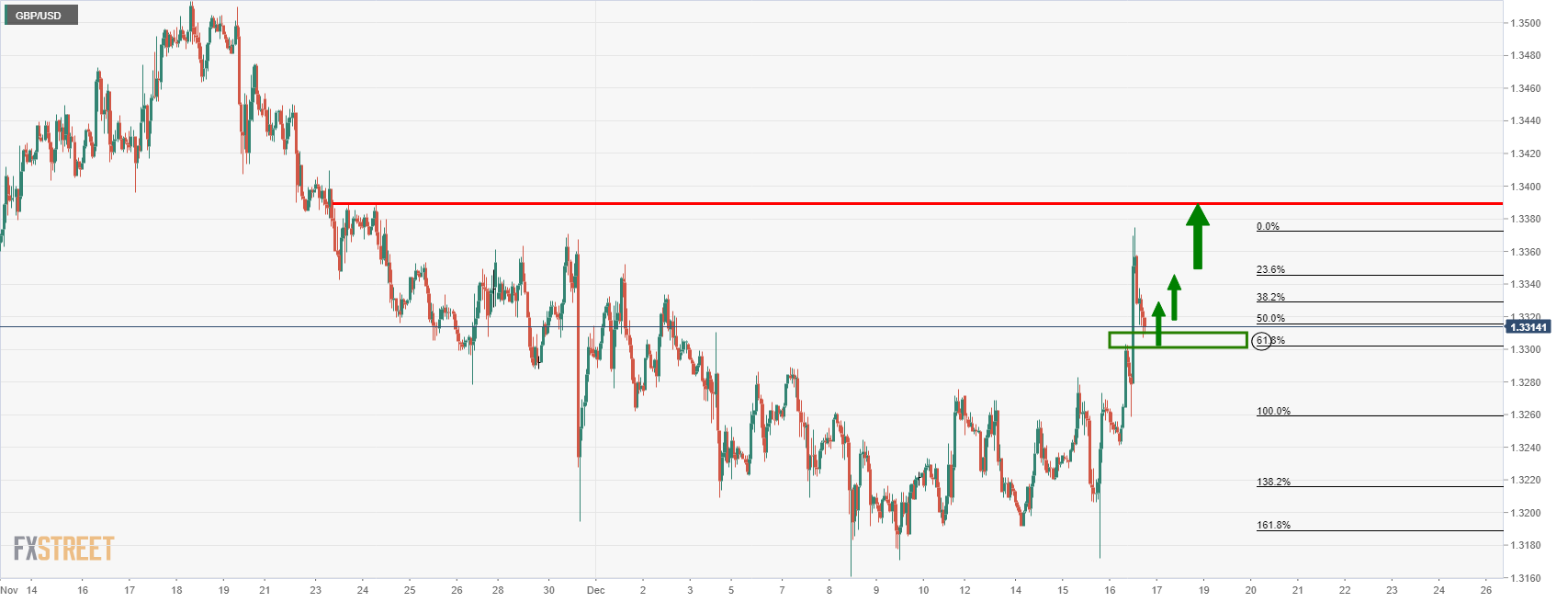
- GBP/USD corrects the BoE rallies imbalance towards daily support.
- 1.3380/90 confluence targets are compelling from an hourly basis.
GBP/USD has been accumulating and broke higher on the daily chart following today's surprise hike of 15bp from the Bank of England. At the same time, the US dollar has been unable to break the 97 levels in the DXY index.
As illustrated on the daily chart, below, the price has rallied strongly in a correction of the dominant bear trend and is leaving a wick on the daily candle.
GBP/USD daily chart
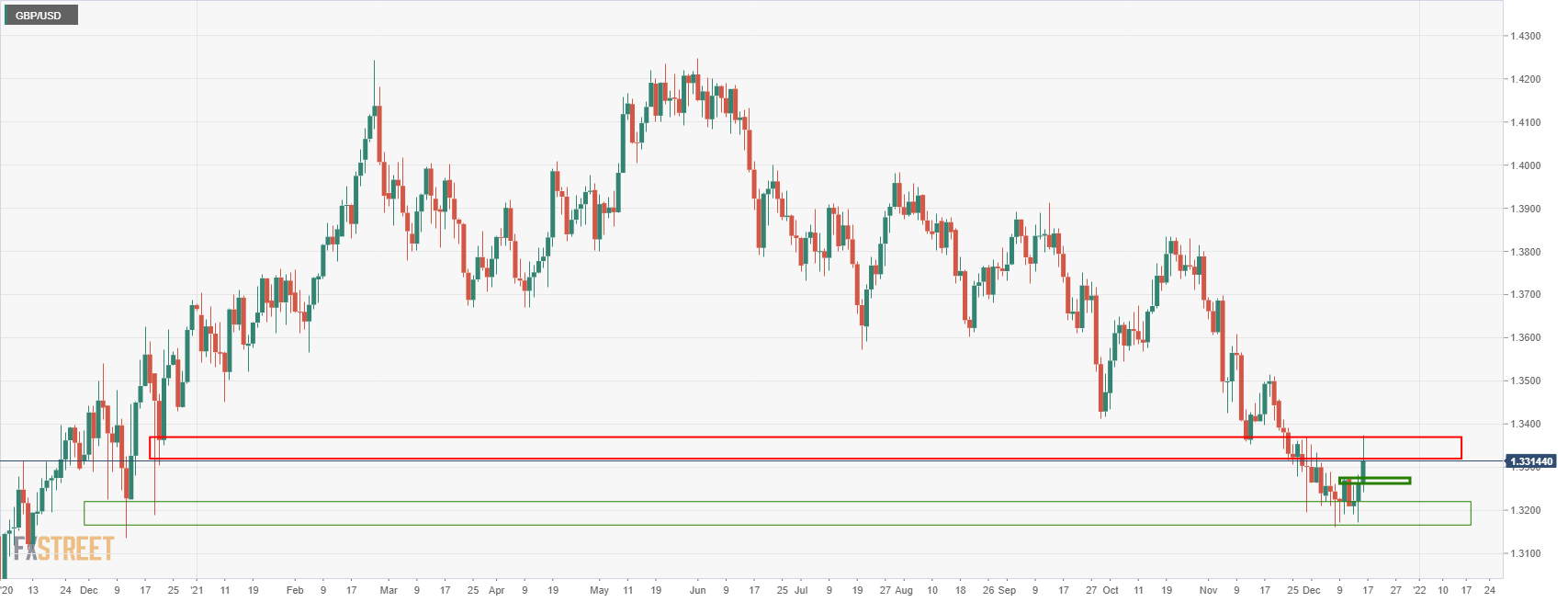
This wick represents short selling on the lower time frames as the market mitigates the imbalance of the price action. This gives rise to an opportunity to buy the dip.
GBP/USD H1 charts
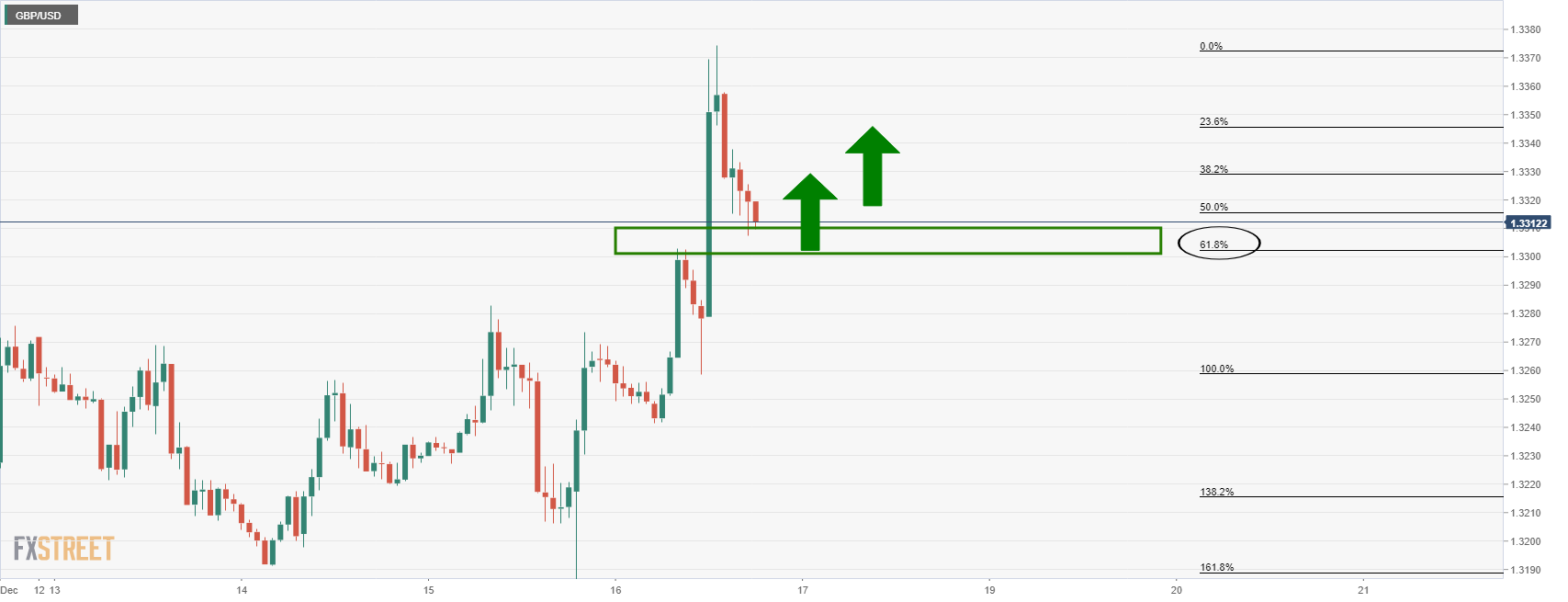
We can see the fade on the hourly time frames and where the price might be expected to stall within the correction. Zooming out, we can see that the price could rally as high as 1.3380/90 which is where the next point of control is on the sessions 22nd Nov and high 23rd Nov. This also has a confluence of the -272% Fibo of the correct correction's range.
We have a similar scenario on the US dollar chart:
DXY H1 chart
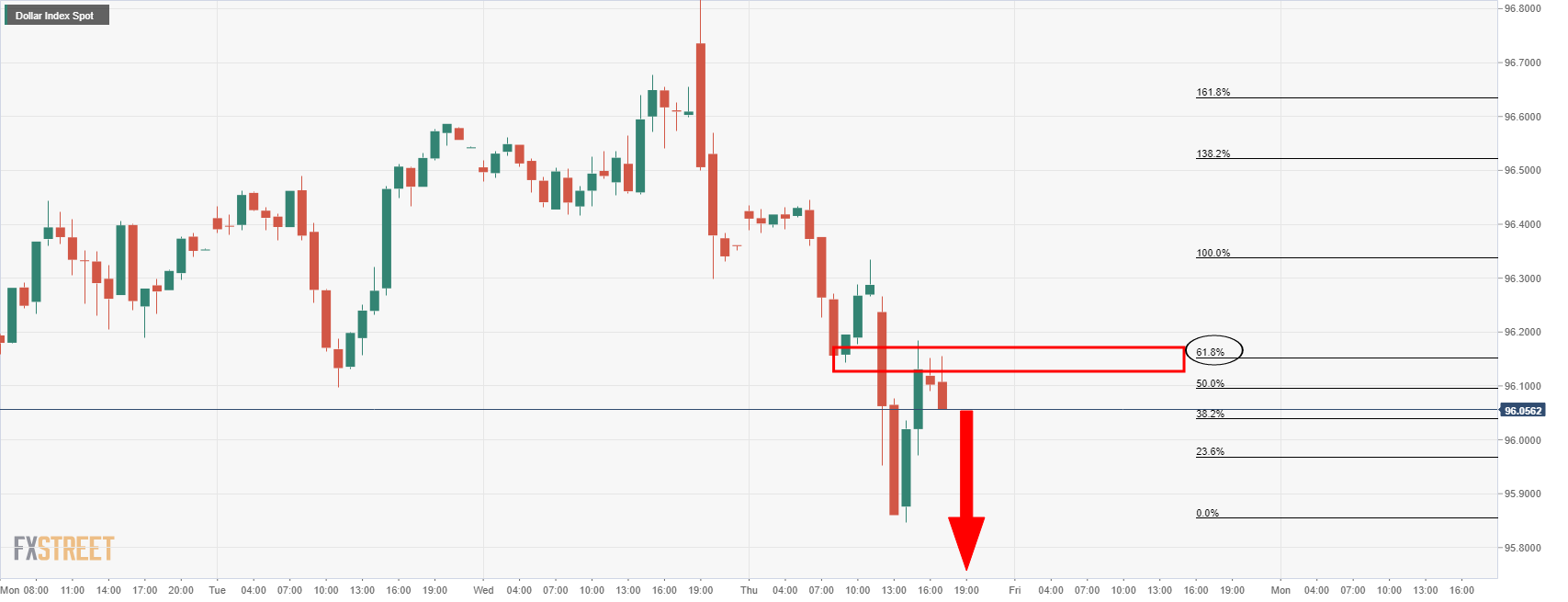
The price has hit the 61.8% Fibonacci retracement and the resistance could lead to the price action to continue south. This would play into the hands of the cable bulls seeking the upside continuation on the hourly chart.
- WTI challenged weekly highs at $73.00 on Thursday, havig rebounded from mid-week lows under $70.00.
- A bullish Fed outlook and evidence of strong US demand are being touted as supportive of prices.
Oil prices have been on the front foot over the course of the last two sessions and, on Thursday, WTI challenged weekly highs at $73.00 before pulling back a little to the low-$72.00s. Oil prices are up just under $1.0 on the day, taking the two-day run of gains to over $2.0 per barrel (roughly 3.0%), with traders seemingly having aggressively bought into the mid-week dip below $70.00 per barrel.
Market commentators said that Fed Chair Jerome Powell’s bullish view of the US economy heading into 2022 (which seemed to help equities) has helped support energy market sentiment on Wednesday and Thursday. Traders were also citing Wednesday’s official US inventory report as bullish, in that it implied that crude oil consumption in the US had risen to 23.2M barrels per day, significantly above the 2020 average of just over 18M barrels per day. Analysts at oil broker PVM said that “these figures suggest a healthy economic backdrop”.
But oil markets continue to monitor risks to the outlook, including the prospect of rising supply in 2022 from OPEC+ and non-OPEC+ nations alike and the spread of Omicron. The UK and South Africa both reported record daily infections on Thursday and other countries will surely be following suit soon. The big question now is whether these high infection rates will translate into high hospitalisation and death rates, which hasn’t yet been the case in South Africa.
Recent upside hasn’t been enough for oil to mount a serious challenge of the top of recent ranges above $73.00. Some traders suspect that into the year-end, oil markets may remain rangebound in the $70.00-$73.00 area as traders balance Omicron/pandemic risks, fears of oversupply in 2022 against high inflation and economic bullishness, particularly with regards to the US.
- EUR/GBP is back to just below the 0.8500 level from earlier near 0.8450 lows.
- Markets are digesting Thursday’s ECB and BoE rate decisions.
EUR/GBP was under scrutiny to an unusual degree this Thursday given both the BoE and ECB set policy, though one of the rate decisions proved more consequential/of a market mover than the other. EUR/GBP dipped as low as 0.8450 after the BoE surprised markets with a 15bps rate hike, breaking to the south of this month’s prior triple bottom in the 0.8490 area in the process.
But most of Thursday’s losses have been pared in wake of the ECB policy announcement, with EUR/GBP now trading back just under 0.8500 and down only about 0.15% on the day. For reference, the ECB delivered few surprises by confirming the end of the PEPP in March, though reinvestments would continue to the end of 2024, whilst also unsurprisingly announcing a temporary increase in APP purchases in Q2 and Q3 to compensate somewhat for the end of the PEPP. The ECB’s 2022 inflation forecast got a big upgrade which may have spurred some upside in the pair.
With the last major risk event out of the way for the year for both the euro and pound sterling, focus will likely now return to the evolution of the pandemic. The UK appears to be the European Omicron hotspot (for now), with France banning tourist travel as cases there rise sharply. The risk of lockdowns being toughened again ahead of Christmas is high and weakness in the economy is already being seen creeping in via the UK December PMIs. Perhaps Europe will follow suit in a few weeks. For now, bearish UK Omicron developments will likely be a tailwind for EUR/GBP, which already relinquished the bulk of its post-surprise BoE rate hike gains.
- Silver rallies for the second day in a row, up some 1.79%, amid falling US T-bond yields.
- Fed announces a faster bond taper, and its policymakers project three interest rates hikes by 2022.
- XAG/USD Technical Outlook: The break of a downslope trendline can send the white-metal towards $23.00
Silver (XAG/USD) rallies during the New York session, up some |.79%, trading at $22.46 at the time of writing. The market sentiment is upbeat, as portrayed by European equity indices finishing in the green. Contrarily in the US, stocks fluctuate between gainers and losers, after on Wednesday, the Federal Reserve announced a faster bond-taper, and the median of its members penciled three rate hikes in 2022
Fed’s increase the speed of the bond-taper, projects three rate hikes in 2022
Fed’s last monetary policy of the year came as widely expected by markets. The US central bank announced that it would increase the pace of its QE reduction from $15 to $30 Billion, double the amount agreed in November’s meeting, meaning that they would end by March of 2022. Furthermore, it revealed its Summary of Economic Projections (SEP), which shows that the board expects inflation as high as 2.6% in 2022, 2.3% in 2023, and 2.1% in 2024, a tick higher than the September projections.
Apart from this, Fed’s policymakers expect that the Federal Fund Rate (FFR) will end at 0.90% in 2022, meaning the US central bank would hike three times. By 2023, they expect the FFR at 1.6%, and in 2024 at 2.1%.
In the meantime, the US 10-year Treasury yield slides four basis points, sits at 1.422%, a headwind for the greenback, thus favoring precious metals. The US Dollar Index, which tracks the buck’s performance against a basket of six peers, edges lower 0.48%, currently at 96.05.
XAG/USD Price Forecast: Technical outlook
Silver is trading above the hourly simple moving averages (SMAs), so XAG/USD has an upward bias in the near term. Additionally, the break of a slight down-slope trendline around $22.25 confirmed the aforementioned, exposing crucial resistance levels to the upside.
The first resistance would be the R2 daily pivot at $22.54, followed by the R3 daily pivot at $22.983, and then $23.00.
On the flip side, the first support would be the 200-hour SMA at $22.19, followed by the 100-hour at $22.09, and the 50-hour SMA at $21.99.
-637752753691093977.png)
- AUD/USD bulls are looking for a deceleration of the downside in New York.
- The session's ahead could see the price evolve into a bullish structure on the hourly chart leading to a daily continuation.
AUD/USD has made a well deserved meanwhile comeback this week, falling from a low of 0.7090 to a high of 0.7223 so far. This is in light of the US dollar being unable to break the 97 levels in the DXY index and some good domestic news in the Aussie jobs market.
As illustrated on the daily chart, below, the price has rallied strongly in a correction of the dominant bear trend, corrected, and then rallied again as follows:
AUD/USD daily chart
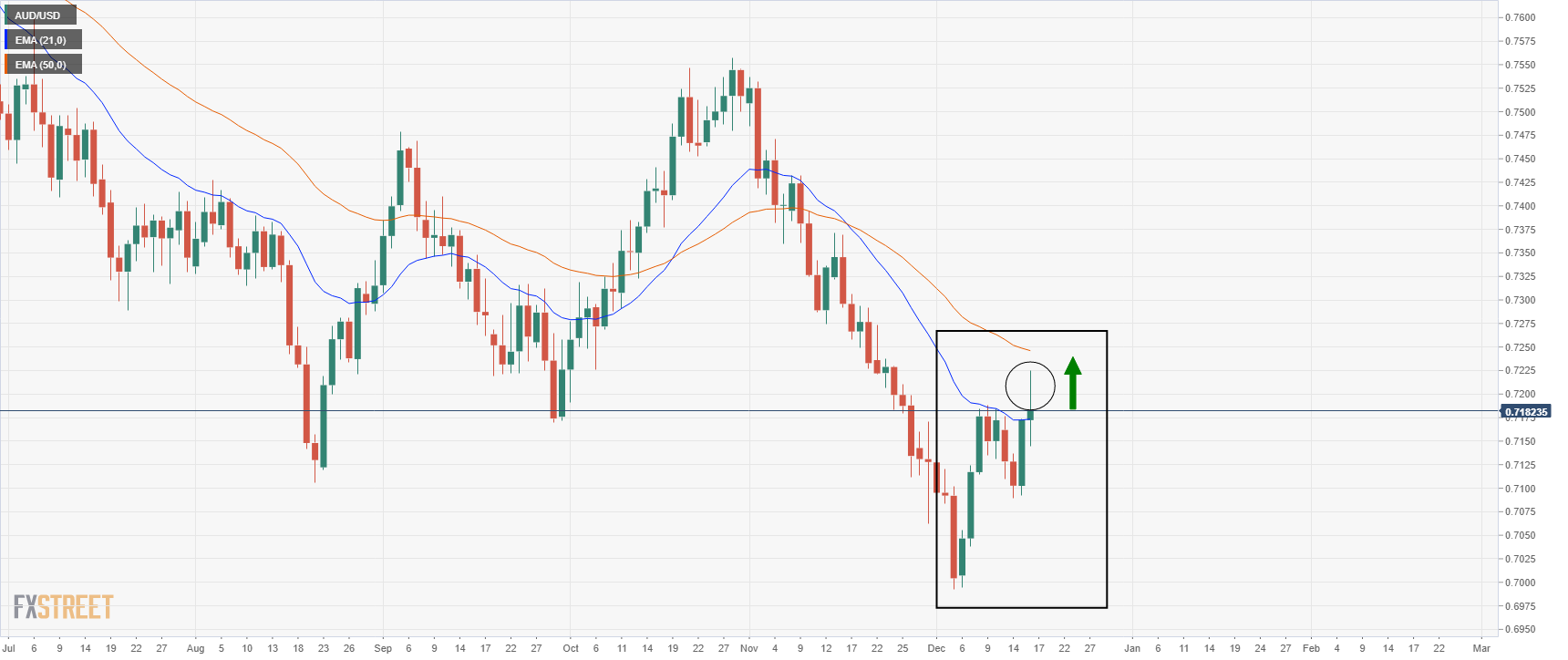
The price move din towards the 50-day moving average and would be expected to continue higher in the coming sessions to fill, at least, the wick that it is leaving behind as the price sinks back to mitigate the imbalance left behind on the recent rally through 0.7180.
AUD/USD H1 chart
From an H1 perspective, the bulls will be looking for a deceleration of the bearish correction as follows:
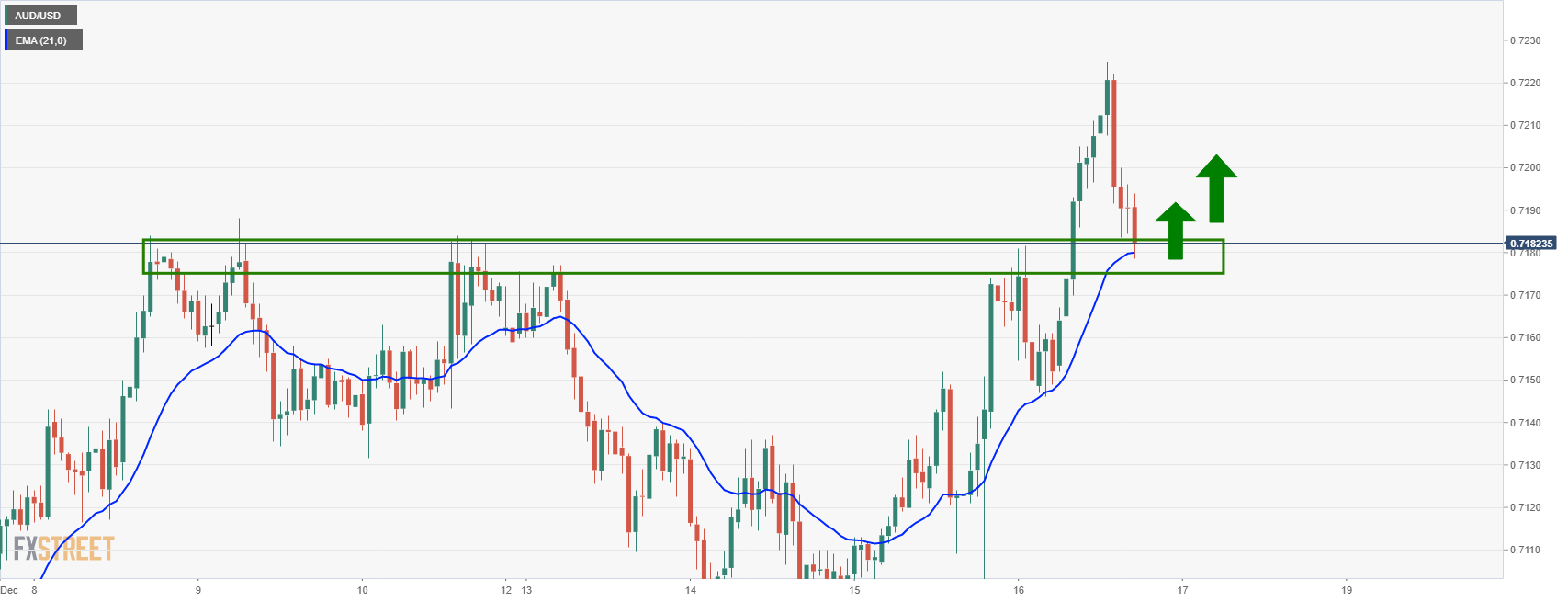
Should the price decelerate and turn higher from the expected support (old daily resistance), then there is a high probability that the price will move higher to fill the daily wick and move in on the 0.7240s.
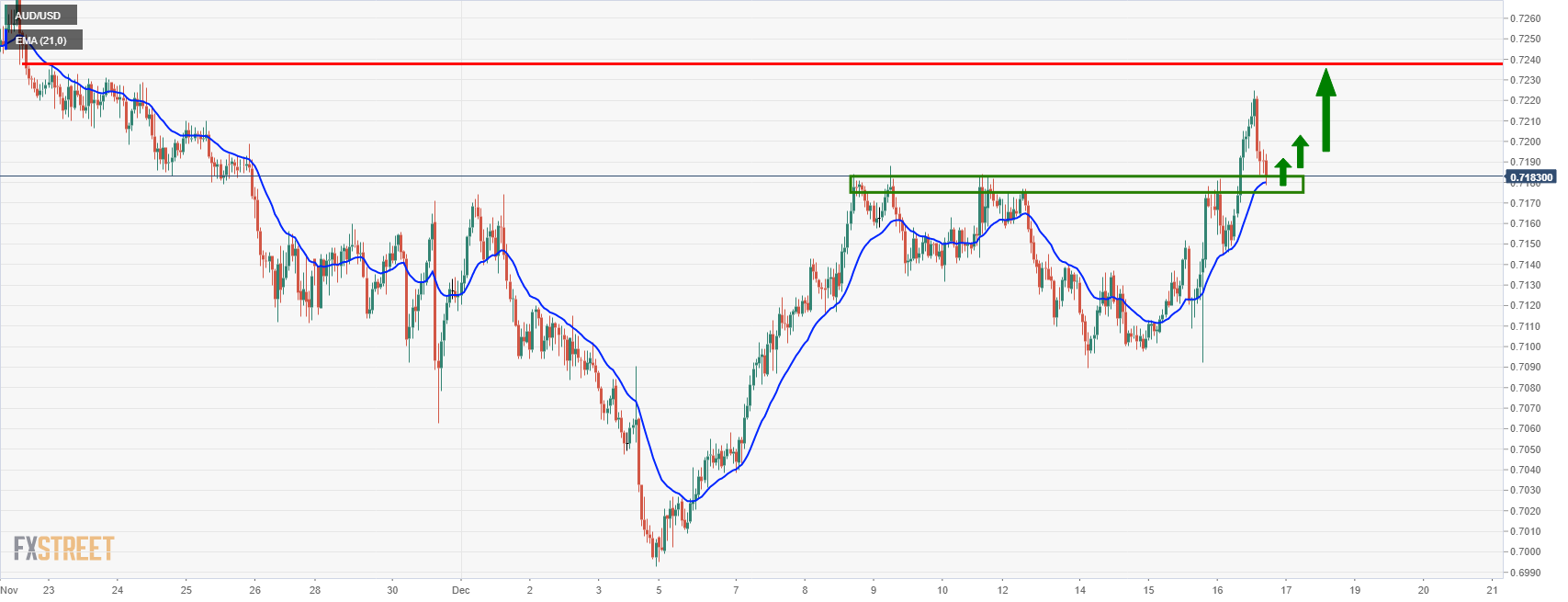
We have a similar scenario on the US dollar chart:
DXY H1 chart
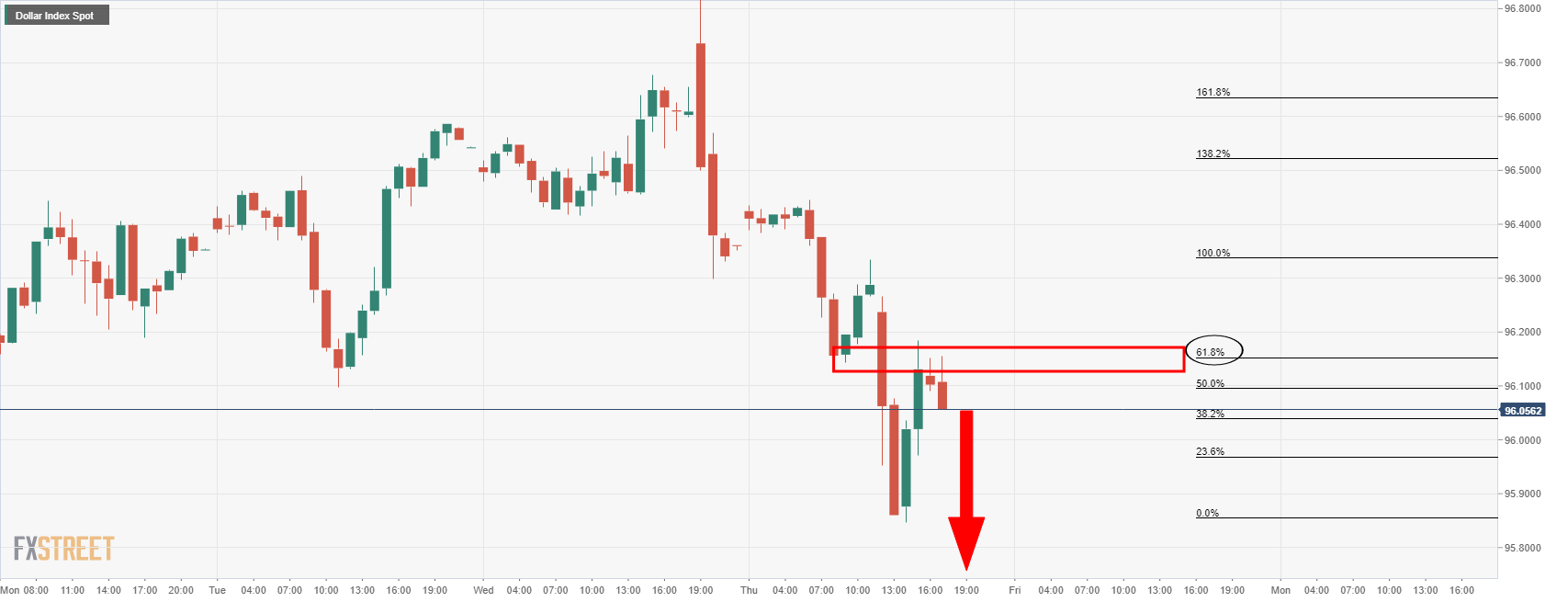
The price has hit the 61.8% Fibonacci retracement and should this hold, as it looks like it is doing currently, then the price would be expected to continue south. This would play into the hands of the Aussie bulls seeking an upside continuation on the hourly chart.
At their latest meeting, the Federal Reserve decided to increase the pace of the QE tapering and the projections of the FOMC staff showed a potential of three rate hikes for next year. Analysts at Wells Fargo, point out the bar for rate hikes now rests squarely on the labor market, with the statement indicating that the inflation threshold even under the Fed's new flexible regime has been met.
Key Quotes:
“With inflation expected to run further above target through next year and the labor market making steady progress toward full employment, the projected path of the fed funds rate moved higher relative to the September dot plot. Based on the median projection, participants have now penciled in three 25 bps increases over 2022 after having been evenly torn between zero and one hike in September. The median projection among Committee members calls for 75 bps of tightening in 2023 followed by another 50 bps in 2024. If realized, that would put the fed funds target range at2.00-2.25% at the end of 2024, a touch below where the FOMC estimates policy would become restrictive.”
“Market pricing over the next two years is roughly in line with the median projection for six cumulative rate hikes through year-end 2023, but beyond that markets are priced for very little additional tightening. We are skeptical of this market pricing, and this is one reason we look for the 10-year Treasury yield to steadily move toward 2% as 2022 progresses.”
- Spot gold is hovering just below $1800, having rallied from Wednesday’s lows just above $1750.
- Bond markets have seen dovish post-Fed moves, even though many analysts did not judge the Fed as hawkish.
- Upside is for now being capped by the presence of the 21, 50 and 200DMAs.
Spot gold (XAU/USD) has continued to advance as the US session has gotten underway, recently breaking out to fresh one-month highs above $1792 and nearly testing the psychologically important $1800 level. The precious metal has seen choppy two-way trade since Wednesday’s Fed policy announcement, initially dropping to multi-week lows in the low $1750s, before reversing to current levels near $1800.
The reversal higher comes despite what most analysts agreed was a slightly more hawkish than consensus expectation tone to the Fed on Wednesday. Most importantly, the bank indicated three rate hikes in 2022, doubled the pace of its QE taper and Fed Chair Jerome Powell was bullish on the economic outlook for 2022. Nonetheless, gold is up as the dollar weakens in what appears to have been a “buy the rumour, sell the fact” reaction to Fed hawkishness. XAU/USD has run into significant resistance in the form of its 21, 50 and 200-day moving averages, all of which reside in the $1790s.
The fluctuation in precious metal markets is a function of volatility in US government bond and Short-Term Interest Rate (STIR) markets. In the former, real yields have been getting a battering, with the 5-year TIPS yield now back to around -1.57% having nearly hit -1.30% in its initial post-Fed reaction. Meanwhile, the implied yield on the December 2022 three-month eurodollar future has pulled back from as high as 1.10% in the aftermath of the Fed meeting to under 1.0% again.
For whatever reason (perhaps because Powell alluded to a slower pace of rate hikes if the economy slows), bond and STIR markets seem to be reacting dovishly to the Fed and this is helping gold. As markets get more time to digest what happened this week, this bias may be dropped. For those expecting a strong US economy and hawkish Fed in 2022, near-$1800 might be a good entry point for shorts.
After the rate hike announcement on Thursday from the Bank of England, analysts at Rabobank held on to their forecast of a much less aggressive tightening cycle than what is currently priced in front-end rates. They expect another 25 bps hike early next year.
Key Quotes:
“The Bank of England MPC confounded expectations of traders and economists once again as it decided to raise its policy rate by 15 bps to 0.25%. The vote was split 8-1.”
“Even though 15 bps is just a small step, the Bank of England is the first of the major central banks to raise its policy rate in order to limit upside risks to inflation (expectations). Given that the market had come round to the idea the MPC would delay its first hike to February, it was a surprising move.”
“Along with the Fed’s pivot to inflation fighting, it illustrates that virus risks are not the central banks’ primary concern anymore. We do, however, hold on to our forecast of a much less aggressive tightening cycle than what is currently priced in front-end rates. We forecast another 25 bps rate hike in the next few months, but expect Bank rate to end the year at 0.50%.”
- The US dollar is under heavy selling pressure, down some 0.55% against the Loonie.
- The Fed hawkish monetary policy decision was seen as a “buy the rumor, sell the fact” event, as shown by US equities at all-time highs.
- USD/CAD Technical Outlook: A double-top in the daily chart looms with a target of 1.2400.
After a spike towards 1.2937 on Wednesday, the USD/CAD grinds lower during the New York session, trading at 1.2770 at the time of writing. The market sentiment has improved as witnessed by European equities rising, while stock indices fluctuate between gainers and losers on the US.
On Wednesday, the Federal Reserve unveiled its monetary policy meeting, where policymakers decided to increase the bond taper speed, eyeing March of 2022 as the end of the coronavirus-pandemic stimulus. Further, it released the dot-plot, a part of its Summary of Economic Projections (SEP), which depicts that the board members’ median expects at least three rate hikes in 2022, in line with market participants’ expectations.
That said, the Federal Reserve monetary policy decision turned to a “buy the rumor, sell the fact event,” with equities rallying to all-time-highs post-Fed. At the same time, risk-sensitive currencies like the GBP, the CAD, and the antipodeans climbed against the greenback.
In the meantime, Western Texas Intermediate (WTI) irises some 1.60%, trading at $72.85, a tailwind for the oil-linked Canadian dollar.
The US 10 year Treasury yield is down almost three basis points, sitting at 1.433%, a headwind for the greenback, with the US Dollar Index, which measures the buck’s performance against a basket of six rivals, slips 0.42%, currently at 96.10.
In the US economic docket, the Initial Jobless Claims for the week ending on December 11 rose to 206K, more than the 200K, a tick higher than the previous one. Concerning Continuous Claims, fell to 1.845M, from 1.999 on the week previous, and better than the 1.934M estimated.
Further, US Housing Starts rose to 11.8% yearly based, while Building Permits increased by 3.6%.
USD/CAD Price Forecast: Technical outlook
USD/CAD Wednesday’s upward move faced strong resistance at the August 20 high at 1.2948, then retreated the move to close below the December 3 high at 1.2853. That said, as shown by the daily chart, it formed a double-top chart pattern with bearish implications.
However, to confirm its validity would need a sustained break under 1.2605, which will target a move towards the October 23 high at 1.2400.
-637752718090648444.png)
The rallied modestly off the back of a more hawkish European Central Bank (ECB), argue analysts at TD Securities. They think EURUSD is likely to respect the 1.12/14 range into year-end, with the "risk of slippage below 1.12 non-trivial next year".
Key Quotes:
“There is probably not enough here to change strategic short positions in EUR. EUR/crosses could see some unwind but ultimately contained. At the end of the day, Lagarde is still committing the EUR to being the most liquid and largest funder next year. Tactically, we're not reading much into price action as we think investors are just hoping to get to year-end after a volatile Oct/Nov. EURUSD likely consolidates; we have highlighted 1.12/14 as the likely range and within that, 1.1385 will be a key resistance marker. Above the range, downtrend resistance established from the May highs comes in around 1.15. This could be the capitulation point for EUR shorts.”
“Given the cyclical forces at play, the USD still seems to be the currency to beat next year. A faster taper by the Fed also means the TIPS market loses a big buyer of 10Y equivalents. That means that US real rates are likely to rise faster than their German counterparts, leaving another key anchor, alongside 1y1y rate spreads, capital divestment and inferior carry as key anchors for EURUSD early next year. As such, we think 1.12 in EURUSD is vulnerable to break then.”
- The Mexican peso rises across the board on Thursday.
- Banxico meeting ahead: rate hike of 25bps expected.
- USD/MXN could post the lowest close in almost a month.
The USD/MXN is falling for the second day in a row on Thursday with Banxico’s decision ahead. The combination of a stronger Mexican peso and a weaker dollar versus commodity and emerging market currencies pushed the pair further to the downside. It is hovering around 20.87, near monthly lows.
After making a run to 21.35 on Wednesday, immediately after the FOMC meeting, the USD/MXN turned to the downside and it has been falling since then. Currently, it is trading under 20.90, looking at the December low of 20.83. A consolidation under 20.85/90 should add more strength to the Mexican peso. The next barrier stands at 20.65.
If USD/MXN manages to hold above 20.85/90 a rebound toward 21.05 initially seem likely in the sessions ahead. Above the next resistance stands at 21.20 that also contains the 20-day moving average.
Banxico set to hike again
Among emerging market currencies, the Mexican peso is a top performs on Thursday ahead of Banxico’s decision. Market participants expect the Bank of Mexico to hike the key interest rate by 25 basis points to 5.25%. Some mentioned a potential for a 50 bps hike. The inflation rose further above 7%; and together with the new message of the Fed poses a challenge to Banxico.
Technical levels
Still beset by supply chain constraints and labor shortages, industrial production grew just 0.5% in November, a marked slowdown from the upwardly revised 1.7% pick-up in October, mentioned analysts at Wells Fargo. They point out that slight improvements in supplier deliveries suggest things are at least not getting worse.
Key Quotes:
“U.S. industrial production increased 0.5% in November, a tenth of a percentage point shy of the consensus expectation; though after accounting for a slight upward revision to October's increase, the level of industrial output is essentially right in line with expectations.”
“There was not much in the way of new developments in today's report; the country's industrial output is limited by the availability of raw materials and workers. While both will improve over time, any meaningful change is still several months away. The fact that ISM supplier deliveries came down a few points in November suggests it is at least not getting worse.”
“Overall capacity utilization rose to 76.8% in November, which is the highest reading since November 2019. That said, it might be premature to worry about a meaningful inflation push from tight capacity, at least if history is any guide. At it's highest point in the prior cycle, capacity utilization topped out at 79.9%, and in the 1990s it rose as high at 85%.”
The European Central Bank (ECB) introduced changes to its QE programs on Thursday. According to analysts at Danske Bank, the ECB could have delivered a more hawkish calibration, but retain flexibility and optionality for now.
Key Quotes:
“During today’s press conference, Lagarde conveyed that optionality and flexibility were key components of ECB’s calibration. The calibration has both something for the hawks and the doves and must be seen as a compromise. In our view, the calibration of instruments could also have been more hawkish given the staff projections, both on core inflation and wage growth, which serves as part of the realised progress in underlying inflation.”
“For ECB, it seems to be somewhat of a discussion about if the supply chain shock will be temporary (or not) and ECB sees it as temporary. Thus, in H2, the ECB expects a large demand shock from both pent-up demand (savings) as well as via the easing of supply chains. This is quite different from how Fed and others view global macro at the moment.”
“To us, the ECB macroeconomic expectations are a risk scenario but certainly not the main one. As such, equally, if ECB proves right then we would expect to see a very EUR-bullish macro narrative, steeper global yield curves and possibly also a step back in the hawkishness of other global CBs. We continue to forecast a lower EUR/USD, at 1.10 in 12M and highlight ECB's expectations being fulfilled as a risk to such.
- US dollar recovers strength versus G10 currencies, still negative for the day.
- EUR/USD fails to break recent range after being rejected from above 1.1350.
- ECB meeting: no major surprises.
The EUR/USD spiked at 1.1360, the highest level in two weeks, but it was unable to hold above 1.1350 and pulled back. The retreat is challenging the 1.1300 zone during the American session after the US dollar recovered ground across the board.
Between data, central banks and expectations
US economic data released on Thursday came mostly below expectations, particularly PMIs. Market participants ignored the numbers. In Europe, the key event was the European Central Bank meeting.
The euro initially reacted positively to the ECB meeting. The central bank left interests rate unchanged and reduced its bond purchases, mostly in line with expectations. ”With today’s decision, the ECB has entered into a very cautious tapering process. The details of the taper are less clear-cut than we had expected. The ECB did not announce a (third) transitional asset purchase programme. It decided instead to ensure the same level of PEPP flexibility in the asset purchases, including allowing it to purchase Greek bonds, and with the reinvestment of PEPP purchases”, explained analysts at ING.
Later the common currency lost momentum and started to pullback, trimming gains. At the same time, the US dollar gained strengths, pushing EUR/USD further to the downside. So far, the correction found support at 1.1300.
The EUR/USD is back at the previous trading range between 1.1350 and 1.1250. The euro needs a firm break above 1.1350/60 to clear the way to more gains. On the flip side, a slide below 1.1250 would point to further losses.
Technical levels
- Euro's momentum fades after ECB spike.
- Yen soars across the board amid a retreat in US yields.
The EUR/JPY peaked during the American session at 129.63, the highest level since November 19, following the European Central Bank meeting. During the last hour, it reversed sharply and dropped to 128.60, turning negative for the day amid a rally of the Japanese yen.
The JPY strengthened amid a decline in US yields. Despite Wednesday’s Fed signs about three potential rate hikes for 2022, Treasuries are up on Thursday. Over the last hours, the 10-year hit a fresh low at 1.42% and weighed on USD/JPY.
Earlier the ECB left interest rates unchanged and reduced its bond purchases, mostly in line with expectations. The euro rose moderately but then lost momentum.
Bullish but…
The EUR/JPY continues to move away from the recent low but the current reversal shows the recovery is bumpy. If the euro slides back under 128.30 it would weaken the short-term outlook. On the upside, EUR/JPY needs a daily close above 129.20 in order to clear the way to more gains.
Technical levels
- The USD/CHF edges down during the New York session, losing 0.35%.
- The market sentiment is upbeat, as the Fed delivered as expected.
- USD/CHF Technical Outlook: Neutral-bullish, as long as it remains above the 200-DMA.
After rallying for three consecutive days, the USD/CHF pierced the 61.8% Fibonacci retracement, then retreated towards December 14 lows, trading at 0.9214 during the New York session at the time of writing. The market sentiment is upbeat once the Federal Reserve unveiled its monetary policy decision, in line with investors’ expectations.
The Fed delivered a faster bond taper, decreasing its bond purchases by $30 Billion, double the November monetary policy meeting’s agreed. Also, in the Summary of Economic Projections (SEP) with the dot-plot, Federal Reserve board members expect at least three rate hikes in 2022, as projections estimate that the Federal Funds Rate would end at 0.90%.
The USD/CHF remained trapped in the 0.9225-50 range in the overnight session. However, once American traders got to their desks, the pair broke support at the December 15 pivot low 0.9224, slumping towards 0.9198.
In the meantime, US Bond yields in the short term of the curve fall between one and seven basis points, led by 2s, 5s, and 10s at 0.6310%, 1.1848%, and 1.42%, each, a headwind for the buck, with its US Dollar Index back under the 96 handle, down 0.53%, at 95.98.
USD/CHF Price Forecast: Technical outlook
After piercing the 61.8% Fibonacci retracement, drawn from the November 24 swing high to the November 30 swing low, the USD/CHF pair fell under the 38.2% Fibonacci retracement, and at press time is trading under the 50-DMA, which lies at 0.9215.
That said, to the upside, the first resistance would be the 50-DMA at the abovementioned level. A break above that level would expose the 38.2% Fibonacci retracement at 0.9239, followed by the 50% Fibonacci retracement at 0.9265.
On the other hand, the first support level would be the 100-DMA at 0.9202. A breach of the latter would expose crucial support levels, as the December 14 low at 0.9188, followed by the 200-DMA at 0.9177.
-637752653551411470.png)
The Bank of Japan (BoJ) will announce its policy decision on Friday, December 17 at 03:00 GMT and as we get closer to the release time, here are the expectations forecast by the economists and researchers of six major banks. The BoJ is seen standing pat on its main stimulus while weighing an extension to its covid aid program.
Standard Chartered
“We expect it to maintain the policy balance rate at -0.1% and the 10Y yield target at c.0%. Japan’s economy suffered weak growth in Q3 due to production disruptions as a result of COVID-19 restrictions. We expect the BoJ to maintain its current policy stance for some time, unlike other central banks. This is largely because the BoJ faces a very different inflation backdrop to peers, with headline CPI inflation still close to 0%. If the Fed and ECB tighten liquidity, the BoJ may come under pressure to join global policy coordination.”
Deutsche Bank
“Although there had been an expectation that the bank would revise their special pandemic corporate financing support program at this meeting, the emergence of the Omicron variant has changed the situation. Given the next meeting is only a month later, the view is now that they’ll maintain a wait-and-see stance in this meeting and adjust the policy in January, although a revision remains possible this week if more positive evidence is found on the new variant.”
BBH
“Some reports suggest the bank is considering an announcement that it will allow its emergency corporate lending programs to expire in March as scheduled. However, other reports suggest some policymakers would rather delay the announcement until the impact of omicron is better known, perhaps at the next meeting on January 18. New macro forecasts will be released then as well, perhaps offering a better opportunity to tweak policy. This week, it should be steady as she goes for the BoJ.”
SocGen
“The BoJ will apply -0.1% to the policy rate balance in the current accounts. It will purchase the necessary amount of JGBs without setting an upper limit so that 10-year JGB yields will remain at around 0%. The BoJ will maintain the current rate guidance that it will continue with QQE with YCC, aiming to achieve the price stability target of 2%, as long as is necessary to maintain that target in a stable manner. The BoJ will maintain the current economic assessment that Japan's economy has picked up as a trend, although it has remained in a difficult situation due to the impact of COVID-19 at home and abroad.”
BMO
“The BoJ will wrap up a hectic week with its announcement on Friday. Nothing meaningful will change.”
ING
“Recent history suggests little to no impact from BoJ rate decisions on the yen and this time should be no different. All policy tools are set to remain untouched, while we think (and this seems to be the consensus) that the BoJ will extend the emergency corporate funding programmes as the Omicron variant generates new risks to the outlook.”
According to anonymous sources at the European Central Bank, some hawkish members of the governing council were unhappy about extending reinvestments from the Pandemic Emergency Purchase Portfolio (PEPP) to 2024. Moreover, some were unhappy about the fact that the ECB did not set an end date to its Asset Purchase Programme.
ECB policymakers also reportedly disagreed on the inflation outlook, with some stressing upside risks to the new forecasts, the sources added. Apparently, according to the sources, it was the governors of the Belgian, Austrian and German central banks that disagreed.
- NZD/USD surged back above 0.6800 on Thursday, as the dollar weakens post-Fed.
- A smaller than expected decline in Q3 NZ GDP didn’t seem to impact FX markets much.
NZD/USD has been choppy over the last two sessions, in fitting with a broader uptick in volatility across G10 FX markets. On Wednesday, in wake of the Fed’s hawkish policy announcement that the pace of the QE taper would be doubled and there could be as many as three rate hikes in 2022, NZD/USD lurched as low as 0.6700. The pair has since surged as high as the 0.6830s, though has eased back to around the 0.6800 level.
While most agree the Fed on Wednesday was hawkish, with Fed Chair Jerome Powell painting a bullish picture for the economy in 2022, FX market participants have seemingly been closing out their bullish dollar positions. Some have referred to the market reaction as “buy the rumour (of Fed hawkishness), sell the fact”. Whatever the cause, USD weakness on Thursday is providing a lift to the majority of its G10 counterparts, NZD included, hence how NZD/USD has recovered back to the north of the 0.6800 level.
A smaller than expected decline in economic activity in New Zealand in Q3, as revealed by a release at the start of Thursday’s Asia Pacific session, is good news for the RBNZ, but does not seem to have impacted FX markets. The economy contracted just 3.7% QoQ in Q3 amid strict lockdowns for much of the quarter in key city Auckland. This was less than the 4.5% QoQ decline markets had expected and well below the decline forecast by the RBNZ. NZD on Thursday is up about 0.3% versus the US dollar, a similar margin to the gains seen in AUD, CHF and JPY and less so than the EUR (+0.4%) and sterling (+0.6%).
The European Central Bank (ECB) paved the way out of the pandemic-era support measures but at the same time retained flexibility to react to unforeseen developments. Economists at Nordea see more upside potential for EUR bond yields and downside for the EUR/USD.
Net asset purchases to end in H1 2023, first hike in late 2023
“The ECB will end net PEPP by the end of March 2022 and introduced a path for tapering its bond purchases, albeit not quite to zero.”
“The path for asset purchases basically excludes the chance of rate hikes already next year – we expect net asset purchases to end in H1 2023 and see the first rate hike in late 2023.”
“We see falling ECB bond purchases supporting a gradual rise in longer euro-area bond yields, and see steepening potential on the EUR curve and room for some widening in euro-area bond spreads.”
“We find there is more room to reprice the Fed outlook compared to the ECB, and expect EUR/USD to fall further next year.”
- The British pound printed a 100-pip gain after the Bank of England (BoE) delivered an unexpected rate hike.
- The Federal Reserve meeting event turned to a “buy the rumor, sell the fact event,” delivering the market expectations.
- GBP/USD Technical Outlook: Tilted upwards, but a clear break of 1.3353 would send the pair rallying towards 1.3400; otherwise, a move back to 1.3300 is on the cards.
At the time of writing, the British pound extends its Thursday rally, trading at 1.3336 during the New Tork session. Early in the European session, the Bank of England (BoE) surprisingly pulled the trigger and hiked 15 basis points its overnight interest rates up to 0.25% in an 8-1 vote, with Sylvana Tenreyro as the only dissenter. Additionally, on Wednesday, the Federal Reserve increased its bond taper speed to double the agreed in November, and per dot-plot depicted, its policymakers eye at least three hikes in 2022.
That said, the Federal Reserve monetary policy decision turned to a “buy the rumor, sell the fact event,” with equities rallying to all-time-highs, while risk-sensitive currencies like the GBP, the CAD, and the antipodeans climbed against the greenback.
BoE’s decision comes amid a COVID-19 outbreak with cases in the UK as of December 15, topping around 78,610 new cases as the Omicron variant spread worldwide continues. Furthermore, UK’s central bank said that “modest” tightening would probably be needed, as they expect inflation to peak at 6% by April of 2022.
In the meantime, US Bond yields in the short term of the curve fall between one and four basis points, led by 2s, 5s, and 10s at 0.6431%, 1.2092%, and 1.458%, each, a headwind for the buck, with its US Dollar Index back under the 96 handle, down 0.64%, at 95.89.
In the US economic docket, the Initial Jobless Claims for the week ending on December 11 rose to 206K, more than the 200K, a tick higher than the previous one. Concerning Continuous Claims, fell to 1.845M, from 1.999 on the week previous, and better than the 1.934M estimated.
Further, US Housing Starts rose to 11.8% yearly based, while Building Permits increased by 3.6%.
GBP/USD Price Forecast: Technical outlook
The GBP/USD daily chart shows a downward bias in the mid-term, as depicted by the daily moving averages (DMAs) above the spot price. At press time, the pair jumped off the 61.8% Fibonacci retracement, which lies at 1.3273, piercing the November 12 swing low-turned-resistance at 1.3353.
To the upside, a clear breach of the latter would expose 1.3400, followed by the 50% Fibonacci retracement at 1.3458.
Failure at 1.3353 would open the door for a retest of the 61.8% Fibonacci retracement under 1.3300 at 1.3273, followed by a challenge of the YTD low at 1.31600 that, it gives way, could send the pair tumbling to the 78.6% Fibonacci retracement at 1.3009.
- Manufacturing PMI dropped to 57.8 in December from 58.3 in November.
- "Barring the initial price slide seen at the start of the pandemic, December saw the steepest fall in factory input price inflation for nearly a decade."
According to IHS Markit's flash PMI survey, the US Manufacturing PMI Index dropped to 57.8 in December from 58.3 in November. That was below expectations for a small rise to 58.5. The Services PMI Index fell to 57.5 in December from 58.0 last month, below expectations for a rise to 58.5. As a result, the Composite PMI Index also fell on the month to 56.9 from 57.2 in November.
Additional Takeaways from the survey
“The survey data paint a picture of an economy showing encouraging resilience to rising virus infection rates and worries over the Omicron variant. Business growth slipped only slightly during the month and held up especially well in the vulnerable service sector. Manufacturing output growth even picked up slightly amid a marked easing in the number of supply chain delays, which also helped to take pressure off raw material prices. Barring the initial price slide seen at the start of the pandemic, December saw the steepest fall in factory input price inflation for nearly a decade."
Market Reaction
Despite signs of easing supply chain problems and easings associated costs, FX markets did not react to the latest report.
The Bank of England's MPC hiked Bank Rate to 0.25% with an 8-1 vote. As a result, GBP/USD is entertaining a nice intraday rally. But as TD Securities’ dashboard shows the USD looks overbought in the short-term, analysts at the bank like fading rallies ahead of 1.35.
MPC to hike Bank Rate three times next year
“The BoE defied expectations, delivering the 15bp rate hike. The 8-1 vote was probably a bit of a surprise to boot - it seems markets expected a hold with 7-2.”
“We expect the MPC to hike rates three times in 2022, in Feb, May, and Aug (previously just two 25bps hikes by end-2022 after the initial 15bps lift-off).”
“USD positioning and valuation models screen overbought, underscoring scope for a relief rally. Given GBP's correlation to risk, that would be supportive in the very short-term. That said, our dashboard shows GBP is trading where it should, so there isn't a big discount to price out.”
“Sterling needs to see growing confidence in another rate hike early next year alongside some steadying of the COVID-19 news. HFFV sits at 1.33 so expect some resistance ahead of 1.35.”
The S&P 500 Index surged higher on Wednesday following the FOMC. A break above 4714 is needed to end thoughts of further short-term consolidation to open up a move to 4744/50 next, analysts at Credit Suisse report.
A break above 4750 would open up 4838
“The S&P 500 is now testing near-term resistance at the highs from late last week/Monday at 4713/14. Above would end thoughts of a consolidation period for a retest of 4744/50, reinforced by the quick turn back higher in daily MACD momentum, which now seems to be in more sustainably bullish territory.”
“Whilst the key 4744/50 resistance area should clearly be respected again, we look for an eventual sustained break higher in due course to clear the way for a move to 4780/82, ahead of the psychological 4800 barrier.”
“Support stays at 4607, then the price gap from last week, which stretches down to 4592/88. This should continue to provide a good floor, however a break would suggest a slightly deeper turn lower towards 4556/54, which is the 63-day average and 2020/21 uptrend. We would have a high level of confidence in finding a floor here if reached.”
In her usual post-meeting press conference, ECB President Christine Lagarde said that under the current economic circumstances, a rate hike in 2022 is very unlikely.
Additional Takeaways:
"Omicron might have a dampening impact."
"A few members did not agree."
"Really making progress towards the inflation target."
"2023, 2024 projections not at target."
"There is possible upside risk in inflation."
"Not seeing second-round effects in wages."
"Energy prices probably going to stabilise."
"PEPP resumption would need a council vote."
Bank of England Governor Andrew Bailey said on Thursday that the labour market is very tight right now and there are signs of more persistent price pressures, which is concerning to the BoE, according to Reuters. Bailey added that wholesale gas prices are likely to push up inflation further as new price caps are set.
Omicron is a very important economic development, Bailey added, and it certainly can have quite an effect on activity in the economy. However, its not clear what the impact of Omicron will be on inflation, he cautioned. Thus, we have to take the action needed to address inflation pressures, he added.
Market Reaction
Bailey's comments come after the BoE surprised markets earlier in the session by opting to hike interest rates by 15bps to 0.25% versus the consensus expectation for a rate hold. That surprise lifted GBP/USD significantly from around 1.3280 to the mid-1.3300s. GBP/USD continues to trade within a 1.3340-1.3370ish range and hasn't reacted to Bailey's latest remarks.
The new ECB staff economic projections for December were recently released in wake of the ECB's latest monetary policy decision. The bank now forecasts HICP inflation of 2.6% in 2021 (versus prior forecast of 2.2%), of 3.2% in 2022 (versus prior forecast of 1.7%), of 1.8% in 2023 (versus prior forecast of 1.5%), while the inflation forecast for 2024 was left unchanged at 1.8%.
Meanwhile, the ECB forecasts that GDP will grow 5.1% in 2021 (versus prior forecast of 5.0%), at a pace of 4.2% in 2022 (versus prior forecast of 4.6%), at a pace of 2.9% in 2023 (versus prior forecast of 2.1%) and then at a pace of 1.6% in 2024, which was unchanged from the prior estimate.
In her usual post-meeting press conference, ECB President Christine Lagarde said that inflation will be above 2% for most of 2022.
Additional Takeaways:
"Slower growth likely to extend into the early part of next year."
"Economy to exceed pre-pandemic level 1Q 22."
"Containment measures could delay recovery."
"Rising energy costs a headwind."
"Bottleneck will be with us for some time, should ease in 2022."
"Expects growth to rebound strongly in 2022."
"Uncertainty about how long for issues to be resolved."
"In course of 2022, expect energy prices to stabilize."
"Risks to outlook are balanced."
In her usual post-meeting press conference, ECB President Christine Lagarde said that Euro area growth had moderated, but was expected to pick up strongly in 2022.
Additional Takeaways:
"The labour market is improving."
"Shortages are restraining activity, and are a headwind in the near term."
"The public health crisis is ongoing."
"High inflation is largely due to energy."
"Inflation is to decline next year."
"Inflation will remain elevated in the near term."
"Continue to see inflation in medium-term below target."
"Inflation projected to settle below target."
"Progress towards target permits step by step reduction in QE."
"Accommodation is still needed."
"Need flexibility, optionality."
There were 206,000 initial claims for unemployment benefits in the US during the week ending December 11, data published by the US Department of Labor (DoL) revealed on Thursday. This reading followed last week's print of 188K (revised up from 184K), which was the lowest reading since 1969, and came in a tad above market expectations for 200K. Continued jobless claims fell to 1.845M in the week ending December 4, the data showed, below expectations for a drop to 1.936M from 1.999M the week prior.
- AUD/USD gained strong positive traction for the second straight day and shot to a three-week high.
- Upbeat Australian employment data, the USD selling bias and the risk-on mood remained supportive.
- Mostly upbeat US economic data failed to impress the USD bulls or stalled the intraday positive move.
The AUD/USD pair maintained its strong bid tone through the early European session and was last seen trading around the 0.7215-20 region, or a near three-week high.
A combination of supporting factors assisted the AUD/USD pair to capitalize on the overnight bounce from the 0.7090 support and scale higher for the second successive day on Thursday. Upbeat employment figures from Australia, along with the prevalent risk-on mood acted as a tailwind for the perceived riskier aussie.
On the other hand, the US dollar extended the post-FOMC retracement slide from the vicinity of a 16-month high and remained depressed through the major part of the European session. This, in turn, provided an additional boost to the AUD/USD pair and allowed bulls to clear the 0.7180-85 strong resistance zone.
Meanwhile, data released from the US showed that the Initial Weekly Jobless Claims rose to 206K last week as against 195K anticipated and 188K previous. Separately, the Philly Fed Manufacturing Index fell more than expected and overshadowed upbeat housing market data – Building Permits and Housing Starts – and failed to lend any support to the USD.
Meanwhile, the ongoing positive move could further be attributed to some technical buying, though the upside potential still seems limited amid fresh COVID-19 jitters. A sharp rise in daily coronavirus cases in Australia's largest state by population – New South Wales – might hold back bulls from placing aggressive bets.
Apart from this, the RBA Governor Philip Lowe's efforts to push back against expectations for a rate hike in 2022 could keep a lid on any meaningful gains for the AUD/USD pair. This warrants some caution before positioning for an extension of the recent recovery move from sub-0.7000 levels, or a one-year low touched earlier this month.
Technical levels to watch
According to a report from the Federal Reserve Bank of Philadelphia released on Thursday, the headline Manufacturing Activity Index of the Manufacturing Business Outlook Survey fell to 15.4 in December from 39.0 in November. That was a much bigger drop than the expected decline to 30.0.
- Housing Starts jumped 11.8% in November, taking the 12-month rolling number to 1.679M, above expected.
- FX markets did not react, as with central banks currently in focus.
Housing Starts in the US rose by 11.8% on a monthly basis in November after falling at a 3.1% rate in October, data published jointly by the US Census Bureau and the US Department of Housing and Urban Development showed on Thursday. That lifted the 12-month rolling number of Housing Starts to 1.679M in November, up from 1.502M in October and above expectations for a 1.568M reading.
Further details of the publication revealed that Building Permits, which rose by 4.2% in October, rose by 3.6% in November. That lifted the 12-month rolling number of Building Permits to 1.712M, up from 1.653M in October and above expectations for a rise to 1.663M.
Market Reaction
US data went under the radar on Thursday with central banks stealing the limelight.
- USD/JPY is consolidating just above 114.00 ahead of Friday’s BoJ policy decision, which is not expected to yield any surprises.
- Market focus is current elsewhere in G10 FX markets on Thursday, given the bonanza of European banks announcing policy.
After Wednesday’s post-Fed policy announcement excitement that saw USD/JPY break out to fresh month-to-date highs above the 114.00 level, conditions have become more subdued for the pair as focus in FX markets switches to other currencies. The Bank of England just surprised markets with a 15bps rate hike, while the ECB held rates and confirmed the end of the PEPP, though will temporarily increased APP purchases in Q2 and Q3 2022 to prevent a cliff-edge drop off in bond purchases in 2022. Euro traders now await remarks from ECB President Christine Lagarde from 1330GMT and, as a result of all the central bank activity in Europe (the SNB and Norges Bank also issued policy decisions on Thursday), there hasn’t been much focus on USD/JPY.
At present, USD/JPY is moving sideways just below Wednesday’s highs in the 114.10s. There is likely to be a degree of caution in the pair ahead of Friday’s BoJ monetary policy decision, though the bank isn't expected to deliver any surprises (as usual). As far as USD/JPY traders will be concerned, the big risk events are already over now for 2021. Traders will need to weigh up whether the “Santa rally” in global equity market can continue into the year-end, which might pressure safe-haven JPY and put upwards pressure on USD/JPY.
The rapid spread of Omicron across much of the world is a risk that could underpin some yen demand, especially if it keeps longer-term US government bond yields at suppressed levels. Indeed, while USD/JPY has cleared the most important technical barrier preventing a recovery back towards November highs at 115.50 in the form of the previous December highs just under 114.00, US yields will need to recover back to their pre-Omicron levels if USD/JPY is to do the same. US bond markets appear to doubt the Fed’s bullish take on the outlook for US economic growth in 2022 and beyond, otherwise, the 10-year would have been able to push back above 1.50%.
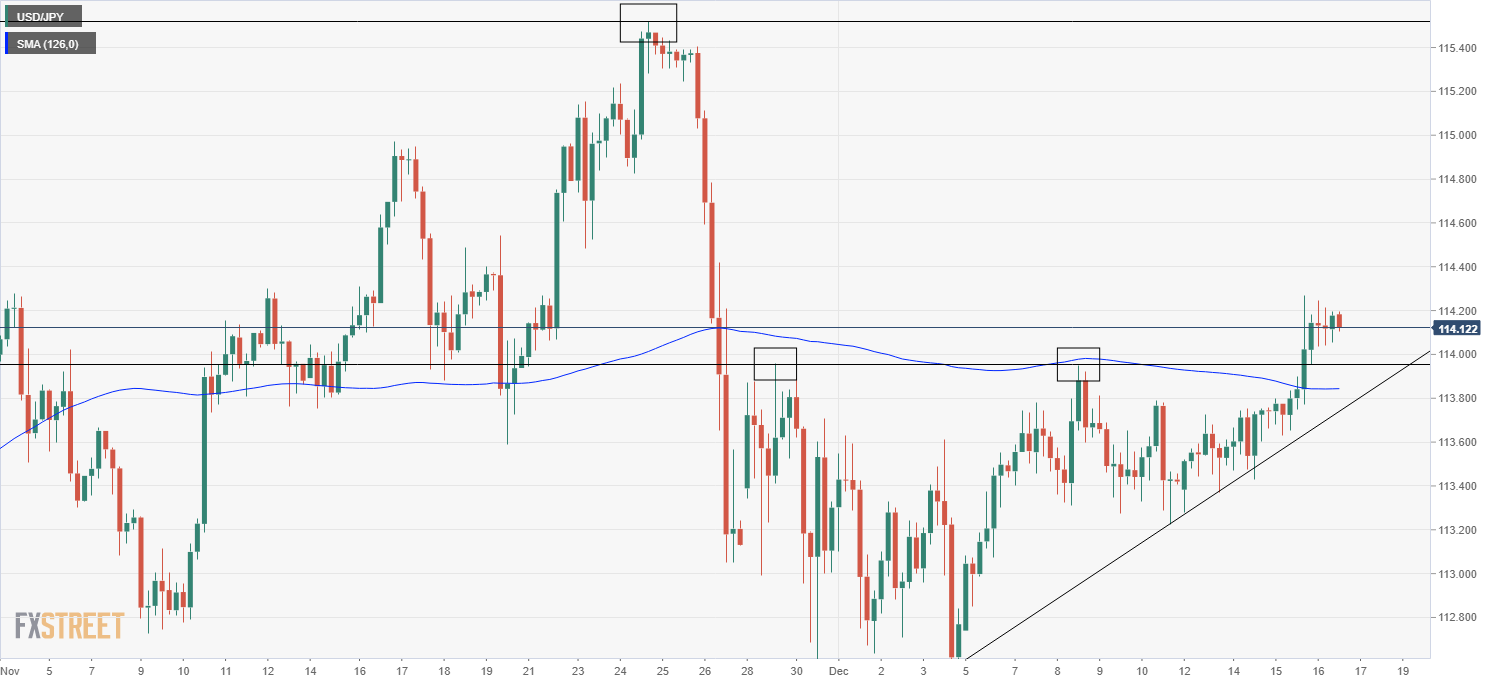
USD/JPY has finally broken clearly above its well-defined intraday highs at 113.96, which completed a base to end its consolidation phase and resume its core uptrend. Economists at Credit Suisse expect back to the 115.50/52 highs and eventually 116.87/117.00 going into next year.
Break above 113.96 to confirm further strength back to 115.52
“USD/JPY has held onto its break above key near-term price resistance at 113.96, which confirms a near-term base to suggest the consolidation phase is over and core uptrend resumed, in line with our broader bullish view, which is based on the completion of a major base.”
“We look for a direct move back to 115.52/62 next, ahead of the long-term downtrend from April 1990, now seen at 115.87.”
“The market should now hold above its 113.96 minor breakout point to maintain a high degree of confidence in the move higher. Below here and 113.23 would negate the breakout for further ranging.”
EUR/USD is set to downward in the first quarter of the new quarter. Nonetheless, economists at Nomura expect the world’s most popular currency pair to recover some ground in the second quarter.
ECB set to maintain accommodative policies into Q1 2022
“Rising COVID-19 cases, lockdowns, a declining euro area trade surplus, fixed income outflows and lacklustre equity inflows in the euro area explain why we expect continued EUR/USD weakness, expecting a move through Q1 2022 towards 1.10.”
“We also have the uncertainty of the April French elections and the recent economic slowdown in China to affect European growth figures. These all add to our conviction that in Q4 2021/Q1 2022 the market will price in more hikes from the US Fed than from the ECB and EUR/USD will trend lower.”
“In early Q2 2022, we expect EUR to rebound with covid vaccine boosters, an economic reopening in the euro area, elections out of the way, and more importantly, signs that inflation is more robust than the ECB expects.”
“If we allow for higher wages and higher inflation than the ECB expects in 2022, the market will likely remain comfortable pricing in expected rate hikes by the ECB in 2022/23. Despite our optimism, an aggressive ECB rate hiking cycle is unlikely. Meanwhile, the risk of high US inflation is just as acute. As we see the Fed waiting until September 2022, the pricing for May 2022 might prove to be too much and this would allow USD softness in Q2.”
- The post-FOMC USD selling pushed EUR/USD higher for the second successive day.
- The lack of fresh dovish signals from the ECB provided an additional boost to the pair.
- Investors now look forward to the post-meeting press conference for a fresh impetus.
The EUR/USD pair added to its intraday gains and climbed to a one-week high, closer to mid-1.1300s after the European Central Bank announced its policy decision.
The pair built on the previous day's post-FOMC bounce from the 1.1220 region and gained some positive traction for the second successive day on Thursday. The ongoing US dollar retracement slide from the vicinity of a 16-month top provided a modest lift to the EUR/USD pair, which was further underpinned by the lack of fresh dovish signals from the ECB.
As was widely expected, the ECB left its monetary policy settings unchanged at the end of the December policy meeting. In the accompanying statement, the ECB announced that it will discontinue net asset purchases under the PEPP in March 2022. This, in turn, was seen as another factor that inspired the euro bulls and collaborated the intraday move up.
Market participants now look forward to the post-meeting press conference, where comments by ECB President Christine Lagarde could provide some impetus to the EUR/USD pair. Traders will also take cues from the US economic docket, featuring the Initial Weekly Jobless Claims, Philly Fed Manufacturing Index, Industrial Production and flash US PMIs.
Technical levels to watch
Christine Lagarde, President of the European Central Bank (ECB), is scheduled to deliver her remarks on the monetary policy outlook in a press conference at 13:30 GMT.
Follow our live coverage of ECB's policy announcements and the market reaction.
About ECB's press conference
Following the ECB´s economic policy decision, the ECB President gives a press conference regarding monetary policy. Her comments may influence the volatility of EUR and determine a short-term positive or negative trend. Her hawkish view is considered as positive, or bullish for the EUR, whereas her dovish view is considered as negative, or bearish.
The European Central Bank announced on Thursday that its Deposit Facility Rate would be left unchanged at -0.50%, as unanimously expected by analysts and market participants. The bank confirmed that the Pandemic Emergency Purchase Programme (PEPP) would end in March 2022, also as expected.
To avoid a cliff-edge drop off in net bond purchases at the start of Q2, the ECB announced that the pace of monthly purchases under its pre-pandemic QE scheme called the Asset Purchase Programme (APP) would be upped to EUR 40B in Q2, and EUR 30B in Q3 from current levels of EUR 20B.
- EUR/GBP witnessed aggressive selling after the BoE delivered a surprise rate hike.
- COVID-19 jitters, a modest pickup in the euro demand helped limit further losses.
- Investors also seemed reluctant to place fresh bets ahead of the key ECB decision.
The sterling rallied across the board in reaction to a hawkish Bank of England decision and dragged the EUR/GBP cross to a near three-week low, around mid-0.8400s in the last hour.
Following a brief consolidation through the mid-European session, the EUR/GBP cross came under intense selling pressure after the BoE delivered a surprise rate hike at the end of the December policy meeting. Adding to this, the 8-1 vote distribution to raise the interest rate by 15 bps to 0.25% was seen as a more hawkish shift.
In the accompanying statement, officials noted that a modest tightening is needed as inflation heads toward a peak and is likely to be around 6% in April. This disappointed market participants, anticipating that the UK central bank will hold fire due to Omicron concerns, and prompted aggressive short-covering around the British pound.
Meanwhile, the GBP bulls seemed unaffected by the fact that the BoE revised down its GDP forecast for Q4 2021 amid the economic risks stemming from the Omicron outbreak. That said, the worsening COVID-19 situation in the UK might hold back the GBP bulls from placing fresh bets and lend some support to the EUR/GBP cross.
Apart from this, a modest pickup in the shared currency, supported by the post-FOMC US dollar selloff, could further help limit the downside for the EUR/GBP cross. The market focus now shifts to the European Central Bank decision, which will influence the euro and provide a fresh trading impetus to the EUR/GBP cross.
Technical levels to watch
- GBP/USD witnessed an aggressive short-covering move after the BoE hiked interest rate to 0.25%.
- A hawkish (8-1) vote distribution was seen as a key factor that seemed to have surprised traders.
- COVID-19 woes could hold back bulls from placing fresh bets and keep a lid on any further gains.
The GBP/USD pair caught aggressive bets after the Bank of England (BoE) announced its policy decision and shot to a fresh monthly high, beyond mid-1.3300s in the last hour.
The British pound strengthened across the board after the BoE MPC voted 8-1 to hike benchmark interest rates to 0.25% from 0.1%. The decision seemed to have disappointed investors, anticipating that the UK central bank would push back its decision to hike rates amid the rapid spread of the Omicron variant. This, in turn, prompted some short-covering move around the GBP/USD pair amid the post-FOMC US dollar selling bias.
Apart from this, the strong move up could also be attributed to some technical buying on a sustained move beyond the 1.3300 round-figure mark. Hence, it remains to be seen if the momentum is backed by genuine buying interest or turns out to be a stop run amid the worsening COVID-19 situations in the UK. In the latest development, France announced that it will close borders for UK tourists from Saturday morning.
With the latest leg up, the GBP/USD pair has now rallied nearly 200 pips from the overnight swing low, around the 1.3170 region and seems poised to prolong its recent recovery move from the YTD low.
Technical levels to watch
The Bank of England announced on Thursday that it would hike its benchmark interest rate by 15bps at 0.25%. The Monetary Policy Committee voted 8-1 in favour of the rate hike. Silvana Tenreyro was the lone dissenter voting against the rate hike.
Leading up to the meeting, markets had been pricing a roughly 60% chance of a hike, with these odds rising in wake of Wednesday’s hotter than expected UK November Consumer Price Inflation report, which came on the heels of a strong labour market report on Tuesday.
The majority of economists had expected the BoE to hold interest rates at 0.1%, though these polls (conducted by newswires) were released prior to Wednesday’s inflation surprise. Market watchers and participants, as indicated by various other polls (such as on social media) had seemed split over whether the BoE would hike or hold.
Additional Takeaways as summarised by Reuters
On the Omicron variant...
“The Omicron variant on the basis of current knowledge posed new risks to public health.”
“The Omicron variant posed downside risks to activity in early 2022, although the balance of its effects on demand and supply, and hence on medium-term global inflationary pressures, was unclear.”
“Successive waves of covid appeared to have had less impact on GDP, although there was uncertainty around the extent to which that would prove to be the case on this occasion.”
“Some tentative signs that UK economic activity had started to be affected by the emergence and spread of Omicron.”
“Experience since march 2020 suggests that successive waves of covid appear to have had less impact on GDP, although there is uncertainty around the extent to which that will prove to be the case on this occasion.”
“The Omicron variant poses downside risks to activity in early 2022.”
“The balance of Omicron's effects on demand and supply, and hence on medium-term global inflationary pressures, is unclear.”
“Given the clear signs of increased transmissibility for the new variant, there was the potential for a very high number of infections over a very short period.”
On the economic outlook...
“Staff had revised down their expectations for the level of UK GDP in 2021 q4 by around ½% since the November report, leaving GDP around 1½% below its pre-covid level.”
“Level of global GDP in 2021 q4 is likely to be broadly in line with the November report projection.”
“Little sign in the available data that the closure of the coronavirus job retention scheme at the end of September had led to a weakening in the labour market.”
“Possible that the unemployment rate could fall further over coming months if hiring continued to keep pace with the current elevated levels of vacancies.”
“The LFS unemployment rate is now expected to fall to around 4% in 2021 q4, compared with the 4 1/2% projection in the November report.”
“Underlying earnings growth had remained above pre-pandemic rates, and the committee continued to see upside risks around the projection for pay.”
“Bank staff continue to estimate that underlying earnings growth has remained above pre-pandemic rates.”
“Bank staff expected inflation to remain around 5% through the majority of the winter period, and to peak at around 6% in April 2022.”
“CPI inflation is still expected to fall back in the second half of next year.”
“Contacts of the bank's agents expect further price increases next year driven in large part by pay and energy costs.”
Market Reaction
GBP surged as dovish bets for an interest rate hold were priced out. GBP/USD lept from around 1.3280 to current levels in the 1.3330s, where it now trades higher on the day by more than 0.5%. EUR/GBP slumped from slightly above 0.8500 to the 0.8460s, where it now trades lower on the day by about0.5%.
ECB monetary policy decision – Overview
The European Central Bank (ECB) is scheduled to announce its monetary policy decision this Thursday at 12:45 GMT, which will be followed by the post-meeting press conference at 13:30 GMT. The ECB remains one of the more dovish major central banks and maintained its patient approach despite rising inflationary pressures. In fact, policymakers have made every effort to push back on market bets for tighter policy and talked down the need for any action to counter inflation.
Moreover, worries about a significant slowdown in the Eurozone economic activity – amid the rapid spread of the Omicron variant – could further allow the ECB to maintain its dovish stance. Hence, the focus will be on the ECB's plan to end the Pandemic Emergency Purchase Program (PEPP) in March 2022. Apart from this, investors will take cues from the updated economic projections and ECB President Christine Lagarde's remarks at the post-meeting press conference.
According to Valeria Bednarik, Chief Analyst at FXStreet: “market participants are expecting an upward revision to inflation projections, for this year and the next ones. Growth, on the other hand, can suffer a downward revision as the region is currently struggling with restrictions due to the rapid spread of Omicron.”
How could it affect EUR/USD?
Heading into the key central bank, the EUR/USD pair inched back closer to weekly swing high, albeit struggled to capitalize on the move amid the emergence of some US dollar buying. A more dovish ECB outlook would be bearish for the shared currency and turn the pair vulnerable to resume its downtrend witnessed since late October. Conversely, a hawkish stance – though seems unlikely – should prompt aggressive short-covering move around the pair and pave the way for some meaningful recovery from the YTD low touched in November.
Meanwhile, Eren Sengezer, Editor at FXStreet, offered a brief technical outlook for the EUR/USD pair: “The technical outlook seems to have turned bullish with the Relative Strength Index (RSI) indicator on the four-hour chart climbing to 60. Additionally, EUR/USD is holding above the 20-period, 50-period and 100-period SMAs on the same chart.”
Eren also outlined important technical levels to trade the major: “On the upside, 1.1350 (static level) aligns as first resistance before 1.1370 (200-period SMA) and 1.1380/1.1400 (static level, psychological level) area. Supports are located at 1.1300 (psychological level), 1.1280 (50-period SMA, 100-period SMA) and 1.1240 (static level).”
Key Notes
• European Central Bank Preview: More recalibration or actual tightening?
• ECB December Preview: How will ECB replace PEPP?
• EUR/USD Forecast: Euro bulls could step aside on dovish ECB
About the ECB interest rate decision
ECB Interest Rate Decision is announced by the European Central Bank. Usually, if the ECB is hawkish about the inflationary outlook of the economy and rises the interest rates it is positive, or bullish, for the EUR. Likewise, if the ECB has a dovish view on the European economy and keeps the ongoing interest rate, or cuts the interest rate it is seen as negative, or bearish.
- USD/CAD has dipped below 1.2800 in recent trade and is now more than 1.2% lower from Wednesday’s peaks.
- The dollar is weaker and markets risk-on after the final Fed meeting of the year, helping the loonie.
- Technical selling upon the break below a recent uptrend likely contributed to the recent drop.
USD/CAD has seen a sharp pick up in volatility over the course of the last two sessions. To recap, the pair hit fresh multi-month highs near 1.2940 in the immediate aftermath of Wednesday’s Fed monetary policy announcement. The pair had been moving higher in the run-up to the meeting after data confirmed an easing of inflationary pressures as expected in Canada in November.
Wednesday’s Fed policy announcement was hawkish leaning, with the pace of the bank’s QE taper doubled in January, three rate hikes indicated in 2022, while Chair Jerome Powell painted a bullish picture of the US economic outlook for 2022. Despite this, risk appetite saw a substantial improvement in the aftermath of the meeting, given the lack of big surprises and amid Powell’s optimism on the economy and this weighed on the buck and is helping risk-sensitive FX.
Thus, USD/CAD has reversed sharply lower again and in recent trade passed underneath the 1.2800 level. That marks a more than 1.2% turnaround from Wednesday’s high, with USD/CAD currently down about 0.4% on the day and trading in the 1.2775 area. Technical selling once USD/CAD broke below an uptrend that had been in play since the start of last week likely also contributed to the recent decline. The pair will now eye a test of its 21-day moving average in the 1.2730s, with the next major level of support below that the December lows around 1.2600.
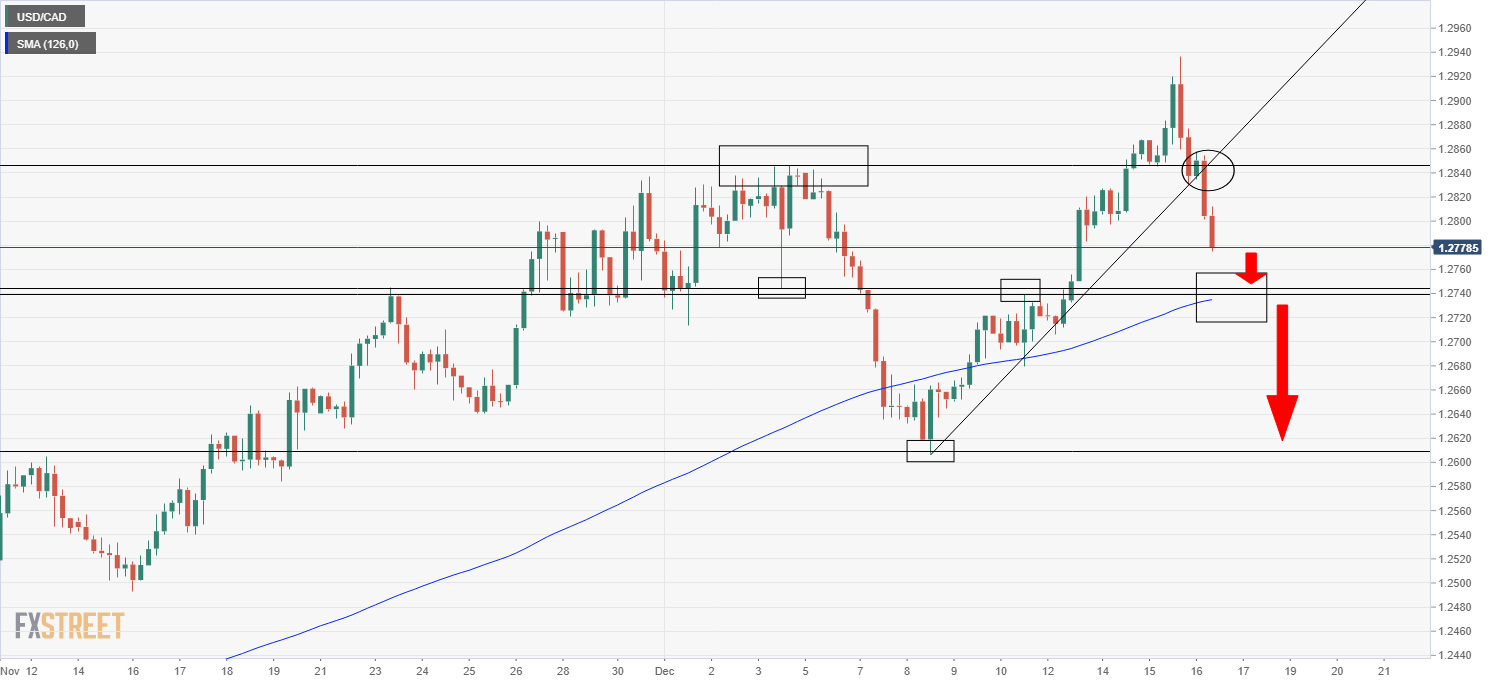
The Central Bank of the Republic of Turkey (CBRT) announced on Thursday that it lowered its policy (one-week repo) rate by 100 basis points to 14% from 15%. This decision came in line with the market expectation.
Market reaction
With the initial market reaction, USD/TRY reached a new record high of 15.67 before retreating. As of writing, the pair was up 2.6% on the day at 15.17.
Key takeaways from policy statement
"Will follow interest rate cut decisions in 2022 Q1."
"Will monitor results of rate cuts in Q1."
"All aspects of the policy framework will be reassessed in order to create a foundation for a sustainable price stability."
"Decided to complete the use of the limited room to cut."
"The room left by supply side inflation factors has passed."
"Stability in general price level will foster macroeconomic stability and financial stability."
"This would create a viable foundation for investment, production and employment to continue growing in a healthy and sustainable way."
"Current account balance is expected to post a surplus in 2022."
"Strengthening of the improvement trend in current account balance is important for price stability objective, developments in commercial and consumer loans are closely monitored."
Norges Bank has decided to increase the key rate to 0.50% at today’s meeting. The krone looks attractive and analysts at ING expect EUR/NOK to find its way below 10.00 in the new year.
Norges Bank remains bullish factor for NOK
“The Bank has kept its interest rate projection essentially unchanged from September, and if anything has nudged up the terminal rate for 2024. That now sits at 1.75% (from 0.5% now), and policymakers are projecting three rate rises next year, with the first expected in March.”
“The spread of Omicron and its potential implications for the global economy and energy markets will make for a challenging period for the high-beta NOK in coming weeks. But the notion that Norges Bank is currently by-and-large overlooking new covid-related risks and remains on track for its 2022 tightening cycle is likely to keep NOK an attractive currency in periods of calm risk sentiment.”
“We expect EUR/NOK to find its way below 10.00 in the new year, and we target 9.60 for 4Q22.”
BoE Monetary Policy Decision – Overview
The Bank of England (BoE) is scheduled to announce its monetary policy decision this Thursday at 12:00 GMT. Analysts believed that the rapid spread of the Omicron variant has raised uncertainty about the economic recovery in the short term and could persuade the BoE to hold its fire. That said, an unexpectedly sharp jump in the UK inflation has added pressure on the UK central bank to hike interest rates, making today's decision more relevant for the FX markets.
As Yohay Elam, Analyst at FXStreet, explains:” It is hard to see the hawks mustering more backing given the Omicron uncertainty, but other considerations such as inflation, jobs shortage, rising home prices, and other factors mean this scenario is a possibility.”
How could it affect GBP/USD?
Should the BoE decide to maintain the status-quo, the vote distribution and the policy outlook for next year will play a key role in influencing the British pound. A clear hint that the BoE would hike rates in February should be enough to provide a strong boost to the sterling. This, in turn, would set the stage for an extension of the pair's recent recovery from the YTD low. Conversely, a less hawkish outcome could prompt some selling around the pair, though the post-FOMC US dollar retracement slide should help limit any meaningful downside.
Meanwhile, Eren Sengezer, Editor at FXStreet, outlined important technical levels to trade the major: “GBP/USD is testing 1.3300 (psycholoıgical level, static level) and a hawkish BOE open the door for additional gains toward 1.3330 (static level) and 1.3380 (200-period SMA on the four-hour chart). 1.3400 (psychological level) aligns as the next resistance.”
“On the downside, 1.3270 (100-period SMA) is the first support before 1.3240 (20-period SMA, 50-period SMA) and 1.3200/1.3190 (psychological level, static level),” Eren added further.
Key Notes
• BOE Preview: Omicron eliminates rate hike chances, voting pattern critical to GBP/USD reaction
• BoE Preview: Forecasts from 10 major banks, no hike due to Omicron
• GBP/USD Forecast: GBP/USD could target 1.3380 if BOE goes for a rate hike
About the BoE interest rate decision
BoE Interest Rate Decision is announced by the Bank of England. If the BoE is hawkish about the inflationary outlook of the economy and raises the interest rates it is positive, or bullish, for the GBP. Likewise, if the BoE has a dovish view on the UK economy and keeps the ongoing interest rate, or cuts the interest rate it is seen as negative, or bearish.
Gold prices have declined by 6.6% so far this year. Strategists at ABN Amro think that the gold price outlook remains negative. Subsequently, their end 2022 forecast is $1,500 per ounce and end-2023 at $1,300 per ounce.
A lower gold price in 2022
“We continue to expect lower gold prices in 2022 and 2023. Our forecast for the end of 2022 stands at $1,500 per ounce and end-2023 at $1,300 per ounce.”
“Monetary policy will tighten globally going forward. We expect the Fed to start hiking in mid-2022. Tighter monetary policy is in general negative for gold, also because yields on government bonds have a tendency to rise.”
“We expect US 2y real yields to pick up. There are two dynamics at play here. First, we expect the 2yr US Treasury yield to rise a bit more than what markets are now expecting. Moreover, we think that inflationary pressures will ease. This results in higher 2y US real yields and that will weigh on gold prices going forward.”
“We expect the US dollar to rally further, especially versus currencies where central banks start the tightening process later. A higher US dollar is generally negative for gold.”
See – Gold Price Forecast: XAU/USD unlikely to have a good 2022 – Deutsche Bank
- GBP/USD gained strong traction for the second successive day and shot to a near two-week high.
- The risk-on mood forced the USD to prolong the post-FOMC slide and continue lending support.
- The focus remains glued to the BoE policy decision amid worries over the Omicron variant fears.
The GBP/USD pair shot to a near two-week high during the first half of the European session, with bulls now awaiting a sustained strength beyond the 1.3300 mark.
The pair built on the previous day's post-FOMC solid bounce from the 1.3170 region and gained strong follow-through traction for the second successive day on Thursday. The US dollar prolonged its retracement slide from the vicinity of a 16-month high, which, in turn, was seen as a key factor driving the GBP/USD pair.
It is worth recalling that the greenback initially rallied after the Fed's so-called dot plot showed that officials expect to hike rates at least three times next year. The USD bulls, however, were quick to take profits off the table as the markets had been pricing in the prospects for a faster policy tightening by the Fed.
Apart from this, the prevalent risk-on mood – as depicted by a generally positive tone around the equity markets – further undermined the safe-haven buck. That said, diminishing odds for an imminent interest rate hike by the Bank of England might act as a headwind for the British pound and cap gains for the GBP/USD pair.
Most analysts believe that fresh economic turmoil led by the new Omicron variant could persuade the UK central bank to hold its fire. Hence, the market focus will remain glued to the BoE monetary policy decision on Thursday. In the meantime, the mixed release of UK PMI prints did little to provide any impetus to the GBP/USD pair.
Later during the early North American session, traders might take cues from the US economic docket, featuring the release of the Initial Weekly Jobless Claims, Philly Fed Manufacturing Index, Industrial Production and flash PMIs. This, along with the BoE/ECB-inspired volatility, should produce some trading opportunities around the GBP/USD pair.
Technical levels to watch
EUR is among 2021’s weaker currencies, with its negative yields proving a major headwind in a year of ongoing risk positive conditions. That is unlikely to change in 2022. The European Central Bank (ECB) remains committed to containing rate hike expectations while the eurozone labours under a major Omicron outbreak and surging energy prices are cutting real incomes, economists at Westpac report.
ECB likely to sustain forms of QE
“EUR is likely to remain a funding currency. ECB’s pandemic emergency purchasing program buying should end in late March, but a more flexible add-on to its asset purchasing program will keep flexible QE buying potential in play as ECB still pursues target inflation of 2% into the end of its forecast period.”
“Although some early restrictions in Austria may be lifting, the bias across the region is to renew restrictions. Restrictions were initially focusing upon non-vaccinated citizens. However, the scale of the infections is pushing governments to broaden restrictions and risk adding to the pullback in activity.”
“There has been a notable rise in EU rhetoric towards Russia after a period of near silence. The more vocal stance of EC President von der Leyen has been mirrored by newly appointed Chancellor Scholz. This suggests that the Nord Stream 2 gas pipeline is unlikely to become operational and the subsequent political strains with Russia are likely to act as another restraint on EUR.”
“EUR/USD is likely to struggle to post gains above 1.1350 near-term with 1.1500 acting as a more notable hurdle should USD falter. Risks of a slide towards 1.10 appear more likely.”
See – ECB Preview: Forecasts from 13 major banks, looking for ways to maintain accommodation
Negative rates and interventions, if necessary, will continue, Swiss National Bank (SNB) Chairman Thomas Jordan said after the monetary policy announcement on Thursday.
Additional headlines
We care a lot about the level of the Swiss franc.
If necessary, we continue to intervene in the forex market, this is crucial.
Negative rates and interventions, if necessary, to continue.
Normalization of global monetary policy is a positive.
Inflationary pressure in Switzerland is very low.
We look at overall exchange rate situation, not just one currency.
Believe inflation differential between Switzerland and US and Europe will narrow.
Think sovereign wealth fund using SNB assets is not a good idea.
Market reaction
USD/CHF is trading under pressure near daily lows of 0.9221, losing 0.25% so far. The weakness in the spot could be mainly attributed to the relentless selling in the US dollar across the board, in the aftermath of the hawkish Fed.
- UK Manufacturing PMI drops as expected to 57.6 in December.
- Services PMI in the UK misses estimates with 53.2 in Dec.
- GBP/USD holds gains near 1.3300 on mixed UK Preliminary PMIs.
The seasonally adjusted IHS Markit/CIPS UK Manufacturing Purchasing Managers’ Index (PMI) worsened to 57.6 in December versus 57.6 expected and 58.1 – November’s final reading.
Meanwhile, the Preliminary UK Services Business Activity Index for December slumped, arriving at 53.2 versus November’s final readout 58.5 and 57.0 expected.
Chris Williamson, Chief Business Economist at IHS Markit, commented on the survey
“The flash PMI data show the UK economy being hit once again by COVID-19, with growth slowing sharply at the end of the year led by a steep drop in spending on services by households.”
“Some brighter news came through from manufacturing, where an easing of supply chain delays helped lift production growth, but more importantly also helped take some upward pressure off prices to hint at a peaking of inflation.”
FX implications
Mixed UK Preliminary Manufacturing and Services PMIs failed to deter GBP bulls, as the GBP/USD pair kept its range near 1.3300.
The spot is trading at 1.3295, adding 0.26% on a daily basis, at the press time.
GBP/USD technical levels
USD/JPY has embarked on a phase of pullback after reaching graphical resistance zone of 114.70/115.50. A break above here is needed to see another leg higher, economists at Société Générale report.
Important support sits at 112.23/111.65
“The 114.70/115.50 hurdle must be overcome for next leg of uptrend.”
“112.23/111.65 will be an important support.”
- EUR/USD built on the overnight post-FOMC recovery from the monthly low.
- The risk-on mood undermined the safe-haven USD and remained supportive.
- Mixed Eurozone PMIs did little to influence ahead of the ECB policy decision.
The EUR/USD pair maintained its bid tone through the first half of the European session and was last seen trading around the 1.1315-20 region, just a few pips below the weekly high.
The US dollar extended the previous day's post-FOMC retracement slide from the vicinity of a 16-month top and witnessed some follow-through selling on Thursday. This, in turn, allowed the EUR/USD pair to gain traction for the second successive day and recover further from the monthly low, around the 1.1220 region touched on Wednesday.
The prevalent risk-on mood – as depicted by a generally positive tone around the equity markets – was seen as a key factor that undermined the greenback's relative safe-haven status. That said, concerns about the rapid spread of the Omicron variant, along with a more hawkish Fed should help limit any deeper losses for the USD.
It is worth recalling that the Fed on Wednesday announced that it would double the pace of tapering to $30 billion per month. Moreover, the so-called dot plot showed that officials expect to raise the fed funds rate at least three times next year. This, in turn, supports prospects for the emergence of some dip-buying around the USD.
Conversely, the European Central Bank (ECB) has made every effort to push back on bets for tighter policy and talked down the need for any action to counter inflation. The ECB-Fed monetary policy divergence might hold back traders from placing aggressive bullish bets around the shared currency and cap gains for the EUR/USD pair.
On the economic data front, the mixed release of the flash Eurozone PMI prints for December did little to provide any impetus or hinder the intraday move up. The market focus remains glued to the latest ECB monetary policy decision, due later this Thursday, which should infuse volatility and provide some impetus to the EUR/USD pair.
Technical levels to watch
The Swiss National Bank (SNB) Chairman Thomas Jordan said that he believes the Swiss inflation has peaked and will decline next year while speaking at the post-monetary policy meeting press conference on Thursday.
Read: SNB leaves the key sight deposit rate on hold at -0.75%
Additional headlines
Forecast Swiss inflation remains within range for price stability.
Effect of Swiss franc nominal appreciation is reduced by higher inflation abroad.
The real trade-weighted exchange rate of Swiss franc has hardly changed since start of pandemic.
Nominal appreciation of Swiss franc has countered rising inflation in Switzerland.
Aware that uncertainty can lead to demand for franc.
SNB will continue to monitor Swiss franc exchange rate and react as necessary.
Market reaction
USD/CHF was last seen trading at 0.9223 amid unabated US dollar supply across the board, as markets reposition ahead of the BOE and ECB policy decision. The spot is down 0.27% on the day, as of writing.
- Eurozone Manufacturing PMI arrives at 58.0 in December vs. 57.8 expected.
- Bloc’s Services PMI drops to 53.3 in December vs. 54.1 expected.
The Eurozone manufacturing sector activity increased more than expected in the reported month, the latest manufacturing activity survey from IHS/Markit research showed on Thursday.
The Eurozone Manufacturing purchasing managers index (PMI) arrived at 58.0 in December vs. 57.8 expectations and 58.4 last. The index hit 10-month lows.
The bloc’s Services PMI dropped to eight-month troughs of 53.3 in December vs. 54.1 expected and 55.9 previous.
The IHS Markit Eurozone PMI Composite eased to 53.4 in December vs. 54.0 estimated and 55.4 previous. The gauge reached the lowest in nine months.
Comments from Chris Williamson, Chief Business Economist at IHS Markit
“The eurozone economy is being dealt yet another blow from COVID-19, with rising infection levels dampening growth in the service sector, in particular, to result in a disappointing end to 2021. Germany is being especially hard hit, seeing the economy stall for the first time in a year-and-a-half, but the growth slowdown is broad-based across the region.”
“Encouragement comes from the manufacturing sector, where the strain on supply chains is showing some signs of easing, in turn helping to revive factory production. Most notably autos production has risen for the first time since August.”
FX implications
EUR/USD is trading close to the daily highs of 1.1319 despite the mixed German and Eurozone Business PMIs, as it finds some comfort from the persistent weakness in the US dollar.
The spot currently trades at 1.1314, up 0.25% on the day.
Australia’s jobs surge adds to Reserve Bank of Australia (RBA) rate hike pricing but with core inflation and wages growth still muted, AUD is likely to struggle to extend rallies. Over the new year, AUD/USD risks a test of 0.7000 given hawkish Fed and Omicron, according to economists at Westpac.
Hawkish Fed vs uncertain RBA
“The Aussie’s tone into early January is likely to be determined by the US dollar mood and whether global risk appetite is unsettled by the spread of the Omicron variant. In this regard, we lean towards a firm US dollar, supported by the FOMC’s hawkish shift, robust US growth momentum and skittish equities as governments in major economies scramble to strike the right balance in response to Omicron. Another test of 0.7000 would not surprise around year-end.”
“The November labour force data showed the largest monthly rise in jobs on record, 366K. The unemployment rate tumbled from 5.2% to 4.6% and underemployment fell to a low since 2014. If the December survey is also robust and core CPI surprises to the strong side, then the aussie should rebound steeply in anticipation of a substantial hawkish turn by the RBA in February.”
“Our base case is that the RBA continues to expect only a gradual rise in wages and inflation, such that it pushes back on markets eager to price in rate hikes from mid-2022. This should help keep a lid on AUD/USD rallies, with our March forecast just 0.7100.”
Economists at Westpac expect the contrast between the hawkish Federal Reserve and other more wary major central banks to provide a solid underpinning for the US dollar. Therefore, US Dollar Index (DXY’s) Fed-fuelled medium-term uptrend is set to extend into Q1 2022.
Uptrend to extend in Q1 2022
“DXY likely to encounter some turbulence into year’s end – the hawkish FOMC was largely priced in, positioning is heavily lopsided into year’s end and Q4 GDP expectations under pressure. But the underlying uptrend remains soundly intact. DXY has yet to fully reflect the lift in yield support. The Fed is streets ahead of the ECB too, the latter at pains to push back against market expectations for lift-off in 2022 and finding ways to glacially wean the economy off QE support.”
“DXY slippage unlikely to extend much past 95.50, the uptrend likely to resume in the new year, new highs on the cards beyond 97 in Q1 2022.”
- Gold gained traction for the second successive day and moved further away from a two-month low.
- The USD extended the post-FOMC retracement slide and extended some support to the commodity.
- The risk-on mood could hold bulls from placing aggressive bets and keep a lid on any further gains.
Gold built on the previous day's post-FOMC recovery move from the $1,753 area, or a two-month low and gained some follow-through traction on Thursday. This marked the second successive day of a positive move and pushed spot prices to the $1,786 region during the early European session.
As was widely expected, the US central bank kept its interest rate unchanged at 0.25% and said that it would double the pace of tapering to $30 billion per month. The so-called dot plot showed that officials expect to raise the fed funds rate at least three times next year. The markets, however, had already priced in the prospects for a faster policy tightening by the Fed. This, in turn, led to a sharp US dollar pullback from the vicinity of a 16-month high, which extended through the early part of the trading on Thursday and benefitted dollar-denominated commodities, including gold.
Apart from this, concerns about the economic fallout from the rapid spread of the new Omicron variant, along with the imposition of fresh restrictions in Europe and Asia further underpinned the safe-haven XAU/USD. That said, a generally positive tone around the equity markets could hold back traders from placing aggressive bullish bets and keep a lid on any further gains for gold. Market participants now look forward to the US economic docket, featuring the release of the Initial Weekly Jobless Claims, Philly Fed Manufacturing Index, Industrial Production and flash PMIs. This, along with some volatility infused by the BoE/ECB policy decision, should provide some impetus to the commodity.
Technical outlook
From a technical perspective, any subsequent move up is likely to confront stiff resistance near a technically significant 200-day SMA. The mentioned barrier, around the $1,795 region, coincides with 100-day SMA. A sustained strength beyond the confluence hurdle should pave the way for a further near-term appreciating move. Gold could then accelerate the momentum towards an intermediate resistance near the $1,812-15 region before eventually climbing to test the $1,832-34 supply zone.
On the flip side, any meaningful pullback now seems to find decent support near the $1,770 level. Some follow-through selling has the potential to drag the XAU/USD back towards the overnight swing low, around the $1,753 region, which if broken will be seen as a fresh trigger for bearish trades. The next relevant support is pegged near the $1,726-25 area, below which gold prices could test the $1,700 round-figure mark.
Gold daily chart
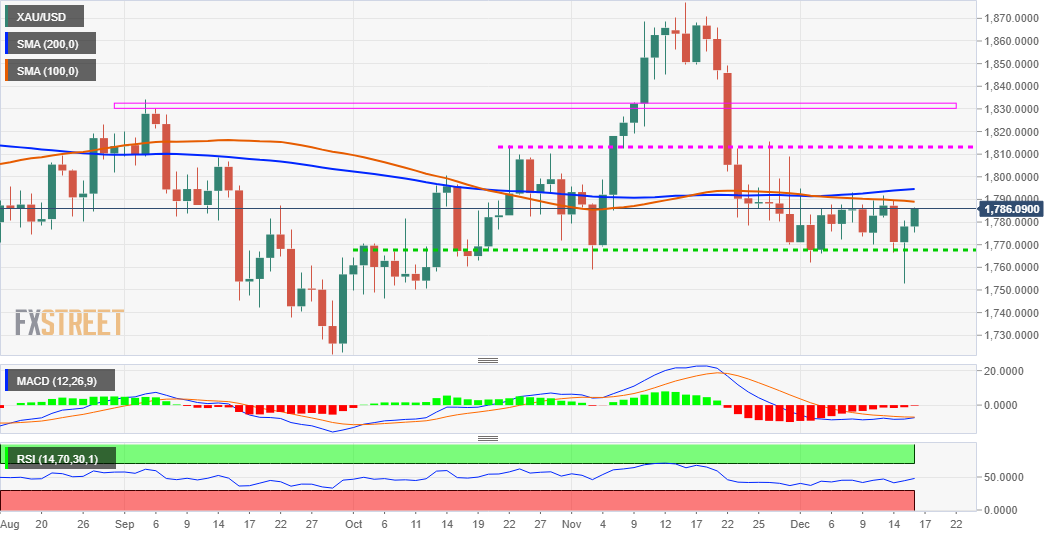
Key levels to watch
The European Central Bank (ECB) will announce its decision on monetary policy and present fresh economic projections on Thursday, December 16 at 12:45 GMT and as we get closer to the release time, here are the expectations as forecast by the economists and researchers of 13 major banks.
The ECB is widely expected to leave the interest rates on the main refinancing operations unchanged. More importantly, the ECB is set to take a step toward policy normalization and unveil its plan to retire the Pandemic Emergency Purchase Program (PEPP).
As FXStreet’s Eren Sengezer notes, a dovish policy outlook could cause EUR/USD to turn south.
SocGen
“Key December meeting objective: Announce an expected end to the coronavirus crisis phase while keeping policy optionality for both downside and upside scenarios. Our call: Announcement of an intention to put PEPP on hold and raise APP in March along with raising the holding limit of supranational debt. Due to heightened uncertainty, the final decision on APP could be taken in March along with announcing a TLTRO4. ECB to stress that it has proven its ability to intervene if fragmentation becomes an issue and that flexibility remains in the PEPP reinvestments. The latest data and legal issues reduce the likelihood of a post-PEPP envelope. Key risk: Leaving markets with uncertainty over the scale of bond purchases after March, something that could invite volatility in January when issuance is high.”
Citibank
“The ECB meeting takes place in the context of high uncertainty and deep divisions within the Council. We expect the ECB to terminate PEPP on schedule in March 2022 and commit to net asset purchases post-PEPP only to December 2022.”
Rabobank
“The ECB will stick to its assessment that inflation is transitory. Amidst high uncertainty, the ECB has to balance commitment and stability with flexibility. The December meeting will focus on the modalities of asset purchases after PEPP ends, while other policy decisions may be postponed until early 2022. The 2024 inflation forecast will provide a key hint for medium-term policy. Announcement that PEPP will be terminated by end-March; redemptions to be reinvested. APP will be increased to EUR40 B/month. No changes to the capital key or issuer limit; but a higher share of supranational purchases. Time-based forward guidance on net asset purchases ‘until at least December 2022’. New TLTROs are likely but may be postponed to March. Modalities will be less generous.”
Nordea
“Major decisions on the monetary policy outlook also longer out were supposed to be taken at the December meeting, but amidst the risen uncertainty and differing opinions, many decisions may now be postponed into early 2022. Net purchases under the PEPP will likely end by the end of March 2022, but buying will still be notable in the coming months. The ECB will probably boost the APP as net PEPP ends, but it is far from certain that it is ready to make the detailed decision next week. The upside inflation risks and elevated near-term uncertainty regarding economic developments make many Governing Council members weary of pre-committing to long periods of time. Staff forecasts will probably show inflation below the target longer out. We see more downside for EUR/USD and upside potential for bonds yields.”
ING
“We expect the ECB to continue to sound cautious about the economic outlook, acknowledging the risk of higher inflation while sticking to the view that inflation is transitory and will eventually return to 2%. In order to gradually start the exit from ultra-loose monetary policy without giving up flexibility amid a fourth wave of the pandemic, we expect the ECB to confirm the end of PEPP in March 2022 and to introduce a third asset purchase programme to smooth the transition. TLTROs will not be extended at their current favourable conditions but instead, the tiering multiplier will be increased from 6 to 10. A gradual recalibration of all emergency measures to prepare for the possibility of more permanent inflation is a very logical step and good risk management at the current juncture.”
Danske Bank
“Inflation has picked up quicker than anticipated while the growth outlook is murky, which we expect will result in a patient approach to monetary policy in 2022, but with the optionality to recalibrate in 2023. We expect the first staff projection for 2024 inflation to land around 1.8%. This combined with real rates hovering around historic lows, allows room for a recalibration. Specifically, we expect PEPP net purchases to end in March 2022, as originally planned. The link between the first-rate hike and the APP is expected to be weakened through calendar-based forward guidance, with APP running until Q4 23 and first-rate hike sometime after that. We expect APP to continue at EUR20/month, and with an additional envelope of EUR250 B that is available with flexible implementation, but with the capital key and ISIN limits still in place. We expect at least a firm indication of TLTRO operations coming in 2022, however, the actual announcement may only come at the February meeting, in light of recent comments from GC members. We expect markets to reprice the front-end in 2022 flatter, but leave it relatively steep in late 2023/2024. Our view may be on the hawkish side of expectations, however, once the initial reaction has settled, we believe markets will realise that this is still a relatively accommodative monetary policy stance.”
Citibank
“The ECB meeting takes place in the context of high uncertainty and deep divisions. We expect this will lead the Council to only make decisions it cannot postpone (those relating to asset purchases) and to make decisions that require minimum innovation. That would likely mean terminating PEPP on schedule in March 2022, committing to net asset purchases post-PEPP only to December 2022, and carrying over into those residual net purchases from PEPP and reinvestment a promise of flexibility that is unlikely to be implemented in practice. More controversially perhaps, we also expect commitment to post-PEPP asset purchases to extend only to the end of 2022, which would break the link between forward guidance on asset purchases and rates (this could be a ‘hawkish’ surprise). We expect the ECB to try and balance what is effectively phasing out of asset purchases as an instrument of monetary policy by introducing optionality in its communication. But in view of the experience of PEPP, and given divisions within the Council, we remain skeptical that any promise of flexibility will actually be implemented.”
Barclays
“We expect the Governing Council (GC) to announce the end of asset purchases via the Pandemic Emergency Purchase Programme (PEPP) in March 2022. We forecast purchases of EUR60 B per month via PEPP in Q1 22 (down from EUR70 B per month in Q4 21). We think that the ECB President will indicate that this programme could be reactivated if needed and that the re-investments stemming from this programme could be conducted flexibly across jurisdictions and asset classes. We also expect the ECB to scale up its regular Asset Purchase Programme (APP), announcing an additional envelope of EUR180 B to be used from April 2022 to September 2022 (December 2022 previously).”
TDS
“We look for the ECB to confirm that the PEPP will end in March, and announce a temporary boost to the APP through 2022Q2 to around EUR50 B/mo, with a commitment to revisit the programme later. More flexibility probably won't translate into much EUR support. While the EUR remains oversold and trades at a discount, we look to fade any near-term consolidation. Also keep in mind that the ECB is likely to follow on the heels of a hawkish Fed, suggesting EUR support, if it leads to that conclusion, might reflect an unwind of risk-correlated carry trades rather than a view on policy settings.”
ANZ
“Amid record COVID-19 case numbers and rising hospitalisations, we expect the ECB will boost APP purchases by EUR20/30 B per month for much of 2022. In our assessment, the probability that inflation will converge on target over the medium term is rising. Fiscal policy is working in tandem with monetary policy, while the changing energy mix, rise in carbon prices and recovering public investment can help inflation reach target sustainably. In the short-term, the diverging policy path with the US can continue to weigh on EUR/USD. Whilst much is discounted, it is difficult to see the dollar’s dominance receding in the near-term.”
BBH
“With APP currently running at around EUR20 B per month, we think it is likely that the ECB will announce a modest tapering process by increasing APP to EUR50-60 B per month once PEPP ends. We also know from public comments that many policymakers are against an open-ended timeframe and so the ECB will likely put an expiry date on when APP would return to its regular EUR20 B monthly pace. Unlike the Fed, the ECB is in no hurry to hike rates and so we expect a 12-month period of elevated APP that is gradually tapered after perhaps six months. Recent reports suggest some ECB policymakers want to delay this decision due to the uncertainty stemming from omicron. While a delay is possible, we think the ECB will reach some sort of workable consensus this week. Of note, new macro forecasts will be released this week and 2024 will be added to the forecast horizon. Inflation forecasts are likely to be raised, while growth forecasts are likely to be cut. The new 2024 forecast for inflation will be a key factor in its forward guidance. If that forecast remains substantially below the 2% target, it would send a very dovish signal on possible lift-off.”
BMO
“Policymakers are now looking at increasing purchases (currently at EUR20 B/mth) under the regular Asset Purchase Program after it puts the PEPP to bed in March. If the amount is increased significantly (example: to EUR50 B), then the timeline for such purchases would be short. If the amount is increased minimally (example: to EUR30 B), then the timeline would be longer. But it will not be open-ended, otherwise, the hawks will not sign on. Whatever the decision, the message on rates will still be clear that a rate hike is unlikely in 2022.”
Deutsche Bank
“The ECB appears on track to initiate a transition to a monetary policy stance based more on policy rates and rates guidance and less on liquidity provision. The ECB is set to confirm that PEPP net purchases will end in March, but will cushion the blow by working flexibility into the post-PEPP asset purchase arrangement. They are also set to make the policy framework more flexible to better respond to inflation uncertainties. One thing to keep an eye out for in particular will be the latest inflation projections, with a report from Bloomberg suggesting that they’ll show inflation beneath the 2% target in both 2023 and 2024. So if that’s true, that could offer a route to arguing against a tightening of monetary policy for the time being, since the ECB’s forward guidance has been that it won’t raise rates until it sees inflation at the target ‘durably for the rest of the projection horizon’.”
- German Manufacturing PMI arrives at 57.9 in December vs. 56.8 expected.
- Services PMI in Germany contracts to 48.4 in December vs. 51.0 expected.
- EUR/USD keeps 1.1300 on mixed German PMIs, largely unfazed.
The German manufacturing sector quickens its pace of expansion in December, the preliminary manufacturing activity report from IHS/Markit research showed this Thursday.
The Manufacturing PMI in Eurozone’s economic powerhouse came in at 57.9 this month vs. 56.8 expected and 57.4 prior. The index rebounds to fresh three-month highs.
Meanwhile, Services PMI slumped ten-month lows of 48.4 in December as against 51.0 estimated and 52.7 previous.
The IHS Markit Flash Germany Composite Output Index arrived at 50.0 in December vs. 51.1 expected and November’s 52.2. The gauge hits an 18-month low.
Key comments from Phil Smith, Economics Associate Director at IHS Markit
“The German economic recovery was stopped in its tracks in December by the resurgence of the pandemic, as renewed restrictions and increased uncertainty dampened activity across the country’s service sector.”
“However, despite the somewhat gloomy headline number, there were a number of more positive takeaways from December’s flash survey, including an uptick in manufacturing growth and resilient business confidence.”
FX implications
EUR/USD is holding the higher ground just above 1.1300, adding 0.18% on the day. The spot extends its post-Fed gains ahead of the ECB decision.
- The SNB left its monetary policy settings unadjusted in December.
At the December quarter monetary policy assessment on Thursday, the Swiss National Bank (SNB) board members announced no changes to its monetary policy settings once again.
The SNB maintained the key sight deposit rate steady at -0.75% while leaving the 3-Month Libor Target Range unchanged between -1.25% to -0.25%, as widely expected.
The Swiss franc eases off highs on the SNB status-quo, with USD/CHF jumping towards 0.9250. The spot sheds 0.18% on the day, now trading at 0.9231 amid a broad US dollar decline.
Summary of the statement
The SNB is maintaining its expansionary monetary policy.
It is thus ensuring price stability and supporting the Swiss economy in its recovery from the impact of the coronavirus pandemic.
Remains willing to intervene in the foreign exchange market as necessary, in order to counter upward pressure on the Swiss franc.
In so doing, it takes the overall currency situation into consideration.
The Swiss franc remains highly valued.
SNB’s new conditional inflation forecast for 2021 and 2022 is slightly above that of September.
In the longer term, the inflation forecast is virtually unchanged compared with September.
The new forecast stands at 0.6% for 2021, 1.0% for 2022, and 0.6% for 2023.
The conditional inflation forecast is based on the assumption that the SNB policy rate remains at −0.75% over the entire forecast horizon.
In its baseline scenario for the global economy, the SNB assumes that extensive containment measures will not have to be introduced again, this despite the adverse developments regarding the pandemic at present.
Expansive monetary policy supports Swiss economy's recovery from consequences of pandemic.
Economic recovery should thus continue, albeit somewhat subdued.
Supply bottlenecks are likely to persist for some time yet, leading to price increases for the goods concerned.
This situation is likely to ease over the medium term, however, with inflation abroad dropping back to more moderate levels.
GDP is likely to grow by around 3.5% this year.
in its baseline scenario for Switzerland, the SNB anticipates a continuation of the economic recovery next year.
The renminbi (CNY) has hit its highest level in six years on a trade-weighted basis and firmest versus USD since May 2018. In the view of economists at TD Securities, the CNY is likely to soften into H2 2022. In the meantime, they are constructive on CNY and CNH and expect further strength vs. the trade-weighted basket.
Underlying support for the CNY is likely to wane
“CNY is supported by China's burgeoning current account surplus and strong inflows. Risk/reward is skewed towards more CNY upside in the next few months. As such, we are constructive on CNY and CNH and expect further strength vs. the basket over H1 2022.”
“Further out, underlying support for the CNY is likely to wane. Exports are likely to soften, and relatively higher US rates will reduce inflows to China. We think these factors will likely to lead to greater pressure on the CNY into H2 2022 and forecast USD/CNY to reach 6.55 by end-2022.”
The Federal Reserve decided to double the pace of asset taper to $30 billion per month as expected. Economists at Nordea see more room for the Fed to turn further to the hawkish direction next year, which supports more curve flattening and a lower EUR/USD.
Fed to turn more hawkish next year
“The Fed expectedly decided to accelerate its tapering process, and is now set to conclude net purchases already by mid-March vs mid-June with the earlier pace. The dot plot was revised significantly higher, and the plot now shows three hikes for next year, a further three for 2023 and another two for 2024.”
“Given the Fed’s willingness to smooth out changes in communication and avoid abrupt changes, we see further room for the Fed to turn more hawkish next year, as we see more longer-lasting inflation pressures in the US economy.”
“We think that the market could price more hikes especially in 2023 and beyond, which should support further curve flattening and a lower EUR/USD.”
EUR/NOK has moved back below 10.20. Economists at ING expect the pair to test the 10.00 level as the Norges Bank is set to hike rates today.
One hike today, three more in 2022
“We think Norges Bank will deliver a hawkish surprise today, by delivering a 25bp hike and keeping its rate projections unchanged – so still signalling three more hikes in 2022.”
“We think the market is currently underpricing the Norges Bank’s 2022 tightening cycle by approximately 25bp, and we therefore see considerable upside room for the krone, which is also receiving some tailwind from booming natural gas prices.”
“We expect a significant fall in EUR/NOK today, possibly to the 10.00 level.”
China’s Commerce Ministry Spokesperson Shu Jueting said in a statement on Thursday, the country’s foreign trade in 2022 will continue to remain "complex and severe".
China will continue to closely track changes in the situation while "stimulating the vitality" of market players and maintaining the operation of foreign trade within a reasonable range, Shu added.
Market reaction
AUD/USD is little affected by these comments, bouncing back towards daily highs of 0.7181, as of writing. The spot is up 0.12% on the day.
EUR/USD closed in the positive territory on Wednesday. Today, Economists at ING expect the EUR to weaken as the European Central Bank (ECB) may announce a new flexible purchase programme.
ECB meeting to mark a further widening in monetary policy outlook
“We expect a dovish message by the ECB today. An extension of the Pandemic Emergency Purchase Programme after March appears unlikely following recent comments bn President Christine Lagarde, and the question is whether the governing council will opt to smooth the transition to the much smaller Asset Purchase Programme (EUR20 B per month) by increasing the size of the APP itself or by introducing a third programme. We see the latter as more likely, given it would allow greater flexibility than the APP, and expect it to amount to around EUR300 B.”
“We expect the EUR reaction to be negative. This week’s meeting should further highlight the Fed-ECB divergence on inflation views (non-transitory vs transitory) and policy direction: we expect all this to keep EUR/USD capped in the medium-term.”
“For today, we expect the mix of the market reversing yesterday’s losses in the dollar and idiosyncratic EUR weakness to put pressure on the 1.1200 support.”
The Bank of England (BoE) will announce its decision on Thursday, December 16 at 12:00 GMT and as we get closer to the release time, here are the expectations forecast by the economists and researchers of 10 major banks. The consensus is to wait until more data about the variant and its economic impact is evident and to raise rates only in February.
As FXStreet’s Analyst Yohay Elam notes, The Monetary Policy Committee's voting pattern is critical to sterling's moves.
Rabobank
“The emergence of the Omicron-variant accentuates the binary risks faced by policymakers, as they grapple with opposed concerns of slowing demand and supply-side price pressures Even though investor worries over this variant being a drag on the economic recovery already started to ease, the government has implemented Plan B. This is likely to encourage the Bank’s MPC to go for Plan B as well and *again* judge there is .value in waiting’. That said, we believe the central bank feels duty-bound to show some willingness to prevent inflationary pressures from persisting We hold on to our forecast of a much less aggressive tightening cycle than what is currently priced in front-end rates, pencilling in only 40 bps worth of rate hikes in 2022. We still see little chance of the Bank of England hiking 100 bps by the end of next year.”
Nordea
“Going into this week’s BoE meeting, it is pretty clear that the bank is set to put an end to its GBP875 B bond-buying programme, while the bigger question is whether we will see a hike or not. November’s data in the UK has been relatively strong; unemployment has dropped two-tenths below the BoE’s Q4 projection, firms have shown uplifting solvency figures despite the end of the furlough scheme, and consumer confidence has ticked higher. All of these economic variables were flagged by the bank at the November rate hold surprise, which suggests a 15bp hike is in place, but we would not be surprised if Covid sends the hike into the February meeting.”
TDS
“We expect the BoE to leave Bank Rate on hold at 0.10%, given the intensified COVID-19 restrictions announced last week. Another pass this month by the BoE leaves GBP vulnerable to a fresh wave of selling pressure, reflecting Omicron uncertainty and heightened volatility. As a result, EUR/GBP should remain near the recent highs for a bit longer, though we like the prospects of fading into 2022. GBP/USD could make a near-term push towards 1.30 if risk appetite starts to crumble.”
ING
“With the situation surrounding Omicron still highly uncertain, it looks more likely than not that the Bank of England will keep rates on hold again next week. But assuming the new variant doesn’t deliver a sharply hindered growth outlook, we think policymakers will increase rates in February. Bank officials have continued to voice concerns about inflation, and if anything Omicron could exacerbate this further via the impact on the supply chain recovery. A lot depends on the hit to January GDP – and if we see further restrictions come in, we could see the Bank delay yet further into 2022. Still, the direction of travel for the BoE is fairly clear. We expect two rate rises next year.”
Deutsche Bank
“We expect the MPC will raise Bank Rate by +15bps to 0.25%. News of the Omicron variant has changed little on the medium-term economic outlook, with the labour market remaining as tight as it has been in recent memory, and inflation continuing to outpace staff forecasts. Nevertheless, the risks to this view are finely balanced, and risk management considerations may lead them to delay a rate hike, as they instead opt to find out more information on Omicron’s impact.”
BBH
“We think it makes perfect sense for the BoE to remain on hold this week. Swaps market is pricing in 100 bp of tightening over the next twelve months, which strikes us as a bit too aggressive.”
SocGen
“Our updated forecast is that the MPC will wait, endorsed with a unanimous vote this week, until the February 2022 meeting to pull the trigger with a 15bp rate hike. By that time, the impact of the end of furlough should be very clear and the Omicron variant should hopefully be under control. We expect the February hike to be followed by three quarterly increases of 25bp to reach 1% by November.”
BMO
“Our view is that the BoE will stay on the sidelines at the final meeting of 2021, particularly with new restrictions being introduced. But, with inflation pressures climbing, and labour markets tightening, there is a risk that delaying a move would force the MPC into a larger hike in February.”
Citibank
“We expect the MPC to hold rates steady. The spread of Omicron has replaced the end of furlough – as the key uncertainty. However, tightness in the labor market and some signs of stiffening demand mean the MPC is still likely to signal a tightening of policy in early 2022. We now expect a 15bps hike in February, a further 25bps hike in May with the MPC then on hold until May 2023. However, a more persistent covid disruption or further delay may mean the MPC either hikes only once in 2022, or even not at all.”
BofA
“It's a close call, but we expect the BoE to leave interest rates unchanged due to Omicron effects/uncertainty. We look for the BoE to hike 15bp in February and 25bp in May. Beyond that, we see the BoE hiking slower than the market does. We expect Omicron to form a strong narrative as to why the MPC will keep rates on hold and, with market still pricing in a one-in-three chance of a hike, our base case view is bearish GBP on no change in rates. Of course, we have to acknowledge this new injection of uncertainty, and prevailing negative sentiment suggests the pain trade is a squeeze higher in GBP if the MPC hikes.”
After another turbulent year for currencies, the 2022 outlook for the aussie looks a little mixed. After a balancing act, economists at ANZ Bank expect the AUD/USD pair to trade at 0.75 by year-end.
Cyclical positioning should continue to limit AUD downside
“We expect the economy to have a better year as high vaccination rates and eased mobility restrictions set the stage for a sustained rebound in activity.”
“For one, we feel Australia is likely to lag the global inflation cycle thanks to less intense supply side friction and lower wage pressure through the first half of next year. The second reason is that the rollover of fixed rate mortgages will lift borrowing costs in isolation of any change to the official cash rate. These factors are likely to keep the Reserve Bank of Australia (RBA) at the back of the pack when it comes to policy normalisation.”
“The global economy will have more momentum – and more inflation – at the start of this tightening cycle than in any other cycle of the past four decades. This should keep cyclical asset allocations above average, and that should support assets like the AUD that are leveraged to the global cycle.”
“With the risk of central bank tightening netted off against above-trend growth, the outlook for the AUD looks broadly balanced. We have retained our AUD/USD year-end forecast of 0.75.”
USD/JPY has moved above the 114.00 resistance, a level that kept the pair since late November. Economists at OCBC Bank expect the pair to extend its advance towards the year high of 115.50
Buoyant dollar
“Improvements in risk, coupled with Fed-led USD strength, is a good recipe for USD/JPY upside.”
“Expect a grind towards the year-high near 115.50.”
- GBP/JPY gained some follow-through traction for the third successive day on Thursday.
- A weaker tone surrounding the USD benefitted the sterling and provided a modest lift.
- The risk-on mood undermined the safe-haven JPY and remained supportive of the move.
- Investors now look forward to the BoE decision before placing aggressive directional bets.
The GBP/JPY cross maintained its bid tone through the early European session and was last seen trading just a few pips below the monthly top, around the 151.35-40 region.
A combination of factors assisted the GBP/JPY cross to build on this week's bounce from the 149.75 region and gained some follow-through traction for the third successive day on Thursday. The prevalent risk-on mood undermined the safe-haven Japanese yen. On the other hand, a softer tone surrounding the US dollar benefitted the British pound and remained supportive of the ongoing positive move.
That said, the rapid spread of the Omicron variant and the imposition of fresh restrictions in the UK has raised uncertainty about the economic recovery in the short term. In fact, the UK recorded 78,610, or the highest number of COVID-19 cases on Wednesday. Moreover, England's chief medical officer Prof Chris Whitty warned that there could be a staggering rise in cases over the next few weeks.
This, in turn, could act as a headwind for the sterling and kept a lid on any further gains for the GBP/JPY cross amid diminishing odds for an imminent interest rate hike by the Bank of England. Most analysts believe that fresh economic turmoil led by the new Omicron variant could persuade the UK central bank to hold its fire. Hence, the focus will be on the BoE policy meeting this Thursday.
Heading into the key central bank event risk, investors might be reluctant to place aggressive bets, rather prefer to wait on the sidelines. This might further contribute to capping the upside for the GBP/JPY cross, at least for the time being. In the meantime, traders on Thursday will take cues from the December flash UK Manufacturing and Services PMI prints for some short-term opportunities.
Technical levels to watch
Kiwi’s sharp upward reversal following the FOMC could extend to 0.6900, in the view of economists at Westpac. Further ahead, NZD will not resist a strong USD in Q1 2022.
NZD/USD has solid fundamental backing, but the US dollar will dominate
“NZD/USD looks bullish near-term. The post-FOMC rebound was sharp, signalling a move towards 0.6900 during the next week or two.”
“Global risk sentiment remains elevated, despite the Fed’s increasingly hawkish stance, supporting the NZD, and the run of local data remains supportive.”
“As strong as local fundamental backing for the NZD is, though, it is likely to be overshadowed by the strong US dollar which will benefit from relative economic outperformance and rising interest rates. Multi-month, then, we are bearish, targeting 0.6600.”
The USD/CAD found no traction above 1.2900. The pair needs to see a sustained break above this level to enjoy further gains, economists at OCBC Bank.
Initial support seen at 1.2800
“Upward stance may be retained, but the near-term resistance zone of 1.2850 to 1.2900 needs to be meaningfully breached.”
“Immediate support at 1.2800.”
USD/JPY is trading at its highest level in three weeks above 114.00. Economists at ANZ Bank expect the Japanese yen to weaken amid a choppy trend. Subsequently, the USD/JPY pair could reach the 116.00 level.
The JPY is likely to become more volatile in the year to come
“The stronger US economy and a global tightening cycle will exacerbate the low yield status of the currency and provide a tailwind for further weakness.”
“We anticipate that the cross could weaken above 116. However, the path there will not be in a straight line. As global inflation drives rising policy uncertainty, there is a rising likelihood that market volatility is higher on average. Through these episodes the JPY will likely strengthen somewhat, however, we do not think that they will occur frequently enough to shift the currencies trend.”
Here is what you need to know on Thursday, December 16:
The greenback weakened against its rivals late Wednesday amid a 'buy the rumour sell the fact' market action following the US Federal Reserve's decision to speed up the asset taper. The US Dollar Index is currently consolidating its losses as investors await the Europen Central Bank's (ECB) and the Bank of England's (BOE) policy decisions. In the second half of the day, weekly Initial Jobless Claims, Philadelphia Fed Manufacturing Survey and Industrial Production data will be featured in the US economic docket.
European Central Bank Preview: More recalibration or actual tightening?
Meanwhile, the USD/TRY pair reached a new record high above 15 earlier in the day and the Turkish lira has lost more than 50% against the dollar since early November. The Central Bank of the Republic of Turkey (CBRT) will announce the rate decision later in the session.
The Fed decided to double the pace of asset taper to $30 billion per month as expected. The Summary of Economic Projections revealed that policymakers now see three rate hikes in 2022. Although the greenback gathered strength against its rivals with the initial reaction, it struggled to preserve its bullish momentum during Chairman Powell’s press conference. Powell noted that it would not be appropriate to hike the policy rate before the taper is completed.
The ECB is expected to confirm that they will end the Pandemic Purchase Emergency Programme by March but investors anticipate the bank to introduce a new tool or increase the amount of purchases in the Asset Purchase Programme to continue to support the economy.
ECB December Preview: How will ECB replace PEPP?
Following the hot inflation report from the UK, markets ramped up the probability of a 15 basis points BOE rate hike. Heightened concerns over the Omicron variant hurting the economic activity, however, could cause the central bank to adopt a cautious tone and deliver a “dovish hike.”
BOE Preview: Omicron eliminates rate hike chances, voting pattern critical to GBP/USD reaction.
EUR/USD closed in the positive territory on Wednesday and stays relatively quiet below 1.1300 ahead of ECB.
GBP/USD rose toward the upper limit of its weekly range in the American session on Wednesday and stays relatively quiet above 1.3250 early Thursday.
Gold staged an impressive rebound after dropping to a fresh two-month low near $1,750. However, XAU/USD continues to trade below $1,800 for the time being.
USD/JPY is trading at its highest level in three weeks above 114.00 on Thursday. The benchmark 10-year US Treasury bond yield registered modest gains on Wednesday but stays below the critical 1.5% mark.
Bitcoin closed in the positive territory for the second straight day on Wednesday and continues to close in on $50,000. Ethereum rose more than 4% and seems to have settled slightly above $4,000 for the time being.
- AUD/USD witnessed a subdued/range-bound price move heading into the European session.
- COVID-19 jitters, dovish remarks by RBA Governor Lowe acted as a headwind for the major.
- The risk-on mood, weaker USD extended some support and helped limit any meaningful slide.
The AUD/USD pair lacked any firm directional bias and seesawed between tepid gains/minor losses through the early part of the trading on Thursday. The pair was last seen hovering in the neutral territory, around the 0.7165 region heading into the European session.
The pair, so far, has struggled to capitalize on the previous day's post-FOMC rebound from the 0.7090 support area and the upside remained capped near the 0.7180 resistance zone. A sharp rise in daily coronavirus cases in Australia's largest state by population – New South Wales – and dovish comments by the RBA Governor Philip Lowe acted as a headwind for the Australian dollar.
In fact, New South Wales reported 1,742 new cases of COVID-19 on Thursday – the highest daily total since the pandemic began. The RBA Governor Philip Lowe also acknowledge the economic risks from the Omicron outbreak and pushed back against expectations for a rate hike in 2022. This overshadowed upbeat employment figures from Australia and capped gains for the AUD/USD pair.
That said, a generally positive tone around the equity markets extended some support to the perceived riskier aussie. Apart from this, a modest US dollar weakness helped limit any meaningful slide for the AUD/USD pair, at least for now. It, however, remains to be seen if bulls are able to regain control or refrain from placing aggressive bets amid a more hawkish Fed outlook.
It is worth recalling that the Fed on Wednesday announced that it would double the pace of tapering to $30 billion per month. Moreover, the so-called dot plot showed that officials expect to raise the fed funds rate at least three times next year. This, in turn, supports prospects for the emergence of some USD dip-buying, which, in turn, should continue to cap gains for the AUD/USD pair.
Market participants now look forward to the US economic docket, featuring the release of the Initial Weekly Jobless Claims, Philly Fed Manufacturing Index, Industrial Production and flash PMIs. This, along with some volatility infused by the BoE/ECB policy decision and the broader market risk sentiment, should provide some impetus to the AUD/USD pair.
Technical levels to watch
Gold price is building onto the previous rebound, although remains well below the critical resistance at $1,790, a tough nut to crack for XAU/USD bulls. Attention now turns towards the monetary policy announcements from the Bank of England (BoE) and European Central Bank (ECB) for fresh trading direction in gold, FXStreet’s Dhwani Mehta reports.
All eyes remain on the BoE and ECB monetary policy announcements
“The BoE is expected to hold back a rate hike, in the face of the looming Omicron threat to the economy. Meanwhile, the ECB is seen boosting its regular asset purchase program (APP), which could likely be their way of replacing its Pandemic Emergency Purchase Program (PEPP). These are the final policy decisions of this year, which will set the tone for markets, dollar valuations and gold in the coming year.”
“Despite Wednesday’s turnaround, gold could likely keep its bearish potential intact while it remains below a dense cluster of healthy resistance levels at $1,790. That level is the confluence of the downward-sloping 21-Daily Moving Average (DMA) and horizontal 100-DMA.”
“Acceptance above $1,790 will expose the next stop for bulls around $1,796, the confluence of the 50 and 200-DMAs. Further up, the $1,800 mark could be retested.”
“On the downside, the November lows of $1,759 remain on the sellers’ radars, below which the two-month lows could be back in play.”
See – Gold Price Forecast: XAU/USD unlikely to have a good 2022 – Deutsche Bank
One-month risk reversal (RR) of USD/CHF, a gauge of calls to puts, remains pressured for the third consecutive day, recently down by -0.025 per the data source Reuters. The options market gauge flashed 0.0000 and -0.0500 figures during the last two respective days after declining from the +0.050 level marked on Monday.
Although the pair traders portray bearish bias, per the options market data, monetary policy meeting by the Swiss National Bank (SNB) restricts the USD/CHF moves around 0.9250. That said, the quote drops to 0.9241 by the press time.
It’s worth noting that the SNB is expected to keep the monetary policy intact, with a benchmark rate of -0.75% during Thursday’s announcement. However, SNB Press Conference around 09:00 AM GMT will be the key to portraying short-term USD/CHF moves.
Above all, ECB monetary policy announcement and the US trader’s post-Fed reaction will be crucial for the pair.
- EUR/GBP extends bounce off monthly low, grinds higher recently.
- Bullish candlestick above 100-DMA joins upbeat MACD signals to keep buyers hopeful.
- 61.8% Fibonacci retracement, 200-DMA challenges upside momentum.
- BOE, ECB both faces Omicron risks to hawkish expectations backed by inflation fears.
EUR/GBP prints mild gains above the 0.8500 threshold heading into the key European session on Thursday.
In doing so, the cross-currency pair justifies the previous day’s Doji candlestick beyond 100-DMA. However, cautious sentiment ahead of monetary policy decisions from the Bank of England (BOE) and the European Central Bank (ECB) challenges the pair’s latest moves.
That said, 61.8% Fibonacci retracement (Fibo.) of September-November downside, around 0.8552, restricts the EUR/GBP pair’s short-term upside ahead of the 200-DMA level of 0.8558.
In a case where the EUR/GBP rises past 0.8558, tops marked during November and December will test the pair buyers around 0.8600.
Alternatively, a daily closing below 100-DMA level of 0.8483 will witness multiple supports around 0.8465-60 and 23.6% Fibo. level near 0.8445, not to forget the 0.8425-20 area.
Overall, technical details favor EUR/GBP bulls but it all depends upon the central bank actions.
EUR/GBP: Daily chart
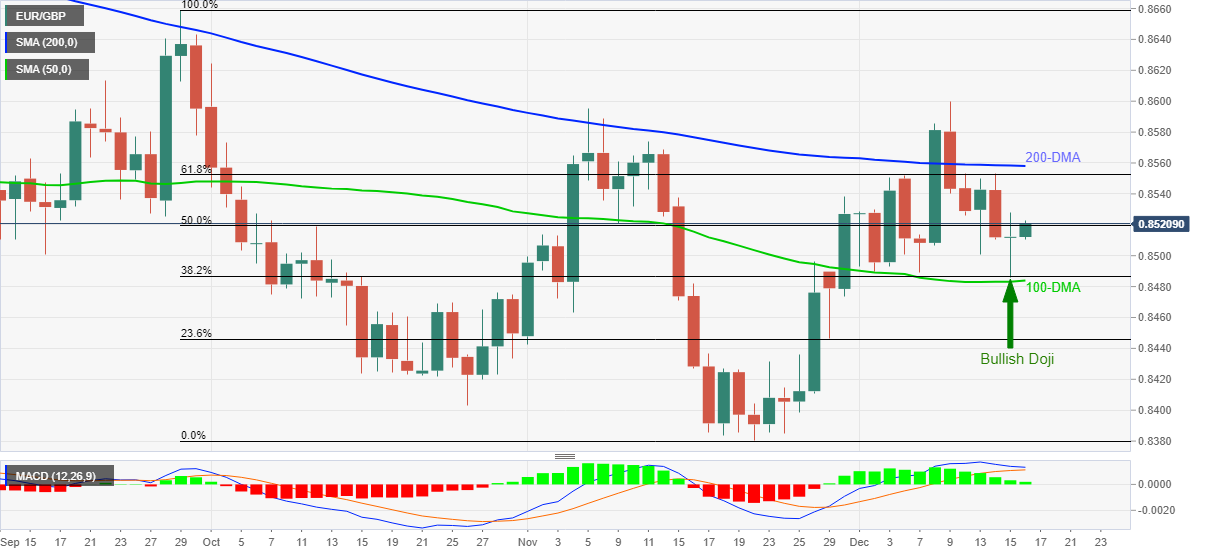
Trend: Further upside expected
- A combination of factors failed to assist USD/CAD to capitalize on its modest intraday gains.
- The risk-on mood undermined the safe-haven USD and capped gains amid positive oil prices.
- A more hawkish Fed outlook should act as a tailwind for the greenback and help limit losses.
The USD/CAD pair surrendered a major part of its modest intraday gains and was last seen trading just a few pips above the daily low, around the 1.2835 region.
Following the previous day's post-FOMC turnaround from the 1.2935 area or a near four-month high, the USD/CAD pair gained some traction during the early part of the trading on Thursday. The attempted move up, however, lacked bullish conviction and faltered near the 1.2860 region amid a softer tone surrounding the US dollar.
A generally positive tone surrounding the equity markets turned out to be a key factor that kept the USD bulls on the defensive and acted as a headwind for the USD/CAD pair. Apart from this, an uptick in crude oil prices underpinned the commodity-linked loonie and further contributed to cap the upside for the major, at least for now.
That said, concerns about the economic fallout from the rapid spread of the Omicron variant and the imposition of fresh restrictions in Europe and Asia might keep a lid on the market optimism. Adding to this, a more hawkish Fed outlook should lend some support to the safe-haven greenback and help limit the downside for the USD/CAD pair.
It is worth recalling that the Fed on Wednesday announced that it would double the pace of tapering to $30 billion per month. Moreover, the so-called dot plot showed that officials expect to raise the fed funds rate at least three times next year. This, in turn, supports prospects for the emergence of some dip-buying around the USD.
Market participants now look forward to the US economic docket, featuring the release of the Initial Weekly Jobless Claims, Philly Fed Manufacturing Index, Industrial Production and flash PMIs. This, along with some volatility infused by the BoE/ECB policy decision and oil price dynamics, should provide some impetus to the USD/CAD pair.
Technical levels to watch
The latest Reuters poll of analysts and fund managers showed Thursday, investors turned bearish on the Indian rupee, with the short bets spiked to the highest in 20 months.
Key findings
“Bullish bets on the Chinese yuan hit their highest since early June.”
“Short positions on the Indian rupee were raised to their highest since April 2020, while bearish bets on the Singapore dollar, Indonesia's rupiah and the Malaysian ringgit also increased, a fortnightly poll of 10 respondents showed.”
“Short bets on the baht the worst performer among Asia's emerging markets with a more than 10% slump in value.”
“Bearish views on South Korea's won were lowered as the currency benefited from an influx of foreign funds into local debt and equity.”
- USD/INR Price Analysis: Indian rupee bears need validation from 76.60 for further ruling
- EUR/USD pares the biggest daily gains in a week, sidelined of late.
- US dollar licks its wounds even as yields dwindle post-Fed.
- Market sentiment remains unclear on mixed updates over Omicron, geopolitics.
- PMIs can offer intermediate moves but PEPP, APP and economic forecasts are crucial words to follow.
EUR/USD hovers around 1.280-85 after posting the biggest daily gains in a week despite the Fed’s hawkish halt. That said, the pair traders struggle to keep the previous day’s optimism ahead of the key European Central Bank (ECB) monetary policy meeting.
Risk appetite dwindles amid mixed updates concerning the South African covid variant, dubbed as the Omicron, as well as relating to China. While the virus cases are spreading outside the West of late, chatters surrounding the medicines and their effectiveness join cautious optimism to overcome the pandemic and favor the bulls.
On the contrary, escalating tussles between Beijing and Washington battles hopes of faster approval to the US Build Back Better (BBB) plan to confuse traders. The US push for the Uyghur Bill and Beijing’s rush to control data companies are the latest factors portraying the cold war.
To portray the mood, the US Treasury yields struggle to extend the previous two-day advances while the stock futures in the West print mild gains by the press time.
That said, the market’s surprise reaction to the US Federal Reserve’s hawkish halt could be linked to Fed Chair Jerome Powell’s comments like “the Omicron variant poses risks to the outlook”, as well as refrain from rate hikes until the tapering is completed.
Read: Fed Quick Analysis: Hawks shift to three hikes in 2022, King dollar to end 2021 on top
Looking forward, EUR/USD traders may take intermediate clues from the preliminary PMI data for the Eurozone, Germany and the US for December. However, major attention will be given to how the ECB will overcome the Pandemic Emergency Purchase Program (PEPP) and manage Asset Purchase Program (APP).
Ahead of the meeting, FXStreet’s Eren Sengezer said, “The European Central Bank (ECB) is widely expected to leave the interest rates on the main refinancing operations, the marginal lending facility and the deposit facility unchanged at 0.00%, 0.25% and -0.50%, at the December policy meeting. More importantly, the ECB is set to take a step toward policy normalization and unveil its plan to retire the Pandemic Emergency Purchase Program (PEPP). Additionally, the bank will release the updated macro projections.”
Read: ECB December Preview: How will ECB replace PEPP?
Technical analysis
EUR/USD seesaws between a seven-week-old descending resistance line close to 1.1325 and an ascending support line from November 24 around 1.1260. Adding to the upside filters is the monthly horizontal resistance near 1.1380-85 and 100-DMA level surrounding 1.1445. On the contrary, a yearly low of 1.1186 offers an additional downside filter. Following that, the 61.8% Fibonacci Expansion (FE) level of October 28 to November moves, near 1.1120, may lure bears during post-ECB fall.
FX option expiries for December 16 NY cut at 10:00 Eastern Time, via DTCC, can be found below.
- EUR/USD: EUR amounts
- 1.1400 1.6b
- 1.1200 1.0bn
- 1.1350 805m
- USD/JPY: USD amounts
- 114.30 1.6b
- 114.25 1.3b
- 114.50 1.2
- AUD/USD: AUD amounts
- 0.7150 354m
- USD/CAD: USD amounts
- 1.22825 300m
- NZD/USD: NZD amounts
- 0.5000 600m
- EUR/GBP: EUR amounts
- 0.8600 392m
- 0.8400 300m
- USD/TRY refreshes all-time high during a three-day uptrend.
- Turkey’s President Erdogan replaces two Finance Ministry officials.
- Markets react surprisingly to hawkish Fed ahead of ECB.
- CBRT is expected to announce a 100 bps rate cut.
USD/TRY picks up bids to refresh record high to $15.07, up 0.36% intraday, as the Turkish lira (TRY) traders await monetary policy decision from the Central Bank of the Republic of Turkey (CBRT) during early Thursday in Europe.
The pair’s latest run-up could be linked to the news stating that Turkish President Recep Tayyip Erdoğan replaced two of the Finance Ministry officials on Thursday. Mr. Erdogan is famous for changing the policymakers in wild moves and support of the easy money policies, to favor his argument for inflation.
On Wednesday, Reuters said, “Turkey's real interest rate is deeply negative, a red flag for investors and savers, including Turks who have flocked to hard currencies.”
It’s worth noting that the US dollar’s slow, but gradual, response to the hawkish Federal Reserve (Fed) outcome also favors the USD/TRY bulls ahead of the CBRT rate decision.
Read: Fed Quick Analysis: Hawks shift to three hikes in 2022, King dollar to end 2021 on top
“Turkey's central bank is expected to cut its policy rate by 100 basis points to 14% next week, forging on with an easing cycle that has sent the currency crashing to record lows and inflation soaring above 21%,” the latest Reuters poll mentions.
Other than the CBRT rate decision, which is likely to propel the USD/TRY in the normal case, ECB outcome and Markit PMIs for the US are extra catalysts to watch for near-term trade directions.
Technical analysis
A three-week-old rising wedge formation challenges USD/TRY bulls between $15.06 and $14.05. Given the overbought RSI conditions, a pullback is more likely should the CBRT surprise the markets.
Read: European Central Bank Preview: More recalibration or actual tightening?
- Gold struggles to extend post-Fed gains amid cautious optimism.
- Fed matched market forecasts of faster tapering and firmer dot-plot, ECB is up for conveying PEPP deadline.
- Eurozone economic forecasts will be the key, PMIs, risk catalysts may entertain traders.
Gold (XAU/EUR) grinds higher around €1,580, up 0.24% intraday heading into the key Thursday’s European session.
The yellow metal prices in Euro refreshed a two-week low the previous day before bouncing off and portraying a daily positive closing amid the overall recovery in market sentiment post-Fed.
That said, the market’s surprise reaction to the US Federal Reserve’s hawkish halt could be linked to Fed Chair Jerome Powell’s comments like “the Omicron variant poses risks to the outlook”, as well as refrain from rate hikes until the tapering is completed.
Following that, Omicron woes join the escalating tussles between Beijing and Washington to test the market sentiment during the lackluster Asian session. The US push for the Uyghur Bill and Beijing’s rush to control data companies are the latest factors portraying the cold war.
Amid these plays, US Treasury yields struggle to extend the previous two-day advances while the stock futures in the West print mild gains by the press time.
Moving on, preliminary readings of the December month PMIs could entertain the XAU/EUR traders but major attention will be given to how the ECB policymakers confront the hawkish calls amid Omicron fears.
Read: European Central Bank Preview: More recalibration or actual tightening?
Technical analysis
An upward sloping trend line from late September, around €1,565 defends gold buyers of late.
Given the RSI recovery supporting the XAU/EUR run-up, the gold prices are likely to cross the 100-SMA immediate hurdle surrounding €1,580. However, any further upside will be challenged by the 200-SMA level near €1,590, followed by the €1,600 threshold.
In a case where gold buyers dominate past €1,600, the late November’s swing high near €1,610 and the €1,615 level may entertain the bulls before directing them to the last month’s peak of €1,653.
On the contrary, a clear downside break of the stated trend line support of €1,565 will make the quote vulnerable to drop towards the monthly low of €1,555.
Though, multiple supports around €1,550 will test the XAU/EUR bears past €1,555, a break of which will highlight November’s low of €1,519.
To sum up, XAU/EUR remains firmer ahead of the key ECB meeting.
XAU/EUR: Four-hour chart
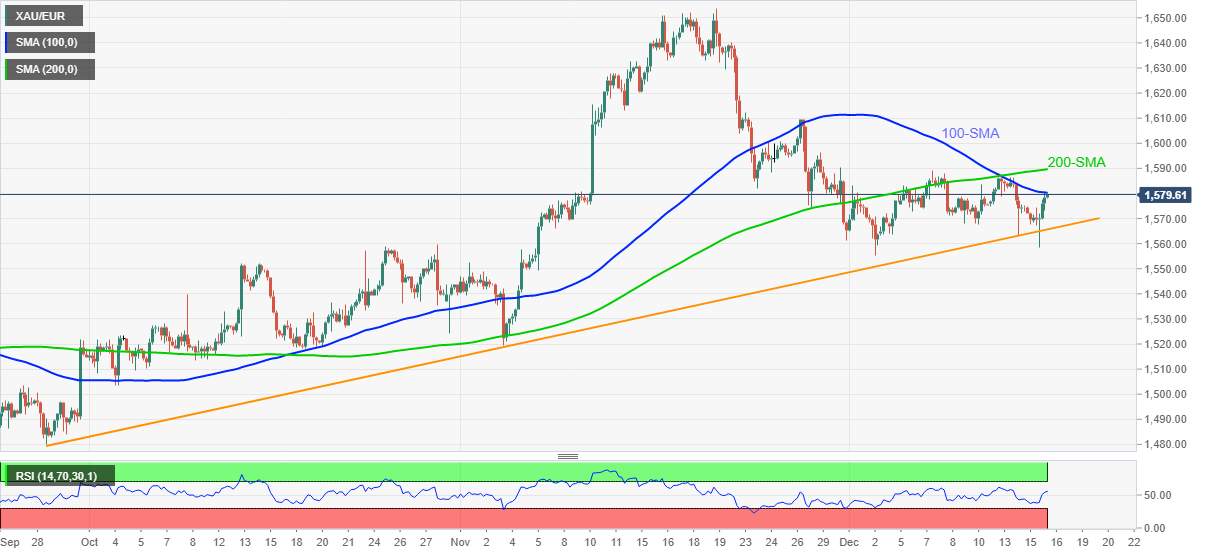
Trend: Further upside expected
- USD/INR bulls take a breather after refreshing 18-month top the previous day.
- Overbought RSI conditions, ascending trend line from November 2020 challenge bulls.
- Pullback moves remain tepid unless breaking monthly support line.
USD/INR struggles for a clear direction around the highest level since June 2020 during early Thursday morning in Europe. In doing so, the Indian rupee (INR) pair defends the 76.00 level, taking rounds to 76.20-25 at the latest.
Despite rising to the fresh multi-month high, USD/INR prices couldn’t cross an upward sloping resistance line from November 2020, not to forget the inability of providing a daily closing beyond the June 2020 peak of 76.51. Also teasing the bears to take risk of entry is the overbought conditions of the RSI.
While the pullback move may recall the 76.00 threhold, an ascending support line from November 18, near 75.73, will challenge the pair sellers afterward.
In a case where the USD/INR sellers conquer the stated support line, tops marked during April and October 2021, near 75.65-60, will be a tough nut to crack for them.
Alternatively, a daily closing beyond the stated resistance line, at 76.60 by the press time, will initially eye the 77.00 round figure before directing the USD/INR buyers to the year 2020 peak of 77.82.
USD/INR: Daily chart

Trend: Pullback expected
- GBP/USD consolidates weekly gains ahead of the key Bank of England monetary policy meeting.
- US dollar tracks yields post-Fed, market sentiment dwindles.
- UK delays Northern Ireland border checks for Brexit progress, British daily covid infections jump all time high.
- BOE policymakers remain divided over rate hikes, QIR, economic forecasts are the key.
GBP/USD takes rounds to 1.3255-60, down 0.07% intraday while paring the weekly gains heading into Thursday’s London open.
The cable pair rose the most in a week the previous day after the market’s surprise reaction to the US Federal Reserve’s hawkish halt. The reason could be linked to Fed Chair Jerome Powell’s comments like “the Omicron variant poses risks to the outlook”, as well as refrain from rate hikes until the tapering is completed.
That said, optimism surrounding Brexit could be considered additional support for the GBP/USD prices as Britain again pushed back the border checks on the goods from Ireland to the UK beyond January 01 deadline. The outcome may have links to European Parliament President David Sassoli’s comments cited by the UK Express who warned the UK it could face "severe consequences" in the trade deal row.
It should be noted, however, that the highest ever daily COVID-19 cases and fears of medical supply outage seem to weigh on the GBP/USD prices.
Adding to the upside filters is the mildly bid US Dollar Index (DXY) amid hopes of disappointment from the ECB and the BOE policymakers to the hawks amid worsening virus conditions in the bloc and the UK.
Even so, the recent jump in the UK Inflation to a decade high pushes policymakers at the “Old Lady” to keep bullish bias towards rate hikes in 2022. The same highlights today’s Quarterly Inflation Report (QIR) from the BOE.
Other than the ECB and the BOE, preliminary readings of the December month PMIs for the UK and the US will also be important for short-term GBP/USD direction. Given the upbeat expectations and a pending reaction to the hawkish Fed, the pair buyers are likely to witness hardships.
Read: BOE Preview: Omicron eliminates rate hike chances, voting pattern critical to GBP/USD reaction
Technical analysis
GBP/USD remains inside the 140-pip envelope between the resistance-turned-support line from October and a descending trend line from late July, respectively around 1.3145 and 1.3285.
That said, the RSI recovery favors the GBP/USD pair’s earlier run-up. However, a clear upside break of the 1.3285 won’t be enough for the bulls to retake controls as 20-DMA and 61.8% Fibonacci retracement level of September 2020 to June 2021 upside adds to the upside filters around 1.3290.
On the flip side, a clear break of the 1.3145 will challenge the 1.3100 threshold before targeting the 78.6% Fibo. level near 1.3015. However, the quote’s weakness past 1.3015 will be questioned by the 1.3000 psychological magnet.
- Asian equities trade mixed, mildly positive after yields fail to cheer hawkish Fed.
- NZ Q3 GDP, Aussie jobs report fail to lure bulls from Pacific region as China struggles.
- Sino-American tensions escalate and so do Omicron fears, suggesting market-positive updates from ECB, BOE.
Asian shares edge higher as Treasury yields takes a back seat despite the US Federal Reserve’s (Fed) hawkish announcements. The traders’ indecision could also be linked to the cautious sentiment ahead of the European Central Bank (ECB) monetary policy meeting and geopolitical fears emanating from China, not to forget Omicron woes.
Read: Fed Quick Analysis: Hawks shift to three hikes in 2022, King dollar to end 2021 on top
While portraying the mood, the MSCI’s index of Asia ex-Japan shares drops 0.05% whereas Japan’s Nikkei 225 rises 1.75% by the press time.
Australia’s ASX 200 and New Zealand’s NZX 50 dropped 0.50% and 0.30% at the latest as New Zealand (NZ) reports the first Omicron case whereas Australia’s employment data for November failed to back the Reserve Bank of Australia (RBA) Governor Philip Lowe’s dovish remarks. Earlier in the day, NZ Q3 GDP recently eased below -4.5% expectations to -3.7% on QoQ whereas the yearly growth figures came in -0.3% versus -1.6% forecast and +17.9% revised prior.
Elsewhere, stocks in China are mostly down as escalating tussles between Beijing and Washington drowns technology shares. The US push for the Uyghur Bill and Beijing’s rush to control data companies are the latest factors portraying the cold war.
On a different page, South Korea’s KOSPI and Hong Kong’s Hang Sang track China while Indonesia’s IDX Composite and India’s BSE Sensex print mild gains following stock futures in the West.
It’s worth noting that the prices of oil and gold keep the post-Fed rebound whereas the US Treasury yields remain lackluster by the press time.
Moving on, preliminary PMI data for December may offer intermediate moves to the markets but major attention will be given to the monetary policy meeting of the ECB and the BOE for clear direction.
One-month risk reversal (RR) of NZD/USD, a gauge of calls to puts, rose the most since December 07, up for the second consecutive day to recently around +0.113 per the data source Reuters.
It’s worth noting that the weekly RR braces for the third positive print, the longest advances since late May, which in turn suggests that the NZD/USD buyers are up for a short-covering should the fundamentals help.
That said, New Zealand’s (NZ) Q3 GDP recently eased below -4.5% expectations to -3.7% on QoQ whereas the yearly growth figures came in -0.3% versus -1.6% forecast and +17.9% revised prior.
Even so, NZD/USD prices remain pressured around the yearly low, down 0.23% near 0.6765 at the latest, as market sentiment dwindles between the key central bank monetary policy decisions.
Having witnessed a surprise rejection of the Fed’s hawkish tone, global investors are up for battling the European Central Bank (ECB) and the Bank of England (BOE) decisions by the press time.
Read: NZD/USD Price Analysis: Pokes falling wedge resistance on firmer NZ Q3 GDP
- AUD/USD moves into a phase of consolidation.
- Bulls need a break of 0.7180 and the bears seek a break of 0.71 the figure.
AUD/USD has been changing hands between the bears and bulls throughout the past two sessions on the back of the US Federal Reserve volatility and domestic jobs data in Asia.
This has left the outlook for the pair uncertain with a lack of firm directional tendencies, at least from an hourly perspective as follows:
AUD/USD H1 chart
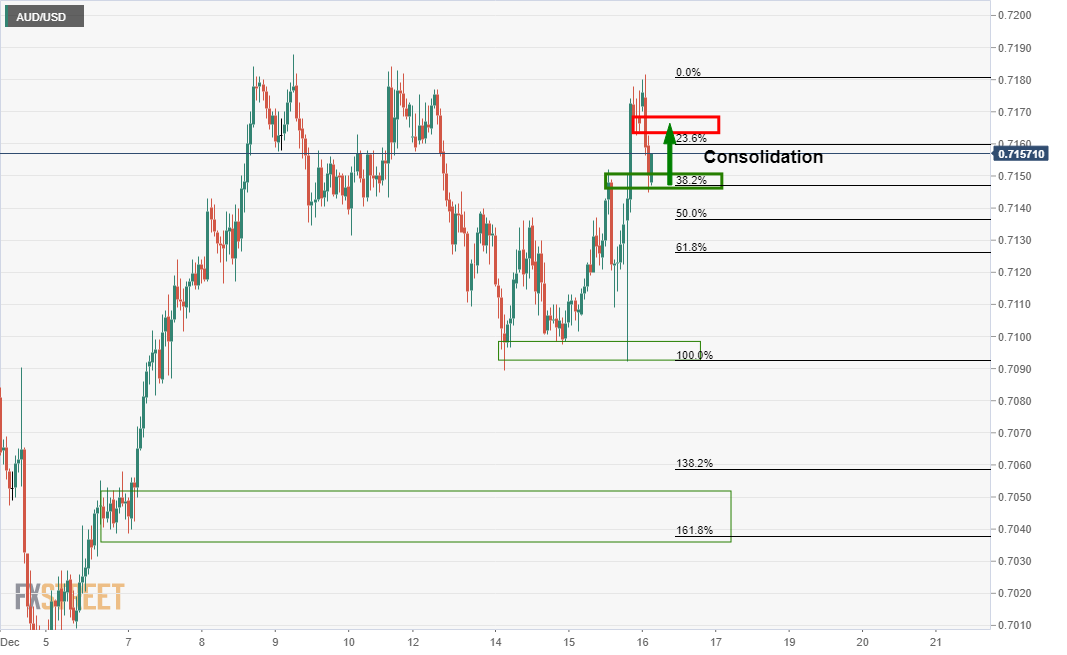
As illustrated, the price has completed a 38.2% Fibonacci retracement since it was capped following both the Fed and the Aussie jobs report earlier.
Without a catalyst until the European Central Bank, the price would be expected to consolidate at this juncture. 0.7150/70 marks current support and resistance from a short term perspective.
AUD/USD daily chart
0.7180 and 0.7100 are the extremes on the daily chart and key levels where a breakout could occur.
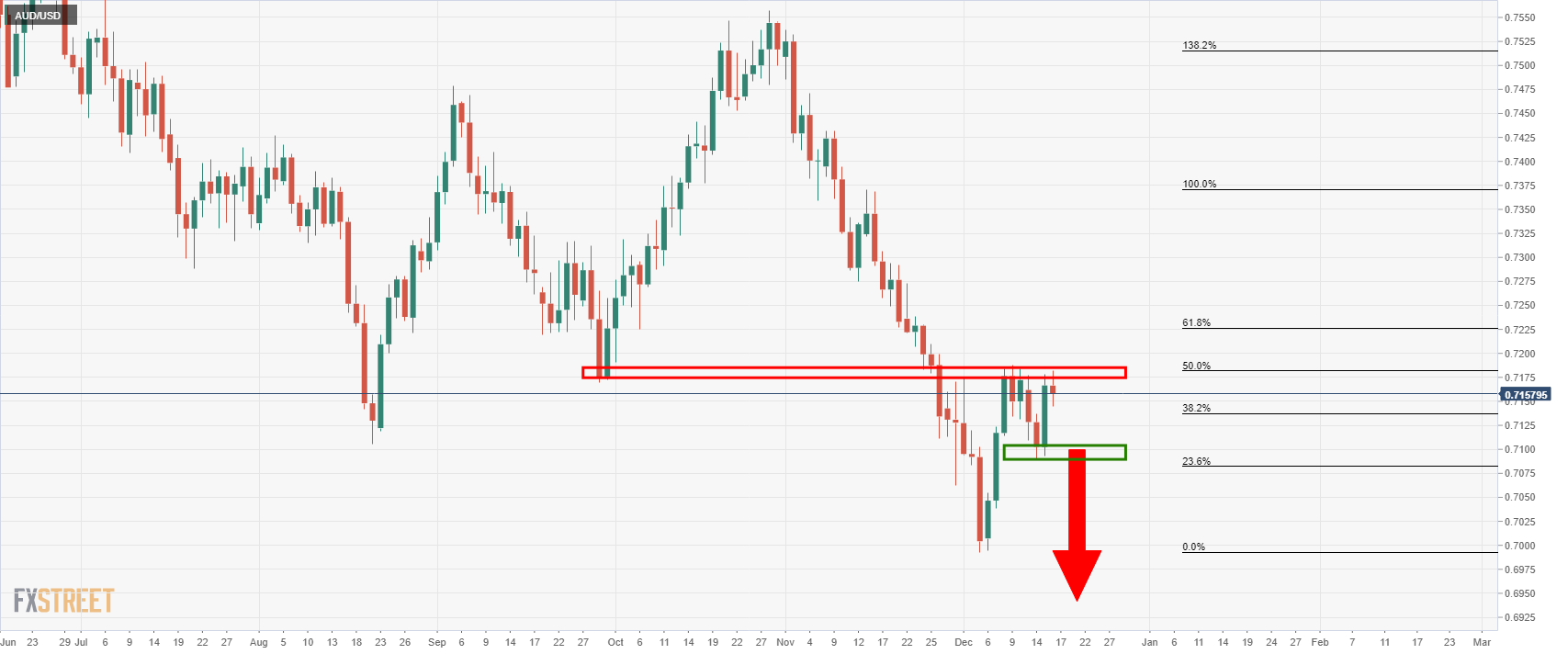
Should the US dollar find its supporters again, then the downside breakout could occur as illustrated above.
- GBP/JPY seesaws around two-week high, recently bouncing off intraday low.
- Descending resistance line from October, 200-DMA also challenge upside momentum.
- Steady RSI favor buyers, five-month-long support line restricts downside.
GBP/JPY pauses two-day uptrend, grinds higher past-151.00 during early European morning on Thursday.
Even as 21-DMA guards short-term GBP/JPY upside around the monthly peak, steady RSI keeps buyers hopeful of overcoming the 151.40 nearby resistance.
Also testing the GBP/JPY buyers is the 61.8% Fibonacci retracement (Fibo.) level of July-October upside and 200-DMA, respectively around 152.20 and 152.55.
In a case where the GBP/JPY prices rally past 152.55, 50% Fibo. near 153.40 should lure the pair bulls.
Alternatively, pullback moves may initially aim for the 150.00 psychological magnet, a break of which will direct GBP/JPY sellers towards an ascending support line from July, near 149.55.
During the quote’s weakness past 149.55, the yearly bottom surrounding 148.45 will be crucial to watch.
Overall, GBP/JPY traders consolidate weekly gains ahead of the key Bank of England (BOE) monetary policy meeting.
Read: BOE Preview: Omicron eliminates rate hike chances, voting pattern critical to GBP/USD reaction
GBP/JPY: Daily chart
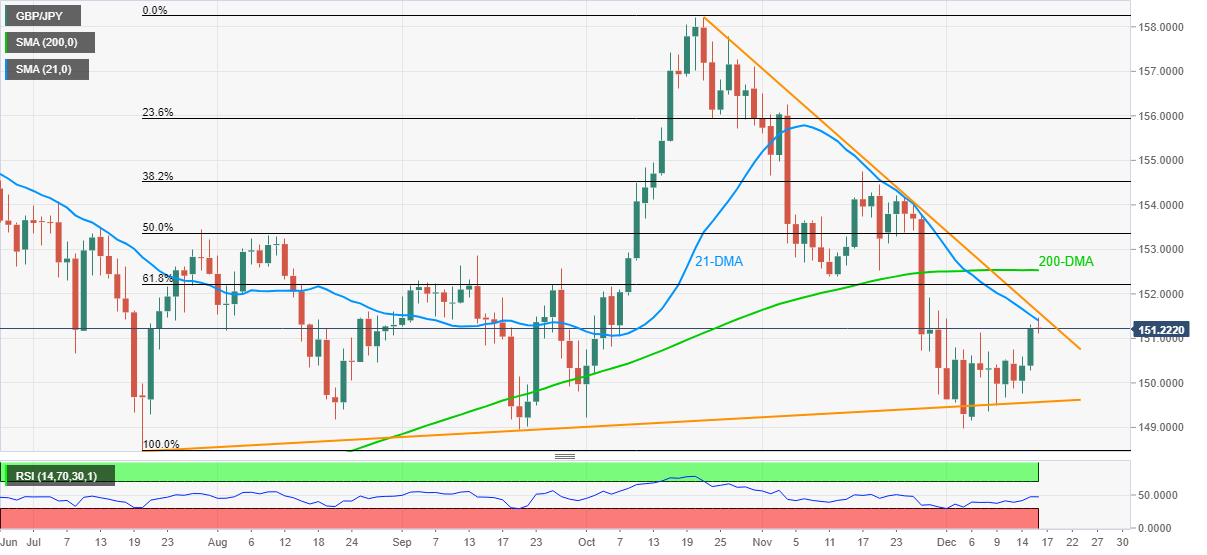
Trend: Pullback expected
Australia’s 2021/22 Federal Mid-Year Economic and Fiscal Outlook has been released and as expected, the deterioration in the deficit owing to the cost of responding to the delta variant was expressed. Nevertheless, higher commodity prices will buffer.
The update offers an optimistic picture, declaring “the Australian economy is rebounding strongly from the impact of the Delta outbreaks”. This is despite the recent wave of Omicron.
But Treasurer Josh Frydenberg told a news conference the expectation was that Omicron would not derail the recovery.
Economic growth, which was 1.5% in 2020-21, is forecast to be 3.75% in this financial year and 3.5% in 2022-23.
Frydenberg explained that the Unemployment Rate is forecast to fall to 4.5% by mid-2022, and 4.25% by mid-2023.
Wage growth is expected to climb from 2.25% this financial year to 2.75% next financial year and to 3.25% by 2024-25.
''Since the onset of the COVID-19 pandemic, the Government has committed an unprecedented $314 billion in direct economic support,'' the report explained.
''The Government’s response has enabled activity and employment to bounce back strongly after restrictions have eased, maintained momentum in economic activity more broadly and prevented labour market scarring. The economic response at this MYEFO has supported individuals, households and businesses through the Delta outbreaks. The response has built the foundation for future growth.''
AUD/USD implications
Meanwhile, the markets are more focused on the Reserve Bank of Australia's well planted dovish tone. The RBA's governor, Phillip Lowe explained that there will be no rate rises in 2022 and the central bank divergence would be expected to hamstring AUD.
- Fed sends mixed signals around timings of lift-off with dots in contrast to Powell's presser.
- US yields gyrate between 2-year bullish/10-year bearish.
The US Federal Reserve doubled the pace of tapering to $30bn per month, as was widely expected, which has a direct impact on the near-term US yields.
The 2-year government bond yields rose from 0.65% to 0.66% while the 10-year government bond yields rose from 1.42% to 1.46%. However, we have seen a setback in the 10's during Asia which has risen to as far as 1.4820% but are now trading at 1.46% and lower by 0.14% on the day so far.
While the ‘dot plot’ projected three 25bp rate hikes in 2022, compared to one previously and two expected by most, this is by no means a road map that is set in stone and the variables that can affect the path of tightening is weighing.
Fed's chairman, Jerome Powell, emphasised that all depends on not just the covid variant but economic data as well, hinting that there was no certainty of lift-off in 2022. This derailed the US dollar and sent US stocks higher. The S&P 500 rose 1.6% to 4,709.85, the Nasdaq Composite was up 2.2% to 15,565.58 and the Dow Jones Industrial Average advanced 1.1% to 35,927.43.
US02Y daily chart
Nevertheless, the technical outlook for US 2-year yields remains firmly bid from a daily perspective while above 0.62%:

| Raw materials | Closed | Change, % |
|---|---|---|
| Brent | 74.31 | 1.43 |
| Silver | 22.08 | 0.57 |
| Gold | 1777.103 | 0.33 |
| Palladium | 1588.1 | -1.79 |
- WTI bulls take a breather following the heaviest daily jump in a week.
- Market sentiment dwindles as post-Fed reaction awaits ECB, PMIs.
- EIA stockpiles dropped double the expectations, Omicron concerns test the bulls.
WTI eases to $71.30, down 0.07% intraday while paring the biggest daily gain of the week during early Thursday.
The black gold’s latest pullback could be linked to the market’s cautious sentiment and mixed concerns ahead of the key central bank meetings and PMI release. That said, the previous day’s rebound could well be linked to the hawkish weekly inventory data from the US Energy Information Administration (EIA) and upbeat reaction to the Federal Reserve’s (Fed) faster tapering and higher dot-plot.
Worsening virus conditions in Europe and the UK join the extension of the cold war between the US and China to weigh on the oil prices of late. It’s worth noting that the US push for Uyghur Bill and Beijing’s rush to control data firms are the latest catalysts portraying the Sino-American tussle.
Cautious sentiment ahead of the European Central Bank (ECB) and the Bank of England (BOE) meeting, as well as the preliminary PMI for December, also weigh on the oil prices.
While portraying the mood, the US stock futures struggle for clear direction while the US 10-year Treasury yields seesaw after a two-day uptrend.
On Wednesday, the weekly prints of the EIA Crude Oil Stocks Change dropped more than double the -2.082M forecast to -4.584M for the period ended on December 10.
Talking about the Fed, the US central bank matched wide market forecasts of faster tapering and signals of the rate hike in 2022. However, the oil traders took it as a positive sign considering Fed Chair Jerome Powell’s comments like “the Omicron variant poses risks to the outlook”, as well as refrain from rate hikes until the tapering is completed.
Looking forward, WTI traders should pay attention to the risk catalysts for short-term direction.
Technical analysis
Unless providing a decisive break of either the 200-SMA level of $70.22 or the 100-SMA surrounding $73.75, WTI prices are likely to remain sidelined.
- EUR/USD imbalances are compelling on both the daily and hourly time frames.
- The price is currently correcting the overnight rally towards a 38.2% Fibo area.
EUR/USD is accumulating in a familiar area of demand as per the prior market structure of last year between May and July. The following illustrates the possibilities for the next trajectory for the forthcoming weeks.
EUR/USD daily chart
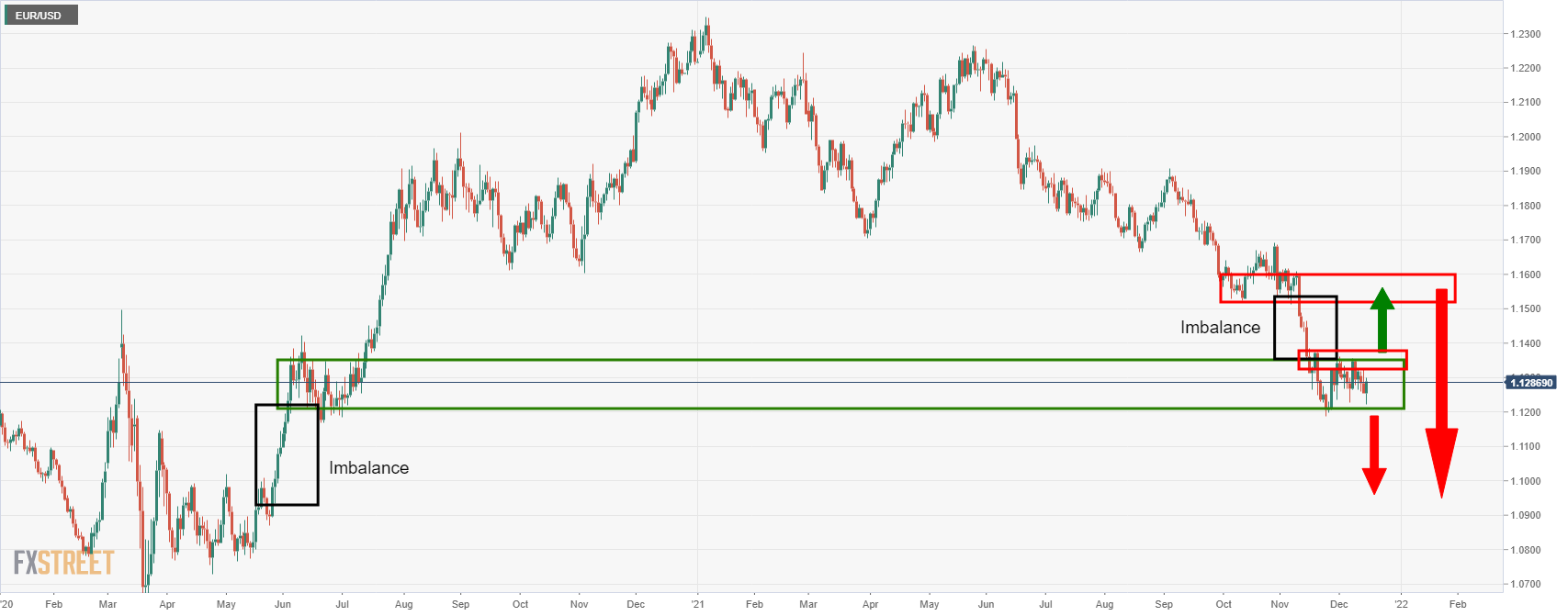
As illustrated, there are two critical areas of imbalance that will at some stage be exploited. On the downside, 1.09 and 1.12 is a compelling target area for the bears to take on, while on the upside, a break of current double top resistance opens the pathway towards 1.1520.
EUR/USD H1 chart
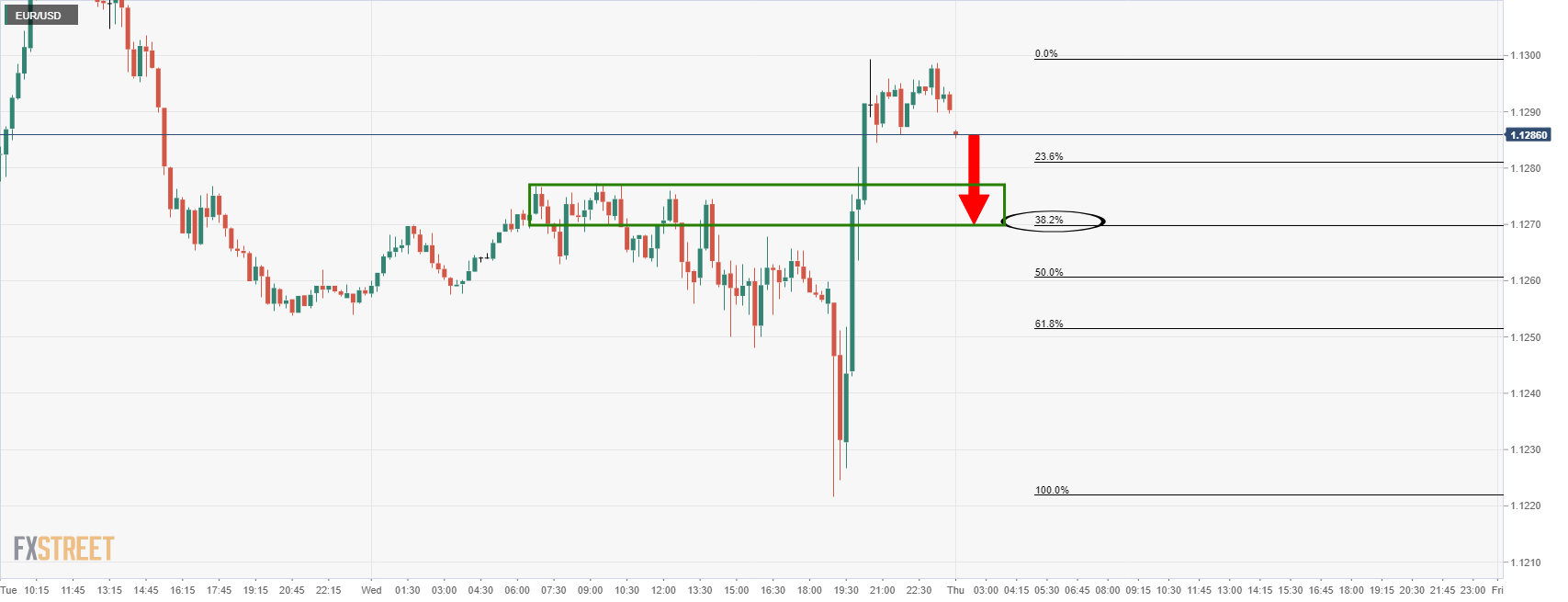
Meanwhile, the hourly chart shows that the price is correcting, which is typical of such a move. The imbalance between towards 1.1250 can be filled by the bears and the 38.2% Fibonacci target comes in at around 1.1270 as the first prospective level of support.
- DXY prints mild gains, keeps rebound from 50-SMA, 100-SMA confluence.
- MACD teases sellers inside bearish chart pattern, 200-SMA adds to the downside filters.
- 97.00, July 2020 top act as extra hurdle to the north.
US Dollar Index (DXY) keeps the bounce off the key SMA confluence around 96.40 during early Thursday.
The greenback gauge recovered from a convergence of the 100-SMA and 50-SMA the previous day while staying inside an ascending triangle bearish chart pattern.
As the MACD line teases bear cross and the DXY remains inside a bearish formation, a clear downside break of the stated triangle’s support line, around 96.10, will portray a notable south-run towards the theoretical target near 94.00.
During the fall, the 200-SMA level of 95.60 and the mid-November swing low near 95.00 can act as intermediate halts.
Meanwhile, recovery moves remain elusive below the triangle’s resistance, close to the 97.00 round-figure, a break of which will direct US Dollar Index bulls towards July 2020 peak near 97.80.
To sum up, the DXY bulls keep controls inside a bearish chart formation, suggesting further grinding towards the north.
Also read: Fed Quick Analysis: Hawks attack with shift to three hikes in 2022, King dollar to end 2021 on top
DXY: Four-hour chart
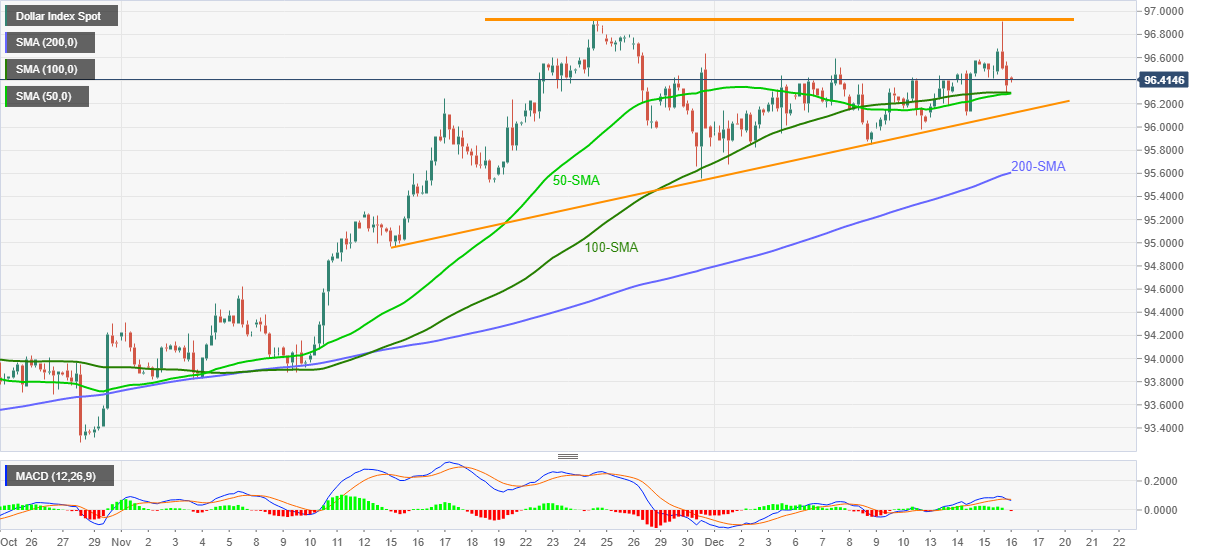
Trend: Pullback expected
- USD/JPY struggles around monthly top during four-day uptrend.
- Yields underpin DXY, market sentiment dwindles even as Fed matched hawkish forecasts.
- Omicron, stimulus and geopolitics test the bulls amid pre-ECB caution.
- Second-tier data, preliminary PMIs for December also heavy the watcher’s list.
USD/JPY pares intraday gains to 114.10, up 0.07% on a day, during a four-day uptrend to Thursday’s Asian session.
In doing so, the yen pair portrays the market’s cautious sentiment ahead of the key central bank meetings, following the US Federal Reserve’s (Fed) hawkish performance.
That said, softer-than-previous readings of Japan’s preliminary PMI data for December and the hopes of tighter monetary policy from the Fed, as well as the ECB’s refrain to sound hawkish, put a floor under the USD/JPY prices of late.
That said, Japan’s Markit/Jibun Bank Manufacturing PMI eased from 54.5 to 54.2 whereas its Services counterpart dropped below 53.0 to 51.1.
Elsewhere, chatters surrounding the US Build Back Better (BBB) plan and hopes of Sino-American tussles, recently over Uyghur Bill and Beijing’s rush to control data, seems to test the USD/JPY buyers.
It should be noted, however, that the US Treasury yields print a three-day uptrend and joins the firmer S&P 500 Futures to keep USD/JPY buyers hopeful with eyes on the European Central Bank (ECB) and the Bank of England (BOE).
Although both the central banks are likely to portray a hawkish mood, Omicron fears may push back the ECB and can help the US dollar to track the firmer yields, favoring the USD/JPY buyers. On the contrary, any surprises will have an additional reason for the greenback to ease.
Other than the central banks, US PMIs, weekly jobless claims and housing market data will also decorate the calendar.
Technical analysis
A clear upside break of a 13-day-old horizontal hurdle near 113.95, not to forget the 20-DMA level surrounding 113.80, directs USD/JPY buyers towards multiple levels marked since mid-October around 114.50.
| Time | Country | Event | Period | Previous value | Forecast |
|---|---|---|---|---|---|
| 00:00 (GMT) | Australia | Consumer Inflation Expectation | December | 4.6% | |
| 00:30 (GMT) | Japan | Manufacturing PMI | December | 54.5 | |
| 00:30 (GMT) | Japan | Nikkei Services PMI | December | 52.1 | |
| 00:30 (GMT) | Australia | Unemployment rate | November | 5.2% | 5% |
| 00:30 (GMT) | Australia | Changing the number of employed | November | -56 | 205 |
| 08:15 (GMT) | France | Services PMI | December | 57.4 | 56 |
| 08:15 (GMT) | France | Manufacturing PMI | December | 55.9 | 55.5 |
| 08:30 (GMT) | Germany | Services PMI | December | 52.7 | 51 |
| 08:30 (GMT) | Germany | Manufacturing PMI | December | 57.4 | 56.8 |
| 08:30 (GMT) | Switzerland | SNB Interest Rate Decision | -0.75% | -0.75% | |
| 09:00 (GMT) | Eurozone | Manufacturing PMI | December | 58.4 | 57.8 |
| 09:00 (GMT) | Eurozone | Services PMI | December | 55.9 | 54.1 |
| 09:30 (GMT) | United Kingdom | Purchasing Manager Index Services | December | 58.5 | 57 |
| 09:30 (GMT) | United Kingdom | Purchasing Manager Index Manufacturing | December | 58.1 | 57.6 |
| 09:30 (GMT) | Switzerland | SNB Press Conference | |||
| 10:00 (GMT) | Eurozone | Trade balance unadjusted | October | 7.3 | 7.6 |
| 12:00 (GMT) | United Kingdom | Asset Purchase Facility | 875 | 875 | |
| 12:00 (GMT) | United Kingdom | BoE Interest Rate Decision | 0.1% | 0.1% | |
| 12:00 (GMT) | United Kingdom | Bank of England Minutes | |||
| 12:45 (GMT) | Eurozone | ECB Interest Rate Decision | 0.0% | 0% | |
| 13:30 (GMT) | Canada | Wholesale Sales, m/m | October | 1% | 1.4% |
| 13:30 (GMT) | U.S. | Continuing Jobless Claims | December | 1992 | 1936 |
| 13:30 (GMT) | U.S. | Initial Jobless Claims | December | 184 | 200 |
| 13:30 (GMT) | U.S. | Philadelphia Fed Manufacturing Survey | December | 39 | 30 |
| 13:30 (GMT) | U.S. | Housing Starts | November | 1.52 | 1.568 |
| 13:30 (GMT) | U.S. | Building Permits | November | 1.653 | 1.663 |
| 13:30 (GMT) | Eurozone | ECB Press Conference | |||
| 14:15 (GMT) | U.S. | Capacity Utilization | November | 76.4% | 76.8% |
| 14:15 (GMT) | U.S. | Industrial Production YoY | November | 5.1% | |
| 14:15 (GMT) | U.S. | Industrial Production (MoM) | November | 1.6% | 0.7% |
| 14:45 (GMT) | U.S. | Manufacturing PMI | December | 58.3 | 58.5 |
| 14:45 (GMT) | U.S. | Services PMI | December | 58 | 58.5 |
In recent trade today, the People’s Bank of China (PBOC) set the yuan (CNY) at 6.3637 vs the previous fix of 6.3716 and the prior close of 6.3680.
About the fix
China maintains strict control of the yuan’s rate on the mainland.
The onshore yuan (CNY) differs from the offshore one (CNH) in trading restrictions, this last one is not as tightly controlled.
Each morning, the People’s Bank of China (PBOC) sets a so-called daily midpoint fix, based on the yuan’s previous day closing level and quotations taken from the inter-bank dealer.
- AUD caught a bid on a very strong jobs report.
- AUD/NZD bears lurking on central bank divergences.
AUD/NZD has added to the day's gains following strong jobs data which, while was anticipated, blew all expectations out of the grounds. The cross is 0.27% higher on the day and has rallied from a low of 81.66 and risen to a high of 82.01.
The data arrived as follows:
- Australian Unemployment Rate Nov: 4.6% (exp 5.0%; prev 5.2%). This was a huge beat.
- Employment Change Nov: 366.1K (exp 200.0K; prev -46.3K). This was also very impressive.
- Participation Rate Nov: 66.1% (exp 65.5%; prev 64.7%).
However, the Aussie has failed to rally significantly because the Reserve Bank of Australia is not on the verge of hiking interest rates anytime soon. RBA's Phillip Lowe today reinforced the dovish sentiment when he said that there will not be any rate rises next year. This leaves the divergence between the Reserve Bank of New Zealand and the RBA a negative factor for AUD/NZD in the medium term.
Moreover, a solid post-lockdown momentum through October, as indicated by the lift in payrolls, suggested a robust gain for employment. When the dist settles, the Aussie could well be vulnerable in the face of central bank diverngences.
- GBP/USD struggles to extend post-Fed gains ahead of the key BOE monetary policy meeting.
- 20-DMA, previous support line from July and 61.8% Fibonacci retracement challenge buyers.
- Decending trend line from October 28 restricts short-term declines.
- RSI recovery suggests further gains but it all depends upon BOE Statement.
GBP/USD fades two-day rebound, eases to 1.3255 during the Asian session, as the cable traders brace for the “Super Thursday” comprising Bank of England (BOE) monetary policy decision.
Read: BOE Preview: Omicron eliminates rate hike chances, voting pattern critical to GBP/USD reaction
In doing so, the quote remains inside the 140-pip envelope between the resistance-turned-support line from October and a descending trend line from late July, respectively around 1.3145 and 1.3285.
That said, the RSI recovery favors the GBP/USD pair’s earlier run-up. However, a clear upside break of the 1.3285 won’t be enough for the bulls to retake controls as 20-DMA and 61.8% Fibonacci retracement level of September 2020 to June 2021 upside adds to the upside filters around 1.3290.
Following that, the early November’s swing low near 1.3355 and September’s bottom of 1.3411 will be in focus.
On the flip side, a clear break of the 1.3145 will challenge the 1.3100 threshold before targeting the 78.6% Fibo. level near 1.3015. However, the quote’s weakness past 1.3015 will be questioned by the 1.3000 psychological magnet.
Should GBP/USD bears conquer the 1.3000 mark, a downward trajectory towards November 2020 low near 1.2850 can’t be ruled out.
GBP/USD: Daily chart
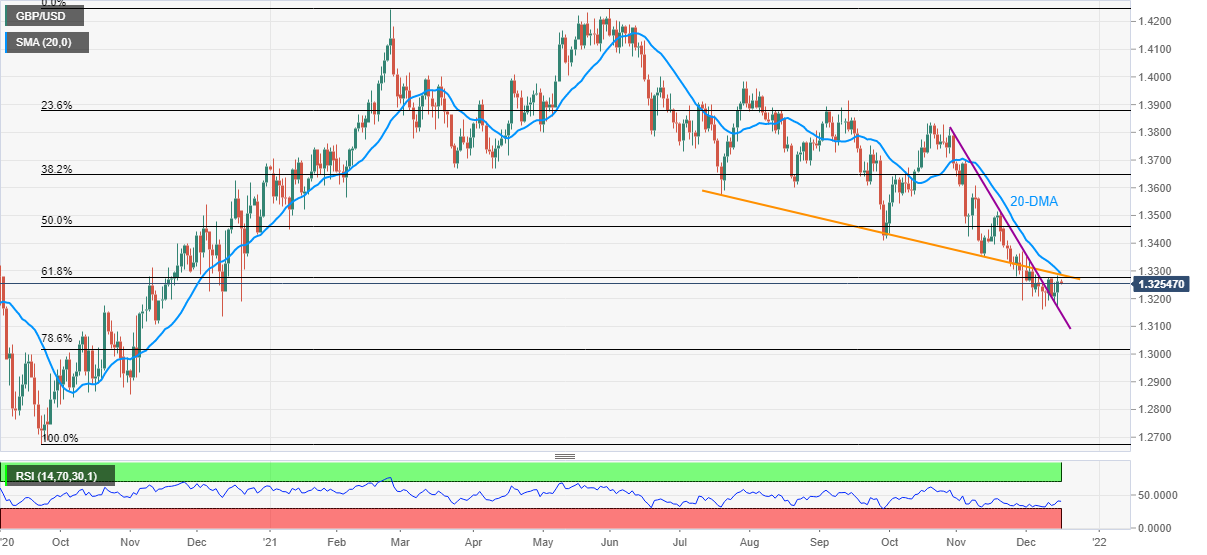
Trend: Further weakness expected
- AUD/USD reverses pullback form weekly high after Aussie data, holds Fed-linked run-up.
- Australia Unemployment Rate dropped, Employment Change rallied in November.
- RBA’s Lowe showed readiness to keep rates low, cited needs for 4.0% wage growth, full employment for rate hike.
- Second-tier US data, including Preliminary PMIs for December, can offer additional direction but ECB is the key.
AUD/USD picks up bids to 0.7172, extending the post-Fed increase as the Australia Employment report for November flashed welcome signs during early Thursday. Adding to the pair’s advances could be the market’s preparation for the European Central Bank (ECB) monetary policy meeting and mixed concerns over the US stimulus and Omicron.
Australia Unemployment Rate dropped to 4.6%, below 5.0% forecast and 5.2% prior, whereas the Employment Change rose to 366.1K from +200K expected and -46.3K previous readouts. Further, the Participation Rate also crossed 65.5% market consensus and 64.7% prior with 66.1% figures.
Read: Aussie Unemployment Rate big beat supports AUD/USD
Earlier in the day, RBA Governor Philip Lowe rejected the rate hike in 2022 while also saying, “Prepared to keep rates low if domestic economy requires it.” “Would like to see wages growing at 4% and full employment,” the RBA Boss added.
Furthermore, Australia’s Commonwealth Bank (CBA) released preliminary PMI data for December. The activity numbers showed Manufacturing gauge rose past 57.1 forecast to 57.4 but easing below 59.2 previous readouts. Further, the Services PMI also stepped back from 55.7 to 55.1, dragging the Composite PMI to 54.9 from 55.7, versus 53.7 market consensus.
Given the firmer Aussie jobs report keeping RBA rate hike expectations on the table, as Lowe said, “If other central banks tightening would increase probability of us following,” AUD/USD bulls keep controls by the press time.
It’s worth noting that the stimulus hopes from the US and mildly bid S&P 500 Futures also help the AUD/USD prices. On the same line are the likely preparations of the US dollar bulls to retake controls after the ECB meeting, with bearish expectations.
Moving on, preliminary readings of the monthly PMIs and Omicron updates will also be watched in addition to the ECB for clearer direction.
Read: European Central Bank Preview: More recalibration or actual tightening?
Technical analysis
AUD/USD portrays an inverse head-and-shoulders bullish chart pattern on the four-hour play, with 0.7170 acting as the neckline, a break of which will direct the quote towards crossing the 200-SMA level of 0.7234 to aim for mid-November swing high near 0.7370. Meanwhile, the monthly horizontal support near 0.7090 can test the bears before directing them to the yearly low near 0.6990.
Australia’s November labour force survey has been released as follows:
- Australian Unemployment Rate Nov: 4.6% (exp 5.0%; prev 5.2%). This is a huge beat.
- Employment Change Nov: 366.1K (exp 200.0K; prev -46.3K). This is also very impressive.
- Participation Rate Nov: 66.1% (exp 65.5%; prev 64.7%).
AUD/USD reaction
Prior to the data release, the price was undergoing a post-Fed-volatility correction to the downside. However, the data is positive for an otherwise dubious bid in the Aussie.
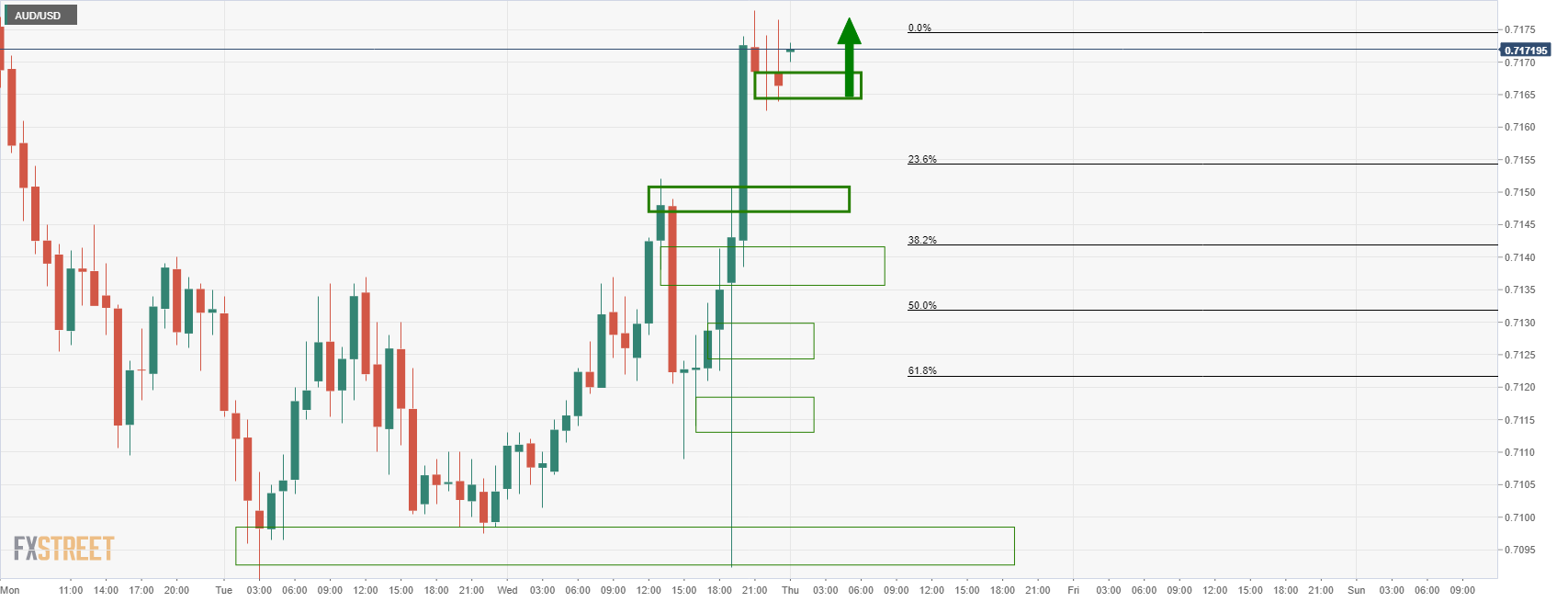
The sentiment prior to the data was that a solid post-lockdown momentum through October, as indicated by the lift in payrolls, suggested a robust gain for employment. Nevertheless, the data is very encouraging for the AUD, at least in the meantime. The participation rate was higher so the Unemployment Rate is impressive.
The Reserve Bank of Australia sees the economy as likely to return to its pre-Delta path in the first half of 2022, but there will not be any rate rises next year which leaves the divergence between the Federal Reserve and the RBA a negative factor for AUD in the medium term.
About the Unemployment Rate
The Unemployment Rate released by the Australian Bureau of Statistics is the number of unemployed workers divided by the total civilian labour force. If the rate hikes indicates a lack of expansion within the Australian labour market. As a result, a rise leads to weakening the Australian economy. A decrease of the figure is seen as positive (or bullish) for the AUD, while an increase is seen as negative (or bearish).
USD/CAD has been pressured mid-week following an irregular reaction to an uber hawkish Federal Reserve meeting from overnight.
The US dollar was put under immense pressure and the jury is still out on the cause other than there was no specific confirmation of when a rate rise will come about and economic performance remains the key. Additionally, position squaring into the eleventh hour of the holiday season could have played a role.
Meanwhile, the price on the hourly chart is starting to correct from the post-Federal reserve sell-off.
USD/CAD H1 chart
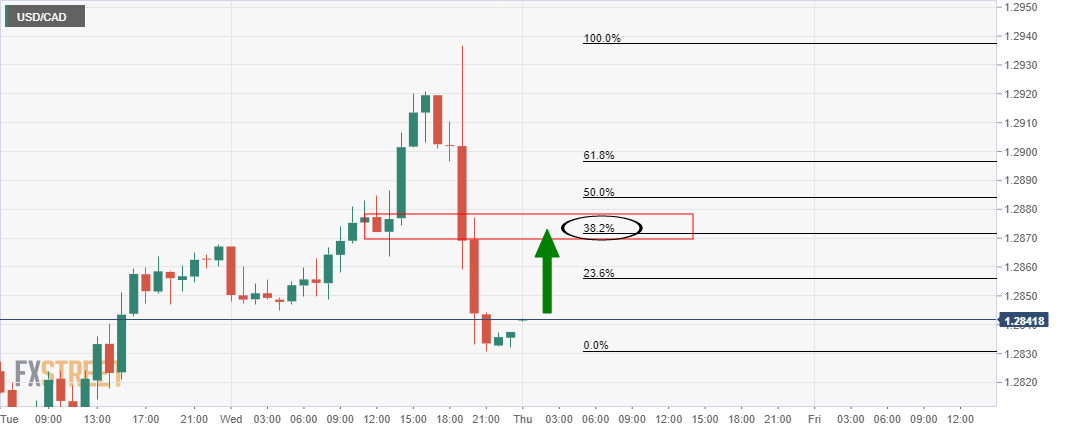
This leaves the Fibonacci scale vulnerable for a significant test of the 38.2% retracement that has a confluence with the prior structure near 1.2860/80 for the coming sessions.
- Gold holds post-Fed rebound from two-month low, sluggish of late.
- Fed’s faster tapering, hawkish dot-plot failed to supersede Omicron fears, indecision over rate hike timing.
- ECB is likely to signal PEPP conclusion but economic forecasts are the key.
- Gold Price Forecast: Lower lows at sight
Gold (XAU/USD) prices grind higher around $1,780, keeping post-Fed rebound from $1,753 during Thursday’s Asian session.
The yellow metal initially reacted to the US Federal Reserve (Fed) decision with a downside to multi-day low before the details triggered the ‘buy the rumor sell the fact’ move. Adding to the corrective pullback could be the market’s preparation for today’s European Central Bank (ECB) meeting and the year-end consolidation in gold prices.
Fed matched wide marked forecasts by doubling trimming the monthly bond purchases by $30 billion and the dot-plot also mentioned three rate hikes in 2022. However, Powell’s comments like “the Omicron variant poses risks to the outlook”, as well as refrain from rate hikes until the tapering is completed, recalled the gold buyers. It’s worth noting that stimulus hopes from the US and a run-up in the equities also helped the corrective pullback.
However, the markets remain divided as the US Treasury yields and the stock futures remain mostly steady ahead of the key ECB monetary policy meeting. That said, the regional central bank is up for closing the Pandemic Emergency Purchase Program (PEPP) but questions over Asset Purchase Program (APP) and economic forecasts will be crucial for the pair traders to watch for fresh impulse.
Read: European Central Bank Preview: More recalibration or actual tightening?
In addition to the ECB, preliminary readings of the monthly PMIs and Omicron updates will also be watched for additional clarity of the gold trades.
Technical analysis
Although RSI rebound and failures to stay below a six-week-old support line defends XAU/USD bulls, the bearish divergence of the RSI and price momentum hints at the commodity’s pullback moves.
The RSI divergence can be identified when the RSI line disagrees with the price moves. In our case of bearish RSI divergence, the prices did make higher highs during December 08 and 13 but the RSI formed lower highs, suggesting a pullback.
That said, the stated immediate support line near $1,763 and the recent low near $1,753 can entertain intraday gold sellers before directing them to September’s low near $1,722.
Alternatively, 100-SMA and descending trend line from November 26, respectively near $1,783 and $1,787, restricts short-term advances of the commodity prices.
Following that, the $1,800 threshold and 200-SMA level near $1,807 will test the gold buyers before giving them controls.
Gold: Four-hour chart
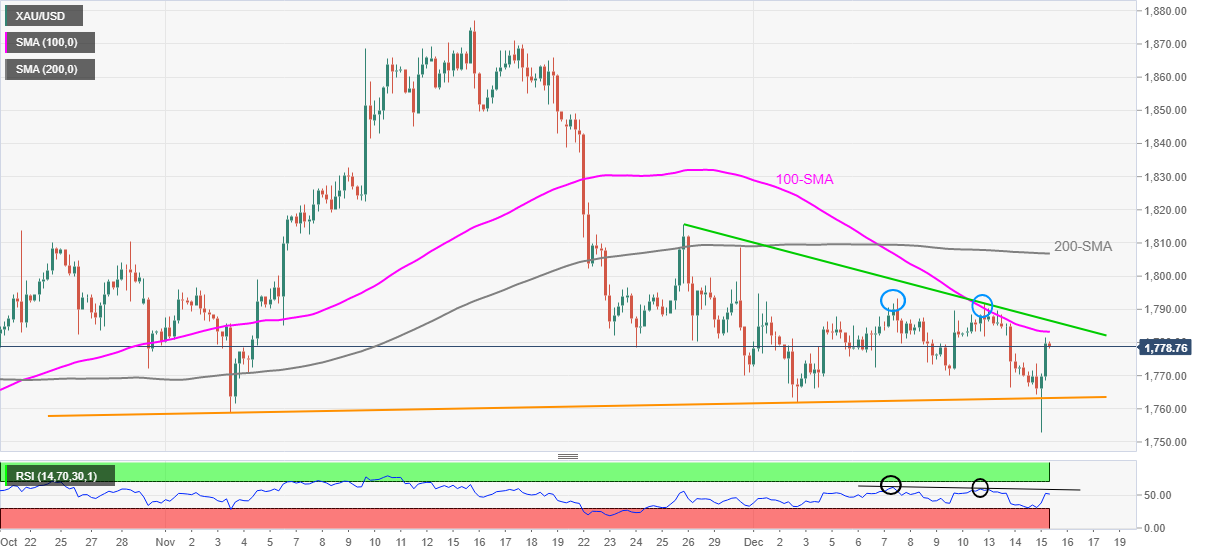
Trend: Further weakness expected
| Pare | Closed | Change, % |
|---|---|---|
| AUDUSD | 0.71733 | 1.03 |
| EURJPY | 128.801 | 0.65 |
| EURUSD | 1.12936 | 0.34 |
| GBPJPY | 151.241 | 0.59 |
| GBPUSD | 1.32615 | 0.29 |
| NZDUSD | 0.67851 | 0.65 |
| USDCAD | 1.2832 | -0.21 |
| USDCHF | 0.92445 | 0.18 |
| USDJPY | 114.047 | 0.31 |







© 2000-2026. All rights reserved.
This site is managed by Teletrade D.J. LLC 2351 LLC 2022 (Euro House, Richmond Hill Road, Kingstown, VC0100, St. Vincent and the Grenadines).
The information on this website is for informational purposes only and does not constitute any investment advice.
The company does not serve or provide services to customers who are residents of the US, Canada, Iran, The Democratic People's Republic of Korea, Yemen and FATF blacklisted countries.
Making transactions on financial markets with marginal financial instruments opens up wide possibilities and allows investors who are willing to take risks to earn high profits, carrying a potentially high risk of losses at the same time. Therefore you should responsibly approach the issue of choosing the appropriate investment strategy, taking the available resources into account, before starting trading.
Use of the information: full or partial use of materials from this website must always be referenced to TeleTrade as the source of information. Use of the materials on the Internet must be accompanied by a hyperlink to teletrade.org. Automatic import of materials and information from this website is prohibited.
Please contact our PR department if you have any questions or need assistance at pr@teletrade.global.


 Bank
Bank transfers


