- Analytics
- News and Tools
- Market News
CFD Markets News and Forecasts — 14-12-2021
- GBP/USD fails to extend corrective pullback from weekly low, pressured around 2021 bottom.
- UK NHS denies pharmacists’ requests for rapid test kits, citing supply issues, cabinet warned for jump in virus cases, hospitalizations.
- IMF pushes BOE for rate hike, cites more Brexit problems ahead, UK jobs report for November came in firmer.
- UK CPI, PPI may offer more clarify for BOE but Fed is the key.
GBP/USD struggles to keep the bounce off the weekly bottom, easing to 1.3220 during Wednesday’s Asian session.
While upbeat UK data and comments from the International Monetary Fund (IMF) favored the cable pair’s bulls, fresh fears concerning the coronavirus and Brexit recall the bears on a key day.
With a reduction in the UK’s Claimant Count Change and Unemployment Rate, not to forget firmer Average Earnings, odds of the Bank of England’s (BOE) hawkish performance on Thursday can’t be ruled out. The IMF urged, per Reuters, the Bank of England on Tuesday to avoid an "inaction bias" when it comes to raising interest rates as it forecast British inflation would hit a 30-year high of around 5.5% next year.
It should be noted, however, that IMF Chief Kristalina Georgieva cited Brexit fears as a challenge to the UK’s economy. “Brexit dealt significant damage to trade with the European Union and there would be further difficulties when Britain implements customs checks on EU imports on Jan. 1, Georgieva said,” per Reuters. Alternatively, the UK Express quotes Irish Foreign Minister Simon Coveney saying, “The EU is anxious to move ahead unilaterally if the UK does not agree on medicine supply to Northern Ireland this month.”
Elsewhere, the UK’s National Health Service (NHS) told, per the UK Telegraph, to the Pharmacies that they cannot have any more extra rapid Covid tests - even though entire cities have run out. The UK policymakers are also warned over a flood of virus-led hospitalization as the cases jump. Reuters said, “Infections from the Omicron variant of the coronavirus have risen in the United Kingdom with the number of new cases reaching 59,610 on Tuesday, the highest figure since early January.”
The UK isn’t the only one suffering from the virus variant as Omicron spreads across the board and challenges the policy hawks as the Fed braces for a crucial day, with faster tapering and rate hike clues eyed.
For now, the UK Consumer Price Index (CPI) for November, expected 4.7% YoY versus 4.2% prior, will be the key for the GBP/USD traders.
Read: Fed Interest Rate Decision Preview: Can the FOMC satisfy and mollify the markets?
Technical analysis
GBP/USD remains on the way to refresh yearly low of 1.3160 even if the weekly support line tests short-term sellers around 1.3200. Meanwhile, the 10-DMA level near 1.3245 guards immediate upside.
- WTI, US crude oil benchmark falls some 1.41%, as COVID-19 infections rise.
- In Europe, Italy, and Scotland, among other countries, impose restrictions as COVID-19 infections climb.
- WTI Technical Outlook: In the near-term has a downward bias, though the upside risks remain.
US crude oil benchmark, also known as Western Texas Intermediate (WTI), is falling during the day as the Asian Pacific session begins, trading at $70.00 at the time of writing. Market conditions had not improved since the early European session when it crossed the wires that two doses of the Pfizer-BioNTech vaccine provided a 70% protection against the newly Omicron variant. The sentiment got follow-through in the New York session, as investors appeared to be sidelined despite the aforementioned, waiting for the Federal Reserve’s last monetary policy meeting decision.
Additionally, some countries started to impose restrictions amid the outbreak of the Omicron variant. Italy will require travelers from other EU countries to provide a negative COVID-19 prove, and Scottland urges no more than three households to mix.
On Tuesday in the overnight session, the black gold peaked at around $71.75, then plunged two dollars, as market mood remained sour, as market participants weighed on central banks, hosting their last monetary policy meetings of the year. Then, it jumped up to $70.75, some $0.50 above the 200-hour simple moving average (SMA), which was reclaimed by oil bears, pushing the price near the $70.00 psychological level.
On the crude-oil-related macroeconomic front, on Tuesday, the American Petroleum Institute reported that US supplies fell 815K barrels last week, according to sources cited by Bloomberg. Data showed that stockpiles increased, though the US government will release its inventory on Wednesday.
Moreover, the Organization of Petroleum Exporting Countries and its allies (OPEC+) increased its outlook for oil consumption in the Q1 of 2022, up to 1.1 million barrels a day, equivalent to an annual world consumption growth in a “typical” year before the pandemic, according to Bloomberg.
On its 2022 outlook, OPEC mentioned that the Omicron variant is expected to have a mild impact as the world gets used to dealing with the COVID-19 pandemic.
WTI Price Forecast: Technical outlook
WTI’s daily chart shows that oil had been in consolidation since Tuesday last week. WTI has a downward bias in the near-term, as WTI bears reclaimed the 200-DMA, which lies at $70.18, piercing under the latter, threatening of breaking below the $70.00 figure.
Failure of WTI bulls to reclaim the 200-DMA would expose the December 14 low at $69.33. A break below that level would expose the figure at $69.00, followed by a retest of September 1 low at $67.01
To the upside, the first resistance would be the 200-DMA. The breach of the latter would expose the December 14 high at $71.79, followed by the psychological $72.00 figure. With a clear break to the upside, the next supply zone would be $73.00.
-637751222313188782.png)
- EUR/USD stays depressed inside bearish chart after two-day downtrend.
- MACD conditions, lower highs favor sellers to aim for fresh 2021 low.
- 200-SMA adds strength to the upside barrier, double tops guard immediate recovery.
- Fed Preview: Dollar hinges on 2022 rate hike dots, guide to trading the grand finale of 2021
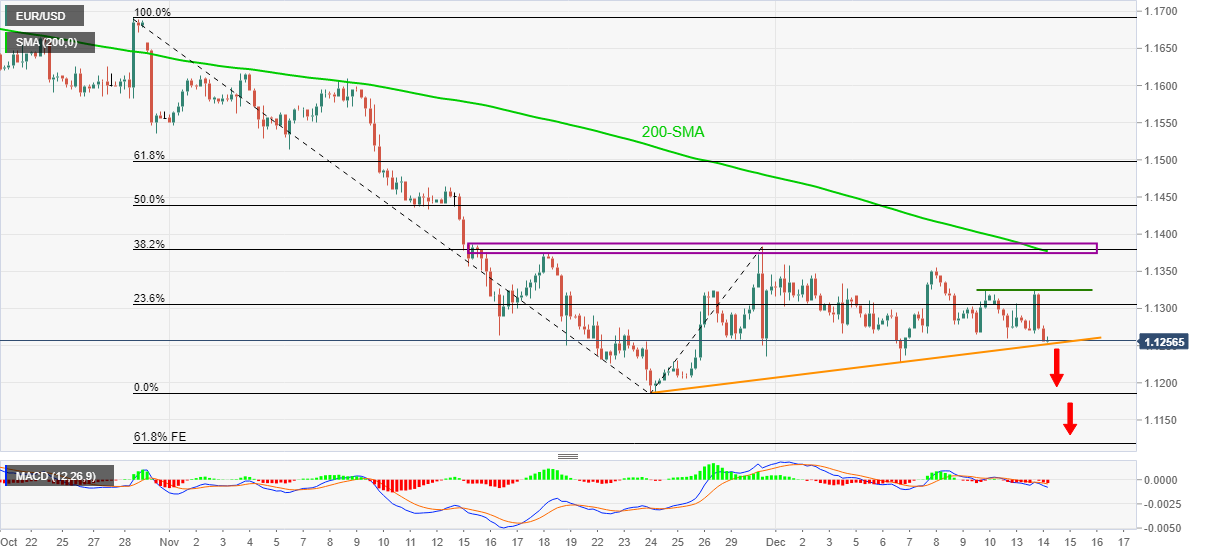
EUR/USD holds lower ground after two-day declines, challenging the support line of a short-term ascending triangle near 1.1250 during the early Asian session on Wednesday.
The bearish MACD signals and the major currency pair’s double top formation around 1.1330, not to forget the lower highs portrayed since November 30, also back the EUR/USD bears to conquer the 1.1250 immediate support.
Following that, the 1.1200 threshold and the yearly low of 1.1186 may become imminent for the pair sellers before targeting the 61.8% Fibonacci Expansion (FE) level of October 28 to November moves, near 1.1120.
Meanwhile, an upside clearance of the 1.1330 immediate hurdle will direct EUR/USD prices towards the 1.1375-87 region comprising 200-SMA, also the upper-end of the stated triangle.
Should the EUR/USD prices remain firm past 1.1375, odds of witnessing numbers past 1.1500 can’t be ruled out.
EUR/USD: Four-hour chart
Trend: Further weakness expected
- The New Zealand dollar, as well as risk-sensitive currencies, keeps accumulating losses against safe-haven peers.
- On Tuesday, the trading range was between 76.43-88.
- NZD/JPY Technical Outlook: It has a downward bias, but upside risks remain.
On Tuesday, the NZD/JPY pair remained subdued, trading at 76.56 during the day at press time. The market mood stills dampened, attributed to central banks hosting monetary policy meetings, though investors mainly focus on the Federal’s Reserve decision.
The cross-currency fluctuated around the 76.43-88 range during the overnight session, between the S1 and the R1 Tuesday’s daily pivot points, with no clear bias. Nevertheless, the hourly-simple moving averages (SMAs) reside above the spot price, confirming the short-term bearish bias.
NZD/JPY Price Forecast: Technical outlook
The NZD/JPY has a neutral-bearish bias. The daily moving averages (DMAs) are located above the spot price with a flattish slope and would be challenging resistance levels to overcome once the price hovers around that area. Additionally, as mentioned in Monday’s piece, the NZD/JPY failed to break above a seven-month-old downslope trendline, which opened the door for further losses.
On the downside, the first support would be the December 3 swing low at 75.95. A breach of the latter would add downward pressure on the NZD/JPY, pushing the price towards July 20 low at 75.25, followed by the August 19 low at 74.55
On the flip side, the first resistance would be the December 9 low previous support-turned-resistance at 76.88, followed by the figure at 77.00. A clear break of the latter would expose 77.30-60 area.
-637751197357490281.png)
Amid widespread coronavirus breakout and after reporting the first Omicron-linked death, the UK’s National Health Service (NHS) told, per the UK Telegraph, to the Pharmacies that they cannot have any more extra rapid Covid tests - even though entire cities have run out.
“Millions of kits are in warehouses across the country, but officials say it is ‘not possible logistically’ to increase supplies,” adds Telegraph.
On the same line is the tweet from Sam Coates Sky saying, “Boris Johnson trapped between his party and scientists as he faces unhappy Christmas. More restrictions had been on the agenda for next week.”
FX reaction
GBP/USD holds on to the corrective pullback from the yearly low, defending 1.3200 level of late, irrespective of the news. The reason could be linked to the market’s increased expectations of the Bank of England’s (BOE) hawkish performance following an upbeat jobs report.
Read: GBP/USD bears back in play, pressure in the 1.3220's
- AUD/USD stays depressed around weekly bottom, further downside hinges on monthly support break.
- Mixed updates of Omicron and stimulus hopes battle fears of Fed rate hike, China news.
- Wall Street closed lower but yields, DXY benefit from risk-off mood.
- Aussie Westpac Consumer Sentiment, China economics may entertain traders but it’s all about Fed today.
AUD/USD extends the two-day downtrend to 0.7100, again challenging fortnight-long support during early Wednesday morning in Asia.
Market’s risk-off mood joins the latest covid outbreak in Australia and challenging details from China and the US to weigh on the Aussie pair of late. Above all, anxiety ahead of today’s Federal Open Market Committee (FOMC) and key data from top customer China weigh on the risk barometer pair.
Sentiment sours as markets brace for the US Federal Reserve’s (Fed) verdict with hopes of faster tapering and a higher dot-plot suggesting sooner rate hikes. Adding to pessimism, which in turn weighs on the AUD/USD prices, was the strong reading of the US Producer Price Index (PPI) for November that refreshed the record top to 9.6% YoY, versus the previous 8.6%.
Other than the Fed-linked fears, mixed updates concerning the virus outbreak also roil the risk appetite and favor the AUD/USD sellers. Australia’s most populous state New South Wales (NSW) registered a 50% jump in daily covid cases for Monday, also marking the Omicron case with a flyer at Brisbane airport. The UK reported the first Omicron-linked death while China also conveyed the presence of the COVID-19 variant at home. Alternatively, vaccine news was positive and so did the market talks signaling that the current coronavirus strain, Omicron, is less harmful and can be overcome.
Elsewhere, the US Senate approved a bill to raise the debt ceiling by $2.5 trillion whereas President Joe Biden also sounds hopeful of getting his Build Back Better (BBB) plan through the House in 2021.
Furthermore, China’s Shimao Group fired another bolt to worry for the Beijing-based markets, adding more pains for the Chinese real-estate and economy. On the same line were recently worsening geopolitical ties among the US-China and the Washington-Tehran.
Amid these plays, Wall Street closed in red and the US Treasury yields helped the US Dollar Index (DXY) to print gains ahead of the key day.
Before the Fed’s verdict, Australia’s Westpac Consumer Confidence for December and China’s data dump, including mainly the Retail Sales and Industrial Production, will entertain the AUD/USD traders. Given the mixed expectations from the scheduled data and likely pre-Fed caution, the quote may remain lackluster, pressured though, heading into today’s FOMC.
Read: Fed Interest Rate Decision Preview: Can the FOMC satisfy and mollify the markets?
Technical analysis
AUD/USD defends 0.7090 support, comprising a 15-day-old horizontal line, amid bearish MACD signals and downbeat RSI. Given the quote’s multiple failures to rise past September’s low surrounding 0.7175, sellers are likely firming grips. That said, the 100-SMA level of 0.7135 acts as an immediate upside hurdle.
- Gold is on the verge of a downside breakout while below $1,790.
- The Fed is the main event for the day and a hawkish outcome could weigh on gold.
- The price is below bearish leaning daily 10 and 20 EMAs.
The price of gold, XAU/USD, is down some 0.90% on the day trading near $1,770 and falling from a high of $1,789.54 to a low of $1,766.58. The greenback has done well in a slightly risk-off market environment which has favoured the greenback over its other safe haven peers, such as gold.
All eyes on the Fed
The US dollar, as measured by the DXY index and vs a basket of major currencies, rallied from a low of 96.10 to a high of 96.59 so far. The Federal Reserve is eagerly awaited today which weighed on equities that traded on the defensive, aiding the greenback to move higher. The S&P 500 dropped 0.8% to 4,634.09 and the Nasdaq Composite fell 1.1% to 15,237.64, while the Dow Jones Industrial Average slipped 0.3% to 35,544.18. The 10-year US Treasury yield rose 2 basis points to 1.44%.
The Federal Reserve began a two-day policy meeting at which it could decide to pare its asset purchases faster than previously planned. The Fed is expected to show a higher dot plot and to double the pace of tapering from USD15bn to USD30bn. ''Fed fund futures are currently pricing 68bps of tightening for next year with fed funds at 1.40% by the end of 2023,'' analysts at ANZ Bank explained.
''Anything in excess of that, or a higher terminal rate (currently 2.5%), will be seen as hawkish. It will also be important to watch the inflation and unemployment forecasts,'' the analysts added. ''In September the FOMC forecast inflation at 2.2% in Q4 2022 and 2023 with the unemployment rate at 3.8% and 3.5% respectively. If inflation forecasts are raised it would show greater uncertainty about the FOMC’s confidence in meeting its inflation target.''
Gold technical analysis
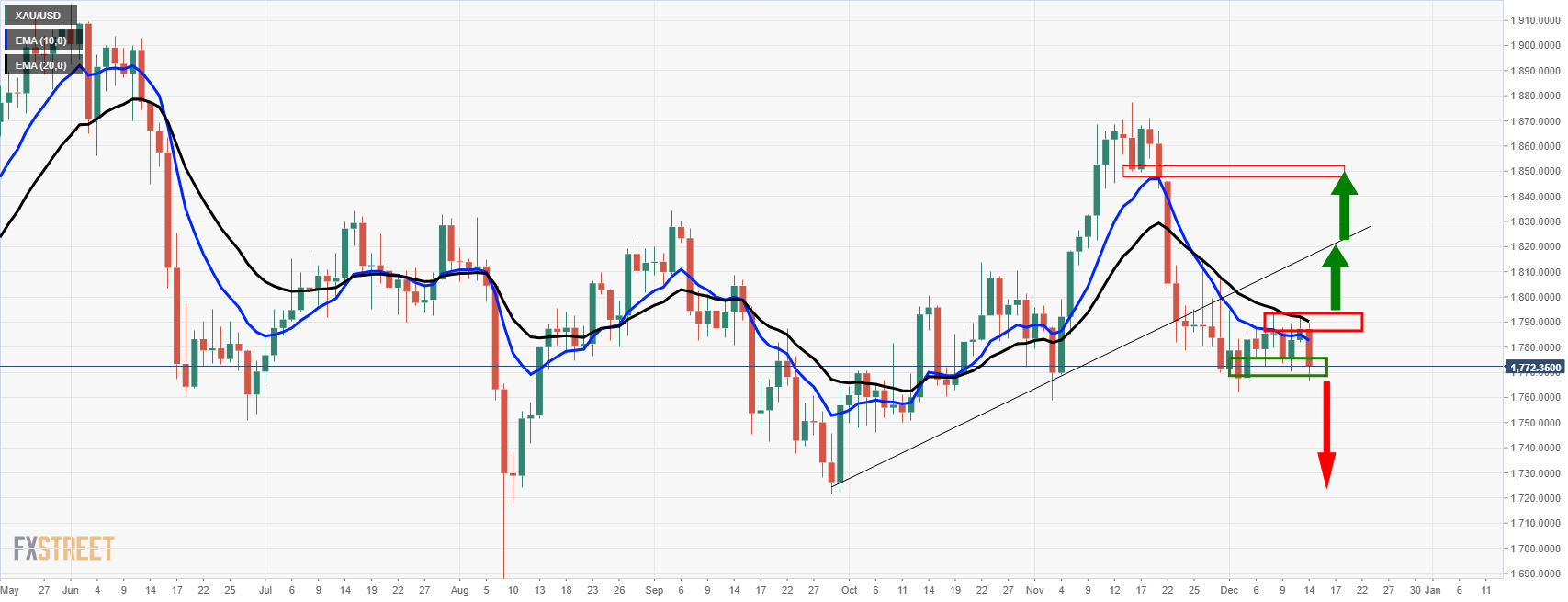
Technically, from a daily perspective, the price is below bearish leaning 10 and 20 EMAs and it could be on the verge of breaking the daily support. However, failures to do so could lead to an upside breakout as follows:
- AUD/JPY bears look to support near to 80.50 for the day ahead.
- Bulls need to get back above 80.90 to hold off the pressures.
The price of AUD/JPY has been forming a bearish engulfing candle in the last hour which would be expected to be followed by bearish price action and a low in the next candles.
AUD/JPY H1 chart
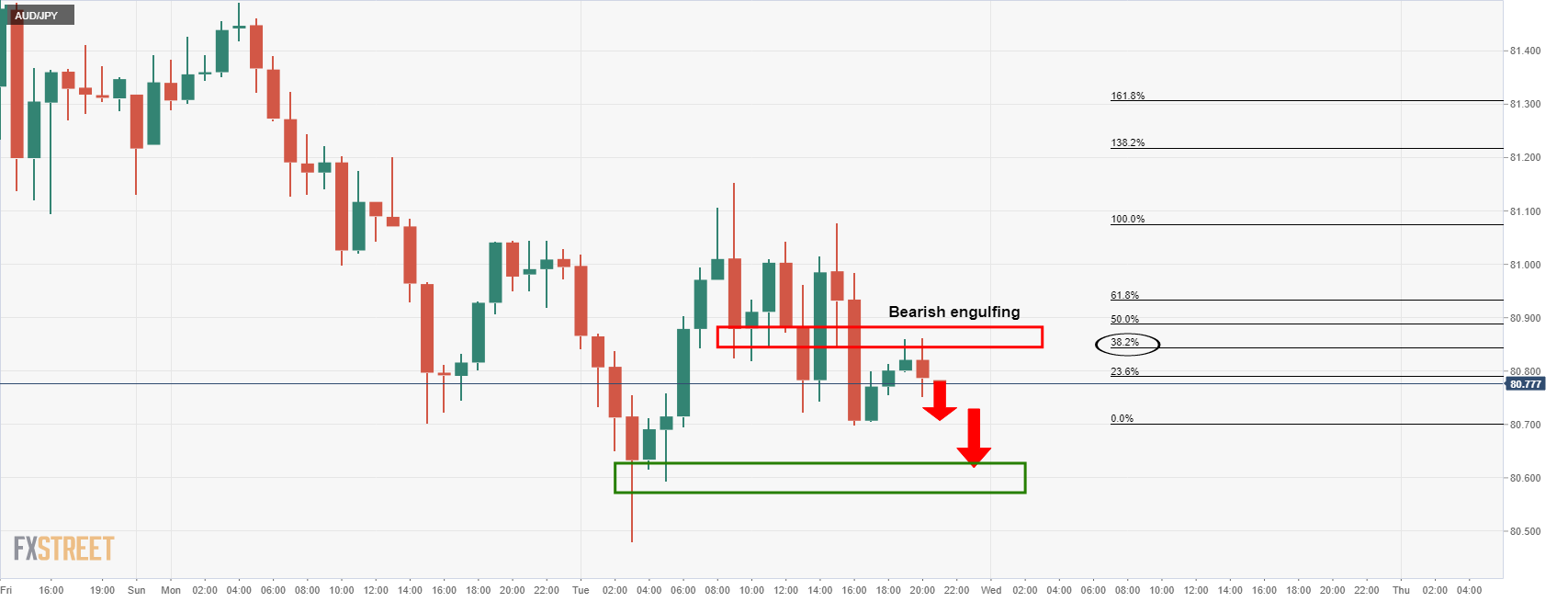
This opens the risk of a downside extension to the test the prior support near to 80.50.
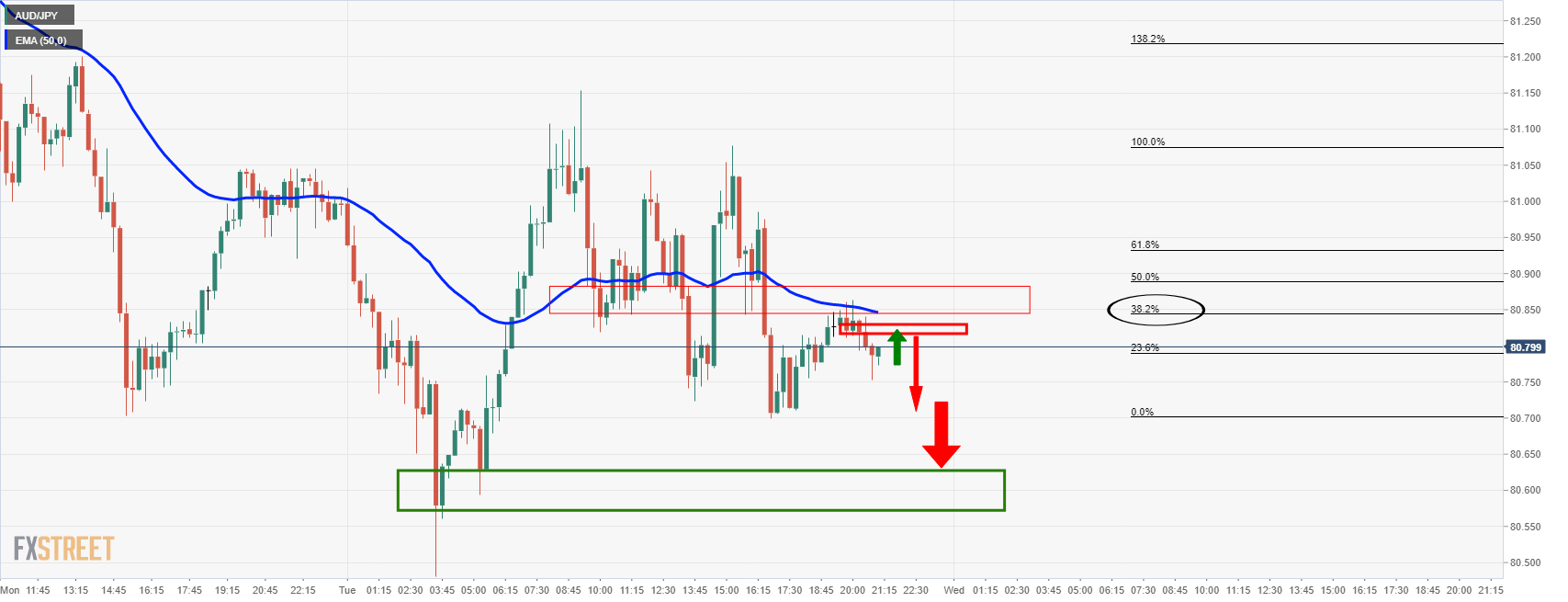
The 15-min chart sees the price headed for a restest of the prior support that would be expected to act as resistance lead to a move to the downside again, as per the outlook for the hourly chart.
- USD/CAD rallied above prior monthly highs in the 1.2850s to hit its highest level since mid-September.
- Market commentators and analysts cited worries about the Omicron variant as weighing on the loonie.
- The pair is now focused on Wednesday’s Canada CPI, US Retail Sales and the Fed policy announcement.
USD/CAD surpassed its earlier monthly highs in the 1.2850s to hit its lowest levels since mid-September on Tuesday. That marked a roughly 0.4% rally from earlier session lows around the 1.2800 level and opens the door to an extended push toward’s the next key area of resistance around 1.2900 (the mid-September high) and then the 1.2950 mark just above it (the mid-August high).
Market commentators and analysts cited worries about the Omicron variant as weighing on the loonie in fitting with a broader downturn in risk appetite on the session. Michael Goshko, corporate risk manager at Western Union Business Solutions, told Reuters that “the increased concerns from public health officials are weighing on sentiment, not only here in Canada but abroad… There's so much uncertainty... It's not surprising to see commodity currencies like the Canadian dollar get harmed in an environment like this.”
But hotter than expected US Producer Price Inflation (PPI) figures released earlier in the session have also contributed to USD/CAD’s upside. Indeed, the dollar broadly strengthened against most of its G10 counterparts on Tuesday (apart from GBP which is likely deriving support from good UK labour market figures) after the annual rate of US PPI hit 9.6% in November, well above expectations.
Coming up at 2100GMT, Canadian PM Justin Trudeau is set to announce the government’s latest economic and fiscal forecasts in the so-called “fall economic statement”. Sources last week told Reuters that any new spending announcements would be “limited in scope”, which makes sense given already high inflation in Canada and pressure from the Canadian business community to exercise greater restraint with further government spending.
Speaking of inflation, the Canada November Consumer Price Inflation report will be released at 1330GMT on Wednesday alongside the US November Retail Sales report, which coud make for choppy conditions for the USD/CAD. BoC Governor Macklem is then scheduled to speak at 1700GMT ahead of the most important event of the week for USD/CAD, Fed policy announcement at 1900GMT and press conference with Jerome Powell at 1930GMT thereafter.
- The USD/JPY climbs during the New York session, up some 0.15%.
- A risk-off market mood as the Federal Reserve monetary policy meeting looms.
- USD/JPY Technical Outlook: The pair has an upward bias, though range-bound around the 113.21-113.95 range.
The USD/JPY barely advances during the New York session, trading at 113.75 at press time. The financial markets sentiment is downbeat as investors seem to be waiting on the Federal Reserve monetary policy decision, to be unveiled on Wednesday.
Before Wall Street opened, the US Bureau of Labor Statistics (BLS) reported the Producer Price Index for November. The numbers came at 9.6% on an annual basis, higher than the 9.2% expected. The Core PPI rose by 7.7%, up from the 7.2% foreseen by analysts.
That data would mount additional pressure on the Federal Reserve to tighten economic conditions faster than expected. Money market futures have fully priced in at least three rate hikes by the end of 2022.
USD/JPY Price Forecast: Technical outlook
The USD/JPY has remained range-bound within the 113.21-113.95 area in the last six days. Further, the pair has been seesawing in each side of the 50-day moving average (DMA), showing that market participants do not have a clear bias as the year-end approaches. Nevertheless, the Japanese yen looks vulnerable, as the greenback, supported by the recent hawkish rhetoric led by Chair Jerome Powell, diverges from the Bank of Japan’s current monetary policy.
That said, the USD/JPY has an upward bias, though it would need to break above 113.95 to cement an upward move towards 2021 year-to-date highs, around 115.52.
In the event of breaking to the upside, the first resistance would be 114.00, followed by the October 20 cycle high at 114.70. A breach of the latter would expose 115.00.
On the other hand, any downward moves would be capped at the 113.00 figure. A break below that level would expose the November 30 pivot low at 112.53, then the 100-DMA at 111.87.
-637751106987829920.png)
- EUR/GBP is being pressured into a key level of demand on the daily chart.
- Bulls looking for a restest of M-formation neckline in due course.
EUR/GBP has been offered this week so far ahead of critical central bank meetings. Technically, the price is forming a compelling chart pattern on the daily time frame as follows:
EUR/GBP daily chart

The price is creating an M-formation on the daily chart and bulls will be looking to target the 0.8530s which is the neckline of the formation. However, there could be some more downside to come yet to test 0.85 the figure first.
There is plenty of data coming out of the UK and Super Thursday will be an important event for the cross with both the Bank of England and the European Central banks meeting.
''It is our view that the market will unwind some of the BoE rate hikes expected for next year and we have revised higher our 6-month EUR/GBP forecast to 0.86 from 0.84,'' analysts at Rabobank argued.
- EUR/JPY has reversed lower again from a test of the 128.50 level and is back to the 128.00 area.
- The pair is tentative ahead of ECB and BoJ rate decisions as well Eurozone flash PMIs and Japan Industrial Production.
EUR/JPY has reversed lower again from a test of the 128.50 level earlier in the session and is back to trading close to the 1.2800 level. The pair ran into resistance in the form of its 21-day moving average which sits just above 128.60 and this unsurprisingly acted as a ceiling to the price action, given that traders have expected FX markets to trade with a lack of conviction ahead of key events later in the week. These include the looming ECB and BoJ rate decision on Thursday and Friday, as well as the release of Eurozone, flash PMIs for December and Japan Industrial Production data for October.
Ahead of these risk events, EUR/JPY is likely to continue to struggle to find meaningful direction. The 128.50 area is likely to continue to cap the price action and recent lows around 1.12750 to the downside are likely to act as a floor. In the scenario that 128.50 and the 21DMA just above it are broken, last week’s high at 129.00 is the next area to look at for resistance. Meanwhile, any break below 127.50 would be significant as it would mean EUR/JPY was back to its lowest levels since February. Given a lack of immediate support, a swift move towards the 125.00 area could be on the cards.
What you need to know on Wednesday, December 15:
The greenback is up against most of its major rivals, rising during US trading hours on the back of higher yields and weaker stocks. The US published November PPI, which jumped to a record of 9.6% YoY, much higher than the previous 8.6%, while the core reading jumped from 6.8% to 7.7%. The news spurred risk aversion ahead of the US Federal Reserve monetary policy decision on Wednesday.
Some positive news from the pandemic front helped high-yielding currencies to advance during the European session. Pfizer-BioNTench reported that two shots of its vaccine provide 70% protection against Omicron hospitalization and 33% protection against infection. So far, only the UK reported one death related to the newly discovered variant. Pfizer also reported that its experimental COVID-19 pill, Paxlovid, appears to be effective against Omicron and the previous variants.
The EUR/USD pair is down to a fresh weekly low of 1.1256, trading nearby heading into the Asian opening. The GBP/USD pair posted modest gains, helped by upbeat UK employment figures. The UK Office for National Statistics reported that the number of people claiming unemployment-related benefits declined by 49.8K in November. Adding to this, the ILO Unemployment Rate edged lower to 4.2% during the three months to October.
Commodity-linked currencies extended their weekly declines, with AUD/USD struggling around 0.7100 and USD/CAD up to 1.2850. The dollar posted modest gains against safe-haven CHF and JPY.
The US Federal Reserve will announce its decision on monetary policy. The central bank will also offer fresh updates on inflation and growth forecasts and a dot-plot which may hint at a sooner rate hike. Additionally, Chief Powell is anticipated to announce a faster pace of tapering, although it’s unclear on whether to which extent in the middle of the Omicron outbreak.
Gold fell, now trading around $1,772 a troy ounce, while crude oil prices also shed ground, with WTI trading at around $70.40 a barrel.
Top 3 Price Prediction Bitcoin, Ethereum, XRP: Cryptos rebound after finding support
Like this article? Help us with some feedback by answering this survey:
- USD/CHF bears face a tough time ahead in light of covid-19.
- Super Thursday will be an important day for CHF.
USD/CHF is trading higher by some 0.16% at the time of writing and between a low of 0.9188 and a high of 0.9244. The price action is in favour of the bulls as we head towards the Federal Reserve on Wednesday.
US dollar the favourite safe haven
Meanwhile, there is a bullish bias in the greenback. ''Growth, inflation and the global backdrop are all still helping the dollar,'' Kit Juckes at Societe Generale explained in a note. Touching on the Omicron risks as well, he notes that the US dollar is a favourable safe-haven instrument in this regard as well. ''The first signs from China that further yuan strength will be resisted also helps the dollar as does concern about the Omicron variant.''
Omicron is becoming the dominant coronavirus variant in European nations, which could leave a spanner in the works for the swiss franc that is otherwise favoured for its safe-haven qualities. Switzerland has imposed further restrictions on public and private gatherings and has advised people to work from home.
Health Minister Alain Berset warned the Delta variant is still not under control while the country is now facing an outbreak of Omicron. “The situation is very serious,” said Berset. “We didn't want this, but we have to work with reality. Some hospitals have already reached their capacity limits."
Overall, the popular economist in the forex space explained,'' the dollar is increasingly seen by some investors as the best hedge against a risk shock, given that the bond market no longer performs this task adequately,'' Kit Juckes at Societe general explained.
All eyes on Super Thursday and the SNB
Meanwhile, the CHF net short positions edged lower last week. In the spot market, we also have seen the CHF edge higher at times of risk-off. However, there is always the risk of the Swiss National Bank intervening and investors are quick to take profits.
“Super Thursday” will be interesting where the SNB will kick things off at 8:30AM (GMT) with a rate announcement. However, the focus will mostly be on CHF-related comments. Traders will look to see if the SNB will stay with its familiar narrative that the franc is “highly valued”.
The jawboning effect could have a negative impact on the currency a the bank attempts to defy speculation that it is prepared to let it run higher to curb stagflationary risks. The EUR/CHF will be an important gauge in this respect with the cross coming under pressure again amid Omicron-related concerns. A less dovish European Central Bank will also be a risk that traders will need to gauge as to how this will impact the CHF.
- AUD/NZD has consolidated within this week’s this week’s thin 1.0520-1.0560ish ranges on Tuesday.
- The pair is awaiting key New Zealand Q3 GDP figures and the Austrlia November jobs report, both out on Thursday.
AUD/NZD has continued to consolidate within this week’s thin 1.0520-1.0560ish ranges on Tuesday as the pair awaits the release of key data out of both Australia and New Zealand later in the week. The main resistance for traders to keep an eye on comes in at 1.0560, while the 1.0500 level is the main area to watch to the downside.
Thursday’s Asia Pacific session will see the release of New Zealand Q3 GDP growth figures, followed by the release of the Australia November jobs report. Both data releases will be watched closely by AUD/NZD traders as both might influence the timeline for RBNZ and RBA policy tightening. The RBNZ has already delivered two 25bps rate hikes to take rates to 0.75%, with more hikes expected to come in 2022 and beyond, while the RBA remains a long way off even lifting rates for the first time since the pandemic.
FX markets have had ample time to price in the large divergence in policy (which drove AUD/NZD much of the weakness in the summer months). Focus has now shifted to whether the RBNZ can live up to market expectations (some fear it can’t/won’t) and on when the RBA’s first rate hike will be coming. Last week’s RBA rate decision was a little more hawkish in tone than anticipated and had analysts speculating that the bank may want to move on rate hikes as soon as mid-2022 – this helped propel AUD/NZD back above 1.0500.
A strong labour market report on Thursday may infuse further hawkish speculation that may further underpin the Aussie. But this may be counteracted if the decline in Q3 NZ GDP isn't as bad as feared (remember, much of the country was in lockdown at the time). A smaller Q3 contraction would embolden the RBNZ to press ahead with the monetary tightening that it knows it needs to do in order to reign in above-target inflation and a hot labour market.
The main point is that AUD/NZD will be highly sensitive to the data on Thursday. Other data out this week, like Tuesday’s release of NZ Q3 Current Account numbers (2145GMT) and Australian December Westpac Consumer Sentiment survey (at 2330GMT), Thursday’s speech from RBA Governor Philip Lowe and Friday’s NZ December ANZ Business Confidence survey, will all also be of note but is unlikely to dictate the broader narrative.
- The Australian dollar continues to fall for the second day in a row, sliding 0.30%.
- The US PPI increased by almost 10%, the most in eleven years, as pressure mounts on the Fed.
- On Wednesday, US Retail Sales and the Federal Reserve monetary policy decision would guide the AUD/USD pair.
The Australian dollar grinds lower against the greenback during the New York session, trading at 0.7103 at the time of writing. On Tuesday, the market sentiment is tepid, as investors await the Federal Reserve monetary policy decision. Additionally, the odds of the US central bank reducing its bond-purchasing program faster as estimated increased when the US Bureau of Labor Statistics (BLS) reported that prices paid for producers rose the most in eleven years.
The AUD/USD tumbled below the 0.7100 figure in the overnight session, as Monday’s Wall Street market mood influenced Asian markets. However, upbeat news that two doses of the Pfizer BioNTech vaccine would provide 70% protection against the COVID-19 Omicron strain improved the market mood during the European session, pushing the pair towards 0.7135.
However, as the American session began, positive US macroeconomic data spurred demand for the greenback, which pushed the AUD/USD back towards the daily lows.
On Tuesday, the US Producer Price Index for November rose to 9.6% annually, higher than the 9.2% expected. The so-called Core PPI, excluding volatile items like food and energy, increased by 7.7%, higher than the 7.2% foreseen by analysts.
On Wednesday, the Australian economic docket will unveil the Westpac Consumer Confidence for December. In the US docket, Retail Sales for November are expected at 0.8%, while excluding Autos, the consensus estimates are at 1%. Later on, the Federal Reserve monetary policy decision, with consensus expecting a reduction of $30 billion on its bond asset purchases, beginning in January 2022.
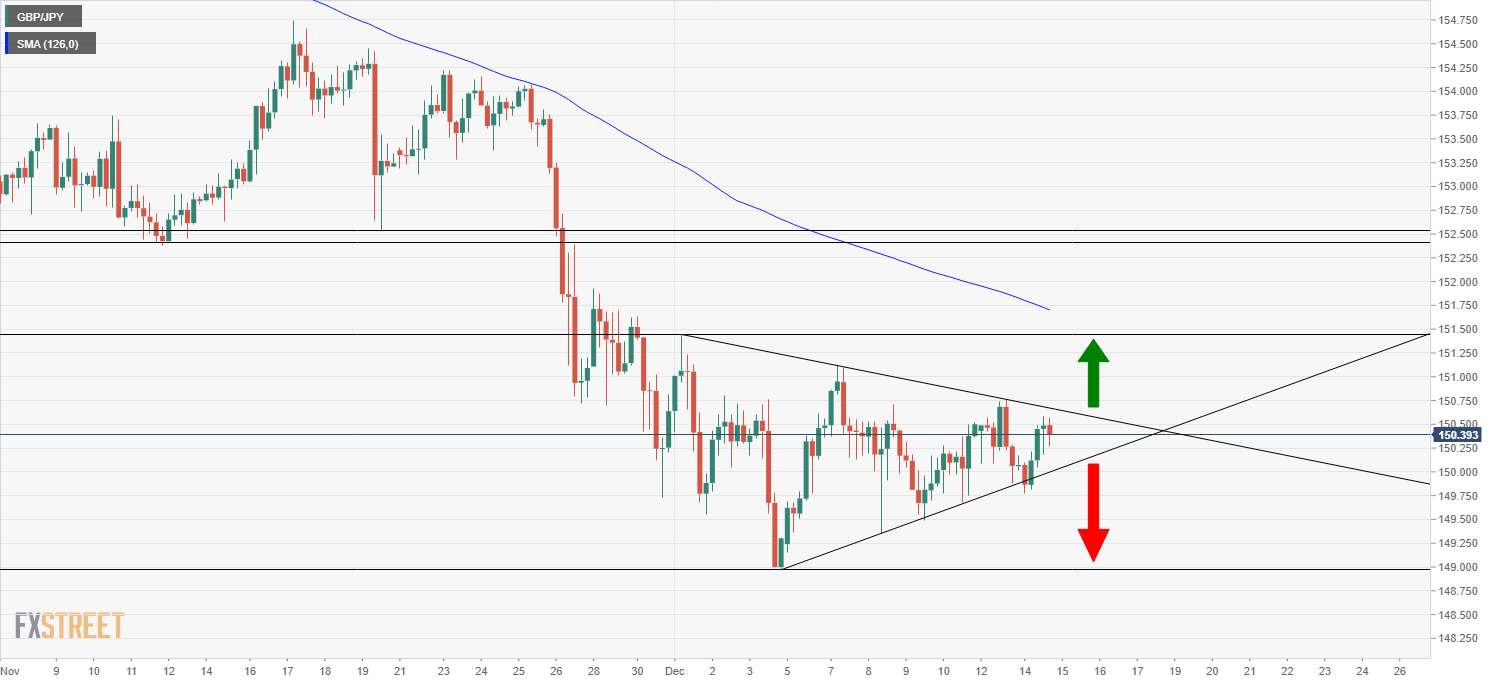
- GBP/JPY hasn’t moved much on Tuesday and continues to consolidate in the low 150.00s area.
- The pair has formed a pennant this month, suggesting a technical break in either direction is on the cards.
- The main events to watch this week for the pair are Thursday’s BoE meeting and Friday’s BoJ meeting.
GBP/JPY hasn’t moved much on Tuesday, with the pair rising by about 0.2% on the day but remaining within recent ranges as it consolidates just to the north of the 150.00 level. It's been six sessions since the pair saw any meaningful volatility and trading conditions on Tuesday were subdued despite the release of the latest UK labour market report, which showed employers hiring a record number of staff in November. It also showed the unemployment rate in October dropping to 4.2% as expected, in a further sign that the UK labour market weathered the end of the government’s furlough scheme in September well.
Subdued trading conditions are not surprising given that FX markets are waiting for a barrage of central bank events later in the week before finding some direction again. The BoE sets rates on Thursday and the BoJ on Friday, with neither likely to alter policy stance. Whilst that is nothing new when it comes to the BoJ, it is a much more interesting story for the BoE; the bank was expected to hike rates by 15bps as recently as the end of November.
But since the emergence of Omicron, BoE policymakers have turned dovish, a shift that weighed on GBP/JPY and contributed to its drop from the 153.00-154.00 area to current levels around 150.00. Amid Omicron uncertainty, UK data has been largely ignored and will likely continue to be for the rest of the week; following Tuesday’s solid jobs report, UK November CPI is out on Wednesday and November Retail Sales is out on Thursday.
The technicals suggest a breakout, either to the upside or downside is on the cards. GBP/JPY has formed a pennant over the course of the month so far, with prices constricted between a downtrend linking the late November, 7 and 13 December highs and an uptrend linking the 3, 8, 9, 10 and 13 December lows. A downside break for whatever reason (like a dovish BoE surprise on Thursday) would likely see the 149.00 level tested, while an upside break would trigger a push towards the 152.00 level and the 21-day moving average just below it.
- GBP/USD bears await a less hawkish outcome from the BoE.
- The US dollar is a favourite in times of uncertainty, to weigh on the pound.
GBP/USD is back under pressure and has been sold off from the post Employment report data hoghs scored in London's trade. At the time of writing, the pound is 0.12% higher on the day but below the 1.3256 highs and testing lower into the 1.3220s. The low of the day was 1.3190.
Risk sentiment remains muted, ahead of this week's flurry of central bank meetings and FX markets are moderately quiet. However, it is a busy week for UK macro and markets await the major event risk of the Federal Reserve and the Bank of England.
BoE to tread carefully
We had the first of a string of events in today's labour market data that comes before tomorrows inflation report and the BoE on Thursday. The data today suggested that the end of the furlough programme went smoothly. The Unemployment Rate improved a tick to 4.2%, better than the MPC's recent forecast of 4.4%.
However, even continued improvement in the labour market is unlikely to push the MPC to hike this week given the threat of the Omicron variant. After all, the MPC signalled in November that it is comfortable with waiting for more data and the spread of the Omicron variant offers a good reason to walk a line of caution.
The consensus is for the Bank of England to hold which could hurt the pound further which has been declining since June of this year. The weakness is suggestive of mounting malaise among GBP investors with concerns over the coronavirus and headwinds to UK growth.
Additionally, the lack of reassurances around the post-Brexit UK economic outlook has been an additional weight. The market is still positioned for a fair amount of tightening next year, according to the latest CFTC data. However, if investors continue to reposition for a less hawkish BoE for 2022, the pound in the spot market will continue to feel the pressures.
Meanwhile, the focus will be on a) how many members will vote to remain on hold, and b) forward-looking language. If the door is left open for, say, a Feb rate hike, then the pound can find some stability on that given how short the market is already, at least as compared to the 2021 average, and having already priced out a rate hike this time around.
Bullish bets on the US dollar
Meanwhile, there is a bullish bias in the greenback. ''Growth, inflation and the global backdrop are all still helping the dollar,'' Kit Juckes at Societe Generale explained in a note.
He explained that the US initial jobless claims data showed the lowest number of claimants since 1969, and he and his colleagues now await the November CPI report with trepidation. He also added that ''the first signs from China that further yuan strength will be resisted also helps the dollar as does concern about the Omicron variant.''
Overall, the popular economist in the forex space explained,'' the dollar is increasingly seen by some investors as the best hedge against a risk shock, given that the bond market no longer performs this task adequately.''
- The EUR/USD slides during the New York session, down 0.08%.
- Fed and ECB monetary policy decisions would be crucial on the direction of the EUR/USD.
- Fed: A faster bond taper and signals of the possibility of hiking rates, would be bullish for the USD.
- ECB: An increase in its bond-purchasing program and further pushing back of rates, would be bearish for the EUR.
The EUR/USD slides for the second-consecutive day, trading at 1.1275 during the New York session at press time. The market sentiment has remained downbeat since Wall Street opened. The rise in prices paid by US producers and last week’s consumer inflation topping 1982 highest level puts pressure on the Federal Reserve, as the US central bank heads to its two-day monetary policy meeting.
In the last hours, the EUR/USD pares some of its early gains, which were spurred on positive reports on the Pfizer-BioNTech vaccine giving 70% protection against the Omicron variant after two doses. As of lately, the 1.1300 figure gave way for USD bulls, as US macroeconomic data increased the odds of a Fed faster QE reduction, attributed to consumer and producer elevated prices.
The US economic docket will feature Retail Sales for November and the FOMC monetary policy decision on Wednesday. On Thursday, Markit PMI’s will be revealed on the Eurozone economic docket, alongside the ECB monetary policy decision.
Central bank divergence between the European Central Bank (ECB) pushing back against higher rates and the Fed in the process of tightening monetary policy seems to favor further EUR/USD weakness. That can be witnessed with US Treasury yields rising during the day, with the 10-year benchmark note rate at 1.44%, edges up one and a half basis points, a tailwind for the greenback.
That said, the EUR/USD might be headed for a retest of the YTD low around 1.1186 in the week if the Fed decreases the number of purchases by double of what initially decided on its November monetary policy meeting. Contrarily, the EUR could strengthen, sending the pair above 1.1300.
EUR/USD Price Forecast: Technical outlook
The EUR/USD has a downward bias, depicted by the daily moving averages (DMAs) residing above the spot price. Additionally, the descending triangle formation opens the door for a fall towards 1.1040, but it would find some hurdles on the way south.
The first support would be 1.1200. A breach of the figure would expose the year-to-date low at 1.1186. A clear break of that level would expose the 1.1100 area, followed by the 1.1000 figure.
On the other hand, the first resistance is 1.1300, followed by the November 30 high at 1.1382, then the 1.1400 figure, and the 50-DMA at 1.1453.
-637751017189911555.png)
- Mexican peso drops across the board during the American session.
- After giving signs of a bottom, USD/MXN jumps above 21.00 erasing most of last week’s losses.
The USD/MXN is sharply higher on Tuesday after staging a rally during the American session. The pair climbed from 21.00/05 to 21.20, reaching the highest level in a week. It remains near the top, supported by a stronger US dollar and also by a broad decline of the Mexican peso.
The greenback gained momentum following US IPP data and particularly ahead of the FOMC decision. On Wednesday, the central bank will announce its decision. It is expected to accelerate the tapering of its purchase program.
Higher US yields and a decline in equity prices is weighing on emerging market currencies. The Mexican peso was holding well, until USD/MXN broke decisively above 21.05. The next resistance stands at 21.30, followed by 21.45. On the flip side, a slide back under 21.05 should alleviate the current bullish pressure.
On Thursday, the Bank of Mexico will have its monetary policy meeting with the most analysts looking for a 25 bp rate hike. Analysts at TD Securities expect Banxico to hike by 25bps and continue to present a hawkish stance, though they warn about some risk of a 50bps rate hike. “MXN still presents reasonably good yield, though competition in Latam is heating up, and risk surrounding the monetary policy and fiscal trajectory are increasing.”
Technical levels
- NZD/USD spent Tuesday trading sideways in the 0.6750 area after printing fresh YTD lows in the 0.6730s earlier.
- FX markets are in wait-and-see mode ahead of the Wednesday Fed meeting and Thursday’s NZ GDP release.
NZD/USD has spent the majority of Tuesday's session trading sideways in the 0.6750 area, with a hotter than expected US Producer Price Inflation report failing to provide a boost to the pair in the run-up to Wednesday’s Fed meeting. The data should seal the deal for the Fed to announce a hawkish pivot on its QE taper timeline and outlook for rate hikes, but expectations heading into the meeting were already very hawkish even prior to the release of the PPI report.
Notably, NZD/USD did print a fresh annual low during Asia Pacific trade on Tuesday, dipping under the 6 December lows at 0.67366 to hit 0.67353. It seems likely that any meaningful push lower on towards the next area of support around 0.6700 will have to wait until after the conclusion of the Fed meeting, as trading conditions enter wait-and-see mode. The pair’s failure to sustain a rally back above 0.6800 was telling that the recent bear-run that has seen it drop nearly 6.0% since the start of November isn’t yet over and a hawkish Fed plus more strong US data this week could cement this.
New Zealand GDP data in focus
But focus will also be on the NZD side of the equation this week with a few key data points due. Later during Tuesday’s session, ahead of the start of the Wednesday Asia Pacific trade, RBNZ Governor Adrian Orr is slated to speak at 1900GMT ahead of the release of New Zealand Q3 Current Account data at 2145GMT. Then, Q3 GDP growth data is due during Thursday’s Asia Pacific session, with a 4.5% QoQ contraction expected given the harsh lockdowns imposed for much of the quarter.
Given that this lockdown was temporary in nature and did not seemingly have any negative impact on the labour market or inflation, it won’t alter the RBNZ’s stance that gradual monetary tightening over the coming years is appropriate. Indeed, some strategists have noted that if the recession in Q3 wasn’t as bad as feared, this could have hawkish implications for RBNZ rate-setting decisions in the coming months. Whether that would be enough to turn the bearish tide weighing on NZD/USD is another thing.
- The S&P 500 falls 1.11%, sits currently at 4,615.85.
- The Nasdaq and the Dow Jones Industrial lose between 0.44% and 1.74%, down at 15,802.13 and 36,494.29, respectively.
- S&P 500 Technical Outlook: Remains bullish, but a negative divergence between price action and the RSI could send the S&P lower.
The S&P 500 falls during the New York session, is at 4,615.85, down 1.02%, after the US Producer Price Index for November rose the most since 2010, following the last week’s CPI footsteps, as pressures mount on the Federal Reserve to tighten monetary conditions, faster than expected.
US Producer Price Index rises the most in eleven years
The market sentiment is downbeat, as the cycle of easy money is about to end. Today, the Department of Labor revealed that producer prices jumped by 9.6%, more than the 9.2% foreseen. Also, the so-called Core Producer Price Index rose by 7.7%, higher than the 7.2% estimated by analysts.
The markets reacted negatively. Following the S&P 500 footsteps, the Nasdaq falls 1.74%, down at 15,802.13. The Dow Jones Industrial could not be left behind, losing 0.44%, currently at 36,494.29.
In the meantime, the so-called “fear index,” the CBOE Volatility Index (VIX), rises almost 12%, currently at 22.70, as investors scramble to get out of stocks, moving towards cash or other assets, as the Fed last monetary policy meeting looms.
Sector-wise, the gainers are led by financials, energy, and materials, each rising 0.61%, 0.29%, and 0.02%. The biggest losers are technology, communication, and real-estate, down 2.18%, 1.39%, and 1.37%, respectively.
On Wednesday, the US economic docket will feature the Retail Sales for November, alongside the critical Federal Reserve monetary policy decision.
S&P 500 Price Forecast: Technical outlook
The S&P 500 remains in an uptrend, as shown by the daily chart, with the 50, 100, and 200-day moving averages (DMAs) below the price action. However, it appears to be forming a double-top around 4,700, which coincides with a negative-divergence in the Relative Strength Index (RSI), which at press time is below the 50 mid-line, at 49.
In the event of breaking to the downside, the first support would be the 50-DMA at 4,591.13. A breach of the latter would expose the confluence of the December 3 low and the 100-DMA around the 4,500-4,515.84 range, followed by the intersection of October 13 low and the 200-DMA around the 4,325-4,341.31 area.
-637750962857477942.png)
- USD/JPY is contained close to its 50DMA around 113.70 ahead of Wednesday’s all-important Fed announcement.
- For the pair to enjoy a sustained rebound towards recent highs above 115.00, the US 10-year yield needs to rally.
USD/JPY is currently probing weekly highs in the 113.70 area, though the presence of the 50-day moving average at 113.70 continues to cap the price action, as has been the case for most of the last four sessions. Above the 50DMA resides the 21DMA at 113.90, a level which was well respected last week when the pair attempted a push on towards the 114.00 level.
A hotter than expected US Producer Price Inflation report gave USD/JPY some momentary support and is helping keep the pair supported to the north of the 113.50 level and above earlier session lows near 113.40, but has not been enough to stir a lasting move higher. The pari is taking its cue from the subdued tone being observed in US bonds markets, where most of the curve is flat. The 10-year yield, which USD/JPY is most sensitive to, is up about 1bps but remains below 1.45% and well below pre-Omicron levels nearer 1.70%.
The subdued tone of US bond markets and thus also of USD/JPY is unsurprising given the proximity of Wednesday’s Fed meeting. The bank is expected to pivot hawkishly by announcing a faster QE taper and indicate sooner lift-off with its updated dot plot. Ahead of the meeting, USD/JPY and bond markets may be a little jumpy on the release of the US November Retail Sales report and December NY Fed Manufacturing survey, but things are likely to remain contained.
That implies that USD/JPY will continue to trade within the 113.30-113.80ish ranges estabilished over the last few sessions. Whilst a more hawkish than expected Fed outcome might spur USD strength versus other G10 currencies, if it prompts further flattening of the US treasury curve and downside in longer-duration bond yields, JPY may hold up much better. If USD/JPY is to rally back to challenge recent highs in the 115.00s, US 10-year yields will need to push into the 1.60s% again.
- WTI is currently trading above a key area of support in the $70.00 region and its 200DMA at $70.37.
- Prices are down about 50 cents on the day, with market commentators citing concerns about the impact of Omicron.
Front-month WTI futures are currently trading above a key area of support in the $70.00 region, a psychologically important level that also coincides with WTI’s 200-day moving average (which resides at $70.37). In recent trade, WTI dipped under the $70.00 level and the 200DMA to print session lows in the $69.70s, but has since bounced back above the big figure and into the mid-$70.00s. On the day, WTI’s losses currently stand at just over 50 cents, taking losses on the week to about $1.50.
Market commentators have been citing concerns about the impact of Omicron on the global demand outlook as weighing on sentiment in the energy complex in wake of recent Covid-19 restriction tightening across Europe. There is also focus on China, health authorities in the Tainjin region picked up the country’s first Omicron case on Monday, whilst the Zhejiang province, a key manufacturing hub, is said to be fighting its first major Covid-19 cluster of the year. China, one of the world’s major oil consumers, maintains a zero-Covid-19 policy which will be put to the test by Omicron, which is slated to be multiple times more transmissible than the previously dominant delta variant.
The IEA and OPEC released their monthly oil market reports this week. The former warned on Tuesday that Omicron is set to hit the global recovery and, as a result, revised lower their expectations for oil demand growth in 2021 and 2022 by 100K barrels per day due to new travel curbs. That contrasted to the more upbeat tone of the OPEC monthly report, which revised higher its expectations for demand in Q1 2022 and said Omicron would only have a mild, brief impact. Thus, market participants expect the group to agree to press ahead with another 400K barrel per day output hike from February next when they meet at the start of January.
Looking ahead for oil markets, weekly private US inventories will be out at 2130GMT on Tuesday ahead of Wednesday’s official US inventory report at 1530GMT. Oil markets will be focused on the broader macroeconomic story this week, the major moment being the Fed’s policy announcement at 1900GMT on Wednesday. The US economy is experiencing significantly higher inflation pressures that the Fed anticipated just a few months ago (case in point was Tuesday’s much hotter than expected PPI report which briefly weighed on oil prices) and markets expect a hawkish pivot.
The bias in the USD/JPY pair is to the upside, according to analysts at MUFG Bank. They see the pair moving in the range of 110.00 and 116.00 over the next weeks.
Key Quotes:
“We see scope for USD/JPY slowly retracing the Omicron drop on the back of an FOMC meeting confirming market expectations of a more active FOMC next year. The market could feasibly contemplate pricing more than three rate hikes next year – we don’t expect the Fed to deliver that but the initial phase of pricing such action is likely to see USD/JPY grind higher again.”
“General levels of volatility will need to subside in order for conditions to be conducive for a renewed grind higher in USD/JPY. G10 FX volatility should subside once we are through this busy week of key central bank meetings. But with year-end approaching there is a risk this move higher for USD/JPY might not happen until the new year.”
“Increased China uncertainty with additional property companies now coming under selling pressure (Shimao Group Holdings Ltd.) and the rapid spread of the Omicron covid variant suggest further reservations over the quick re-establishment of USD/JPY carry positions. Overall though, we assume the Fed induced demand for dollars will help lift USD/JPY although our bullishness is somewhat lower than in previous months and the move higher may be curtailed to a degree by broader volatility and elevated levels of uncertainty globally.”
- The USD/CAD rises 0.08%, as the Federal Reserve’s last meeting looms.
- Falling crude oil prices weighed on the commodity-linked Canadian dollar amid a dull FX market session.
- USD/CAD Technical Outlook: Has an upward bias, and a break above 1.2850 would expose the YTD high around 1.2940s.
At the time of writing, the USD/CAD advances for the fifth consecutive day, trading at 1.2831 during the New York session, as the Federal Reserve begins its last monetary policy meeting of 2021. Financial markets mood is risk-off or perhaps cautious as investors await if the Fed would taper faster than foreseen, while money market futures discount three rate hikes of the US central bank by the end of 2022.
In the meantime, European equities drop, except for the FTSE 100, while US stocks indices fall between 0.03% and 0.48% across the pond at the open of Wall Street.
Falling crude oil prices, and rising US PPI weighs on the CAD
In the commodities complex, Western Texas Intermediate (WTI), which is linked to the Loonie, drops 1.11%, down at $70.50, weighs on the Canadian dollar, after the OPEC+ stuck to its 2022 outlook increase of 1.11 Million barrels amid a fourth-wave of COVID-19 infections worldwide.
In the macroeconomic docket, the US Department of Labor reported that the Producer Price Index (PPI) for November rose by almost 10% annually, more than the 9.2% estimated. The so-called Core PPI, excluding volatile items like food and energy, increase by 7.7&, higher than the 7.2% foreseen by analysts.
That reading would put the Federal Reserve under pressure, as it is the highest figure since 2010. According to the report, some businesses have passed those added costs to customers through higher prices, and this report suggests additional increases in the coming months.
That said, the USD/CAD might reverse all its losses from December of 2020, when it began its drop from 1.2956, down to the YTD low at 1.2006, as the Fed’s eyes the end of the easy money cycle, after US Consumer Prices rose the most since 1982, as reported on Friday’s of last week.
USD/CAD Price Forecast: Technical outlook
The USD/CAD daily chart depicts that the USD/CAD has recovered most of its losses, and it has an upward bias, confirmed by the daily moving averages (DMAs) residing well below the spot price. At press time, the pair approaches strong resistance around 1.2850, which in the event of being broken could send the USD/CAD rallying towards the year-to-date high at 1.2948, followed by a test of December 21, 2020, cycle high at 1.2956.
On the other hand, failure at 1.2850 would form a double-top pattern that could send the USD/CAD tumbling towards the December 8 low at 1.2605, followed by the 100-DMA at 1.2583, and then the 50-DMA at 1.2546.
- Gold under pressure after US data, ahead of FOMC meeting.
- XAU/USD break short-term barrier of $1780.
- US dollar remains mostly in recent ranges versus most of its rivals.
Gold prices are under pressure on Tuesday following US data and ahead of the Federal Reserve decision. The yellow metal broke below the $1780 support and tumbled to $1766, reaching the lowest level since December 3.
From the bottom, XAU/USD rebounded to as highs at $1777 and as of writing it is moving toward $1770, still facing a negative momentum. The decline started after the release of US PPI numbers that sent US yields higher.
The US 10-year rose from 1.44% to 1.47% and the 30-year to 1.86% from 1.82%. The move in the bond market weakened gold. At the same time, the dollar gained momentum but posted limited gains. The greenback still remains in negative ground for the day against most of its main rivals, although trading in the recent range.
Market participants await the outcome of the FOMC meeting. On Wednesday the central bank will announce its decision on monetary policy. The central bank is expected to announce a faster reduction of its bond-buying program.
From a technical perspective, XAU/USD still is under pressure. A recovery above $1780 would alleviate the pressure. The next support stands at $1760 followed by $1745. On a wider perspective, $1795 is the critical resistance; a daily close clearly above should open the doors to a recovery above $1800 and more.
Technical levels
- Spot silver prices tumbled to print fresh multi-month lows under $21.80 amid a sharp pullback from session highs above $22.20.
- Silver was hit by a hot US PPI report, which showed prices rising 9.6% YoY versus expectations for 9.2%.
Spot silver (XAG/USD) prices tumbled to print fresh multi-month lows under $21.80 on Tuesday, amid a sharp pullback from earlier session highs above $22.20 in wake of a hotter than expected US Producer Price Inflation (PPI) report. At current levels in the $21.80s, XAG/USD is down more than 2.0%. That takes the precious metal’s losses on the month to nearly 5.0%.
Spot prices have been in a pattern of posting lower highs and lower lows since mid-November, during which time spot prices have dropped back from highs near $25.50 to current levels, a near 15% drawdown. Weighing on prices has been a broadly strengthening dollar (though the DXY has been consolidating for the past two weeks) and a build-up in expectations that the Fed will fight the current surge in inflation being felt in the US economy by tightening monetary policy sooner rather than later.
That is why silver was hit by Tuesday’s PPI report, which showed headline factory gate price inflation in the US hitting 9.6% YoY, well above expectations for a 9.2% reading. The latest numbers pile further pressure onto the Fed to act and act they are expected to do at Wednesday’s policy announcement. Markets expect the bank to announce a doubling of the pace of its QE taper to $30B per month from the current $15B per month pace, which would see net QE buying end by March, and for the bank’s new dot plot to point to multiple hikes in 2022.
Aside from Wednesday’s Fed meeting, there is also the release of the November Retail Sales report and the December NY Fed survey earlier in the session that will be worth keeping an eye on. Then, on Thursday, after the ECB, BoE, SNB and Norges Bank all set policy, US weekly jobless claims figures and the December Philly Fed survey will be released.
As far as this week’s US data is concerned, expectations are for the data to reflect a strong US economy that has picked up pace into the year’s end, though is still struggling with supply-side imbalances and high inflation, a story which argues in favour of Fed tightening. Clearly, precious metals like silver and gold face futher downside risks as the week draws on.
- AUD/USD struggled to capitalize on its intraday recovery from a one-week low.
- Hawkish Fed expectations acted as a tailwind for the USD and capped gains.
- The technical setup favours bearish traders amid renewed COVID-19 jitters.
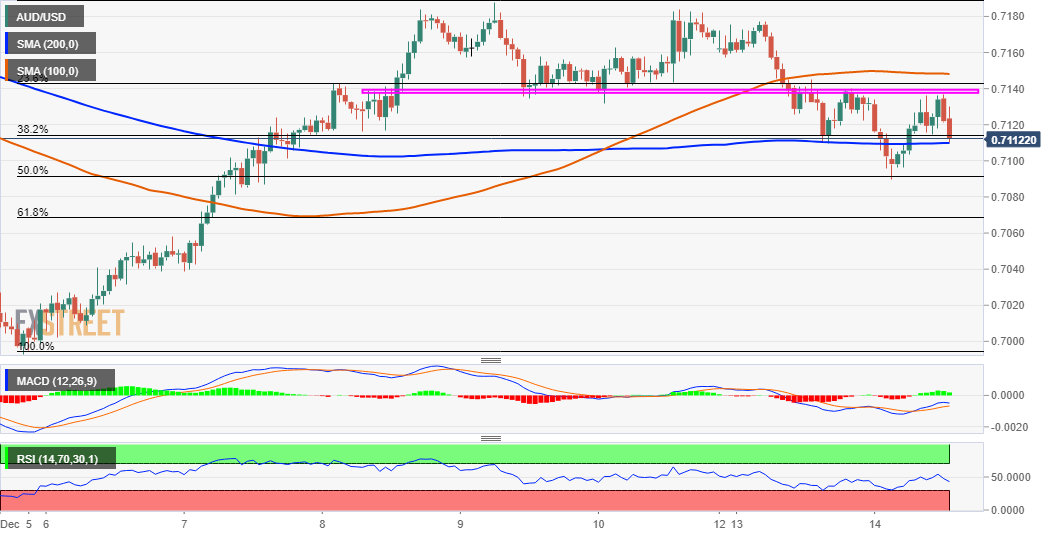
The AUD/USD pair attracted some buying near support marked by the 50% Fibonacci level of the 0.6993-0.7188 recent move up and stalled the previous day's pullback from the 0.7175-80 area. The attempted intraday recovery from a one-week low touched early this Tuesday, however, lacked bullish conviction and remained capped near the 0.7135-40 horizontal support breakpoint.
The US dollar trimmed a part of its intraday losses following the release of the hotter-than-expected US Producer Price Index, which reinforced hawkish Fed expectations. Apart from this, concerns about the potential economic fallout from the Omicron variant underpinned the safe-haven greenback. This, along with the cautious market mood, acted as a headwind for the perceived riskier aussie.
Meanwhile, technical indicators on the daily chart – though have been recovering from lower levels – are still holding in the bearish territory. Moreover, oscillators on the 1-hour chart have again started gaining negative traction and favour bearish traders. That said, it will be prudent to wait for acceptance below the 0.7100 mark before positioning for any further downfall.
The AUD/USD pair might then turn vulnerable to accelerate the slide towards intermediate support near the 0.7060 region. The downward trajectory could further get extended towards challenging the key 0.7000 psychological mark, or the YTD low set earlier this month. Some follow-through selling should pave the way for the resumption of the bearish trajectory witnessed since late October.
On the flip side, the 0.7135-40 region might continue to act as immediate resistance. Any further move up could still be seen as a selling opportunity near the 0.7175-80 zone, which if cleared decisively might negate the bearish bias. The AUD/USD pair might then surpass the 0.7200 mark and test the 0.7225 resistance before eventually aiming to reclaim the 0.7300 round number level in the near term.
AUD/USD 1-hour chart
Key levels to watch
- The YoY rate of PPI hit 9.6% in November, a fresh record high going back to 2011.
- Risk appetite took a knock, though the US dollar was little moved in response to the data.
The headline US Producer Price Index (PPI) rose at an annual pace of 9.6% in November, according to the latest report from the US Bureau of Labor Statistics on Tuesday. That marked a new series record high (PPI was first reported back in 2011) and was above the median economist forecast for 9.2%. MoM, PPI came in at 0.8% in November, also well above expectations for a 0.5% MoM gain.
In terms of the core measures of PPI, the YoY rate rose to 7.7% in November, well above expectations for 7.2% and last month's 6.8% reading. That was driven by a 0.7% MoM pace of core price growth, which exceeded expectations for a 0.4% rise and marked an acceleration from last month's 0.4% reading.
Market Reaction
Risk appetite has taken a hit in the aftermath of the latest, concerning PPI report, which shows inflationary pressures on the supply side running significantly hotter than forecast. S&P 500 futures dropped from above 4660 to current levels under 4650 and are now down about 0.7% in pre-market trade, WTI slipped under $70.50 and hit its lowest point since December 7 in the $70.20s.
The DXY has seen a two-way reaction, despite the hawkish implications the report is likely to have on Fed policymaking decisions (it will up the pressure on them to tighten policy faster). For now, the DXY continues to trade in the low-96.00s and in the red by about 0.2% on the day.
According to an article from the UK's The Sun newspaper, the UK government was warned that hospitals in the UK could be overwhelmed within four weeks and some could be forced to close and turn away patients.
- GBP/JPY regained traction on Tuesday amid a strong pickup in demand for the British pound.
- Omicron fears extended some support to the safe-haven JPY and might cap gains for the pair.
- Reduced BoE rate hike bets also warrant some caution before placing aggressive bullish bets.
The GBP/JPY cross maintained its bid tone through the mid-European session and was last seen hovering near the daily tops, around mid-150.00s.
Following the previous day's two-way price moves, the GBP/JPY cross attracted fresh buying on Tuesday and was supported by a goodish pickup in demand for the British pound. Against the backdrop of Upbeat UK employment data, a modest US dollar pullback provided a goodish lift to the sterling. Apart from this, signs of stability in the equity markets undermined the safe-haven Japanese yen and contributed to the pair's intraday move up.
Reports that two doses of Pfizer-BioNTech vaccine give 70% protection against the Omicron variant boosted investors' confidence. That said, concerns about the potential economic fallout from the spread of the new variant and the imposition of fresh restrictions in Europe and Asia kept a lid on any optimistic move in the markets. This, in turn, warrants some caution before positioning for any further appreciating move.
Apart from this, diminishing odds for an imminent interest rate hike by the Bank of England (BoE) in December, along with Brexit uncertainties should cap gains for the GBP/JPY cross. Investors might also refrain from placing aggressive bets ahead of the key central bank event risks. The BoE will announce its monetary policy decision on Thursday and the Bank of Japan meetings is scheduled on Friday. This further warrants some caution before positioning for any further appreciating move.
Even from a technical perspective, the GBP/JPY cross has been oscillating in a range over the past one week or so. This marks a consolidation phase, making it prudent to wait for a convincing break in either direction before confirming that the pair has bottomed out in the near term.
Technical levels to watch
- Spot gold prices remain capped at the $1790 area ahead of Wednesday’s Fed event.
- Precious metals will likely take their cue from the bond market reaction to the rate decision.
Spot gold (XAU/USD) prices continue to trade in a subdued manner at the start of the week, with prices remaining within this week’s pre-established $1780-$1790ish ranges. The $1790 level and the 200 and 50-day moving averages just above it (at $1793 and $1796 respectively) provide substantial resistance, as has been the case for the whole of the month so far. The $1790ish ceiling to the price action is likely to remain in place with precious metals markets now in wait-and-see mode ahead of Wednesday’s FOMC policy announcement. The bank is expected to announce plans to quicken the pace of its QE taper, whilst the updated dot plot will likely indicate multiple hikes are expected by Fed policymakers in 2022.
Ahead of the Fed meeting, there are a few key US data releases worth noting, including Tuesday’s November PPI release at 1330GMT, followed by Wednesday’s November Retail Sales release, also at 1330GMT. The former should likely show that US producers continue to face heavy inflationary pressures, with the YoY headline rate seen above 9.0%. Some are touting the risk of an upside surprise perhaps having the ability to spur some upside in US yields, which are currently mostly flat on the session, with this potentially weighing on gold.
For reference, the US 10-year nominal yield is up about 1bps on the day but remains under 1.45% and well below its pre-Omicron levels, reflecting bond market participant’s seemingly bleak outlook for the US economy’s long-term growth and inflation prospects. The US 10-year TIPS yield (the real 10-year yield) continues to trade broadly within recent ranges and is close to the -1.0% level. Data ahead of the Fed meeting is unlikely to shift the macro narrative (i.e. of a bullish, high inflation US economy) much, unless of course there is a big miss on expectations.
Should a more hawkish than expected Fed outcome on Wednesday prompt upside in real yields (and likely also the US dollar), then spot gold prices may find themselves in trouble. For now, any further rallies to $1790 likely remain a sell, with bears likely to target recent lows in the $1760s-$1770 area.
- USD/CHF witnessed some selling on Tuesday and dropped to over a one-week low.
- A modest USD profit-taking slide was seen as a key factor exerting some pressure.
- The cautious mood underpinned the safe-haven CHF and added to the selling bias.
- Hawkish Fed expectations should help limit the USD losses and lend some support.
The USD/CHF pair dropped to over one-week low in the last hour, with bears now looking to extend the downward trajectory further below the 0.9200 round-figure mark.
Following a brief consolidation earlier this Tuesday, the USD/CHF pair met with a fresh supply during the European session and extended the previous day's retracement slide from the 0.9255-65 hurdle. The US dollar witnessed a modest pullback from a one-week high, which, in turn, was seen as a key factor that exerted downward pressure on the USD/CHF pair.
On the other hand, the prevalent cautious mood around the equity markets benefitted the Swiss franc's safe-haven status and further contributed to the USD/CHF pair's intraday slide. Concerns about the potential economic fallout from the imposition of fresh restrictions in Europe and Asia turned out to be a key factor that weighed on investors' sentiment.
This, to a larger extent, overshadowed reports that two doses of the Pfizer-BioNTech vaccine give 70% protection against the new Omicron variant. That said, growing market acceptance that the Fed would tighten its monetary policy sooner rather than later to contain stubbornly high inflation helped limit the downside for the greenback and the USD/CHF pair.
The markets have been pricing in the possibility for an eventual liftoff by June 2022 and another rate hike as early as November. Investors might also refrain from placing aggressive bets, rather prefer to wait on the sidelines ahead of the highly-anticipated FOMC policy decision on Wednesday. This, in turn, warrants some caution for aggressive bearish traders.
Market participants now look forward to the release of the US Producer Price Index (PPI) for some impetus during the early North American session. Traders will take cues from developments surrounding the coronavirus saga, which will influence the broader market risk sentiment and produce some meaningful trading opportunities around the USD/CHF pair.
Technical levels to watch
- EUR/GBP is trading sideways just under 0.8550 on Thursday, the pair having ignored strong UK jobs numbers.
- The pair is in wait-and-see mode ahead of Super Thursday, when both the ECB and BoE will set policy.
EUR/GBP has been moving sideways just to the south of the 0.8550 level throughout the duration of Tuesday’s sessions as the pair enters wait-and-see mode ahead of super Thursday, a day which sees both the BoE and ECB decide on policy in quick succession. The 200-day moving average resides at 0.8560 and, in the run up to the two major central bank events, is likely to act as a ceiling, whilst support in the form of this week’s earlier lows around 0.8500 will likely act as a floor.
To recap what markets are expecting from the BoE and ECB; most expect the BoE to leave rates unchanged at 0.1% amid the recent uptick in uncertainty about the UK’s near-term outlook as the Omicron variant spreads and Covid-19 curbs are tightened. That despite calls on Tuesday from the IMF for the BoE to avoid inaction bias and get on with modest policy tightening with a focus on the 12-24 month time horizon so as to minimise the costs associated with tackling second-round inflation effects. The ECB, meanwhile, is expected to confirm that the PEPP will end in March and that the APP will have its monthly purchase rate upper on a temporary basis to avoid a cliff-edge drop in net monthly bond purchases that could roil European bond markets.
Back to EUR/GBP, the pair largely ignored Tuesday morning’s data releases. The latest UK jobs report showed employers hiring a record number of staff in November and the unemployment rate in October dropping to 4.2% as expected, in a further sign that the UK labour market weathered the end of the government’s furlough scheme in September well. Eurozone Industrial Production saw a decent 1.1% MoM recovery in output in October, only slightly below the expected 1.2% MoM pace of growth.
- EUR/USD attracted some buying on Tuesday and rallied over 50 pips from the daily low.
- The USD witnessed some profit-taking and provided a modest intraday push to the pair.
- Divergent ECB-Fed policy outlooks should cap gains ahead of the central bank meetings.
The EUR/USD pair rallied nearly 60 pips from the early European session low and was last seen trading around the 1.1320 region, up 0.35% for the day.
Reports that two doses of Pfizer-BioNTech vaccine give 70% protection against the Omicron variant prompted some selling around the safe-haven US dollar. This was seen as a key factor that assisted the EUR/USD pair to reverse an intraday dip to the 1.1265 region. That said, the prevalent cautious market mood, along with hawkish Fed expectations should help limit any deeper USD losses and cap any further gains for the major.
Investors remain concerned about the potential economic fallout from the spread of the new variant and the imposition of fresh restrictions in Europe and Asia. This, in turn, should keep a lid on any optimistic move in the financial markets. Apart from this, the prospects for an early policy tightening by the Fed should act as a tailwind for the greenback and keep a lid on any meaningful upside for the EUR/USD pair.
In fact, the money markets indicate the possibility for an eventual liftoff by June 2022 and another rate hike as early as November. Conversely, the European Central Bank (ECB) has been pushing back against bets for a tighter policy and talked down the need for any action to counter inflation. The divergence in the Fed and ECB monetary policy outlooks should further hold back traders from placing bullish bets around the EUR/USD pair.
Moreover, investors might also prefer to wait on the sidelines ahead of this week's key central bank event risks. The Fed will announce its monetary policy decision on Wednesday and the ECB meeting is scheduled on Thursday. This further makes it prudent to wait for a strong follow-through buying before traders start positioning for any meaningful appreciating move for the EUR/USD pair.
Technical levels to watch
According to a report by the IMF, UK GDP is expected to grow 6.8% in 2021, followed by 5.0% in 2022. The international financing institution said it sees inflation in the UK peaking at about 5.5% in spring 2022 in the UK. The IMF added that, due to recently imposed curbs to contain the spread of Omicron, a small slowdown is expected in UK growth in Q1 2022.
Thus, the institution said that the BoE should begin to pare back on policy stimulus, though tightening would still keep policy mostly accommodative. The BoE needs to withdraw exceptional monetary stimulus and focus on the 12-24 month time horizon rather than near-term Covid-19 trends, the IMF added. Moreover, the IMF said that because of the cost of minimising second rounds inflation impacts, the bank must avoid inaction bias. Thus, the BoE should take advantage of the earliest chance to implement a quantitative tightening programme on a pre-planned track and should provide framework guidelines for this, the IMF urged.
Market Reaction
GBP/USD has not reacted to the latest IMF report, despite the institution urging the BoE to avoid inaction bias and to get on with monetary policy tightening to curb inflationary pressures. The pair continues to trade well within recent ranges in the 1.3250 area, though up from earlier session lows around 1.3200.
- GBP/USD reversed an intraday dip to sub-1.3200 levels amid a modest USD pullback.
- Upbeat UK jobs data further underpinned the British pound and remained supportive.
- The upside seems limited ahead of the highly-anticipated FOMC/BoE policy meetings.
The intraday USD selling bias pushed the GBP/USD pair to a fresh daily high, closer to mid-1.3200s during the mid-European session.
The pair continued showing some resilience below the 1.3200 round-figure mark and attracted fresh buying on Tuesday amid a modest US dollar pullback from a one-week high. The market concerns over the spread of the Omicron eased on the back of reports that two doses of Pfizer-BioNTech vaccine give 70% protection against the new variant. This, in turn, undermined the greenback's relative safe-haven status and provided a goodish lift to the GBP/USD pair.
The British pound was further benefitted from Tuesday's upbeat UK employment details. The UK Office for National Statistics reported that the number of people claiming unemployment-related benefits declined by 49.8K in November. Adding to this, the ILO Unemployment Rate edged lower to 4.2% during the three months to October. This was seen as another factor that contributed to the GBP/USD pair's intraday positive move of over 50 pips.
That said, a further appreciating move still seems elusive amid the imposition of fresh COVID-19 restrictions in the UK and persistent Brexit uncertainties. The latest development surrounding the coronavirus saga might have forced investors to push back their expectations for an imminent interest rate hike by the Bank of England in England. This, in turn, should hold back traders from placing aggressive bullish bets around the GBP/USD pair.
Meanwhile, growing acceptance that the Fed would tighten its monetary policy sooner rather than later to contain stubbornly high inflation should limit any meaningful USD decline. In fact, the money markets indicate the possibility of an eventual liftoff by June 2022 and another hike as early as November. This could further keep a lid on any meaningful upside for the GBP/USD pair ahead of this week's key central bank event risks.
The Fed will announce the outcome of a two-day monetary policy meeting on Wednesday, while the BoE MPC is scheduled to meet on Thursday. This further makes it prudent to wait for a strong follow-through buying before confirming that the GBP/USD pair has bottomed out in the near term. Conversely, bearish traders are likely to wait for acceptance below the 1.3200 mark before positioning for an extension of the recent downward trajectory.
Market participants now look forward to the release of the US Producer Price Index (PPI) for some impetus later during the early North American session. This, along with the broader market risk sentiment, will influence the USD price dynamics and produce some short-term trading opportunities around the GBP/USD pair.
Technical levels to watch
According to a study released by South Africa's largest private health insurance administrator, Discovery Health, two doses of Pfizer-BioNTech vaccine give 70% protection against Omicron hospitalisation, as reported by Reuters.
Additional takeaways
"Two doses of Pfizer-BioNTech vaccine give 33% protection against infection during current wave."
"Study suggests risk of reinfection during current wave significantly higher than during previous waves."
"Study finds risk of hospitalisation among adults diagnosed with COVID-19 is 29% lower compared to infection in South Africa's first wave, adjusting for vaccination status."
"Study finds children have 20% higher risk of hospital admission with complications relative to the first wave, despite the very low absolute incidence."
"Analysis includes more than 211,000 positive COVID-19 test results, roughly 78,000 of which were attributed to Omicron, over Nov. 15-Dec. 7."
Market reaction
This headline doesn't seem to be having a significant impact on market sentiment. As of writing, the S&P Futures were flat on the day.
- USD/CAD struggled to capitalize on its modest intraday gains to over a one-week high.
- An uptick in oil prices underpinned the loonie and kept a lid on any meaningful gains.
- Hawkish Fed expectations extended support to the USD and help limit the downside.
The USD/CAD pair recovered a few pips from the early European session low and was last seen trading with modest intraday gains, just above the 1.2800 round-figure mark.
A combination of factors failed to assist the USD/CAD pair to capitalize on its early uptick to an over one-week high and led to a subdued/range-bound price move on Tuesday. Crude oil prices regained positive traction and recovered a major part of the overnight retracement slide. This, in turn, underpinned the commodity-linked loonie and acted as a headwind for the USD/CAD pair.
On the other hand, the US dollar struggled to preserve its modest intraday gains and was seen consolidating near a one-week high. This was seen as another factor that kept a lid on any meaningful upside for the USD/CAD pair. The downside, however, remains cushioned amid uncertainty over the economic risks stemming from the spread of the Omicron variant and hawkish Fed expectations.
Worries that the imposition of fresh COVID-19 restrictions in Europe and Asia could dent fuel demand could cap gains for crude oil prices. Apart from this, growing acceptance that the Fed would tighten its monetary policy sooner than expected should limit any meaningful USD downside. This, in turn, should hold back traders from placing any bearish bets on the USD/CAD pair.
Investors might also prefer to wait on the sidelines heading into the key central bank event risk like the highly-anticipated FOMC monetary policy decision on Wednesday. Hence, it will be prudent to wait for strong follow-through selling before confirming that the USD/CAD pair's recent move up from the 1.2600 neighbourhood has run out of steam.
Market participants now look forward to the release of the US Producer Price Index (PPI), due later during the early North American session. Apart from this, the broader market risk sentiment will influence the USD demand and provide some impetus to the USD/CAD pair. Traders will further take cues from oil price dynamics to grab some short-term opportunities around the major.
Technical levels to watch
Germany’s IFO institute sharply revised down the country’s GDP growth projections from 5.1% to 3.7% for 2022 amid dwindling economic recovery due to the fourth covid wave.
Key takeaways
Supply bottlenecks, fourth covid wave further delay economic recovery.
Lifts 2023 GDP growth forecast to 2.9% from 1.5%.
Expects GDP in Q4 2021 to shrink by 0.5% QoQ stagnate in Q1 2022.
Confirms 2021 GDP growth forecast of 2.5%.
Related reads
- German Economy Ministry: Coronavirus situation puts brakes on economic recovery
- EUR/USD Forecast: Bears remain in control ahead of key central bank meetings
- USD/TRY looks to retest record highs of 14.64 on Tuesday.
- Lira gives up Turkey’s central bank intervention-led brief rebound.
- Overbought RSI fails to deter the USD/TRY bulls ahead of the Fed.
USD/TRY is rebounding towards the all-time highs of 14.64 in the European trading this Tuesday, having corrected sharply to sub-14.00 levels a day before.
The quick retracement in the pair came after the lira was rescued by the Turkish central bank (CBRT) intervention in the forex exchange market, by selling the US dollar.
The CBRT played its hands for the third time this month to stem the relentless fall in the local currency.
Expectations of a CBRT rate cut are likely the main reason behind the lira’s turmoil. On Monday, Turkish Finance Minister Nureddin Nebati said the country is determined not to raise interest rates, voicing President Recep Tayyip Erdogan’s bold stance against raising rates.
The only that can save the lira from additional declines is a dovish surprise from the Fed on Wednesday, which could knock down the greenback across the board, in turn, weighing heavily on USD/TRY.
Looking at USD/TRY’s technical chart, the bulls have recaptured the 14.00 barrier, in a sharp comeback after closing in the red on Monday, the first time in four trading days.
Bulls will now challenge the immediate upside at the 14.50 psychological level, above which the record highs will be put to test once again.
The Relative Strength Index (RSI) is inching higher while within the overbought region, suggesting that there is some room to rise for the spot.
USD/TRY: Daily chart
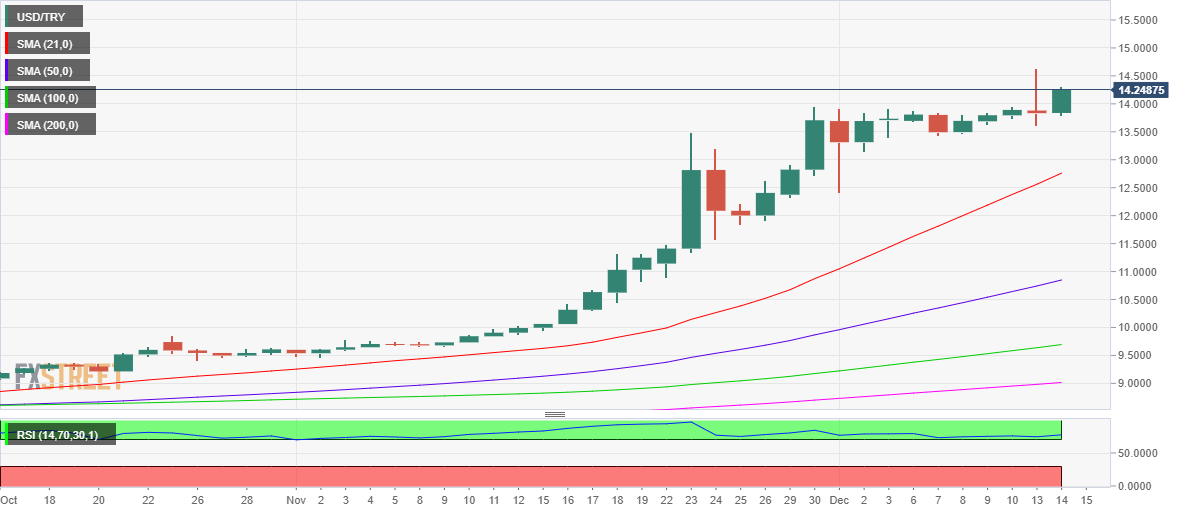
On the flip side, any retracement could test the bullish commitments at Monday’s low of 13.61.
The recent range lows of around 13.40 could cap the additional corrective declines.
Selling interest will revive below the latter, calling for a retest of the upward-pointing 21-Daily Moving Average (DMA) at 12.76.
In its monthly oil market report, the International Energy Agency (IEA) revised down oil demand outlook by around 100,000 bpd for both 2021 and 2022, citing the emergence of the Omicron variant to dent global demand for oil.
Key points
If OPEC+ continues to unwind cuts, oil surplus of 1.7 mln bpd could materialise in 1Q22, 2 mln bpd in 2Q22.
Saudi Arabia and Russia could hit record annual production levels in 2022 if OPEC+ cuts fully unwound.
OECD industry stocks fell by 21 mln barrels in oct to 2.737 billion barrels, 240 mln barrels below five-year average.
Biggest single increase in oil output came from the US for a second month in a row.
Global supply could soar by 6.4 mln bpd next year compared with a 1.5 mln bpd rise in 2021.
World oil supply set to overtake demand starting this month.
Demand for road transport fuels and petrochemical feedstocks to continue to grow but jet fuel use will fall.
New COVID-19 cases are expected to temporarily slow but not upend recovery in oil demand.
Market reaction
WTI has eased from daily highs of $71.80 on the IEA report. The US oil now trades at $71.52, still adding 0.74% on the day.
The German Economy Ministry is out with its latest outlook on the economy, citing a weak final quarter of 2021.
Key takeaways
Coronavirus situation puts brakes on economic recovery.
Expects weak development for GDP in Q4 2021.
Less than a fifth of companies believe supply chain situation will improve by February 2022.
Despite bottlenecks, outlook for exports looks positive.
more to come ....
- NZD/USD attracted some buying near 0.6735, or a fresh YTD low touched earlier this Tuesday.
- A positive tone around the equity markets extended some support to the perceived riskier kiwi.
- COVID-19 woes, hawkish Fed expectations acted as a tailwind for the USD and capped the upside.
The NZD/USD pair moved back above mid-0.6700s during the early European session, albeit struggled to capitalize on the intraday recovery from a fresh YTD low.
The pair edged lower during the early part of the trading on Tuesday and dropped to the lowest level since November 2020, though a combination of supporting factors helped limit further losses. A slight improvement in the global risk sentiment – as depicted by a generally positive tone around the equity markets – extended some support to the perceived riskier kiwi.
On the other hand, the US dollar struggled to preserve its modest intraday gains to a one-week high and was seen consolidating near a one-week high. This was seen as another factor that assisted the NZD/USD pair to attract some buying near the 0.6735 region. That said, any meaningful recovery still seems elusive amid fresh COVID-19 jitters and hawkish Fed expectations.
The economic risks emerging from the spread of the Omicron variant and the imposition of fresh restrictions in Europe and Asia should keep a lid on any optimistic move in the markets. Moreover, the prospects for an early policy tightening by the Fed should act as a tailwind for the greenback and hold back traders from placing bullish bets around the NZD/USD pair.
Investors might also prefer to wait on the sidelines and look for a fresh catalyst from the outcome of a two-day FOMC monetary policy meeting, scheduled to be announced on Wednesday. This further makes it prudent to wait for a strong follow-through buying before confirming that the NZD/USD pair has bottomed out in the near term and positioning for any meaningful upside.
Heading into the key central bank event risk, trades on Tuesday might take cues from the release of the US Producer Price Index (PPI) later during the early North American session. Apart from this, developments surrounding the coronavirus saga and the broader market risk sentiment will also be looked upon for some short-term opportunities around the NZD/USD pair.
Technical levels to watch
- Gold price drops as the US dollar rises on a risk-off market profile.
- Wednesday’s Fed decision to provide the next decisive move in gold price.
- Gold at the mercy of the Fed, ascending triangle pattern in play.
Where is gold price headed? Markets are eagerly looking forward to the Fed decision, as the two-day FOMC meeting kicks off on Tuesday. Ahead of the Fed verdict, the Omicron covid variant fears have gripped the market, putting a fresh bid under the safe-haven US dollar at gold’s expense. Meanwhile, the Treasury yields hold steady on expectations of faster Fed’s tapering and hint at a mid-2022 rate hike.
Read: Gold Price Forecast: XAU/USD bull-bear tug-of-war likely to extend but upside risks likely
Gold Price: Key levels to watch
The Technical Confluences Detector shows that the gold price continues to run into strong offers at $1,790, which is the meeting point of the SMA100 one-day, Fibonacci 23.6% one-day and SMA100 four-hour.
A decisive break above the latter could unleash the additional recovery towards the next powerful resistance at $1,793. At that level, the SMA200 one-day coincides with the previous week’s high and pivot point one-week R1.
Gold bulls will then target $1,796, the confluence of the pivot point one-day R2 and SMA50 one-day.
A dense cluster of healthy resistance levels awaits at $1,804, the convergence of the Fibonacci 38.2% one-month, pivot point one-week R2 and pivot point one-day R3.
Alternatively, the selling momentum could accelerate below the pivot point one-day S1 at $1,781.
Gold bears will then challenge the downside target at $1,779, where the Fibonacci 38.2% one-week meets with the SMA10 one-day.
Further south, the intersection of the Fibonacci 161.8% and Fibonacci 23.6% one-week at $1,775.
The last line of defense for gold buyers is the previous week’s low of $1,770.
Here is how it looks on the tool
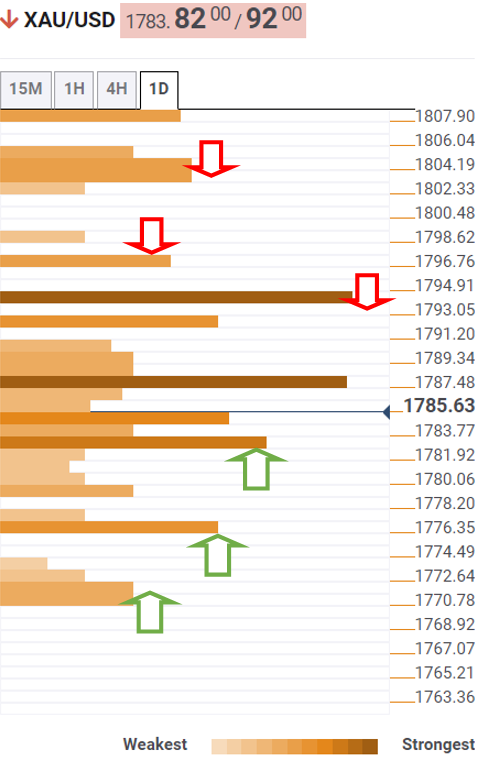
About Technical Confluences Detector
The TCD (Technical Confluences Detector) is a tool to locate and point out those price levels where there is a congestion of indicators, moving averages, Fibonacci levels, Pivot Points, etc. If you are a short-term trader, you will find entry points for counter-trend strategies and hunt a few points at a time. If you are a medium-to-long-term trader, this tool will allow you to know in advance the price levels where a medium-to-long-term trend may stop and rest, where to unwind positions, or where to increase your position size.
- AUD/USD attracted some dip-buying on Tuesday and reversed an early dip to sub-0.7100 levels.
- Signs of stability in the equity markets extended some support to the perceived riskier aussie.
- COVID-19 jitters should cap gains amid a modest USD strength ahead of the key FOMC decision.
The AUD/USD pair has managed to recover a major part of its intraday losses and was last seen trading just a few pips below the daily swing high, around the 0.7125-30 region.
The pair extended the previous day's retracement slide from the 0.7175-80 region, or a two-week high, and witnessed some selling during the early part of the trading on Tuesday. The intraday decline was sponsored by a combination of factors, though bulls showed some resilience below the 0.7100 round-figure mark.
Renewed concerns about the economic risks emerging from the spread of the Omicron variant continued weighing on investors' sentiment. This, along with a rise in daily coronavirus cases in Australia's largest state by population (New South Wales), undermined the perceived riskier aussie amid a modest US dollar strength.
The USD stood tall near a one-week high and remained supported by expectations that the Fed would tighten its monetary policy sooner rather than later to contain stubbornly high inflation. In fact, the money markets indicate the possibility of an eventual liftoff by June 2022 and another hike as early as November.
The downside, however, remains cushioned as investors seemed reluctant to place aggressive bets and preferred to wait for the outcome of a two-day FOMC monetary policy meeting. Apart from this, signs of stability in the equity markets assisted the AUD/USD pair to attract some dip-buying near the 0.7090 region.
Market participants now look forward to the release of the US Producer Price Index, due later during the early North American session. Traders will further take cues from the broader market risk sentiment to grab some short-term opportunities around the AUD/USD pair ahead of the Chinese data dump on Wednesday.
Meanwhile, the focus will remain on the FOMC decision, scheduled to be announced on Wednesday. The Fed is widely expected to signal a faster wind-down of its monthly bond-buying program and move a step closer to raising rates. This, in turn, will drive the USD and determine the near-term trajectory for the AUD/USD pair.
Technical levels to watch
- EUR/USD struggled to gain any meaningful traction and was pressured by a modest USD strength.
- The ECB-Fed policy divergence was seen as another factor that acted as a headwind for the major.
- The downside seems limited as traders seemed reluctant ahead of the key central bank event risks.
The EUR/USD pair remained on the defensive through the early European session and was last seen trading around the 1.1275-70 region, just a few pips above the overnight swing low.
The US dollar stood tall near a one-week high amid firming expectations that the Fed would tighten its monetary policy sooner rather than later to contain stubbornly high inflation. Apart from this, fresh concerns about the economic risks emerging from the spread of the Omicron variant of the coronavirus further benefitted the greenback's safe-haven status.
Conversely, a more dovish stance adopted by the European Central Bank (ECB) undermined the shared currency and exerted some pressure on the EUR/USD pair. In fact, the ECB policymakers have talked down the need for any action to counter inflation. The divergence in monetary policy outlooks between the Fed and the ECB acted as a headwind for the EUR/USD pair.
The downside, however, remains cushioned, at least for the time being, as investors preferred to wait on the sidelines ahead of the key central bank event risks. The Fed will announce its monetary policy decision on Wednesday and the ECB meeting is scheduled on Thursday. The outcome will determine the next leg of a directional move for the EUR/USD pair.
In the meantime, traders might take cues from the release of the Eurozone Industrial Production data, which will be followed by the US Producer Price Index later during the early North American session. Apart from this, the broader market risk sentiment will influence the USD price dynamics and produce some trading opportunities around the EUR/USD pair.
Technical levels to watch
Here is what you need to know on Tuesday, December 14:
The dollar preserves its strength against its major rivals on Tuesday with the US Dollar Index edging higher toward mid-96.00s after gaining 0.33% on Monday. Ahead of this week's critical central bank meetings, the risk-averse market environment seems to be helping the greenback find demand. Later in the day, October Industrial Production data from the euro area and November Producer Price Index (PPI) from the US will be looked upon for fresh impetus. Investors will keep a close eye on fresh developments surrounding the coronavirus Omicron variant as well.
According to the latest reports, at least 20 manufacturing companies in China's Zheijang provide have shut down their operations due to the spread of the virus. The UK Health Agency reported that omicron infections were running at 200,000 a day and the number of confirmed infections in Australia’s largest state, New South Wales, reached its highest level in more than two months. Reflecting the sour market mood, Wall Street's main indexes closed deep in the negative territory, Shanghai Composite is down 0.55% and Nikkei 225 fell 0.73%. In the early European session on Tuesday, US stock index futures are trading flat.
EUR/USD closed below 1.1300 on Monday and stays relatively quiet around 1.1270 early Tuesday.
GBP/USD holds steady around 1.3200. The data published by the UK's Office for National Statistics revealed on Tuesday that the ILO Unemployment Rate declined to 4.2% in October as expected.
USD/JPY clings to small gains above 113.50. Reuters reported on Tuesday that the Bank of Japan (BoJ) has offered to inject a total of 11 trillion yen into markets to drive down interest rates.
Gold continues to fluctuate within a narrow band below $1,800 as investors refrain from making large bets ahead of the Fed's policy announcements.
AUD/USD dropped below 0.7100 during the Asian trading hours for the first time in a week. The National Australia Bank's Business Confidence Index slumped to 12 in November from 20 in October.
USD/CAD consolidates Monday's gains around 1.2800. The Bank of Canada's Policy Framework Review revealed on Monday that the bank concerns over inflation are heightened to the upside "much more than usual."
Bitcoin fell more than 6% on Monday after failing to break above $50,000 and trades flat around $46,700 early Tuesday. Ethereum stays under bearish pressure and continues to push lower toward the multi-week lows it set at $3,575 earlier in the month.
- GBP/USD struggled to gain any meaningful traction amid a modest USD strength.
- Upbeat UK employment details failed to impress bulls or provide a fresh impetus.
- Reduced BoE rate hike bets acted as a headwind amid Brexit-related uncertainties.
The GBP/USD pair held steady above the 1.3200 round-figure mark and moved little following the release of the UK monthly employment details.
The UK Office for National Statistics reported that the number of people claiming unemployment-related benefits dropped by 49.8K in November as against the 14.9K fall in the previous month. Adding to this, the ILO Unemployment Rate edge lower from 4.3% to 4.2% during the three months to October. Further details revealed that wage pressures moderated slightly going into year-end.
The data, however, did little to provide any meaningful impetus to the British pound amid diminishing odds for an imminent interest rate hike by the Bank of England at its upcoming meeting on Thursday. This, along with persistent Brexit uncertainties, continued acting as a headwind for the sterling and capped the upside for the GBP/USD pair amid a modest US dollar strength.
The greenback stood tall near a one-week high and remained well supported by the prospects for an early policy tightening by the Fed. In fact, the money markets indicate the possibility of an eventual liftoff by June 2022 and another hike as early as November. Apart from this, economic risks emerging from the spread of the Omicron variant further underpinned the safe-haven USD.
Meanwhile, the GBP/USD pair's inability to gain any meaningful traction suggests that the recent bearish trend witnessed since October might still be far from being over. That said, investors might refrain from placing aggressive bets ahead of the key central bank event risks. The Fed will announce its policy decision on Wednesday and the BoE meeting is scheduled on Thursday.
Hence, it will be prudent to wait for acceptance below the 1.3200 mark before positioning for any further depreciating move. Market participants now look forward to the US Producer Price Index for some impetus later during the early North American session. Trades will further take cues from the broader market risk sentiment to grab some opportunities around the GBP/USD pair.
Technical levels to watch
- UK claimant count change arrived at -49.8K in November.
- The unemployment rate in the UK dropped to 4.2% in October.
- The UK wages excluding bonuses fell to 4.3% YoY vs. 4.0% expected.
The Office for National Statistics (ONS) showed on Tuesday, the UK’s official jobless rate matched market expectations, by arriving at 4.2% in October vs. the previous 4.3% and 4.2% expected while the claimant count change showed a big drop last month from the previous.
The number of people claiming jobless benefits showed a drop of 49.8K in November when compared to -14.9K registered previously. The claimant count rate came in at 4.9% vs. 5.0% last.
The UK’s average weekly earnings, excluding bonuses, arrived at 4.3% 3Mo/YoY in October versus +5.0% last and +4.0% expected while the gauge including bonuses came in at 4.9% 3Mo/YoY in October versus +5.9% previous and +4.5% expected.
Key points (via ONS)
UK LFS employment +149k 3m/3m in 3 months to October.
UK vacancies hit a record 1.219 million in three months to November.
GBP/USD reaction
GBP/USD keeps the rebound intact above 1.3200 on the upbeat UK jobs report.
The spot was last seen trading at 1.3213, down 0.04% on the day, courtesy of a pause in the US dollar buying across the board.
About UK jobs
The UK Average Earnings released by the Office for National Statistics (ONS) is a key short-term indicator of how levels of pay are changing within the UK economy. Generally speaking, the positive earnings growth anticipates positive (or bullish) for the GBP, whereas a low reading is seen as negative (or bearish).
- EUR/GBP refreshes intraday low, grinds higher around 20-SMA.
- Receding bearish bias of MACD, firmer RSI line keeps buyers hopeful.
- Eight-day-old support line, 200-SMA restrict short-term downside.
EUR/GBP remains on the back foot around daily lows near 0.8535, down 0.07% intraday ahead of the UK jobs report, up for publishing amid early Tuesday.
Also read: When are the UK jobs and how could they affect GBP/USD?
The cross-currency pair’s latest pullback could be linked to the failure to cross a one-week-old resistance line and the 20-SMA. However, easing the bearish bias of the MACD and steady RSI hints at the further upside of the quote.
That said, a clear run-up beyond the nearby SMA and trend line resistance, around 0.8540 and 0.8550 respectively, will become necessary for the EUR/GBP bulls to retake controls.
Following that, 0.8575 and the monthly peak surrounding 0.8600 will be crucial to watch.
Alternatively, further weakness will aim for an ascending trend line from December 02, at 0.8500 by the press time.
It should be noted, however, that a clear downside break of the 0.8500 threshold will confirm a head-and-shoulders bearish chart pattern, which in turn directs EUR/GBP sellers towards late November lows near 0.8485.
Though, the 200-SMA level of 0.8492 will act as a validation point for the downside.
EUR/GBP: Four-hour chart
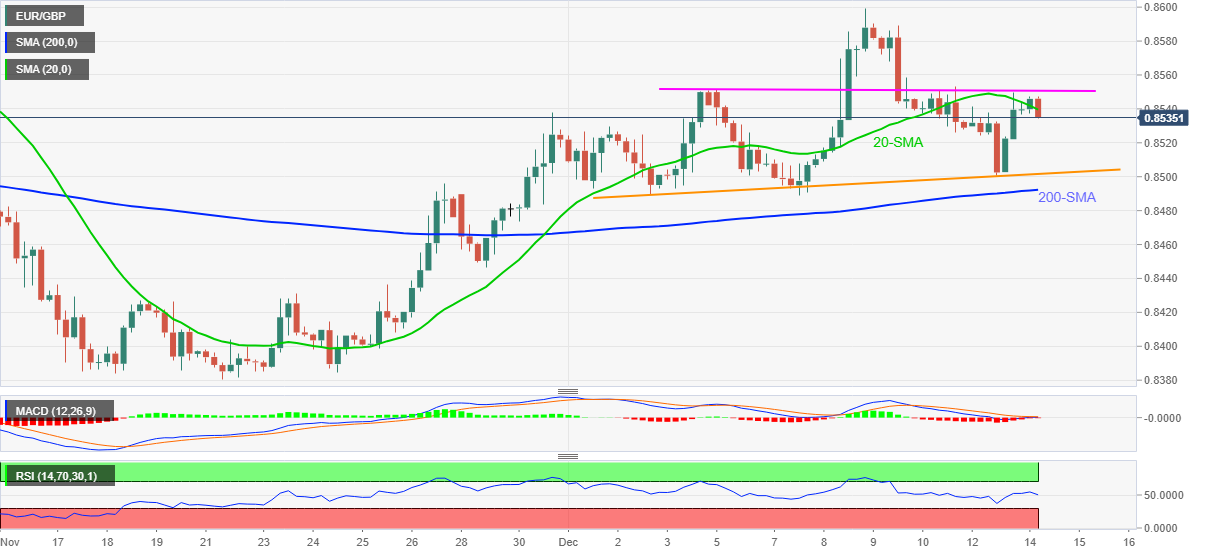
Trend: Further upside expected
- USD/JPY struggled to gain any meaningful traction and remained confined in a range on Tuesday.
- Hawkish Fed expectations continued acting as a tailwind for the USD and extended some support.
- COVID-19 jitters underpinned the safe-haven JPY and capped gains amid declining US bond yields.
The USD/JPY pair oscillated in a narrow trading band through the Asian session and was last seen hovering in the neutral territory, just above mid-113.00s.
A combination of diverging forces failed to assist the USD/JPY pair to capitalize on the previous day's modest gains and led to a subdued/range-bound price move on Tuesday. The US dollar stood tall near a one-week high and remained well supported by the prospects for an early policy tightening by the Fed. That said, a generally softer risk tone underpinned the safe-haven Japanese yen and kept a lid on any further gains for the major.
The US CPI report for November released on Friday reaffirmed market expectations that the Fed would adopt a more aggressive policy response to contain stubbornly high inflation. In fact, the money markets indicate the possibility of liftoff by June 2022 and another hike as early as November. This, in turn, was seen as a key factor that continued acting as a tailwind for the greenback and extended some support to the USD/JPY pair.
Apart from this, renewed concerns about the economic risks emerging from the spread of the Omicron variant of the coronavirus tempered investors' appetite for riskier assets. This was evident from the prevalent cautious mood around the equity markets, which drove some haven flows towards the JPY. The flight to safety was evident from a further decline in the US Treasury bond yields, which further capped the upside for the USD/JPY pair.
Moving ahead, market participants now look forward to the release of the US Producer Price Index (PPI) later during the early North American session. This, along with the US bond yields, will influence the USD price dynamics and provide some impetus to the USD/JPY pair. Traders will further take cues from the broader market risk sentiment.
The key focus, however, will remain on the outcome of a two-day FOMC monetary policy meeting. The US central bank is scheduled to announce its decision on Wednesday, which will play a key role in driving the USD demand in the near term. Apart from this, developments surrounding the coronavirus saga would determine the next leg of a directional move for the USD/JPY pair.
Technical levels to watch
- Gold prices benefit from risk-off mood, EUR weakness adds to the XAU/EUR strength.
- Omicron fears escalate, China, inflation-linked stories add strength to sour sentiment.
- Yields dwindle, stock futures print mild gains amid anxious markets.
- Gold Price Forecast: Risk-off underpins the bright metal in the near term
Gold (XAU/EUR) prints a three-day uptrend of around €1,600 while poking the weekly top amid Tuesday’s European morning. The yellow metal not only cheers the safe-haven demand but also benefits from the regional currency’s weakness.
Omicron fears and cautious sentiment ahead of the key central bank meetings can be linked to the market’s rush to risk safety. Adding to the sour sentiment were the chatters surrounding China and geopolitics.
Following the UK’s first Omicron-linked death and return of the mask mandate in California, Australia’s largest state, population-wise, New South Wales (NSW) reports the highest daily virus infections tally in more than two months.
Market chatters that Hong Kong-listed Shimao Group. is up for activating another China-linked financial crisis and concerns over Beijing’s growth, as raised by the Asian Development Bank (ADB), weigh on the sentiment.
Furthermore, Bloomberg’s news mentioning that the US House of Representatives and the Senate inch closer to an agreement over the Uyghur Bill aimed at China hints at escalated US-China tussles. On the same line was the latest update from Axios saying, “White House National Security Adviser Sullivan to visit Israel next week to discuss Iran.”
Against this backdrop, the US 10-year Treasury yields seesaw around 1.42% whereas the S&P 500 Futures rise 0.15% at the latest. Also portraying the risk-off mood is the firmer US Dollar Index (DXY) and downbeat EUR/USD prices.
Moving on, the Fed versus ECB drama is likely a big hit during the week as policymakers from the bloc are less hawkish, despite repeatedly failing to convince traders, than their counterparts at the US Federal Reserve. As a result, Wednesday’s FOMC and Thursday’s ECB will be crucial for the XAU/EUR traders. Even so, the virus updates and risk catalysts can offer intermediate clues to watch.
Technical analysis
XAU/EUR holds onto the bounce off 50-DMA and an ascending support line from late September amid the receding bearish bias of the MACD.
Given the recent higher-low formations, the gold prices are likely to extend the latest rebound towards the monthly resistance line near €1,590. However, a clear upside break of the stated resistance line will help the gold prices to revisit the €1,600 threshold and the €1,635 resistances.
Meanwhile, a convergence of the 50-DMA and aforementioned support line, around €1,568, restricts short-term declines of gold prices.
In a case where the XAU/EUR drops below €1,568, an ascending trend line from August, at €1,568 by the press time, will be crucial to watch as a break of which will direct bears towards November’s low of €1,524.
To sum up, gold prices regain upside momentum but the bulls have a bumpy road ahead.
Gold: Daily chart
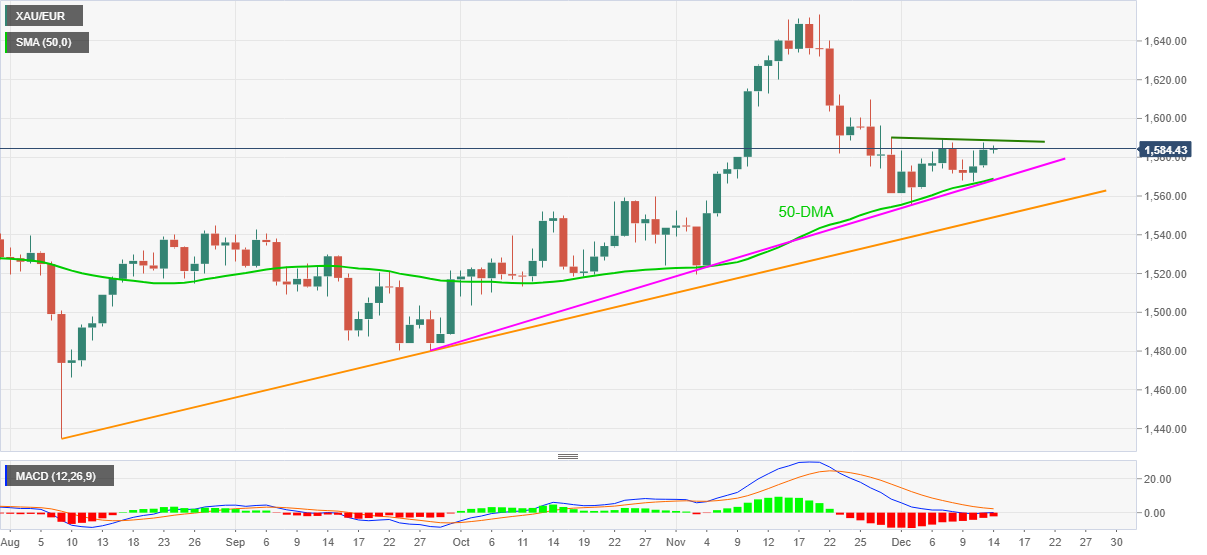
Trend: Pullback expected
According to an influential Chinese think tank called China Finance 40 Forum, the People’s Bank of China (PBOC) needs to cut the interest rates and boost infrastructure investment to achieve its 5% growth target in 2022.
more to come ....
- USD/CAD struggles to extend four-day bounce off late-November lows, oil consolidates intraday losses.
- Sentiment sours as Omicron fears spread, market anxiety ahead of key central bank meetings adds to the risk-off mood.
- BOC’s Macklem cited concerns to bring inflation back to the 2.0% target.
USD/CAD grinds higher around the weekly top, recently easing from intraday high to 1.2820 ahead of Tuesday’s European session. In doing so, the Loonie pair probes the previous four-day run-up from the lowest levels since November 19.
While the bulls can rely on the risk-off mood, the latest swing in the prices of Canada’s key export item, WTI crude oil, could be linked to the USD/CAD pullback. That said, WTI crude oil bounces off an intraday low to regain $71.00 at the latest.
Behind the oil’s recovery moves could be comments from Saudi Arabian Oil Minister Abdulaziz bin Salman who warned of a 30% drop in oil output by the end of this decade due to falling capital investment. Also in the line were geopolitical fears concerning the US-Iran and the Sino-American diplomatic ties.
It's worth noting, however, that the market sentiment remains sour and underpins the US dollar’s safe-haven demand. While portraying the sentiment, the US 10-year Treasury yields seesaw around 1.42% whereas the S&P 500 Futures rise 0.15% at the latest. Furthermore, shares in Japan, Australia, New Zealand and China trade mixed by the press time.
Following the UK’s first Omicron-linked death and return of the mask mandate in California, Australia’s largest state, population-wise, New South Wales (NSW) reports the highest daily virus infections tally in more than two months. The virus woes pushed the finance ministers and central bank governors of the Group of Seven (G7) nations to pledge more efforts to combat the pandemic. Additionally, the Asian Development Bank (ADB) cut growth forecasts for developing Asia due to the same reason, per Reuters.
On Monday, Bank of Canada Governor Tiff Macklem said that the BoC was currently focused on bringing inflation back down to target without choking off Canada's economic recovery, in a post-Framework Review speech alongside Canadian Finance Minister Chrystia Freeland. The Canadian central bank left the five-year inflation rate unchanged at 2.0%.
Looking forward, the US Producer Price Index (PPI) for November, expected 9.2% YoY versus 8.6% prior, may offer intraday direction to the AUD/USD prices but major attention will be given to the risk catalysts.
Technical analysis
Although 10-DMA guards immediate USD/CAD declines around 1.2760, the monthly peak surrounding 1.2850 appears as a tough nut crack for the bulls.
- AUD/USD is off the lows but remains vulnerable after rejection at higher levels.
- Escalating fears over the Omicron covid variant contagion hits the aussie.
- Bearish crossover and RSI keep the downside open towards 0.7050.
AUD/USD is reversing a brief dip below 0.7100 but the bearish bias remains intact amid a broadly firmer US dollar and the prevalent risk-off market profile.
Fears over the rapid spread of the Omicron covid variant worldwide, with the Australian state of New South Wales (NSW) reporting a spike in covid cases, weigh heavily on the high-beta currencies such as the aussie dollar. Further, mixed NAB Business Survey added to the pain in the aussie.
Markets will likely remain cautious ahead of Wednesday’s Fed policy decision and Thursday’s Australian employment data.
Looking at AUD/USD’s daily chart, the pair is extending the previous pullback after facing rejection once again at the bearish 21-Daily Moving Average (DMA), now at 0.7161.
The 14-Day Relative Strength Index (RSI) is inching lower below the midline, allowing room for more declines.
The downside bias is also backed by the bear cross confirmed on the daily time frame on Monday. The 50-DMA pierced through the 100-DMA from above, flashing the bearish signal.
The next relevant support is seen at the 0.7050 psychological level if the daily lows of 0.7090 cave in.
AUD/USD: Daily chart
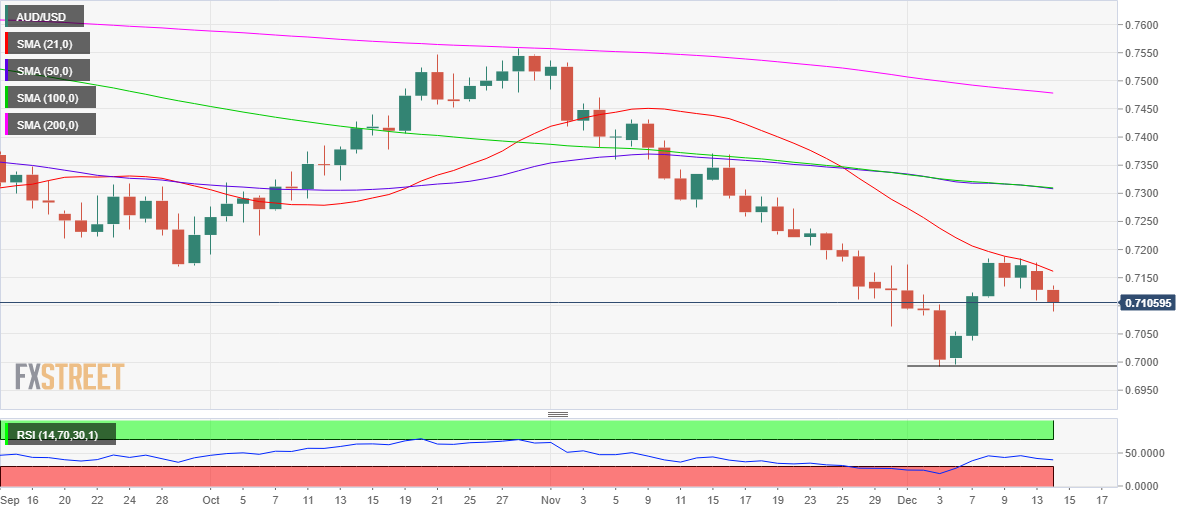
On the flip side, buyers will need acceptance above the 21-DMA cap to extend the recovery from yearly lows of 0.6993 reached a week ago.
Further up, the recent range highs around 0.7185 could come into play, opening doors for a rally towards 0.7250.
AUD/USD: Additional levels to consider
- Asian equity markets remain pressured as Omicron woes join cautious mood ahead of the key central bank meeting.
- Japan braces for huge liquidity injection, China’s Shimao Group adds to the financial market risks.
- ADB slashes growth forecasts for developing Asia economies.
Risks dwindle during early Tuesday in Europe, also inflicting losses to Asia-Pacific markets, as the COVID-19 variant spreads faster outside the origins of late. Adding to the risk-off mood was the market’s anxiety over the next moves of critical central bank decisions scheduled for Wednesday and Thursday, including the US Federal Reserve (Fed) and the European Central Bank (ECB).
To portray the mood, MSCI’s index of Asia ex-Japan shares drops around 1.0% whereas Japan’s Nikkei 225 also marked 0.85% loss by the press time even as the Bank of Japan (BOJ) offers huge liquidity injection to defend rates.
Following the UK’s first Omicron-linked death and return of the mask mandate in California, Australia’s largest state, population-wise, New South Wales (NSW) reports the highest daily virus infections tally in more than two months. The virus woes pushed the finance ministers and central bank governors of the Group of Seven (G7) nations to pledge more efforts to combat the pandemic. Additionally, the Asian Development Bank (ADB) cut growth forecasts for developing Asia due to the same reason, per Reuters.
The ADB cuts the economic forecast for China by 0.1% and 0.2% for 2021 and 2022 and drags the Beijing-based shares. Also weighing on the Chinese equities are the market fears that Hong Kong-listed Shimao Group. “Chinese property stocks sank for a third day, heading for the lowest level since early 2017, after a deal between units of Shimao Group Holdings Ltd. heightened governance concerns in an industry already grappling with a liquidity squeeze,” said Bloomberg.
Elsewhere, Australia’s largest state, population-wise, New South Wales (NSW) reports the highest daily virus infections tally in more than two months and weigh on the Aussie and Kiwi stocks. Markets in South Korea and India follow the trend while those from Indonesia print mild gains despite earth-quake and Tsunami threats.
On a broader front, the US 10-year Treasury yields seesaw around 1.42% whereas the S&P 500 Futures rise 0.15% at the latest.
As the economic calendar turn active from Wednesday, investors may remain cautious ahead of that. However, the virus updates and other risk catalysts may challenge the optimists.
Read: Yields test weekly low, S&P 500 Futures print mild gains amid coronavirus, Fed concerns
UK Jobs report overview
Early Tuesday, the UK’s Office for National Statistics (ONS) will release the November month Claimant Count figures together with the Unemployment Rate in the three months to October at 06:00 AM GMT.
Although the furlough schemes seem to have a future considering the latest outbreak of the Omicron covid variant in the UK, the Bank of England (BOE) is yet to dump the bullish side, which in turn highlight today’s British jobs report as an important catalyst for the GBP/USD traders ahead of Thursday’s BOE meeting.
The UK labor market report is expected to show that the average weekly earnings, including bonuses, in the three months to October, ease from the previous 5.8% to 4.5%, while ex-bonuses, the wages are seen declining from 4.9% to 4.0% during the stated period.
Further, the ILO Unemployment Rate favors upbeat signals of the employment data as forecasts suggest figures to ease to 4.2% from 4.3% for the three months ending in October. It’s worth noting that the Claimant Count Change figures dropped by -14.9K in October while the Claimant Count Rate was 5.1% during the stated month.
Deviation impact on GBP/USD
Readers can find FXStreet's proprietary deviation impact map of the event below. As observed the reaction is likely to remain confined around 20-pips in deviations up to + or -2, although in some cases, if notable enough, a deviation can fuel movements over 60-70 pips.
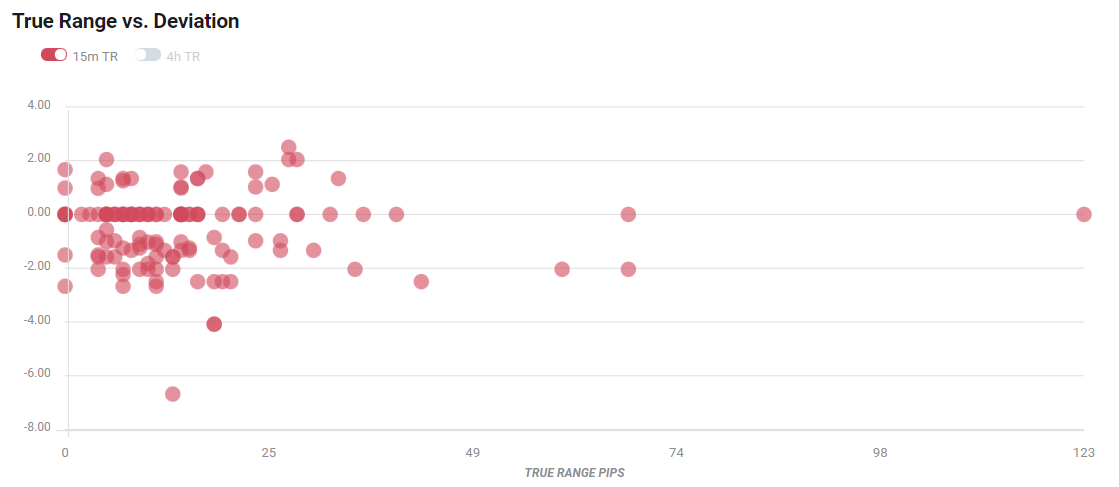
How could they affect GBP/USD?
GBP/USD bears the burden of the Omicron woes while tracking other majors to print mild losses heading into Tuesday’s London open. That said, the quote drops for the second consecutive day, reversing the previous bounce of yearly low.
In addition to the first covid variant-linked death in the UK and return of the partial activity restrictions and anxiety ahead of Wednesday’s Fed meeting, as well as Thursday’s BOE performance, also weigh on the GBP/USD prices of late.
That said, the UK employment data may offer intermediate direction to the GBP/USD prices but may witness a milder response as global markets remain most interested in the Omicron updates. Another reason is the return of the lockdowns and the jump in the virus cases in the UK that suggests hardships of British employment and inflation conditions going forward, which in turn could stop the BOE hawks during this week.
“Although the MPC has made it clear that the decision to hike rates would depend substantially on how the labor market develops post-furlough, we expect that the uncertainty introduced by the Omicron variant will delay a potential hike to February,” said TD Securities.
On the same line, FXStreet’s Ross J Burdland said, “On the macro front for the week idea, employment and inflation data on Tuesday and Wednesday will precede the latest Bank of England policy decision on Thursday. Cable is suffering on the divergence between the BoE and the Federal reserve as trader expectations for a rate hike have been eroding due to the new variant with the market now expecting the BoE to leave all policy settings unchanged, at least until February.”
Technically, a downward sloping trend line from November 04, around 1.3225 by the press time, directs GBP/USD towards a fresh yearly low, currently around 1.3160.
Key notes
GBP/USD leans bearish towards 1.3050 and then 1.2920
GBP/USD slips, as UK report first Omicron death, US Indices lower ahead of Fed meeting [Video]
About UK jobs
The UK Average Earnings released by the Office for National Statistics (ONS) is a key short-term indicator of how levels of pay are changing within the UK economy. Generally speaking, the positive earnings growth anticipates positive (or bullish) for the GBP, whereas a low reading is seen as negative (or bearish).
- Silver eases from weekly high, wavers around intraday low.
- Bearish MACD signals, failures to cross immediate moving average direct bears to four-month-old support.
- 50-DMA acts as the key for buyer’s entry, early November’s low offers additional filters to the north.
Silver (XAG/USD) prices stay pressured around $22.20, down 0.30% intraday, while snapping the previous two-day uptrend during early Tuesday.
The brighter metal’s latest weakness could be linked to the failures to cross the 10-DMA, as well as bearish MACD signals.
Even if the quote manages to cross the 10-DMA hurdle of $22.32, 61.8% Fibonacci retracement (Fibo.) of September-November upside and November 03 swing low, respectively around $22.90 and $23.00, will test the recovery moves.
Should XAG/USD bulls cross the $23.00 hurdle, the 50-DMA level near $23.55 will be important to follow.
Meanwhile, pullback moves eye a downward sloping trend line from early August, near $21.75 but the $22.00 threshold and the monthly low of $21.82 may offer intermediate halts during the fall.
In a case where silver prices drop below $21.75, the yearly low marked in October around $21.47 will be in focus.
Silver: Daily chart
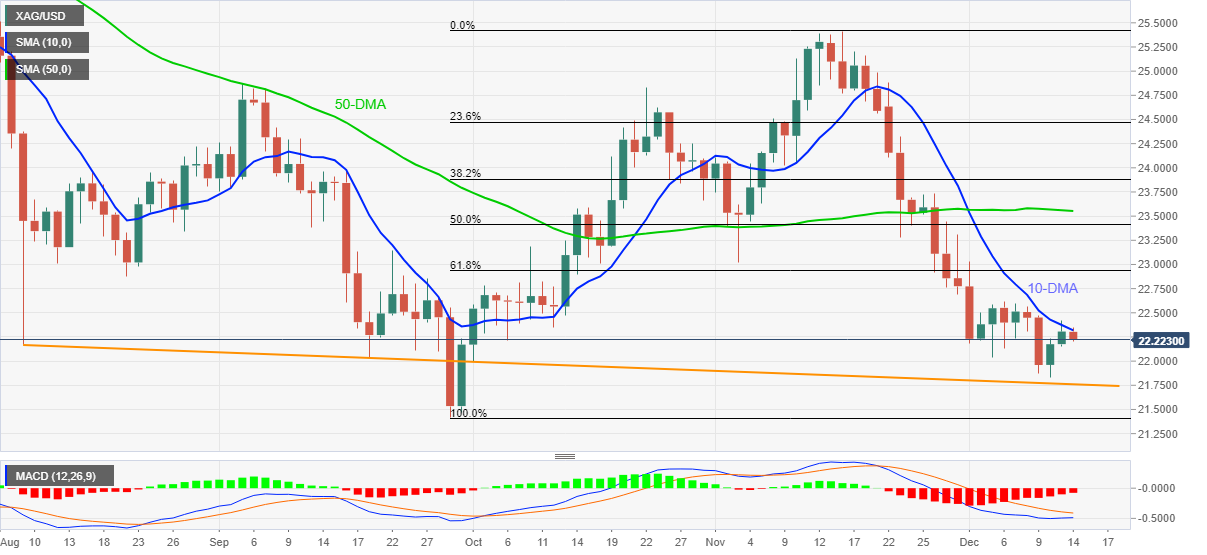
Trend: Further weakness expected
- USD/INR prints eight-day uptrend, stays firmer around June 2020 levels.
- India’s retail inflation missed expectations in November but analysts stay hopeful of escalated price pressure.
- Omicron fears jump, ADB cuts growth forecasts for developing Asia.
- Indian WPI inflation, risk catalysts eyed ahead of Wednesday’s FOMC.
USD/INR picks up bids 75.87 on early Tuesday morning in Europe, following the run-up to a multi-day high the previous day.
The Indian rupee (INR) pair rises for the eighth consecutive day by the press time as markets fears underpin the US dollar’s safe-haven demand. Adding to the bullish bias were chatters surrounding a likely jump in the Indian inflation figures pushing the Reserve Bank of India (RBI) towards a sooner action after its latest status-quo.
The risk-off mood takes clues from fears of rolling back easy-money policies ahead of the key central bank meetings. On the same line were the woes concerning the COVID-19 variant linked to South Africa, dubbed as Omicron.
Following the UK’s first Omicron-linked death and return of the mask mandate in California, Australia’s largest state, population-wise, New South Wales (NSW) reports the highest daily virus infections tally in more than two months. The virus woes pushed the finance ministers and central bank governors of the Group of Seven (G7) nations to pledge more efforts to combat the pandemic. Additionally, the Asian Development Bank (ADB) cut growth forecasts for developing Asia due to the same reason.
“The ADB trimmed its 2021 growth forecast for India to 9.7% from the 10.0% estimate it made in September, but left a 2022 growth forecast unchanged at 7.5%,” said Reuters.
At home, retail inflation jumped to 4.91% in November versus 5.10% forecast and 4.48% prior. However, analysts from Goldman Sachs, Morgan Stanley and Barclays hint at firming up the price pressures, which in turn will push the RBI towards a rate hike.
On the contrary, progress over the US stimulus and India’s lowest daily covid infections since May 01, per official data, caps USD/INR upside.
Amid these plays, the US 10-year Treasury yields seesaw around 1.42% whereas the S&P 500 Futures rise 0.15% at the latest. Furthermore, shares in Japan, Australia, New Zealand and China trade mixed by the press time.
USD/INR traders will pay attention to the scheduled release of Indian WPI Inflation for November, expected 11.9% versus 12.54%, followed by the US Producer Price Index (PPI) for November for intraday clues. However, virus updates and pre-Fed anxiety will be crucial catalysts to watch for clearer direction.
Technical analysis
An upward sloping trend line from November 2020 joins June 2020 peak around 76.50-52 to challenge USD/INR bulls. However, pullback moves remain elusive until staying beyond 75.60.
- EUR/USD bears dominating as the US dollar catches a risk-off bid.
- EU worried to be the epicentre of the new covid variant spread.
EUR/USD is weighed down by the prospects of the EU becoming the epicentre of the new covid variant, Omicron. At the time of writing, EUR/USD is trading at 1.1277 and between a low of 1.1273 and 1.1286, virtually flat on the day in comparison to the start of the week's range.
Following its discovery at the end of November, there have now been at least 6,430 confirmed cases of the variant detected in 70 countries, according to the European Centre for Disease Prevention and Control (ECDC). The variant is said to be becoming dominant in Europe. European countries were among the first to report cases but the variant has yet to be detected everywhere on the continent.
Meanwhile, the new variant fears weighed on risk sentiment on Monday and the FTSE 100 closed down 0.73% at 654. S&P 500 fell a similar margin, ending down 0.9% to 4,668.97. The Nasdaq Composite dropped 1.4% to 15,413.28 and the Dow Jones Industrial Average was 0.9% lower at 35,650.95. The 10-year US Treasury yield also fell 8 basis points to 1.41% while the two-year Treasury yields fell 3 basis points to 0.63%. EUR/USD trimmed losses to about 25 pips, at 1.1290.
ECB in focus
Elsewhere, central banks will be taking up the spotlight this week. ''So far the European Central Bank (ECB) has considered inflation to be transitory but it is increasingly looking persistent,'' analysts at ANZ Bank noted.
The analysts continued, ''recently, the US Federal Reserve changed its tune on inflation and it is highly possible that a change of stance may be seen from the ECB when they meet later this week. Inflation is strong across the euro area with consumer prices currently at a record 4.9%, which is well above the 2% target.''
''Unlike the US the economic recovery in Europe is much more fragile and the region is currently battling the current wave of Omicron cases. At this stage the ECB expects inflation to ease to 1.5% in 2023 and will soon release its inflation forecast for 2024,'' the analysts explained.
In an effort to counter a rise in short-term interest rates, the Bank of Japan (BOJ) intervened in the money market and offered two schemes to pump a combined $97 billion via temporary government bond purchases.
Key takeaways
“The central bank on Tuesday made two offers, including one to buy bonds worth 2 trillion yen for immediate fund provision. Under another offer, it would buy 7 trillion yen to inject funds for a period between Dec. 15-16.”
“Both offers have arrangements to sell the bonds back.”
Market reaction
USD/JPY fell sharply to 113.49 on the BOJ’s operation before recovering ground to now trade flat at 113.57.
- NZD/USD is pressured in general risk-off sentiment.
- NZ is so far not reporting any cases of new covid variant.
NZD/USD is under pressure and trades down 0.15% falling from 0.6759 to a low of 0.6739 made so far on the day. High-beta currencies such as the kiwi are out of favour while risk has been shunned due to the new covid variant fears.
The FTSE 100 closed down 0.73% at 654. S&P 500 fell a similar margin, ending down 0.9% to 4,668.97. The Nasdaq Composite dropped 1.4% to 15,413.28 and the Dow Jones Industrial Average was 0.9% lower at 35,650.95. As for the bond markets, the 10-year US Treasury yield also fell 8 basis points to 1.41% while the two-year Treasury yields fell 3 basis points to 0.63% as stocks take a hit.
For NZD/USD, support is being eroded below 0.6750. ''Given the busy domestic and international event schedule, we’re keeping an open mind, especially given that the NZD and AUD “wore it” disproportionally last night,'' analysts at ANZ Bank said. ''Volatility seems to be the order of the day, with most traders likely watching correlated markets rather than data. Food price data today isn’t likely to perturb the Kiwi much.''
NZ's clean bill of Omicron health
As of December 9, the Omicron variant had been identified in 63 nations. In the US, at least 29 states and Washington DC. In Australia, the fifth Covid ‘variant of concern’, first identified in South Africa in November, has been detected in four Australian states and territories although domestic border restrictions in Australia have eased. The variant is said to be becoming dominant in Europe.
No cases of the Omicron variant have been reported in New Zealand although several members of a flight crew who arrived in New Zealand this week are reported to have been identified as close contacts of a Covid Omicron variant case in Australia. The Ministry of Health announced this today.
- USD/TRY remains sidelined after consolidating gains from record top the previous day.
- CBRT intervenes, Turkish President Erdogan meets Central Bank Governor, FinMin but refrains from rate hike.
- Risk-off mood underpins USD bulls amid Omicron fear, pre-Fed anxiety, Thursday’s CBRT meeting is the key.
USD/TRY pokes intraday high around $13.85, testing the previous day’s pullback from an all-time high during early Tuesday.
The Turkish lira (TRY) pair refreshed its record top to $14.65 on Monday as Turkey’s five-year Credit Default Swaps (CDS) jumped 13 basis points (bps). The run-up also took clues from the market’s risk-aversion wave ahead of the key central bank meetings and fears emanating from the South African covid variant called Omicron.
Following the slump in the TRY, Turkish President Recep Tayyip Erdoğan met the Governor of the Central Bank of the Republic of Turkey (CBRT) and the newly appointed Finance Minister (FinMin) Nureddin Nebati. The meeting preceded the central bank’s intervention that dragged USD/TRY from the all-time high.
However, Erdogan’s rejection to rate hikes and firmer inflation pressure in the economy keeps USD/TRY buyers hopeful. “Erdogan is standing firm on his policy of low borrowing costs, raising expectations for another rate cut when the Central Bank's monetary policy board meets Thursday. Adding to concerns, S&P Global Ratings lowered its outlook for Turkey's credit rating to negative from stable Friday, according to media reports,” said The Independent (UK).
Elsewhere, the market’s mood remains mixed, mostly downbeat, as traders await the key central bank meetings and the Omicron fears escalate. That said, the sour sentiment underpins traditional safe havens like the US government bonds, gold and the US dollar.
It should be noted, however, that Friday’s US Consumer Price Index (CPI) for November and the US inflation expectations, portrayed by the 10-year breakeven inflation rate per the St. Louis Federal Reserve (FRED) data, challenge Fed hawks and weigh on the risk appetite.
On the other hand, the UK reports the first Omicron-linked death and Californian recall the mask mandate. Further, Australia’s largest state, population-wise, New South Wales (NSW) reports the highest daily virus infections tally in more than two months.
Against this backdrop, the US 10-year Treasury yields seesaw around 1.42% whereas the S&P 500 Futures rise 0.15% at the latest. Furthermore, shares in Japan, Australia, New Zealand and China trade mixed by the press time while the US Dollar Index (DXY) rises 0.06% intraday to 96.41 at the latest.
Looking forward, Wednesday’s Fed verdict and Thursday’s CBRT action will be important for the USD/TRY traders.
Read: Fed Preview: Dollar hinges on 2022 rate hike dots, guide to trading the grand finale of 2021
- GBP/JPY is under a little pressure in Asia following a slide from 150.75 on Monday.
- Yen is attracting a safe haven bid across the board due to covid-19 Omicron.
GBP/JPY is weighed to the downside following a slide from 150.75 as the yen attracts a safe haven bid with the concerns over covid-19 and the new Omicron variant.
Covid-19 Omicron variant sinking high-beta FX
The following illustrates the price from a daily and hourly perspective as the bears move in on daily support with risks tilted to the downside for the sessions ahead.
GBP/JPY daily chart
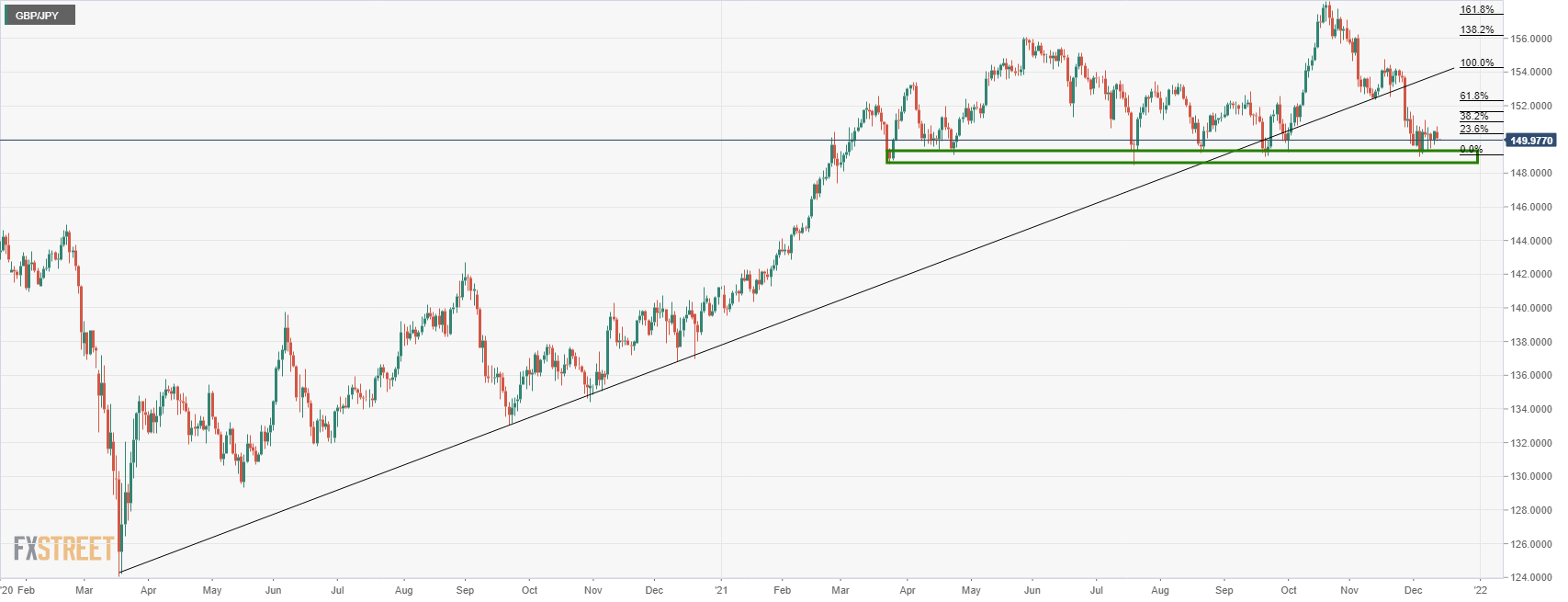
The price broke the daily dynamic support and is pressuring the daily horizontal support area near 149 to current levels.
GBP/JPY H1 chart
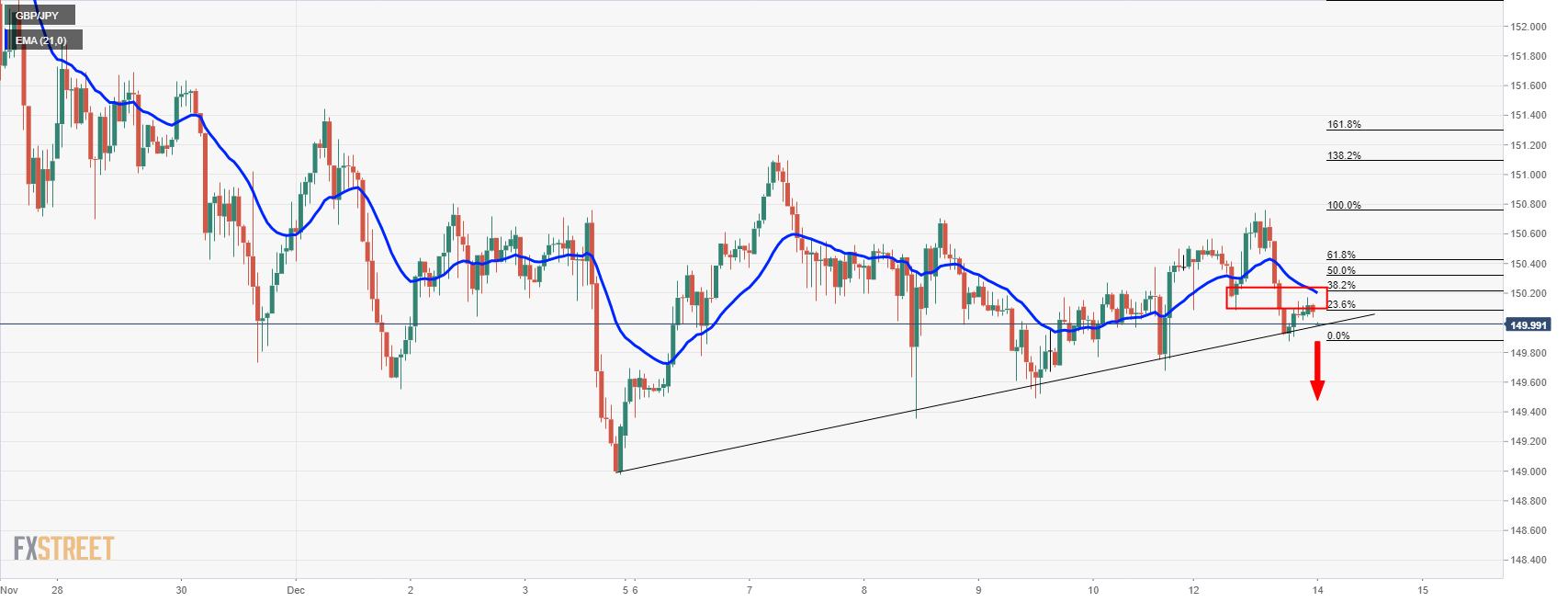
With the price below the 21-EMA, the bears are in control and there is a risk of the break of the hourly dynamic support.
In the wake of the annual meeting of China's Central Economic Work Conference this week, analysts at Nomura analyse the memo of the meeting.
Key quotes
“The memo especially features the ruling party’s return to its long-term core principle of growing the economy since the late 1970s.”
“The memo confirms that Beijing has undoubtedly shifted its policy focus to ‘growth stability’, as it faces mounting downward pressure on growth.”
Related reads
- USD/CNY: Two-way volatility in the yuan unchanged despite fast appreciation – China Press
| Raw materials | Closed | Change, % |
|---|---|---|
| Brent | 74.26 | -1.88 |
| Silver | 22.325 | 0.53 |
| Gold | 1786.933 | 0.23 |
| Palladium | 1675.23 | -5.19 |
- US 10-year Treasury yields grind lower following a three-day declines to weekly bottom.
- S&P 500 Futures consolidate recent losses, Asia-Pacific shares trade mixed.
- Omicron fears push ADB to cut developing Asia’s growth forecasts, Fed-linked fears stay on the table.
- UK posts first variant-linked death, Australia’s NSW marks 50% jump in daily infections.
Market’s mood remains mixed, mostly downbeat, as traders await the key central bank meetings and the Omicron fears escalate during early Tuesday.
While portraying the sentiment, the US 10-year Treasury yields seesaw around 1.42% whereas the S&P 500 Futures rise 0.15% at the latest. Furthermore, shares in Japan, Australia, New Zealand and China trade mixed by the press time.
The COVID-19 variant linked to South Africa, dubbed as Omicron, seems to exert the heaviest pressure on the risk appetite of late. Following the UK’s first Omicron-linked death and return of the mask mandate in California, Australia’s largest state, population-wise, New South Wales (NSW) reports the highest daily virus infections tally in more than two months.
The virus woes pushed the finance ministers and central bank governors of the Group of Seven (G7) nations to pledge more efforts to combat the pandemic. Additionally, the Asian Development Bank (ADB) cut growth forecasts for developing Asia due to the same reason, per Reuters.
In addition to the Omicron-led fears, anxiety over the US Federal Reserve’s (Fed) next move also weighs on the market sentiment. The reason could be linked to Friday’s US Consumer Price Index (CPI) for November and the US inflation expectations, portrayed by the 10-year breakeven inflation rate per the St. Louis Federal Reserve (FRED) data, which slumped to the 10-week low on Monday.
Elsewhere, US Democrats’ push to have a $1.75 trillion worth of aid package by the end of 2021 join the geopolitical chatters surrounding Uyghur Bill and White House National Security Adviser Sullivan’s Israel visit to challenge the traders.
That said, the UK jobs report and US Producer Price Index (PPI) for November will decorate the calendar ahead of the key Fed meeting. Though, major attention will be given to the risk catalyst for clear directions.
Read: Fed Preview: Dollar hinges on 2022 rate hike dots, guide to trading the grand finale of 2021
UK and US stocks ended lower Monday, pulling back from last week's record highs amid reports that two vaccine doses may not be enough to fight the COVID-19 omicron variant. It has also been reported that at least one person in the UK has died with the Omicron coronavirus variant, the UK's prime minister, Boris Johnson, has said. Health Secretary Sajid Javid told MPs Omicron now represented 20% of cases in England.
Risk was shunned on the new variant fears and the FTSE 100 closed down 0.73% at 654. S&P 500 fell a similar margin, ending down 0.9% to 4,668.97, the Nasdaq Composite dropped 1.4% to 15,413.28 and the Dow Jones Industrial Average was 0.9% lower at 35,650.95. The 10-year US Treasury yield also fell 8 basis points to 1.41% while the two-year Treasury yields fell 3 basis points to 0.63%. High-beta currencies, which track equities, are being weighed by the risk-off sentiment with AUD on the back foot vs the safe-haven yen.
AUD/JPY Price Analysis: Bears eye 80.60 downside target
The fears have merged as the COVID-19 vaccines from AstraZeneca (AZN) or Pfizer (PFE) and BioNTech (BNTX) have been reported to be substantially less effective at warding off omicron than earlier variants of the virus, CNBC has stated, citing a new University of Oxford study.
This comes as the variant spreads at an alarming rate. The UK's Health Secretary Sajid Javid said the UK Health Security Agency (UKHSA) estimated the current number of daily infections was around 200,000. Omicron has already risen to more than 44% of cases in London and is expected to become the dominant variant in the city in the next 48 hours, he said.
Additionally, the BBC's medical editor Fergus Walsh argues that with Omicron doubling every two to three days, it could go from a small to a huge number very quickly. Data also suggests Omicron is more transmissible than previous variants, with cases doubling in the UK every two to three days. As a consequence, the UK has raised its Covid alert level and reintroduced restrictions amid concerns that Omicron poses a “rapidly increasing risk to the public and healthcare services”.
In other parts of the world, as of December 9, the Omicron variant had been identified in 63 nations. In the US, at least 29 states and Washington DC. In Australia, the fifth Covid ‘variant of concern’, first identified in South Africa in November, has been detected in four Australian states and territories although domestic border restrictions in Australia have eased. The variant is said to be becoming dominant in Europe.
Meanwhile, the Asian Development Bank on Tuesday trimmed its growth forecasts for developing Asia for this year and next to reflect risks and uncertainty brought on by the new Omicron coronavirus variant, Reuters reported.
The Manila-based lender now sees 2021 gross domestic product (GDP) growth of 7.0% for developing Asia, down from 7.1%, and 2022 growth of 5.3%, down from 5.4% in September.
"COVID-19 has receded in developing Asia, but rising infections worldwide and the emergence of a fast-spreading variant suggest that the pandemic will take time to play out," the ADB said in a supplement to its Asian Development Outlook report.
Reuters has also reported that most of developing Asia's subregions are forecast to grow slower than previously thought this year, due in part to a weak recovery in China.
Saudi Arabian Oil Minister Abdulaziz bin Salman warned of a 30% drop in oil output by the end of this decade due to falling capital investment.
Key quotes
“We’re heading toward a phase that could be dangerous if there’s not enough spending on energy.”
“Result could be an “energy crisis.”
“Daily oil output may fall by 30 million barrels by 2030.”
Market reaction
WTI is treading water just above the $71 mark, unfazed by these above comments.
- WTI Price Analysis: Bears take a breather on the way to $69.80
- USD/CHF extends the week-start rebound while poking intraday high.
- Steady RSI, symmetrical triangle favor sideways moves, 100-SMA adds strength to the 0.9250 hurdle.
- Six-week-old ascending trend line challenges bears, monthly low adds to the downside filters.
USD/CHF remains mildly bid around 0.9230, holding Monday’s recovery moves during early Tuesday inside a one-week-old symmetrical triangle formation.
In addition to the chart pattern suggesting the sideways grinds of the major currency pair, a risk barometer, steady RSI line also portrays the pair trader’s cautious mood.
That said, the 100-SMA offers additional strength to the triangle’s resistance line near 0.9250, a break of which will propel the quote towards late November’s swing high near 0.9275.
Should USD/CHF bulls keep reins past 0.9275, the 0.9300 round figure and the 0.9325 level may act as buffers before directing the prices towards the last month’s peak of 0.9373.
Alternatively, a downside break of the stated triangle’s support, around 0.9205 at the latest, will direct the USD/CHF pair towards refreshing the monthly low, currently near 0.9165.
However, an upward sloping trend line from November 01, close to 0.9150, can challenge the pair bears afterward.
USD/CHF: Four-hour chart
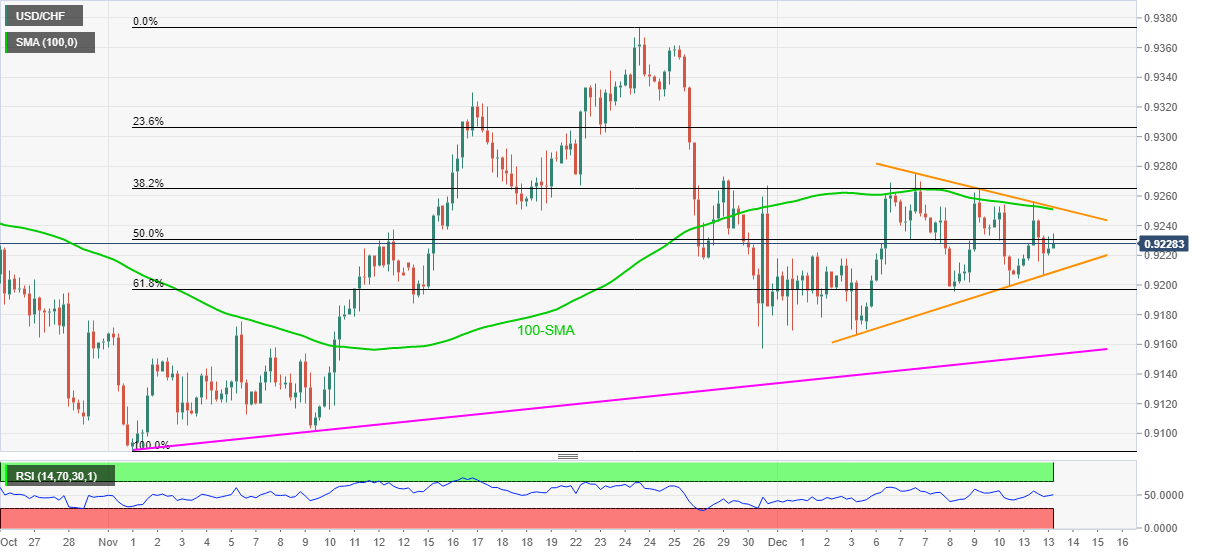
Trend: Sideways
Analysts at Goldman Sachs offer their near-term outlook on the US dollar, citing that it depends on the Fed’s dot plot graph.
Key quotes
“The currency's near-term direction will likely be determined by the Fed: if the "dot plot" at this week's FOMC meeting shows a two-hike median for 2022 we may see the recent weakness extend while a baseline of three or more hikes for 2022 would likely result in a return to USD appreciation.”
“Beyond this month, incoming inflation data will likely set the course for the Dollar.”
“There is a wide range of possible outcomes. In our baseline outlook—which envisions three Fed rate hikes next year alongside solid global growth—we see a range-bound USD vs EUR and most other G1Os, but decent gains vs USD for a number of EM crosses.”
- AUD/USD remains on the back foot for the second consecutive day, refreshes weekly low at the latest.
- Australia’s most populous state NSW report 50% jump in virus cases, UK reports the first Omicron-linked death.
- Australia’s NAB sentiment numbers came in mixed for November.
- Indecision over Fed’s next moves, geopolitical risks also favor sellers ahead of the key central bank meetings, Aussie jobs report.
AUD/USD takes offers to refresh intraday low around 0.7110, down 0.27% daily, during early Tuesday. In doing so, the Aussie pair prints a two-day downtrend to a one-week low as market sentiment sours.
The main catalysts behind the risk-off mood are multiple negatives concerning the COVID-19 variant linked to South African, dubbed as Omicron, as well as geopolitical fears and cautious mood before critical central bank monetary policy meetings.
Australia’s largest state, population-wise, New South Wales (NSW) reports the highest daily virus infections tally in more than two months, per Bloomberg. “The state recorded 804 new virus infections in the 24 hours to 8 p.m. Monday, a 50% jump from the day before, officials said in a statement Tuesday. It’s the largest tally since Oct. 2, when its largest city Sydney was in the midst of a months-long lockdown to combat the delta variant,” the news adds.
Elsewhere, the UK’s first Omicron-linked death and return of the mask mandate in California are some of the latest updates concerning the virus strain.
While citing the virus-led pessimism, the finance ministers and central bank governors of the Group of Seven (G7) nations pledged more efforts to combat the pandemic. Also portraying the Omicron effect is the update from the Asian Development Bank (ADB). “The ADB on Tuesday trimmed its growth forecasts for developing Asia for this year and next to reflect risks and uncertainty brought on by the new Omicron coronavirus variant,” per Reuters.
It’s worth mentioning that the US House of Representatives and the Senate inch closer to an agreement over the Uyghur Bill aimed at China, per Bloomberg. The same triggered geopolitical tensions between Washington and Beijing previously. On the same line was the latest update from Axios saying, “White House National Security Adviser Sullivan to visit Israel next week to discuss Iran.”
Above all, anxiety over the US Federal Reserve’s (Fed) next move and cautious sentiment ahead of Australia’s employment report for November, up for publishing on Thursday, challenges the AUD/USD prices.
Talking about data, National Australia Bank’s (NAB) Business Conditions grew from 11 to 12 in November while the NAB Business Confidence eased to 12 versus 21 prior.
Amid these plays, the US 10-year Treasury yields seesaw around 1.42% whereas the S&P 500 Futures print mild gains. Furthermore, shares in Japan, Australia, New Zealand and China trade mixed by the press time.
Moving on, the US Producer Price Index (PPI) for November, expected 9.2% YoY versus 8.6% prior, may offer intraday direction to the AUD/USD prices but major attention will be given to the risk catalysts.
Technical analysis
Failures to cross an 11-week-old horizontal hurdle surrounding 0.7175-80, which also includes the 21-DMA, direct AUD/USD sellers to attack the 10-DMA level near 0.7110. It should be noted, however, that MACD and RSI conditions aren’t in favor of welcoming the bears. The same requires a clear break of the 0.7110 support before highlighting the 0.7060 and the 0.7000 round figure.
| Time | Country | Event | Period | Previous value | Forecast |
|---|---|---|---|---|---|
| 00:30 (GMT) | Australia | National Australia Bank's Business Confidence | November | 20 | |
| 04:30 (GMT) | Japan | Industrial Production (YoY) | October | -2.3% | |
| 04:30 (GMT) | Japan | Industrial Production (MoM) | October | -5.4% | |
| 07:00 (GMT) | United Kingdom | Average earnings ex bonuses, 3 m/y | October | 4.9% | 4% |
| 07:00 (GMT) | United Kingdom | Average Earnings, 3m/y | October | 5.8% | 4.6% |
| 07:00 (GMT) | United Kingdom | ILO Unemployment Rate | October | 4.3% | 4.2% |
| 07:00 (GMT) | United Kingdom | Claimant count | November | -14.9 | |
| 07:30 (GMT) | Switzerland | Producer & Import Prices, y/y | November | 5.1% | |
| 09:00 (GMT) | France | IEA Oil Market Report | |||
| 10:00 (GMT) | Eurozone | Industrial Production (YoY) | October | 5.2% | 3.2% |
| 10:00 (GMT) | Eurozone | Industrial production, (MoM) | October | -0.2% | 1.2% |
| 13:30 (GMT) | U.S. | PPI excluding food and energy, m/m | November | 0.4% | 0.4% |
| 13:30 (GMT) | U.S. | PPI excluding food and energy, Y/Y | November | 6.8% | 7.2% |
| 13:30 (GMT) | U.S. | PPI, y/y | November | 8.6% | 9.2% |
| 13:30 (GMT) | U.S. | PPI, m/m | November | 0.6% | 0.5% |
| 21:45 (GMT) | New Zealand | Current Account | Quarter III | -1.396 | -7.913 |
| 23:30 (GMT) | Australia | Westpac Consumer Confidence | December | 105.3 |
In recent trade today, the People’s Bank of China (PBOC) set the yuan (CNY) at 6.3675 vs the previous fix of 6.3669.
About the fix
China maintains strict control of the yuan’s rate on the mainland.
The onshore yuan (CNY) differs from the offshore one (CNH) in trading restrictions, this last one is not as tightly controlled.
Each morning, the People’s Bank of China (PBOC) sets a so-called daily midpoint fix, based on the yuan’s previous day closing level and quotations taken from the inter-bank dealer.
- Gold picks up bids to renew intraday high, attacks short-term resistance.
- US Treasury yields consolidate three-day downside, stock futures and Asia-Pacific equities trade mixed.
- Omicron fears battle stimulus hopes ahead of the key central bank meetings.
- Fed December Preview: Gold stays vulnerable as Fed looks to battle inflation
Gold (XAU/USD) rises to $1,788 in a bid to the two-day rebound during early Tuesday. The yellow metal’s recent recovery could be linked to the market’s rush to risk-safety amid multiple negatives concerning Omicron and geopolitical, not to forget cautious mood before critical central bank monetary policy meetings.
The UK’s first Omicron-linked death and return of the mask mandate in California are some of the latest updates concerning the virus strain. The same push the finance ministers and central bank governors of the Group of Seven (G7) nations to pledge more efforts to combat the COVID-19 variant and supply chain issues. Also portraying the Omicron effect is the update from the Asian Development Bank (ADB). “The ADB on Tuesday trimmed its growth forecasts for developing Asia for this year and next to reflect risks and uncertainty brought on by the new Omicron coronavirus variant,” per Reuters.
Elsewhere, the US House of Representatives and the Senate inch closer to an agreement over the Uyghur Bill aimed at China, per Bloomberg, which triggered geopolitical tensions between Washington and Beijing earlier. On the same line was the latest update from Axios saying, “White House National Security Adviser Sullivan to visit Israel next week to discuss Iran.”
It’s worth mentioning that the market chatters surrounding faster tapering of the Fed and hints to the rate hike during Wednesday’s Federal Open Market Committee (FOMC) meeting contrast the latest weakness in the US inflation expectations, providing extra support to gold prices. Recently, the global rating agency Moody’s highlights the delicate decision the US Federal Reserve (Fed) will have to make during Wednesday’s monetary policy meeting.
On the positive side, the US Democratic Party’s push to have a $1.75 trillion worth of aid package by the end of 2021 seems to favor the equities amid mixed concerns.
Against this backdrop, the US 10-year Treasury yields seesaw around 1.42% whereas the S&P 500 Futures print mild gains. Furthermore, shares in Japan, Australia, New Zealand and China trade mixed by the press time.
Moving on, gold traders should keep their eyes on the virus updates and central bank chatters for fresh impulse. That said, the US Producer Price Index (PPI) for November, expected 9.2% YoY versus 8.6% prior, may offer intraday direction.
Technical analysis
Gold extends bounce off a two-month-old horizontal support area, crossing 100-SMA amid firmer RSI and a steady Momentum line.
While the near-term momentum favors buyers, the 200-SMA and a seven-week-long resistance zone, respectively around $1,808 and $1,815 could challenge the bulls.
Should the quote rise past $1,815, odds of witnessing a run-up towards $1,834 level comprising tops marked in July and September holds the key to $1,850.
It’s worth noting that gold’s pullback move teases bearish head-and-shoulder formation, which gets confirmed on a downside break of $1,758. Following that, a theoretical south-run towards refreshing the yearly low of $1,687 lures gold sellers.
However, multiple supports around $1,770, $1,745 and $1,721 can test the metal’s downturn during fall past $1,758.
Gold: Four-hour chart
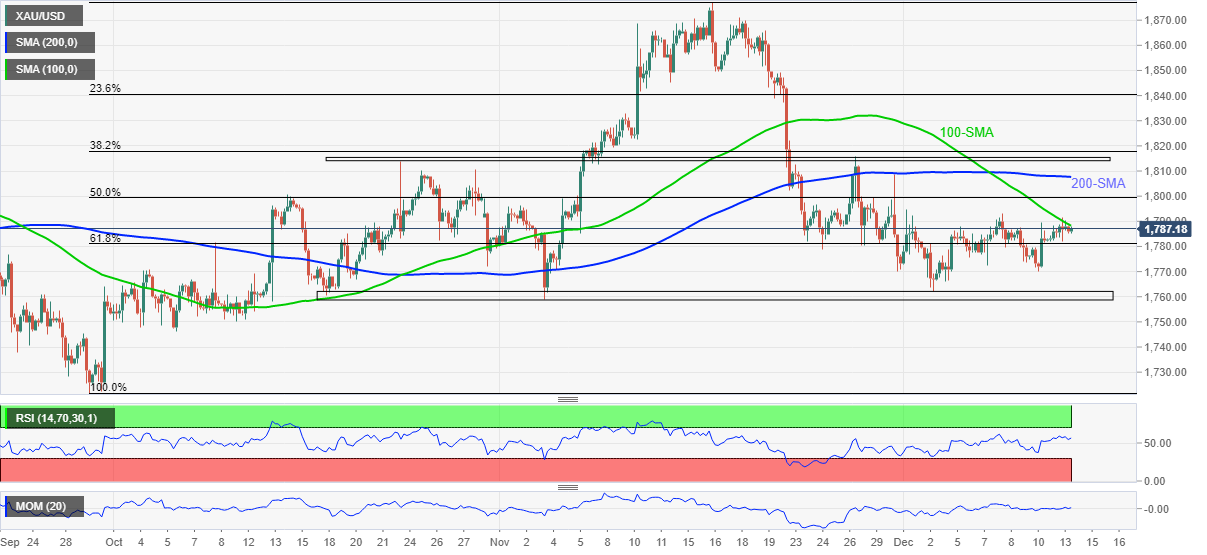
Trend: Pullback expected
- GBP/USD could be on the road to 1.3050 eyed ahead of 1.2920.
- UK's Covid-19 alert level has been raised to level four.
- BoE and UK macro slated for three straight days of key events for GBP traders.
At the time of writing, GBP/USD is idling 1.32 the figure after being in a range of between 1.3205 and 1.3216. There is a tendency to the downside on the charts following the drop at the start of the week due to heightened concerns over the spread of Omicron. Cable fell around 60 pips since the start of this week.
The UK's Covid alert level has been raised to level four. This is meaning that there is a high or rising level of transmission for the first time since May. The spread has dented rate hike prospects for this week's Bank of England meeting.
GBP/USD looking into the abyss
It has also been reported that at least one person in the UK has died with the Omicron coronavirus variant, the UK's prime minister, Boris Johnson, has said. Health Secretary Sajid Javid told MPs Omicron now represented 20% of cases in England. Mr Javid also said the UK Health Security Agency (UKHSA) estimated the current number of daily infections was around 200,000.
Omicron has risen to more than 44% of cases in London and is expected to become the dominant variant in the city in the next 48 hours, he said. Meanwhile, BBC medical editor Fergus Walsh argues that with Omicron doubling every two to three days, it could go from a small to a huge number very quickly. Data also suggests Omicron is more transmissible than previous variants, with cases doubling in the UK every two to three days.
This leaves GBP/USD looking into the abyss at the start of the week and traders will be looking to the UK's Parliament that will vote on the government's strategy to counter the Omicron variant on Tuesday. A Conservative rebellion is anticipated although Labour leader Sir Keir Starmer said it was his party's "patriotic duty" to back the measures.
The macro will be weighed against the implications of social distancing measures from a new Plan B. These are being implemented to slow the spread of Omicron including advising people to work from home. Schools will also see numbers of pupils and staff dropping off for fear of the variant. Additionally, the prime minister has repeatedly declined to rule out further restrictions ahead of Christmas.
On the macro front for the week idea, employment and inflation data on Tuesday and Wednesday will precede the latest Bank of England policy decision on Thursday. Cable is suffering on the divergence between the BoE and the Federal reserve as trader expectations for a rate hike have been eroding due to the new variant with the market now expecting the BoE to leave all policy settings unchanged, at least until February.
GBP/USD technical analysis
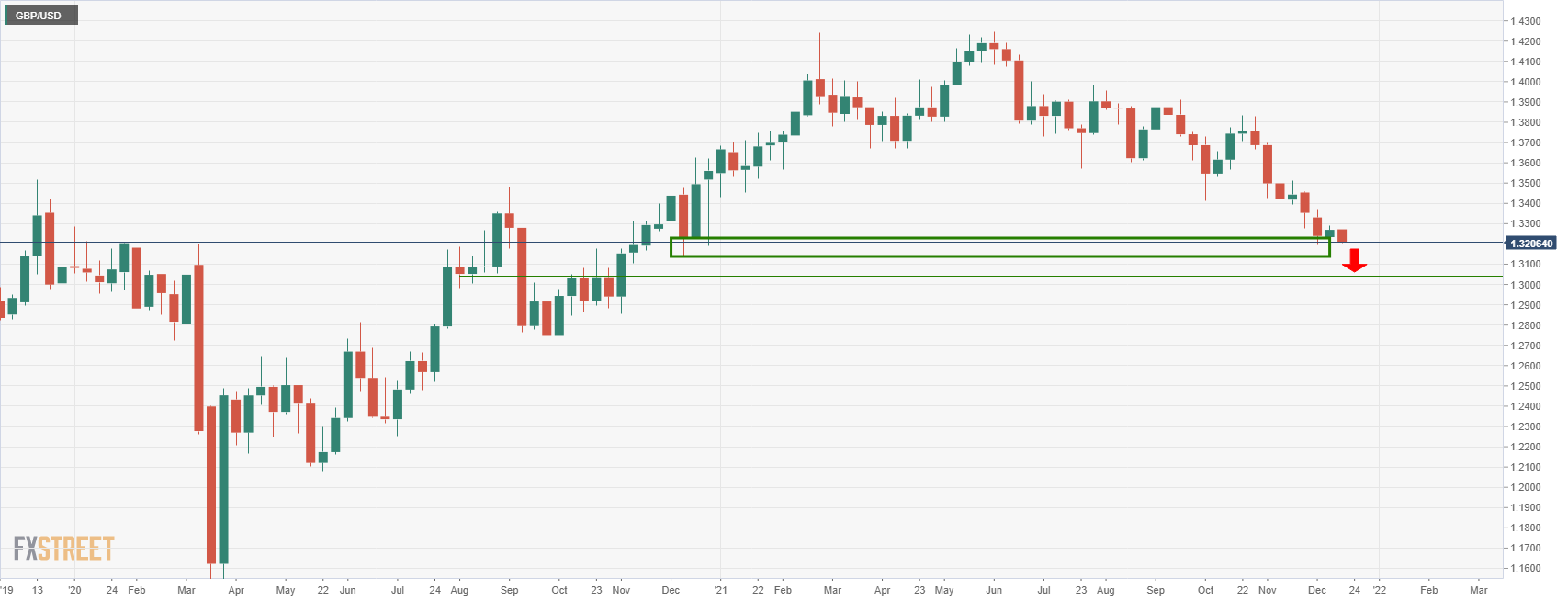
The daily chart illustrates the downside potential for the coming week should investors continue to unwind long positions and/or add to shorts with 1.3050 eyed ahead of 1.2920.
- USD/JPY struggles for a clear direction amid a quiet session, refreshes intraday top.
- Bond coupons seesaw around weekly low, S&P 500 Futures print mild gains.
- BOJ offers to acquire two trillion yen of bonds via repo.
- Omicron fears worsen, US stimulus hopes renew but nothing more important than Fed.
USD/JPY pokes intraday high close to 113.60 as Tokyo opens for Tuesday, after rising the most in a week the previous day. Even so, the yen pair prints 0.02% daily gains by the press time.
The risk barometer pair portrays the market’s sour sentiment amid fears of the South African covid variant, dubbed as Omicron, as well as anxiety ahead of the key central bank meetings. However, the US dollar bulls refrain from stepping back, also ignoring the weaker Treasury yields, as traders have high hopes from the US Federal Reserve (Fed).
The UK’s first Omicron-linked death and return of the mask mandate in California are some of the latest updates concerning the virus strain. The same push the finance ministers and central bank governors of the Group of Seven (G7) nations to pledge more efforts to combat the COVID-19 variant and supply chain issues. Also portraying the Omicron effect is the update from the Asian Development Bank (ADB). “The ADB on Tuesday trimmed its growth forecasts for developing Asia for this year and next to reflect risks and uncertainty brought on by the new Omicron coronavirus variant,” per Reuters.
On a different page, the Bank of Japan (BOJ) offered to purchase 700 billion yen in Japanese Government Bond (JGB) repurchase future while also proposing the acquisition of two trillion yen in bonds via repo. The BOJ actions could well be linked as a preparation for the Omicron crisis.
It’s worth observing that indecision ahead of critical central bank meetings provided a dull start to the week with the US Treasury yields declining the most in seven days while the Wall Street benchmarks also posted losses. By the press time, the US 10-year Treasury yields seesaw around 1.42% whereas the S&P 500 Futures print mild gains. The reasons could be linked to the stimulus hopes from the US amid the Democratic push to have a $1.75 trillion worth of aid package by the end of 2021.
Moving on, US Producer Price Index (PPI) for November, expected 9.2% YoY versus 8.6% prior, may offer intermediate direction to the USD/JPY traders. However, major attention will be given to the risk catalysts and central bank updates, not to forget virus news, for a clearer view.
Technical analysis
While 50-DMA guards immediate upside around 113.70, double tops marked around 113.95 becomes the key hurdle to cross for the USD/JPY bulls before retaking the controls. On the contrary, 113.20 will precede the 113.00 threshold and the monthly bottom near 112.50 to entertain the sellers.
- EUR/USD retreats from weekly resistance line, 200-HMA amid receding bullish bias of MACD.
- 61.8% Fibonacci retracement, three-week-long support line to test short-term bears.
- Monthly horizontal area adds to the upside filters.
EUR/USD remains depressed around 1.1285-80 after a negative start to the week.
The major currency pair’s pullback on Monday could be linked to the U-turn from a one-week-old descending trend line as the MACD fades bullish bias. However, 50% Fibonacci retracement (Fibo.) of November 24-30 upside restricts the quote’s immediate moves.
In addition to the 1.1280 nearby support, the 61.8% Fibo. level close to 1.1260 and an upward sloping trend line from November 24, close to 1.1245, also challenge the EUR/USD sellers.
Furthermore, a horizontal area comprising multiple lows marked since November 25, near 1.1225, will precede the 1.1200 threshold before directing the pair to the 2021 bottom of 1.1186.
Meanwhile, recovery moves will initially be challenged by the 200-HMA level of 1.1300 before the weekly resistance line, around 1.1305, plays its role.
Even if the EUR/USD prices cross the $1,305 hurdle, it needs to refresh the monthly high, currently around 1.1360, before recalling the bulls.
To sum up, EUR/USD bears keeps reins but have a bumpy road to travel during the key week.
EUR/USD: Hourly chart
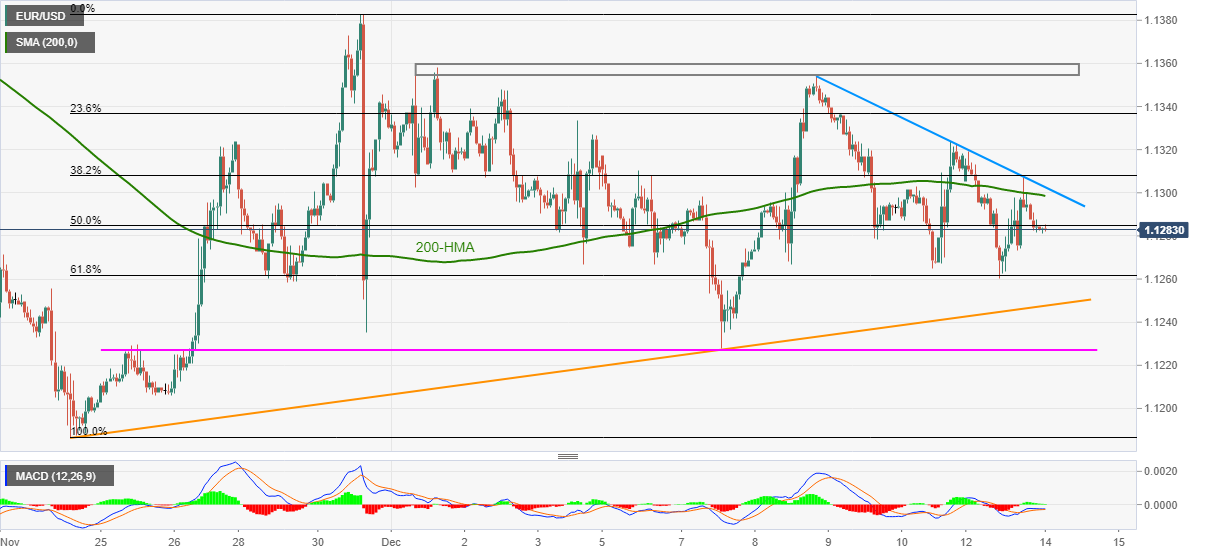
Trend: Further weakness expected
| Pare | Closed | Change, % |
|---|---|---|
| AUDUSD | 0.71345 | -0.41 |
| EURJPY | 128.19 | 0.01 |
| EURUSD | 1.12866 | -0.21 |
| GBPJPY | 150.072 | -0.13 |
| GBPUSD | 1.32131 | -0.3 |
| NZDUSD | 0.67533 | -0.72 |
| USDCAD | 1.28061 | 0.63 |
| USDCHF | 0.92234 | 0.26 |
| USDJPY | 113.576 | 0.19 |







© 2000-2026. All rights reserved.
This site is managed by Teletrade D.J. LLC 2351 LLC 2022 (Euro House, Richmond Hill Road, Kingstown, VC0100, St. Vincent and the Grenadines).
The information on this website is for informational purposes only and does not constitute any investment advice.
The company does not serve or provide services to customers who are residents of the US, Canada, Iran, The Democratic People's Republic of Korea, Yemen and FATF blacklisted countries.
Making transactions on financial markets with marginal financial instruments opens up wide possibilities and allows investors who are willing to take risks to earn high profits, carrying a potentially high risk of losses at the same time. Therefore you should responsibly approach the issue of choosing the appropriate investment strategy, taking the available resources into account, before starting trading.
Use of the information: full or partial use of materials from this website must always be referenced to TeleTrade as the source of information. Use of the materials on the Internet must be accompanied by a hyperlink to teletrade.org. Automatic import of materials and information from this website is prohibited.
Please contact our PR department if you have any questions or need assistance at pr@teletrade.global.


 Bank
Bank transfers


