- Analytics
- News and Tools
- Market News
CFD Markets News and Forecasts — 13-12-2021
Global rating agency Moody’s highlights the delicate decision the US Federal Reserve (Fed) will have to make during Wednesday’s monetary policy meeting.
The rating giant initially states, “If the market perceives that the Fed is behind the curve in controlling inflation, it would lead to higher inflation expectations and long-term interest rates, potentially weakening the dollar and affecting asset values.” Before mentioning that while, on the other hand, if the Fed overreacts to inflation, ‘it could result in tightening monetary policy too much, in turn dampening economic growth.’
Additional key quotes
Even if the FOMC were to announce a quickening taper and an earlier end to bond purchases, the committee will likely stress data dependency with regards to the timing and pace of rate increases.
If the Fed announces faster tapering to end the bond purchase program, possibly by March 2022, it would more strongly signal that monetary policy is turning.
A faster taper would give the Fed the flexibility to begin raising rates anytime in the second half of 2022.
Read: Fed Preview: Dollar hinges on 2022 rate hike dots, guide to trading the grand finale of 2021
- AUD/JPY 15-min double top opens risk of a break below the 50-EMA.
- The daily chart's W-formation has a neckline target near to 80.60.
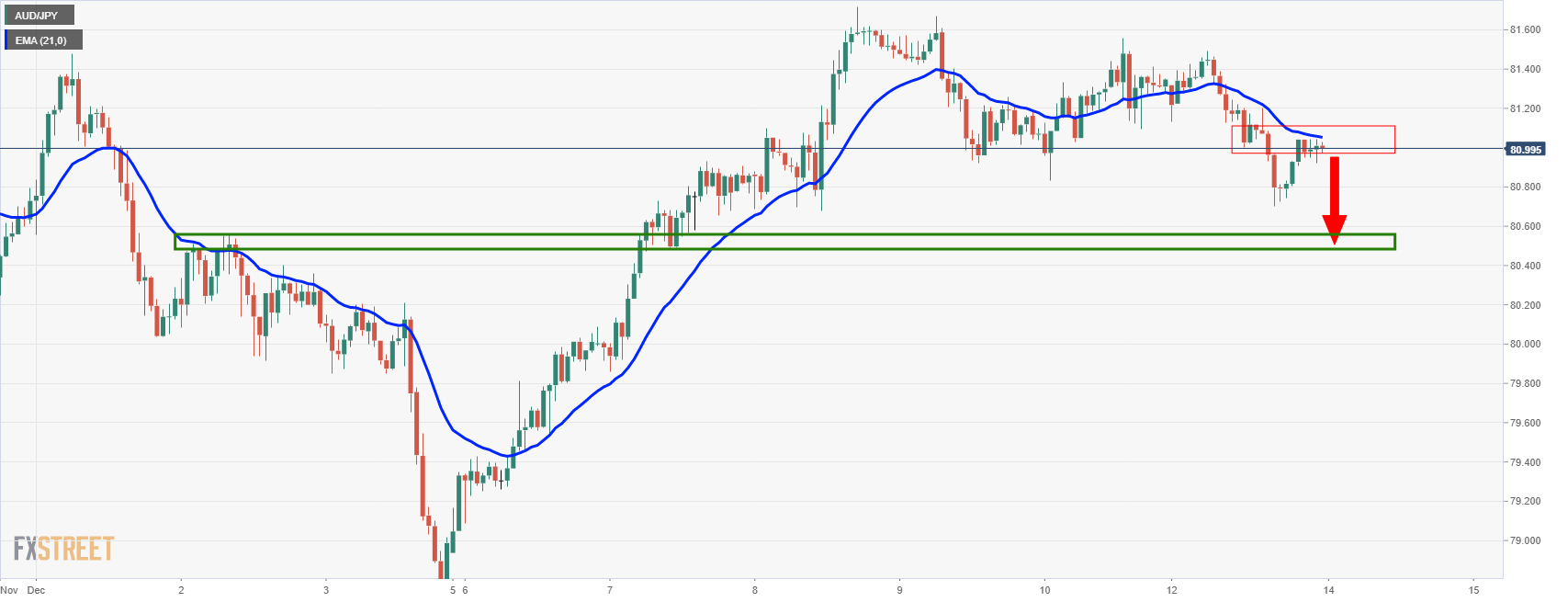
AUD/JPY is stalling in hourly resistance leaving the focus on the downside for the sessions ahead. The following illustrates the progress the price is making as per the prior analysis, AUD/JPY Price Analysis: H1 bears moving into gear:
AUD/JPY H1 chart
AUD/JPY M15 chart
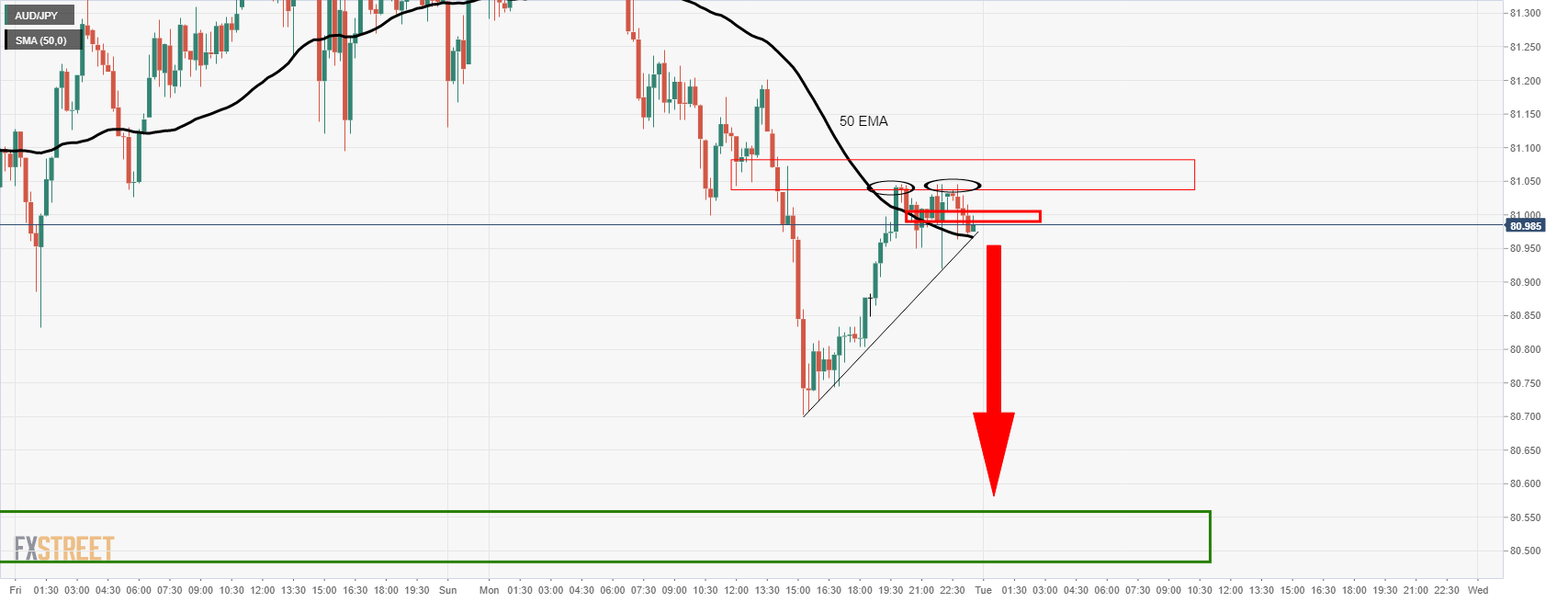
The bulls will be expecting a phase of distribution which brown down on the 15-min chart, there is the prospect of this retest of prior support failing and resulting in the start of a potential downside continuation. A break of the 50-EMA should be encouraging for the bears following the double top of the correction.
AUD/JPY daily chart
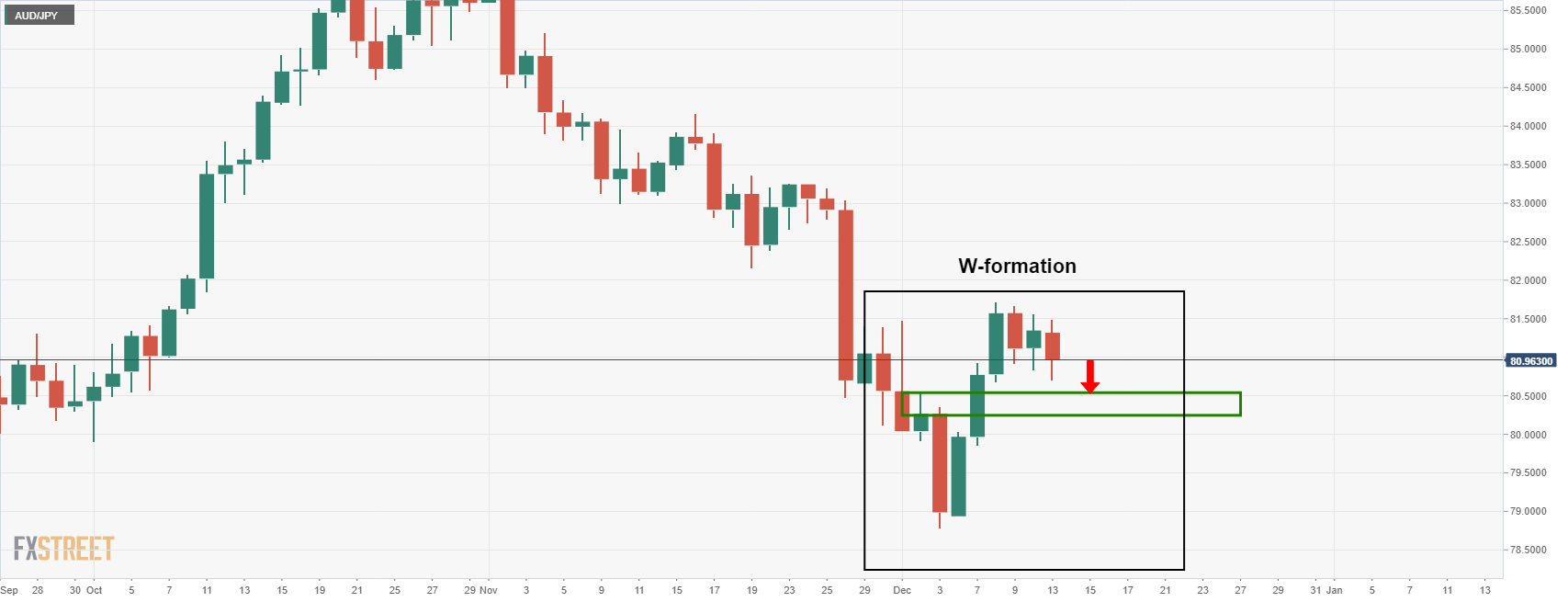
From a daily perspective, the downside is a captivating prospect as well. The W-formation is a high completion price reversion pattern and the price would typically retest the neckline of the formation, which in this case, is located near 80.60.
- WTI consolidates recent losses after breaking short-term support.
- Descending RSI, not oversold, adds to the bearish bias targeting 200-HMA.
- Immediate descending trend line challenges buyer’s return ahead of $73.20.
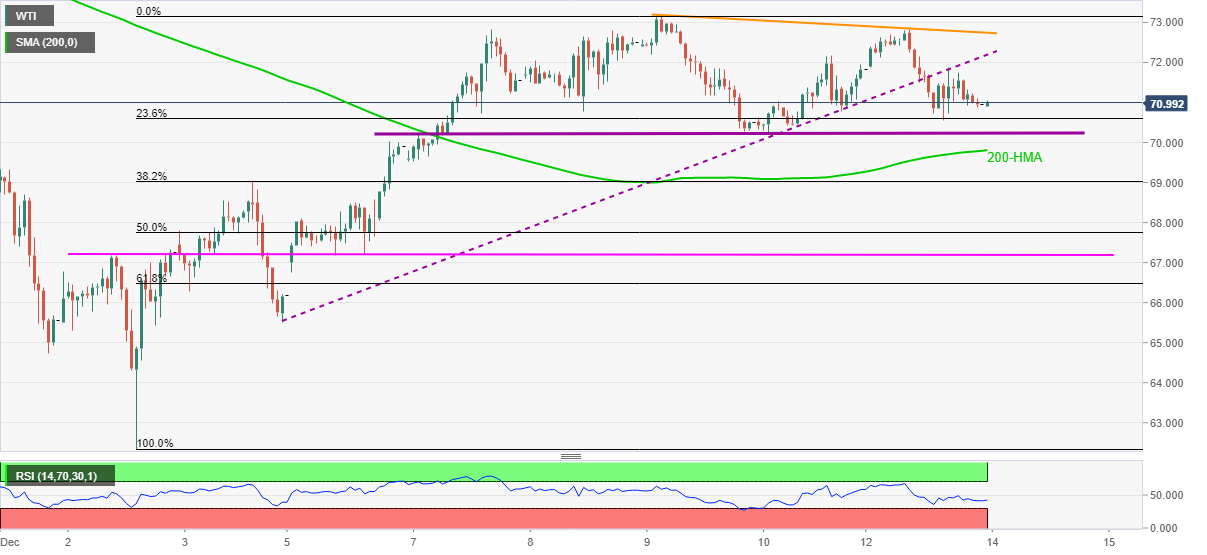
WTI crude oil defends the $71.00 threshold during a quiet Asian session on Tuesday. Even so, the energy bears remain hopeful as the quote broke an upward sloping trend line from December 03 the previous day.
Adding to the bearish bias is the descending RSI line, not oversold, as well as a falling trend line from the last Thursday.
That said, a one-week-old horizontal support area around $70.20 may offer an intermediate halt to the oil sellers before directing them to the 200-HMA level of $69.80.
In a case where the black gold drops below $69.80, the 38.2% Fibonacci retracement (Fibo.) level of December 02-09 upside will precede an eight-day-long horizontal line, respectively around $69.00 and $67.20, to challenge the WTI’s further downside.
On the flip side, the previous support line and descending resistance line from December 12, around $72.20 and $72.80 in that order, restrict the short-term upside of the WTI crude oil prices.
Adding to the resistance is the monthly top near $73.20, a break of which will highlight the late November swing low near $74.65 for the bulls.
WTI: Hourly chart
Trend: Further weakness expected
- The US Dollar Index pares Friday’s losses, up 0.39%.
- The US 10-year Treasury yield plunges to 1.414%, but the greenback rises.
- DXY Technical outlook: Has an upward bias, threatening of breaking above the ascending triangle, which targets 98.00.
The US Dollar Index, also known as DXY, which measures the greenback’s performance against a basket of six rivals, climbs 0.29%, sits at 96.37 during the day as the New York session winds down, at the time of writing. The risk-off market mood was spurred from reports of the UK of the first COVID-19 Omicron-related death. Further, three of the most important central banks worldwide will host their last monetary policy meeting of 2021, adding fuel to the weak sentiment.
In the US bond market, Treasury yields in the long-term maturity of the curve fell with 10s, the 20s and 30s dropping between seven to eight basis points, ended at 1.414%, 1.84%, and 1.80%, each.
On Monday, there is nothing to report on the economic docket. By Tuesday, the Department of Labors would release the Producer Price Index for November. Apart from that, the market participants’ focus is on the Federal Reserve monetary policy meeting, which begins on Tuesday. At the same reunion, the Fed will unveil its Summary of Economic Projections (SEP), which has the famous “dot-plot,” a chart that shows policymakers interest rates expectations. A Bloomberg poll predicts that all US central bank policymakers (18) would expect two rate hikes by 2022.
Money market futures show around 66 basis points of tightening by the end of next year.
Further, two weeks ago, a parade of Fed policymakers, led by Chairman Jerome Powell, expressed their interest in a “faster” QE’s reduction. The same Bloomberg poll sees an increase to $30 billion reduction, beginning in January of 2022.
US Dollar Index (DXY) Price Forecast: Technical outlook
The US Dollar Index started the week above 96.00 and approached the top-trendline of the ascending triangle. The DXY is in a clear uptrend, and through the last couple of weeks, price action consolidated around the 95.50-96.50 range, forming an ascending triangle in an uptrend.
In the event of breaking to the upside of the formation, the ascending-triangle target would be 98.00, but it would find some hurdles on the way up.
The first resistance would be 97.00, followed by June 30 high at 97.80, followed by the bullish flag 98.00 targets.
-637750351515026313.png)
JP Morgan retains bearish bias for the prices for gold and silver during its latest forecast, projecting an average price of $1,630 per ounce for gold and $20.48 for silver in 2022.
“Expect rebasing higher in long end us nominal yields to weigh on gold over medium-term,” said the US bank in the recent analysis.
On the same line were comments from Kitco that quotes analysts tracking the Commodity Futures Trading Commission (CFTC) data to mention, “Hawkish comments from Federal Reserve Chair Jerome Powell continue to drive hedge funds away from gold and silver.”
“The latest data shows that sentiment in gold is at its lowest point since late-October as funds liquidate their bullish bets,” said Kitco News.
Market implications
Although precious metal bears are bracing for more gains into 2022, this week’s US Federal Reserve (Fed) monetary policy meeting will be the key to follow for clearer directions.
Read: Fed Preview: Dollar hinges on 2022 rate hike dots, guide to trading the grand finale of 2021
- AUD/USD dropped the most in a week before the day-end corrective pullback.
- Cautious mood ahead of the key central bank meetings, Omicron woes offered a negative start to the week.
- China’s readiness for more stimulus fails to save the bulls but 10-DMA does.
- Aussie NAB figures, US PPI will decorate calendar but risk catalysts are more important.
AUD/USD consolidates the heaviest daily fall in a week around 0.7130 during early Tuesday morning in Asia. Market’s fears at the start of the crucial week could be linked to the Aussie pair’s declines the previous day, after failing to cross an important resistance amid late last week.
Anxiety over the US Federal Reserve’s (Fed) next step amid the fears emanating from the South African covid variant, dubbed as Omicron, becomes the cornerstone of the latest sour sentiment. Not only the Fed but the concerns relating to the European Central Bank (ECB) and the Bank of England (BOE) were on the same line that roiled the mood of late.
Friday’s US Consumer Price Index (CPI) for November matched market consensus and the US inflation expectations, portrayed by the 10-year breakeven inflation rate per the St. Louis Federal Reserve (FRED) data, slumped to the 10-week low on Monday. In addition to receding inflation woes, the UK’s first Omicron-linked death and return of the mask mandate in California also makes it tough for the Fed has to match hawkish expectations.
Also challenging the AUD/USD buyers is a lack of confidence in China’s vow to stabilize the economy in 2022 with monetary and fiscal measures. During the 2021 Central Economic Work Conference, Chinese officials showed readiness to use monetary and fiscal policy tools to stabilize the world’s second-largest economy in 2022.
Furthermore, the recently escalating tensions between the US and China could also be cited as the factor to back the latest risk-off mood.
On the contrary, hopes of faster progress on the US President Joe Biden’s $1.75 trillion aide package join a pullback in the US dollar to probe the AUD/USD bears.
Amid these plays, the Wall Street benchmarks posted losses while the US 10-year Treasury yields also dropped amid the rush to risk safety that propelled traditional safe-havens like gold and US bonds.
Moving on, National Australia Bank’s (NAB) Business Confidence and Business Conditions for November can initially entertain AUD/USD traders ahead of the US Producer Price Index (PPI). It should be noted, however, that major attention will be given to the risk catalysts, mainly concerning the inflation and the South African covid variant named Omicron, for fresh impulse.
Technical analysis
Despite crossing 10-DMA, AUD/USD bulls failed to pierce an 11-week-old horizontal hurdle surrounding 0.7175-80 that also includes the 21-DMA. Even so, bullish MACD signals and firmer RSI keeps buyers hopeful. That said, short-term sellers may aim for the 10-DMA level near 0.7110 but the 0.7060 and the 0.7000 support levels will challenge the pair’s further downside.
“The White House is scrambling to salvage its plans to pass Joe Biden’s $1.75 trillion Build Back Better bill by the end of the year, with time running out to win over Democratic holdouts worried about excessive spending and persistent inflation.” said Financial Times (FT) during the late Monday news.
Following the update, CNN’s Manu Raju quotes a spokesperson of Democratic senator Joe Manchin as saying, “Senator Manchin and President Biden had a productive conversation this afternoon. They will continue to talk over the coming days.”
“After talking with Biden, Manchin tells a group of us he’s not walking away from talks. And when we asked if he thinks bill can get done this year, he said: ‘anything is possible’ and he’s still ‘engaged’ in talks,” also tweeted CNN’s Manu Raju.
“Manchin, the most conservative Democrat in the Senate, has for months raised concerns about the size and scope of Build Back Better, and has recently tied his objections to rising inflation,” said the FT news.
The Financial Times also said, “Because Democrats control the chamber by the narrowest of margins — 50-50, with vice-president Kamala Harris able to cast the tiebreaking vote — they need the support of all 50 Democratic senators.”
FX reaction
Although the news should have helped the risk barometers, cautious sentiment ahead of the key central bank meetings and the latest spread of the Omicron fears weigh on the mood of late.
Read: Forex Today: Risk-aversion at the start of the week
- The first Omicron-linked death in the UK dented the market sentiment.
- NZD/JPY Technical outlook: The pair has a downward bias as long as it remains under the 200-DMA.
As Wall Street closes, the NZD/JPY pair is trading at 76.65 during the day at the time of writing. As the trading session in the day ends, the market sentiment is downbeat. Omicron variant woes, and central bank monetary policy meetings, keep investors at bay.
In the European session in the UK, the first Omicron-linked death was reported amid raising the COVID-19 alert from three to four. Also, according to a University of Oxford study, two shots of vaccines showed a “substantial drop in neutralizing antibodies” when in contact with the new variant.
In the overnight session, the NZD/JPY pair seesawed around the Monday central daily pivot at 77.05, coinciding with the 50 and the 100-hour simple moving average (SMA). However, as the market sentiment worsened, market participants flew towards safe-haven assets, leaving adrift risk-sensitive currencies.
NZD/JPY Price Forecast: Technical outlook
The NZD/JPY pair failed to break a seven-month-old downslope trendline, opening the door for further downside. Additionally, the daily moving averages (DMAs) reside well above the spot price, supporting the bearish bias.
That said, the first support on the way down would be the December 8 cycle low at 76.69, followed by the December 3 low at 75.95. A breach of the latter would expose the August 19 cycle low at 74.57.
On the other hand, the NZD/JPY first resistance would be the 77.30-60 area, respected on Thursday, followed by the 200-day SMA, at 78.07, immediately followed by the 100-day SMA at 78.26.
-637750305143322594.png)
- USD/CAD is testing an important resistance area.
- Bears are moving in with a focus on 1.2720.
USD/CAD is consolidating the recent bullish impulse as it meets an important resistance area on the weekly and daily chart as illustrated below:
USD/CAD weekly chart
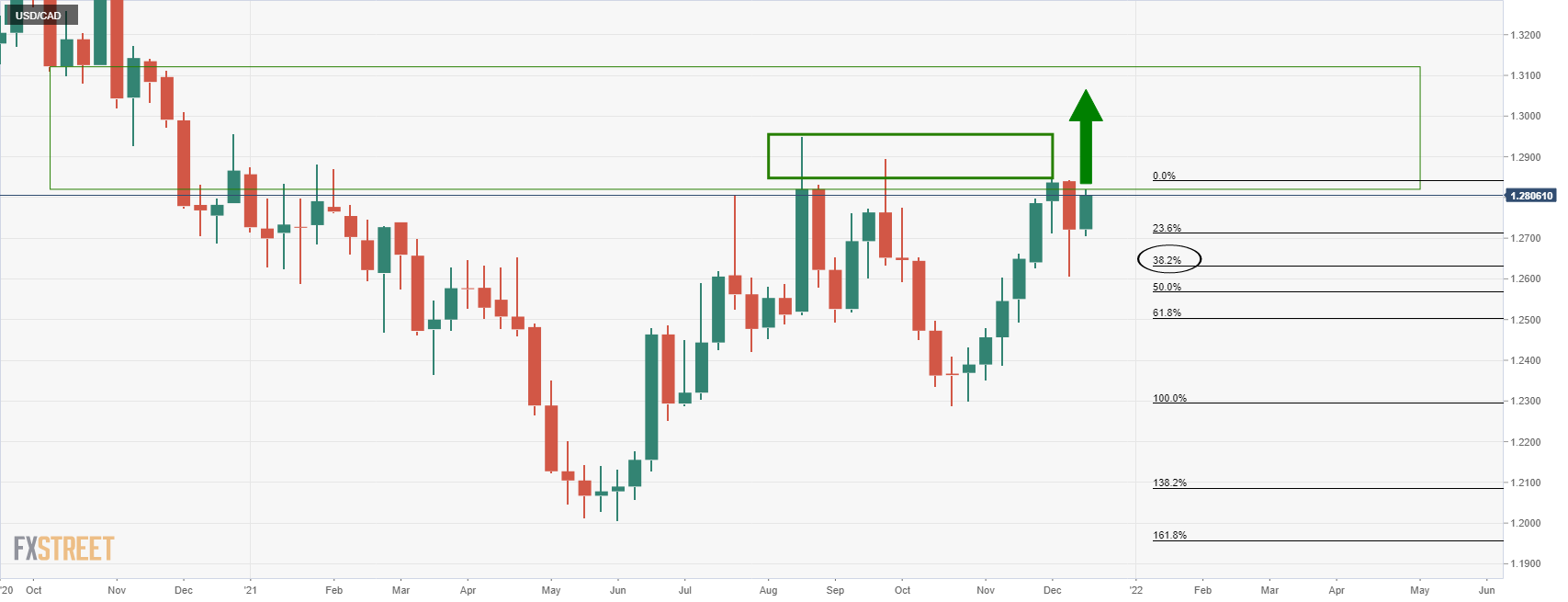
The bulls have stepped in after making a 38.2% Fibonacci retracement Cleveland taking on the bears to weekly resistance.
USD/CAD daily chart
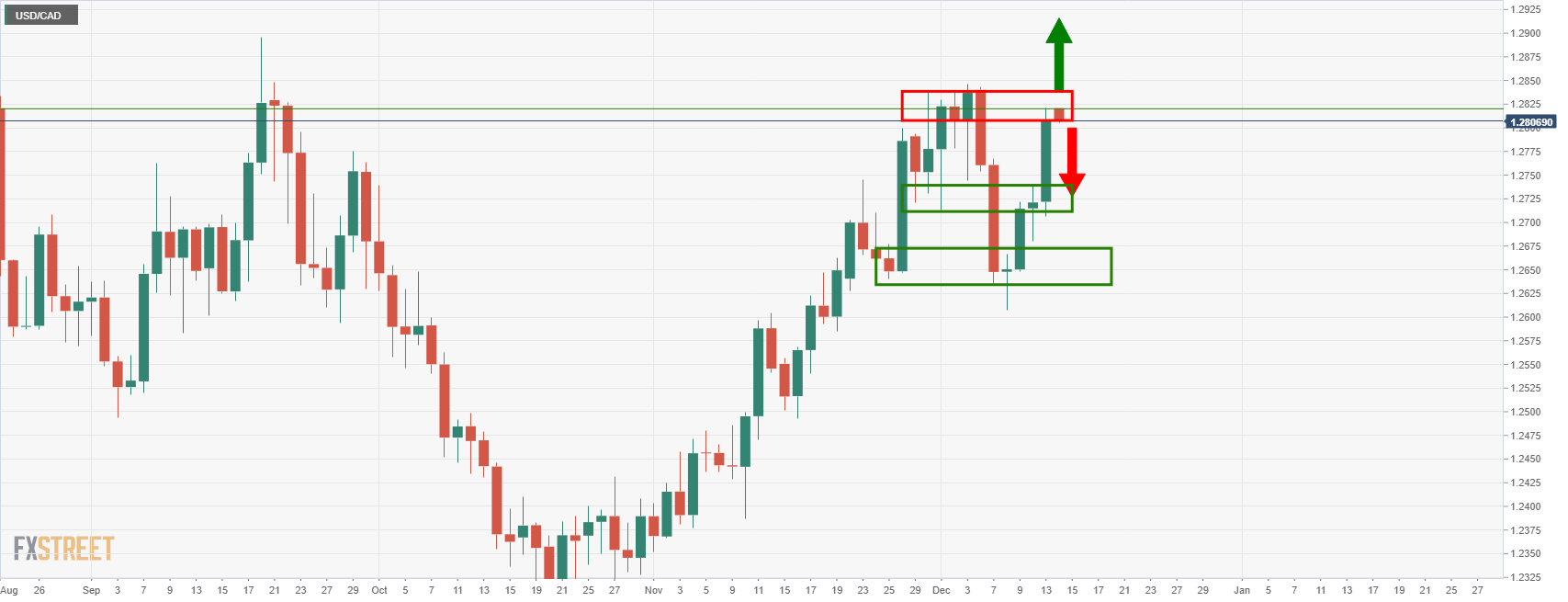
However, the bulls could be on the verge of throwing in the towel at this juncture and keen to take off some risk as the price meets both weekly and daily resistance structures near 1.2850. An imminent retracement will likely home in on 1.2710/40.
- In a subdued start to the week, EUR/JPY consolidated within thin ranges just to the north of 128.00.
- The lack of conviction isnt overly surprising given the looming ECB and BoJ rate decision on Thursday and Friday.
- Ahead of these events, the pair could also be volatile on any further swings in risk appetite.
It was a subdued start to the week for EUR/JPY, with the pair consolidating within thin ranges just to the north of the 128.00 level. The lack of conviction isn't overly surprising given the looming ECB and BoJ rate decision on Thursday and Friday, as well as the release of Eurozone, flash PMIs for December and Japan Industrial Production data for October.
Ahead of these risk events, it would be surprising to see EUR/JPY find meaningful direction. Traders will thus be looking to resistance in the 128.50 area to cap the price action and to recent lows around 1.12750 to act as a floor. Should 128.50 be broken, there is the 21-day moving average at 128.70 just above it and then last week’s high at 129.00 to act as resistance.
One thing to keep an eye out for ahead of these key macro events later in the week would be if Wednesday’s Fed meeting or any Omicron-related developments spurred a broad shift in the market’s appetite for risk. It seems that the risks here tilt to the downside (perhaps the Fed spooks markets by being too hawkish, or lockdown fears are rekindled), which arguably means the risks to EUR/JPY lay to the downside also. Out of the two currencies, the yen is seen as more of a safe haven.
Indeed, the 127.50 level is highly significant and a break below it would see EUR/JPY hit its lowest levels since February. Given a lack of immediate support, a swift move towards the 125.00 area could be on the cards if this was to be the case.
- AUD/USD bulls tun into a wall of resistance across the time frames.
- Bears can aim for a test of 0.70 the figure for the week ahead.
The price is moving in on the support zone between 0.7120/30 and if bulls commit then the price can head beyond the 0.7140s in the coming sessions towards 0.7160 /80.
AUD/USD H1 chart
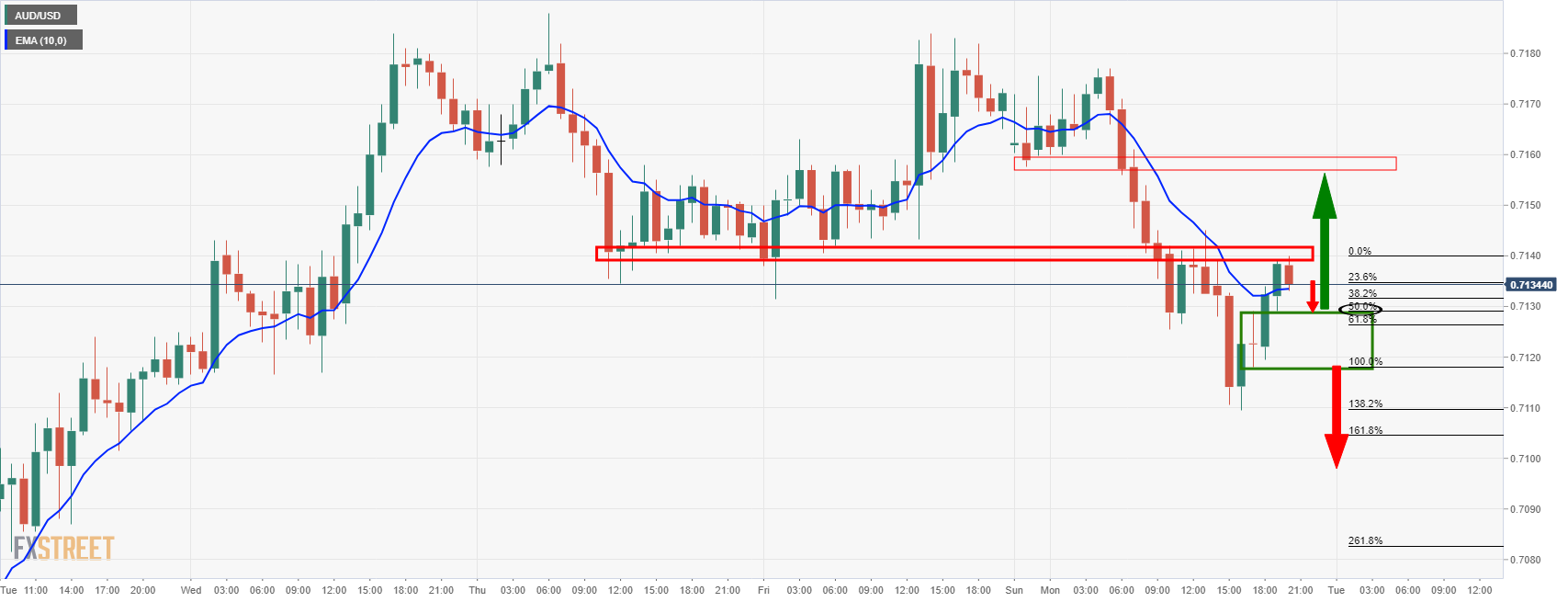
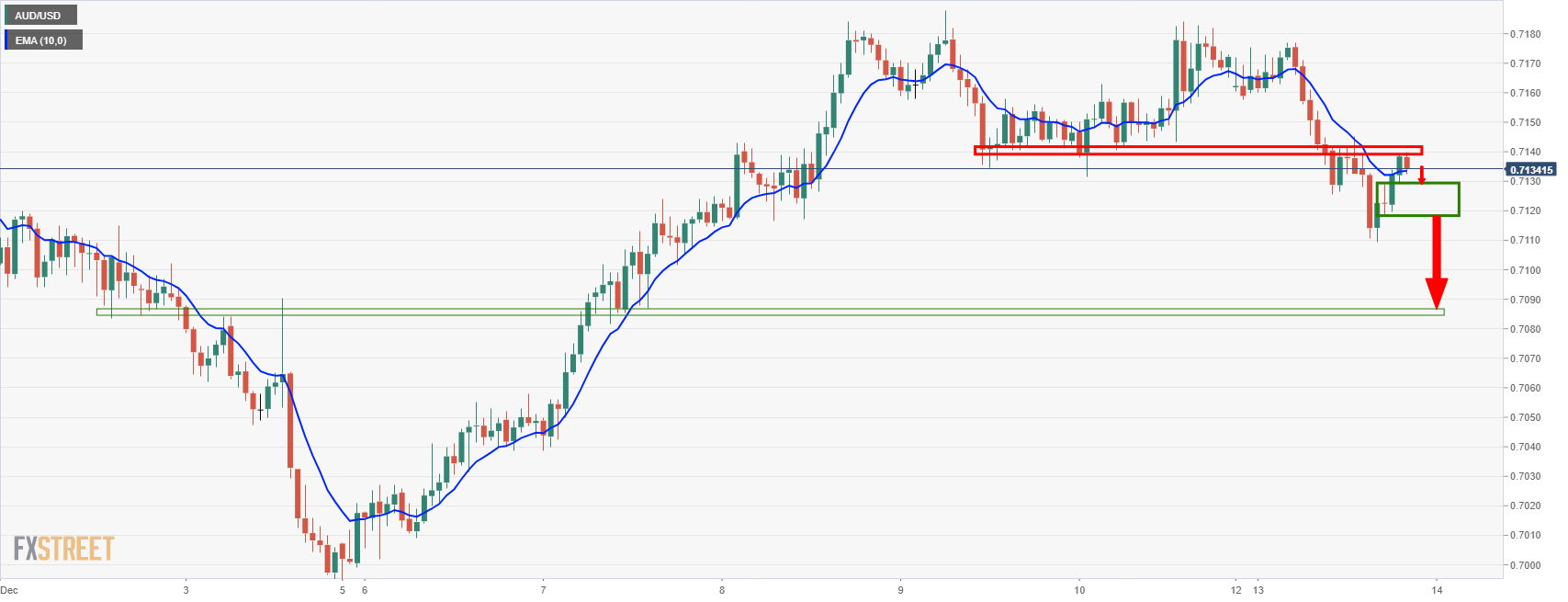
However, should the bulls give way, then 0.7080 will be a potential target met early this week:
AUD/USD daily chart

From a daily perspective, the price is meeting resistance below 0.72 the figure and the focus is on a break of 0.7000 for the week ahead.
- EUR/USD was capped by its 21DMA and the 1.1300 level on Monday.
- Some traders attributed this to markets prepositioning for a more hawkish lean from the Fed later this week.
- There will also be attention on the ECB’s policy decision on Thursday.
EUR/USD upside was capped by the psychologically important 1.1300 level and its 21-day moving average just below it on Monday. At present, the pair trades around the 1.1290 mark and is set to end the day around 0.2% lower, a decent recovery from earlier session lows close to 1.1260 when the pair was, at the time, down about 0.5% on the day.
Monday’s weakness was driven by a stronger dollar rather than any idiosyncratic euro weakness. Some market commentators framed this as reflective of markets pricing in expectations for a more hawk Fed policy announcement on Wednesday. But looking at EUR/USD over a broader time horizon, Monday’s trading conditions are in fitting with the broadly consolidative conditions that have dominated in recent sessions, during which time EUR/USD has carved out an approximate 1.1250 to 1.1350ish range.
For EUR/USD to establish some directional momentum again, it is likely going to need to see a sustained breakout of these recent ranges. Perhaps this week’s Fed meeting can provide such impetus. But some dollar bulls worry that, in wake of recent hot US inflation and labour market reports and the hawkish tone of Fed Chair Jerome Powell when he last spoke earlier in the month, it will be hard for the Fed to match already very hawkish expectations for this week’s meeting.
Perhaps this impetus can come from the ECB policy announcement on Thursday. The bank is expected to announce its post-PEPP QE plans, with a temporary lift to the pre-pandemic APP QE scheme likely. Markets will likely be more sensitive to the bank’s updated economic forecasts and how ECB rate hike expectations react to these.
- AUD/NZD pushed back above 1.0550 on Monday to challenge last week’s highs on Monday.
- External central bank events will dictate FX action this week, but Australia and New Zealand data will be of note.
AUD/NZD pushed back towards last week’s highs above 1.0550 on Monday, up about 0.1% on the day, as the Aussie dollar tentatively continued its run of outperformance versus its kiwi counterpart. The pair has rallied about 2.0% from lows earlier in the month close to 1.0350 and in doing so crossed back above both its 21 and 50-day moving averages which both currently reside close to the 1.0450 mark. To the upside lays the 200DMA almost bang on the 1.0600 level, which is also roughly in line with the October highs, while, to the downside, the 1.0500 area is a key zone of support.
The main theme in FX markets this week is central bank meetings, though neither the RBA or RBNZ are setting policy. But that doesn’t mean the pair can’t still derive some external tailwinds; one strategist suggested that if the Fed’s dot-plot this week is more hawkish than expected, then hawkish RBA bets could be boosted in tandem with more hawkish Fed bets. This could provide AUD/NZD with tailwinds.
But there will also be plenty of domestic Australia/New Zealand data for FX markets to sink their teeth into, as well as some central bank speak. RBNZ Governor Adrian Orr orates on Tuesday ahead of the release of NZ Q3 Current Account numbers and the Australia December Westpac Consumer Sentiment survey. Then, during Thursday’s Asia Pacific session, NZ Q3 GDP numbers are out, ahead of a speech from RBA Governor Philip Lowe and the release of the Australian November Labour Market report. On Friday, ANZ Business Confidence data is scheduled for release.
- US crude oil prices fall 1.20%, as the first omicron-related death looms the impact of the new COVID-19 strain.
- Crude oil demand might decrease if the Omicron variant causes severe illness than the first ones.
- WTI Technical outlook: Has an upward bias, but the 200-DMA is at risk.
The US crude oil benchmark, Western Texas Intermediate (WTI), edges lower during the New York session, trading at $70.96 at the time of writing. Since the mid-European session, the market mood has been in risk-off mode. The increase in COVID-19 cases, linked to the newly discovered omicron variant, and the first death caused by the strain in the UK, kept investors nervous. Alongside that, the impact on people’s mobility and the UK’s weighing on imposing stricter restrictions pushed crude oil prices down.
In the overnight session, WTI’s peaked at around $72.75, then tumbled towards $70.50 amid the impact of the omicron variant and mobility restrictions that could decrease oil demand. That, alongside technical resistance levels with the 100-hour simple moving average (SMA) at $71.70 and the 50-hour SMA at $71.36, put a lid on WTI’s prices.
Furthermore, the Organization of Petroleum Exporting Countries and its allies (OPEC+) increased its outlook for oil consumption in the Q1 of 2022, up to 1.1 million barrels a day, equivalent to an annual world consumption growth in a “typical” year before the pandemic, according to Bloomberg.
On its 2022 outlook, OPEC mentioned that the Omicron variant is expected to have a mild impact as the world gets used to dealing with the COVID-19 pandemic.
WTI Price Forecast: Technical outlook
WTI’s daily chart shows that oil had been in consolidation since Tuesday last week. WTI has an upward bias, with the 200-DMA below the price, acting as a dynamic support area. However, downside risks remain unless oil bulls reclaim the 100-DMA at $73.77.
To the upside, the first resistance level would be the psychological $72.00 figure. A breach of the latter would send US crude oil towards the 100-DMA but need to break above $73.00.
On the other hand, a break below the 200-DMA would expose the figure at $70.00. If WTI bears break that level, the following demand area would be the September 1 low at $67.01, followed by the December 2 cycle low at $62.34.
-637750224009960620.png)
- The focus is on central banks and the Covid-19 torment.
- The price is running into hourly resistance below a bearish 10/21 EMA crossover.
NZD/USD is off by some 0.45% at the time of writing and is correcting the bearish hourly impulse within the day's range of 0.6801 to 0.6745 so far. A series of central bank meetings are scheduled for this week which is weighing on risk appetite and the higher beta currencies such as the kiwi.
Central banks on focus
With a shift from the transitory language, inflation risks are the driving force on a week where more than 20 central banks are expected to meet this week including the Federal Reserve, the European Central Bank, the Bank of England and the Bank of Japan.
Besides inflation, Omicron will be a top priority on these central bank's mandates at a time where the first publicly confirmed death globally was announced at the start of this week from the swiftly spreading strain. Case numbers have started to soar – particularly in Europe and risk-off flows are a weight for the kiwi despite the fact that Markets are positioning for multiple further rate rises by the RBNZ next year.
''Given the busy domestic and international event schedule, we’re keeping an open mind, especially given that the NZD and AUD “wore it” disproportionally last night,'' analysts at ANZ Bank said. 'Volatility seems to be the order of the day, with most traders likely watching correlated markets rather than data. Food price data today isn’t likely to perturb the Kiwi much.''
NZD/USD technical analysis
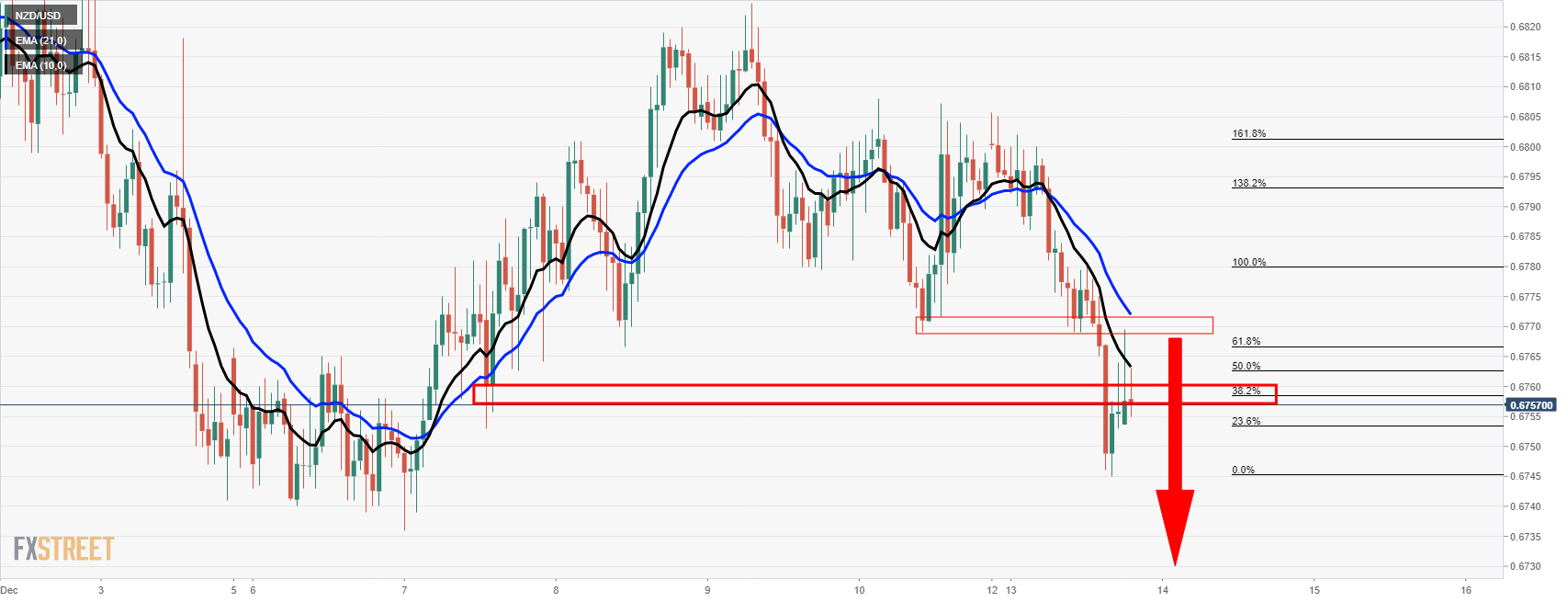
The price is running into hourly resistance below a bearish 10/21 EMA crossover. The pressures would be expected to move in from the bears around the 38.2% Fibonacci retracmenet level resulting in a downside continuation of the bearish trend.
What you need to know on Tuesday, December 14:
Major pairs seesawed between gains and losses in a risk-averse environment, with volatility subdued and majors confined to familiar levels, as market participants await central banks’ announcements. The US Federal Reserve will announce its monetary policy decision on Wednesday, while the Bank of England and the European Central Bank will do the same on Thursday.
Concerns rotate around how the ongoing Omicron outbreak may affect such decisions and global economic growth. Meanwhile, the UK reported the first death related to the Omicron variant.
The EUR/USD pair trades a handful of pips below the 1.1300 level, while the British Pound fell against the greenback towards the 1.3200 region. Commodity-linked currencies came under selling pressure as Wall Street edged lower, recovering modestly ahead of the close. Safe-haven CHF and JPY are little changed against the dollar on a daily basis, trimming losses in the last trading session of the day.
The yield on the 10-year US Treasury note peaked at 1.50%, but retreated to 1.41%, finishing the day near the latter.
Gold managed to advance, with spot trading around $1,787 a troy ounce, while crude oil prices were weighed by the poor performance of equities, and WTI ended the day at $71.00 a barrel.
Dogecoin price to return to $0.09 as DOGE enters bear market
Like this article? Help us with some feedback by answering this survey:
- The S&P 500 dropped 0.6% on Monday in a cautious start to the week as Omicron fears persist.
- Travel-related companies performer the worst in the US, whilst defensive names did better.
US equities markets have come under pressure on the first trading day of the week after the S&P 500 managed a record high close last Friday at 4712. The index has dropped more than 25 points to current levels in the 4680s, a decline of over 0.5%. Still, the S&P 500 continues to trade within the ranges carved out during the latter part of last week, so Monday’s selling pressure is hardly catastrophic. But it is indicative of markets beginning the week with a sense of caution as worries about the Omicron variant persist and ahead of a deluge of key central bank meetings (most important of which is the Fed) and G10 economic data releases.
The Nasdaq 100 is the worst performing of the major indices, down about 0.9% on the session, though the index looks set to find support above the 16.1K level for a fifth consecutive session. The Dow, meanwhile, is down about 0.7%, while the VIX is up about 1.50 and back above the 20.00 mark, indicative of traders deeming it too soon to completely unwind post-Omicron volatility expectations. Speaking of the new variant, news from the UK seems to have triggered some concern after the UK PM warned of a “tidal wave” of infections, which now apparently already account for around a fifth of the infections in the whole country.
“Creeping headlines about the Omicron variant are weighing on traders' minds”, said analysts at Equiti Capital. Meanwhile, according to analysts at Charles Schwab, “the big unknown is still the Omicron variant and we don't know just yet how that may affect markets and the economy, but as long as that uncertainty exists the volatility is probably going to remain higher”.
Covid-19 fears weighed heavily on the Transportation (-1.2%) and Airline (-3.9%) sectors, with traders citing the possibility that parts of the US follow in the footsteps of Europe in the coming weeks and reimpose restrictions. The uncertain start to the week also weighed on US yields, particularly at the long-end (given that the short-end remains underpinned by expectations for a hawkish Fed midweek), but this has not come to Big Tech’s aide. The S&P 500 Communication Services and Information Technology GICS sectors were down about 0.5% and 0.9% respectively. The more defensive sectors held up better. The Consumer Staples sector was up more than 1.0%, while the S&P 500 Healthcare sector was up 0.9%.
- AUD/JPY bulls are in charge, for now, while bears get ready to move in.
- The hourly chart's price action is forming a bearish structure, in line with the meanwhile daily outlook.
As illustrated below, the price of AUD/JPY is with the bulls for the time being, but the prior support would be expected to act as a resistance and failure on the retest opens risk to the downside.
AUD/JPY H1 chart
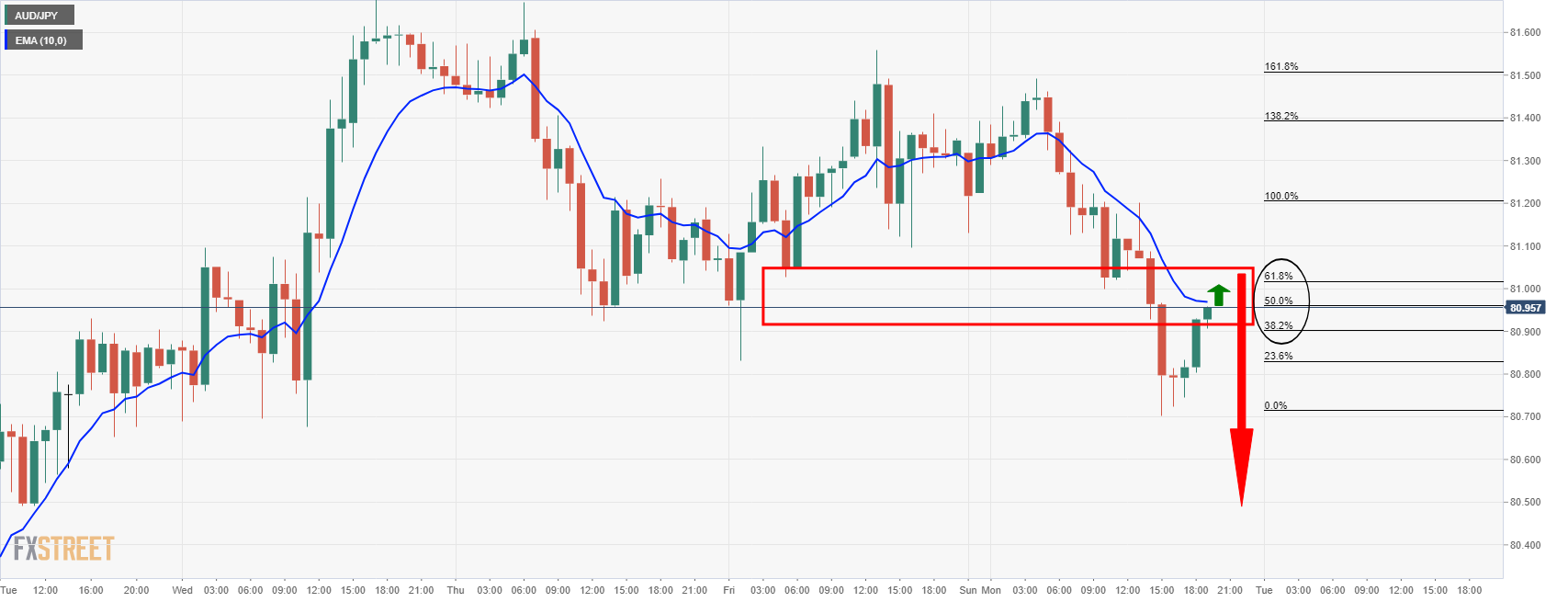
The 61.8% ratio is in confluence with this area of potential resistance located near 81 the figure. Before there, however, 80.95 is under pressure and could hold up as a 50% mean reversion level.
AUD/JPY daily chart
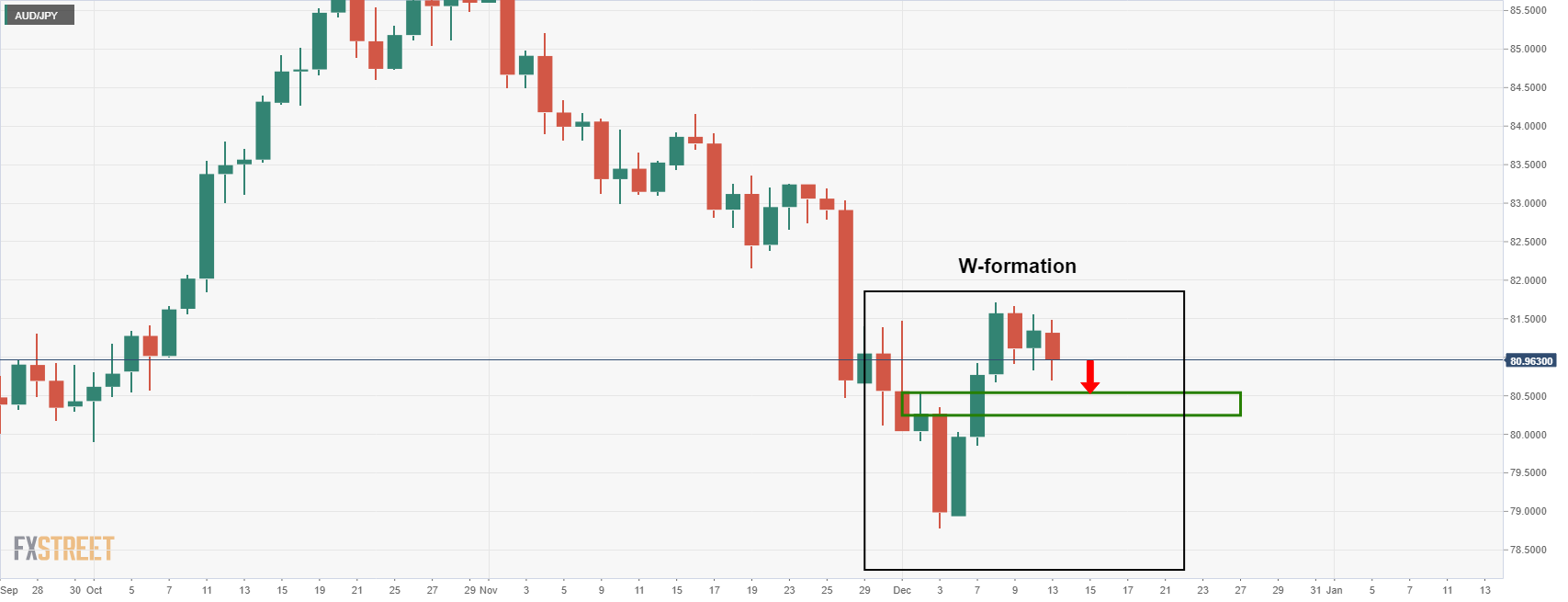
From a daily perspective, the downside is compelling considering the W-formation which is a high completion rate reversion pattern. The price would typically retest the neckline of the formation, which in this case, is located near 80.56.
- The euro recovers some ground against cable, up some 0.32%.
- EUR/GBP Technical outlook: The daily chart, has a downward bias, as long as the 200-DMA and a downslope trendline hold.
- EUR/GBP Technical outlook: The 1-hour chart has an upward bias, but it would face strong resistance around 0.8550s.
The shared currency grinds higher, recovering from Friday’s losses, is trading at 0.8543 during the New York session at press time. The market sentiment stills downbeat since the Wall Street open, as portrayed by European stock indices recording losses, while across the Atlantic, the US indices are down between 0.71% and 1.55%.
In the European session, the UK informed the death of the first omicron-linked COVID-19 case that spurred the switch in market mood. That triggered a move from 0.8500 up to 0.8520 in the cross-currency pair, as investors look for low-yielding peers as safe-haven flows. The British pound continued weakening against the euro in the last couple of hours, though the EUR/GBP pair will face strong resistance around 0.8550.
EUR/GBP Price Forecast: Technical outlook
Daily chart
From the daily chart perspective, the pair still tilted to the downside, as long as the 200-day moving average (DMA) remains respected. However, during today’s price action, the cross-currency bounced at the 100-DMA at 0.8511, so the EUR/GBP could be range-bound unless a catalyst hits the market.
To the upside, the first resistance would be the 200-DMA at 0.8555. If the 200-DMA gives way to EUR bulls, then the next resistance would be a downslope trendline that travels from April highs through July’s one, around the 0.8575-95 area, followed by the figure at 0.8600.
On the other hand, the first support would be the 100-DMA at 0.8511. A break of that level would expose 0.8500, followed by the 50-DMA at 0.8480.
-637750183027626125.png)
1-hour chart
In the 1-hour chart, the EUR/GBP is tilted to the upside, though it would face strong resistance at a downslope trendline that travels from December 9 highs, passing around the 0.8550-60 area. In the event of breaking to the upside, the first resistance would be 0.8588, followed by 0.8600.
On the flip side, the first support would be the 100-hour simple moving average (SMA) at 0.8541, followed by the 50-hour SMA at 0.8534 and then the 200-hour at 0.8527.
-637750183203190109.png)
- GBP/JPY bulls are in play from critical support.
- 152.40s are eyed from the longer-term analysis. Nearer term,150.20 is compelling on the 4-hour chart.
GBP/JPY is meeting a critical area of support and the focus is on the upside across the time frames and various structures as follows:
GBP/JPY weekly chart

The weekly chart is compelling as per the M-formation. The price will typically revert for a test of the neckline, which in this case, is located near 152.40.
GBP/JPY daily chart

The daily support is so far holding up and zooming in, there are prospects for a test the upside as follows:
GBP/JPY H4 chart

From a 4-hour perspective, the price could be destined for a test of the prior lows and the confluence of the 38.2% Fibonacci retracement of the prior bearish impulse. This comes in near 150.20. Should the resistance hold at this area, then the downside will be in play and a break of the dynamic support opens risk towards 149 the figure.
- Spot silver continued to rise on Monday amid risk-off and a favourable yield environment.
- The main event of the week will be the Fed and their hawkishness might hurt precious metals.
Spot silver (XAG/USD) prices are higher on Monday, building on last Friday’s rebound from just under $22.00 per troy ounce to current levels close to current levels around $22.30 amid a favourable yield environment. To the upside, XAG/USD faces resistance in the $22.60 area in the form of last week’s highs, whilst to the downside, there is support around $21.80. A bullish break would open the door to a move towards the $23.00 level, which has been an important balance area in recent months. A bearish break would bring the $21.50 level in focus, which coincides roughly with September’s low.
Driving the day
US yields have been falling gradually for most of the session, particularly at the long end of the curve, amid a risk-off market feel that is favouring safe havens assets like US bonds (thus suppressing yields) as risk assets (stocks, commodities, risk-sensitive currencies) decline. There is a sense of caution in the market ahead of a week jam-packed with important central bank events, the most important of which is Wednesday’s Fed policy announcement, and G10 data releases.
Meanwhile, worries about the impact of Omicron on the near-term economic outlook remain elevated after UK PM Boris Johnson sounded the alarm about a coming “tidal wave” of infections in the UK over the weekend. US 10-year yields are down about 6bps and back under 1.45%, still well below pre-Omicron emergence levels (near 1.70%), while US 10-year TIPS yields are down about 3bps on the day and remain under -1.0%. The dollar is a little firmer, which some market commentators have attributed to pre-FOMC meeting positioning (on expectations of a hawkish outcome), though the dominant driver of markets on Monday remains risk appetite.
In terms of the outlook for silver this week, if risk appetite continues to be the main driver (perhaps on more bad Omicron news), then the prospect for further upside is good. However, if central banks and the theme of their reaction functions to economic conditions is the main driver, then things look less positive for precious metals. There is a bonanza G10 and EM central banks this week, but the most important of which is the Fed on Wednesday and they are going to pivot hawkishly – recall that Chairman Jerome Powell indicated this in his Congressional testimony earlier in the month when he said it might be appropriate to hasten the pace of QE tapering and to drop the term “transitory” to describe inflation.
For precious metals to see a sustained rebound, there is going to have to be a notably dovish change in tone from the Fed that weighs on short-end and real yields and causes inflation bets to rise. With inflation at 6.8%, as the latest Consumer Price Inflation report revealed last Friday and with the Fed now framing inflation as a greater threat to the labour market as opposed to pre-emptive policy tightening, such a shift seems highly unlikely.
- Gold bulls rake control at the start of the week and eye $1,1815 resistance.
- The Fed is the key focus this week and markets weigh aggressive tightening.
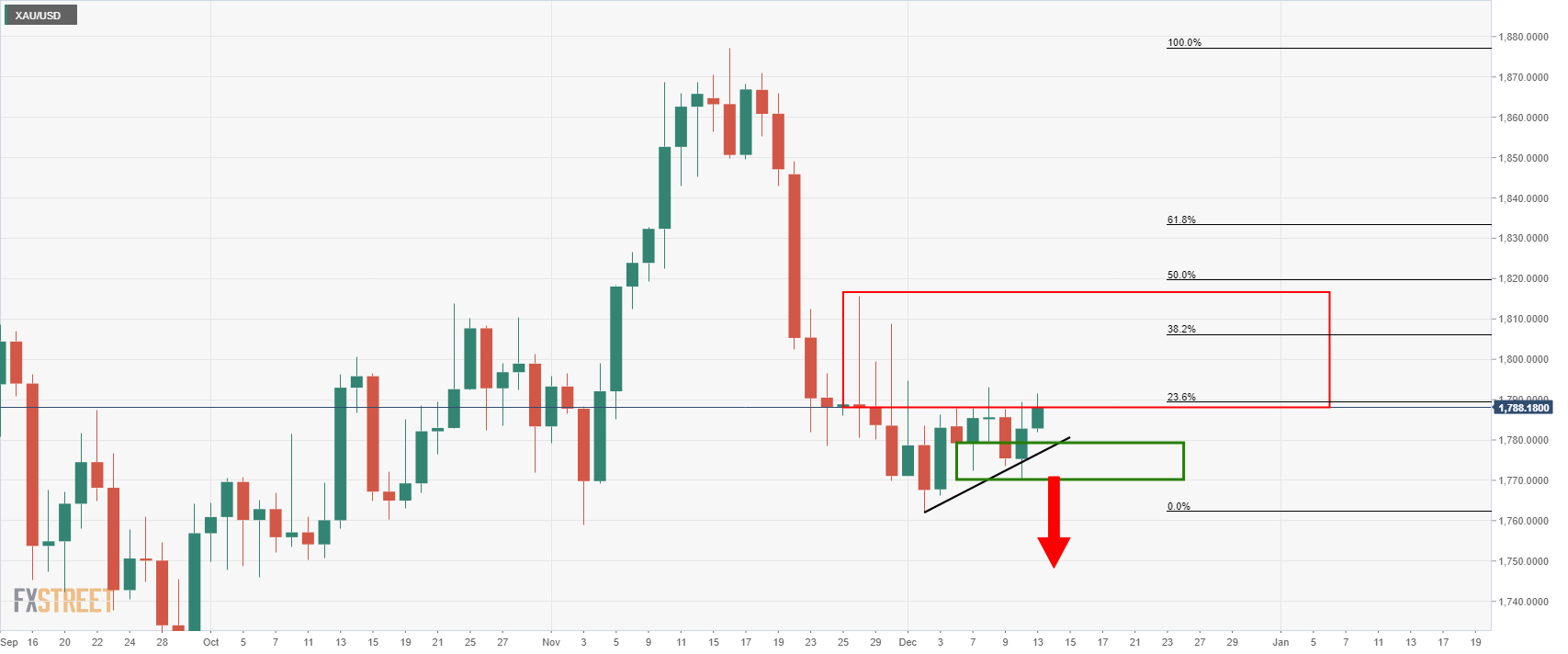
On Monday, the price of gold has started off in the hands of the bulls eyeing a breakout to test the familiar daily resistance near $1,815. At the time of writing, the yellow metal is higher by some 0.3% and has travelled between a low of $1,781.89 and a high of $1,791.65.
The start of the week is active ahead of a flurry of central bank announcements amid fears about inflation and the economic threats posed by the Omicron. The precious metals are customary to such a climate and can avail where volatility and risk-off themes dictate the flows.
With respect to the Covid-19 variant, Omicron, while it has been noted as a concern by the World Health Organization and the U.S. Centers for Disease Control and Prevention, scientists say preliminary data suggests it may cause milder cases of covid-19 than the delta variant. Nevertheless, news of the first death from the variant is troublesome for risk appetite, supporting the demand for gold. At least one person has died in the United Kingdom after contracting Omicron cPrime Minister Boris Johnson said on Monday, the first publicly confirmed death globally from the swiftly spreading strain.
Meanwhile, the Federal Reserve is anticipated to accelerate the withdrawal of stimulus on Wednesday, perhaps opening the door to earlier interest-rate hikes in 2022 if price pressures remain near a four-decade high. Therefore, US yields will be a major driver on the outcome. On Monday, the US 10-year Treasury yield as fallen hard by over 4% which has sunk the greenback, as measured by the DXY index, by 0.19%.
However, should the pace of the Fed's taper be doubled to $30bn per month, then a generally more hawkish tone from the central bank could play into the hands of the US dollar bulls.
''This could once again weigh on the yellow metal in the near term, particularly as a reversal of the liquidity premium in breakeven markets, driven by tapering, could also catalyze a change in sentiment across precious metals as its impact ripples through into market pricing for Fed hikes,'' analysts at TD Securities argued.
''Beyond the near-term, our macro strategists expect enough slowing in inflation and growth to delay rate hikes until 2023. In this scenario, amid an increasingly clean positioning slate, gold would be set to recover in 2022 as markets would be forced to reprice aggressive Fed hikes.''
Gold technical analysis
From a technical standpoint, the price remains in familiar territory but is pining for a breakout, one way or the other. We are seeing some upside pressure built into the consolidation phase for the month of December and there is room to test the $1,815 level as follows:
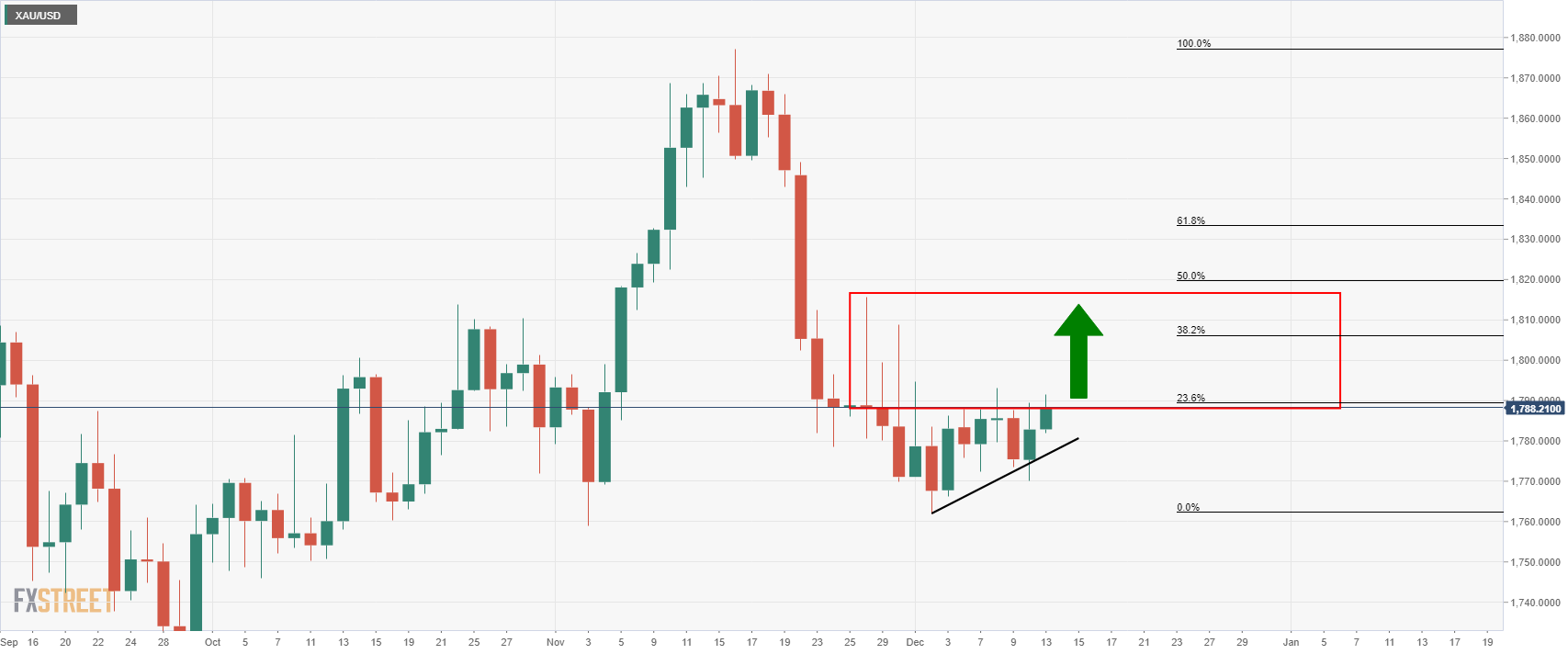
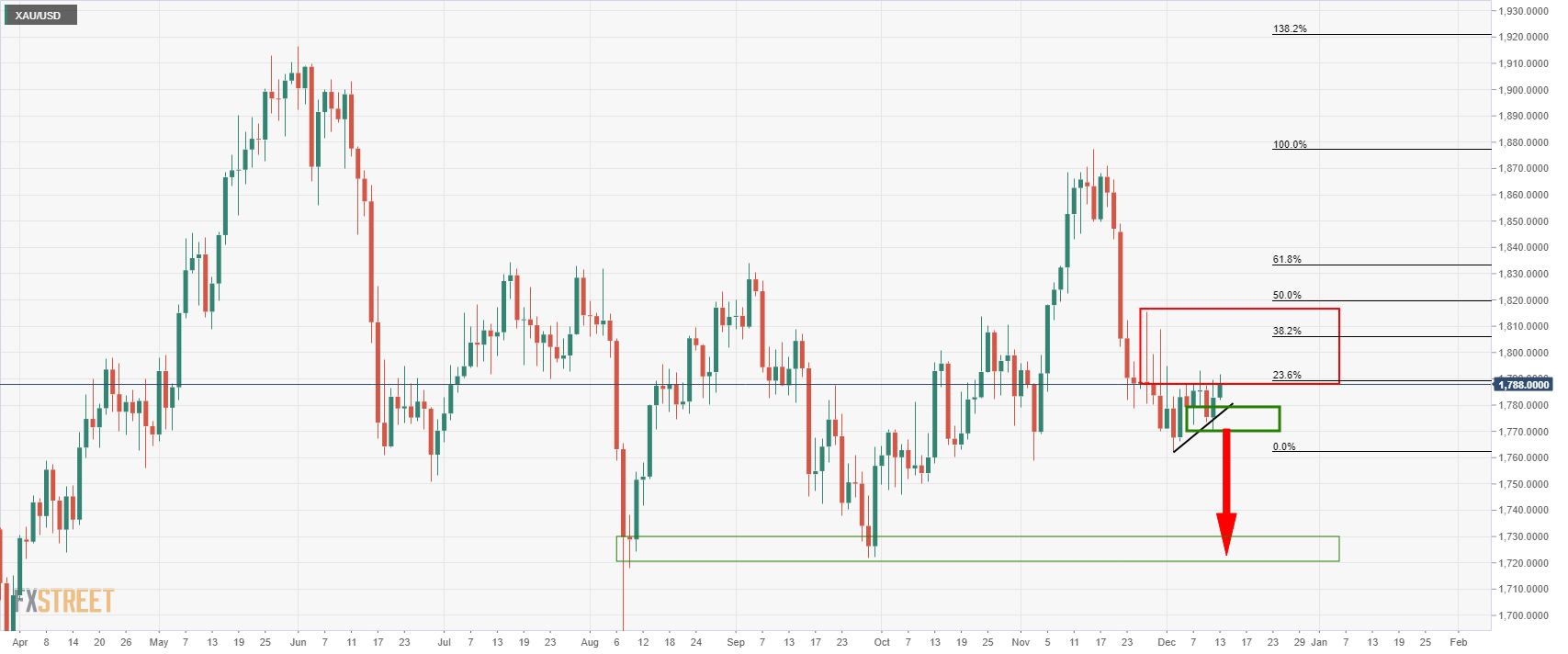
Failing that, a break of $1,770 opens risk to the downside:
$1,720 comes as the next area of support:
- The British pound falls some 0.32%, as market participants head to US and UK central bank meetings.
- UK’s COVID-19 first omicron-linked death dampened the market sentiment, as depicted by global equities falling.
- GBP/USD Techincal outlook: Mild-bearish, as long as the spot price remains below the 200-hour SMA.
The GBP/USD pares some of its last Friday’s gains, slide some 0.32%, trading at 1.3226 during the New York session at the time of writing. Investors’ mood is downbeat, as portrayed by European equities ending in the red, while major US stock indexes are losing between 0.65% and 0.85%.
Factors like the first death linked to the omicron variant in the UK dented the market mood amid its fast global spread. In response to increasing COVID-19 cases in the country, Borish Johnson, PM, raised the COVID alert to four. That, alongside the Federal Reserve and Bank of England’s last monetary policy meetings in the year, keep GBP/USD traders at bay, waiting for more clues.
Since the overnight session, the British pound has failed to capitalize a move towards 1.3300, courtesy of increased demand for the greenback. Further, the Fed’s “hawkish” pivot for the last two weeks keeps USD in charge against most G8 currencies, with the US Dollar Index rising 0.16%, sitting at 96.25, a headwind for sterling, which retreated from 1.3270s down to 1.3220s.
US bond yields from mid to longer-term maturities in the bond market are plunging between 7 to 8 basis points. The 10-year Treasury yield, a barometer for interest rates, is down seven basis points, at 1.419%, while the 20s and 30s are down to 1.85% and 1.80%, respectively.
The absent UK and US economic docket left GBP/USD traders leaning on the dynamics of market sentiment and US dollar macroeconomic data. However, on Wednesday, the UK would report the Consumer Price Index. On the US front, the Federal Open Market Committee will unveil its monetary policy. The market expects an increase in the bond taper, at least by double of the original $15 billion amount of reducing purchases.
GBP/USD Price Forecast: Technical outlook
The GBP/USD 1-hour chart depicts the pair is neutral, though mild-bearish, as it has failed to sustain a clear break above the 200-hour simple moving average (SMA), 14-days before, which at press time lies at 1.3251. Also, GBP bears reclaimed the 50-hour SMA and threaten to break below the 100-hour SMA at 1.3227.
In the event of breaking the abovementioned level, the first support would be the S1 daily pivot around the 1.3200-08 range. A breach of the latter would expose the December 10 low at 1.3287, followed by the December 8 cycle low at 1.3160.
On the flip side, the first resistance is the 200-hour SMA at 1.3251. A break above that resistance would open the door for further gains, with the December 10 high at 1.3275. The breach of the latter would send the pair rallying towards 1.3300.
- USD/TRY has reversed back under 14.00 and is lower on the day after printing record highs close to 15.00 earlier.
- The CBRT intervened for the fourth time in two weeks to shield TRY from post-S&P rating downgrade selling.
- The CBRT is expected to press ahead with a widely criticised 100bps rate cut on Thursday, despite inflation above 20%.
USD/TRY has seen an explosion of volatility this Monday. Early in the European session, the pair surged above the 14.00 level (that the CBRT had spent last week defending) for the first-ever time and then came within a whisker of hitting 15.00. The surge was initially triggered after S&P Global lowered its outlook for Turkey’s sovereign credit rating to negative. The lira then rebounded after the CBRT announced a fourth FX market intervention in two weeks and USD/TRY now trades to the south of the 14.00 level once again and is actually trading in the red on the day by a small margin.
But traders will be cautious that the lira remains highly vulnerable to selling pressure. Turkish President Recep Erdogan remains as intransigent as ever on his determination to bully the CBRT into lowering rates (despite inflation surpassing 21% in November) and his Finance Ministry is on board. Just this morning, the newly appointed pro-Erdoganomics Finance Minister said that the government was determined not to raise interest rates. This ahead of an expected 100bps rate cut from the CBRT on Thursday to take rates to 13.0% from 14.0%, which would amount to over 500bps in easing since September.
Credit Suisse “still expect the MPC to cut the repo rate by 100bps next week on the back of political pressure despite the recent Lira sell-off and rising inflation pressures”, in line with the Bloomberg consensus. The bank is skeptical about the market assigning a higher probability of an unchanged interest rate following a recent call between the CBRT and investors. Thus, they maintain their long USD bias. Meanwhile, according to analysts at Commerzbank, "last week's apparent relative stability of lira was artificial and non-sustainable”. “Now we see the build-up pressure unfolding, driving lira weakness to the next level,” the bank continued, adding that “any further attempts ... to stabilize lira by interventions is probably bound to fail.”
Bank of Canada Governor Tiff Macklem said on Monday that the BoC was currently focused on bringing inflation back down to target without choking off Canada's economic recovery, in a post-Framework Review speech alongside Canadian Finance Minister Chrystia Freeland. We are not in a situation right now where we could probe for maximum sustainable employment, added Macklem.
Market Reaction
USD/CAD has pulled back from highs in recent trade but continues to trade to the north of the 1.2800 level, having seemingly not taken much notice of Macklem's remarks.
Industrial Production (IP) in Turkey increased by 8.5% in October from a year earlier, in line with consensus. Analysts at BBVA point out GDP growth in 2021 will be around 10.5-11%, above their current forecast of 9.5%. All these took place before the recent devaluation of the lira.
Key Quotes:
“IP still doesn’t indicate a clear slowdown in economic activity given the slight recovery in monthly growth of 0.6% which was a -1.5% previous month.”
“Our Big Data demand proxies and other high frequency indicators still displayed solid momentum in November and December. Hence, our monthly GDP indicator nowcasts a yearly growth rate of 8.1% for November (52% of info) and 8.5% yoy for December (33% of info), indicating a quarterly growth rate of 2% for 4Q.”
“Current strong momentum, looser economic policies, remaining robust global activity would support the economy. However the latest currency shock , uncertainties tied to new Covid-19 variant and tighter financial conditions will likely be downside factors on 2022 GDP growth.”
According to the latest New York Fed survey, median one-year-ahead inflation expectations rose to 6.0% in November from 5.7% in October. Median three-year-ahead inflation expectations fell to 4.0% from 4.2%. Median uncertainty regarding future inflation outcomes rose at both the short and medium-term horizons, both teachings their highest levels since the survey was launched in 2013.
Meanwhile, the median one-year-ahead expected earnings growth dropped to 2.8% in November from 3.0% in October. That means consumers expected inflation over the course of the next year to outpace their earnings growth by 3.2%, the widest such gap since the launch of the survey. Elsewhere, the median one-year-ahead expected rise in home prices decreased to 5.0% from 5.7%.
Market Reaction
Markets have not reacted to the survey, with attention firmly on key US data and the Fed meeting later this week.
- The Mexican peso remains among the top weekly performers across the globe.
- US dollar mixed on Monday, between risk aversion and lower US yields.
- USD/MXN holds near the recent bottom, supported around 20.85.
The USD/MXN is rising marginally on Monday supported by a deterioration in market sentiment during the American session. Still it remains under 21.00 and near the three-week low it reached on Friday at 20.83.
The greenback is up across the board despite lower US yields. The Dow Jones is falling by 0.89% and the Nasdaq 0.78%. The slide in equity prices favored the demand from the dollar.
FOMC and Banxico at the same week
The key focus of the week will be on central bank. Their decisions are likely to impact on prices across all financial assets.
On Tuesday, the Federal Reserve will start its two-day meeting. “Fed officials are likely to strike a much more hawkish tone at this week's FOMC meeting than they did in November, although a major shift is now widely anticipated by markets participants”, mentioned analysts at TD Securities. Analysts expected an increase in the pace of tapering and some signs that interest rate might rise sooner than previously expected.
The Bank of Mexico will meet on Thursday. It is expected to hike the key interest rate 25 basis point to 5.25%; some analysts consider the possibility of a 50 bp hike. “November CPI rose 7.37% y/y, the highest since January 2001 and further above the 2-4% target range. Swaps market is pricing in a peak policy rate of 7.25% by end-2022 and remaining there through 2023”, said BBH analysts.
Technical levels
- USD/CAD has been pushing higher in recent trade as broad risk appetite takes a turn for the worse.
- The pair, which is now above 1.2800, is also being pushed higher as the dollar strengthens pre-Fed.
USD/CAD has been gunning to the upside on Monday and has recently moved above the 1.2800 level, having started the week only just above 1.2700. That amounts to a 0.7% move to the upside and means that most of last week’s losses have now been eroded. Recall that USD/CAD fell from around 1.2840 to lows just above 1.2600 last week. If the pair can break to the north of 1.2800, the next key area of resistance to watch out for is at 1.2850. Beyond that, it’s the summer highs in the 1.2900-1.2950 region.
The pair’s move higher comes amid a broad sell-off in risk-sensitive currencies - NZD and AUD are down by a similar amount to CAD, whilst NOK is down more than 1.2.% on the session – as risk appetite deteriorates. CAD’s downside doesn’t seem to have anything, in particular, to do with any Canada-specific news, though, notably, the BoC did announce the conclusion of its monetary policy framework review. The bank will keep its inflation target at the 2% midpoint of a 1-3% range and said it would keep rates lower for longer if needed to optimise employment outcomes, as expected.
Rather, it is selling pressure in global equities that is likely to be the main reason for the acceleration of CAD depreciation in recent trading. Since the open of US markets at 1430GMT, global equities have been under selling pressure. The S&P 500 posted a record close last Friday, so profit-taking ahead of what is going to be a busy week of central bank events and data is likely driving the downside. But even before stocks started dropping, USD/CAD was already higher amid broad USD strength.
The main event as far as USD/CAD is concerned this week is the Fed’s monetary policy decision on Wednesday, where the bank will likely announce an acceleration of the pace of its QE taper plans. The bank’s new dot plot and economic forecasts will also be key points of focus, as will (as usual) the updated policy statement and remarks from Chairman Jerome Powell in the post-meeting press conference. As noted, even prior to the deterioration in risk appetite, the US dollar was on the front foot on Monday, with markets seemingly positioning themselves for a more hawkish outcome. Whether the Fed can live up to the hawkish expectations already priced into money markets (three hikes are seen in 2022) is another question.
- The USD/CHF begins the week on the right foot, up some 0.26 %.
- A mixed-market mood has kept the pair range-bound within the 0.9200-0.9250 range.
- USD/CHF Technical outlook: Neutral at the lack of a catalyst, influenced by market sentiment plays.
The USD/CHF begins the week on the right foot, though fluctuating around the familiar 0.9200-50 range, for the fifth consecutive day, trading at 0.9230 at the time of writing. The market sentiment remains mixed, though slightly downbeat, as European equities fluctuate between gainers and losers. Contrarily, across the pond, US equities are down, ahead of the 2021’s Federal Reserve last monetary policy meeting, which also added to the ongoing dampened market mood.
That said, in the overnight session, the USD/CHF jumped off the 0.9200 figure towards the 0.9250 area, as demand for US dollars increased during the Asian and early European session. As of late, the pair retreated towards the central daily pivot point at 0.9219 amid an absent economic docket from Switzerland and the US, so the Swiss franc might only be influenced by market sentiment.
USD/CHF Price Forecast: Technical outlook
The USD/CHF hourly chart depicts that the pair has a neutral bias. At the time of publication, the spot price is approaching an upslope trendline around the 0.9210-15 region, a support level that, in the case of giving way, could send the pair towards the December 9 cycle low at 0.9191.
To the upside, the USD/CHF is firmly pressured by the 200-hour simple moving average (SMA) at 0.9220, followed by a key resistance area at the confluence of the 50-hour SMA and the 100-hour SMA at 0.9230. Once that region gives way, it would open the door for the December 10 high at 0.9252.
On the flip side, the 0.9200 figure is the first line of defense for USD bulls. The breach of the latter exposes essential support levels, with the December 9 low at 0.9191, followed by December 3 low at 0.9165.
-637750079700751910.png)
- Lower US yields boost EUR/USD from near 1.1250 toward 1.1300.
- A decline in equity prices in Wall Street favors the greenback against commodity currencies.
- Market participants with focus on central banks.
The EUR/USD recovered from the lowest level in almost a week at 1.1259 and climbed to 1.1297. Near the 1.1300 area the euro lost momentum and the pair pulled back to 1.1270. It continues to move sideways, with a bearish bias.
The slide in US yields weighed on the greenback. The 10-year fell to 1.44% and the 30-year to 1.83%. The Dow Jones is falling by 0.85% and the Nasdaq by 0.65%.
Looking at central Banks
On Tuesday, the Federal Reserve will start its two-day meeting. “Fed officials are likely to strike a much more hawkish tone at this week's FOMC meeting than they did in November, although a major shift is now widely anticipated by markets participants. We expect the taper pace to be doubled and "transitory" dropped, with the median dot showing a 50bp increase in 2022. We expect enough slowing in inflation and growth in 2022 to delay rate hikes until 2023, but, for now, strong data are encouraging hawkishness”, explained analysts at TD Securities.
On Thursday, the “We expect that the ECB will continue to assess inflation as ‘transitory’. Unlike the US there are few signs of second order wage inflation in the region. Against this backdrop, we expect the size of the standard asset purchase programme (APP) to be increased to EUR 40 bln/mth”, mentioned analysts at Rabobank.
The divergence regarding expectations from the Fed and the ECB has been a key driver in the slide of EUR/USD. The meeting should be a critical even having a significant impact on the market.
Technical levels
- USD/JPY continues to trade close to its 50DMA and the 113.50 level as key market events are awaited.
- The most important event this week will be the Fed meeting, which should see the bank pivot hawkishly.
USD/JPY is trading in subdued fashion amid a quiet start to what will ultimately be a very busy week. The pair has been undulating just to the north of the 113.50 level and close to its 50-day moving average in the 113.60s, levels which have acted as a magnet for the price action for most of the last week. Ahead of key events later in the week, subdued trading conditions are likely to persist and, thus, playing the pair’s recent 113.25-114.00 ish range might be the way to go.
If long-term US yields continue to push lower (the 10-year is down about 5bps on the day and back below 1.45%), USD/JPY may well test the bottom of this range in the near future. Beyond these nearest levels of support and resistance, there is the 112.50 area to the downside, which is a double bottom from late November/early December, and there is the November (annual) high at 115.50.
Week Ahead
In terms of the major events in store this week, the highlights will be the Fed’s monetary policy decision on Wednesday, followed by the BoJ’s decision on Friday. There are also plenty of important economic data releases for FX market participants to sink their teeth into, including November PPI on Tuesday, November Retail Sales and the December NY Fed survey on Wednesday, weekly jobless claims numbers, November housing data, November Industrial production and the December Philly Fed and flash Markit PMI surveys on Thursday. Japan sees the release of November Industrial Production figures on Tuesday and then trade numbers on Thursday.
In terms of how markets might react to all of the above; the Fed meeting will be far and away the most important FX market driver of the week. US data is likely to by and large reinforce well-established narratives on the US economy such as high inflation pressures, coupled with strong growth, but supply chain disruptions still hurting output in some sectors (and contributing to higher prices). This is likely to feed into a stronger dollar, whilst it doesn’t seem there is much that the BoJ or Japanese data can do to help the yen, whose fate is likely to be determined more by broader risk sentiment/rate differentials. Case in point, the widely followed Tankan survey of large manufacturers saw its headline index improve for a sixth successive quarter and hit its highest since late 2018, but failed to stir any movement in FX.
- AUD/USD edges lower some 0.56%, as the Fed’s last monetary policy meeting looms.
- Risk sentiment dampens as the UK reported its first COVID-19 omicron-related death, increasing restrictions.
- AUD/USD Technical outlook: Below 0.7200 bearish, otherwise could challenge an important confluence of technicals around 0.7300.
After closing the last week in the green, the AUD/USD slides during the New York session, trading at 0.7132 at the time of writing. As shown by European equities fluctuating between gainers and losers, financial markets are mixed. At the same time, US indices begin the day in the red, as the UK reported the first omicron-related death, as the spread of the new strain continues worldwide. Furthermore, some of the most important central banks would hold their last monetary policy meetings of the year, adding to the cautious tone of investors.
At the beginning of the trading week in the Asian session, the Australian dollar remained subdued, peaking at the daily high at 0.7174, then slumping as the market sentiment spurred a flow towards the safe-haven status of the greenback, weighing on the commodity-related currency.
In the meantime, the US Dollar Index advances 0.19%, sitting at 96.27, while US bond yields with the 10-year benchmark note are down four basis points (bps), at 1.448%, as the FOMC’s last monetary policy meeting looms.
An absent Australian economic docket left the Australian dollar at the mercy of dynamics surrounding the US dollar. Additionally, suppose the Federal Reserve decides to increase the speed in the bond taper in their last monetary policy meeting. In that case, it could trigger another leg-down in the pair ahead of the end of the year.
AUD/USD Price Forecast: Technical outlook
As the AUD/USD daily chart depicted, the 0.7186 barrier would still be difficult to overcome as the pair retreated towards the 0.7130s area since Wednesday of the last week. That said, the pair is mild-bearish, as long as the daily moving averages (DMAs) remain above the spot price, with a slightly-downslope direction. Nevertheless, upside risks remain unless the pair breaks below 0.7105.
At press time, on the downside, the first support would be the August 20 cycle low at 0.7105. A break of that level would exert downward pressure on the AUD. The next support would be the YTD low at 0.6992.
On the other hand, AUD bulls will need to reclaim 0.7200. In that event, the next resistance would be the confluence of the 50 and the 100-DMAs around the figure at 0.7300.
The Bank of Canada announced on Monday that it had agreed with the government to leave its inflation target at the 2.0% midpoint of a 1.0%-3.0% range for the next five year, as expected, according to Reuters.
Additional Takeaways:
“Will sometimes hold policy rate at a low level for longer than usual to address challenges of structurally low interest rates, will use other tools as well.”
“The bank will use a broad set of monetary policy tools to deal with likelihood bank's policy rate will more often be at its lowest possible rate, given circumstances at the time.”
“Agrees with the government that primary objective of monetary policy is to maintain low, stable inflation over time.”
“Agrees with the government that monetary policy should continue to support maximum sustainable employment while recognizing this is not directly measurable and is determined largely by non-monetary factors.”
“Neutral interest rates are likely to be lower than in the past, which means central banks will have less room to lower policy rates in case of shocks.”
“Evolving forces are having major effects on the Canadian labor market, increasing uncertainty about the level of maximum sustainable employment.”
“The bank will continue to use the flexibility of 1-3% control range to actively seek the maximum sustainable level of employment when conditions warrant.”
“The bank will use the flexibility of the 1 to 3% range only to the extent that it is consistent with keeping medium-term inflation expectations well anchored at 2%.”
“The bank will explain when it is using flexibility in the framework.”
“Because monetary policy can exacerbate financial vulnerabilities, the bank will continue to be mindful that such vulnerabilities can lead to worse outcomes down the road.”
“Strong and inclusive labor market helps reduce income inequality and supports robust demand for goods and services.”
“The bank will consider a broad range of labor market indicators and systematically report to Canadians how labor market outcomes have factored into policy decisions.”
“The government will work with relevant agencies to ensure arrangements for financial regulation and supervision are fit for purpose and consider changes if and where appropriate.”
Market Reaction
There has not been a notable market reaction to the announcement, which did not come as a surprise.
- Spot gold prices failed to break above their 50DMA at $1,793 again on Monday.
- The precious metal is back to trading within recent ranges as this week’s Fed meeting is eyed.
Spot gold (XAU/USD) prices are a touch higher at the start of the week, but have once again failed to break to the north of the 50-day moving average, which currently resides at $1,793. Spot prices moved above $1,790 and came within a whisker of testing the level earlier in the session, but have since ebbed lower again to trade in the mid-$1,780s. At current levels, spot gold is about 0.25% higher on the day, aided by a drop in long-term US government bond yields which has helped to shield gold against a modest strengthening of the US dollar.
Spot gold prices have spent the whole of December unable to rally to the north of the 50DMA and Monday’s failure is not too surprising given the proximity of key central bank events later in the week. The most important of these for spot gold is, of course, the FOMC meeting on Wednesday, where the Fed is expected to announce a doubling in the pace of its QE taper to $30B per month from the current $15B per month. Of most interest to markets will be the tweaks to the language of the statement (the word transitory is set to be dropped), the Fed’s new dot plot and the updated economic forecasts. The dot plot is likely to show as many as two forecasts are expected by Fed members in 2022.
With the Fed likely to lean hawkish, most strategists suspect that the dollar, as well as short-end and real yields, can expect to remain well supported this week. This is likely not a good recipe for gold and the bears will be eyeing a move lower to test recent lows in the $1,770 area. In wake of last Friday’s hot US Consumer Price Inflation report, this Tuesday’s Producer Price Inflation report is likely to re-emphasise the uncomfortable inflationary backdrop for the Fed the day before they announce policy. This is unlikely to offer gold much support as an inflation hedge if it reinforces the idea that a hawkish Fed pivot is coming/already in motion.
USD/CAD’s rebound from the low 1.26 area looks poised to extend somewhat. Economists at Scotiabank expect the pair to reach the 1.28 neighborhood.
Support is seen at the 1.2725 mark
“The steady bid for the USD looks set to probe the upper 1.27s/low 1.28s.”
“We now expect better resistance to emerge around the 1.28 zone where USD gains have tended to falter this year.”
“Intraday support is 1.2725.”
EUR/CHF has paused around 1.0400. Nevertheless, economists at Credit Suisse expect this pause to end this week for a move to the 1.0254/35 area.
Above 1.0455/59 would suggest a correction back to 1.0500/14
“The short-term momentum picture is concerning, as daily MACD has crossed higher and there is a large and growing divergence on the daily RSI. Despite these signals, we expect this pause to end this week, in line with our view that a medium-term trending phase to the downside has begun.”
“We look for a renewed turn back lower, which would be confirmed below 1.0373/65, with further minor supports at 1.0314 and 1.0280. More important medium-term support is seen at the 2015 corrective low and 50% retracement of the recovery from the peg removal spike low at 1.0254/35.”
“Short-term resistance stays at 1.0455/59, above which would instead elongate the pause and suggest a correction back to the point-of-breakdown at 1.0500/14.”
EUR/USD is pressured by Omicron spread and energy concerns. Additionally, the European Central Bank (ECB) monetary policy is set to contrast the path of the Federal Reserve, dragging the pair down towards the 1.10 level, economists at Scotiabank report.
EUR/USD to head towards 1.10
“Over the weekend, Germany’s Foreign Minister Baerbock noted that the Nord Stream 2 pipeline (through the Baltic Sea) cannot be certified as it does not meet requirements of European energy law. Today, Belarus’ Lukashenko warned that his country may halt gas transit through it to Europe if the G-7 deploys new sanctions on Russia over its military threat in Ukraine (the other key path for Russian gas transports to Europe).”
“The ECB meeting this week will likely see the bank hold back on signaling clearly how (and by how much) it intends to replace the PEPP (read: supplement the APP) once it expires in March. Prior to the emergence of Omicron, the bank looked set to deliver a less dovish decision and express optimism in the economic recovery. However, the new virus wave and more restrictions that look set to depress output over the next few weeks and perhaps months will see the ECB punt a clearer decision to the new year.”
“The ECB’s contrast to the Fed, which is expected to accelerate its reduction of asset buying this week, will weigh on the EUR toward the 1.10 zone in the near-term.”
- Resurgent USD demand prompted fresh selling around NZD/USD on Monday.
- Hawkish Fed expectations continued acting as a tailwind for the greenback.
- Traders might refrain from aggressive bets ahead of the key FOMC decision.
The NZD/USD pair maintained its bid tone through the early North American session and was last seen trading near a multi-day low, around the 0.6775-70 region.
Having struggled to find acceptance above the 0.6800 mark, the NZD/USD pair met with a fresh supply on the first day of a new week and was pressured by resurgent US dollar demand. Friday's US consumer inflation figures reinforced expectations for an early policy tightening by the Fed, which, in turn, continued acting as a tailwind for the USD.
Hence, the market focus will remain glued to the outcome of a two-day FOMC monetary policy meeting, scheduled to be announced on Wednesday. In the meantime, anxiety ahead of the key central bank event risk kept a lid on any optimistic move in the markets and further benefitted the greenback's relative safe-haven status against the perceived riskier kiwi.
The US central bank is expected to quicken the pace of tapering the bond purchases. Hence, investors would look for clues about the Fed's strategy on interest rate hikes amid worries about the persistent rise in inflation pressures. This will influence the near-term USD price dynamics and provide a fresh directional impetus to the NZD/USD pair.
Meanwhile, retreating US Treasury bond yields could hold back the USD bulls from placing aggressive bets and extend some support to the NZD/USD pair, at least for the time being. This warrants some caution before positioning for any further depreciating move amid absent relevant market moving economic releases from the US.
Technical levels to watch
- WTI has slipped back to the low-$71.00s from earlier session highs at $73.00.
- But continues to trade within recent ranges as more clarity regarding the impact of Omicron is awaited.
Front-month futures of the American benchmark for sweet light crude oil, West Texas Intermediary or WTI, slipped back from earlier session highs close to $73.00 on Monday and currently trade in the low-$71.00s. Despite finding some support at the $71.00 level in recent trade, prices are still down more than 50 cents on the day.
WTI prices continue to trade with the $70.50-$73.00ish ranges established towards the back end of last week, so Monday’s losses should be viewed in that context and not read into too much. Indeed, as markets await more clarity about the impact of Omicron on the global demand picture, rangebound trade makes sense. On which note, in its latest Short-Term Energy Outlook (STEO), OPEC said it expected the impact of the Omicron Covid-19 variant to be mild as the world continues to adapt to the presence of the pandemic. Meanwhile, the group left its oil demand growth forecasts for 2021 and 2022 unchanged at 5.65M barrels per day and 4.15M barrels per day respectively.
In terms of other crude oil-relevant news, Iranian nuclear negotiators sounded positive on the prospect for progress in negotiations with Western powers on a return to the 2015 nuclear accord. Western nations involved in the talks (UK, France, etc.) are yet to reciprocate this optimism, market commentators have noted. But if substantial progress were to be made, this would bring closer the prospect of a return of millions of barrels per day in Iranian crude oil exports to global markets as US sanctions are lifted.
This may compound worries that some in the industry have about global market oversupply in 2022. Indications from OPEC+ oil ministers is that the cartel will again agree to press ahead with a 400K barrel per day output increase from February when they meet at the start of the new year. According to analysts at Commerzbank, “the oil market risks facing a sizeable oversupply in the first quarter of 2022… We, therefore, envisage potential setbacks for the oil price in the coming weeks”.
Economists at Credit Suisse continue to look for support at 1.3189/35 to hold for now. As they note, GBP/USD needs to surpass the 1.3280/90 zone to see a deeper recovery.
Support zone of 1.3189/35 to remain a floor
“Whilst below 1.3280/90 the immediate risk stays seen lower for another move into our core objective support zone of 1.3189/35, which includes the 38.2% retracement of the 2020/21.”
“Although our broader bias for the USD stays firmly bullish, we continue to look for 1.3189/35 to try and remain a floor for now for the unfolding of a consolidation range.”
“A break below 1.3135 would warn of further significant weakness with support seen next at 1.3109/06 but with the next more meaningful support not seen until the 50% retracement of the 2020/2021 uptrend and November 2020 low at 1.2855/29.”
“A close above 1.3280/90 remains needed to suggest a deeper recovery can emerge for a retest of the recent ‘outside day’ high at 1.1371 which we would look to then ideally cap to define the upper end of a potential consolidation range.”
EUR/USD remains in its tight converging range above the 1.1186/68 price support from June 2020. An eventual break below 1.1168 should confirm a resumption of the core bear trend for a move to the 1.1019/02 region, economists at Credit Suisse report.
Close above 1.1387 needed to clear the way for a deeper recovery to 1.1433
“We maintain our core negative view and look for a break below 1.1265 for a fall back to 1.1237/27 initially, then a retest of 1.1186/68.”
“An eventual break below 1.1186/68 would confirm the resumption of the core bear trend to the measured ‘head & shoulders’ top objective at 1.1075 then our 1.1019/02 core objective – the 78.6% retracement of the 2020/2021 uptrend and ‘neckline’ to the April/May 2020 base. With the long-term uptrend from 2000 just below, our bias remains to look for a major floor here.”
“Near-term resistance moves to 1.1325, with 1.1356/60 ideally capping to keep the immediate risk lower.”
“A close above 1.1387 remains needed to see a small base complete instead to clear the way for a deeper recovery to 1.1433, potentially what we would expect to be much tougher resistance at 1.1464.”
- A combination of supporting factors pushed USD/CAD to a near one-week high on Monday.
- Hawkish Fed expectations acted as a tailwind for the USD and provided a goodish boost.
- Retreating crude oil prices undermined the loonie and remained supportive of the move.
The USD/CAD pair continued scaling higher heading into the North American session and climbed to a fresh four-day high, around the 1.2765 region in the last hour.
The pair attracted some dip-buying in the vicinity of the 1.2700 mark on Monday and built on last week's post-BoC bounce from the 1.2600 neighbourhood. The US dollar made a strong comeback on the first day of a new week and remained well supported by the prospects for a faster policy tightening by the Fed. Adding to this, retreating crude oil prices undermined the commodity-linked loonie and provided a modest lift to the USD/CAD pair.
Investors seem convinced that the Fed would be forced to adopt a more aggressive policy response to contain stubbornly high inflation and have been pricing in the possibility of liftoff in May 2022. The bets were reinforced by Friday's data, which showed that the headline CPI accelerated to the highest level since 1982 in November. Adding to this, the core CPI – excluding food and energy prices – recorded the sharpest pickup since mid-1991.
On the other hand, the Canadian dollar was weighed down by a weaker trading sentiment around the oil markets. This was seen as another factor that acted as a tailwind for the USD/CAD pair and contributed to the intraday move up. That said, easing concerns that the Omicron variant would have a limited impact on the fuel demand should help limit losses for the black liquid. In fact, OPEC on Monday raised its world oil demand forecast for the first quarter of 2022.
Apart from this, the prevalent risk-on environment might hold back traders from placing aggressive bullish bets around the safe-haven greenback. Investors would also prefer to move on the sidelines heading into this week's key central bank event risk – the FOMC monetary policy decision on Wednesday. The combination of factors could keep a lid on any further gains for the USD/CAD pair amid absent relevant market-moving economic releases on Monday.
Technical levels to watch
- GBP/USD rebounded above 1.3250 on Monday from earlier session lows in the 1.3220s.
- Sterling has been holding up well despite an increasingly alarming Omicron backdrop in the UK.
GBP is holding up comparatively well versus a broadly stronger US dollar versus its G10 peers on Monday, with GBPUSD currently trading only very slightly in the red on the session close to the 1.3250 level. GBP is the second best performing G10 currency on the day after the US dollar. The rebound from earlier session lows in the 1.3220s comes despite the UK PM and health authorities sounding the alarm about Omicron over the weekend.
Technical buying could be lending GBP/USD some support. The pair broke to the north of a long-term downtrend at the end of last week and appeared to retest this downtrend earlier on Monday’s session. Short-term technical speculators may have seen this as a good entry point to ride the pair back towards last week’s highs in the 1.3270s.
UK Update
Over the weekend, UK PM urged British citizens to get their booster jabs amid an incoming “tidal wave” of Omicron Covid-19 infections, which the health secretary Sajid Javid said now account for about 40% of infections in London. The UK Health Security Agency also advised that the UK have its Covid-19 alert level lifted to four from its current three and the PM on Monday ruled out the prospect of further restrictions being imposed ahead of Christmas.
Against the deteriorating backdrop in the UK, it seems highly unlikely that the BoE will press ahead with a rate hike. Policymakers have in recent weeks expressed concerns about the impact of Omicron on the UK’s economic outlook and these concerns will have only risen. Against that backdrop, Tuesday’s UK labour market report and Wednesday's UK Consumer Price Inflation report will be seen as holding less sway over policy-making decisions. If it wasn’t for Omicron, strategists would likely argue that strong labour market and inflation data would have been enough to swing in favour of a rate hike.
In its latest Short-Term Energy Outlook (STEO), the Organisation of Petroleum Exporting Countries (OPEC) left its oil demand growth forecasts for 2021 and 2022 unchanged at 5.65M barrels per day and 4.15M barrel per day respectively. The group said it expected the impact of the Omicron Covid-19 variant to be mild as the world continues to adapt to the presence of the pandemic.
Market Reaction
Crude oil prices continue to chop within recent ranges, with WTI moving lower towards $71.00, with eyes on this week's Iran/Western power discussions about a return to the 2015 nuclear deal.
- EUR/GBP witnessed some follow-through selling for the third successive day on Monday.
- A more ECB dovish was seen as a key factor behind the euro’s relative underperformance.
- Diminishing BoE rate hike bets should cap the upside for the GBP and help limit the slide.
The EUR/GBP cross dropped to a multi-day low during the mid-European session, with bears now awaiting a sustained break below the key 0.8500 psychological mark.
The cross extended last week's retracement slide from the 0.8600 neighbourhood, or the highest level since early October and remained under some selling pressure for the third successive day on Monday. The shared currency's relative underperformance could be attributed to a more dovish stance adopted by the European Central Bank (ECB).
In fact, policymakers have been pushing back on market bets for tighter policy and talked down the need for any action to counter inflation. That said, a combination of factors should hold back traders from placing aggressive bullish bets around the British pound and help limit any deeper losses for the EUR/GBP cross, at least for now.
News that the UK Prime Minister Boris Johnson could impose additional COVID-19 restrictions forced investors to further push back their expectations for an imminent interest rate hike by the Bank of England (BoE) in December. Last week, Johnson advised people to work from home and mandated the use of vaccine passports in large venues.
Apart from this, investors might also prefer to wait on the sidelines ahead of this week's key central bank event risks. Both the BoE and the ECB are scheduled to announce their respective decisions on Thursday. This, in turn, will play a key role in determining the next leg of a directional move for the EUR/GBP cross.
Hence, it will be prudent to wait for a strong follow-through selling before confirming that the recent strong recovery move from the lowest level since February 2020 has run out of steam. In the absence of any major market-moving economic releases, traders on Monday will take cues from the BoE Governor Andrew Bailey's scheduled speech.
Technical levels to watch
British Prime Minister Boris Johnson has confirmed Sky News' report claiming that the first patient has died after contracting the coronavirus Omicron variant, as reported by Reuters.
Market reaction
The market mood seems to have soured following this headline. As of writing, the UK's FTSE 100 Index was down 0.1% on the day at 7,285 points. Meanwhile, the GBP/USD pair, which touched a daily low of 1.3221, was last seen trading at 1.3255, where it was down 0.1% on a daily basis.
- EUR/USD witnessed fresh selling on Monday amid a goodish pickup in the USD demand.
- Expectations for an early policy tightening by the Fed acted as a tailwind for the greenback.
- Diverging ECB-Fed monetary policy outlooks support prospects for a retest of the YTD low.
The EUR/USD pair maintained its offered tone through the mid-European session and was last seen hovering just a few pips above a four-day low, around the 1.1260 region touched in the last hour.
The pair struggled to capitalize on Friday's intraday move up of around 60 pips, instead meeting with fresh supply on the first day of a new week amid resurgent US dollar demand. The prospects for an early policy tightening by the Fed continued acting as a tailwind for the greenback. This, along with a more dovish European Central Bank (ECB), exerted some downward pressure on the EUR/USD pair.
Investors seem convinced that the Fed would be forced to adopt a more aggressive policy response to contain stubbornly high inflation. Market bets were reaffirmed by data released on Friday, which showed that the headline CPI accelerated to the highest level since 1982. Adding to this, the core CPI recorded the sharpest rise since mid-1991 and validated hawkish Fed expectations.
On the other hand, ECB policymakers have been pushing back on market bets for tighter policy and talked down the need for any action to counter inflation. The divergence in the Fed-ECB monetary policy outlooks turned out to be another factor that drove flows away from the shared currency. That said, a combination of factors could cap the USD and help limit deeper losses for the EUR/USD pair.
Retreating US Treasury bond yields, along with the prevalent risk-on environment might hold back the USD bulls from placing aggressive bets. Investors might also prefer to wait on the sidelines ahead of the key central bank event risks – the highly-anticipated FOMC decision on Wednesday and the ECB meeting on Thursday. This, in turn, warrants some caution before positioning for any further losses.
Nevertheless, the bias remains tilted in favour of bearish trades and any attempted recovery might still be seen as a selling opportunity. The EUR/USD pair seems vulnerable to a slide back to retest sub-1.1200 levels, or the YTD low touched on November 25 and remains at the mercy of USD price dynamics amid absent relevant macro releases.
Technical levels to watch
- AUD/USD came under renewed selling pressure on Monday amid a pickup in the USD demand.
- The prevalent risk-on mood also did little to lend any support to the perceived riskier aussie.
- The downside is likely to remain cushioned as the focus remains on the FOMC policy decision.
The AUD/USD pair extended its steady intraday descent through the early part of the European session and dropped to a fresh daily low, around the 0.7140-35 region in the last hour.
The pair struggled to capitalize on last week's strong recovery move from sub-0.7000 levels or the lowest level since November 2020 and met with a fresh supply on Monday. The US dollar was back in demand amid hawkish Fed expectations and was seen as a key factor that exerted some downward pressure on the AUD/USD pair.
Investors seem convinced that the Fed would tighten its monetary policy sooner rather than later to contain stubbornly high inflation. The market expectations were reaffirmed by Friday's data, which showed that the headline CPI accelerated to the highest level since 1982 and the core CPI recorded the sharpest rise since mid-1991.
In the meantime, the USD bulls seemed rather unaffected by a softer tone surrounding the US Treasury bond yields. Even the prevalent risk-on environment also did little to lend any support to the perceived riskier aussie. This, in turn, favours bearish traders and support prospects a further intraday downside for the AUD/USD pair.
That said, investors might prefer to wait on the sidelines ahead of the highly-anticipated FOMC monetary policy decision, scheduled to be announced on Wednesday. Given that the money markets have been pricing in the possibility for an eventual liftoff in May 2022, the outcome should provide a fresh directional impetus to the AUD/USD pair.
Even from a technical perspective, the two-way price move witnessed over the past four trading sessions points to indecision over the AUD/USD pair's near-term trajectory. This makes it prudent to wait for a strong follow-through selling before placing aggressive bearish bets amid absent relevant market moving economic releases from the US.
Technical levels to watch
EUR/HUF rise faced an interim hurdle at 372.00 after breaking out from the year-long consolidation. Although the pair is staging an initial pullback, EUR/HUF is set to resume its advance towards the 375.00 level, economists at Société Générale report.
November low of 358.50 should be a near-term support
“An initial pullback is under way, however, a large downside is not envisaged; November low of 358.50 should be a near-term support.”
“The pair is likely to continue its up move gradually towards graphical levels of 369.50 and even towards projections of 375.00.”
“Only a break below 358.50 would mean a deeper pullback.”
The December Reverse Bank of India (RBI) meeting proved to be a let-down for the Indian rupee. However, economists at HSBC expect the INR to recover gradually over time amid improving balance of payments.
The December RBI meeting somewhat disappointed INR
“The INR was slightly weaker following the RBI’s decision to keep its policy rates unchanged against some expectations of a 20bp hike in the reverse repo rate.”
“The RBI held on to its accommodative stance for ‘as long as necessary to revive and sustain growth on a durable basis and continue to mitigate the impact of COVID-19 on the economy’. Yet, this need not hold back the INR from gradually recovering over time, amid supportive trends from India’s balance of payments.”
Oxford University said on Monday that vaccines are shown to induce lower levels of neutralising antibodies against the Omicron coronavirus variant, as reported by Reuters.
Key takeaways
"Increasing vaccine uptake among unvaccinated, encouraging third doses, priority to reduce transmission levels, the potential for severe disease."
"Researchers used samples from study participants who got 2 doses of standard COVID-19 shots for neutralisation assays using Omicron virus isolate."
"Blood samples from individuals who had previously received two doses of Oxford-AstraZeneca or Pfizer-BioNTech vaccines were used."
"Pre-print results indicate omicron has the potential to drive a further wave of infections, including among those already vaccinated."
Market reaction
These remarks don't seem to be having a significant impact on market sentiment. As of writing, the UK's FTSE 100 Index was up 0.15% on a daily basis.
- A combination of factors prompted fresh selling around GBP/USD on Monday.
- COVID-19 jitters dashed hopes for a BoE rate hike and weighed on the sterling.
- Hawkish Fed expectations underpinned the USD and added to the selling bias.
The GBP/USD pair remained depressed through the early part of the European session and was last seen hovering near the daily low, around the 1.3225 region.
The pair struggled to capitalize on last week's goodish recovery move from a one-year low, around the 1.3060 area and opened with a modest bearish gap on Monday. The British pound was undermined by news that the UK Prime Minister Boris Johnson could impose additional COVID-19 restrictions. Last week, Johnson advised people to work from home and mandated the use of vaccine passports in large venues.
Separately, the UK health secretary, Sajid Javid, reaffirmed this Monday that the Omicron coronavirus is spreading at a phenomenal rate and around 40% of infections in London involve the new variant. The latest developments surrounding the coronavirus saga forced investors to push back their expectations about an imminent interest rate hike by the Bank of England in December and undermined the sterling.
On the other hand, the US dollar regained positive traction amid growing market acceptance that the Fed would adopt a more aggressive policy response to contain stubbornly high inflation. The market bets were reaffirmed by the data release on Friday, which showed that the headline CPI accelerated to the highest level since 1982 in November and the core CPI recorded the sharpest rise since mid-1991.
Investors, however, might refrain from placing aggressive bets, rather prefer to wait on the sidelines ahead of this week's key central bank event risks. The Fed is scheduled to announce its policy decision on Wednesday, which will be followed by the BoE meeting on Thursday. The outcome will play a key role in determining the next leg of a directional move for the GBP/USD pair.
Hence, it remains to be seen if Monday's downtick marks the resumption of the prior bearish trend or attracts some buying at lower levels amid absent relevant market moving economic releases. Nevertheless, the GBP/USD pair's inability to gain any follow-through traction and the emergence of fresh selling suggests that the recent downward trajectory might still be far from being over.
Technical levels to watch
USD/CAD trades closer to mid-1.2700s. While above the 200-day moving average (DMA) at 1.25, a test of 1.2950/1.3020 is on the cards, economists at Société Générale report.
Near-term support located at 1.2500/1.2480
“The 200-DMA near 1.2500/1.2480 is near-term support.”
“Holding above the 200-DMA around 1.2500/1.2480, the pair could attempt a revisit of graphical levels at 1.2950/1.3020.”
Economists at Morgan Stanley still think US Treasury yields will rise and the US dollar will strengthen in the first half of the year. But now they see a flatter US yield curve and the greenback performing better than before.
Central bank policy divergence supports a stronger dollar
“We don't foresee a tantrum occurring next year. We forecast 10-year Treasury yields will end 2022 just above 2%. That would represent a similar increase to what we saw in 2021.”
“We see a continued divergence between US and European economic data. This should keep the US dollar appreciating against low yielding G10 currencies, such as the euro. We also expect further upside for the US dollar against the Japanese yen, driven by higher US Treasury yields.
“The Fed could strike a more upbeat and hawkish tone throughout next year, just as it has done more recently. On the other hand, the risk for the ECB is that its more hawkish members adjust their views in a more dovish direction, and then the ECB delivers more accommodation than expected, not less. If the upcoming Fed and ECB meetings this December go as we expect, they would set up the dollar for additional strength in the first half of next year.”
“We expect the Canadian dollar and the Norwegian krona to outperform the US dollar and lead the G10 pack. We see buoyant energy prices and hawkish central bank policies keeping these currencies running ahead of the US dollar and far ahead of the euro and the yen.”
The coffee market has already suffered from drought and frost damage. How much of an impact this will have on next season’s crop will depend on precipitation over the rainy season. Given the uncertainty, coffee prices are likely to remain elevated until the market gets a better idea of how big Brazil’s next crop will be, strategists at ING report.
2021/22 global coffee deficit
“While we still wait for what Omicron will throw at us, if most economies continue easing emergency restrictions, then demand is likely to continue growing in 2021/22.”
“For the 2021/22 coffee year, demand is expected to outstrip supply. This will be driven by a combination of further growth in demand, along with a Brazilian crop weighed down by frost and possibly drought. However, much will depend on precipitation in the coming months.”
“The expectation of a deficit in 2021/22 and the uncertainty on how big this deficit could be suggest that prices should remain well supported.”
EUR/NOK has experienced an impressive bounce after forming a low near 9.65 in October. Economists at Société Générale believe that the pair could reach the 10.45 peak.
Holding above 9.95 is crucial to sustain the up move
“Daily MACD has entered positive territory which points towards the possibility of further upside.”
“Holding above 9.95, the 61.8% retracement from October, the pair is likely to head higher towards 10.22 and perhaps even towards the recent peak of 10.39/10.45.”
- USD/CAD gained some positive traction on Monday amid a modest pickup in the USD demand.
- Bullish crude oil prices might underpin the loonie and keep a lid on any further gains for the pair.
- Investors might also refrain from placing aggressive bets ahead of the key FOMC policy decision.
The USD/CAD pair edged higher through the early European session and climbed to a four-day high, around the 1.2745 region in the last hour.
Having defended the 1.2700 mark, the USD/CAD pair caught some bids on the first day of a new week and is now looking to build on last week's post-BoC recovery from the vicinity of the 1.2600 mark. The uptick was exclusively sponsored by a pickup in demand for the US dollar and seemed unaffected by an uptick in crude oil prices, which tend to underpin the commodity-linked loonie.
The USD was back in demand amid firming expectations that the Fed would tighten its monetary policy sooner rather than later to contain stubbornly high inflation. The speculations were reinforced after data released on Friday showed that the headline US CPI accelerated to the highest level since 1982 in November. Adding to this, the core CPI recorded the sharpest rise since mid-1991.
Meanwhile, easing concerns that the Omicron coronavirus variant would have a limited impact on the global fuel demand acted as a tailwind for oil prices. Apart from this, the prevalent risk-on mood could undermine the safe-haven greenback and cap the upside for the USD/CAD pair. This warrants some caution for aggressive bullish traders and positioning for any further gains.
Investors might also be reluctant, rather prefer to wait on the sidelines ahead of this week's key event risk – the highly-anticipated FOMC monetary policy decision on Wednesday. Given that the markets have been pricing in the possibility for an eventual liftoff in May 2022, the outcome will influence the USD demand and provide a fresh directional impetus to the USD/CAD pair.
In the meantime, the broader market risk sentiment will drive the safe-haven greenback. Apart from this, traders will further take cues from oil price dynamics to grab some short-term opportunities around the USD/CAD pair amid absent relevant market moving economic releases.
Technical levels to watch
In the view of analysts at ANZ Bank, the European Central Bank decision will stand in stark contrast to the Federal Reserve where there now seems more political pressure to rein in super-loose monetary policy. Subsequently, the EUR/USD pair could slip below the 1.10 level.
Euro weakness to extend further if more stringent social distancing measures are imposed
“For the euro, the contrasting monetary policy path with the US, where the Fed is actively creating space to raise rates soon if needed, is stark. The diverging assessments of US and EA inflation paths and policy rate expectations can continue to keep the USD strong in the near-term.”
“Euro weakness could extend further if the wave of COVID-19 infections across the EU forces more stringent social distancing measures while an exacerbation of gas shortages could add to economic disruption.”
“A test in EUR/USD of 1.10 or below cannot be ruled out.”
After touching a record high in early May of$10,460/tonne, copper prices largely fluctuated above$9,000/tonne. In the view of economists at ING, copper prices could slip moderately in 2022 but the stage is set for above long-term average prices over the next few years.
A delicate balance for copper
“Supply chain bottlenecks with their effects on copper supply to the China market may not go away easily in 2022, especially given the spread of the Omicron variant.”
“The tailwinds from the macro front could turn into some headwinds as we move into 2022, which could take some wind out of copper’s sails. This would include a stronger dollar and higher real rate along the US Federal Reserve's tightening cycle.”
“The low visible inventories may shield it from sharp price correction. While we anticipate that prices will slip moderately in 2022 from highs this year, the supply constraints over the long term and its appeal to investors as a key green metal are setting the stage for above long-term average prices over the next few years.”
Gold is breaking higher. In the view of FXStreet’s Dhwani Mehta, XAU/USD could recapture the $1,800 level amid a symmetrical triangle breakout.
Gold confirms a symmetrical triangle breakout
“The Fed is likely to announce faster tapering from January 2022 while the Dot plot graph could hint at a mid-2022 rate lift-off. Although amid looming uncertainty over the new variant, investors could see a dovish tapering announcement, calling for an extension of the recent recovery in XAU/USD.”
“Gold has confirmed a two-week-long symmetrical triangle breakout on the four-hour chart. The upside breakout clears the path for a test of the downward-sloping 100-Simple Moving Average (SMA) at $1,792. Acceptance above here will bring the $1,800 threshold back into the picture, above which a fresh upswing towards the horizontal 200-SMA at $1,808 is envisioned.”
“Any reversal from higher levels will challenge the $1,782 support area, which is where the 21 and 50-SMAs close in. A decisive break below here could trigger a steep drop towards the triangle support at $1,771. The next relevant support is seen at the fierce cap of around $1,761.”
So far, it has been a good year for the US dollar. Economists at ING expect this trend to largely continue as Fed’s dot plot is likely to shift up.
Ending the year with a bang
“Wednesday's FOMC meeting should see the Fed shift its stance on inflation and announce a faster pace of tapering of its bond purchases. We are also particularly interested in the Fed Dot Plots, which we believe turned the bearish dollar trend around in June this year. Assuming the Fed does shift to a median expectation of two hikes in 2022, we would expect US money market rates to push higher again, taking the dollar with it.”
“We think nearly three weeks of consolidation have seen the dollar correct from its overbought levels in late November and a hawkish Fed can be the catalyst for pushing DXY to new highs for the year.”
EUR/USD still broadly retains a downside bias despite the recent consolidation on either side of 1.1300. Economists at OCBC expect the pair to stage a sustained move below the 1.1300 level.
Focus on medium-term downside
“Some signs of front-end riskies moving in favour of EUR calls ahead of the central bank decisions this week, but the medium-term downside bias should be unchanged.”
“Expect 1.1380/00 to cap bounces while bears target for a sustained run below 1.1300.”
- A combination of supporting factors assisted USD/JPY to regain positive traction on Monday.
- The risk-on mood undermined the safe-haven JPY, hawkish Fed expectations benefitted the USD.
- Investors might refrain from placing aggressive bets ahead of the FOMC/BoJ meeting this week.
The USD/JPY pair maintained its bid tone through the early European session and was last seen hovering near the top end of the intraday trading range, around mid-113.00s.
The pair attracted fresh buying near the 113.25 region on Monday and was supported by a combination of factors. Easing concerns about the potential economic fallout from the spread of the new Omicron variant of the coronavirus remained supportive of the upbeat market mood. This, in turn, undermined the safe-haven Japanese yen and acted as a tailwind for the USD/JPY pair.
On the other hand, the US dollar drew some support from firming expectations that the Fed would adopt a more aggressive policy response to contain stubbornly high inflation. The markets bets were reaffirmed by Friday's US CPI report, showing that the yearly rate accelerated to the highest level since 1982 and the core reading posted the sharpest rise since mid-1991.
A stronger greenback was seen as another factor that provided a modest lift to the USD/JPY pair. That said, a softer tone around the US Treasury bond yields could hold back bullish traders from placing aggressive bets. Traders might also prefer to move on the sidelines ahead of this week's central bank event risks – the FOMC decision on Wednesday and the BoJ meeting on Thursday.
The Fed is widely expected to quicken the pace of tapering the bond purchases and set the stage for an earlier-than-expected interest rate hike. It is worth recalling that the markets have been pricing in the possibility for an eventual lift-off in May 2022. Hence, the outcome will play a key role in influencing the USD and provide a fresh directional impetus to the USD/JPY pair.
From a technical perspective, the USD/JPY pair has been oscillating in a narrow trading band over the past one week or so. In the absence of any major market-moving economic releases, this makes it prudent to wait for a strong follow-through buying before positioning for any further appreciating move. Nevertheless, the intraday price action favours bullish traders.
Technical levels to watch
The natural gas market has been the star performer within the commodities complex. As strategists at ING note, inventories in Europe are tight and are expected to tighten still further going into 2022. This suggests prices will remain well supported into early next year.
European gas tightness to persist
“We will likely finish the winter season with lower than usual inventories, which should mean that going into spring and summer we'll see strong demand for injections. This suggests that while prices might come off from the elevated levels seen over the winter, seasonally they will still be high for much of 2022.”
“Looking at the forward curve, the Asian market is at a premium to Europe all the way through 2022, with the premium being at its widest early next year. Therefore, do not expect the LNG market to solve Europe’s tightness. The region will need to continue to compete against Asia for spot LNG through 2022.”
“The LNG market should stay in a relatively healthy state through 2022. However, the clear risk to this view is a demand hit due to renewed Covid-related lockdowns or restrictions.”
USD/JPY is posting modest gains around 113.50. Economists at OCBC Bank think the removal of 114.00 will open up the 115.50 mark.
USD/JPY locked in within the 112.50 and 114.00 range in the near-term
“The USD/JPY is locked in within the 112.50 and 114.00 range in the near-term.”
“Omicron concerns have eased noticeably, and that should limit any downside expectations.”
“Any breach of the 114.00 range top will open up an approach to 115.50.”
The pound has not been trading well. The drop in expectations for a December Bank of England’s rate hike partly explains some of the recent softness but headwinds to UK growth and a lack of reassurances about the post-Brexit economic outlook are also likely contributing factors. Subsequently, economists at Rabobank have revised down their 2022 GBP forecasts.
Muddy waters
“In our view GBP’s performance in recent months is suggestive of a broader malaise among GBP investors which can likely be explained by concerns over headwinds to UK growth and a lack of reassurances about the post-Brexit UK economic outlook.”
“In total, we anticipate that the MPC is likely to raise rates by 40 bps next year, to take Bank rate to 0.5% on a 1-year view. The money market, however, is anticipating that rates could be hiked by almost 100 bps over the next 12 months. We expect that some of this will be reversed next year which will leave GBP exposed to downside pressure.”
“It is our view that the market will unwind some of the BoE rate hikes expected for next year and we have revised higher our 6-month EUR/GBP forecast to 0.86 from 0.84. This pushes our 6-month cable view to 1.30 from a previous forecast of 1.35.”
Oil has had a strong year. Both non-OPEC and OPEC supplies are expected to grow next year pushing the market back into surplus. However, for now, the biggest downside risk remains covid, as strategists at ING note.
Back to surplus for oil
“Given the continued unwinding of OPEC+ supply cuts, along with strong non-OPEC supply growth, the global oil market could return to surplus as soon as the first quarter of next year. This should keep the market from trading back towards the recent highs we have seen in 2021. The bulk of the surplus is estimated in 2Q22, which suggests that this is where we could see some downward pressure on prices.”
“We expect that ICE Brent will average US$76/bbl over 2022. Longer-term concerns over the lack of investment in upstream oil and falling OPEC spare capacity next year (as the group eases cuts) will likely put a floor under the market.”
”Clearly, the largest downside risk is further Covid related restrictions going into 2022 which could hit oil demand.”
“The upside risks include falling OPEC capacity, US oil growth falling short of expectations and Iranian supply remaining flat over 2022. We currently expect that Iranian flows will trend higher through the year. However, for that to happen, we need to see a breakthrough in Iranian nuclear talks.”
"The Omicron variant is spreading at a phenomenal rate," British Health Secretary Sajid Javid said on Monday and noted that the new variant makes up around 40% of infections in London, per Reuters.
Javid added that they have not confirmed any Omicron-related deaths yet in England and reiterated that three doses of vaccine provide protection against the variant.
Market reaction
The British pound is having a tough time finding demand on Monday and the GBP/USD pair was last seen losing 0.3% on the day at 1.3230.
- Gold gained positive traction for the second successive day on Monday.
- Hawkish Fed expectations and renewed USD strength capped the upside.
- Investors also seemed reluctant ahead of the key central bank meeting.
Gold built on Friday's goodish rebound from the $1,770 area and gained some follow-through traction on the first day of a new week. The headline US CPI accelerated to the highest level since 1982 and acted as a tailwind for the precious metal, which is a proven long-term hedge against rising prices. However, a combination of factors kept a lid on any further gains for the XAU/USD.
The markets seem convinced that the Fed would tighten its monetary policy at a faster pace to contain stubbornly high inflation. This, in turn, continued underpinning the US dollar and capped the upside for the dollar-denominated commodity. Apart from this, the prevalent risk-on environment further held back traders from placing aggressive bullish bets around the safe-haven gold. Investors also seemed reluctant to place aggressive bets, rather preferred to wait on the sidelines ahead of this week's key central bank event risks.
The Fed is scheduled to announce its policy decision on Wednesday and is widely expected to quicken the pace of tapering the bond purchases, setting the stage for an earlier-than-expected interest rate hike. The European Central Bank (ECB), the Bank of England, and the Bank of Japan will also hand down their policy decisions later during the week. The outcome will play a key role in determining the next leg of a directional move for gold prices.
Nevertheless, gold, so far, has managed to hold in the positive territory for the second successive day and remains at the mercy of the broader market risk sentiment/the USD price dynamics. That said, it will still be prudent to wait for a strong follow-through buying before positioning for any further appreciating move amid absent relevant market-moving economic releases.
Technical outlook
Even from a technical perspective, bulls are likely to wait for a sustained move beyond a technically significant 200-day SMA before placing fresh bets. The mentioned barrier, around the $1,793-95 region, coincides with 100-day SMA and should act as a pivotal point for traders. A convincing breakthrough has the potential to push spot prices beyond the $1,800 mark, towards testing the next relevant resistance near the $1,810-15 supply zone. The momentum could further get extended towards the $1,832-34 strong horizontal barrier.
On the flip side, the $1,775-74 area, followed by the $1,770 level should protect the immediate downside. This is followed by the monthly swing low, around the $1,762 region, which if broken will be set the stage for a fall towards the $1,750-48 support zone. Bearish traders could eventually aim to challenge the $1,725 support zone before dragging the XAU/USD to the $1,700 round figure.
Gold daily chart
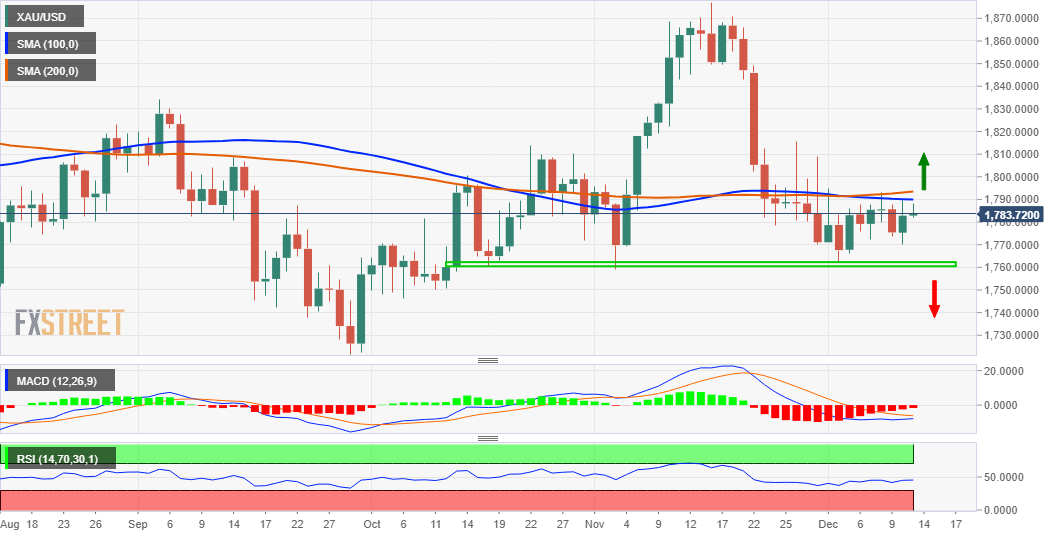
Key levels to watch
- EUR/GBP bounces off intraday low, challenges pullback from 10-week top.
- UK raises virus alert levels after a jump in covid variant cases, PM Johnson pushes for booster shots to above 30.
- EU-UK talks over medicine supplies dwindle, fishing raw continues and UK PM Johnson keeps ECJ in role to trigger NI protocol.
- ECB, BOE will be the key, UK Retail Sales, Brexit and virus updates are important too.
EUR/GBP picks up bids to pare Asian session losses as European traders await Monday’s bell. The cross-currency pair seems to react to the latest Brexit and virus updates concerning the UK to portray a rebound from the intraday low.
Among them, the UK’s escalation of the virus-linked activity restrictions from level 3 to level 4 gains major attention. As per the latest official details, 1,239 fresh omicron cases took the national tally to 3,137, marking the biggest daily jump in the virus variant cases since its detection in Britain. Even so, UK Prime Minister (PM) Boris Johnson sounds hopeful to overcome the crisis and pushes citizens above 30 years to take booster doses of the coronavirus vaccine.
On a different page, UK PM Johnson seems to step back from removing the European Court of Justice (ECJ) from its role in enforcing the Northern Ireland protocol. Though, the lack of progress in the latest talks over medicine supplies and the British-Fresh tussles over fishing licenses keeps Brexit fears on the top.
It’s worth observing that the Bank of England (BOE) policymakers are earlier conveyed concerns over the virus spread and are likely not to play any major games during this week’s monetary policy meeting. Alternatively, the European Central Bank (ECB) may surprise markets with a change in bond purchase methods amid mixed views of the Monetary Policy Committee (MPC) members.
Additionally, the US dollar’s pullback following the US inflation data offers counter-strength to the Euro and hence favors the EUR/GBP buyers of late.
Amid these plays, US Treasury yields struggle to pick up whereas the stock futures print mild gains at the latest.
Looking forward, a light calendar at home will restrict EUR/GBP pair’s intraday moves but risk catalysts are the key to follow.
Technical analysis
Sustained trading below the 13-day-old previous support, around 0.8535, becomes necessary for the EUR/GBP bears to keep reins.
Gold has struggled to make headway amid Omicron fears and higher US inflation. As FXStreet’s Yohay Elam notes, XAU/USD is at the mercy of the Fed while mid-December's daily chart is showing an ascending triangle, which is bullish.
Decisions by two other major central banks are worth watching
“Chair Jerome Powell and his colleagues will likely accelerate the pace of tapering their bond-buying scheme. For gold, such a move is adverse but mostly priced into XAU/USD. However, any deviation from a modest acceleration from $15 to $20 billion/month could rock markets. A surprise announcement of a $25 billion/month tapering pace would hurt the value of XAU/USD. Conversely, if the Fed fears Omicron and decides against changing its policy, gold would shine.”
“It is also worth watching the bank's updated forecasts for interest rates, aka the ‘dot-plot.’ If officials go for a duo of increases in 2022, the dollar could rise and XAU/USD could decline.”
“The ECB is set to announce an expansion of one of its bond-buying schemes, to compensate for the expiry of another one. A large increase would be gold-positive and refraining from announcing anything would be adverse for the price.”
“The Bank of England is on course to leave its rates unchanged amid growing economic damage from the virus. A surprise hike would weigh on gold while a no-change decision would likely be ignored.”
“The 50, 100 and 200-day Simple Moving Average nearly converge at $1,792. This phenomenon makes that level of high importance, as a tight cap. Looking down, XAU/USD is trading alongside an uptrend support line since August. Together, these two lines form an ascending triangle – which is bullish. On the other hand, failure to break above $1,792 and downside momentum could push the price below the uptrend support line and trigger a rapid downfall.”
Here is what you need to know on Monday, December 13:
Investors remain on the sidelines ahead of this week's critical events and major currency pairs trade within familiar ranges on Monday. The US Dollar Index holds steady above 96.00 after posting small losses last week with the 10-year US Treasury bond yield moving sideways slightly below 1.5%. Wholesale Price Index from Germany will be featured in the European economic docket and the Bank of England will publish its bi-annual Financial Stability Report later in the day.
Despite some concerning headlines regarding the coronavirus Omicron variant, the market mood is cautiously optimistic in the early European session. Nikkei 225 Index gained 0.7%, US stock index futures are up between 0.3% and 0.35% and the Shanghai Composite Index adds 0.35% on the day.
According to the World Health Organization, the omicron variant has a "growth advantage" over the Delta variant and the preliminary data show that it seems to be reducing vaccine efficacy.
EUR/USD opened with a small bullish gap struggled to gather momentum during the Asian trading hours. The pair is currently trading in the negative territory below 1.1300.
GBP/USD is edging lower on Monday and trades below 1.3250. Over the weekend, Britain announced that it has raised its alert level to 'Level 4.' Regarding this decision, "data on the severity will become clearer over the coming weeks but hospitalisations from Omicron are already occurring and these are likely to increase rapidly," UK medical officers said in a joint statement.
USD/JPY is posting modest gains around 113.50. Earlier in the day, the data from Japan showed that the sentiment in the manufacturing sector improved in the last quarter of the year but a Bank of Japan official noted that firms who took part in the survey did not take the impact of the omicron variant into account.
Gold continues to move sideways in a two-week-old range below $1,800. The yellow metal managed to register some gains after the data from the US showed on Friday that the annual CPI jumped to 6.8% in November.
Cryptocurrencies: Bitcoin is having a difficult time reclaiming $50,000 and Ethereum seems to have returned to $4,000 area after closing the previous two trading days in the positive territory.
- GBP/USD takes offers to refresh intraday low, fails to cheer monthly resistance break.
- Bearish MACD signals, pullback from 200-HMA keeps sellers hopeful.
GBP/USD refreshes intraday low near 1.3240, down 0.16% on a day ahead of Monday’s London open.
In doing so, the cable pair reverses the previous day’s break of a descending trend line from November-end, as well as the 200-HMA. Considering the bearish MACD signals adding strength to the seller’s hopes, the GBP/USD prices are likely to retest the previous resistance line, near 1.3220.
However, any further weakness will be challenged by the weekly support line near 1.3200 and the recently flashed yearly low of 1.3160.
Alternatively, an upside break of the 200-HMA level of 1.3256 should recall the GBP/USD buyers targeting the 1.3300.
However, the monthly top near 1.3350 and late November peak of 1.3370 can test the pair bulls afterward.
To sum up, the pair’s failures to extend the corrective pullback favor sellers to look for fresh yearly low.
GBP/USD: Hourly chart
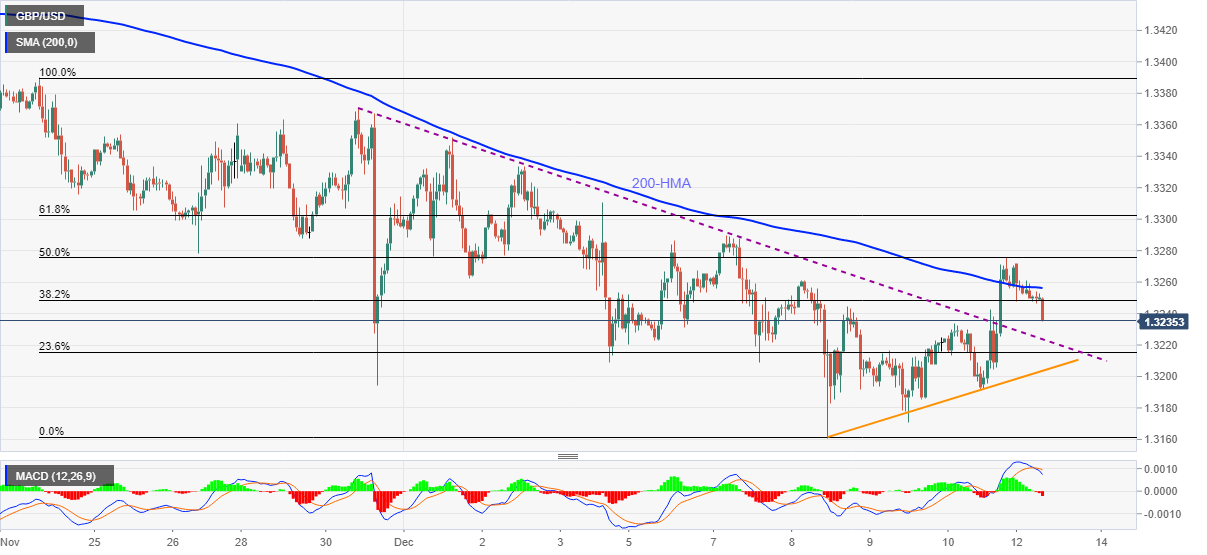
Trend: Further weakness expected
- USD/ZAR stays mildly bid, keeps upside break of 200-HMA, short-term key resistance.
- Firmer RSI line suggests continuation of recovery moves.
- Fibonacci retracement signals intermediate stops before the multi-month high flashed in November.
USD/ZAR pokes intraday high around $15.97, up 0.08% on a day heading into Monday’s European session.
The South African currency (ZAR) pair crossed a fortnight-old descending trend line, as well as the 200-HMA, the previous day but failed to cross the $16.10 hurdle of late.
Even so, the quote remains firmer past the stated key moving average and previous resistance line, around $15.90 by the press time. Given the steady RSI line favoring the latest rebound, the USD/ZAR can portray another attempt to cross the key Fibonacci retracement (Fibo.) levels of November 26 to December 08 declines.
Among them, the 50% and 61.8% Fibo. levels surrounding $16.00 and $16.10 are crucial before the quote can challenge November’s high of $16.36.
In a case where USD/ZAR bulls keep reins past $16.36, the mid-October peak close to $16.70 can offer an intermediate halt during the run-up to $17.00.
Meanwhile, a downside break of $15.90 support convergence will direct USD/ZAR bears towards the monthly low of $15.66.
However, the pair’s declines past $15.66 will be challenged by March 2021 tops near $15.58.
USD/ZAR: Hourly chart
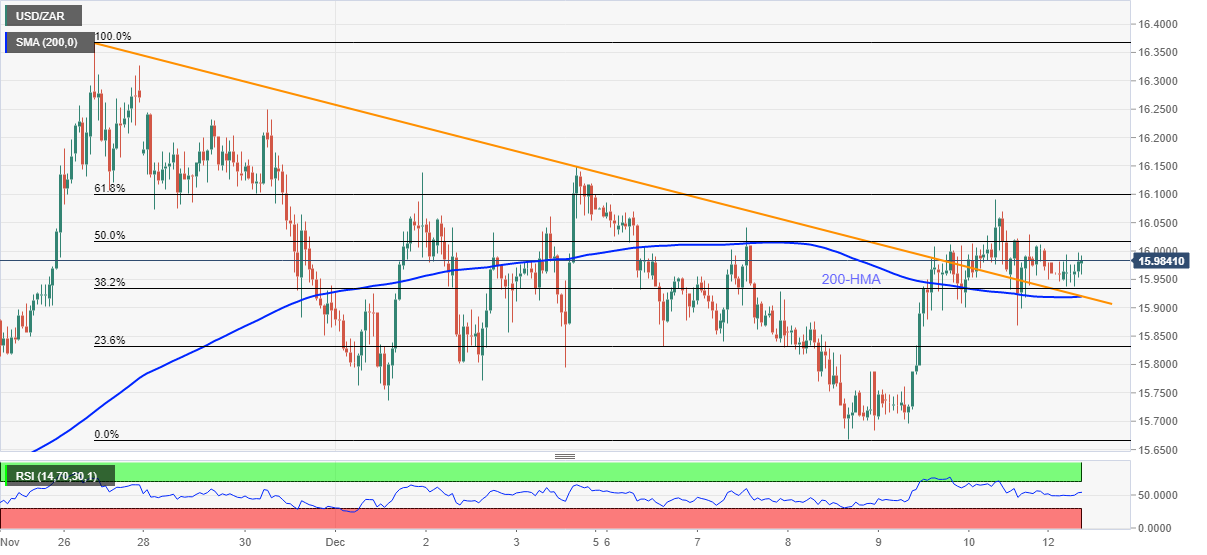
Trend: Further upside expected
- AUD/USD retreats from intraday high, fails to extend Friday’s gains.
- Market begins the key week with cautious optimism following Friday’s US CPI data.
- Dalian iron ore futures jumped over 5%, Asia-Pacific stocks trade mixed.
- China data dump can offer intermediate direction ahead of Fed’s verdict, Aussie jobs.
AUD/USD fades Friday recovery moves, easing to 0.7170 ahead of Monday’s European session.
The Aussie pair initially cheered the market’s optimism and stimulus news from Australia, as well as China, to pare the day-start losses. Though, market fears ahead of the key events lined up for publish during the week seem to weigh on the quote of late.
Australia's Treasurer Frydenberg is expected to announce on Monday, an extension to the government’s existing loan guarantee scheme for small to medium-sized businesses due to expire at the end of December, per Aussie media. On the other hand, Chinese policymakers vowed to use monetary and fiscal policy tools to stabilize the world’s second-largest economy in 2022 during the annual Central Economic Work Conference.
Also positive for the AUD/USD are the firmer prices of its largest export item iron ore. “Iron ore futures for May 2021 delivery rises past 5.0% to 671 yuan ($105.46) per ton,” said Reuters during the Asian session.
It’s worth observing that Friday’s US Consumer Price Index (CPI) data favored market sentiment and the AUD/USD prices as the inflation data matched expectations for November. Also favoring the pair buyers was a reduction in the US inflation expectations, as measured by the 10-year breakeven inflation rate per the St. Louis Federal Reserve (FRED) data.
That said, market fears surrounding the Fed’s faster tapering and rate hike signals haven’t yet faded as a widespread breakout of the South African covid variant, dubbed as Omicron, favors the policy hawks to expect further inflation and the need for tighter policies. On the same line are the chatters over some of the Chinese companies’ production suspension Zhejiang Province and postponing of the SenseTime Hong Kong IPO worth $767 million.
Amid these plays, the US 10-year Treasury yields wobbled around 1.49% while the US stock futures printed mild gains and the Asia-Pacific shares traded mixed at the latest.
Moving on, a lack of major data/events at home will keep AUD/USD traders cautious but Wednesday’s China data dump may provide intermediate relief to the pair optimists before the Fed’s verdict.
Technical analysis
AUD/USD trades successfully above a five-week-old descending trend line and 50-SMA, respectively close to 0.7120 and the 0.7100 threshold, taking rounds to 100-SMA recently. However, a fortnight-long horizontal area challenges the bulls around 0.7190 as MACD shows traders’ indecision and RSI nears the overbought region, suggesting the need for a strong push to the north if buyers want to keep the reins.
- USD/CAD pares intraday losses, stays inside bearish chart pattern.
- Sustained trading below 200-HMA, steady RSI also favor sellers.
USD/CAD licks wounds near 1.2715 during early Monday morning in Europe. In doing so, the Loonie pair portrays a rising wedge bearish formation on the one-hour chart.
In addition to the aforementioned one-week-old rising wedge, the quote’s failure to cross the 200-HMA and an absence of extreme RSI conditions keep the sellers hopeful.
However, a clear downside break of the 1.2700 level becomes necessary for the USD/CAD bears to refresh the monthly low surrounding 1.2607 while aiming for the 1.2570 theoretical target.
During the fall, 23.6% Fibonacci retracement level of December 03-08 downside, near 1.2660, may offer an intermediate halt.
Alternatively, 200-HMA and the upper line of the wedge, respectively around 1.2740 and 1.2755, will test the USD/CAD buyers before directing them to the monthly peak surrounding 1.2850.
In a case where the USD/CAD bears keep reins past 1.2570, lows marked during September and late July, near 1.2422 and 1.2495 in that order, will gain the market’s attention.
USD/CAD: Hourly chart
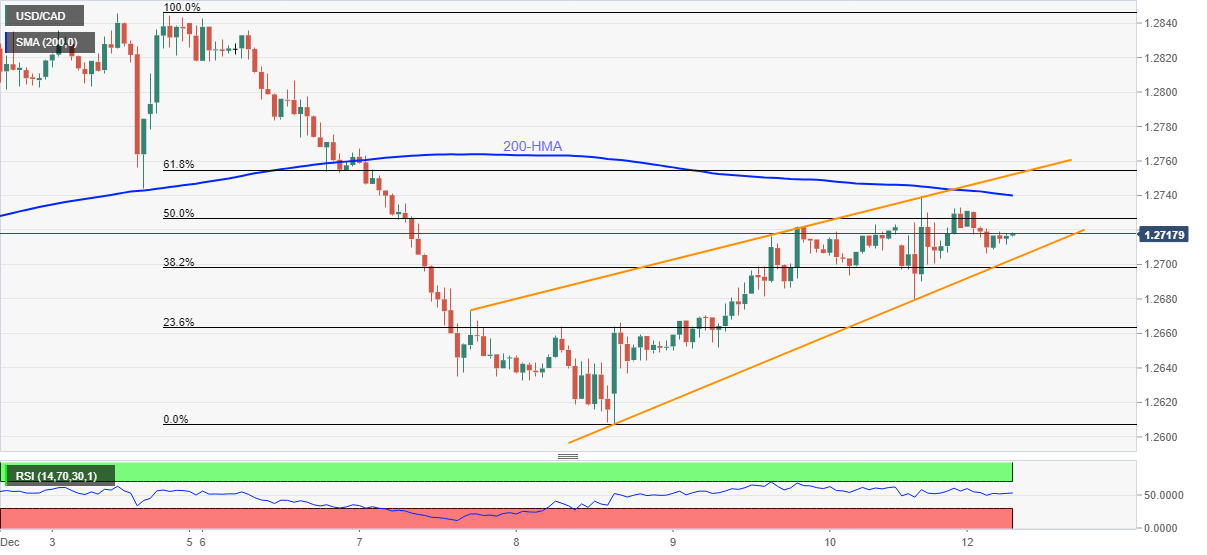
Trend: Pullback expected
- EUR/USD sellers attack intraday low, stays mildly offered inside monthly triangle.
- Yields benefit from market anxiety ahead of the key central bank meeting, Omicron updates.
- US consumer-centric figures triggered market consolidation the previous day.
- ECB may vouch for APP requirements but the Fed’s verdict on tapering is more important to watch.
EUR/USD drops back to 1.1300, following the previous day’s corrective pullback heading into Monday’s European session. In doing so, the major currency pair drops 0.20% intraday while staying inside a short-term bearish chart formation at the latest.
The indecision over the next moves of the European Central Bank (ECB) and the US Federal Reserve (Fed) seems to restrict the EUR/USD prices of late. While the Market News Internation (MNI) cited sources to confirm further easy money policies at the ECB, Reuters’ poll eyes a reduction in the bond purchase from April. Adding to the confusion was ANZ report saying, “The ECB is expected to boost its monthly APP purchases as part of the transition from PEPP from next April onwards. It is expected that the ECB’s inflation forecast will show inflation below target in 2023, justifying guidance that rates won’t rise next year.”
On the other hand, the Fed hawks were recently poked by the US Consumer Price Index (CPI) data that matched 6.8% market forecasts to refresh the 39-year high. Also testing the Fed policymakers were stable inflation expectations revealed via the University of Michigan Consumer Sentiment Index, to 70.4 for December.
Above all, fears emanating from the South African covid variant, dubbed as Omicron, join financial market woes from China to put a floor under the US dollar and Treasury yields.
That said, the US 10-year Treasury bond coupons print mild gains of around 1.49% whereas the S&P 500 Futures rise 0.36% by the press time.
Given the anxiety ahead of the crucial events, coupled with a light calendar for Monday, the EUR/USD prices are likely to remain pressured amid firmer yields.
Technical analysis
A one-month-old ascending triangle bearish formation restricts short-term EUR/USD moves, between 1.1245 and 1.1380, with bullish MACD signals and a steady RSI line favoring the bulls.
- Asian equities traded mixed as market players turn cautious ahead of the key events.
- US stock futures print mild gains tracking Wall Street benchmarks but yields rebound with eyes on Fed.
- China, Japan stay ready for further stimulus, New Zealand PM Ardern eases virus-led activity controls.
- Omicron fears escalate in the West, could stop policy hawks.
Asian shares struggle to cheer for Friday’s upbeat Wall Street performance and easy inflation fears during Monday. However, the bloc leaders’ readiness to propel the domestic economies, with monetary and fiscal measures, seems to help the investors stay cautiously optimistic ahead of crucial events lined up for publish during the week.
That said, MSCI’s index of Asia-Pacific shares ex-Japan rises 0.81% while Japan’s Nikkei 225 copies the move with 0.85% intraday upside by the press time.
Japan’s Prime Minister Fumio Kishida recently said, per Reuters, “If there is a crisis, the government will take appropriate fiscal measures.” On the other hand, Chinese policymakers vowed to use monetary and fiscal policy tools to stabilize the world’s second-largest economy in 2022 during the annual Central Economic Work Conference.
Elsewhere, the UK escalates covid alert level from 3 to 4 amid a jump in the cases of the South African covid variant, dubbed as Omicron. Alternatively, New Zealand (NZ) Prime Minister (PM) Jacinda Ardern eased activity restrictions citing a reduction in the virus numbers at home. With this, the UK stock futures and NZX 50 print stay firmer by the press time.
It’s worth noting that Australia announced $7.0 billion new loans for small businesses hit by the virus-led lockdowns, which in turn joined firmer prices of Dalian iron ore futures to help the ASX print 0.80% daily upside at the latest. Moving on, stocks in China, South Korea and Indonesia print mild gains by the press time.
Market sentiment improved on Friday after the US Consumer Price Index (CPI) refrained from providing any major blow to the markets than already feared. That said, the US CPI matched expectations of 6.8% YoY, versus 6.2% prior, while flashing the fresh 39-year high for November. Adding strength to the GBP/USD bounce were stable inflation expectations revealed via the University of Michigan Consumer Sentiment Index, to 70.4 for December.
The receding fears of US inflation helped Wall Street benchmarks and weighed on the US Treasury yields, as well as the greenback. Even so, the 10-year Treasury yields stay firmer around 1.50% after snapping a two-week downtrend the previous week.
Looking forward, a lack of major data/events for Monday will highlight risk catalysts for fresh impulse. However, major attention will be given to the Fed’s reaction to the Omicron woes and reflation fears. The market expects faster tapering and/or signals for rate hikes.
Read: US Treasury yields consolidate recent losses as traders await Fed signals
- Dalian iron ore snaps two-day downtrend, spot prices dwindle.
- China vouches for economic stability during Central Economic Work Conference.
- Omicron updates contradict US inflation data to challenge commodity traders.
- AUD/USD struggles to cheer the run-up in main export item amid firmer yields.
Iron ore futures for May 2021 delivery rises past 5.0% to 671 yuan ($105.46) per ton during early Monday morning in Europe. In doing so, the key steelmaking ingredient marks the first daily jump in three while taking clues from China.
During the 2021 Central Economic Work Conference, Chinese officials showed readiness to use monetary and fiscal policy tools to stabilize the world’s second-largest economy in 2022. Given the dragon nation’s status as the world’s largest commodity user, its readiness to spend more ultimately helps the iron prices.
It should be noted, however, that the spot prices aren’t much impressed as Reuters quotes SteelHome consultancy to say, “Spot prices of iron ore, with 62% iron content for delivery to China, dipped $1 to $108 per tonne on Friday.”
The reason could be linked to the market’s cautious sentiment ahead of this week’s key monetary policy meeting by the US Federal Reserve (Fed).
That said, the market sentiment remains divided as Friday’s consumer-centric data favored bulls but the Omicron updates keep fears of supply outage and inflation rush on the table, favoring the needs of the tighter monetary policy.
It’s worth observing that iron ore is Australia’s biggest export item and any move in the prices should ideally affect the AUD/USD. As a result, the Aussie pair reverses the early Asian losses to jump back towards the 0.7190 upside hurdle.
Read: AUD/USD Price Analysis: Mildly offered below 0.7190 upside hurdle
Moving on, commodity traders should pay attention to the virus updates and the China news for intermediate clues before the Fed meeting. In a case where the FOMC members cite Omicron fears and disappoint markets, by not announcing a faster tapering, the commodity basket will have a few more good days.
New Zealand Prime Minister Jacinda Ardern announced a further reduction in Auckland coronavirus restrictions on Monday.
“A further review of the level will take place on January 17,” Ardern added.
New Zealand entered the new traffic light system on December 3. Auckland will move to orange.
Market reaction
NZD/USD is posting a 0.09% daily loss so far, currently trading at 0.6790, unimpressed by the above comments.
- USD/CHF rebounds but keeps its recent trading range around 0.9200.
- Risk-on mood weighs on the safe-haven Swiss franc this Monday.
- The spot is stuck between key averages as RSI holds flat at 50.00.
USD/CHF is attempting a bounce above 0.9200, although remains confined within the recent trading range, as investors look forward to the Fed decision for a fresh direction.
The persisting risk-on market mood, amid easing fears over the Omicron covid variant on the global economic recovery, dampens the sentiment around the safe-haven Swiss franc.
The major draws support from the rebound in the US Treasury yields and the greenback, in absence of any important macro data due for release on Monday.
From a short-term technical perspective, USD/CHF is locked in a tight range between the horizontal 50-Daily Moving Average (DMA) at 0.9221, which guards the topside.
Meanwhile, the 100-DMA at 0.9202 keeps the downside cushioned. A lack of clear directional bias can be attributed to the 14-day Relative Strength Index (RSI) trading flat at the 50.00 level.
The leading indicator is at a coin flip level, with the spot awaiting a range breakout.
USD/CHF: Daily chart
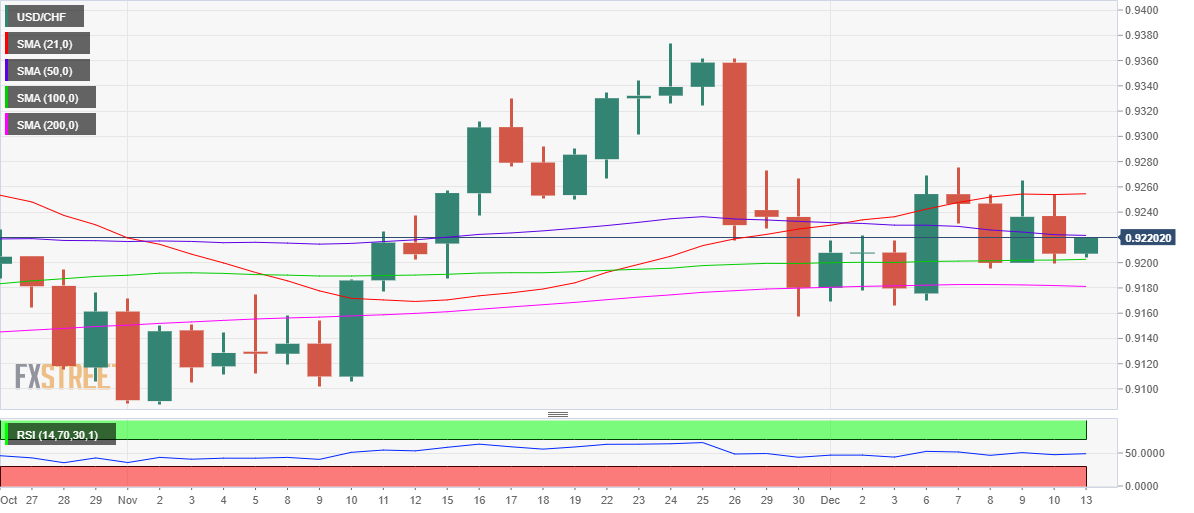
A firm break above 50-DMA could call for a rally towards 21-DMA at 0.9254. Further up, the 0.9300 round figure could be tested.
Meanwhile, the critical 200-DMA at 0.9181 will be the level to beat for USD/CHF bears.
USD/CHF: Additional levels
Early Monday morning in Europe, Japanese Prime Minister Fumio Kishida crossed wires, via Reuters, while assuring the markets of the government’s readiness to act if there is a crisis.
“I will secure a budget to help the economy recover during emergency,” adds Japanese PM Kishida.
FX implications
Earlier in the day, Japan’s one-year inflation expectations jumped to the highest levels since September 2015.
It’s worth noting that Japan’s big manufacturers and non-manufacturers seem to have a cautious outlook for Q4 2021, as depicted from the latest Tankan data.
Even so, USD/JPY prints 0.10% intraday gains, around 113.50 by the press time while tracking firmer yields and stock futures as the key week begins.
Read: When the Facts Change: US Inflation becomes the dominant economic topic
- USD/INR defends bulls around 18-month high, retreats of late.
- Sustained upside break of double tops, bullish MACD signals keep buyers hopeful.
- 13-month-old resistance line adds strength to the upside filter around 76.55.
USD/INR holds onto the previous day’s break of 75.65 key hurdle during early Monday. In doing so, the Indian rupee (INR) pair stays near the highest levels in 18 months.
In addition to the clear run-up beyond the tops marked in August and October, bullish MACD signals also favor bulls until the quote stays beyond the 75.65 resistance-turned-support area.
Also defending the USD/INR buyers is an upward sloping trend line from late November around 75.48.
It should be noted, however, that a break of 75.48 support will not hesitate to drag the USD/INR prices towards October high near 75.20 and July’s peak of 75.01.
Meanwhile, further upside eyes a confluence of June 2020 top and an ascending trend line from November 2020, around 76.55.
During the rise, the 76.00 threshold may offer an intermediate halt while the record top marked in April 2020 near the 77.00 round figure will lure the USD/INR bulls afterward.
USD/INR: Daily chart
-637749597330589406.png)
Trend: Further upside expected
| Raw materials | Closed | Change, % |
|---|---|---|
| Brent | 75.38 | 2 |
| Silver | 22.172 | 0.86 |
| Gold | 1782.433 | 0.37 |
| Palladium | 1753.85 | -2.76 |
US inflation expectations, as measured by the 10-year breakeven inflation rate per the St. Louis Federal Reserve (FRED) data, printed a two-day fall with Friday’s reading of 2.44%, per the data source Reuters.
In doing so, the inflation gauge stays depressed around the monthly low, easing pressure off the US Federal Reserve (Fed) officials to alter the monetary policy amid the Omicron woes.
It’s worth noting that the US Consumer Price Index (CPI) flashed a fresh 39-year high but matched market forecasts of 6.8% YoY for November.
An absence of surprise from the US inflation number triggered a relief rally the previous day, helping equities and commodities. However, cautious sentiment underpins the US Treasury yields as the key week comprising major central bank events and important data begins.
That said, the US 10-year Treasury yields rise one basis point (bps) to 1.50%, snapping two-day downside, whereas S&P 500 Futures print mild gains at the latest.
Read: US Treasury yields consolidate recent losses as traders await Fed signals
- GBP/JPY takes the bids to refresh intraday high, extends Friday’s rebound.
- Clear upside break of short-term key hurdles joins bullish MACD signals to back further advances.
- Monthly resistance line guards immediate upside, sellers need downside break of 149.70 for fresh entry.
GBP/JPY justifies the run-up beyond a weekly triangle and 200-HMA, refreshing intraday high around 150.50 during early Monday. The cross-currency pair also takes clues from bullish MACD signals to keep buyers hopeful.
It should be noted, however, that a descending trend line from December 01, around 150.85, probes the GBP/JPY buyers ahead of directing them to the 151.00 threshold and the monthly peak of 151.44.
Following that, 50% and 61.8% Fibonacci retracement levels of November 23 to December 03 downside, around 151.60 and 152.65 in that order, will challenge the pair’s further upside momentum.
Meanwhile, the 200-HMA level of 150.27 will precede the stated triangle’s resistance line, now support around 150.00, to restrict the short-term GBP/JPY declines.
Adding to the downside filters is a one-week-old rising trend line, forming part of the triangle, near 149.70.
GBP/JPY: Hourly chart

Trend: Further upside expected
- US bond yields reverse pullback from December’s high, S&P 500 Futures stay mildly bid around record top.
- Market remains indecisive ahead of the key central bank meetings, Friday’s US inflation offered a relief rally.
- Qualitative catalysts to offer short-term direction before the calendar heats up.
Global traders remain cautiously optimistic heading into the key weekly events, namely the US Federal Reserve (Fed) and the European Central Bank (ECB) monetary policy meetings.
Investors cheered an absence of any major surprises from the US inflation data the previous day. However, fears of faster tapering by the Fed and challenges surrounding the South African covid variant, dubbed as Omicron, test the bulls of late.
While portraying the mood, the US 10-year Treasury yields rose 1.2 basis points (bps) to regain 1.50% level whereas the S&P 500 Futures print 0.36% intraday gains by the press time. Furthermore, Asia-Pacific stocks trade mixed and the US Dollar Index (DXY) adds a few pips to defend the 96.00 threshold at the latest.
The US Consumer Price Index (CPI) flashed a fresh 39-year high but matched market forecasts of 6.8% YoY for November. Also adding to the traders’ confidence were the stable inflation expectations revealed via the University of Michigan Consumer Sentiment Index.
It should be noted, however, that the escalating Omicron cases in the West hint at higher inflation and the need to further roll back the easy money policies. Furthermore, the US-China tension and financial risks emanating from Beijing-based companies like Evergrande and Kaisa also challenge the optimists.
Looking forward, a lack of major data/events and cautious sentiment before the key central bank meeting may keep the traders chained. However, bears are holding high hopes from the Fed and hence scope of disappointment, followed by heavy repercussions, can’t be ruled out.
Read: When the Facts Change: US Inflation becomes the dominant economic topic
| Time | Country | Event | Period | Previous value | Forecast |
|---|---|---|---|---|---|
| 07:00 (GMT) | United Kingdom | BOE Financial Stability Report | |||
| 21:45 (GMT) | New Zealand | Food Prices Index, y/y | November | 3.7% |
One-month risk reversal (RR) for the EUR/USD, a gauge of calls to puts, drops for the first time in the last three days as per the latest options market data on Reuters.
The downbeat signals join the market’s anxiety ahead of the key monetary policy meetings by the European Central Bank (ECB) and the US Federal Reserve (Fed).
That said, the RR figure of -0.037 remains in favor of the US dollar bulls amid firmer expectations of the Fed’s faster tapering and rate hike despite Omicron's woes.
It’s worth noting that the US inflation expectations, as measured by the 10-year breakeven inflation rate per the St. Louis Federal Reserve (FRED) data, remain sluggish of late, suggesting a challenge for the Fed hawks.
Technically, a downward sloping trend line from late September, around 1.1345, becomes short-term key resistance while EUR/USD bears await a clear downside break of 1.1230 level for fresh entries.
Read: EUR/USD Weekly Forecast: The Fed and the ECB ready to rock markets
The People’s Bank of China (PBOC) set the USD/CNY reference rate at 6.3669 on Monday when compared to the previous fix and the previous close at 6.3702 and 6.3700 respectively.
- DXY stays below 100-SMA, eyes monthly support line for further declines.
- Sluggish Momentum, multiple supports to the south challenge bears.
- Bulls need to cross 13-day-old hurdle for fresh entry.
- Fed is expected to announce faster tapering but Omicron challenges hawks.
Despite the day-start uptick, the US Dollar Index (DXY) remains beneath the 100-SMA during early Monday. Also keeping the greenback bears hopeful is the Momentum line and the lower high formation, marked after refreshing the 17-month high in November.
It should be noted, however, that a clear downside break of an ascending support line from November 15, around 96.00 by the press time, becomes necessary for the DXY to convince bears.
Even so, a six-week-old trend line support and 200-SMA, respectively near 95.60 and 95.35, will challenge further downside of the US Dollar Index. Following that, the 95.00 threshold and early November’s swing high close to 94.60 will be in focus.
Alternatively, an upside clearance of the 100-SMA level of 96.25 will direct the DXY bulls towards a downward sloping resistance line from November 24, near 96.50 at the latest.
In a case where the US Dollar Index remains firmer past-96.50, odds of the quote’s rally to refresh the multi-month high can’t be ruled out. In doing so, the 97.00 round figure will act as an extra upside filter.
Also read: Attention shifts to the Fed as US CPI hits a 39-year high
DXY: Four-hour chart
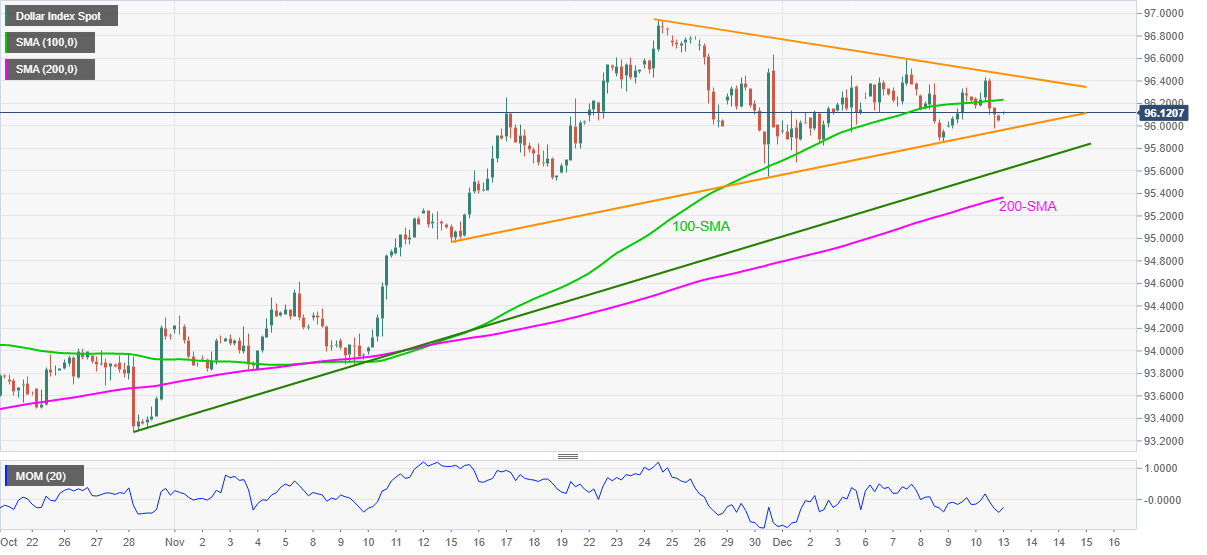
Trend: Further weakness expected
With the Bank of England (BOE) December rate hike expectations waning amid growing Omicron covid variant concerns in the UK, analysts at Societe Generale offer their bearish outlook on GBP/USD.
Key quotes
"The pound is often the FX market’s favorite short. Journalists this week have been keen to ask how far sterling can fall in the weeks ahead, by which they mean ‘how far can GBP/USD fall’ with no consideration of the fact that the biggest driver of where Cable goes is what happens to EUR/USD. But sterling found itself some home-grown problems this time."
"For much of this year, GBP/USD has fallen more slowly than EUR/USD, because the UK’s MPC is likely to raise rates long before the ECB. Now, however, a cocktail of economic worries (thanks in part to Omicron) political turbulence (where do I start with the Government’s faux pas?) and the MPC’s policy miscommunications, are feeding bearish sentiment. And the bears are hungry!."
Read: BOE Preview: Omicron eliminates rate hike chances, voting pattern critical to GBP/USD reaction
Commenting on the outcome of the central bank’s Tankan Survey, a Bank of Japan (BO) official said, “most firms that replied in December BOJ Tankan likely did not take into account impact of Omicron.”
On inflation, the official noted that Japan firms' inflation expectations for one year ahead stand at +1.1%m the highest level since September 2015.
- USD/TRY keeps pushing higher, recapturing 14.00 is evitable.
- Turkey’s central bank intervention fails to stem the lira’s selling spiral.
- The spot has room to rise as RSI is well off the extremely overbought zone.
USD/TRY is flirting with fresh all-time highs of 13.96 on Monday, rallying for the third straight day amid the financial market unitability and central bank woes in Turkey.
The Turkish central bank (CBRT) intervened in the forex exchange market for the third time this month but its efforts failed to arrest the freefall in the lira.
“The monetary authority said Friday it sold foreign exchange because of “unhealthy” price formations, echoing President Recep Tayyip Erdogan’s words to describe the recent turbulence,” per Bloomberg.
The local currency is down roughly 40% since end-September, looking to recapture 14.00 and beyond, as the daily technical setup points to more upside in the offing.
USD/TRY is breaking higher from the recent consolidative phase seen ever since the spot hit the previous record highs at 13.96 on November 30.
The next stop for the bulls is pegged at the 14.50 psychological level if the 14.00 barrier is taken out.
The Relative Strength Index (RSI) is trading within the overbought region but well off the extreme conditions, suggesting that there is scope for a fresh upswing in the near term.
USD/TRY: Daily chart
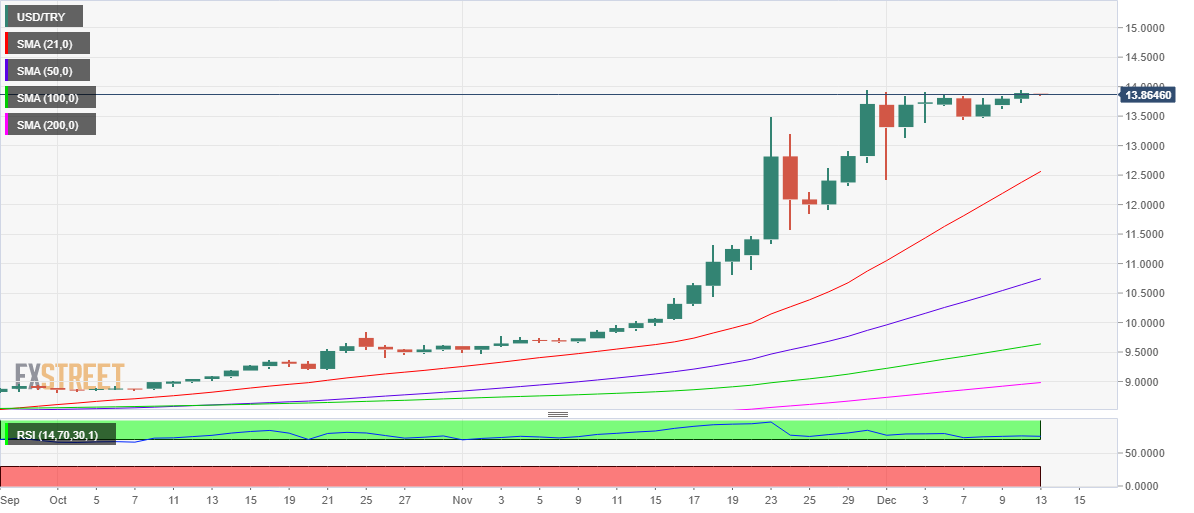
On the flip side, the recent range lows around 13.40 could cap any immediate retracement.
Selling interest will revive below the latter, calling for a retest of the upward-pointing 21-Daily Moving Average (DMA) at 12.56.
- Gold prices remain sidelined between key trend lines, below crucial SMA convergence.
- Market sentiment dwindles as US inflation matched forecasts but Fed rate hike talks stay on the table.
- US Treasury yields struggle to extend first weekly gains in five, S&P 500 Futures post mild gains.
- Gold Price Weekly Forecast: XAU/USD is at the mercy of the Fed, ascending triangle pattern in play
Gold (XAU/USD) stays directionless around $1,786, keeping the monthly sideways performance amid Monday’s Asian session.
The yellow metal benefited from the US inflation data the previous day but the market’s anxiety ahead of the key central bank meetings and the virus fears challenge the buyers of late. It should be noted, however, that the options market keeps the bearish bias over the commodity, as per the weekly risk reversals (RR).
The US Consumer Price Index (CPI) flashed a fresh 39-year high but matched market forecasts of 6.8% YoY for November. Also adding to the previous relief rally were the stable inflation expectations revealed via the University of Michigan Consumer Sentiment Index. That said, the RR, a gauge of calls to puts, marked a five-week downtrend with the latest figures of -0.1000.
Friday’s consolidation helped equities and weighed on the US Treasury yields, as well as the US Dollar Index (DXY). Though, markets turn cautious as the key week begins, comprising the monetary policy meeting of the US Federal Reserve (Fed).
Given the escalating fears of the Fed’s rush towards faster tapering and rate hikes, gold prices are likely to remain pressured. However, the US 10-year Treasury yields need to keep the recent rebound should the gold bears aim for further dominance.
Against this backdrop, the key US Treasury bond coupons take rounds to 1.49% whereas the S&P 500 Futures rise 0.20% by the press time.
In addition to Fed-linked woes, covid updates and the US-China tussles are also important to watch for clear direction amid a light calendar on Monday.
Technical analysis
Although a clear break of the previous support line from September 30 precedes the sustained trading below 100-SMA and 200-SMA, gold buyers lurk around a four-month-old ascending trend line.
Given the receding bearish bias of the MACD signals and mostly steady RSI, the bears are likely fading the strength. However, the stated DMAs around $1,790-95 and the support-turned-resistance line close to $1,800 will keep the bulls away.
Adding to the upside filter is the $1,815 level and tops marked in July, as well as September, surrounding $1,834.
On the contrary, a downside break of the multi-day-old support line, close to $1,769 at the latest, will need validation from the 61.8% Fibonacci retracement (Fibo.) of August-November upside surrounding $1,759 to convince the gold sellers.
To sum up, gold prices depict traders’ indecision as the key week begins.
Gold: Daily chart
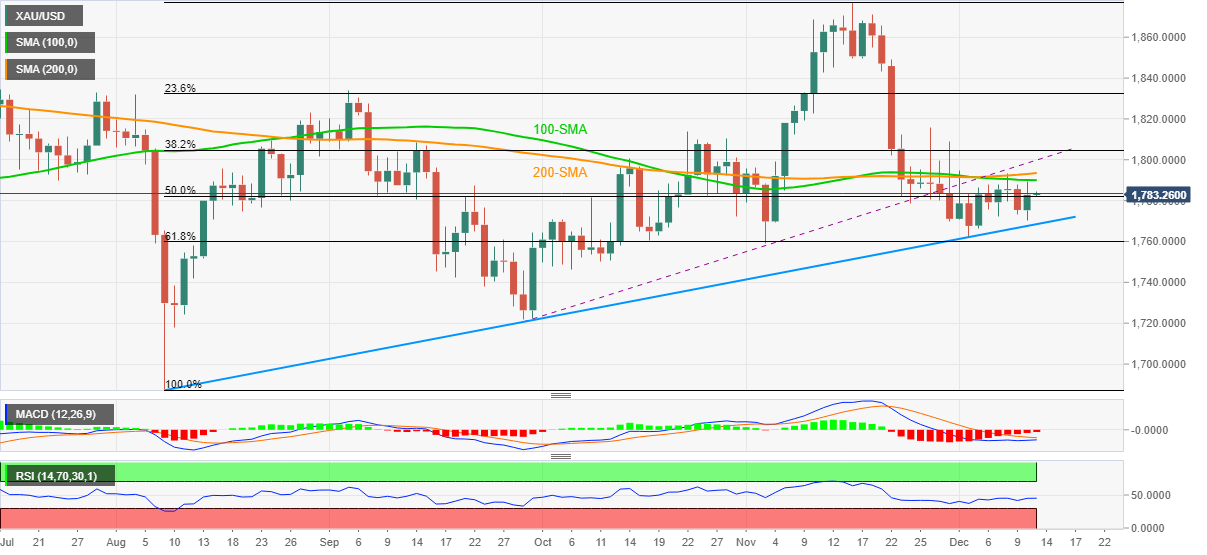
Trend: Sideways
- AUD/USD remains pressured below short-term resistance, fails to extend Friday’s run-up.
- RSI, MACD lure bulls as the quote stays beyond previous resistance line, 100-SMA.
- 50-SMA adds to the downside filters, 0.7275 acts as important resistance.
AUD/USD struggles to extend the previous day’s upside momentum, down 0.13% around 0.7160 during Monday’s Asian session.
Even so, AUD/USD trades successfully past the five-week-old descending trend line and 50-SMA, taking rounds to 100-SMA recently. However, a fortnight-long horizontal area challenges the bulls as MACD shows traders’ indecision and RSI nears the overbought region, suggesting the need for a strong push to the north if buyers want to keep the reins.
Following that, a convergence of 200-SMA and 50% Fibonacci retracement (Fibo.) November-December fall, around 0.7270-75, will be in focus. During the run-up, November 19 swing lows near 0.7225-30 can act as a buffer.
On the downside, the resistance-turned-support line and 50-SMA, respectively close to 0.7120 and the 0.7100 threshold, could stop the sellers during a pullback.
Adding to the supports are 0.7060 and 0.7030 levels, a break of which will shift the market’s attention towards the key 0.7000-0.6990 area comprising lows marked during November 2020 and so far during December 2021.
AUD/USD: Four-hour chart

Trend: Further recovery expected
The European Central Bank is seen rolling back the asset purchases by half from April, according to a Reuters poll of ECB-watchers.
Key findings
After April, the central bank is set to carry on buying 40 billion euros of bonds a month through the end of next year, with some forecasting ECB buys through to mid-2023.
The median from 21 forecasts showed a 20 billion euros APP top-up for a total of 40 billion euros.
But 13 of a slightly smaller sample of 20 respondents to an additional question said if the ECB approves an APP increase, there would be an envelope covering a longer period. The rest said it would be in set monthly volumes.
About 70% or 18 of 26, who responded to an additional question said the APP would finish by end-2023, while five said by Q4 2024 and three said Q4 2025.
Consensus forecasts for eurozone inflation, meanwhile, rose for a sixth consecutive monthly poll, set to top the European Central Bank's 2% target through Q3 of next year.
The economy was expected to grow 0.6% this quarter and 0.7% in the next.
It was expected to average 4.2% next year, unchanged from last month's poll and slow to 2.3% in 2023, up from 2.1%.
About 60%, or 18 of 31 respondents, said the spread of new coronavirus variants was the biggest downside risk to the eurozone economy next year.
| Pare | Closed | Change, % |
|---|---|---|
| AUDUSD | 0.71696 | 0.32 |
| EURJPY | 128.341 | 0.28 |
| EURUSD | 1.13154 | 0.22 |
| GBPJPY | 150.477 | 0.38 |
| GBPUSD | 1.32668 | 0.36 |
| NZDUSD | 0.6797 | 0.08 |
| USDCAD | 1.27231 | 0.11 |
| USDCHF | 0.92087 | -0.28 |
| USDJPY | 113.422 | 0.09 |
- Silver fades bounce off 10-week low amid cautious mood.
- US CPI triggered relief rally but pre-Fed anxiety, Omicron woes test the commodity buyers.
- Risk catalysts stay in the driver’s seat amid a light calendar day, Fed’s vedict eyed.
Silver (XAG/USD) eases from an intraday high of $22.25, marking the failure to extend the bounce off late September levels.
The bright metal snapped a two-day downtrend to rebound from the multi-day bottom the previous day amid broad US dollar weakness. However, the market’s anxiety ahead of the week’s key central bank decisions weighs on the quote of late. Also challenging the commodity prices could be the fresh fears of the South African covid variant, dubbed as Omicron, as well as the US-China tussles concerning Taiwan and the phase one deal.
Global markets stayed positive on Friday even as the Consumer Price Index (CPI) flashed a fresh 39-year high. The reason could be linked to the inflation gauge’s matching of the broad consensus, which rejected fears of an unusually high price pressure than forecasted. That said, the US CPI matched expectations of 6.8% YoY, versus 6.2% prior, for November. Furthermore, stable inflation expectations, as revealed via the University of Michigan Consumer Sentiment Index, to 70.4 for December, added to the upside momentum of XAG/USD prices.
While the US inflation data triggered the market’s optimism, the return of the Fed rate hike woes seems to weigh on the quote by the press time. Even so, S&P 500 Futures rise 0.18% intraday while tracking the Wall Street benchmark’s rise to the fresh all-time.
It’s worth observing that the US 10-year Treasury yields remained sluggish around 1.50% and hence market players await more clues to extend the latest recovery of the silver prices.
Given the absence of the major data/events scheduled for release on Monday, covid updates and risk catalysts are crucial to watch for fresh impulse.
Technical analysis
The 10-DMA level surrounding $22.35 challenges silver’s corrective pullback from the latest multi-day bottom of $21.82. However, a clear upside break of the fortnight-old descending trend line keeps XAG/USD buyers hopeful.
Australia's Treasurer Frydenberg is expected to announce on Monday, an extension to the government’s existing loan guarantee scheme for small to medium-sized businesses due to expire at the end of December, an Australian media outlet reported.
Key points
“Australian federal government will partially underwrite up to $7bn in new loans for small businesses hit by the Delta wave lockdowns.”
“This will take the scheme to just beyond May 2022.”
“The extended program will see the current 80% government guarantee drop to 50%.”
“Treasury expects on current trends up to 24,000 small businesses could be expected to take up new loans, which are capped at $5m each.”
Market reaction
AUD/USD remains under pressure around 0.7165 so far this Monday, slightly off the lows, helped by the uptick in the S&P 500 futures.
New Zealand’s economic outlook appears weaker in the near term, the latest NZIER Consensus Forecasts (CF) showed Monday.
Additional takeaways
This largely reflects the expected impact of restrictions to contain the latest COVID-19 community outbreak, which turned out to persist for longer than initially expected.
As a result, forecasts for private domestic demand for the coming year were revised lower.
However, beyond March 2022, forecasts were shifted higher, suggesting that the New Zealand economy is still expected to remain resilient.
Growing capacity pressures in the New Zealand economy are contributing to a sharp rise in inflation.
Beyond near-term expectations of annual CPI inflation rising above 5 percent in 2022, price rises are expected to remain elevated above the Reserve Bank’s inflation target mid-point of 2 percent through to 2025.
NZD reaction
NZD/USD is back under 0.6800 on these headlines, trading at 0.6793, as of writing. The major is lower by 0.06% on the day.







© 2000-2026. All rights reserved.
This site is managed by Teletrade D.J. LLC 2351 LLC 2022 (Euro House, Richmond Hill Road, Kingstown, VC0100, St. Vincent and the Grenadines).
The information on this website is for informational purposes only and does not constitute any investment advice.
The company does not serve or provide services to customers who are residents of the US, Canada, Iran, The Democratic People's Republic of Korea, Yemen and FATF blacklisted countries.
Making transactions on financial markets with marginal financial instruments opens up wide possibilities and allows investors who are willing to take risks to earn high profits, carrying a potentially high risk of losses at the same time. Therefore you should responsibly approach the issue of choosing the appropriate investment strategy, taking the available resources into account, before starting trading.
Use of the information: full or partial use of materials from this website must always be referenced to TeleTrade as the source of information. Use of the materials on the Internet must be accompanied by a hyperlink to teletrade.org. Automatic import of materials and information from this website is prohibited.
Please contact our PR department if you have any questions or need assistance at pr@teletrade.global.


 Bank
Bank transfers


