- Analytics
- News and Tools
- Market News
CFD Markets News and Forecasts — 09-12-2021
- USD/CAD bulls are committing which could lead to upside correction in the coming hours.
- The daily chart and hourly time frame mary for a continuation towards the 61.8% ratio.
USD/CAD has been making tracks to the upside in recent sessions and is now on the verge of a bullish extension. The hourly support is currently holding up so bulls are looking for an optimal entry at this juncture. However, there is the possibility of another test of the bullish commitments near 1.27 the figure.
USD/CAD daily chart
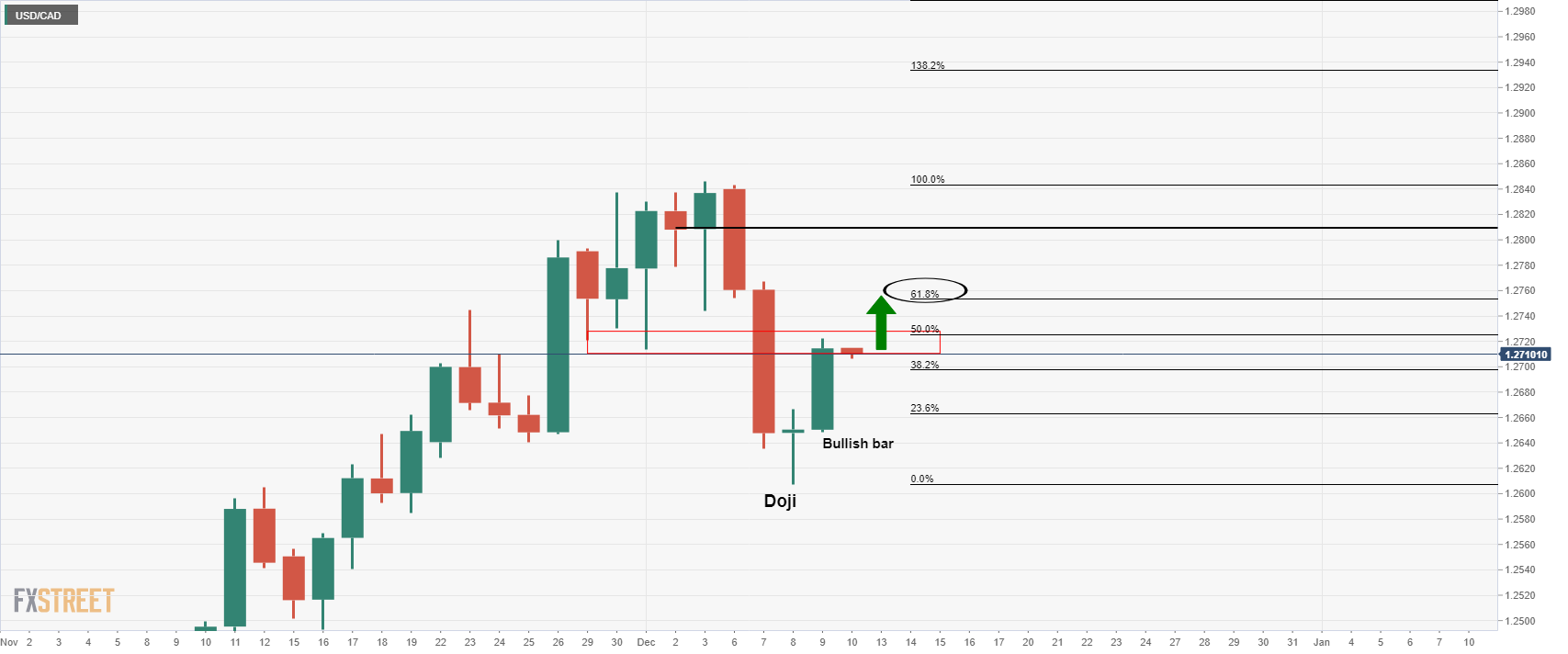
The daily chart shows that the price stalled on the downside with a dojo reversal candle followed by a strongly bullish candle and close the next day. This is a bullish prospect and the price would be expected to move through a 50% mean reversion to target the 61.8% ratio or even as high as the neckline of the M-formation. That comes in near to 1.28 the figure.
USD/CAD hourly chart
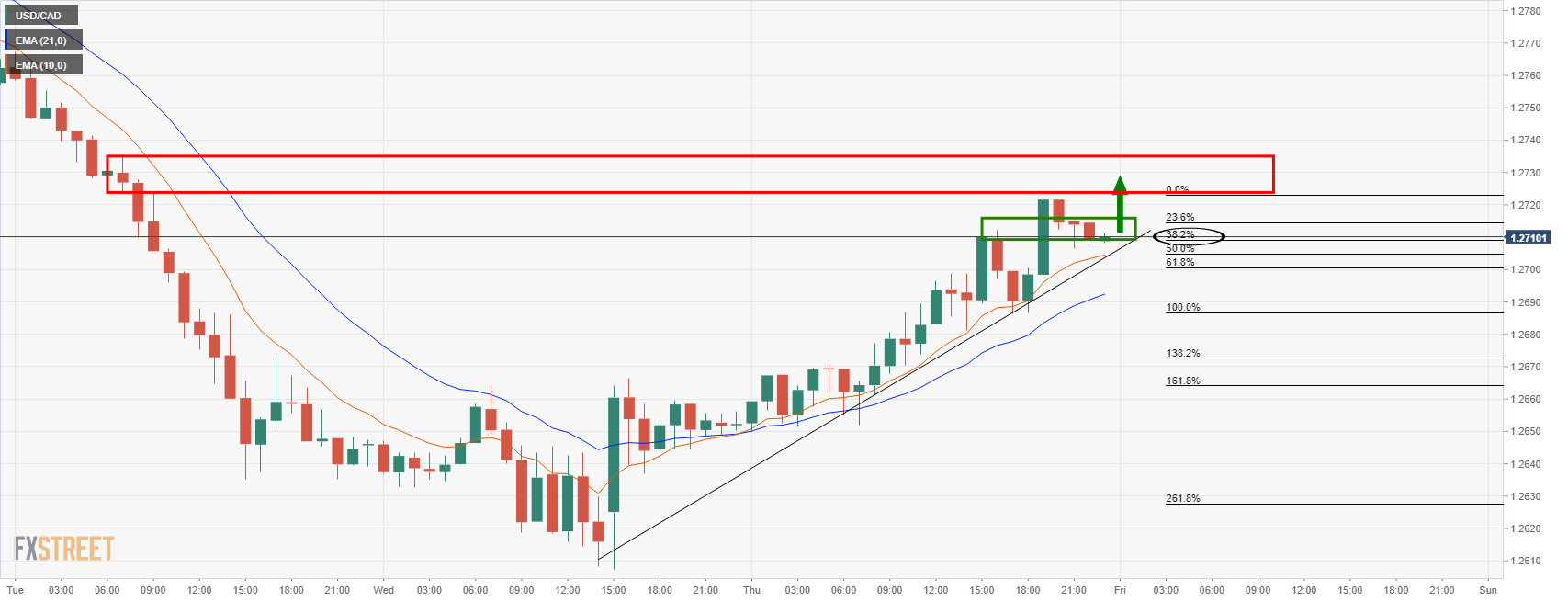
From an hourly perspective, the price is testing hourly support which includes the dynamic trendline, the 10-EMA and the prior resistance of the last bullish impulse. However, while the price has already reached a 38.2% Fibonacci level, there is still potential for a deeper correction to the 61.8% that meets structure also, as follows:
USD/CAD M15 chart
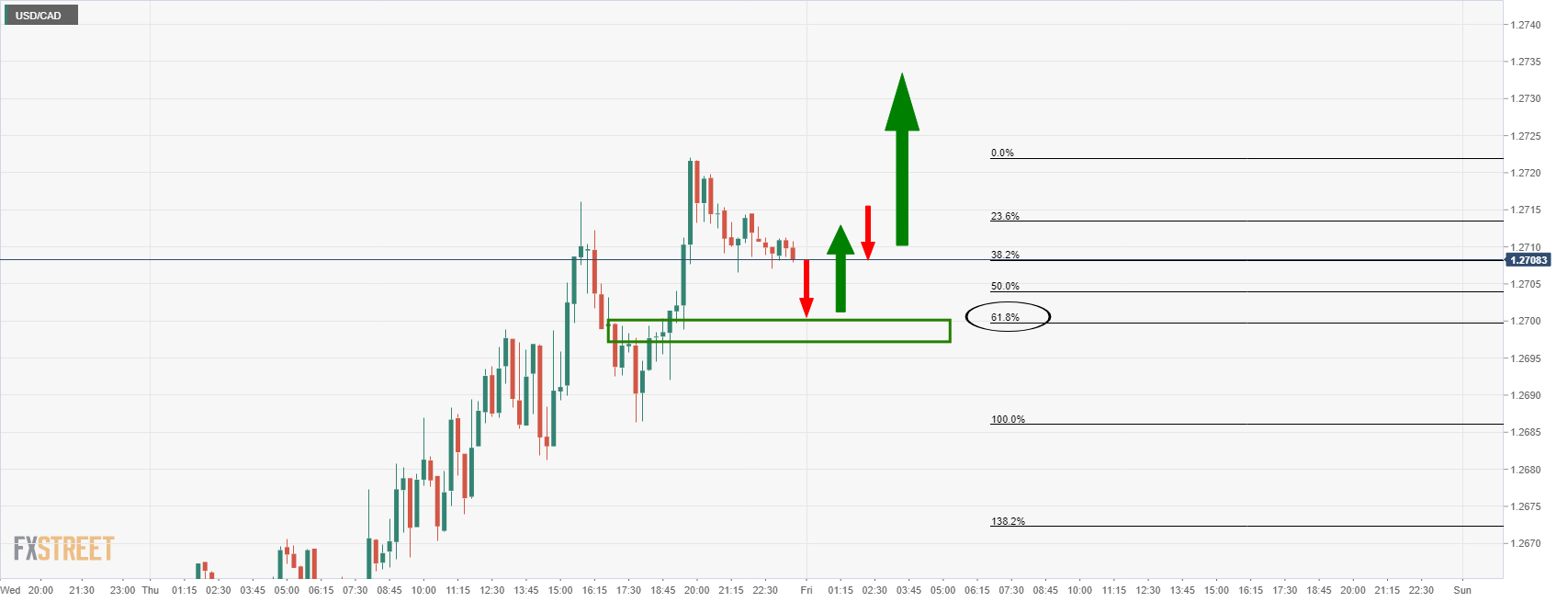
Should the hourly support give out, then the next layer to the downside comes in just below 1.27 the figure and it will be critical that the bulls commit there.
- GBP/USD portrays corrective pullback around yearly low, seesaws after three-day downtrend.
- UK says France won’t get full 104 fishing licenses, Ireland to raise Brexit concerns with Britain.
- British Health Minister Javid tried to placate ‘Plan B’ fears, BOE rate hike expectations were pushed back.
- UK data dump for November precedes US CPI to decorate calendar.
GBP/USD licks its wounds near 1.3220 amid a quiet Asian session on Friday. The cable pair dropped during the last three days as Brexit and coronavirus updates offered a double whammy of attacks towards the south, which refreshed yearly low. However, the traders seem to turn cautious ahead of the key data releases from the UK and the US.
Having announced the re-introduction of the virus-led activity measures and promoting the work-from-home culture, the UK policymakers tried to tame pessimism spreading from their actions. In doing so, the UK Health Minister Sajid Javid said that ‘Plan B’ is designed to slow down the spread of the Omicron variant.
However, the markets did believe in them as the CME’s BOEWatch Tool signals the delayed rate hike in 2022 than the previously conveyed. On the same line were Goldman Sachs and Reuters’ poll.
Not only the virus-linked fears but Brexit chatters are also weighing on the GBP/USD prices. After initial peace, the UK and France are again at loggerheads over the fishing terms as the UK Daily Telegraph quotes Britain rejecting the French demand to approve all 104 licenses. Additionally, iTV conveyed the news that the ex-Irish PM Leo Vardakar mentioned Ireland’s likely push to the UK for altering Brexit terms that negatively affect the nation.
On a broader front, mixed updates concerning the South African covid variant, namely Omicron, joined geopolitical fears surrounding China and Iran to weigh on the market sentiment. However, the US dollar benefits from the increasing bets on the Federal Reserve’s faster tapering.
That said, Wall Street benchmarks closed in the red while the US 10-year Treasury yields drops 1.2 basis points to 1.497% by the end of Thursday’s North American session.
Looking forward, a heavy economic calendar will entertain the GBP/USD traders even if the bulls have little hope of return. “October GDP is expected to have risen 1.0%mth, with industrial production up 0.1%. The trade deficit is expected to narrow slightly in October, but significant uncertainty remains given Brexit and COVID-19 (market f/c: -£2.4bn),” Westpac said ahead of the events.
Read: US Consumer Price Index November Preview: Inflation is the new cause celebre
Technical analysis
GBP/USD bears remain hopeful as a downward sloping trend line from October 28 restricts immediate upside around 1.3230.
- The NZD/JPY pares some of Wednesday’s gains, down some 0.01%.
- A seven-month-old downslope trendline around 77.30-50, reclaimed on Thursday.
- NZD/JPY Price Forecast: Failure to break resistance around 77.30-50, opened the door for further losses.
As the Asian Pacific session begins, the NZD/JPY starts on the wrong foot down some 0.01%, trading at 77.09 during the day at the time of writing. Factors like newly imposed COVID-19 restrictions across Europe, with the UK adding its name to the list, and Omicron variant’s spread, dented market sentiment, thus favoring safe-haven currencies like the JPY.
On Thursday, the NZD/JPY pair remained subdued within the 77.30-50 range, around the seven-month-old trendline. However, the pair dropped to the daily low at 76.88 amid a risk-off market mood as the European session began.
NZD/JPY Price Forecast: Technical outlook
The NZD/JPY failure to break the seven-month-old downslope resistance trendline could open the way for further downside. As mentioned yesterday, the daily moving averages (DMA’s) remain well above the spot price, supporting the bearish bias.
That said, the first support on the way down would be the December 9 swing low at 76.88. A breach of the latter would expose the December 8 cycle low at 76.69, followed by the December 3 low at 75.95.
On the other hand, the NZD/JPY first resistance would be the 77.30-60 area, respected on Thursday, followed by the 200-day SMA, at 78.07, immediately followed by the 100-day SMA at 78.26.
-637746890155731942.png)
- EUR/USD pares the biggest daily loss in two weeks inside a choppy range.
- Steady RSI, bullish MACD signals keep buyer hopeful.
- Six-week-old descending trend line joins nearby horizontal hurdle to challenge upside.
- Ascending triangles formation could offer fresh yearly low on break of 1.1240.
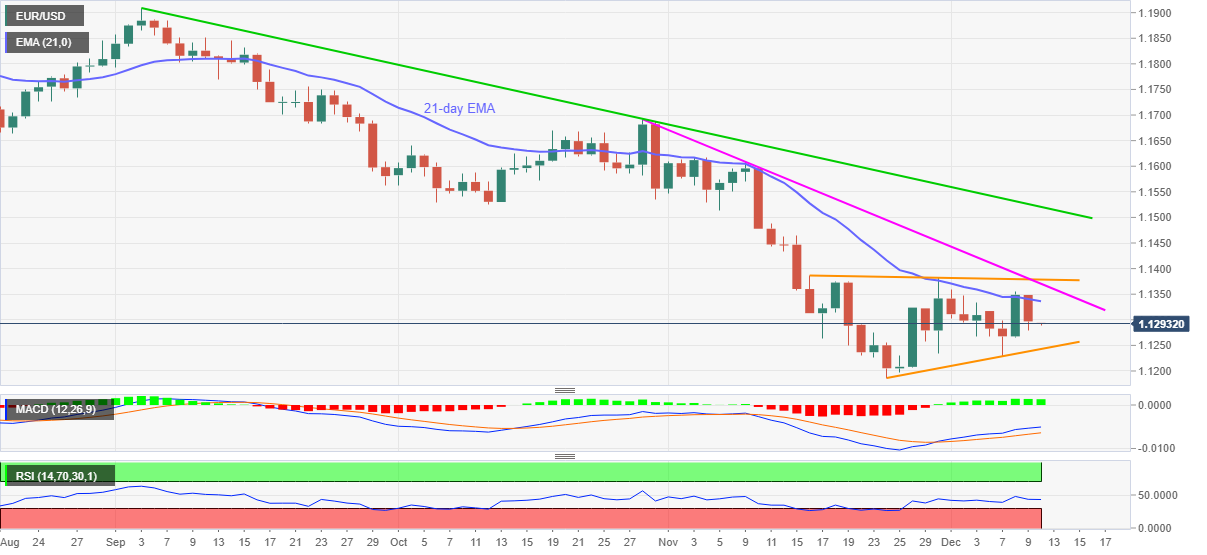
EUR/USD grinds lower around 1.1300 after posting the biggest daily fall in a fortnight. The major currency pair reversed from the 21-day EMA the previous day but stays inside a bearish chart pattern during early Friday morning in Asia.
It’s worth noting that the bullish MACD signals and firmer RSI favor the buyers but 21-day EMA, around 1.1340, acts as an immediate hurdle to recovery moves.
Adding to the upside filters, actually being a major hurdle, is the joint of a descending trend line from late October and the upper line of the stated three-week-long ascending triangle, around 1.1370.
Should the quote jumps past 1.1370, odds of its run-up to a descending resistance line from September, near 1.1520 can’t be ruled out.
Alternatively, a downside break of the triangle’s support, at 1.1240 by the press time, will initially attack the yearly low of 1.1186 during the theoretical slump towards 1.1050.
To sum up, EUR/USD struggles for a clear direction but bears have the upper hand.
EUR/USD: Daily chart
Trend: Sideways
"US and its allies would respond to Russia's aggression," said the White House (WH) during early Friday.
The news came after chatters that Russia rejected Ukraine's proposal to strengthen the July 2020 ceasefire.
The White House communiqué also mentioned that US President Joe Biden reaffirmed the United States’ unwavering commitment to Ukraine’s sovereignty and territorial integrity.
“The leaders called on Russia to de-escalate tensions and agreed that diplomacy is the best way to make meaningful progress on conflict resolution,” said the WH document covering talks between US President Biden and his Ukrainian counterpart Volodymyr Zelenskyy.
Fx implication
The news should have weighed on the risk appetite and commodity prices but the market’s cautious mood ahead of the key US inflation data dims the reaction.
Read: US Consumer Price Index November Preview: Inflation is the new cause celebre
- NZD/USD braces for the first weekly gain in six, snapped two-day uptrend before steadying.
- Market’s anxiety ahead of key weekly events joins mixed updates over Omicron and China to weigh on sentiment.
- New Zealand Business NZ PMI eased to three-month low in November, Electronic Card Retail Sales came in mixed.
- Risk catalysts may offer intermediate direction during the likely dull day ahead of US CPI.
NZD/USD struggles for clear direction around 0.6800 during early Friday morning in Asia, after stepping back from the weekly top the previous day. The Kiwi pair dropped for the most in a week on Thursday as risk appetite soured amid a light calendar. That said, the quote’s latest performance could be linked to the market’s cautious mood ahead of the US Consumer Price Index (CPI) for November.
Mixed updates concerning the South African covid variant, namely Omicron, joined geopolitical fears surrounding China and Iran to weigh on the market sentiment the previous day. The economic calendar was also light with the US Initial Jobless Claims preceding the recently released New Zealand NZ Business PMI and Electronic Card Retail Sales. Further, China's CPI came in firmer but PPI eased from a multi-year high.
US Initial Jobless Claims dropped to the lowest levels since 1969, 184K versus 215K expected and 227K forecast, raising odds of the faster tapering by the US Federal Reserve (Fed) ahead of today’s key inflation data and the next week’s Federal Open Market Committee (FOMC) meeting. China’s Consumer Price Index (CPI) jumped the most since August 2020, by 2.3% YoY and 0.4% MoM in November whereas the Producer Price Index (PPI) crossed 12.6% forecasts to arrive at 12.9% YoY in November, easing from a 26-year high posted the last month.
At home, NZ Business PMI eased below 56.7 market consensus and 54.3 previous readings to 50.6 while Electronic Card Retail Sales recovered to +2.9% YoY from -7.6% prior but eased on MoM to 9.6% from 10.0% printed in October.
Elsewhere, the return of lockdowns in Europe and the UK, as well as protective measures in parts of the US, renew COVID-19 fears even as global policymakers followed scientists suggesting three vaccine shots as effective against the virus variant. The fears could be linked to the Japanese study saying Omicron is four-time more transmissible than the other covid strains.
On the other hand, Fitch termed China’s Evergrande as “restricted default” and pushed the People’s Bank of China (PBOC) to raise the reserve requirement ratio (RRR) on banks' foreign currency holdings.
Additionally, the US-Russia and the Sino-American tussles join the latest one between Washington and Tehran to weigh on the risk appetite.
Above all, the market’s indecision ahead of the key US inflation data and the next week’s super-pack central bank actions portray a risk-off mood and challenge the NZD/USD prices.
Amid these plays, Wall Street benchmarks closed in the red while the US 10-year Treasury yields drops 1.2 basis points to 1.497% while gold and crude prices also weakened.
Looking forward, a lack of major data/events will keep NZD/USD traders at the mercy of the US CPI.
Read: US Consumer Price Index November Preview: Inflation is the new cause celebre
Technical analysis
A convergence of monthly and fortnightly resistance lines challenged NZD/USD rebound on Thursday. The receding bullish bias of MACD and RSI retreat supports the following pullback moves, which in turn suggests further declines towards immediate horizontal support near 0.6765. On the contrary, recovery moves will get validation on crossing the weekly top of 0.6824.
- AUD/USD is correcting a sharp bullish daily rally.
- The bulls will be looking for a discount in the coming sessions.
AUD/USD is stalling on the bid, for the moment, and forming a bearish structure on the lower time frames which would be expected to equate to an extension of the correction. However, the daily chart offers a bullish outlook and bulls would be expected to engage again in the coming days.
AUD/USD H1 chart
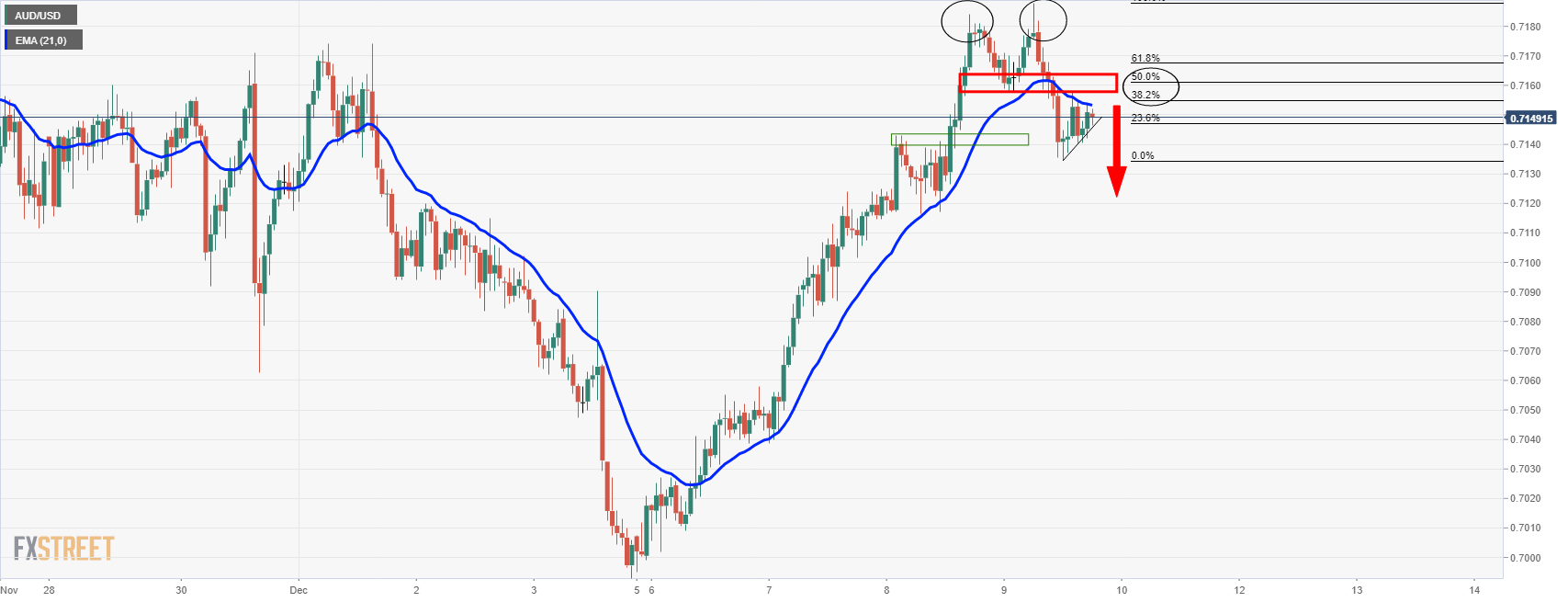
AUD/USD has failed to move higher as dip-buying ran out of steam in London, breaking below the 21 EMA and the focus has flipped back to the downside. The dynamic support meets the prior resistance area near 0.7130.
However, the bulls have taken charge as seen on the daily chart which is now correcting towards a 38.2% Fibonacci retracement level near 0.7110.
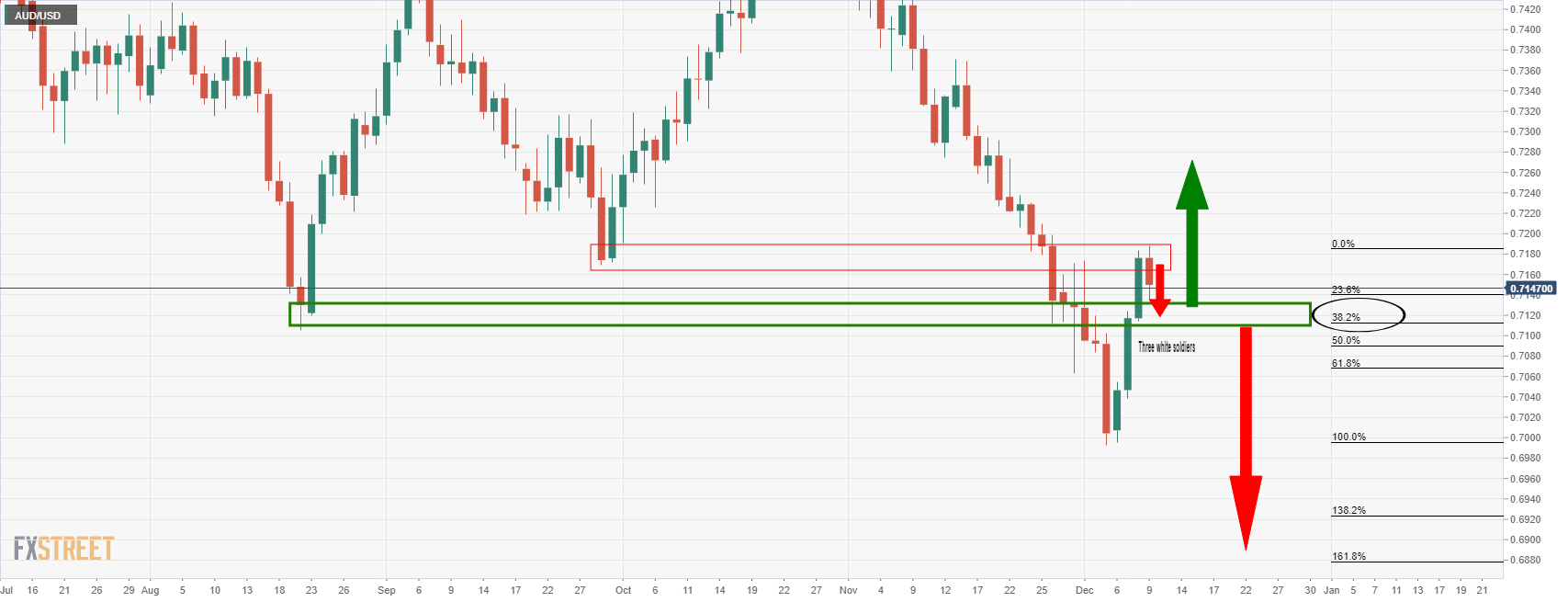
Given the strength of the rally, the correction would be texted to stall in the coming days and lead to a continuation to the upside.
- Gold slides on COVID-19 restrictions spurred by the omicron variant’s rapid spread.
- The German 10-year bund is flat at -0.3530%.
- XAU/EUR Price Forecast: Doji in the daily chart opens the door for further upside.
Gold (XAU/EUR) vs. the euro is barely down during the day, trading at €1,572.06, down some 0.01% at the time of writing. Concerns about COVID-19 restrictions and the omicron variant’s rapid spread dented investors’ mood, thus, in this case, favoring the low-yielding euro.
COVID-19 restrictions around the Eurozone led by Germany and Austria also kept the EUR under pressure against the greenback, but it seems that gold bulls were absent, failing to push prices higher. Additionally, the 10-year German bund is flat during the day, at -0.353%, which dragged XAU/EUR prices slightly down despite being static.
XAU/EUR Price Forecast: Technical outlook
XAU/EUR has an upward bias depicted by the daily moving averages (DMA’s) residing below the spot price, which is approaching the confluence of the 50-day moving average and the June 1 pivot low around the €1,565-45 area, that in this case acts as support. At press time, gold is forming a candle pattern called “doji” meaning that the downside move could be exhausted, but the lack of buyers failed to push the price higher.
If gold aims higher, the first resistance would be the December 7 high at €1,589.26. A breach of that level, the XAU/EUR would aim towards the November 26 high at €1,609.65, followed by the robust resistance area around €1,640-50.
Contrarily, if XAU/EUR edges down, the first support is the confluence of the 50-DMA and the June 1 low around the €1,565-45 range. A break below that demand zone would send gold towards the December 2 low at €1,555.31, followed by the 100-DMA at €1,538.52.
-637746823604532613.png)
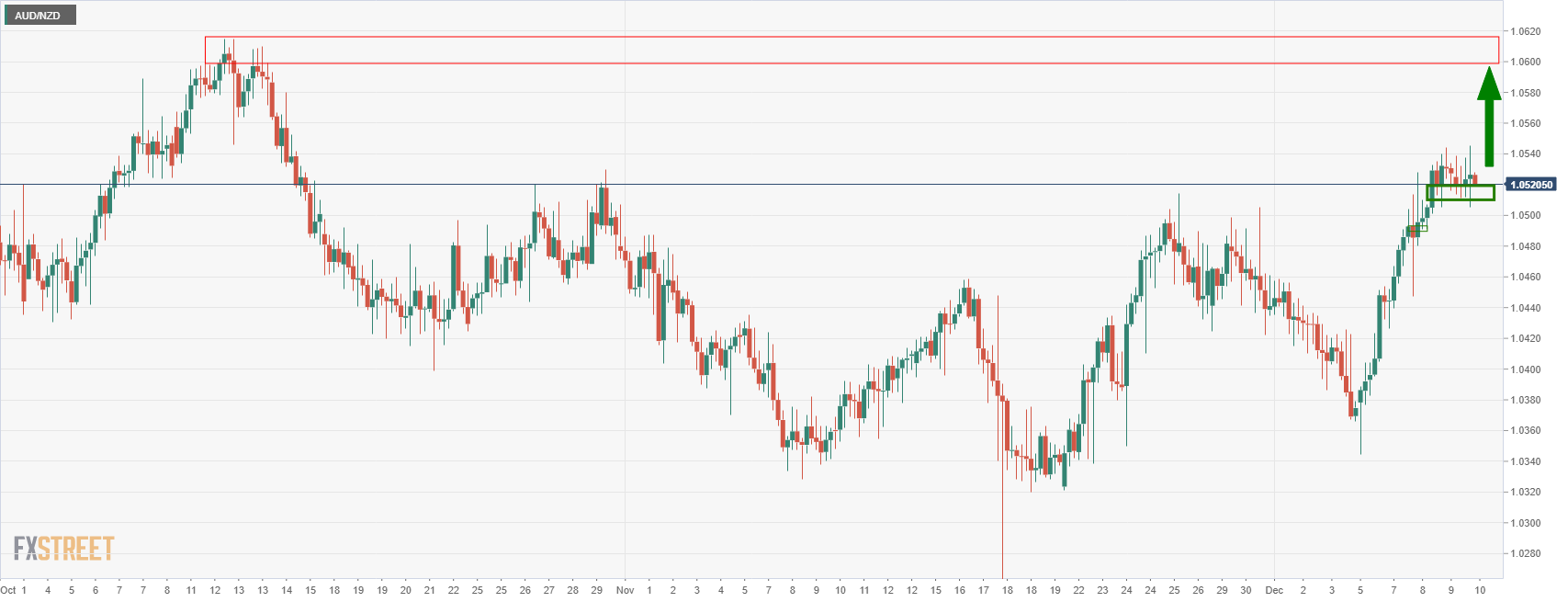
- AUD/NZD bulls look to the 1.06 area should support holds.
- Hourly support keeps the bears off and bulls charged for the days ahead.
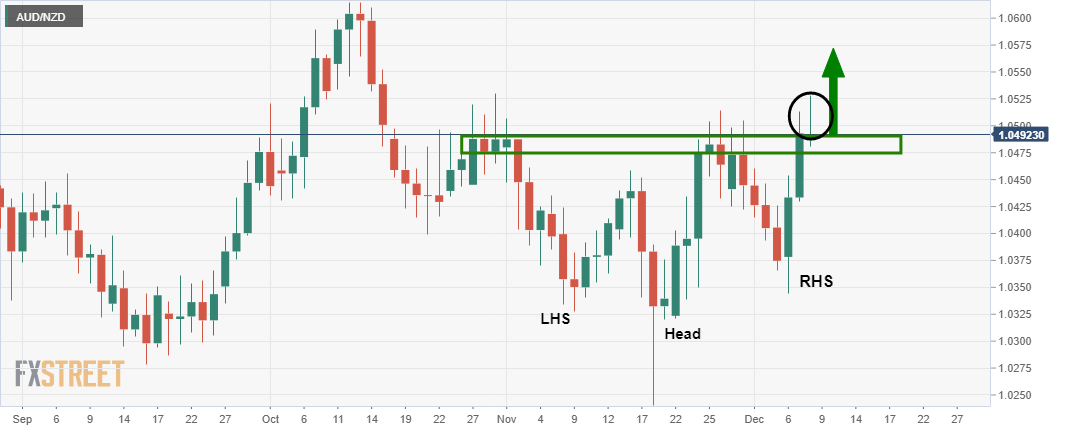
As per the prior analysis, AUD/NZD Price Analysis: Bulls are taking on the 1.05's, the pair has extended higher in an inverse head and shoulders breakout.
AUD/NZD prior analysis
AUD/NZD update
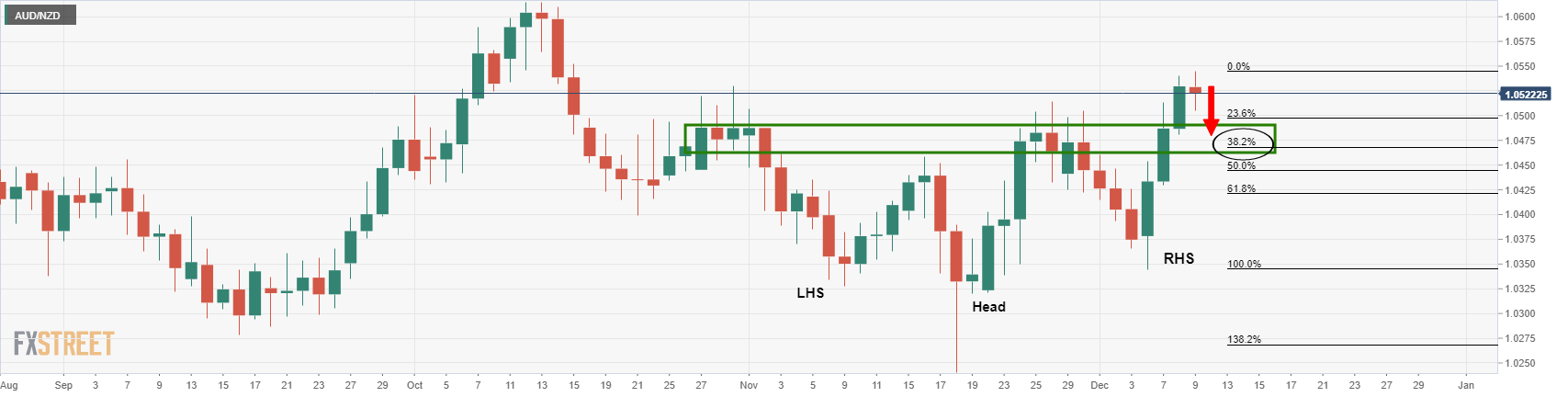
As illustrated, the price filled the wick of the prior daily candlestick and moved into resistance.
AUD/NZD C1 chart
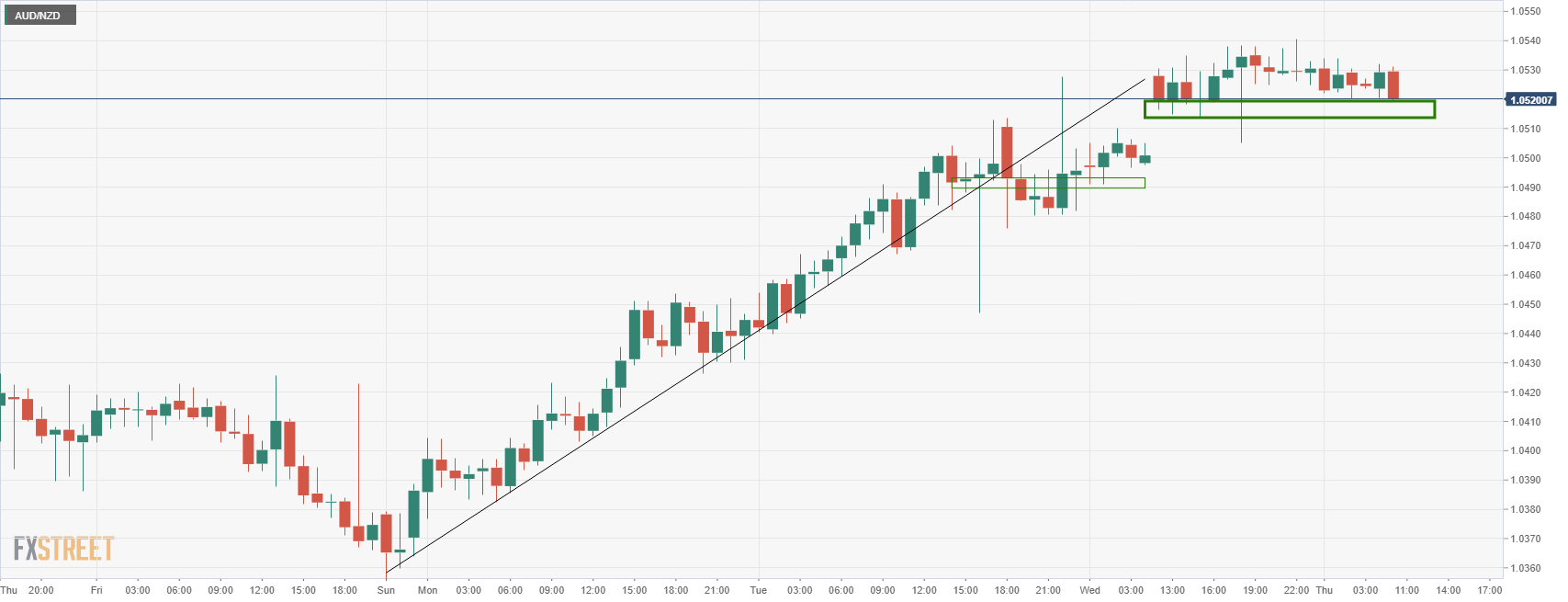
The price is consolidating at this juncture and awaits the next catalyst for direction. Should the support hold, then the bulls will be looking to the 1.06 in the coming week:
- GBP/JPY was subdued on Thursday, trading roughly at the midpoint of this week’s 149.00-151.00ish range.
- UK GDP data on Friday will be watched, but the main themes driving the pair remains Omicron and the BoE.
GBP/JPY saw subdued trading conditions on Thursday, in fitting with the broadly subdued conditions also witness over the past two days. The pair has spent the session trading either side of the 150.00 level and is currently changing hands close to 149.90, down about 0.1% on the day. That puts it roughly at the midpoint of this week’s 149.00-151.00ish range.
Looking ahead to Friday’s session, UK GDP data for October is set for release at 0700GMT. The data will be closely watched by traders, but the main interest they will have is in trying to guage how the BoE will interpret the data. Most likely, even if growth did start off Q4 stronger than expected (markets expected 0.4% MoM growth), this wouldn’t factor into the BoE’s thinking much with regards to whether or not it is going to hike rates at next week’s meeting.
Indeed, the emergence of Omicron, which triggered GBP/JPY’s initial tumble from close to 154.00 on November 26, has seen BoE members adopt a more dovish tone. Most economists now expect the bank to hold interest rates steady in December and kick the can down to the road until February (regarding rate hikes) as they await further information about the Omicron variant and observe the UK government response. The fact that the UK government announced Covid-19 “Plan B” on Wednesday, where people will be ordered to work from home (where possible), amongst other restrictions on hospitality sectors/public spaces, will give the BoE further cause for caution.
BoE dovishness in face of Omicron and the winding down of expectations for a rate hike at next week’s meeting is likely one key reason why GBP/JPY has been unable to sustain any reasonable attempt at a recovery back towards its pre-Omicron levels. At present, the pair is about 2.4% below pre-Omicron news levels. By comparison, USD/JPY (which is not weighed by a dovish central bank, rather, the Fed has since turned more hawkish) is down about 1.6%.
For now, GBP/JPY is being held up by decent support in the 148.50-149.00 area. Should Omicron/pandemic woes worsen in the coming weeks as cases in places like the UK and US spike and hospitalisation start to rise, this could exacerbate the yen’s safe-haven bid. If that further deters BoE hawkishness and further suppresses UK/Japan yield differentials as a result, a good medium-term target for GBP/JPY could the next area of key support around 145.00.
Bank of Canada Deputy Governor Toni Gravelle said on Thursday that concerns about upside inflation risks are heightened much more than usual. We are likely to react a little bit more readily to the upside risk given it's already above our inflation-control range, Gravelle added. For reference, the bank's inflation-control range is 1.0%-3.0%.
Market Reaction
The comments come in wake of remarks from Gravelle earlier in the session. His comments are hawkish-leaning (hinting at a proactive BoC response to upside inflation risks), but the loonie does not seem to have reacted.
According to Reuters, the Bank of Canada will leave its inflation target at 2.0%, the mid-point of a 1.0%-3.0% range, in a soon-to-be-announced review of its monetary policy framework. However, the bank will include new language on the importance of employment to the economy.
According to the source cited by Reuters, "the upcoming announcement will be a very clear reaffirmation of the centrality of the inflation target". "But it's not a photocopy of last time" the source continued, "there's a little bit of updating to reflect what the bank is already doing - some updating of the language to reflect the consideration the bank is already giving to employment factors".
Market Reaction
The loonie did not see any notable reaction to the story reported by Reuters.
- Crude oil prices fall during the day after rallying for six weeks, down in the day 2.82%.
- COVID-19 restrictions, and the spread of the omicron variant, dented market mood as oil demand decreased, dragging prices lower.
- WTI Price Forecast: In the near-term has a downward bias, though a break of the 200-DMA is needed so that WTI bears could target December 2 low at $62.34.
The US crude oil benchmark WTI falls during the New York session, trading at $70.34 at the time of writing. Concerns about COVID-19 restrictions and the omicron variant’s rapid spread dented investors’ mood and hit oil prices as lockdowns loom. That, alongside countries tapering some crude reserves, helped ease energy prices.
According to sources cited by Bloomberg, “the market is still in calibration mode around the virus.” At the beginning of the week, global equities and oil rallied, on the back that the newly discovered strain, although highly transmissible, caused mild symptoms. However, 19,842 new cases reported from South Africa on December 8 increased market participants’ worries, which flew through safe-haven assets as they waited for additional omicron information.
During the day, Western Texas Intermediate peaked above December 8 cycle high at $73.17, retreating towards the $70.50s area amid dented market sentiment.
In the meantime, the US Dollar Index, which price influences commodities quoted in US dollars, is up 0.34%, sitting at 96.24, a headwind for WTI.
WTI Price Forecast: Technical outlook
WTI is approaching the 200-day moving average (DMA) at $70.06, which would be the first line of defense for oil bulls. Crude oil has a downward bias, as failure to break above the 100-DMA at $73.72 could push WTI towards a re-test of December 2 low at $62.34. If WTI bears reclaim the 200-DMA, the first support would be September 1 swing low at $67.01, followed by the aforementioned December 2 low.
To the upside, a bounce at the 200-DMA could push crude oil prices higher. The December 7 high at $72.81 would be the first supply zone, followed by the 100-DMA at $73.72.
-637746782876273150.png)
What you need to know on Friday, December 10:
The market’s mood remained sour, amid Omicron uncertainty and as top central banks’ decisions loom.
According to Reuters and citing sources familiar with the matter, the European Central Bank Governing Council members are converging on a debate over a limited and temporary increase of Asset Purchases Programme (APP) in the December meeting. The ECB and the US Federal Reserve will announce their decisions on monetary policy next week. The Fed is seen speeding up tapering, moving in the opposite direction from the ECB. EUR/USD trimmed its recent gains and settled in the 1.1280 price zone.
The GBP/USD pair hovers around 1.3200, as odds for a rate hike in the UK had been pushed back amid the uncertainty caused by the coronavirus Omicron variant and the resulting decision of applying Plan B in the UK.
Not only the UK is announcing tighter coronavirus measures, unnerving market participants. Most European and American indexes closed in the red, weighing on commodity-linked currencies, which pulled back from their weekly highs vs the greenback. USD/CAD trades around 1.12710, while AUD/USD quotes at around 0.7150.
The USD/JPY is marginally lower in the 113.40 region, as government bond yields ticked lower.
Gold eased despite the worsening mood, now trading at around $1,776 a troy ounce. Crude oil prices also head lower, with WTI at $70.50 a barrel.
Shiba Inu buyers disappear as SHIB falls towards $0.00003
Like this article? Help us with some feedback by answering this survey:
- Gold remains in familiar ranges in the countdown to the Fed.
- US CPI is the next potential catalyst for gold.
Gold, XAU/USD, has been pressured on Thursday as the greenback corrects the prior day's slump ahead of the US Consumer Price Index data on Friday. The yellow metal is down some 0.4% at the time of writing after travelling from a high of $1,787 and reaching a low of $1,773.31 so far.
The greenback, as measured vs. six major currency rivals in the DXY index, is up by 0.3% at the time of writing. The index finding support near 96 the figure as investors position for a stronger inflation outlook into next week's Federal Reserve meeting.
Analysts at TD Securities explained that they expect inflation to slow significantly as fiscal stimulus fades and supply constraints ease, but we don't expect the data to be validated in the near term. ''The CPI likely surged in Nov, with a drop in oil coming too late to avert another large gain in gasoline and core prices boosted by rapidly rising used vehicle prices and post-Delta strengthening in airfares and lodging.''
Fed in focus
The Fed next week is expected to open the gates to a second-quarter rate rise if needed. The tightness in the labour market is becoming more evident and that was seen in the Initial Claims for the latest week.
The data climbed just 184k, the lowest increase since 6 September 1969, signalling labour hoarding amid strong demand for labour is at play. Analysts at ANZ Bank explained. ''Available slack in the labour market is low and constrained by high levels of early retirees and ongoing jobs displacement (childcare etc) from the pandemic. Wage pressure look set to intensify further.''
However, while inflation prints are expected to remain elevated into the early months of the new year, suggesting that the market's pricing for Fed hikes could still become more aggressive, analysts at TD Securities said that they ultimately expect that it will prove to be far too hawkish.
''In fact, with both an accelerated taper and more than three rate hikes already priced in for 2022, the balance of risks for gold positioning remains to the upside, as geopolitical risks and virus risk could catalyze a positioning reshuffling.''
Meanwhile, the wild card for financial markets stays with the new variant of the Covid-19 disease. Omicron is sweeping its way through the world. The epicentre is once again in Europe. However, while the increased number of people vaccinated against Covid had inspired hopes that Americans would be able to avoid a fresh wave of the illness, the rise in Covid cases; holiday gatherings; and unanswered questions about the Omicron variant have sparked fresh concerns. Nonetheless, the Fed has turned uber hawkish despite the risks which is undermining the greenback and weighing on the price of gold.
Gold technical analysis
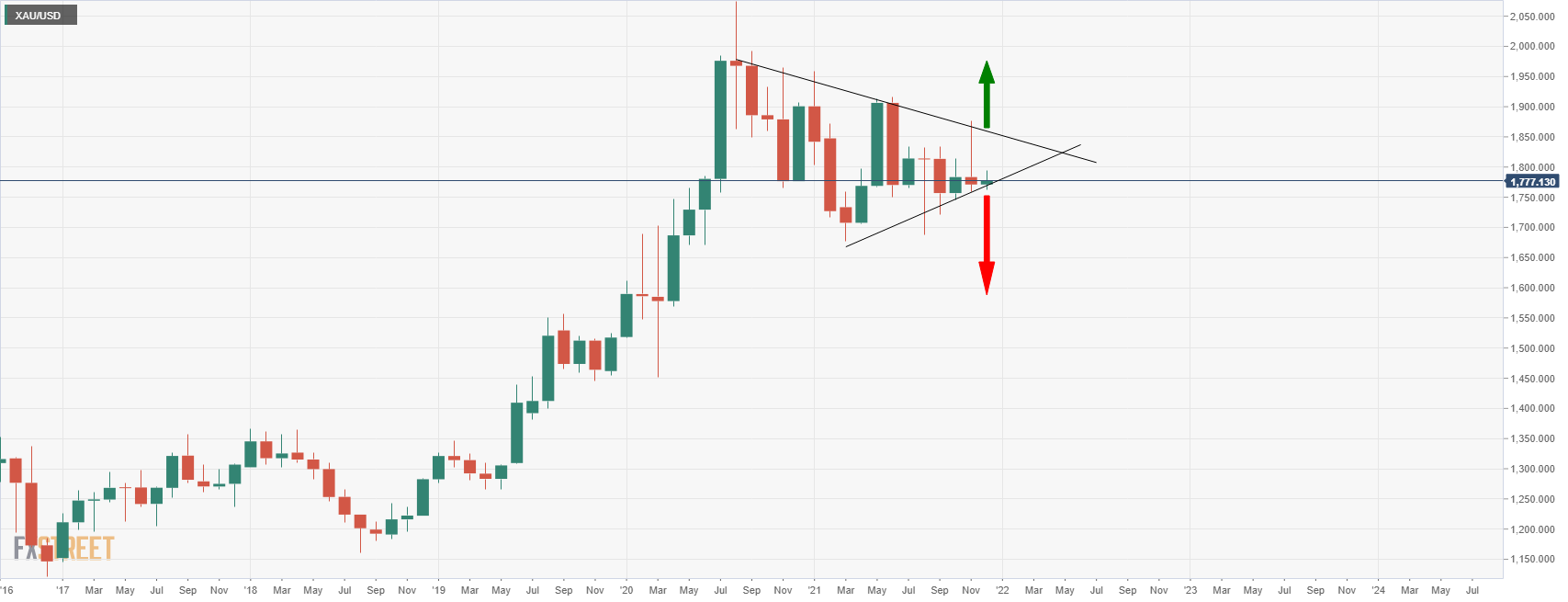
The yellow metal remains within a familiar territory and the monthly chart illustrates that space is running out for the bulls. A break of the symmetrical triangle opens the risk of a breakout to the downside which could be potentially significant if $1,700 gives out
- USD/CAD moved back above 1.2700 on Thursday as oil prices came under selling pressure.
- BoC’s Gravelle spoke and largely stuck to the bank’s script after it held policy settings/guidance as expected on Wednesday.
USD/CAD has been on the front foot on Thursday, gaining about 0.4% to move back to the north of the 1.2700 level. That marks a 0.8% turnaround from Wednesday’s lows close to 1.2600, though the pair still trades lower on the week by about 1.0%, having opened Monday trade to the north of the 1.2800 level.
Thursday’s upside means USD/CAD is back above its 21-day moving average and the pair is now probing an area of resistance around the 1.2810 mark (the December 1 low). The next level of upside resistance is around 1.2750. Beyond that, there isnt much by way of technical barriers to stop the pair from retracing all of this week’s losses and returning to last Friday’s highs at 1.2850.
Driving the day
The main driver of upside in USD/CAD on Thursday has been a downturn in crude oil prices. WTI has been slipping in recent trade and is now down more than $2.0 on the day and under the $71.00 level. Risk appetite has deteriorated broadly on Thursday, not especially due to any one headline or piece of news, but likely more due to profit-taking ahead of risk events (like US inflation on Friday). This is likely the main driver of crude oil’s downside, though concerns about Covid-19 restriction reimposition after UK PM Boris Johnson announced new restrictions for England on Wednesday may be contributing to the caution.
Elsewhere there has been plenty of focus on the Bank of Canada over the last two days. The bank on Wednesday held interest rates at 0.25% as expected and maintained guidance for a first rate hike as soon as April 2022. There was something for both the hawks and doves to clutch at in the statement, which noted the risk presented by Omicron, whilst also noting the growing upside inflation risks.
Deputy Governor Toni Gravelle was on the wires on Thursday but largely stuck to the bank’s script in terms of economic commentary and thus didn’t move the loonie. Indeed, the latest BoC meeting seems not to have really had any noticeable impact on the loonie at all. Things should spice up next year from a BoC/FX reaction point of view when the bank has more certainty about the impact of the Omicron variant and potential rate hikes are closer.
- The S&P 500 looks on course to snap a three-day win streak, having dropped a modest 0.3%.
- Investors weighed up recent Omicron news and are looking ahead to key US inflation data on Friday.
US equities appear on course to snap a three-day win streak, amid a more tentative feel to trade on Thursday as investors weigh up recent Omicron news and look ahead to key US inflation data on Friday ahead of a bonanza of major central bank activity next week. The S&P 500 shed a modest 0.3% to trade around 4690, while the Dow gained about 0.25% to move above 35.8K. The Nasdaq 100 was down about 0.8% and the CBOE S&P 500 Volatility Index, often referred to as “Wall Street’s fear guage” rose about half a point to move back above 20.00.
In terms of the pandemic news, investors are weighing positive recent news that Omicron infections tend to be milder than infection by previous variants and that a third shot of the Pfizer vaccine is effective in neutralising the Omicron variant (according to Pfizer themselves) against a continued trend towards tighter global health restrictions. Much was made yesterday of UK PM Boris Johnson’s announcement that the UK would move to Covid-19 “Plan B”, which would see restrictions reimposed on everyday life and people encouraged to work from home.
Elsewhere, US equity markets weren’t particularly reactive to Thursday’s much stronger than expected weekly jobless claims report. In the week ending on November 4, just 184K people signed up for unemployment insurance, the lowest such weekly tally since 1969. This prompted calls by some for the Fed to respond to “full employment” with immediate rate hikes, not that this troubled equity markets much at the time.
Separately, in notable individual stock news; there was a fair amount of attention on Apple, as the company’s market capitalisation approaches $3T. Shares need only rally about another 4.5% for the company to reach the significant milestone. At present, AAPL shares are trading around $175.50, which gives the company a market cap of about $2.87T.
- The shared currency gives way against the British pound, down some 0.43%.
- EUR/GBP Price Forecast: It has an upward bias, but as long as bears keep the spot under the 200-DMA, they are in charge.
The EUR/GBP retreats after printing a new eight-week high around 0.8598, down to 0.8540 during the New York session at the time of writing. Financial markets sentiment is downbeat, as shown by US equities recording losses, except for the Dow Jones Industrial, up some 0.11%. Factors like COVID-19 restrictions across Europe, particularly in Germany, Austria, Netherlands, and on Wednesday the UK, weighed on risk appetite as omicron infections rise, despite its recently reported mild symptoms.
The EUR/GBP pair remained subdued around 0.8570-0.8598 during the overnight session. However, through the mid-European session, it dropped below the bottom of the range, stopping between the 50 and the 100-hourly simple moving averages (SMA’s), at 0.8540. The downward move helps GBP bulls to reclaim the 200-day SMA lying at 0.8555.
At press time, the cross-currency pair has an upward bias, despite the fact of trading below the 200-DMA. If EUR bulls get a daily close above the 200-DMA, the first resistance would be 0.8600. A breach of the latter would send the pair upwards to the September 29 swing high at 0.8658, followed by the figure at 0.8700.
On the other hand, If GBP bulls want to reclaim control, they will need a daily close around the 100-DMA at 0.8511. Once that happens, the first support would be the December 7 swing low at 0.8488, followed by the 50-DMA at 0.8480.
EUR/GBP Daily chart
-637746737094014420.png)
- AUD/USD now depends on o the US CPI outside this Friday/
- The divergence between the Fed and RBA would be expected to keep AUD/USD hamstrung.
At 0.7150, AUD/USD is lower by some 0.25% on the day and sat between a range of 0.7186 and 0.7135. The greenback continues to recover within a wider consolidative phase ahead of Friday's Consumer Price Index and next week's Federal Reserve meeting.
The central bank divergence between the Fed and Reserve bank of Australia has undermined the Aussie of late due to the dovish tones of the RBA. Beyond the Fed, attention is already turning to the RBA February policy meeting. The Bank has made it clear that it will be considering its QE programme in the new year and speculation is already mounting that an end to the programme could be a favoured outcome for the Bank. A better tone in risk appetite more generally has allowed AUD/USD to pull back some ground.
''On the back of decent economic data including the improved current account position we see scope for AUD/USD to recover modestly to the 0.72 area on a 3-month view,'' analysts at Rabobank said.
US CPI eyed
Looking ahead for the week, the uS Consumer Price index will be key. Analysts at TD Securities explained that they expect inflation to slow significantly as fiscal stimulus fades and supply constraints ease, but we don't expect the data to be validated in the near term. ''The CPI likely surged in Nov, with a drop in oil coming too late to avert another large gain in gasoline and core prices boosted by rapidly rising used vehicle prices and post-Delta strengthening in airfares and lodging.''
Meanwhile, in the third quarter, Australian underlying CPI inflation has registered 2.1% YoY and at the bottom of the RBA’s 2% to 3% target and below the average of the past 30 years. This clearly contrasts with some of the high inflation prints for other G10 economies especially that of the US which is likely to helo AUD/USD remain underpinned should the US CPI come in hot.
''The RBA is not expecting underlying inflation to reach the middle of its target until the end of 2023 and Lowe maintains that the first increase in the Cash rate may not be before 2024,'' analysts at Rabobank explained. ''Even if this target slips, it is clear that the RBA will be well behind the Fed when it comes to hiking rates in the forthcoming cycle.''
In a speech on Thursday, Bank of Canada Deputy Governor Toni Gravelle warned that supply disruptions and related cost pressures could last longer than expected, boosting the likelihood of Consumer Price Inflation (CPI) remaining above the bank's control range, according to Reuters. This could feed into inflation expectations and contribute to wage pressures, Gravelle added, leading to second-round price increases.
Additional Remarks
"Although there is much to be hopeful for as we approach full recovery, materialization of upside risks to CPI is of greater concern."
"The risk that supply disruptions last longer than expected figured prominently in our decision leading up to the December 8 rate announcement."
"We believe inflation will ease over time as supply catches up and that medium to long-term inflation expectations remain well-anchored."
"While there are signs some supply constraints are easing, most remain largely unresolved and it is hard to pinpoint when impact of supply disruptions will peak."
"There is a risk the Omicron variant of Covid-19 could hold back services consumption and exacerbate upward pressure on goods suffering from supply constraints."
"The degree of excess supply and demand varies across sectors, which means our typical measure of slack comes with a higher degree of uncertainty."
"Only recently have we seen a meaningful increase in services consumption, but it is still 4% below where it was before the pandemic."
"Customers can be expected to resume spending on a more typical share of their income on services."
Market Reaction
CAD did not see any notable reaction to the comments at the time.
- EUR/USD corrects a steep decline in the New York sessions.
- Bears seek a downside continuation below 1.12 the figure.
EUR/USD has been pressured in a risk-off environment on Thursday. The pair is down by some 0.45% as it attempts to correct the supply that has arisen on the back of concerns of economic risks from measures to regulate the new coronavirus variant.
In its early stages, the coronavirus variant called Omicron is said to be 4.2 times more transmissible than the Delta version, according to research. The European Centre for Disease Prevention and Control has predicted that the Omicron variant could become the dominant variant in Europe within months. Seventy-nine cases of the new Omicron variant of Covid-19 have been reported in 15 European countries so far, according to the EU's European Centre for Disease Prevention and Control.
Germany's fourth wave of Covid is it's most severe so far, with another 388 deaths recorded in the past 24 hours. Omicron is causing renewed restrictions on public life and Germany's national and regional leaders have agreed to bar unvaccinated people from much of public life in a bid to fend off the fourth wave of Covid-19.
Meanwhile, as for data today, Initial Jobless Claims in the US fell by 43,000 to 184,000 during the week ended Dec. 4, the lowest level since 1969. Analysts in a survey compiled by Bloomberg had expected claims to come in at 220,000.
Looking ahead, the Consumer Price Index in the US is forecast to grow at an annualized rate of 6.9% in November, up from a 6.2% recorded in the previous month, according to data compiled by Trading Economics. The November cycle high in the US dollar index, DXY, near 96.938 remains in sight as the 2-year rate differentials continue to move in the dollar’s favour. The CPi data could add further upside pressure in the yields to support the greenback in the coming days.
ECB in focus
Meanwhile, next week's European Central Bank meeting is going to be critical, especially with the emergence of the Omicron variant is putting more downward pressure on European economies. Traders note that inflation is on the rise, although the re-entering of carry trades amid a recovery in risk sentiment has been weighing on the euro.
''Inflation has picked up quicker than anticipated while the growth outlook is murky, which we expect will result in a patient approach to monetary policy in 2022, but with the optionality to recalibrate in 2023,'' analysts at Danske Bank said. ''We expect the first staff projection for 2024 inflation to land around 1.8%. This combined with real rates hovering around historic lows, allows room for a recalibration.''
EUR/USD may prove sensitive to any hawkish surprise, whether that be on the timing of unwinding asset purchases or on staff projections. There is room for the pair to catch up with the unfavourable widening of USD-EUR short-term rates.
EUR/USD technical analysis
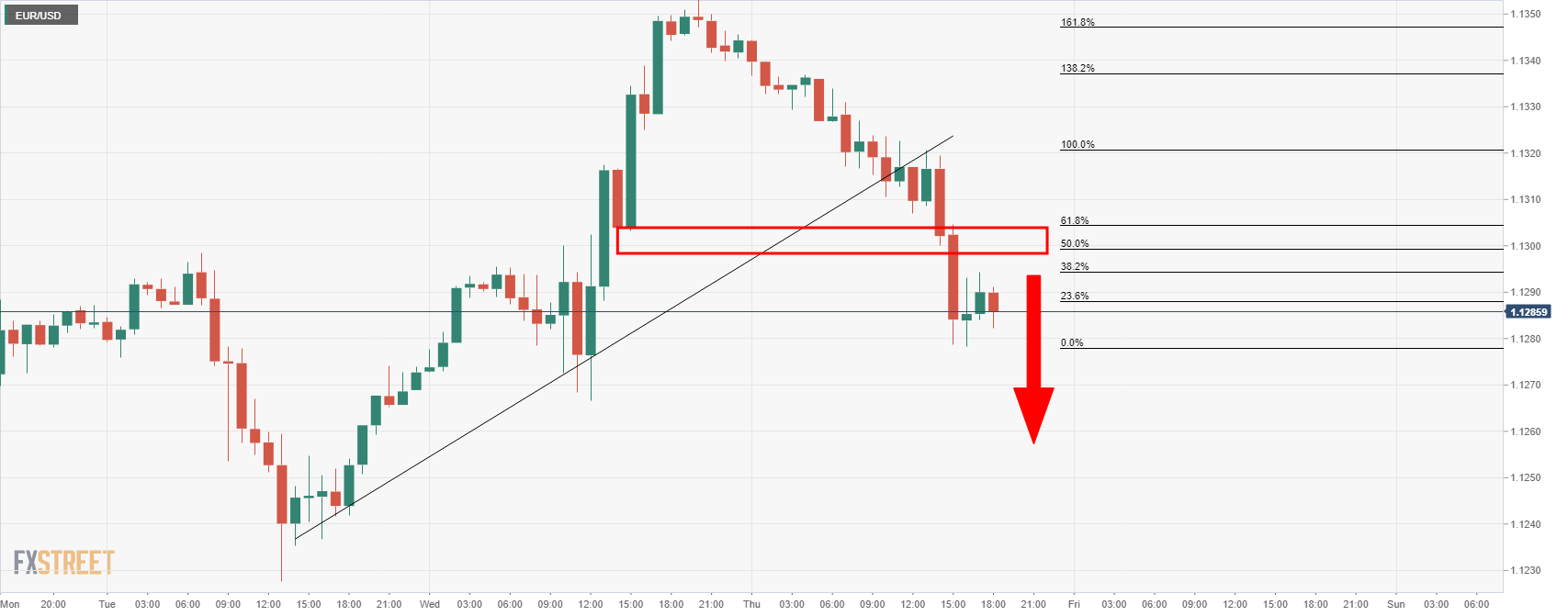
The price is attempting to correct but the downside is dominant and would be expected to overpower resulting in a bearish continuation below the counter trendline and 1.13 the figure's resistance.
- The risk-sensitive New Zealand dollar falls as market mood dampened linked to COVID-19 woes.
- US Initial Jobless Claims rose to 184K, better than the 215K estimated by analysts.
- NZD/USD Price Forecast: Threatening of breaking below the YTD low at 0.6736, which would expose November’s 2020 low at 0.6589.
The NZD/USD shed Wednesday’s gains, trading at 0.6785, during the New York session, amid risk-off market mood attributed to COVID-19 restrictions across Europe while investors assess the economic impact of the newly discovered omicron variant. Furthermore, according to Bloomberg, the omicron variant is four times more transmissible than delta in a new study.
In the meantime, during the overnight session, the NZD/USD pair peaked around the December 8 high at 0.6818, retreating below the 0.6800 figure down to 0.6780s, as market mood conditions dampened by the abovementioned causes, increasing demand for safe-haven assets.
In the US, the Department of Labor reported that the Initial Jobless Claims for the week ending on December 3 rose to 184K, lower than the 215K, declining the most since 1969, beating economists’ estimations. Meanwhile, the US Dollar Index, which tracks the greenback’s performance against a basket of six rivals, is recovering from Wednesday’s losses, up 0.31%, sitting at 96.19, a headwind for the New Zealand dollar.
Therefore, the NZD/USD trader's focus turns to Friday’s release of US inflation figures, which in case of being higher, would increase the odds of a faster bond-taper by the Federal Reserve.
NZD/USD Price Forecast: Technical outlook
After facing strong resistance at 0.6818, the NZD/USD pair is approaching the December 8 cycle low around 0.6766. The pair has a downward bias, with the daily moving averages (DMA’s) located well above the spot price. Despite the previously mentioned, the NZD/USD is approaching November’s monthly low at 0.6772, which could lead to further losses if it is broken.
In that outcome, the first support would be the YTD low, December 7 at 0.6736, followed by the 0.6700 figure. A break below that level could send the pair tumbling towards November’s 2020 monthly low at 0.6589
- GBP/USD has spent the majority of Thursday’s session chopping either side of the 1.3200 handle.
- The 38.2% Fibonnacci retracement back from the post-pandemic high to the post-pandemic low is offering some.
- A break below this support would open the door to a swift move to the psychologically important 1.3000 level.
GBP/USD has spent the majority of Thursday’s session chopping either side of the 1.3200 handle and currently trades with losses of slightly more than 0.1% on the session around the 1.3190 mark. The pair is holding up rather well in light of the downside being seen in risk assets (stocks and oil), risk-sensitive currencies (NZD, AUD and CAD) and its European peers (EUR and CHF) that would normally also weaken sterling. For reference, all of these currencies are between 0.3-0.7% lower on the day versus the buck.
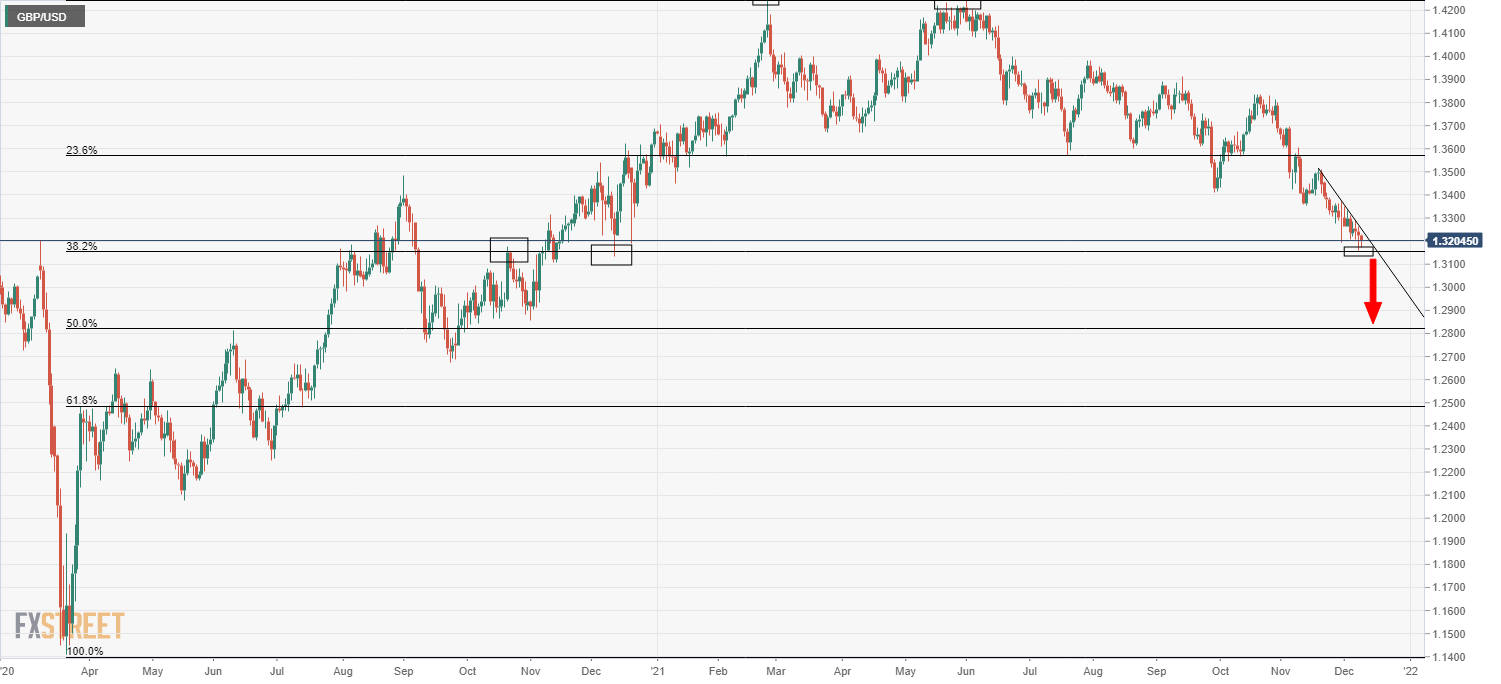
One reason for sterling’s resilience could be technical; the 38.2% Fibonacci retracement back from the post-pandemic high at 1.4250 to the post-pandemic low at just above 1.1400 is offering the pair some support in the 1.3170 area. Meanwhile, according to the 14-day Relative Strength Index, GBP/USD is fast approaching oversold territory and currently sits just above the 30.00 (below which an asset is viewed as oversold).
As positioning becomes stretched - GBP/USD has lost over 3.5% since the start of last month versus EUR/USD’s 2.3% - some profit-taking on shorts makes sense, especially given that key UK and US data looms on Friday. At 0700GMT, UK October GDP and activity data is out, while at 1330GMT, US November Consumer Price Inflation data will be released. Both will be closely scrutinised by central bankers ahead of next week’s Fed and BoE meetings. Caution ahead of these key events is another reason for GBP/USD selling pressure to ease – for now.
One factor weighing on sterling in recent weeks has been markets revising lower their expectations for the BoE to hike rates next week due to Omicron uncertainty, whilst Fed tightening expectations have remained largely intact (with this week’s strong US labour market data helping). According to Refinitiv data cited by Reuters earlier in the session on Thursday, the implied probability of a 15bps rate hike from the BoE next week had dropped to 40% versus 46% on Wednesday and nearly 70% at the start of last week.
Technically speaking, things aren't looking great for GBP/USD unless the pair can break above a recent downtrend that has been capping the price action going all the way back to the end of October. If for whatever reason (surprise BoE hike or dovish Fed…?) it was able to do that, then a move back to test resistance in the 1.3400 area could be on the cards. But if the pair does break below support in the mid-1.3100s, a swift move to the psychologically important 1.3000 level would be on the cards.
French President Emmanuel Macron criticised the British government on Thursday, saying post-Brexit relationships with the UK are difficult because the government does not do what it says. I hope Britain will re-commit to proper relations, he said.
His comments come against the backdrop of ongoing negotiations with France and the EU over access for the former's fishing fleet to UK waters and over the implementation of the Northern Ireland Protocol (NIP). France has threatened retaliatory trade and legal measures against the UK if more fishermen aren't granted licenses, while the EU has threatened to retaliate against the UK if it triggers Article 16 of the NIP.
The UK maintains that if an agreement cannot be found with the EU on the implementation of the NIP, triggering Article 16, which would allow it to unilaterally make changes to trade arrangements with Northern Ireland, remain on the table.
Market Reaction
Sterling is unmoved following the latest comments from Macron. GBP/USD continues to trade close to recent lows around 1.3200.
- The USD/CHF grind higher, up some 0.62%, as the greenback safe-status outweighed the Swiss franc.
- Market sentiment hit by COVID-19 restrictions amid the fourth wave in Europe.
- COVID-19 omicron variant transmissibility threatens to overwhelm hospitals.
- USD/CHF Price Forecast: Range-bound waiting for US inflation figures.
After reaching a double-top chart pattern target on Wednesday, the USD/CHF has reversed its course, is advancing sharply, trading at 0.9255 during the New York session at the time of writing. Investors’ mood is downbeat as participants assess COVID-19 restrictions in countries being hit by the fourth wave, threatening a slowdown in the economic recovery. Furthermore, omicron increased transmissibility, increased worries that hospitals could be overwhelmed, despite the less severe symptoms caused by the strain.
That said, the greenback has regained its safe-haven status, with the US Dollar Index rising 0.38%, sitting at 96.26, a tailwind for the USD/CHF pair, gaining 0.62% in the day.
In the overnight session, the USD/CHF dipped as low as 0.9190, then bounced immediately, reclaiming the 0.9200. Then, the pair edged slightly up around the central daily pivot at 0.9215, followed by a climb towards the December 8 high at 0.9252.
USD/CHF Price Forecast: Technical outlook
In the 4-hour chart, the USD/CHF has been seesawing around the 200 and the 100-simple moving average in a range-bound environment. The lack of catalyst would keep the pair trading at familiar levels, around 0.9190s-0.9260, waiting for Friday’s release of the US Consumer Price Index for November.
At press time, the spot price is near the 100-SMA, which lies at 0.9258, facing strong resistance. If the USD/CHF breaks to the upside, it will find resistance levels around 0.9270s; an area respected by traders since November 29, followed by the figure at 0.9300.
On the flip side, the first support would be the R1 daily pivot at 0.9234, followed by a strong confluence of support levels with the 50, the 200-SMA’s, and the central daily pivot point at 0.9214.
- WTI has dipped back under $72.00 after printing weekly highs above $73.00 earlier in the session on Thursday.
- Whilst a little lower on the day, oil prices remain largely rangebound as it awaits further Omicron/lockdown/pandemic headlines.
Oil prices have pulled back a little after printing fresh weekly highs this Thursday, though remain comfortably within recent intra-day ranges and holding on to impressive weekly gains. Front-month WTI futures managed to pip the $73.00 level during Asia Pacific hours and have since pulled back under $72.00, where they trade with losses on the day of close to $1.0. But that leaves them comfortably above Wednesday’s sub-$71.00 lows, and still over $5.0 (roughly 8.0%) up on the week.
Oil prices have eroded about 60% of their decline in wake of the emergence of the Omicron variant that saw prices tumble from around $78.00 on November 25 to the $62.00s on December 2. Price action over the past two days, which has seen broadly seen oil prices stabilise in the $71.00-$73.00 region, suggests that oil market participants deemed the initial sell-off as overdone, especially in light of evidence showing that Omicron is milder than previous variants. But recent price action suggests that (unlike in equity markets), there isnt yet the confidence to drive oil prices back to pre-Omicron levels. Countries around the world continue to tighten restrictions aimed at slowing the spread of the virus – UK PM Boris Johnson announced Covid-19 “Plan B” for England on Wednesdays and there are fears that parts of the US may follow suit.
Global infection rates, still mainly driven by delta (though likely to be rapidly accelerated by Omicron), are rising and it would be wise to expect more light lockdown measures. According to analysts at ING, “the UK has moved back to work from home as the norm... Other countries will doubtless follow”. “At the very least,” the bank continues, “the F&B industry and leisure will suffer from this at the most critical time of the year for them... So I'd be hesitant before piling back into risk assets at this time of the business year”.
In other oil-related news on Thursday, talks between the Iranians and Western powers over a return to the 2015 nuclear deal are scheduled to resume, though expectations remain low amid maximalist Iranian demands. Whilst Iran nuclear talks will be worth following (any signs of substantive progress would be bearish for oil), the main driver will remain headlines about Omicron, lockdowns and, more broadly, the state of the global pandemic.
- Spot silver slumped to $22.00 on Thursday amid a bout of technical selling.
- Strong US macro data is likely not helping and eyes will be on US inflation numbers on Friday.
Spot silver (XAG/USD) saw a pickup in volatility on Thursday, after a bout of technical selling sent it to its lowest level since early October under $22.00. Spot prices had been supported by an uptrend over the course of the last week and when that short-term uptrend was broken on Thursday, selling pressure increased. With XAG/USD now trading around the $22.00 level, its losses on the day stand at nearly 2.0%. Its losses on the week are closer to 2.5%, whilst its losses since the emergence of the Omicron variant back on November 26 are above 7.0%.
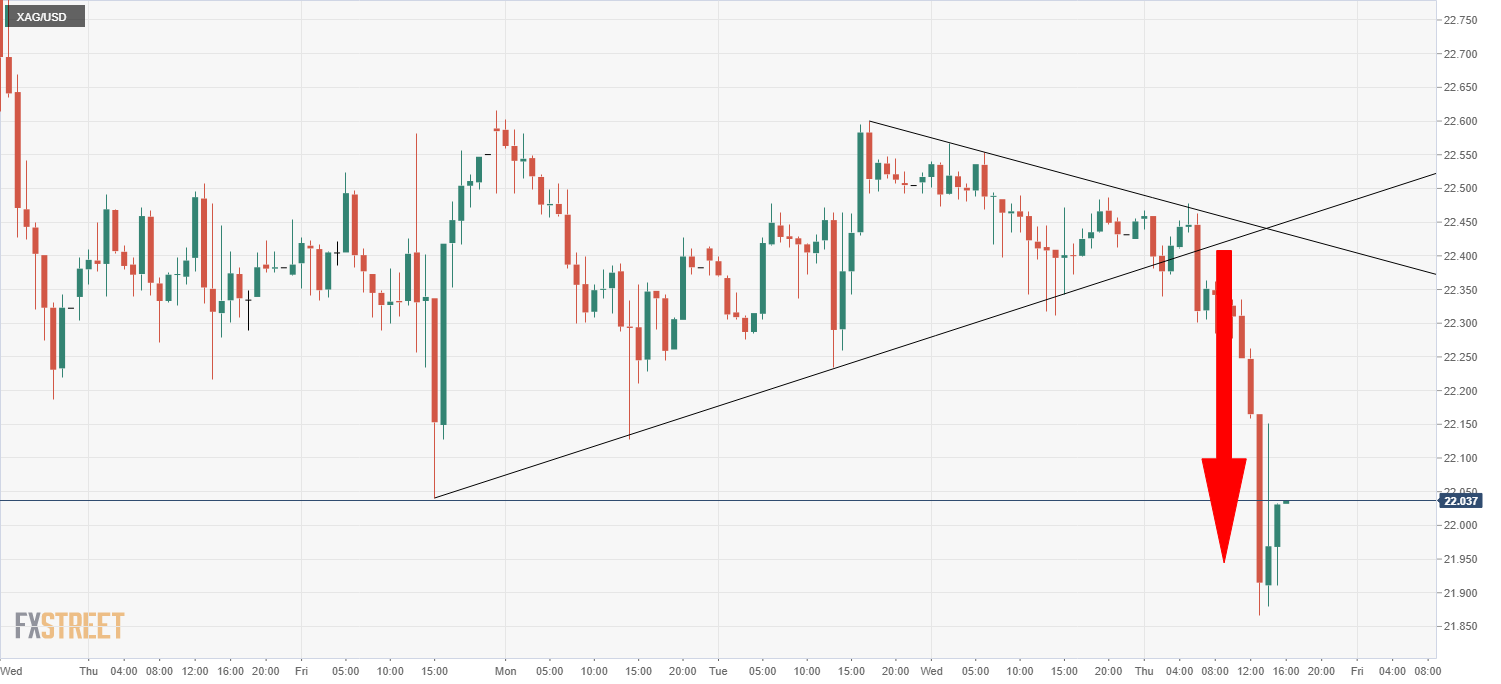
Unlike spot gold prices, FX and bond markets, which have been more rangebound this week ahead of Friday’s key US inflation numbers and ahead of next week’s central bank bonanza, silver prices have continued the recent bearish run. Silver has outperformed gold by a significant margin since mid-November when it topped out close to $25.50 at its 200-day moving average. Perhaps this rejection of the 200DMA have made things worse for the precious metal over the last few weeks.
-637746625064475382.png)
In light of another very strong US labour market report, which showed weekly initial jobless claims falling to their lowest since 1969, and comes after JOLTs data showed job openings moving above 11M again at the end of October and official BLS data showing the unemployment rate dropping to 4.2% in November, downside makes sense.
The Fed is becoming increasingly attuned to just how tight the labour market is, and is very aware that inflation is currently running at more than three times its target. On that note, if the YoY rate of Consumer Price Inflation (expected to rise to 6.8% in November) is revealed to have surpassed 7.0% in November, that would add further selling pressure to precious metals like silver on expectations for a more hawkish Fed. The bears will be targetting a test of late-September lows around $21.50.
Gold might well be more supported this winter than previously forecast, but the ‘pain trade’ baseline still seems bearish bullion in 2022 and 2023, according to strategists at Citibank. They forecast XAU/USD around $1,685 in 2022.
XAU/USD to sink towards $1,500 in 2023
“We forecast average gold prices around ~$1,685/oz in 2022, declining to $1,500/oz in 2023, versus 2020/2021 annual mean prices near ~$1,800/oz.”
“We hold a 60% conviction for our bearish base case gold price outlook and concedes that prices could spike again to $1,825-1,850 this winter. But on balance, macro and micro factors tilt negative for the yellow metal next year.”
“We assign a 30% bull case scenario that gold prices post fresh nominal highs north of $2,100 by the middle of 2022. The team is sympathetic to the gold bulls’ (monetary) inflation narrative, concerns about persistent government and private debt loads, and bloated fiscal balance sheets. But ultimately, this should lift the long-term price floor for XAU/USD as opposed to buttressing an ongoing bull cycle rally, particularly if real yields are to rise and Fed tightening continues.”
See – Gold Price Forecast: XAU/USD to sink towards $1,600 by end-2022 – ANZ
- The Loonie losses during the New York session amid risk-off market mood as countries impose COVID-19 restrictions.
- Crude oil prices are down, as COVID-19 restriction measures could impact demand for black gold.
- USD/CAD Price Forecast: The pair is mild-bearish, facing strong resistance around 1.2700.
At the time of writing, the USD/CAD advances up some 0.42% on Thursday, trading at 1.2703 during the New York session. On Thursday, imposing restrictions in the UK and the increased transmissibility of the omicron variant worsened market mood amid the optimism of the vaccine’s effectiveness. That, along with good US employment figures, and the safe-haven status of the buck, weighed on the Loonie..
US Initial Jobless Claims drops the most since 1969
On Thursday, the Bureau of Labor Statistics (BLS) reported that the Initial Jobless Claims for the week ending on December 3 rose to 184K, lower than the 215K, declining the most since 1969, beating economists’ estimations.
During the overnight session, the USD/CAD seesawed around Wednesday’s high at 1.2666. However, as market sentiment has worsened, due partly to the omicron news, the pair edged higher, near the 1.2700 figure, retreating to current levels. Furthermore, the US Dollar Index, which tracks the greenback’s performance against a basket of six rivals, is recovering from Wednesday’s losses, up 0.31%, sitting at 96.19, a tailwind for the USD/CAD.
In the meantime, US crude oil benchmark WTI is down almost 0.77%, trading at $71.80, exerting additional pressure on the oil-linked Canadian dollar.
That said, USD/CAD trader’s focus would turn to Friday’s US inflation figures, as Fed policymakers have expressed the need for a faster bond taper, so the US central bank has room to maneuver.
USD/CAD Price Forecast: Technical outlook
The USD/CAD 4-hour chart depicts the bias as mild-bearish, as the spot price is below the 50 and 100-simple moving averages (SMA’s). Furthermore, it is trading near the confluence of the 100-SMA and the 38.2% Fibonacci retracement, around 1.2700, which would be a difficult resistance to overcome. Nevertheless, in the outcome of breaking upward, the next resistance would be the confluence of the 50% Fibonacci retracement and the trendline break, around 1.2720-30 area.
On the downside, the first support would be the December 8 high at 1.2666, followed by the central daily pivot at 1.2640, and then the December 8 low at 1.2605.
After trading at a one-week high on Wednesday of 1.1355, the EUR/USD has just slipped below the 1.13 level as yield differentials edge wider. Economists at Scotiabank think the world's most popular currency pair is set to decline towards the 1.10 level.
Upside scope remains limited
“Today, the spread of US over European debt yields has moved again in favour of the USD. Yesterday’s narrowing may have reflected the reaction to news on the vaccines/virus front, but we would generally advise to look past EUR upside on moves in rates ahead of tomorrow’s US CPI release and especially prior to next week’s Fed decision.”
“In a quarter where the Fed may begin hiking rates, that the ECB is still working through net purchases of government bonds is a solid trigger for continued EUR losses.”
“In the near-term, we see EUR downside to 1.10 on the policy outlook and the possibility of further virus limits with cases surging even before the full arrival of the Omicron strain.”
- USD/JPY slipped under its 50DMA but well within this week’s ranges.
- The pair is trading in a relatively cautious manner on Thursday ahead of US inflation data.
USD/JPY slipped back below its 50-day moving average, which resides just above 113.50, on Thursday, with FX markets trading in tentative, rangebound fashion ahead of Friday’s key US November inflation report and next week's central bank bonanza. The pair currently trades lower by about 0.2% on the day, with the yen sitting at the top of the G10 performance table amid a slightly more risk-averse tone to broader trade. Stocks in Europe and the US are mostly a little lower, as is oil. But at current levels just under 113.50, the pair is trading roughly at the mid-point of this week’s 113.00-114.00 range.
USD/JPY continues to trade largely as a function of movements in US bond markets, particularly in the 10-year yield. 10-year yields started the week under 1.40% but rallied to hit 1.54% on Wednesday, before pulling back to around 1.50%. That broadly mirrors USD/JPY’s rally from 113.00 to 114.00 at the start of the week than more recent retracement back to the mid-113.00s.
Technical factors have also been in play for USD/JPY, however, with the 21-day moving average on Wednesday providing solid resistance just under 114.00 and in the end capping this week’s price action. Much stronger than expected US initial weekly jobless claims numbers on Thursday, which dropped to their lowest since 1969 at 184K, failed to stir the price action on Thursday with focus on Friday’s inflation data. US Consumer Price Inflation is seen rising to 6.8% and some are calling for an above 7.0% reading.
The Fed
The Fed has grown increasingly uncomfortable with inflation at such elevated levels, hence why Fed Chair Jerome Powell said the description “transitory” would be dropped and said it would be appropriate to discuss speeding the QE taper at next week’s meeting. Markets now fully expect the bank to announce plans to accelerate the pace of its QE taper next week, while the tone on inflation and the potential path for rates will be closely eyed, as will the bank’s updated economic projections and dot-plot. As inflation persists at elevated levels, and with FOMC members for now seeing Covid-19 variant risks as more inflationary than anything else, risks are clearly tilted towards the bank opting to start hiking rates sooner rather than later.
USD/JPY is more sensitive to longer-term US yields, which is more sensitive to long-term growth and inflation expectations, rather than the short-end, which is more sensitive to short-term interest rate expectations. If high inflation on Friday triggers hawkish Fed vibes and then the Fed backs this up next week, the US treasury curve is at risk of further flattening (short-end yields up, long-end yields down) like was seen last week – a potential reflection of investor concern that a more prompt Fed tightening to tackle near-term inflation will damage the already shakey (as a result of Omicron) long-term economic outlook. This could weigh on USD/JPY and send it back to recent 112.50 lows.
GBP/USD retains a soft tone amid Omicron covid concerns. The cable aims for the 1.30 level amid limited support markers, economists at Scotiabank report.
Bank of England’s rate hike expectations pushed back
“Uncertainty remains around the severity and speed of contagion of omicron in the UK and thus the BoE will likely hold fire next week. In combination with a hawkish Fed, we see the GBP possibly heading back toward the low 1.30s before gains resume in Q1 as the BoE tightens.”
“The PM’s waning popularity within the Tory ranks (as he announced the virus measures earlier possibly to distract from a staff Christmas party in 2020) risks political anxiety in the UK that will likely weigh on the GBP in the weeks ahead with a slight chance that he faces a confidence vote.”
“The 38.2% Fibonacci retracement of its 2020-21 climb at 1.3165 stands as support followed by a psychological trigger at 1.31.”
“Intraday resistance is 1.3200/15 and then 1.3240/60.”
The S&P 500 Index has essentially held above the 63-day average at 4532 and after a wobbly couple of sessions, the market has surged back higher. Economists at Credit Suisse look for a resumption of the core bull trend and a move to new 2021 highs.
Near-term support moves to 4632/4588
“We look for a break above 4703 to reinforce this further for strength back to the current high and our Q4 objective at 4744/50. Whilst this should again be respected, we look for a break in due course, with resistance then seen next at 4800 and with trend resistance from April now at 4822.”
“Near-term support moves to 4632/4588 initially, which now ideally holds. Only a weekly close below 4529 though would raise the prospect of a lengthier and more damaging correction and ‘risk off’ phase, with support seen next at 4448/38 and then more importantly at the 200-day average at 4313.”
Following a rapid, post-lockdown recovery in 2021, uncertainty has come back to cloud the outlook. Economists at ABN Amro summarise their key judgment calls and assumptions for macro and financial market developments in 2022.
COVID-19
“The pandemic will remain a headwind in the first half of the year, but will not cause further outright contractions in the eurozone or US economies. This assumes that the Omicron variant does not cause more severe disease than prior variants and that vaccination and prior infection still affords some immune protection.”
Inflation
“Supply chain bottlenecks will gradually ease in the course of the year, with pandemic-related disturbances likely to be less significant in 2022 than in 2021. Inflation will fall significantly, coming in below the ECB’s 2% target by year-end in the eurozone, but remaining somewhat above target in the US.”
Interest rates and FX
“The Fed will start raising rates from June, with a total of three 25bp hikes during the course of the year. The ECB will maintain an accommodative policy stance, with purchases under the APP continuing and policy rates remaining on hold. This will create a significant policy divergence with the Fed. Rising US yields will put some upward pressure on eurozone bond yields, and drive a weakening in the euro.”
Emerging Markets
“Tighter global financial conditions could put significant stress on some emerging market economies, but for EMs in aggregate, the impact of this will likely be significantly offset by strong external demand from advanced economies and a further catch-up recovery from the pandemic.”
Economists at Nomura maintains a bearish bias targeting a move towards 1.10 in EUR/USD. They believe the trigger level for a material de-risking is around 1.1434.
Europe faces a tougher winter ahead than the US
"We suspect that buying pressure may already be over as Europe faces a tougher winter ahead than the US and UK with higher levels of naturally acquired immunity. Positioning amongst CTAs is short EUR/USD, but we believe the trigger level for a material de-risking is around 1.1434."
"We doubt EUR/USD will get to 1.1434 as US inflation data this week could yield another positive surprise. We remain short in EUR/USD in spot, looking for a move towards 1.10."
The USD/CAD continues to drift higher but the upside is limited to low 1.27s, in the view of economists at Scotiabank.
Support is seen at 1.2670/60
“After solid gains earlier in the week, some retrenchment in the CAD is not too surprising but we still rather view USD upside potential against the CAD as limited.”
“Short-term price signals suggest the USD rebound from Wednesday’s low can extend modestly after cracking minor resistance (inverse Head & Shoulders trigger) at 1.2665; upside potential extends to the 1.2720 zone (near the 50% retracement of the early week USD drop at 1.2730) in the next day or so.”
“Support is 1.2660/70.”
- Gold witnessed some selling for the second successive day on Thursday amid a stronger USD.
- A weaker tone around the equity markets could limit deeper losses for the safe-haven metal.
- The market focus remains glued to the US consumer inflation figures, due for release on Friday.
Following a brief consolidation through the early part of the trading action, gold witnessed a fresh selling on Thursday and retreated further from a one-week high touched in the previous day. The intraday selling picked up pace during the early North American session and dragged the XAU/USD back closer to the weekly low, below the $1,775 level in the last hour. This marked the second successive day of a negative move and was sponsored by renewed US dollar buying interest, which tends to drive flows away from the dollar-denominated commodity.
The USD was back in demand and reversed a part of the overnight profit-taking slide amid hawkish Fed expectations. Investors seem convinced that the Fed would be forced to tighten its monetary policy sooner rather than later to contain stubbornly high inflation. This was seen as another factor that undermined demand for non-yielding gold. That said, the risk-off impulse – as depicted by a generally weaker tone around the equity markets – extended some support to traditional safe-haven assets and helped limit losses for the XAU/USD.
Mixed headlines on the Omicron variant of the coronavirus kept a lid on the recent optimism. BioNTech and Pfizer said on Wednesday that a three-shot course of their COVID-19 vaccine was able to neutralise the Omicron variant in a laboratory test. This, however, was overshadowed by the fact that the UK Prime Minister Boris Johnson on Wednesday imposed fresh COVID-19 restrictions in England to slow the spread of the new variant. This, along with escalating geopolitical tensions, tempered investors' appetite for perceived riskier assets.
Investors might also refrain from placing aggressive bets, rather prefer to wait for a fresh catalyst from Friday's release of the latest US consumer inflation figures. The US CPI report will be looked upon for fresh clues about the Fed's next policy move strategy on interest rate hikes. This, in turn, will influence the USD price dynamics and gold prices heading into next week's FOMC monetary policy meeting. Hence, it will be prudent to wait for a strong follow-through selling before positioning for any further depreciating move.
Technical outlook
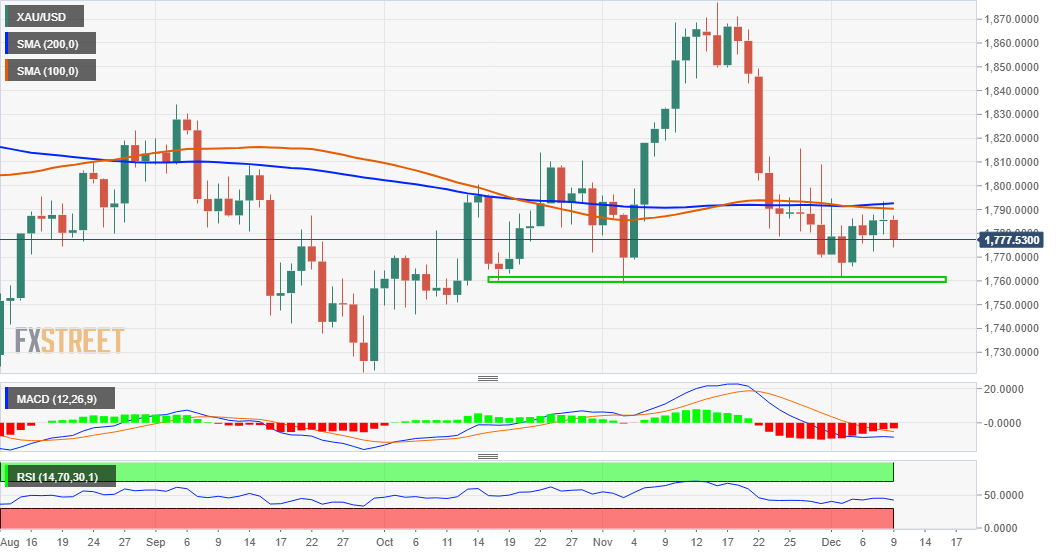
From a technical perspective, the overnight rejection near a technically significant 200-day SMA and the subsequent downfall favours bearish traders. Gold seems poised to prolong its recent corrective slide from a multi-month high and retest the monthly swing low, around the $1,762 area touched last week.
On the flip side, a sustained strength beyond the 200-DMA, which coincides with 100-day SMA, is needed to support prospects for any meaningful upside. Spot prices could then surpass the $1,800 mark and test the next relevant resistance near the $1,810-15 supply zone. The momentum could further get extended towards the $1,832-34 strong horizontal barrier, which should act as a key pivotal point for short-term traders.
Gold daily chart
Key levels to watch
- Spot gold broke below a near-term uptrend on Thursday and subsequent technical selling saw it dip under the $1780 level.
- But gold remains within this week's ranges amid caution ahead of key risk events, including US inflation and the Fed.
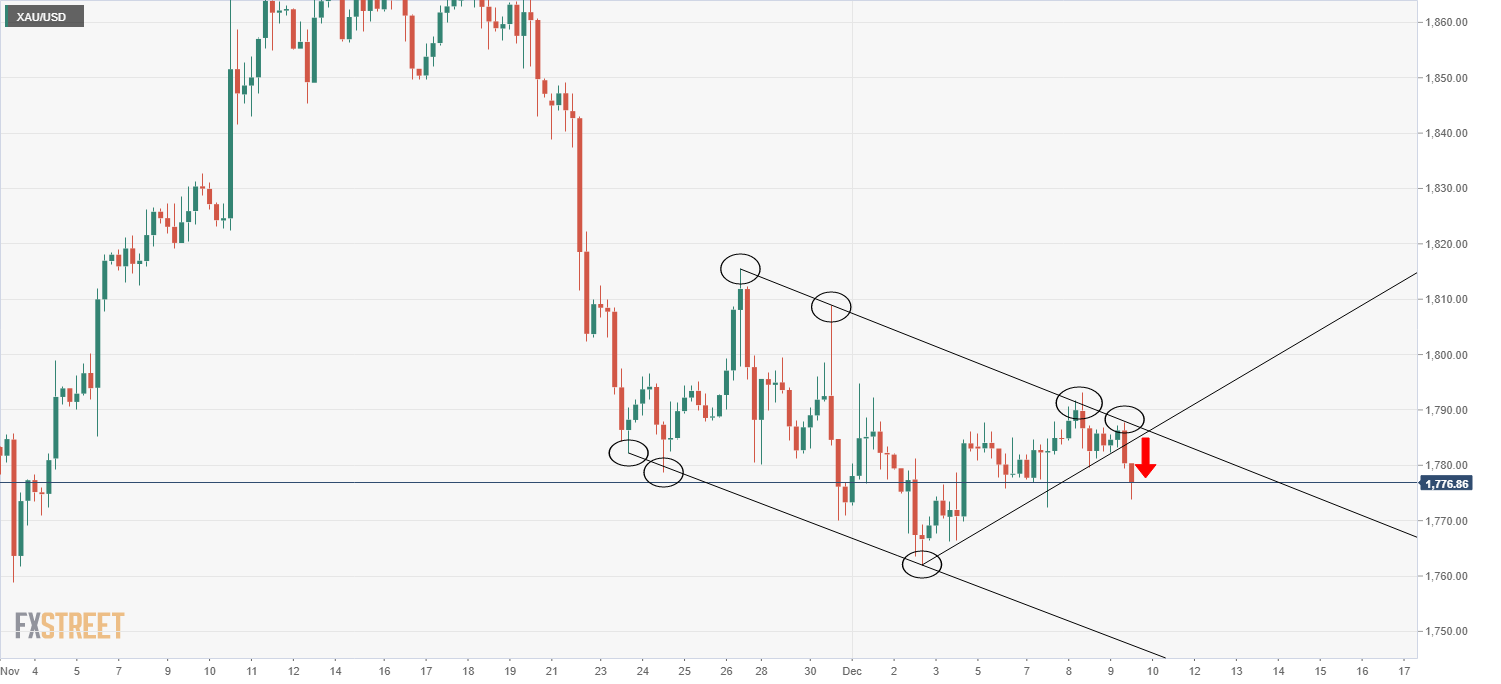
Spot gold (XAU/USD) prices have been under pressure in recent trade, with the precious metal dipping from the mid-$1780s to current levels below the $1780 mark over the past few hours. Spot prices are now down about 0.3% on the day, with the selling mainly driven by technical factors and perhaps some dollar strength as opposed to anything happening in US bond markets.
Spot gold recently broke below a short-term uptrend that had been in play since this time last week, and the associated technical selling was enough to push prices under $1780, though not enough to test earlier weekly lows around $1772. The dollar has also seen a modest pick up on Thursday, with the DXY able to recover back above 96.00, though recent upside momentum has stalled in recent trade despite the strong initial weekly jobless claims number since 1969. A stronger US dollar makes dollar-denominated spot gold more expensive for purchase by the holders of foreign currencies, thus reducing its demand.
Key risk events loom
Both the US dollar and spot gold prices have remained within this week’s ranges on Thursday, which is not overly surprising given the important events coming up that will shape the macro narrative. First up, US Consumer Price Inflation data is set to be reported on Friday, with the headline YoY rate of inflation seen rising to 6.8%. The Fed has grown increasingly uncomfortable with inflation at such elevated levels, hence why Fed Chair Jerome Powell said the description “transitory” would be dropped and said it would be appropriate to discuss speeding the QE taper at next week’s meeting.
Speaking of, that will be the next key event on the macro horizon (for gold, the dollar and US yields, anyway). Markets now fully expect the bank to announce plans to accelerate the pace of its QE taper next week, while the tone on inflation and the potential path for rates will be closely eyed, as will the bank’s updated economic projections and dot-plot.
As inflation persists at elevated levels, and with FOMC members for now seeing Covid-19 variant risks as more inflationary than anything else, risks are clearly tilted towards the bank opting to start hiking rates sooner rather than later. The gold bears will be hoping for a hawkish surprise in the coming days, which would likely see the precious metal test recent lows in the $1760 area.
- Initial Jobless Claims fell to 184K last week according to the DoL
- That marked the lowest such reading since 1969.
There were 184,000 initial claims for unemployment benefits in the US during the week ending December 4, data published by the US Department of Labor (DoL) revealed on Thursday. That marked a new post-pandemic low. and, indeed, was the lowest such reading since 1969. This reading followed last week's print of 227K (revised from 222K) and came in well below market expectations for 215K.
Continued jobless claims rose to 1.992M in the week ending November 27, the data showed, above expectations for a drop to 1.90M from 1.954M the week prior. As a result, the insured unemployment rate rose to 1.5% in the week ending November 27 from 1.4% the week prior.
Market Reaction
The Dollar Index (DXY) saw some positive ticks in wake of the stronger than expected data, rising from 96.06 to above 96.10. The data further strengthens the narrative that the US labour market is very strong/tight at the moment, in wake of last Friday's mostly strong jobs report and Wednesday's much higher than expected job openings number.
The electronic and solar sectors are set to support silver throughout the next year. Economists at ANZ Bank expect XAG/USD to find a floor around $20.80 and outperform gold in 2022.
Silver to outperform gold in 2022
“Silver is likely to largely follow gold, but the market balance looks supportive through 2022.”
“We expect fabrication demand to increase by 3% YoY to 572moz, supported by electronic and solar sectors.”
“Automotive industry demand for silver is rising and is estimated to increase from 61moz to 88moz by 2025, according to Metal Focus.”
“We expect silver to outperform gold in 2022, with prices finding a floor near $20.8/oz.”
See – Gold Price Forecast: XAU/USD to sink towards $1,600 by end-2022 – ANZ
- GBP/USD witnessed some selling on Thursday and was pressured by a combination of factors.
- Reduced BoE rate hike bets, Brexit woes continued acting as a headwind for the British pound.
- A softer risk tone benefited the safe-haven greenback and also contributed to the selling bias.
The GBP/USD pair remained on the defensive heading into the North American session, albeit has managed to recover a few pips from the daily swing low. The pair was last seen trading just below the 1.3200 mark, still down over 0.20% for the day.
The pair struggled to capitalize on the overnight bounce from the 1.3160 area, or the lowest level since November 2020 and witnessed fresh selling on Thursday. The imposition of strict COVID-19 restrictions in the UK forced investors to scale back their bets for an imminent interest rate hike by the Bank of England. This, along with persistent Brexit-related uncertainties, continued acting as a headwind for the British pound.
On the other hand, the US dollar attracted fresh buying and reversed a part of the overnight profit-taking slide amid a generally weaker tone around the equity markets. Apart from this, hawkish Fed expectations further underpinned the greenback and exerted some downward pressure on the GBP/USD pair. The downside, however, remains cushioned as investors preferred to wait on the sidelines ahead of Friday's release of the US consumer inflation figures.
The markets have been pricing in the possibility for an eventual Fed liftoff in May 2022 amid worries about rising inflationary pressures. Hence, the US CPI report would influence the Fed's decision to taper its stimulus at a faster pace and set the stage for a rate hike. This, in turn, will drive the USD demand and provide a fresh impetus to the GBP/USD pair.
In the meantime, traders might take cues from Thursday's release of the US Weekly Initial Jobless Claims data. Apart from this, developments surrounding the coronavirus saga and the broader market risk sentiment would allow traders to grab some short-term opportunities around the GBP/USD pair.
Technical levels to watch
- EUR/USD has been ebbing lower on Thursday, though still trades to the north of 1.1300.
- The pair rejected a test of a key long-term downtrend, with markets in wait-and-see mode ahead of key upcoming events.
After its impressive run higher on Wednesday, which was at the time triggered by short-term technical buying as after cross broke above a short-term downtrend, EUR/USD faltered at 1.1350 and has, ever since, been ebbing lower. The pair on Thursday is still trading to the north of the 1.1300 level for now, but has in recent trade dipped under its 21-day moving average again (which resides at 1.1317).
It appears that, ahead of key US inflation data later in the week and next week’s Fed and ECB monetary policy meetings, traders lacked the conviction to send EUR/USD back to the north of a key long-term downtrend. For reference, in mid-November, EUR/USD broke below a downwards trendline that had been supporting the price action all the way back to June. Since then, it has failed twice to break back above this downtrend.
A break above this downtrend would likely signal a shift in EUR/USD’s near-term momentum and a push towards the 1.1400s area to 1.1500 level, but traders and analysts seemingly remain unconvinced that the fundamental backdrop warrants such a move. At the very least, the rejection of the key downtrend suggests that markets want to wait and see what happens with the upcoming key Fed and ECB events.
-637746519563699048.png)
The Fed is unanimously expected to announce an accelerated pace of QE taper as of January, as Chair Jerome Powell hinted last week. If US inflation data this Friday comes out above 7.0%, this will up pressure on the bank to be hawkish, and there are already some outside calls that the bank may start hiking as soon as March, though this is not what markets are currently pricing.
In terms of the ECB next week, it's all about what the bank will do with its pre-pandemic APP to make up for the sudden drop off in monthly QE purchases when the PEPP ends in March. Various ECB sources this morning told the financial press that the bank is converging on a view to increasing APP purchases from March, though in a limited and ideally flexible manner. Meanwhile, separate sources said the ECB might tweak its PEPP reinvestment guidance – reinvestments currently run to the end of 2023. These comments didn’t have any impact on EUR/USD.
Ahead, aside from the release of US weekly jobless claims figures at 1330GMT, it's set to be a quiet day calendarwise. That means Omicron-related headlines will likely continue to dictate the action, from a macro-perspective, at least.
The pound’s relative underperformance this week was partly driven by the announcement of new covid restrictions in the UK. These measures have pushed back Bank of England’s (BoE) rate hike expectations. Subsequently, economists at MUFG Bank expect the GBP/USD pair to edge lower towards the 1.30 level.
BoE rate hike expectations delayed to early 2022
“The UK government will move to the next stage of tighter COVID-19 restrictions in response to the spread of the Omicron variant. The dampening near-term impact on the growth outlook has further encouraged market participants to scale back BoE rate hike expectations. When combined with recent more cautious comments from BoE officials, we now expect the BoE to delay raising rates until at least February. In contrast, we still expect the Fed to speed up the pace of their QE programme this month.”
“The time gap between the first BoE and Fed rate hikes is likely to be much shorter now than initially expected which should keep downward pressure on cable heading into year-end and moving it closer to the 1.3000-level.”
- Silver dropped closer to a one-week-old trading range support on Thursday.
- The recent range-bound price action points to a bearish consolidation phase.
- RSI on the daily chart warrants some caution for aggressive bearish traders.
Silver edged lower for the second successive day on Thursday and dropped back closer to the lower end of its weekly trading range, around the $22.25-20 region during the mid-European session.
From a technical perspective, the recent range-bound price action witnessed over the past one week or so constitutes the formation of a rectangle. Given the recent sharp pullback from over three-month high touched in November, the rectangle could now be categorized as a bearish consolidation phase before the next leg down.
The negative outlook is reinforced by the fact that technical indicators on the daily chart are holding deep in the bearish territory. That said, RSI (14) on the mentioned chart is hovering near the oversold zone. This, in turn, warrants some caution for bearish traders ahead of the key US consumer inflation figures on Friday.
The technical set-up suggests that the XAG/USD is more likely to prolong its consolidative price move, though the bias remains tiled firmly in favour of bearish traders. Hence, any attempted recovery move might still be seen as a selling opportunity and runs the risk of fizzling out rather quickly near the $22.60 supply zone.
A sustained strength beyond could prompt some near-term short-covering move and push the XAG/USD back towards the $23.00 mark. Some follow-through buying beyond the $23.15-20 region will negate the negative bias and pave the way for a further move up towards the $23.55-60 intermediate resistance en-route the $24.00 mark.
On the flip side, a convincing break below the trading range support, around the $22.20 region, will be seen as a fresh trigger for bearish traders. The XAG/USD might then turn vulnerable to break through the $22.00 mark and accelerate the fall towards challenge the YTD low, around the $21.40 region touched in September.
Silver 4-hour chart
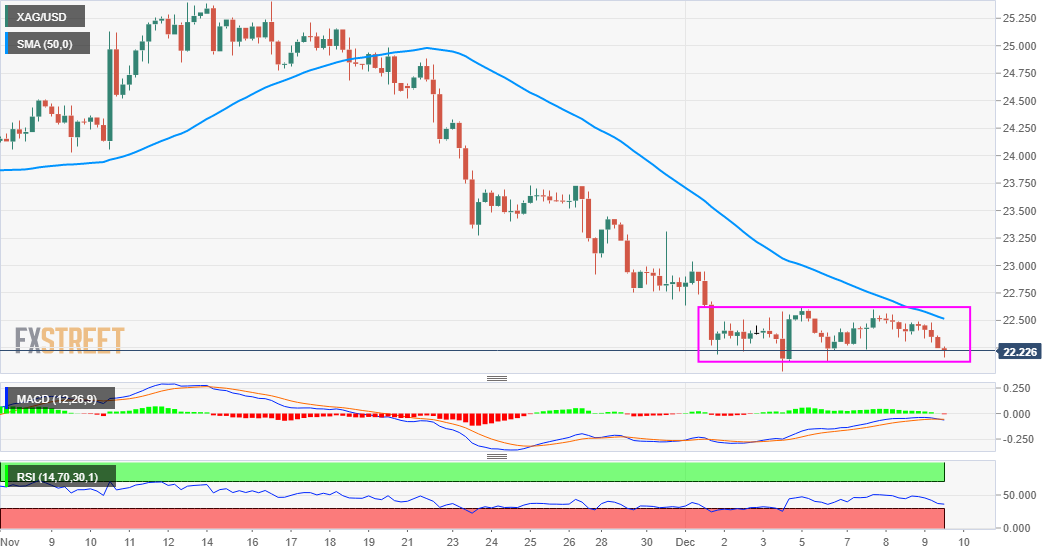
Technical levels to watch
According to sources cited by Bloomberg, the ECB is considering tweaks to its PEPP reinvestment plans. The sources said that the bank might add geographical flexibility to the reinvestments, or might extent the reinvestment time under the emergency programme. A final decision on changes to the PEPP reinvestment plans has not yet been reached, the sources added.
At present, the ECB plans to reinvest all of the proceeds from the bonds it bought under the Pandemic Emergency Purchase Programme (coupons and principal payments) until the end of 2023. By extending this for longer, the bank would delay quantitative tightening - this is when the bank allows the bonds in its portfolio to expire, reducing the size of its balance sheet over time. The aim of this is to provide greater levels of monetary support for longer.
Meanwhile, the potential to add geographical flexibility to the purchases suggests that the ECB is keenly interested in preventing significant divergence between the bond yields of Eurozone nations, likely with an eye to preventing a repeat of the crises in the early 2010s.
The ECB meets next Thursday and the main topic of discussion/point of contention is what the bank will do with its Asset Purchase Programme (APP) once the PEPP expires at the end of March. Separate ECB sources suggested earlier in the session on Thursday that there has been a convergence of views on some sort of limited, temporary bump to purchases conducted under the APP.
Market Reaction
The euro has barely reacted to the latest ECB sources and EUR/USD continues to gradually ebb lower, though for now remains above 1.1300.
- AUD/USD witnessed a turnaround from a near two-week high touched earlier this Thursday.
- A softer risk tone drove flows away from the perceived riskier aussie amid renewed USD buying.
- Hawkish Fed expectations further acted as a tailwind for the USD ahead of Friday’s US CPI.
The AUD/USD pair extended its steady intraday descent through the mid-European session and dropped to a fresh daily low, around the 0.7140-35 region in the last hour.
The pair stalled this week's strong recovery move from sub-0.7000 levels and witnessed a turnaround from the 0.7185 region, or a near two-week high touched earlier this Thursday. As investors looked past stronger Chinese inflation figures, the emergence of fresh US dollar buying turned out to be a key factor that exerted pressure on the AUD/USD pair.
Data released on Thursday showed that China's headline CPI rose 0.4% MoM in November and the yearly rate accelerated to 2.3%, marking the fastest pace since August 2020. Moreover, the Producer Price Index surpassed expectations and came in at a 12.9% YoY rate, though a combination of factors held back traders from placing fresh bullish bets around the AUD/USD pair.
Mixed headlines on the Omicron variant of the coronavirus kept a lid on the recent optimism, which was evident from a softer tone around the equity markets. This, in turn, drove some haven flows towards the greenback and acted as a headwind for the perceived riskier aussie. The buck was further supported by firming expectations for a faster policy tightening by the Fed.
In the latest developments, BioNTech and Pfizer said on Wednesday that a three-shot course of their COVID-19 vaccine was able to neutralise the Omicron variant in a laboratory test. This, however, was overshadowed by the fact that the UK Prime Minister Boris Johnson on Wednesday imposed fresh COVID-19 restrictions in England to slow the spread of the new variant.
Nevertheless, the AUD/USD pair, for now, seems to have snapped three consecutive days of the winning streak as traders start repositioning for Friday's release of the US consumer inflation figures. The markets have been pricing in the possibility of an eventual Fed liftoff in May 2022 amid worries about the persistent rise in inflationary pressure. Hence, the latest US CPI report will influence the USD price dynamics and provide a fresh impetus to the AUD/USD pair.
In the meantime, traders on Thursday will take cues from the only release of the US Weekly Initial Jobless Claims, due later during the early North American session. Apart from this, the broader market risk sentiment will drive the USD and allow traders to grab some short-term trading opportunities around the AUD/USD pair.
Technical levels to watch
- USD/CAD gained positive traction on Thursday and built on the overnight bounce a multi-week low.
- Retreating oil prices undermined the loonie and provided a modest lift amid a modest USD strength.
- Hawkish Fed expectations, rising US bond yields, cautious market mood all benefitted the greenback.
The USD/CAD pair continued scaling higher through the first half of the European session and climbed to a two-day high, around the 1.2685 region in the last hour.
A combination of factors assisted the USD/CAD pair to build on the previous day's post-BoC recovery move from the 1.2600 neighbourhood and gain some positive traction on Thursday. The Bank of Canada held interest rate at 0.25% and stuck to its guidance that a first hike could come in the middle quarters of 2022. The BoC, however, warned that the Omicron coronavirus variant has created renewed uncertainty, which seemed to be the only factor that weighed on the Canadian dollar.
Meanwhile, crude oil prices struggled to find acceptance above the $73.00/barrel mark and witnessed a modest pullback from a two-week high touched earlier this Thursday. This further undermined the commodity-linked loonie and provided a goodish lift to the USD/CAD pair amid a modest pickup in the US dollar demand. A further rise in the US Treasury bond yields, bolstered by hawkish Fed expectations, along with the cautious market mood extended some support to the safe-haven greenback.
Investors seem convinced that the Fed would tighten its monetary policy sooner rather than later to contain stubbornly high inflation and have been pricing in the possibility for liftoff in May 2022. This was seen as a key factor that pushed the yield on the benchmark 10-year US government bond back above the 1.50% threshold. Adding to this, escalating geopolitical tensions overshadowed the recent optimism in the markets and acted as a tailwind for safe-haven currencies, including the USD.
Market participants now look forward to the US economic docket, featuring the release of the usual Weekly Initial Jobless Claims. Traders will further take cues from the US bond yields and the broader market risk sentiment, which will drive the USD demand. Apart from this, oil price dynamics should provide some impetus to the USD/CAD pair. The key focus, however, will remain on Friday's release of the US consumer inflation figures, which will help determine the next leg of a directional move.
Technical levels to watch
As ultra-loose monetary policy nears an end and stimulus starts to shrink, supports for the precious metals sector are likely to wane in 2022, in the view of strategists at ANZ Bank. They expect gold to move downward to $1,600 by end-2022.
Reduction in asset purchases and the possibility of rate hikes to be significant headwinds for XAU/USD
“Comparing the current business cycle to previous ones, inflation numbers are way higher and look sticky. This should keep real interest rates deep in negative territory in 2022. The prospect of sustained higher inflation could lift hedging investments in gold in the short-term, and that could increase the prospects for an earlier hike and faster tapering.”
“We believe that, despite reversing US break-even inflation, negative real interest rates could keep the gold price near $1,800/oz in H1 2022. More downward pressure is likely to build after the Fed starts hiking interest rates in mid-2022. We target gold prices to end the year at $1,600/oz.”
See – Gold Price Forecast: XAU/USD to rally towards January high of $1,951 on a break above $1,835 – Standard Chartered
FX option expiries for December 9 NY cut at 10:00 Eastern Time, via DTCC, can be found below.
- EUR/USD: EUR amounts
- 1.1300 451m
- 1.1380 568m
- 1.1400 360m
- 1.1425 534m
- GBP/USD: GBP amounts
- 1.3200 370m
- 1.3300 261m
- USD/JPY: USD amounts
- 112.00 1.3b
- 112.90 751m
- 113.00-10 893m
- 113.15 1.5b
- 113.50 868m
- 113.70 1b
- 114.10 2.2b
- AUD/USD: AUD amounts
- 0.7250 485m
- NZD/USD: NZD amounts
- 0.6810 322m
- EUR/GBP: EUR amounts
- 0.8425 500m
- 0.8475-80 539m
- 0.8555-60 625m
Economists at Credit Suisse think upward pressure on USD/TRY is likely to persist, but expect realised volatility to moderate, as the central bank has resorted to FX intervention.
The central bank has resorted to intervention in the FX market more frequently in recent days
“Our core view remains that USD/TRY will stay subject to upside pressure as real rates have fallen substantially in recent weeks while the inflation outlook has worsened.”
“For now, central bank intervention in the FX market is likely to persist. The two FX intervention episodes last week suggest that the central bank aims to create a notable price impact by selling large amounts of dollars in concentrated time periods. Last week’s two intervention episodes also suggest that the immediate aim is to prevent a move in USD/TRY to levels above 14.00.”
“We would expect that if USD/TRY rises to levels above 14.00, the central bank will mount relatively heavy FX market intervention, especially on possible spikes towards 14.50.”
- GBP/USD eyes deeper losses as Omicron restrictions derail BOE rate hike bets.
- The US dollar jumps on mixed market mood, critical daily support line remains at risk.
- 21-DMA is the level to beat for GBP bulls if the rebound from yearly lows kick in.
GBP/USD is trading mildly offered around 1.3200, unable to find its feet amid persistent concerns over the rising Omicron cases in the UK and resurgent US dollar demand.
The Plan B guidance announced by the UK PM Boris Johnson on Wednesday has pushed back the Bank of England (BOE) rate hike calls to February 2022, undermining the sentiment around the local currency.
Meanwhile, uncertainty over the new covid variant and its implications on the global economic growth keeps the investors on the edge, lifting the US dollar’s safe-haven appeal, which in turn weighs on cable.
Looking at GBP/USD’s daily chart, the price remains directed towards the critical falling support line at 1.3111.
On selling resurgence, the latter could give way, opening floors for a sharp sell-off towards 1.3000 the figure.
The 14-day Relative Strength Index (RSI) is sitting just above the oversold territory, allowing room for the additional decline.
GBP/USD: Daily chart
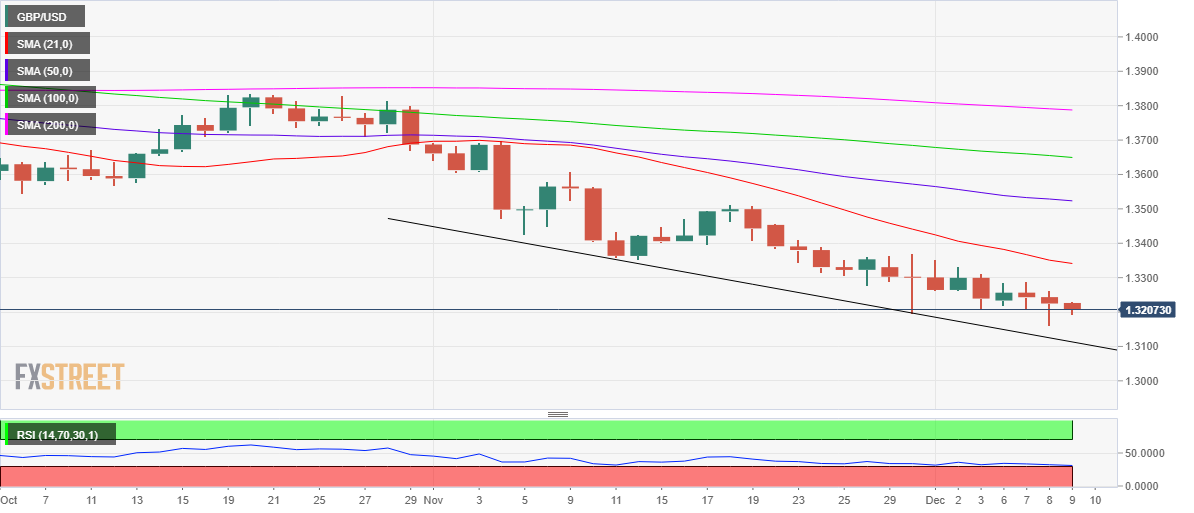
Alternatively, if the bulls manage to defend the yearly lows of 1.3167, then a rebound towards the bearish 21-Daily Moving Average (DMA) at 1.3341 cannot be ruled.
Ahead of that, the buyers will test the bearish commitments at 1.3300.
GBP/USD: Additional levels to consider
AUD/USD has rebounded after revisiting November 2020 levels of 0.6990. However, the bounce is set to run out of steam ahead of the 0.7250 level. Economists at Société Générale warn that a break below 0.6990 would imply a deeper down move.
Upside limited
“A large upside is not envisaged; daily Kijun line at 0.7250 should contain.”
“In case 0.6990 breaks, there would be a risk of deeper downtrend.”
Analysts at ABN Amro expect more weakness in EUR/USD due to the policy divergence between the Federal Reserve (FED) and the European Central Bank (ECB). They forecast the world's most popular currency pair as low as 1.05 by end-2022.
Significant policy divergence between the Fed and the ECB over the coming years
“We now expect that the Fed will begin hiking interest rates in mid-2022, with the goal of returning the Fed funds rate to the pre-pandemic target range of 1.50-1.75 by the end of 2023.”
“We believe that the ECB is facing a different set of macroeconomic circumstances than faced by the US central bank. The ECB has also explicitly ruled out a rate hike in 2022 and has hinted that it could well be ‘on hold’ for much longer.”
“Our forecast for EUR/USD at year-end 2021 is 1.10 and 1.05 for year-end 2022.”
- EUR/USD reverses the previous rebound to test 21-DMA, now support.
- Cautious mood lifts the demand for the safe-haven US dollar.
- Downside appears more compelling after ECB said to boost APP next week.
EUR/USD is easing towards 1.1300, having failed to find acceptance above the 1.1350 psychological level.
The latest downswing in the spot comes on the back of the rebound in the US dollar across the board. The cautious market mood has revived the dollar’s safe-haven demand, investors reassess the risks of the new Omicron covid variant on the global economic growth.
The latest Reuters reports, citing that the European Central Bank (ECB) is planning a temporary and limited boost to its regular Asset Purchase Programme (APP) at its December meeting, added to pain in the euro.
The divergent monetary policy outlooks between the Fed and the ECB are likely to keep the downside open for the major towards its yearly lows of 1.1185. The Fed is on track to accelerate its tapering when it meets next week amid elevated inflation.
In absence of any relevant top-tier US economic data, the ECB reports and the US Jobless Claims will influence the pair’s price action. The sentiment on Wall Street amid covid updates will also play a pivotal role.
EUR/USD: Technical outlook
The spot is back to test its 21-Daily Moving Average (DMA) at 1.1311 on the downside.
The 14-day Relative Strength Index (RSI) has turned lower below the 50.00 level, justifying the latest move lower in the main currency pair.
A sustained break below the 21-DMA will expose the rising trendline support on the daily sticks at 1.1232.
Daily closing below the latter is needed for a retest of 1.1200. The next stop for EUR bears is seen at the yearly lows of 1.1185.
EUR/USD: Daily chart
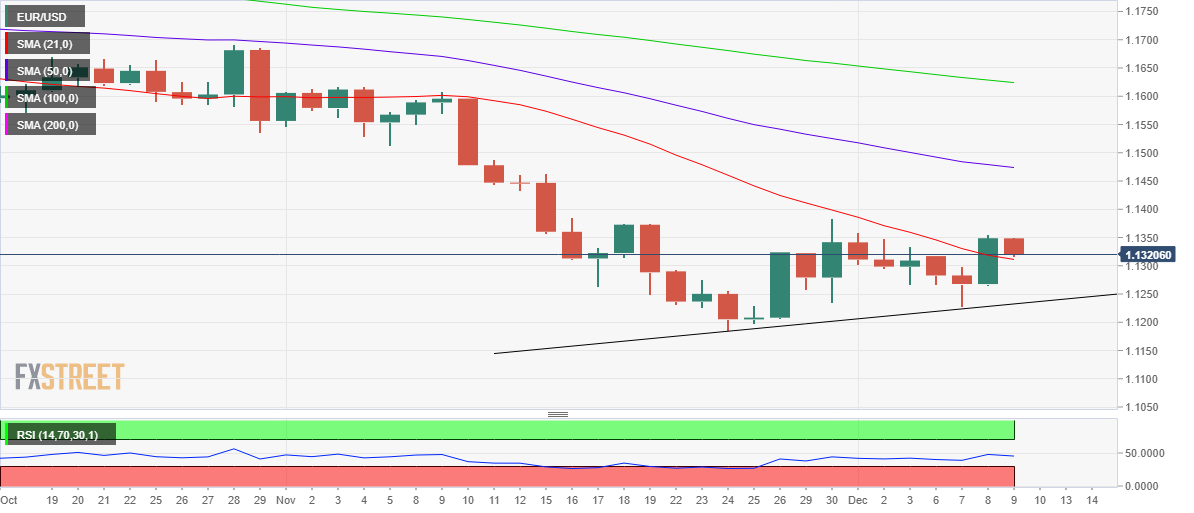
On the flip side, the 1.1350 psychological level acts as an initial hurdle on the road to recovery.
Buying resurgence could then see the 1.1400 round figure back into play.
EUR/USD: Additional levels to consider
EUR/GBP has staged an impressive bounce from the lower limit of a multi-month channel near 0.8380. Economists at Société Générale believe that the pair could climb as high as the April peak of 0.8720.
Initial support seen at 0.8540
“Daily MACD has established itself within positive territory which points towards further upside.”
“Ongoing up move is expected to persist towards the upper band of the channel at 0.8650/0.8660 with possibility to retest April high of 0.8720.”
“First support is at 0.8540.”
Views on ECB governing council converging on limited, temporary increase of APP in Dec meeting – Reuters
more to come, ,,,
USD/TRY has recently faced interim hurdle at 13.95 resulting in a pause. A break above here would open up the 14.25 and 14.95 marks, economists at Société Générale report.
Last week’s trough near 12.32 is an important support
“Short-term price action could remain within a range; last week’s trough near 12.32 is likely to be an important support. Signals of reversal are still not visible.”
“A break above the recent high of 13.95 will affirm continuation in the up move towards next projections at 14.25 and 14.95.”
Gold has established below the $1,800 level after bouncing from $1,675-$1,685. However, the yellow metal needs to erode the crucial resistance at $1,835 to enjoy further gains towards the January high of $1,951, strategists at Standard Chartered report.
The tough part is to remove the $1,835 hurdle
“In a way, the easy part for gold is done. That is, the rebound from the crucial support at $1,675-$1,685. While a rebound from the support is not surprising, it is not a sufficient condition to ensure that the worst is over.”
“The yellow metal needs to break above a tough resistance on a horizontal trendline from July at $1,835. Until then, it would be premature to conclude that XAU/USD is out of the woods.”
“Any break above the $1,835 resistance would trigger a reverse head and shoulders pattern (the left shoulder at the June low of $1,749, the head at the August low of $1,684 and the right shoulder at the September low of $1,720), implying a possible rise towards the June high of $1,916, possibly the January high of $1,951.”
The concerns around China’s distressed property developers are far from over, as Fitch Ratings on Thursday downgraded Kaisa Group, Evergrande Group and its subsidiaries, Hengda and Tianji, to restricted default following the missed payments.
For Evergrande, Fitch noted, "This reflects the non-payment of coupons due 6 November 2021 for Tianji's USD645 million 13% bonds and USD590 million 13.75% bonds after the grace period lapsed on 6 December. The non-payment is consistent with an 'RD' rating, signifying the uncured expiry of any applicable grace period, cure period or default forbearance period following a payment default on a material financial obligation."
"Failure to make the principal payment is consistent with Fitch's definition of an 'RD' rating, as the company has experienced an uncured payment default on a material financial obligation but has not yet entered into a bankruptcy filing, administration, receivership, liquidation, or other formal winding-up procedures, and has not otherwise ceased operating,” Fitch Ratings said on Kaisa’s downgrade.
This comes after the Chinese central bank Governor Yi Gang said, “the risks from a few property firms in the short-term will not undermine Hong Kong’s capital market.”
Market reaction
These above headlines failed to have any material impact on the market mood, as investors digest the mixed Omicron news ahead of the critical US inflation data due on Friday.
The S&P 500 futures are down 0.20% on the day while AUD/USD is heading back towards 0.7150, as of writing.
The US dollar appreciated significantly in November, as a result of the strong economy of the US and after a series of hawkish remarks. It is thus possible for the Singapore dollar to rally in the times ahead, according to economists at Mizuho Bank.
The Singapore dollar is forecast to strengthen against the US dollar in December
“In December, the Singapore dollar is forecast to strengthen against the US dollar so as to balance the appreciation of the US dollar in November.”
“From a medium to long-term perspective, the SGD is likely to weaken gradually, as there has been limited room for the appreciation of the Singapore dollar within the NEER band, and the USD is likely to appreciate with expected interest rate hikes in 2022.”
The EUR/USD rally stalled around the 1.1350 level on Wednesday, now trading in the middle of the 1.1300/1.1350 range. Economists at ING are closely watching a break above 1.1380 though they expect the pair to stage a pullback towards the 1.12-1.13 range as investors may be attracted by current levels to build back some dollar longs ahead of the Fed meeting next week.
1.1380 is the level to watch
“Rather than a break above 1.1350, we see more significance in the 1.1380 resistance which was where the 30 November rally found a stop. A break above that level may signal consolidating bullish sentiment, and possibly rising bets on a hawkish turn by the European Central Bank next Thursday.”
“We are more inclined to expect a pullback towards the 1.12/1.13 range in the next few days, as markets may see some attractive levels to enter long-USD positions ahead of the Fed meeting next week.”
The USD/MYR has exceeded the 4.20 level. The Malaysian ringgit is set to continue under pressure as market participants remain careful about risk-averse sentiment growing worldwide, economists at Mizuho Bank report.
Growing risk-averse sentiment in the global market due to concerns about Omicron
“In December, the USD/MYR is forecast to remain unstable, due to new sources of concern related to the covid pandemic with the spread of the Omicron variant detected in South Africa, as well as due to headlines related to interest rate hikes in the US toward the second half of November, the currencies of emerging countries depreciated.”
“Market participants should keep in mind that the political situation in Malaysia could deteriorate rapidly along with public sentiment if COVID-19 cases start to increase again domestically.”
Norway's krone extended early-week gains yesterday, with EUR/NOK breaking below the 10.10 level and now trading around 10.06. In the view of economists at ING, NOK gains could pause today, but resume next week.
Markets may have started to position for a hawkish tone by the Norges Bank
“The improvement in Omicron-related sentiment is indeed the main driver of the krone’s exceptional performance. Another spike in natural gas prices – caused by a Norwegian plant outage – also pushed NOK higher.”
“We are seeing a recovery in the market’s expectations around Norges Bank tightening in 2022. Markets may have started to position for a hawkish tone by the Norges Bank as it announces monetary policy (and most likely hike rates) next week.”
“We may see some pullback after yesterday’s big move, but there is likely some more room for NOK to appreciate into the NB meeting next week.”
“'Plan B' designed to slow down the spread of Omicron variant,” the UK Health Minister Sajid Javid said in a statement on Thursday.
Additional quotes
“Decisive action now will help us avoid action later.”
“Possible that omicron impacts vaccine efficacy, but booster shots will give some protection.”
On Wednesday, the UK PM Boris Johnson the nation Will move to COVID-19 “plan B”, with work from home encouraged and new face mask requirements.
Market reaction
GBP/USD is struggling to extend its recovery from yearly lows, currently trading modestly flat around 1.3200.
The recovery in EUR/USD has lost legs just below 1.1350. The pair could resume its downtrend if it fails to surpass the 1.14 level, economists at Westpac report.
Might the end of PEPP widen Eurozone Bund Spreads and pressure EUR?
“Europe is sustaining a degree of covid restrictions as cases remain persistently high and there are further pushes from the more impacted Eurozone nations to add to their fiscal support.”
“The end of ECB’s PEPP, expected to be confirmed at next week’s ECB policy meeting, could lay bare the fiscal shifts within the region and return as a means of instability through bond spread widening.”
“In the near-term, markets appear to be focusing upon the subsiding of risk aversion. Although EUR finally squeezed firmer as aversion heightened, the current risk lift is impacting USD and could see EUR/USD test 1.14. Failure to break higher could see the prior trend resume for a further test of 1.1200, if not 1.1000-50.”
In November, USD/IDR continued fluctuating without moving in any direction. In December, the Indonesian rupiah is likely to remain weak against the US dollar. This is due to the progress on global economic recovery being slowed by the detection of the omicron variant, economists at Mizuho Bank report.
Uncertain elements regarding the omicron variant to keep the market unstable in the near-term
“The omicron variant is only likely to lead the USD/IDR to fluctuate from a short-term perspective. From a medium to long-term perspective, the Indonesian rupiah is likely to weaken, regardless of whether or not the variant will become a threat to daily life and the global economy.”
“The October trade surplus of Indonesia recorded its largest trade surplus on a single-month basis. If the situation remains the same, it would keep the Indonesian rupiah exchange rate from falling further. However, commodity prices could fall significantly, depending on the situation related to the omicron variant of covid.”
Sterling is currently the big underperformer in the G10 space, dragged down by the introduction of new covid restrictions by the British government. Economists at ING expect the GBP/USD pair to fall below the 1.32 level.
Sterling hit by new restrictions
“New guidance to work from home is largely expected to generate a fresh drag to an economy that can no longer count on pandemic emergency support tools, like the furlough scheme. This is likely contributing to tilt market sentiment further towards the ‘no-hike’ camp ahead of the 16 December Bank of England meeting.”
“PM Boris Johnson seems to be navigating the toughest period of his tenure and there is some risk that along with the economic implications of new restrictions in the UK, markets may be inclined to price in some degree of political instability as well.”
“Some recovery in the dollar may pressure cable below 1.3200 today, with sterling struggling to show any idiosyncratic strength for the time being.”
On Thursday, the USD/JPY pair is holding the lower ground around 113.50. Economists at OCBC Bank expect USD/JPY to remove the 114.00 hurdle and rally towards 115.50.
USD/JPY still trapped within the 112.50 and 114.00 range
“The USD/JPY was dragged in different directions by the improvement in risk sentiment and broad USD selling. The net impact is the pair still being trapped within the 112.50 and 114.00 range.”
“Bias is for the upside to be eventually breached, leaving a run towards the previous high near 115.50.”
In November, the Philippine peso appreciated against the US dollar and the USD/PHP fell below the 50.00 mark for the first time in approximately two months. Economists at Mizuho Bank believe that market participants are likely to be encouraged to buy the US dollar and sell the Philippine peso based on the difference in respective monetary policy.
The US is normalizing its monetary policy while the Philippines maintains measures of monetary easing
“It is also possible for risk assets to depreciate as a result of expectations for early interest rate hikes based on strong economic indices in the US, and this should be kept in mind as a potential factor that could lead the PHP to depreciate sharply in the times ahead.”
“There have been concerns over the global spread of the new COVID-19 variant detected in South Africa, which is another potential factor to lead the Philippine peso to depreciate in the coming month.”
“The central bank of the Philippines will maintain measures of monetary easing in order to prioritize stable economic recovery. The PHP is thus forecast to weaken in the times ahead.”
“The US dollar is forecast to appreciate against the Philippine peso only slowly, as the Philippine peso is supported by the recovery of economic activities based on the relaxation of restrictions on public movement as well as based on OFW remittances.”
The EUR/USD reversed its downside drift and edged higher through the 1.1300 support. However, the recovery in EUR/USD has lost legs just as the pair now inches lower towards 1.1300. Economists at OCBC expect EUR/USD to continue moving downward.
Focus on medium-term downside
“Expect firmer resistance towards 1.1380. A breach of that level may see the pair turn positive in the near-term on technical grounds.”
“The underlying Fed-ECB divergence theme is unchanged, and any EUR/USD bounce could be short-lived.”
Sterling is vulnerable into a “finely balanced” MPC meeting, but renewed restrictions may tilt MPC to be on hold. Failure to rebound off 1.3150-75 risks further slides to 1.2850, economists at Westpac report.
UK toughening up restrictions
“Domestic political stress has accelerated the decision to adopt more stringent covid restrictions. The renewed restrictions also highlight the uncertainties referenced by Dep. Gov. Broadbent this week ahead of MPC’s ‘finely balanced’ meeting on Dec 16th and may well be sufficient to stay the MPC’s hand.”
“MPC will be monitoring how UK’s labour market reacts as the distortions from the now-ended furlough scheme unwind. A slide in UK’s claimant rate could be a signal of increasing labour market tightness and inflation risks. However, renewed restrictions should outweigh data near-term.”
“Renewed restrictions should outweigh data near term. GBP/USD has met 1.3150-75 retracement support. Failure to sustain rebounds (stops above 1.3300?) could trigger slides towards 1.2825-50.”
Gold is trading flat below the critical $1,792 hurdle, awaiting the US weekly Jobless Claims for fresh incentives. As FXStreet’s Haresh Menghani notes, the corrective slide from a multi-month high might still be far from over.
Bearish consolidation phase
“Traders will take cues from the release of the US Weekly Initial Jobless Claims data. Apart from this, the US bond yields, the broader market risk sentiment and the USD price dynamics will also be looked upon for some short-term trading opportunities.”
“Traders might still wait for some follow-through selling below the $1,762 area before positioning for any further depreciating move. On the way down, the $1,778-77 region might act as intermediate support ahead of the $1,772-70 zone.”
“Bulls are likely to wait for a sustained strength beyond the 200-DMA, which coincides with 100-day SMA around $1,792, before placing fresh bets. A convincing breakthrough this confluence hurdle should push XAU/USD beyond the $1,800 mark, towards the next relevant resistance near the $1,810-15 supply zone.”
- NZD/USD gained some positive traction for the third successive day on Thursday.
- Easing Omicron fears continued acting as a tailwind for the perceived riskier kiwi.
- A modest pickup in the USD demand should keep a lid on any meaningful upside.
The NZD/USD pair edged higher through the early European session and climbed to a one-week high, around the 0.6820 region in the last hour.
The pair prolonged this week's goodish bounce from the 0.6735 area, or the lowest level since November 2020 and gained traction for the third successive day on Thursday. Easing concerns about the economic fallout from the new Omicron variant of the coronavirus continued acting as a tailwind for the perceived riskier kiwi. In the latest development, Pfizer said that the third dose of their COVID-19 vaccine neutralized the Omicron variant in lab tests and further boosted investors' confidence.
That said, escalating geopolitical tensions kept a lid on the optimistic move in the financial markets. Relations between the US and Russia took a turn for the worse after US President Joe Biden threatened to impose strong economic and other measures on Russia if it invades Ukraine. This comes after the US recently announced that it will not send an official delegation to the 2022 Winter Olympics in Beijing to protest against China's alleged violations of human rights.
This, in turn, drove some haven flows towards the US dollar and might hold back bullish traders from placing aggressive bets around the NZD/USD pair. The greenback was further underpinned by the prospects for a faster policy tightening by the Fed and drew additional support from a further rise in the US Treasury bond yields. In fact, the markets have been pricing in the possibility for an eventual Fed liftoff in May 2022 amid worries about the persistent rise in inflationary pressures.
Hence, the market focus remains glued to Friday's release of the US CPI report. The data would influence the Fed's decision to taper its stimulus at a faster pace and set the stage for an interest rate hike, which, in turn, will drive the USD demand. This further warrants some caution before positioning for any further appreciating move for the NZD/USD pair amid absent relevant market moving economic releases from the US.
Technical levels to watch
- AUD/USD refreshes weekly high during four-day uptrend, reversing early Asian losses.
- Successful beak of key SMAs, six-week-old trend line favor buyers.
- 200-SMA becomes a tough nut to crack for bulls, sellers need validation from 0.7060.
AUD/USD keeps a six-week-old resistance break, bouncing off 100-SMA to refresh daily high near 0.7190 during early Thursday morning in Asia.
In addition to the sustained recovery from the key SMA, not to forget a clear break of 50-SMA and descending trend line from October 29, bullish MACD signals also favor AUD/USD buyers.
That said, 38.2% Fibonacci retracement (Fibo.) level of October-December downside near 0.7210, seems an imminent target for the bulls.
However, the 50% Fibo level near 0.7275 and the 200-SMA figure of 0.7300 will challenge the pair’s upside afterward.
Alternatively, sellers need to conquer the 100-SMA level of 0.7160 to take fresh entries but a convergence of the 50-SMA and previous resistance line, around 0.7100 will challenge the further downside.
Following that, 0.7030 may probe the AUD/USD bears before directing them to the 0.7000-6990 key support zone, including lows marked during November 2020 and so far during December 2021.
AUD/USD: Four-hour chart
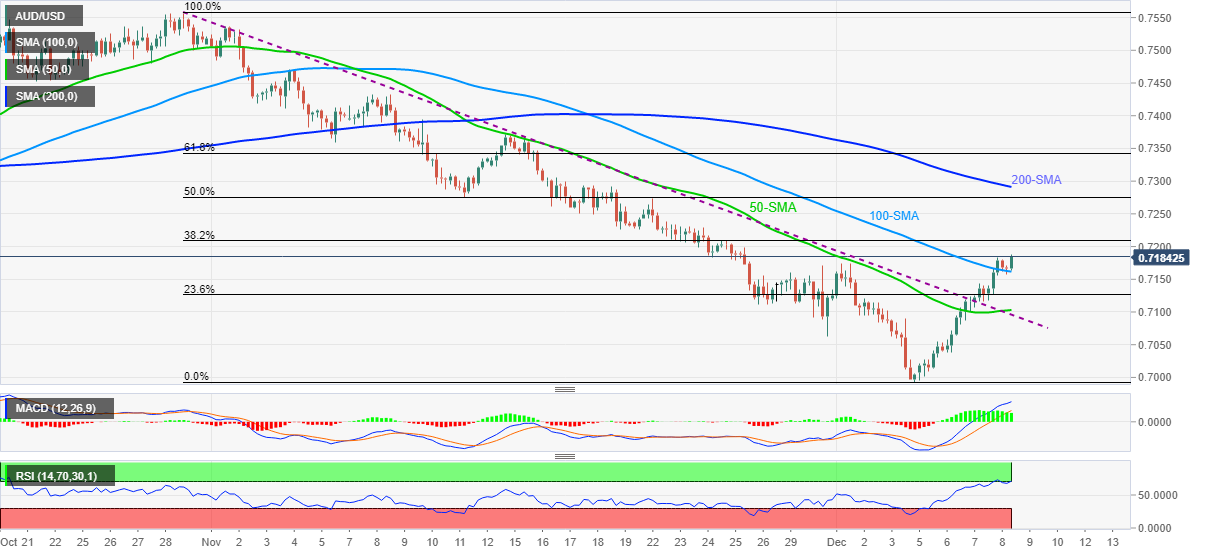
Trend: Further upside expected
The People’s Bank of China (PBOC) Governor Yi Gang said on Thursday, the risks from a few property firms in the short-term will not undermine Hong Kong’s capital market.
“Rights of Evergrande shareholders and creditors will be fully respected,” Yi added.
The Governor offers conciliatory comments to soothe the markets, despite missed payments by Kaisa Group this week.
Market reaction
USD/CNY is trading almost unchanged on the day at 6.3445, as of writing.
Here is what you need to know on Thursday, December 9:
The market mood remains tepid amid mixed headlines on the Omicron covid variant globally. Renewed geopolitical tensions between US and Iran amid looming American-Sino woes also temper the risk sentiment.
On the Omicron front, a Japanese study revealed that the new variant of COVID-19 is 4.2 times more transmissible in its early stage than Delta. Meanwhile, the UK imposed fresh restrictions to curb the Omicron contagion after a solid surge in cases over the past few days. PM Boris Johnson urged to work from home and have to show proof of vaccination under the new guidance, known as Plan B.
On the other hand, Pfizer Inc. and BioNTech SE said initial lab studies show a third dose of their covid vaccine may be needed to neutralize the omicron variant.
Investors also weigh in fresh US-Iran concerns after Reuters reported, citing a US official that ''US and Israeli defense chiefs are expected on Thursday to discuss possible military exercises that would prepare for a worst-case scenario to destroy Iran’s nuclear facilities should diplomacy fail and if their nations’ leaders request it.”
On the US-Sino side, US House passed a bill to punish China over the oppression of Uyghurs Muslims in the country’s far western Xinjiang region.
The Asian stocks are a mixed bag, rescued by the rally in the Chinese stocks. China stocks cheer the central bank’s policy support measures and moderation in factory inflation. The S&P 500 futures are down 0.15% on the day, justifying the cautious mood.
The safe-haven US dollar attempts a bounce while the Treasury yields hold onto the recent rebound ahead of Friday’s critical inflation data.
The recovery in EUR/USD lost legs just below 1.1350, as the pair now inches lower towards 1.1300 ahead of the German trade data.
GBP/USD is holding steady above 1.3200, consolidating the impressive bounce from a fresh yearly low of 1.3167. The Omicron covid concerns and Brexit risks will continue to undermine the British pound, especially as the latest covid restrictions push back BOE rate hike expectations to early 2022.
AUD/USD is closing in on 0.7200 after finding fresh bids near mid-0.7150s. USD/JPY is holding the lower ground around 113.60 amid sluggish markets and a retreat in the yields.
USD/CAD is paring back gains to test 1.2750 amid a rebound in WTI prices. The US oil is on the move higher following the US-Iran headlines. The Bank of Canada (BOC) kept the key rate unchanged at 0.25% but warned of elevated inflation, which drove USD/CAD briefly higher, where it is now consolidating.
Gold is trading flat below the critical $1,792 hurdle, awaiting the US weekly Jobless Claims for fresh incentives.
Bitcoin is battling $50,000, unable to find acceptance above the latter amid a damp mood across the crypto board.
- USD/JPY extended its sideways consolidative price moves heading into the European session.
- A cautious market mood underpinned the safe-haven JPY and acted as a headwind for the pair.
- Hawkish Fed expectations, rising US bond yields benefitted the USD and extended some support.
The USD/JPY pair lacked any firm directional bias and remained confined in a narrow trading band, just above mid-113.00s heading into the European session.
A combination of diverging forces failed to provide any meaningful impetus to the USD/JPY pair and led to a subdued/range-bound price move through the early part of the trading action on Thursday. Despite easing fears about the economic fallout from the new Omicron variant of the coronavirus, escalating geopolitical tensions kept a lid on the recent optimism. This was evident from a softer tone around the equity markets, which benefitted the safe-haven Japanese yen and acted as a headwind for the major.
Investors turned cautious after US President Joe Biden on Tuesday threatened to impose strong economic and other measures on Russia if it invades Ukraine. This comes after the US recently announced that it will not send an official delegation to the 2022 Winter Olympics in Beijing. The move was meant to protest against China's alleged violations of human rights and actions against Muslims in Uyghur. The developments overshadowed the news that the third dose of Pfizer's COVID-19 vaccine neutralized the Omicron variant in lab tests.
That said, the downside remains cushioned amid a modest pickup in the US dollar demand, bolstered by the prospects for a faster policy tightening by the Fed. The markets seem convinced that the Fed would be forced to adopt a more aggressive policy response to contain stubbornly high inflation. This, along with a further recovery in the US Treasury bond yields, underpinned the greenback and extended some support to the USD/JPY pair. Investors, however, preferred to wait on the sidelines ahead of Friday's release of the US CPI report.
The latest US consumer inflation figures would influence the Fed's decision to taper its stimulus at a faster pace and set the stage for an interest rate hike next year. It is worth mentioning that the money markets indicate the possibility for an eventual liftoff in May 2022. Hence, the data will play a key role in driving the USD demand in the near term and help determine the next leg of a directional move for the USD/JPY pair.
Technical levels to watch
- Gold portrays trader’s indecision below the key moving average following Wednesday’s bearish candlestick.
- Market sentiment dwindles as virus-linked news battles geopolitical fears, Fed rate hike concerns.
- Friday’s US CPI becomes crucial as inflation expectations improve, virus-led lockdowns, yields are important to track too.
- Gold Price Forecast: Sellers happily adding on spikes amid a lack of clear direction
Gold (XAU/USD) remains steady at around $1,785, recently easing from intraday top heading into Thursday’s European session.
The yellow metal portrayed a bearish candlestick the previous day amid mixed concerns over the South African covid variant and its cure. However, the latest challenges to the market sentiment underpin the US dollar and lure the gold sellers ahead of the all-important US Consumer Price Index (CPI) data, up for publishing on Friday.
News that leading covid vaccines’ booster shots are effective against Omicron joined studies that the virus variant is less detrimental than the previous versions to favor previous risk-on mood. However, fresh virus-led lockdowns in Germany, France and the UK join the latest study from Japan saying four-time more transmissibility of the South Africa-linked COVID-19 strain to weigh on the sentiment.
Elsewhere, US-China tussles got escalated on the Taiwan issue, following the previous tension over Beijing Olympics, which in turn weighed on the sentiment and the gold prices. Adding to the China-linked challenges for risk appetite were fears of Evergrande and Kaisa defaults. On the same line were the US-Russia tussles over Ukraine and Washington-Israel talks concerning Tehran.
While the risk-off mood favors US 10-year Treasury yields and the US Dollar Index (DXY) to stay positive, a four-day rebound of the US inflation expectations propels market chatters over the Fed rate hike and fuels bond coupons as well as DXY, also weighing on the gold.
It should be noted, however, that the market’s wait for Friday’s US CPI and more clues over Omicron keeps the gold prices steady below the key hurdle.
Technical analysis
Despite bouncing off a seven-week-old horizontal area, gold stays beneath the 200-DMA, not to forget mentioning the previous support line from late September. The metal’s failures to cross short-term key hurdles join bearish MACD signals and Wednesday’s Doji candlestick to keep sellers hopeful.
That said, the 61.8% Fibonacci retracement (Fibo.) of September-November upside, near $1,780, precedes the $1,772 level to restrict short-term declines of gold prices.
Following that, multiple levels marked since October 18 challenge gold bears around $1,760-62.
On the flip side, the 200-DMA and the support-turned-resistance line, respectively around $1,792 and $1,798, join the 50.0% Fibo. level surrounding $1,800 to question the gold buyers.
During the quote’s sustained run-up past $1,800, the $1,815 and $1,845 levels may offer intermediate halts before directing gold prices towards November’s peak of $1,877.
Gold: Daily chart
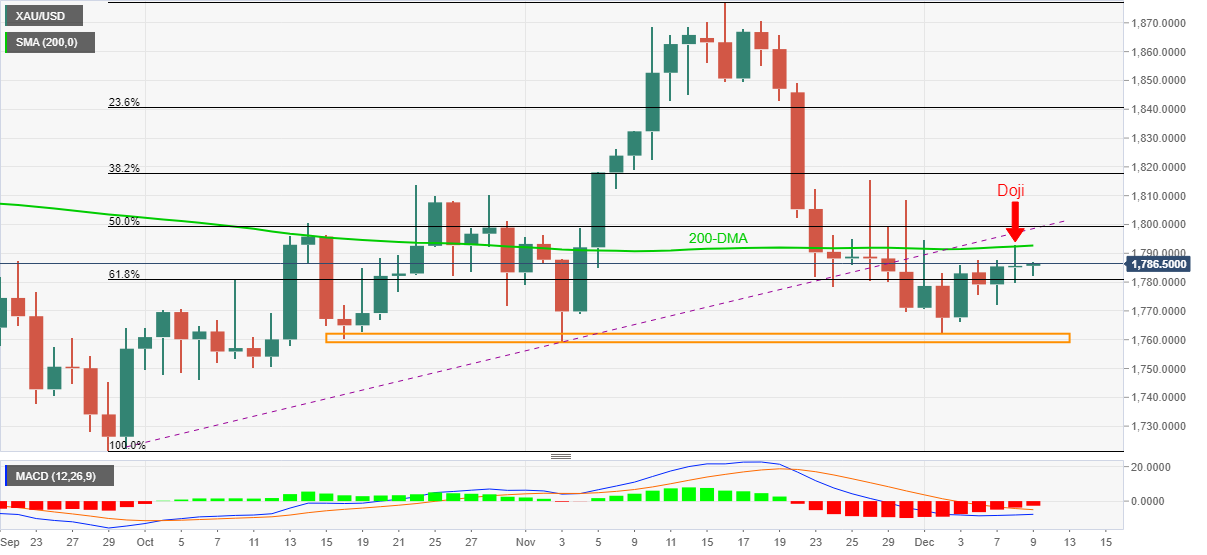
Trend: Pullback expected
- USD/ZAR snaps three-day downtrend, sidelined around late November lows.
- Bearish MACD, 20-DMA break favor sellers to brace for a bumpy road.
USD/ZAR struggles to keep the corrective pullback from a three-week low of around $15.72 during early Thursday morning in Europe.
The South African currency (ZAR) pair refreshed multi-day low the previous day on breaking the 20-DMA. However, an ascending support line from October 20, around $15.65, challenges the bears of late.
Even so, bearish MACD signals hint at the USD/ZAR downside towards five-week-old horizontal support near $15.50.
In a case where the pair sellers dominate past $15.50, the 50-DMA level of $15.30 is in focus.
Alternatively, an upside clearance of the 20-DMA level of $15.80 will direct the USD/ZAR prices towards a short-term resistance line near the $16.00 threshold.
Any further upside past $16.00 will propel the quote to the November highs near $16.36.
USD/ZAR: Daily chart
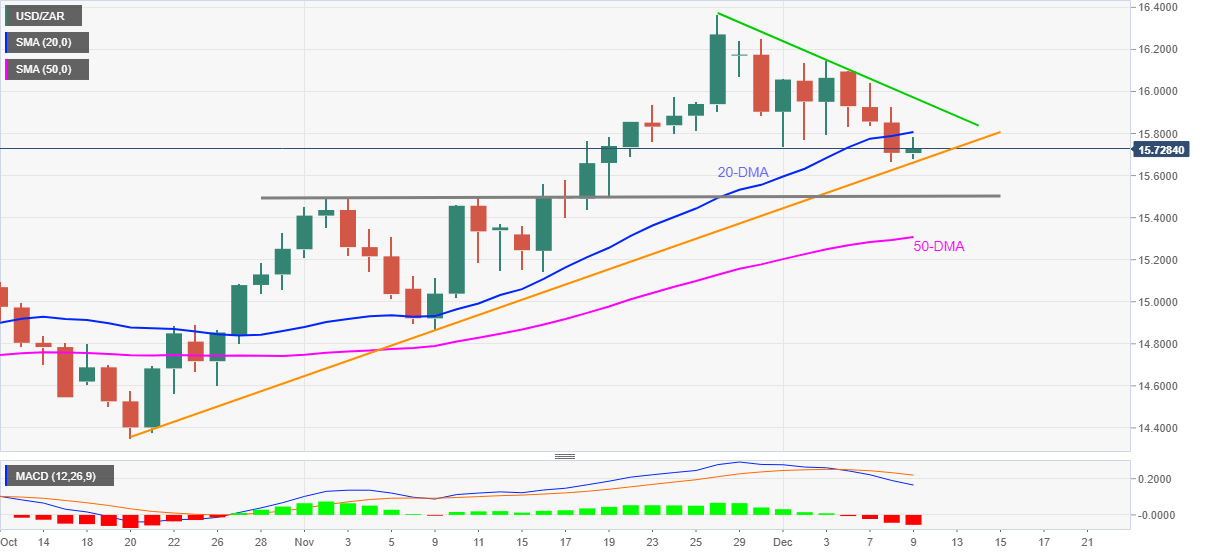
Trend: Further declines expected
- GBP/USD seemed struggling to capitalize on the overnight goodish rebound from a one-year low.
- Fresh COVID-19 jitters pushed back BoE rate hike expectations and undermined the British pound.
- A modest pickup in the USD demand further held back traders from placing aggressive bullish bets.
The GBP/USD pair held steady above the 1.3200 mark through the Asian session, though the uptick lacked bullish conviction amid fresh COVID-19 jitters.
The pair struggled to capitalize on the overnight bounce from a one-year low, around the 1.3160 area and oscillated in a narrow trading band through the early part of the trading action on Thursday. The British pound was undermined by the imposition of tougher COVID-19 restrictions in England. Apart from this, a modest pickup in the US dollar demand capped any meaningful upside for the GBP/USD pair.
The UK Prime Minister Boris Johnson on Wednesday ordered people to work from home, wear masks in public places and use vaccine passes to slow the spread of the Omicron variant of the coronavirus. This comes on the back of the UK-EU impasse over the Northern Ireland Protocol, which seems to have dashed hopes for an imminent interest rate hike by the Bank of England at its meeting next week.
On the other hand, the USD continued drawing some support from growing market acceptance that the Fed would tighten its monetary policy sooner rather than later to contain stubbornly high inflation. This, along with a further recovery in the US Treasury bond yields and a cautious market mood, benefitted the safe-haven greenback and held back traders from placing bullish bets around the GBP/USD pair.
The fundamental backdrop seems tilted firmly in favour of bearish traders, suggesting that the attempted recovery might still be seen as a selling opportunity. In the absence of any major market-moving economic releases, either from the UK or the US, the USD price dynamics will continue to influence the GBP/USD pair and allow traders to grab some short-term opportunities.
Technical levels to watch
- USD/CAD extends the previous day’s rebound from three-week high.
- Oil prices benefit from geopolitical fears, mixed concerns over Omicron.
- BOC left monetary policy unchanged, as expected, but teased rate hike in early 2022.
- BOC’s Gravelle, US Jobless Claims eyed, risk catalysts are more important.
USD/CAD keeps the post-BOC recovery around 1.2670, up 0.13% intraday, while heading into Thursday’s European session.
The loonie pair dropped to the lowest levels since November 19 the previous day before bouncing off 1.2607, which in turn portrays bullish Doji and keeps the buyers hopeful. Also favoring the upside momentum is the latest US dollar strength amid mixed concerns over the South African South Africa-linked COVID-19 strain, dubbed as Omicron, as well as the Fed rate hike.
The Bank of Canada (BOC) matched wide market forecasts while leaving the benchmark interest rate unchanged at 0.25%. However, BOC reiterated its bullish bias but couldn’t tame the USD/CAD upside. “The BoC repeated that it sees slack being absorbed sometime in the middle quarters of 2022,” per Reuters.
Following that, doubts over the transmissibility of Omicron and fresh lockdowns in Germany, France and the UK challenged the market sentiment and underpinned the US dollar’s safe-haven demand. Also adding to the risk-off mood were US-China tussles, talks over Iran diplomacy and increased calls of the Fed’s sooner rate hike.
Additionally, a four-day rebound of the US inflation expectations ahead of Friday’s key US Consumer Price Index (CPI) joins Reuters’ poll favoring the sooner Fed rate hike, to propel the US Treasury yields and the US dollar.
Amid these plays, US 10-year Treasury yields stay firmer around the week’s high near 1.51% while stock futures print mild losses at the latest. It should be noted that the WTI Crude Oil prices rise for the fourth consecutive day amid geopolitical tensions surrounding US-China, Washington-Russia and America-Iran.
Although the fresh risk-aversion wave favors USD/CAD bulls, the pair traders should wait for comments from BOC Deputy Governor Toni Gravelle and US Jobless Claims for clear direction. Above all, Friday’s US inflation data are crucial to watch.
Technical analysis
A bullish Doji around multi-day low keeps USD/CAD buyers hopeful to conquer the 1.2700 threshold. However, further advances will be challenged around 1.2850. On the contrary, the 200-DMA and ascending trend line from late October, near 1.2580-75, offers a tough nut to crack for the pair bears.
- EUR/GBP retreats from two-month tops, pressured around intraday low of late.
- Firmer Momentum, sustained break of 200-DMA directs bulls to multi-day-old resistance line.
- Fortnight-old support line adds to the downside filters.
EUR/GBP stays pressured around intraday low surrounding 0.8580, consolidating the biggest daily gains since late September. The cross-currency pair crossed the 200-DMA the previous day to mark a notable rally.
The latest pullback seems to direct the quote back to the aforementioned key SMA, near 0.8560 at the latest, but any further downside isn’t backed by an upward sloping Momentum line.
Even if the quote breaks the 200-DMA level of 0.8560, an ascending trend line from November 24, at 0.8510 by the press time, also challenges the EUR/GBP sellers.
In a case where the pair drops below 0.8510, the 0.8500 threshold and the monthly low of 0.8488 will probe the bears before directing them to August month’s bottom around 0.8450.
Meanwhile, further upside will aim for the 0.8600 round figure and then to the descending resistance line from late April, near 0.8630.
It’s worth noting that the EUR/GBP rally beyond 0.8630 will reverse the downtrend and propel the quote towards September’s high close to 0.8660.
EUR/GBP: Daily chart
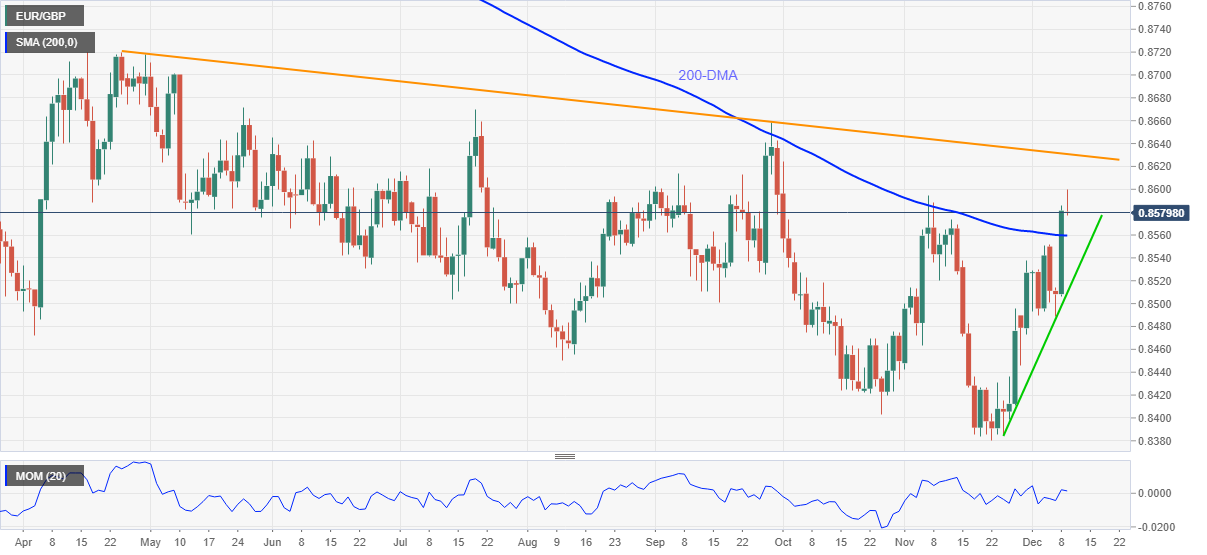
Trend: Further upside expected
- EUR/USD consolidates the biggest daily jump in fortnight, pressured around weekly top.
- Risk-off mood underpins US Treasury yields, DXY ahead of US CPI.
- Omicron, geopolitics weigh on sentiment, Fed rate hike chatters renew on firmer US inflation expectations.
- Second-tier US/German data eyed but US inflation, virus updates become crucial catalysts.
EUR/USD bounces off intraday low to pare daily losses around 1.1335, down 0.12% near the weekly top ahead of Thursday’s European session.
The major currency pair jumped the most in two weeks the previous day amid firmer market sentiment, mainly linked to the South African covid variant and its cure. However, sour sentiment in Asia challenged the EUR/USD buyers afterward.
Behind the downbeat mood are the chatters concerning the four-time more transmissibility of the South Africa-linked COVID-19 strain, dubbed as Omicron. On the same line was the spark in virus variant cases in Europe that recalled the activity restrictions in Germany, France and the UK.
Furthermore, US-China tussles, talks over Iran diplomacy and increased calls of the Fed’s sooner rate hike were additional catalysts to weigh on the market sentiment and EUR/USD prices.
Recently, US Assistant Secretary of Defense for Indo-Pacific Security Affairs Ely Ratner said, “Bolstering Taiwan's self-defenses is an ‘urgent task’ and an essential feature of deterring China.” On the same line were the US-Russia tussles over Ukraine and Washington-Israel talks concerning Tehran, not to forget a major setback for Beijing Olympics 2022.
On the other hand, a four-day rebound of the US inflation expectations ahead of the key US CPI data, up for Friday, pushes analysts to expect, per Reuters, a sooner rate hike from the Fed, which in turn favors the US Treasury yields as well as the US Dollar Index (DXY).
That said, US 10-year Treasury yields stay firmer around the week’s high near 1.51% while stock futures print mild losses at the latest.
Looking forward, German trade numbers and the US Jobless Claims could entertain the EUR/USD traders while the risk catalysts are major factors to watch. Above all, Friday’s US Consumer Price Index (CPI) is the key to follow for clearer direction.
Technical analysis
A successful break of the 100-SMA and a monthly resistance line, now support around 1.1285-90, keeps EUR/USD buyers hopeful. However, multiple tops marked since November 15, as well as descending resistance line from October 28, challenge the pair bulls below 1.1385-90.
- USD/CHF eases from intraday high, snaps two-day downtrend.
- Sustained trading below key SMAs, bearish MACD signals favor sellers.
- 61.8% Fibonacci retracement, short-term rising trend line test further downside.
USD/CHF drops back to 0.9200 after consolidating the two-day losses during early Thursday in Asia. The Swiss currency (CHF) pair remains below the key moving averages amid the bearish MACD signals, which in turn backs bearish bias.
However, a clear downside break of the 61.8% Fibonacci retracement (Fibo.) of November’s upside and a four-week-long rising trend line, respectively around 0.9197 and 0.9185, challenge the pair sellers.
In a case where the USD/CHF bears dominate below 0.9185, multiple swings near 0.9150 may probe the quote’s additional declines ahead of the last month’s low of 0.9088.
On the contrary, 200-SMA and 50% Fibo. around 0.9215 and 0.9230 in that order, guards immediate recovery moves of the pair.
Following that, the 100-SMA level of 0.9260 and a monthly high of 0.9275 will lure the USD/CHF buyers.
USD/CHF: Four-hour chart
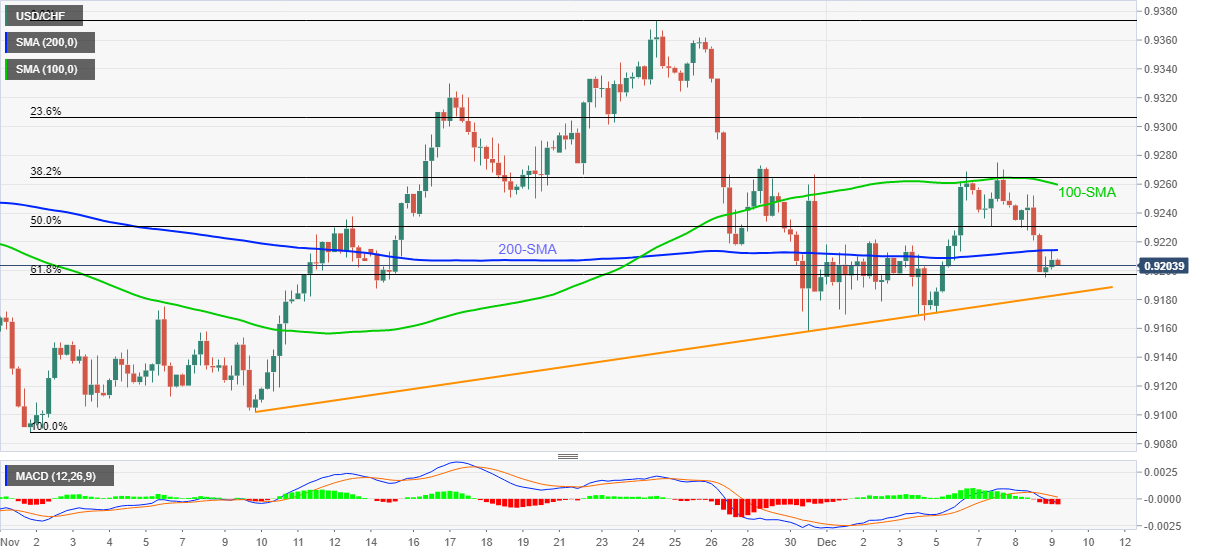
Trend: Further weakness expected
- Asian equities trade mixed, mostly higher as market sentiment dwindles ahead of the key US inflation data.
- Fresh fears over covid variant join Evergrande-linked woes to favor bears, stimulus hopes, vaccine news keep buyers hopeful.
- China CPI jumped the most since August 2020, PPI eased from 26-year high in November.
- Sino-American tussles, US-Iran tension also poke upside momentum.
Asian equities remain mostly firmer as stimulus hopes battle virus woes heading into Thursday’s European session. To portray the mood, the MSCI’s index of Asia-Pacific shares outside Japan jumps 0.81% but Japan’s Nikkei 225 drops 0.15% at the latest.
Return of the virus-led activity restrictions in Germany, France and the UK renews COVID-19 fears. However, headlines from leading covid vaccine producers signal the effectiveness of booster shots to tame the South African coronavirus variant, dubbed as Omicron.
Elsewhere, China’s Consumer Price Index (CPI) jumped the most since August 2020, by 2.3% YoY and 0.4% MoM in November. Further, the Producer Price Index (PPI) crossed 12.6% forecasts to arrive at 12.9% YoY in November. Further, the People’s Bank of China (PBOC) raised the Yuan mid-point to the highest in 3.5 years, to 6.3498 yuan per dollar, to battle the challenges at home.
Among the key issues worrying China are the geopolitical tussles with the US and fears of default emanating from Evergrande and Kaisa are the major ones. Recently, US Assistant Secretary of Defense for Indo-Pacific Security Affairs Ely Ratner said, “Bolstering Taiwan's self-defenses is an ‘urgent task’ and an essential feature of deterring China”.
Amid these plays, stocks in China and Hong Kong remain positive but not Australian equities. Further, New Zealand’s NZX 50 drops around 1.5% by the press time. It’s worth noting that South Korea’s KOSPI and Indonesia’s IDX Composite print mild gains whereas India’s BSE Sensex drops 0.15% even after the Reserve Bank of India (RBI) kept monetary policy unchanged the previous day.
On a broader front, fresh fears of the Fed rate hike propel the US Treasury yields and weigh on the stock futures. However, oil prices remain firmer on concerns relating to Ukraine and Iran.
Looking forward, market players will remain at loggerheads and could witness a lack of major moves ahead of the key US inflation data, up for publishing on Friday.
- USD/TRY extends its side-trend below all-time highs of 13.92.
- Turkey’s President Erdogan called for lower rates on Wednesday.
- Bullish RSI points lower, suggesting a test of 50-SMA on the 4H chart.
USD/TRY is reversing Wednesday’s rebound, as the Turkish lira finds its feet after Turkey’s President Tayyip Erdogan’s comments-led sell-off.
Erdogan said that he “will bring inflation, exchange rate down through low-interest rates” while speaking in an interview with NTV.
Later on, he calmed markets by saying that the price hikes stemming from rising energy costs would soon stabilize.
USD/TRY jumped to intraday highs of 13.81 on his comments before retreating to finish the day at 13.69.
In Thursday’s trades in running, USD/TRY is trading listlessly, wrapped around the 21-Simple Moving Average (SMA) on the four-hour sticks at $13.69.
The Relative Strength Index (RSI) has edged slightly lower suggesting that a fresh leg lower cannot be ruled out in the session ahead.
The upward-sloping 50-SMA at 13.45 will come into the sellers’ radars.
USD/TRY: Four-hour chart
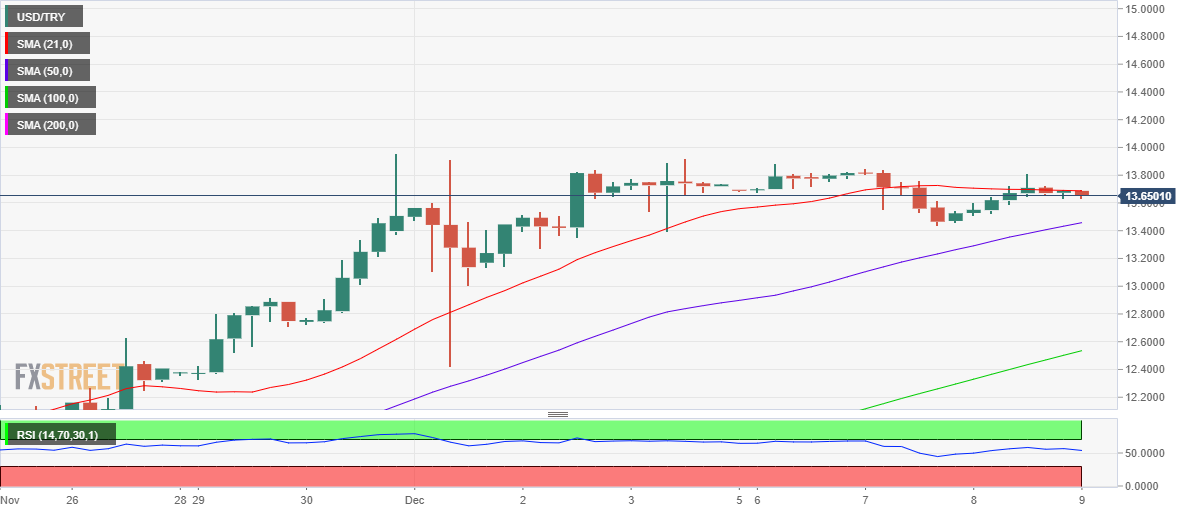
On the flip side, a four-hourly candlestick closing above 21-SMA is needed to extend the upside towards Wednesday’s high.
Buying interest will revive above the latter, calling for a retest of the record highs at 13.96.
- USD/INR stays firmer around October’s high, tracks three-week-old rising support line.
- RSI conditions, bearish candlestick formation join double tops around 75.65 to challenge bulls.
USD/INR reverses the previous day’s pullback from a two-month low, mildly bid near 75.45 during early European morning on Thursday.
In doing so, the Indian rupee (INR) pair follows an upward sloping support line from November 18 amid firmer RSI conditions.
However, the RSI line’s proximity to the overbought area joins the previous day’s Doji candlestick formation to challenge the USD/INR buyers. Adding to the upside filters are the tops marked during April and September near 75.65.
Should the pair buyers manage to cross the 75.65 hurdle, a rally towards June 2020 peak surrounding 76.45 can’t be ruled out.
Alternatively, pullback moves need to break a short-term support line, near 75.25 by the press time, to recall the USD/INR sellers.
Following that, July’s top of 75.01 will be crucial to watch as a break of which will confirm the downward trajectory towards 74.55 level, comprising August month’s high.
USD/INR: Daily chart
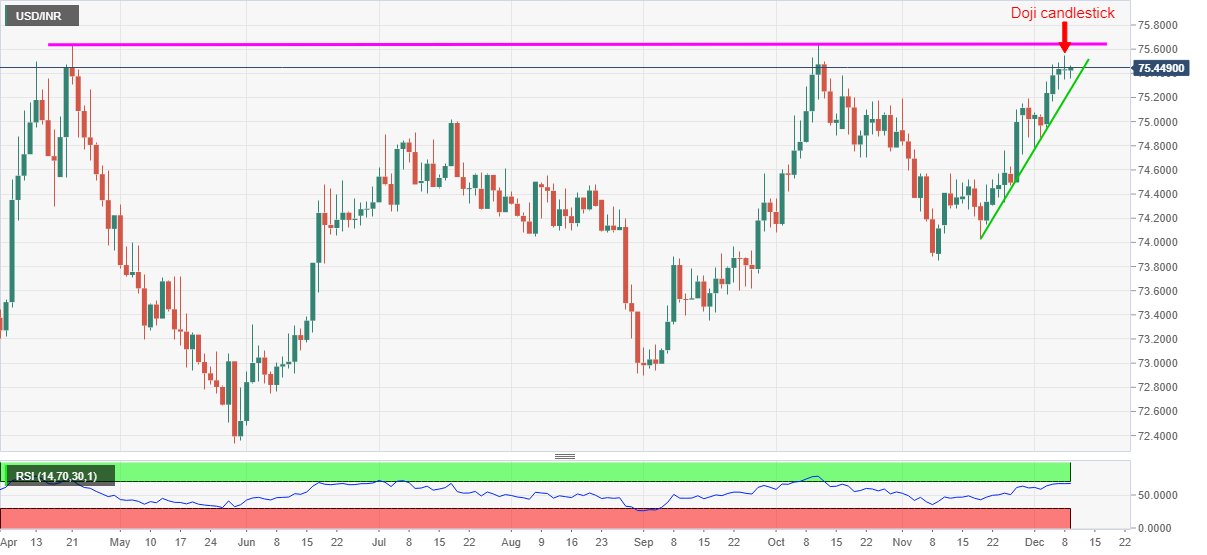
Trend: Pullback expected
Two-way volatility in the Chinese yuan has not changed despite the currency's rise to three-year highs amid shifts in global monetary policy stances, the state-owned China Securities Journal carried a front-page story on Thursday.
Key takeaways
“Robust exports, foreign capital inflows and prudent monetary policy have provided support a stable yuan.”
"Towards the year-end, heavy FX settlement by companies may contribute to a fast yuan rally to a certain extent, but the impact of seasonal and transactional factors may not be sustainable.”
Market reaction
USD/CNY was last seen trading at 6.3446, modestly flat on the day. Investors digest the hot Chinese inflation data ahead of the US CPI report due on Friday.
- Gold price returns to the red on Thursday amid sell-on-rallies trading.
- US Treasury yields trade firmer above 1.50%, lifting the dollar’s demand.
- Gold sellers eye $1,750 as Fed stays on tightening path.
Gold price is correcting from weekly tops, as global stocks and Treasury yields rebound on easing Omicron fears. Further, hopes that the Fed will likely accelerate the reduction in bond-buying next week add to the pullback in gold price. However, expectations of hot US inflation and rising Chinese Consumer Price Index (CPI) could likely limit the decline in gold price. Markets also remain cautious ahead of Thursday’s Treasury note auction and incoming Omicron updates worldwide.
Read: Gold Price Forecast: Sellers happily adding on spikes amid a lack of clear direction
Gold Price: Key levels to watch
The Technical Confluences Detector shows that the gold price is heading towards powerful support at $1,780, where the previous day’s low, pivot point one-day S1 and Fibonacci 38.2% one-week converge.
A sustained move below the latter could trigger a drop towards $1,773-$1,772, the intersection of the Fibonacci 23.6% one-week, pivot point one-day S2 and the Fibonacci 161.8% one-day.
The further downside could challenge the bullish commitments at the pivot point one-day S3 at $1,766, below which floors will open up towards the previous week’s low of $1,762.
On the flip side, gold bulls need to break through a dense cluster of healthy resistance levels around $1,786. That price zone is the confluence of the Fibonacci 23.6% one-month, Fibonacci 61.8% one-day and SMA10 four-hour.
The next relevant upside barrier is seen at $1,792, the meeting point of the Fibonacci 61.8% one-week, SMAs 100 and 200 one-day.
The SMA50 one-day at $1,796 will then challenge the bullish attempts, above which a rally towards $1,800 cannot be ruled out. That is the pivot point one-day R2.
Here is how it looks on the tool
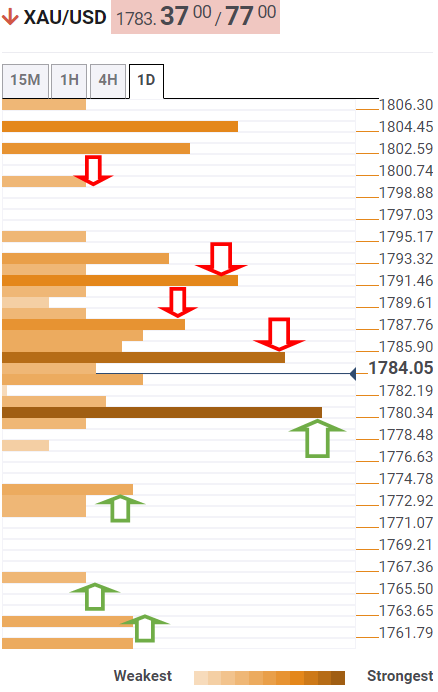
About Technical Confluences Detector
The TCD (Technical Confluences Detector) is a tool to locate and point out those price levels where there is a congestion of indicators, moving averages, Fibonacci levels, Pivot Points, etc. If you are a short-term trader, you will find entry points for counter-trend strategies and hunt a few points at a time. If you are a medium-to-long-term trader, this tool will allow you to know in advance the price levels where a medium-to-long-term trend may stop and rest, where to unwind positions, or where to increase your position size.
- DXY consolidates the previous day’s losses, keeps bounce off weekly low.
- US inflation expectations rise ahead of US CPI, sooner Fed rate hike calls grow.
- Market fears relating to Omicron, geopolitics also underpin US dollar’s safe-haven demand.
- US Weekly Jobless Claims may offer intermediate clues, risk catalysts are the key.
US Dollar Index (DXY) defends 96.00 during a corrective pullback from the weekly low amid early Thursday. The greenback gauge dropped the most in a fortnight the previous day but the return of the risk-off mood seems to challenge the bears of late.
A four-day rebound of the US inflation expectations propels market chatters over the Fed rate hike and fuels the US Treasury yields as well as the US Dollar Index (DXY). Also weighing on the bonds could be the geopolitical headlines concerning China, Russia and Iran.
That said, US Assistant Secretary of Defense for Indo-Pacific Security Affairs Ely Ratner said, “Bolstering Taiwan's self-defenses is an ‘urgent task’ and an essential feature of deterring China”. On the other hand, US and Israel discuss Iran’s diplomacy while Washington and Kremlin remain at loggerheads over the Ukraine issue.
Furthermore, the return of the virus-led activity restrictions in Germany, France and the UK renews COVID-19 fears, reversing the previous optimism after major vaccine producers cited booster shots as effective to tame Omicron.
It’s worth observing that a strong print of October’s US Job Openings and Labour Turnover Survey (JOLTS), 11.033M versus 10.438M, favor odds of the sooner Fed rate hike, as backed by the Reuters poll.
Amid these plays, the US 10-year Treasury yields rise 1.7 basis points (bps) to 1.52%, up for the fourth consecutive day, whereas S&P 500 Futures print mild losses to challenge the three-day uptrend.
Looking forward, the weekly prints of US jobs-related data will join the inflation and virus updates to entertain the markets but nothing more important than Friday’s US Consumer Price Index (CPI).
Technical analysis
Despite bouncing off a weekly low, US Dollar Index needs a clear break of the 21-DMA and the previous support line from early November, respectively around 96.05 and 96.35, to recall the bulls. On the contrary, a three-week-old rising trend line near 95.60 challenges the bears.
In its latest Global Economic Outlook (GEO), published Thursday, Fitch Ratings highlighted how the sustained rise in inflation has prompted the global central bankers to embark upon monetary policy normalization.
Key takeaways
“There are now signs that price level shocks related to pandemic shortages are starting to morph into ongoing inflation. With monetary policy settings still super-loose, this is worrying central bankers.”
“High inflation is raising policy tensions. The Omicron COVID-19 variant of concern represents a downside risk to growth but could adversely affect supply leading to further price increases, implying risks if central banks delay normalization.”
“Monetary policy responses are becoming more divergent, with ECB interest rates still likely to remain on hold through 2023 and the PBOC expected to cut interest rates in 2022.”
Related reads
- Chinese CPI rises at fastest pace since August 2020
- US inflation expectations print four-day rebound from early October lows
Japan’s ruling Liberal Democratic Party (LDP) tax panel approved the FY2022/23 tax reform plan on Thursday, per Reuters.
After seeing the draft plan, Reuters reported that Japan is likely to proceed with technical consideration of policy mix to achieve carbon neutrality.
Japan will swiftly consider steps on capital gains tax from derivatives trading to avoid tax evasion, according to the draft plan.
Market reaction
USD/JPY is consolidating gains around 113.75, up 0.07% on the day, benefiting from firmer Treasury yields.
| Raw materials | Closed | Change, % |
|---|---|---|
| Brent | 76.13 | 0.79 |
| Silver | 22.419 | -0.36 |
| Gold | 1782.483 | -0.13 |
| Palladium | 1845.04 | 0.31 |
- Silver extends the previous day’s pullback, pressured around intraday low.
- Sluggish RSI line, failures to cross immediate DMA challenge buyers, Bears eye yearly low.
Silver (XAG/USD) retreats to $22.40, down 0.23% intraday, as sellers keep reins during early Thursday.
The bright metal’s weakness could be linked to the failures to cross the 10-DMA and downbeat RSI line, not oversold, which suggest further downside.
That said, 78.6% Fibonacci Retracement (Fibo.) level of September-November upside, near $22.20, restricts near-term declines of the XAG/USD prices. Adding to the downside filters is the $22.00 threshold.
However, a clear decline below the $22.00 will make the commodity vulnerable to test the yearly bottom of $21.42.
Alternatively, recovery moves need to cross the 10-DMA level of $22.56 and 61.8% Fibo. level near $22.95 before directing the silver buyers toward November’s low near $23.00.
Even if the quote rises past $23.00, bulls will wait for the sustained run-up beyond the late November swing high, around $23.75, for conviction.
Silver: Daily chart
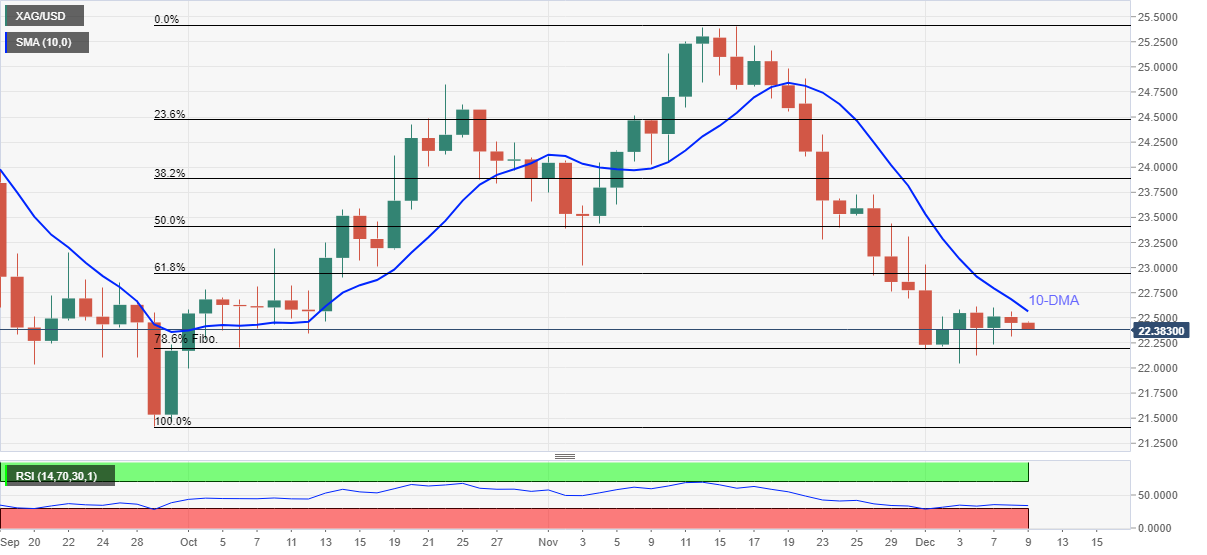
Trend: Further weakness expected
- NZD/USD snaps two-day rebound from 2021 bottom as market sentiment sours.
- China CPI jumped the most since August 2020 in December but risk-off mood keep bears hopeful.
- Omicron, China and Fed rate hike fears are back to the table ahead of Friday’s US inflation data.
NZD/USD struggles to cheer upbeat China inflation figures, down 0.16% intraday to re-test 0.6805 level during early Thursday. Although firmer data from the key customer helps the Kiwi pair buyers to provide a tough fight to the recently arrived bears, the risk-off mood seems to welcome the latest entrants.
China’s Consumer Price Index (CPI) jumped the most since August 2020, by 2.3% YoY and 0.4% MoM in November. Further, the Producer Price Index (PPI) crossed 12.6% forecasts to arrive at 12.9% YoY in November.
Read: Chinese CPI rises at fastest pace since August 2020
It’s worth noting that China also raised the Yuan mid-point to the highest in 3.5 years, to 6.3498 yuan per dollar, to battle the challenges at home.
Among them, geopolitical tussles with the US and fears of default emanating from Evergrande and Kaisa are the major ones. Recently, US Assistant Secretary of Defense for Indo-Pacific Security Affairs Ely Ratner said, “Bolstering Taiwan's self-defenses is an ‘urgent task’ and an essential feature of deterring China”. Additionally, headlines concerning Iran and the US-Russia tussle over the Ukraine issue add to the sour sentiment and weigh on the NZD/USD prices.
Furthermore, a four-day rebound of the US inflation expectations ahead of the key US CPI data, up for Friday, propels market chatters over the Fed rate hike and fuels the US Treasury yields as well as the US Dollar Index (DXY).
That said, the US 10-year Treasury yields rise 2.3 basis points (bps) to 1.53%, up for the fourth consecutive day, whereas S&P 500 Futures print mild losses to challenge the three-day uptrend.
Given the fresh risk-aversion amid a lack of major data/events, NZD/USD traders will keep their eyes on the risk catalysts for fresh impulse. However, weekly US Jobless Claims may offer intermediate moves to the Kiwi pair.
Technical analysis
NZD/USD pullback remains elusive beyond 0.6740 level comprising the previous resistance trend line from November 19. Meanwhile, fresh recovery moves can aim for a 10-week-old horizontal area surrounding 0.6860-65.
- GBP/JPY is back in the red after a volatile Wednesday’s trading.
- The UK’s restrictions amid Omicron pushes back BOE rate hike expectations.
- Looming bear cross on the daily chart points to more downside in the offing.
GBP/JPY is hovering around 150.00, on the defensive after a volatile trading session witnessed on Wednesday.
The cross fell as low as 149.35 before rebounding firmly to finish the day modestly flat at 150.29.
So far this Thursday, the bulls have faded the recovery and given up control amid persistent weakness in the pound.
The cable tumbled to fresh yearly lows of 1.3167 after the UK re-imposed fresh restrictions to curb the spread of the Omicron covid variant. This comes as cases double every few days.
The pair also feels the pull of gravity as the Omicron concerns have pushed back the Bank of England (BOE) rate hike expectations.
However, the downside in the cross remains cushioned by the rebounding US Treasury yields, in anticipation of Friday’s inflation data.
From a short-term technical perspective, GBP/JPY risks additional declines amid an impending bear cross on the daily chart.
The 100-Daily Moving Average (DMA) is on the verge of piercing the 200-DMA from above, flashing a bearish signal.
The 14-day Relative Strength Index (RSI) is trading listlessly below the midline, allowing room for more declines.
A retest of Wednesday’s low remains on the cards should the selling momentum accelerate.
On the flip side, strong resistance appears at Wednesday’s high of 150.70, above which a test of the 151.00 level will be inevitable.
GBP/JPY daily chart
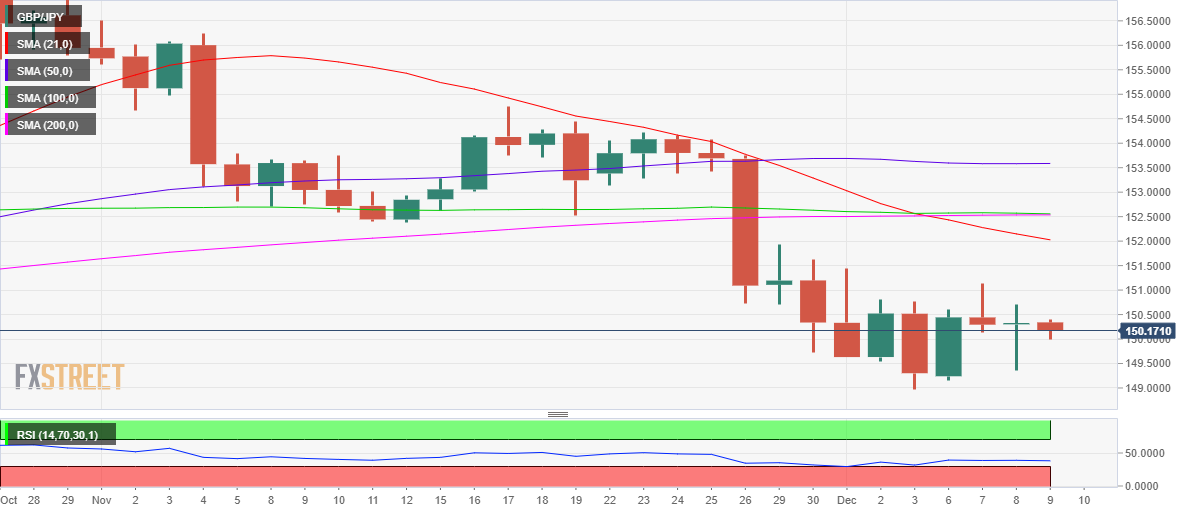
GBP/JPY additional levels to watch
- AUD/JPY bounces off intraday low as China posts biggest CPI jump since August 2020.
- Momentum line, sustained break of 61.8% Fibonacci retracement level favor bullish bias.
- 100-DMA, September’s high add to the upside filters before 200-DMA.
AUD/JPY wavers around 81.50, despite the latest rebound from intraday low, during early Thursday.
The risk barometer pair recently benefited from upbeat China Consumer Price Index (CPI) and Producer Price Index (PPI) data but a challenge to sentiment joins descending trend line from November 01 to probe buyers.
Read: AUD/USD pares intraday losses below 0.7200 on China inflation but yields test bulls
That said, the quote’s sustained trading beyond 61.8% Fibonacci retracement (Fibo.) of August-October upside joins upward sloping Momentum line to keep buyers hopeful of overcoming the immediate trend line resistance, near 81.60 at the latest.
Though, the 100-DMA and September’s high, respectively around 81.80 and 82.00, will act as additional resistances before directing the AUD/JPY prices to the 200-DMA level of 82.80.
On the flip side, pullback moves will initially eye the 61.8% Fibo. level of 81.08 and the 80.00 threshold before convincing the bears.
Following that, a broad horizontal area from August 20, between 78.60 and 78.85, will test the AUD/JPY sellers.
AUD/JPY: Daily chart
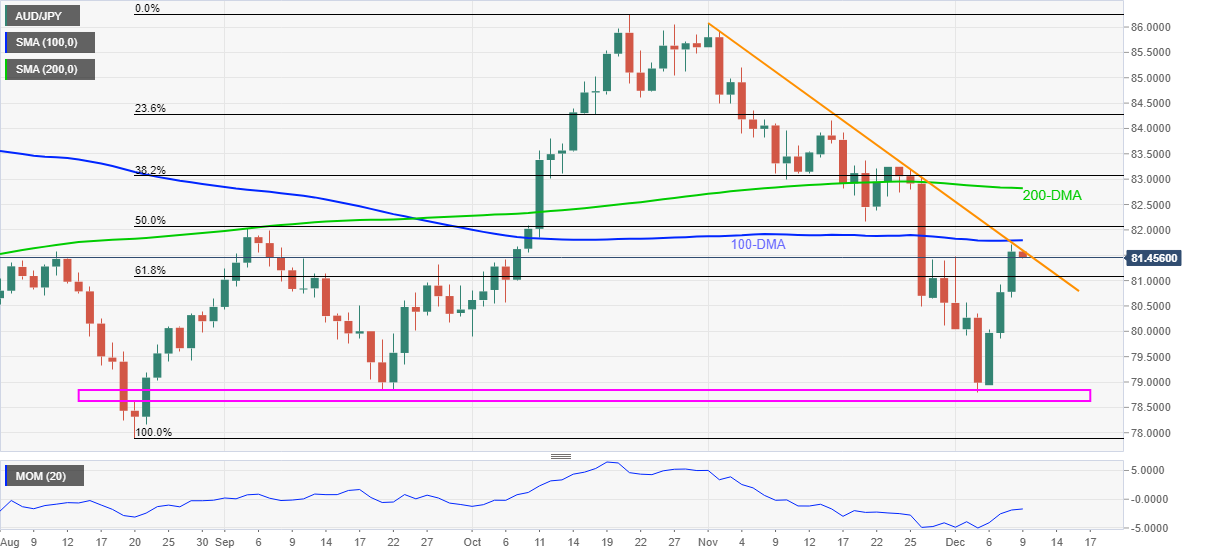
Trend: Further upside expected
''US and Israeli defence chiefs are expected on Thursday to discuss possible military exercises that would prepare for a worst-case scenario to destroy Iran’s nuclear facilities should diplomacy fail and if their nations’ leaders request it, a senior US official told Reuters.''
This is the strapline that is doing the rounds today which is likely to play into the oil markets in the forthcoming sessions.
The Iranians seem determined to become a nuclear power against the wishes of the US. ''However, if Biden fails to dissuade them, Israel may decide to take the matter into their own hands,'' analysts at Rabobank warned.
''Iran denies seeking nuclear weapons, saying it wants to master nuclear technology for peaceful purposes,'' Reuters reported. “We’re in this pickle because Iran’s nuclear program is advancing to a point beyond which it has any conventional rationale,” a US official said.
- AUD/USD challenges early Asian pullback from two-week top after strong China inflation data.
- China CPI rises the most since August 2020, PPI crosses market consensus in November.
- Sentiment sours amid fresh fears concerning Omicron, Fed rate hike.
- Yields stay firmer, S&P 500 Futures snap three-day rebound.
AUD/USD picks up bids to 0.7167, bouncing off intraday low, while consolidating the daily losses to 0.13% during early Thursday.
The Aussie pair’s latest rebound could be linked to the strong prints of the Consumer Price Index (CPI) and Producer Price Index (PPI) from Australia’s largest customer, China. However, the buyers remain cautious as the US Treasury yields stay firmer amid a risk-off mood.
China’s headline CPI jumped the most since August 2020, by 2.3% YoY and 0.4% MoM in November. The factory-gate inflation data also crossed 12.6% forecasts to arrive at 12.9% YoY in November.
Read: Chinese CPI rises at fastest pace since August 2020
Contrary to the China data, fresh fears of the South African coronavirus variant, dubbed at Omicron, join the chatters over the sooner rate hike by the US Federal Reserve (Fed) to weigh on the market sentiment, as well as the AUD/USD prices. The geopolitical tension surrounding the US, China, Iran and Russia are extra catalysts that roil the mood and underpin the US Treasury yields.
The re-introduction of the virus-led activity restrictions in Germany, France and the UK renews COVID-19 fears, reversing the previous optimism after major vaccine producers cited booster shots as effective to tame Omicron.
Further, the geopolitical tension among the world’s top two economies escalated as US Assistant Secretary of Defense for Indo-Pacific Security Affairs Ely Ratner said, “Bolstering Taiwan's self-defenses is an ‘urgent task’ and an essential feature of deterring China”. Also favoring the risk-off mood are the news suggesting the diplomatic tussles of the Washington-Tehran and the US-Russia.
It should be noted that the steady increase in the US inflation expectations and hawkish survey concerning the Fed rate hike by Reuters also propel the US Treasury yields and weigh on the AUD/USD prices.
Against this backdrop, the US 10-year Treasury yields rise 2.4 basis points (bps) to 1.53%, up for the fourth consecutive day, whereas S&P 500 Futures print mild losses to challenge the three-day uptrend.
Having witnessed the initial reaction of China inflation data, AUD/USD traders will pay attention to the risk catalysts, which in turn keeps sellers hopeful ahead of Friday’s US CPI release.
Technical analysis
Despite the latest pullback, AUD/USD prices remain above the previous key resistance confluence around 0.7100, comprising 50-SMA and descending trend line from late October. The same joins bullish MACD signals to keep the pair buyers hopeful of challenging the 0.7200 threshold.
Both the Consumer Price Index and the Producer Price Indexis that are released by the National Bureau of Statistics of China have been released as follows:
- November CPI 2.3% YoY (Reuters poll +2.5% ).
- November CPI+0.4% MoM (Reuters poll +0.3%).
- November PPI +12.9 pct from a year ago (Reuters poll +12.4 pct).
- November PPI 0.0 pct from the previous month.
The Aussie dollar, which can at times react to Chinese data, (China is Australia's largest export customer), has perked up a little on the data but has only moved a few pips higher.
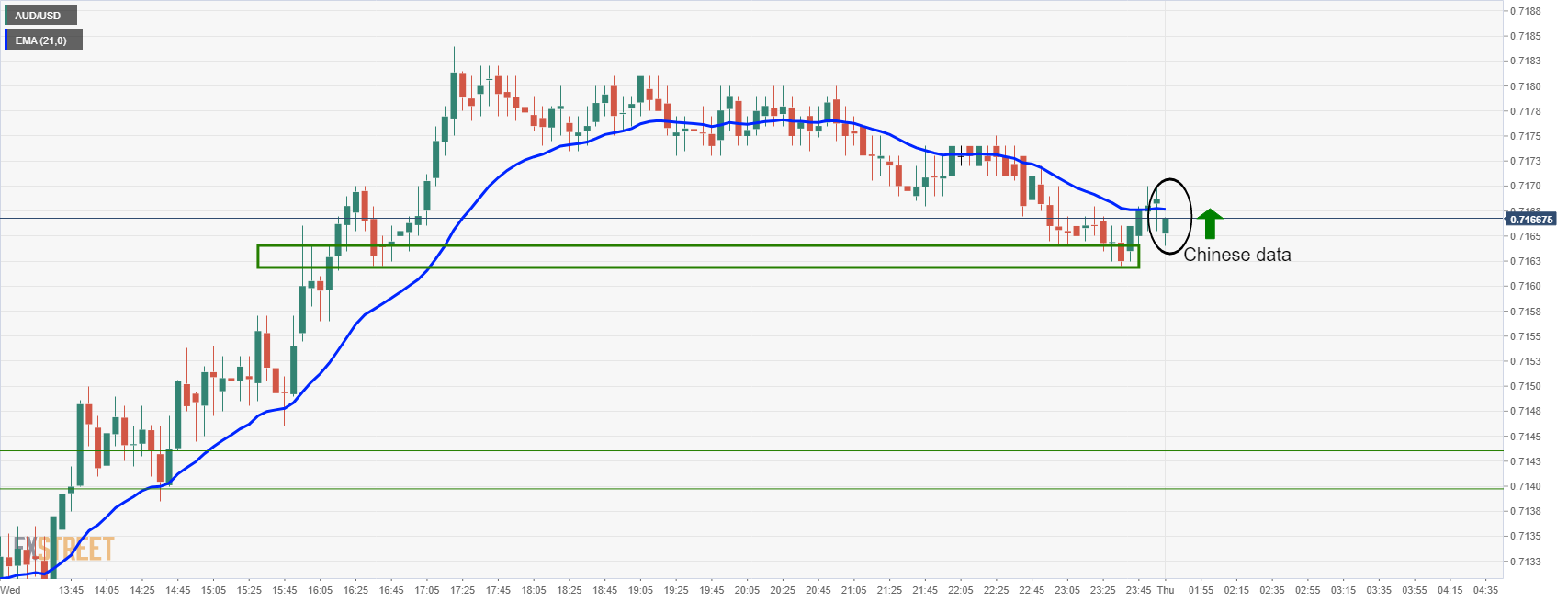
For a more in-depth technical analysis on AUD/USD, see here: AUD/USD Price Analysis: Bullish momentum in play, bulls to buy the dip
About the Consumer Price Index
The Consumer Price Index is released by the National Bureau of Statistics of China and was the most key of the two data releases today. It is a measure of retail price variations within a representative basket of goods and services. The result is a comprehensive summary of the results extracted from the urban consumer price index and rural consumer price index.
The purchasing power of the CNY is dragged down by inflation. The CPI is a key indicator to measure inflation and changes in purchasing trends. A substantial consumer price index increase would indicate that inflation has become a destabilizing factor in the economy, potentially prompting The People’s Bank of China to tighten monetary policy and fiscal policy risk. Generally speaking, a high reading is seen as positive (or bullish) for the CNY, while a low reading is seen as negative (or Bearish) for the CNY.
| Time | Country | Event | Period | Previous value | Forecast |
|---|---|---|---|---|---|
| 00:30 (GMT) | Australia | RBA Bulletin | |||
| 01:30 (GMT) | China | PPI y/y | November | 13.5% | 12.4% |
| 01:30 (GMT) | China | CPI y/y | November | 1.5% | 2.5% |
| 06:00 (GMT) | Japan | Prelim Machine Tool Orders, y/y | November | 81.5% | |
| 07:00 (GMT) | Germany | Current Account | October | 19.6 | |
| 07:00 (GMT) | Germany | Trade Balance (non s.a.), bln | October | 16.2 | |
| 08:00 (GMT) | Switzerland | SECO Economic Forecasts | |||
| 13:30 (GMT) | U.S. | Continuing Jobless Claims | November | 1956 | 1900 |
| 13:30 (GMT) | U.S. | Initial Jobless Claims | December | 222 | 215 |
| 15:00 (GMT) | U.S. | Wholesale Inventories | October | 1.4% | 2.2% |
| 21:30 (GMT) | New Zealand | Business NZ PMI | November | 54.3 |
- The 61.8% golden ratio and the old resistance could be on the cards. This comes in just below 0.7150.
- Below there, the daily support structure will instead be in focus near 0.7110.
Ahead of the last key events for the pair this week, including Chinese inflation data today and US Consumer Price Index on Friday, AUD/USD is correcting the recent bullish rally and buyers are n the prowl for an optimum entry point.
The following illustrates the daily and hourly perspective which leans with a bullish bias for the sessions and days ahead.
AUD/USD daily chart
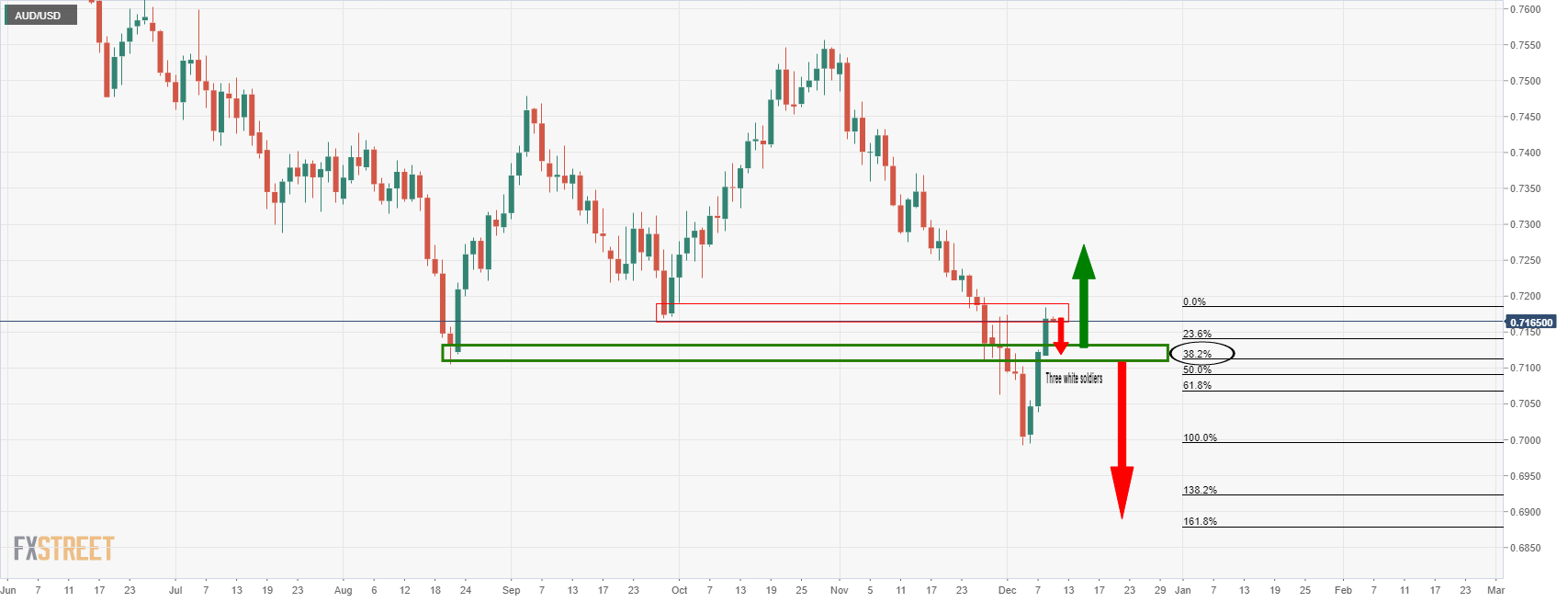
The price has rallied to resistance and would be expected to correct at this juncture. The rally has consisted of three bullish daily candles (''Three White Soldiers'') that suggest a strong change in market sentiment.
With that being said, a 38.2% Fibonacci retracement at 0.7111 is not out of the question, but the hourly conditions suggest a shallower correction to prior resistance could be on the cards. Bulls will start to look to engage on signs of stabilisation and demand coming in for a continuation opportunity.
AUD/USD H1 chart
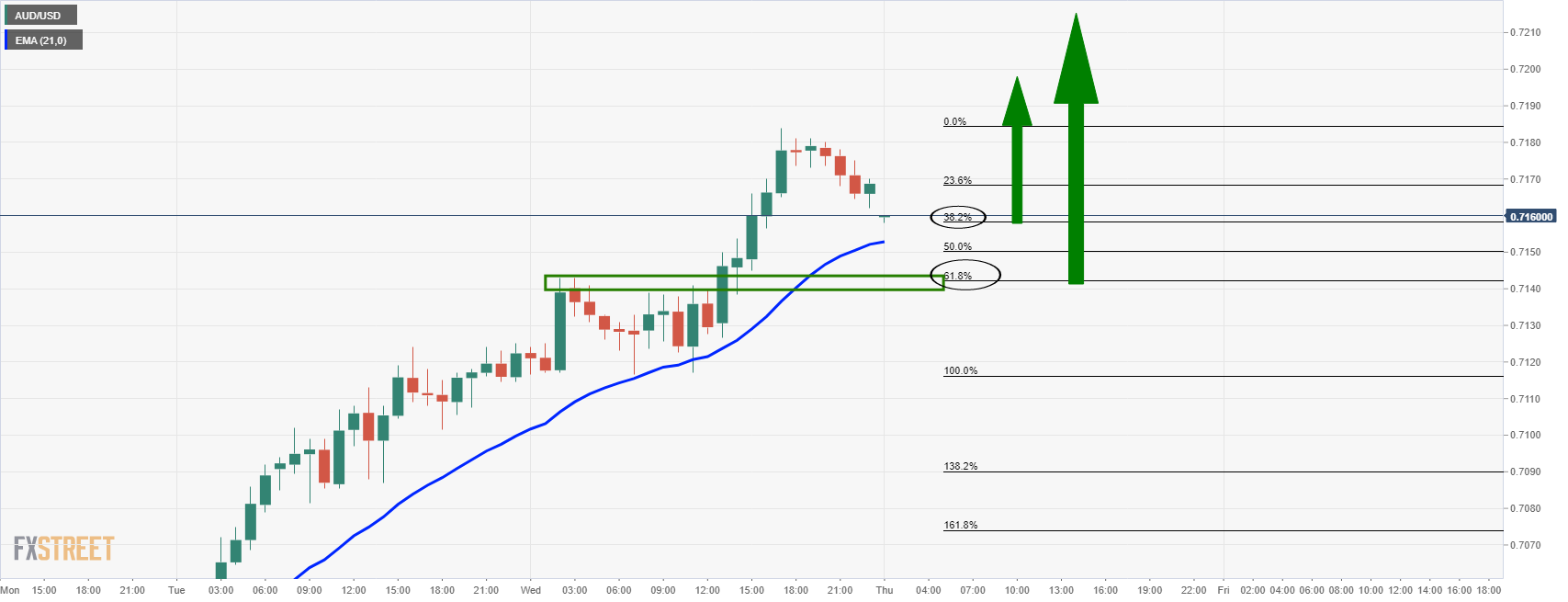
The price is correcting to a 38.2% Fibo near 0.7160. The market could easily flip higher from here, although a deeper test to the 61.8% golden ratio and the old resistance could be on the cards. This comes in just below 0.7150 and will have a confluence with the 21-EMA.
Bulls will be looking for bullish conditions and structure from where to engage with the potential fresh bullish impulse. If there are no bullish tendencies with the price extending lower, then the daily support structure will instead be in focus near 0.7110.
US inflation expectations, as measured by the 10-year breakeven inflation rate per the St. Louis Federal Reserve (FRED) data, rise to the highest level in December during the four-day run-up by the end of Wednesday’s North American session, per the data source Reuters.
In doing so, the inflation gauge bounced off the nine-week low to print 2.52% at the latest.
The steady recovery in the inflation expectations underpins the US Treasury yields ahead of the Consumer Price Index (CPI) data and weighs on the market sentiment.
Read: USD/JPY approaches 114.00 as coronavirus propels yields
That said, the US 10-year Treasury yields rise 1.4 basis points (bps) to 1.52%, up for the fourth consecutive day, whereas S&P 500 Futures print mild losses at the latest.
Reuters' latest poll on the Fed rate hike confirms the bullish bias while expecting sooner action.
Read: Fed to lift rates in Q3 2022, but risk it comes sooner – Reuters Poll
It's worth noting that the global rating giant Fitch recently said, "Inflation is prompting global monetary policy normalisation."
"Short-term oil and gas prices have risen, while long-term oil prices have remained unchanged," adds Fitch.
- USD/JPY stays on the front foot, up for fourth consecutive day.
- Covid vaccine-linked optimism fades on fresh virus-led activity restrictions in Europe.
- Geopolitical tensions, fears of early Fed rate hike add strength to the bullish bias.
- Omicron, China and inflation are the key catalysts to watch for near-term directions.
USD/JPY picks up bids to refresh intraday top around 113.80 as Tokyo opens for Thursday.
The yen pair prints a four-day uptrend as yields stays firmer amid fresh coronavirus fears from the West, challenging the previous optimism that the South African covid variant, dubbed at Omicron, is milder than the previous strains. Also challenging the market sentiment and underpinning the US bond coupons are the chatters over the US-China and Fed rate hikes.
The re-introduction of the virus-led activity restrictions in Germany, France and the UK renews COVID-19 fears in the market even if major vaccine producers cite booster shots as effective to tame Omicron.
On the other hand, Sino-American tussles are likely escalating as US Assistant Secretary of Defense for Indo-Pacific Security Affairs Ely Ratner said, “Bolstering Taiwan's self-defenses is an ‘urgent task’ and an essential feature of deterring China”. Also favoring the risk-off mood are the news suggesting the diplomatic tussles of the Washington-Tehran and the US-Russia.
At home, Japan’s Prime Minister Fumio Kishida battles for the record covid stimulus in the Parliament as Tokyo registered the fourth Omicron case.
In addition to the virus-linked headlines and geopolitical fears, fresh chatters over the Fed’s rate hike, triggered by Reuters’ poll, also weigh on the US bonds and favor the Treasury yields, as well as the USD/JPY prices.
That said, the US 10-year Treasury yields rise 1.4 basis points (bps) to 1.52%, up for the fourth consecutive day, whereas S&P 500 Futures print mild losses at the latest.
Given the recent shift in the market sentiment, the USD/JPY is likely to remain stronger as markets brace for Friday’s US Consumer Price Index (CPI) data.
Technical analysis
A daily close beyond 50-DMA, around 113.55 by the press time, pushes USD/JPY prices toward October’s top near 114.80. However, the 114.00 threshold may offer an intermediate halt during the anticipated rise.
- USD/CAD bulls looking for a significant correction in the days ahead.
- Hourly inverse H&S is compelling in USD/CAD, eyes on daily 61.8% Fibo.
- US CPI is the next key event following BoC and ahead of Fed next week.
USD/CAD popped and stopped overnight as the Bank of Canada left interest rates unchanged although signalled concerns over elevated inflation that could persist longer than previously thought. USD/CAD ended around 1.2650 after reaching a high of 1.2666 on the day.
The stag is being set by the BoC for a shift in policy early next year. Inflation “is elevated and the impact of global supply constraints is feeding through to a broader range of goods prices,” governor Tiff Macklem wrote in the central bank's updated statement. “The effects of these constraints on prices will likely take some time to work their way through, given existing supply backlogs.”
Nevertheless, the Lonnie fell as traders that had positioned for a more hawkish outcome pulled their positions expecting that the BoC will not move until at least the second quarter of 2022. “We will provide the appropriate degree of monetary policy stimulus to support the recovery and achieve the inflation target,” the central bank reiterated in its new statement.
Key themes in play
Meanwhile, risk appetite remained resilient amid Omicron vaccine optimism which helped Wall Street, Treasury yields and commodities extended their recent gains. The greenback subsequently fell as traders looked ahead into the US Consumer Price Index on Friday and a series of BoE, ECB, and Federal Reserve rate decisions the following week.
USD/CAD daily chart
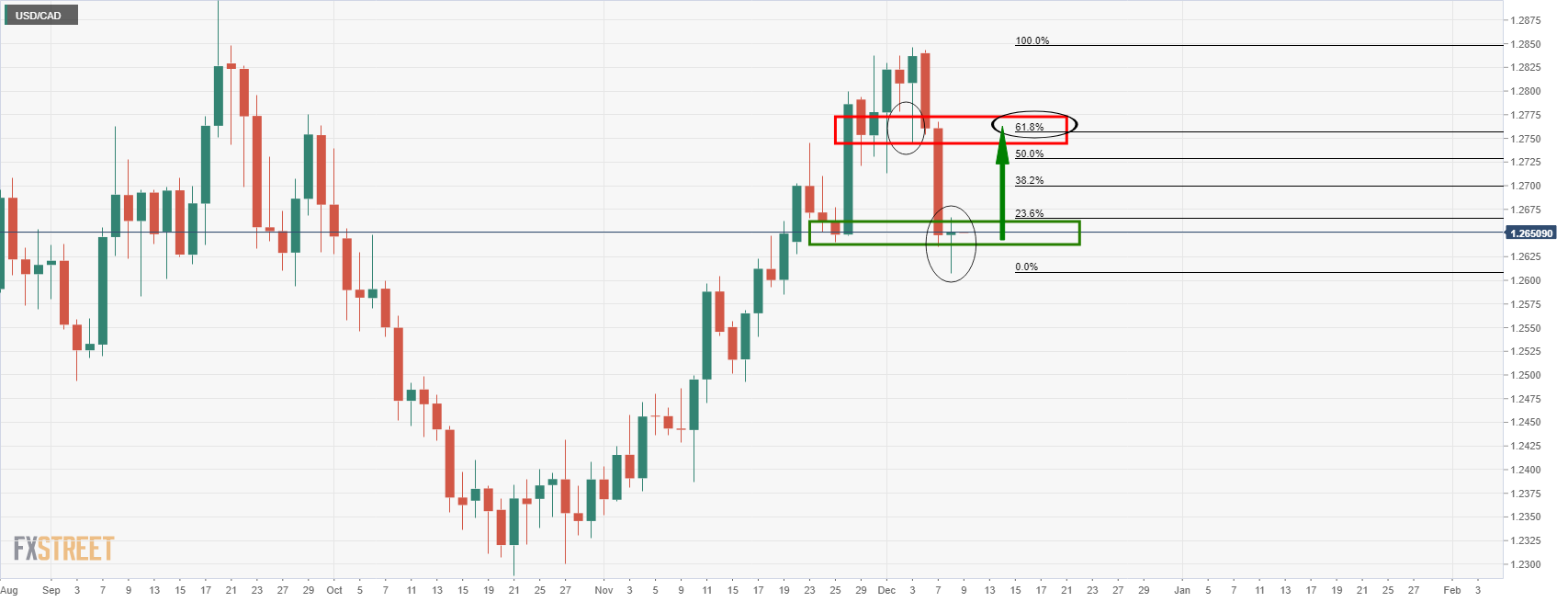
The price is meeting support at this juncture and a reversal in the US dollar is all that would b needed to see the price correct and potentially move in towards the 61.8% Fibonacci retracement level.
USD/CAD H1 chart
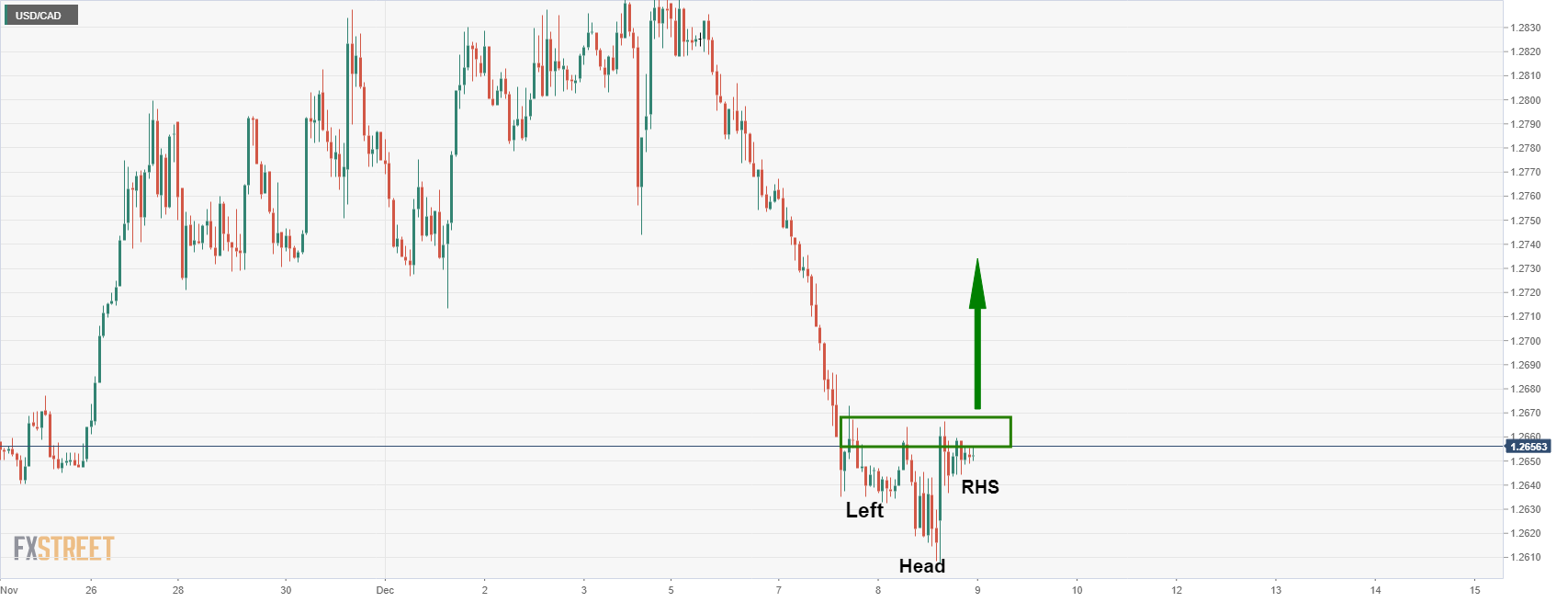
The inverse head and shoulders pattern on the hourly chart is a potentially bullish prospect for the sessions ahead.
| Pare | Closed | Change, % |
|---|---|---|
| AUDUSD | 0.71707 | 0.74 |
| EURJPY | 128.981 | 0.96 |
| EURUSD | 1.13443 | 0.73 |
| GBPJPY | 150.003 | -0.16 |
| GBPUSD | 1.31937 | -0.31 |
| NZDUSD | 0.68071 | 0.28 |
| USDCAD | 1.26505 | 0.12 |
| USDCHF | 0.92051 | -0.45 |
| USDJPY | 113.694 | 0.21 |
“The US Federal Reserve will raise rates in the third quarter of next year, earlier than expected a month ago, according to economists in a Reuters poll who mostly said the risk was that a hike comes even sooner,” said Reuters during the early Asian session on Thursday.
The survey of economists cites persistently higher inflation to mark the shift in expectations for lift-off to Q3 from Q4 next year. Even so, “Rising COVID-19 cases around the world and the emergence of the Omicron coronavirus variant, along with renewed restrictions in some countries underscore that the pandemic is not yet over,” said the Reuters poll.
Key quotes
The Dec. 3-8 poll predicted the Fed would raise rates by 25 basis points to 0.25-0.50% in Q3 2022, followed by three more hikes - in Q4 next year and Q1 and Q2 of 2023. The fed funds rate was expected to reach 1.25-1.50% by end-2023.
The timing shift to the third quarter of next year was also underpinned by Fed Chair Jerome Powell saying the central bank would discuss in December whether to end its $120 billion in monthly bond purchases a few months sooner than anticipated. Previous expectations were for it to end in mid-2022.
More than 60% of respondents to an additional question, 22 of 35, said the program would end by March. More than 80% of respondents, 30 of 36, said the risk to the timing of the first hike in this cycle was that it comes earlier.
Sixteen said a hike could come in the second quarter of 2022 and five said it could come as early as next quarter. Just a month ago only five economists said the Fed should hike in Q2 next year and four said Q1.
Economists were split on the biggest downside risk to the U.S. economy next year with 18 of 36 saying new coronavirus variants and 15 choosing high inflation.
Market implications
The poll results hint at the firmer US Treasury yields and the US dollar ahead of Friday’s US Consumer Price Index (CPI). The same could also be cited as the catalysts to challenge AUD/USD bulls of late.
Read: AUD/USD hovers below 0.7200 as RBA’s Lowe cheers digital payments, China inflation eyed
- WTI remains on the front foot around weekly top, after three-day uptrend.
- Firmer RSI, sustained trading beyond weekly support keeps buyers hopeful.
- Clear break of $73.00 is needed to convince bulls, $69.00 holds the key to seller’s return.
WTI crude oil bulls attack key upside hurdle around $72.50 during Thursday’s Asian session.
The oil benchmark rose for the consecutive three days last but failures to overcome the $72.80 resistance portrayed a bullish cup-and-handle chart pattern on the four-hour play.
Given the strong RSI line, not overbought, coupled with the quote’s successful recovery following the one-week-old support line, WTI crude oil prices are likely to stay stronger.
However, the 100-SMA level of $73.00 adds to the upside filters, other than the formation’s neckline near $72.80.
In a case where the black gold rises past $73.00, the bullish impulse will aim for the $80.00 threshold with the 200-SMA level near $77.00 likely offering an intermediate halt during the anticipated rally.
On the contrary, the aforementioned weekly support line, around $72.00 by the press time, restricts the commodity’s pullback moves, a break of which will direct the quote towards the $69.00 support.
Should the oil bears dominate past $69.00, the recently flashed multi-month low near $62.35 will be in focus.
WTI: Four-hour chart
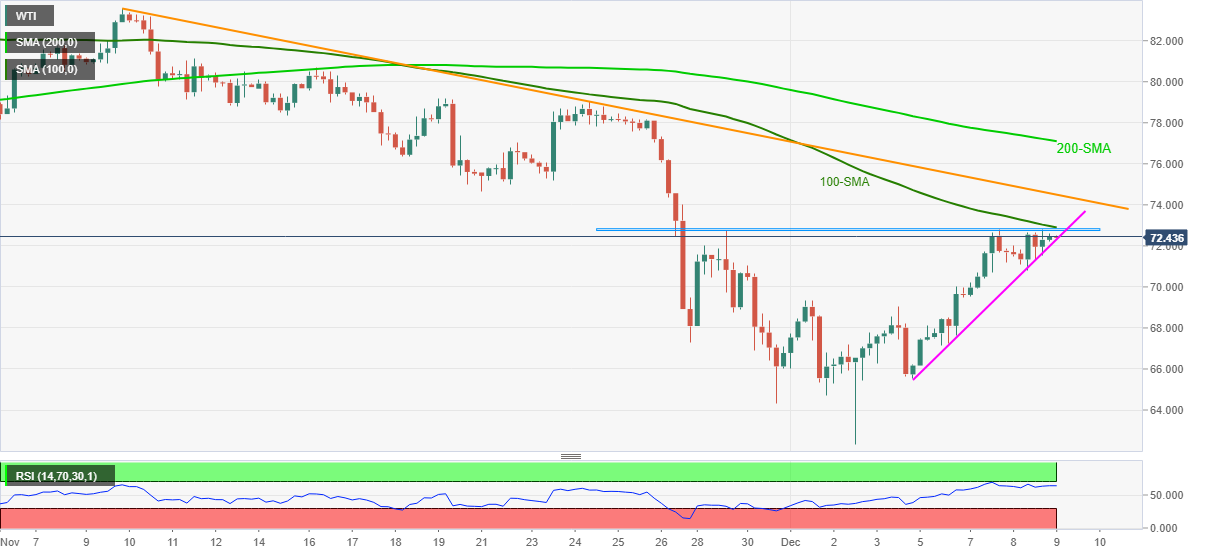
Trend: Further upside expected







© 2000-2026. All rights reserved.
This site is managed by Teletrade D.J. LLC 2351 LLC 2022 (Euro House, Richmond Hill Road, Kingstown, VC0100, St. Vincent and the Grenadines).
The information on this website is for informational purposes only and does not constitute any investment advice.
The company does not serve or provide services to customers who are residents of the US, Canada, Iran, The Democratic People's Republic of Korea, Yemen and FATF blacklisted countries.
Making transactions on financial markets with marginal financial instruments opens up wide possibilities and allows investors who are willing to take risks to earn high profits, carrying a potentially high risk of losses at the same time. Therefore you should responsibly approach the issue of choosing the appropriate investment strategy, taking the available resources into account, before starting trading.
Use of the information: full or partial use of materials from this website must always be referenced to TeleTrade as the source of information. Use of the materials on the Internet must be accompanied by a hyperlink to teletrade.org. Automatic import of materials and information from this website is prohibited.
Please contact our PR department if you have any questions or need assistance at pr@teletrade.global.


 Bank
Bank transfers


